
University Leadership & Management Maynooth
DJ
Published · 11 slides · 0 views

1 / 1
Description
University Leadership Management Maynooth University on-line learning programme October 2015 Ashley ODonoghue Programme Outline 1. The university context: An introduction 2. University leadership and management 3. University cultures and
Related Topics
Share
Embed code
Download this presentation From Below
"University Leadership & Management Maynooth" is the property of its rightful owner. Permission is granted to download and print the materials on this website for personal, non-commercial use only, and to display it on your personal computer provided you do not modify the materials and that you retain all copyright notices contained in the materials. By downloading content from our website, you accept the terms of this agreement.
Presentation Transcript
01
University Leadership & Management Maynooth University
on-line learning programme
October 2015
Ashley O’Donoghue<br>
on-line learning programme
October 2015
Ashley O’Donoghue<br>
02
Programme Outline 1. The university context: An introduction
2. University leadership and management
3. University cultures and organisational management
4. Strategic planning
5. Managing people
6. Managing resources<br>
2. University leadership and management
3. University cultures and organisational management
4. Strategic planning
5. Managing people
6. Managing resources<br>
03
1. The university context: An introduction The University Context: An introduction contains 4 hours of optional self-development activity content.
Publication date: July 2012. Core activities: 1.5 hours. Additional activities: 4 hours
This introductory course sets out the aims and structure of the programme. The course will help participants to:
Gain a better understanding of the broader higher education context
Begin to plan their learning and development as an effective leader or manager within their own institution
Identify the areas of the programme that will best address their particular needs.
Syllabus
Module 1: Welcome to the University Leadership and Management programme: introduction, structure and guiding principles
Module 2: The higher education context
Module 3: Personal development – how the programme can address your particular needs
Author: Professor Shelda Debowski. Deputy Vice-Chancellor and Head of Campus, University of Notre Dame Australia
Reviewer: Dr Richard Bolden. Senior Lecturer and Head, Centre for Leadership Studies (CLS), University of Exeter Business School<br>
Publication date: July 2012. Core activities: 1.5 hours. Additional activities: 4 hours
This introductory course sets out the aims and structure of the programme. The course will help participants to:
Gain a better understanding of the broader higher education context
Begin to plan their learning and development as an effective leader or manager within their own institution
Identify the areas of the programme that will best address their particular needs.
Syllabus
Module 1: Welcome to the University Leadership and Management programme: introduction, structure and guiding principles
Module 2: The higher education context
Module 3: Personal development – how the programme can address your particular needs
Author: Professor Shelda Debowski. Deputy Vice-Chancellor and Head of Campus, University of Notre Dame Australia
Reviewer: Dr Richard Bolden. Senior Lecturer and Head, Centre for Leadership Studies (CLS), University of Exeter Business School<br>
04
2. University Leadership & Management The University Leadership and Management .6.5 hours of optional self-development activity content.
Publication date: July 2012. Core activities: 5 hours. Additional activities: 6.5 hours
This course explores management and leadership theories in the context of higher education. The course will help participants to:
Understand how management and leadership processes in higher education institutions differ from those in other organisations
Apply principles and techniques to increase their effectiveness as leaders and/or managers
Understand how to gain and maintain influence with colleagues and within their institution
Understand how and why true leadership promotes collegiality, trust and respect.
SYLLABUS
Module 1: Introduction to academic management and leadership: why universities are different, theoretical approaches
Module 2: Becoming an effective academic manager: benefits, disadvantages, key tasks
Module 3: Becoming an effective academic leader: how leaders are selected, leadership styles, a personal philosophy of leadership
Module 4: Maintaining influence: social power, social and emotional intelligence, communication, key lessons for leaders and managers.
Author: Professor Robert Birnbaum. Emeritus Professor of Higher Education at the University of Maryland, College Park
Reviewer: Dr Rajani Naidoo. Senior Lecturer and Director, DBA in Higher Education Management, University of Bath<br>
Publication date: July 2012. Core activities: 5 hours. Additional activities: 6.5 hours
This course explores management and leadership theories in the context of higher education. The course will help participants to:
Understand how management and leadership processes in higher education institutions differ from those in other organisations
Apply principles and techniques to increase their effectiveness as leaders and/or managers
Understand how to gain and maintain influence with colleagues and within their institution
Understand how and why true leadership promotes collegiality, trust and respect.
SYLLABUS
Module 1: Introduction to academic management and leadership: why universities are different, theoretical approaches
Module 2: Becoming an effective academic manager: benefits, disadvantages, key tasks
Module 3: Becoming an effective academic leader: how leaders are selected, leadership styles, a personal philosophy of leadership
Module 4: Maintaining influence: social power, social and emotional intelligence, communication, key lessons for leaders and managers.
Author: Professor Robert Birnbaum. Emeritus Professor of Higher Education at the University of Maryland, College Park
Reviewer: Dr Rajani Naidoo. Senior Lecturer and Director, DBA in Higher Education Management, University of Bath<br>
05
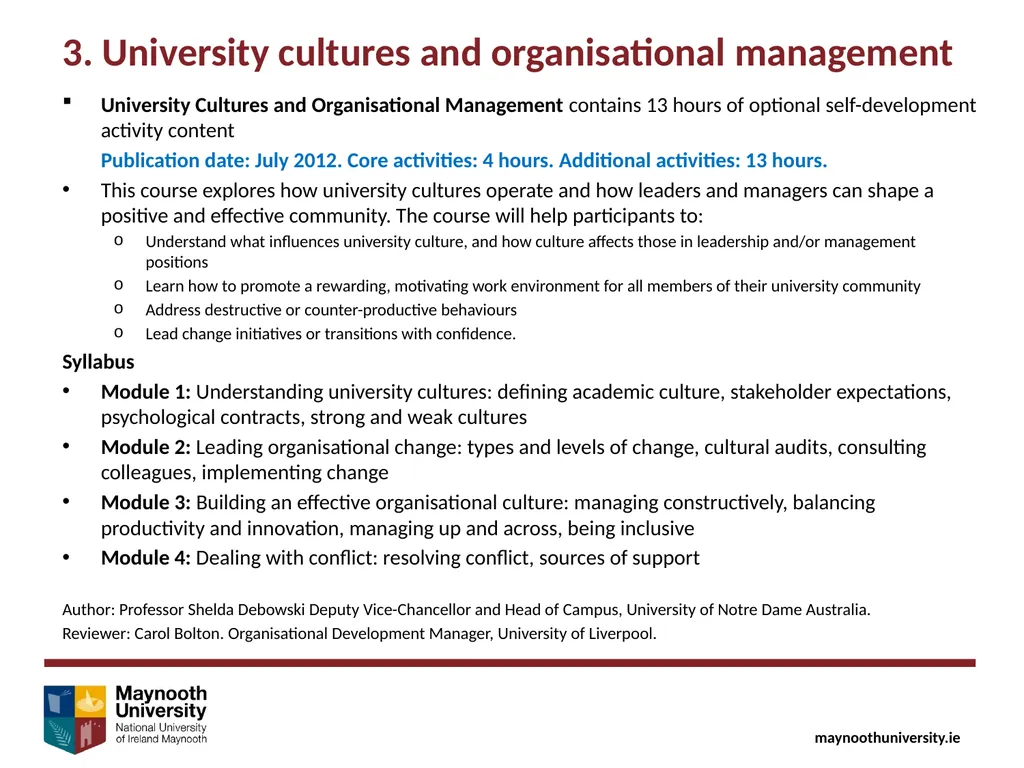
3. University cultures and organisational management University Cultures and Organisational Management contains 13 hours of optional self-development activity content
Publication date: July 2012. Core activities: 4 hours. Additional activities: 13 hours.
This course explores how university cultures operate and how leaders and managers can shape a positive and effective community. The course will help participants to:
Understand what influences university culture, and how culture affects those in leadership and/or management positions
Learn how to promote a rewarding, motivating work environment for all members of their university community
Address destructive or counter-productive behaviours
Lead change initiatives or transitions with confidence.
Syllabus
Module 1: Understanding university cultures: defining academic culture, stakeholder expectations, psychological contracts, strong and weak cultures
Module 2: Leading organisational change: types and levels of change, cultural audits, consulting colleagues, implementing change
Module 3: Building an effective organisational culture: managing constructively, balancing productivity and innovation, managing up and across, being inclusive
Module 4: Dealing with conflict: resolving conflict, sources of support
Author: Professor Shelda Debowski Deputy Vice-Chancellor and Head of Campus, University of Notre Dame Australia.
Reviewer: Carol Bolton. Organisational Development Manager, University of Liverpool.<br>
Publication date: July 2012. Core activities: 4 hours. Additional activities: 13 hours.
This course explores how university cultures operate and how leaders and managers can shape a positive and effective community. The course will help participants to:
Understand what influences university culture, and how culture affects those in leadership and/or management positions
Learn how to promote a rewarding, motivating work environment for all members of their university community
Address destructive or counter-productive behaviours
Lead change initiatives or transitions with confidence.
Syllabus
Module 1: Understanding university cultures: defining academic culture, stakeholder expectations, psychological contracts, strong and weak cultures
Module 2: Leading organisational change: types and levels of change, cultural audits, consulting colleagues, implementing change
Module 3: Building an effective organisational culture: managing constructively, balancing productivity and innovation, managing up and across, being inclusive
Module 4: Dealing with conflict: resolving conflict, sources of support
Author: Professor Shelda Debowski Deputy Vice-Chancellor and Head of Campus, University of Notre Dame Australia.
Reviewer: Carol Bolton. Organisational Development Manager, University of Liverpool.<br>
06
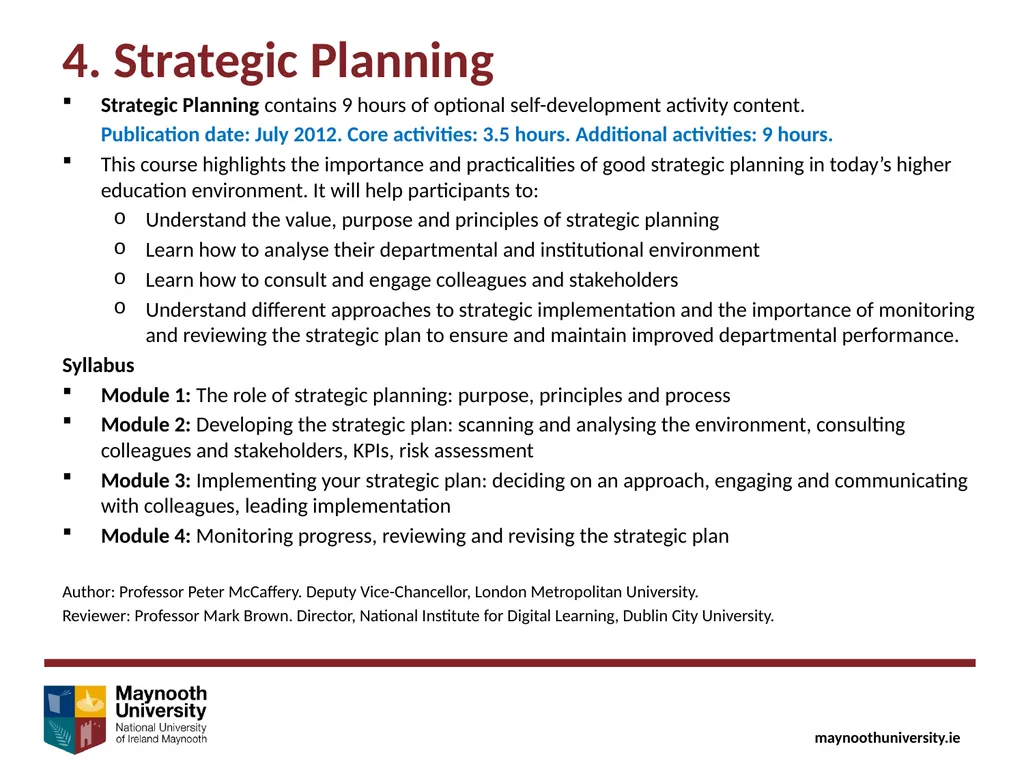
4. Strategic Planning Strategic Planning contains 9 hours of optional self-development activity content.
Publication date: July 2012. Core activities: 3.5 hours. Additional activities: 9 hours.
This course highlights the importance and practicalities of good strategic planning in today’s higher education environment. It will help participants to:
Understand the value, purpose and principles of strategic planning
Learn how to analyse their departmental and institutional environment
Learn how to consult and engage colleagues and stakeholders
Understand different approaches to strategic implementation and the importance of monitoring and reviewing the strategic plan to ensure and maintain improved departmental performance.
Syllabus
Module 1: The role of strategic planning: purpose, principles and process
Module 2: Developing the strategic plan: scanning and analysing the environment, consulting colleagues and stakeholders, KPIs, risk assessment
Module 3: Implementing your strategic plan: deciding on an approach, engaging and communicating with colleagues, leading implementation
Module 4: Monitoring progress, reviewing and revising the strategic plan
Author: Professor Peter McCaffery. Deputy Vice-Chancellor, London Metropolitan University.
Reviewer: Professor Mark Brown. Director, National Institute for Digital Learning, Dublin City University.<br>
Publication date: July 2012. Core activities: 3.5 hours. Additional activities: 9 hours.
This course highlights the importance and practicalities of good strategic planning in today’s higher education environment. It will help participants to:
Understand the value, purpose and principles of strategic planning
Learn how to analyse their departmental and institutional environment
Learn how to consult and engage colleagues and stakeholders
Understand different approaches to strategic implementation and the importance of monitoring and reviewing the strategic plan to ensure and maintain improved departmental performance.
Syllabus
Module 1: The role of strategic planning: purpose, principles and process
Module 2: Developing the strategic plan: scanning and analysing the environment, consulting colleagues and stakeholders, KPIs, risk assessment
Module 3: Implementing your strategic plan: deciding on an approach, engaging and communicating with colleagues, leading implementation
Module 4: Monitoring progress, reviewing and revising the strategic plan
Author: Professor Peter McCaffery. Deputy Vice-Chancellor, London Metropolitan University.
Reviewer: Professor Mark Brown. Director, National Institute for Digital Learning, Dublin City University.<br>
07
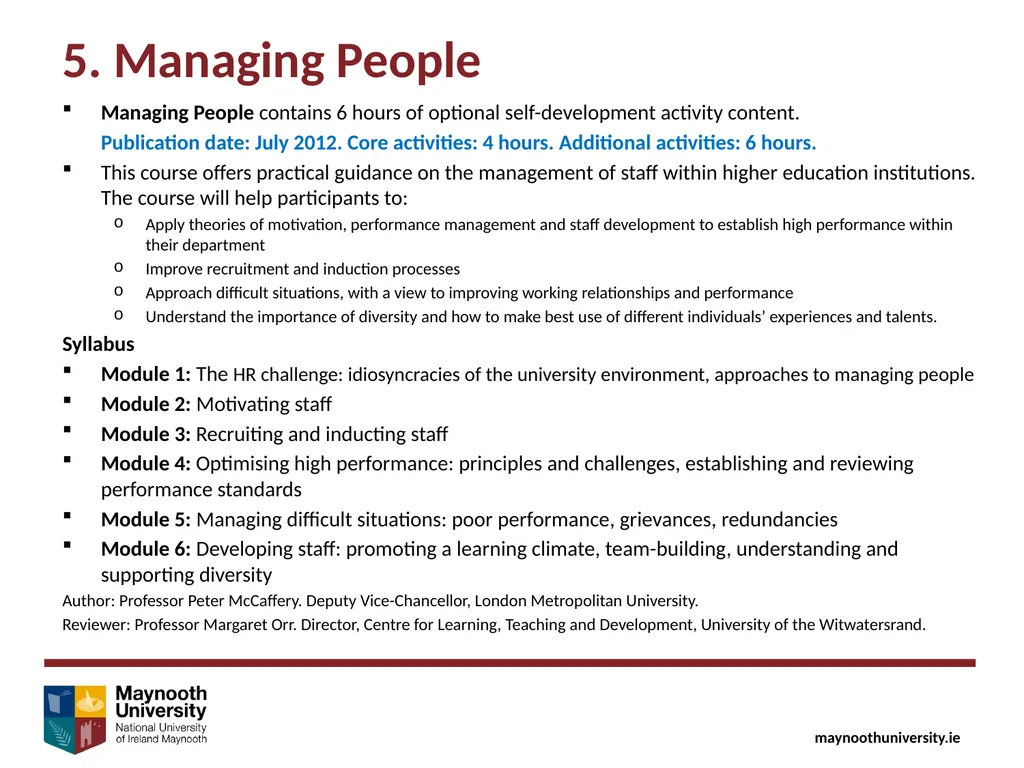
5. Managing People Managing People contains 6 hours of optional self-development activity content.
Publication date: July 2012. Core activities: 4 hours. Additional activities: 6 hours.
This course offers practical guidance on the management of staff within higher education institutions. The course will help participants to:
Apply theories of motivation, performance management and staff development to establish high performance within their department
Improve recruitment and induction processes
Approach difficult situations, with a view to improving working relationships and performance
Understand the importance of diversity and how to make best use of different individuals’ experiences and talents.
Syllabus
Module 1: The HR challenge: idiosyncracies of the university environment, approaches to managing people
Module 2: Motivating staff
Module 3: Recruiting and inducting staff
Module 4: Optimising high performance: principles and challenges, establishing and reviewing performance standards
Module 5: Managing difficult situations: poor performance, grievances, redundancies
Module 6: Developing staff: promoting a learning climate, team-building, understanding and supporting diversity
Author: Professor Peter McCaffery. Deputy Vice-Chancellor, London Metropolitan University.
Reviewer: Professor Margaret Orr. Director, Centre for Learning, Teaching and Development, University of the Witwatersrand.<br>
Publication date: July 2012. Core activities: 4 hours. Additional activities: 6 hours.
This course offers practical guidance on the management of staff within higher education institutions. The course will help participants to:
Apply theories of motivation, performance management and staff development to establish high performance within their department
Improve recruitment and induction processes
Approach difficult situations, with a view to improving working relationships and performance
Understand the importance of diversity and how to make best use of different individuals’ experiences and talents.
Syllabus
Module 1: The HR challenge: idiosyncracies of the university environment, approaches to managing people
Module 2: Motivating staff
Module 3: Recruiting and inducting staff
Module 4: Optimising high performance: principles and challenges, establishing and reviewing performance standards
Module 5: Managing difficult situations: poor performance, grievances, redundancies
Module 6: Developing staff: promoting a learning climate, team-building, understanding and supporting diversity
Author: Professor Peter McCaffery. Deputy Vice-Chancellor, London Metropolitan University.
Reviewer: Professor Margaret Orr. Director, Centre for Learning, Teaching and Development, University of the Witwatersrand.<br>
08
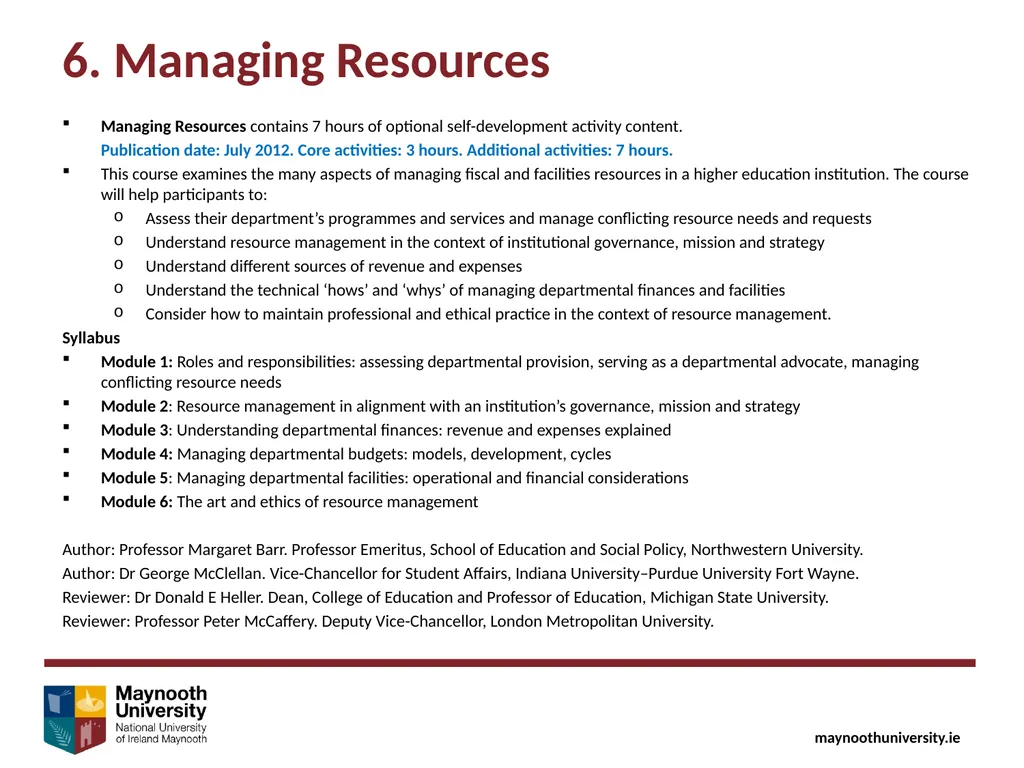
6. Managing Resources Managing Resources contains 7 hours of optional self-development activity content.
Publication date: July 2012. Core activities: 3 hours. Additional activities: 7 hours.
This course examines the many aspects of managing fiscal and facilities resources in a higher education institution. The course will help participants to:
Assess their department’s programmes and services and manage conflicting resource needs and requests
Understand resource management in the context of institutional governance, mission and strategy
Understand different sources of revenue and expenses
Understand the technical ‘hows’ and ‘whys’ of managing departmental finances and facilities
Consider how to maintain professional and ethical practice in the context of resource management.
Syllabus
Module 1: Roles and responsibilities: assessing departmental provision, serving as a departmental advocate, managing conflicting resource needs
Module 2: Resource management in alignment with an institution’s governance, mission and strategy
Module 3: Understanding departmental finances: revenue and expenses explained
Module 4: Managing departmental budgets: models, development, cycles
Module 5: Managing departmental facilities: operational and financial considerations
Module 6: The art and ethics of resource management
Author: Professor Margaret Barr. Professor Emeritus, School of Education and Social Policy, Northwestern University.
Author: Dr George McClellan. Vice-Chancellor for Student Affairs, Indiana University–Purdue University Fort Wayne.
Reviewer: Dr Donald E Heller. Dean, College of Education and Professor of Education, Michigan State University.
Reviewer: Professor Peter McCaffery. Deputy Vice-Chancellor, London Metropolitan University.<br>
Publication date: July 2012. Core activities: 3 hours. Additional activities: 7 hours.
This course examines the many aspects of managing fiscal and facilities resources in a higher education institution. The course will help participants to:
Assess their department’s programmes and services and manage conflicting resource needs and requests
Understand resource management in the context of institutional governance, mission and strategy
Understand different sources of revenue and expenses
Understand the technical ‘hows’ and ‘whys’ of managing departmental finances and facilities
Consider how to maintain professional and ethical practice in the context of resource management.
Syllabus
Module 1: Roles and responsibilities: assessing departmental provision, serving as a departmental advocate, managing conflicting resource needs
Module 2: Resource management in alignment with an institution’s governance, mission and strategy
Module 3: Understanding departmental finances: revenue and expenses explained
Module 4: Managing departmental budgets: models, development, cycles
Module 5: Managing departmental facilities: operational and financial considerations
Module 6: The art and ethics of resource management
Author: Professor Margaret Barr. Professor Emeritus, School of Education and Social Policy, Northwestern University.
Author: Dr George McClellan. Vice-Chancellor for Student Affairs, Indiana University–Purdue University Fort Wayne.
Reviewer: Dr Donald E Heller. Dean, College of Education and Professor of Education, Michigan State University.
Reviewer: Professor Peter McCaffery. Deputy Vice-Chancellor, London Metropolitan University.<br>
09
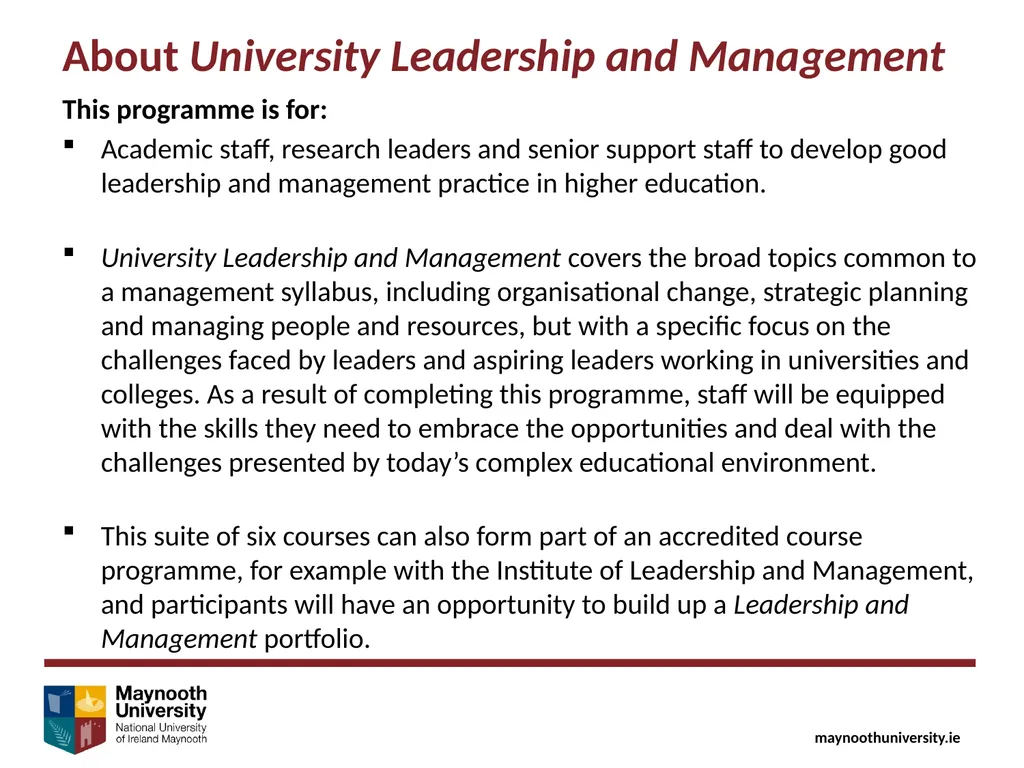
About University Leadership and Management This programme is for:
Academic staff, research leaders and senior support staff to develop good leadership and management practice in higher education.
University Leadership and Management covers the broad topics common to a management syllabus, including organisational change, strategic planning and managing people and resources, but with a specific focus on the challenges faced by leaders and aspiring leaders working in universities and colleges. As a result of completing this programme, staff will be equipped with the skills they need to embrace the opportunities and deal with the challenges presented by today’s complex educational environment.
This suite of six courses can also form part of an accredited course programme, for example with the Institute of Leadership and Management, and participants will have an opportunity to build up a Leadership and Management portfolio.<br>
Academic staff, research leaders and senior support staff to develop good leadership and management practice in higher education.
University Leadership and Management covers the broad topics common to a management syllabus, including organisational change, strategic planning and managing people and resources, but with a specific focus on the challenges faced by leaders and aspiring leaders working in universities and colleges. As a result of completing this programme, staff will be equipped with the skills they need to embrace the opportunities and deal with the challenges presented by today’s complex educational environment.
This suite of six courses can also form part of an accredited course programme, for example with the Institute of Leadership and Management, and participants will have an opportunity to build up a Leadership and Management portfolio.<br>
10
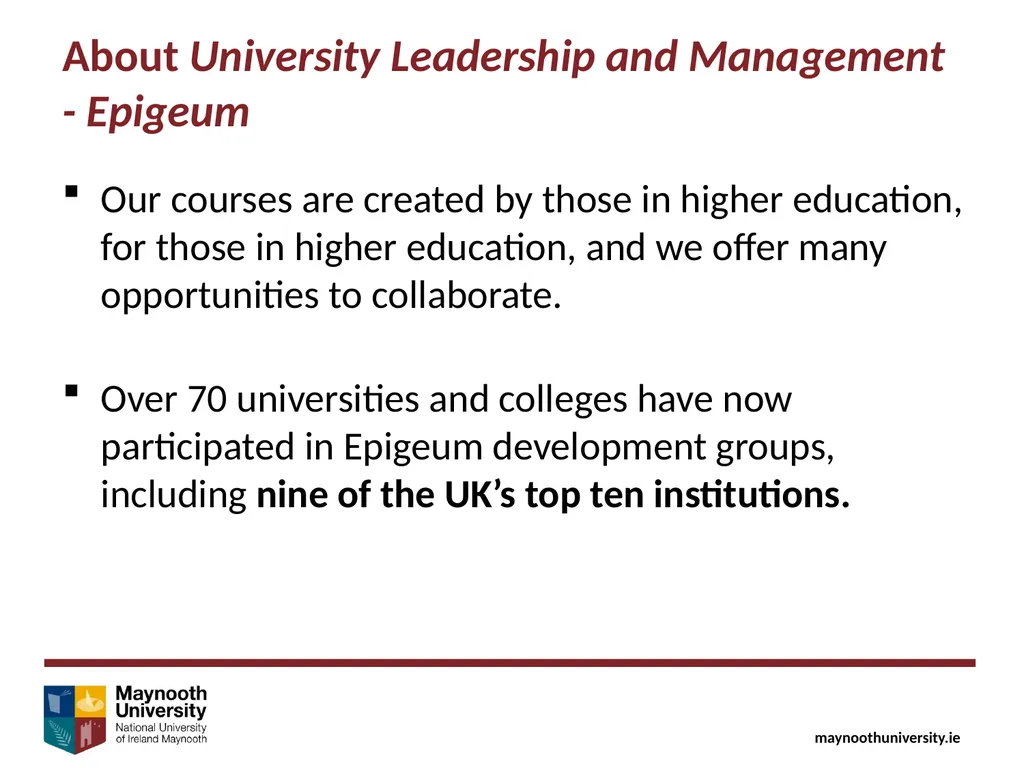
About University Leadership and Management - Epigeum Our courses are created by those in higher education, for those in higher education, and we offer many opportunities to collaborate.
Over 70 universities and colleges have now participated in Epigeum development groups, including nine of the UK’s top ten institutions.<br>
Over 70 universities and colleges have now participated in Epigeum development groups, including nine of the UK’s top ten institutions.<br>
11
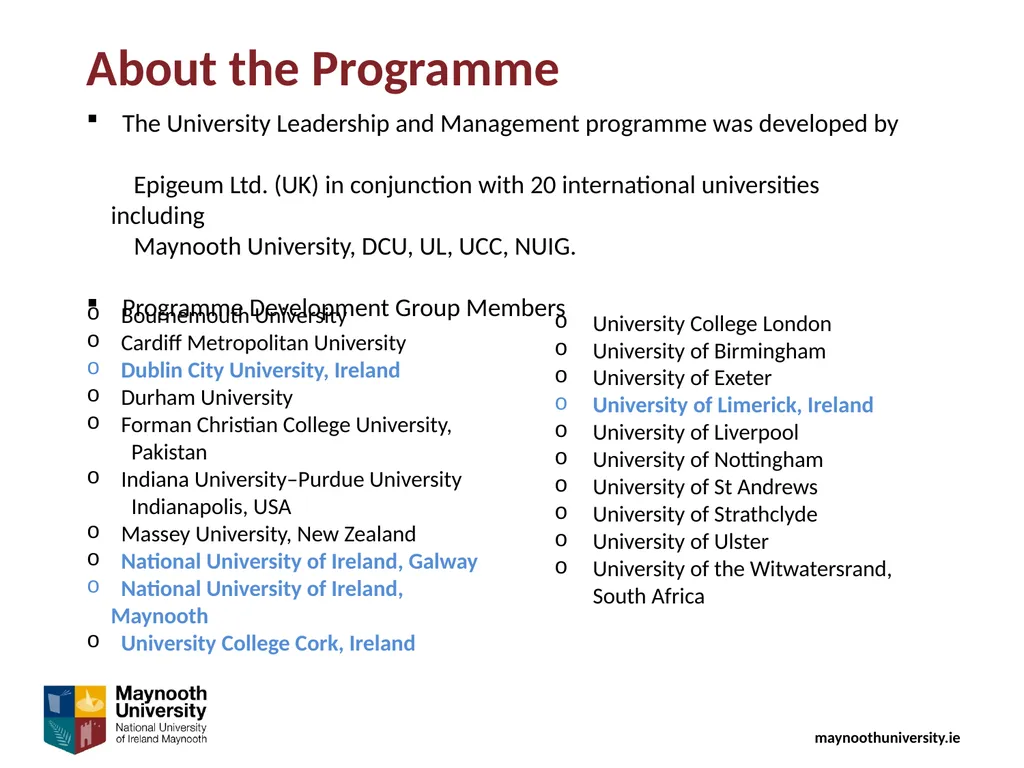
About the Programme The University Leadership and Management programme was developed by
Epigeum Ltd. (UK) in conjunction with 20 international universities including
Maynooth University, DCU, UL, UCC, NUIG.
Programme Development Group Members Bournemouth University
Cardiff Metropolitan University
Dublin City University, Ireland
Durham University
Forman Christian College University, Pakistan
Indiana University–Purdue University Indianapolis, USA
Massey University, New Zealand
National University of Ireland, Galway
National University of Ireland, Maynooth
University College Cork, Ireland University College London
University of Birmingham
University of Exeter
University of Limerick, Ireland
University of Liverpool
University of Nottingham
University of St Andrews
University of Strathclyde
University of Ulster
University of the Witwatersrand, South Africa<br>
Programme Development Group Members Bournemouth University
Cardiff Metropolitan University
Dublin City University, Ireland
Durham University
Forman Christian College University, Pakistan
Indiana University–Purdue University Indianapolis, USA
Massey University, New Zealand
National University of Ireland, Galway
National University of Ireland, Maynooth
University College Cork, Ireland University College London
University of Birmingham
University of Exeter
University of Limerick, Ireland
University of Liverpool
University of Nottingham
University of St Andrews
University of Strathclyde
University of Ulster
University of the Witwatersrand, South Africa<br>