Using deliberate repetition to reveal character and to highlight key moments in the plot LEAD Principles Sitting-room, bedroom, lumber-room. All as they should be. Nobody under the table, nobody under the sofa; a small fire in the grate;
"Using deliberate repetition to reveal character" is the property of its rightful owner. Permission is granted to
download and print the materials on this website for personal, non-commercial use only, and to display it
on your personal computer provided you do not modify the materials and that you retain all copyright
notices contained in the materials. By downloading content from our website, you accept the terms of this
agreement.
Presentation Transcript
01
Using deliberate repetition to reveal character and to highlight key moments in the plot<br>
02
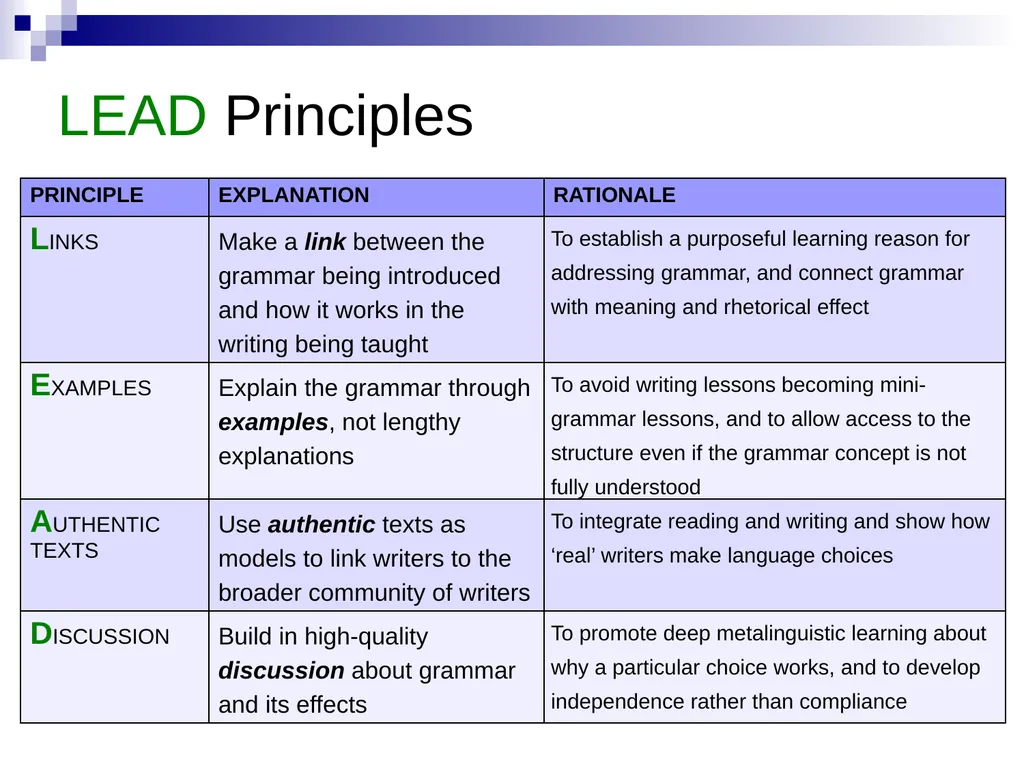
LEAD Principles<br>
03
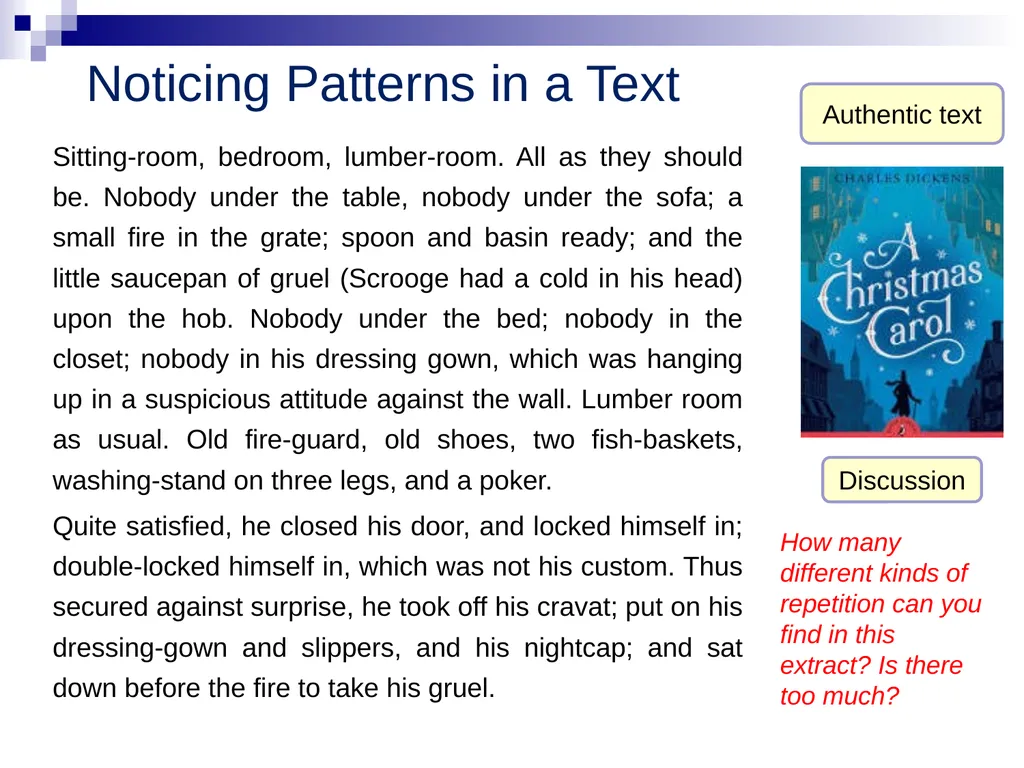
Sitting-room, bedroom, lumber-room. All as they should be. Nobody under the table, nobody under the sofa; a small fire in the grate; spoon and basin ready; and the little saucepan of gruel (Scrooge had a cold in his head) upon the hob. Nobody under the bed; nobody in the closet; nobody in his dressing gown, which was hanging up in a suspicious attitude against the wall. Lumber room as usual. Old fire-guard, old shoes, two fish-baskets, washing-stand on three legs, and a poker.
Quite satisfied, he closed his door, and locked himself in; double-locked himself in, which was not his custom. Thus secured against surprise, he took off his cravat; put on his dressing-gown and slippers, and his nightcap; and sat down before the fire to take his gruel. Authentic text Discussion How many different kinds of repetition can you find in this extract? Is there too much? Noticing Patterns in a Text<br>
04
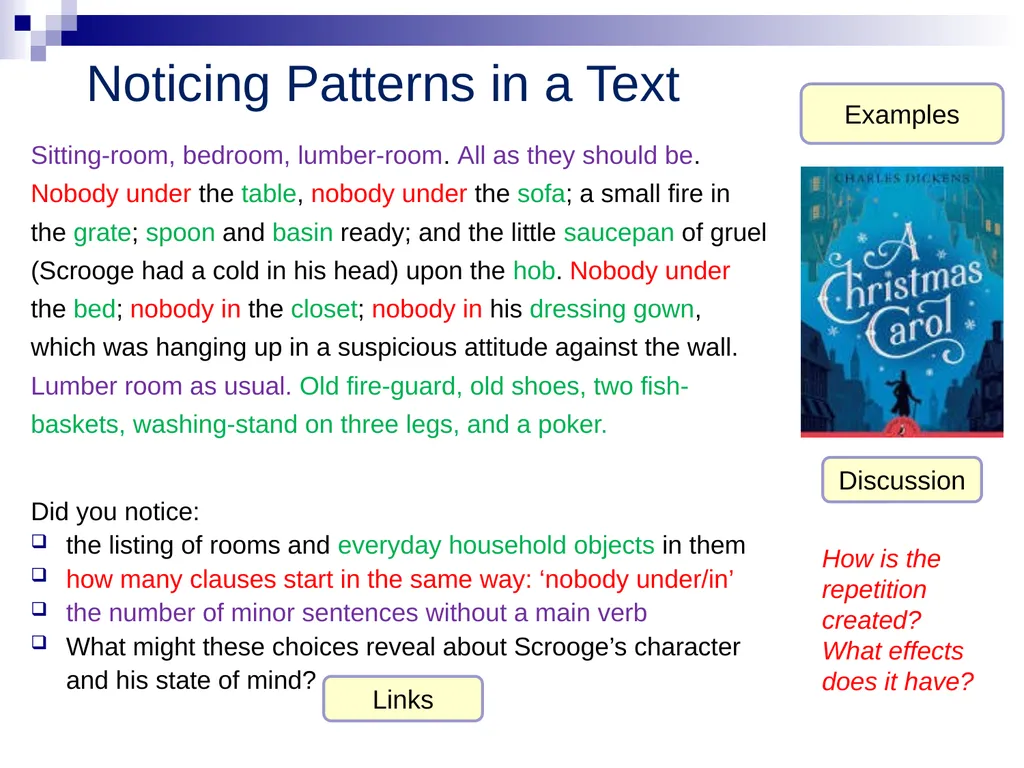
Sitting-room, bedroom, lumber-room. All as they should be. Nobody under the table, nobody under the sofa; a small fire in the grate; spoon and basin ready; and the little saucepan of gruel (Scrooge had a cold in his head) upon the hob. Nobody under the bed; nobody in the closet; nobody in his dressing gown, which was hanging up in a suspicious attitude against the wall. Lumber room as usual. Old fire-guard, old shoes, two fish-baskets, washing-stand on three legs, and a poker.
Did you notice:
the listing of rooms and everyday household objects in them
how many clauses start in the same way: ‘nobody under/in’
the number of minor sentences without a main verb
What might these choices reveal about Scrooge’s character and his state of mind? Examples Discussion How is the repetition created? What effects does it have? Noticing Patterns in a Text Links<br>
05
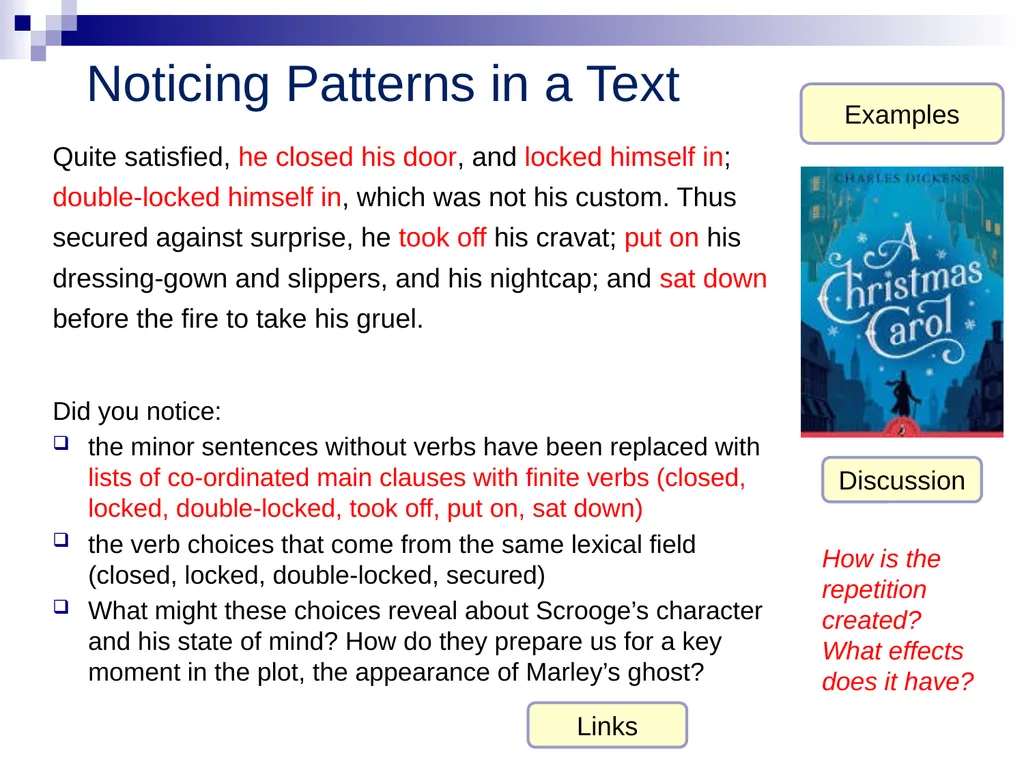
Quite satisfied, he closed his door, and locked himself in; double-locked himself in, which was not his custom. Thus secured against surprise, he took off his cravat; put on his dressing-gown and slippers, and his nightcap; and sat down before the fire to take his gruel.
Did you notice:
the minor sentences without verbs have been replaced with lists of co-ordinated main clauses with finite verbs (closed, locked, double-locked, took off, put on, sat down)
the verb choices that come from the same lexical field (closed, locked, double-locked, secured)
What might these choices reveal about Scrooge’s character and his state of mind? How do they prepare us for a key moment in the plot, the appearance of Marley’s ghost? Examples Discussion How is the repetition created? What effects does it have? Noticing Patterns in a Text Links<br>
06
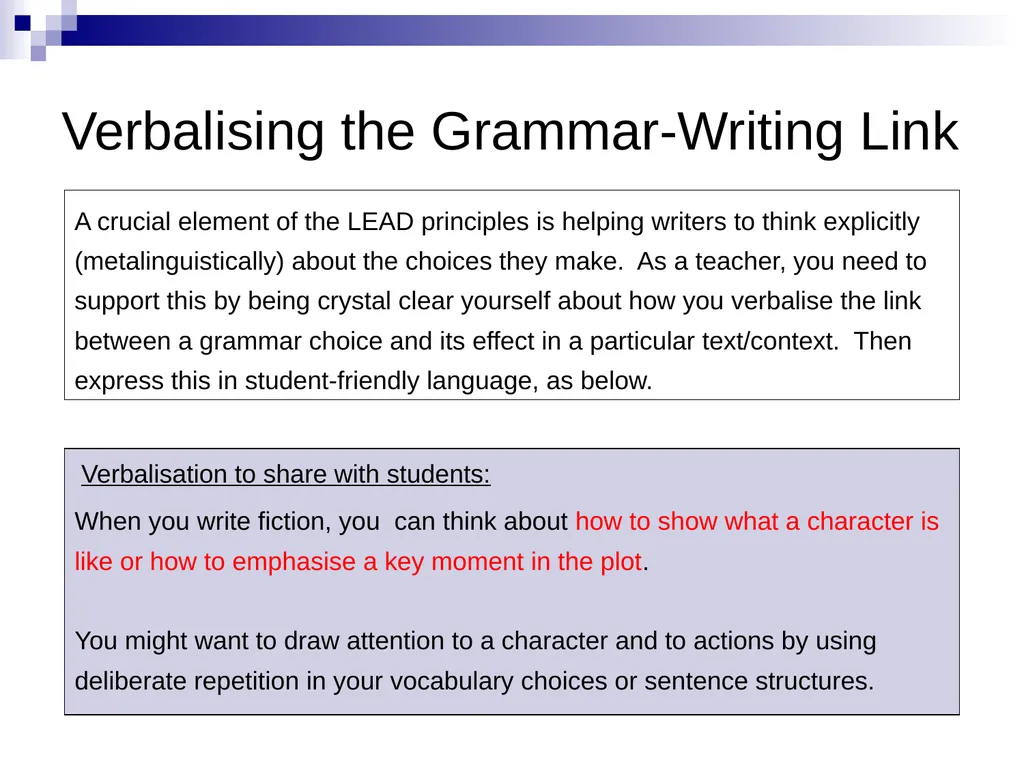
Verbalising the Grammar-Writing Link Verbalisation to share with students:
When you write fiction, you can think about how to show what a character is like or how to emphasise a key moment in the plot.
You might want to draw attention to a character and to actions by using deliberate repetition in your vocabulary choices or sentence structures. A crucial element of the LEAD principles is helping writers to think explicitly (metalinguistically) about the choices they make. As a teacher, you need to support this by being crystal clear yourself about how you verbalise the link between a grammar choice and its effect in a particular text/context. Then express this in student-friendly language, as below.<br>
07
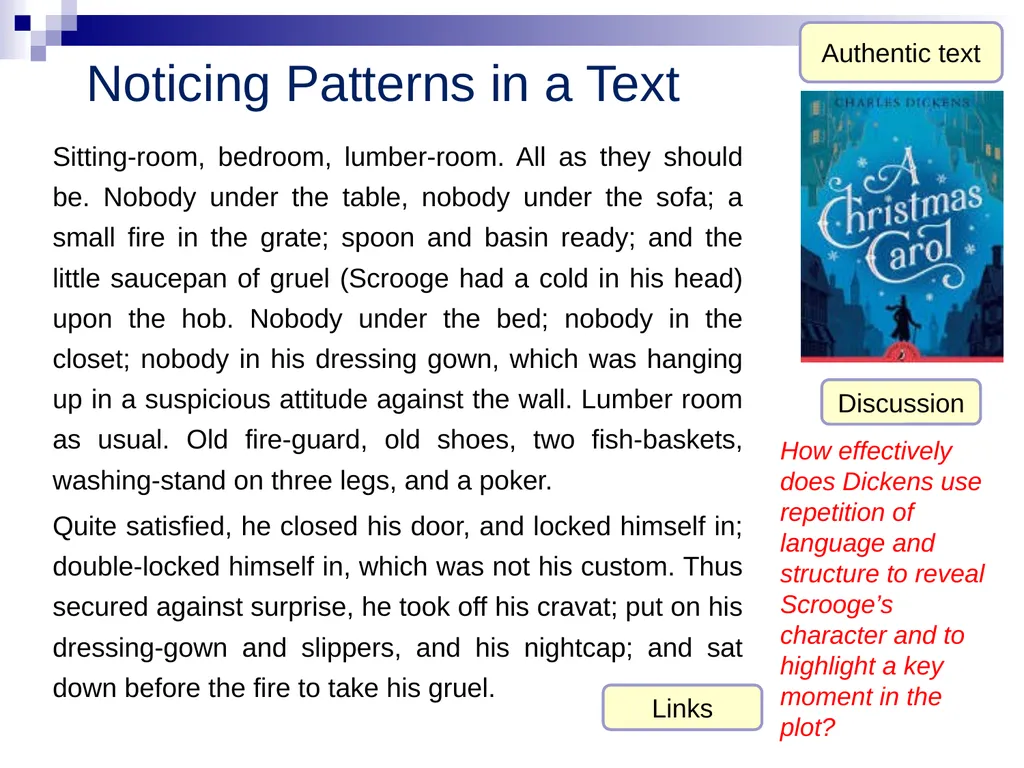
Sitting-room, bedroom, lumber-room. All as they should be. Nobody under the table, nobody under the sofa; a small fire in the grate; spoon and basin ready; and the little saucepan of gruel (Scrooge had a cold in his head) upon the hob. Nobody under the bed; nobody in the closet; nobody in his dressing gown, which was hanging up in a suspicious attitude against the wall. Lumber room as usual. Old fire-guard, old shoes, two fish-baskets, washing-stand on three legs, and a poker.
Quite satisfied, he closed his door, and locked himself in; double-locked himself in, which was not his custom. Thus secured against surprise, he took off his cravat; put on his dressing-gown and slippers, and his nightcap; and sat down before the fire to take his gruel. Authentic text Discussion How effectively does Dickens use repetition of language and structure to reveal Scrooge’s character and to highlight a key moment in the plot? Noticing Patterns in a Text Links<br>