UUA Faith Development Office White Fragility: Why Its So Hard for White People to Talk About Race DISCUSSION GUIDE QUESTIONS AND PROMPTS UUA Faith Development Office SESSION 1 Facing White Supremacy UUA Faith Development Office CHALICE
"UUA Faith Development Office White Fragility: Why" is the property of its rightful owner. Permission is granted to
download and print the materials on this website for personal, non-commercial use only, and to display it
on your personal computer provided you do not modify the materials and that you retain all copyright
notices contained in the materials. By downloading content from our website, you accept the terms of this
agreement.
Presentation Transcript
01
UUA Faith Development Office White Fragility:
Why It’s So Hard for White People to Talk About Race
DISCUSSION GUIDE QUESTIONS AND PROMPTS<br>
02
UUA Faith Development Office SESSION 1
Facing White Supremacy<br>
03
UUA Faith Development Office CHALICE LIGHTING Any real change implies the breakup of the world as one has always known it, the loss of all that gave one an identity, the end of safety. And at such a moment, unable to see and not daring to imagine what the future will now bring forth, one clings to what one knew, or dreamed that one possessed. Yet, it is only when a [person] is able, without bitterness or self-pity, to surrender a dream [they have] long cherished or a privilege [they have] long possessed that [they are] set free—[they have] set [themselves] free—for higher dreams, for greater privileges.
— James Baldwin<br>
04
UUA Faith Development Office COVENANT We each promise to:
Speak from our own experiences and perspectives.
Listen generously to the experiences and perspectives of others, creating supportive space for each person to learn.
Actively resist making assumptions about one another.
Refrain from fixing, saving, advising, or correcting each other.
Be mindful of “taking space and making space” to ensure everyone has opportunities to speak and to listen.
Expect and accept non-closure, because the work of disrupting racism is ongoing.
Be willing to be challenged to disrupt racist patterns, both by the activities and discussions and by other participants.
Respect the confidentiality of personal information and stories shared here.<br>
05
UUA Faith Development Office FIRST IMPRESSIONS
What insight stays with you after reading the book White Fragility?
What did you find surprising? Challenging? Liberating? Hopeful?<br>
06
UUA Faith Development Office DISCUSSION What is meant by the sentence “Racism is a structure, not an event,” a J. Kēhaulani Kauanui quote cited by DiAngelo? How does that speak to you?
What are some implications—both local and national—of racism being a foundational structure and ideology in US American history and culture and its economic system and civic life?<br>
07
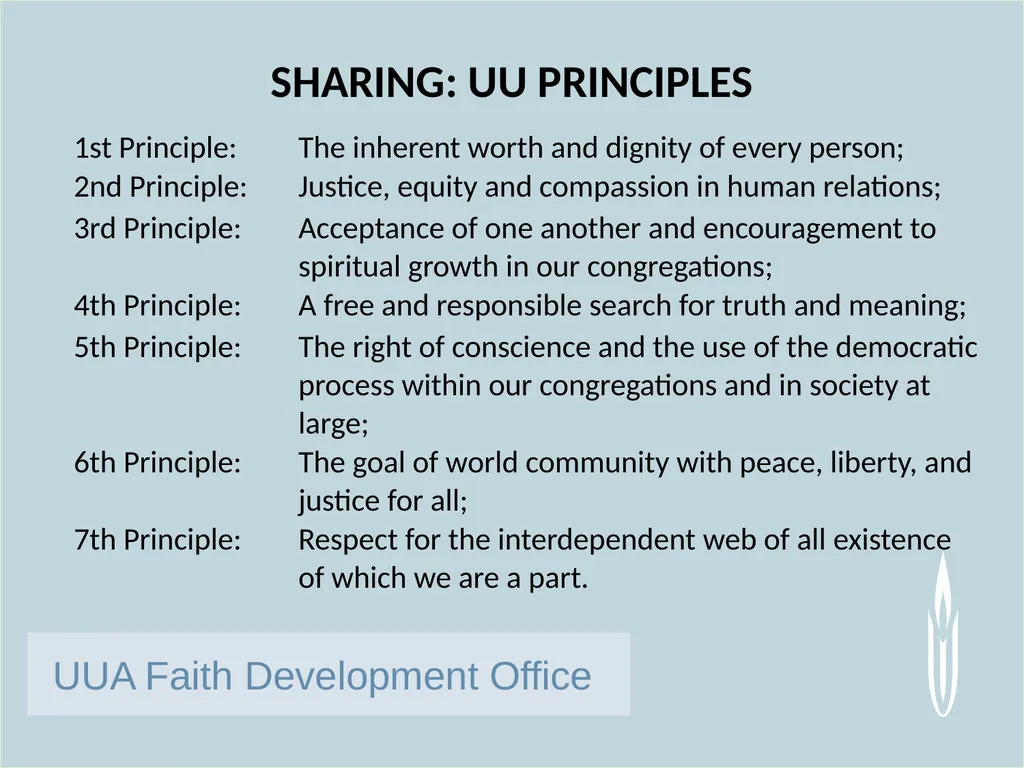
UUA Faith Development Office SHARING: UU PRINCIPLES<br>
08
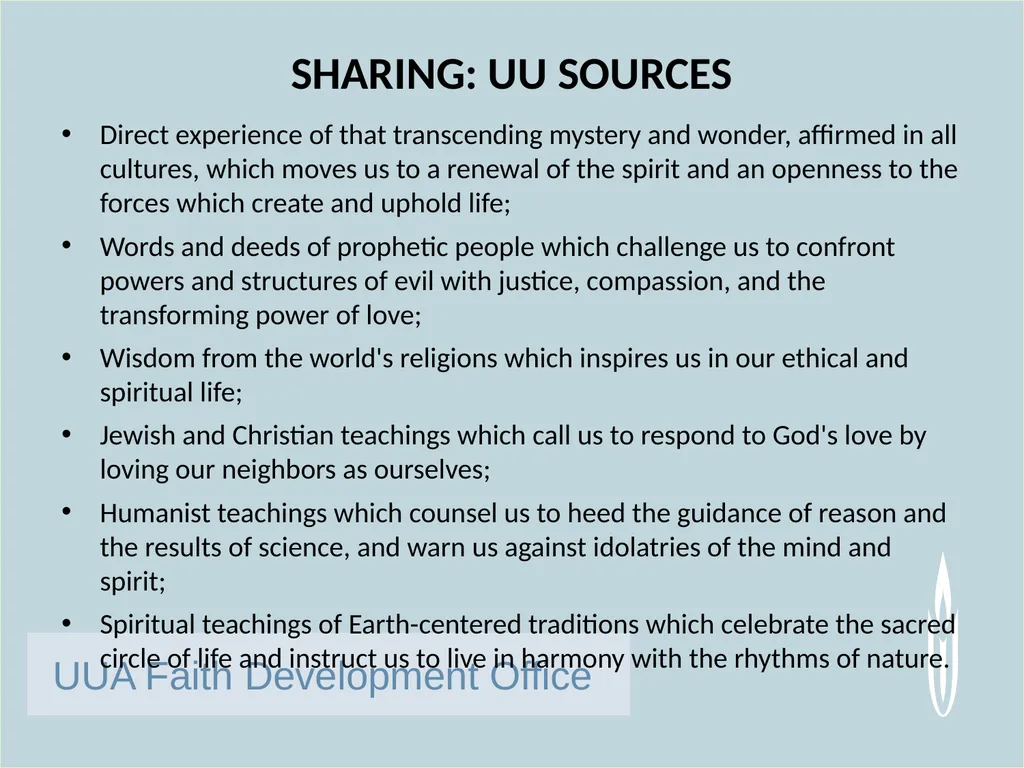
UUA Faith Development Office SHARING: UU SOURCES Direct experience of that transcending mystery and wonder, affirmed in all cultures, which moves us to a renewal of the spirit and an openness to the forces which create and uphold life;
Words and deeds of prophetic people which challenge us to confront powers and structures of evil with justice, compassion, and the transforming power of love;
Wisdom from the world's religions which inspires us in our ethical and spiritual life;
Jewish and Christian teachings which call us to respond to God's love by loving our neighbors as ourselves;
Humanist teachings which counsel us to heed the guidance of reason and the results of science, and warn us against idolatries of the mind and spirit;
Spiritual teachings of Earth-centered traditions which celebrate the sacred circle of life and instruct us to live in harmony with the rhythms of nature.<br>
09
UUA Faith Development Office QUESTIONS Why does this unsettle me?
What would it mean for me if this were true?
How does this lens change my understanding of racial dynamics?
How can my unease help reveal the unexamined assumptions I have been making?
Is it possible that because I am white, there are some racial dynamics that I can’t see?
Am I willing to consider that possibility? If I am not willing to do it, then why not?
— Robin DiAngelo, White Fragility<br>
10
UUA Faith Development Office SESSION 2
How Does Race Shape the Lives of White People?<br>
11
UUA Faith Development Office CHALICE LIGHTING The irony of American history is the tendency of good white Americans to presume racial innocence. Ignorance of how we are shaped racially is the first sign of privilege.
In other words. It is a privilege to ignore the consequences of race in America.
— Tim Wise, activist, lecturer, author of White Like Me<br>
12
UUA Faith Development Office REFLECTION AND JOURNALING How is my life shaped by race?
What has previously been invisible or hidden from my perception?
Where has antiblackness (hatred, contempt, condemnation, or devaluation of or indifference to black people) played out in my life?<br>
13
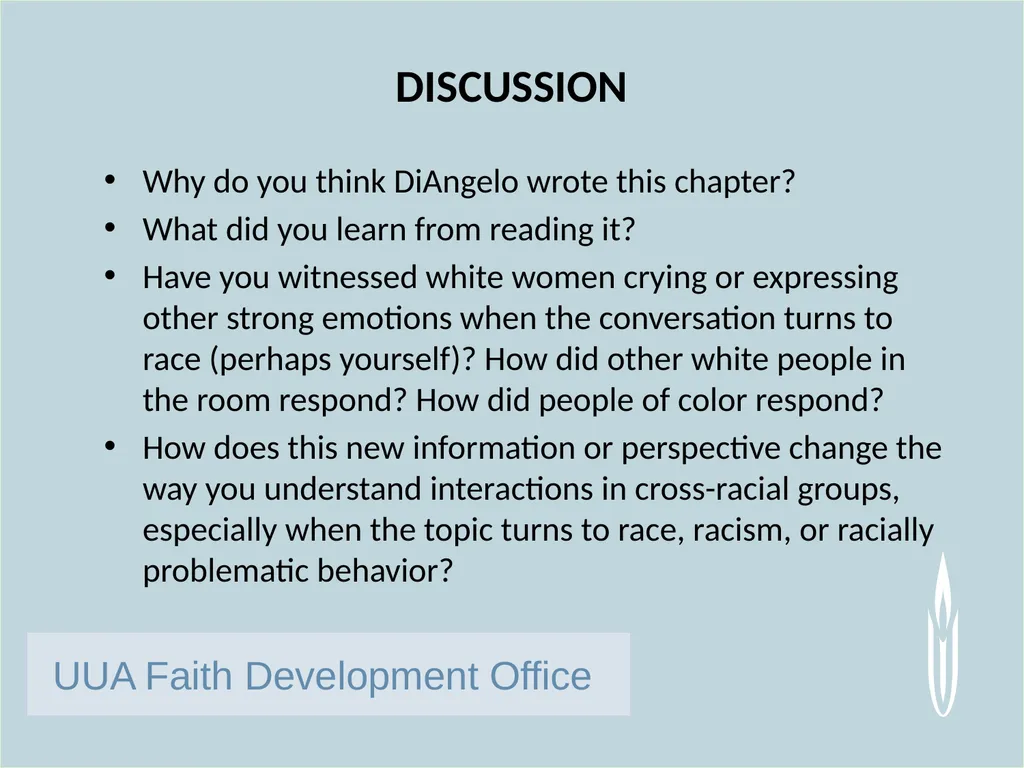
UUA Faith Development Office DISCUSSION Why do you think DiAngelo wrote this chapter?
What did you learn from reading it?
Have you witnessed white women crying or expressing other strong emotions when the conversation turns to race (perhaps yourself)? How did other white people in the room respond? How did people of color respond?
How does this new information or perspective change the way you understand interactions in cross-racial groups, especially when the topic turns to race, racism, or racially problematic behavior?<br>
14
UUA Faith Development Office SESSION 3
Interrupting Racist Patterns<br>
15
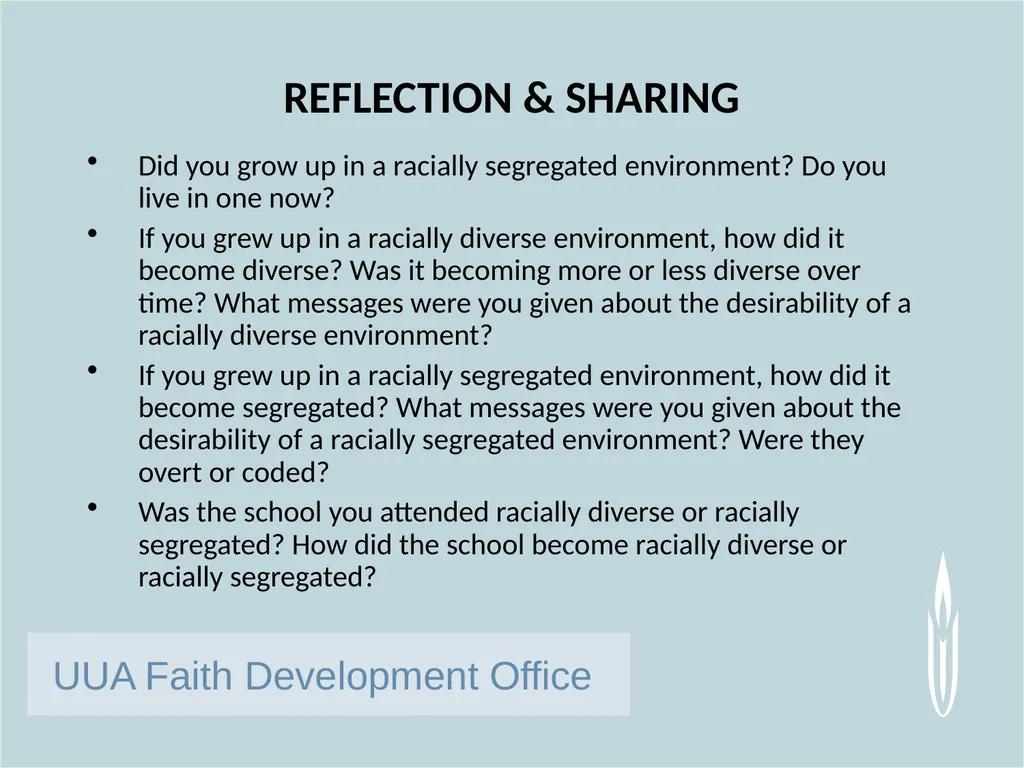
UUA Faith Development Office REFLECTION & SHARING Did you grow up in a racially segregated environment? Do you live in one now?
If you grew up in a racially diverse environment, how did it become diverse? Was it becoming more or less diverse over time? What messages were you given about the desirability of a racially diverse environment?
If you grew up in a racially segregated environment, how did it become segregated? What messages were you given about the desirability of a racially segregated environment? Were they overt or coded?
Was the school you attended racially diverse or racially segregated? How did the school become racially diverse or racially segregated?<br>
16
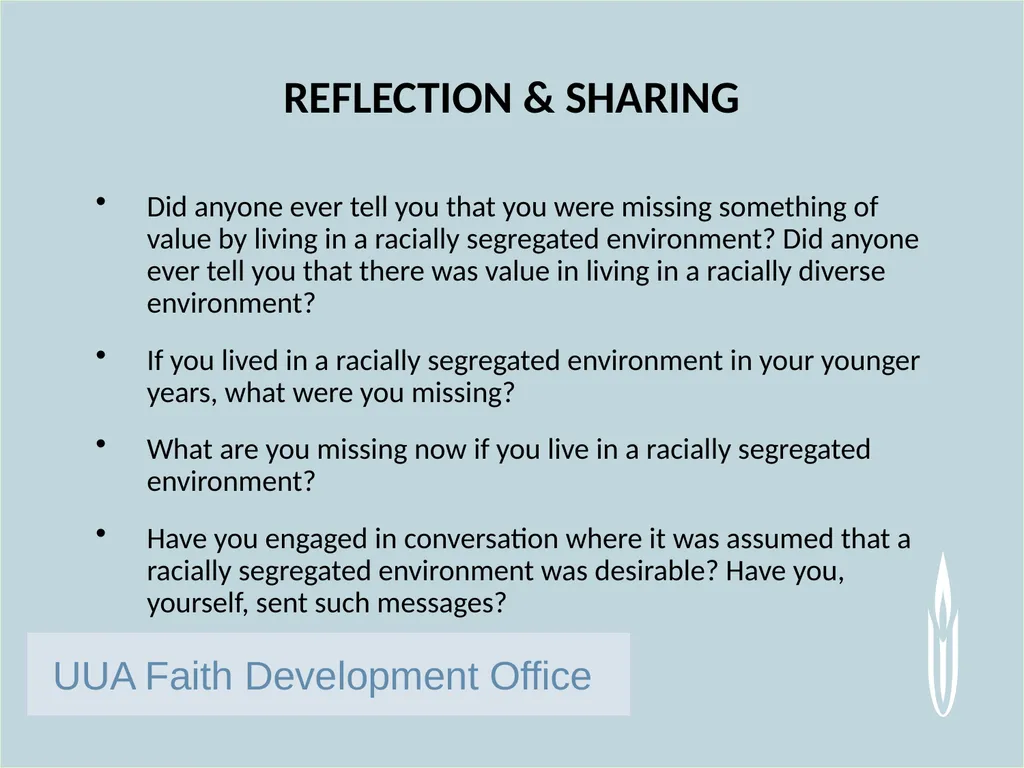
UUA Faith Development Office REFLECTION & SHARING Did anyone ever tell you that you were missing something of value by living in a racially segregated environment? Did anyone ever tell you that there was value in living in a racially diverse environment?
If you lived in a racially segregated environment in your younger years, what were you missing?
What are you missing now if you live in a racially segregated environment?
Have you engaged in conversation where it was assumed that a racially segregated environment was desirable? Have you, yourself, sent such messages?<br>
17
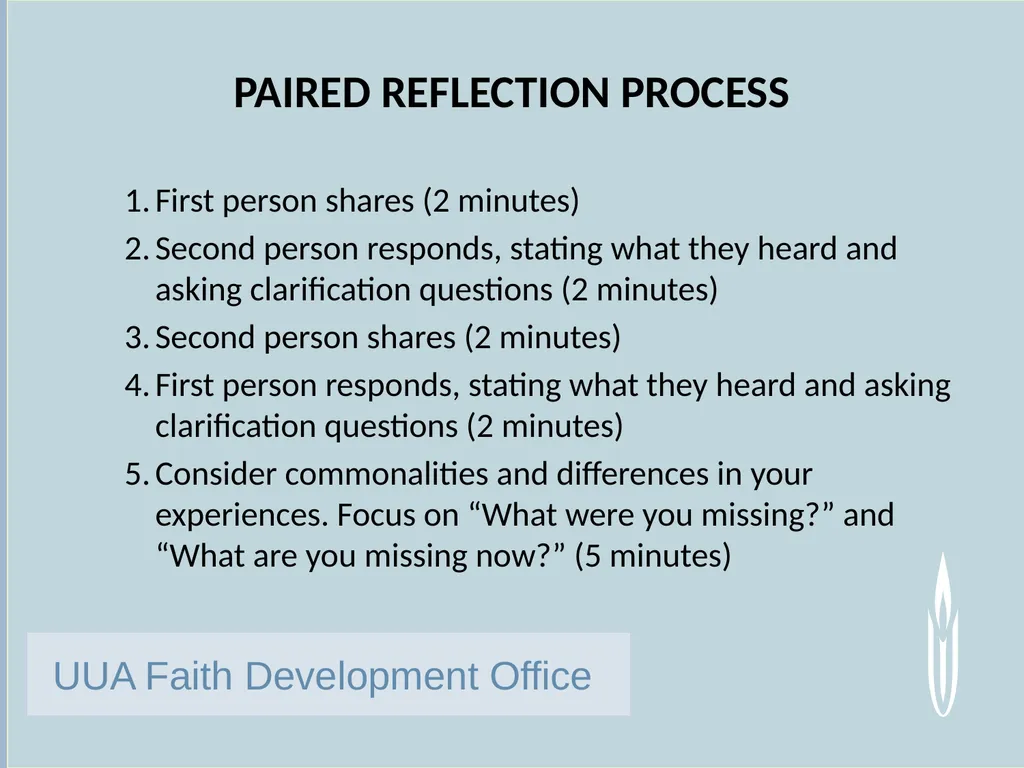
UUA Faith Development Office PAIRED REFLECTION PROCESS 1. First person shares (2 minutes)
2. Second person responds, stating what they heard and asking clarification questions (2 minutes)
3. Second person shares (2 minutes)
4. First person responds, stating what they heard and asking clarification questions (2 minutes)
5. Consider commonalities and differences in your experiences. Focus on “What were you missing?” and “What are you missing now?” (5 minutes)<br>