Variations in plants and animals Lesson 5c How Do Differences (Variations) in Plants or Animals of the Same Kind Help Them Survive So They Can Produce Young (Babies or Seeds)? Review: Cottonwood-Tree Seeds What trait in cottonwood-tree
"Variations in plants and animals Lesson 5c How Do" is the property of its rightful owner. Permission is granted to
download and print the materials on this website for personal, non-commercial use only, and to display it
on your personal computer provided you do not modify the materials and that you retain all copyright
notices contained in the materials. By downloading content from our website, you accept the terms of this
agreement.
Presentation Transcript
01
Variations in plants and animals Lesson 5c How Do Differences (Variations) in Plants or Animals of the Same Kind Help Them Survive So They Can Produce Young (Babies or Seeds)?<br>
02
Review: Cottonwood-Tree Seeds What trait in cottonwood-tree seeds did we investigate?
What variations did we observe in that trait?
What happened to the cottonwood seeds in our story?
What happened to the bigger seeds? Where did they land?
What happened to the smaller seeds? Where did they land?<br>
03
Today’s Focus Question How do differences (variations) in plants or animals of the same kind help them survive so they can produce young (babies or seeds)?<br>
04
Review: Dandelions in a City Park What trait in dandelions did we investigate?
What variations did we observe in that trait?
Why did it make a difference that some dandelion stems were longer than others?
Are taller or shorter dandelions more likely to survive and produce seeds? Why?
So is it better to be a taller dandelion or a shorter dandelion in a city park? Why?<br>
05
Review: Giraffes What traits do all giraffes share?
What variations did we observe in one giraffe trait?
How do variations in the length of their necks help some giraffes survive better in their environment?
What about giraffes with shorter necks? Can they find enough leaves to eat if the trees are tall?<br>
06
Review: Giraffes What do you think will happen to the giraffes with shorter necks?
What if all of the trees were the same size? Which giraffes would have a better chance of surviving?
Which giraffes are more likely to have babies? Why?
If the giraffes with longer necks have babies, what do you think they’ll look like? Why?<br>
07
Our Focus Question and Unit Central Question How do differences (variations) in plants or animals of the same kind help them survive so they can produce young (babies or seeds)?<br>
08
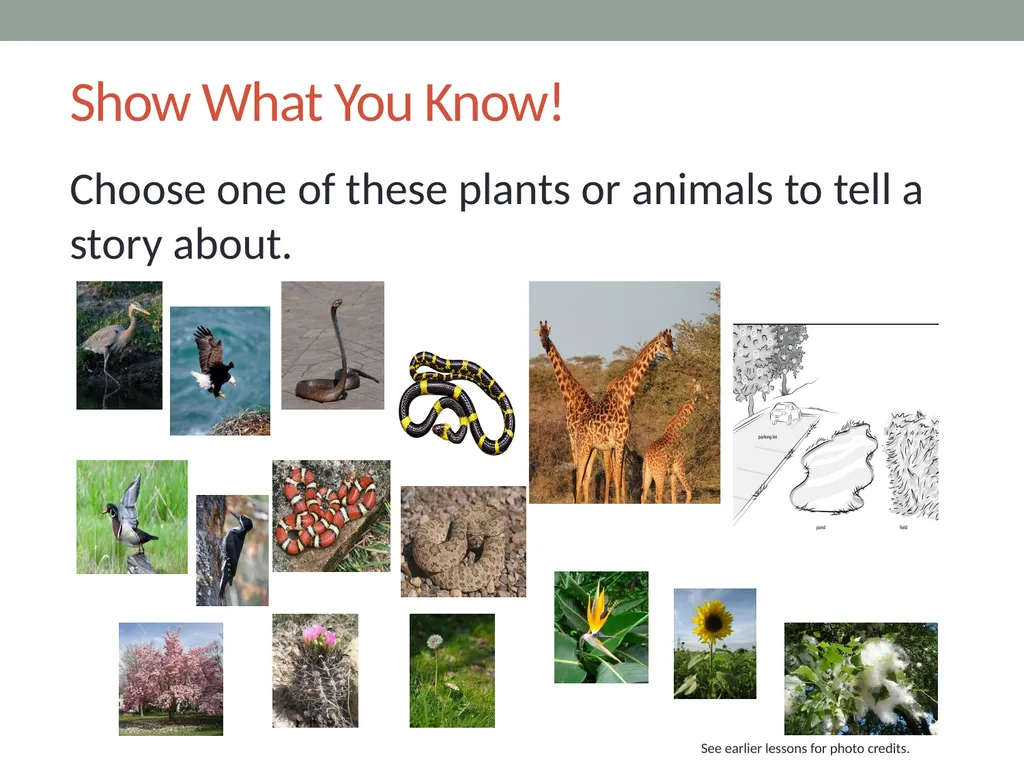
Show What You Know! Choose one of these plants or animals to tell a story about. See earlier lessons for photo credits.<br>
09
Show What You Know! After you choose your plant or animal, think about these questions:
What traits does your plant or animal have?
What are two variations of that trait?
Why is it important for this plant or animal to survive in its environment?
How might a certain trait variation help your plant or animal survive in its environment so it can make seeds or babies?<br>
10
Show What You Know! In your notebook, draw a picture of your plant or animal and its traits.
At the top of the page, write the name of the plant or animal. Then label each trait.
Circle the trait you’re going to include in your story.
Draw two variations of that trait and label them.
Write a sentence explaining why one trait variation will give your plant or animal a better chance of surviving in its environment so it can have babies.<br>
11
Key Science Ideas Plants or animals of the same kind share many traits that make them more alike than different.
But plants or animals of the same kind aren’t exactly alike. They also have differences or variations in their traits.
All plants and animals live in environments that are always changing.
Some trait variations help plants or animals of the same kind survive in their environment.<br>
12
Key Science Ideas These variations can give individual plants or animals a better chance of surviving and having seed or babies with the same variations as their parents.
Variations in traits and the environment determine which plants or animals of the same kind survive and which don’t.
The variations of plants or animals of the same kind that survive become more common in the next generation.<br>