
VCE Foundation Maths Why choose Foundation
Description: VCE Foundation Maths Why choose Foundation Mathematics? Universal, real world application Year 11 Foundation Mathematics Units 1 and 2 has a strong emphasis on using Mathematics in practical ways. Students will study mathematics that are
Related Topics
Download Presentation
"VCE Foundation Maths Why choose Foundation" is the property of its rightful owner. Permission is granted to download and print the materials on this website for personal, non-commercial use only, and to display it on your personal computer provided you do not modify the materials and that you retain all copyright notices contained in the materials. By downloading content from our website, you accept the terms of this agreement.
Presentation Transcript
slide1. VCE
Foundation Maths<br>
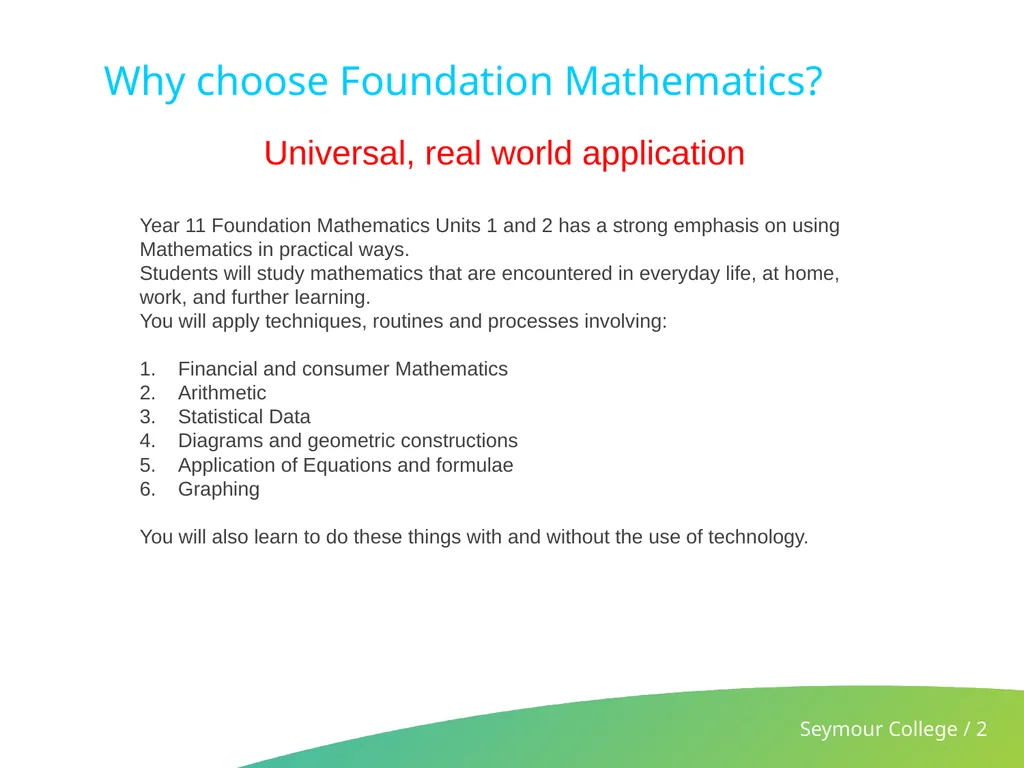
slide2. Why choose Foundation Mathematics? Universal, real world application
Year 11 Foundation Mathematics Units 1 and 2 has a strong emphasis on using Mathematics in practical ways.
Students will study mathematics that are encountered in everyday life, at home, work, and further learning.
You will apply techniques, routines and processes involving:
Financial and consumer Mathematics
Arithmetic
Statistical Data
Diagrams and geometric constructions
Application of Equations and formulae
Graphing
You will also learn to do these things with and without the use of technology.<br>
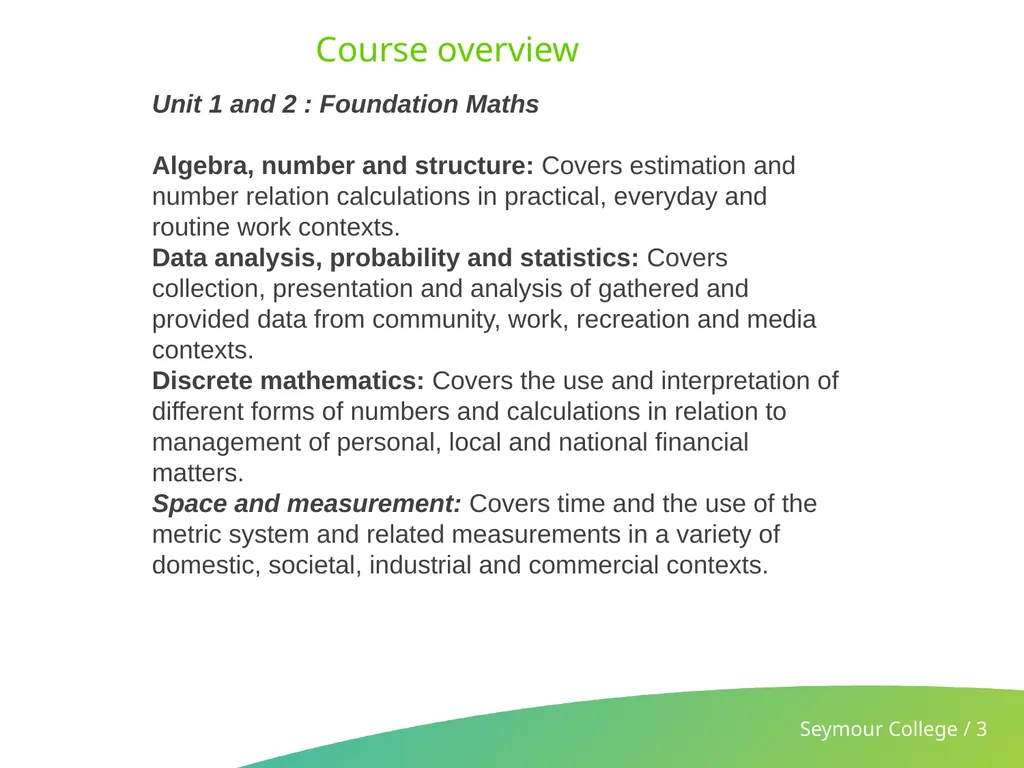
slide3. Course overview Unit 1 and 2 : Foundation Maths
Algebra, number and structure: Covers estimation and number relation calculations in practical, everyday and routine work contexts.
Data analysis, probability and statistics: Covers collection, presentation and analysis of gathered and provided data from community, work, recreation and media contexts.
Discrete mathematics: Covers the use and interpretation of different forms of numbers and calculations in relation to management of personal, local and national financial matters.
Space and measurement: Covers time and the use of the metric system and related measurements in a variety of domestic, societal, industrial and commercial contexts.<br>
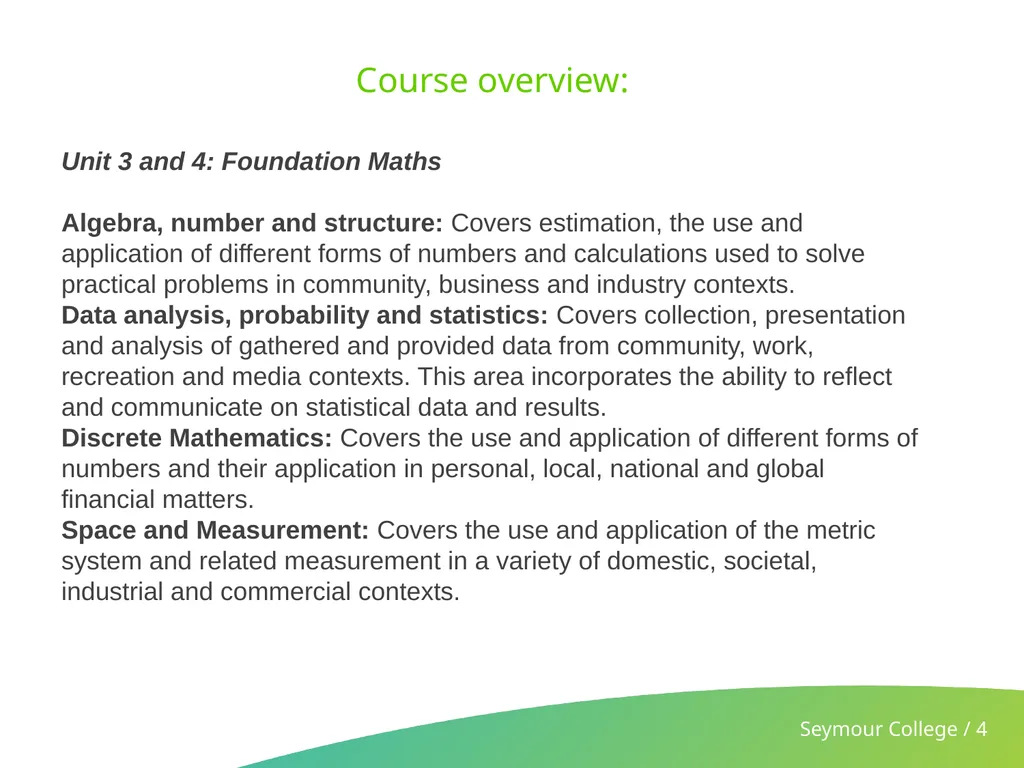
slide4. Course overview: Unit 3 and 4: Foundation Maths
Algebra, number and structure: Covers estimation, the use and application of different forms of numbers and calculations used to solve practical problems in community, business and industry contexts.
Data analysis, probability and statistics: Covers collection, presentation and analysis of gathered and provided data from community, work, recreation and media contexts. This area incorporates the ability to reflect and communicate on statistical data and results.
Discrete Mathematics: Covers the use and application of different forms of numbers and their application in personal, local, national and global financial matters.
Space and Measurement: Covers the use and application of the metric system and related measurement in a variety of domestic, societal, industrial and commercial contexts.<br>
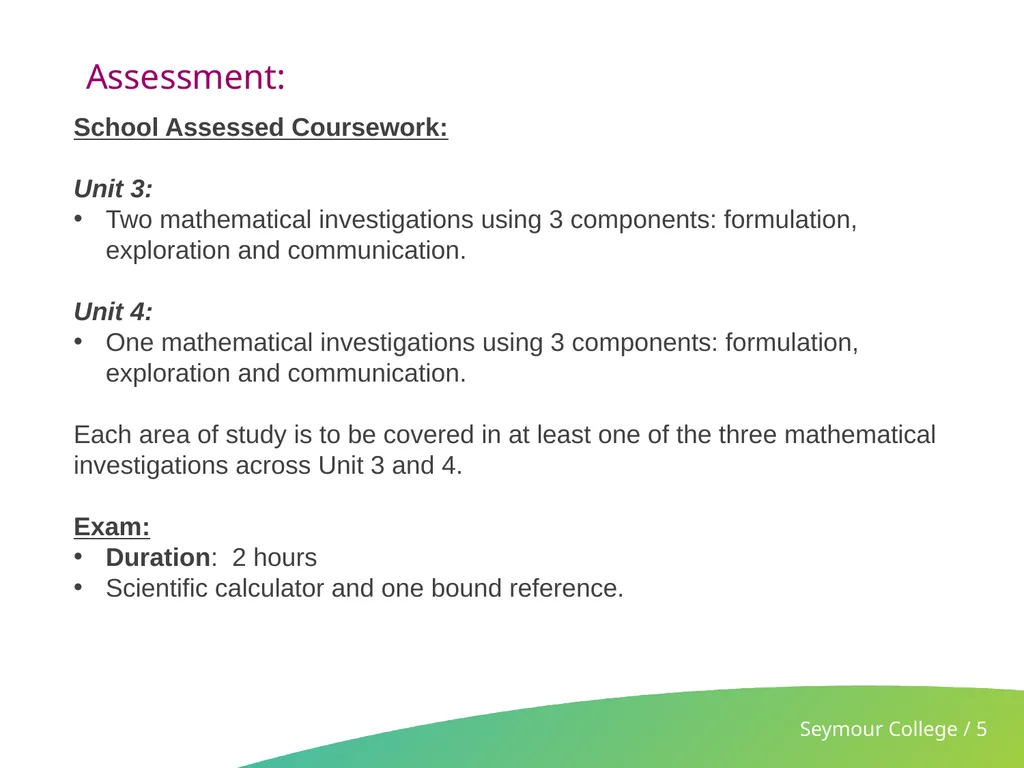
slide5. Assessment: School Assessed Coursework:
Unit 3:
Two mathematical investigations using 3 components: formulation, exploration and communication.
Unit 4:
One mathematical investigations using 3 components: formulation, exploration and communication.
Each area of study is to be covered in at least one of the three mathematical investigations across Unit 3 and 4.
Exam:
Duration: 2 hours
Scientific calculator and one bound reference.<br>
slide2. Why choose Foundation Mathematics? Universal, real world application
Year 11 Foundation Mathematics Units 1 and 2 has a strong emphasis on using Mathematics in practical ways.
Students will study mathematics that are encountered in everyday life, at home, work, and further learning.
You will apply techniques, routines and processes involving:
Financial and consumer Mathematics
Arithmetic
Statistical Data
Diagrams and geometric constructions
Application of Equations and formulae
Graphing
You will also learn to do these things with and without the use of technology.<br>
slide3. Course overview Unit 1 and 2 : Foundation Maths
Algebra, number and structure: Covers estimation and number relation calculations in practical, everyday and routine work contexts.
Data analysis, probability and statistics: Covers collection, presentation and analysis of gathered and provided data from community, work, recreation and media contexts.
Discrete mathematics: Covers the use and interpretation of different forms of numbers and calculations in relation to management of personal, local and national financial matters.
Space and measurement: Covers time and the use of the metric system and related measurements in a variety of domestic, societal, industrial and commercial contexts.<br>
slide4. Course overview: Unit 3 and 4: Foundation Maths
Algebra, number and structure: Covers estimation, the use and application of different forms of numbers and calculations used to solve practical problems in community, business and industry contexts.
Data analysis, probability and statistics: Covers collection, presentation and analysis of gathered and provided data from community, work, recreation and media contexts. This area incorporates the ability to reflect and communicate on statistical data and results.
Discrete Mathematics: Covers the use and application of different forms of numbers and their application in personal, local, national and global financial matters.
Space and Measurement: Covers the use and application of the metric system and related measurement in a variety of domestic, societal, industrial and commercial contexts.<br>
slide5. Assessment: School Assessed Coursework:
Unit 3:
Two mathematical investigations using 3 components: formulation, exploration and communication.
Unit 4:
One mathematical investigations using 3 components: formulation, exploration and communication.
Each area of study is to be covered in at least one of the three mathematical investigations across Unit 3 and 4.
Exam:
Duration: 2 hours
Scientific calculator and one bound reference.<br>