
Verb-based Curriculum for Mathematics Education
MS
Published · 27 slides · 0 views
1 / 1
Description
Verb-based Curriculum for Mathematics Education Takuya BABA Hiroshima University Knowledge-based society require more than knowledge. From Quantity of knowledge to Quality of knowledge (knowledge about knowledge, systematization of
Related Topics
Share
Embed code
Download this presentation From Below
"Verb-based Curriculum for Mathematics Education" is the property of its rightful owner. Permission is granted to download and print the materials on this website for personal, non-commercial use only, and to display it on your personal computer provided you do not modify the materials and that you retain all copyright notices contained in the materials. By downloading content from our website, you accept the terms of this agreement.
Presentation Transcript
01
Verb-based Curriculum for Mathematics Education Takuya BABA
Hiroshima University<br>
Hiroshima University<br>
02
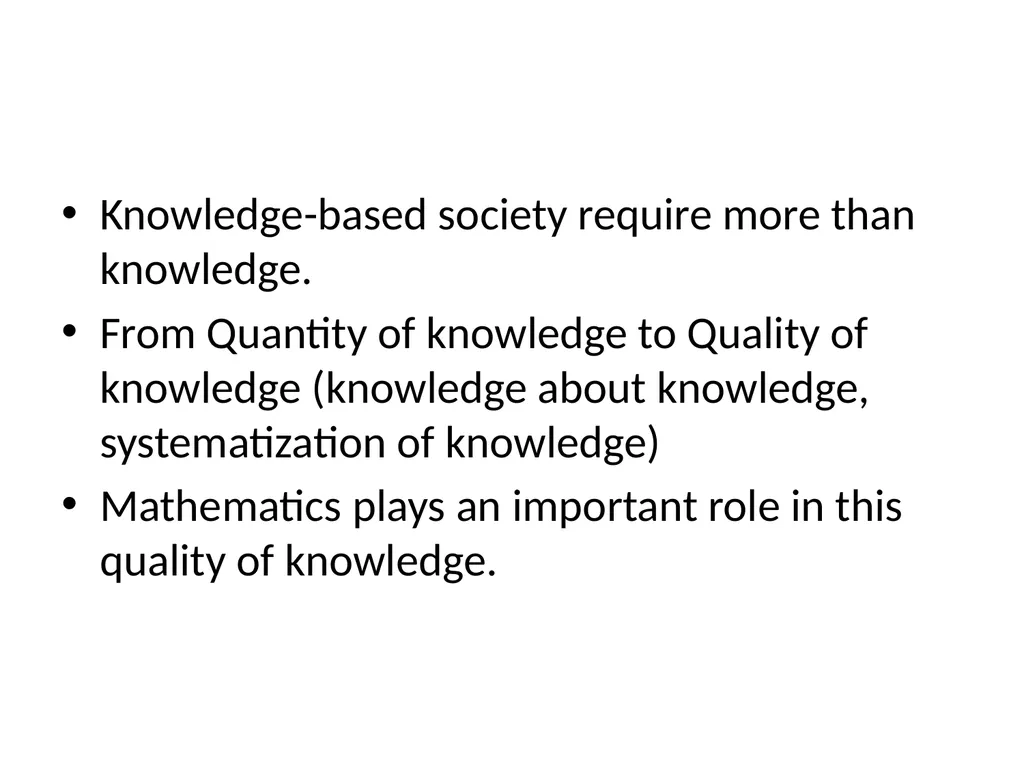
Knowledge-based society require more than knowledge.
From Quantity of knowledge to Quality of knowledge (knowledge about knowledge, systematization of knowledge)
Mathematics plays an important role in this quality of knowledge.<br>
From Quantity of knowledge to Quality of knowledge (knowledge about knowledge, systematization of knowledge)
Mathematics plays an important role in this quality of knowledge.<br>
03
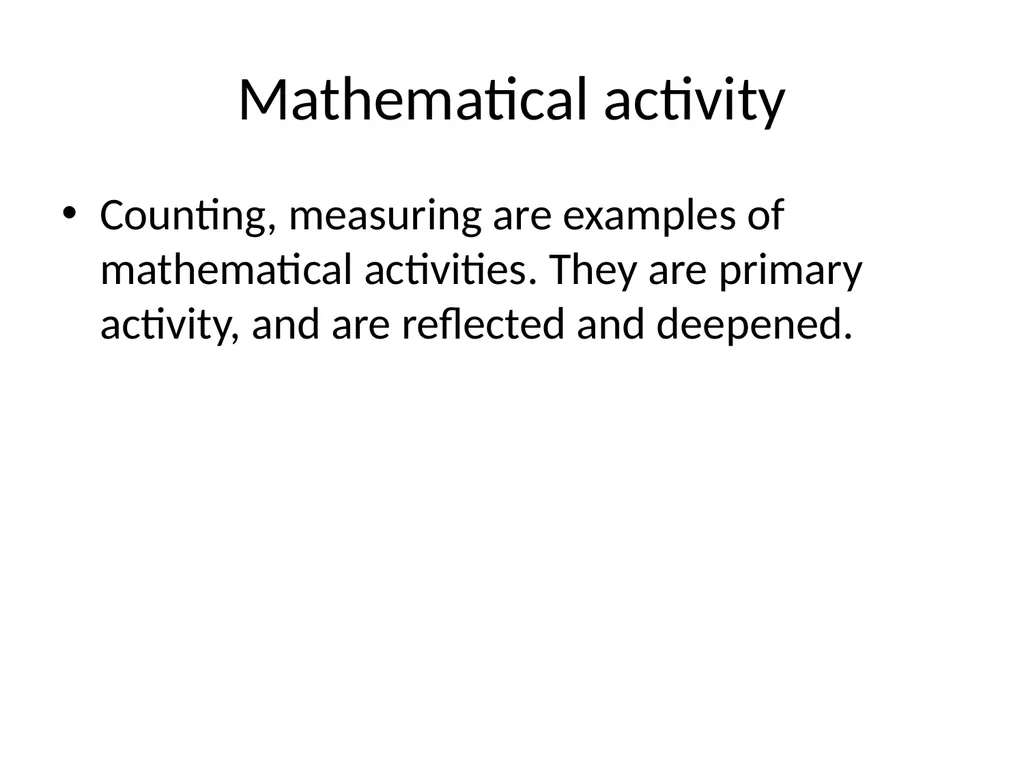
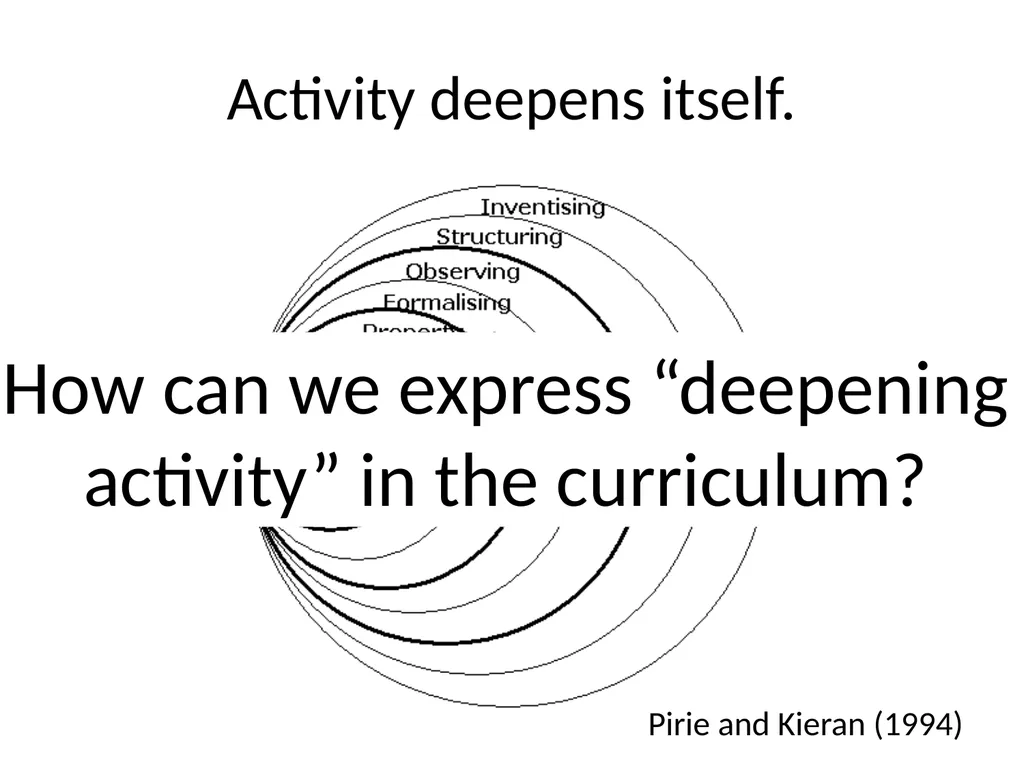
Mathematical activity Counting, measuring are examples of mathematical activities. They are primary activity, and are reflected and deepened.<br>
04
Activity deepens itself. Pirie and Kieran (1994) How can we express “deepening activity” in the curriculum?<br>
05
Content 1. Initial idea of verb-based curriculum
2. Characteristics of activity and verb
3. Analysis of Japanese Course of Study in terms of verbs
4. Structure of verb-based curriculum<br>
2. Characteristics of activity and verb
3. Analysis of Japanese Course of Study in terms of verbs
4. Structure of verb-based curriculum<br>
06
1. Initial idea of verb-based curriculum<br>
07
Background New course of study put emphasis on learning mathematics “through mathematical activity” at all stages of school education (MEXT 2008).
According to constructivism (Nakahara 1995), children play a major role in mathematical activity not only on the real objects but also on mathematical objects.<br>
According to constructivism (Nakahara 1995), children play a major role in mathematical activity not only on the real objects but also on mathematical objects.<br>
08
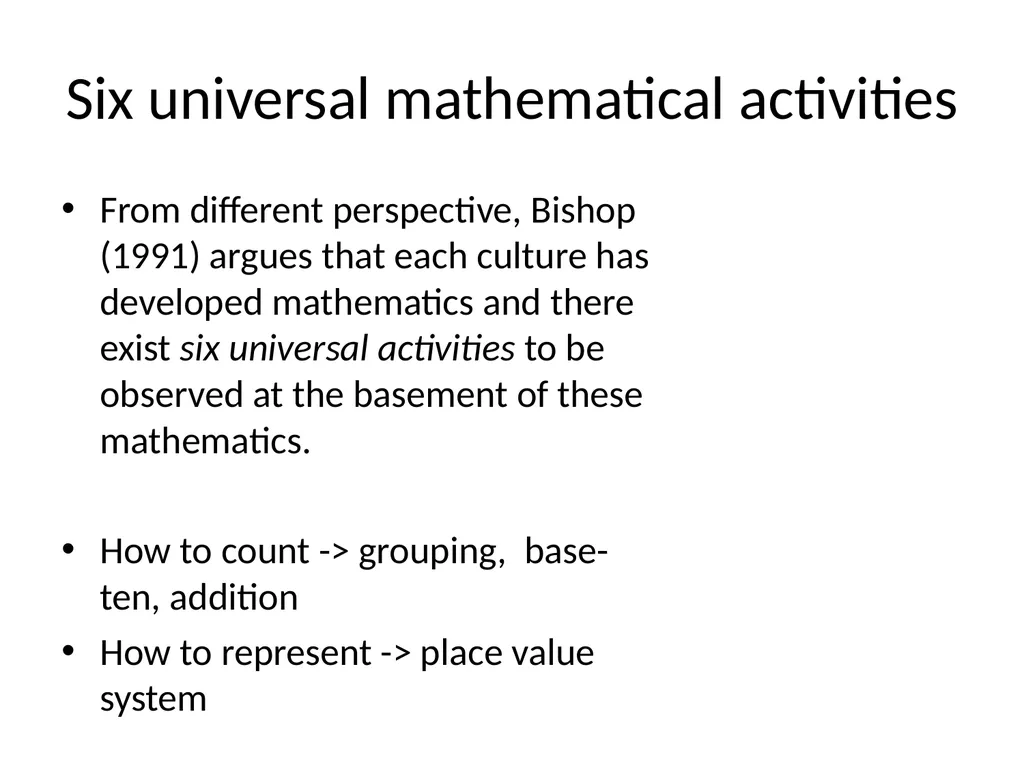
Six universal mathematical activities From different perspective, Bishop (1991) argues that each culture has developed mathematics and there exist six universal activities to be observed at the basement of these mathematics.
How to count -> grouping, base-ten, addition
How to represent -> place value system<br>
How to count -> grouping, base-ten, addition
How to represent -> place value system<br>
09
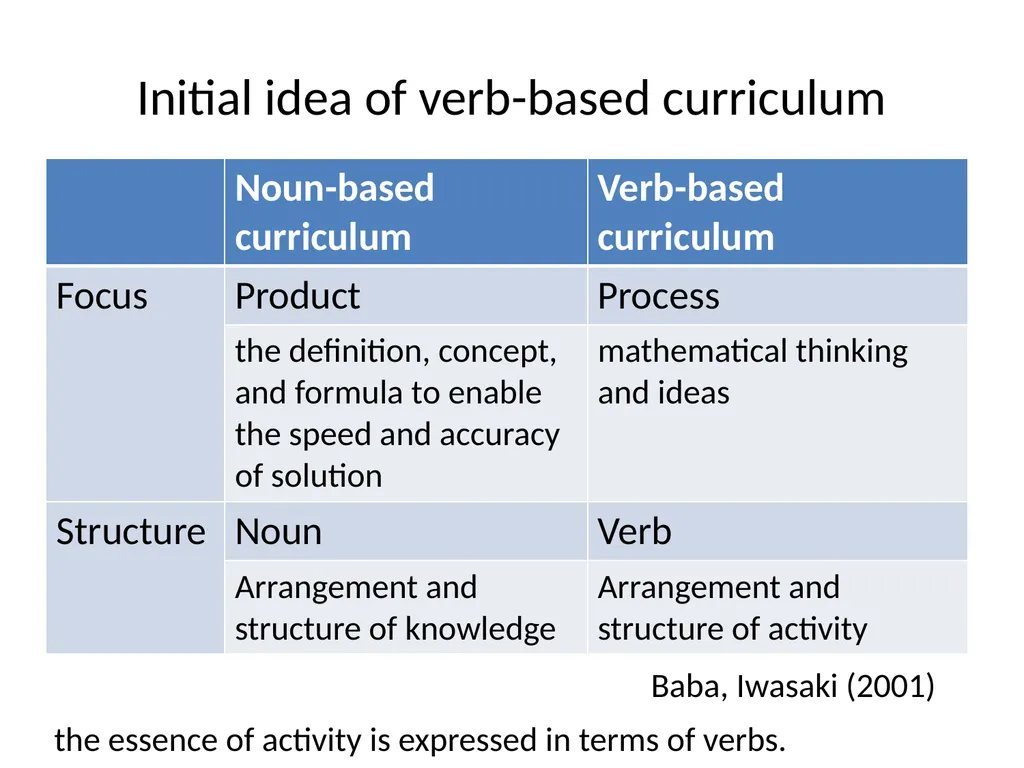
Initial idea of verb-based curriculum the essence of activity is expressed in terms of verbs. Baba, Iwasaki (2001)<br>
10
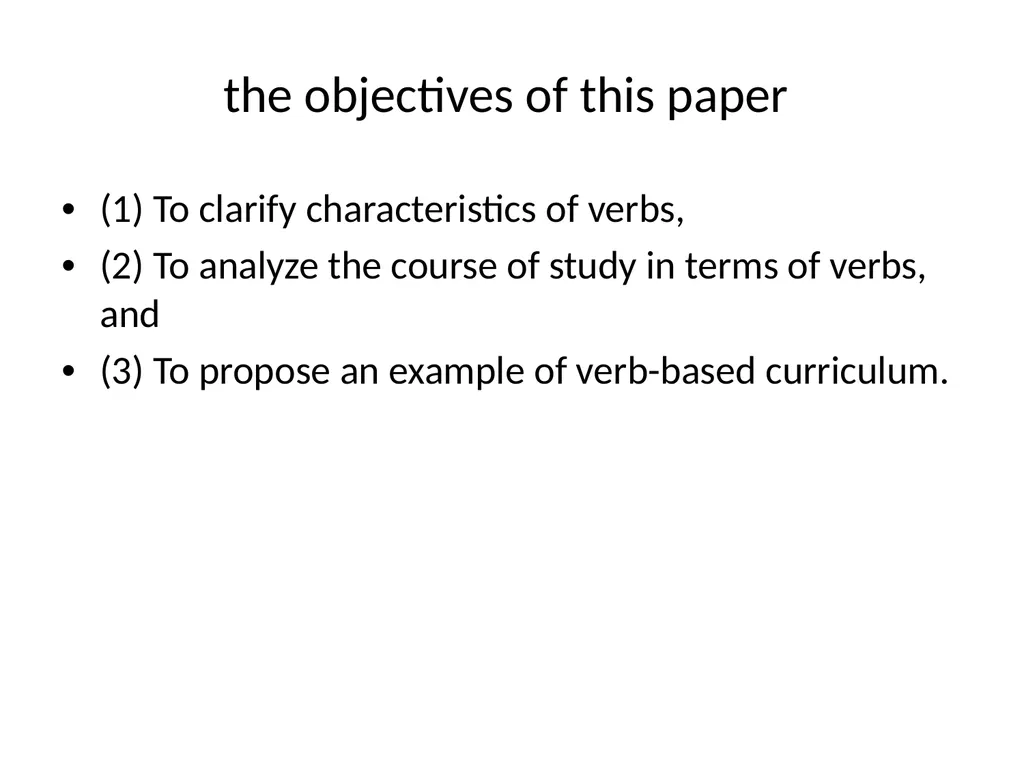
the objectives of this paper (1) To clarify characteristics of verbs,
(2) To analyze the course of study in terms of verbs, and
(3) To propose an example of verb-based curriculum.<br>
(2) To analyze the course of study in terms of verbs, and
(3) To propose an example of verb-based curriculum.<br>
11
2. Characteristics of activities and verbs<br>
12
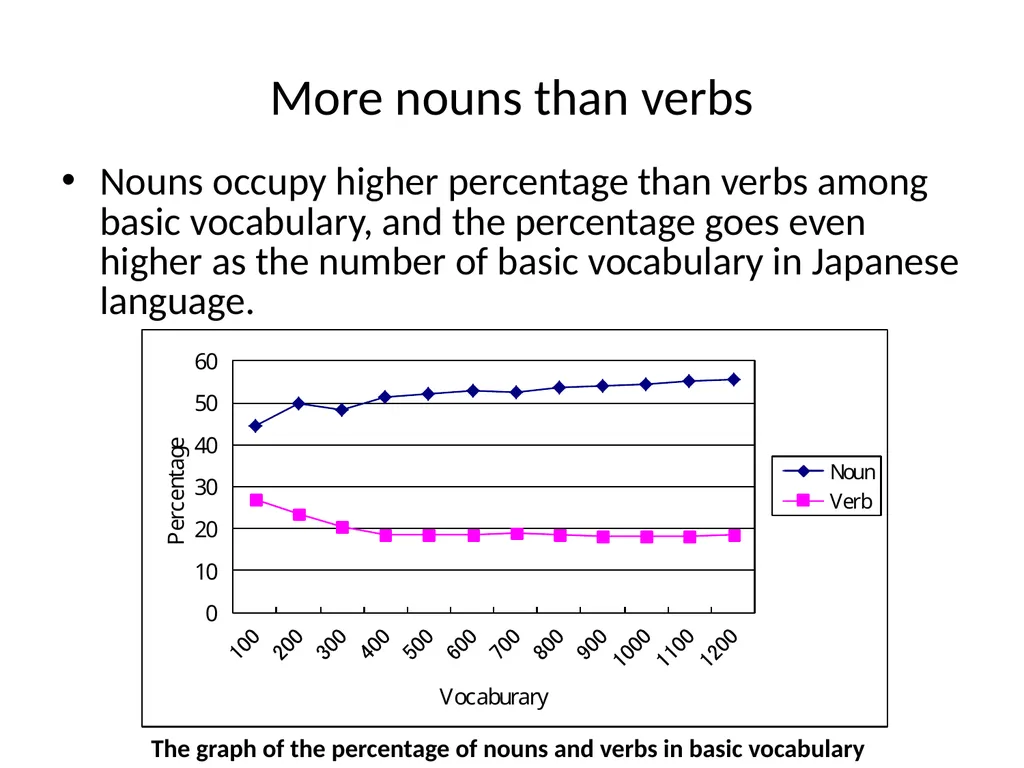
More nouns than verbs Nouns occupy higher percentage than verbs among basic vocabulary, and the percentage goes even higher as the number of basic vocabulary in Japanese language. The graph of the percentage of nouns and verbs in basic vocabulary<br>
13
Instantaneousness of activity The reason why verbs as signifier are fewer than nouns, lies in the property of activity as signified that is instantaneous and does not retain its locus of movement very long. For example, the activity 'to count' can be perceived by means of eyes and ears, but it only remains as an afterimage for a while and then its existence cannot be perceived by our senses any longer.<br>
14
Elasticity of verbs The way of counting sheep and the way of counting sheets of paper are different. Probably the former is pointing at each sheep at a time, and continues one after another until it covers all. The latter may be turning over the pages.<br>
15
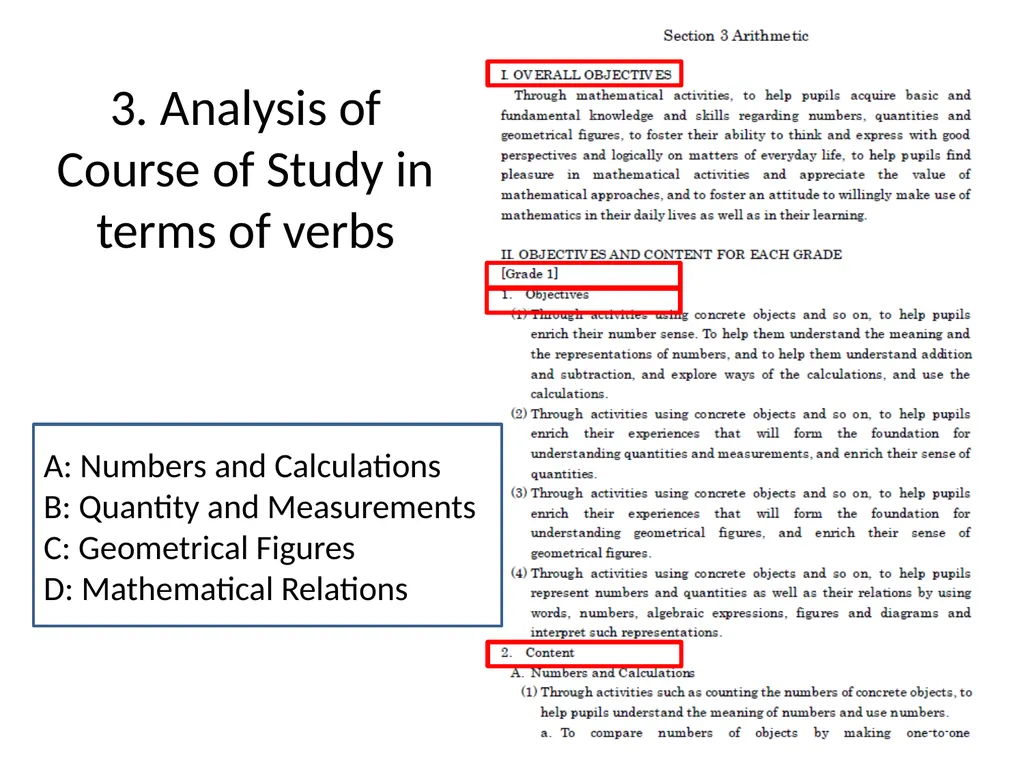
3. Analysis of Course of Study in terms of verbs A: Numbers and Calculations
B: Quantity and Measurements
C: Geometrical Figures
D: Mathematical Relations<br>
B: Quantity and Measurements
C: Geometrical Figures
D: Mathematical Relations<br>
16
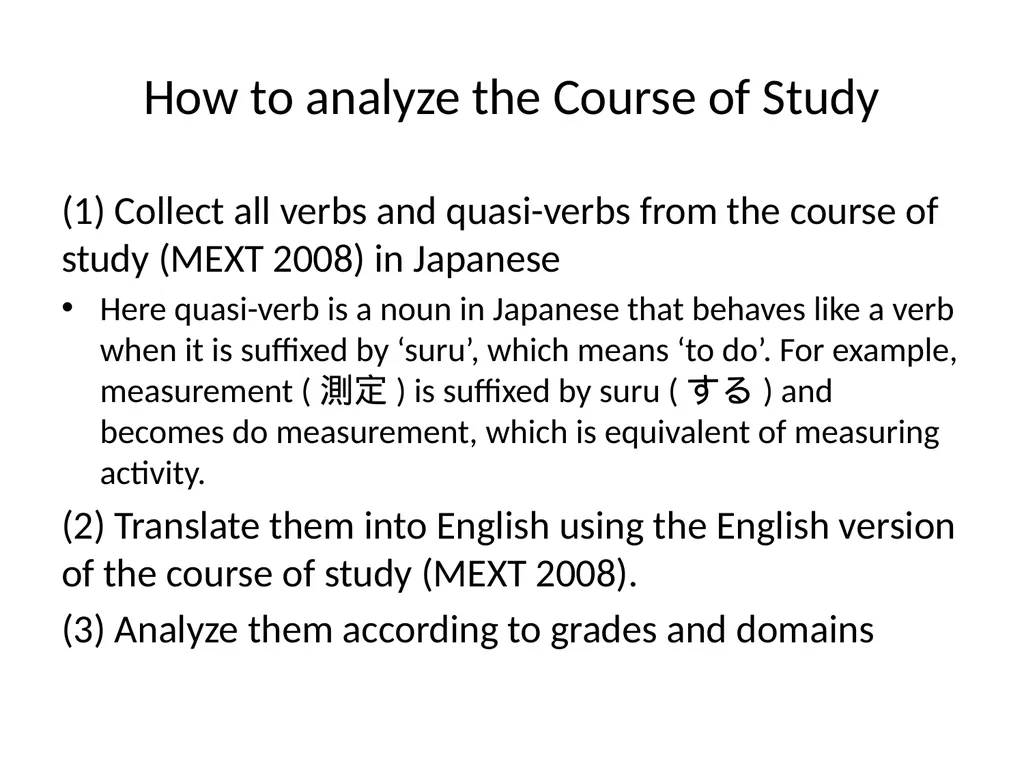
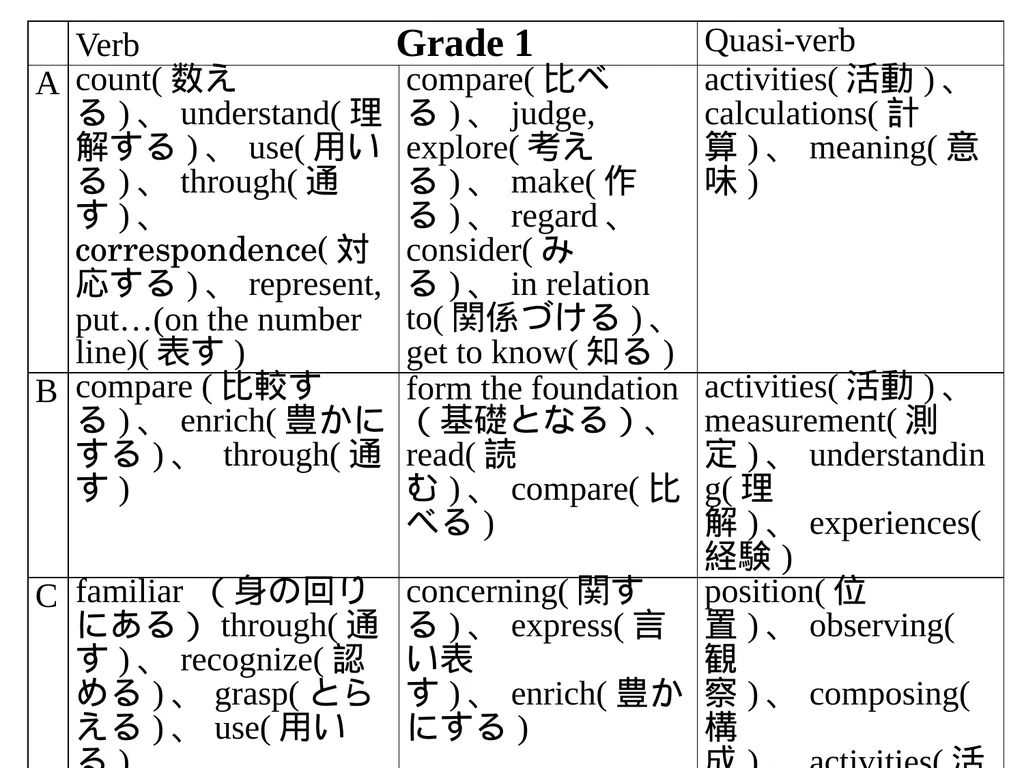
How to analyze the Course of Study (1) Collect all verbs and quasi-verbs from the course of study (MEXT 2008) in Japanese
Here quasi-verb is a noun in Japanese that behaves like a verb when it is suffixed by ‘suru’, which means ‘to do’. For example, measurement (測定) is suffixed by suru (する) and becomes do measurement, which is equivalent of measuring activity.
(2) Translate them into English using the English version of the course of study (MEXT 2008).
(3) Analyze them according to grades and domains<br>
Here quasi-verb is a noun in Japanese that behaves like a verb when it is suffixed by ‘suru’, which means ‘to do’. For example, measurement (測定) is suffixed by suru (する) and becomes do measurement, which is equivalent of measuring activity.
(2) Translate them into English using the English version of the course of study (MEXT 2008).
(3) Analyze them according to grades and domains<br>
17
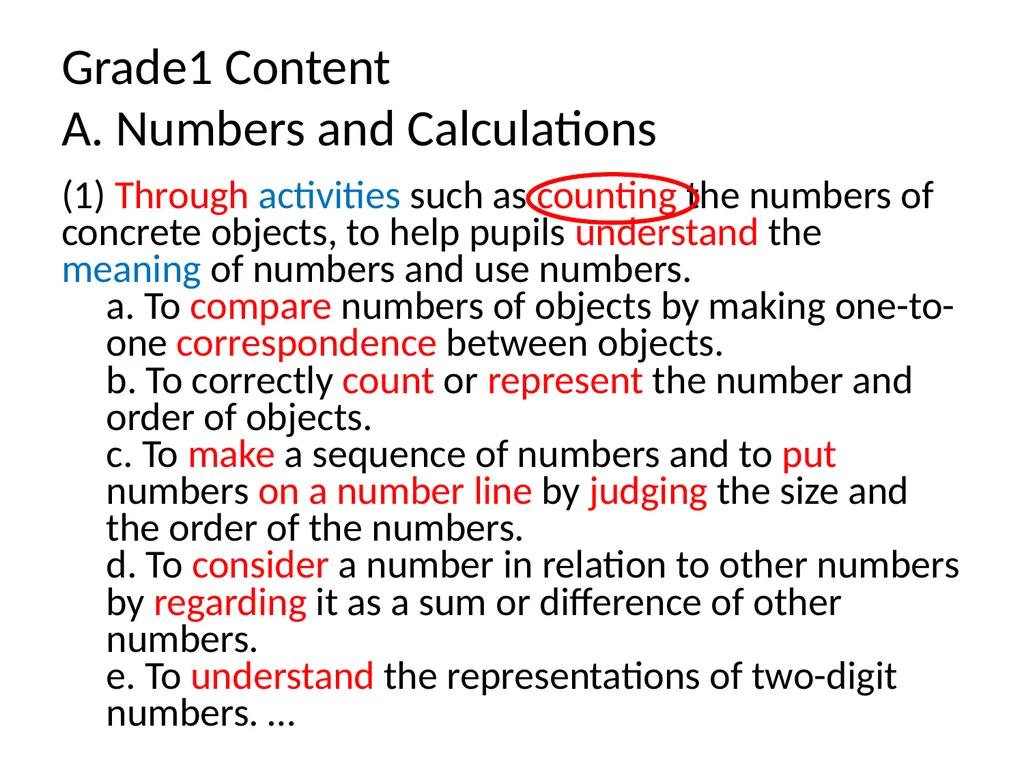
Grade1 Content
A. Numbers and Calculations (1) Through activities such as counting the numbers of concrete objects, to help pupils understand the meaning of numbers and use numbers.
a. To compare numbers of objects by making one-to-one correspondence between objects.
b. To correctly count or represent the number and order of objects.
c. To make a sequence of numbers and to put numbers on a number line by judging the size and the order of the numbers.
d. To consider a number in relation to other numbers by regarding it as a sum or difference of other numbers.
e. To understand the representations of two-digit numbers. …<br>
a. To compare numbers of objects by making one-to-one correspondence between objects.
b. To correctly count or represent the number and order of objects.
c. To make a sequence of numbers and to put numbers on a number line by judging the size and the order of the numbers.
d. To consider a number in relation to other numbers by regarding it as a sum or difference of other numbers.
e. To understand the representations of two-digit numbers. …<br>
18
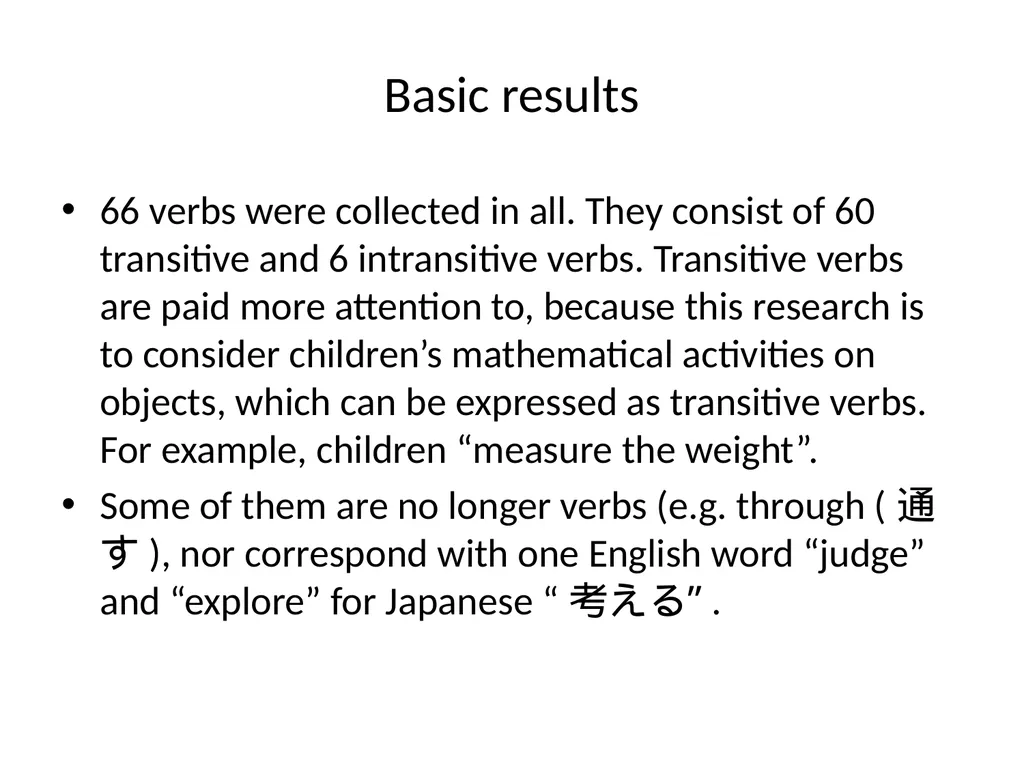
Basic results 66 verbs were collected in all. They consist of 60 transitive and 6 intransitive verbs. Transitive verbs are paid more attention to, because this research is to consider children’s mathematical activities on objects, which can be expressed as transitive verbs. For example, children “measure the weight”.
Some of them are no longer verbs (e.g. through (通す), nor correspond with one English word “judge” and “explore” for Japanese “考える”.<br>
Some of them are no longer verbs (e.g. through (通す), nor correspond with one English word “judge” and “explore” for Japanese “考える”.<br>
19
Further analysis Making activity an object of another activity
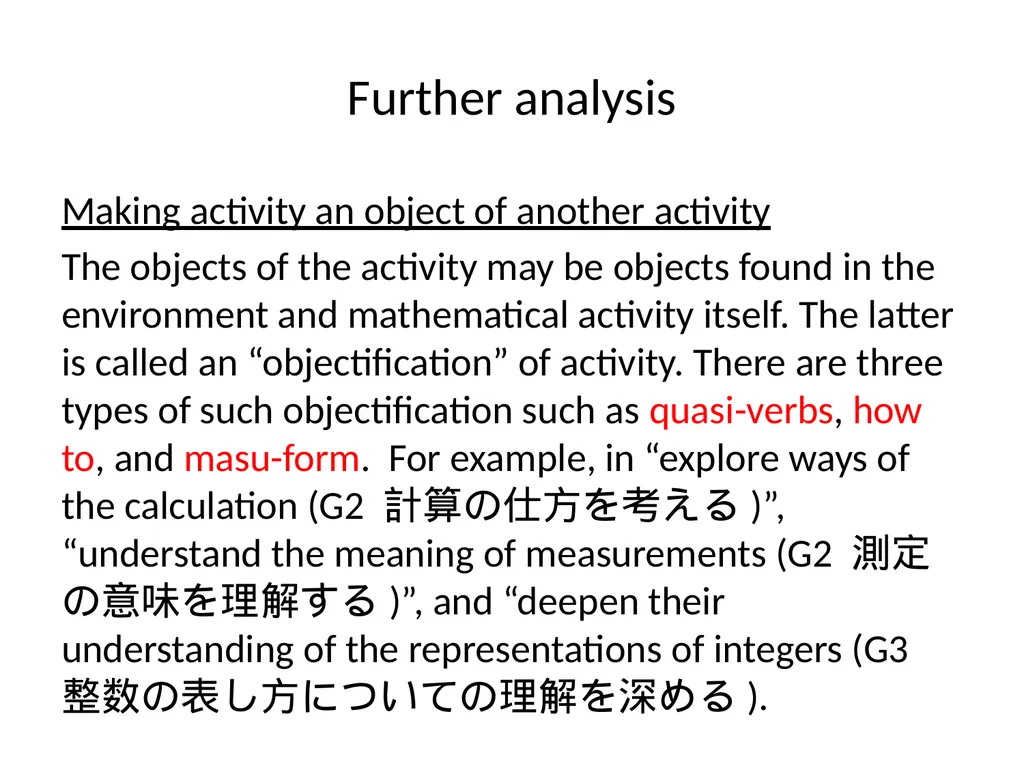
The objects of the activity may be objects found in the environment and mathematical activity itself. The latter is called an “objectification” of activity. There are three types of such objectification such as quasi-verbs, how to, and masu-form. For example, in “explore ways of the calculation (G2 計算の仕方を考える)”, “understand the meaning of measurements (G2 測定の意味を理解する)”, and “deepen their understanding of the representations of integers (G3 整数の表し方についての理解を深める).<br>
The objects of the activity may be objects found in the environment and mathematical activity itself. The latter is called an “objectification” of activity. There are three types of such objectification such as quasi-verbs, how to, and masu-form. For example, in “explore ways of the calculation (G2 計算の仕方を考える)”, “understand the meaning of measurements (G2 測定の意味を理解する)”, and “deepen their understanding of the representations of integers (G3 整数の表し方についての理解を深める).<br>
20
Further analysis The role of verb ‘to deepen’ and ‘to extend’
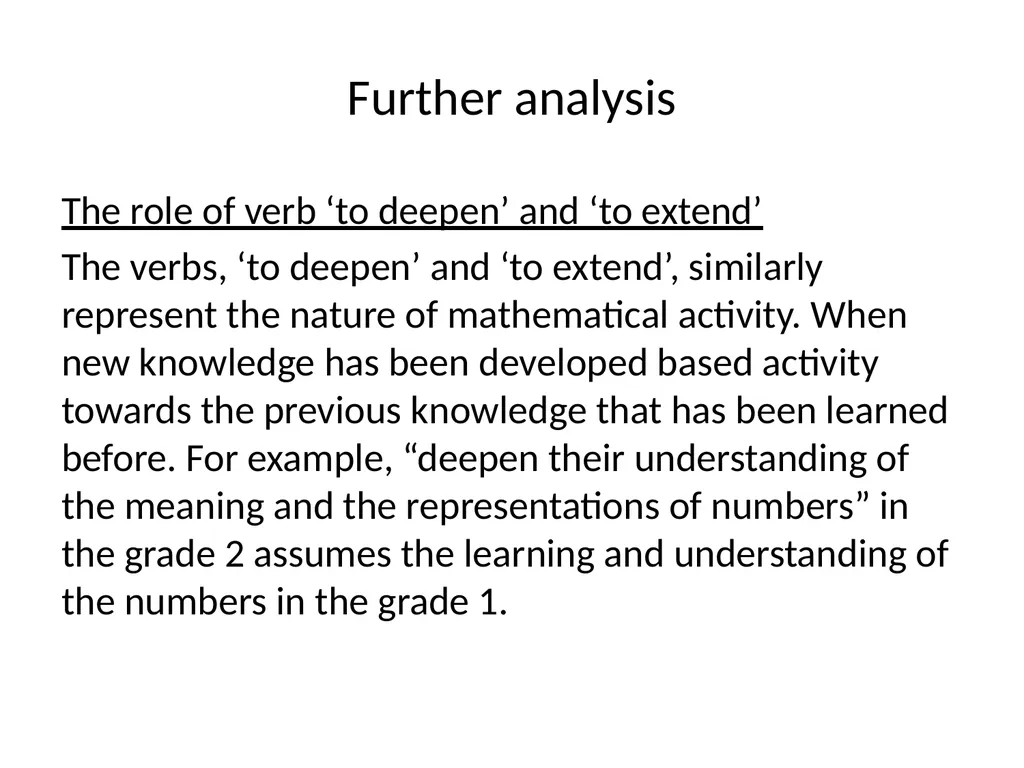
The verbs, ‘to deepen’ and ‘to extend’, similarly represent the nature of mathematical activity. When new knowledge has been developed based activity towards the previous knowledge that has been learned before. For example, “deepen their understanding of the meaning and the representations of numbers” in the grade 2 assumes the learning and understanding of the numbers in the grade 1.<br>
The verbs, ‘to deepen’ and ‘to extend’, similarly represent the nature of mathematical activity. When new knowledge has been developed based activity towards the previous knowledge that has been learned before. For example, “deepen their understanding of the meaning and the representations of numbers” in the grade 2 assumes the learning and understanding of the numbers in the grade 1.<br>
21
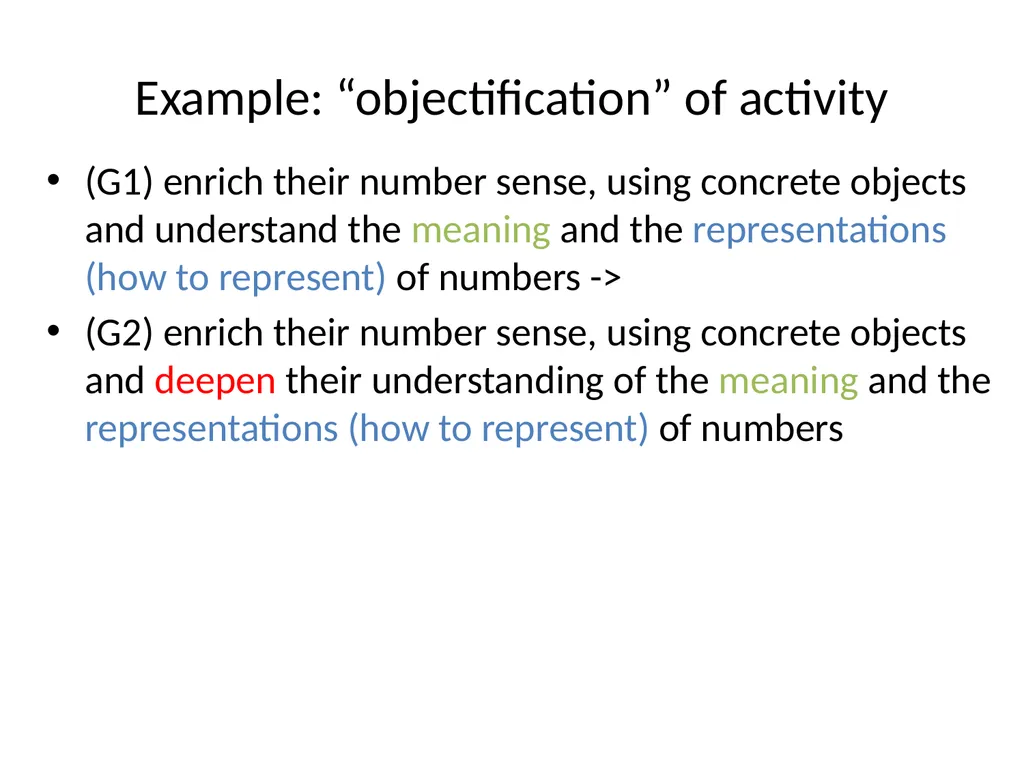
Example: “objectification” of activity (G1) enrich their number sense, using concrete objects and understand the meaning and the representations (how to represent) of numbers ->
(G2) enrich their number sense, using concrete objects and deepen their understanding of the meaning and the representations (how to represent) of numbers<br>
(G2) enrich their number sense, using concrete objects and deepen their understanding of the meaning and the representations (how to represent) of numbers<br>
22
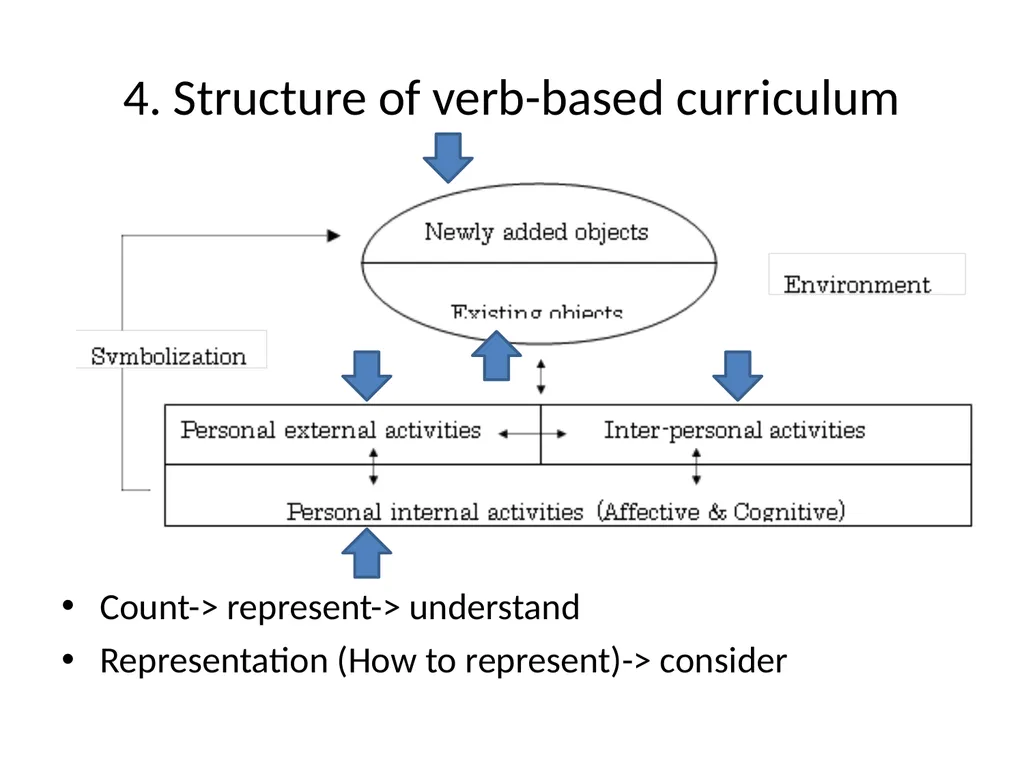
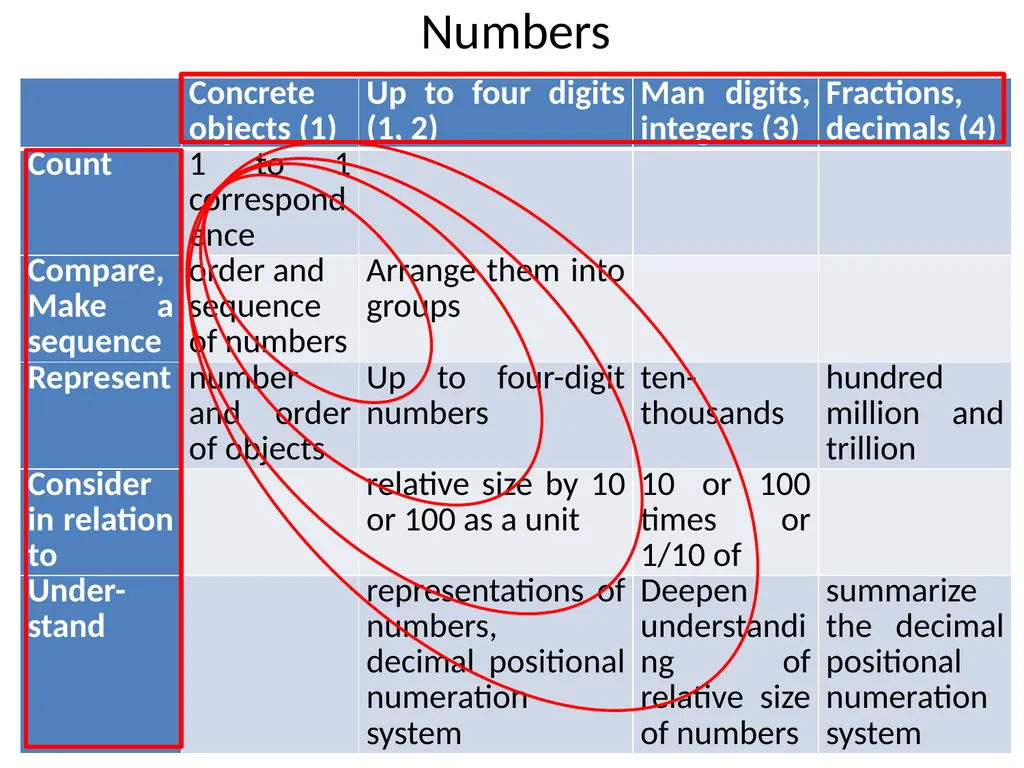
4. Structure of verb-based curriculum Count-> represent-> understand
Representation (How to represent)-> consider<br>
Representation (How to represent)-> consider<br>
23
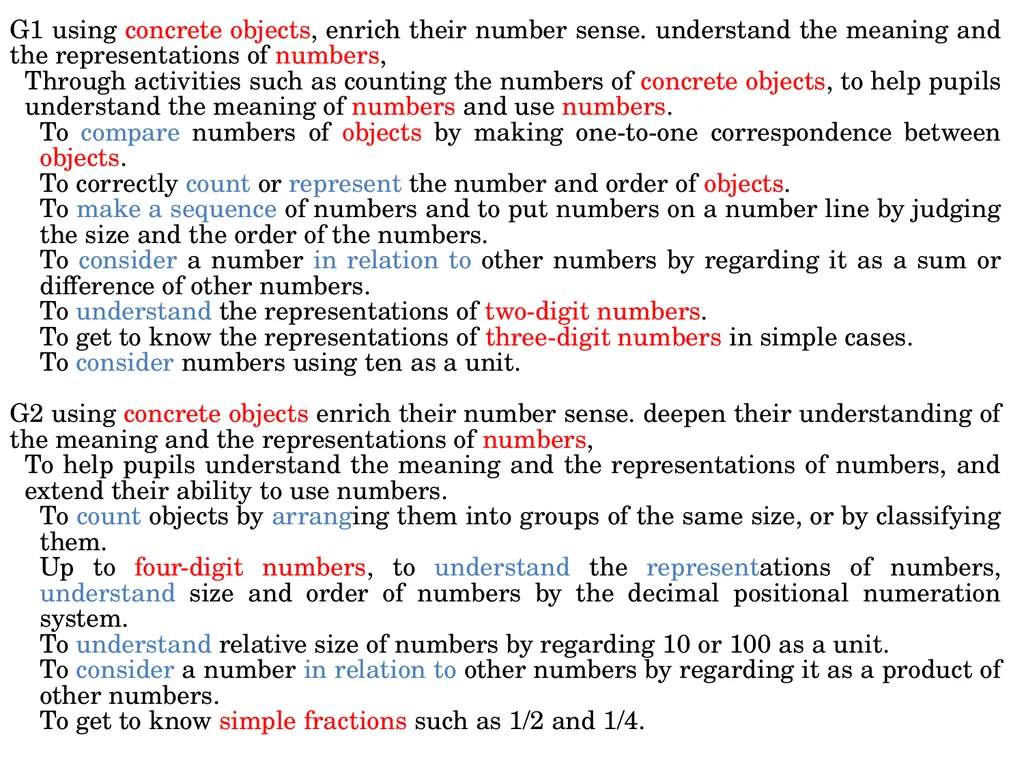
G1 using concrete objects, enrich their number sense. understand the meaning and the representations of numbers,
Through activities such as counting the numbers of concrete objects, to help pupils understand the meaning of numbers and use numbers.
To compare numbers of objects by making one-to-one correspondence between objects.
To correctly count or represent the number and order of objects.
To make a sequence of numbers and to put numbers on a number line by judging the size and the order of the numbers.
To consider a number in relation to other numbers by regarding it as a sum or difference of other numbers.
To understand the representations of two-digit numbers.
To get to know the representations of three-digit numbers in simple cases.
To consider numbers using ten as a unit.
G2 using concrete objects enrich their number sense. deepen their understanding of the meaning and the representations of numbers,
To help pupils understand the meaning and the representations of numbers, and extend their ability to use numbers.
To count objects by arranging them into groups of the same size, or by classifying them.
Up to four-digit numbers, to understand the representations of numbers, understand size and order of numbers by the decimal positional numeration system.
To understand relative size of numbers by regarding 10 or 100 as a unit.
To consider a number in relation to other numbers by regarding it as a product of other numbers.
To get to know simple fractions such as 1/2 and 1/4.<br>
Through activities such as counting the numbers of concrete objects, to help pupils understand the meaning of numbers and use numbers.
To compare numbers of objects by making one-to-one correspondence between objects.
To correctly count or represent the number and order of objects.
To make a sequence of numbers and to put numbers on a number line by judging the size and the order of the numbers.
To consider a number in relation to other numbers by regarding it as a sum or difference of other numbers.
To understand the representations of two-digit numbers.
To get to know the representations of three-digit numbers in simple cases.
To consider numbers using ten as a unit.
G2 using concrete objects enrich their number sense. deepen their understanding of the meaning and the representations of numbers,
To help pupils understand the meaning and the representations of numbers, and extend their ability to use numbers.
To count objects by arranging them into groups of the same size, or by classifying them.
Up to four-digit numbers, to understand the representations of numbers, understand size and order of numbers by the decimal positional numeration system.
To understand relative size of numbers by regarding 10 or 100 as a unit.
To consider a number in relation to other numbers by regarding it as a product of other numbers.
To get to know simple fractions such as 1/2 and 1/4.<br>
24
Numbers<br>
25
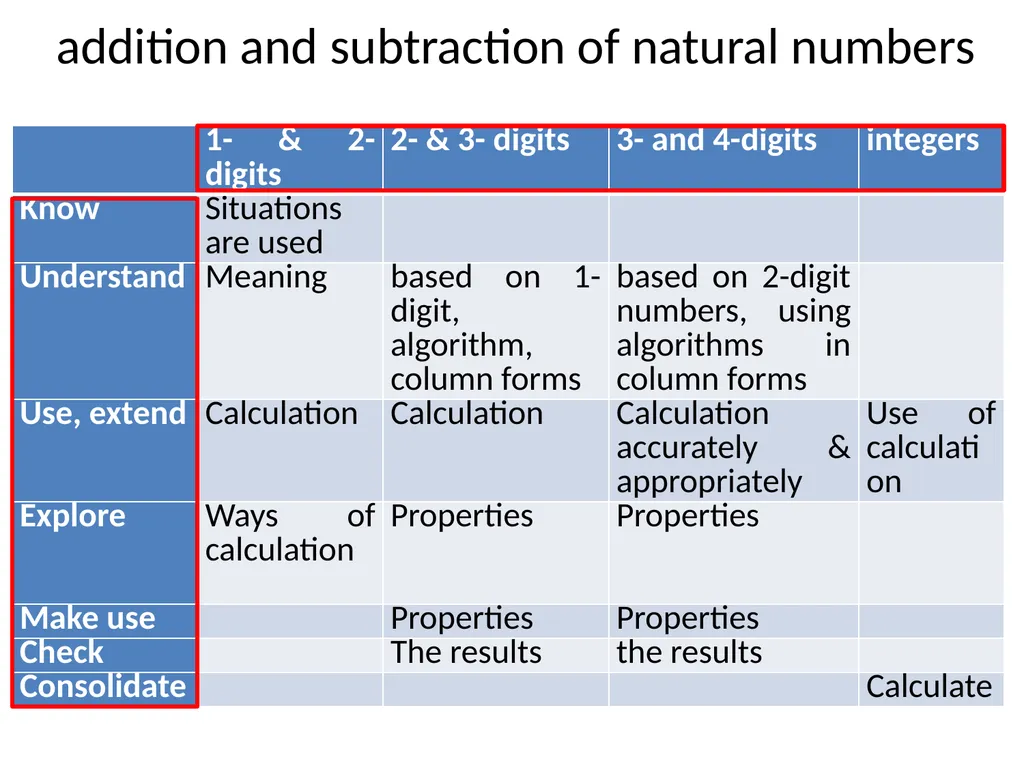
addition and subtraction of natural numbers<br>
26
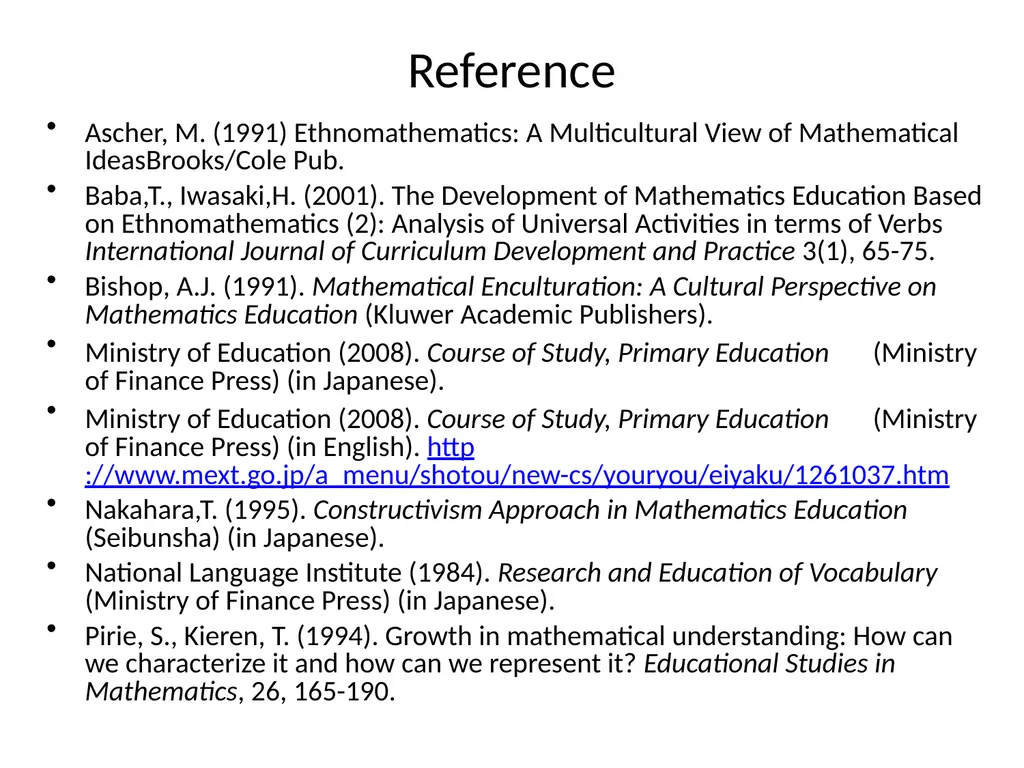
Reference Ascher, M. (1991) Ethnomathematics: A Multicultural View of Mathematical IdeasBrooks/Cole Pub.
Baba,T., Iwasaki,H. (2001). The Development of Mathematics Education Based on Ethnomathematics (2): Analysis of Universal Activities in terms of Verbs International Journal of Curriculum Development and Practice 3(1), 65-75.
Bishop, A.J. (1991). Mathematical Enculturation: A Cultural Perspective on Mathematics Education (Kluwer Academic Publishers).
Ministry of Education (2008). Course of Study, Primary Education (Ministry of Finance Press) (in Japanese).
Ministry of Education (2008). Course of Study, Primary Education (Ministry of Finance Press) (in English). http://www.mext.go.jp/a_menu/shotou/new-cs/youryou/eiyaku/1261037.htm
Nakahara,T. (1995). Constructivism Approach in Mathematics Education (Seibunsha) (in Japanese).
National Language Institute (1984). Research and Education of Vocabulary (Ministry of Finance Press) (in Japanese).
Pirie, S., Kieren, T. (1994). Growth in mathematical understanding: How can we characterize it and how can we represent it? Educational Studies in Mathematics, 26, 165-190.<br>
Baba,T., Iwasaki,H. (2001). The Development of Mathematics Education Based on Ethnomathematics (2): Analysis of Universal Activities in terms of Verbs International Journal of Curriculum Development and Practice 3(1), 65-75.
Bishop, A.J. (1991). Mathematical Enculturation: A Cultural Perspective on Mathematics Education (Kluwer Academic Publishers).
Ministry of Education (2008). Course of Study, Primary Education (Ministry of Finance Press) (in Japanese).
Ministry of Education (2008). Course of Study, Primary Education (Ministry of Finance Press) (in English). http://www.mext.go.jp/a_menu/shotou/new-cs/youryou/eiyaku/1261037.htm
Nakahara,T. (1995). Constructivism Approach in Mathematics Education (Seibunsha) (in Japanese).
National Language Institute (1984). Research and Education of Vocabulary (Ministry of Finance Press) (in Japanese).
Pirie, S., Kieren, T. (1994). Growth in mathematical understanding: How can we characterize it and how can we represent it? Educational Studies in Mathematics, 26, 165-190.<br>