04
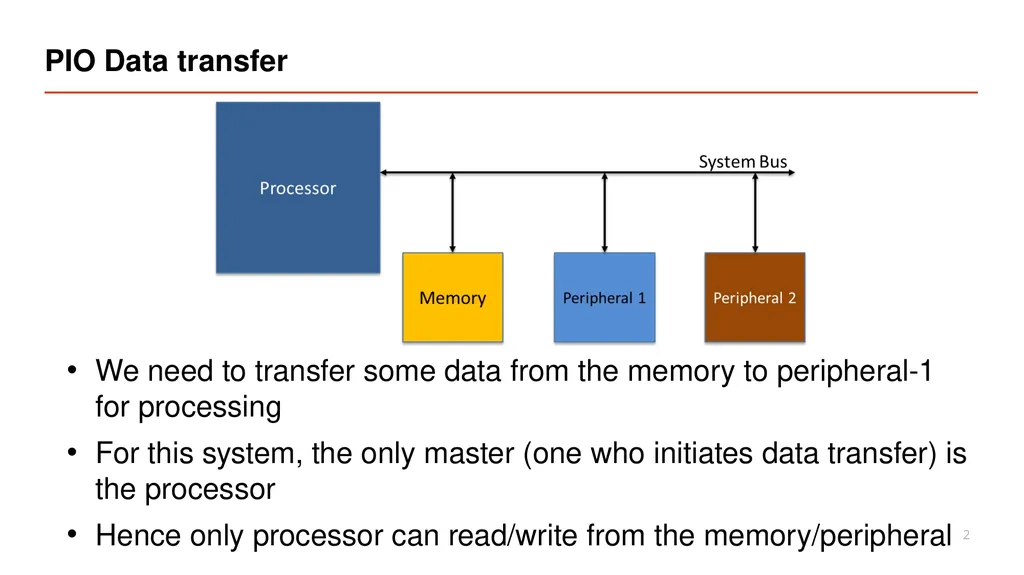
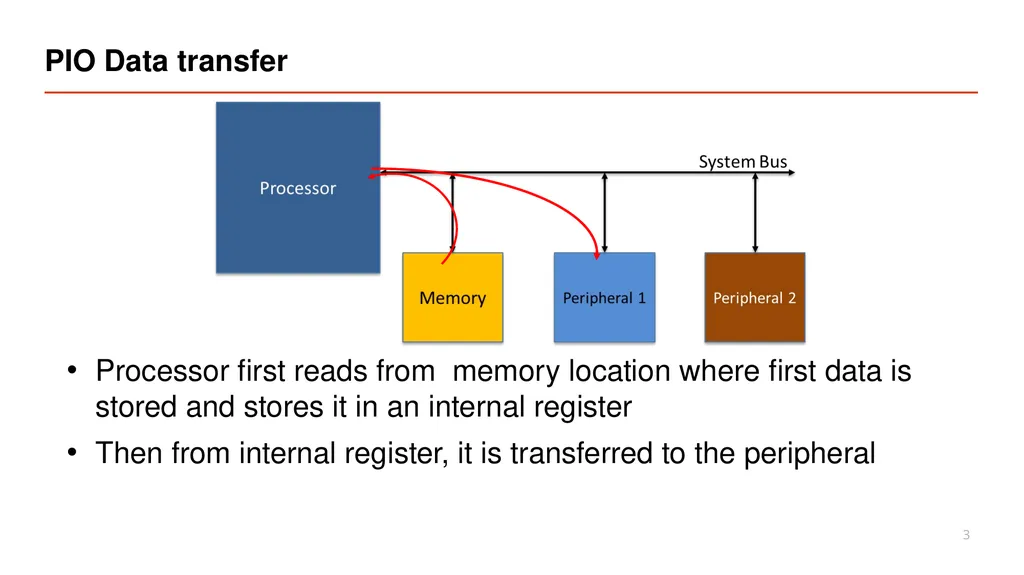
PIO Data transfer 4 One data transfer involves one read and write under processor supervision
Each read/write operation takes several clock cycles to complete
When large data transfer is involved between memory and peripheral, this method is very inefficient
For example a 1080p video frame is stored in memory and needs to be transferred to the display controller
If PIO method is followed most probably the performance requirement of 50 fps won’t be met<br>
05
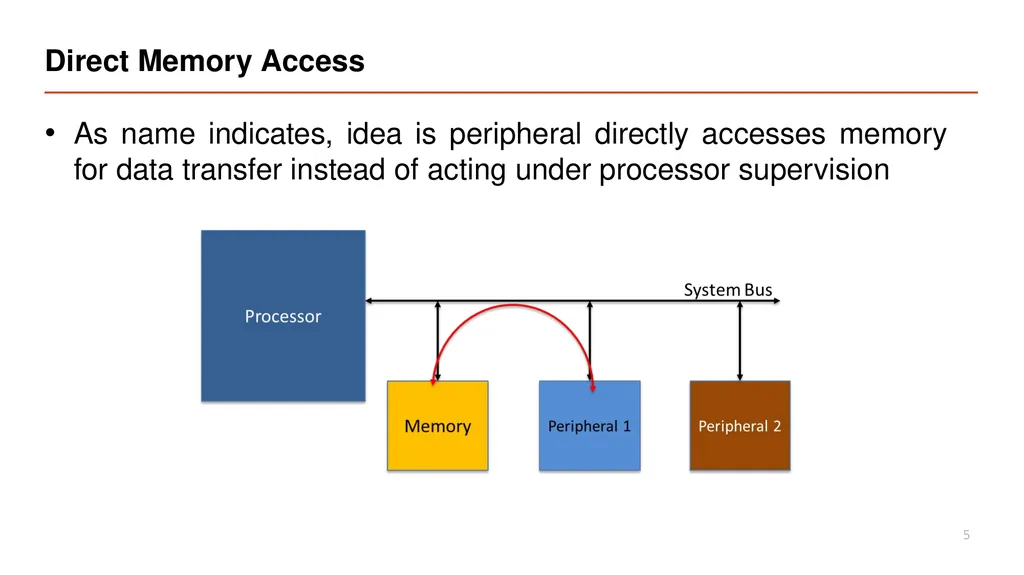
Direct Memory Access 5 As name indicates, idea is peripheral directly accesses memory for data transfer instead of acting under processor supervision<br>
06
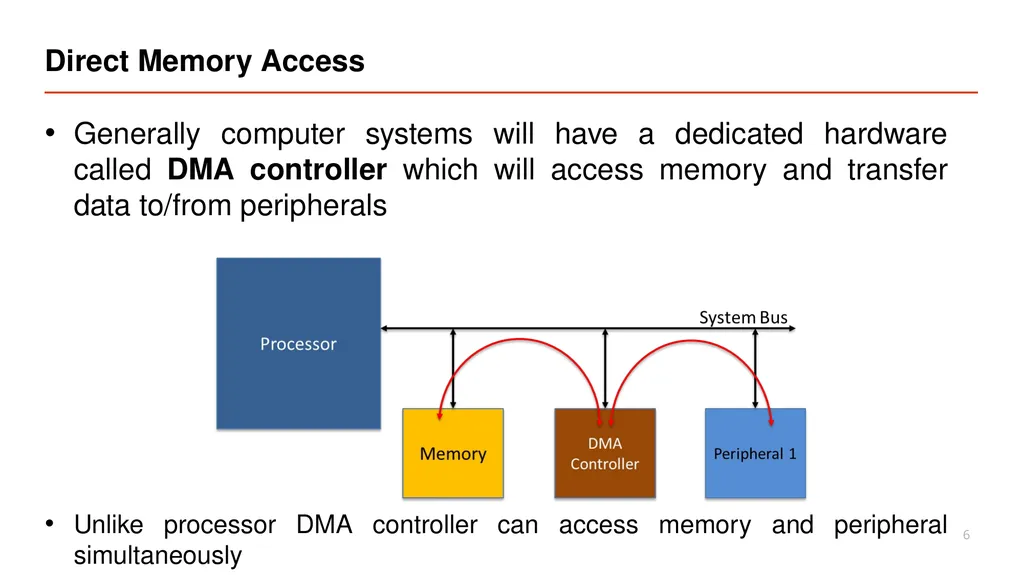
Direct Memory Access 6 Generally computer systems will have a dedicated hardware called DMA controller which will access memory and transfer data to/from peripherals Unlike processor DMA controller can access memory and peripheral simultaneously<br>
07
Direct Memory Access 7 Remember only masters can initiate data transfer
Since the DMA controller is managing data transfer here, needs to be a master
Now there are two masters in out system, the processor and the DMA controller
At a given point in time, only one master can use the system bus, otherwise two circuits will try to drive the same wire which will cause issues
So there should be some mechanism, which decides which master gets to use the system bus
This mechanism is called bus arbitration<br>
08
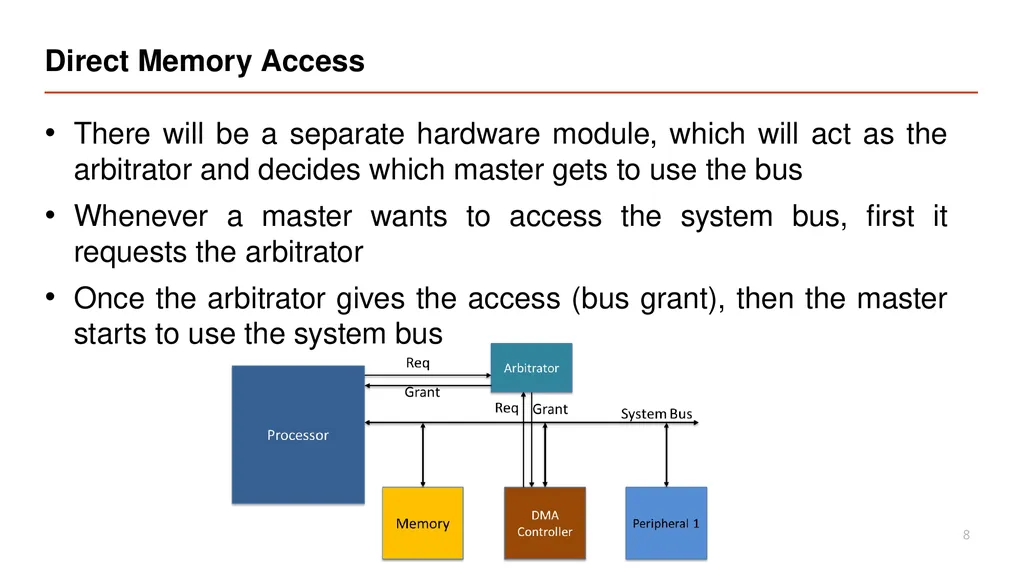
Direct Memory Access 8 There will be a separate hardware module, which will act as the arbitrator and decides which master gets to use the bus
Whenever a master wants to access the system bus, first it requests the arbitrator
Once the arbitrator gives the access (bus grant), then the master starts to use the system bus<br>
09
Bus Arbitration 9 But how does the arbitrator know to which master the bus access should be given?
That is based on arbitration policy
There can be multiple policies, such as fixed time division multiple access (TDMA), where time is divided into multiple slots of equal duration and each master is given chance to access the bus for one time slot
Bus this could waste time since even if a master doesn’t require to access the bus, it is given the bus control for a time slot
Another popular policy is round robin arbitration<br>
10
Bus Arbitration 10 Here only if one master is requesting for the bus, it will be given the bus access. But if more than one master requests for the bus, the master who accessed the bus most recently gets the least priority
There can be other more complex policies such as round robin with priorities. Here each master is assigned a priority and the master with highest priority gets the access<br>
11
DMA advantages 11 Since DMA happens mostly under hardware control, it is much faster than PIO although here also each transfer includes one read and one write
Bus the main advantage is the processor is freed from data transfer and can do some other useful processing since data transfer is now managed by the DMA controller
In modern system a lot of data is stored in the cache memory hence the processor doesn’t need to access the memory frequently
But when it has to, now a bus arbitration should happen since DMA controller is also trying to access the memory<br>
12
12 But how does the DMA controller know it needs to do a data transfer and from where to where it need to do it?
That happens under s/w control from the processor!!
So the DMA controller is a master all other peripherals, but it is still a slave to the processor
When the processor finds out it need to transfer large data between memory and the peripherals, it configures the DMA controller (configures the internal registers of the DMA controller)
It basically needs to configure three information
Starting address from where data has to be transferred
Starting address where the data has to be stored
Total length of the data transfer Configuring DMA Controller<br>
13
13 Once these information is configured, the processor configures the control register of the DMA controller to start the data transfer
Once the data transfer is over, the processor finds it out either by reading the status register of the controller or through the interrupt signal from the controller Configuring DMA Controller<br>
14
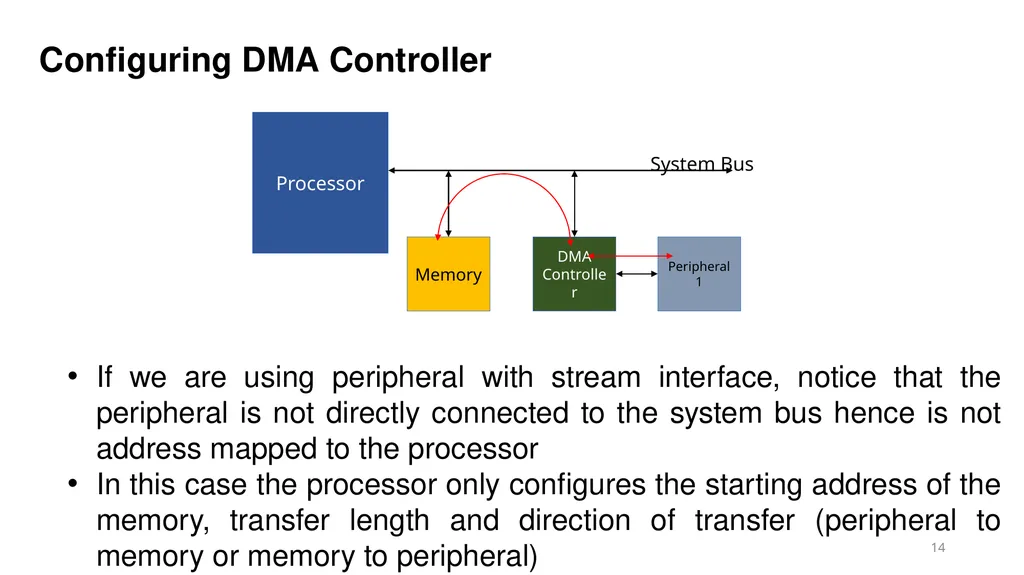
Configuring DMA Controller 14 Processor System Bus Memory DMA Controller Peripheral 1 If we are using peripheral with stream interface, notice that the peripheral is not directly connected to the system bus hence is not address mapped to the processor
In this case the processor only configures the starting address of the memory, transfer length and direction of transfer (peripheral to memory or memory to peripheral)<br>
15
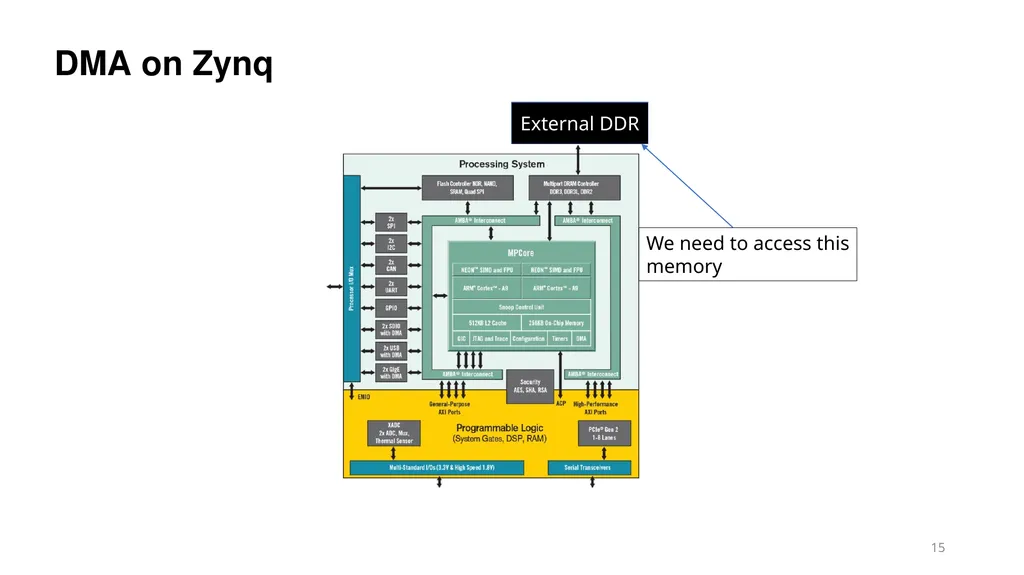
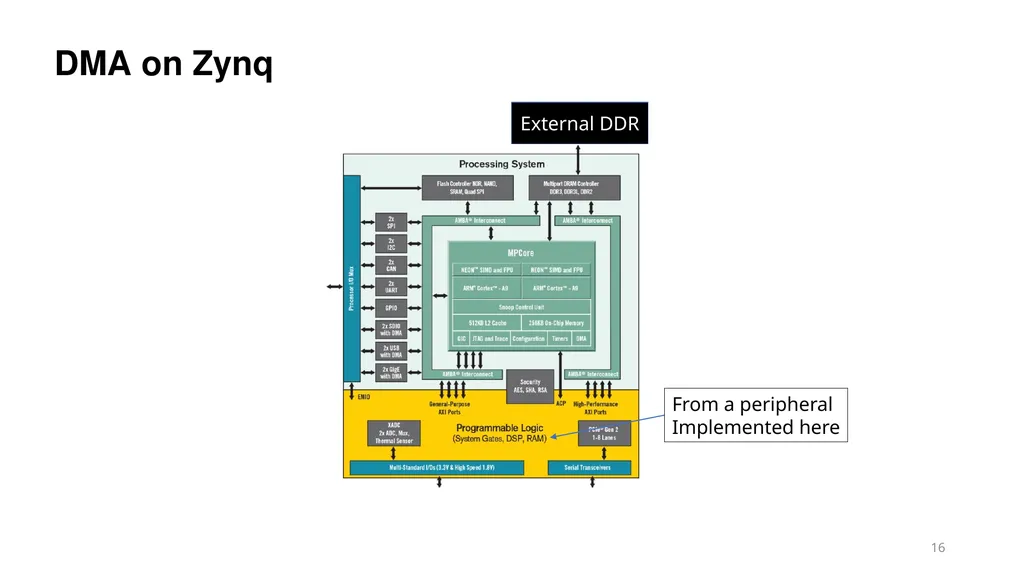
15 External DDR We need to access this
memory DMA on Zynq<br>
16
16 External DDR From a peripheral
Implemented here DMA on Zynq<br>
17
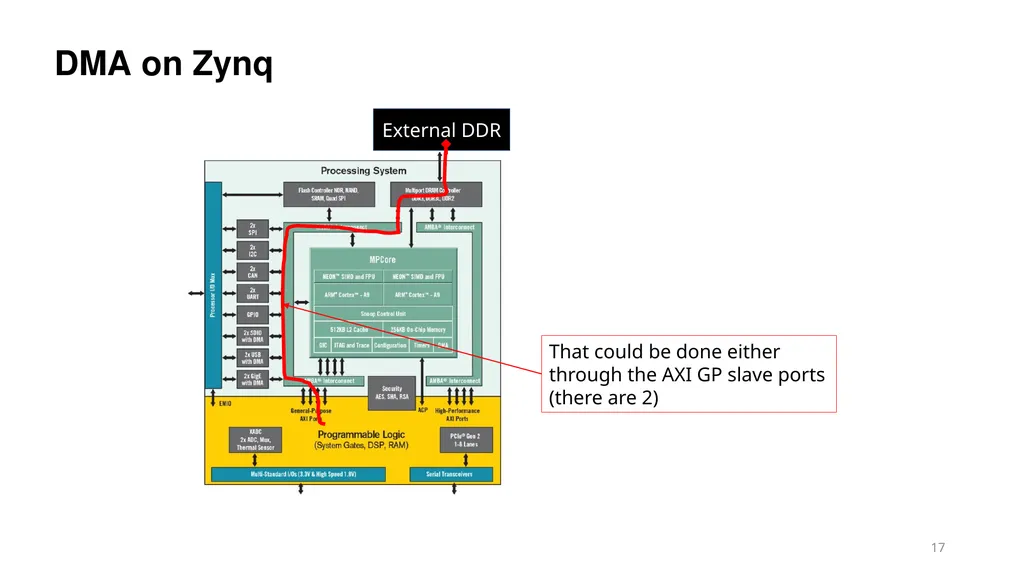
17 External DDR That could be done either through the AXI GP slave ports (there are 2) DMA on Zynq<br>
18
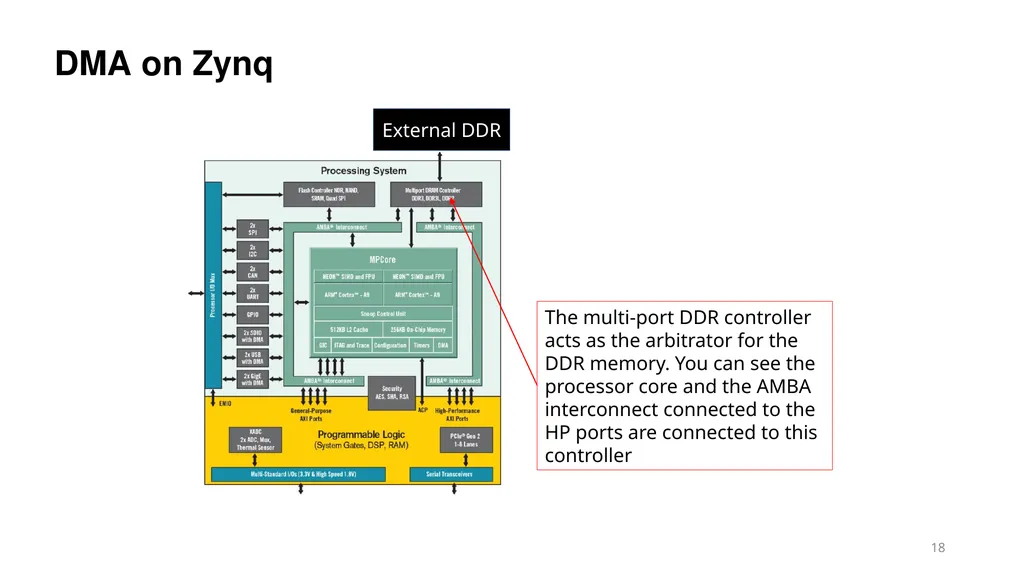
DMA on Zynq 18 External DDR The multi-port DDR controller acts as the arbitrator for the DDR memory. You can see the processor core and the AMBA interconnect connected to the HP ports are connected to this controller<br>
19
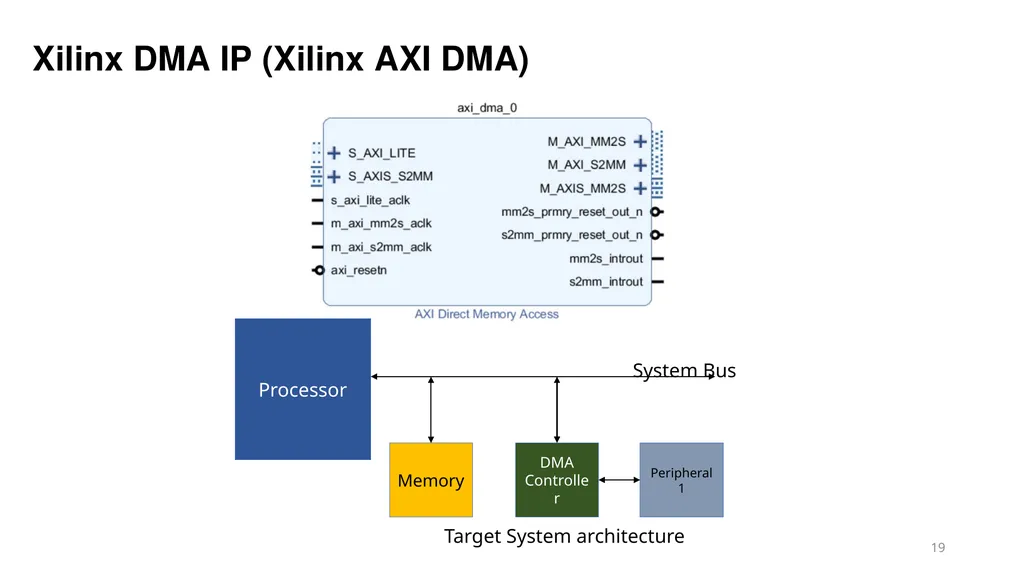
Xilinx DMA IP (Xilinx AXI DMA) 19 Processor System Bus Memory DMA Controller Peripheral 1 Target System architecture<br>
20
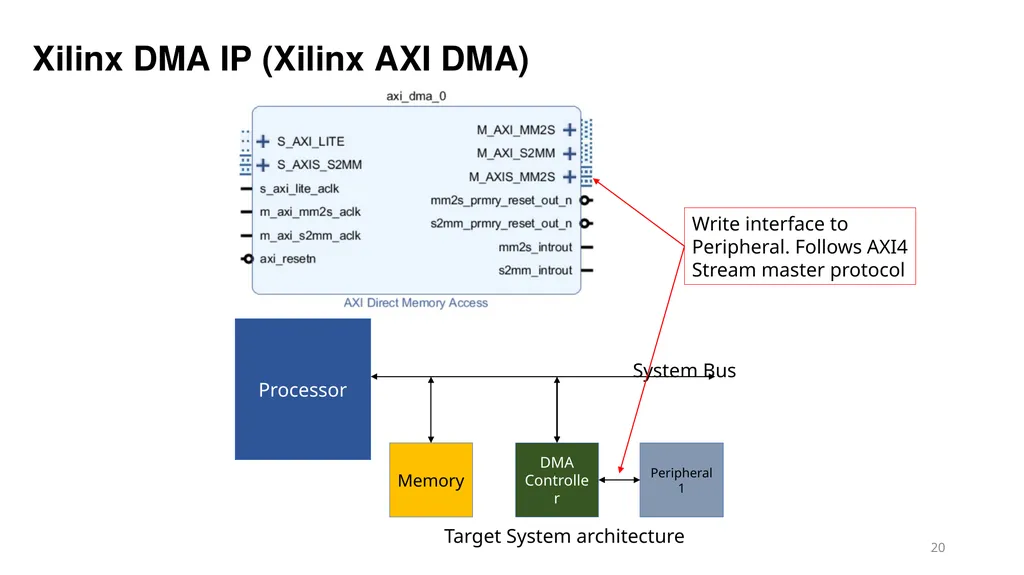
20 Processor System Bus Memory DMA Controller Peripheral 1 Target System architecture Write interface to
Peripheral. Follows AXI4
Stream master protocol Xilinx DMA IP (Xilinx AXI DMA)<br>
21
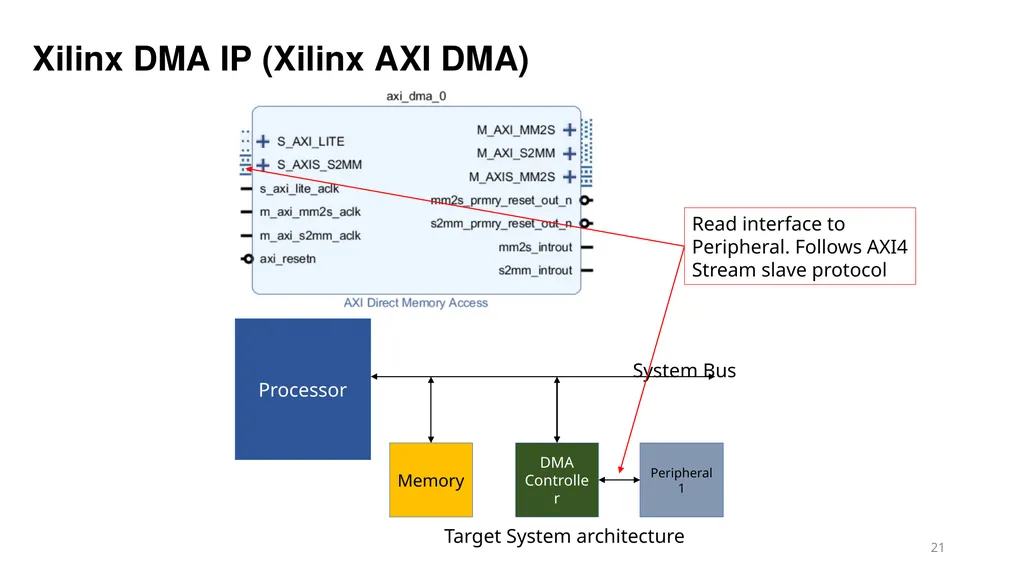
21 Processor System Bus Memory DMA Controller Peripheral 1 Target System architecture Read interface to
Peripheral. Follows AXI4
Stream slave protocol Xilinx DMA IP (Xilinx AXI DMA)<br>
22
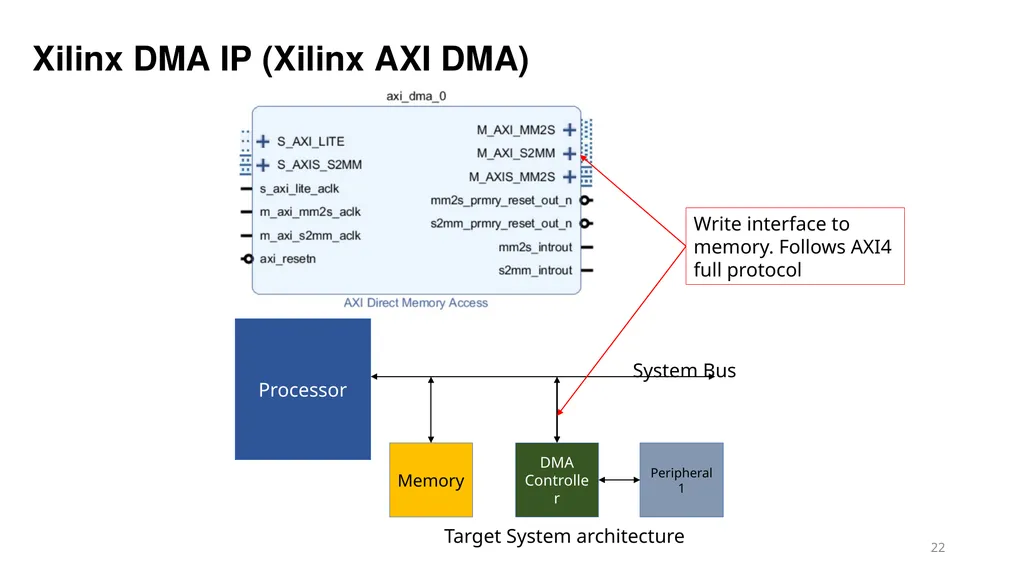
22 Processor System Bus Memory DMA Controller Peripheral 1 Target System architecture Write interface to
memory. Follows AXI4
full protocol Xilinx DMA IP (Xilinx AXI DMA)<br>
23
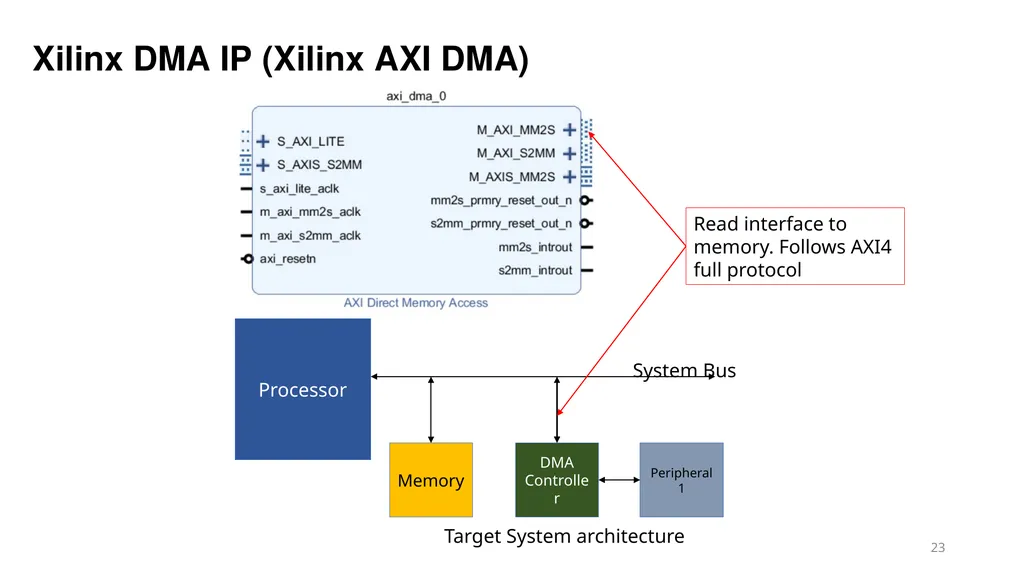
23 Processor System Bus Memory DMA Controller Peripheral 1 Target System architecture Read interface to
memory. Follows AXI4
full protocol Xilinx DMA IP (Xilinx AXI DMA)<br>
24
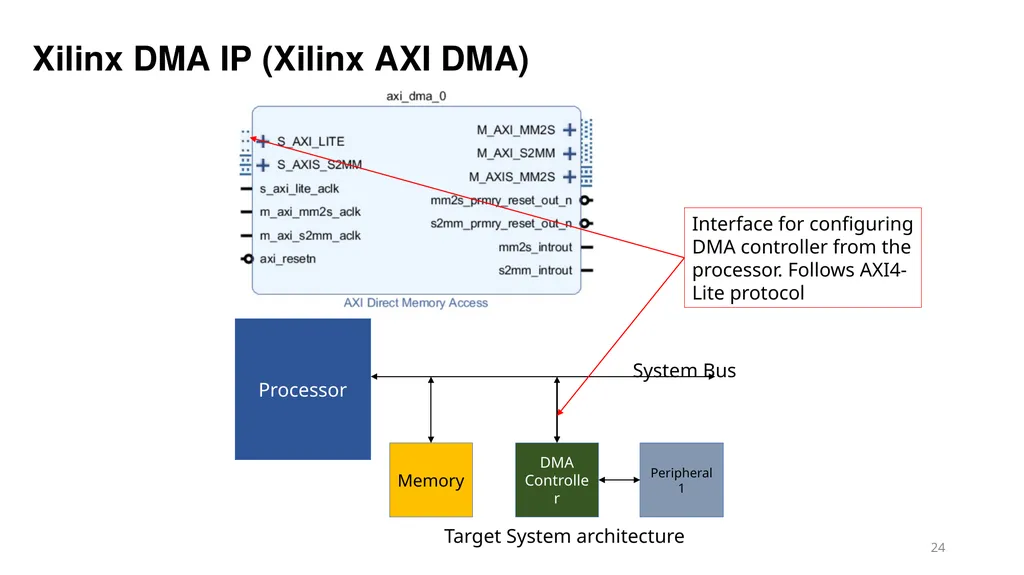
24 Processor System Bus Memory DMA Controller Peripheral 1 Target System architecture Interface for configuring
DMA controller from the
processor. Follows AXI4-
Lite protocol Xilinx DMA IP (Xilinx AXI DMA)<br>
25
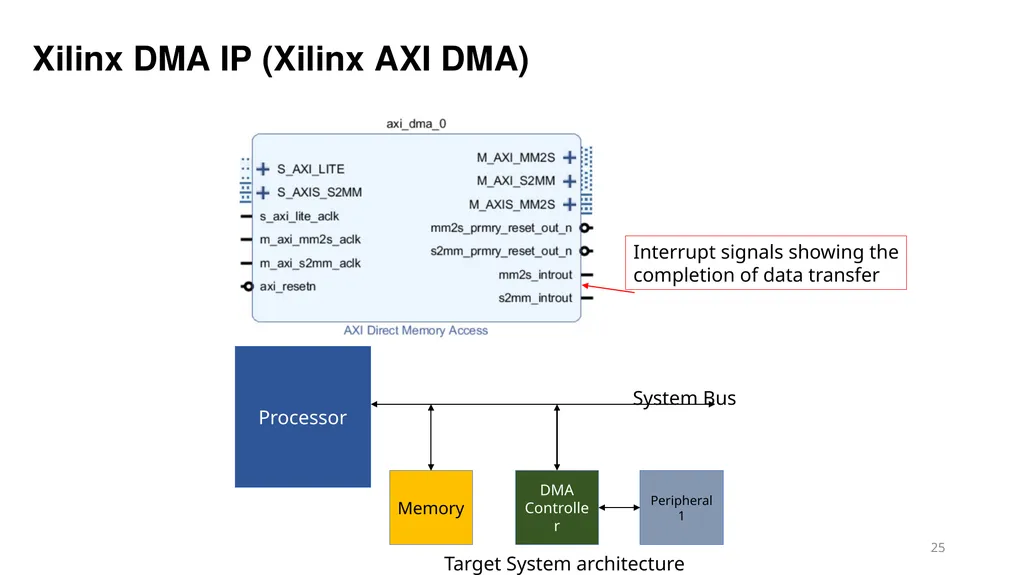
25 Processor System Bus Memory DMA Controller Peripheral 1 Target System architecture Interrupt signals showing the
completion of data transfer Xilinx DMA IP (Xilinx AXI DMA)<br>
26
26 Thank you any questions<br>