Visual Narratives in Advertising Case Study: Wallis Dress to Kill Context The Wallis Dress to Kill advertising campaign, launched in 1998, was a landmark in fashion marketing. Created by Bartle Bogle Hegarty (BBH), the campaign was a
"Visual Narratives in Advertising Case Study:" is the property of its rightful owner. Permission is granted to
download and print the materials on this website for personal, non-commercial use only, and to display it
on your personal computer provided you do not modify the materials and that you retain all copyright
notices contained in the materials. By downloading content from our website, you accept the terms of this
agreement.
Presentation Transcript
01
Visual Narratives in Advertising Case Study: Wallis Dress to Kill<br>
02
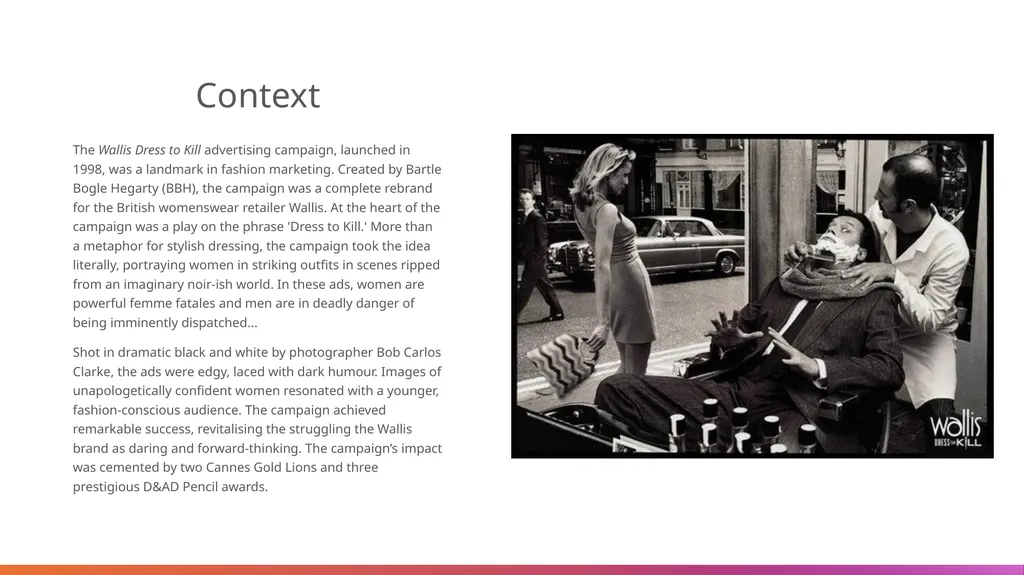
Context The Wallis Dress to Kill advertising campaign, launched in 1998, was a landmark in fashion marketing. Created by Bartle Bogle Hegarty (BBH), the campaign was a complete rebrand for the British womenswear retailer Wallis. At the heart of the campaign was a play on the phrase 'Dress to Kill.' More than a metaphor for stylish dressing, the campaign took the idea literally, portraying women in striking outfits in scenes ripped from an imaginary noir-ish world. In these ads, women are powerful femme fatales and men are in deadly danger of being imminently dispatched...
Shot in dramatic black and white by photographer Bob Carlos Clarke, the ads were edgy, laced with dark humour. Images of unapologetically confident women resonated with a younger, fashion-conscious audience. The campaign achieved remarkable success, revitalising the struggling the Wallis brand as daring and forward-thinking. The campaign’s impact was cemented by two Cannes Gold Lions and three prestigious D&AD Pencil awards.<br>
03
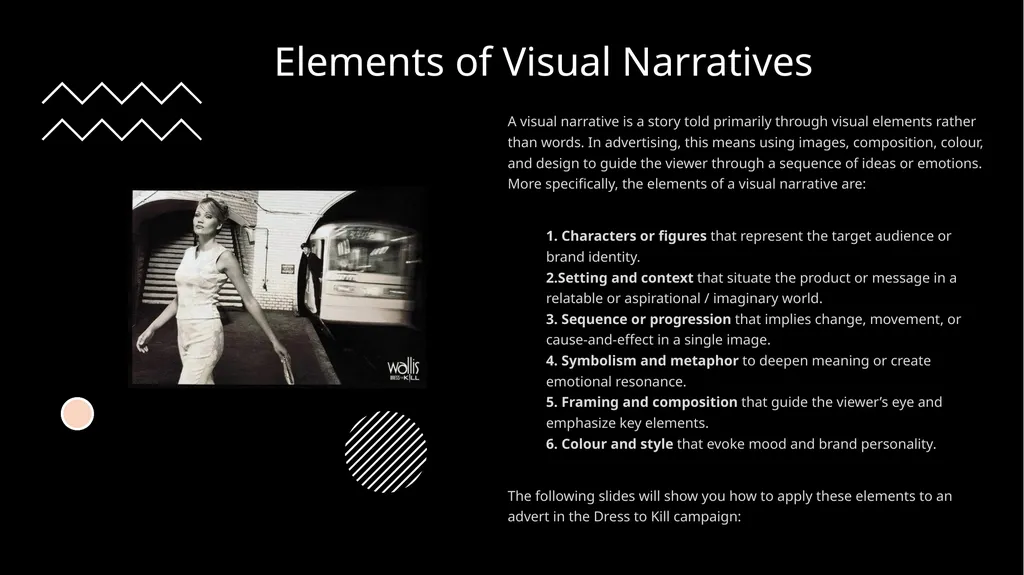
Elements of Visual Narratives A visual narrative is a story told primarily through visual elements rather than words. In advertising, this means using images, composition, colour, and design to guide the viewer through a sequence of ideas or emotions. More specifically, the elements of a visual narrative are:
1. Characters or figures that represent the target audience or brand identity.
2.Setting and context that situate the product or message in a relatable or aspirational / imaginary world.
3. Sequence or progression that implies change, movement, or cause-and-effect in a single image.
4. Symbolism and metaphor to deepen meaning or create emotional resonance.
5. Framing and composition that guide the viewer’s eye and emphasize key elements.
6. Colour and style that evoke mood and brand personality.
The following slides will show you how to apply these elements to an advert in the Dress to Kill campaign:<br>
04
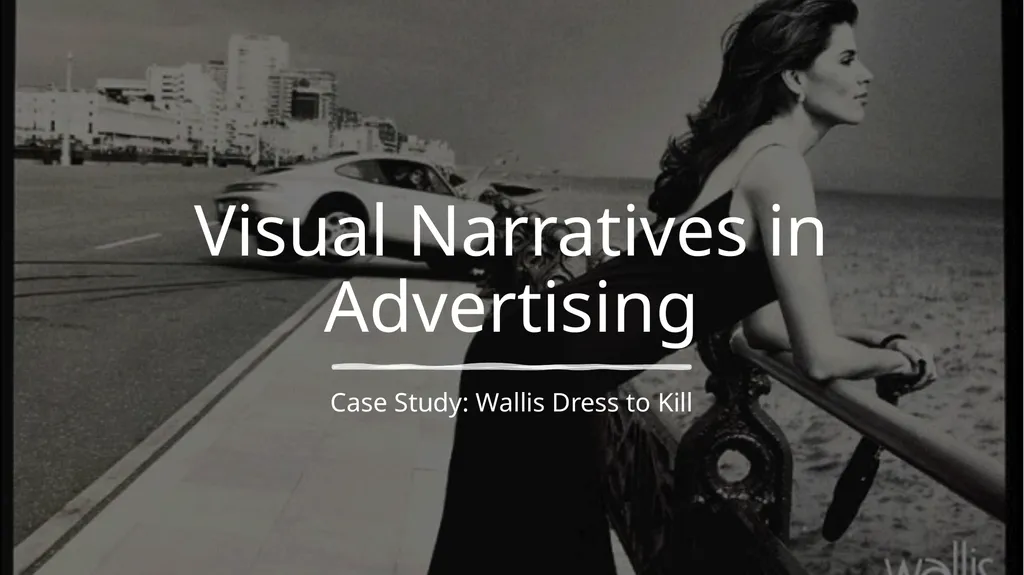
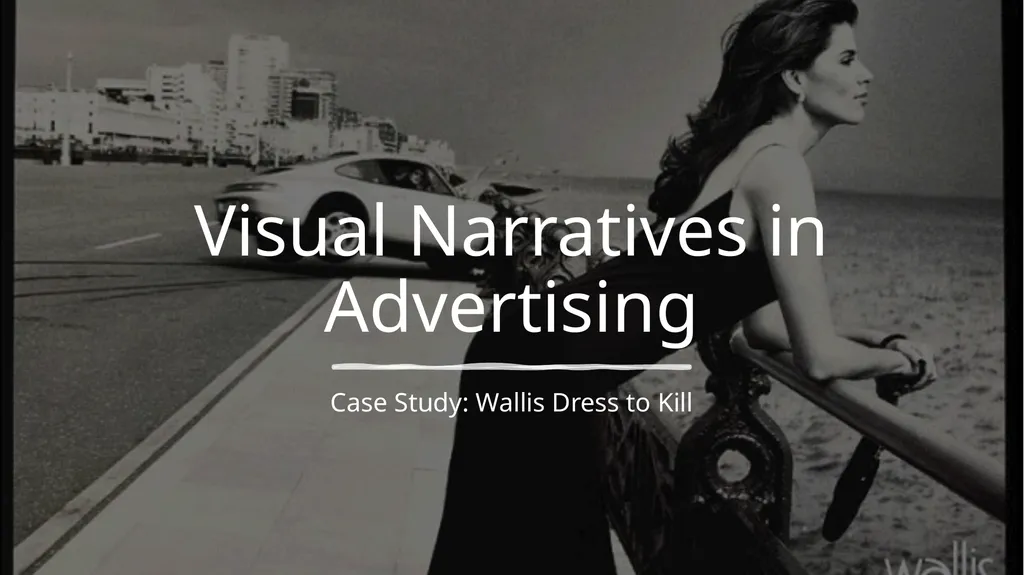
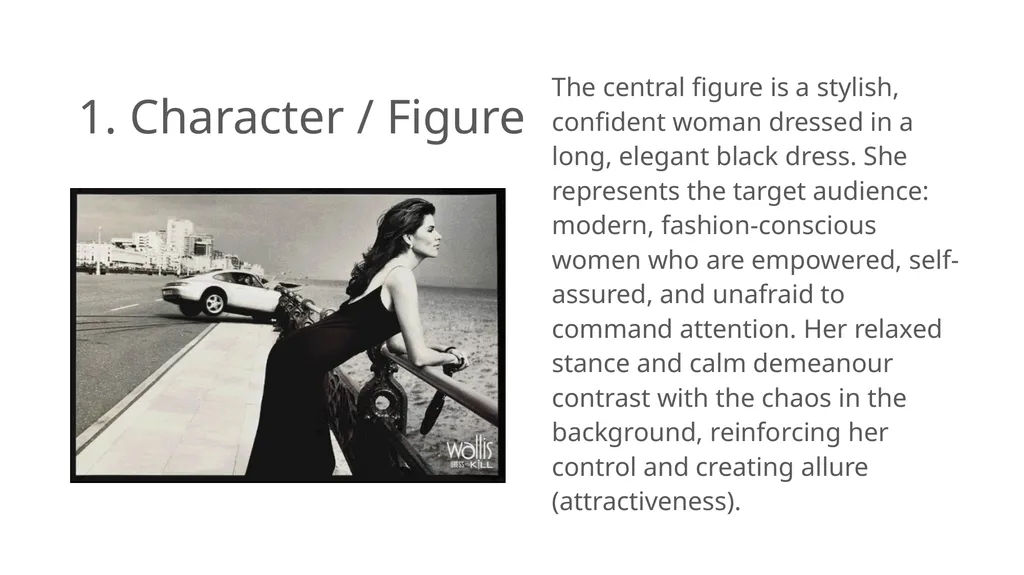
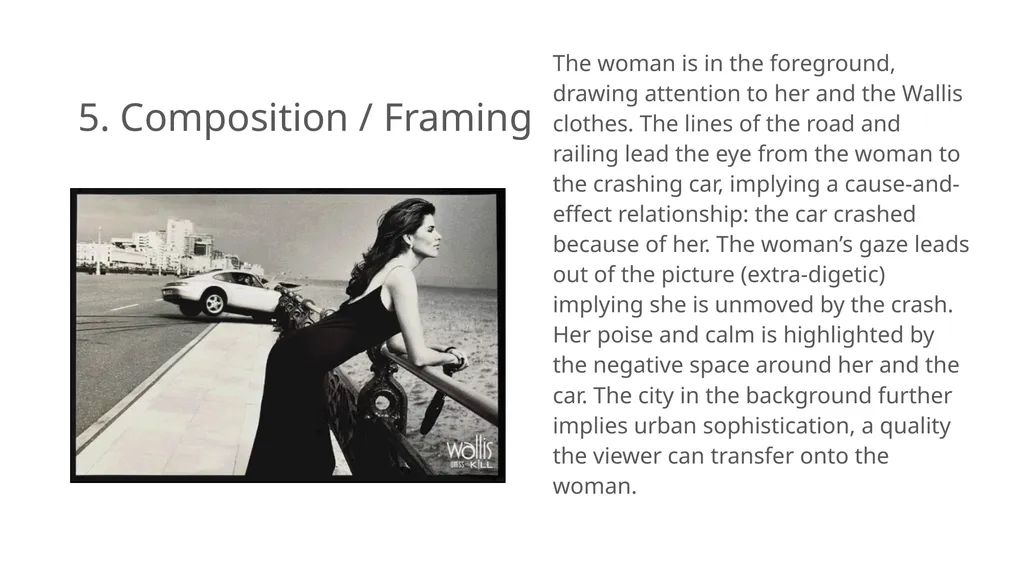
1. Character / Figure The central figure is a stylish, confident woman dressed in a long, elegant black dress. She represents the target audience: modern, fashion-conscious women who are empowered, self-assured, and unafraid to command attention. Her relaxed stance and calm demeanour contrast with the chaos in the background, reinforcing her control and creating allure (attractiveness).<br>
05
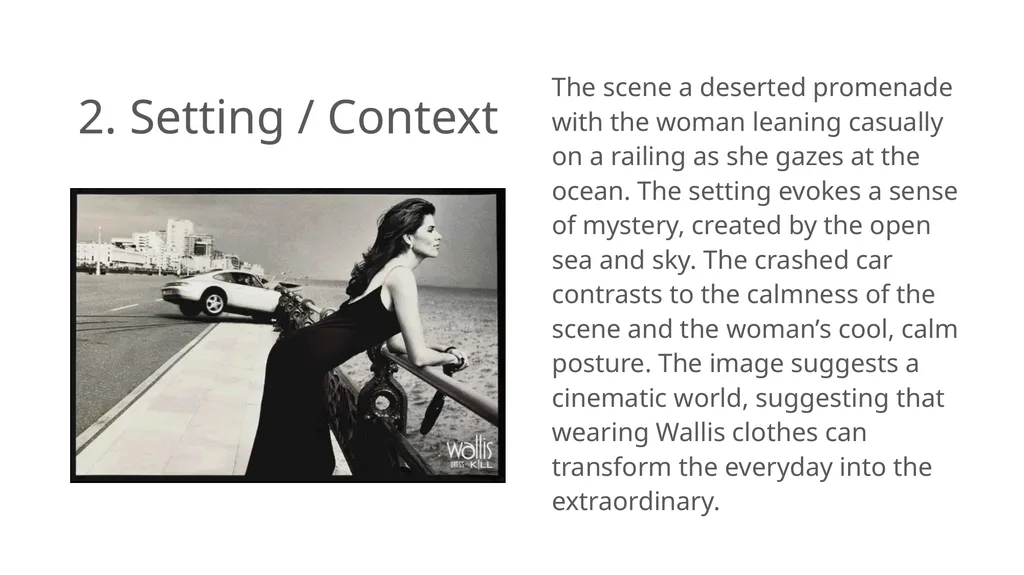
2. Setting / Context The scene a deserted promenade with the woman leaning casually on a railing as she gazes at the ocean. The setting evokes a sense of mystery, created by the open sea and sky. The crashed car contrasts to the calmness of the scene and the woman’s cool, calm posture. The image suggests a cinematic world, suggesting that wearing Wallis clothes can transform the everyday into the extraordinary.<br>
06
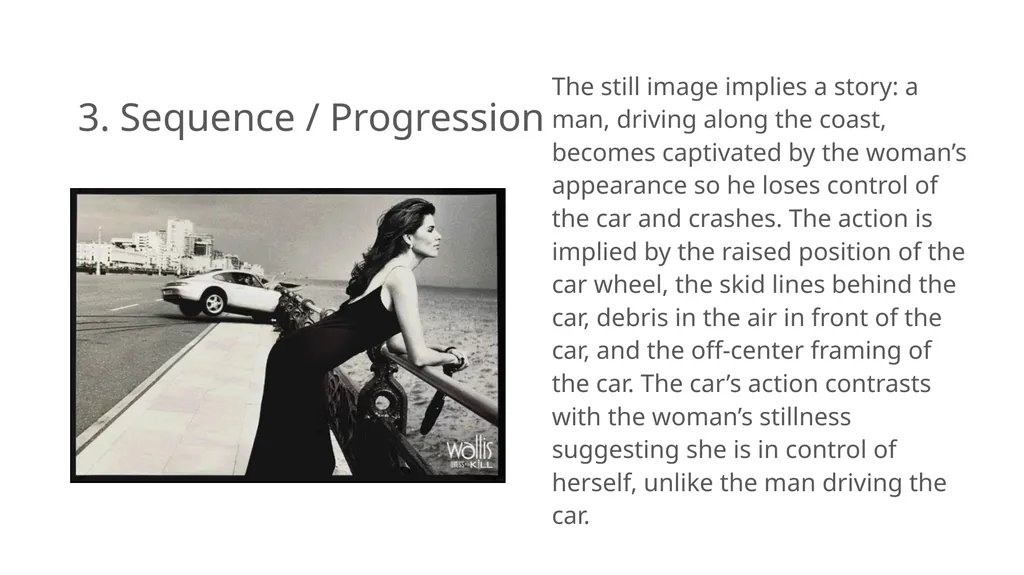
3. Sequence / Progression The still image implies a story: a man, driving along the coast, becomes captivated by the woman’s appearance so he loses control of the car and crashes. The action is implied by the raised position of the car wheel, the skid lines behind the car, debris in the air in front of the car, and the off-center framing of the car. The car’s action contrasts with the woman’s stillness suggesting she is in control of herself, unlike the man driving the car.<br>
07
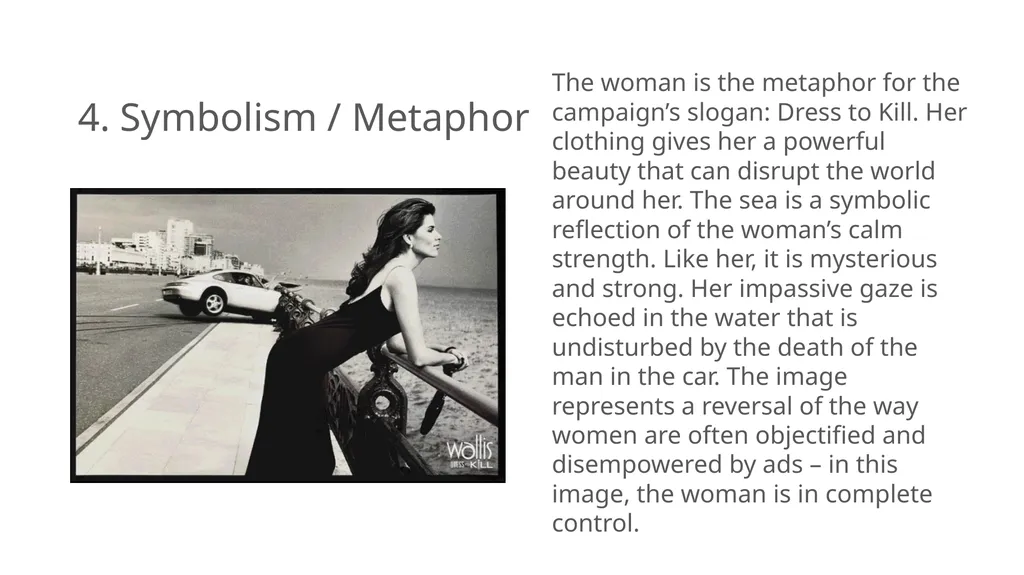
4. Symbolism / Metaphor The woman is the metaphor for the campaign’s slogan: Dress to Kill. Her clothing gives her a powerful beauty that can disrupt the world around her. The sea is a symbolic reflection of the woman’s calm strength. Like her, it is mysterious and strong. Her impassive gaze is echoed in the water that is undisturbed by the death of the man in the car. The image represents a reversal of the way women are often objectified and disempowered by ads – in this image, the woman is in complete control.<br>
08
5. Composition / Framing The woman is in the foreground, drawing attention to her and the Wallis clothes. The lines of the road and railing lead the eye from the woman to the crashing car, implying a cause-and-effect relationship: the car crashed because of her. The woman’s gaze leads out of the picture (extra-digetic) implying she is unmoved by the crash. Her poise and calm is highlighted by the negative space around her and the car. The city in the background further implies urban sophistication, a quality the viewer can transfer onto the woman.<br>
09
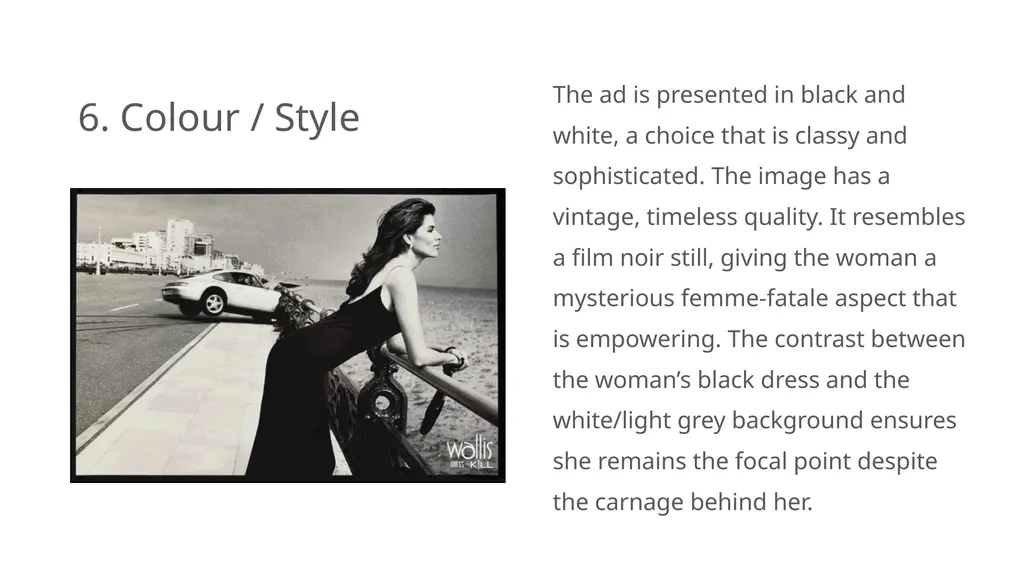
6. Colour / Style The ad is presented in black and white, a choice that is classy and sophisticated. The image has a vintage, timeless quality. It resembles a film noir still, giving the woman a mysterious femme-fatale aspect that is empowering. The contrast between the woman’s black dress and the white/light grey background ensures she remains the focal point despite the carnage behind her.<br>
10
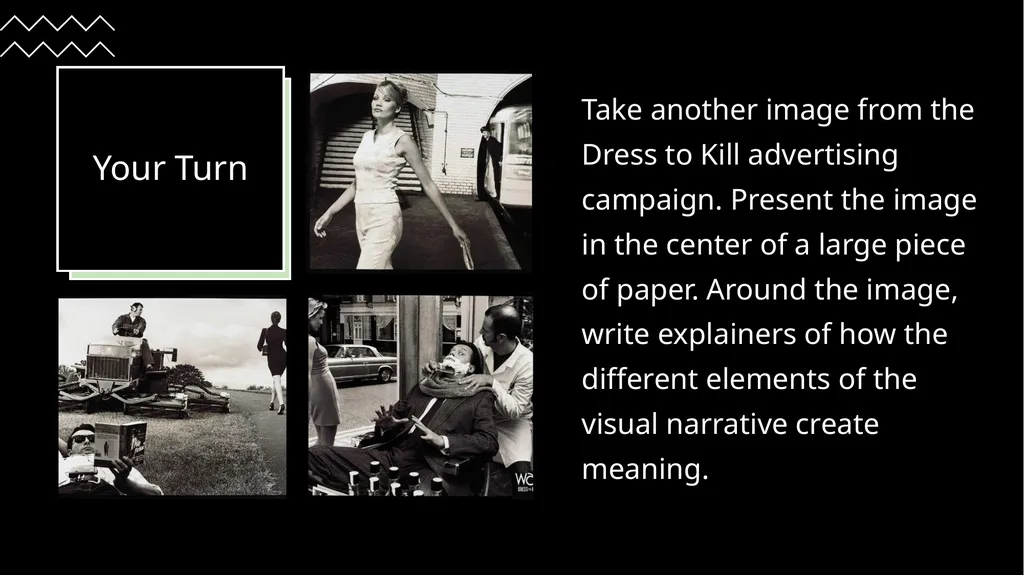
Your Turn Take another image from the Dress to Kill advertising campaign. Present the image in the center of a large piece of paper. Around the image, write explainers of how the different elements of the visual narrative create meaning.<br>
11
Follow- Up Task (choose 1) Research a different ad campaign produced by a different brand(such as Nike’s Just Do It) that relies on strong visual narratives to create meaning and emotion. Create a PPT to teach others about visual narratives using this campaign.
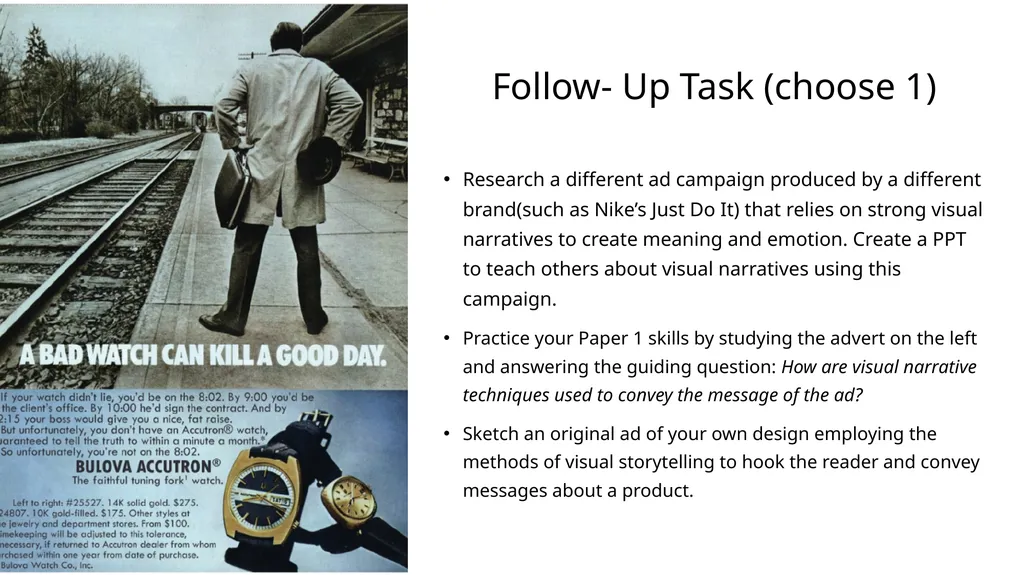
Practice your Paper 1 skills by studying the advert on the left and answering the guiding question: How are visual narrative techniques used to convey the message of the ad?
Sketch an original ad of your own design employing the methods of visual storytelling to hook the reader and convey messages about a product.<br>