Welcome to Student Success Services We Support Students with Learning Barriers What is a Learning Barrier? Disability related - Learning disability, Cognitive disability, ADHD, Mental Health, Medical needs Personal - death, break up,
Related Topics
Share
Embed code
Download this presentation From Below
"Welcome to Student Success Services We Support" is the property of its rightful owner. Permission is granted to
download and print the materials on this website for personal, non-commercial use only, and to display it
on your personal computer provided you do not modify the materials and that you retain all copyright
notices contained in the materials. By downloading content from our website, you accept the terms of this
agreement.
Presentation Transcript
01
Welcome to Student Success Services<br>
02
We Support Students with Learning Barriers What is a “Learning Barrier”?
Disability related
- Learning disability, Cognitive disability, ADHD, Mental Health, Medical needs
Personal
- death, break up, uncertain about program, experienced trauma, academic mediation
Uncertain or Academic Skill related
- student may have an IEP with no formal diagnosis, do accommodations need to continue?<br>
03
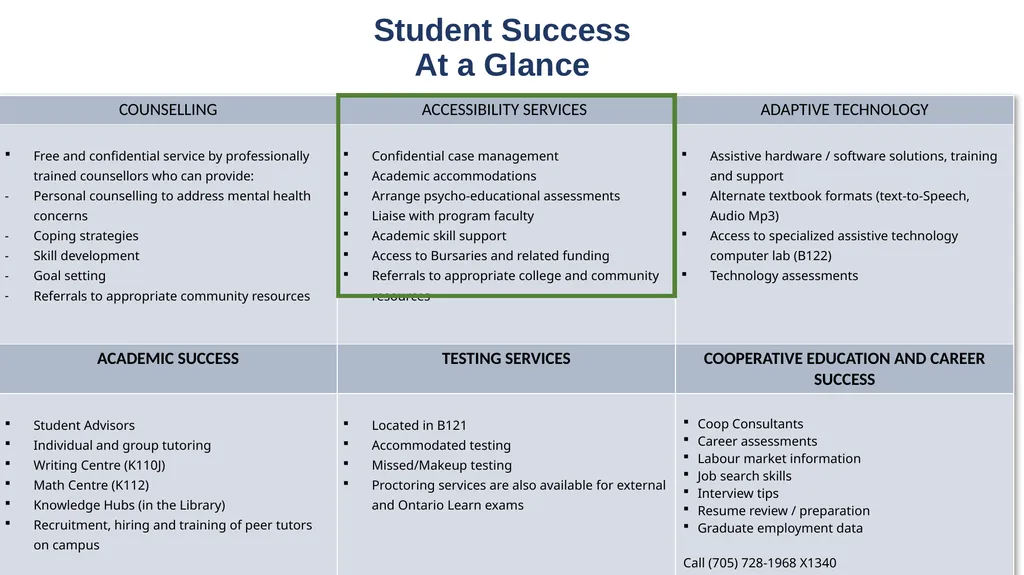
Student Success At a Glance<br>
04
What Does an Accessibility Advisor do? Assists students with setting up academic accommodations and supports, such as:
Referral to adaptive technology training, counselling or other supports in the College
Use of testing services, technology in the classroom or missed classes due to disability related needs
Study skill development
Recommendations for course loads and academic pathway planning
Coordinate psycho-educational assessments when required
*Accommodations require the collaboration and agreement between the student and Accessible Services<br>
05
What Documents do I provide to my Accessibility Advisor? Recent Psycho-educational Assessment- within the last 4 years to access OSAP Bursaries and Grants
IEP or IPRC documents
Medical notes
Note: documentation must indicate a permanent disability and be diagnosed by the appropriate licensed practitioner*
OSAP has a separate Disability Verification form that must be completed to access related grants and bursaries<br>
06
Accommodations vs. Modifications Courses at the post secondary level have specific learning outcomes that need to be achieved for the student to pass the course. These learning outcomes cannot be modified.
The same course work needs to be completed, however if required the method for completion can be accommodated i.e. speech to text software instead of writing or typing an essay to accommodate a Learning Disability or Dysgraphia. The essay will be evaluated based on the same criteria as the student’s peers.
If needed, student can reduce their course load to complete their diploma over a longer period of time. This can often assist students who have more significant learning needs.<br>
07
College Accommodations are Different than High School What are the Students Responsibilities in College?
Students need to make appointments with Accessibility Services when they received their offer of admission
Provide adequate up-to-date documentation, IEPs and OSR contents are not provided to the college automatically. Students must bring them to develop accommodations.
Participate in discussions about accommodations
Access all support services in a timely manner
Practice self-advocacy
Students report academic and accommodation information to parents/guardians if they choose<br>
08
College Accommodations are Different than High School Role of Parents/Guardians:
In order to protect student’s personal information Student Success Staff are unable to disclose any student information to parent/guardians
We encourage students to report academic and accommodation information directly to parents/guardians (if they choose)<br>
09
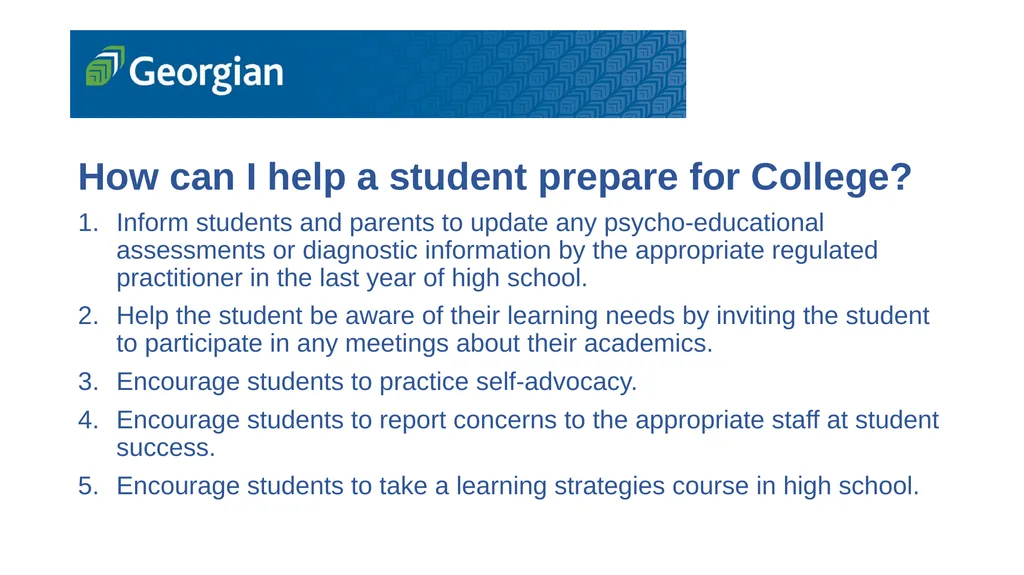
How can I help a student prepare for College?
Inform students and parents to update any psycho-educational assessments or diagnostic information by the appropriate regulated practitioner in the last year of high school.
Help the student be aware of their learning needs by inviting the student to participate in any meetings about their academics.
Encourage students to practice self-advocacy.
Encourage students to report concerns to the appropriate staff at student success.
Encourage students to take a learning strategies course in high school.<br>
10
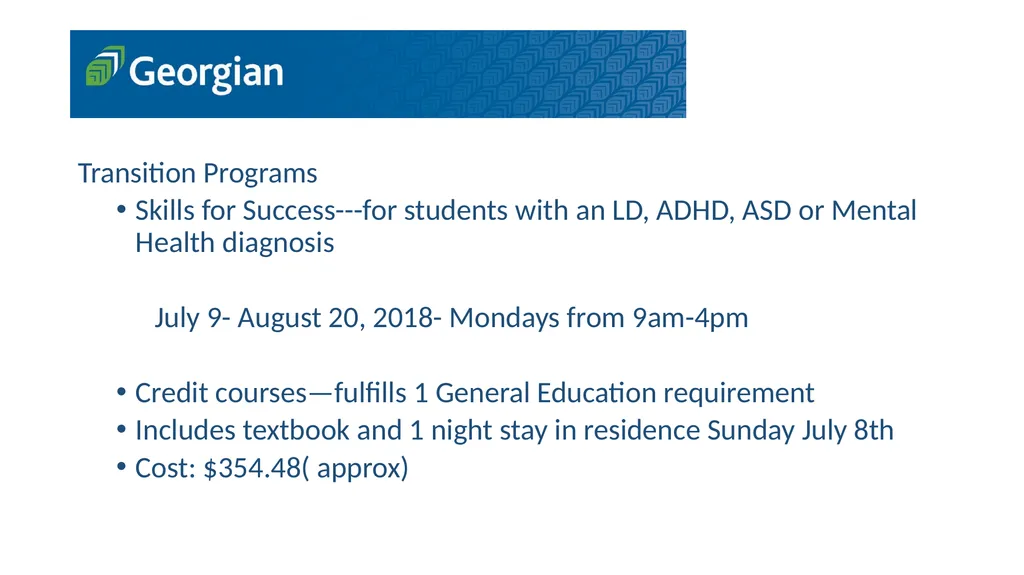
Transition Programs
Skills for Success---for students with an LD, ADHD, ASD or Mental Health diagnosis
July 9- August 20, 2018- Mondays from 9am-4pm
Credit courses—fulfills 1 General Education requirement
Includes textbook and 1 night stay in residence Sunday July 8th
Cost: $354.48( approx)<br>