
Welcome USCSOMG Clinical Faculty Member Training
KB
Published · 31 slides · 0 views

1 / 1


Description
Welcome USCSOMG Clinical Faculty Member Training Content A Little About the USC School of Medicine Greenville Introduction to OASIS online scheduling and assessment application Brief Overviews of M3 and M4 Years Assessment Competencies
Related Topics
Share
Embed code
Download this presentation From Below
"Welcome USCSOMG Clinical Faculty Member Training" is the property of its rightful owner. Permission is granted to download and print the materials on this website for personal, non-commercial use only, and to display it on your personal computer provided you do not modify the materials and that you retain all copyright notices contained in the materials. By downloading content from our website, you accept the terms of this agreement.
Presentation Transcript
01
Welcome USCSOMG
Clinical Faculty Member<br>
02
Training Content A Little About the USC School of Medicine Greenville
Introduction to OASIS online scheduling and assessment application
Brief Overviews of M3 and M4 Years
Assessment
Competencies
Criteria for Evaluation
Responsibilities: Yours and the Student’s
Policies and other important information<br>
Introduction to OASIS online scheduling and assessment application
Brief Overviews of M3 and M4 Years
Assessment
Competencies
Criteria for Evaluation
Responsibilities: Yours and the Student’s
Policies and other important information<br>
03
Our Mission
Heal compassionately. Teach innovatively. Improve constantly.
Our Vision
Transform healthcare for the benefit of the people and communities we serve.
Our Values
Together we serve with integrity, respect, trust and openness. A New School of Thought<br>
Heal compassionately. Teach innovatively. Improve constantly.
Our Vision
Transform healthcare for the benefit of the people and communities we serve.
Our Values
Together we serve with integrity, respect, trust and openness. A New School of Thought<br>
04
A New School of Thought Key Educational Components
Early and ongoing immersion into the practice of medicine
EMT Certification and Training
Integrated basic science and clinical learning and practice
Graduated continuum of clinical responsibility
Small-group, student-centered learning environment In addition to the traditional basic medical and clinical sciences, our school weaves three other pillars through all four years of the curriculum: *Professionalism, *Lifestyle Medicine, and *Behavioral, Social and Population Health Sciences.<br>
Early and ongoing immersion into the practice of medicine
EMT Certification and Training
Integrated basic science and clinical learning and practice
Graduated continuum of clinical responsibility
Small-group, student-centered learning environment In addition to the traditional basic medical and clinical sciences, our school weaves three other pillars through all four years of the curriculum: *Professionalism, *Lifestyle Medicine, and *Behavioral, Social and Population Health Sciences.<br>
05
Office of Academic Affairs A New School of Thought Senior Associate Dean for Academic Affairs
– Angela Sharkey, MD Assistant Dean for Academic Affairs
– April Buchanan, MD Assistant Dean for Longitudinal Clinical Education – Tom Blackwell, MD Senior Clerkship Coordinator: Anne Green Buckner Longitudinal Academic Coordinator: Theresa Baultripp<br>
– Angela Sharkey, MD Assistant Dean for Academic Affairs
– April Buchanan, MD Assistant Dean for Longitudinal Clinical Education – Tom Blackwell, MD Senior Clerkship Coordinator: Anne Green Buckner Longitudinal Academic Coordinator: Theresa Baultripp<br>
06
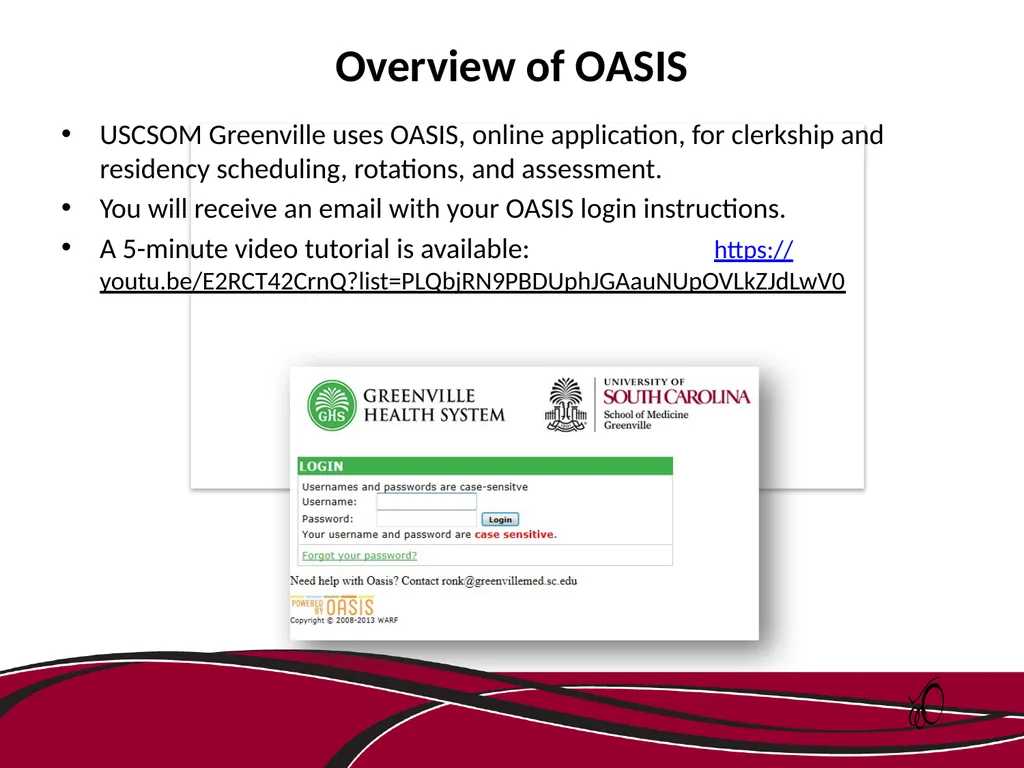
Overview of OASIS USCSOM Greenville uses OASIS, online application, for clerkship and residency scheduling, rotations, and assessment.
You will receive an email with your OASIS login instructions.
A 5-minute video tutorial is available: https://youtu.be/E2RCT42CrnQ?list=PLQbjRN9PBDUphJGAauNUpOVLkZJdLwV0<br>
You will receive an email with your OASIS login instructions.
A 5-minute video tutorial is available: https://youtu.be/E2RCT42CrnQ?list=PLQbjRN9PBDUphJGAauNUpOVLkZJdLwV0<br>
07
M3 Core Clerkships Internal Medicine
Family Medicine
Pediatrics
Obstetrics and Gynecology
Surgery
Emergency Medicine
Psychiatry and Neurology<br>
Family Medicine
Pediatrics
Obstetrics and Gynecology
Surgery
Emergency Medicine
Psychiatry and Neurology<br>
08
M3/M4 What you need to do:
Become familiar with the objectives for the M3 clerkship or M3/M4 elective in which you teach
Evaluate students at the end of the clerkship and/or elective (in OASIS)
Sign off on patient encounter entries in OASIS<br>
Become familiar with the objectives for the M3 clerkship or M3/M4 elective in which you teach
Evaluate students at the end of the clerkship and/or elective (in OASIS)
Sign off on patient encounter entries in OASIS<br>
09
Attendance Policy Students are allowed a maximum of 3 excused absences in a 7-week clerkship.
Beyond 3, the student must make up days missed.
Students are allowed 1 excused absence in a 2-week elective.
Please notify the clerkship coordinator of any student absences.<br>
Beyond 3, the student must make up days missed.
Students are allowed 1 excused absence in a 2-week elective.
Please notify the clerkship coordinator of any student absences.<br>
10
Duty Hours Maximum of 80 hours per week
1 day in 7 free from all educational and clinical responsibilities (averaged over the clerkship)
24 hours max + 4 additional hours to finish work and participate in didactic activities
Infractions must be reported
Clerkship Director, Faculty, and Chair must make sure duty hours are not exceeded<br>
1 day in 7 free from all educational and clinical responsibilities (averaged over the clerkship)
24 hours max + 4 additional hours to finish work and participate in didactic activities
Infractions must be reported
Clerkship Director, Faculty, and Chair must make sure duty hours are not exceeded<br>
11
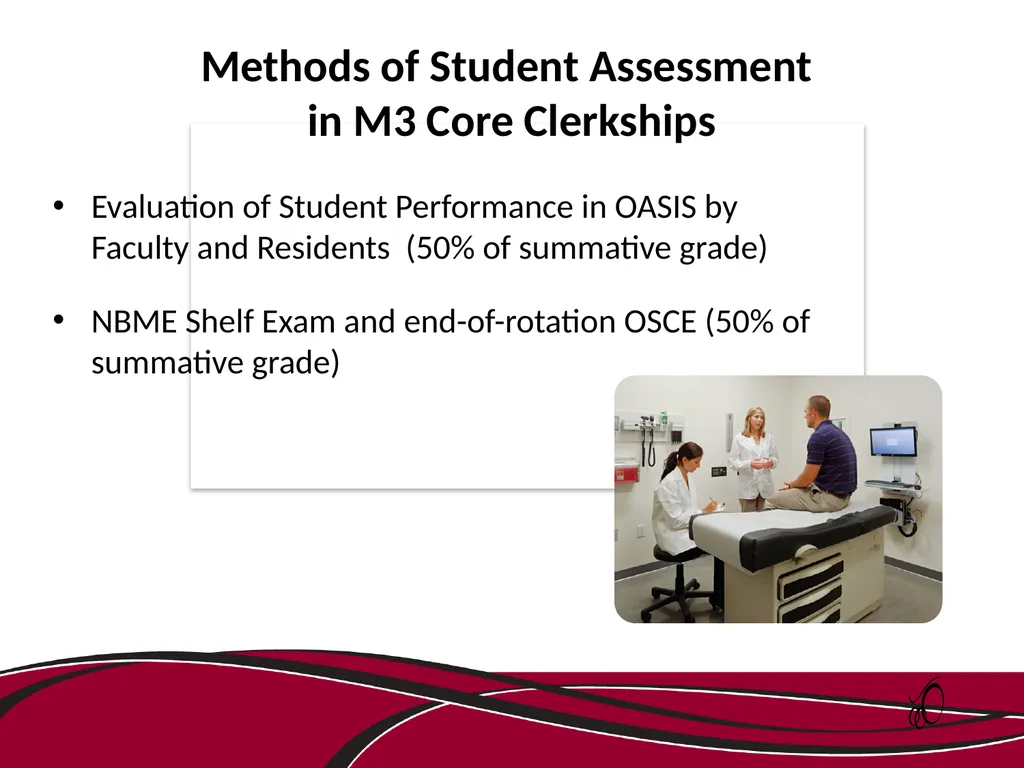
Methods of Student Assessment
in M3 Core Clerkships Evaluation of Student Performance in OASIS by Faculty and Residents (50% of summative grade)
NBME Shelf Exam and end-of-rotation OSCE (50% of summative grade)<br>
NBME Shelf Exam and end-of-rotation OSCE (50% of summative grade)<br>
12
What You Will Be Assessing Competencies:
Patient Care
Knowledge for Practice
Practice-Based Learning and Improvement
Interpersonal and Communication Skills
Professionalism
Systems-Based Practice
Interprofessional Collaboration<br>
Patient Care
Knowledge for Practice
Practice-Based Learning and Improvement
Interpersonal and Communication Skills
Professionalism
Systems-Based Practice
Interprofessional Collaboration<br>
13
What You Will Be Assessing Competencies
Patient Care: Provide patient-centered care that is compassionate, appropriate, and effective for the treatment of health problems and the promotion of health
Obtains accurate comprehensive or focused history appropriate to the presenting problem
Performs comprehensive or focused physical examination appropriate for the presenting problem
Performs and interprets diagnostic and screening tests with an understanding of their indications and limitations.
Develops reasoned differential diagnoses of patients’ clinical problems
Applies clinical problem solving skills to develop integrated therapeutic plans for the acute and longitudinal management of health problems<br>
Patient Care: Provide patient-centered care that is compassionate, appropriate, and effective for the treatment of health problems and the promotion of health
Obtains accurate comprehensive or focused history appropriate to the presenting problem
Performs comprehensive or focused physical examination appropriate for the presenting problem
Performs and interprets diagnostic and screening tests with an understanding of their indications and limitations.
Develops reasoned differential diagnoses of patients’ clinical problems
Applies clinical problem solving skills to develop integrated therapeutic plans for the acute and longitudinal management of health problems<br>
14
What You Will Be Assessing Competencies
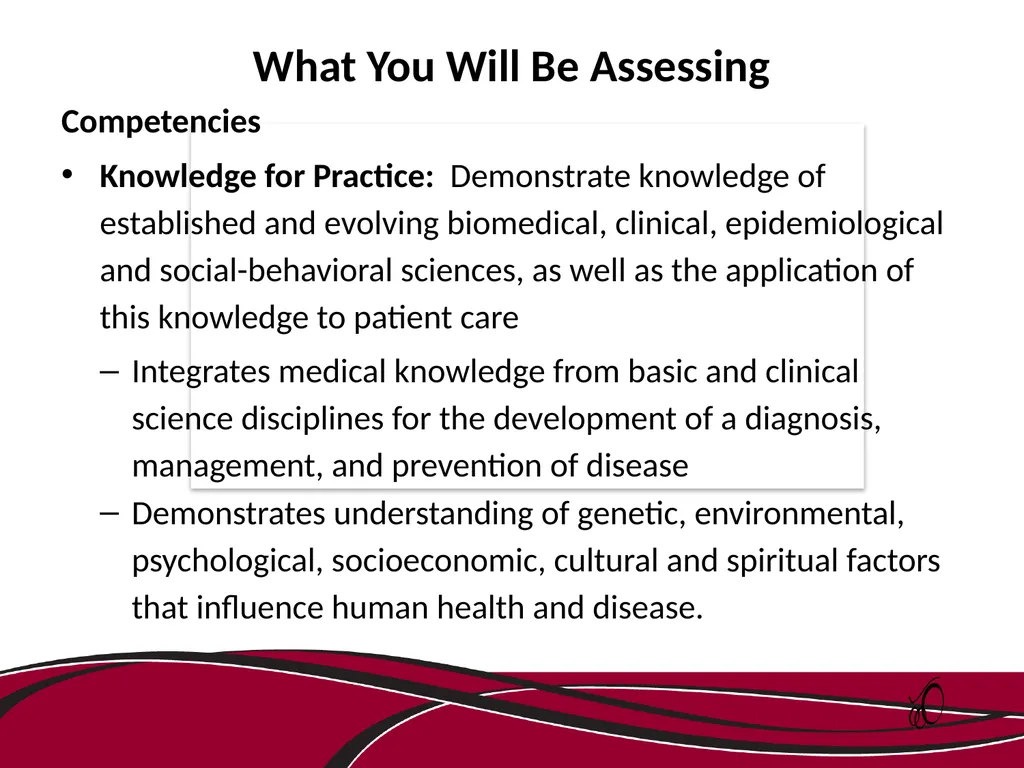
Knowledge for Practice: Demonstrate knowledge of established and evolving biomedical, clinical, epidemiological and social-behavioral sciences, as well as the application of this knowledge to patient care
Integrates medical knowledge from basic and clinical science disciplines for the development of a diagnosis, management, and prevention of disease
Demonstrates understanding of genetic, environmental, psychological, socioeconomic, cultural and spiritual factors that influence human health and disease.<br>
Knowledge for Practice: Demonstrate knowledge of established and evolving biomedical, clinical, epidemiological and social-behavioral sciences, as well as the application of this knowledge to patient care
Integrates medical knowledge from basic and clinical science disciplines for the development of a diagnosis, management, and prevention of disease
Demonstrates understanding of genetic, environmental, psychological, socioeconomic, cultural and spiritual factors that influence human health and disease.<br>
15
What You Will Be Assessing Competencies
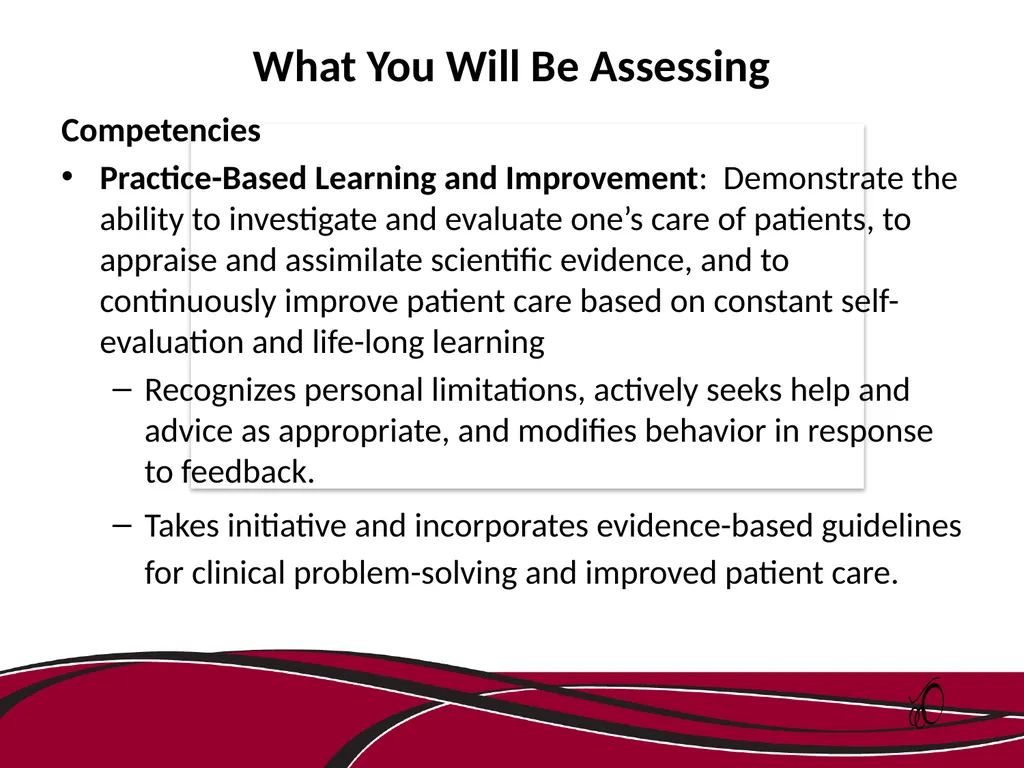
Practice-Based Learning and Improvement: Demonstrate the ability to investigate and evaluate one’s care of patients, to appraise and assimilate scientific evidence, and to continuously improve patient care based on constant self-evaluation and life-long learning
Recognizes personal limitations, actively seeks help and advice as appropriate, and modifies behavior in response to feedback.
Takes initiative and incorporates evidence-based guidelines for clinical problem-solving and improved patient care.<br>
Practice-Based Learning and Improvement: Demonstrate the ability to investigate and evaluate one’s care of patients, to appraise and assimilate scientific evidence, and to continuously improve patient care based on constant self-evaluation and life-long learning
Recognizes personal limitations, actively seeks help and advice as appropriate, and modifies behavior in response to feedback.
Takes initiative and incorporates evidence-based guidelines for clinical problem-solving and improved patient care.<br>
16
What You Will Be Assessing Competencies
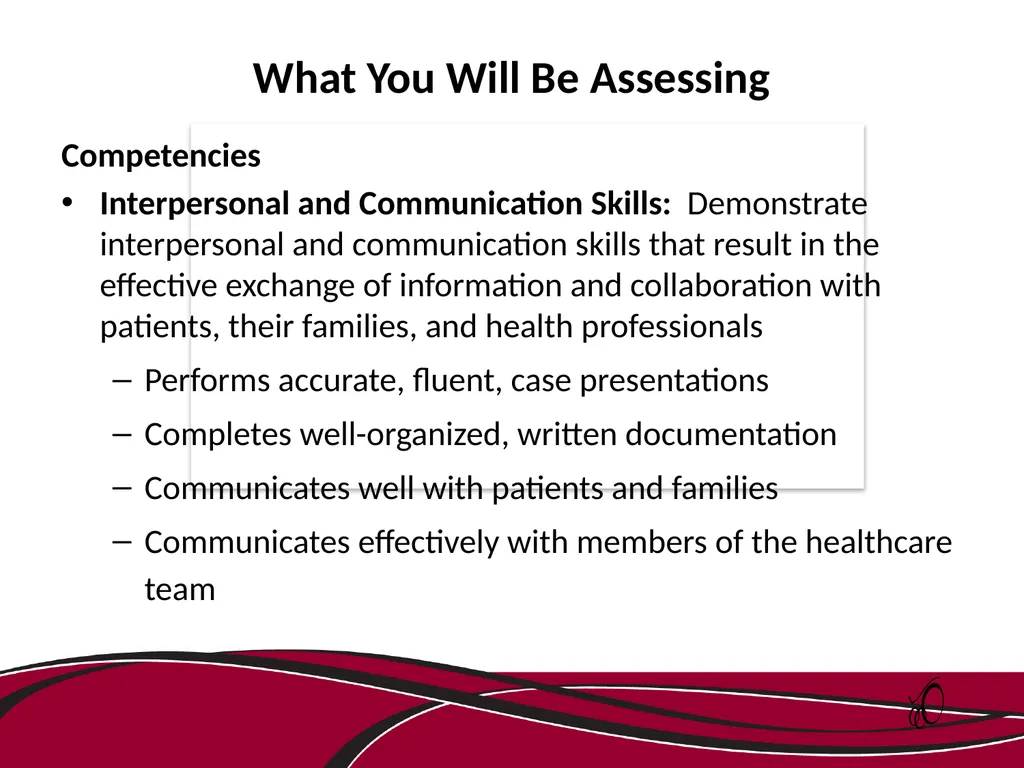
Interpersonal and Communication Skills: Demonstrate interpersonal and communication skills that result in the effective exchange of information and collaboration with patients, their families, and health professionals
Performs accurate, fluent, case presentations
Completes well-organized, written documentation
Communicates well with patients and families
Communicates effectively with members of the healthcare team<br>
Interpersonal and Communication Skills: Demonstrate interpersonal and communication skills that result in the effective exchange of information and collaboration with patients, their families, and health professionals
Performs accurate, fluent, case presentations
Completes well-organized, written documentation
Communicates well with patients and families
Communicates effectively with members of the healthcare team<br>
17
What You Will Be Assessing Competencies
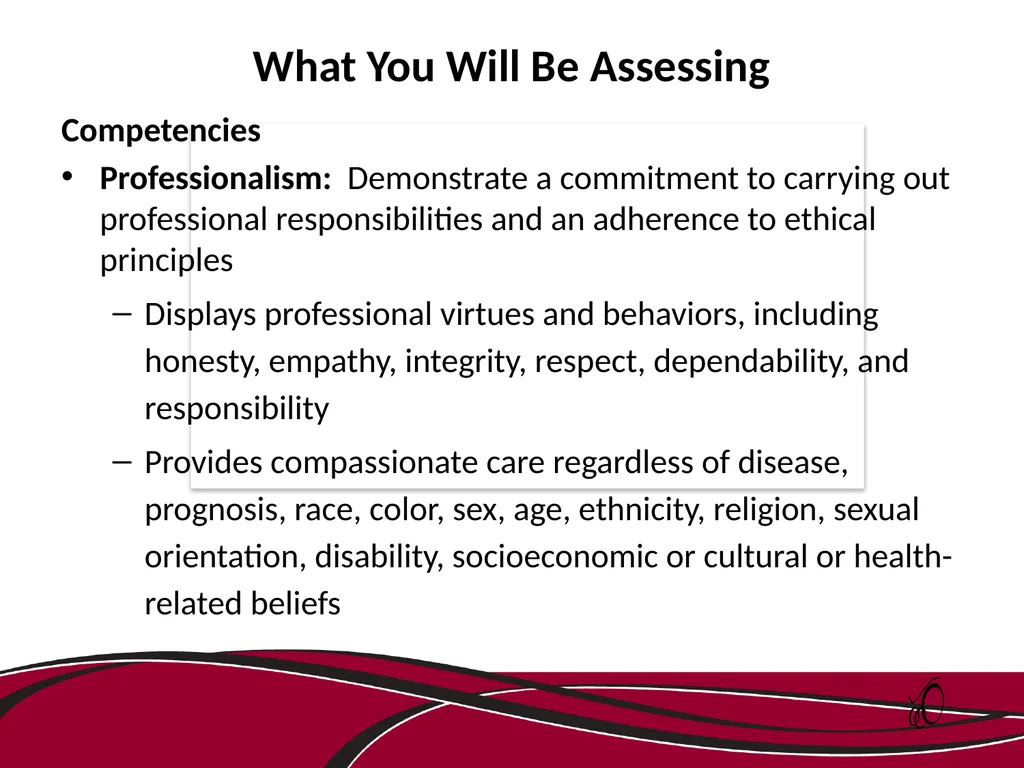
Professionalism: Demonstrate a commitment to carrying out professional responsibilities and an adherence to ethical principles
Displays professional virtues and behaviors, including honesty, empathy, integrity, respect, dependability, and responsibility
Provides compassionate care regardless of disease, prognosis, race, color, sex, age, ethnicity, religion, sexual orientation, disability, socioeconomic or cultural or health-related beliefs<br>
Professionalism: Demonstrate a commitment to carrying out professional responsibilities and an adherence to ethical principles
Displays professional virtues and behaviors, including honesty, empathy, integrity, respect, dependability, and responsibility
Provides compassionate care regardless of disease, prognosis, race, color, sex, age, ethnicity, religion, sexual orientation, disability, socioeconomic or cultural or health-related beliefs<br>
18
What You Will Be Assessing Competencies
Interprofessional Collaboration: Demonstrate the ability to engage in an interprofessional team in a manner that optimizes safe, effective patient- and population-centered care
Takes responsibility for patient care appropriate for his/her level of training to ensure safe, timely, efficient, equitable, and patient-centered care
Works effectively as a team member with health care providers including those from other disciplines to assess, coordinate, and improve patient care<br>
Interprofessional Collaboration: Demonstrate the ability to engage in an interprofessional team in a manner that optimizes safe, effective patient- and population-centered care
Takes responsibility for patient care appropriate for his/her level of training to ensure safe, timely, efficient, equitable, and patient-centered care
Works effectively as a team member with health care providers including those from other disciplines to assess, coordinate, and improve patient care<br>
19
Assessment for M3 and M4 Narrative Comments
Summative Evaluation (REQUIRED) – Comment on specific attributes that characterize this student’s performance. When possible, please relate specific instances that form the basis of your comments. This section is VERY important and will be included in Medical Student Performance Evaluation/”Dean’s Letter.”
Recommendations for Improvement -- Please be as specific as possible and provide specific instances that form the basis of your comments. This information is given to the student but is not included in MSPE/”Dean’s Letter.”<br>
Summative Evaluation (REQUIRED) – Comment on specific attributes that characterize this student’s performance. When possible, please relate specific instances that form the basis of your comments. This section is VERY important and will be included in Medical Student Performance Evaluation/”Dean’s Letter.”
Recommendations for Improvement -- Please be as specific as possible and provide specific instances that form the basis of your comments. This information is given to the student but is not included in MSPE/”Dean’s Letter.”<br>
20
M3/M4 Student Encounters/logs Sign off on student encounters/logs in OASIS
Understand that if a student fails to achieve experiences, the student will be required to remediate<br>
Understand that if a student fails to achieve experiences, the student will be required to remediate<br>
21
Policies and Other Important Information<br>
22
Student Mistreatment Guidelines for Conduct in Teacher/Learner Relationships (Student Handbook http://sc.edu/study/colleges_schools/medicine_greenville/docs/studenthandbook.pdf and the Faculty Handbook http://greenvillemed.sc.edu/Faculty_Handbook.shtml)
Identifies responsibility of teachers and learners
Describes inappropriate and unacceptable behaviors as those which demonstrate disrespect for others or lack of professionalism in interpersonal conduct
Retaliation for reporting mistreatment is unacceptable and is not tolerated.
The School’s Ombudsman is empowered to receive and investigate reports of mistreatment in a confidential manner, to mediate, and to make recommendations<br>
Identifies responsibility of teachers and learners
Describes inappropriate and unacceptable behaviors as those which demonstrate disrespect for others or lack of professionalism in interpersonal conduct
Retaliation for reporting mistreatment is unacceptable and is not tolerated.
The School’s Ombudsman is empowered to receive and investigate reports of mistreatment in a confidential manner, to mediate, and to make recommendations<br>
23
Responsibilities of Teachers Treat all learners with respect and fairness.
Treat all learners equally regardless of age, gender, race, ethnicity, national origin, religion, disability, or sexual orientation.
Provide current material in an effective format for learning.
Be prepared and punctual for didactic, investigational, and clinical encounters and prompt in responding to requests and questions from students.
Provide timely feedback with constructive suggestions and opportunities for improvement/remediation when needed.<br>
Treat all learners equally regardless of age, gender, race, ethnicity, national origin, religion, disability, or sexual orientation.
Provide current material in an effective format for learning.
Be prepared and punctual for didactic, investigational, and clinical encounters and prompt in responding to requests and questions from students.
Provide timely feedback with constructive suggestions and opportunities for improvement/remediation when needed.<br>
24
Responsibilities of Teachers Practice insightful (Socratic) questioning, which stimulates learning and self-discovery and avoid overly aggressive questioning which may be perceived as hurtful, humiliating, degrading or punitive.
Encourage students who experience mistreatment or who witness unprofessional behavior to report the facts immediately.
Demonstrate respect and professionalism toward other members of the faculty in developing and delivering an integrated curriculum.<br>
Encourage students who experience mistreatment or who witness unprofessional behavior to report the facts immediately.
Demonstrate respect and professionalism toward other members of the faculty in developing and delivering an integrated curriculum.<br>
25
Inappropriate Behaviors for the
Teacher-Learner Relationship Unwanted physical contact (e.g., hitting, slapping, kicking, pushing) or the threat of the same.
Sexual harassment (including romantic relationships between teachers and learners in which the teacher has authority over the learner’s academic progress) or harassment based on age, gender, race, ethnicity, national origin, religion, disability, or sexual orientation.
Loss of personal civility including shouting, personal attacks, insults or bullying, displays of temper (such as throwing objects), use of culturally insensitive language.
Discrimination of any form including in teaching and assessment based upon age, gender, race, ethnicity, national origin, religion, disability, or sexual orientation.
Requests for another to perform inappropriate personal errands unrelated to the didactic, investigational, or clinical situation at hand.
Grading/evaluation on factors unrelated to performance, effort, or level of achievement.<br>
Sexual harassment (including romantic relationships between teachers and learners in which the teacher has authority over the learner’s academic progress) or harassment based on age, gender, race, ethnicity, national origin, religion, disability, or sexual orientation.
Loss of personal civility including shouting, personal attacks, insults or bullying, displays of temper (such as throwing objects), use of culturally insensitive language.
Discrimination of any form including in teaching and assessment based upon age, gender, race, ethnicity, national origin, religion, disability, or sexual orientation.
Requests for another to perform inappropriate personal errands unrelated to the didactic, investigational, or clinical situation at hand.
Grading/evaluation on factors unrelated to performance, effort, or level of achievement.<br>
26
The Family and Educational Rights and Privacy Act (FERPA) FERPA pertains to school records, including grades, student ID numbers, course schedule, records of disciplinary actions, and so forth. Exempt from FERPA regulations is information considered “directory information” by the University (e.g., name, email address, “Class of ___” status, photo, etc.).
Information maintained by an individual faculty member is not considered school records unless it overlaps with official school records (e.g., grades, disciplinary actions). So, records of personal observations or opinions that are not shared with others, as well as communications with students that do not include protected information, are not regulated by FERPA.
Unless the student provides written permission, access to FERPA-protected information is only allowed to those (employees) who have a “legitimate educational interest” in the specific information being shared.<br>
Information maintained by an individual faculty member is not considered school records unless it overlaps with official school records (e.g., grades, disciplinary actions). So, records of personal observations or opinions that are not shared with others, as well as communications with students that do not include protected information, are not regulated by FERPA.
Unless the student provides written permission, access to FERPA-protected information is only allowed to those (employees) who have a “legitimate educational interest” in the specific information being shared.<br>
27
Responsibilities of Students Recognize the privileges and responsibilities coming from the opportunity to work with patients in clinical settings.
Treat all fellow learners and teachers with respect and fairness, equally regardless of age, gender, race, ethnicity, national origin, religion, disability, or sexual orientation.
Be prepared and on time for didactic, investigational, and clinical encounters.
Commit the time and energy necessary to achieve the goals and objectives of each course.
Recognize personal limitations and seek help as needed.<br>
Treat all fellow learners and teachers with respect and fairness, equally regardless of age, gender, race, ethnicity, national origin, religion, disability, or sexual orientation.
Be prepared and on time for didactic, investigational, and clinical encounters.
Commit the time and energy necessary to achieve the goals and objectives of each course.
Recognize personal limitations and seek help as needed.<br>
28
Responsibilities of Students Communicate concerns/suggestions about the curriculum, didactic methods, teachers, or the learning environment in a respectful, professional manner.
Develop a lifelong learner’s perspective and take ownership of their own learning process and anticipate long-term needs for knowledge, skills, attitudes and behavior.
When experiencing mistreatment or witnessing unprofessional behavior, report the facts immediately, and encourage other students with such experiences to do the same.
Solicit feedback on their performance and recognize that criticism is not synonymous with “abuse.”<br>
Develop a lifelong learner’s perspective and take ownership of their own learning process and anticipate long-term needs for knowledge, skills, attitudes and behavior.
When experiencing mistreatment or witnessing unprofessional behavior, report the facts immediately, and encourage other students with such experiences to do the same.
Solicit feedback on their performance and recognize that criticism is not synonymous with “abuse.”<br>
29
Reporting Mistreatment Can be reported on student evaluation
Can be reported directly to the Clerkship Director or Assistant Dean for Clinical Clerkship Education
Student mistreatment policy and reporting form is located here:
https://greenvillehealthsystem.formstack.com/forms/mistreatment_report_formmw<br>
Can be reported directly to the Clerkship Director or Assistant Dean for Clinical Clerkship Education
Student mistreatment policy and reporting form is located here:
https://greenvillehealthsystem.formstack.com/forms/mistreatment_report_formmw<br>
30
Reporting Professionalism Concerns or Commendations Can be reported on student evaluation or to the Clerkship Director
Concerns can be reported online here:
https://greenvillehealthsystem.formstack.com/forms/honor_system_violation
Commendations can be reported online here:
https://greenvillehealthsystem.formstack.com/forms/professionalism_commendation_report_form<br>
Concerns can be reported online here:
https://greenvillehealthsystem.formstack.com/forms/honor_system_violation
Commendations can be reported online here:
https://greenvillehealthsystem.formstack.com/forms/professionalism_commendation_report_form<br>
31
Questions? Assistant Dean – April Buchanan, MD, ABuchanan@ghs.org
Internal Medicine – Nanette Dendy, MD, NDendy@ghs.org
Family Medicine – John Emerson, MD, JEmerson@ghs.org
Pediatrics – Josh Brownlee, MD, JBrownlee@ghs.org
Obstetrics and Gynecology – Christy Lee, MD, CMLee@ghs.org
Surgery – Joseph Camunas, MD, JCamunas@ghs.org
Emergency Medicine – Page Bridges, MD, EBridges@ghs.org
Psychiatry and Neurology – Ben Griffeth, MD, BGriffeth@ghs.org<br>
Internal Medicine – Nanette Dendy, MD, NDendy@ghs.org
Family Medicine – John Emerson, MD, JEmerson@ghs.org
Pediatrics – Josh Brownlee, MD, JBrownlee@ghs.org
Obstetrics and Gynecology – Christy Lee, MD, CMLee@ghs.org
Surgery – Joseph Camunas, MD, JCamunas@ghs.org
Emergency Medicine – Page Bridges, MD, EBridges@ghs.org
Psychiatry and Neurology – Ben Griffeth, MD, BGriffeth@ghs.org<br>