
What is discourse? “A continuous stretch of
T
Published · 47 slides · 0 views
1 / 1
Description
What is discourse? A continuous stretch of language larger than a sentence, often constituting a coherent unit, such as sermon, argument, joke or narrative. (Crystal:1992) stretches of language perceived to be meaningful, unified and
Related Topics
Share
Embed code
Download this presentation From Below
"What is discourse? “A continuous stretch of" is the property of its rightful owner. Permission is granted to download and print the materials on this website for personal, non-commercial use only, and to display it on your personal computer provided you do not modify the materials and that you retain all copyright notices contained in the materials. By downloading content from our website, you accept the terms of this agreement.
Presentation Transcript
01
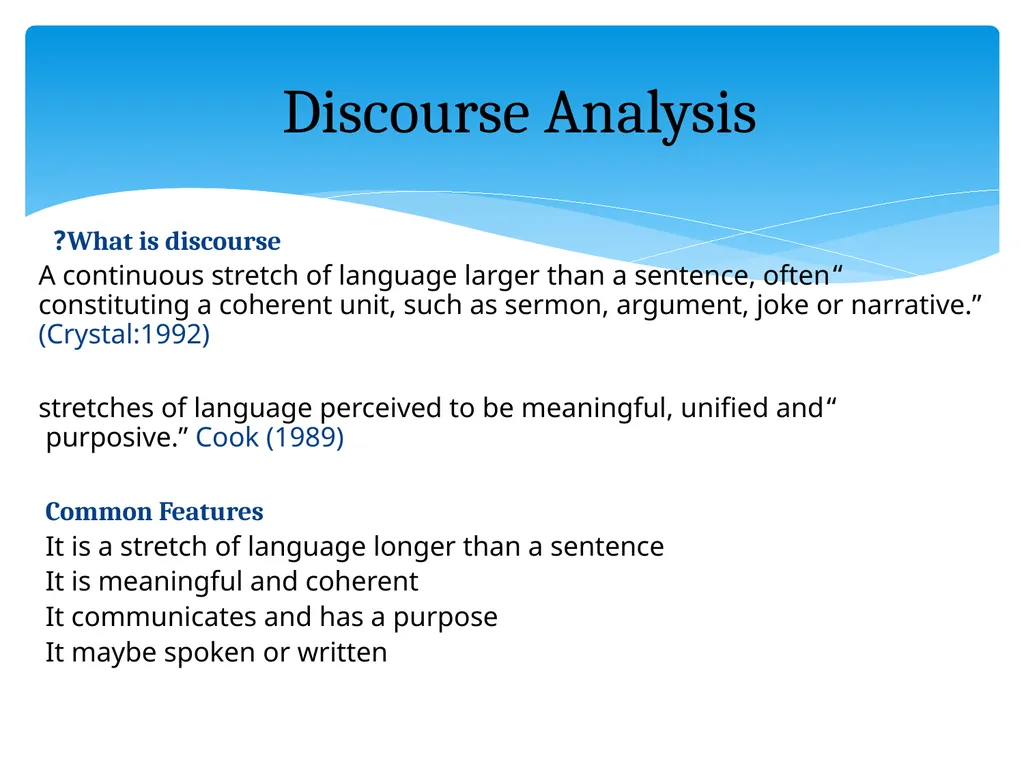
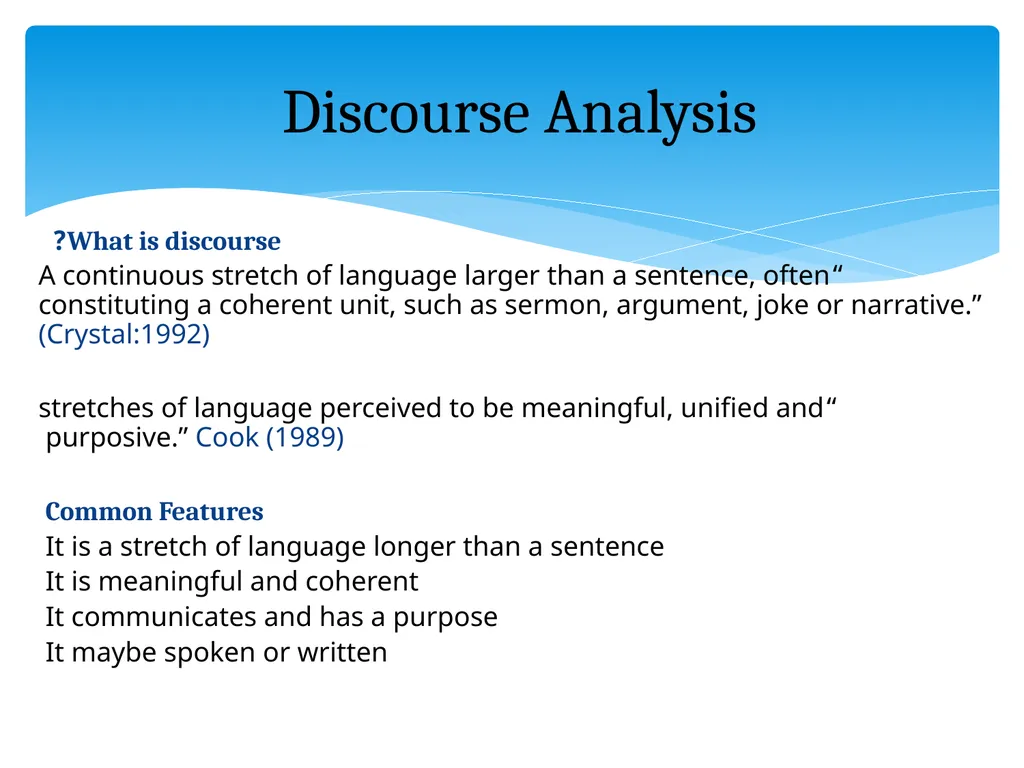
What is discourse?
“A continuous stretch of language larger than a sentence, often constituting a coherent unit, such as sermon, argument, joke or narrative.” (Crystal:1992)
“stretches of language perceived to be meaningful, unified and purposive.” Cook (1989)
Common Features
It is a stretch of language longer than a sentence
It is meaningful and coherent
It communicates and has a purpose
It maybe spoken or written Discourse Analysis<br>
02
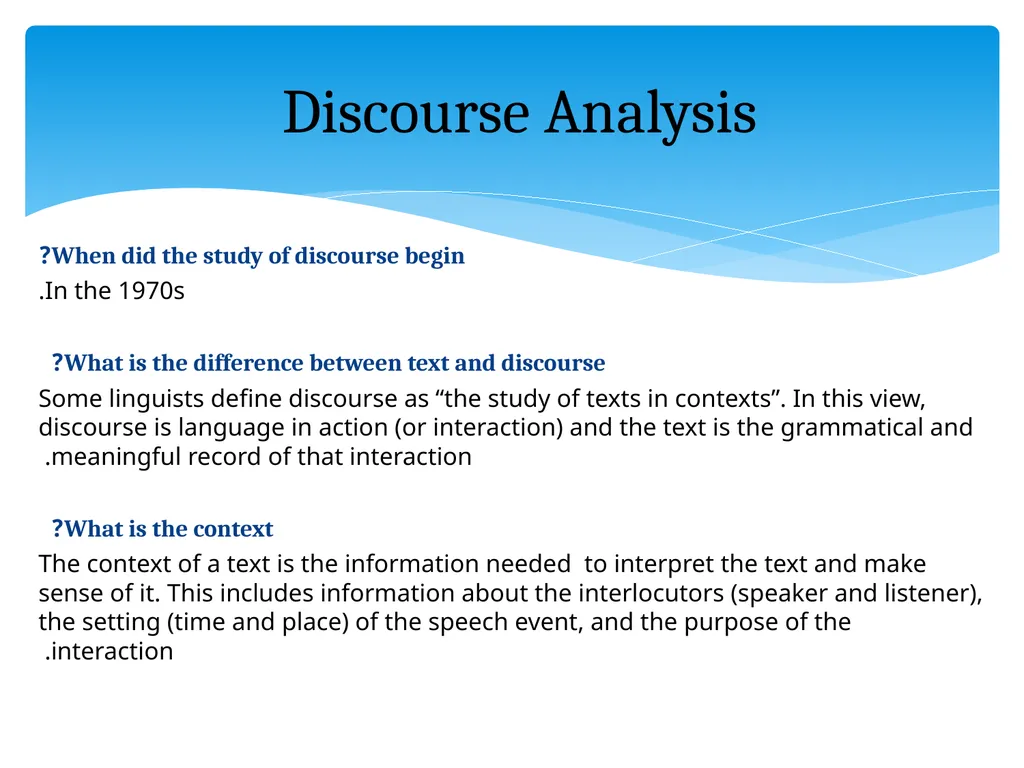
When did the study of discourse begin?
In the 1970s.
What is the difference between text and discourse?
Some linguists define discourse as “the study of texts in contexts”. In this view, discourse is language in action (or interaction) and the text is the grammatical and meaningful record of that interaction.
What is the context?
The context of a text is the information needed to interpret the text and make sense of it. This includes information about the interlocutors (speaker and listener), the setting (time and place) of the speech event, and the purpose of the interaction. Discourse Analysis<br>
03
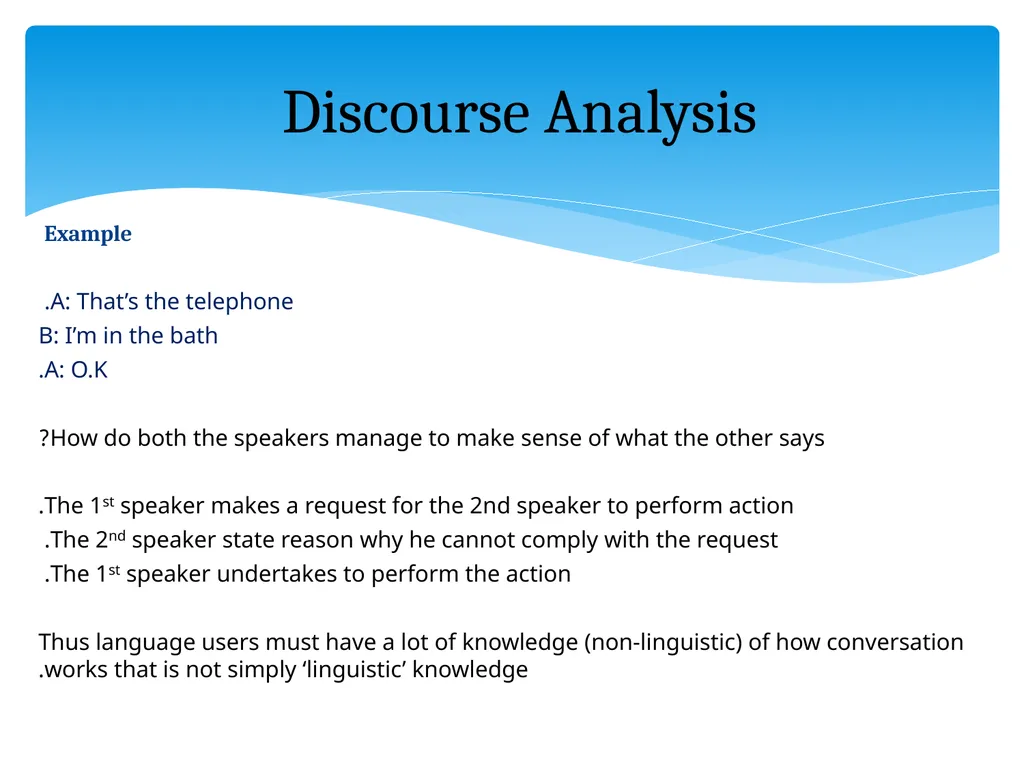
Example
A: That’s the telephone.
B: I’m in the bath
A: O.K.
How do both the speakers manage to make sense of what the other says?
The 1st speaker makes a request for the 2nd speaker to perform action.
The 2nd speaker state reason why he cannot comply with the request.
The 1st speaker undertakes to perform the action.
Thus language users must have a lot of knowledge (non-linguistic) of how conversation works that is not simply ‘linguistic’ knowledge. Discourse Analysis<br>
04
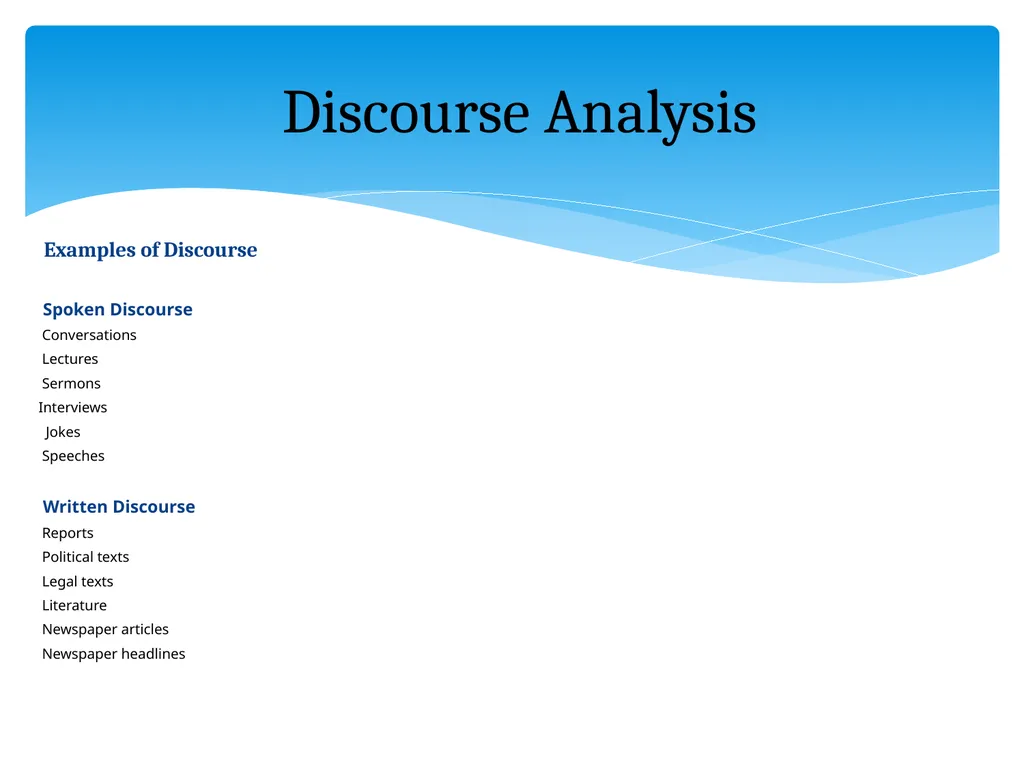
Examples of Discourse
Spoken Discourse
Conversations
Lectures
Sermons
Interviews
Jokes
Speeches
Written Discourse
Reports
Political texts
Legal texts
Literature
Newspaper articles
Newspaper headlines Discourse Analysis<br>
Spoken Discourse
Conversations
Lectures
Sermons
Interviews
Jokes
Speeches
Written Discourse
Reports
Political texts
Legal texts
Literature
Newspaper articles
Newspaper headlines Discourse Analysis<br>
05
Emergence of Discourse Analysis
Discourse Analysis emerged in the 1970s as a reaction to the exclusive concern with the idealized native speaker-hearer knowledge (and the formal features of language) in Chomsky’s tradition to the exclusion of considerations of context.
There was a new interest in conversation and meaning beyond language. Discourse Analysis<br>
06
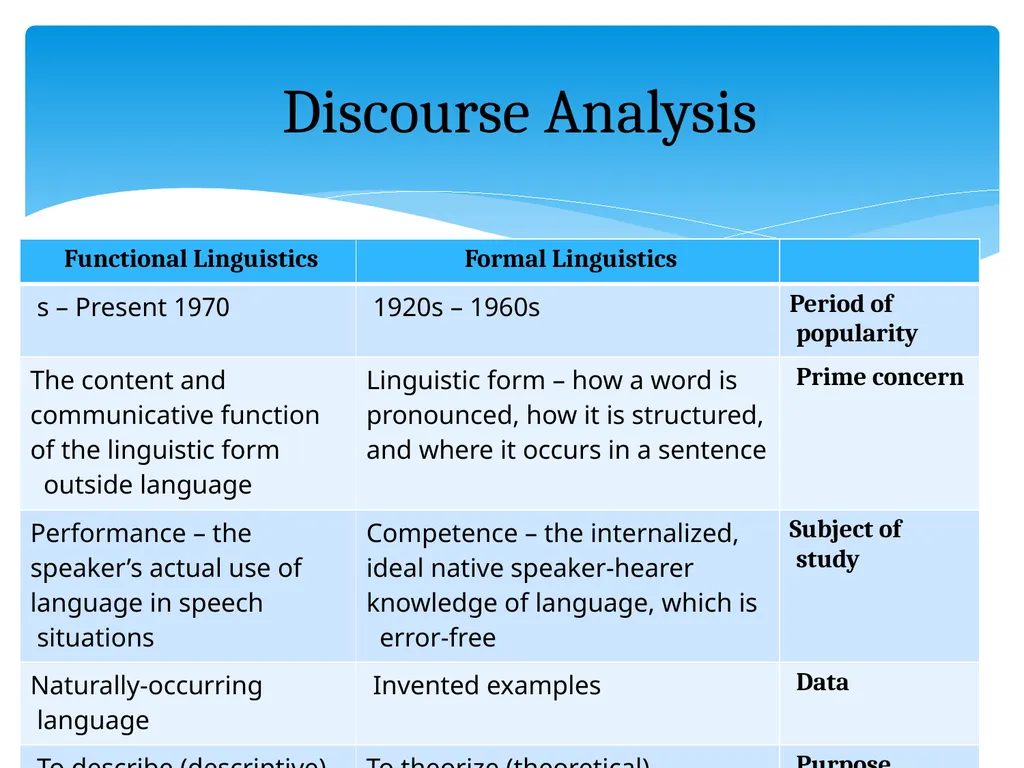
Discourse Analysis<br>
07
Speech Act Theory
Who proposed the theory and when?
The theory was introduced by the Oxford philosopher Austin in the year 1962.
Austin gave a series of lectures at Harvard University which were later published in the book How to Do Things with Words.
What was Austin’s main argument?
Austin observed that there are sentences that look like statements but have functions other than ‘stating’ a state of affairs. These are:
Constatives,
ethical propositions,
performatives, and
expositives. Discourse Analysis<br>
08
Speech Act Theory
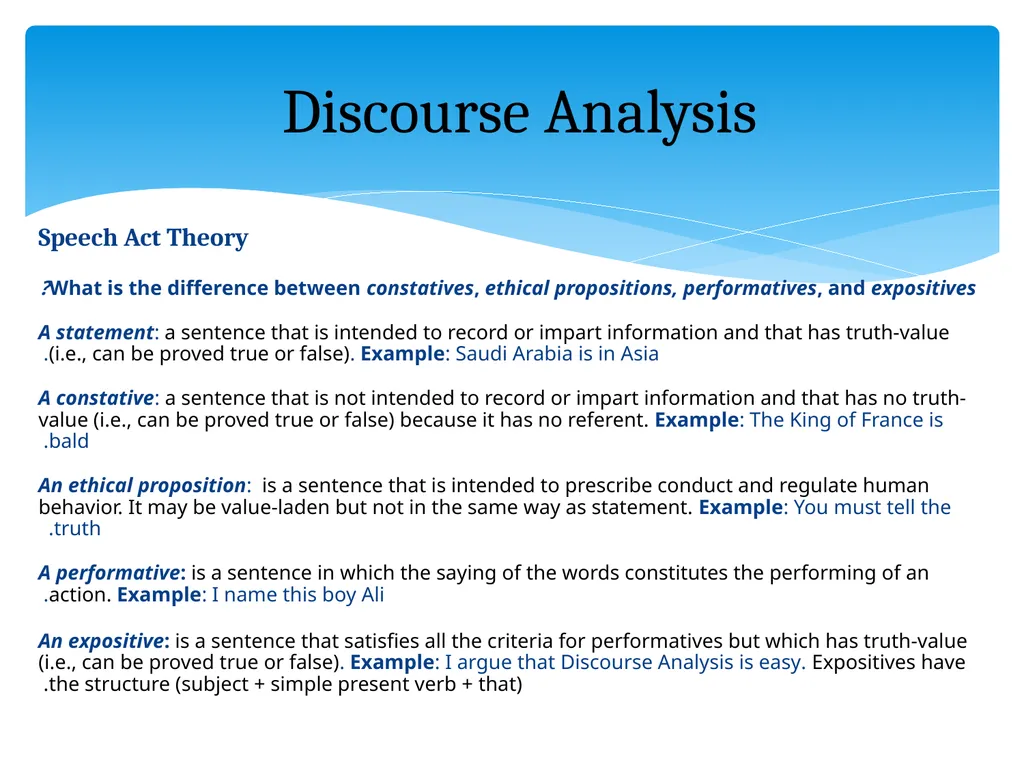
What is the difference between constatives, ethical propositions, performatives, and expositives?
A statement: a sentence that is intended to record or impart information and that has truth-value (i.e., can be proved true or false). Example: Saudi Arabia is in Asia.
A constative: a sentence that is not intended to record or impart information and that has no truth-value (i.e., can be proved true or false) because it has no referent. Example: The King of France is bald.
An ethical proposition: is a sentence that is intended to prescribe conduct and regulate human behavior. It may be value-laden but not in the same way as statement. Example: You must tell the truth.
A performative: is a sentence in which the saying of the words constitutes the performing of an action. Example: I name this boy Ali.
An expositive: is a sentence that satisfies all the criteria for performatives but which has truth-value (i.e., can be proved true or false). Example: I argue that Discourse Analysis is easy. Expositives have the structure (subject + simple present verb + that). Discourse Analysis<br>
09
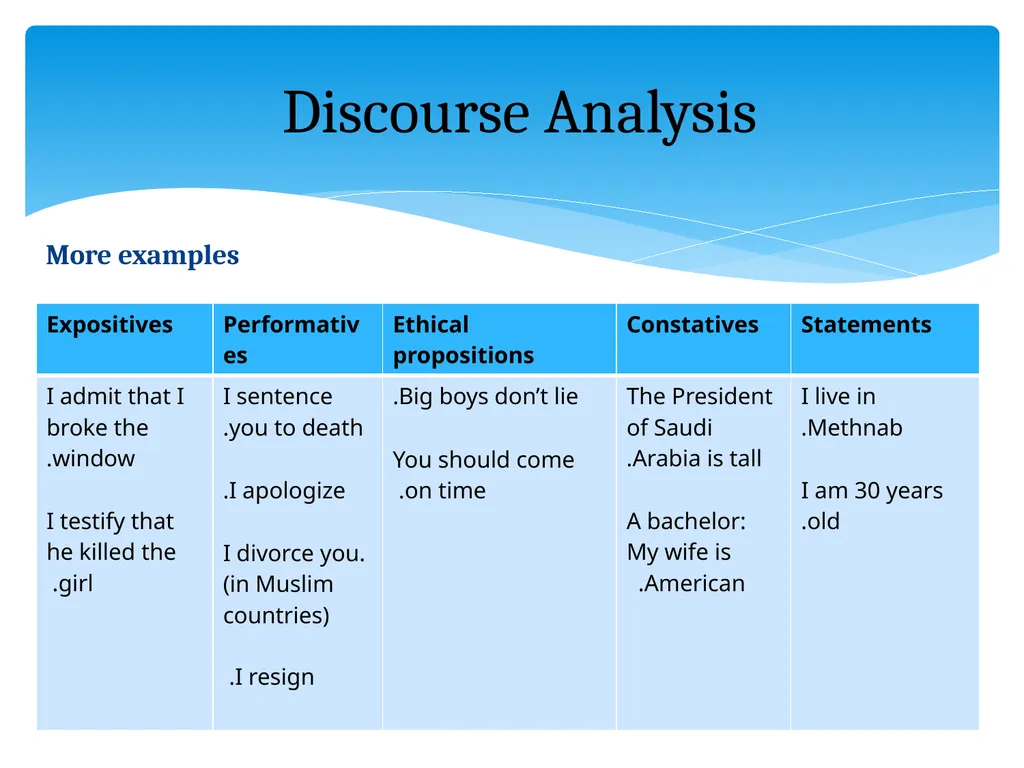
More examples Discourse Analysis<br>
10
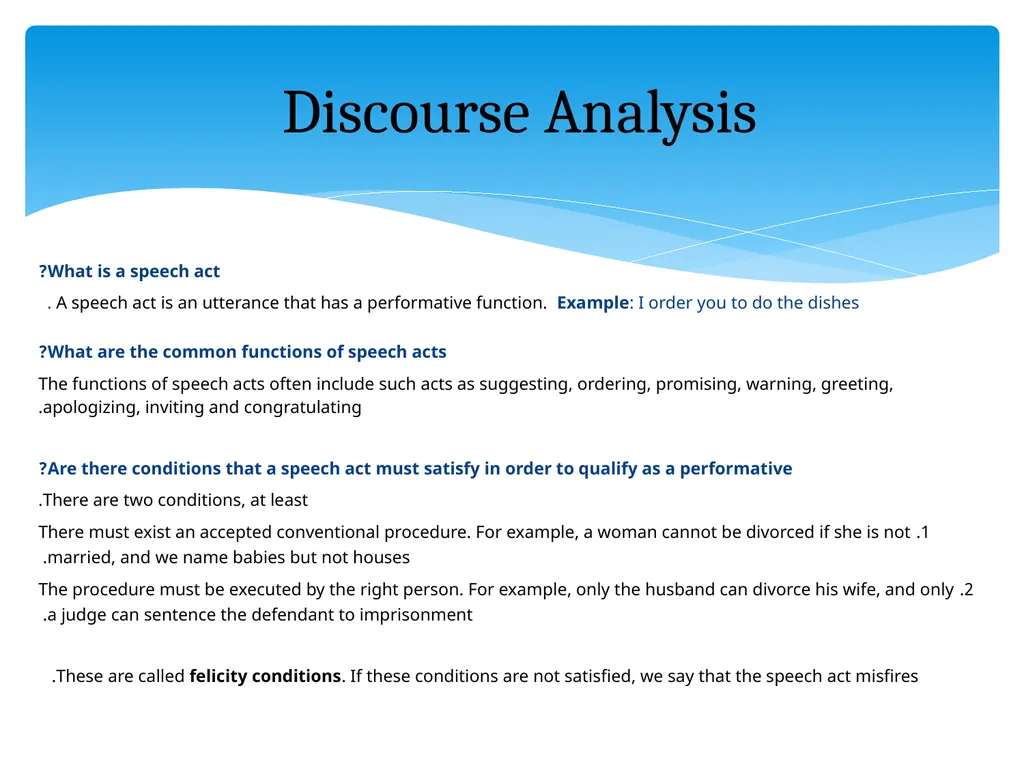
What is a speech act?
A speech act is an utterance that has a performative function. Example: I order you to do the dishes .
What are the common functions of speech acts?
The functions of speech acts often include such acts as suggesting, ordering, promising, warning, greeting, apologizing, inviting and congratulating.
Are there conditions that a speech act must satisfy in order to qualify as a performative?
There are two conditions, at least.
1. There must exist an accepted conventional procedure. For example, a woman cannot be divorced if she is not married, and we name babies but not houses.
2. The procedure must be executed by the right person. For example, only the husband can divorce his wife, and only a judge can sentence the defendant to imprisonment.
These are called felicity conditions. If these conditions are not satisfied, we say that the speech act misfires. Discourse Analysis<br>
11
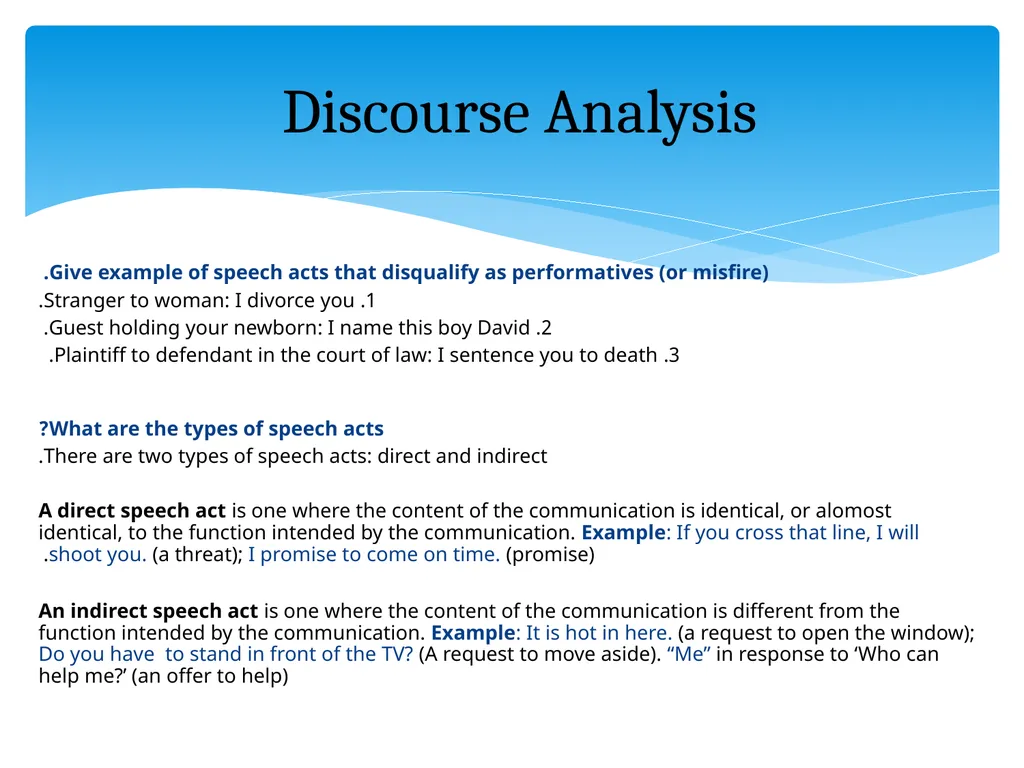
Give example of speech acts that disqualify as performatives (or misfire).
1. Stranger to woman: I divorce you.
2. Guest holding your newborn: I name this boy David.
3. Plaintiff to defendant in the court of law: I sentence you to death.
What are the types of speech acts?
There are two types of speech acts: direct and indirect.
A direct speech act is one where the content of the communication is identical, or alomost identical, to the function intended by the communication. Example: If you cross that line, I will shoot you. (a threat); I promise to come on time. (promise).
An indirect speech act is one where the content of the communication is different from the function intended by the communication. Example: It is hot in here. (a request to open the window); Do you have to stand in front of the TV? (A request to move aside). “Me” in response to ‘Who can help me?’ (an offer to help) Discourse Analysis<br>
12
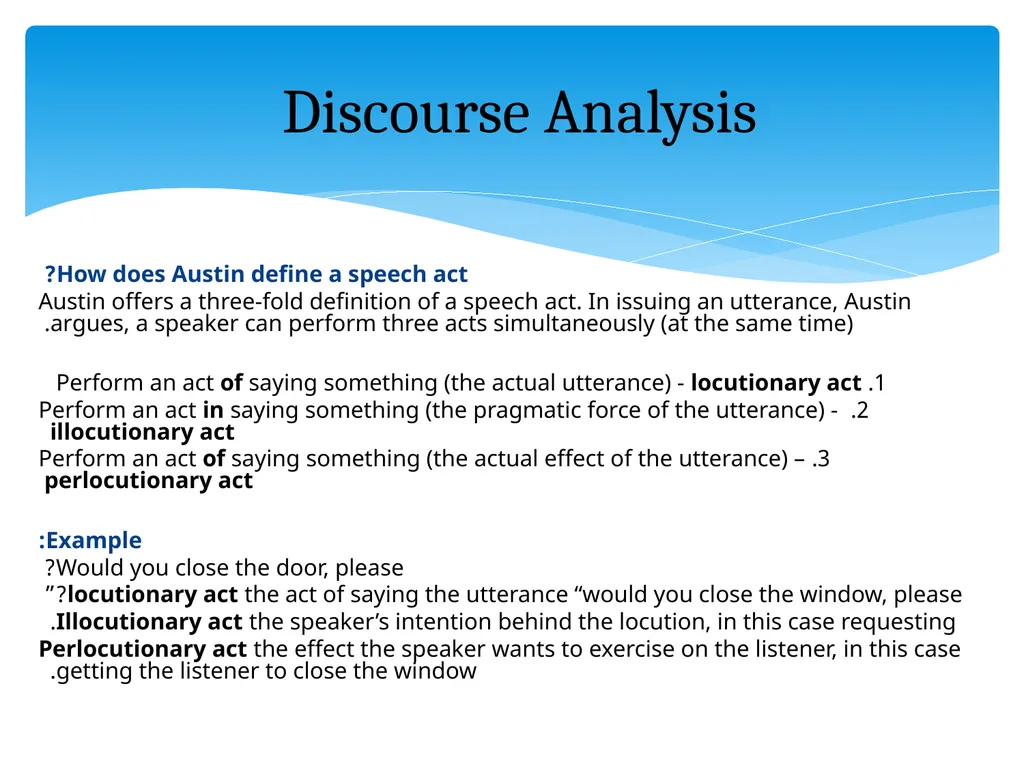
How does Austin define a speech act?
Austin offers a three-fold definition of a speech act. In issuing an utterance, Austin argues, a speaker can perform three acts simultaneously (at the same time).
1. Perform an act of saying something (the actual utterance) - locutionary act
2. Perform an act in saying something (the pragmatic force of the utterance) - illocutionary act
3. Perform an act of saying something (the actual effect of the utterance) – perlocutionary act
Example:
Would you close the door, please?
locutionary act the act of saying the utterance “would you close the window, please?”
Illocutionary act the speaker’s intention behind the locution, in this case requesting.
Perlocutionary act the effect the speaker wants to exercise on the listener, in this case getting the listener to close the window. Discourse Analysis<br>
13
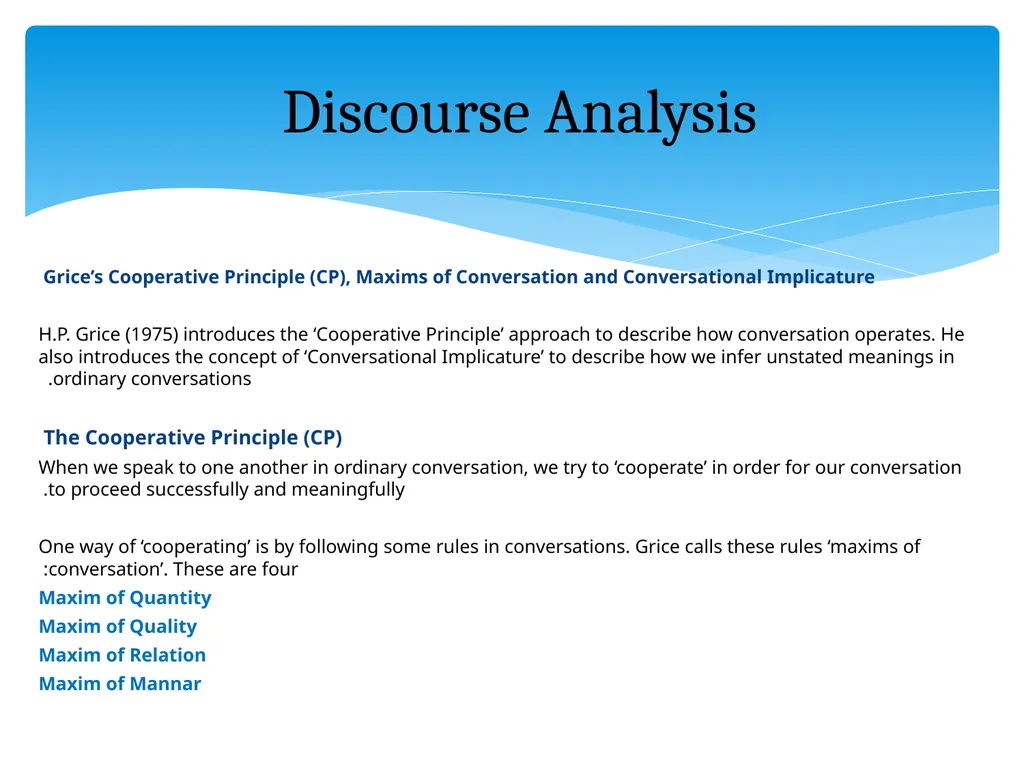
Grice’s Cooperative Principle (CP), Maxims of Conversation and Conversational Implicature
H.P. Grice (1975) introduces the ‘Cooperative Principle’ approach to describe how conversation operates. He also introduces the concept of ‘Conversational Implicature’ to describe how we infer unstated meanings in ordinary conversations.
The Cooperative Principle (CP)
When we speak to one another in ordinary conversation, we try to ‘cooperate’ in order for our conversation to proceed successfully and meaningfully.
One way of ‘cooperating’ is by following some rules in conversations. Grice calls these rules ‘maxims of conversation’. These are four:
Maxim of Quantity
Maxim of Quality
Maxim of Relation
Maxim of Mannar Discourse Analysis<br>
14
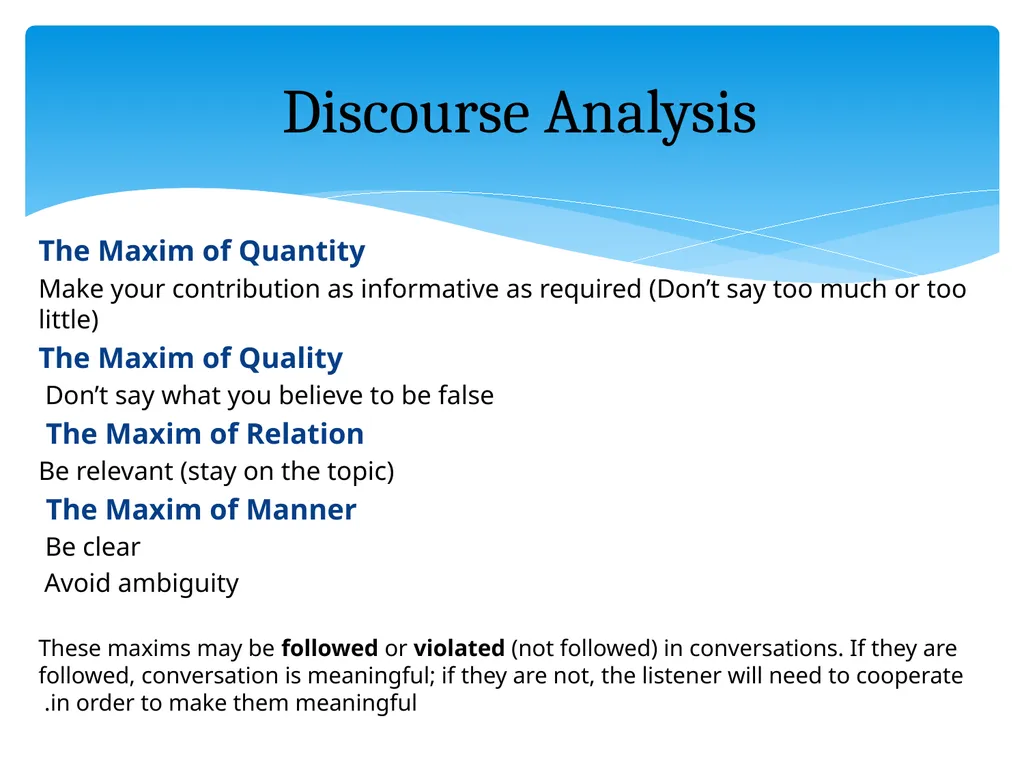
The Maxim of Quantity
Make your contribution as informative as required (Don’t say too much or too little)
The Maxim of Quality
Don’t say what you believe to be false
The Maxim of Relation
Be relevant (stay on the topic)
The Maxim of Manner
Be clear
Avoid ambiguity
These maxims may be followed or violated (not followed) in conversations. If they are followed, conversation is meaningful; if they are not, the listener will need to cooperate in order to make them meaningful. Discourse Analysis<br>
15
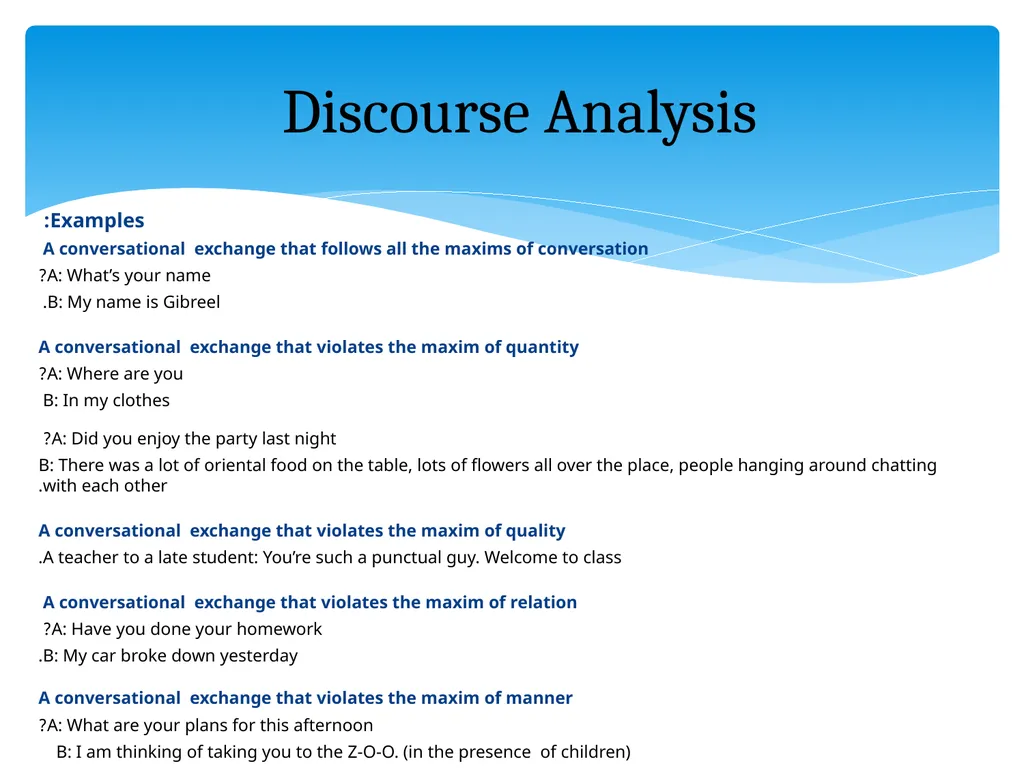
Examples:
A conversational exchange that follows all the maxims of conversation
A: What’s your name?
B: My name is Gibreel.
A conversational exchange that violates the maxim of quantity
A: Where are you?
B: In my clothes
A: Did you enjoy the party last night?
B: There was a lot of oriental food on the table, lots of flowers all over the place, people hanging around chatting with each other.
A conversational exchange that violates the maxim of quality
A teacher to a late student: You’re such a punctual guy. Welcome to class.
A conversational exchange that violates the maxim of relation
A: Have you done your homework?
B: My car broke down yesterday.
A conversational exchange that violates the maxim of manner
A: What are your plans for this afternoon?
B: I am thinking of taking you to the Z-O-O. (in the presence of children) Discourse Analysis<br>
16
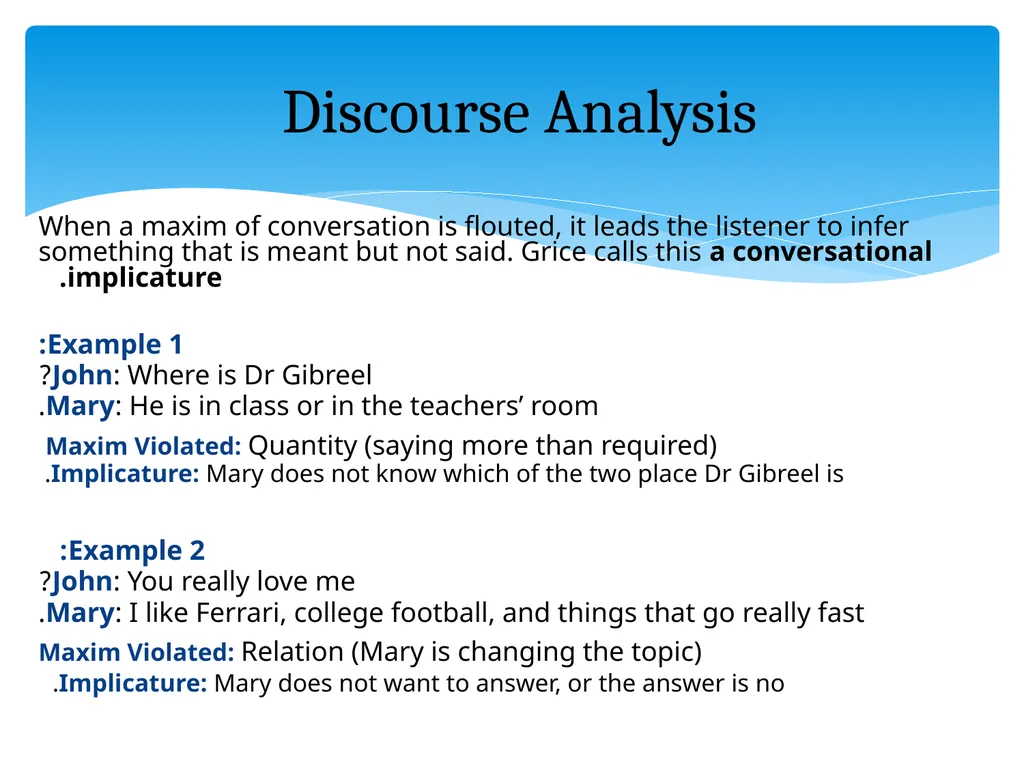
When a maxim of conversation is flouted, it leads the listener to infer something that is meant but not said. Grice calls this a conversational implicature.
Example 1:
John: Where is Dr Gibreel?
Mary: He is in class or in the teachers’ room.
Maxim Violated: Quantity (saying more than required)
Implicature: Mary does not know which of the two place Dr Gibreel is.
Example 2:
John: You really love me?
Mary: I like Ferrari, college football, and things that go really fast.
Maxim Violated: Relation (Mary is changing the topic)
Implicature: Mary does not want to answer, or the answer is no. Discourse Analysis<br>
17
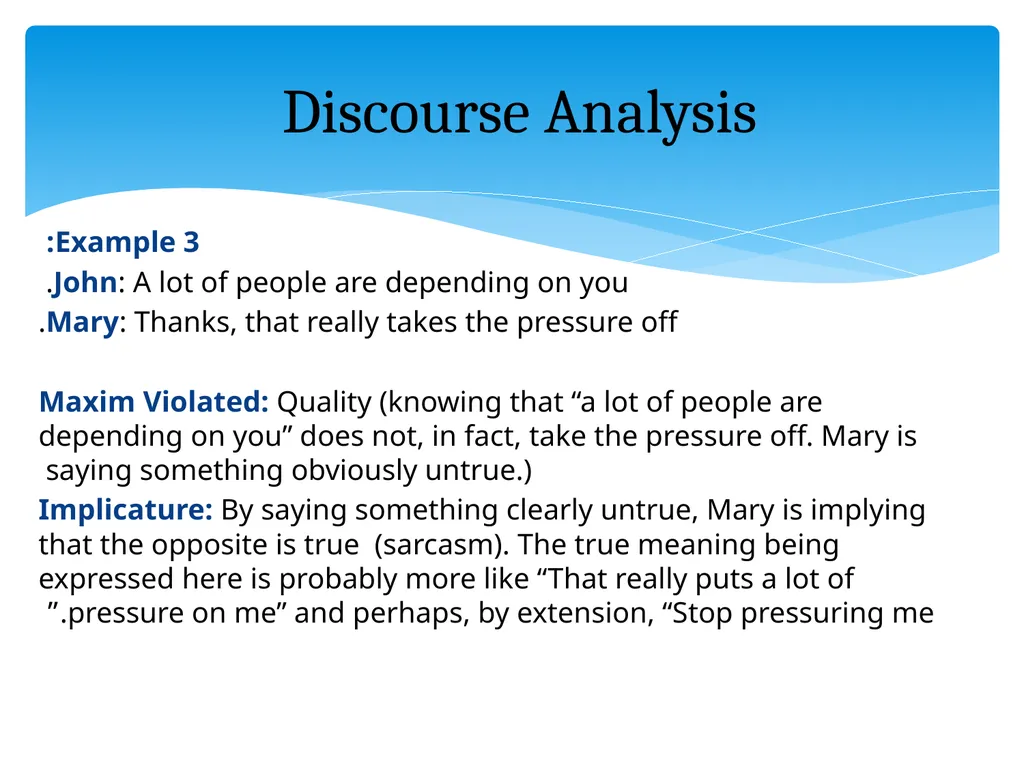
Example 3:
John: A lot of people are depending on you.
Mary: Thanks, that really takes the pressure off.
Maxim Violated: Quality (knowing that “a lot of people are depending on you” does not, in fact, take the pressure off. Mary is saying something obviously untrue.)
Implicature: By saying something clearly untrue, Mary is implying that the opposite is true (sarcasm). The true meaning being expressed here is probably more like “That really puts a lot of pressure on me” and perhaps, by extension, “Stop pressuring me.” Discourse Analysis<br>
18
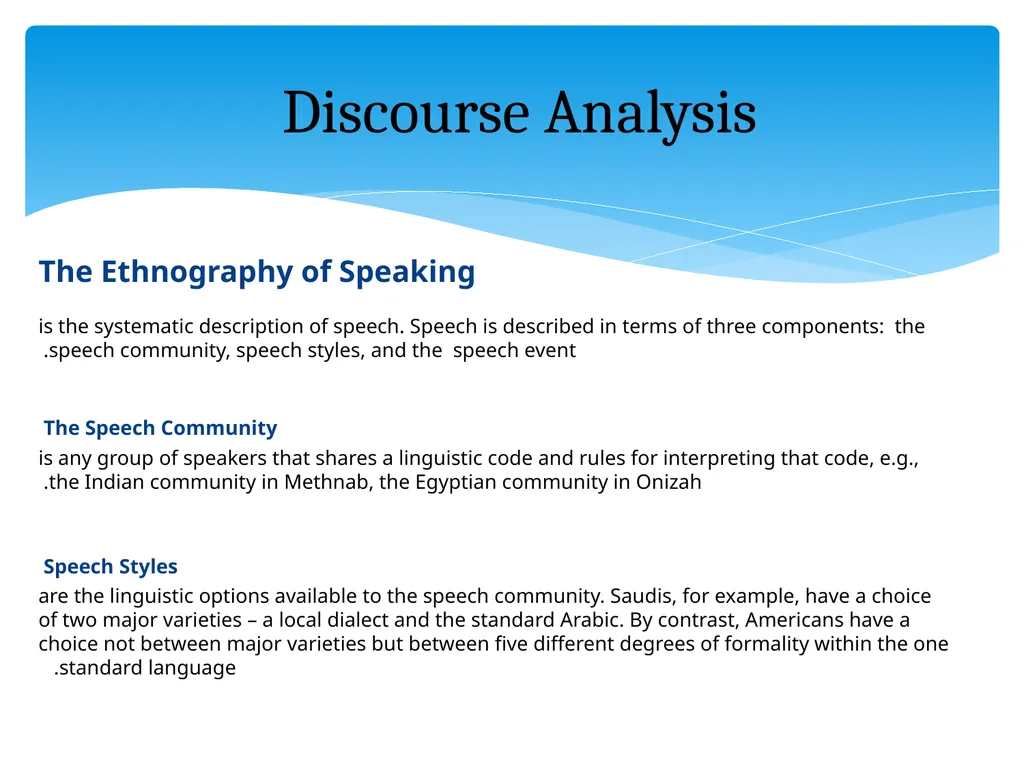
The Ethnography of Speaking
is the systematic description of speech. Speech is described in terms of three components: the speech community, speech styles, and the speech event.
The Speech Community
is any group of speakers that shares a linguistic code and rules for interpreting that code, e.g., the Indian community in Methnab, the Egyptian community in Onizah.
Speech Styles
are the linguistic options available to the speech community. Saudis, for example, have a choice of two major varieties – a local dialect and the standard Arabic. By contrast, Americans have a choice not between major varieties but between five different degrees of formality within the one standard language. Discourse Analysis<br>
19
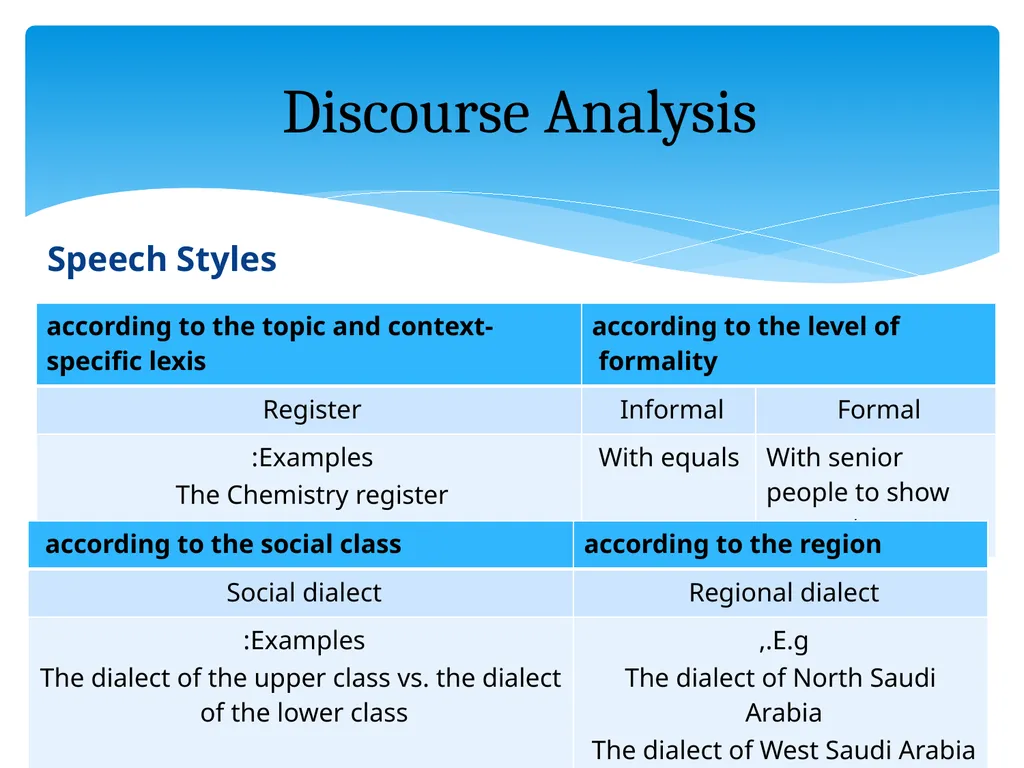
Speech Styles Discourse Analysis<br>
20
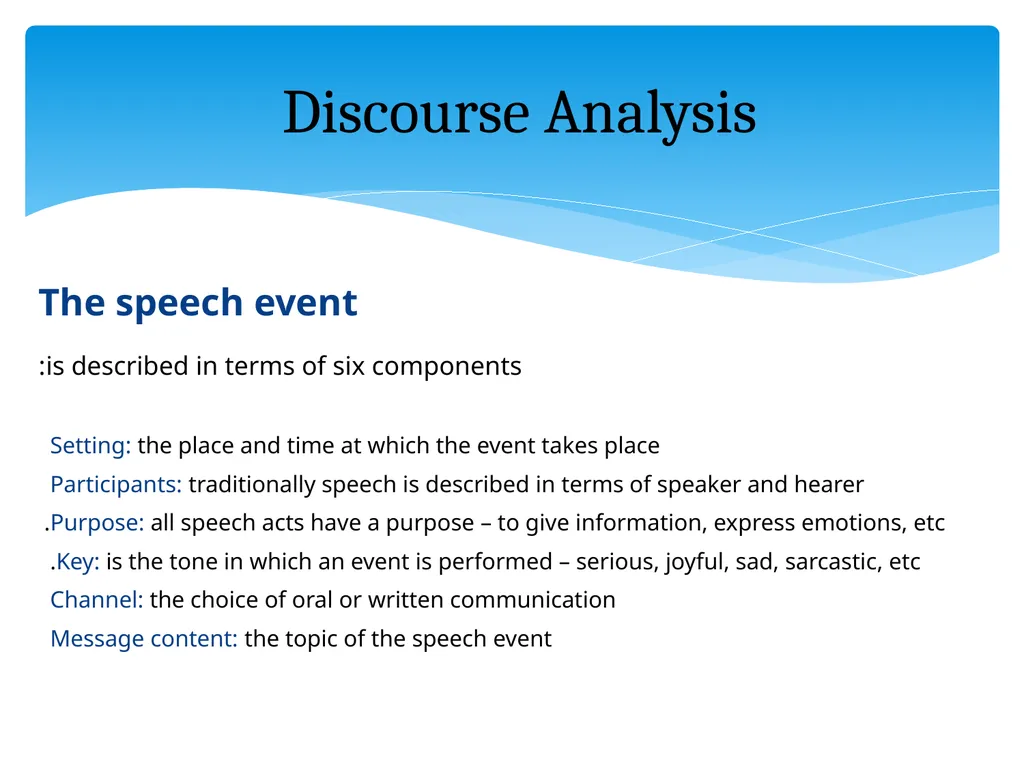
The speech event
is described in terms of six components:
Setting: the place and time at which the event takes place
Participants: traditionally speech is described in terms of speaker and hearer
Purpose: all speech acts have a purpose – to give information, express emotions, etc.
Key: is the tone in which an event is performed – serious, joyful, sad, sarcastic, etc.
Channel: the choice of oral or written communication
Message content: the topic of the speech event Discourse Analysis<br>
21
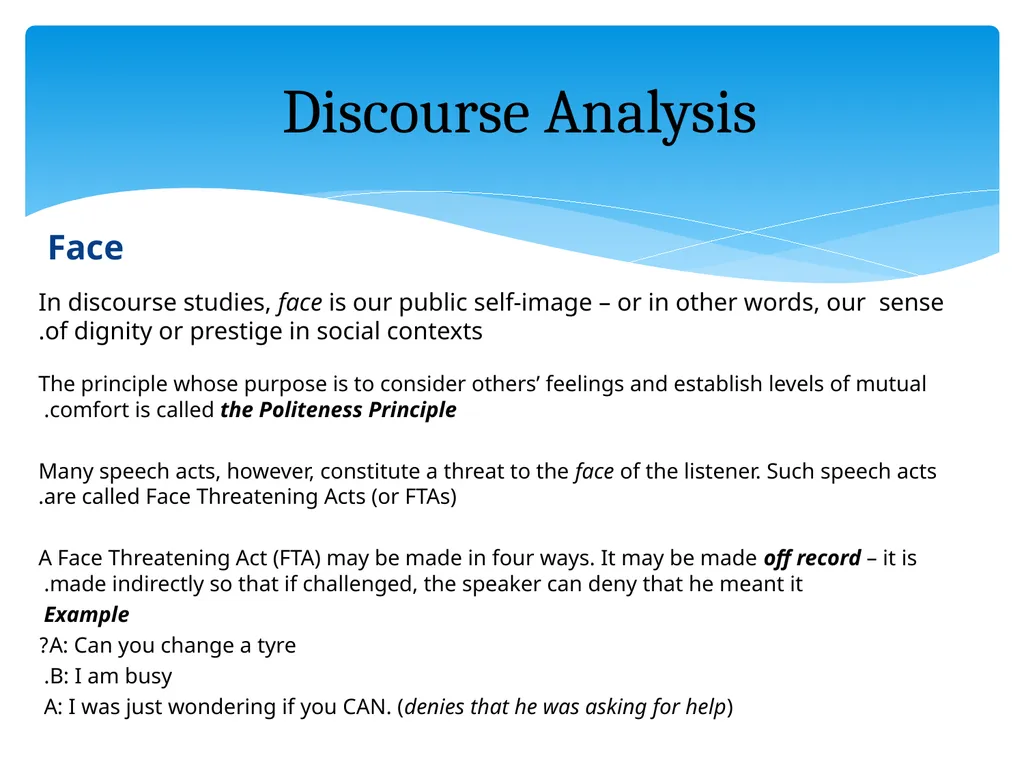
Face
In discourse studies, face is our public self-image – or in other words, our sense of dignity or prestige in social contexts.
The principle whose purpose is to consider others’ feelings and establish levels of mutual comfort is called the Politeness Principle.
Many speech acts, however, constitute a threat to the face of the listener. Such speech acts are called Face Threatening Acts (or FTAs).
A Face Threatening Act (FTA) may be made in four ways. It may be made off record – it is made indirectly so that if challenged, the speaker can deny that he meant it.
Example
A: Can you change a tyre?
B: I am busy.
A: I was just wondering if you CAN. (denies that he was asking for help) Discourse Analysis<br>
22
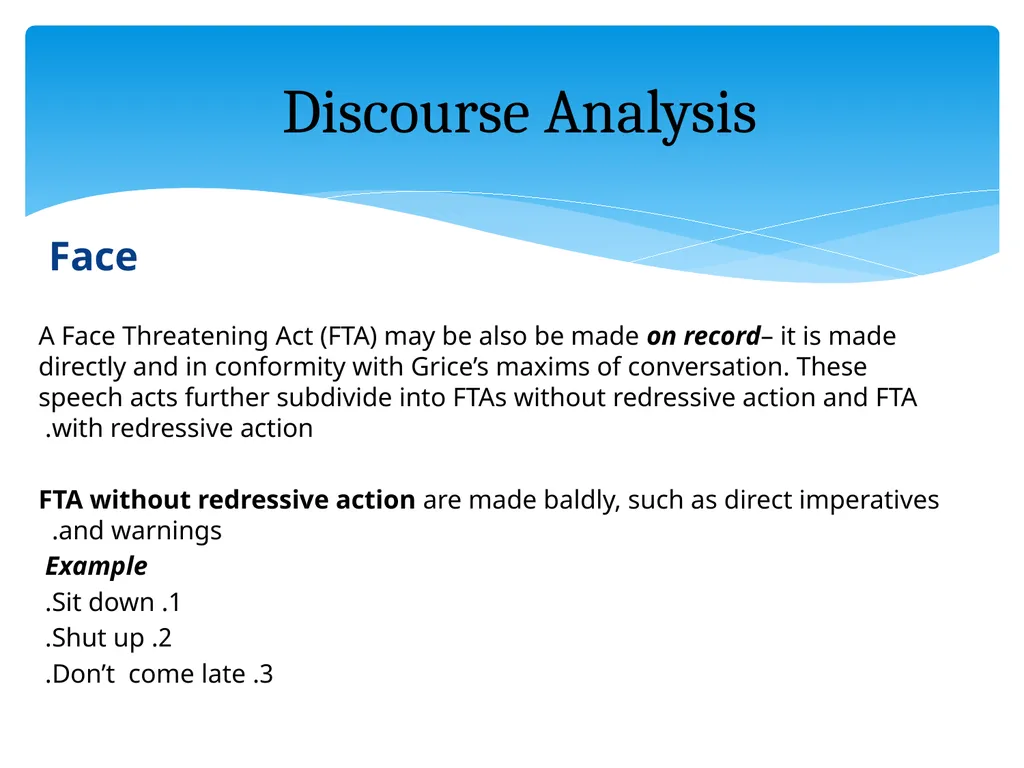
Face
A Face Threatening Act (FTA) may be also be made on record– it is made directly and in conformity with Grice’s maxims of conversation. These speech acts further subdivide into FTAs without redressive action and FTA with redressive action.
FTA without redressive action are made baldly, such as direct imperatives and warnings.
Example
1. Sit down.
2. Shut up.
3. Don’t come late. Discourse Analysis<br>
23
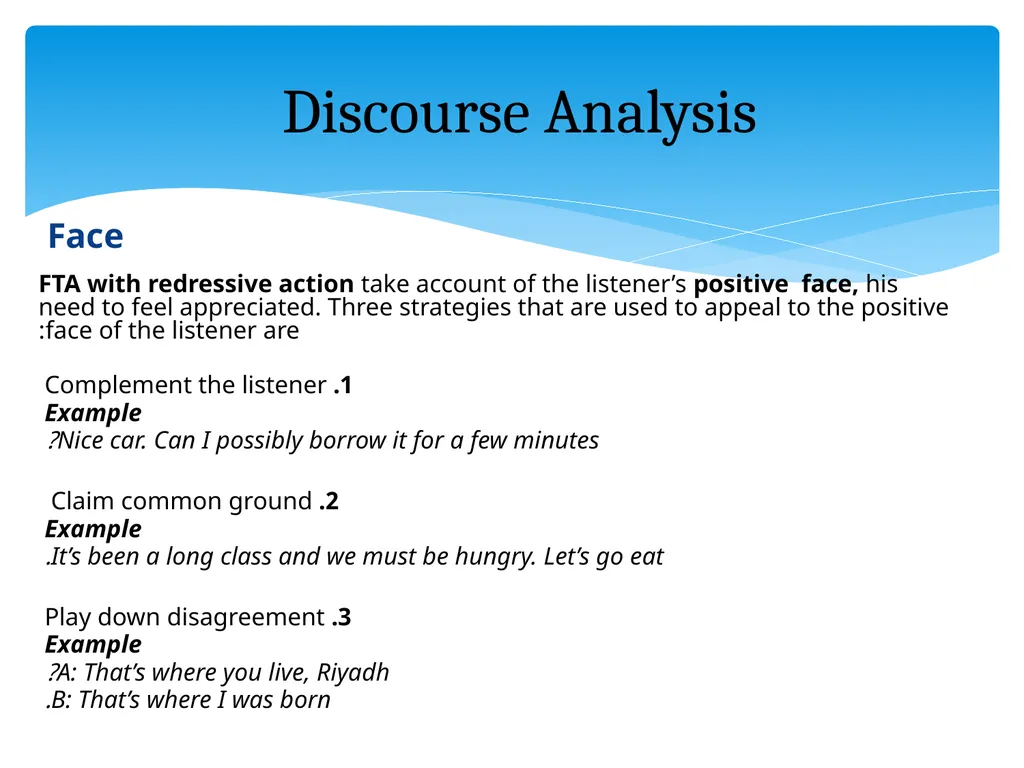
Face
FTA with redressive action take account of the listener’s positive face, his need to feel appreciated. Three strategies that are used to appeal to the positive face of the listener are:
1. Complement the listener
Example
Nice car. Can I possibly borrow it for a few minutes?
2. Claim common ground
Example
It’s been a long class and we must be hungry. Let’s go eat.
3. Play down disagreement
Example
A: That’s where you live, Riyadh?
B: That’s where I was born. Discourse Analysis<br>
24
Face
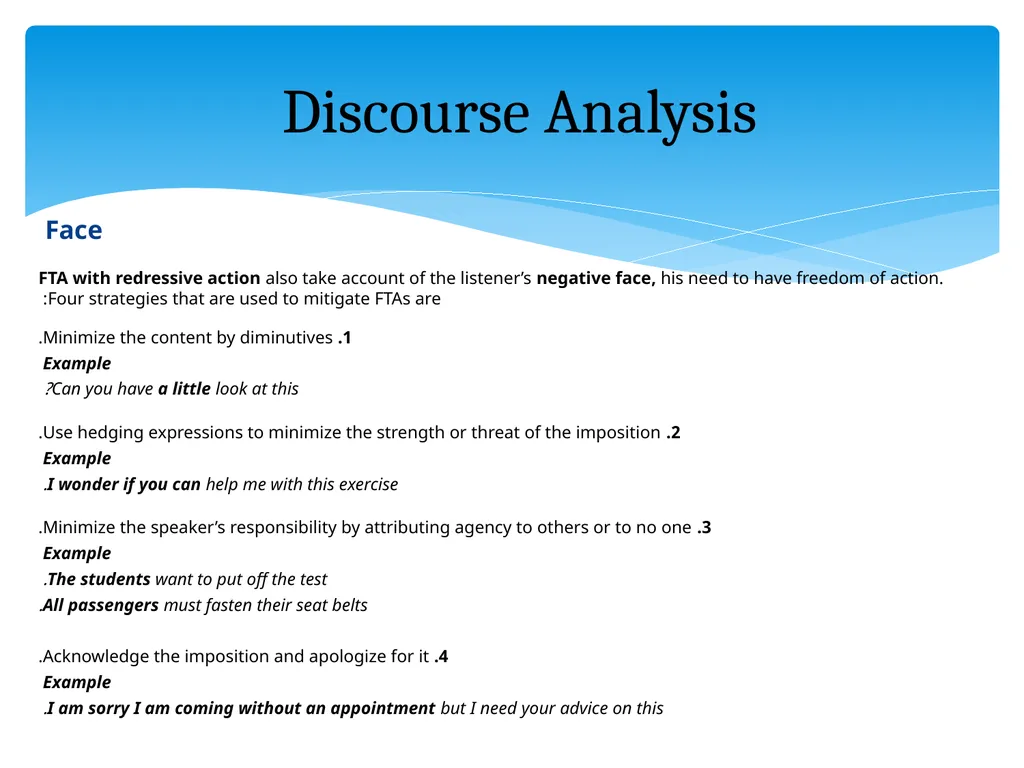
FTA with redressive action also take account of the listener’s negative face, his need to have freedom of action. Four strategies that are used to mitigate FTAs are:
1. Minimize the content by diminutives.
Example
Can you have a little look at this?
2. Use hedging expressions to minimize the strength or threat of the imposition.
Example
I wonder if you can help me with this exercise.
3. Minimize the speaker’s responsibility by attributing agency to others or to no one.
Example
The students want to put off the test.
All passengers must fasten their seat belts.
4. Acknowledge the imposition and apologize for it.
Example
I am sorry I am coming without an appointment but I need your advice on this. Discourse Analysis<br>
25
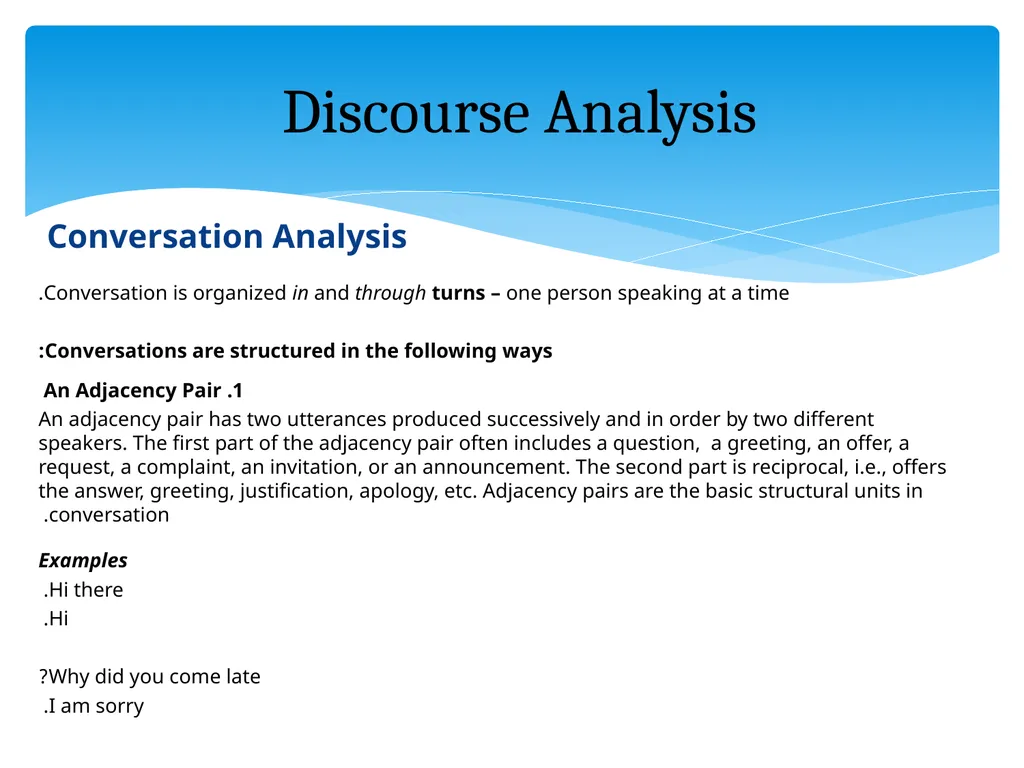
Conversation Analysis
Conversation is organized in and through turns – one person speaking at a time.
Conversations are structured in the following ways:
1. An Adjacency Pair
An adjacency pair has two utterances produced successively and in order by two different speakers. The first part of the adjacency pair often includes a question, a greeting, an offer, a request, a complaint, an invitation, or an announcement. The second part is reciprocal, i.e., offers the answer, greeting, justification, apology, etc. Adjacency pairs are the basic structural units in conversation.
Examples
Hi there.
Hi.
Why did you come late?
I am sorry. Discourse Analysis<br>
26
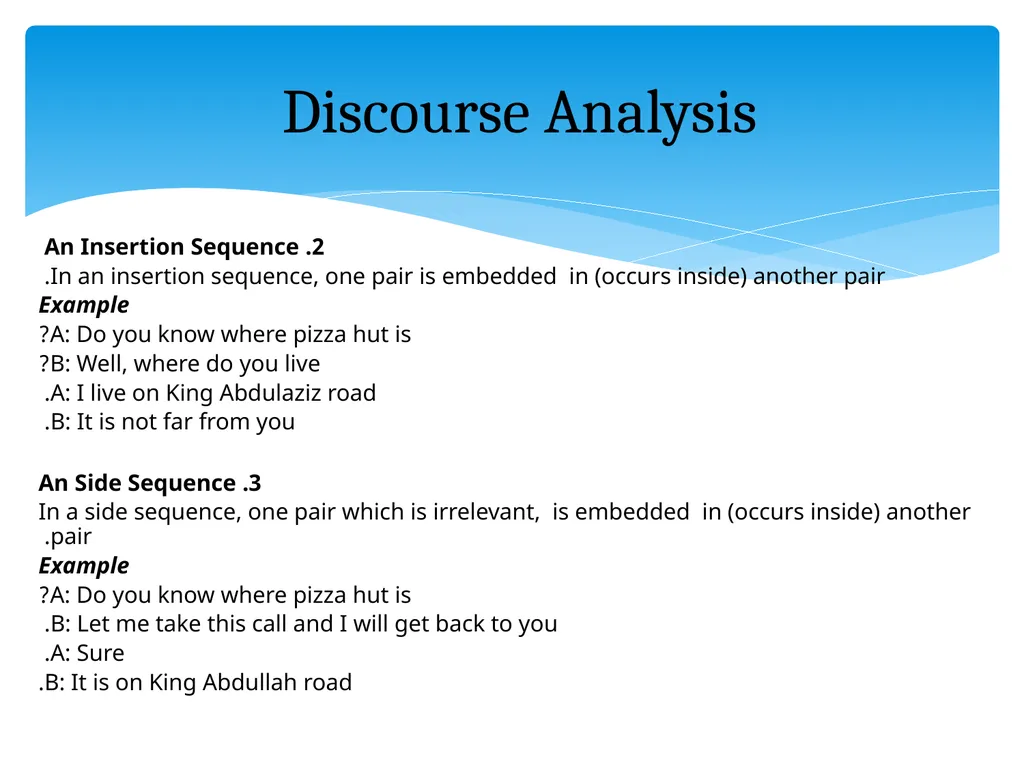
2. An Insertion Sequence
In an insertion sequence, one pair is embedded in (occurs inside) another pair.
Example
A: Do you know where pizza hut is?
B: Well, where do you live?
A: I live on King Abdulaziz road.
B: It is not far from you.
3. An Side Sequence
In a side sequence, one pair which is irrelevant, is embedded in (occurs inside) another pair.
Example
A: Do you know where pizza hut is?
B: Let me take this call and I will get back to you.
A: Sure.
B: It is on King Abdullah road. Discourse Analysis<br>
27
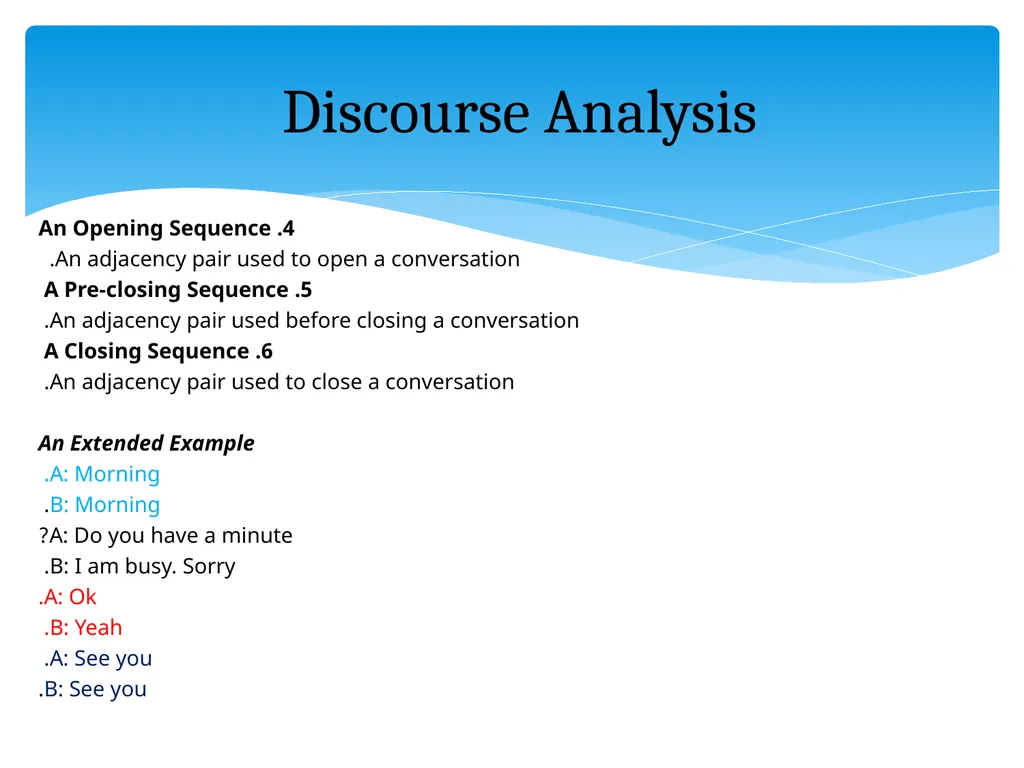
4. An Opening Sequence
An adjacency pair used to open a conversation.
5. A Pre-closing Sequence
An adjacency pair used before closing a conversation.
6. A Closing Sequence
An adjacency pair used to close a conversation.
An Extended Example
A: Morning.
B: Morning.
A: Do you have a minute?
B: I am busy. Sorry.
A: Ok.
B: Yeah.
A: See you.
B: See you. Discourse Analysis<br>
28
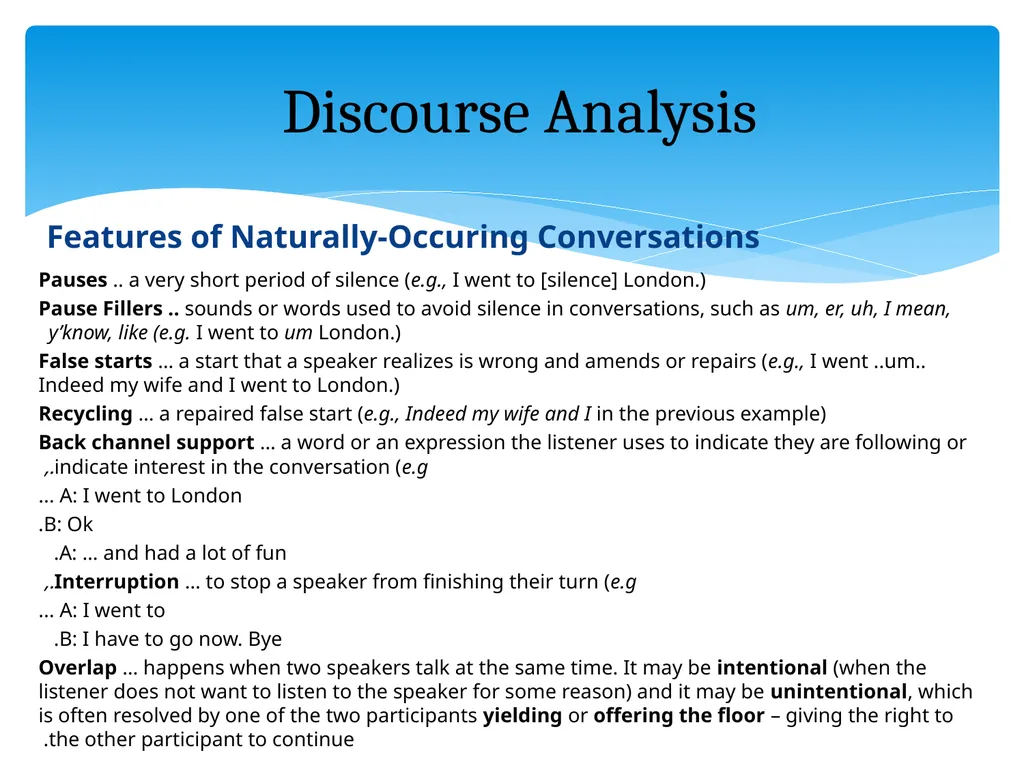
Features of Naturally-Occuring Conversations
Pauses .. a very short period of silence (e.g., I went to [silence] London.)
Pause Fillers .. sounds or words used to avoid silence in conversations, such as um, er, uh, I mean, y’know, like (e.g. I went to um London.)
False starts … a start that a speaker realizes is wrong and amends or repairs (e.g., I went ..um.. Indeed my wife and I went to London.)
Recycling … a repaired false start (e.g., Indeed my wife and I in the previous example)
Back channel support … a word or an expression the listener uses to indicate they are following or indicate interest in the conversation (e.g.,
A: I went to London …
B: Ok.
A: … and had a lot of fun.
Interruption … to stop a speaker from finishing their turn (e.g.,
A: I went to …
B: I have to go now. Bye.
Overlap … happens when two speakers talk at the same time. It may be intentional (when the listener does not want to listen to the speaker for some reason) and it may be unintentional, which is often resolved by one of the two participants yielding or offering the floor – giving the right to the other participant to continue. Discourse Analysis<br>
29
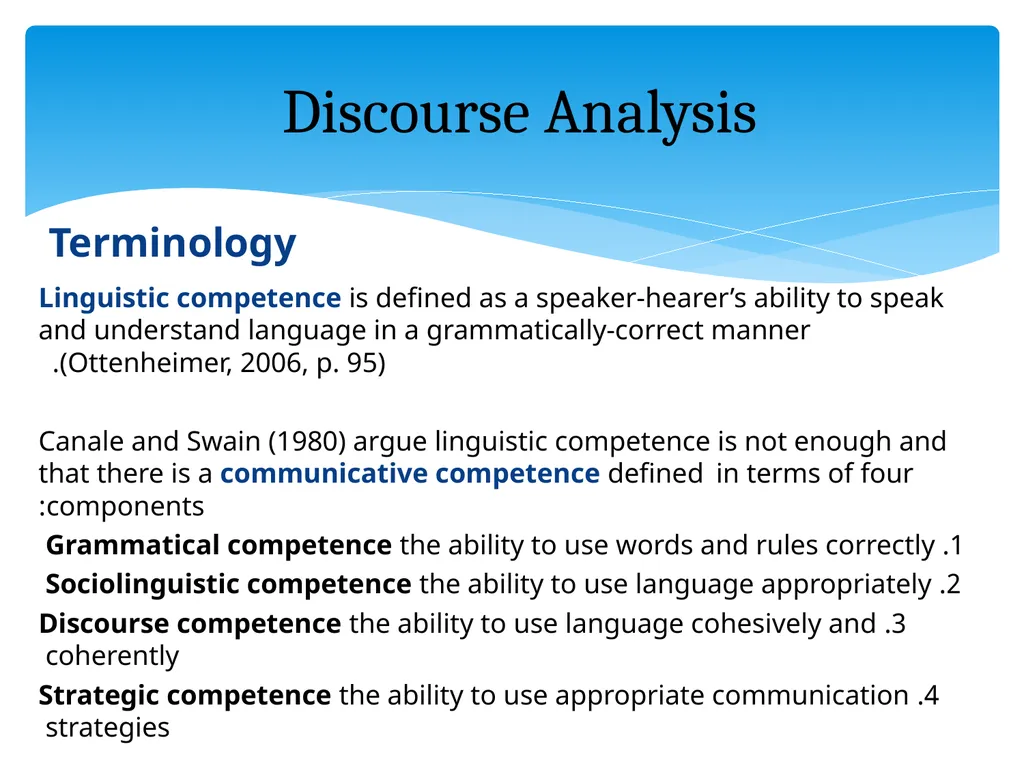
Terminology
Linguistic competence is defined as a speaker-hearer’s ability to speak and understand language in a grammatically-correct manner (Ottenheimer, 2006, p. 95).
Canale and Swain (1980) argue linguistic competence is not enough and that there is a communicative competence defined in terms of four components:
1. Grammatical competence the ability to use words and rules correctly
2. Sociolinguistic competence the ability to use language appropriately
3. Discourse competence the ability to use language cohesively and coherently
4. Strategic competence the ability to use appropriate communication strategies Discourse Analysis<br>
30
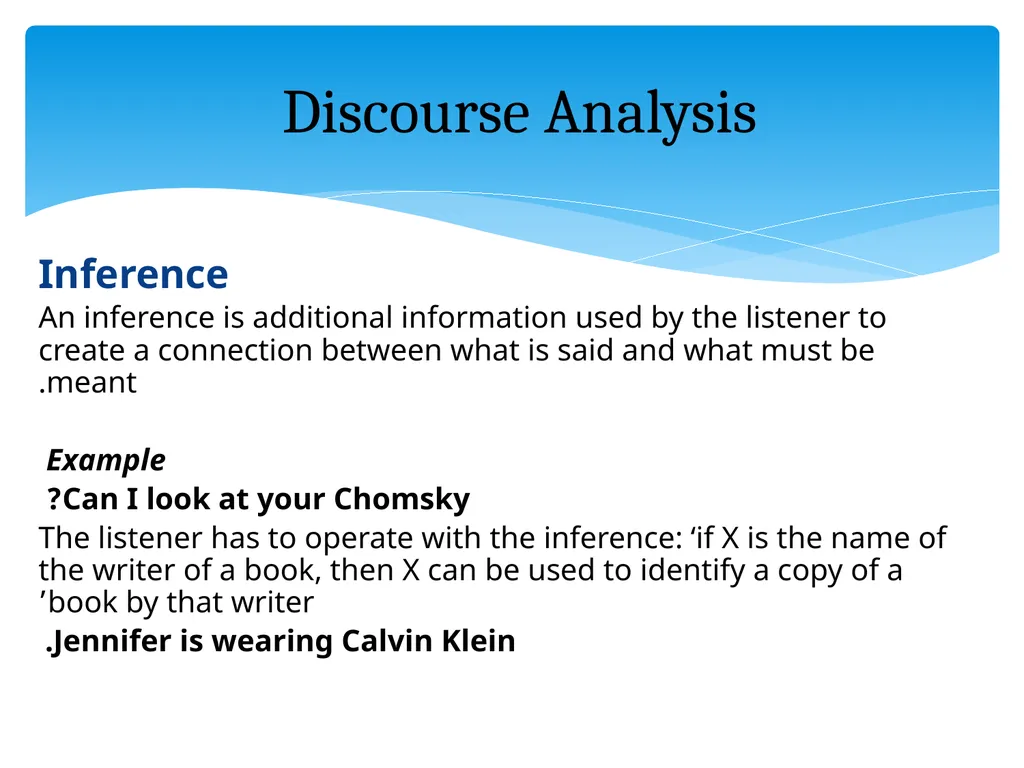
Inference
An inference is additional information used by the listener to create a connection between what is said and what must be meant.
Example
Can I look at your Chomsky?
The listener has to operate with the inference: ‘if X is the name of the writer of a book, then X can be used to identify a copy of a book by that writer’
Jennifer is wearing Calvin Klein. Discourse Analysis<br>
31
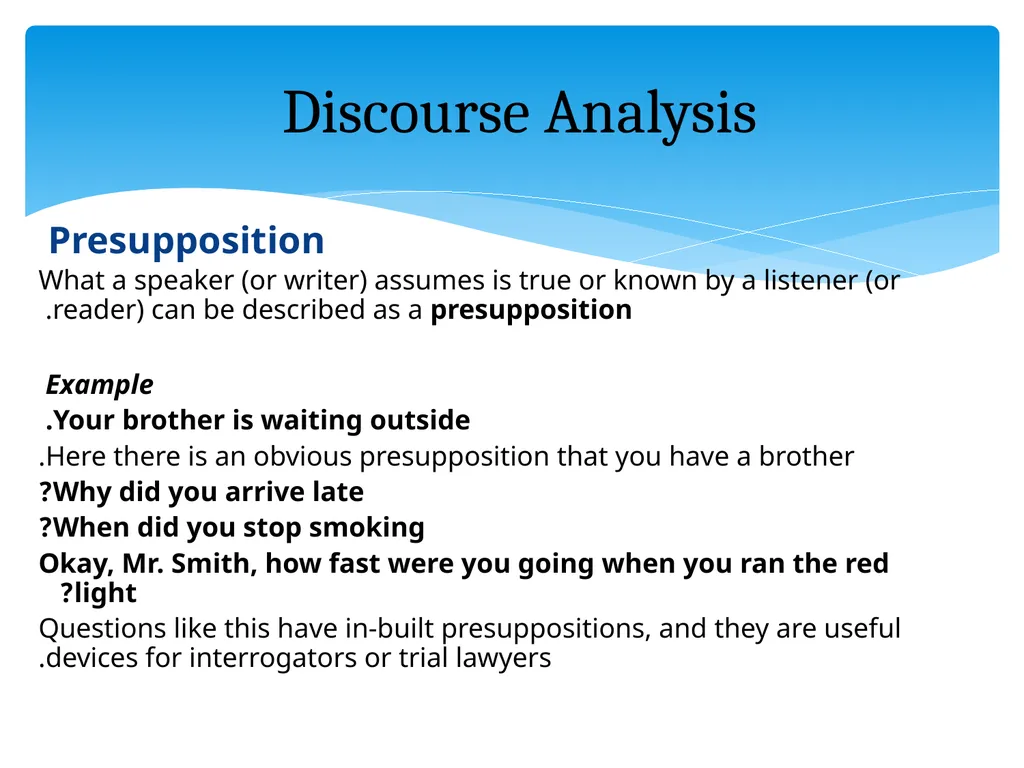
Presupposition
What a speaker (or writer) assumes is true or known by a listener (or reader) can be described as a presupposition.
Example
Your brother is waiting outside.
Here there is an obvious presupposition that you have a brother.
Why did you arrive late?
When did you stop smoking?
Okay, Mr. Smith, how fast were you going when you ran the red light?
Questions like this have in-built presuppositions, and they are useful devices for interrogators or trial lawyers. Discourse Analysis<br>
32
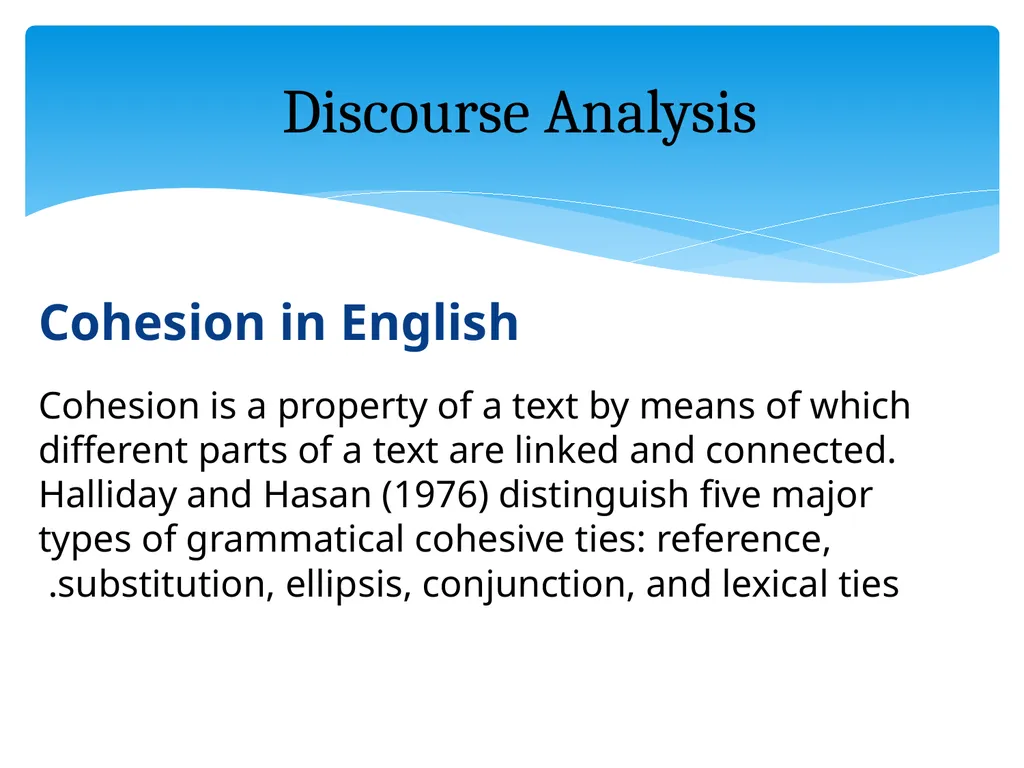
Cohesion in English
Cohesion is a property of a text by means of which different parts of a text are linked and connected. Halliday and Hasan (1976) distinguish five major types of grammatical cohesive ties: reference, substitution, ellipsis, conjunction, and lexical ties. Discourse Analysis<br>
Cohesion is a property of a text by means of which different parts of a text are linked and connected. Halliday and Hasan (1976) distinguish five major types of grammatical cohesive ties: reference, substitution, ellipsis, conjunction, and lexical ties. Discourse Analysis<br>
33
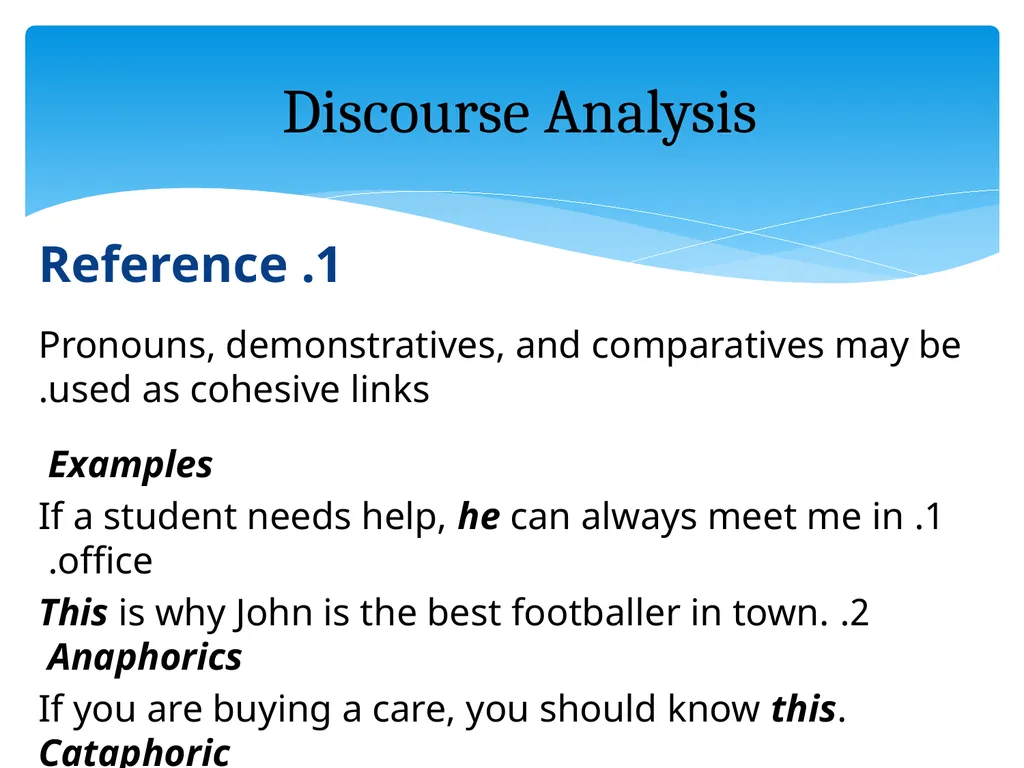
1. Reference
Pronouns, demonstratives, and comparatives may be used as cohesive links.
Examples
1. If a student needs help, he can always meet me in office.
2. This is why John is the best footballer in town. Anaphorics
If you are buying a care, you should know this. Cataphoric
3. This car is good but that one is better. Discourse Analysis<br>
34
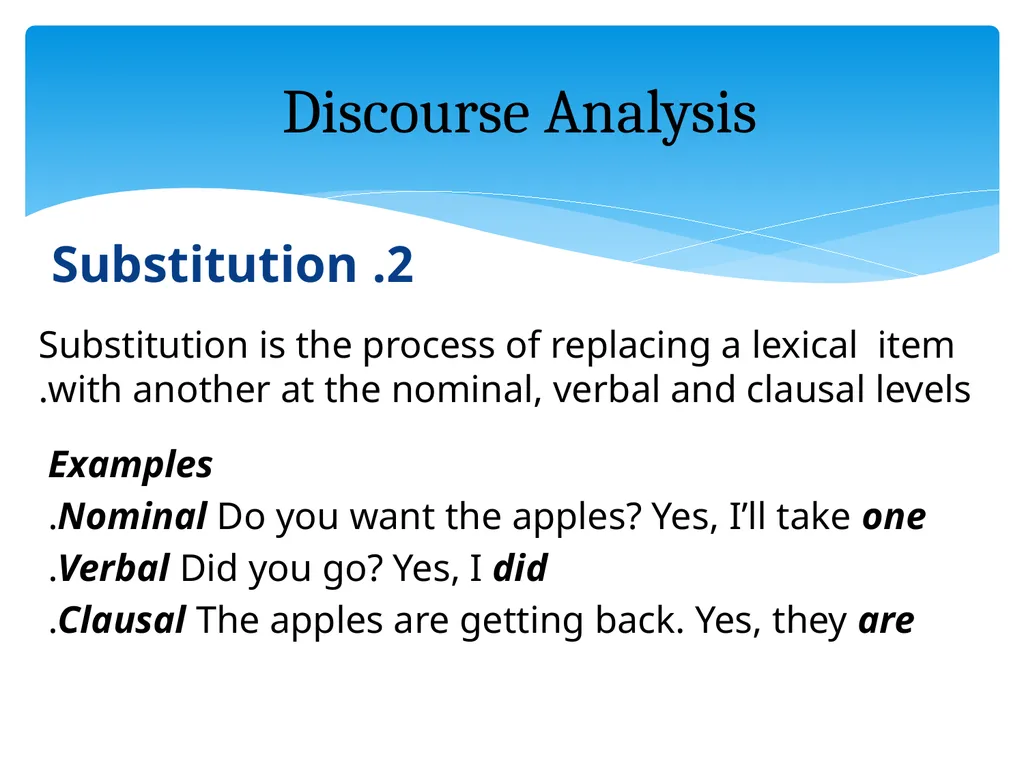
2. Substitution
Substitution is the process of replacing a lexical item with another at the nominal, verbal and clausal levels.
Examples
Nominal Do you want the apples? Yes, I’ll take one.
Verbal Did you go? Yes, I did.
Clausal The apples are getting back. Yes, they are. Discourse Analysis<br>
Substitution is the process of replacing a lexical item with another at the nominal, verbal and clausal levels.
Examples
Nominal Do you want the apples? Yes, I’ll take one.
Verbal Did you go? Yes, I did.
Clausal The apples are getting back. Yes, they are. Discourse Analysis<br>
35
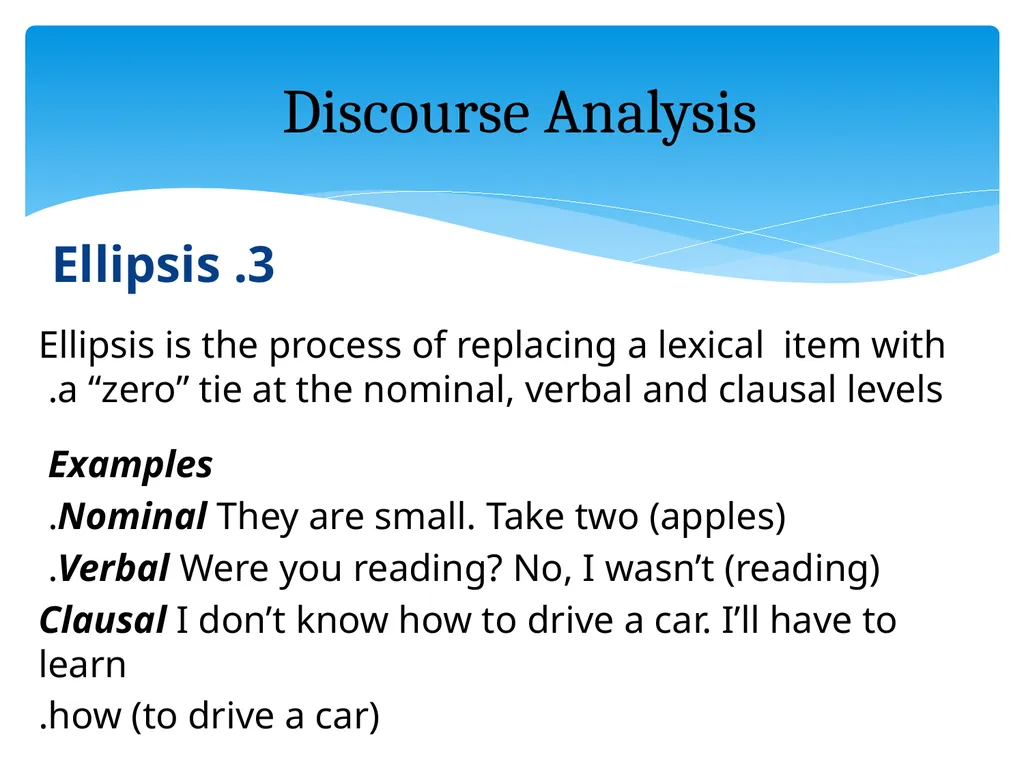
3. Ellipsis
Ellipsis is the process of replacing a lexical item with a “zero” tie at the nominal, verbal and clausal levels.
Examples
Nominal They are small. Take two (apples).
Verbal Were you reading? No, I wasn’t (reading).
Clausal I don’t know how to drive a car. I’ll have to learn
how (to drive a car). Discourse Analysis<br>
36
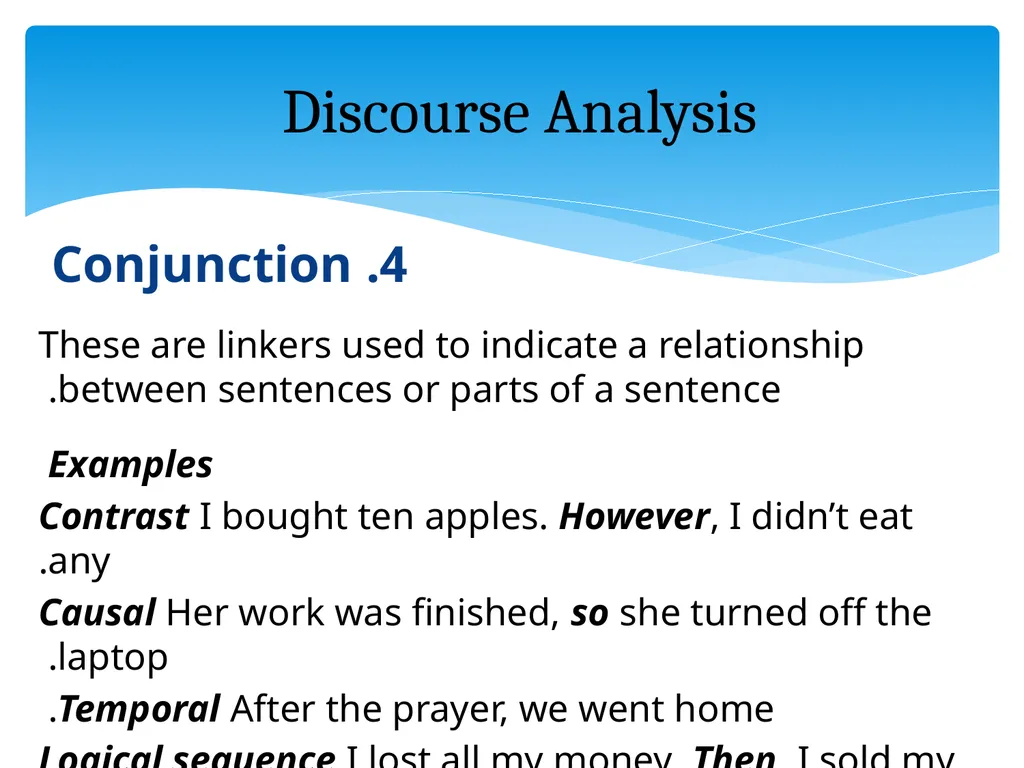
4. Conjunction
These are linkers used to indicate a relationship between sentences or parts of a sentence.
Examples
Contrast I bought ten apples. However, I didn’t eat any.
Causal Her work was finished, so she turned off the laptop.
Temporal After the prayer, we went home.
Logical sequence I lost all my money. Then, I sold my house. Discourse Analysis<br>
37
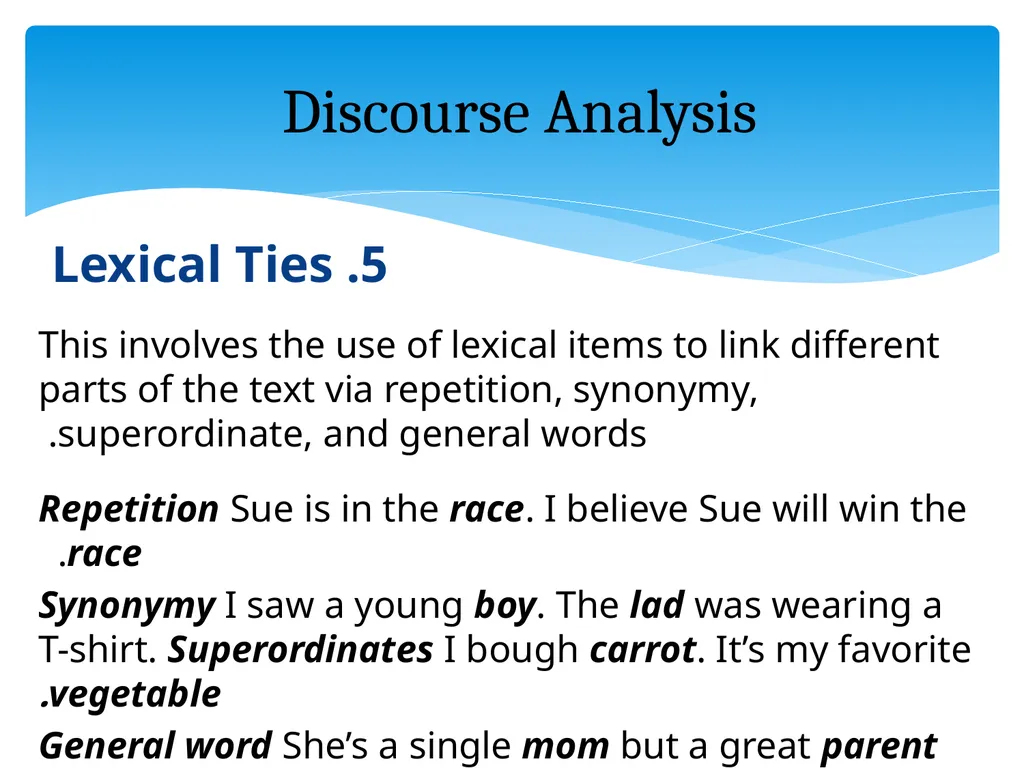
5. Lexical Ties
This involves the use of lexical items to link different parts of the text via repetition, synonymy, superordinate, and general words.
Repetition Sue is in the race. I believe Sue will win the race.
Synonymy I saw a young boy. The lad was wearing a T-shirt. Superordinates I bough carrot. It’s my favorite vegetable.
General word She’s a single mom but a great parent indeed. Discourse Analysis<br>
38
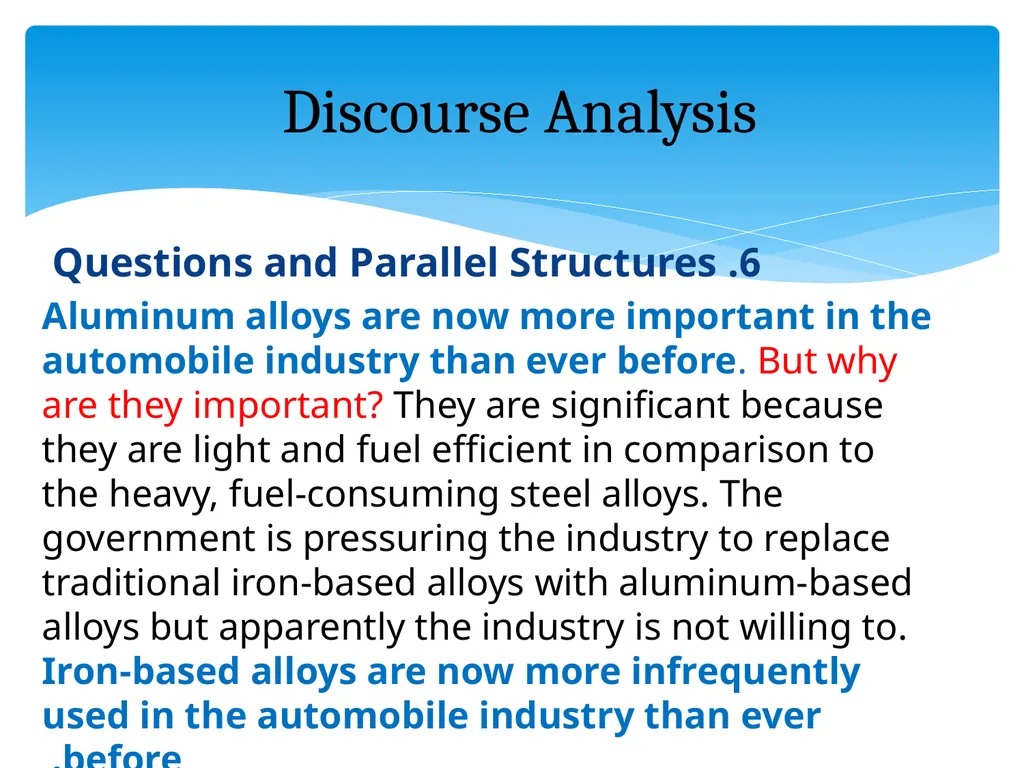
6. Questions and Parallel Structures
Aluminum alloys are now more important in the automobile industry than ever before. But why are they important? They are significant because they are light and fuel efficient in comparison to the heavy, fuel-consuming steel alloys. The government is pressuring the industry to replace traditional iron-based alloys with aluminum-based alloys but apparently the industry is not willing to. Iron-based alloys are now more infrequently used in the automobile industry than ever before. Discourse Analysis<br>
Aluminum alloys are now more important in the automobile industry than ever before. But why are they important? They are significant because they are light and fuel efficient in comparison to the heavy, fuel-consuming steel alloys. The government is pressuring the industry to replace traditional iron-based alloys with aluminum-based alloys but apparently the industry is not willing to. Iron-based alloys are now more infrequently used in the automobile industry than ever before. Discourse Analysis<br>
39
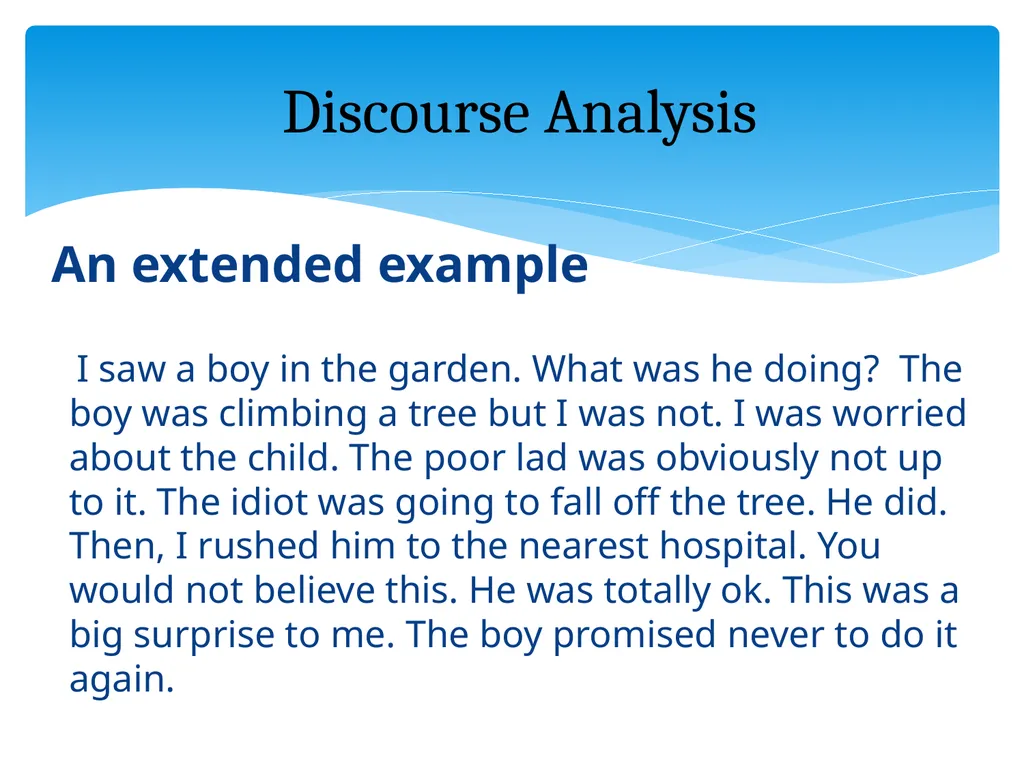
An extended example
I saw a boy in the garden. What was he doing? The boy was climbing a tree but I was not. I was worried about the child. The poor lad was obviously not up to it. The idiot was going to fall off the tree. He did. Then, I rushed him to the nearest hospital. You would not believe this. He was totally ok. This was a big surprise to me. The boy promised never to do it again. Discourse Analysis<br>
I saw a boy in the garden. What was he doing? The boy was climbing a tree but I was not. I was worried about the child. The poor lad was obviously not up to it. The idiot was going to fall off the tree. He did. Then, I rushed him to the nearest hospital. You would not believe this. He was totally ok. This was a big surprise to me. The boy promised never to do it again. Discourse Analysis<br>
40
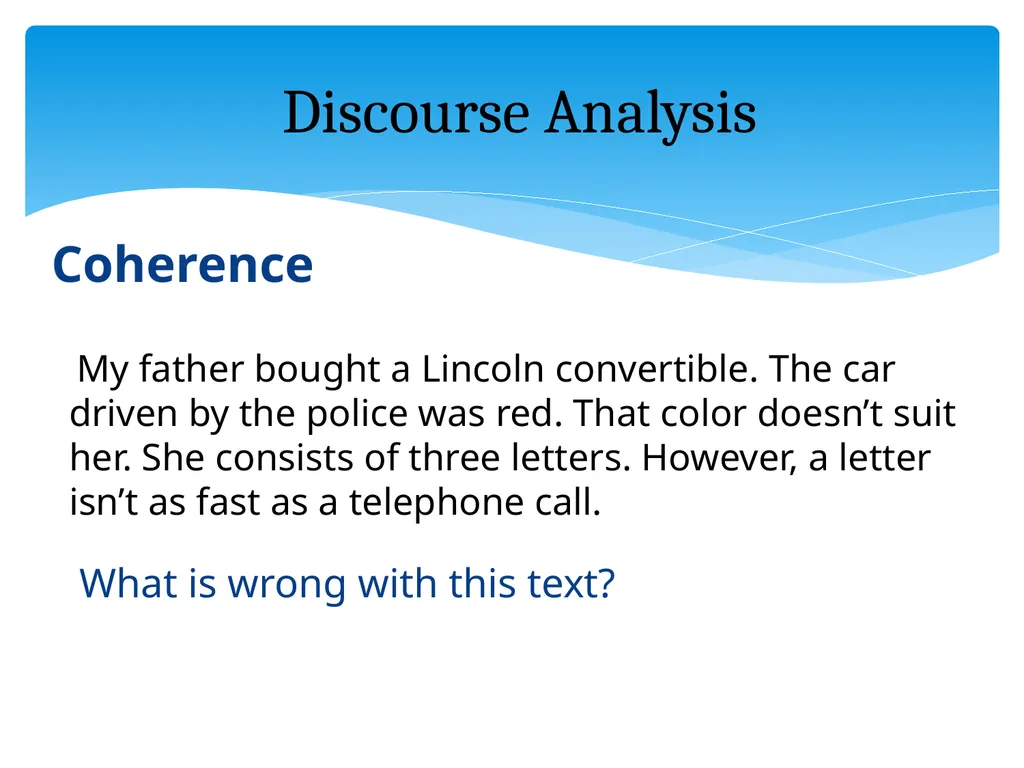
Coherence
My father bought a Lincoln convertible. The car driven by the police was red. That color doesn’t suit her. She consists of three letters. However, a letter isn’t as fast as a telephone call.
What is wrong with this text? Discourse Analysis<br>
My father bought a Lincoln convertible. The car driven by the police was red. That color doesn’t suit her. She consists of three letters. However, a letter isn’t as fast as a telephone call.
What is wrong with this text? Discourse Analysis<br>
41
Coherence
Coherence means the connection of ideas at the idea level (whereas cohesion is the connection of ideas at the sentence level). Discourse Analysis<br>
Coherence means the connection of ideas at the idea level (whereas cohesion is the connection of ideas at the sentence level). Discourse Analysis<br>
42
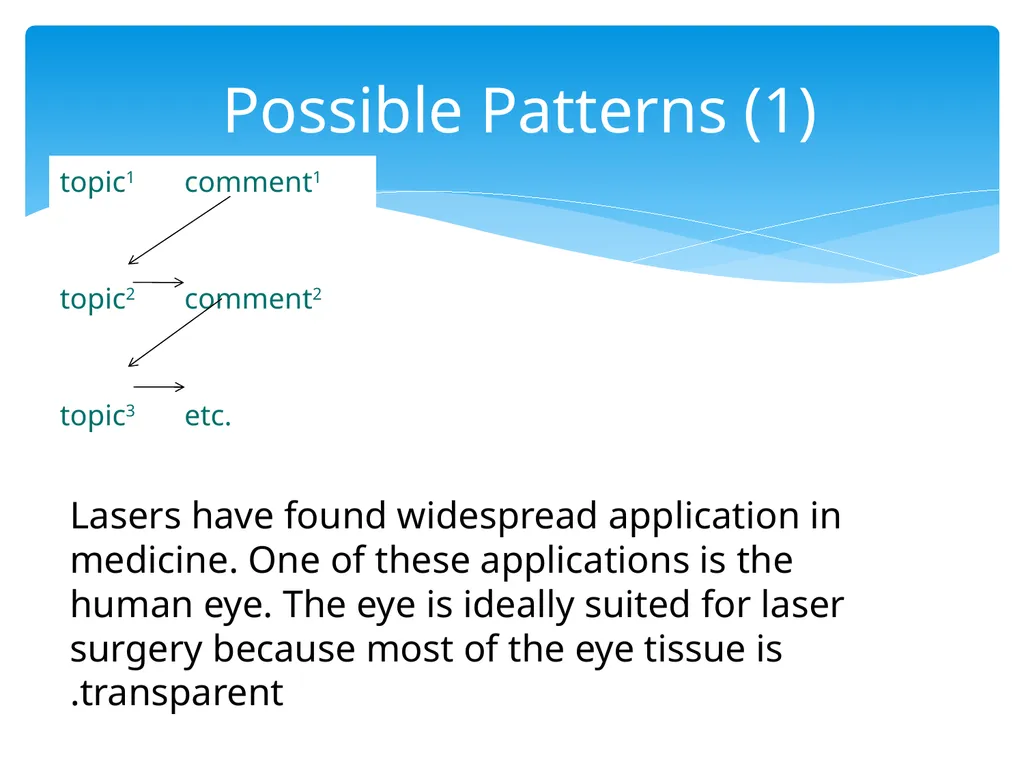
Possible Patterns (1) Lasers have found widespread application in medicine. One of these applications is the human eye. The eye is ideally suited for laser surgery because most of the eye tissue is transparent.<br>
43
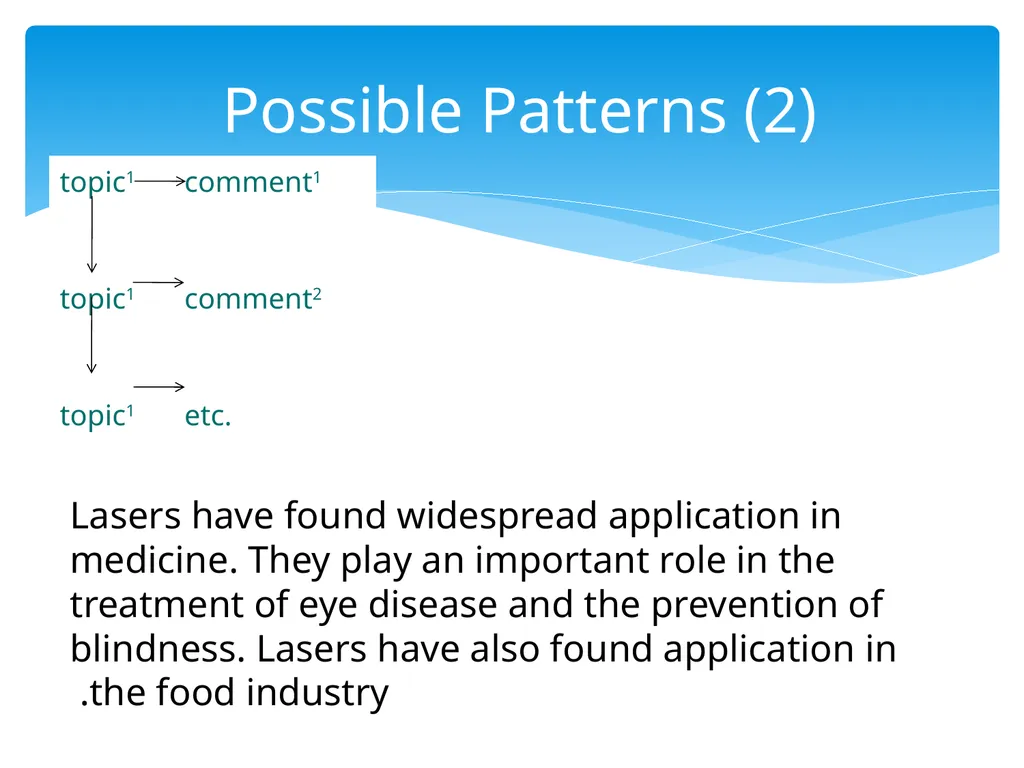
Possible Patterns (2) Lasers have found widespread application in medicine. They play an important role in the treatment of eye disease and the prevention of blindness. Lasers have also found application in the food industry.<br>
44
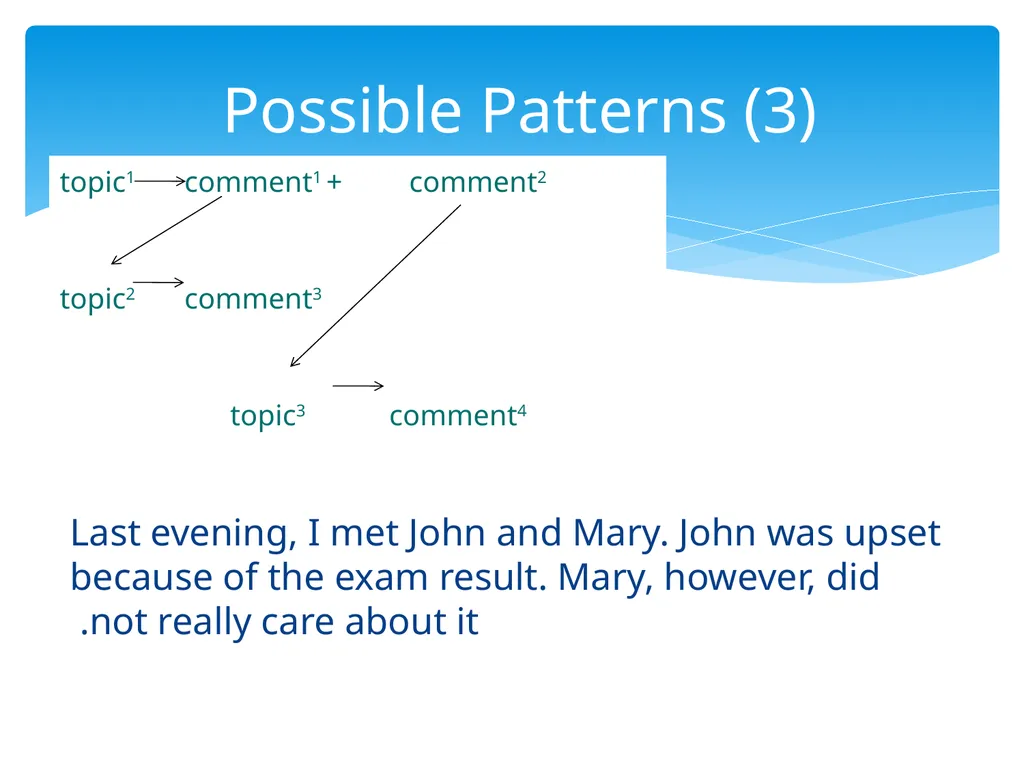
Possible Patterns (3) Last evening, I met John and Mary. John was upset because of the exam result. Mary, however, did not really care about it.<br>
45
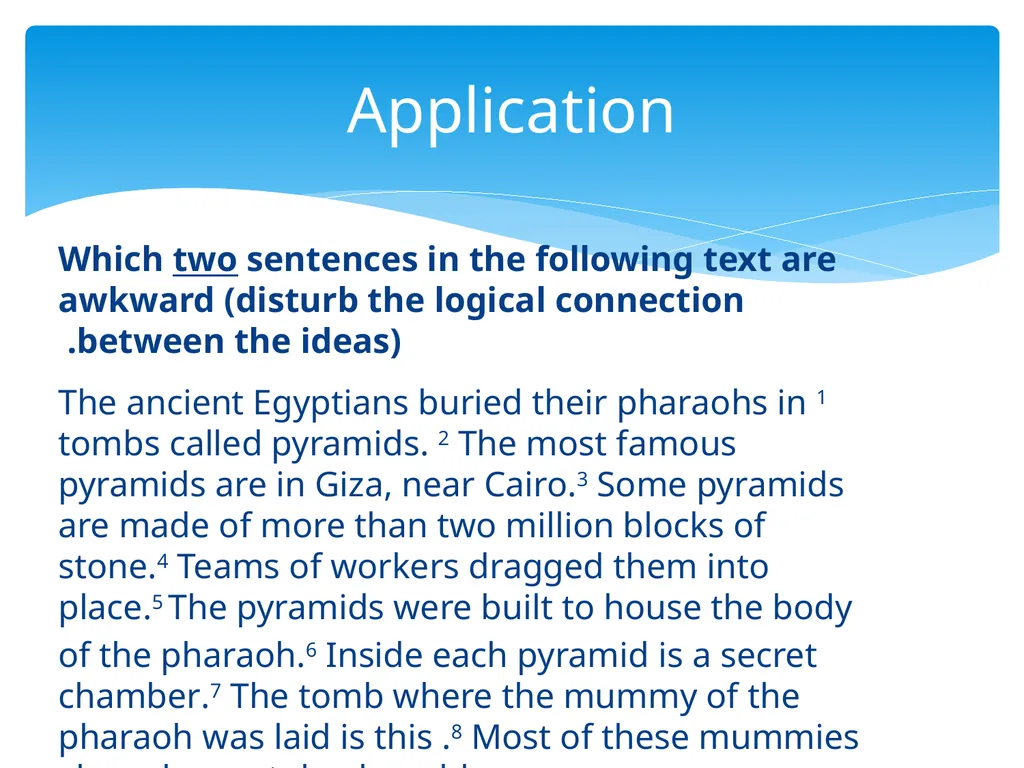
Application Which two sentences in the following text are awkward (disturb the logical connection between the ideas).
1 The ancient Egyptians buried their pharaohs in tombs called pyramids. 2 The most famous pyramids are in Giza, near Cairo.3 Some pyramids are made of more than two million blocks of stone.4 Teams of workers dragged them into place.5 The pyramids were built to house the body
of the pharaoh.6 Inside each pyramid is a secret chamber.7 The tomb where the mummy of the pharaoh was laid is this .8 Most of these mummies have been stolen by robbers.<br>
46
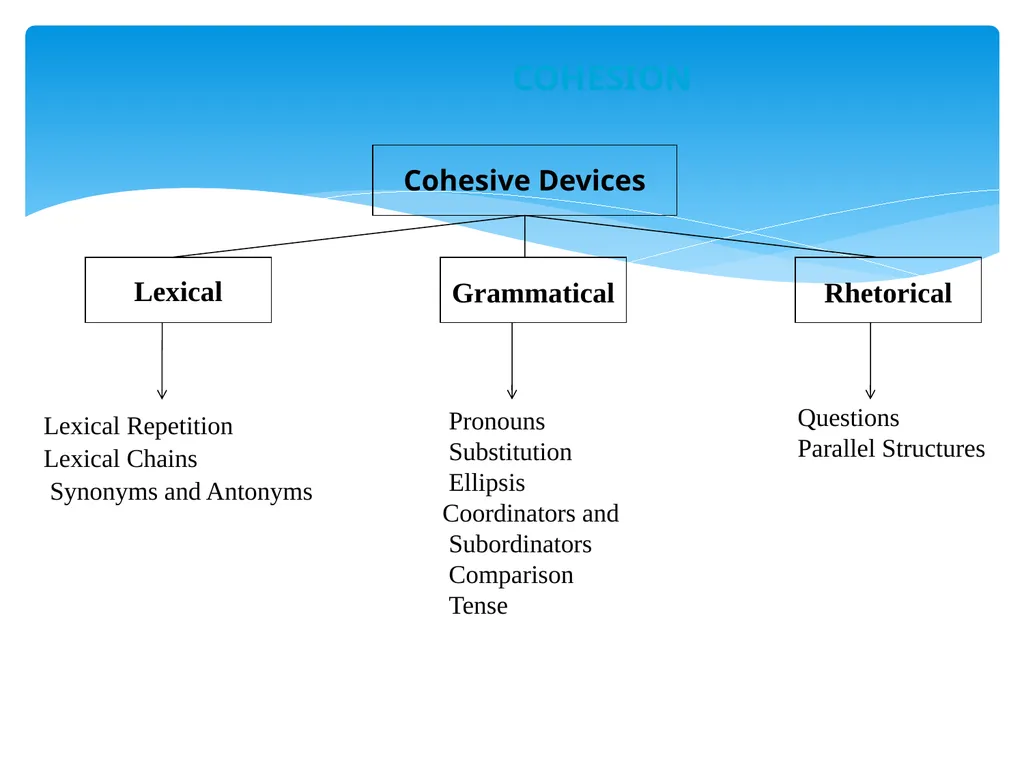
Lexical Repetition
Lexical Chains
Synonyms and Antonyms Pronouns
Substitution
Ellipsis
Coordinators and Subordinators
Comparison
Tense Questions
Parallel Structures COHESION<br>
Lexical Chains
Synonyms and Antonyms Pronouns
Substitution
Ellipsis
Coordinators and Subordinators
Comparison
Tense Questions
Parallel Structures COHESION<br>