
What is Intelligence? Let’s try to define
Description: What is Intelligence? Lets try to define intelligence Definition (Merriam Webster): Capacity for learning, reasoning, understanding and similar forms of mental activity Aptitude in grasping truths, relationships, facts, meanings Problem:
Related Topics
Download Presentation
"What is Intelligence? Let’s try to define" is the property of its rightful owner. Permission is granted to download and print the materials on this website for personal, non-commercial use only, and to display it on your personal computer provided you do not modify the materials and that you retain all copyright notices contained in the materials. By downloading content from our website, you accept the terms of this agreement.
Presentation Transcript
slide1. What is Intelligence? Let’s try to define intelligence
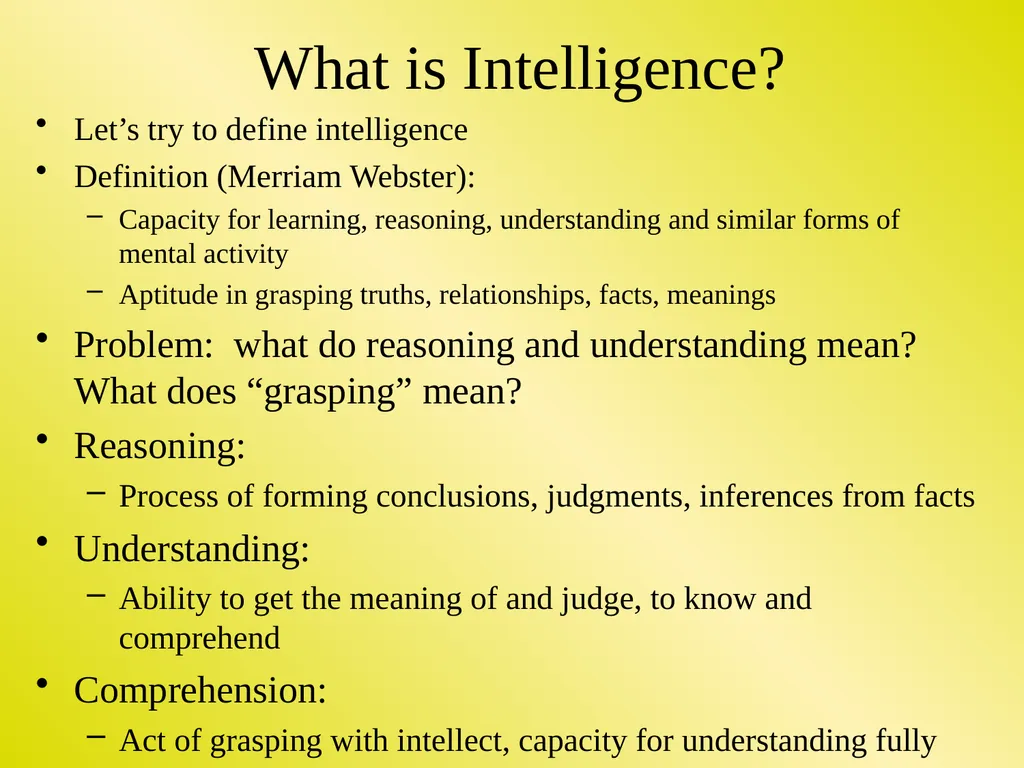
Definition (Merriam Webster):
Capacity for learning, reasoning, understanding and similar forms of mental activity
Aptitude in grasping truths, relationships, facts, meanings
Problem: what do reasoning and understanding mean? What does “grasping” mean?
Reasoning:
Process of forming conclusions, judgments, inferences from facts
Understanding:
Ability to get the meaning of and judge, to know and comprehend
Comprehension:
Act of grasping with intellect, capacity for understanding fully<br>
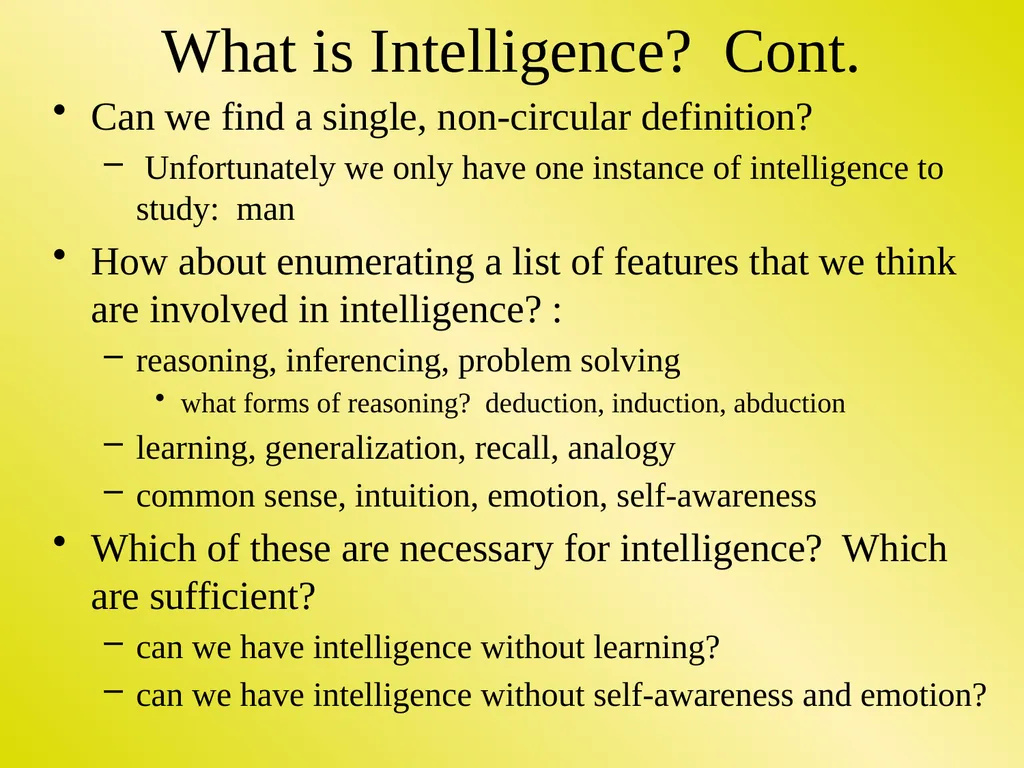
slide2. What is Intelligence? Cont. Can we find a single, non-circular definition?
Unfortunately we only have one instance of intelligence to study: man
How about enumerating a list of features that we think are involved in intelligence? :
reasoning, inferencing, problem solving
what forms of reasoning? deduction, induction, abduction
learning, generalization, recall, analogy
common sense, intuition, emotion, self-awareness
Which of these are necessary for intelligence? Which are sufficient?
can we have intelligence without learning?
can we have intelligence without self-awareness and emotion?<br>
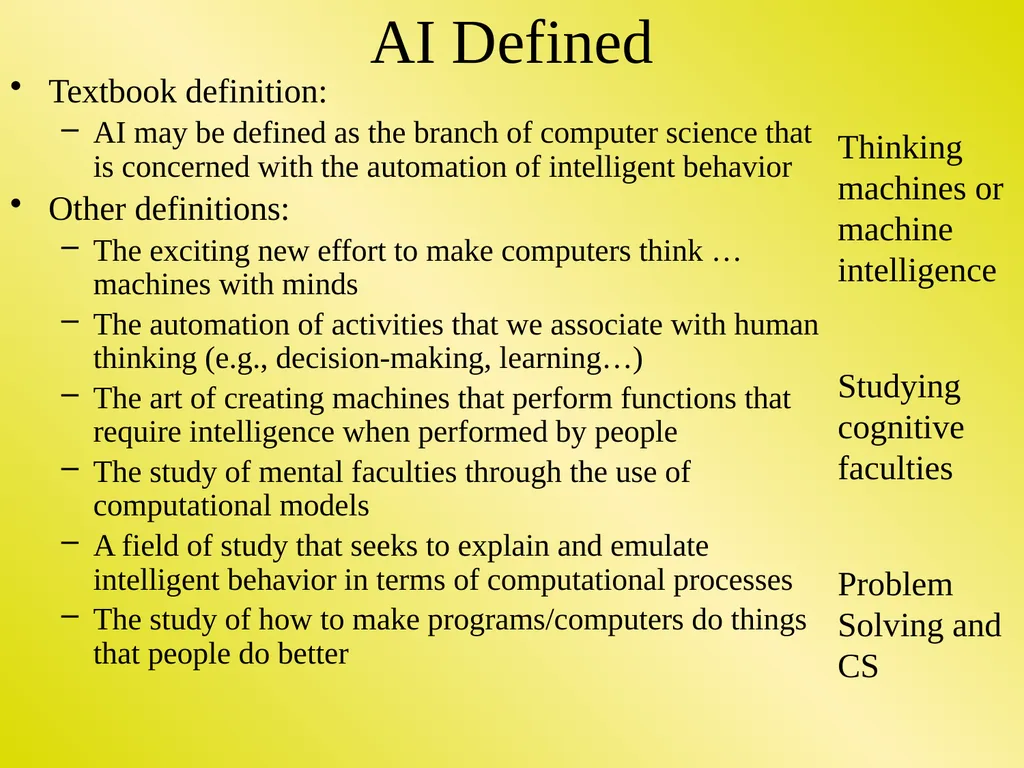
slide3. AI Defined Textbook definition:
AI may be defined as the branch of computer science that is concerned with the automation of intelligent behavior
Other definitions:
The exciting new effort to make computers think … machines with minds
The automation of activities that we associate with human thinking (e.g., decision-making, learning…)
The art of creating machines that perform functions that require intelligence when performed by people
The study of mental faculties through the use of computational models
A field of study that seeks to explain and emulate intelligent behavior in terms of computational processes
The study of how to make programs/computers do things that people do better Thinking machines or machine intelligence
Studying cognitive faculties
Problem Solving and CS<br>
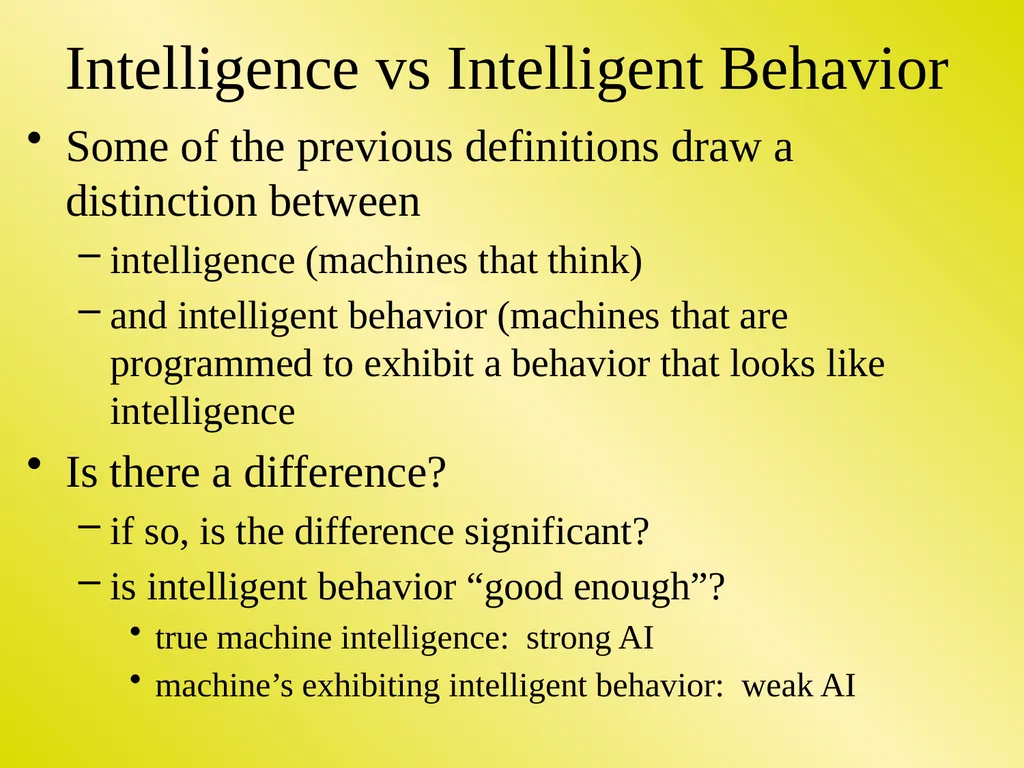
slide4. Intelligence vs Intelligent Behavior Some of the previous definitions draw a distinction between
intelligence (machines that think)
and intelligent behavior (machines that are programmed to exhibit a behavior that looks like intelligence
Is there a difference?
if so, is the difference significant?
is intelligent behavior “good enough”?
true machine intelligence: strong AI
machine’s exhibiting intelligent behavior: weak AI<br>
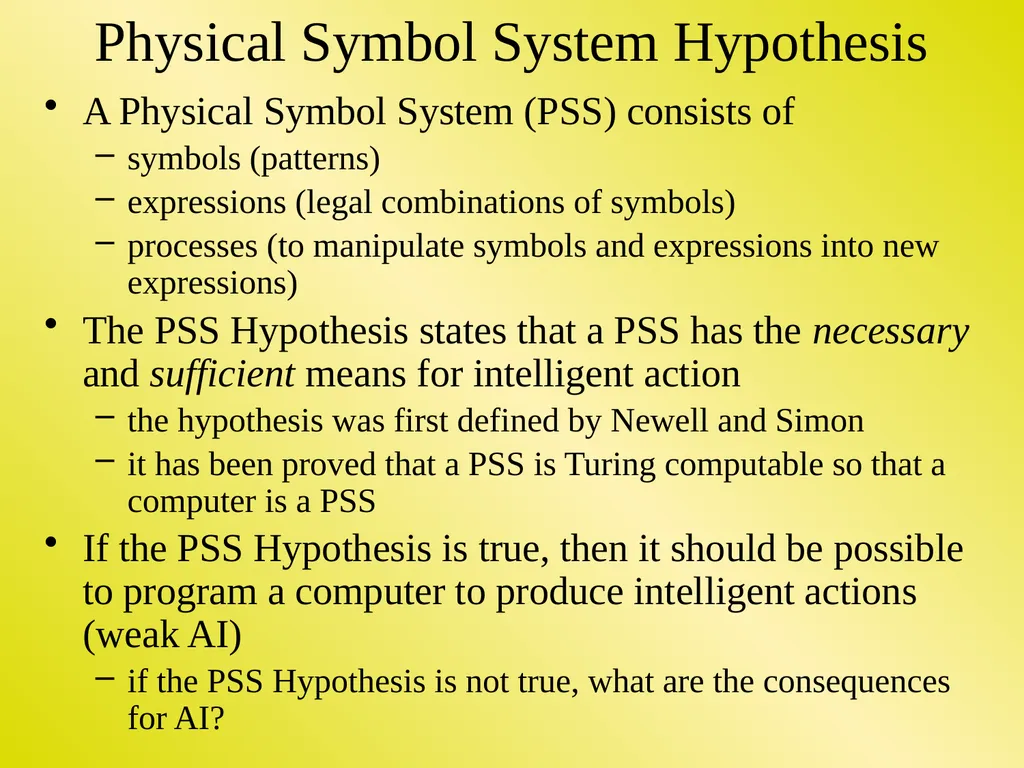
slide5. Physical Symbol System Hypothesis A Physical Symbol System (PSS) consists of
symbols (patterns)
expressions (legal combinations of symbols)
processes (to manipulate symbols and expressions into new expressions)
The PSS Hypothesis states that a PSS has the necessary and sufficient means for intelligent action
the hypothesis was first defined by Newell and Simon
it has been proved that a PSS is Turing computable so that a computer is a PSS
If the PSS Hypothesis is true, then it should be possible to program a computer to produce intelligent actions (weak AI)
if the PSS Hypothesis is not true, what are the consequences for AI?<br>
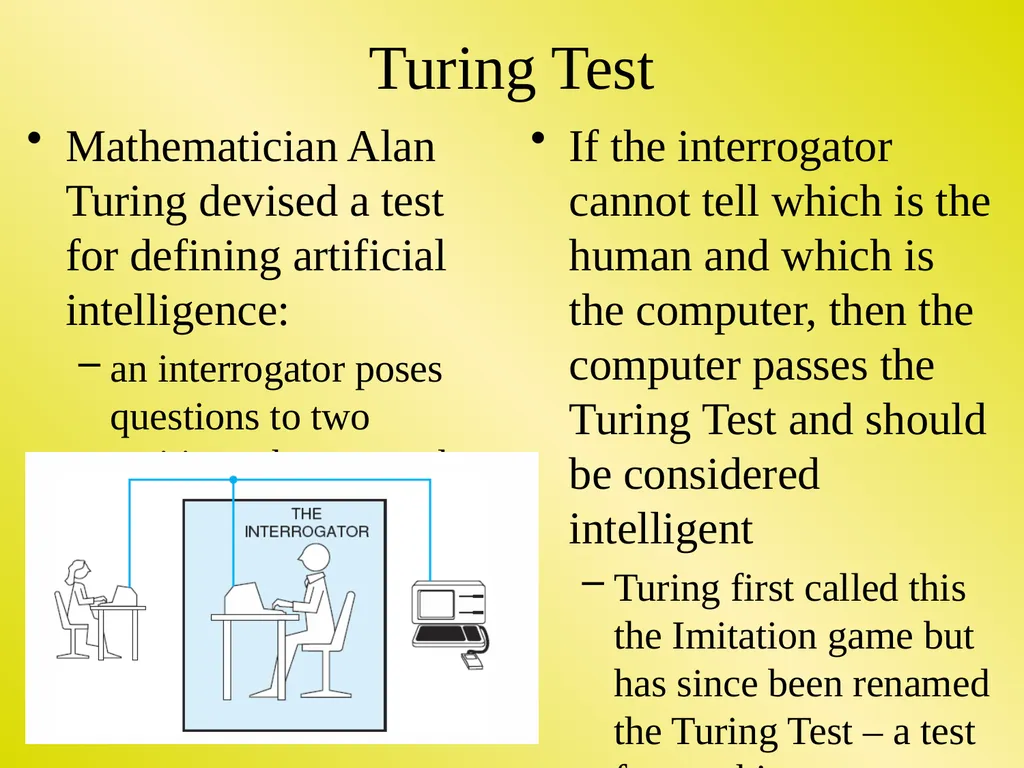
slide6. Turing Test Mathematician Alan Turing devised a test for defining artificial intelligence:
an interrogator poses questions to two entities, a human and a computer If the interrogator cannot tell which is the human and which is the computer, then the computer passes the Turing Test and should be considered intelligent
Turing first called this the Imitation game but has since been renamed the Turing Test – a test for machine intelligence<br>
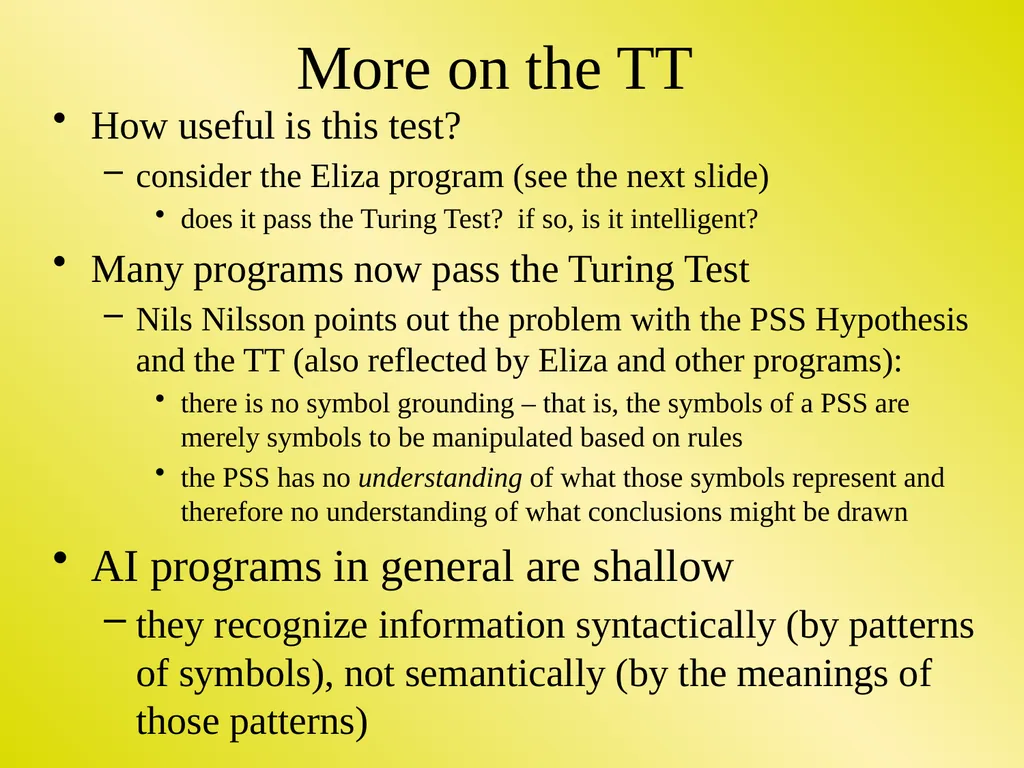
slide7. How useful is this test?
consider the Eliza program (see the next slide)
does it pass the Turing Test? if so, is it intelligent?
Many programs now pass the Turing Test
Nils Nilsson points out the problem with the PSS Hypothesis and the TT (also reflected by Eliza and other programs):
there is no symbol grounding – that is, the symbols of a PSS are merely symbols to be manipulated based on rules
the PSS has no understanding of what those symbols represent and therefore no understanding of what conclusions might be drawn
AI programs in general are shallow
they recognize information syntactically (by patterns of symbols), not semantically (by the meanings of those patterns) More on the TT<br>
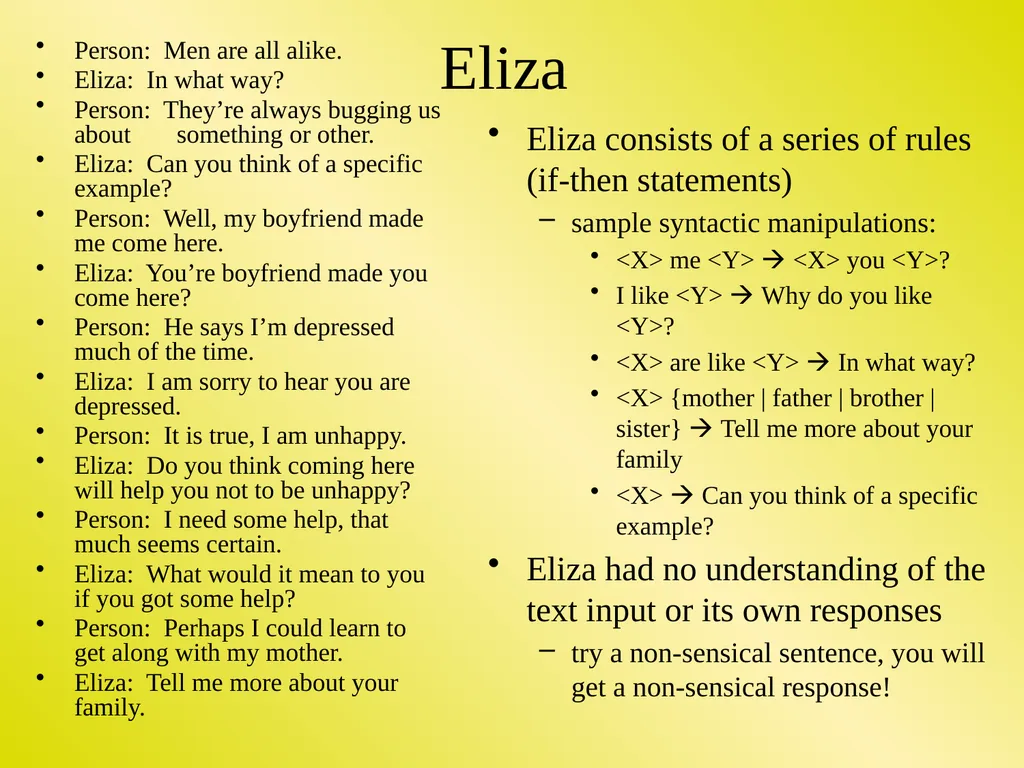
slide8. Eliza Person: Men are all alike.
Eliza: In what way?
Person: They’re always bugging us about something or other.
Eliza: Can you think of a specific example?
Person: Well, my boyfriend made me come here.
Eliza: You’re boyfriend made you come here?
Person: He says I’m depressed much of the time.
Eliza: I am sorry to hear you are depressed.
Person: It is true, I am unhappy.
Eliza: Do you think coming here will help you not to be unhappy?
Person: I need some help, that much seems certain.
Eliza: What would it mean to you if you got some help?
Person: Perhaps I could learn to get along with my mother.
Eliza: Tell me more about your family. Eliza consists of a series of rules (if-then statements)
sample syntactic manipulations:
<X> me <Y> <X> you <Y>?
I like <Y> Why do you like <Y>?
<X> are like <Y> In what way?
<X> {mother | father | brother | sister} Tell me more about your family
<X> Can you think of a specific example?
Eliza had no understanding of the text input or its own responses
try a non-sensical sentence, you will get a non-sensical response!<br>
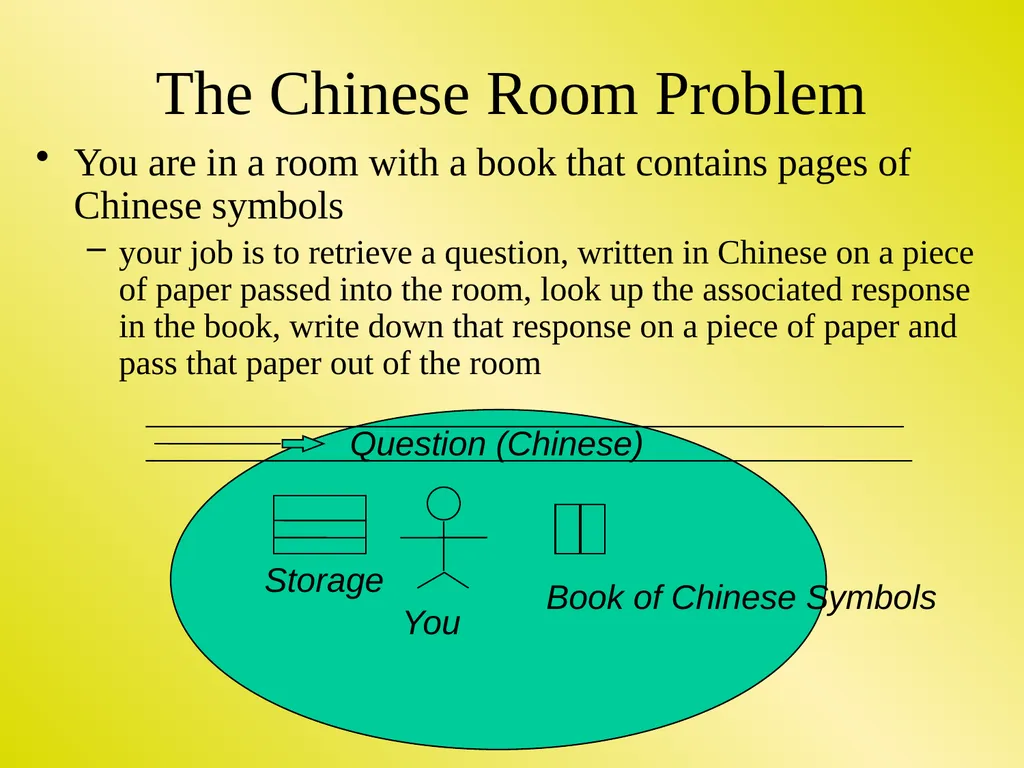
slide9. The Chinese Room Problem You are in a room with a book that contains pages of Chinese symbols
your job is to retrieve a question, written in Chinese on a piece of paper passed into the room, look up the associated response in the book, write down that response on a piece of paper and pass that paper out of the room Question (Chinese) Book of Chinese Symbols Storage You<br>
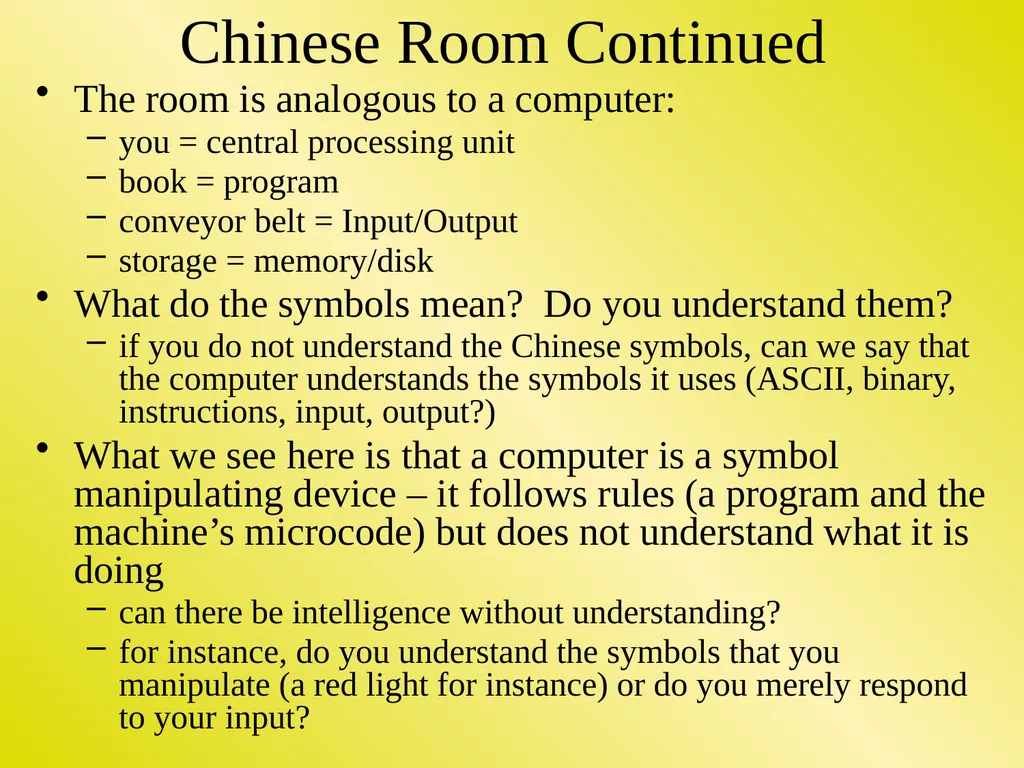
slide10. Chinese Room Continued The room is analogous to a computer:
you = central processing unit
book = program
conveyor belt = Input/Output
storage = memory/disk
What do the symbols mean? Do you understand them?
if you do not understand the Chinese symbols, can we say that the computer understands the symbols it uses (ASCII, binary, instructions, input, output?)
What we see here is that a computer is a symbol manipulating device – it follows rules (a program and the machine’s microcode) but does not understand what it is doing
can there be intelligence without understanding?
for instance, do you understand the symbols that you manipulate (a red light for instance) or do you merely respond to your input?<br>
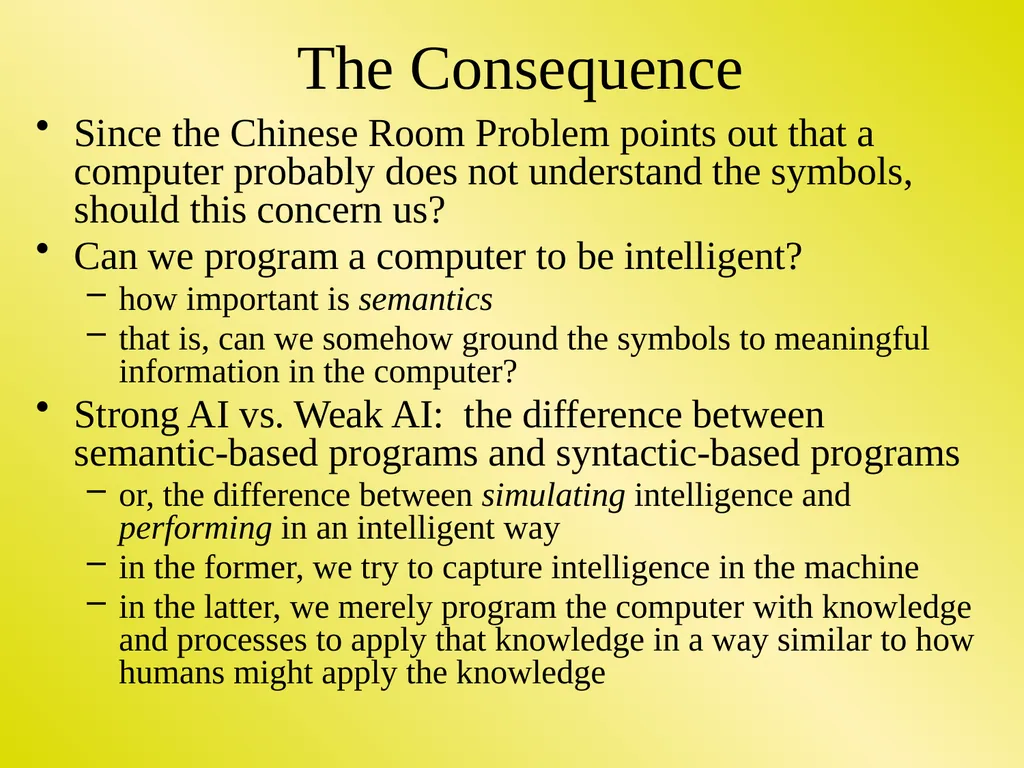
slide11. Since the Chinese Room Problem points out that a computer probably does not understand the symbols, should this concern us?
Can we program a computer to be intelligent?
how important is semantics
that is, can we somehow ground the symbols to meaningful information in the computer?
Strong AI vs. Weak AI: the difference between semantic-based programs and syntactic-based programs
or, the difference between simulating intelligence and performing in an intelligent way
in the former, we try to capture intelligence in the machine
in the latter, we merely program the computer with knowledge and processes to apply that knowledge in a way similar to how humans might apply the knowledge The Consequence<br>
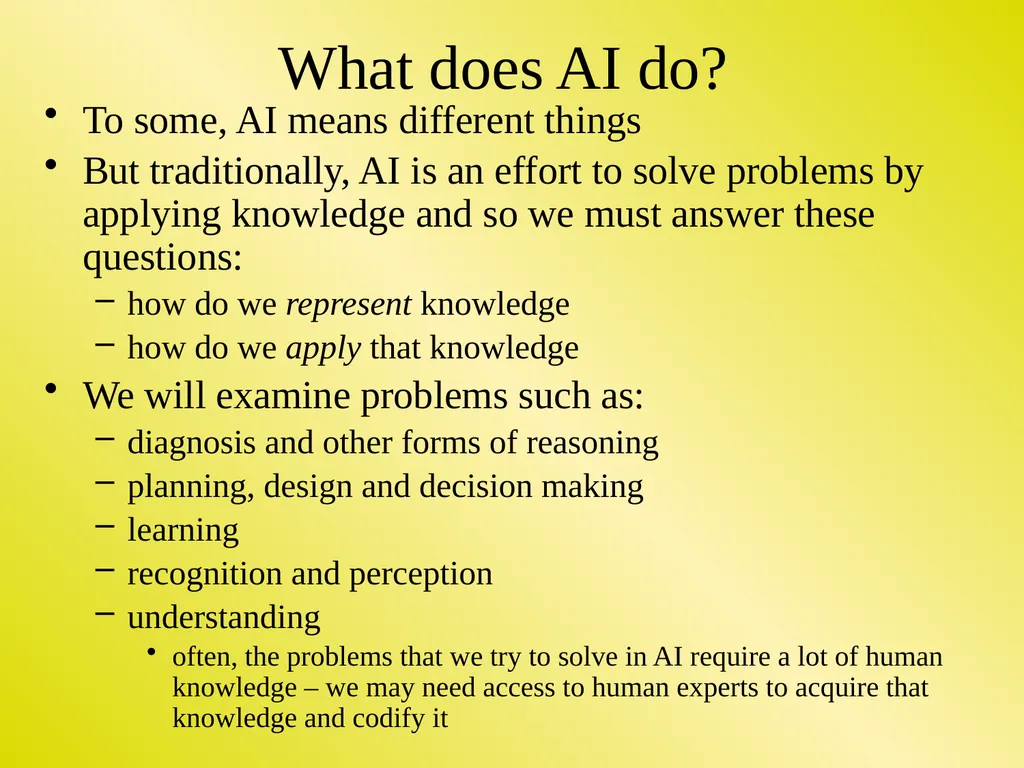
slide12. What does AI do? To some, AI means different things
But traditionally, AI is an effort to solve problems by applying knowledge and so we must answer these questions:
how do we represent knowledge
how do we apply that knowledge
We will examine problems such as:
diagnosis and other forms of reasoning
planning, design and decision making
learning
recognition and perception
understanding
often, the problems that we try to solve in AI require a lot of human knowledge – we may need access to human experts to acquire that knowledge and codify it<br>
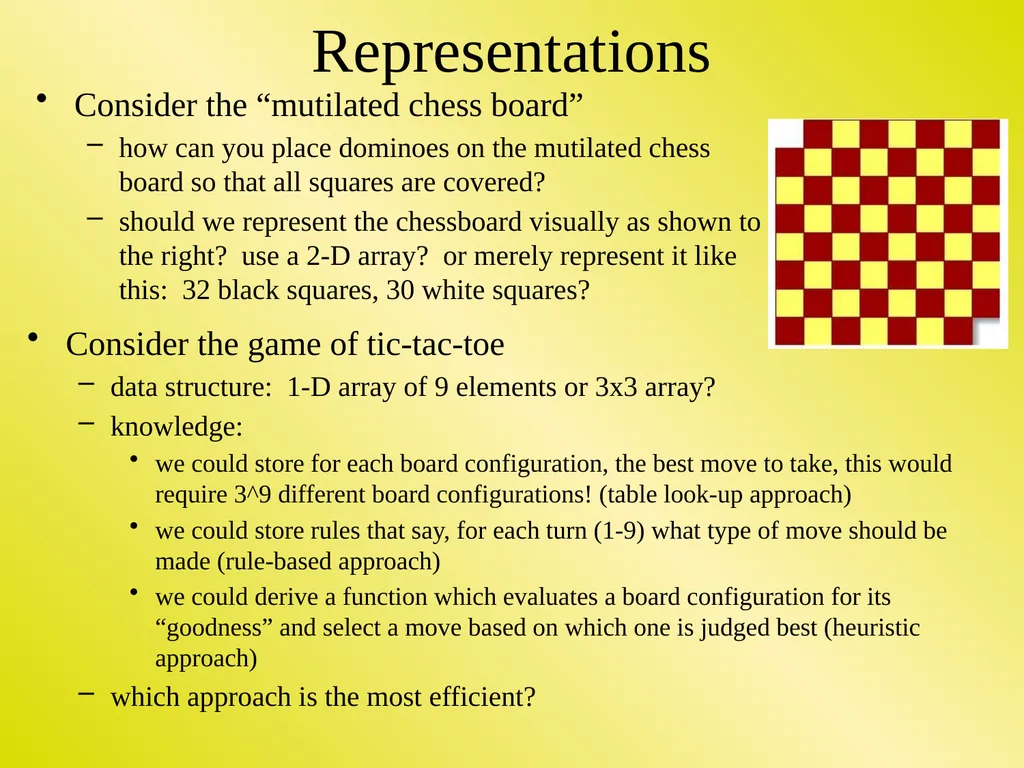
slide13. Representations Consider the “mutilated chess board”
how can you place dominoes on the mutilated chess board so that all squares are covered?
should we represent the chessboard visually as shown to the right? use a 2-D array? or merely represent it like this: 32 black squares, 30 white squares? Consider the game of tic-tac-toe
data structure: 1-D array of 9 elements or 3x3 array?
knowledge:
we could store for each board configuration, the best move to take, this would require 3^9 different board configurations! (table look-up approach)
we could store rules that say, for each turn (1-9) what type of move should be made (rule-based approach)
we could derive a function which evaluates a board configuration for its “goodness” and select a move based on which one is judged best (heuristic approach)
which approach is the most efficient?<br>
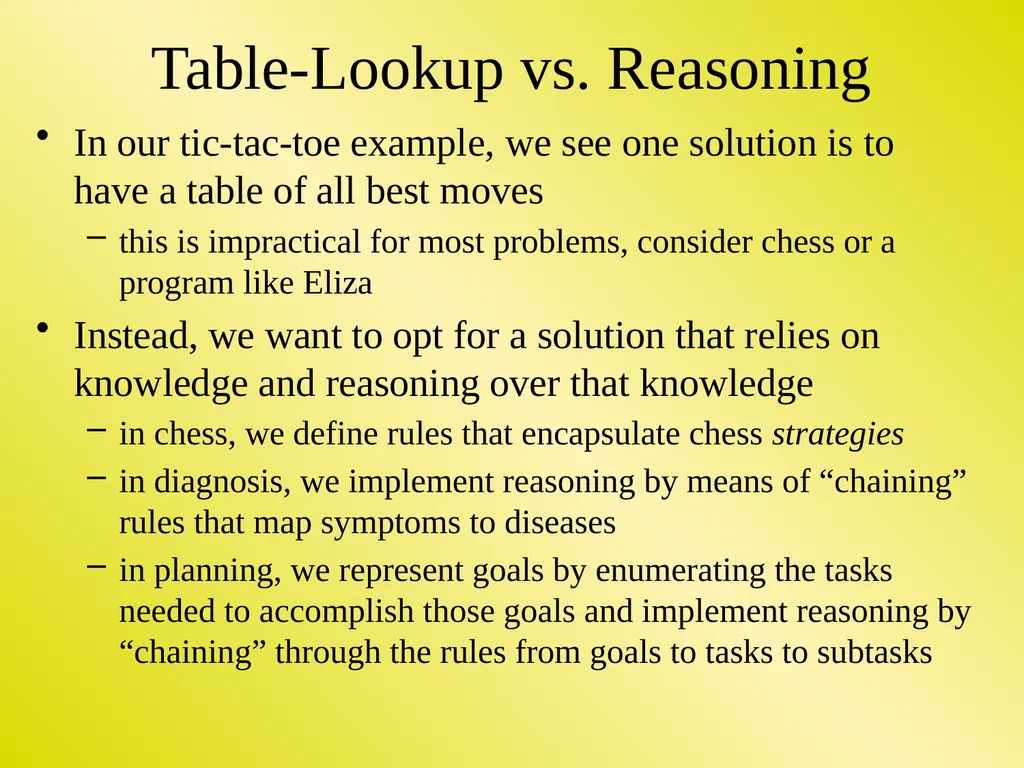
slide14. Table-Lookup vs. Reasoning In our tic-tac-toe example, we see one solution is to have a table of all best moves
this is impractical for most problems, consider chess or a program like Eliza
Instead, we want to opt for a solution that relies on knowledge and reasoning over that knowledge
in chess, we define rules that encapsulate chess strategies
in diagnosis, we implement reasoning by means of “chaining” rules that map symptoms to diseases
in planning, we represent goals by enumerating the tasks needed to accomplish those goals and implement reasoning by “chaining” through the rules from goals to tasks to subtasks<br>
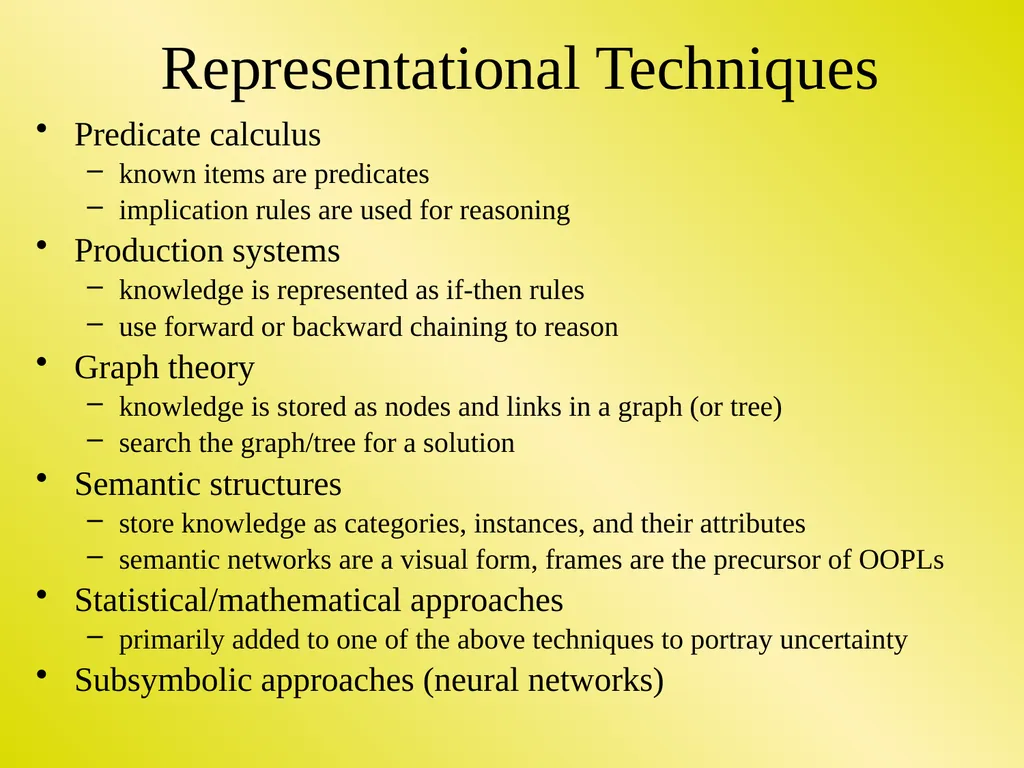
slide15. Representational Techniques Predicate calculus
known items are predicates
implication rules are used for reasoning
Production systems
knowledge is represented as if-then rules
use forward or backward chaining to reason
Graph theory
knowledge is stored as nodes and links in a graph (or tree)
search the graph/tree for a solution
Semantic structures
store knowledge as categories, instances, and their attributes
semantic networks are a visual form, frames are the precursor of OOPLs
Statistical/mathematical approaches
primarily added to one of the above techniques to portray uncertainty
Subsymbolic approaches (neural networks)<br>
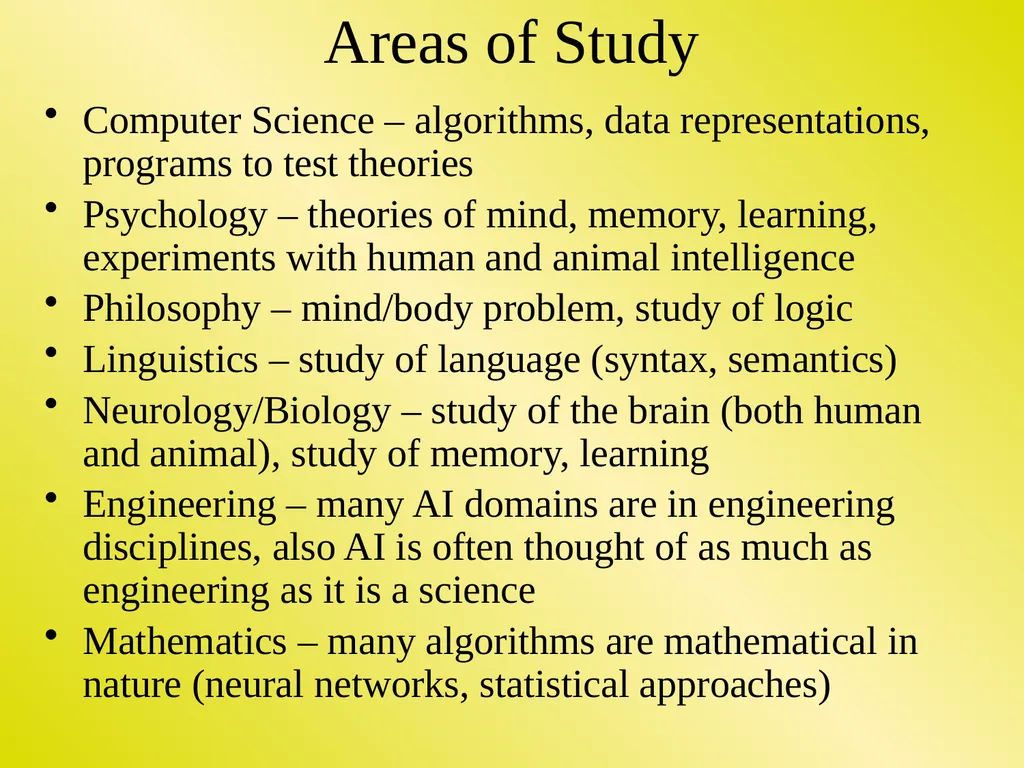
slide16. Areas of Study Computer Science – algorithms, data representations, programs to test theories
Psychology – theories of mind, memory, learning, experiments with human and animal intelligence
Philosophy – mind/body problem, study of logic
Linguistics – study of language (syntax, semantics)
Neurology/Biology – study of the brain (both human and animal), study of memory, learning
Engineering – many AI domains are in engineering disciplines, also AI is often thought of as much as engineering as it is a science
Mathematics – many algorithms are mathematical in nature (neural networks, statistical approaches)<br>
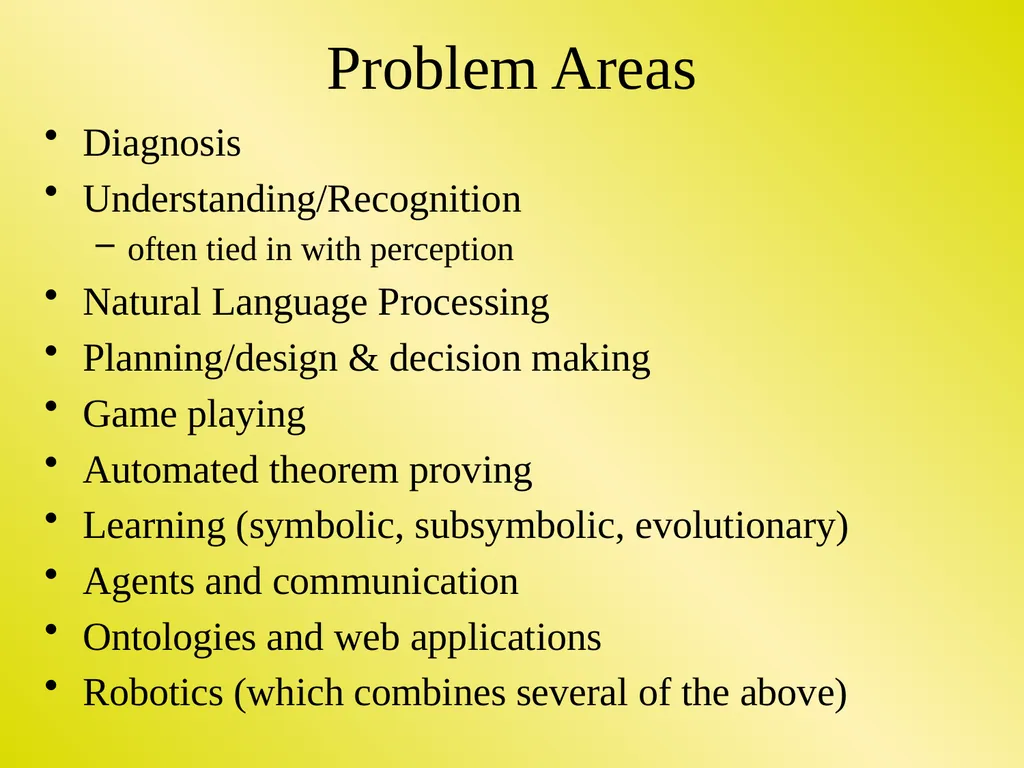
slide17. Problem Areas Diagnosis
Understanding/Recognition
often tied in with perception
Natural Language Processing
Planning/design & decision making
Game playing
Automated theorem proving
Learning (symbolic, subsymbolic, evolutionary)
Agents and communication
Ontologies and web applications
Robotics (which combines several of the above)<br>
Definition (Merriam Webster):
Capacity for learning, reasoning, understanding and similar forms of mental activity
Aptitude in grasping truths, relationships, facts, meanings
Problem: what do reasoning and understanding mean? What does “grasping” mean?
Reasoning:
Process of forming conclusions, judgments, inferences from facts
Understanding:
Ability to get the meaning of and judge, to know and comprehend
Comprehension:
Act of grasping with intellect, capacity for understanding fully<br>
slide2. What is Intelligence? Cont. Can we find a single, non-circular definition?
Unfortunately we only have one instance of intelligence to study: man
How about enumerating a list of features that we think are involved in intelligence? :
reasoning, inferencing, problem solving
what forms of reasoning? deduction, induction, abduction
learning, generalization, recall, analogy
common sense, intuition, emotion, self-awareness
Which of these are necessary for intelligence? Which are sufficient?
can we have intelligence without learning?
can we have intelligence without self-awareness and emotion?<br>
slide3. AI Defined Textbook definition:
AI may be defined as the branch of computer science that is concerned with the automation of intelligent behavior
Other definitions:
The exciting new effort to make computers think … machines with minds
The automation of activities that we associate with human thinking (e.g., decision-making, learning…)
The art of creating machines that perform functions that require intelligence when performed by people
The study of mental faculties through the use of computational models
A field of study that seeks to explain and emulate intelligent behavior in terms of computational processes
The study of how to make programs/computers do things that people do better Thinking machines or machine intelligence
Studying cognitive faculties
Problem Solving and CS<br>
slide4. Intelligence vs Intelligent Behavior Some of the previous definitions draw a distinction between
intelligence (machines that think)
and intelligent behavior (machines that are programmed to exhibit a behavior that looks like intelligence
Is there a difference?
if so, is the difference significant?
is intelligent behavior “good enough”?
true machine intelligence: strong AI
machine’s exhibiting intelligent behavior: weak AI<br>
slide5. Physical Symbol System Hypothesis A Physical Symbol System (PSS) consists of
symbols (patterns)
expressions (legal combinations of symbols)
processes (to manipulate symbols and expressions into new expressions)
The PSS Hypothesis states that a PSS has the necessary and sufficient means for intelligent action
the hypothesis was first defined by Newell and Simon
it has been proved that a PSS is Turing computable so that a computer is a PSS
If the PSS Hypothesis is true, then it should be possible to program a computer to produce intelligent actions (weak AI)
if the PSS Hypothesis is not true, what are the consequences for AI?<br>
slide6. Turing Test Mathematician Alan Turing devised a test for defining artificial intelligence:
an interrogator poses questions to two entities, a human and a computer If the interrogator cannot tell which is the human and which is the computer, then the computer passes the Turing Test and should be considered intelligent
Turing first called this the Imitation game but has since been renamed the Turing Test – a test for machine intelligence<br>
slide7. How useful is this test?
consider the Eliza program (see the next slide)
does it pass the Turing Test? if so, is it intelligent?
Many programs now pass the Turing Test
Nils Nilsson points out the problem with the PSS Hypothesis and the TT (also reflected by Eliza and other programs):
there is no symbol grounding – that is, the symbols of a PSS are merely symbols to be manipulated based on rules
the PSS has no understanding of what those symbols represent and therefore no understanding of what conclusions might be drawn
AI programs in general are shallow
they recognize information syntactically (by patterns of symbols), not semantically (by the meanings of those patterns) More on the TT<br>
slide8. Eliza Person: Men are all alike.
Eliza: In what way?
Person: They’re always bugging us about something or other.
Eliza: Can you think of a specific example?
Person: Well, my boyfriend made me come here.
Eliza: You’re boyfriend made you come here?
Person: He says I’m depressed much of the time.
Eliza: I am sorry to hear you are depressed.
Person: It is true, I am unhappy.
Eliza: Do you think coming here will help you not to be unhappy?
Person: I need some help, that much seems certain.
Eliza: What would it mean to you if you got some help?
Person: Perhaps I could learn to get along with my mother.
Eliza: Tell me more about your family. Eliza consists of a series of rules (if-then statements)
sample syntactic manipulations:
<X> me <Y> <X> you <Y>?
I like <Y> Why do you like <Y>?
<X> are like <Y> In what way?
<X> {mother | father | brother | sister} Tell me more about your family
<X> Can you think of a specific example?
Eliza had no understanding of the text input or its own responses
try a non-sensical sentence, you will get a non-sensical response!<br>
slide9. The Chinese Room Problem You are in a room with a book that contains pages of Chinese symbols
your job is to retrieve a question, written in Chinese on a piece of paper passed into the room, look up the associated response in the book, write down that response on a piece of paper and pass that paper out of the room Question (Chinese) Book of Chinese Symbols Storage You<br>
slide10. Chinese Room Continued The room is analogous to a computer:
you = central processing unit
book = program
conveyor belt = Input/Output
storage = memory/disk
What do the symbols mean? Do you understand them?
if you do not understand the Chinese symbols, can we say that the computer understands the symbols it uses (ASCII, binary, instructions, input, output?)
What we see here is that a computer is a symbol manipulating device – it follows rules (a program and the machine’s microcode) but does not understand what it is doing
can there be intelligence without understanding?
for instance, do you understand the symbols that you manipulate (a red light for instance) or do you merely respond to your input?<br>
slide11. Since the Chinese Room Problem points out that a computer probably does not understand the symbols, should this concern us?
Can we program a computer to be intelligent?
how important is semantics
that is, can we somehow ground the symbols to meaningful information in the computer?
Strong AI vs. Weak AI: the difference between semantic-based programs and syntactic-based programs
or, the difference between simulating intelligence and performing in an intelligent way
in the former, we try to capture intelligence in the machine
in the latter, we merely program the computer with knowledge and processes to apply that knowledge in a way similar to how humans might apply the knowledge The Consequence<br>
slide12. What does AI do? To some, AI means different things
But traditionally, AI is an effort to solve problems by applying knowledge and so we must answer these questions:
how do we represent knowledge
how do we apply that knowledge
We will examine problems such as:
diagnosis and other forms of reasoning
planning, design and decision making
learning
recognition and perception
understanding
often, the problems that we try to solve in AI require a lot of human knowledge – we may need access to human experts to acquire that knowledge and codify it<br>
slide13. Representations Consider the “mutilated chess board”
how can you place dominoes on the mutilated chess board so that all squares are covered?
should we represent the chessboard visually as shown to the right? use a 2-D array? or merely represent it like this: 32 black squares, 30 white squares? Consider the game of tic-tac-toe
data structure: 1-D array of 9 elements or 3x3 array?
knowledge:
we could store for each board configuration, the best move to take, this would require 3^9 different board configurations! (table look-up approach)
we could store rules that say, for each turn (1-9) what type of move should be made (rule-based approach)
we could derive a function which evaluates a board configuration for its “goodness” and select a move based on which one is judged best (heuristic approach)
which approach is the most efficient?<br>
slide14. Table-Lookup vs. Reasoning In our tic-tac-toe example, we see one solution is to have a table of all best moves
this is impractical for most problems, consider chess or a program like Eliza
Instead, we want to opt for a solution that relies on knowledge and reasoning over that knowledge
in chess, we define rules that encapsulate chess strategies
in diagnosis, we implement reasoning by means of “chaining” rules that map symptoms to diseases
in planning, we represent goals by enumerating the tasks needed to accomplish those goals and implement reasoning by “chaining” through the rules from goals to tasks to subtasks<br>
slide15. Representational Techniques Predicate calculus
known items are predicates
implication rules are used for reasoning
Production systems
knowledge is represented as if-then rules
use forward or backward chaining to reason
Graph theory
knowledge is stored as nodes and links in a graph (or tree)
search the graph/tree for a solution
Semantic structures
store knowledge as categories, instances, and their attributes
semantic networks are a visual form, frames are the precursor of OOPLs
Statistical/mathematical approaches
primarily added to one of the above techniques to portray uncertainty
Subsymbolic approaches (neural networks)<br>
slide16. Areas of Study Computer Science – algorithms, data representations, programs to test theories
Psychology – theories of mind, memory, learning, experiments with human and animal intelligence
Philosophy – mind/body problem, study of logic
Linguistics – study of language (syntax, semantics)
Neurology/Biology – study of the brain (both human and animal), study of memory, learning
Engineering – many AI domains are in engineering disciplines, also AI is often thought of as much as engineering as it is a science
Mathematics – many algorithms are mathematical in nature (neural networks, statistical approaches)<br>
slide17. Problem Areas Diagnosis
Understanding/Recognition
often tied in with perception
Natural Language Processing
Planning/design & decision making
Game playing
Automated theorem proving
Learning (symbolic, subsymbolic, evolutionary)
Agents and communication
Ontologies and web applications
Robotics (which combines several of the above)<br>