Will Annex II States Ever Ratify the CTBT? Tracing Policies, Obstacles, and Future Prospects Ian Fleming Zhou SnT 2025 University of pretoria Introduction PostCold War arms-control architecture is fraying: INF collapsed (2019), NPT RevCon
"Will Annex II States Ever Ratify the CTBT? Tracing" is the property of its rightful owner. Permission is granted to
download and print the materials on this website for personal, non-commercial use only, and to display it
on your personal computer provided you do not modify the materials and that you retain all copyright
notices contained in the materials. By downloading content from our website, you accept the terms of this
agreement.
Presentation Transcript
01
Will Annex II States Ever Ratify the CTBT? Tracing Policies, Obstacles, and Future Prospects Ian Fleming Zhou
SnT 2025
University of pretoria<br>
02
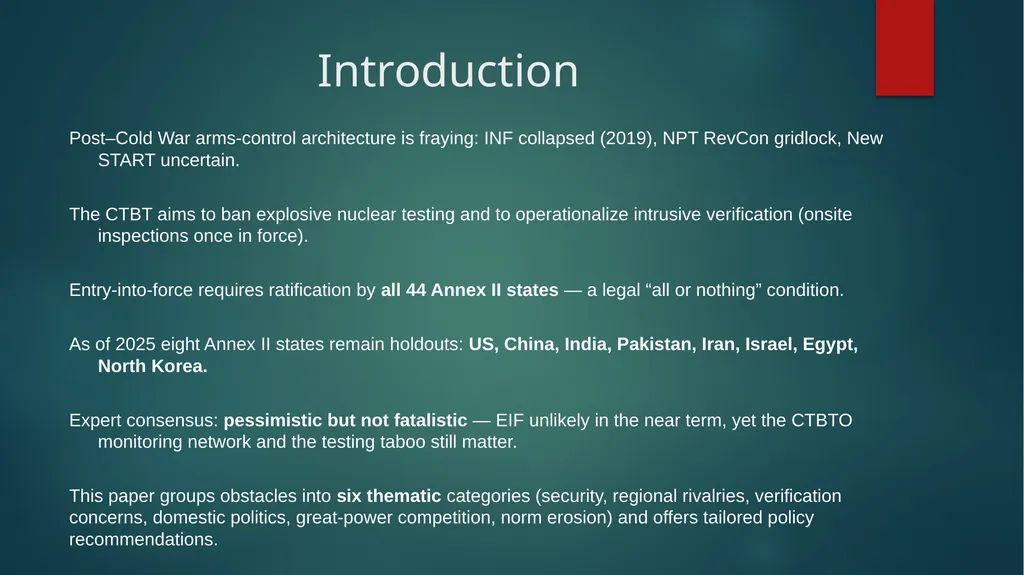
Introduction Post–Cold War arms-control architecture is fraying: INF collapsed (2019), NPT RevCon gridlock, New START uncertain.
The CTBT aims to ban explosive nuclear testing and to operationalize intrusive verification (onsite inspections once in force).
Entry-into-force requires ratification by all 44 Annex II states — a legal “all or nothing” condition.
As of 2025 eight Annex II states remain holdouts: US, China, India, Pakistan, Iran, Israel, Egypt, North Korea.
Expert consensus: pessimistic but not fatalistic — EIF unlikely in the near term, yet the CTBTO monitoring network and the testing taboo still matter.
This paper groups obstacles into six thematic categories (security, regional rivalries, verification concerns, domestic politics, great-power competition, norm erosion) and offers tailored policy recommendations.<br>
03
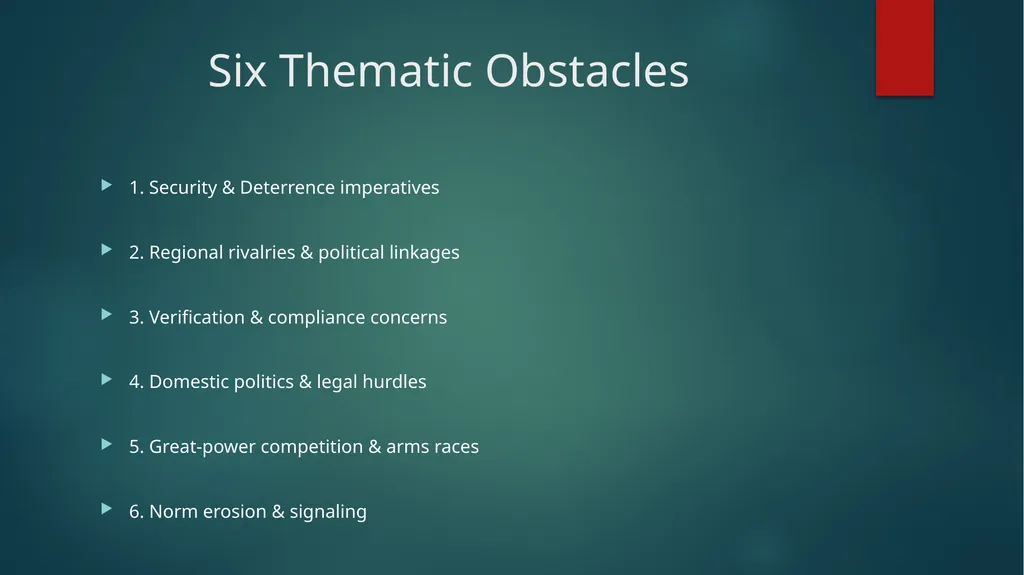
Six Thematic Obstacles 1. Security & Deterrence imperatives
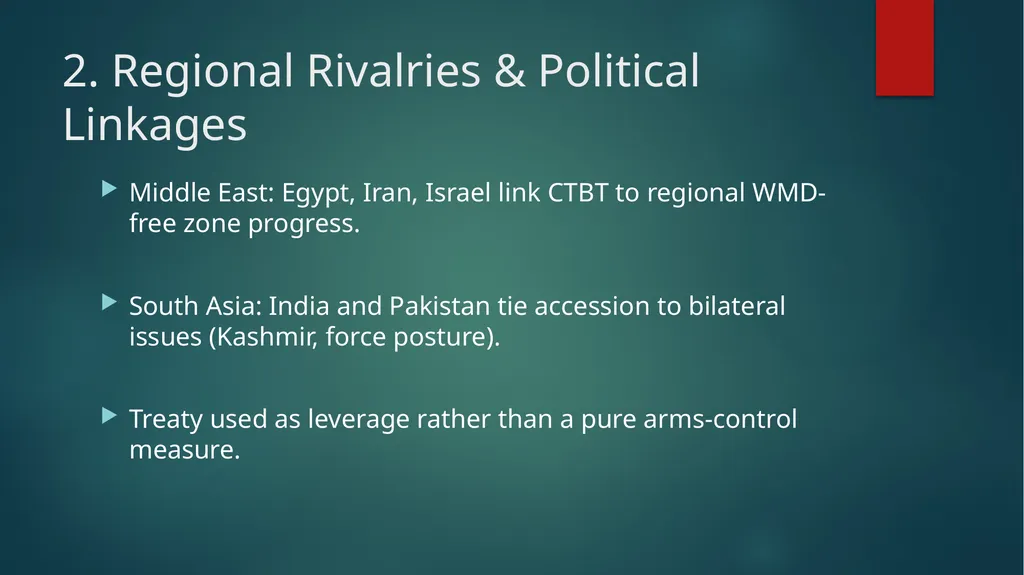
2. Regional rivalries & political linkages
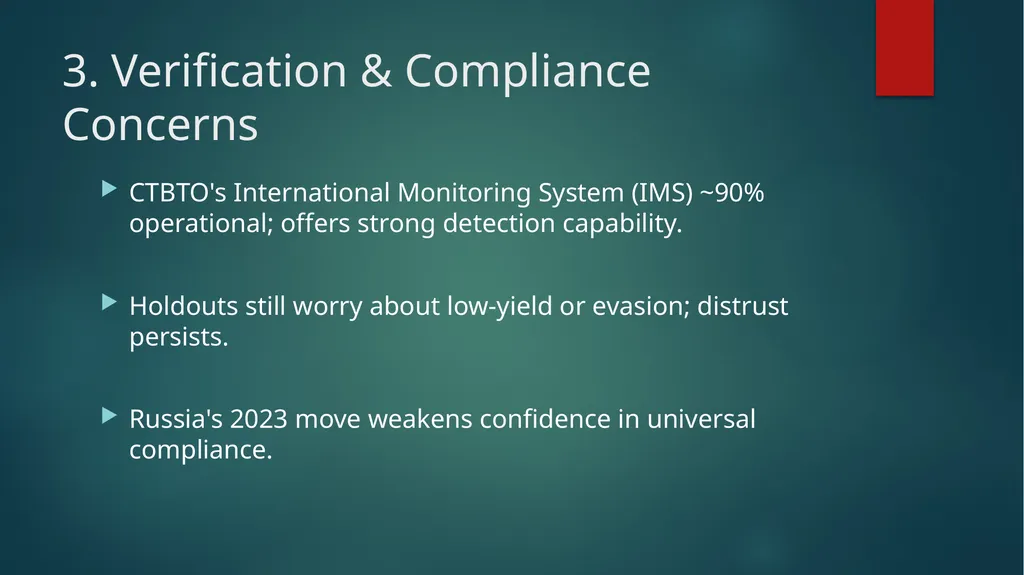
3. Verification & compliance concerns
4. Domestic politics & legal hurdles
5. Great-power competition & arms races
6. Norm erosion & signaling<br>
04
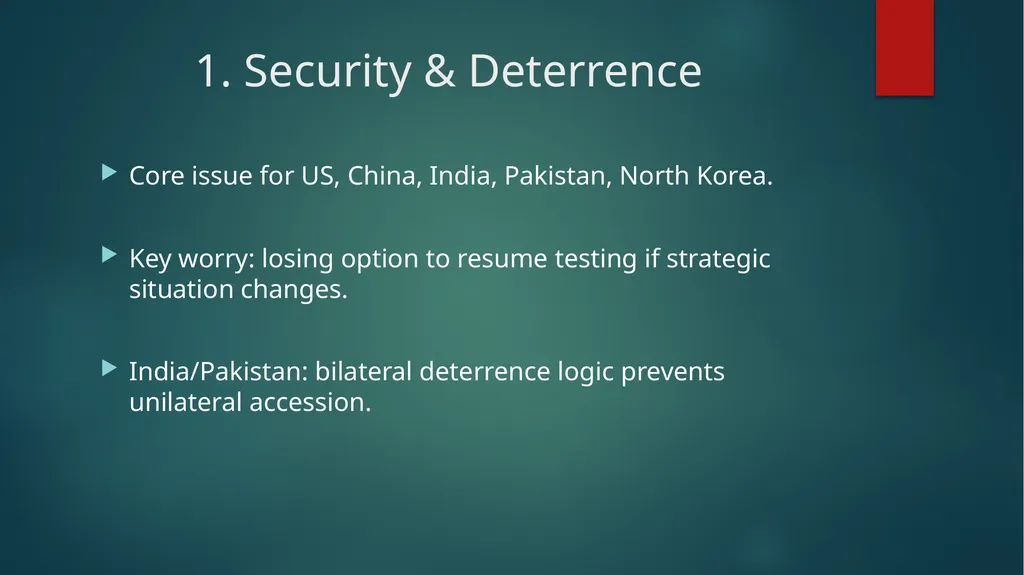
1. Security & Deterrence Core issue for US, China, India, Pakistan, North Korea.
Key worry: losing option to resume testing if strategic situation changes.
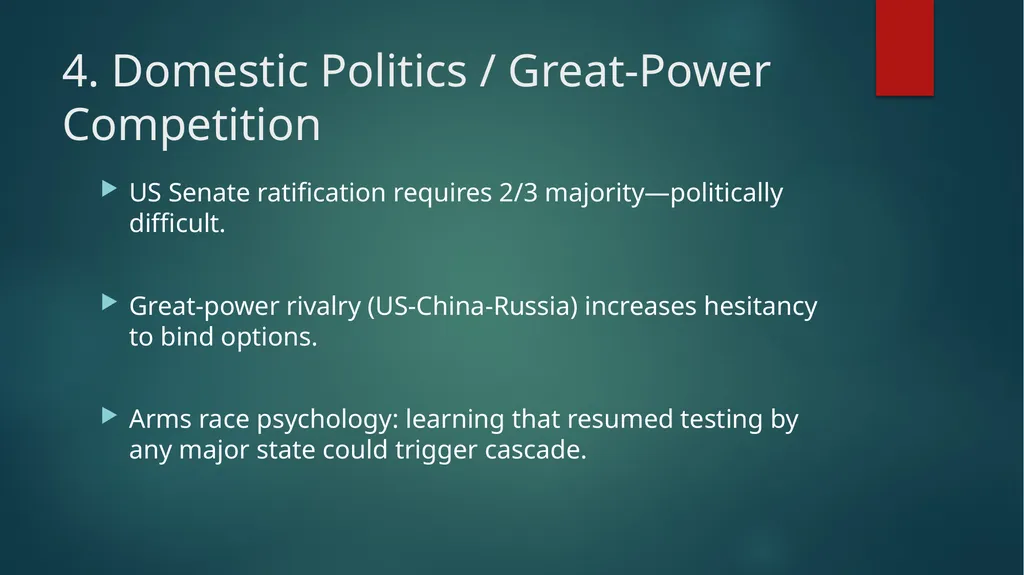
Great-power rivalry (US-China-Russia) increases hesitancy to bind options.
Arms race psychology: learning that resumed testing by any major state could trigger cascade.<br>
08
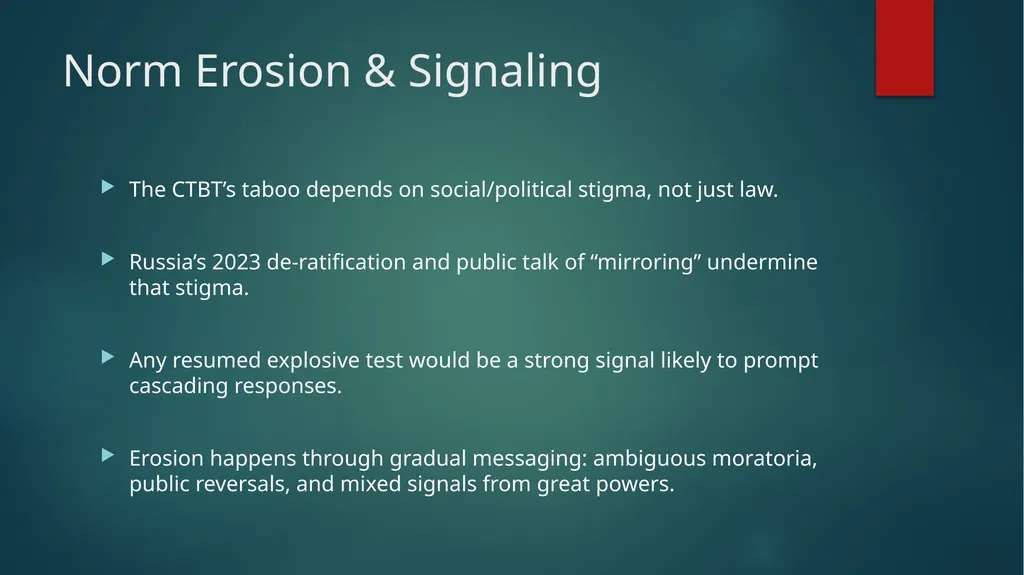
Norm Erosion & Signaling The CTBT’s taboo depends on social/political stigma, not just law.
Russia’s 2023 de-ratification and public talk of “mirroring” undermine that stigma.
Any resumed explosive test would be a strong signal likely to prompt cascading responses.
Erosion happens through gradual messaging: ambiguous moratoria, public reversals, and mixed signals from great powers.<br>
09
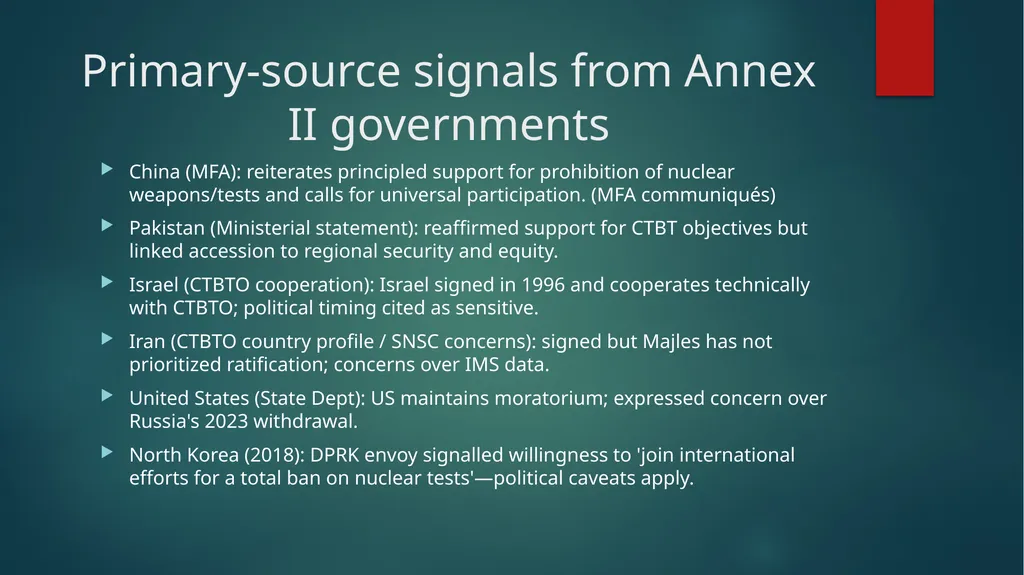
Primary-source signals from Annex II governments China (MFA): reiterates principled support for prohibition of nuclear weapons/tests and calls for universal participation. (MFA communiqués)
Pakistan (Ministerial statement): reaffirmed support for CTBT objectives but linked accession to regional security and equity.
Israel (CTBTO cooperation): Israel signed in 1996 and cooperates technically with CTBTO; political timing cited as sensitive.
Iran (CTBTO country profile / SNSC concerns): signed but Majles has not prioritized ratification; concerns over IMS data.
United States (State Dept): US maintains moratorium; expressed concern over Russia's 2023 withdrawal.
North Korea (2018): DPRK envoy signalled willingness to 'join international efforts for a total ban on nuclear tests'—political caveats apply.<br>
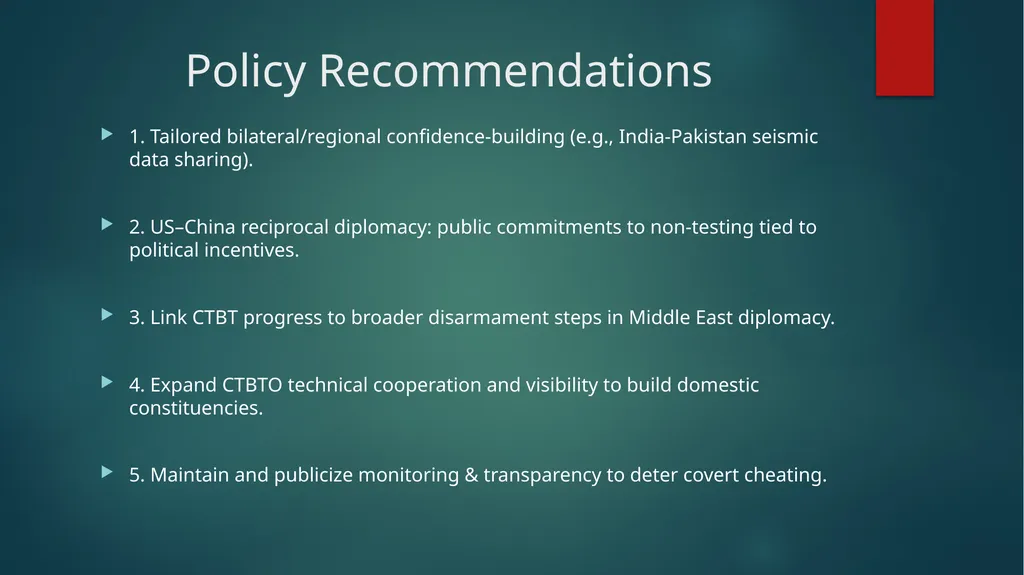
2. US–China reciprocal diplomacy: public commitments to non-testing tied to political incentives.
3. Link CTBT progress to broader disarmament steps in Middle East diplomacy.
4. Expand CTBTO technical cooperation and visibility to build domestic constituencies.
5. Maintain and publicize monitoring & transparency to deter covert cheating.<br>
11
Conclusion The CTBT remains a vital norm and technical asset, but legal EIF is blocked by eight Annex II holdouts.
The global arms-control architecture is fraying — making unconditional EIF unlikely in the near term.
Experts are pessimistic but still prioritize preserving the taboo and expanding CTBTO technical cooperation.
Practical path forward: tailored bilateral/regional measures, US–China reciprocity, stronger CTBTO outreach, and linking CTBT steps to regional confidence-building.
“Only through the CTBT’s entry into force can we fully realise its promise of a universal ban on nuclear testing.” — Robert Floyd, CTBTO Executive Secretary<br>