
WLTP ANNEX 4, ROAD LOAD CALCULATION Proposal for
Description: WLTP ANNEX 4, ROAD LOAD CALCULATION Proposal for calculating the road load of individual vehicles C. Lueginger, BMW; A. Feucht, Audi 14.03.2013 WLTP-DTP-LabProcICE-202 (partly presented at DTP-13) Note: Proposal not yet finalized. It is an
Related Topics
Download Presentation
"WLTP ANNEX 4, ROAD LOAD CALCULATION Proposal for" is the property of its rightful owner. Permission is granted to download and print the materials on this website for personal, non-commercial use only, and to display it on your personal computer provided you do not modify the materials and that you retain all copyright notices contained in the materials. By downloading content from our website, you accept the terms of this agreement.
Presentation Transcript
slide1. WLTP ANNEX 4, ROAD LOAD CALCULATION
Proposal for calculating the road load of individual vehicles
C. Lueginger, BMW; A. Feucht, Audi
14.03.2013 WLTP-DTP-LabProcICE-202 (partly presented at DTP-13) Note:
Proposal not yet finalized. It is an intermediate proposal which reflects the current state of discussions in the Drafting Task Force and outlines the general concept.<br>
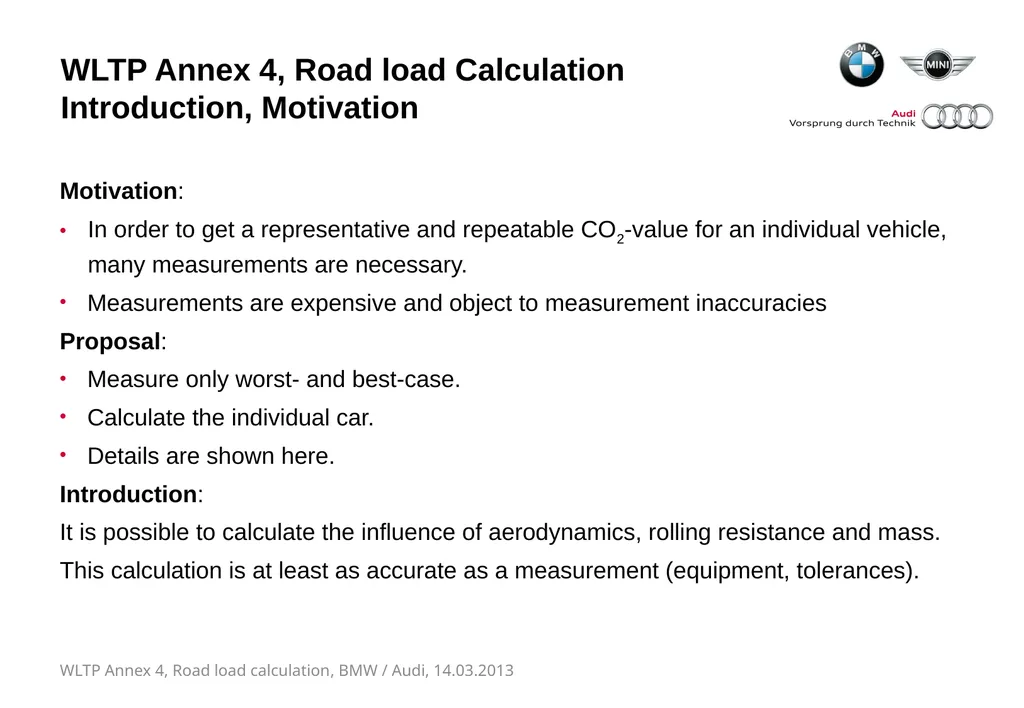
slide2. WLTP Annex 4, Road load Calculation Introduction, Motivation WLTP Annex 4, Road load calculation, BMW / Audi, 14.03.2013 Motivation:
In order to get a representative and repeatable CO2-value for an individual vehicle, many measurements are necessary.
Measurements are expensive and object to measurement inaccuracies
Proposal:
Measure only worst- and best-case.
Calculate the individual car.
Details are shown here.
Introduction:
It is possible to calculate the influence of aerodynamics, rolling resistance and mass.
This calculation is at least as accurate as a measurement (equipment, tolerances).<br>
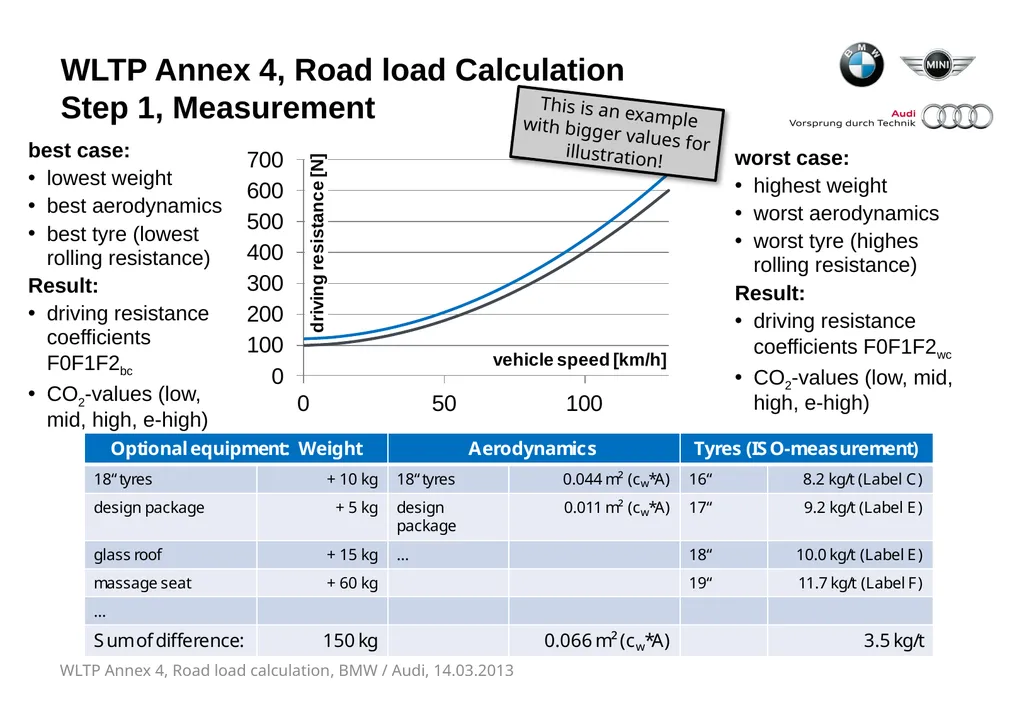
slide3. WLTP Annex 4, Road load Calculation Step 1, Measurement WLTP Annex 4, Road load calculation, BMW / Audi, 14.03.2013 best case:
lowest weight
best aerodynamics
best tyre (lowest rolling resistance)
Result:
driving resistance coefficients F0F1F2bc
CO2-values (low, mid, high, e-high) worst case:
highest weight
worst aerodynamics
worst tyre (highes rolling resistance)
Result:
driving resistance coefficients F0F1F2wc
CO2-values (low, mid, high, e-high) „Measure best- and worst case and determine influence of optional equipment.“ This is an example with bigger values for illustration!<br>
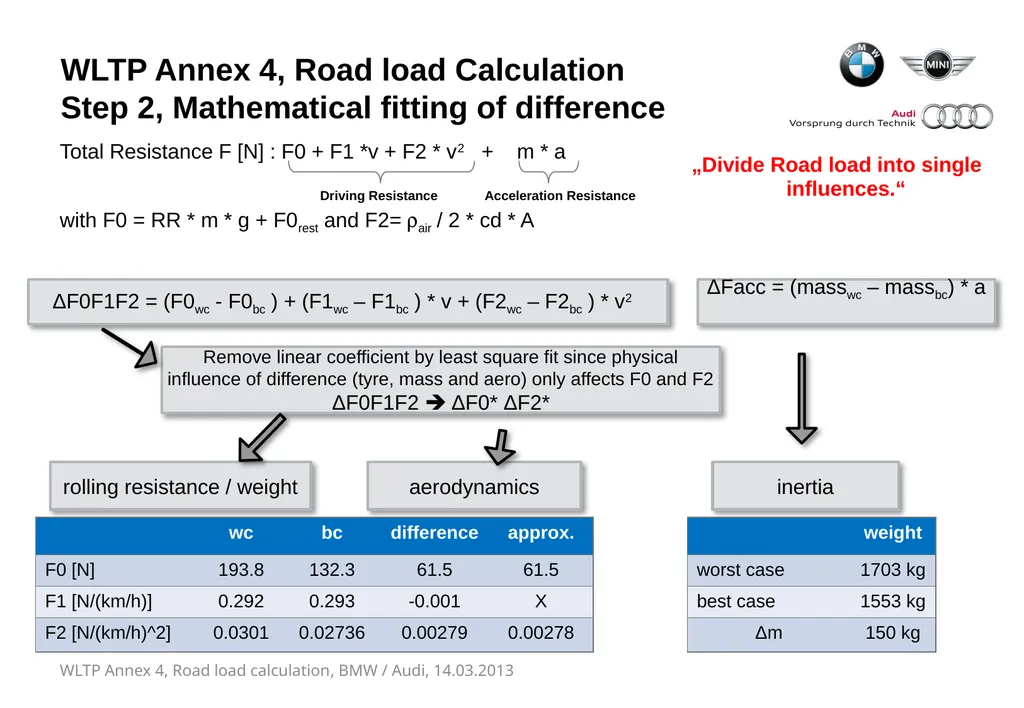
slide4. WLTP Annex 4, Road load Calculation Step 2, Mathematical fitting of difference WLTP Annex 4, Road load calculation, BMW / Audi, 14.03.2013 Remove linear coefficient by least square fit since physical influence of difference (tyre, mass and aero) only affects F0 and F2
ΔF0F1F2 ΔF0* ΔF2* „Divide Road load into single influences.“ ΔF0F1F2 = (F0wc - F0bc ) + (F1wc – F1bc ) * v + (F2wc – F2bc ) * v2 rolling resistance / weight aerodynamics inertia Total Resistance F [N] : F0 + F1 *v + F2 * v2 + m * a
with F0 = RR * m * g + F0rest and F2= rair / 2 * cd * A Driving Resistance Acceleration Resistance ΔFacc = (masswc – massbc) * a<br>
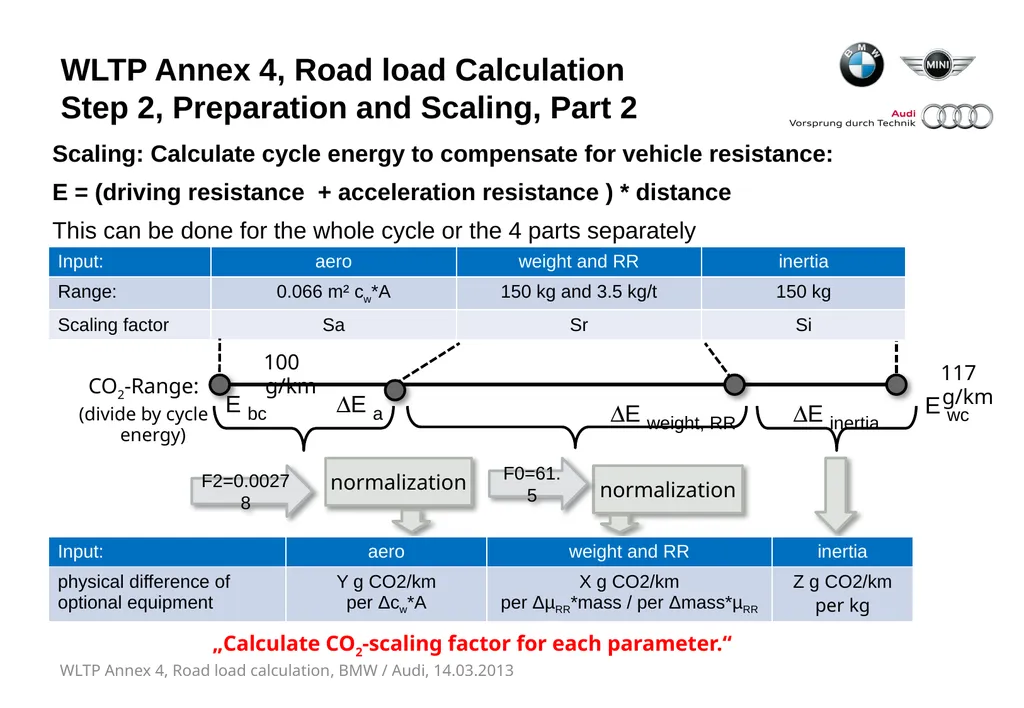
slide5. WLTP Annex 4, Road load Calculation Step 2, Preparation and Scaling, Part 2 WLTP Annex 4, Road load calculation, BMW / Audi, 14.03.2013 „Calculate CO2-scaling factor for each parameter.“ CO2-Range:
(divide by cycle energy) 117 g/km normalization F2=0.00278 100 g/km normalization F0=61.5 Scaling: Calculate cycle energy to compensate for vehicle resistance:
E = (driving resistance + acceleration resistance ) * distance
This can be done for the whole cycle or the 4 parts separately E bc E wc DE a DE weight, RR DE inertia<br>
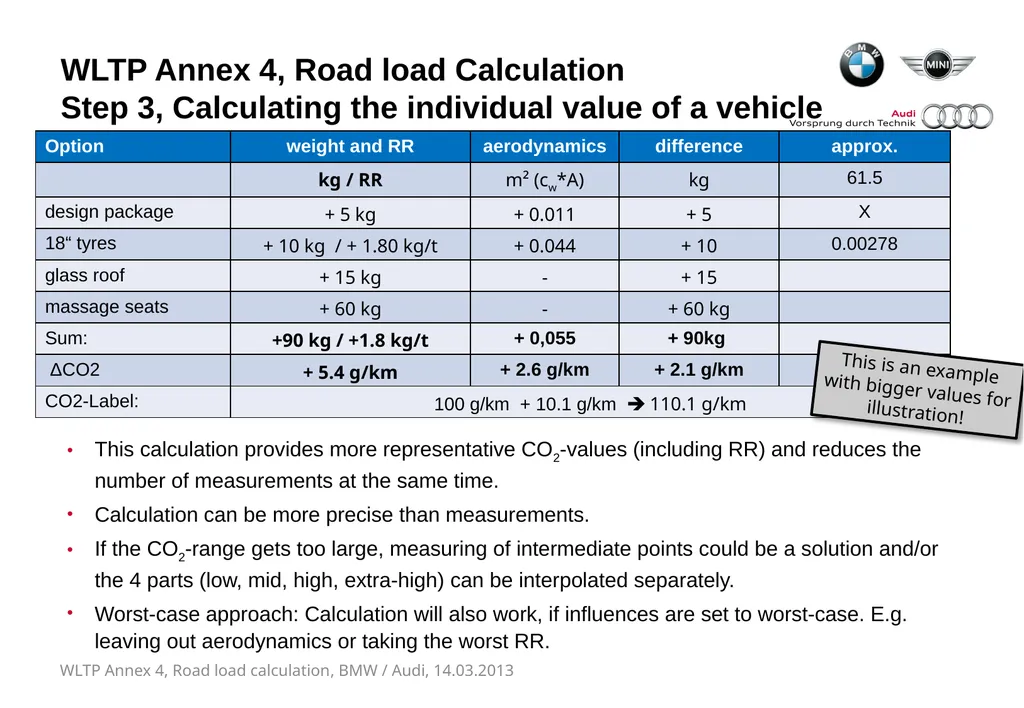
slide6. WLTP Annex 4, Road load Calculation Step 3, Calculating the individual value of a vehicle WLTP Annex 4, Road load calculation, BMW / Audi, 14.03.2013 This calculation provides more representative CO2-values (including RR) and reduces the number of measurements at the same time.
Calculation can be more precise than measurements.
If the CO2-range gets too large, measuring of intermediate points could be a solution and/or the 4 parts (low, mid, high, extra-high) can be interpolated separately.
Worst-case approach: Calculation will also work, if influences are set to worst-case. E.g. leaving out aerodynamics or taking the worst RR. This is an example with bigger values for illustration!<br>
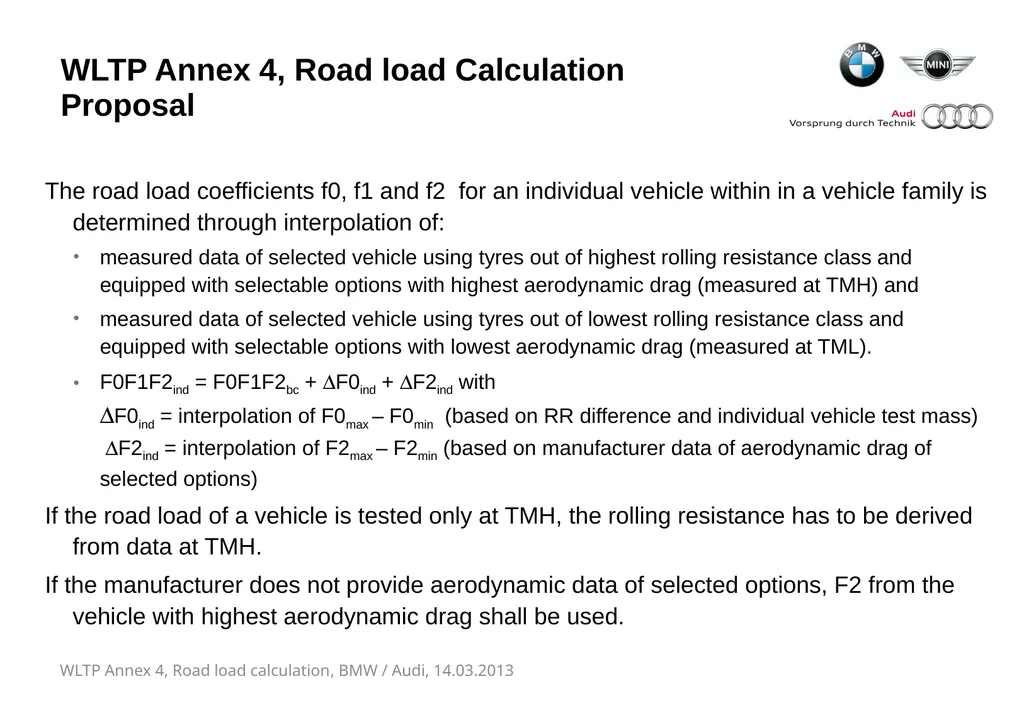
slide7. WLTP Annex 4, Road load Calculation Proposal WLTP Annex 4, Road load calculation, BMW / Audi, 14.03.2013 The road load coefficients f0, f1 and f2 for an individual vehicle within in a vehicle family is determined through interpolation of:
measured data of selected vehicle using tyres out of highest rolling resistance class and equipped with selectable options with highest aerodynamic drag (measured at TMH) and
measured data of selected vehicle using tyres out of lowest rolling resistance class and equipped with selectable options with lowest aerodynamic drag (measured at TML).
F0F1F2ind = F0F1F2bc + DF0ind + DF2ind with DF0ind = interpolation of F0max – F0min (based on RR difference and individual vehicle test mass) DF2ind = interpolation of F2max – F2min (based on manufacturer data of aerodynamic drag of selected options)
If the road load of a vehicle is tested only at TMH, the rolling resistance has to be derived from data at TMH.
If the manufacturer does not provide aerodynamic data of selected options, F2 from the vehicle with highest aerodynamic drag shall be used.<br>
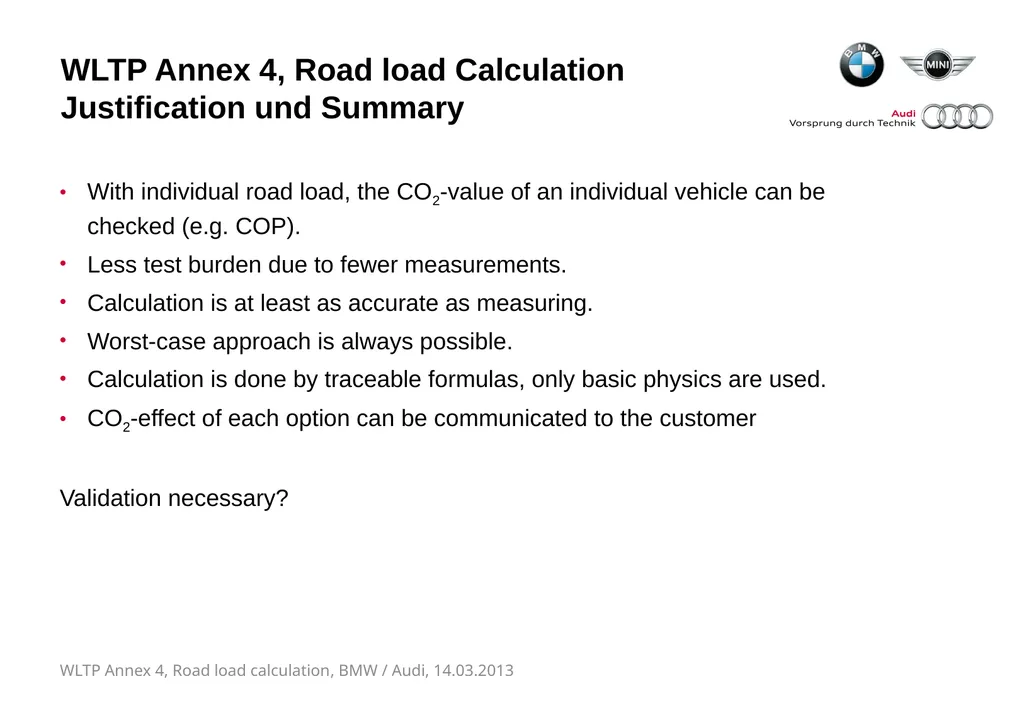
slide8. WLTP Annex 4, Road load Calculation Justification und Summary WLTP Annex 4, Road load calculation, BMW / Audi, 14.03.2013 With individual road load, the CO2-value of an individual vehicle can be checked (e.g. COP).
Less test burden due to fewer measurements.
Calculation is at least as accurate as measuring.
Worst-case approach is always possible.
Calculation is done by traceable formulas, only basic physics are used.
CO2-effect of each option can be communicated to the customer
Validation necessary?<br>
Proposal for calculating the road load of individual vehicles
C. Lueginger, BMW; A. Feucht, Audi
14.03.2013 WLTP-DTP-LabProcICE-202 (partly presented at DTP-13) Note:
Proposal not yet finalized. It is an intermediate proposal which reflects the current state of discussions in the Drafting Task Force and outlines the general concept.<br>
slide2. WLTP Annex 4, Road load Calculation Introduction, Motivation WLTP Annex 4, Road load calculation, BMW / Audi, 14.03.2013 Motivation:
In order to get a representative and repeatable CO2-value for an individual vehicle, many measurements are necessary.
Measurements are expensive and object to measurement inaccuracies
Proposal:
Measure only worst- and best-case.
Calculate the individual car.
Details are shown here.
Introduction:
It is possible to calculate the influence of aerodynamics, rolling resistance and mass.
This calculation is at least as accurate as a measurement (equipment, tolerances).<br>
slide3. WLTP Annex 4, Road load Calculation Step 1, Measurement WLTP Annex 4, Road load calculation, BMW / Audi, 14.03.2013 best case:
lowest weight
best aerodynamics
best tyre (lowest rolling resistance)
Result:
driving resistance coefficients F0F1F2bc
CO2-values (low, mid, high, e-high) worst case:
highest weight
worst aerodynamics
worst tyre (highes rolling resistance)
Result:
driving resistance coefficients F0F1F2wc
CO2-values (low, mid, high, e-high) „Measure best- and worst case and determine influence of optional equipment.“ This is an example with bigger values for illustration!<br>
slide4. WLTP Annex 4, Road load Calculation Step 2, Mathematical fitting of difference WLTP Annex 4, Road load calculation, BMW / Audi, 14.03.2013 Remove linear coefficient by least square fit since physical influence of difference (tyre, mass and aero) only affects F0 and F2
ΔF0F1F2 ΔF0* ΔF2* „Divide Road load into single influences.“ ΔF0F1F2 = (F0wc - F0bc ) + (F1wc – F1bc ) * v + (F2wc – F2bc ) * v2 rolling resistance / weight aerodynamics inertia Total Resistance F [N] : F0 + F1 *v + F2 * v2 + m * a
with F0 = RR * m * g + F0rest and F2= rair / 2 * cd * A Driving Resistance Acceleration Resistance ΔFacc = (masswc – massbc) * a<br>
slide5. WLTP Annex 4, Road load Calculation Step 2, Preparation and Scaling, Part 2 WLTP Annex 4, Road load calculation, BMW / Audi, 14.03.2013 „Calculate CO2-scaling factor for each parameter.“ CO2-Range:
(divide by cycle energy) 117 g/km normalization F2=0.00278 100 g/km normalization F0=61.5 Scaling: Calculate cycle energy to compensate for vehicle resistance:
E = (driving resistance + acceleration resistance ) * distance
This can be done for the whole cycle or the 4 parts separately E bc E wc DE a DE weight, RR DE inertia<br>
slide6. WLTP Annex 4, Road load Calculation Step 3, Calculating the individual value of a vehicle WLTP Annex 4, Road load calculation, BMW / Audi, 14.03.2013 This calculation provides more representative CO2-values (including RR) and reduces the number of measurements at the same time.
Calculation can be more precise than measurements.
If the CO2-range gets too large, measuring of intermediate points could be a solution and/or the 4 parts (low, mid, high, extra-high) can be interpolated separately.
Worst-case approach: Calculation will also work, if influences are set to worst-case. E.g. leaving out aerodynamics or taking the worst RR. This is an example with bigger values for illustration!<br>
slide7. WLTP Annex 4, Road load Calculation Proposal WLTP Annex 4, Road load calculation, BMW / Audi, 14.03.2013 The road load coefficients f0, f1 and f2 for an individual vehicle within in a vehicle family is determined through interpolation of:
measured data of selected vehicle using tyres out of highest rolling resistance class and equipped with selectable options with highest aerodynamic drag (measured at TMH) and
measured data of selected vehicle using tyres out of lowest rolling resistance class and equipped with selectable options with lowest aerodynamic drag (measured at TML).
F0F1F2ind = F0F1F2bc + DF0ind + DF2ind with DF0ind = interpolation of F0max – F0min (based on RR difference and individual vehicle test mass) DF2ind = interpolation of F2max – F2min (based on manufacturer data of aerodynamic drag of selected options)
If the road load of a vehicle is tested only at TMH, the rolling resistance has to be derived from data at TMH.
If the manufacturer does not provide aerodynamic data of selected options, F2 from the vehicle with highest aerodynamic drag shall be used.<br>
slide8. WLTP Annex 4, Road load Calculation Justification und Summary WLTP Annex 4, Road load calculation, BMW / Audi, 14.03.2013 With individual road load, the CO2-value of an individual vehicle can be checked (e.g. COP).
Less test burden due to fewer measurements.
Calculation is at least as accurate as measuring.
Worst-case approach is always possible.
Calculation is done by traceable formulas, only basic physics are used.
CO2-effect of each option can be communicated to the customer
Validation necessary?<br>