
Workforce planning guidance: to support 23/24






Description: Workforce planning guidance: to support 2324 Supplemental Substance Misuse grant planning March 2023 About this guidance This guidance is intended to support local authorities (LAs) and their delivery partners in year 2 Supplemental
Related Topics
Download Presentation
"Workforce planning guidance: to support 23/24" is the property of its rightful owner. Permission is granted to download and print the materials on this website for personal, non-commercial use only, and to display it on your personal computer provided you do not modify the materials and that you retain all copyright notices contained in the materials. By downloading content from our website, you accept the terms of this agreement.
Presentation Transcript
slide1. Workforce planning guidance:
to support 23/24 Supplemental Substance
Misuse grant planning March 2023<br>
slide2. About this guidance This guidance is intended to support local authorities (LAs) and their delivery partners in year 2 Supplemental Substance Misuse Treatment and Recovery (SSMTR) grant planning.
A Strategic framework for the drug and alcohol treatment and recovery workforce will soon be published with comprehensive information on each of these areas. It will also outline national projects that will support workforce transformation, so stakeholders know when to expect national resources.
In advance of this publication, this guidance pack provides key actions for LAs and delivery partners to consider in 2023/24 budgets and plans.<br>
slide3. How to use this guidance The guidance in this pack and the workforce census data described below are designed to help LAs and their delivery partners identify workforce gaps and develop local workforce expansion and enhancement plans. This is in addition to the SSMTR delivery planning template itself and support offer provided by regional and national support teams.
This guidance is intended to be used alongside the findings of the first-ever national workforce census undertaken by NHS Benchmarking Network (NHSBN) in 2022.
This census has 4 outputs:
a national report available on the Health Education England (HEE) website.
LA-level reports provided directly to LAs by NHSBN. These compare LA-level findings to national findings.
employer-level reports will be sent directly to those who responded to the survey by NHSBN. These compare employer-level findings to national findings.
regional-level reports provided to OHID regional and national support team leads to inform their support offer. These compare regional-level findings to national findings.<br>
slide4. Workforce development: areas of focus Extensive engagement with sector, scoping and development work has been undertaken by OHID and Health Education England (HEE) to inform the drug and alcohol treatment and recovery workforce transformation programme and its outputs.
This has identified 4 key areas of focus for workforce development. These are:
Recruitment and retention
Training and skills development
Career progression
Supervision and support with a focus on clinical supervision.
This pack provides guidance on LA and employer-level actions to take regarding each of these areas. It also provides some general guidance on workforce planning approaches.<br>
slide5. Recruitment and retention<br>
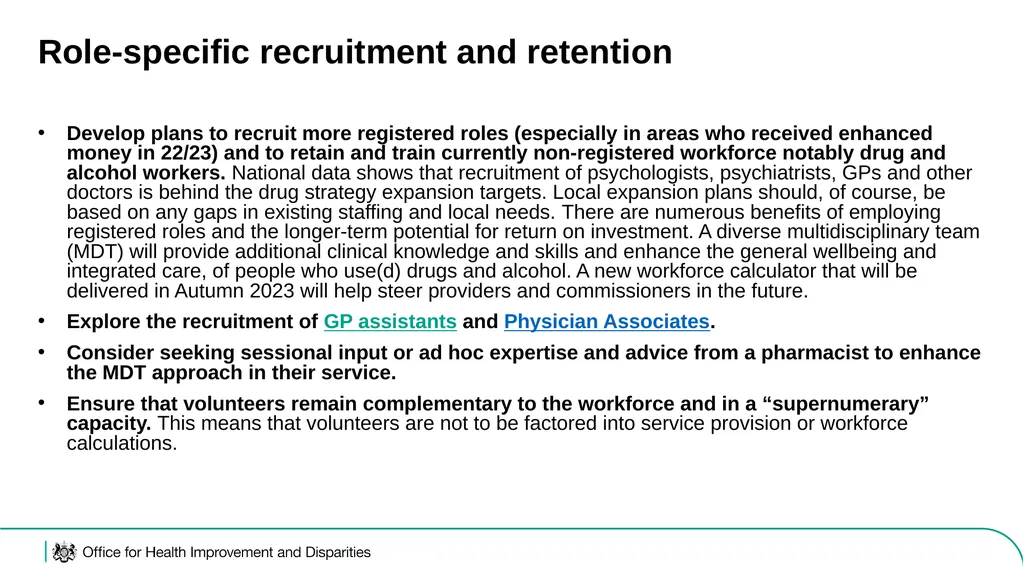
slide6. Role-specific recruitment and retention Develop plans to recruit more registered roles (especially in areas who received enhanced money in 22/23) and to retain and train currently non-registered workforce notably drug and alcohol workers. National data shows that recruitment of psychologists, psychiatrists, GPs and other doctors is behind the drug strategy expansion targets. Local expansion plans should, of course, be based on any gaps in existing staffing and local needs. There are numerous benefits of employing registered roles and the longer-term potential for return on investment. A diverse multidisciplinary team (MDT) will provide additional clinical knowledge and skills and enhance the general wellbeing and integrated care, of people who use(d) drugs and alcohol. A new workforce calculator that will be delivered in Autumn 2023 will help steer providers and commissioners in the future.
Explore the recruitment of GP assistants and Physician Associates.
Consider seeking sessional input or ad hoc expertise and advice from a pharmacist to enhance the MDT approach in their service.
Ensure that volunteers remain complementary to the workforce and in a “supernumerary” capacity. This means that volunteers are not to be factored into service provision or workforce calculations.<br>
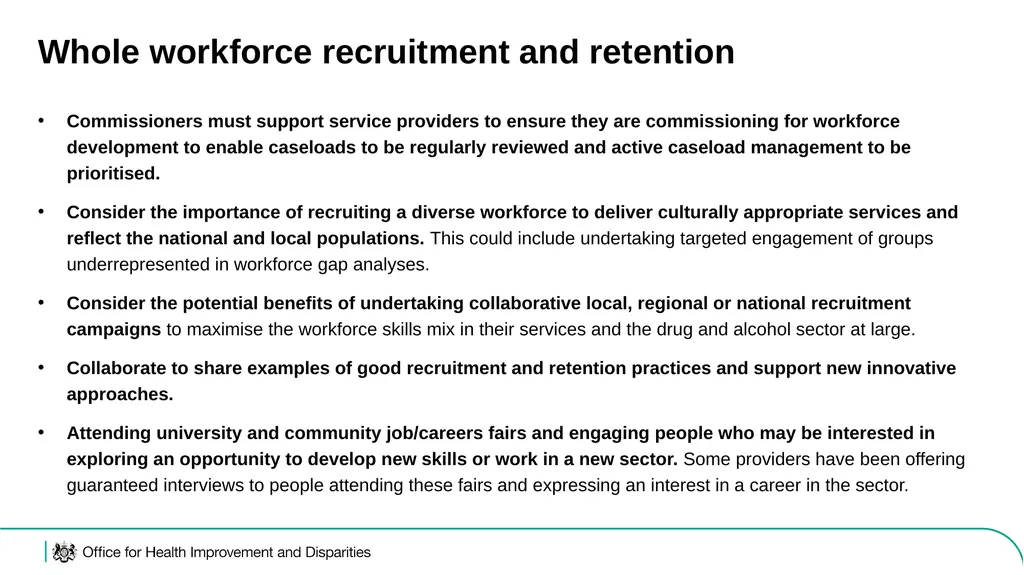
slide7. Whole workforce recruitment and retention Commissioners must support service providers to ensure they are commissioning for workforce development to enable caseloads to be regularly reviewed and active caseload management to be prioritised.
Consider the importance of recruiting a diverse workforce to deliver culturally appropriate services and reflect the national and local populations. This could include undertaking targeted engagement of groups underrepresented in workforce gap analyses.
Consider the potential benefits of undertaking collaborative local, regional or national recruitment campaigns to maximise the workforce skills mix in their services and the drug and alcohol sector at large.
Collaborate to share examples of good recruitment and retention practices and support new innovative approaches.
Attending university and community job/careers fairs and engaging people who may be interested in exploring an opportunity to develop new skills or work in a new sector. Some providers have been offering guaranteed interviews to people attending these fairs and expressing an interest in a career in the sector.<br>
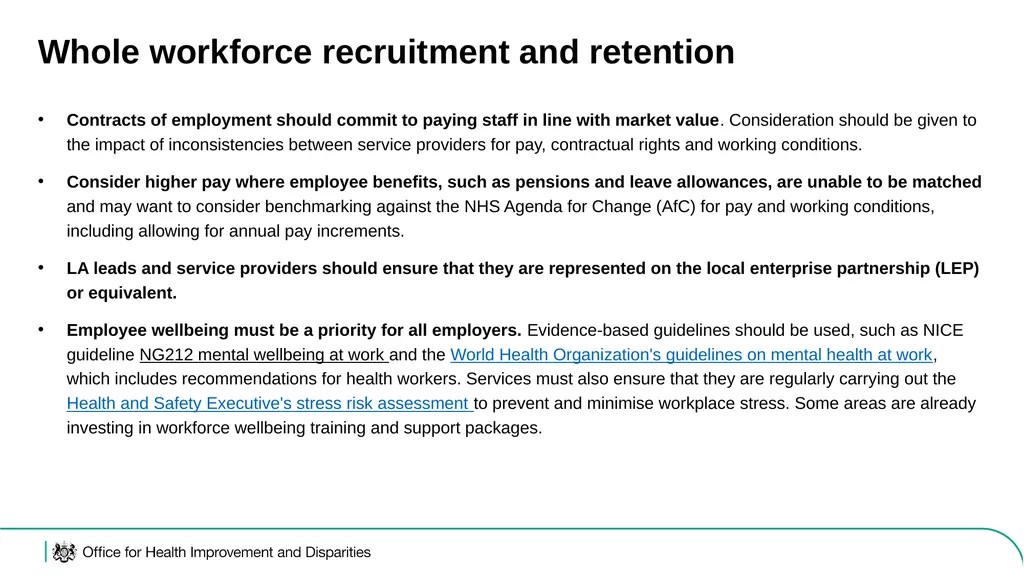
slide8. Whole workforce recruitment and retention Contracts of employment should commit to paying staff in line with market value. Consideration should be given to the impact of inconsistencies between service providers for pay, contractual rights and working conditions.
Consider higher pay where employee benefits, such as pensions and leave allowances, are unable to be matched and may want to consider benchmarking against the NHS Agenda for Change (AfC) for pay and working conditions, including allowing for annual pay increments.
LA leads and service providers should ensure that they are represented on the local enterprise partnership (LEP) or equivalent.
Employee wellbeing must be a priority for all employers. Evidence-based guidelines should be used, such as NICE guideline NG212 mental wellbeing at work and the World Health Organization's guidelines on mental health at work, which includes recommendations for health workers. Services must also ensure that they are regularly carrying out the Health and Safety Executive's stress risk assessment to prevent and minimise workplace stress. Some areas are already investing in workforce wellbeing training and support packages.<br>
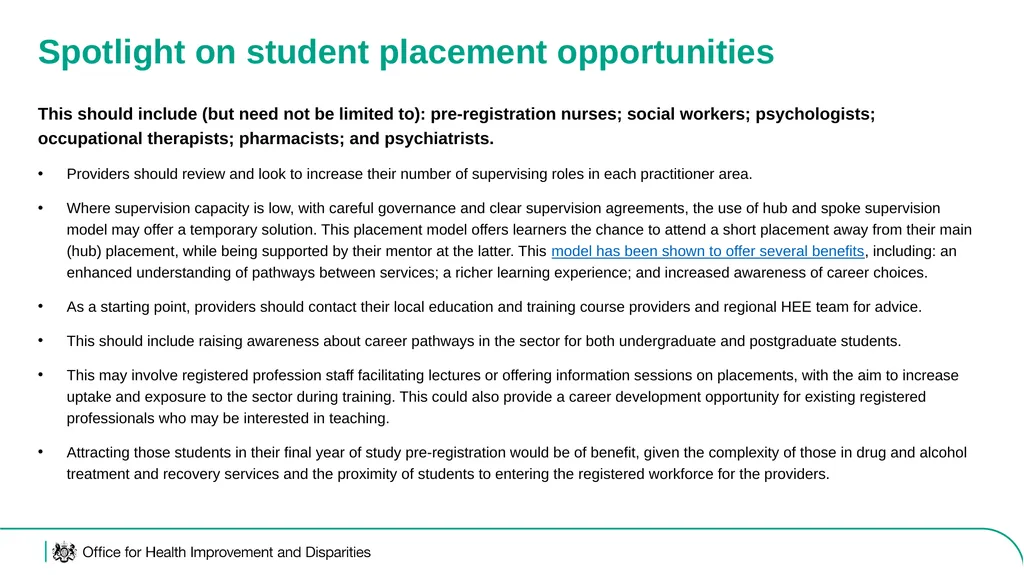
slide9. Spotlight on student placement opportunities This should include (but need not be limited to): pre-registration nurses; social workers; psychologists; occupational therapists; pharmacists; and psychiatrists.
Providers should review and look to increase their number of supervising roles in each practitioner area.
Where supervision capacity is low, with careful governance and clear supervision agreements, the use of hub and spoke supervision model may offer a temporary solution. This placement model offers learners the chance to attend a short placement away from their main (hub) placement, while being supported by their mentor at the latter. This model has been shown to offer several benefits, including: an enhanced understanding of pathways between services; a richer learning experience; and increased awareness of career choices.
As a starting point, providers should contact their local education and training course providers and regional HEE team for advice.
This should include raising awareness about career pathways in the sector for both undergraduate and postgraduate students.
This may involve registered profession staff facilitating lectures or offering information sessions on placements, with the aim to increase uptake and exposure to the sector during training. This could also provide a career development opportunity for existing registered professionals who may be interested in teaching.
Attracting those students in their final year of study pre-registration would be of benefit, given the complexity of those in drug and alcohol treatment and recovery services and the proximity of students to entering the registered workforce for the providers.<br>
slide10. Spotlight on international recruitment Explore the feasibility of “active recruitment” of registered professionals from outside the UK. About international recruitment
"Active international recruitment" is defined as the process by which UK health and social care employers (including LAs) market employment opportunities in the UK health or social care sector internationally.
There are several benefits of international recruitment, including having a wider pool of suitable applicants, increasing workplace diversity, uncovering a new talent pool of potential workforce and providing global workforce expansion opportunities.
Resources
NHS Employers international recruitment toolkit
NHS Employers and the Department of Health and Social Care’s (DHSC) International Workforce team have delivered webinars for drug and alcohol treatment and recovery service provider HR leads. If you would like the resources that they presented (some of which is tailored to the sector), please contact Laura.Pechey@dhsc.gov.uk.
International recruitment of overseas nurses and midwives
International recruitment of overseas doctors
World Health Organization (WHO) Code of Practice on ethical international recruitment
A quick guide to help NHS employers and candidates understand what the WHO Code of Practice means for them
The International Induction Programme can support the “active” international recruitment of GPs and other doctors.<br>
slide11. Training and skills development<br>
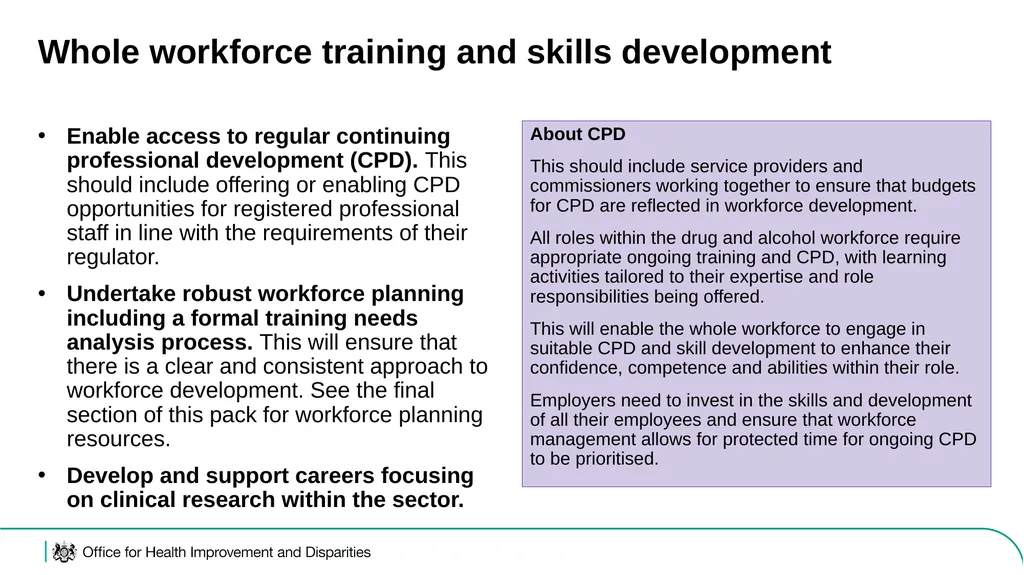
slide12. Whole workforce training and skills development Enable access to regular continuing professional development (CPD). This should include offering or enabling CPD opportunities for registered professional staff in line with the requirements of their regulator.
Undertake robust workforce planning including a formal training needs analysis process. This will ensure that there is a clear and consistent approach to workforce development. See the final section of this pack for workforce planning resources.
Develop and support careers focusing on clinical research within the sector. About CPD
This should include service providers and commissioners working together to ensure that budgets for CPD are reflected in workforce development.
All roles within the drug and alcohol workforce require appropriate ongoing training and CPD, with learning activities tailored to their expertise and role responsibilities being offered.
This will enable the whole workforce to engage in suitable CPD and skill development to enhance their confidence, competence and abilities within their role.
Employers need to invest in the skills and development of all their employees and ensure that workforce management allows for protected time for ongoing CPD to be prioritised.<br>
slide13. Career progression<br>
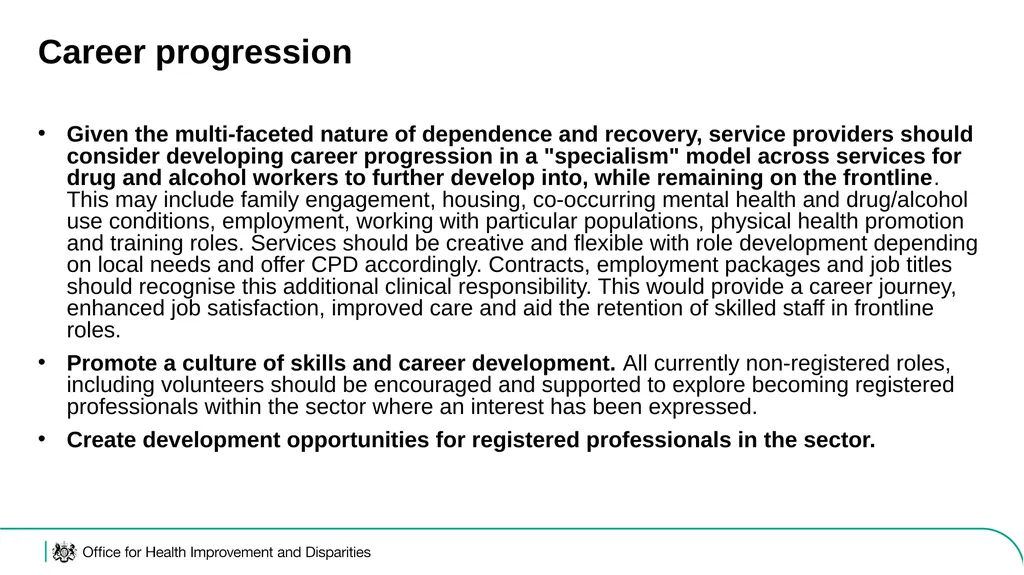
slide14. Career progression Given the multi-faceted nature of dependence and recovery, service providers should consider developing career progression in a "specialism" model across services for drug and alcohol workers to further develop into, while remaining on the frontline. This may include family engagement, housing, co-occurring mental health and drug/alcohol use conditions, employment, working with particular populations, physical health promotion and training roles. Services should be creative and flexible with role development depending on local needs and offer CPD accordingly. Contracts, employment packages and job titles should recognise this additional clinical responsibility. This would provide a career journey, enhanced job satisfaction, improved care and aid the retention of skilled staff in frontline roles.
Promote a culture of skills and career development. All currently non-registered roles, including volunteers should be encouraged and supported to explore becoming registered professionals within the sector where an interest has been expressed.
Create development opportunities for registered professionals in the sector.<br>
slide15. Supervision and support<br>
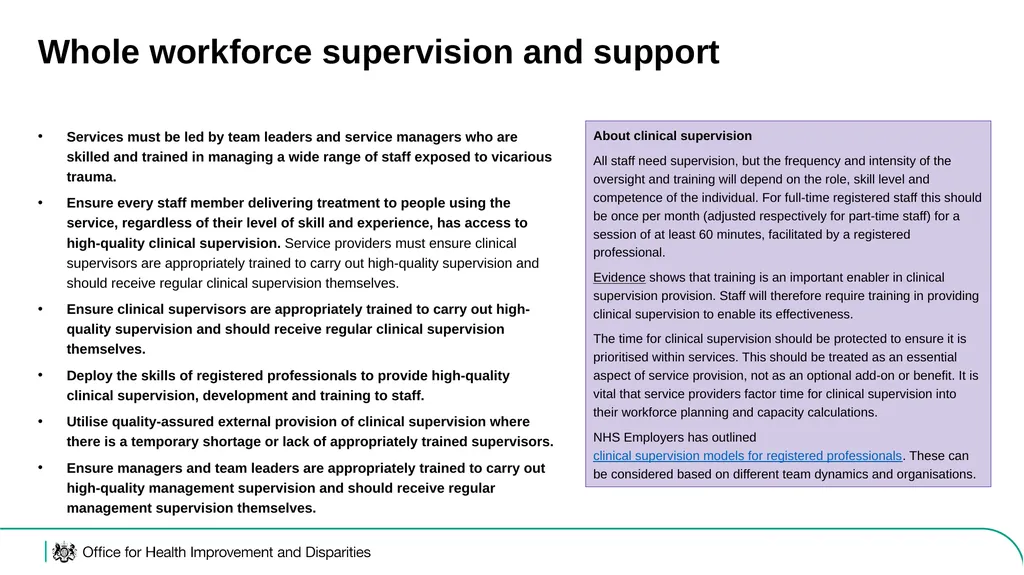
slide16. Whole workforce supervision and support Services must be led by team leaders and service managers who are skilled and trained in managing a wide range of staff exposed to vicarious trauma.
Ensure every staff member delivering treatment to people using the service, regardless of their level of skill and experience, has access to high-quality clinical supervision. Service providers must ensure clinical supervisors are appropriately trained to carry out high-quality supervision and should receive regular clinical supervision themselves.
Ensure clinical supervisors are appropriately trained to carry out high-quality supervision and should receive regular clinical supervision themselves.
Deploy the skills of registered professionals to provide high-quality clinical supervision, development and training to staff.
Utilise quality-assured external provision of clinical supervision where there is a temporary shortage or lack of appropriately trained supervisors.
Ensure managers and team leaders are appropriately trained to carry out high-quality management supervision and should receive regular management supervision themselves. About clinical supervision
All staff need supervision, but the frequency and intensity of the oversight and training will depend on the role, skill level and competence of the individual. For full-time registered staff this should be once per month (adjusted respectively for part-time staff) for a session of at least 60 minutes, facilitated by a registered professional.
Evidence shows that training is an important enabler in clinical supervision provision. Staff will therefore require training in providing clinical supervision to enable its effectiveness.
The time for clinical supervision should be protected to ensure it is prioritised within services. This should be treated as an essential aspect of service provision, not as an optional add-on or benefit. It is vital that service providers factor time for clinical supervision into their workforce planning and capacity calculations.
NHS Employers has outlined clinical supervision models for registered professionals. These can be considered based on different team dynamics and organisations.<br>
slide17. Workforce planning Self-assessment and resources<br>
slide18. Workforce planning self-assessment criteria The Commissioning quality standard: alcohol and drug treatment and recovery guidance provides criteria by which the system will know if the workforce is meeting the needs of the people they treat, as well as examples of evidence it should have. This can be used as a self-assessment tool in workforce planning:
You will know you are achieving this standard if you meet the following criteria.
Treatment services employ a multidisciplinary workforce who are competent to treat and support the treatment population, including people with co-morbidities.
All members of the workforce who provide care and support have a caseload that is clinically safe and appropriate to be able to deliver quality treatment.
Treatment service specifications and legal contracts make sure that service providers comply with treatment workforce standards. This also includes any mandatory training and development plans for the workforce and the partnership has dedicated funding to support this.
Any gaps in skills are identified by a training needs analysis.
Entry level roles and opportunities for trainee posts, including addiction psychiatry posts, are incorporated into workforce strategies and clear career progression routes are available.
All members of the treatment workforce receive regular supervision, including clinical supervision.
The partnership supports opportunities to exchange staff between different partner organisations to promote skill and practice sharing and to improve communication and collaboration.
There is a long-term local treatment and recovery workforce strategy to maintain a flexible and sustainable workforce model.<br>
slide19. Workforce planning self-assessment: evidence examples You should have evidence available that you are meeting this standard. This could include the following examples:
Contract monitoring processes.
A workforce structure chart which is part of a service's contract.
Workforce skills analysis and training and development plans for the treatment workforce, which services can prove are routinely monitored and shared with their commissioner.
A record of CPD for each staff member, which is demonstrated in staff CPD records and in broader workforce consultation and feedback reports.
Evidence that service providers have met local management and clinical supervision standards.
The partnership's commissioning and delivery plan.<br>
slide20. Workforce planning resources The following practical resources and guidance will help guide workforce planning:
Workforce planning – Chartered Institute of Personnel and Development (CIPD)
HEE Star: Accelerating workforce redesign
HEE Multidisciplinary team (MDT) toolkit
Workforce planning, transformation and commissioning – Skills for Care
Six steps methodology to integrated workforce planning – Skills for Care
Who needs a workforce plan? A simple guide to workforce planning – Local Government Association<br>
slide2. About this guidance This guidance is intended to support local authorities (LAs) and their delivery partners in year 2 Supplemental Substance Misuse Treatment and Recovery (SSMTR) grant planning.
A Strategic framework for the drug and alcohol treatment and recovery workforce will soon be published with comprehensive information on each of these areas. It will also outline national projects that will support workforce transformation, so stakeholders know when to expect national resources.
In advance of this publication, this guidance pack provides key actions for LAs and delivery partners to consider in 2023/24 budgets and plans.<br>
slide3. How to use this guidance The guidance in this pack and the workforce census data described below are designed to help LAs and their delivery partners identify workforce gaps and develop local workforce expansion and enhancement plans. This is in addition to the SSMTR delivery planning template itself and support offer provided by regional and national support teams.
This guidance is intended to be used alongside the findings of the first-ever national workforce census undertaken by NHS Benchmarking Network (NHSBN) in 2022.
This census has 4 outputs:
a national report available on the Health Education England (HEE) website.
LA-level reports provided directly to LAs by NHSBN. These compare LA-level findings to national findings.
employer-level reports will be sent directly to those who responded to the survey by NHSBN. These compare employer-level findings to national findings.
regional-level reports provided to OHID regional and national support team leads to inform their support offer. These compare regional-level findings to national findings.<br>
slide4. Workforce development: areas of focus Extensive engagement with sector, scoping and development work has been undertaken by OHID and Health Education England (HEE) to inform the drug and alcohol treatment and recovery workforce transformation programme and its outputs.
This has identified 4 key areas of focus for workforce development. These are:
Recruitment and retention
Training and skills development
Career progression
Supervision and support with a focus on clinical supervision.
This pack provides guidance on LA and employer-level actions to take regarding each of these areas. It also provides some general guidance on workforce planning approaches.<br>
slide5. Recruitment and retention<br>
slide6. Role-specific recruitment and retention Develop plans to recruit more registered roles (especially in areas who received enhanced money in 22/23) and to retain and train currently non-registered workforce notably drug and alcohol workers. National data shows that recruitment of psychologists, psychiatrists, GPs and other doctors is behind the drug strategy expansion targets. Local expansion plans should, of course, be based on any gaps in existing staffing and local needs. There are numerous benefits of employing registered roles and the longer-term potential for return on investment. A diverse multidisciplinary team (MDT) will provide additional clinical knowledge and skills and enhance the general wellbeing and integrated care, of people who use(d) drugs and alcohol. A new workforce calculator that will be delivered in Autumn 2023 will help steer providers and commissioners in the future.
Explore the recruitment of GP assistants and Physician Associates.
Consider seeking sessional input or ad hoc expertise and advice from a pharmacist to enhance the MDT approach in their service.
Ensure that volunteers remain complementary to the workforce and in a “supernumerary” capacity. This means that volunteers are not to be factored into service provision or workforce calculations.<br>
slide7. Whole workforce recruitment and retention Commissioners must support service providers to ensure they are commissioning for workforce development to enable caseloads to be regularly reviewed and active caseload management to be prioritised.
Consider the importance of recruiting a diverse workforce to deliver culturally appropriate services and reflect the national and local populations. This could include undertaking targeted engagement of groups underrepresented in workforce gap analyses.
Consider the potential benefits of undertaking collaborative local, regional or national recruitment campaigns to maximise the workforce skills mix in their services and the drug and alcohol sector at large.
Collaborate to share examples of good recruitment and retention practices and support new innovative approaches.
Attending university and community job/careers fairs and engaging people who may be interested in exploring an opportunity to develop new skills or work in a new sector. Some providers have been offering guaranteed interviews to people attending these fairs and expressing an interest in a career in the sector.<br>
slide8. Whole workforce recruitment and retention Contracts of employment should commit to paying staff in line with market value. Consideration should be given to the impact of inconsistencies between service providers for pay, contractual rights and working conditions.
Consider higher pay where employee benefits, such as pensions and leave allowances, are unable to be matched and may want to consider benchmarking against the NHS Agenda for Change (AfC) for pay and working conditions, including allowing for annual pay increments.
LA leads and service providers should ensure that they are represented on the local enterprise partnership (LEP) or equivalent.
Employee wellbeing must be a priority for all employers. Evidence-based guidelines should be used, such as NICE guideline NG212 mental wellbeing at work and the World Health Organization's guidelines on mental health at work, which includes recommendations for health workers. Services must also ensure that they are regularly carrying out the Health and Safety Executive's stress risk assessment to prevent and minimise workplace stress. Some areas are already investing in workforce wellbeing training and support packages.<br>
slide9. Spotlight on student placement opportunities This should include (but need not be limited to): pre-registration nurses; social workers; psychologists; occupational therapists; pharmacists; and psychiatrists.
Providers should review and look to increase their number of supervising roles in each practitioner area.
Where supervision capacity is low, with careful governance and clear supervision agreements, the use of hub and spoke supervision model may offer a temporary solution. This placement model offers learners the chance to attend a short placement away from their main (hub) placement, while being supported by their mentor at the latter. This model has been shown to offer several benefits, including: an enhanced understanding of pathways between services; a richer learning experience; and increased awareness of career choices.
As a starting point, providers should contact their local education and training course providers and regional HEE team for advice.
This should include raising awareness about career pathways in the sector for both undergraduate and postgraduate students.
This may involve registered profession staff facilitating lectures or offering information sessions on placements, with the aim to increase uptake and exposure to the sector during training. This could also provide a career development opportunity for existing registered professionals who may be interested in teaching.
Attracting those students in their final year of study pre-registration would be of benefit, given the complexity of those in drug and alcohol treatment and recovery services and the proximity of students to entering the registered workforce for the providers.<br>
slide10. Spotlight on international recruitment Explore the feasibility of “active recruitment” of registered professionals from outside the UK. About international recruitment
"Active international recruitment" is defined as the process by which UK health and social care employers (including LAs) market employment opportunities in the UK health or social care sector internationally.
There are several benefits of international recruitment, including having a wider pool of suitable applicants, increasing workplace diversity, uncovering a new talent pool of potential workforce and providing global workforce expansion opportunities.
Resources
NHS Employers international recruitment toolkit
NHS Employers and the Department of Health and Social Care’s (DHSC) International Workforce team have delivered webinars for drug and alcohol treatment and recovery service provider HR leads. If you would like the resources that they presented (some of which is tailored to the sector), please contact Laura.Pechey@dhsc.gov.uk.
International recruitment of overseas nurses and midwives
International recruitment of overseas doctors
World Health Organization (WHO) Code of Practice on ethical international recruitment
A quick guide to help NHS employers and candidates understand what the WHO Code of Practice means for them
The International Induction Programme can support the “active” international recruitment of GPs and other doctors.<br>
slide11. Training and skills development<br>
slide12. Whole workforce training and skills development Enable access to regular continuing professional development (CPD). This should include offering or enabling CPD opportunities for registered professional staff in line with the requirements of their regulator.
Undertake robust workforce planning including a formal training needs analysis process. This will ensure that there is a clear and consistent approach to workforce development. See the final section of this pack for workforce planning resources.
Develop and support careers focusing on clinical research within the sector. About CPD
This should include service providers and commissioners working together to ensure that budgets for CPD are reflected in workforce development.
All roles within the drug and alcohol workforce require appropriate ongoing training and CPD, with learning activities tailored to their expertise and role responsibilities being offered.
This will enable the whole workforce to engage in suitable CPD and skill development to enhance their confidence, competence and abilities within their role.
Employers need to invest in the skills and development of all their employees and ensure that workforce management allows for protected time for ongoing CPD to be prioritised.<br>
slide13. Career progression<br>
slide14. Career progression Given the multi-faceted nature of dependence and recovery, service providers should consider developing career progression in a "specialism" model across services for drug and alcohol workers to further develop into, while remaining on the frontline. This may include family engagement, housing, co-occurring mental health and drug/alcohol use conditions, employment, working with particular populations, physical health promotion and training roles. Services should be creative and flexible with role development depending on local needs and offer CPD accordingly. Contracts, employment packages and job titles should recognise this additional clinical responsibility. This would provide a career journey, enhanced job satisfaction, improved care and aid the retention of skilled staff in frontline roles.
Promote a culture of skills and career development. All currently non-registered roles, including volunteers should be encouraged and supported to explore becoming registered professionals within the sector where an interest has been expressed.
Create development opportunities for registered professionals in the sector.<br>
slide15. Supervision and support<br>
slide16. Whole workforce supervision and support Services must be led by team leaders and service managers who are skilled and trained in managing a wide range of staff exposed to vicarious trauma.
Ensure every staff member delivering treatment to people using the service, regardless of their level of skill and experience, has access to high-quality clinical supervision. Service providers must ensure clinical supervisors are appropriately trained to carry out high-quality supervision and should receive regular clinical supervision themselves.
Ensure clinical supervisors are appropriately trained to carry out high-quality supervision and should receive regular clinical supervision themselves.
Deploy the skills of registered professionals to provide high-quality clinical supervision, development and training to staff.
Utilise quality-assured external provision of clinical supervision where there is a temporary shortage or lack of appropriately trained supervisors.
Ensure managers and team leaders are appropriately trained to carry out high-quality management supervision and should receive regular management supervision themselves. About clinical supervision
All staff need supervision, but the frequency and intensity of the oversight and training will depend on the role, skill level and competence of the individual. For full-time registered staff this should be once per month (adjusted respectively for part-time staff) for a session of at least 60 minutes, facilitated by a registered professional.
Evidence shows that training is an important enabler in clinical supervision provision. Staff will therefore require training in providing clinical supervision to enable its effectiveness.
The time for clinical supervision should be protected to ensure it is prioritised within services. This should be treated as an essential aspect of service provision, not as an optional add-on or benefit. It is vital that service providers factor time for clinical supervision into their workforce planning and capacity calculations.
NHS Employers has outlined clinical supervision models for registered professionals. These can be considered based on different team dynamics and organisations.<br>
slide17. Workforce planning Self-assessment and resources<br>
slide18. Workforce planning self-assessment criteria The Commissioning quality standard: alcohol and drug treatment and recovery guidance provides criteria by which the system will know if the workforce is meeting the needs of the people they treat, as well as examples of evidence it should have. This can be used as a self-assessment tool in workforce planning:
You will know you are achieving this standard if you meet the following criteria.
Treatment services employ a multidisciplinary workforce who are competent to treat and support the treatment population, including people with co-morbidities.
All members of the workforce who provide care and support have a caseload that is clinically safe and appropriate to be able to deliver quality treatment.
Treatment service specifications and legal contracts make sure that service providers comply with treatment workforce standards. This also includes any mandatory training and development plans for the workforce and the partnership has dedicated funding to support this.
Any gaps in skills are identified by a training needs analysis.
Entry level roles and opportunities for trainee posts, including addiction psychiatry posts, are incorporated into workforce strategies and clear career progression routes are available.
All members of the treatment workforce receive regular supervision, including clinical supervision.
The partnership supports opportunities to exchange staff between different partner organisations to promote skill and practice sharing and to improve communication and collaboration.
There is a long-term local treatment and recovery workforce strategy to maintain a flexible and sustainable workforce model.<br>
slide19. Workforce planning self-assessment: evidence examples You should have evidence available that you are meeting this standard. This could include the following examples:
Contract monitoring processes.
A workforce structure chart which is part of a service's contract.
Workforce skills analysis and training and development plans for the treatment workforce, which services can prove are routinely monitored and shared with their commissioner.
A record of CPD for each staff member, which is demonstrated in staff CPD records and in broader workforce consultation and feedback reports.
Evidence that service providers have met local management and clinical supervision standards.
The partnership's commissioning and delivery plan.<br>
slide20. Workforce planning resources The following practical resources and guidance will help guide workforce planning:
Workforce planning – Chartered Institute of Personnel and Development (CIPD)
HEE Star: Accelerating workforce redesign
HEE Multidisciplinary team (MDT) toolkit
Workforce planning, transformation and commissioning – Skills for Care
Six steps methodology to integrated workforce planning – Skills for Care
Who needs a workforce plan? A simple guide to workforce planning – Local Government Association<br>