Working with Clients Who Need Interpreters February 2020 Objectives Interpreting vs. Translation Translator translates written text Translators need to have the ability to understand the source language and the culture of the country
"Working with Clients Who Need Interpreters" is the property of its rightful owner. Permission is granted to
download and print the materials on this website for personal, non-commercial use only, and to display it
on your personal computer provided you do not modify the materials and that you retain all copyright
notices contained in the materials. By downloading content from our website, you accept the terms of this
agreement.
Presentation Transcript
01
Working with Clients Who Need Interpreters February 2020<br>
02
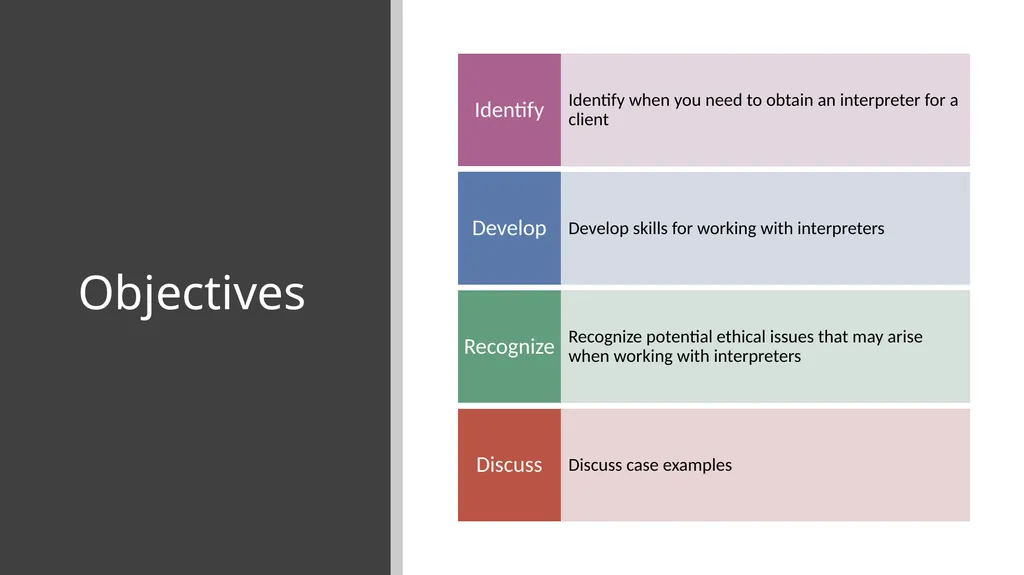
Objectives<br>
03
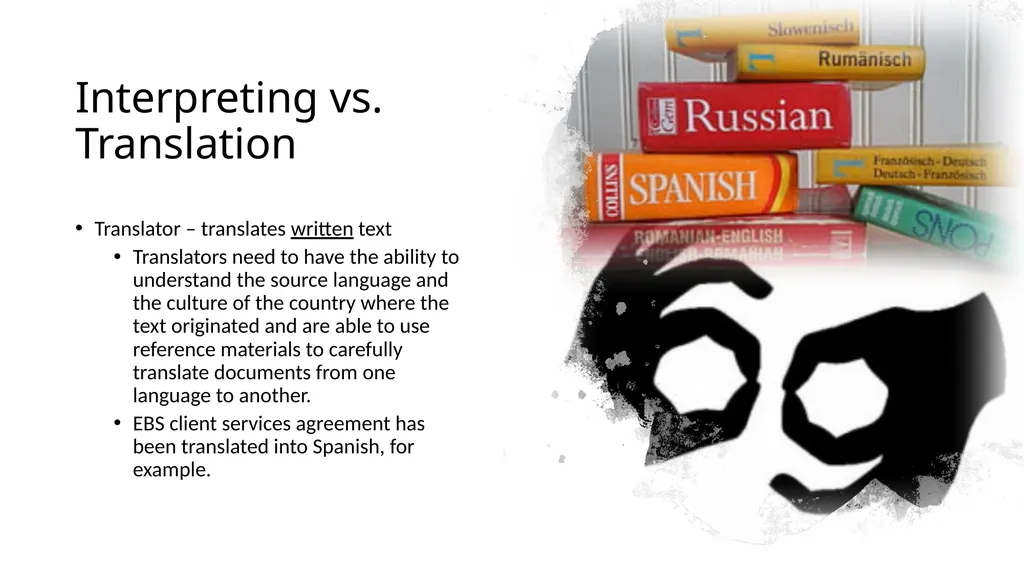
Interpreting vs. Translation Translator – translates written text
Translators need to have the ability to understand the source language and the culture of the country where the text originated and are able to use reference materials to carefully translate documents from one language to another.
EBS client services agreement has been translated into Spanish, for example.<br>
04
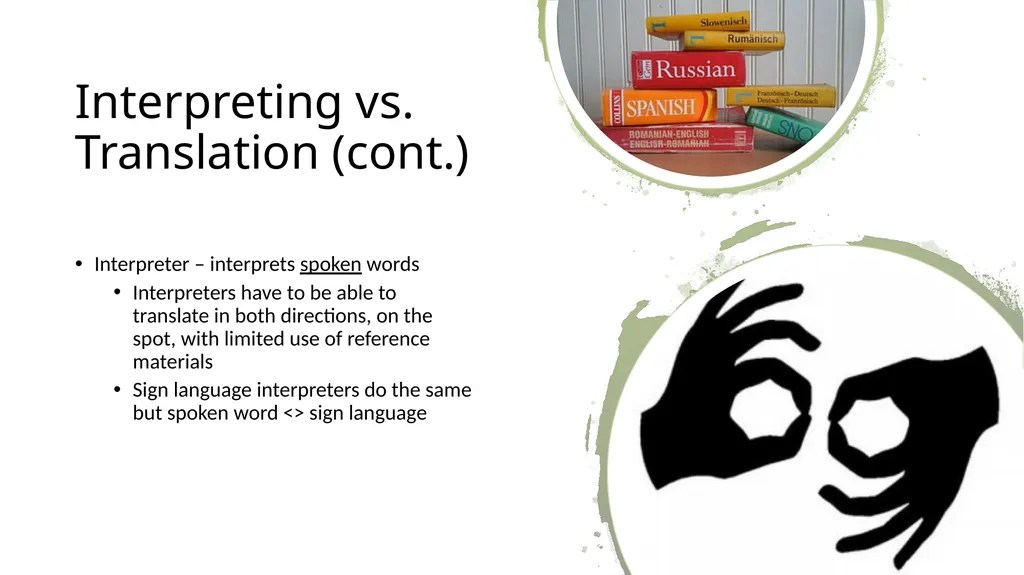
Interpreting vs. Translation (cont.) Interpreter – interprets spoken words
Interpreters have to be able to translate in both directions, on the spot, with limited use of reference materials
Sign language interpreters do the same but spoken word <> sign language<br>
05
When to Request an Interpreter Conversational fluency in any language is vastly different from the process of professional interpreting.
Short, simple conversations – might be okay to use a family member or pass a notebook back and forth
Long, complex conversation – qualified interpreter may be required
Spoken communication takes place at a rate of 125 to 230 words per minute, professional interpreters are trained to deliver a smooth, accurate and impartial interpretation, while a person who is merely fluent in any language is not.<br>
06
When to Request an Interpreter (cont.) Most importantly, when the person asks for an interpreter, we must provide one
Title VI of the Civil Rights Act of 1964 - protects people from discrimination based on race, color or national origin
The Americans with Disabilities Act (ADA) & The Rehabilitation Act of 1973 - recognizes the civil rights of people who are deaf and hard of hearing
Contract with DHS & Aging Units etc.<br>
07
Aging Network Manual<br>
08
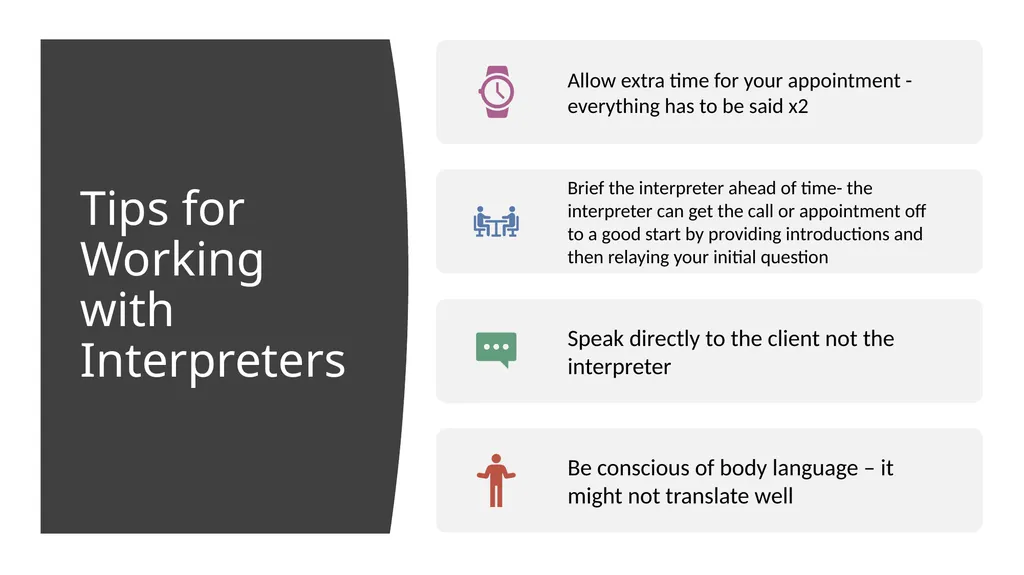
Tips for Working with Interpreters<br>
09
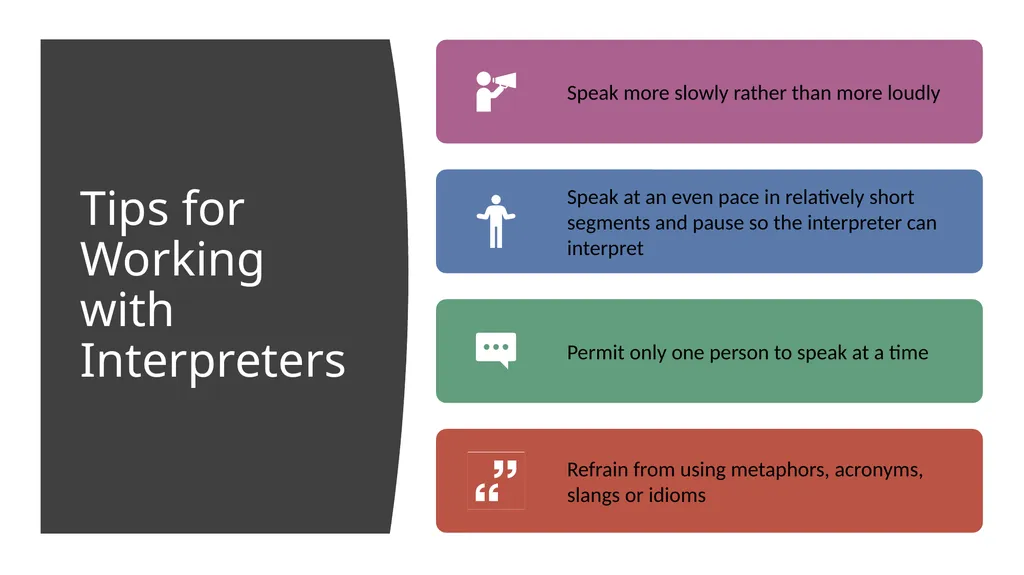
Tips for Working with Interpreters<br>
10
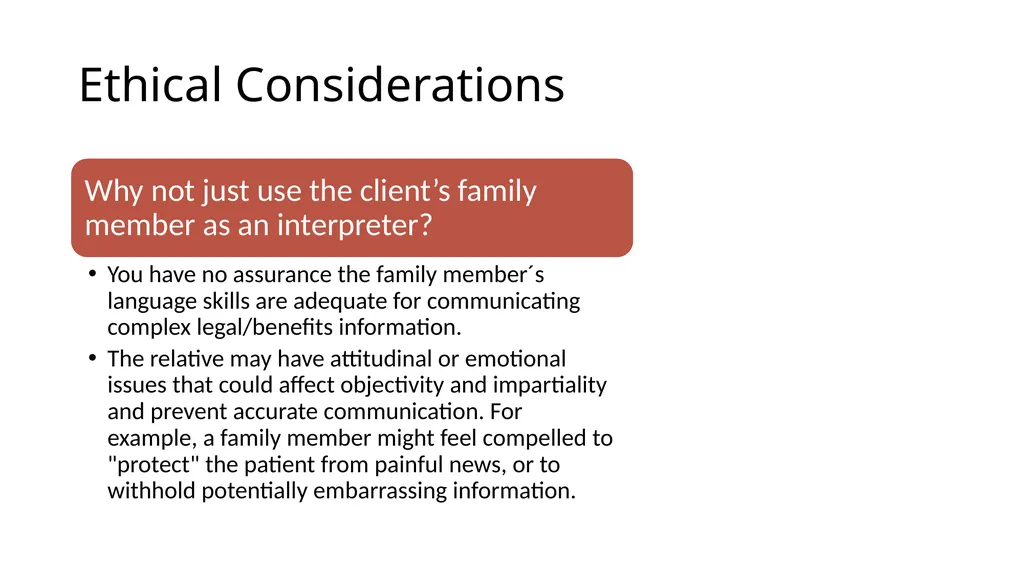
Ethical Considerations<br>
11
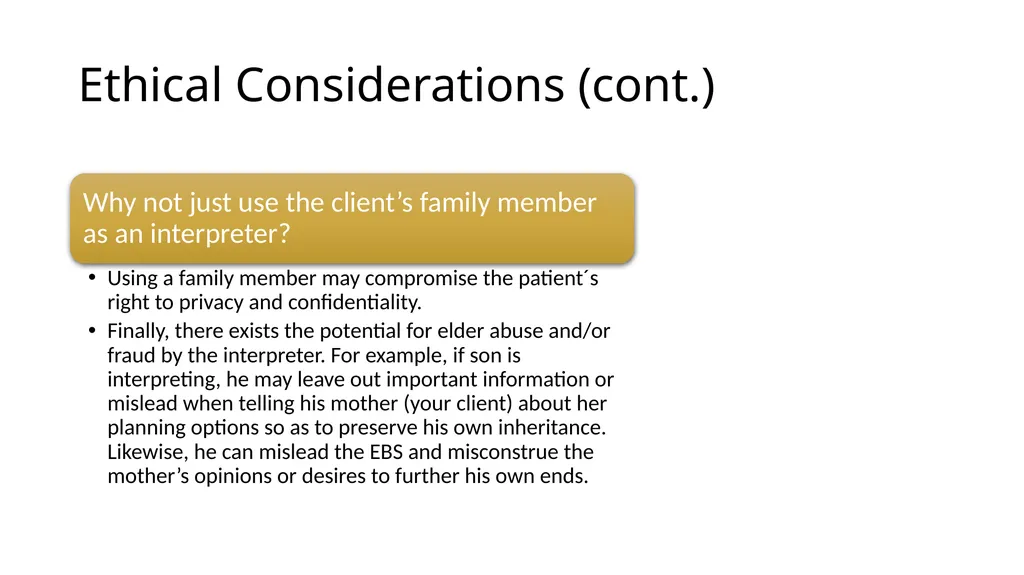
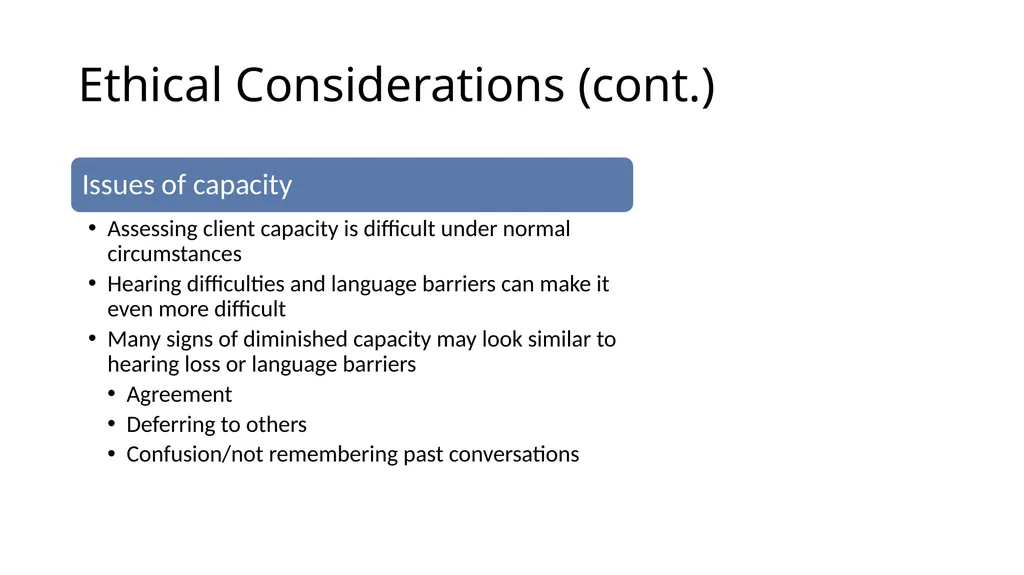
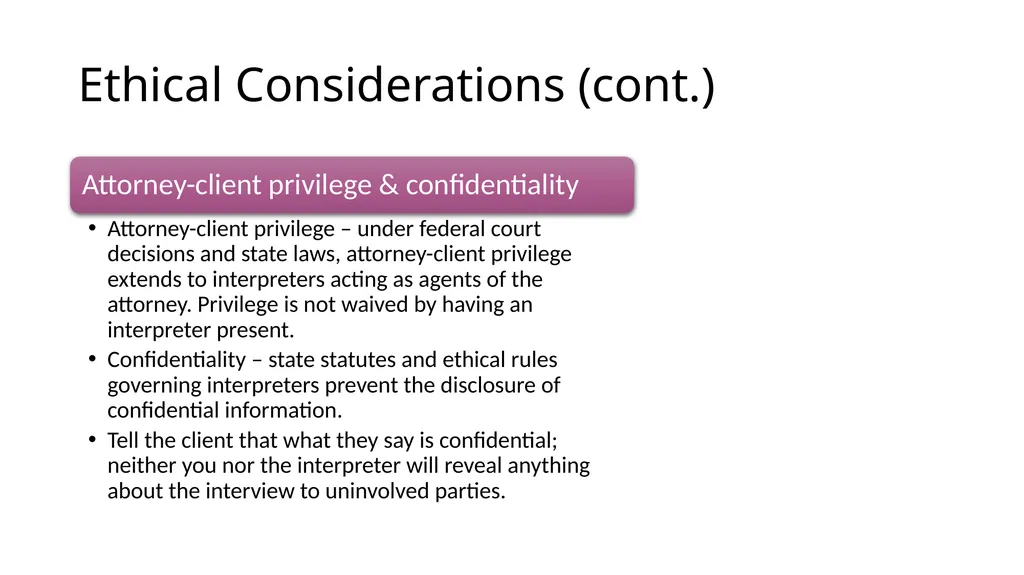
Ethical Considerations (cont.)<br>
12
Ethical Considerations (cont.)<br>
13
Ethical Considerations (cont.)<br>
14
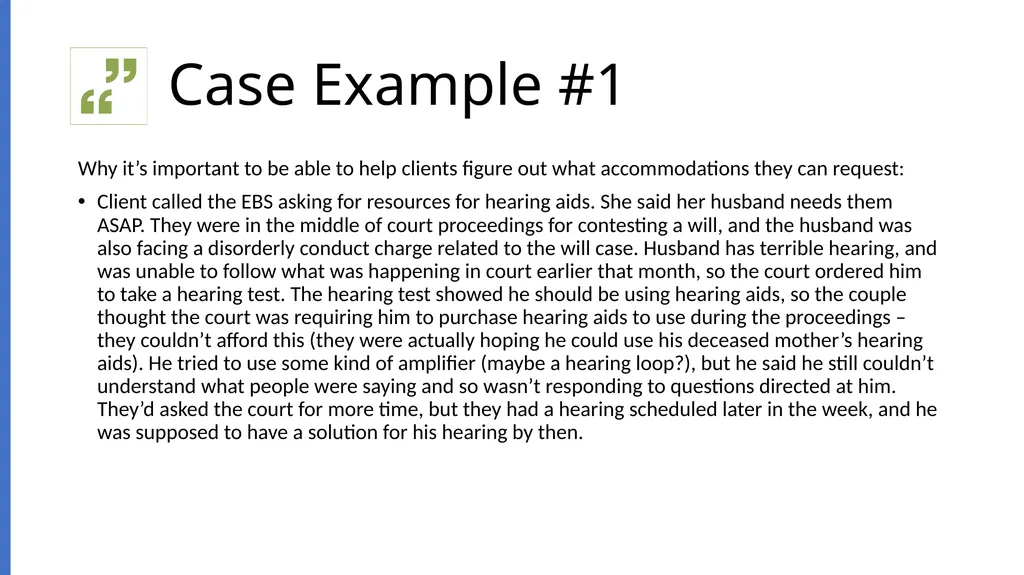
Case Example #1 Why it’s important to be able to help clients figure out what accommodations they can request:
Client called the EBS asking for resources for hearing aids. She said her husband needs them ASAP. They were in the middle of court proceedings for contesting a will, and the husband was also facing a disorderly conduct charge related to the will case. Husband has terrible hearing, and was unable to follow what was happening in court earlier that month, so the court ordered him to take a hearing test. The hearing test showed he should be using hearing aids, so the couple thought the court was requiring him to purchase hearing aids to use during the proceedings – they couldn’t afford this (they were actually hoping he could use his deceased mother’s hearing aids). He tried to use some kind of amplifier (maybe a hearing loop?), but he said he still couldn’t understand what people were saying and so wasn’t responding to questions directed at him. They’d asked the court for more time, but they had a hearing scheduled later in the week, and he was supposed to have a solution for his hearing by then.<br>
15
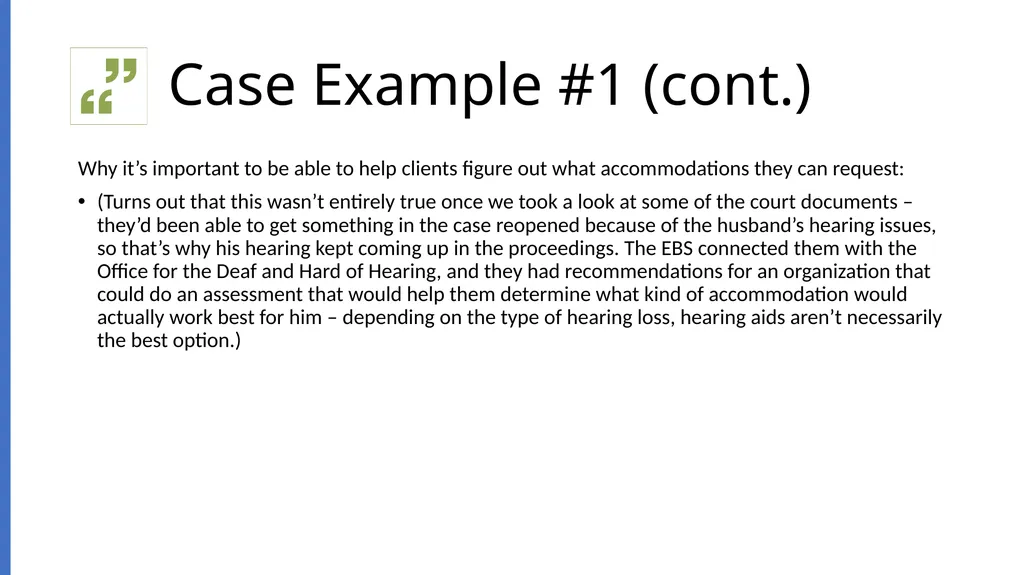
Case Example #1 (cont.) Why it’s important to be able to help clients figure out what accommodations they can request:
(Turns out that this wasn’t entirely true once we took a look at some of the court documents – they’d been able to get something in the case reopened because of the husband’s hearing issues, so that’s why his hearing kept coming up in the proceedings. The EBS connected them with the Office for the Deaf and Hard of Hearing, and they had recommendations for an organization that could do an assessment that would help them determine what kind of accommodation would actually work best for him – depending on the type of hearing loss, hearing aids aren’t necessarily the best option.)<br>
16
Case Example #2 Client tried to enroll in Medicare Part B in January 2016, but, due to a language barrier, he did not understand the enrollment process. SSA never offered to provide an interpreter for him, even though the POMS (below) requires SSA to provide one for individuals who have difficulty speaking English. The client tried to enroll again in 2017 and was told that his Part B would not start until July 2017 and that he would have a late enrollment penalty. We requested equitable relief, and the client was able to enroll in Part B immediately without a LEP.<br>
17
Case Example #2 (cont.) GN 00203.011 - SSA will provide an interpreter free of charge to individuals requesting language assistance or when it is evident that such assistance is necessary to ensure that the individual is not disadvantaged.<br>
18
Case Example #3 An ADRC has a contract with an independent company to hire interpreters. The EBS requested an interpreter through the company, as usual. In the middle of the meeting, the client got up to go to the bathroom, at which point the interpreter started making small talk with the EBS. He mentioned that he was an attorney, and what they were talking about would be interesting to his practice. The EBS continued the meeting with the client and interpreter, but called her BSSA right away afterwards.<br>
19
Case Example #3 (cont.) Concerns
Check the contract with the independent provider – can an interpreter be a practicing attorney?
Client confidentiality
Conflict of interest
Possible solicitation of business
Confusing about representation if the client learns the interpreter is an attorney<br>