
Interpreters’ Working Conditions (Or how numbers
LO
Published · 36 slides · 0 views
1 / 1


Description
Interpreters Working Conditions (Or how numbers can lie) Average time in the interpreting booth of 11:54 hrs per week. Unfair distribution of workload with some interpreters working on average only 6 hrs in the interpreting booth per week
Related Topics
Share
Embed code
Download this presentation From Below
"Interpreters’ Working Conditions (Or how numbers" is the property of its rightful owner. Permission is granted to download and print the materials on this website for personal, non-commercial use only, and to display it on your personal computer provided you do not modify the materials and that you retain all copyright notices contained in the materials. By downloading content from our website, you accept the terms of this agreement.
Presentation Transcript
01
Interpreters’ Working Conditions
(Or how numbers can lie)<br>
02
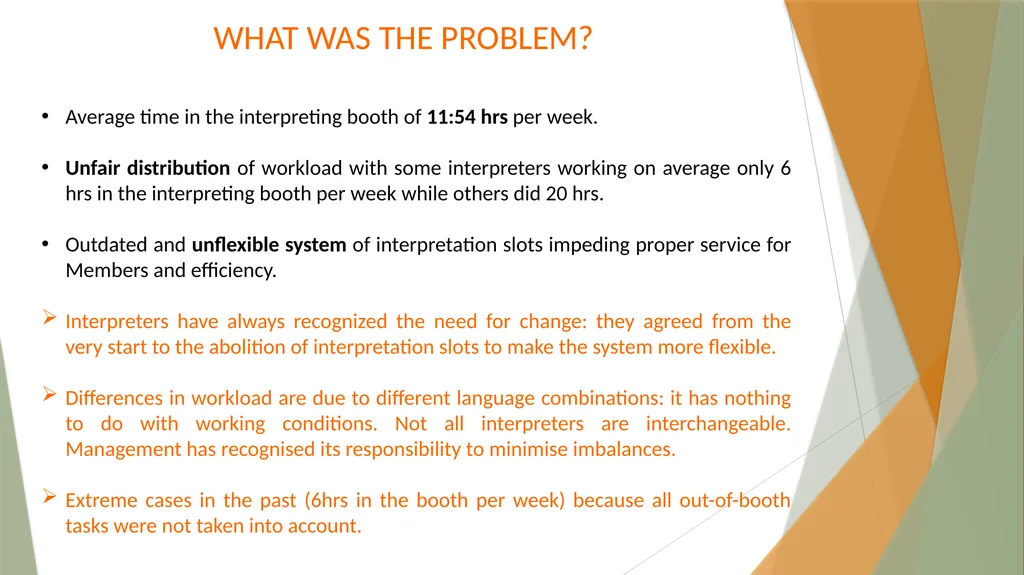
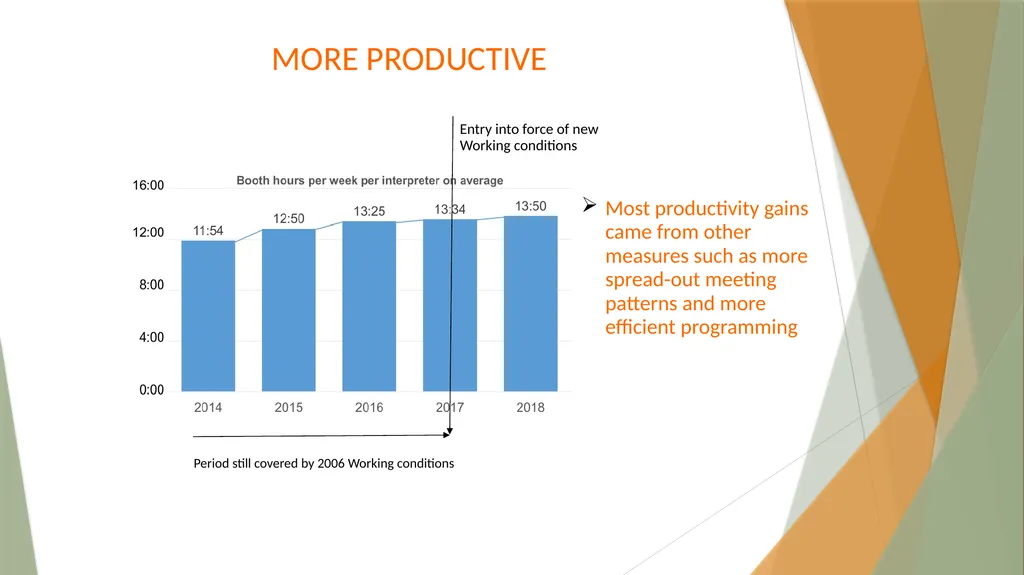
Average time in the interpreting booth of 11:54 hrs per week.
Unfair distribution of workload with some interpreters working on average only 6 hrs in the interpreting booth per week while others did 20 hrs.
Outdated and unflexible system of interpretation slots impeding proper service for Members and efficiency.
Interpreters have always recognized the need for change: they agreed from the very start to the abolition of interpretation slots to make the system more flexible.
Differences in workload are due to different language combinations: it has nothing to do with working conditions. Not all interpreters are interchangeable. Management has recognised its responsibility to minimise imbalances.
Extreme cases in the past (6hrs in the booth per week) because all out-of-booth tasks were not taken into account. WHAT WAS THE PROBLEM?<br>
Unfair distribution of workload with some interpreters working on average only 6 hrs in the interpreting booth per week while others did 20 hrs.
Outdated and unflexible system of interpretation slots impeding proper service for Members and efficiency.
Interpreters have always recognized the need for change: they agreed from the very start to the abolition of interpretation slots to make the system more flexible.
Differences in workload are due to different language combinations: it has nothing to do with working conditions. Not all interpreters are interchangeable. Management has recognised its responsibility to minimise imbalances.
Extreme cases in the past (6hrs in the booth per week) because all out-of-booth tasks were not taken into account. WHAT WAS THE PROBLEM?<br>
03
Effects
of
measures taken<br>
of
measures taken<br>
04
MORE PRODUCTIVE Period still covered by 2006 Working conditions Most productivity gains came from other measures such as more spread-out meeting patterns and more efficient programming Entry into force of new
Working conditions<br>
Working conditions<br>
05
MORE PRODUCTIVE New imposed Working Conditions have brought about savings, but there are limits to their impact on productivity due to the EP calendar.
Productivity is not measured by the number of booth hours, but by the number of meetings serviced. If DG LINC covers all meeting requests, the system is 100% productive. The only other parameter should be quality.
EP Management’s statistics cover only booth hours, all out-of-booth activities are not taken into account.
Annual leave during weeks of parliamentary activities and short-term sick leave initially not taken into account
Statistics still do not:
factor in booth hours worked at the Commission and Council;
exclude rest time after late assignments;
exclude rest time after intercontinental missions;
factor in last-minute cancellation of meetings.<br>
Productivity is not measured by the number of booth hours, but by the number of meetings serviced. If DG LINC covers all meeting requests, the system is 100% productive. The only other parameter should be quality.
EP Management’s statistics cover only booth hours, all out-of-booth activities are not taken into account.
Annual leave during weeks of parliamentary activities and short-term sick leave initially not taken into account
Statistics still do not:
factor in booth hours worked at the Commission and Council;
exclude rest time after late assignments;
exclude rest time after intercontinental missions;
factor in last-minute cancellation of meetings.<br>
06
FAIRER WORKLOAD
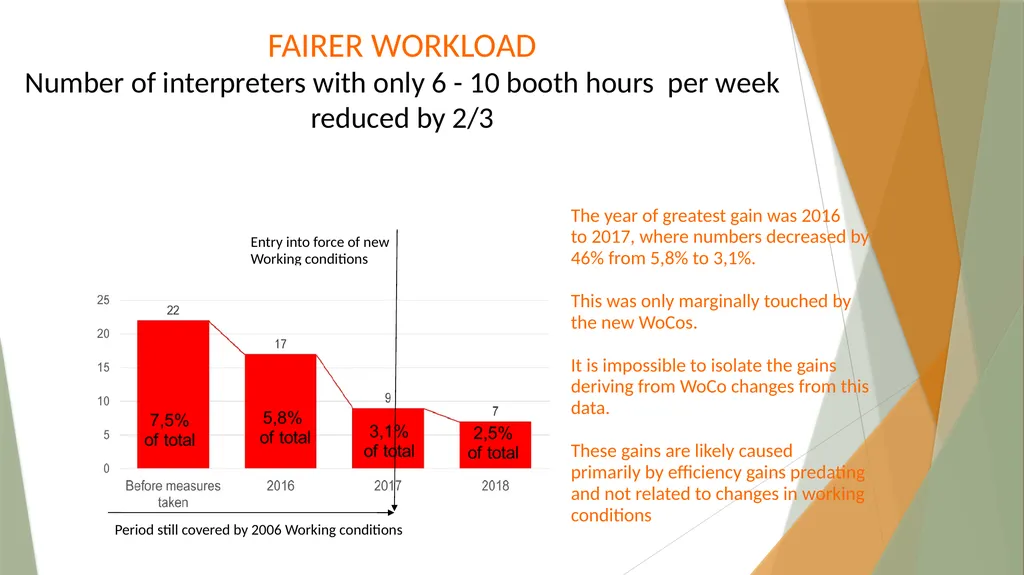
Number of interpreters with only 6 - 10 booth hours per week reduced by 2/3 Entry into force of new
Working conditions Period still covered by 2006 Working conditions The year of greatest gain was 2016
to 2017, where numbers decreased by
46% from 5,8% to 3,1%.
This was only marginally touched by
the new WoCos.
It is impossible to isolate the gains
deriving from WoCo changes from this
data.
These gains are likely caused
primarily by efficiency gains predating
and not related to changes in working
conditions Period still covered by 2006 Working conditions<br>
Working conditions Period still covered by 2006 Working conditions The year of greatest gain was 2016
to 2017, where numbers decreased by
46% from 5,8% to 3,1%.
This was only marginally touched by
the new WoCos.
It is impossible to isolate the gains
deriving from WoCo changes from this
data.
These gains are likely caused
primarily by efficiency gains predating
and not related to changes in working
conditions Period still covered by 2006 Working conditions<br>
07
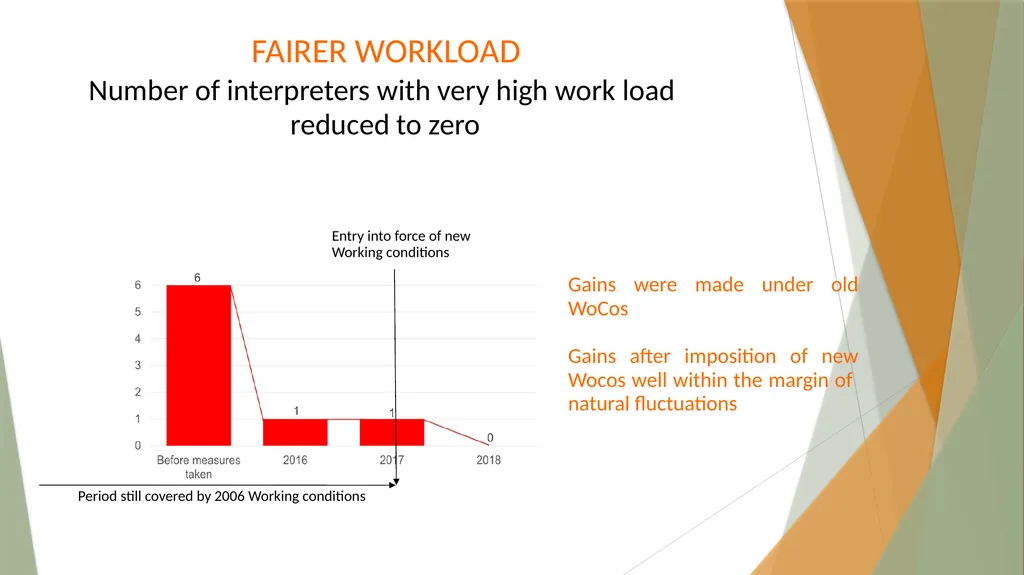
FAIRER WORKLOAD Number of interpreters with very high work load
reduced to zero Period still covered by 2006 Working conditions Entry into force of new
Working conditions Gains were made under old WoCos
Gains after imposition of new Wocos well within the margin of natural fluctuations<br>
reduced to zero Period still covered by 2006 Working conditions Entry into force of new
Working conditions Gains were made under old WoCos
Gains after imposition of new Wocos well within the margin of natural fluctuations<br>
08
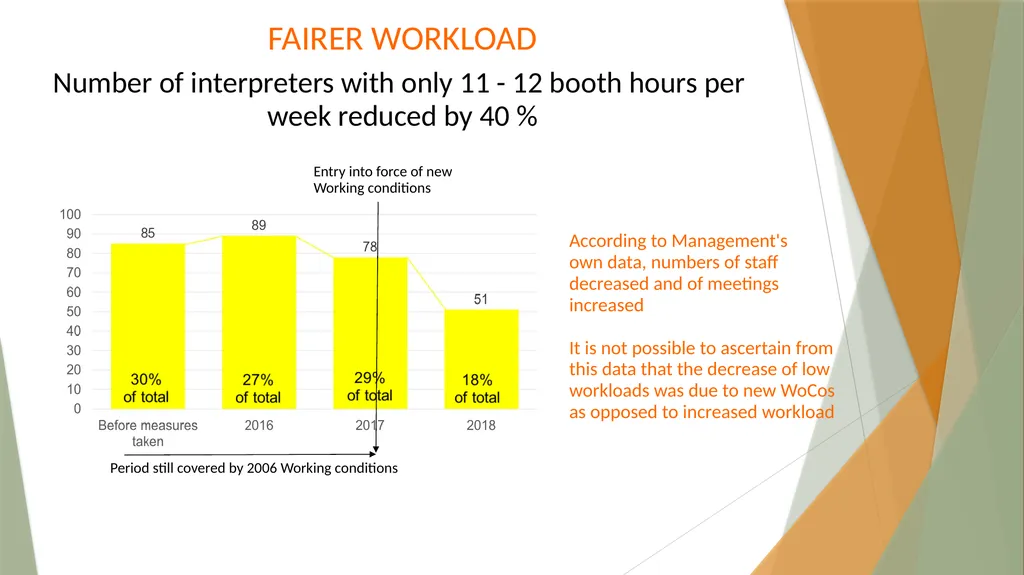
FAIRER WORKLOAD Number of interpreters with only 11 - 12 booth hours per week reduced by 40 % According to Management's
own data, numbers of staff
decreased and of meetings
increased
It is not possible to ascertain from
this data that the decrease of low
workloads was due to new WoCos
as opposed to increased workload Period still covered by 2006 Working conditions Entry into force of new
Working conditions<br>
own data, numbers of staff
decreased and of meetings
increased
It is not possible to ascertain from
this data that the decrease of low
workloads was due to new WoCos
as opposed to increased workload Period still covered by 2006 Working conditions Entry into force of new
Working conditions<br>
09
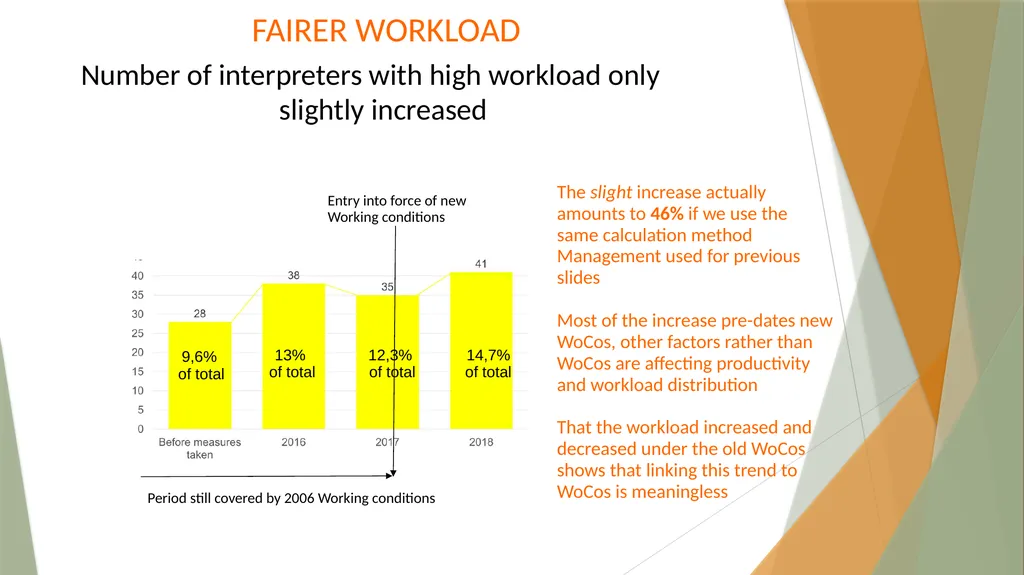
FAIRER WORKLOAD Number of interpreters with high workload only
slightly increased Period still covered by 2006 Working conditions Entry into force of new
Working conditions The slight increase actually
amounts to 46% if we use the
same calculation method
Management used for previous
slides
Most of the increase pre-dates new
WoCos, other factors rather than
WoCos are affecting productivity
and workload distribution
That the workload increased and
decreased under the old WoCos
shows that linking this trend to
WoCos is meaningless 9,6%
of total 13%
of total 12,3%
of total 14,7%
of total<br>
slightly increased Period still covered by 2006 Working conditions Entry into force of new
Working conditions The slight increase actually
amounts to 46% if we use the
same calculation method
Management used for previous
slides
Most of the increase pre-dates new
WoCos, other factors rather than
WoCos are affecting productivity
and workload distribution
That the workload increased and
decreased under the old WoCos
shows that linking this trend to
WoCos is meaningless 9,6%
of total 13%
of total 12,3%
of total 14,7%
of total<br>
10
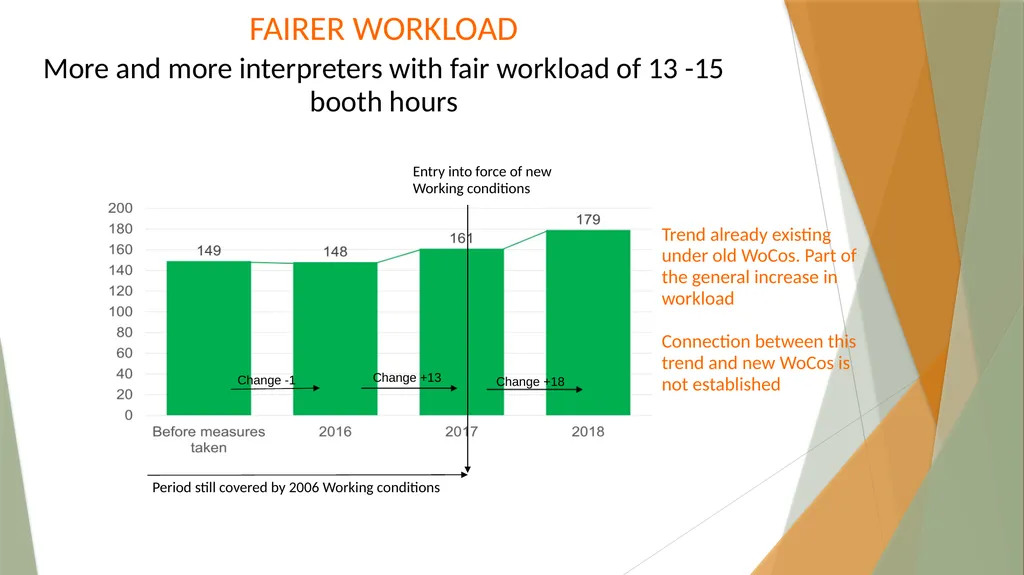
FAIRER WORKLOAD More and more interpreters with fair workload of 13 -15 booth hours Period still covered by 2006 Working conditions Entry into force of new
Working conditions Trend already existing
under old WoCos. Part of
the general increase in
workload
Connection between this
trend and new WoCos is
not established Change -1 Change +13 Change +18<br>
Working conditions Trend already existing
under old WoCos. Part of
the general increase in
workload
Connection between this
trend and new WoCos is
not established Change -1 Change +13 Change +18<br>
11
As proven by Management's own numbers, change happened mainly before new WoCos.
The connection between productivity gains or fairness and new WoCos remains to be established. The changes can be best explained by better programming. MORE FAIRNESS IN DISTRIBUTION OF WORKLOAD Entry into force of new
Working conditions Period still covered by 2006 Working conditions<br>
The connection between productivity gains or fairness and new WoCos remains to be established. The changes can be best explained by better programming. MORE FAIRNESS IN DISTRIBUTION OF WORKLOAD Entry into force of new
Working conditions Period still covered by 2006 Working conditions<br>
12
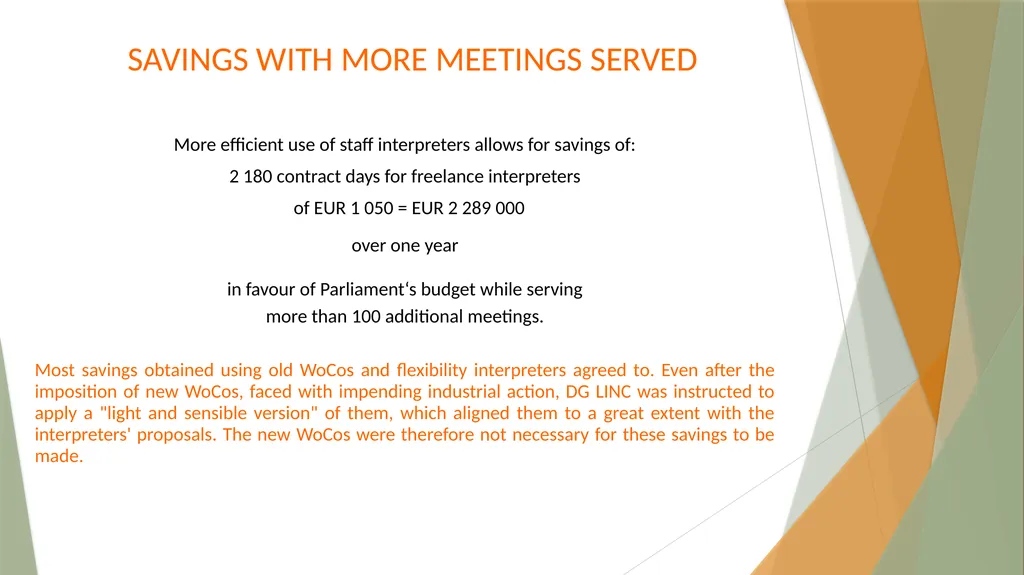
SAVINGS WITH MORE MEETINGS SERVED More efficient use of staff interpreters allows for savings of:
2 180 contract days for freelance interpreters
of EUR 1 050 = EUR 2 289 000
over one year
in favour of Parliament‘s budget while serving
more than 100 additional meetings.
Most savings obtained using old WoCos and flexibility interpreters agreed to. Even after the imposition of new WoCos, faced with impending industrial action, DG LINC was instructed to apply a "light and sensible version" of them, which aligned them to a great extent with the interpreters' proposals. The new WoCos were therefore not necessary for these savings to be made.<br>
2 180 contract days for freelance interpreters
of EUR 1 050 = EUR 2 289 000
over one year
in favour of Parliament‘s budget while serving
more than 100 additional meetings.
Most savings obtained using old WoCos and flexibility interpreters agreed to. Even after the imposition of new WoCos, faced with impending industrial action, DG LINC was instructed to apply a "light and sensible version" of them, which aligned them to a great extent with the interpreters' proposals. The new WoCos were therefore not necessary for these savings to be made.<br>
13
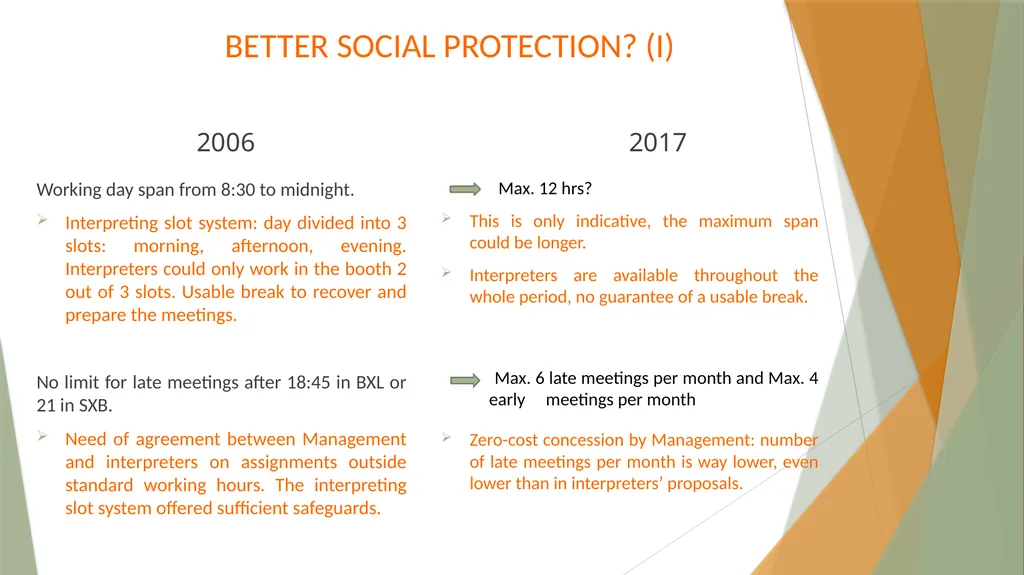
BETTER SOCIAL PROTECTION? (I) 2006 Working day span from 8:30 to midnight.
Interpreting slot system: day divided into 3 slots: morning, afternoon, evening. Interpreters could only work in the booth 2 out of 3 slots. Usable break to recover and prepare the meetings.
No limit for late meetings after 18:45 in BXL or 21 in SXB.
Need of agreement between Management and interpreters on assignments outside standard working hours. The interpreting slot system offered sufficient safeguards. 2017 Max. 12 hrs?
This is only indicative, the maximum span could be longer.
Interpreters are available throughout the whole period, no guarantee of a usable break.
Max. 6 late meetings per month and Max. 4 early meetings per month
Zero-cost concession by Management: number of late meetings per month is way lower, even lower than in interpreters’ proposals.<br>
Interpreting slot system: day divided into 3 slots: morning, afternoon, evening. Interpreters could only work in the booth 2 out of 3 slots. Usable break to recover and prepare the meetings.
No limit for late meetings after 18:45 in BXL or 21 in SXB.
Need of agreement between Management and interpreters on assignments outside standard working hours. The interpreting slot system offered sufficient safeguards. 2017 Max. 12 hrs?
This is only indicative, the maximum span could be longer.
Interpreters are available throughout the whole period, no guarantee of a usable break.
Max. 6 late meetings per month and Max. 4 early meetings per month
Zero-cost concession by Management: number of late meetings per month is way lower, even lower than in interpreters’ proposals.<br>
14
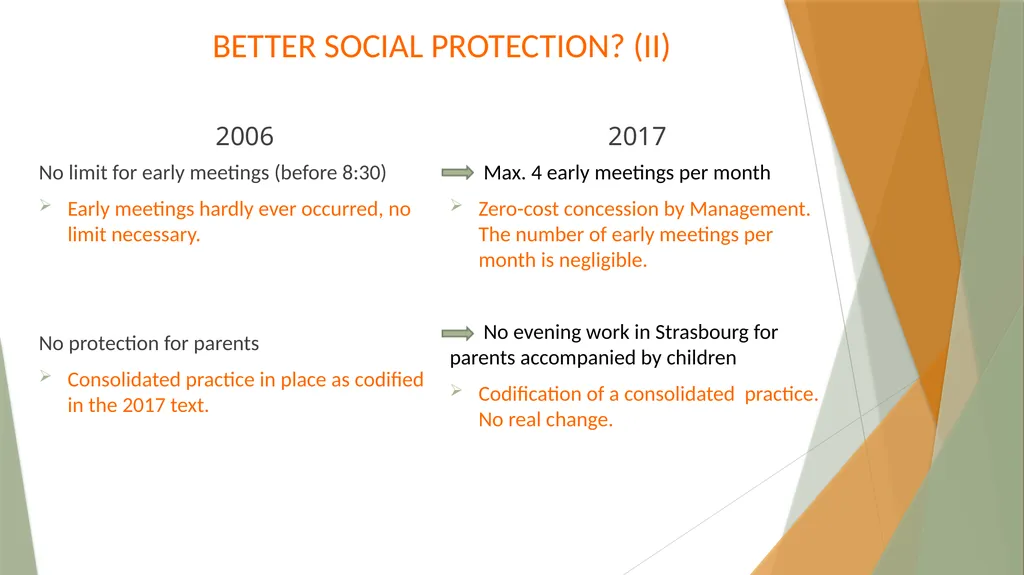
BETTER SOCIAL PROTECTION? (II) 2006 No limit for early meetings (before 8:30)
Early meetings hardly ever occurred, no limit necessary.
No protection for parents
Consolidated practice in place as codified in the 2017 text. 2017 Max. 4 early meetings per month
Zero-cost concession by Management. The number of early meetings per month is negligible.
No evening work in Strasbourg for parents accompanied by children
Codification of a consolidated practice. No real change.<br>
Early meetings hardly ever occurred, no limit necessary.
No protection for parents
Consolidated practice in place as codified in the 2017 text. 2017 Max. 4 early meetings per month
Zero-cost concession by Management. The number of early meetings per month is negligible.
No evening work in Strasbourg for parents accompanied by children
Codification of a consolidated practice. No real change.<br>
15
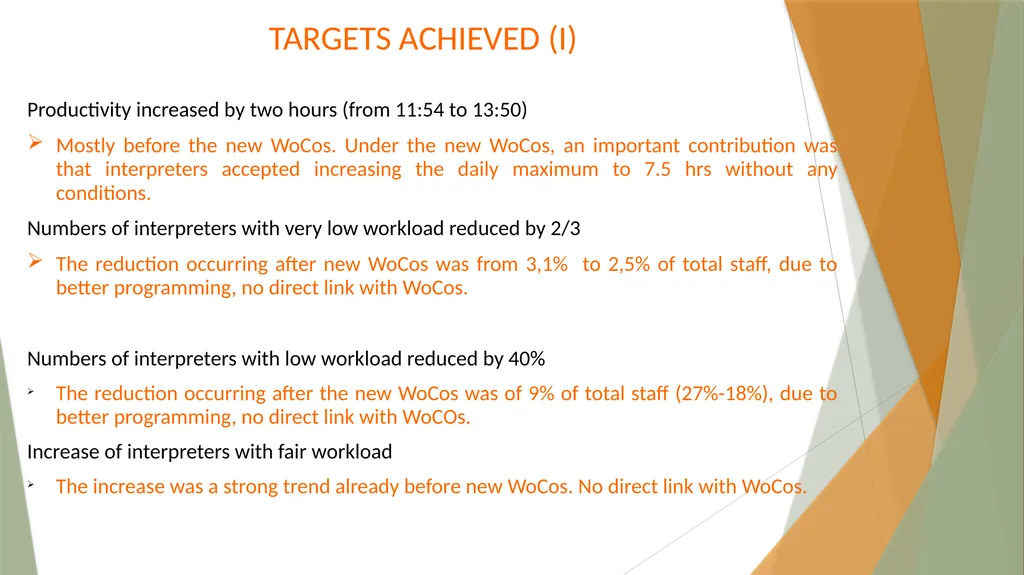
TARGETS ACHIEVED (I) Productivity increased by two hours (from 11:54 to 13:50)
Mostly before the new WoCos. Under the new WoCos, an important contribution was that interpreters accepted increasing the daily maximum to 7.5 hrs without any conditions.
Numbers of interpreters with very low workload reduced by 2/3
The reduction occurring after new WoCos was from 3,1% to 2,5% of total staff, due to better programming, no direct link with WoCos.
Numbers of interpreters with low workload reduced by 40%
The reduction occurring after the new WoCos was of 9% of total staff (27%-18%), due to better programming, no direct link with WoCOs.
Increase of interpreters with fair workload
The increase was a strong trend already before new WoCos. No direct link with WoCos.<br>
Mostly before the new WoCos. Under the new WoCos, an important contribution was that interpreters accepted increasing the daily maximum to 7.5 hrs without any conditions.
Numbers of interpreters with very low workload reduced by 2/3
The reduction occurring after new WoCos was from 3,1% to 2,5% of total staff, due to better programming, no direct link with WoCos.
Numbers of interpreters with low workload reduced by 40%
The reduction occurring after the new WoCos was of 9% of total staff (27%-18%), due to better programming, no direct link with WoCOs.
Increase of interpreters with fair workload
The increase was a strong trend already before new WoCos. No direct link with WoCos.<br>
16
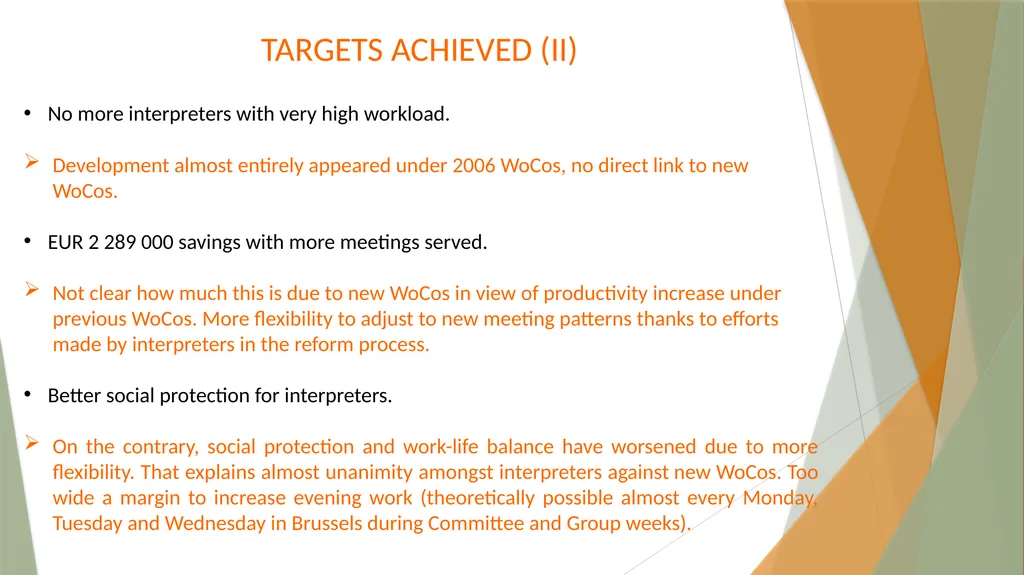
TARGETS ACHIEVED (II) No more interpreters with very high workload.
Development almost entirely appeared under 2006 WoCos, no direct link to new WoCos.
EUR 2 289 000 savings with more meetings served.
Not clear how much this is due to new WoCos in view of productivity increase under previous WoCos. More flexibility to adjust to new meeting patterns thanks to efforts made by interpreters in the reform process.
Better social protection for interpreters.
On the contrary, social protection and work-life balance have worsened due to more flexibility. That explains almost unanimity amongst interpreters against new WoCos. Too wide a margin to increase evening work (theoretically possible almost every Monday, Tuesday and Wednesday in Brussels during Committee and Group weeks).<br>
Development almost entirely appeared under 2006 WoCos, no direct link to new WoCos.
EUR 2 289 000 savings with more meetings served.
Not clear how much this is due to new WoCos in view of productivity increase under previous WoCos. More flexibility to adjust to new meeting patterns thanks to efforts made by interpreters in the reform process.
Better social protection for interpreters.
On the contrary, social protection and work-life balance have worsened due to more flexibility. That explains almost unanimity amongst interpreters against new WoCos. Too wide a margin to increase evening work (theoretically possible almost every Monday, Tuesday and Wednesday in Brussels during Committee and Group weeks).<br>
17
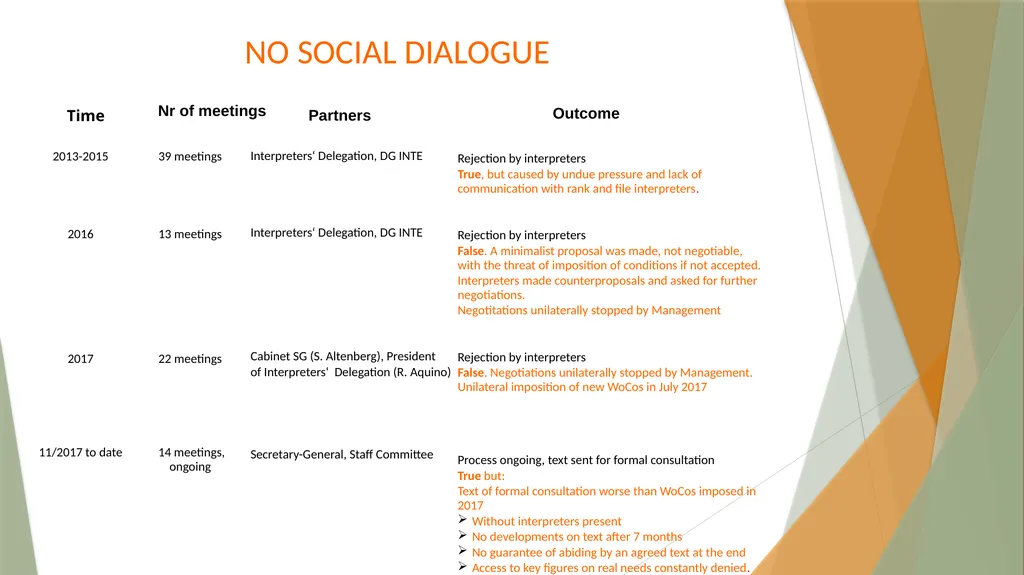
NO SOCIAL DIALOGUE Time Nr of meetings Outcome 2013-2015
2016
2017
11/2017 to date 39 meetings
13 meetings
22 meetings
14 meetings, ongoing Interpreters‘ Delegation, DG INTE
Interpreters‘ Delegation, DG INTE
Cabinet SG (S. Altenberg), President
of Interpreters‘ Delegation (R. Aquino)
Secretary-General, Staff Committee Rejection by interpreters
True, but caused by undue pressure and lack of communication with rank and file interpreters.
Rejection by interpreters
False. A minimalist proposal was made, not negotiable, with the threat of imposition of conditions if not accepted.
Interpreters made counterproposals and asked for further negotiations.
Negotitations unilaterally stopped by Management
Rejection by interpreters
False. Negotiations unilaterally stopped by Management. Unilateral imposition of new WoCos in July 2017
Process ongoing, text sent for formal consultation
True but:
Text of formal consultation worse than WoCos imposed in 2017
Without interpreters present
No developments on text after 7 months
No guarantee of abiding by an agreed text at the end
Access to key figures on real needs constantly denied. Partners<br>
2016
2017
11/2017 to date 39 meetings
13 meetings
22 meetings
14 meetings, ongoing Interpreters‘ Delegation, DG INTE
Interpreters‘ Delegation, DG INTE
Cabinet SG (S. Altenberg), President
of Interpreters‘ Delegation (R. Aquino)
Secretary-General, Staff Committee Rejection by interpreters
True, but caused by undue pressure and lack of communication with rank and file interpreters.
Rejection by interpreters
False. A minimalist proposal was made, not negotiable, with the threat of imposition of conditions if not accepted.
Interpreters made counterproposals and asked for further negotiations.
Negotitations unilaterally stopped by Management
Rejection by interpreters
False. Negotiations unilaterally stopped by Management. Unilateral imposition of new WoCos in July 2017
Process ongoing, text sent for formal consultation
True but:
Text of formal consultation worse than WoCos imposed in 2017
Without interpreters present
No developments on text after 7 months
No guarantee of abiding by an agreed text at the end
Access to key figures on real needs constantly denied. Partners<br>
18
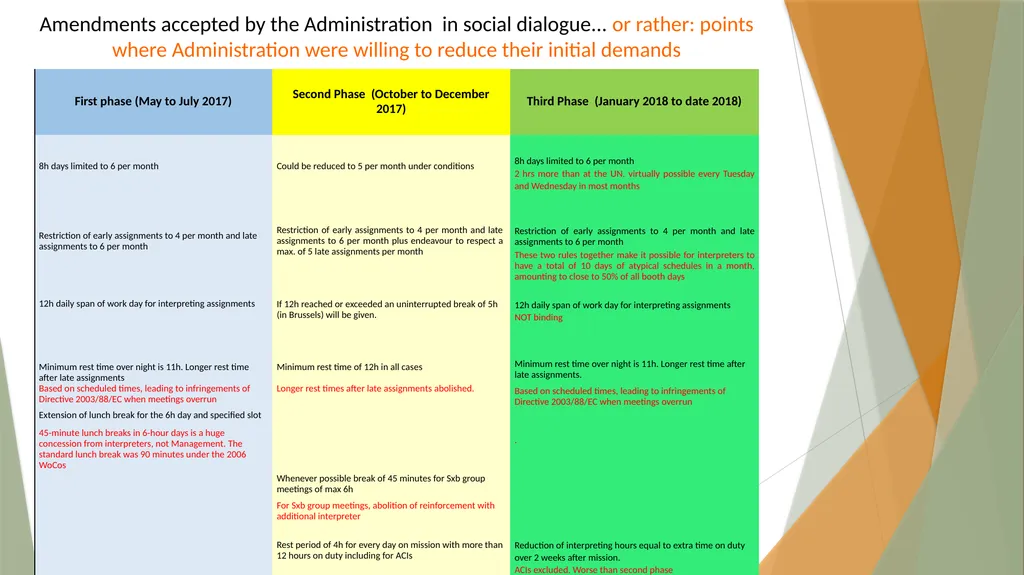
Amendments accepted by the Administration in social dialogue... or rather: points where Administration were willing to reduce their initial demands<br>
19
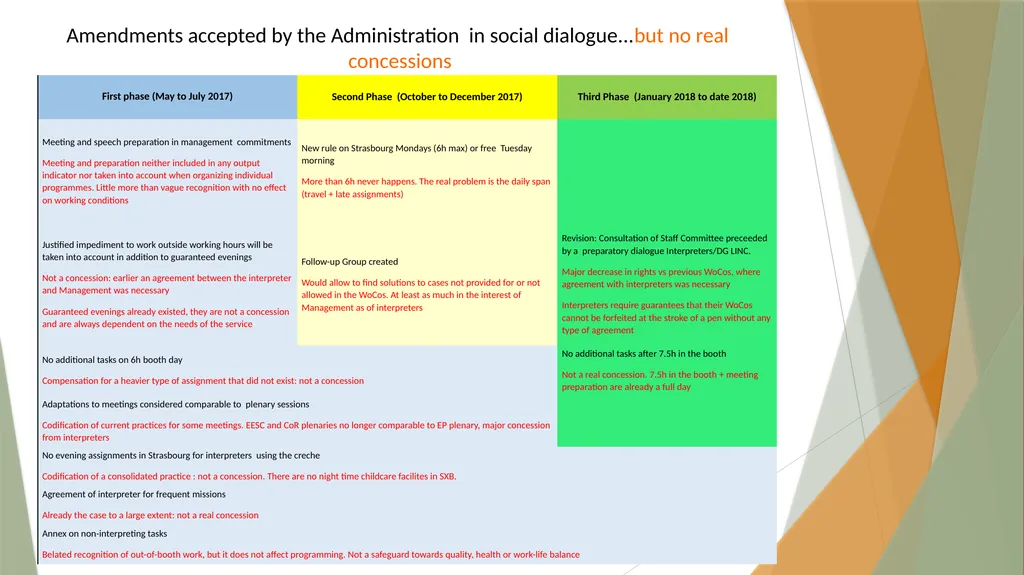
Amendments accepted by the Administration in social dialogue...but no real concessions<br>
20
N.B. All the efforts included in the table above are to be seen in a context where the work environment has become increasingly challenging for interpreters in terms of speed of delivery and technical nature of debates and where interpreters have increased their productivity through adding new languages.<br>
21
Is this fair?<br>
22
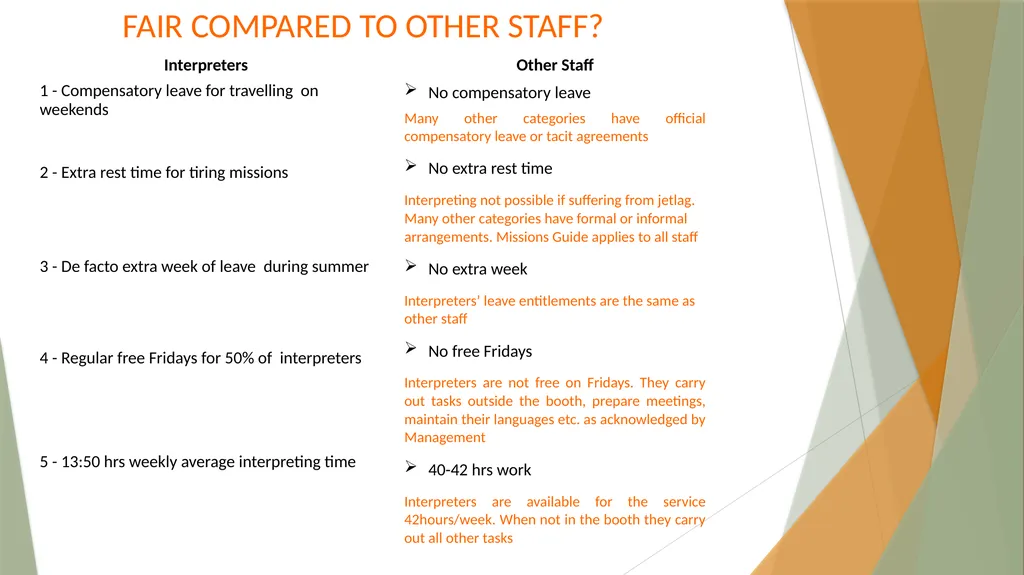
FAIR COMPARED TO OTHER STAFF? Other Staff
No compensatory leave
Many other categories have official compensatory leave or tacit agreements
No extra rest time
Interpreting not possible if suffering from jetlag. Many other categories have formal or informal arrangements. Missions Guide applies to all staff
No extra week
Interpreters’ leave entitlements are the same as other staff
No free Fridays
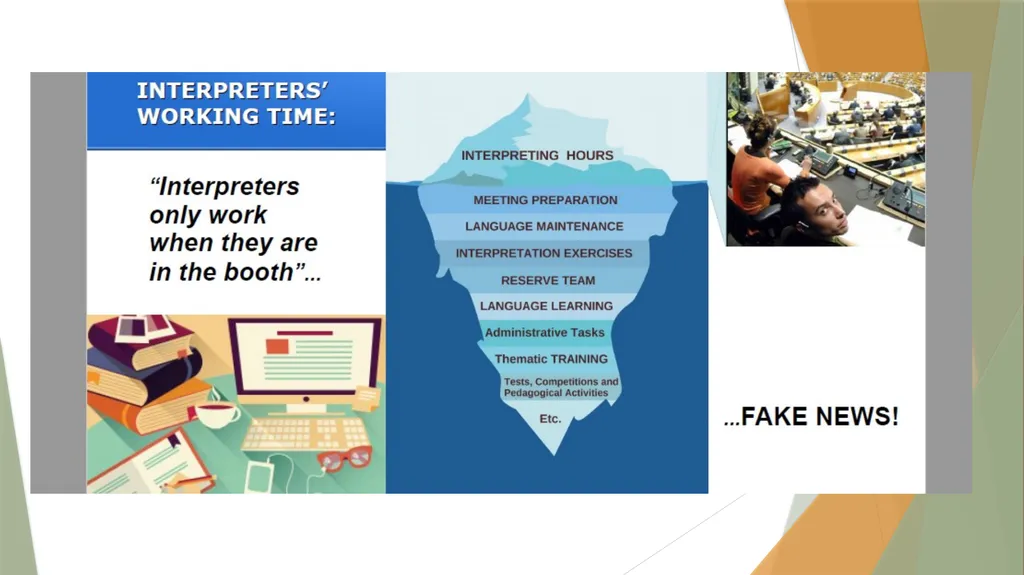
Interpreters are not free on Fridays. They carry out tasks outside the booth, prepare meetings, maintain their languages etc. as acknowledged by Management
40-42 hrs work
Interpreters are available for the service 42hours/week. When not in the booth they carry out all other tasks Interpreters
1 - Compensatory leave for travelling on weekends
2 - Extra rest time for tiring missions
3 - De facto extra week of leave during summer
4 - Regular free Fridays for 50% of interpreters
5 - 13:50 hrs weekly average interpreting time<br>
No compensatory leave
Many other categories have official compensatory leave or tacit agreements
No extra rest time
Interpreting not possible if suffering from jetlag. Many other categories have formal or informal arrangements. Missions Guide applies to all staff
No extra week
Interpreters’ leave entitlements are the same as other staff
No free Fridays
Interpreters are not free on Fridays. They carry out tasks outside the booth, prepare meetings, maintain their languages etc. as acknowledged by Management
40-42 hrs work
Interpreters are available for the service 42hours/week. When not in the booth they carry out all other tasks Interpreters
1 - Compensatory leave for travelling on weekends
2 - Extra rest time for tiring missions
3 - De facto extra week of leave during summer
4 - Regular free Fridays for 50% of interpreters
5 - 13:50 hrs weekly average interpreting time<br>
23
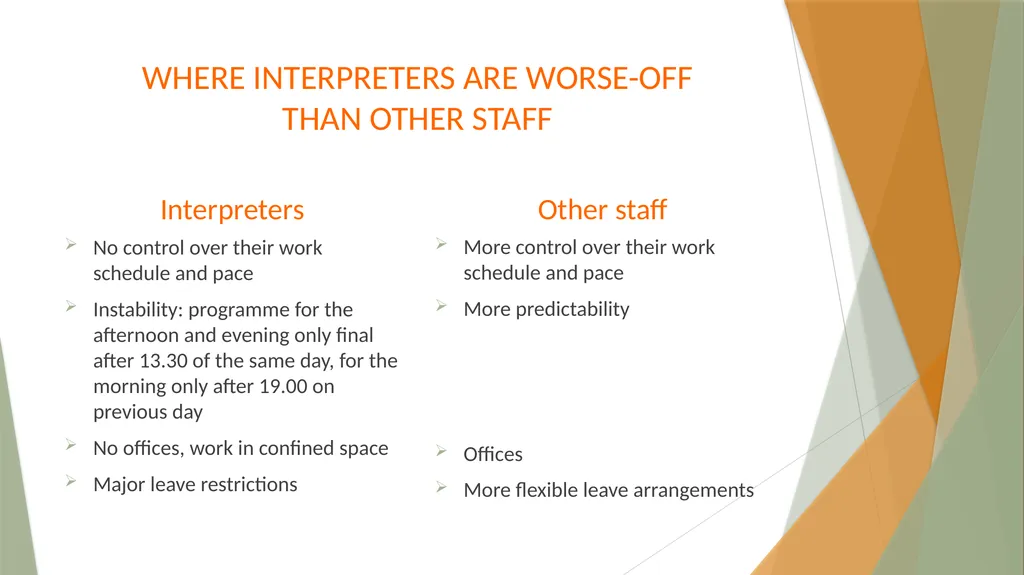
WHERE INTERPRETERS ARE WORSE-OFF
THAN OTHER STAFF Interpreters No control over their work schedule and pace
Instability: programme for the afternoon and evening only final after 13.30 of the same day, for the morning only after 19.00 on previous day
No offices, work in confined space
Major leave restrictions Other staff More control over their work schedule and pace
More predictability
Offices
More flexible leave arrangements<br>
Instability: programme for the afternoon and evening only final after 13.30 of the same day, for the morning only after 19.00 on previous day
No offices, work in confined space
Major leave restrictions Other staff More control over their work schedule and pace
More predictability
Offices
More flexible leave arrangements<br>
24
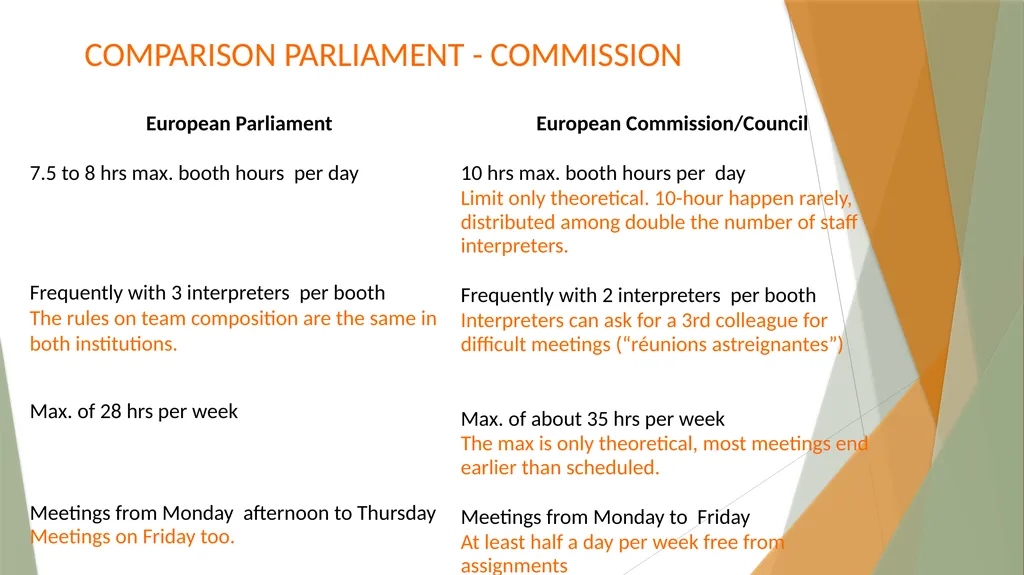
COMPARISON PARLIAMENT - COMMISSION European Parliament
7.5 to 8 hrs max. booth hours per day
Frequently with 3 interpreters per booth
The rules on team composition are the same in both institutions.
Max. of 28 hrs per week
Meetings from Monday afternoon to Thursday Meetings on Friday too. European Commission/Council
10 hrs max. booth hours per day
Limit only theoretical. 10-hour happen rarely, distributed among double the number of staff interpreters.
Frequently with 2 interpreters per booth
Interpreters can ask for a 3rd colleague for difficult meetings (“réunions astreignantes”)
Max. of about 35 hrs per week
The max is only theoretical, most meetings end earlier than scheduled.
Meetings from Monday to Friday
At least half a day per week free from assignments<br>
7.5 to 8 hrs max. booth hours per day
Frequently with 3 interpreters per booth
The rules on team composition are the same in both institutions.
Max. of 28 hrs per week
Meetings from Monday afternoon to Thursday Meetings on Friday too. European Commission/Council
10 hrs max. booth hours per day
Limit only theoretical. 10-hour happen rarely, distributed among double the number of staff interpreters.
Frequently with 2 interpreters per booth
Interpreters can ask for a 3rd colleague for difficult meetings (“réunions astreignantes”)
Max. of about 35 hrs per week
The max is only theoretical, most meetings end earlier than scheduled.
Meetings from Monday to Friday
At least half a day per week free from assignments<br>
25
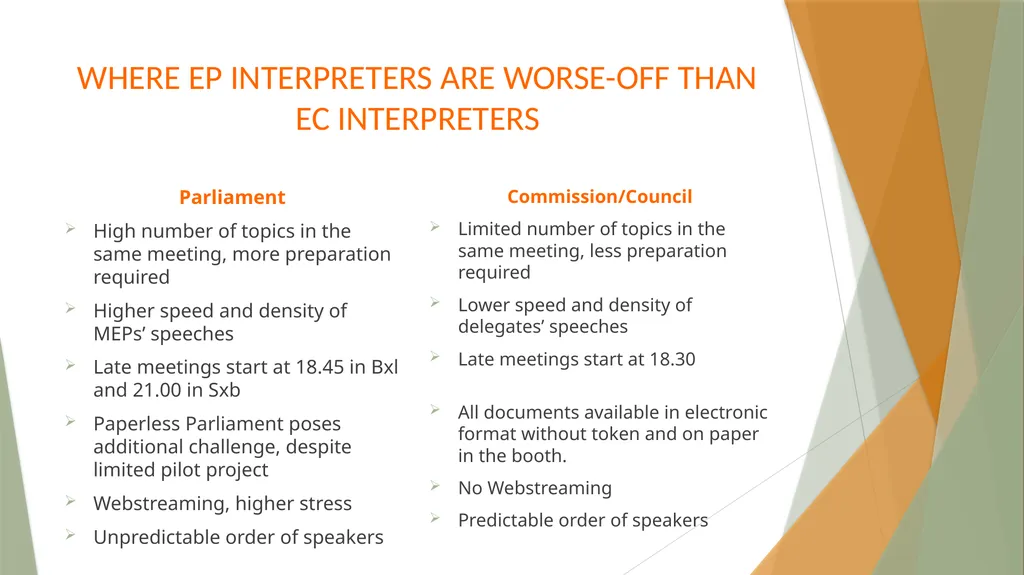
WHERE EP INTERPRETERS ARE WORSE-OFF THAN EC INTERPRETERS Parliament
High number of topics in the same meeting, more preparation required
Higher speed and density of MEPs’ speeches
Late meetings start at 18.45 in Bxl and 21.00 in Sxb
Paperless Parliament poses additional challenge, despite limited pilot project
Webstreaming, higher stress
Unpredictable order of speakers Commission/Council
Limited number of topics in the same meeting, less preparation required
Lower speed and density of delegates’ speeches
Late meetings start at 18.30
All documents available in electronic format without token and on paper in the booth.
No Webstreaming
Predictable order of speakers<br>
High number of topics in the same meeting, more preparation required
Higher speed and density of MEPs’ speeches
Late meetings start at 18.45 in Bxl and 21.00 in Sxb
Paperless Parliament poses additional challenge, despite limited pilot project
Webstreaming, higher stress
Unpredictable order of speakers Commission/Council
Limited number of topics in the same meeting, less preparation required
Lower speed and density of delegates’ speeches
Late meetings start at 18.30
All documents available in electronic format without token and on paper in the booth.
No Webstreaming
Predictable order of speakers<br>
26
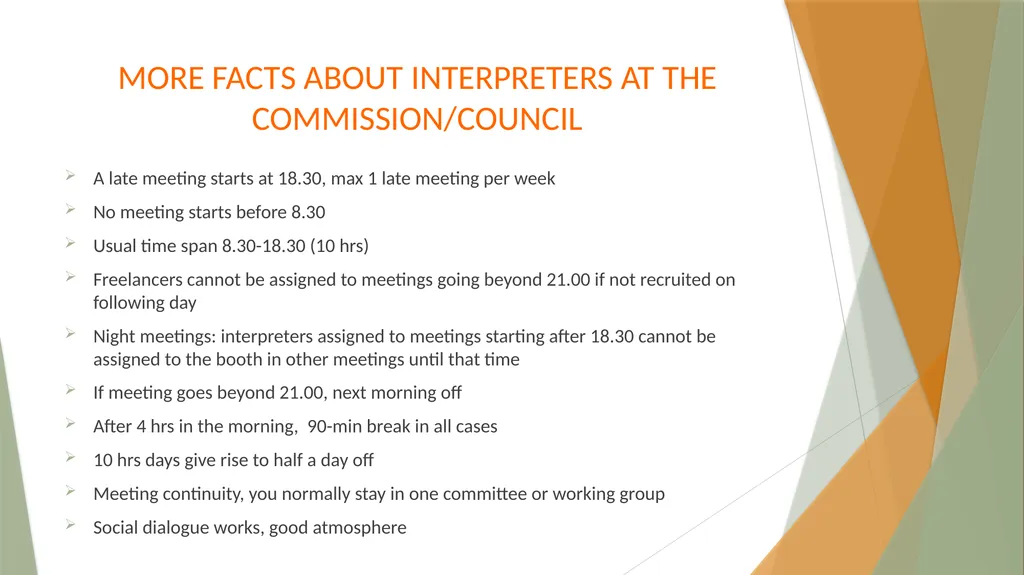
MORE FACTS ABOUT INTERPRETERS AT THE COMMISSION/COUNCIL A late meeting starts at 18.30, max 1 late meeting per week
No meeting starts before 8.30
Usual time span 8.30-18.30 (10 hrs)
Freelancers cannot be assigned to meetings going beyond 21.00 if not recruited on following day
Night meetings: interpreters assigned to meetings starting after 18.30 cannot be assigned to the booth in other meetings until that time
If meeting goes beyond 21.00, next morning off
After 4 hrs in the morning, 90-min break in all cases
10 hrs days give rise to half a day off
Meeting continuity, you normally stay in one committee or working group
Social dialogue works, good atmosphere<br>
No meeting starts before 8.30
Usual time span 8.30-18.30 (10 hrs)
Freelancers cannot be assigned to meetings going beyond 21.00 if not recruited on following day
Night meetings: interpreters assigned to meetings starting after 18.30 cannot be assigned to the booth in other meetings until that time
If meeting goes beyond 21.00, next morning off
After 4 hrs in the morning, 90-min break in all cases
10 hrs days give rise to half a day off
Meeting continuity, you normally stay in one committee or working group
Social dialogue works, good atmosphere<br>
27
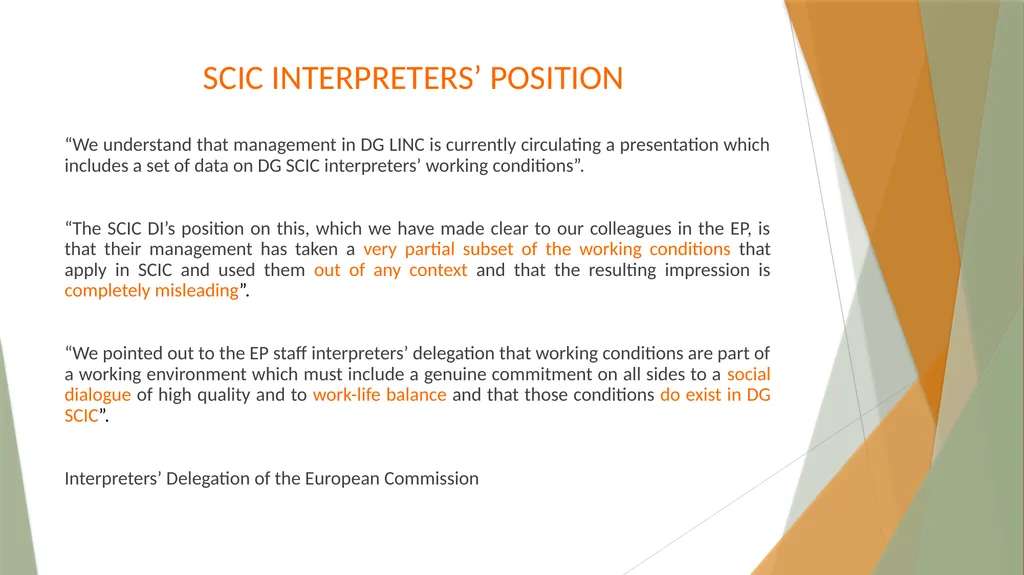
SCIC INTERPRETERS’ POSITION “We understand that management in DG LINC is currently circulating a presentation which includes a set of data on DG SCIC interpreters’ working conditions”.
“The SCIC DI’s position on this, which we have made clear to our colleagues in the EP, is that their management has taken a very partial subset of the working conditions that apply in SCIC and used them out of any context and that the resulting impression is completely misleading”.
“We pointed out to the EP staff interpreters’ delegation that working conditions are part of a working environment which must include a genuine commitment on all sides to a social dialogue of high quality and to work-life balance and that those conditions do exist in DG SCIC”.
Interpreters’ Delegation of the European Commission<br>
“The SCIC DI’s position on this, which we have made clear to our colleagues in the EP, is that their management has taken a very partial subset of the working conditions that apply in SCIC and used them out of any context and that the resulting impression is completely misleading”.
“We pointed out to the EP staff interpreters’ delegation that working conditions are part of a working environment which must include a genuine commitment on all sides to a social dialogue of high quality and to work-life balance and that those conditions do exist in DG SCIC”.
Interpreters’ Delegation of the European Commission<br>
28
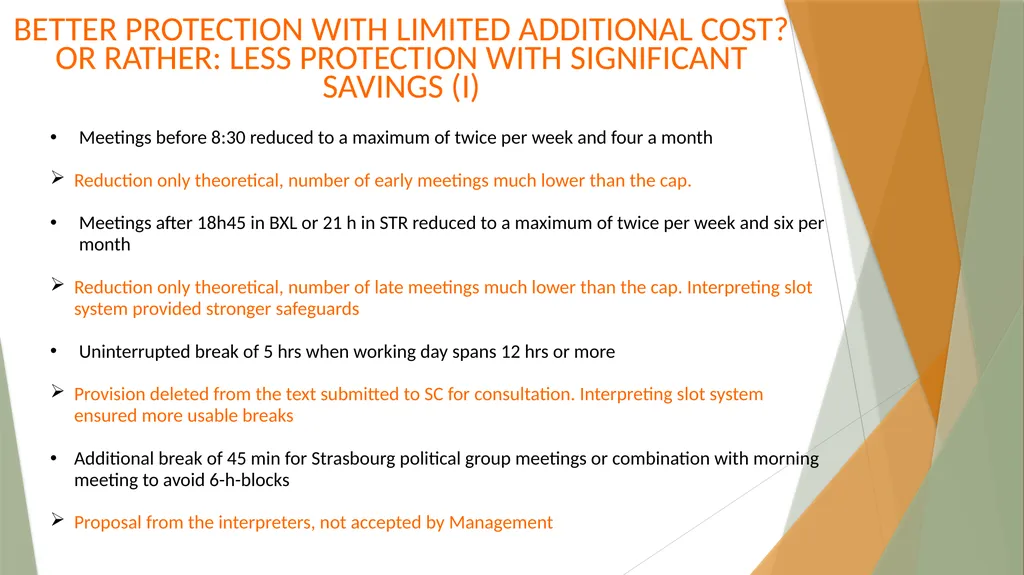
BETTER PROTECTION WITH LIMITED ADDITIONAL COST? OR RATHER: LESS PROTECTION WITH SIGNIFICANT SAVINGS (I) Meetings before 8:30 reduced to a maximum of twice per week and four a month
Reduction only theoretical, number of early meetings much lower than the cap.
Meetings after 18h45 in BXL or 21 h in STR reduced to a maximum of twice per week and six per month
Reduction only theoretical, number of late meetings much lower than the cap. Interpreting slot system provided stronger safeguards
Uninterrupted break of 5 hrs when working day spans 12 hrs or more
Provision deleted from the text submitted to SC for consultation. Interpreting slot system ensured more usable breaks
Additional break of 45 min for Strasbourg political group meetings or combination with morning meeting to avoid 6-h-blocks
Proposal from the interpreters, not accepted by Management<br>
Reduction only theoretical, number of early meetings much lower than the cap.
Meetings after 18h45 in BXL or 21 h in STR reduced to a maximum of twice per week and six per month
Reduction only theoretical, number of late meetings much lower than the cap. Interpreting slot system provided stronger safeguards
Uninterrupted break of 5 hrs when working day spans 12 hrs or more
Provision deleted from the text submitted to SC for consultation. Interpreting slot system ensured more usable breaks
Additional break of 45 min for Strasbourg political group meetings or combination with morning meeting to avoid 6-h-blocks
Proposal from the interpreters, not accepted by Management<br>
29
BETTER PROTECTION WITH LIMITED ADDITIONAL COST?
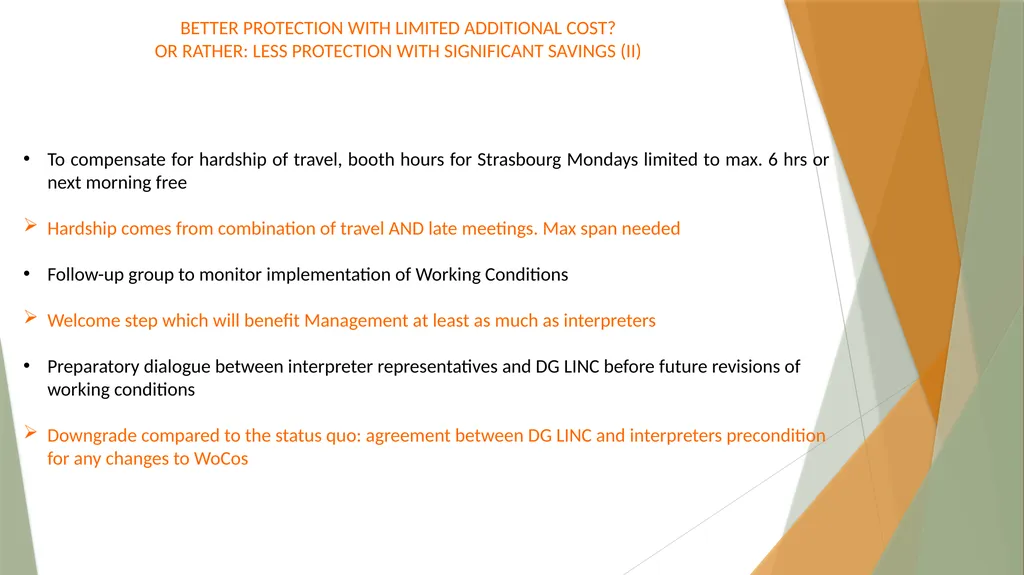
OR RATHER: LESS PROTECTION WITH SIGNIFICANT SAVINGS (II) To compensate for hardship of travel, booth hours for Strasbourg Mondays limited to max. 6 hrs or next morning free
Hardship comes from combination of travel AND late meetings. Max span needed
Follow-up group to monitor implementation of Working Conditions
Welcome step which will benefit Management at least as much as interpreters
Preparatory dialogue between interpreter representatives and DG LINC before future revisions of working conditions
Downgrade compared to the status quo: agreement between DG LINC and interpreters precondition for any changes to WoCos<br>
Hardship comes from combination of travel AND late meetings. Max span needed
Follow-up group to monitor implementation of Working Conditions
Welcome step which will benefit Management at least as much as interpreters
Preparatory dialogue between interpreter representatives and DG LINC before future revisions of working conditions
Downgrade compared to the status quo: agreement between DG LINC and interpreters precondition for any changes to WoCos<br>
30
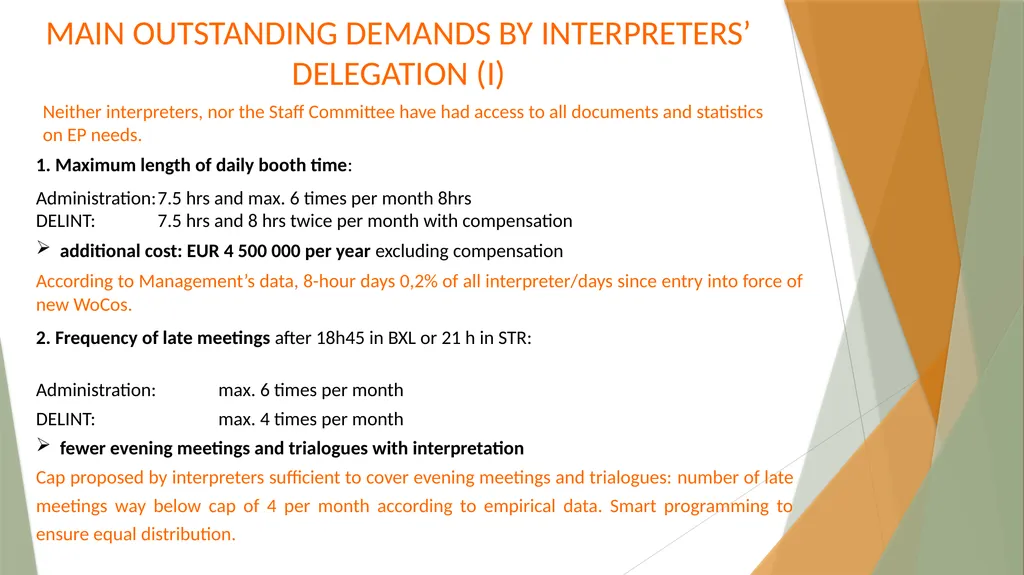
MAIN OUTSTANDING DEMANDS BY INTERPRETERS’ DELEGATION (I) 1. Maximum length of daily booth time:
Administration: 7.5 hrs and max. 6 times per month 8hrs
DELINT: 7.5 hrs and 8 hrs twice per month with compensation
additional cost: EUR 4 500 000 per year excluding compensation
According to Management’s data, 8-hour days 0,2% of all interpreter/days since entry into force of new WoCos. 2. Frequency of late meetings after 18h45 in BXL or 21 h in STR:
Administration: max. 6 times per month
DELINT: max. 4 times per month
fewer evening meetings and trialogues with interpretation
Cap proposed by interpreters sufficient to cover evening meetings and trialogues: number of late meetings way below cap of 4 per month according to empirical data. Smart programming to ensure equal distribution. Neither interpreters, nor the Staff Committee have had access to all documents and statistics on EP needs.<br>
Administration: 7.5 hrs and max. 6 times per month 8hrs
DELINT: 7.5 hrs and 8 hrs twice per month with compensation
additional cost: EUR 4 500 000 per year excluding compensation
According to Management’s data, 8-hour days 0,2% of all interpreter/days since entry into force of new WoCos. 2. Frequency of late meetings after 18h45 in BXL or 21 h in STR:
Administration: max. 6 times per month
DELINT: max. 4 times per month
fewer evening meetings and trialogues with interpretation
Cap proposed by interpreters sufficient to cover evening meetings and trialogues: number of late meetings way below cap of 4 per month according to empirical data. Smart programming to ensure equal distribution. Neither interpreters, nor the Staff Committee have had access to all documents and statistics on EP needs.<br>
31
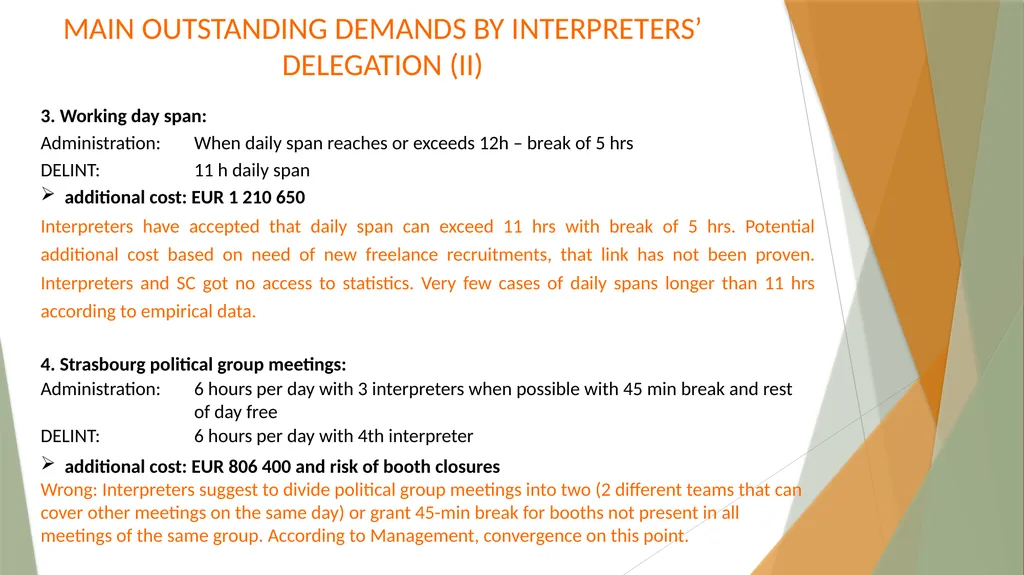
3. Working day span:
Administration: When daily span reaches or exceeds 12h – break of 5 hrs
DELINT: 11 h daily span
additional cost: EUR 1 210 650
Interpreters have accepted that daily span can exceed 11 hrs with break of 5 hrs. Potential additional cost based on need of new freelance recruitments, that link has not been proven. Interpreters and SC got no access to statistics. Very few cases of daily spans longer than 11 hrs according to empirical data.
4. Strasbourg political group meetings:
Administration: 6 hours per day with 3 interpreters when possible with 45 min break and rest of day free
DELINT: 6 hours per day with 4th interpreter
additional cost: EUR 806 400 and risk of booth closures
Wrong: Interpreters suggest to divide political group meetings into two (2 different teams that can cover other meetings on the same day) or grant 45-min break for booths not present in all meetings of the same group. According to Management, convergence on this point. MAIN OUTSTANDING DEMANDS BY INTERPRETERS’ DELEGATION (II)<br>
Administration: When daily span reaches or exceeds 12h – break of 5 hrs
DELINT: 11 h daily span
additional cost: EUR 1 210 650
Interpreters have accepted that daily span can exceed 11 hrs with break of 5 hrs. Potential additional cost based on need of new freelance recruitments, that link has not been proven. Interpreters and SC got no access to statistics. Very few cases of daily spans longer than 11 hrs according to empirical data.
4. Strasbourg political group meetings:
Administration: 6 hours per day with 3 interpreters when possible with 45 min break and rest of day free
DELINT: 6 hours per day with 4th interpreter
additional cost: EUR 806 400 and risk of booth closures
Wrong: Interpreters suggest to divide political group meetings into two (2 different teams that can cover other meetings on the same day) or grant 45-min break for booths not present in all meetings of the same group. According to Management, convergence on this point. MAIN OUTSTANDING DEMANDS BY INTERPRETERS’ DELEGATION (II)<br>
32
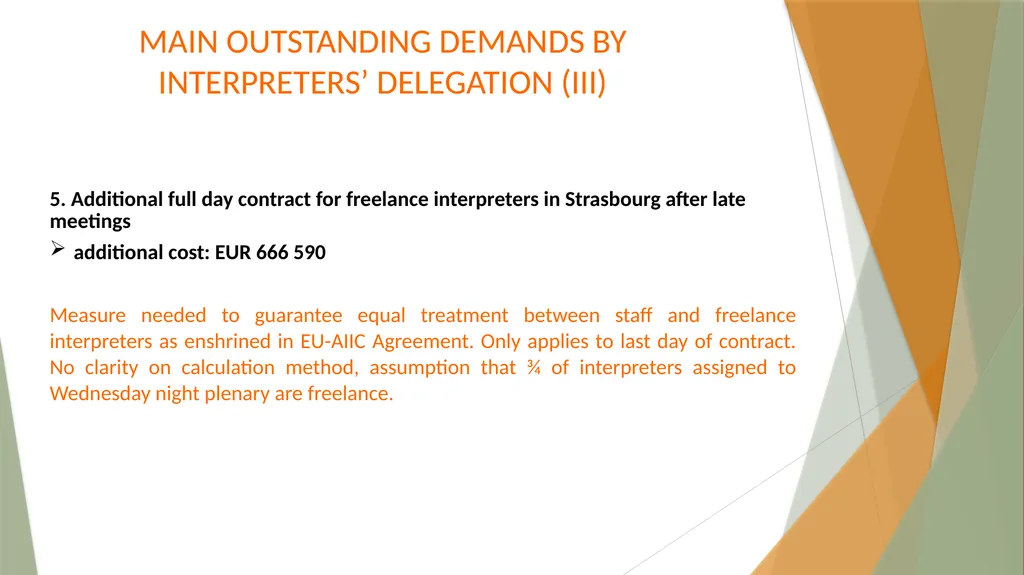
5. Additional full day contract for freelance interpreters in Strasbourg after late meetings
additional cost: EUR 666 590
Measure needed to guarantee equal treatment between staff and freelance interpreters as enshrined in EU-AIIC Agreement. Only applies to last day of contract. No clarity on calculation method, assumption that ¾ of interpreters assigned to Wednesday night plenary are freelance. MAIN OUTSTANDING DEMANDS BY INTERPRETERS’ DELEGATION (III)<br>
additional cost: EUR 666 590
Measure needed to guarantee equal treatment between staff and freelance interpreters as enshrined in EU-AIIC Agreement. Only applies to last day of contract. No clarity on calculation method, assumption that ¾ of interpreters assigned to Wednesday night plenary are freelance. MAIN OUTSTANDING DEMANDS BY INTERPRETERS’ DELEGATION (III)<br>
33
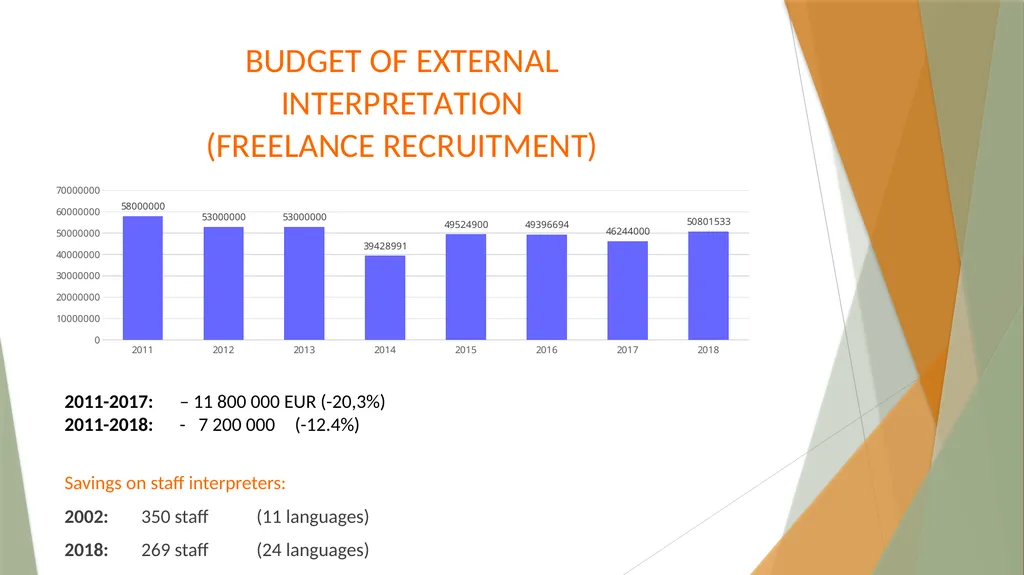
2011-2017: – 11 800 000 EUR (-20,3%)
2011-2018: - 7 200 000 (-12.4%) Savings on staff interpreters:
2002: 350 staff (11 languages)
2018: 269 staff (24 languages)<br>
2002: 350 staff (11 languages)
2018: 269 staff (24 languages)<br>
34
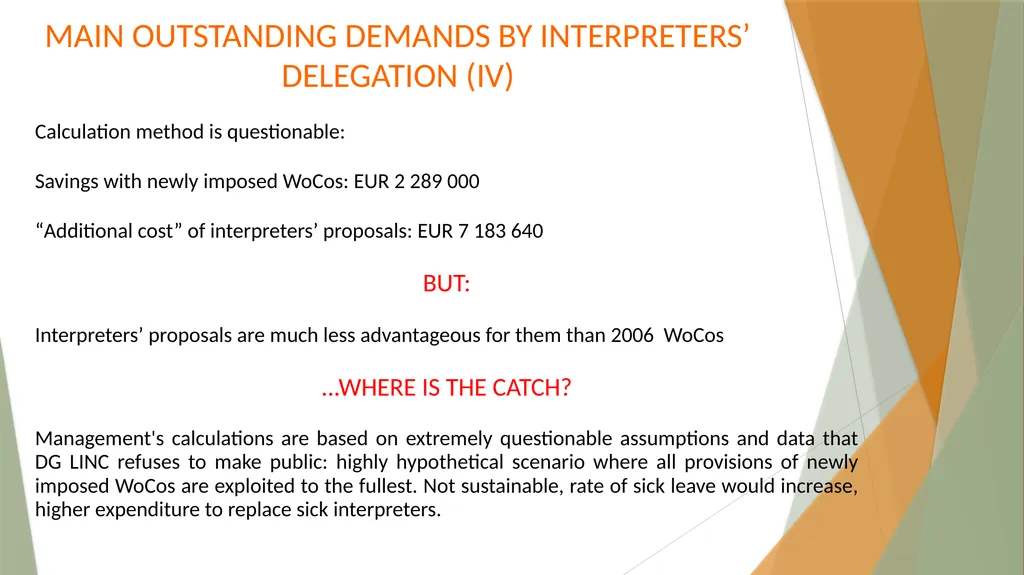
MAIN OUTSTANDING DEMANDS BY INTERPRETERS’ DELEGATION (IV) Calculation method is questionable:
Savings with newly imposed WoCos: EUR 2 289 000
“Additional cost” of interpreters’ proposals: EUR 7 183 640
BUT:
Interpreters’ proposals are much less advantageous for them than 2006 WoCos
...WHERE IS THE CATCH?
Management's calculations are based on extremely questionable assumptions and data that DG LINC refuses to make public: highly hypothetical scenario where all provisions of newly imposed WoCos are exploited to the fullest. Not sustainable, rate of sick leave would increase, higher expenditure to replace sick interpreters.<br>
Savings with newly imposed WoCos: EUR 2 289 000
“Additional cost” of interpreters’ proposals: EUR 7 183 640
BUT:
Interpreters’ proposals are much less advantageous for them than 2006 WoCos
...WHERE IS THE CATCH?
Management's calculations are based on extremely questionable assumptions and data that DG LINC refuses to make public: highly hypothetical scenario where all provisions of newly imposed WoCos are exploited to the fullest. Not sustainable, rate of sick leave would increase, higher expenditure to replace sick interpreters.<br>
35
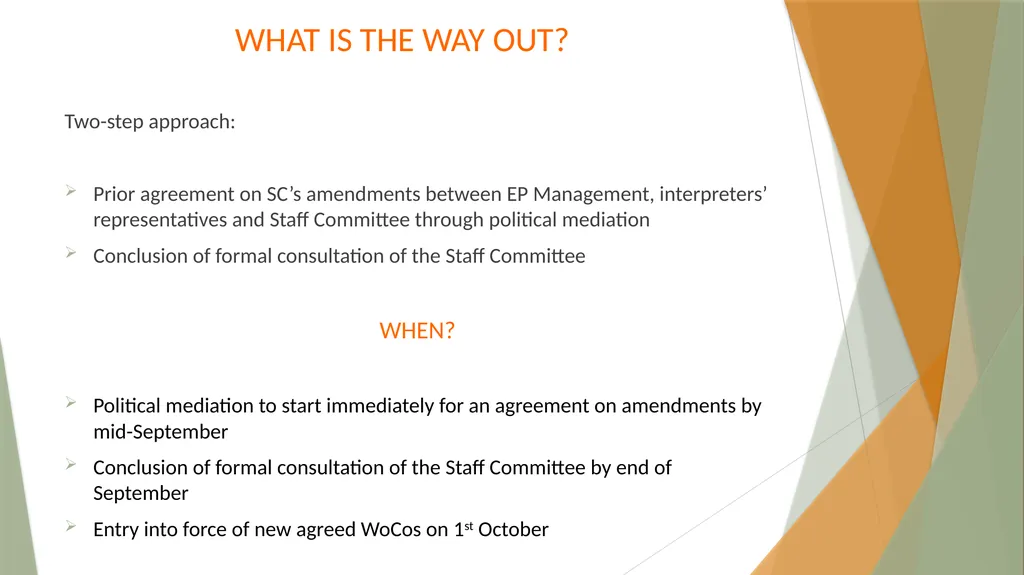
WHAT IS THE WAY OUT? Two-step approach:
Prior agreement on SC’s amendments between EP Management, interpreters’ representatives and Staff Committee through political mediation
Conclusion of formal consultation of the Staff Committee
WHEN?
Political mediation to start immediately for an agreement on amendments by mid-September
Conclusion of formal consultation of the Staff Committee by end of September
Entry into force of new agreed WoCos on 1st October<br>
Prior agreement on SC’s amendments between EP Management, interpreters’ representatives and Staff Committee through political mediation
Conclusion of formal consultation of the Staff Committee
WHEN?
Political mediation to start immediately for an agreement on amendments by mid-September
Conclusion of formal consultation of the Staff Committee by end of September
Entry into force of new agreed WoCos on 1st October<br>