
Writing Effective Program Learning Outcomes
Description: Writing Effective Program Learning Outcomes Deborah Panter, J.D. Director of Educational Effectiveness Assessment Overall Assessment Process Articulate learning outcomes: What is this program about? Develop a curriculum map: When and how
Related Topics
Download Presentation
"Writing Effective Program Learning Outcomes" is the property of its rightful owner. Permission is granted to download and print the materials on this website for personal, non-commercial use only, and to display it on your personal computer provided you do not modify the materials and that you retain all copyright notices contained in the materials. By downloading content from our website, you accept the terms of this agreement.
Presentation Transcript
slide1. Writing Effective
Program Learning Outcomes Deborah Panter, J.D.
Director of Educational Effectiveness & Assessment<br>
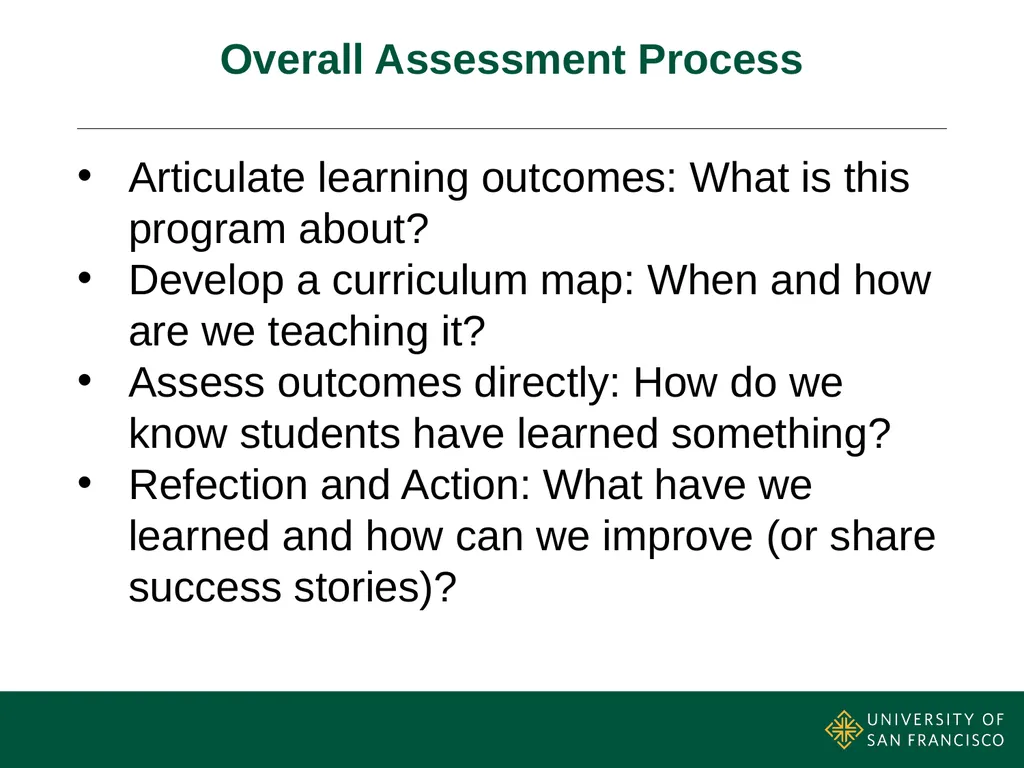
slide2. Overall Assessment Process Articulate learning outcomes: What is this program about?
Develop a curriculum map: When and how are we teaching it?
Assess outcomes directly: How do we know students have learned something?
Refection and Action: What have we learned and how can we improve (or share success stories)?<br>
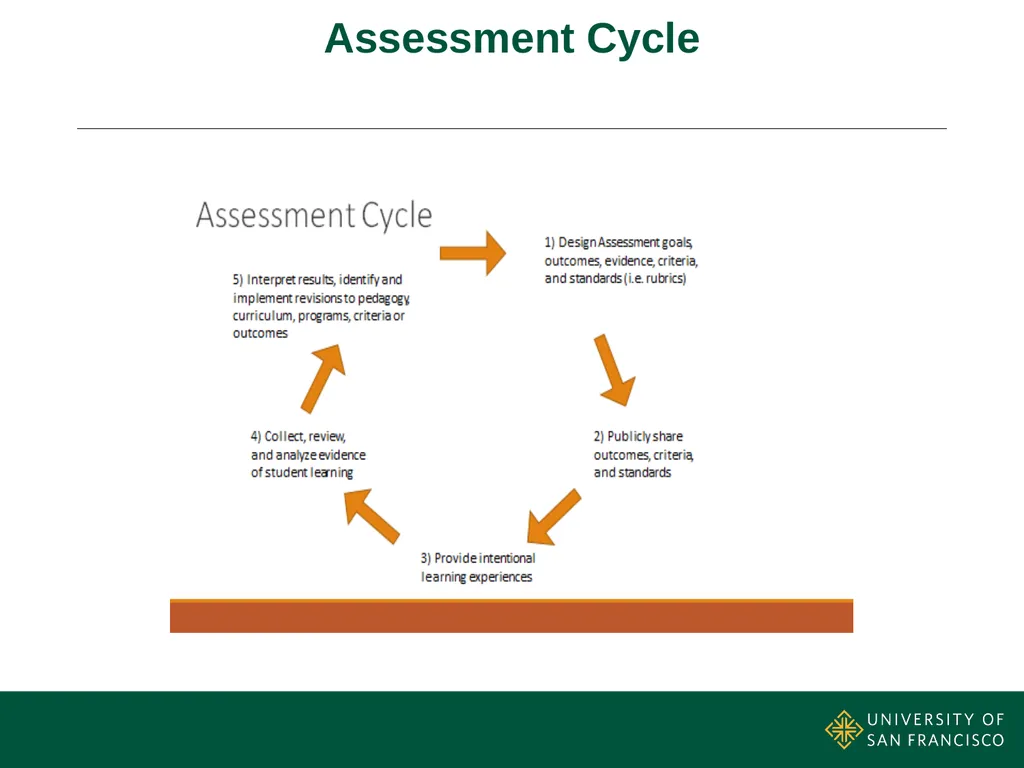
slide3. Assessment Cycle<br>
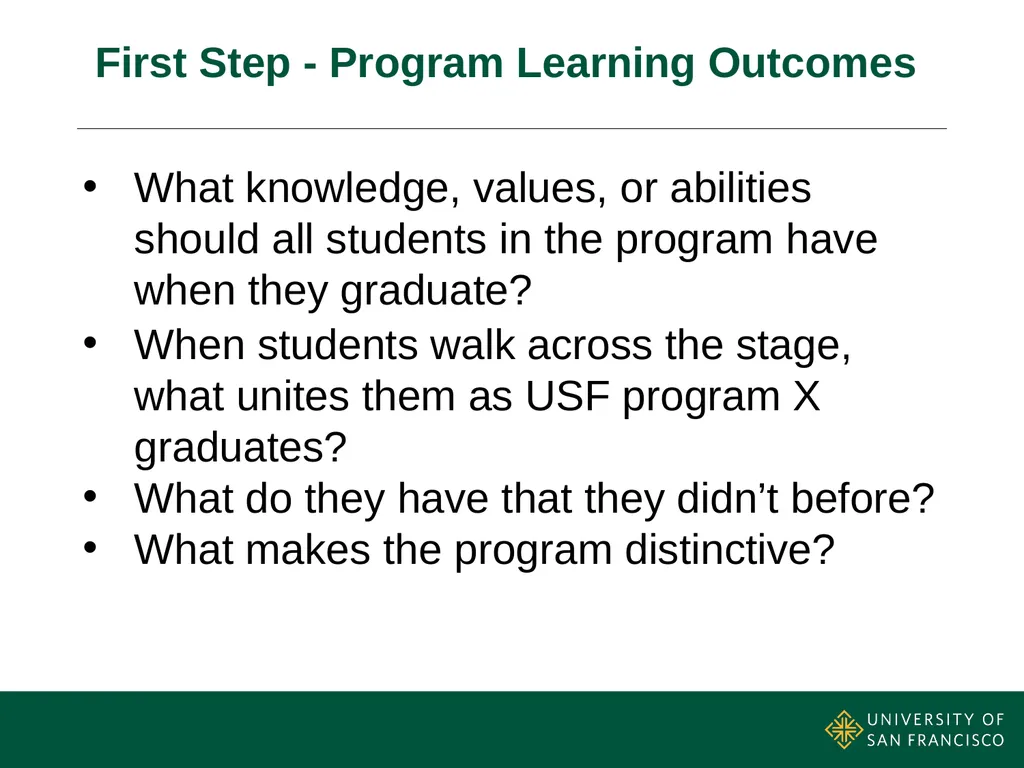
slide4. First Step - Program Learning Outcomes What knowledge, values, or abilities should all students in the program have when they graduate?
When students walk across the stage, what unites them as USF program X graduates?
What do they have that they didn’t before?
What makes the program distinctive?<br>
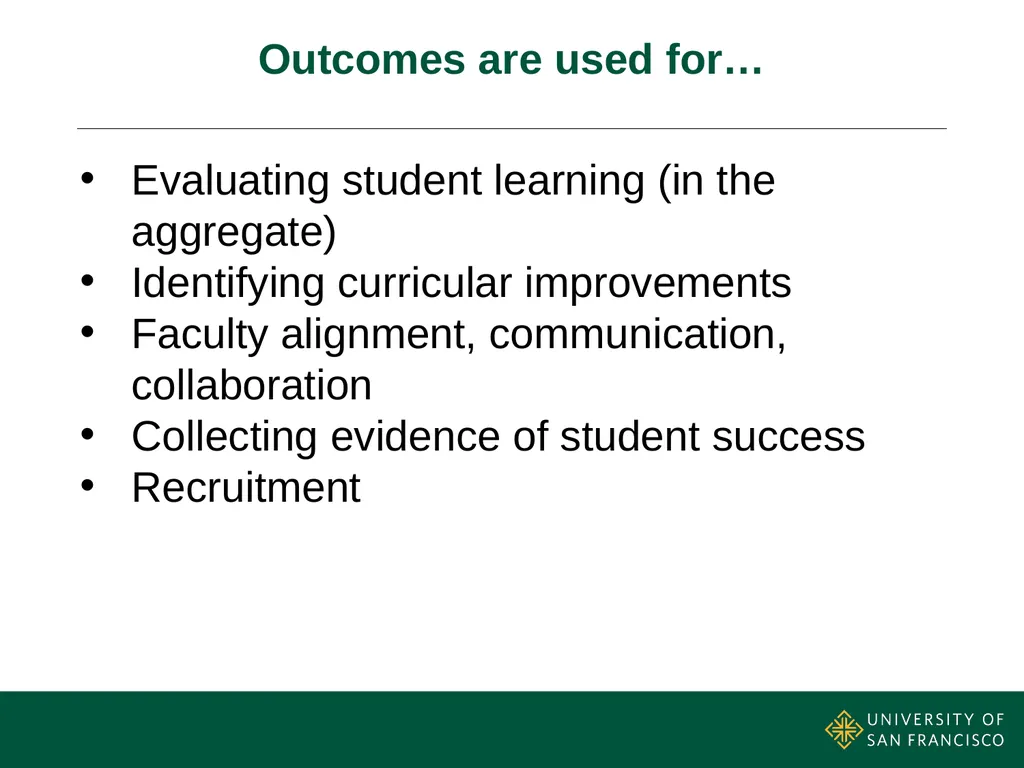
slide5. Evaluating student learning (in the aggregate)
Identifying curricular improvements
Faculty alignment, communication, collaboration
Collecting evidence of student success
Recruitment Outcomes are used for…<br>
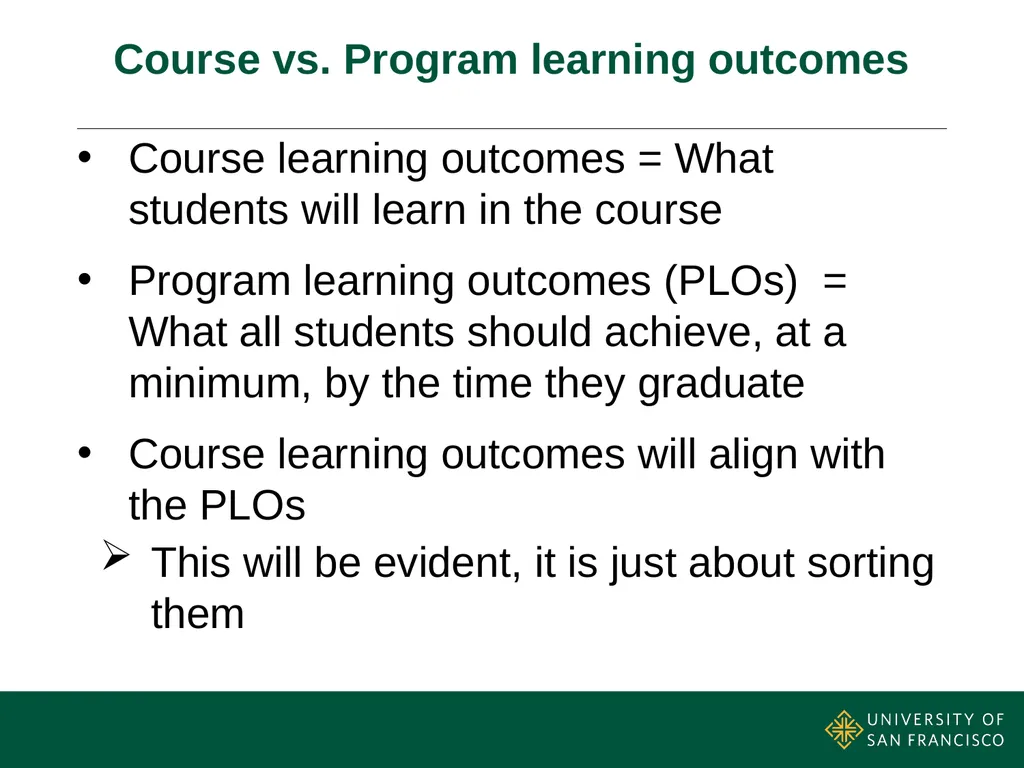
slide6. Course learning outcomes = What students will learn in the course
Program learning outcomes (PLOs) = What all students should achieve, at a minimum, by the time they graduate
Course learning outcomes will align with the PLOs
This will be evident, it is just about sorting them Course vs. Program learning outcomes<br>
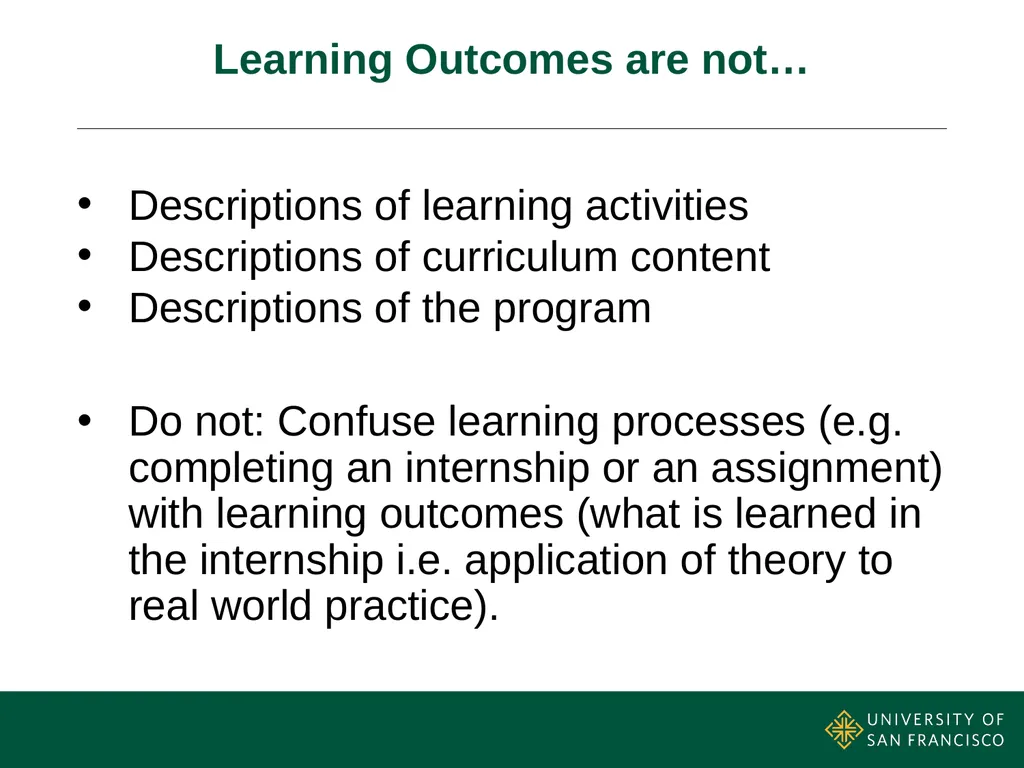
slide7. Learning Outcomes are not… Descriptions of learning activities
Descriptions of curriculum content
Descriptions of the program
Do not: Confuse learning processes (e.g. completing an internship or an assignment) with learning outcomes (what is learned in the internship i.e. application of theory to real world practice).<br>
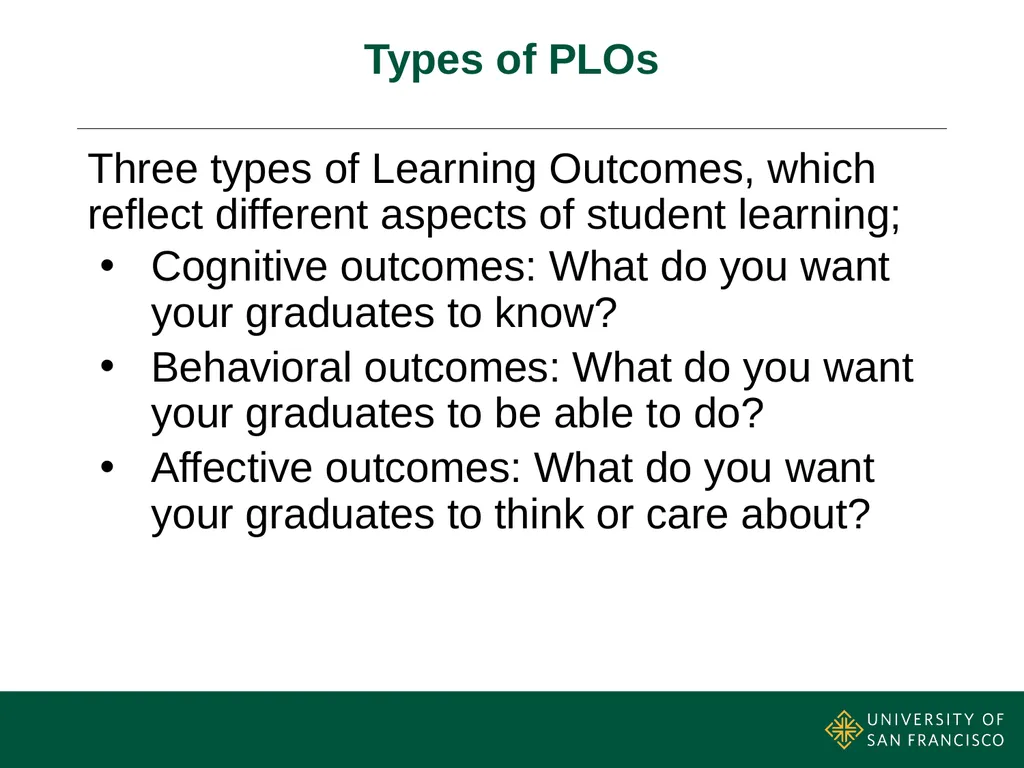
slide8. Types of PLOs Three types of Learning Outcomes, which reflect different aspects of student learning;
Cognitive outcomes: What do you want your graduates to know?
Behavioral outcomes: What do you want your graduates to be able to do?
Affective outcomes: What do you want your graduates to think or care about?<br>
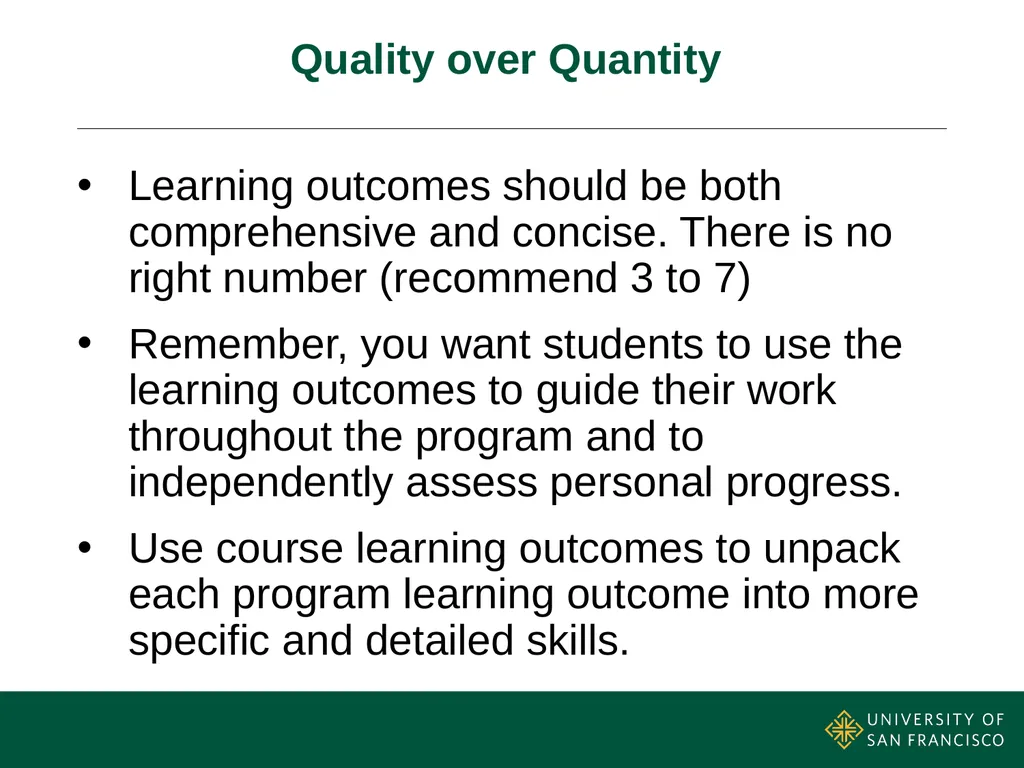
slide9. Quality over Quantity Learning outcomes should be both comprehensive and concise. There is no right number (recommend 3 to 7)
Remember, you want students to use the learning outcomes to guide their work throughout the program and to independently assess personal progress.
Use course learning outcomes to unpack each program learning outcome into more specific and detailed skills.<br>
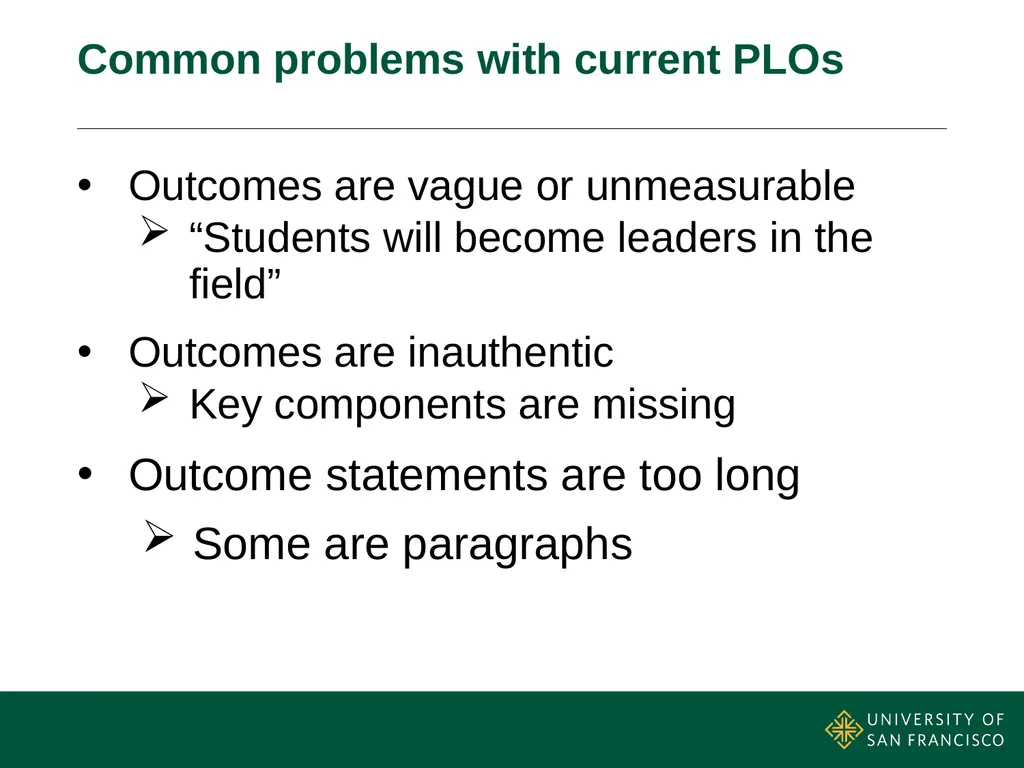
slide10. Common problems with current PLOs Outcomes are vague or unmeasurable
“Students will become leaders in the field”
Outcomes are inauthentic
Key components are missing
Outcome statements are too long
Some are paragraphs<br>
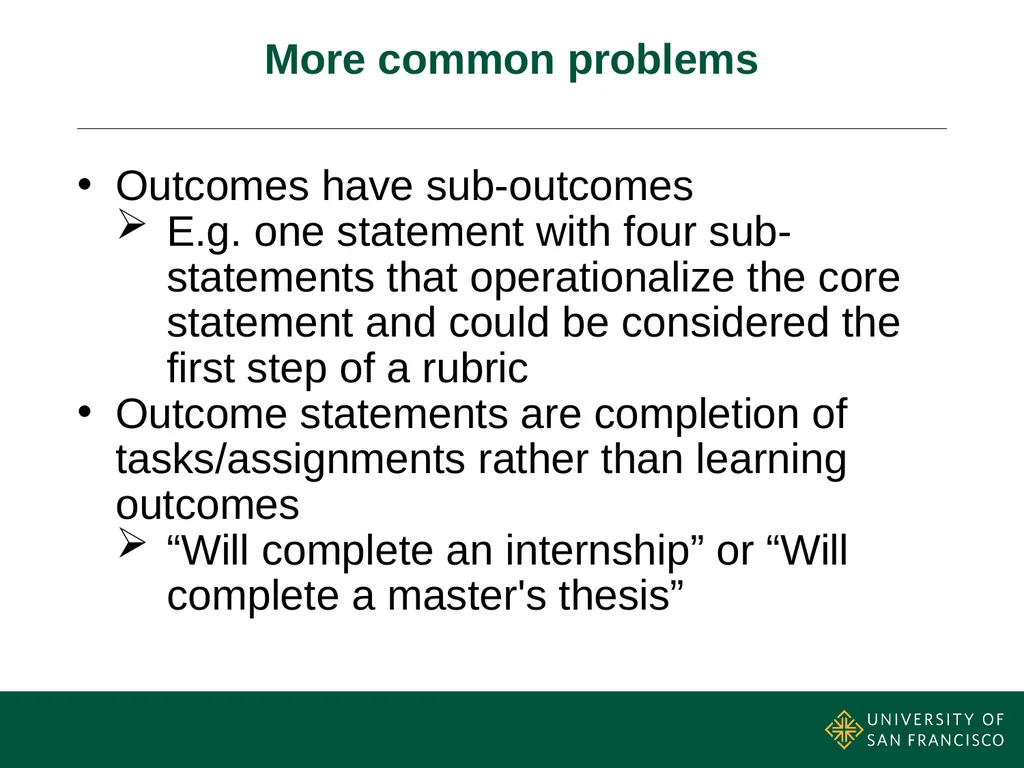
slide11. More common problems Outcomes have sub-outcomes
E.g. one statement with four sub-statements that operationalize the core statement and could be considered the first step of a rubric
Outcome statements are completion of tasks/assignments rather than learning outcomes
“Will complete an internship” or “Will complete a master's thesis”<br>
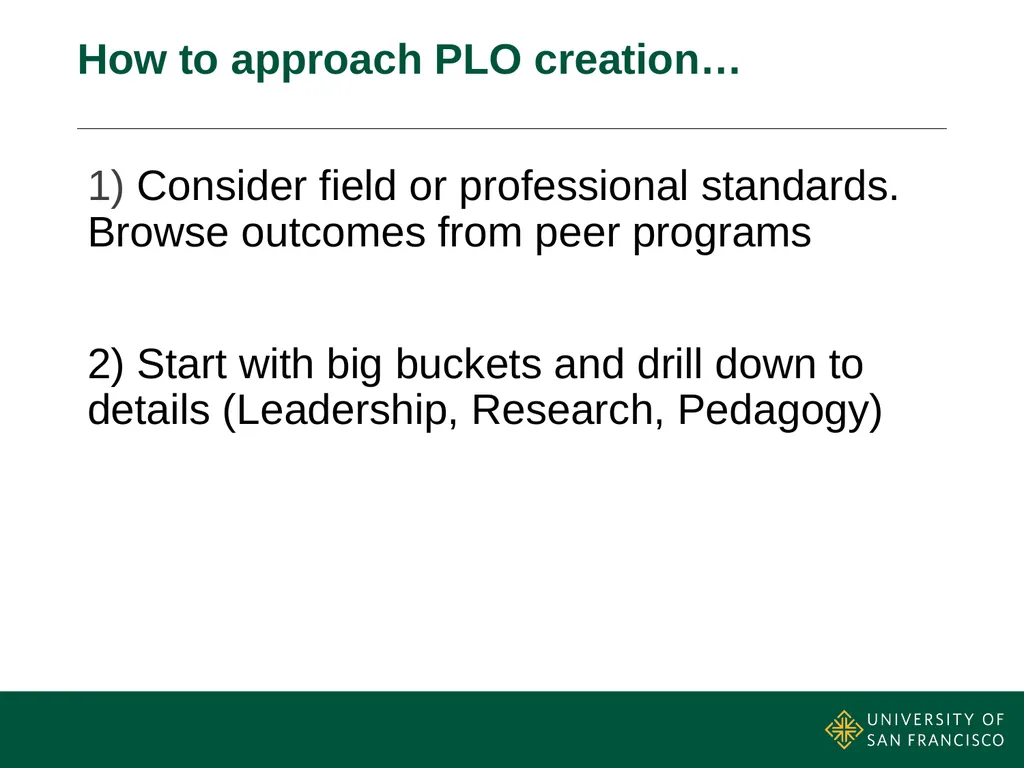
slide12. How to approach PLO creation… 1) Consider field or professional standards. Browse outcomes from peer programs
2) Start with big buckets and drill down to details (Leadership, Research, Pedagogy)<br>
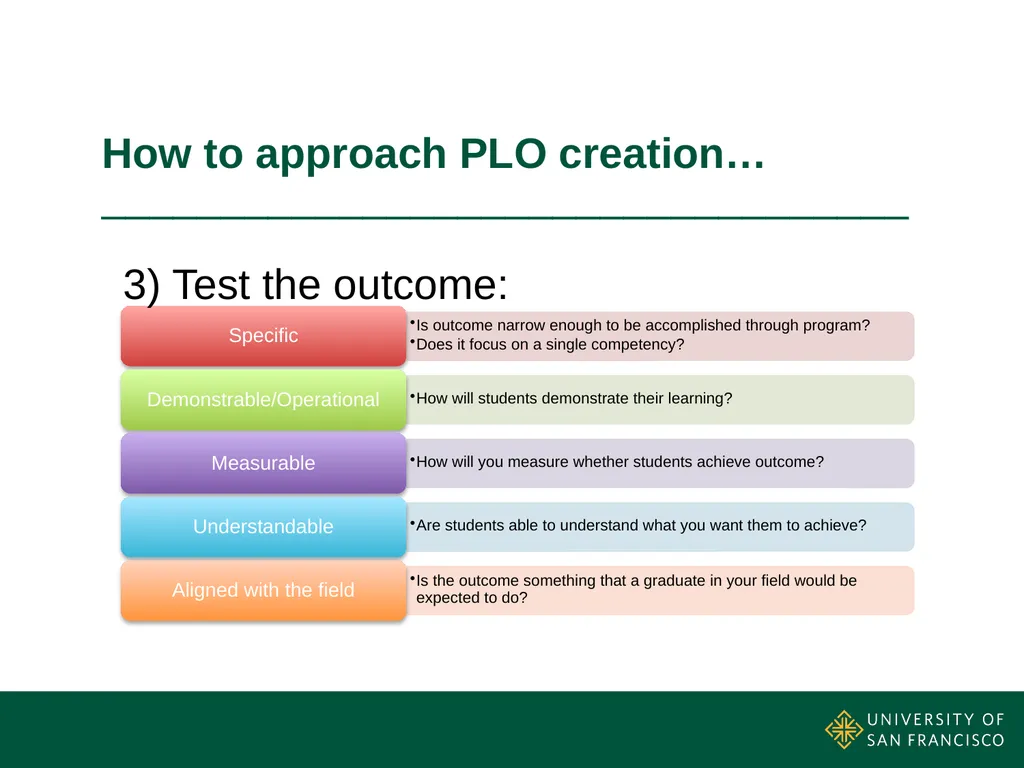
slide13. How to approach PLO creation… __________________________________ 3) Test the outcome:<br>
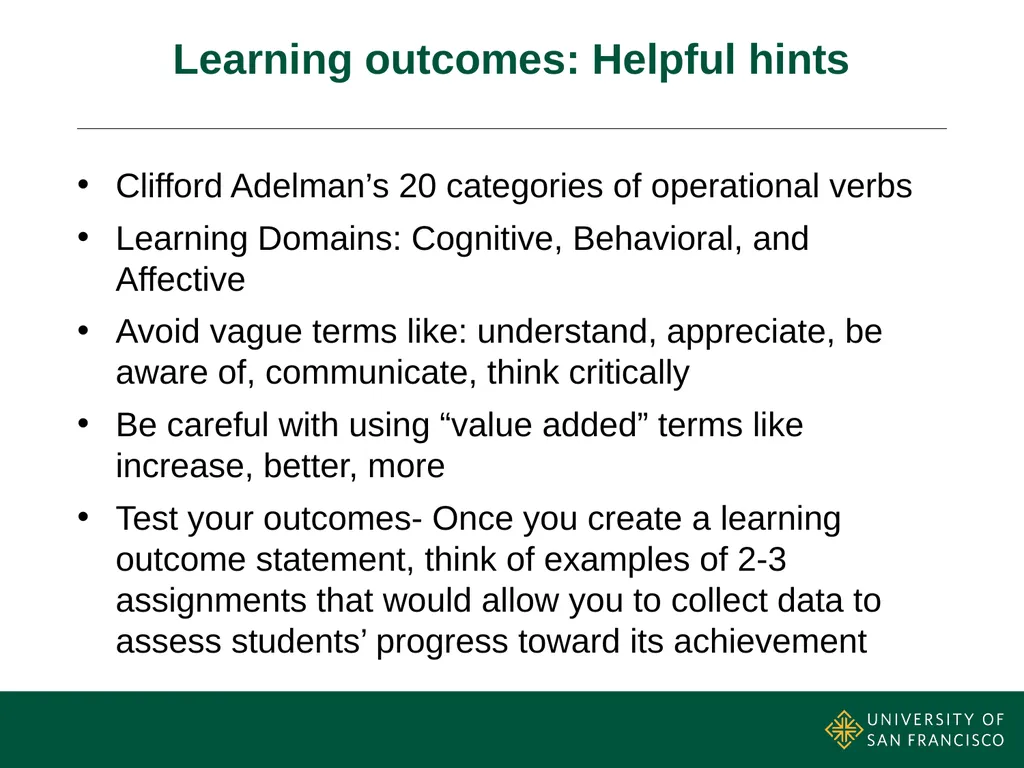
slide14. Learning outcomes: Helpful hints Clifford Adelman’s 20 categories of operational verbs
Learning Domains: Cognitive, Behavioral, and Affective
Avoid vague terms like: understand, appreciate, be aware of, communicate, think critically
Be careful with using “value added” terms like increase, better, more
Test your outcomes- Once you create a learning outcome statement, think of examples of 2-3 assignments that would allow you to collect data to assess students’ progress toward its achievement<br>
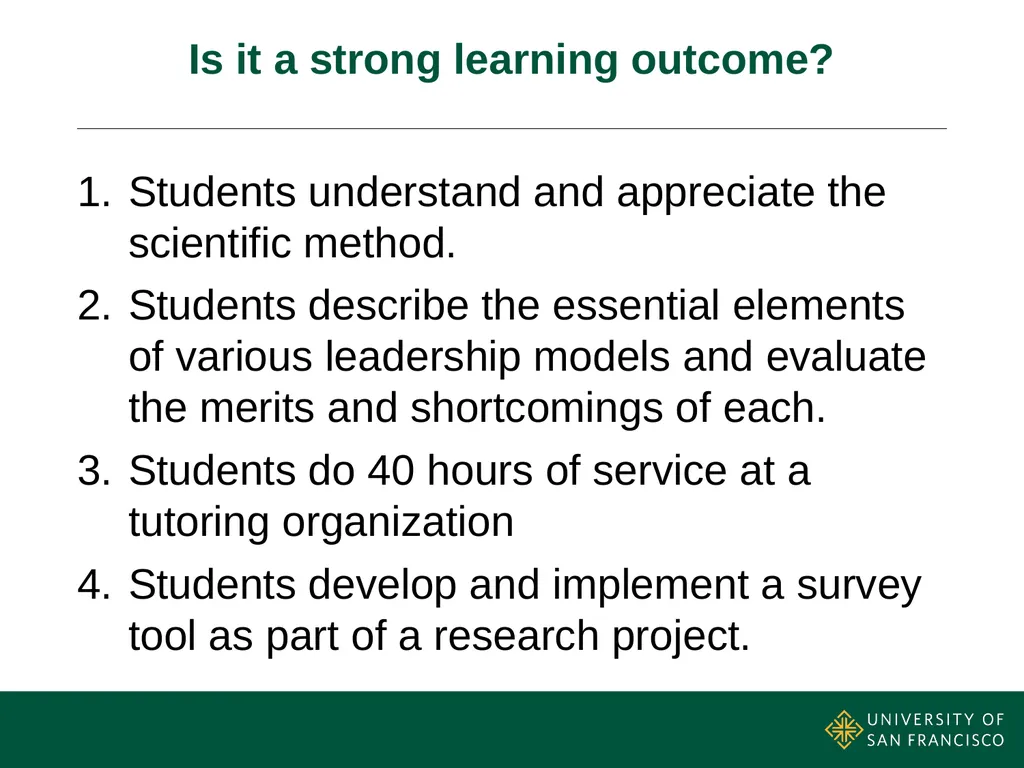
slide15. Is it a strong learning outcome? Students understand and appreciate the scientific method.
Students describe the essential elements of various leadership models and evaluate the merits and shortcomings of each.
Students do 40 hours of service at a tutoring organization
Students develop and implement a survey tool as part of a research project.<br>
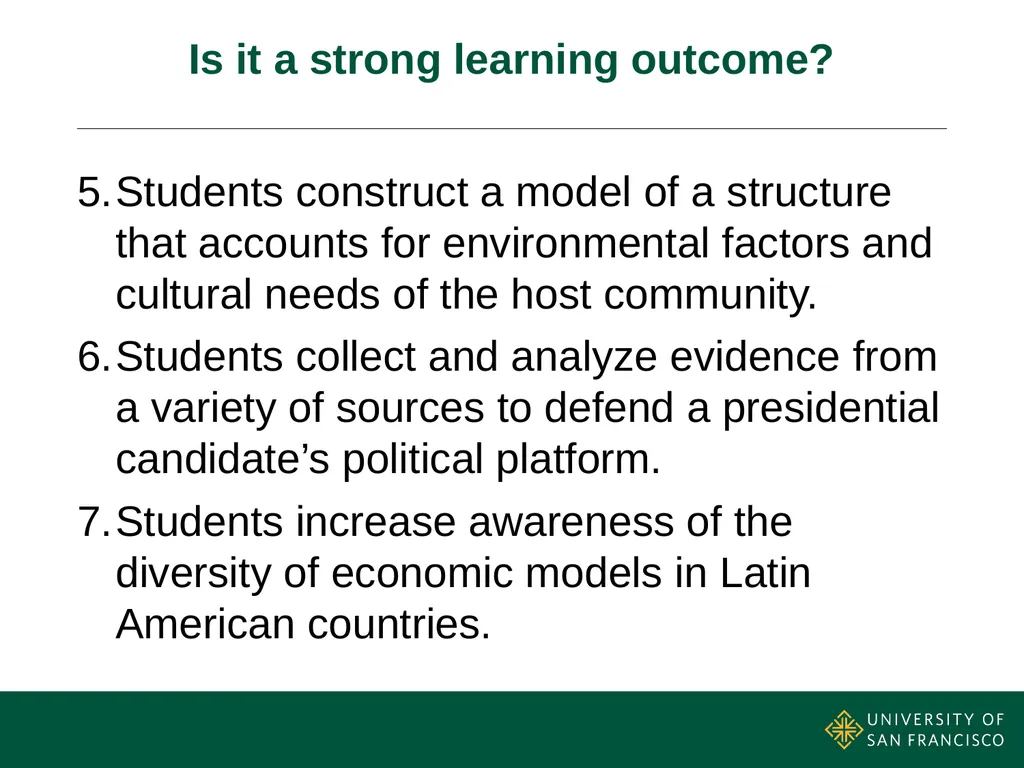
slide16. Is it a strong learning outcome? Students construct a model of a structure that accounts for environmental factors and cultural needs of the host community.
Students collect and analyze evidence from a variety of sources to defend a presidential candidate’s political platform.
Students increase awareness of the diversity of economic models in Latin American countries.<br>
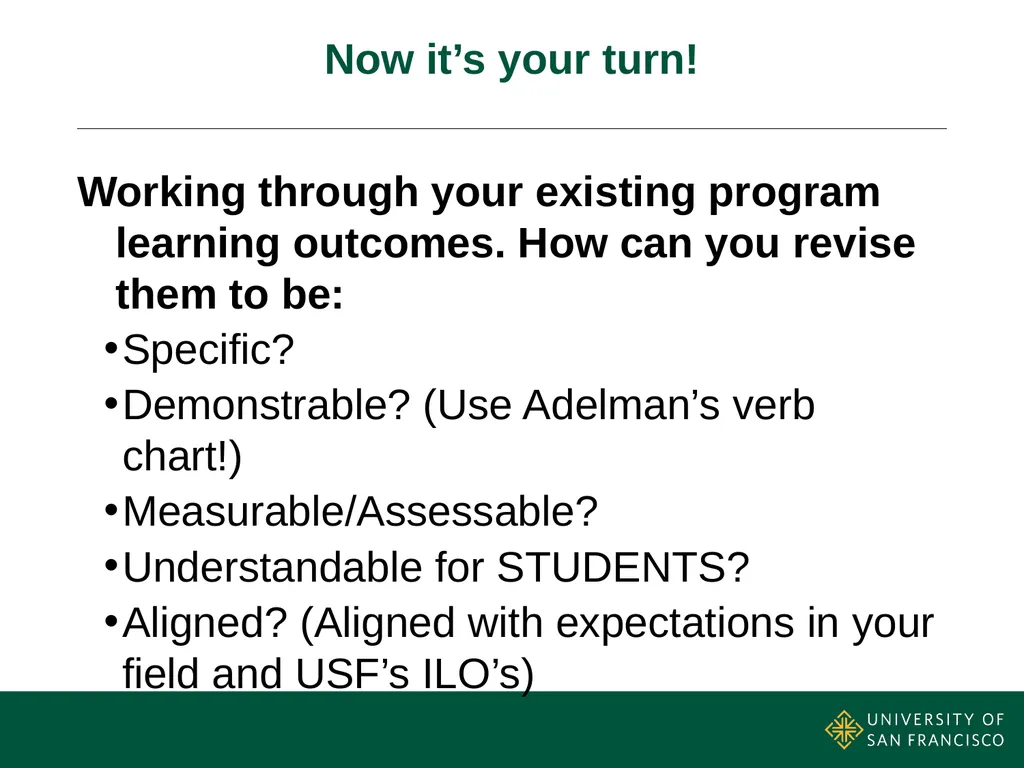
slide17. Now it’s your turn! Working through your existing program learning outcomes. How can you revise them to be:
Specific?
Demonstrable? (Use Adelman’s verb chart!)
Measurable/Assessable?
Understandable for STUDENTS?
Aligned? (Aligned with expectations in your field and USF’s ILO’s)<br>
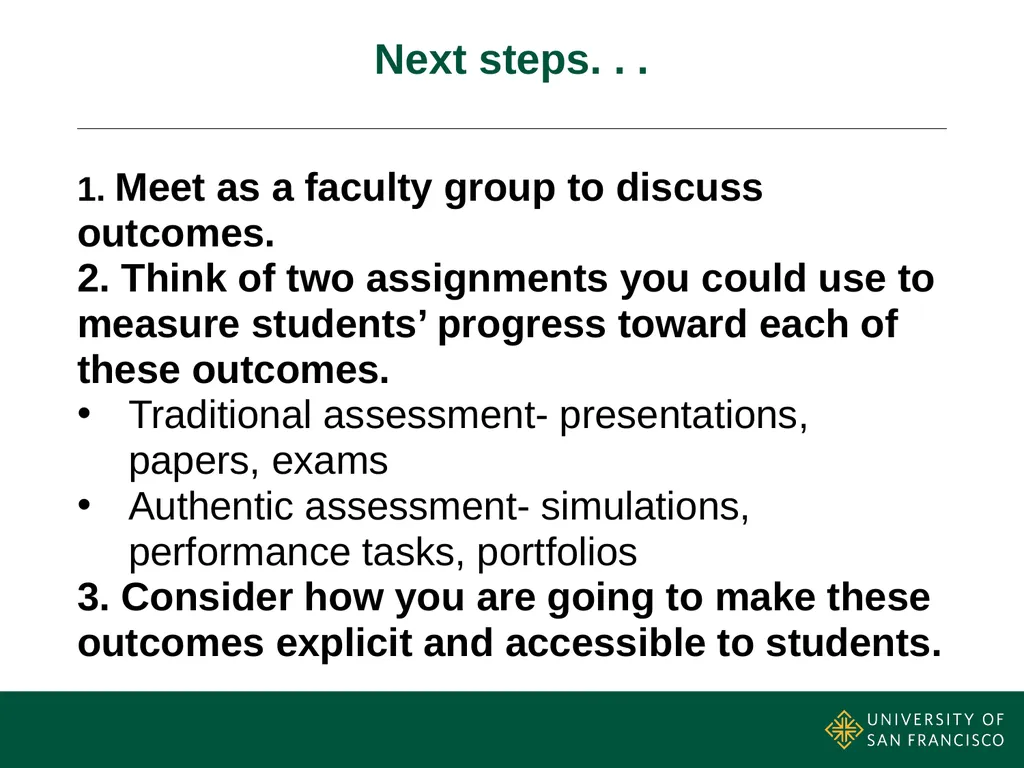
slide18. Next steps. . . 1. Meet as a faculty group to discuss outcomes.
2. Think of two assignments you could use to measure students’ progress toward each of these outcomes.
Traditional assessment- presentations, papers, exams
Authentic assessment- simulations, performance tasks, portfolios
3. Consider how you are going to make these outcomes explicit and accessible to students.<br>
slide19. Questions? Want to talk more about assessment?
Deborah Panter
415-422-4588
dpanter@usfca.edu<br>
Program Learning Outcomes Deborah Panter, J.D.
Director of Educational Effectiveness & Assessment<br>
slide2. Overall Assessment Process Articulate learning outcomes: What is this program about?
Develop a curriculum map: When and how are we teaching it?
Assess outcomes directly: How do we know students have learned something?
Refection and Action: What have we learned and how can we improve (or share success stories)?<br>
slide3. Assessment Cycle<br>
slide4. First Step - Program Learning Outcomes What knowledge, values, or abilities should all students in the program have when they graduate?
When students walk across the stage, what unites them as USF program X graduates?
What do they have that they didn’t before?
What makes the program distinctive?<br>
slide5. Evaluating student learning (in the aggregate)
Identifying curricular improvements
Faculty alignment, communication, collaboration
Collecting evidence of student success
Recruitment Outcomes are used for…<br>
slide6. Course learning outcomes = What students will learn in the course
Program learning outcomes (PLOs) = What all students should achieve, at a minimum, by the time they graduate
Course learning outcomes will align with the PLOs
This will be evident, it is just about sorting them Course vs. Program learning outcomes<br>
slide7. Learning Outcomes are not… Descriptions of learning activities
Descriptions of curriculum content
Descriptions of the program
Do not: Confuse learning processes (e.g. completing an internship or an assignment) with learning outcomes (what is learned in the internship i.e. application of theory to real world practice).<br>
slide8. Types of PLOs Three types of Learning Outcomes, which reflect different aspects of student learning;
Cognitive outcomes: What do you want your graduates to know?
Behavioral outcomes: What do you want your graduates to be able to do?
Affective outcomes: What do you want your graduates to think or care about?<br>
slide9. Quality over Quantity Learning outcomes should be both comprehensive and concise. There is no right number (recommend 3 to 7)
Remember, you want students to use the learning outcomes to guide their work throughout the program and to independently assess personal progress.
Use course learning outcomes to unpack each program learning outcome into more specific and detailed skills.<br>
slide10. Common problems with current PLOs Outcomes are vague or unmeasurable
“Students will become leaders in the field”
Outcomes are inauthentic
Key components are missing
Outcome statements are too long
Some are paragraphs<br>
slide11. More common problems Outcomes have sub-outcomes
E.g. one statement with four sub-statements that operationalize the core statement and could be considered the first step of a rubric
Outcome statements are completion of tasks/assignments rather than learning outcomes
“Will complete an internship” or “Will complete a master's thesis”<br>
slide12. How to approach PLO creation… 1) Consider field or professional standards. Browse outcomes from peer programs
2) Start with big buckets and drill down to details (Leadership, Research, Pedagogy)<br>
slide13. How to approach PLO creation… __________________________________ 3) Test the outcome:<br>
slide14. Learning outcomes: Helpful hints Clifford Adelman’s 20 categories of operational verbs
Learning Domains: Cognitive, Behavioral, and Affective
Avoid vague terms like: understand, appreciate, be aware of, communicate, think critically
Be careful with using “value added” terms like increase, better, more
Test your outcomes- Once you create a learning outcome statement, think of examples of 2-3 assignments that would allow you to collect data to assess students’ progress toward its achievement<br>
slide15. Is it a strong learning outcome? Students understand and appreciate the scientific method.
Students describe the essential elements of various leadership models and evaluate the merits and shortcomings of each.
Students do 40 hours of service at a tutoring organization
Students develop and implement a survey tool as part of a research project.<br>
slide16. Is it a strong learning outcome? Students construct a model of a structure that accounts for environmental factors and cultural needs of the host community.
Students collect and analyze evidence from a variety of sources to defend a presidential candidate’s political platform.
Students increase awareness of the diversity of economic models in Latin American countries.<br>
slide17. Now it’s your turn! Working through your existing program learning outcomes. How can you revise them to be:
Specific?
Demonstrable? (Use Adelman’s verb chart!)
Measurable/Assessable?
Understandable for STUDENTS?
Aligned? (Aligned with expectations in your field and USF’s ILO’s)<br>
slide18. Next steps. . . 1. Meet as a faculty group to discuss outcomes.
2. Think of two assignments you could use to measure students’ progress toward each of these outcomes.
Traditional assessment- presentations, papers, exams
Authentic assessment- simulations, performance tasks, portfolios
3. Consider how you are going to make these outcomes explicit and accessible to students.<br>
slide19. Questions? Want to talk more about assessment?
Deborah Panter
415-422-4588
dpanter@usfca.edu<br>