X-rays: Dr Gulshan Kumar MVSc PhD Interaction with matter X-rays are actually photons travelling with the speed of light. Interaction.. How a photon interacts with matter on which it fallsimpinges. Matter may be tissuecellsor
"X-rays: Dr Gulshan Kumar MVSc PhD Interaction with" is the property of its rightful owner. Permission is granted to
download and print the materials on this website for personal, non-commercial use only, and to display it
on your personal computer provided you do not modify the materials and that you retain all copyright
notices contained in the materials. By downloading content from our website, you accept the terms of this
agreement.
Presentation Transcript
01
X-rays: Dr Gulshan Kumar
MVSc PhD Interaction with matter<br>
02
X-rays are actually photons travelling with the speed of light.
Interaction.. How a photon interacts with matter on which it falls/impinges.
Matter may be tissue/cells/or non-biological material (here, we are considered with biological material only).
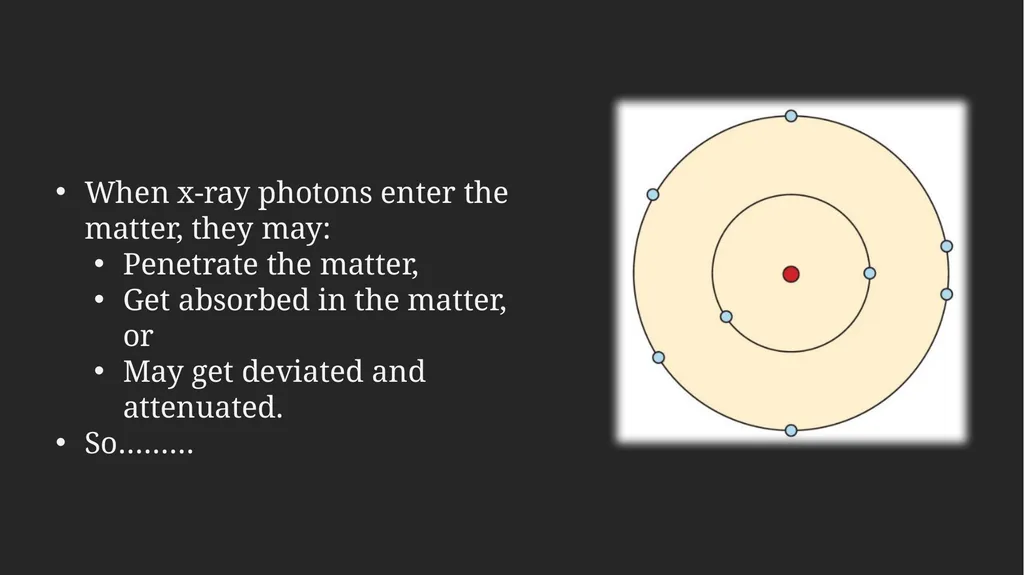
When the photon falls/strikes/impinges on the matter it encounters the atoms of that matter.
An atom comprises of a nucleus containing neutrons and protons around which are several orbits in which electrons are arranged (2n²)<br>
03
When x-ray photons enter the matter, they may:
Penetrate the matter,
Get absorbed in the matter, or
May get deviated and attenuated.
So………<br>
04
X-rays photons may interact with matter in five (05) ways:
Coherent Scatter
Compton Scatter
Photoelectric effect/absorption
Pair production
Photodisintegration<br>
05
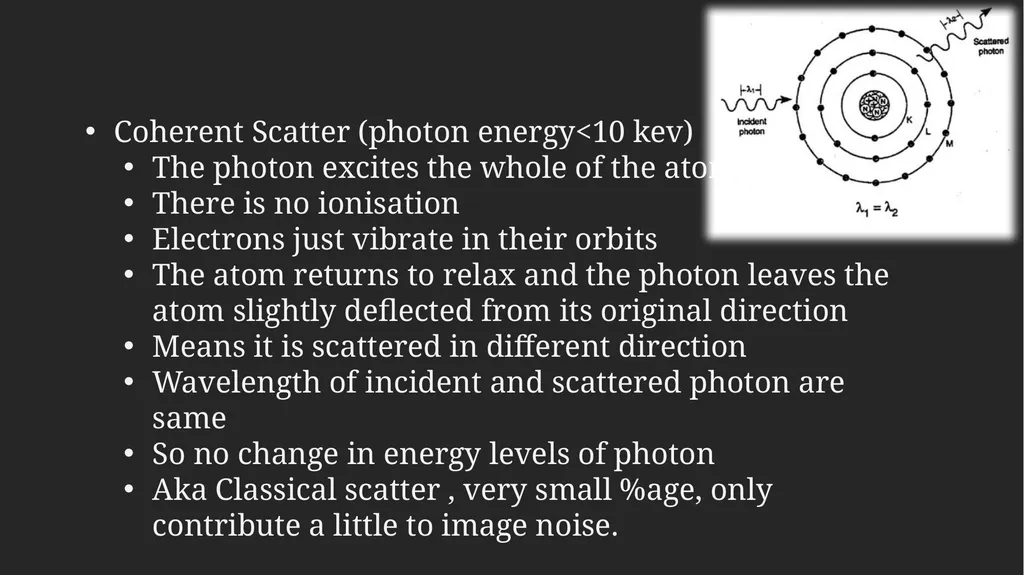
Coherent Scatter (photon energy<10 kev)
The photon excites the whole of the atom
There is no ionisation
Electrons just vibrate in their orbits
The atom returns to relax and the photon leaves the atom slightly deflected from its original direction
Means it is scattered in different direction
Wavelength of incident and scattered photon are same
So no change in energy levels of photon
Aka Classical scatter , very small %age, only contribute a little to image noise.<br>
06
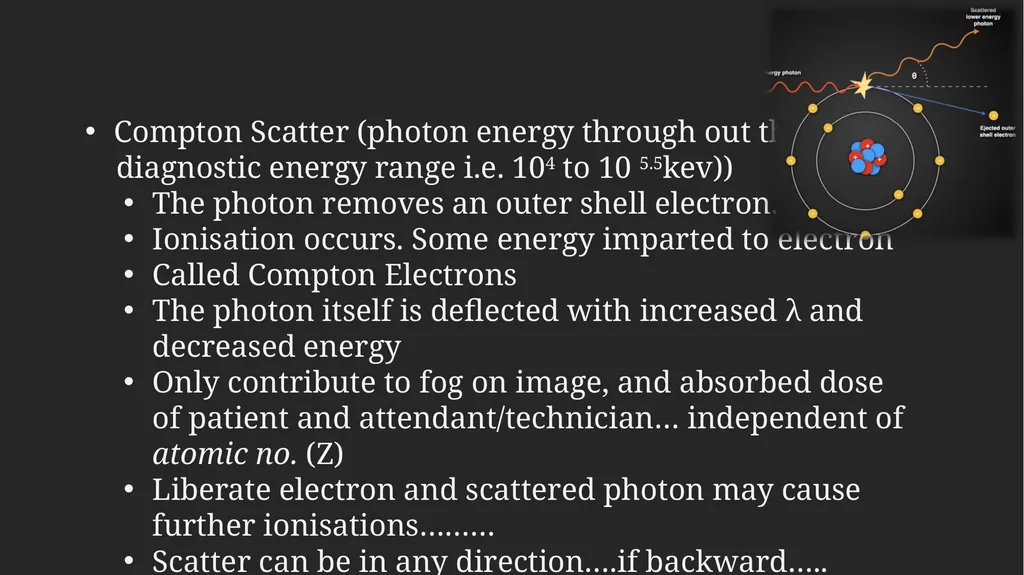
Compton Scatter (photon energy through out the
diagnostic energy range i.e. 104 to 10 5.5kev))
The photon removes an outer shell electron.
Ionisation occurs. Some energy imparted to electron
Called Compton Electrons
The photon itself is deflected with increased λ and decreased energy
Only contribute to fog on image, and absorbed dose of patient and attendant/technician… independent of atomic no. (Z)
Liberate electron and scattered photon may cause further ionisations………
Scatter can be in any direction….if backward….. “Back Scatter”<br>
07
Photo-electric effect/absorption (also with photon energy through out the diagnostic energy range i.e. 104 to 10 5.5kev))
The photon removes an inner shell electron.
Ionisation occurs. All energy imparted to electron the photo electron.
Photon gets absorbed, the ejected electron may act to form characteristic x rays of low energy from adjacent atoms… and so on.
Higher the Z, greater the absorption
Contribute to image formation
Increasing the photon energy decreases the probability of Photo-electric absorption. Even bone will be penetrated (darker).<br>
08
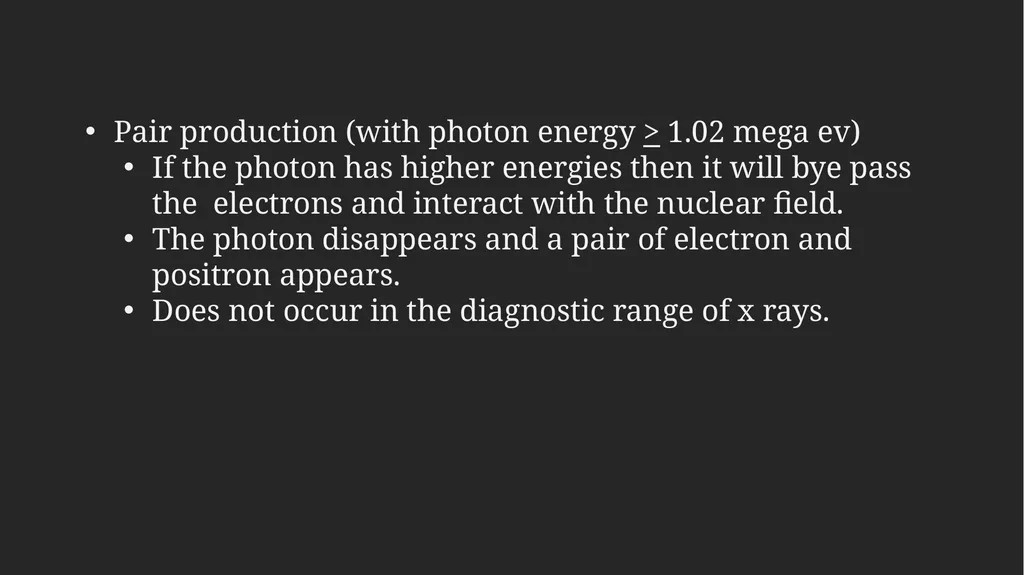
Pair production (with photon energy > 1.02 mega ev)
If the photon has higher energies then it will bye pass the electrons and interact with the nuclear field.
The photon disappears and a pair of electron and positron appears.
Does not occur in the diagnostic range of x rays.<br>
09
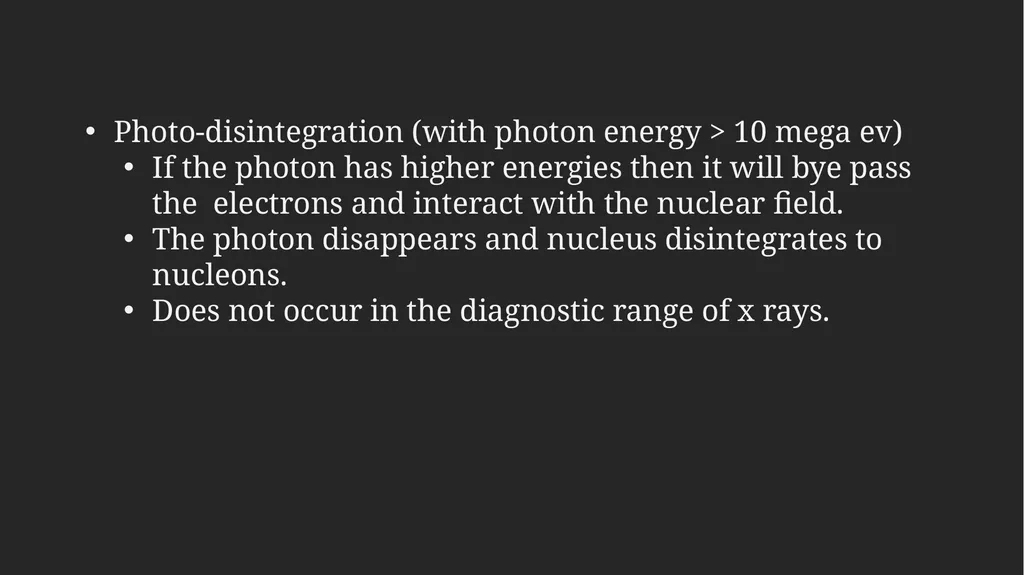
Photo-disintegration (with photon energy > 10 mega ev)
If the photon has higher energies then it will bye pass the electrons and interact with the nuclear field.
The photon disappears and nucleus disintegrates to nucleons.
Does not occur in the diagnostic range of x rays.<br>