Y9 Language Detectives Investigating how language works: word choices: use of pronouns in fiction Who is he? I found him in the garage on a Sunday afternoon. It was the day after we moved into Falconer Road. The winter was ending. Mum had
"Y9 Language Detectives Investigating how language" is the property of its rightful owner. Permission is granted to
download and print the materials on this website for personal, non-commercial use only, and to display it
on your personal computer provided you do not modify the materials and that you retain all copyright
notices contained in the materials. By downloading content from our website, you accept the terms of this
agreement.
Presentation Transcript
01
Y9 Language Detectives Investigating how language works: word choices: use of pronouns in fiction<br>
02
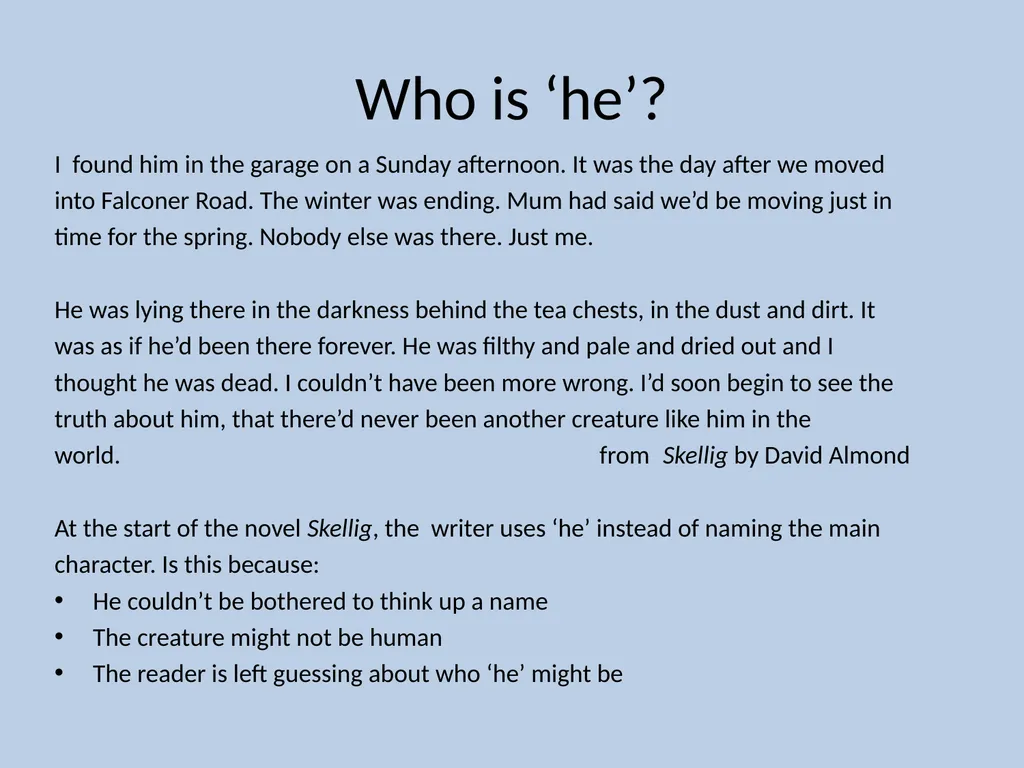
Who is ‘he’? I found him in the garage on a Sunday afternoon. It was the day after we moved
into Falconer Road. The winter was ending. Mum had said we’d be moving just in
time for the spring. Nobody else was there. Just me.
He was lying there in the darkness behind the tea chests, in the dust and dirt. It
was as if he’d been there forever. He was filthy and pale and dried out and I
thought he was dead. I couldn’t have been more wrong. I’d soon begin to see the
truth about him, that there’d never been another creature like him in the
world. from Skellig by David Almond
At the start of the novel Skellig, the writer uses ‘he’ instead of naming the main
character. Is this because:
He couldn’t be bothered to think up a name
The creature might not be human
The reader is left guessing about who ‘he’ might be<br>
03
How can writers withhold information about characters at the start of a story by using pronouns? Terminology check:
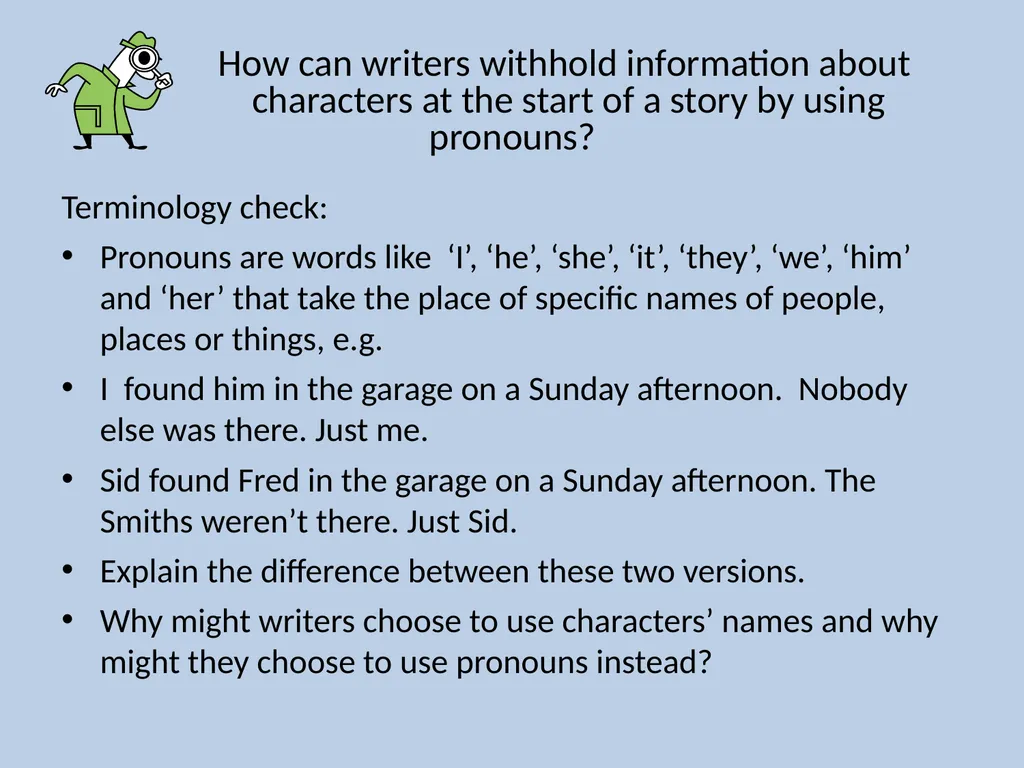
Pronouns are words like ‘I’, ‘he’, ‘she’, ‘it’, ‘they’, ‘we’, ‘him’ and ‘her’ that take the place of specific names of people, places or things, e.g.
I found him in the garage on a Sunday afternoon. Nobody else was there. Just me.
Sid found Fred in the garage on a Sunday afternoon. The Smiths weren’t there. Just Sid.
Explain the difference between these two versions.
Why might writers choose to use characters’ names and why might they choose to use pronouns instead?<br>
04
How can writers withhold information about characters at the start of a story by using pronouns? Writers make choices about how much information to reveal to the reader, and the ways in which they will reveal it. In the opening of a story, for example, pronouns (I, you, he, she, it, we, they) reveal little about characters, except the number of characters or their gender. Writers can therefore use pronouns to withhold information from the reader, making them ask questions like ‘Who is this person? This can engage the reader’s interest by making them want to discover the answers.<br>
05
Read the opening of The Bourne Imperative by Robert Ludlum. How would the impact of this opening be altered if the writer had used the characters’ names – Jason Bourne and Rebeka – instead of the pronouns he and she? She came out of the mist, and he was running, just as he had been for hours,
days. It felt like he had been alone for weeks, his heart continually
thundering inside his chest, his mind befogged with bitter betrayal. Sleep was
unthinkable, rest a thing of the past.
Nothing was clear now except that she had come out of the mist after he had
been certain – for the thirteenth, or was it the fifteenth, time? – that he had
eluded her. But here she was, coming for him like a mythical exterminating
angel, indestructible and implacable.
His life had been reduced to the two of them. Nothing else existed outside
the wall of white – snow and ice and the wispy brushstrokes of fishing
cottages, deep red with white trim, small, compact.<br>
06
Read the opening of The Bourne Imperative by Robert Ludlum. How would the impact of this opening be altered if the writer had used the characters names – Jason Bourne and Rebeka – instead of the pronouns he and she? The mist burned like fire – a cold fire that ran up his spine and gripped
the back of his neck.
Half skating across a large, frozen lake, he slipped, lost his gun, which
went skittering over the ice. He was about to make a lunge for it when
he heard the snap of a twig, as clear and sharp as a knife thrust.
Instead, he continued on, made for a stand of shivering pines. Powdery
snow sprayed his face, coating his eyebrows and the stubble of a long
flight across continents. He did not dare waste another moment
looking back over his shoulder to check the progress of his pursuer.<br>
07
Why does David Almond use pronouns instead of characters’ names at the start of Skellig? I found him in the garage on a Sunday afternoon. It was the day
after we moved into Falconer Road. The winter was ending. Mum
had said we’d be moving just in time for the spring. Nobody else
was there. Just me.
He was lying there in the darkness behind the tea chests, in the
dust and dirt. It was as if he’d been there forever. He was filthy and
pale and dried out and I thought he was dead. I couldn’t have been
more wrong. I’d soon begin to see the truth about him, that
there’d never been another creature like him in the world.<br>
08
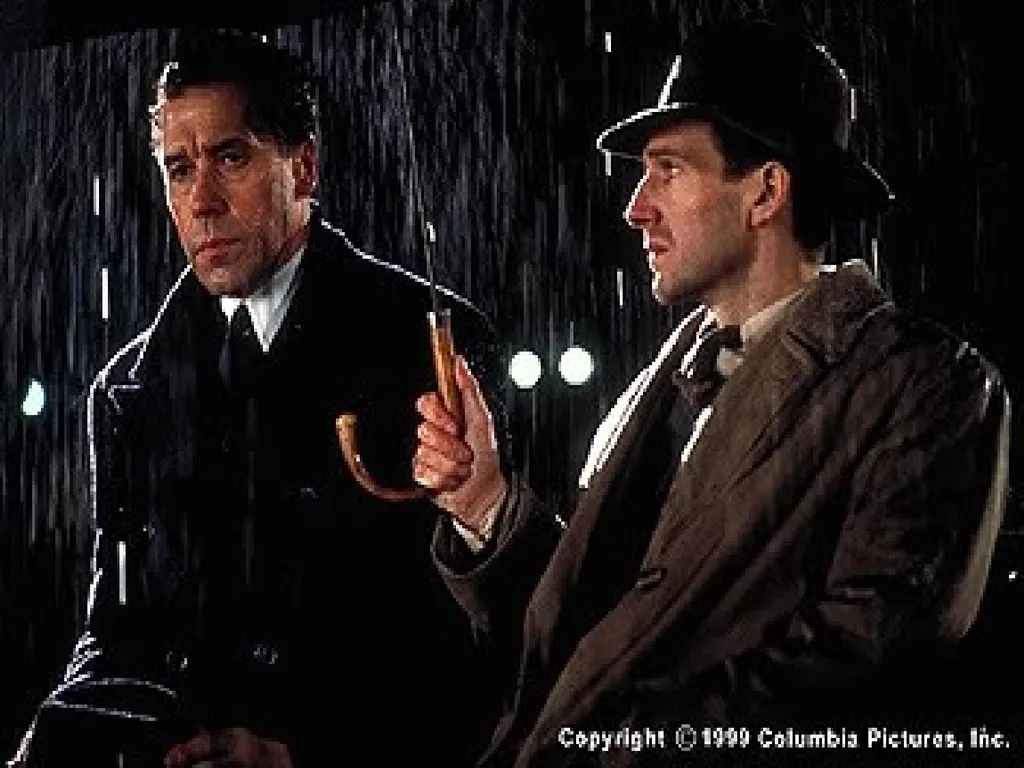
How can writers withhold information about characters at the start of a story by using pronouns? Write the opening paragraph of a mystery or thriller story, using pronouns instead of characters’ names to hook the reader’s interest by withholding information.
You can use the picture on the next slide to prompt ideas.
You might want to start:
“I met him on a bench in the park....”<br>
09
Try it Write your own opening paragraph to a mystery story or thriller in which you deliberately withhold information about characters by using pronouns.
You can use the picture on the next slide to prompt ideas.<br>
10
How can writers withhold information about characters at the start of a story by using pronouns? I met him on a bench in the park. They had told me what to look for: a man with a tight-lipped half smile and dark shadows beneath his eyes, as if he hadn’t slept well in weeks. When the cold rain started, he shrugged further into his coat, wincing slightly. They had told me I should pretend we were friends, so I opened my umbrella to shelter us both and shifted a little closer to him. But still he stared ahead and said nothing.<br>