
Year 11 English Language Paper Two Revision

Description: Year 11 English Language Paper Two Revision Booklet Name: Teacher: Class: The Secret of Success: Stop
Related Topics
Download Presentation
"Year 11 English Language Paper Two Revision" is the property of its rightful owner. Permission is granted to download and print the materials on this website for personal, non-commercial use only, and to display it on your personal computer provided you do not modify the materials and that you retain all copyright notices contained in the materials. By downloading content from our website, you accept the terms of this agreement.
Presentation Transcript
slide1. Year 11 English Language Paper Two Revision Booklet Name: ___________________________________________
Teacher: ___________________________________________
Class: _____________________________________________ The Secret of Success:
Stop Wishing!
Start Doing!<br>
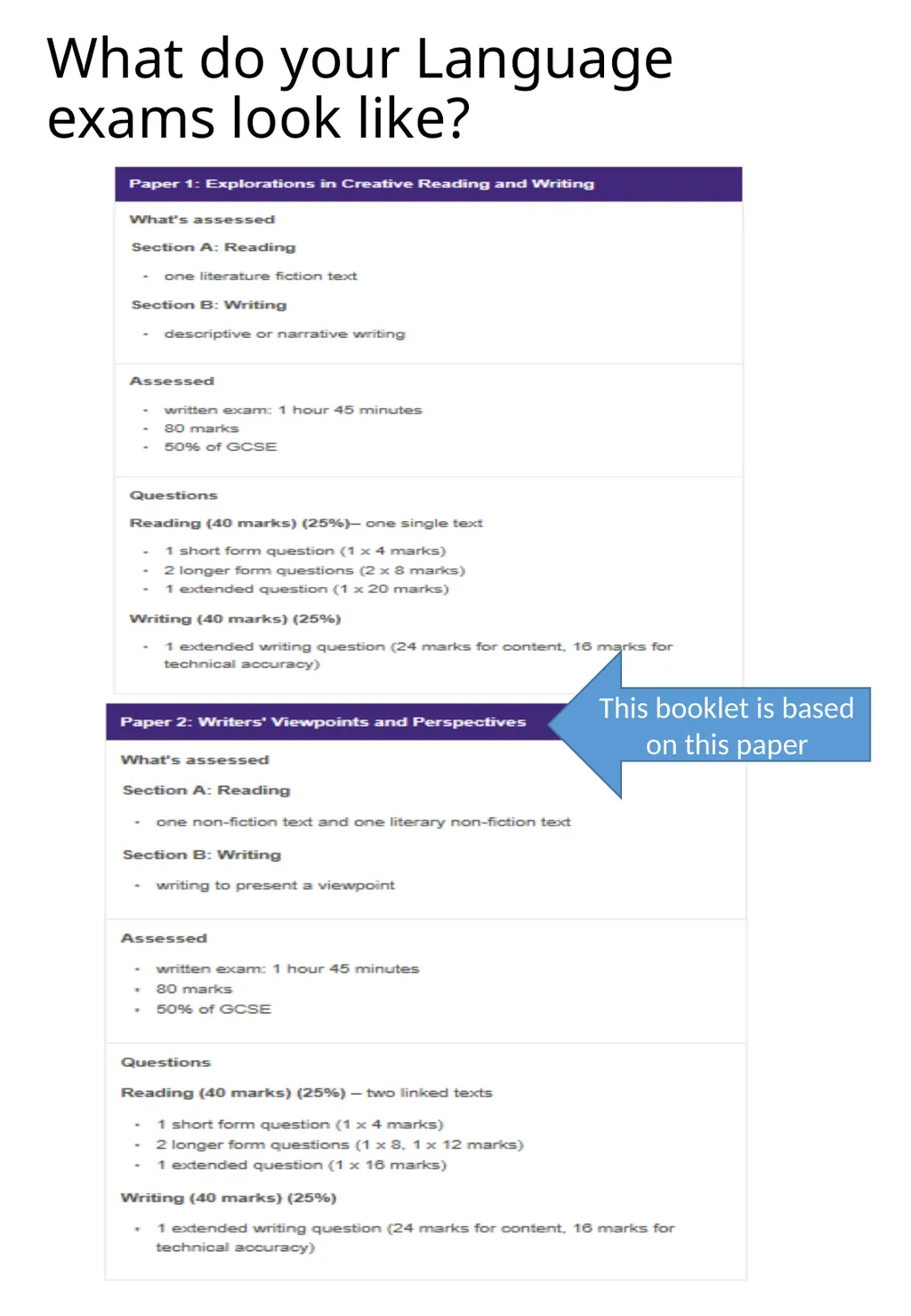
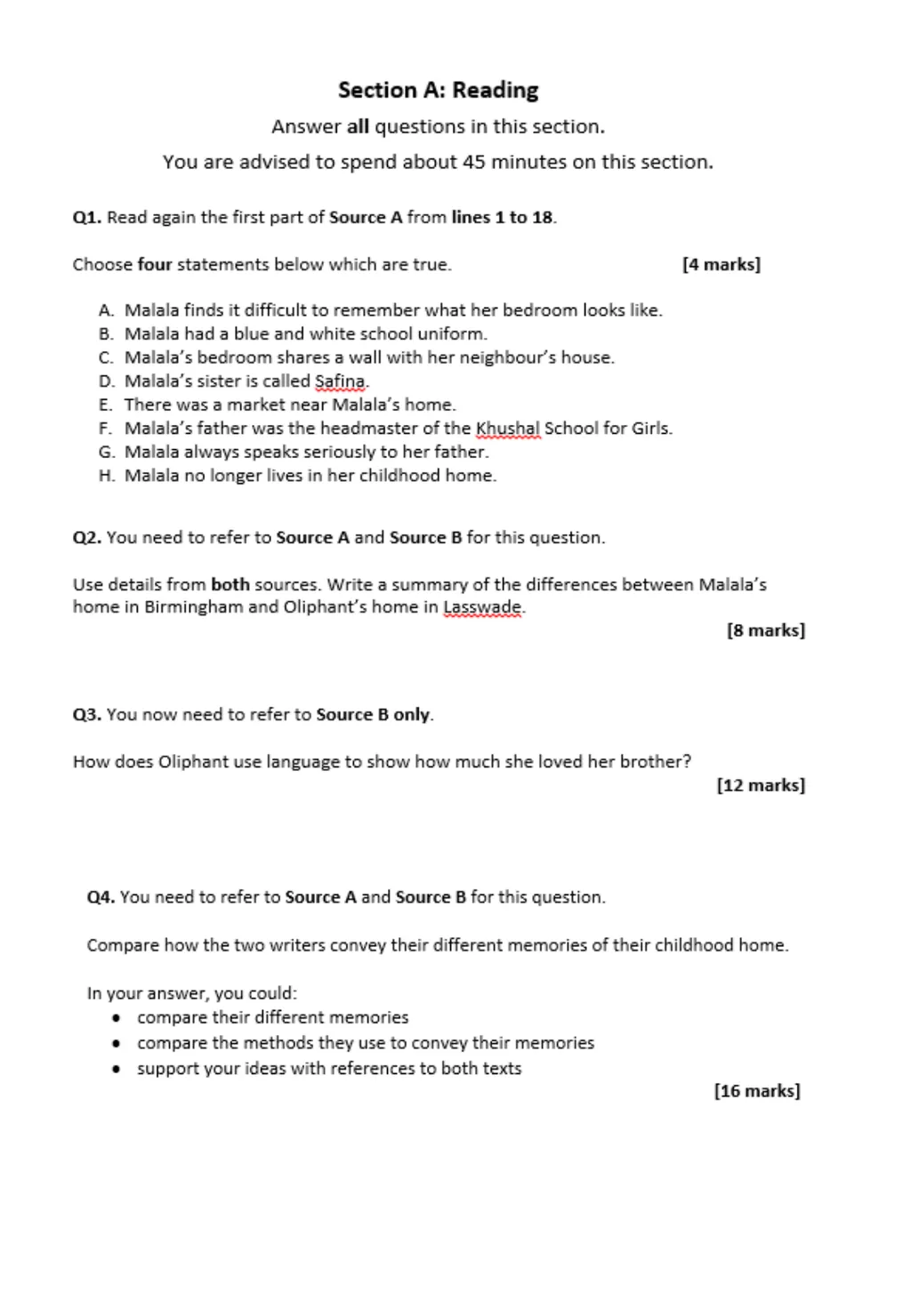
slide2. What do your Language exams look like? This booklet is based on this paper<br>
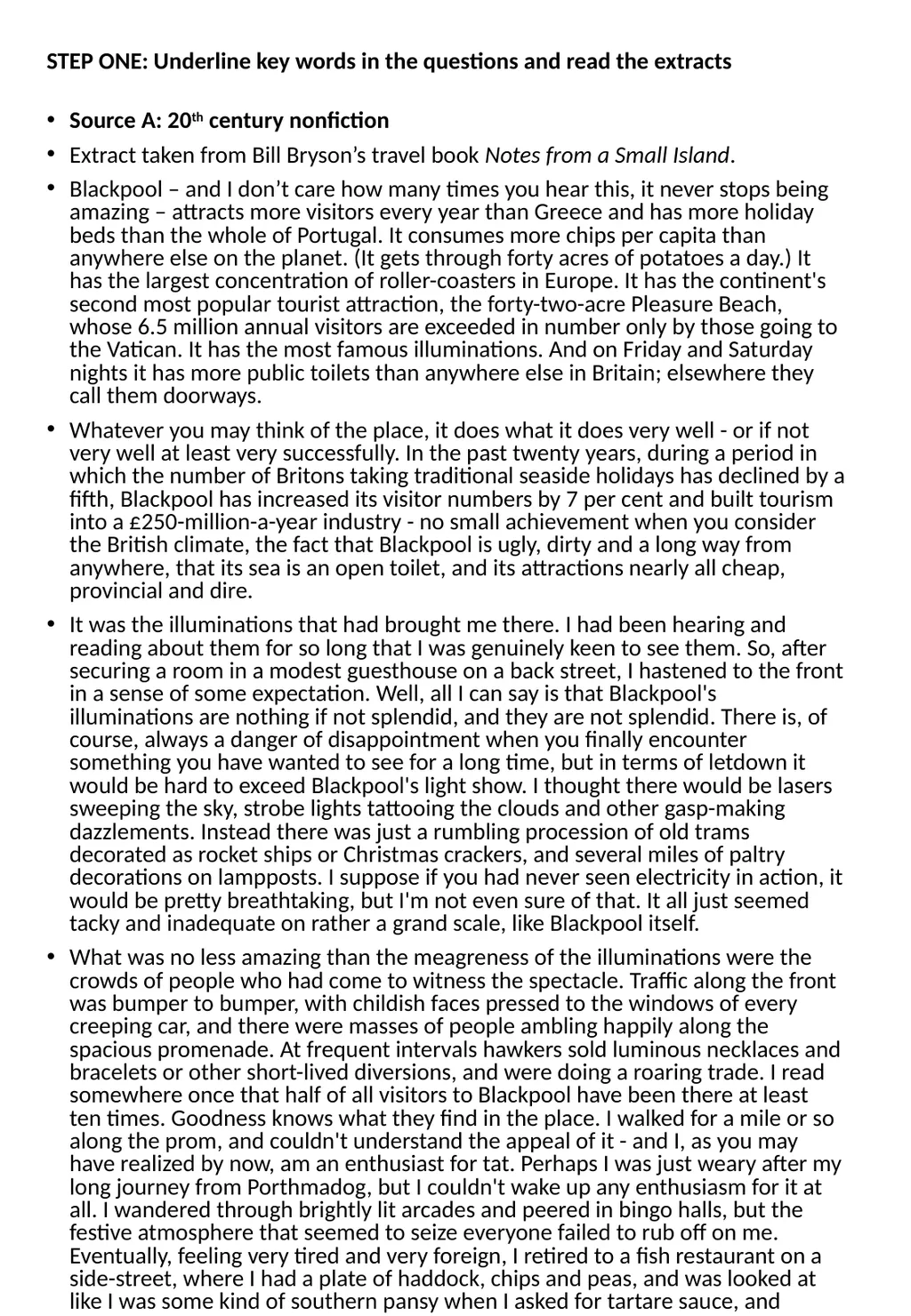
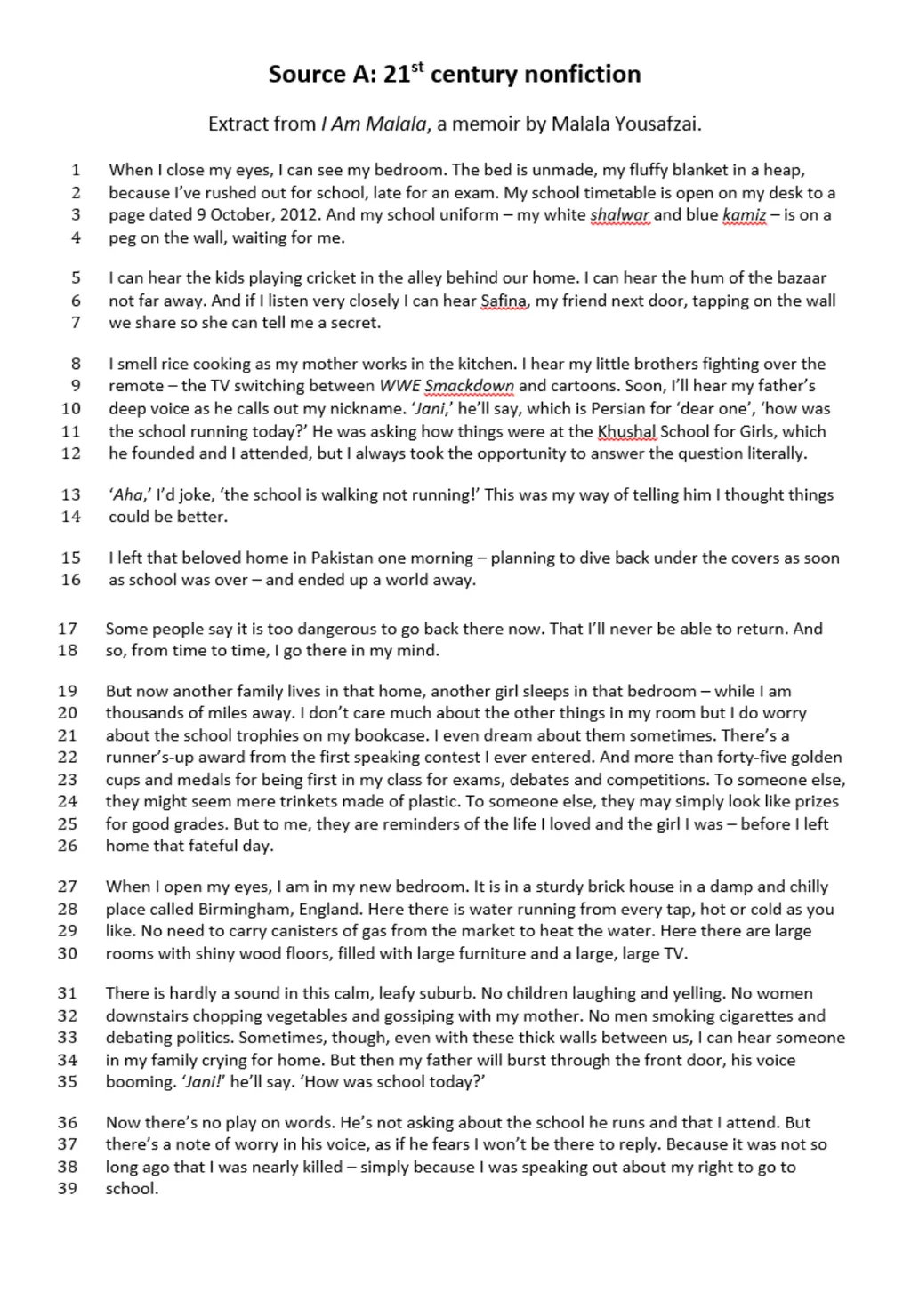
slide3. Source A: 20th century nonfiction
Extract taken from Bill Bryson’s travel book Notes from a Small Island.
Blackpool – and I don’t care how many times you hear this, it never stops being amazing – attracts more visitors every year than Greece and has more holiday beds than the whole of Portugal. It consumes more chips per capita than anywhere else on the planet. (It gets through forty acres of potatoes a day.) It has the largest concentration of roller-coasters in Europe. It has the continent's second most popular tourist attraction, the forty-two-acre Pleasure Beach, whose 6.5 million annual visitors are exceeded in number only by those going to the Vatican. It has the most famous illuminations. And on Friday and Saturday nights it has more public toilets than anywhere else in Britain; elsewhere they call them doorways.
Whatever you may think of the place, it does what it does very well - or if not very well at least very successfully. In the past twenty years, during a period in which the number of Britons taking traditional seaside holidays has declined by a fifth, Blackpool has increased its visitor numbers by 7 per cent and built tourism into a £250-million-a-year industry - no small achievement when you consider the British climate, the fact that Blackpool is ugly, dirty and a long way from anywhere, that its sea is an open toilet, and its attractions nearly all cheap, provincial and dire.
It was the illuminations that had brought me there. I had been hearing and reading about them for so long that I was genuinely keen to see them. So, after securing a room in a modest guesthouse on a back street, I hastened to the front in a sense of some expectation. Well, all I can say is that Blackpool's illuminations are nothing if not splendid, and they are not splendid. There is, of course, always a danger of disappointment when you finally encounter something you have wanted to see for a long time, but in terms of letdown it would be hard to exceed Blackpool's light show. I thought there would be lasers sweeping the sky, strobe lights tattooing the clouds and other gasp-making dazzlements. Instead there was just a rumbling procession of old trams decorated as rocket ships or Christmas crackers, and several miles of paltry decorations on lampposts. I suppose if you had never seen electricity in action, it would be pretty breathtaking, but I'm not even sure of that. It all just seemed tacky and inadequate on rather a grand scale, like Blackpool itself.
What was no less amazing than the meagreness of the illuminations were the crowds of people who had come to witness the spectacle. Traffic along the front was bumper to bumper, with childish faces pressed to the windows of every creeping car, and there were masses of people ambling happily along the spacious promenade. At frequent intervals hawkers sold luminous necklaces and bracelets or other short-lived diversions, and were doing a roaring trade. I read somewhere once that half of all visitors to Blackpool have been there at least ten times. Goodness knows what they find in the place. I walked for a mile or so along the prom, and couldn't understand the appeal of it - and I, as you may have realized by now, am an enthusiast for tat. Perhaps I was just weary after my long journey from Porthmadog, but I couldn't wake up any enthusiasm for it at all. I wandered through brightly lit arcades and peered in bingo halls, but the festive atmosphere that seemed to seize everyone failed to rub off on me. Eventually, feeling very tired and very foreign, I retired to a fish restaurant on a side-street, where I had a plate of haddock, chips and peas, and was looked at like I was some kind of southern pansy when I asked for tartare sauce, and afterwards took yet another early night. STEP ONE: Underline key words in the questions and read the extracts<br>
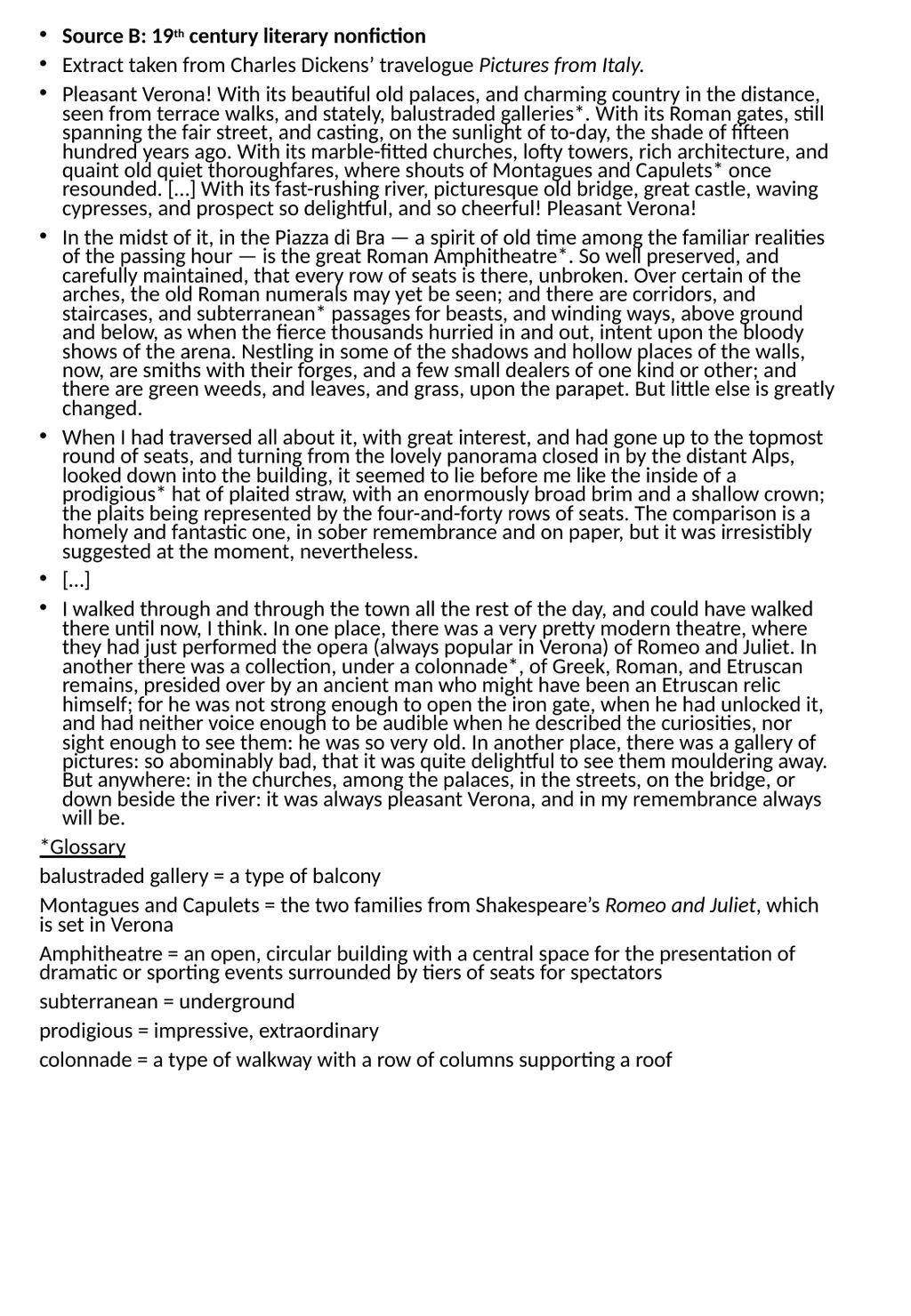
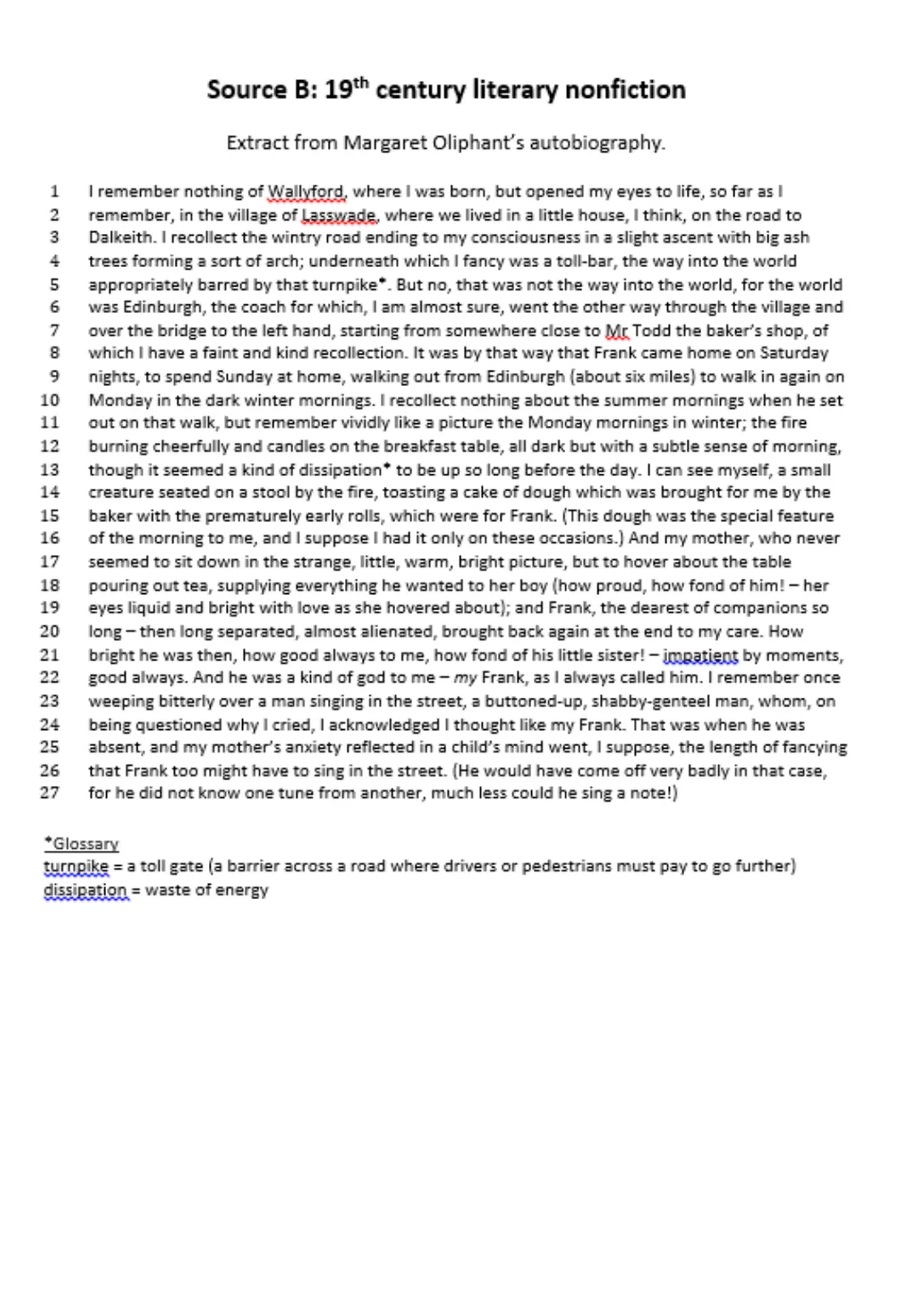
slide4. Source B: 19th century literary nonfiction
Extract taken from Charles Dickens’ travelogue Pictures from Italy.
Pleasant Verona! With its beautiful old palaces, and charming country in the distance, seen from terrace walks, and stately, balustraded galleries*. With its Roman gates, still spanning the fair street, and casting, on the sunlight of to-day, the shade of fifteen hundred years ago. With its marble-fitted churches, lofty towers, rich architecture, and quaint old quiet thoroughfares, where shouts of Montagues and Capulets* once resounded. […] With its fast-rushing river, picturesque old bridge, great castle, waving cypresses, and prospect so delightful, and so cheerful! Pleasant Verona!
In the midst of it, in the Piazza di Bra — a spirit of old time among the familiar realities of the passing hour — is the great Roman Amphitheatre*. So well preserved, and carefully maintained, that every row of seats is there, unbroken. Over certain of the arches, the old Roman numerals may yet be seen; and there are corridors, and staircases, and subterranean* passages for beasts, and winding ways, above ground and below, as when the fierce thousands hurried in and out, intent upon the bloody shows of the arena. Nestling in some of the shadows and hollow places of the walls, now, are smiths with their forges, and a few small dealers of one kind or other; and there are green weeds, and leaves, and grass, upon the parapet. But little else is greatly changed.
When I had traversed all about it, with great interest, and had gone up to the topmost round of seats, and turning from the lovely panorama closed in by the distant Alps, looked down into the building, it seemed to lie before me like the inside of a prodigious* hat of plaited straw, with an enormously broad brim and a shallow crown; the plaits being represented by the four-and-forty rows of seats. The comparison is a homely and fantastic one, in sober remembrance and on paper, but it was irresistibly suggested at the moment, nevertheless.
[…]
I walked through and through the town all the rest of the day, and could have walked there until now, I think. In one place, there was a very pretty modern theatre, where they had just performed the opera (always popular in Verona) of Romeo and Juliet. In another there was a collection, under a colonnade*, of Greek, Roman, and Etruscan remains, presided over by an ancient man who might have been an Etruscan relic himself; for he was not strong enough to open the iron gate, when he had unlocked it, and had neither voice enough to be audible when he described the curiosities, nor sight enough to see them: he was so very old. In another place, there was a gallery of pictures: so abominably bad, that it was quite delightful to see them mouldering away. But anywhere: in the churches, among the palaces, in the streets, on the bridge, or down beside the river: it was always pleasant Verona, and in my remembrance always will be.
*Glossary
balustraded gallery = a type of balcony
Montagues and Capulets = the two families from Shakespeare’s Romeo and Juliet, which is set in Verona
Amphitheatre = an open, circular building with a central space for the presentation of dramatic or sporting events surrounded by tiers of seats for spectators
subterranean = underground
prodigious = impressive, extraordinary
colonnade = a type of walkway with a row of columns supporting a roof<br>
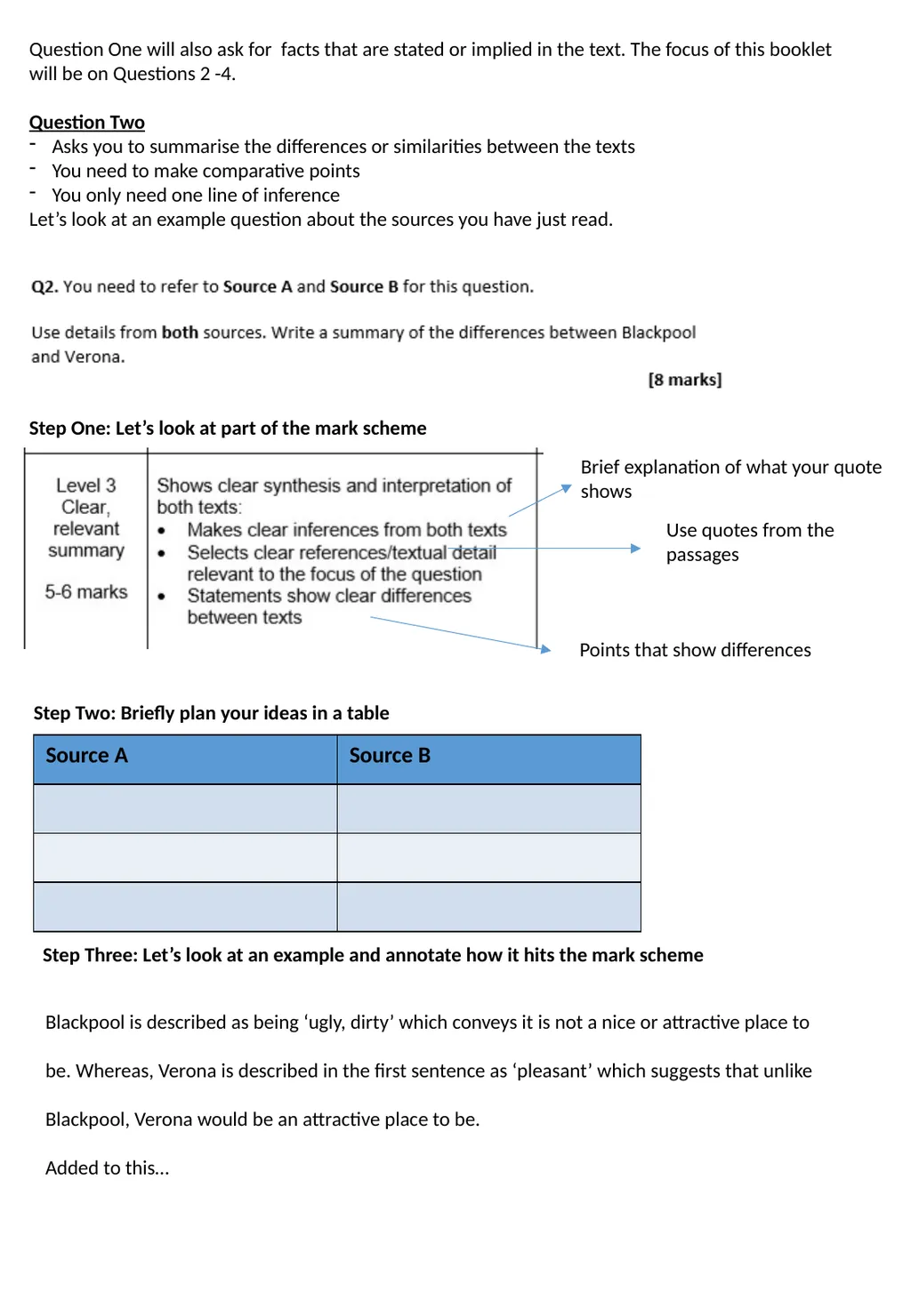
slide5. Question One will also ask for facts that are stated or implied in the text. The focus of this booklet will be on Questions 2 -4.
Question Two
Asks you to summarise the differences or similarities between the texts
You need to make comparative points
You only need one line of inference
Let’s look at an example question about the sources you have just read. Step One: Let’s look at part of the mark scheme Brief explanation of what your quote shows Use quotes from the passages Points that show differences Step Two: Briefly plan your ideas in a table Step Three: Let’s look at an example and annotate how it hits the mark scheme Blackpool is described as being ‘ugly, dirty’ which conveys it is not a nice or attractive place to
be. Whereas, Verona is described in the first sentence as ‘pleasant’ which suggests that unlike
Blackpool, Verona would be an attractive place to be.
Added to this…<br>
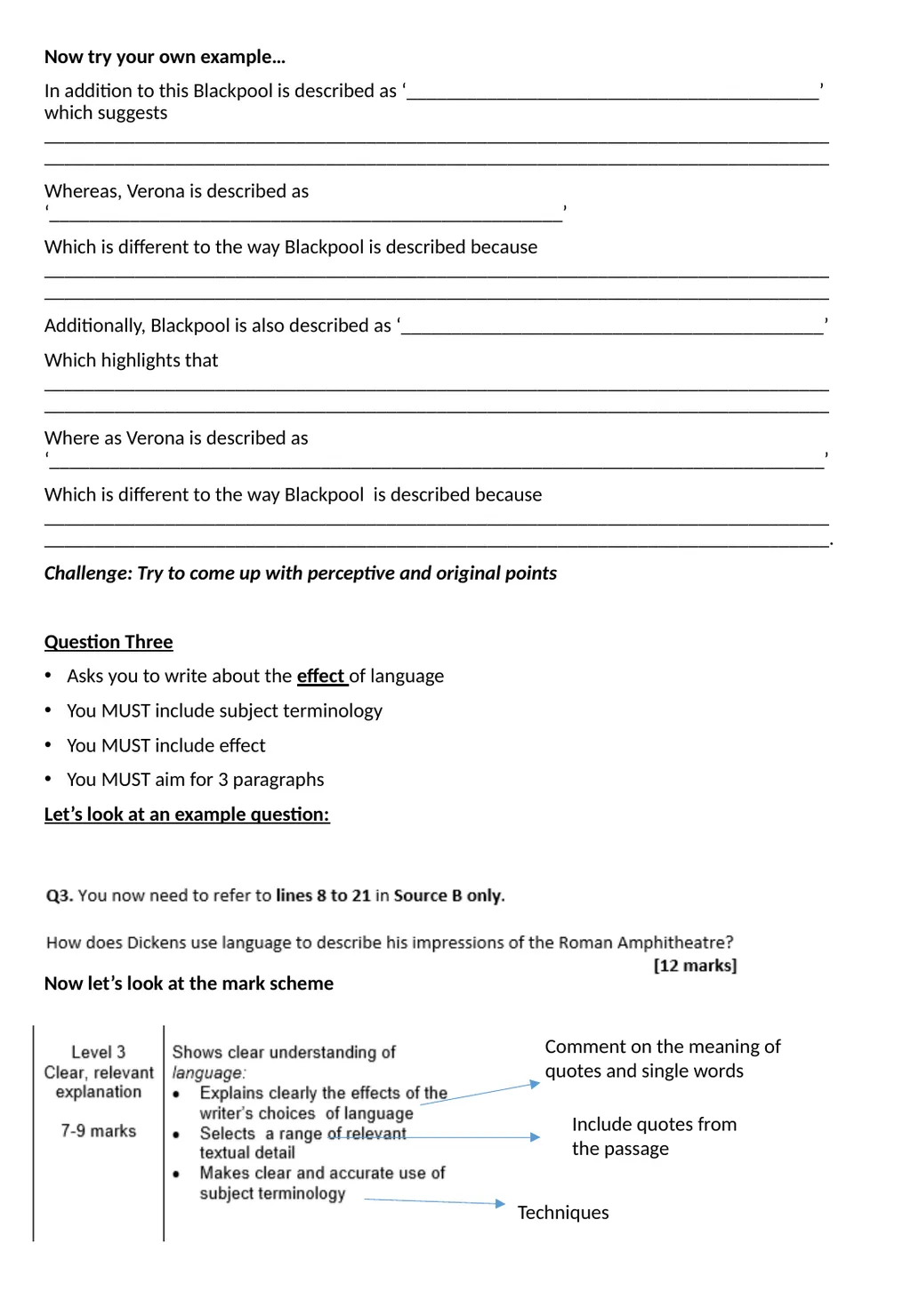
slide6. Now try your own example…
In addition to this Blackpool is described as ‘_________________________________________’ which suggests ____________________________________________________________________________________________________________________________________________________________
Whereas, Verona is described as ‘___________________________________________________’
Which is different to the way Blackpool is described because ____________________________________________________________________________________________________________________________________________________________
Additionally, Blackpool is also described as ‘__________________________________________’
Which highlights that ____________________________________________________________________________________________________________________________________________________________
Where as Verona is described as ‘_____________________________________________________________________________’
Which is different to the way Blackpool is described because ____________________________________________________________________________________________________________________________________________________________.
Challenge: Try to come up with perceptive and original points
Question Three
Asks you to write about the effect of language
You MUST include subject terminology
You MUST include effect
You MUST aim for 3 paragraphs
Let’s look at an example question: Now let’s look at the mark scheme Comment on the meaning of quotes and single words Include quotes from the passage Techniques<br>
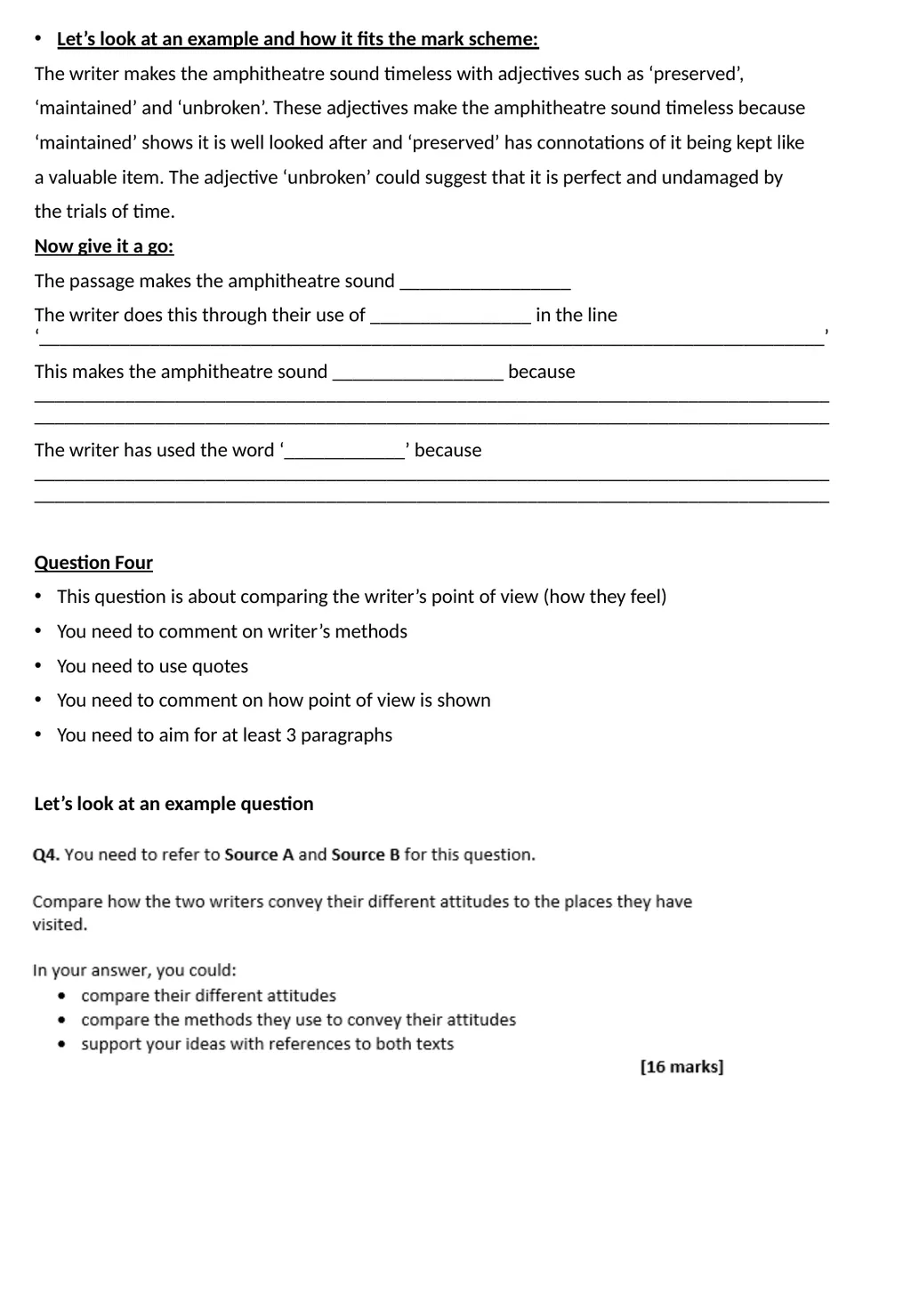
slide7. Let’s look at an example and how it fits the mark scheme:
The writer makes the amphitheatre sound timeless with adjectives such as ‘preserved’,
‘maintained’ and ‘unbroken’. These adjectives make the amphitheatre sound timeless because
‘maintained’ shows it is well looked after and ‘preserved’ has connotations of it being kept like
a valuable item. The adjective ‘unbroken’ could suggest that it is perfect and undamaged by
the trials of time.
Now give it a go:
The passage makes the amphitheatre sound _________________
The writer does this through their use of ________________ in the line ‘______________________________________________________________________________’
This makes the amphitheatre sound _________________ because ______________________________________________________________________________________________________________________________________________________________
The writer has used the word ‘____________’ because ______________________________________________________________________________________________________________________________________________________________
Question Four
This question is about comparing the writer’s point of view (how they feel)
You need to comment on writer’s methods
You need to use quotes
You need to comment on how point of view is shown
You need to aim for at least 3 paragraphs
Let’s look at an example question<br>
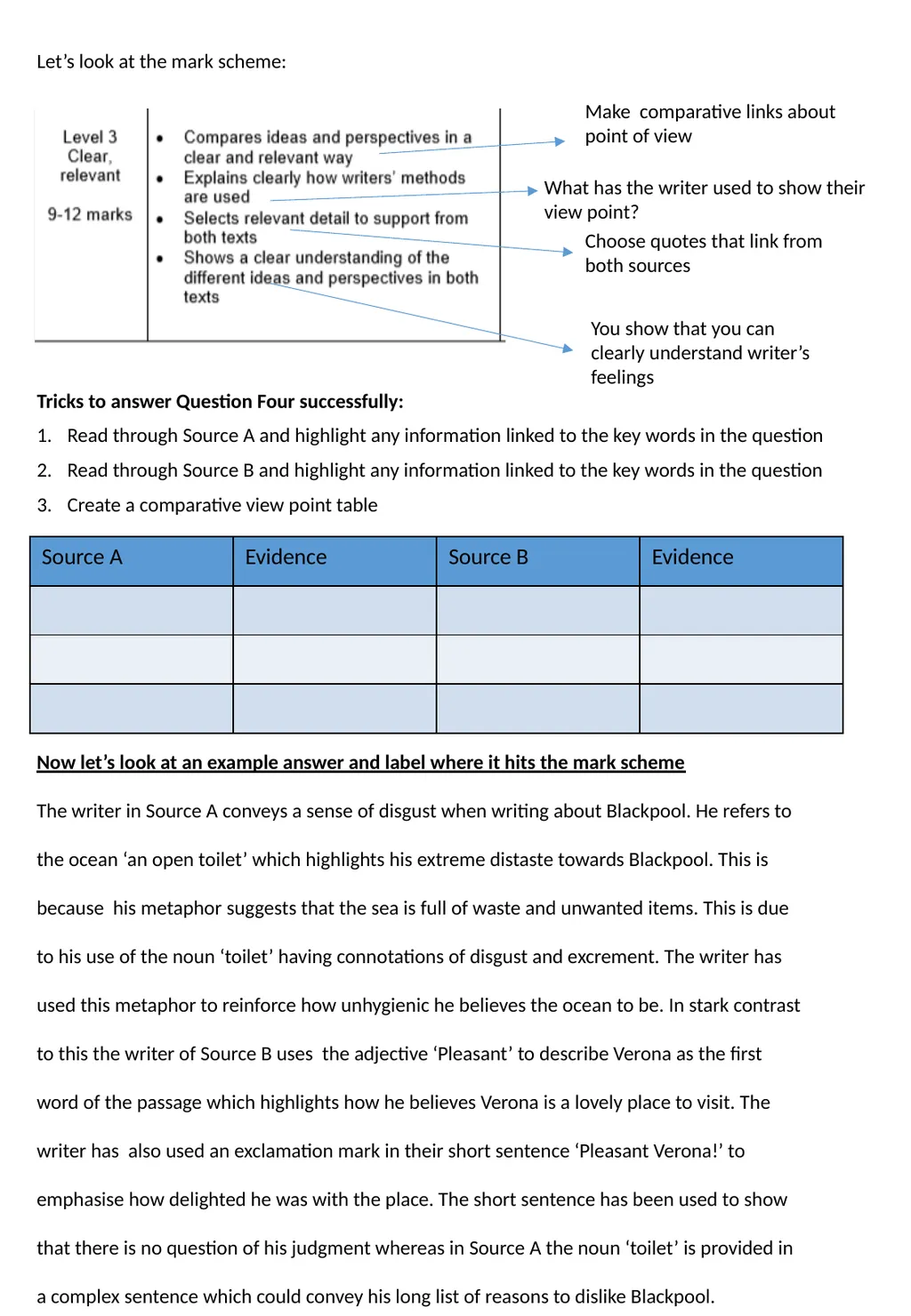
slide8. Let’s look at the mark scheme:
Tricks to answer Question Four successfully:
Read through Source A and highlight any information linked to the key words in the question
Read through Source B and highlight any information linked to the key words in the question
Create a comparative view point table Make comparative links about point of view What has the writer used to show their view point? Choose quotes that link from both sources You show that you can clearly understand writer’s feelings Now let’s look at an example answer and label where it hits the mark scheme
The writer in Source A conveys a sense of disgust when writing about Blackpool. He refers to
the ocean ‘an open toilet’ which highlights his extreme distaste towards Blackpool. This is
because his metaphor suggests that the sea is full of waste and unwanted items. This is due
to his use of the noun ‘toilet’ having connotations of disgust and excrement. The writer has
used this metaphor to reinforce how unhygienic he believes the ocean to be. In stark contrast
to this the writer of Source B uses the adjective ‘Pleasant’ to describe Verona as the first
word of the passage which highlights how he believes Verona is a lovely place to visit. The
writer has also used an exclamation mark in their short sentence ‘Pleasant Verona!’ to
emphasise how delighted he was with the place. The short sentence has been used to show
that there is no question of his judgment whereas in Source A the noun ‘toilet’ is provided in
a complex sentence which could convey his long list of reasons to dislike Blackpool.<br>
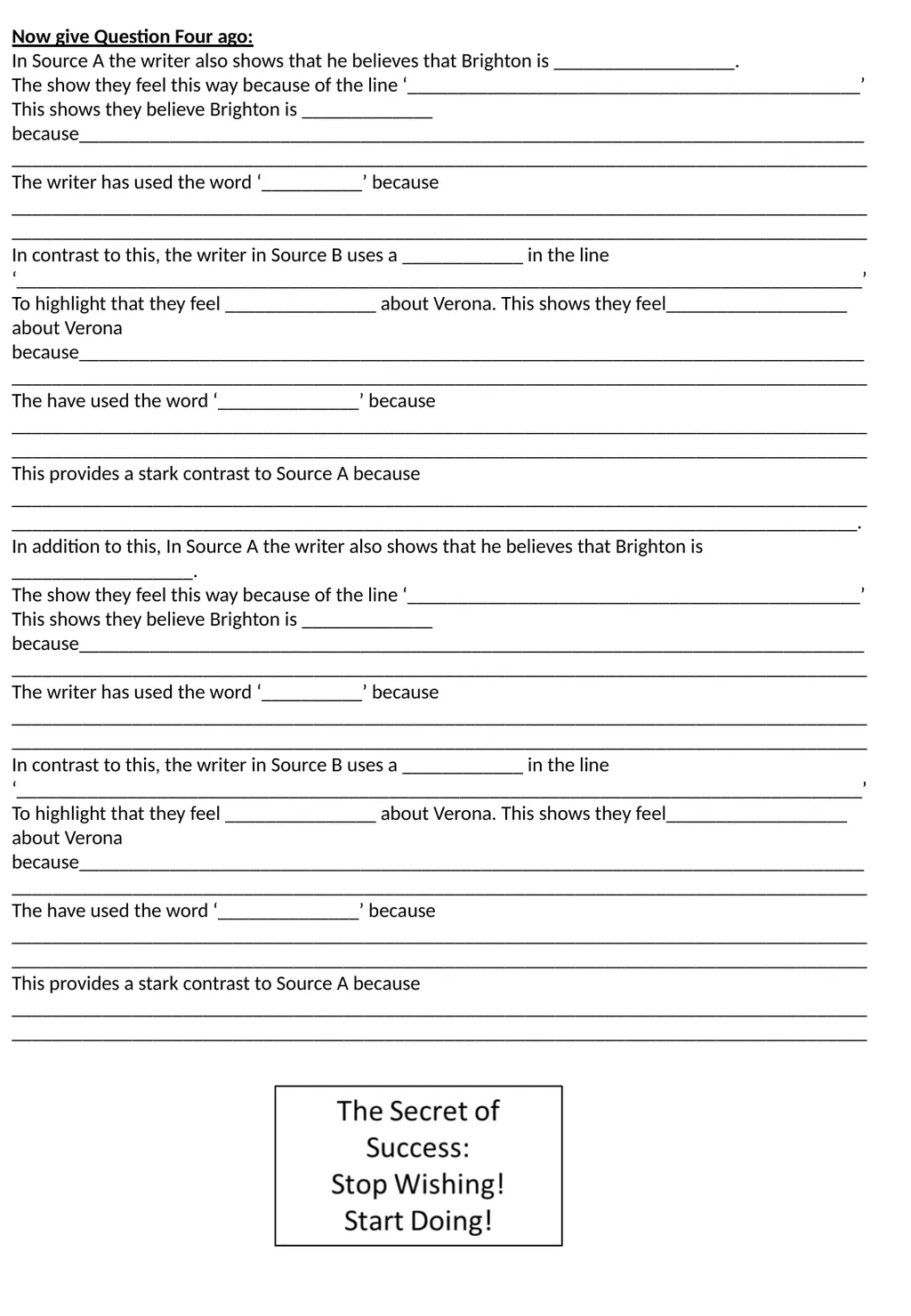
slide9. Now give Question Four ago:
In Source A the writer also shows that he believes that Brighton is __________________.
The show they feel this way because of the line ‘_____________________________________________’
This shows they believe Brighton is _____________ because___________________________________________________________________________________________________________________________________________________________________
The writer has used the word ‘__________’ because __________________________________________________________________________________________________________________________________________________________________________
In contrast to this, the writer in Source B uses a ____________ in the line ‘____________________________________________________________________________________’
To highlight that they feel _______________ about Verona. This shows they feel__________________ about Verona because___________________________________________________________________________________________________________________________________________________________________The have used the word ‘______________’ because __________________________________________________________________________________________________________________________________________________________________________
This provides a stark contrast to Source A because _________________________________________________________________________________________________________________________________________________________________________.
In addition to this, In Source A the writer also shows that he believes that Brighton is __________________.
The show they feel this way because of the line ‘_____________________________________________’
This shows they believe Brighton is _____________ because___________________________________________________________________________________________________________________________________________________________________
The writer has used the word ‘__________’ because __________________________________________________________________________________________________________________________________________________________________________
In contrast to this, the writer in Source B uses a ____________ in the line ‘____________________________________________________________________________________’
To highlight that they feel _______________ about Verona. This shows they feel__________________ about Verona because___________________________________________________________________________________________________________________________________________________________________The have used the word ‘______________’ because __________________________________________________________________________________________________________________________________________________________________________
This provides a stark contrast to Source A because __________________________________________________________________________________________________________________________________________________________________________<br>
Teacher: ___________________________________________
Class: _____________________________________________ The Secret of Success:
Stop Wishing!
Start Doing!<br>
slide2. What do your Language exams look like? This booklet is based on this paper<br>
slide3. Source A: 20th century nonfiction
Extract taken from Bill Bryson’s travel book Notes from a Small Island.
Blackpool – and I don’t care how many times you hear this, it never stops being amazing – attracts more visitors every year than Greece and has more holiday beds than the whole of Portugal. It consumes more chips per capita than anywhere else on the planet. (It gets through forty acres of potatoes a day.) It has the largest concentration of roller-coasters in Europe. It has the continent's second most popular tourist attraction, the forty-two-acre Pleasure Beach, whose 6.5 million annual visitors are exceeded in number only by those going to the Vatican. It has the most famous illuminations. And on Friday and Saturday nights it has more public toilets than anywhere else in Britain; elsewhere they call them doorways.
Whatever you may think of the place, it does what it does very well - or if not very well at least very successfully. In the past twenty years, during a period in which the number of Britons taking traditional seaside holidays has declined by a fifth, Blackpool has increased its visitor numbers by 7 per cent and built tourism into a £250-million-a-year industry - no small achievement when you consider the British climate, the fact that Blackpool is ugly, dirty and a long way from anywhere, that its sea is an open toilet, and its attractions nearly all cheap, provincial and dire.
It was the illuminations that had brought me there. I had been hearing and reading about them for so long that I was genuinely keen to see them. So, after securing a room in a modest guesthouse on a back street, I hastened to the front in a sense of some expectation. Well, all I can say is that Blackpool's illuminations are nothing if not splendid, and they are not splendid. There is, of course, always a danger of disappointment when you finally encounter something you have wanted to see for a long time, but in terms of letdown it would be hard to exceed Blackpool's light show. I thought there would be lasers sweeping the sky, strobe lights tattooing the clouds and other gasp-making dazzlements. Instead there was just a rumbling procession of old trams decorated as rocket ships or Christmas crackers, and several miles of paltry decorations on lampposts. I suppose if you had never seen electricity in action, it would be pretty breathtaking, but I'm not even sure of that. It all just seemed tacky and inadequate on rather a grand scale, like Blackpool itself.
What was no less amazing than the meagreness of the illuminations were the crowds of people who had come to witness the spectacle. Traffic along the front was bumper to bumper, with childish faces pressed to the windows of every creeping car, and there were masses of people ambling happily along the spacious promenade. At frequent intervals hawkers sold luminous necklaces and bracelets or other short-lived diversions, and were doing a roaring trade. I read somewhere once that half of all visitors to Blackpool have been there at least ten times. Goodness knows what they find in the place. I walked for a mile or so along the prom, and couldn't understand the appeal of it - and I, as you may have realized by now, am an enthusiast for tat. Perhaps I was just weary after my long journey from Porthmadog, but I couldn't wake up any enthusiasm for it at all. I wandered through brightly lit arcades and peered in bingo halls, but the festive atmosphere that seemed to seize everyone failed to rub off on me. Eventually, feeling very tired and very foreign, I retired to a fish restaurant on a side-street, where I had a plate of haddock, chips and peas, and was looked at like I was some kind of southern pansy when I asked for tartare sauce, and afterwards took yet another early night. STEP ONE: Underline key words in the questions and read the extracts<br>
slide4. Source B: 19th century literary nonfiction
Extract taken from Charles Dickens’ travelogue Pictures from Italy.
Pleasant Verona! With its beautiful old palaces, and charming country in the distance, seen from terrace walks, and stately, balustraded galleries*. With its Roman gates, still spanning the fair street, and casting, on the sunlight of to-day, the shade of fifteen hundred years ago. With its marble-fitted churches, lofty towers, rich architecture, and quaint old quiet thoroughfares, where shouts of Montagues and Capulets* once resounded. […] With its fast-rushing river, picturesque old bridge, great castle, waving cypresses, and prospect so delightful, and so cheerful! Pleasant Verona!
In the midst of it, in the Piazza di Bra — a spirit of old time among the familiar realities of the passing hour — is the great Roman Amphitheatre*. So well preserved, and carefully maintained, that every row of seats is there, unbroken. Over certain of the arches, the old Roman numerals may yet be seen; and there are corridors, and staircases, and subterranean* passages for beasts, and winding ways, above ground and below, as when the fierce thousands hurried in and out, intent upon the bloody shows of the arena. Nestling in some of the shadows and hollow places of the walls, now, are smiths with their forges, and a few small dealers of one kind or other; and there are green weeds, and leaves, and grass, upon the parapet. But little else is greatly changed.
When I had traversed all about it, with great interest, and had gone up to the topmost round of seats, and turning from the lovely panorama closed in by the distant Alps, looked down into the building, it seemed to lie before me like the inside of a prodigious* hat of plaited straw, with an enormously broad brim and a shallow crown; the plaits being represented by the four-and-forty rows of seats. The comparison is a homely and fantastic one, in sober remembrance and on paper, but it was irresistibly suggested at the moment, nevertheless.
[…]
I walked through and through the town all the rest of the day, and could have walked there until now, I think. In one place, there was a very pretty modern theatre, where they had just performed the opera (always popular in Verona) of Romeo and Juliet. In another there was a collection, under a colonnade*, of Greek, Roman, and Etruscan remains, presided over by an ancient man who might have been an Etruscan relic himself; for he was not strong enough to open the iron gate, when he had unlocked it, and had neither voice enough to be audible when he described the curiosities, nor sight enough to see them: he was so very old. In another place, there was a gallery of pictures: so abominably bad, that it was quite delightful to see them mouldering away. But anywhere: in the churches, among the palaces, in the streets, on the bridge, or down beside the river: it was always pleasant Verona, and in my remembrance always will be.
*Glossary
balustraded gallery = a type of balcony
Montagues and Capulets = the two families from Shakespeare’s Romeo and Juliet, which is set in Verona
Amphitheatre = an open, circular building with a central space for the presentation of dramatic or sporting events surrounded by tiers of seats for spectators
subterranean = underground
prodigious = impressive, extraordinary
colonnade = a type of walkway with a row of columns supporting a roof<br>
slide5. Question One will also ask for facts that are stated or implied in the text. The focus of this booklet will be on Questions 2 -4.
Question Two
Asks you to summarise the differences or similarities between the texts
You need to make comparative points
You only need one line of inference
Let’s look at an example question about the sources you have just read. Step One: Let’s look at part of the mark scheme Brief explanation of what your quote shows Use quotes from the passages Points that show differences Step Two: Briefly plan your ideas in a table Step Three: Let’s look at an example and annotate how it hits the mark scheme Blackpool is described as being ‘ugly, dirty’ which conveys it is not a nice or attractive place to
be. Whereas, Verona is described in the first sentence as ‘pleasant’ which suggests that unlike
Blackpool, Verona would be an attractive place to be.
Added to this…<br>
slide6. Now try your own example…
In addition to this Blackpool is described as ‘_________________________________________’ which suggests ____________________________________________________________________________________________________________________________________________________________
Whereas, Verona is described as ‘___________________________________________________’
Which is different to the way Blackpool is described because ____________________________________________________________________________________________________________________________________________________________
Additionally, Blackpool is also described as ‘__________________________________________’
Which highlights that ____________________________________________________________________________________________________________________________________________________________
Where as Verona is described as ‘_____________________________________________________________________________’
Which is different to the way Blackpool is described because ____________________________________________________________________________________________________________________________________________________________.
Challenge: Try to come up with perceptive and original points
Question Three
Asks you to write about the effect of language
You MUST include subject terminology
You MUST include effect
You MUST aim for 3 paragraphs
Let’s look at an example question: Now let’s look at the mark scheme Comment on the meaning of quotes and single words Include quotes from the passage Techniques<br>
slide7. Let’s look at an example and how it fits the mark scheme:
The writer makes the amphitheatre sound timeless with adjectives such as ‘preserved’,
‘maintained’ and ‘unbroken’. These adjectives make the amphitheatre sound timeless because
‘maintained’ shows it is well looked after and ‘preserved’ has connotations of it being kept like
a valuable item. The adjective ‘unbroken’ could suggest that it is perfect and undamaged by
the trials of time.
Now give it a go:
The passage makes the amphitheatre sound _________________
The writer does this through their use of ________________ in the line ‘______________________________________________________________________________’
This makes the amphitheatre sound _________________ because ______________________________________________________________________________________________________________________________________________________________
The writer has used the word ‘____________’ because ______________________________________________________________________________________________________________________________________________________________
Question Four
This question is about comparing the writer’s point of view (how they feel)
You need to comment on writer’s methods
You need to use quotes
You need to comment on how point of view is shown
You need to aim for at least 3 paragraphs
Let’s look at an example question<br>
slide8. Let’s look at the mark scheme:
Tricks to answer Question Four successfully:
Read through Source A and highlight any information linked to the key words in the question
Read through Source B and highlight any information linked to the key words in the question
Create a comparative view point table Make comparative links about point of view What has the writer used to show their view point? Choose quotes that link from both sources You show that you can clearly understand writer’s feelings Now let’s look at an example answer and label where it hits the mark scheme
The writer in Source A conveys a sense of disgust when writing about Blackpool. He refers to
the ocean ‘an open toilet’ which highlights his extreme distaste towards Blackpool. This is
because his metaphor suggests that the sea is full of waste and unwanted items. This is due
to his use of the noun ‘toilet’ having connotations of disgust and excrement. The writer has
used this metaphor to reinforce how unhygienic he believes the ocean to be. In stark contrast
to this the writer of Source B uses the adjective ‘Pleasant’ to describe Verona as the first
word of the passage which highlights how he believes Verona is a lovely place to visit. The
writer has also used an exclamation mark in their short sentence ‘Pleasant Verona!’ to
emphasise how delighted he was with the place. The short sentence has been used to show
that there is no question of his judgment whereas in Source A the noun ‘toilet’ is provided in
a complex sentence which could convey his long list of reasons to dislike Blackpool.<br>
slide9. Now give Question Four ago:
In Source A the writer also shows that he believes that Brighton is __________________.
The show they feel this way because of the line ‘_____________________________________________’
This shows they believe Brighton is _____________ because___________________________________________________________________________________________________________________________________________________________________
The writer has used the word ‘__________’ because __________________________________________________________________________________________________________________________________________________________________________
In contrast to this, the writer in Source B uses a ____________ in the line ‘____________________________________________________________________________________’
To highlight that they feel _______________ about Verona. This shows they feel__________________ about Verona because___________________________________________________________________________________________________________________________________________________________________The have used the word ‘______________’ because __________________________________________________________________________________________________________________________________________________________________________
This provides a stark contrast to Source A because _________________________________________________________________________________________________________________________________________________________________________.
In addition to this, In Source A the writer also shows that he believes that Brighton is __________________.
The show they feel this way because of the line ‘_____________________________________________’
This shows they believe Brighton is _____________ because___________________________________________________________________________________________________________________________________________________________________
The writer has used the word ‘__________’ because __________________________________________________________________________________________________________________________________________________________________________
In contrast to this, the writer in Source B uses a ____________ in the line ‘____________________________________________________________________________________’
To highlight that they feel _______________ about Verona. This shows they feel__________________ about Verona because___________________________________________________________________________________________________________________________________________________________________The have used the word ‘______________’ because __________________________________________________________________________________________________________________________________________________________________________
This provides a stark contrast to Source A because __________________________________________________________________________________________________________________________________________________________________________<br>