
1 Icons Activating prior knowledge Remember what
T
Published · 31 slides · 0 views
1 / 1


Description
1 Icons Activating prior knowledge Remember what you already know about a topic before you start to learn something new, to help build connections in your long-term memory. Retrieval practice Quizzing, recall and memory activities to slow
Related Topics
Share
Embed code
Download this presentation From Below
"1 Icons Activating prior knowledge Remember what" is the property of its rightful owner. Permission is granted to download and print the materials on this website for personal, non-commercial use only, and to display it on your personal computer provided you do not modify the materials and that you retain all copyright notices contained in the materials. By downloading content from our website, you accept the terms of this agreement.
Presentation Transcript
01
1<br>
02
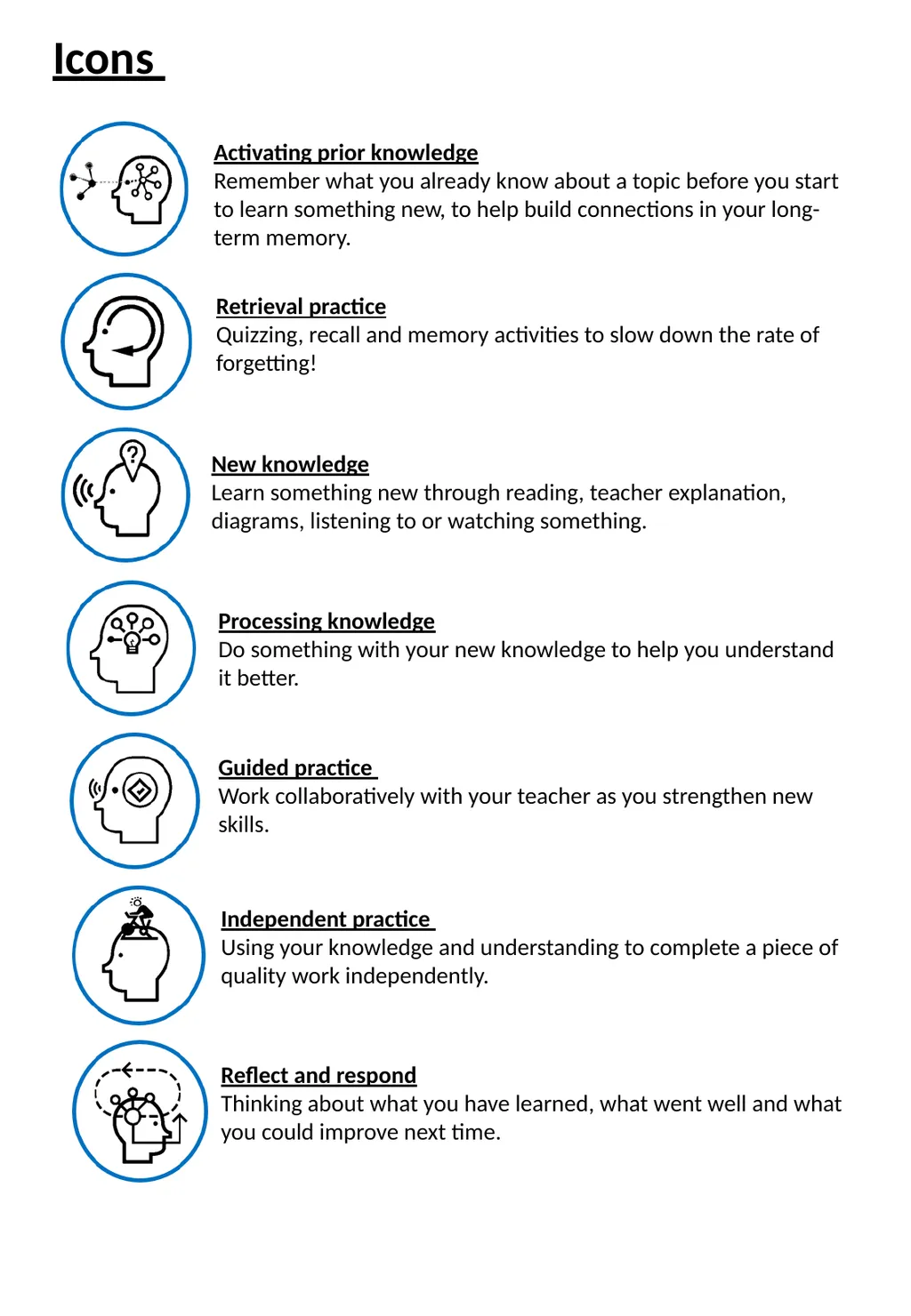
Icons Activating prior knowledge
Remember what you already know about a topic before you start to learn something new, to help build connections in your long-term memory. Retrieval practice
Quizzing, recall and memory activities to slow down the rate of forgetting! New knowledge
Learn something new through reading, teacher explanation, diagrams, listening to or watching something. Processing knowledge
Do something with your new knowledge to help you understand it better. Guided practice
Work collaboratively with your teacher as you strengthen new skills. Independent practice
Using your knowledge and understanding to complete a piece of quality work independently. Reflect and respond
Thinking about what you have learned, what went well and what you could improve next time.<br>
Remember what you already know about a topic before you start to learn something new, to help build connections in your long-term memory. Retrieval practice
Quizzing, recall and memory activities to slow down the rate of forgetting! New knowledge
Learn something new through reading, teacher explanation, diagrams, listening to or watching something. Processing knowledge
Do something with your new knowledge to help you understand it better. Guided practice
Work collaboratively with your teacher as you strengthen new skills. Independent practice
Using your knowledge and understanding to complete a piece of quality work independently. Reflect and respond
Thinking about what you have learned, what went well and what you could improve next time.<br>
03
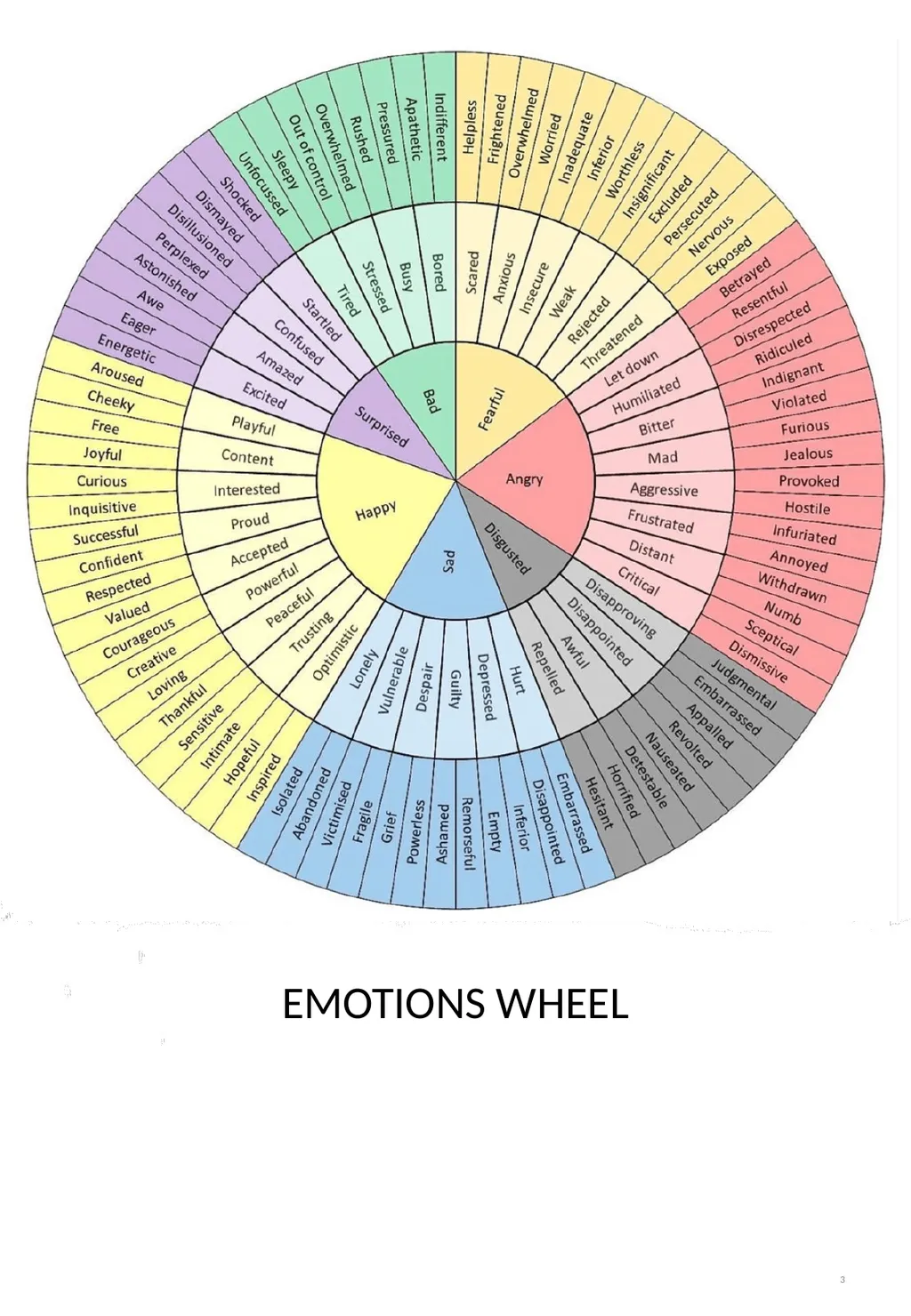
EMOTIONS WHEEL 3<br>
04
4<br>
05
Speeches are alive. They may be ‘written,’ but they are there to be heard, not studied
on the page. They are a performance, and even the same speaker might give the same speech in 20 different ways depending on different audience, venue, time and reaction. It is this interactive nature of speeches that makes them unique; you will receive immediate feedback from an audience in terms of the their body language – or cheering or heckling – in a way that you wouldn’t if you wrote something for people to read. A writer for the page is spared the immediacy and rawness of a live audience. In many ways, this presents a challenge – a good speaker must attempt to marry up the speech they had planned with the one that is most needed for that audience and situation. Every speech is a composite of circumstances, meaning that the ability to adapt, change vocabulary, phrasing, timing, emphasis, prosody and body language is vital to conveying the right message at the right time. Another challenge is that you will rarely be addressing an audience of one! Speakers often have to appeal to a range of different people and groups with varying viewpoints and priorities. This calls for nuance and sensitive judgement.
The opportunity of speaking live, of creating something and having the flexibility to adapt, is an exciting one, though. Writers for the page must have something concrete and final. Writing and delivering a speech is something that is far more fluid, and a truly competent speaker can therefore tailor their message exactly to meet the needs of their listeners at that precise moment in time. The potential power of speeches is enormous.
Listening to a speech is an experience akin to going to a concert or theatre performance – the auditory and visual elements are just as important as the words being said. The best speakers consider their volume and dynamics throughout their performance.
Pace – how quickly or slowly you want to speak. Sometimes you might want to vary your pace depending on what you are saying at the time.
Pauses – even the shortest pause can feel like you are stopping for a very long time, but sometimes it is critical to give your listener some time to process what you have just said. Sometimes it is equally important to give yourself a little break! NEW KNOWLEDGE: Challenges and opportunities of performance
Dame Estelle Morris of Yardley, 2020 5<br>
on the page. They are a performance, and even the same speaker might give the same speech in 20 different ways depending on different audience, venue, time and reaction. It is this interactive nature of speeches that makes them unique; you will receive immediate feedback from an audience in terms of the their body language – or cheering or heckling – in a way that you wouldn’t if you wrote something for people to read. A writer for the page is spared the immediacy and rawness of a live audience. In many ways, this presents a challenge – a good speaker must attempt to marry up the speech they had planned with the one that is most needed for that audience and situation. Every speech is a composite of circumstances, meaning that the ability to adapt, change vocabulary, phrasing, timing, emphasis, prosody and body language is vital to conveying the right message at the right time. Another challenge is that you will rarely be addressing an audience of one! Speakers often have to appeal to a range of different people and groups with varying viewpoints and priorities. This calls for nuance and sensitive judgement.
The opportunity of speaking live, of creating something and having the flexibility to adapt, is an exciting one, though. Writers for the page must have something concrete and final. Writing and delivering a speech is something that is far more fluid, and a truly competent speaker can therefore tailor their message exactly to meet the needs of their listeners at that precise moment in time. The potential power of speeches is enormous.
Listening to a speech is an experience akin to going to a concert or theatre performance – the auditory and visual elements are just as important as the words being said. The best speakers consider their volume and dynamics throughout their performance.
Pace – how quickly or slowly you want to speak. Sometimes you might want to vary your pace depending on what you are saying at the time.
Pauses – even the shortest pause can feel like you are stopping for a very long time, but sometimes it is critical to give your listener some time to process what you have just said. Sometimes it is equally important to give yourself a little break! NEW KNOWLEDGE: Challenges and opportunities of performance
Dame Estelle Morris of Yardley, 2020 5<br>
06
Tone – nobody wants to listen to a speech given entirely in monotone. Variety of tone and prosody helps to convey meaning. Some people have naturally more exciting, varied tone colour to their voice than others. If you are someone with quite a plain tone of voice, consider ways in which you can vary this to emphasise important words and key ideas.
Body language – gestures, facial expression and other movement can significantly affect the way people understand your message. The best rule is to do what feels natural rather than trying to do something that is not comfortable for you. Body language can help to convince your audience that you believe in what you are saying, but this doesn’t need to be dramatic gesticulation and pacing around the stage if this is not your style. It’s also important to remember that very exaggerated body language may actually detract from the message you are trying to convey: try to keep things simple and clear. 6 Summarise they key points Morris makes about the challenges and benefits
of making live speeches…
……………………………………………………………………………………………………………………………………………………………………………………………………………………………………………………………………………………………………………………………………………………………………………………………………………………………………………………………………………………………………………………………………………………………………………………………………………………………………………………………………………………………………………………………………………………………………………………………………………………………………………………………………………………………………………………………………………………………………<br>
Body language – gestures, facial expression and other movement can significantly affect the way people understand your message. The best rule is to do what feels natural rather than trying to do something that is not comfortable for you. Body language can help to convince your audience that you believe in what you are saying, but this doesn’t need to be dramatic gesticulation and pacing around the stage if this is not your style. It’s also important to remember that very exaggerated body language may actually detract from the message you are trying to convey: try to keep things simple and clear. 6 Summarise they key points Morris makes about the challenges and benefits
of making live speeches…
……………………………………………………………………………………………………………………………………………………………………………………………………………………………………………………………………………………………………………………………………………………………………………………………………………………………………………………………………………………………………………………………………………………………………………………………………………………………………………………………………………………………………………………………………………………………………………………………………………………………………………………………………………………………………………………………………………………………………<br>
07
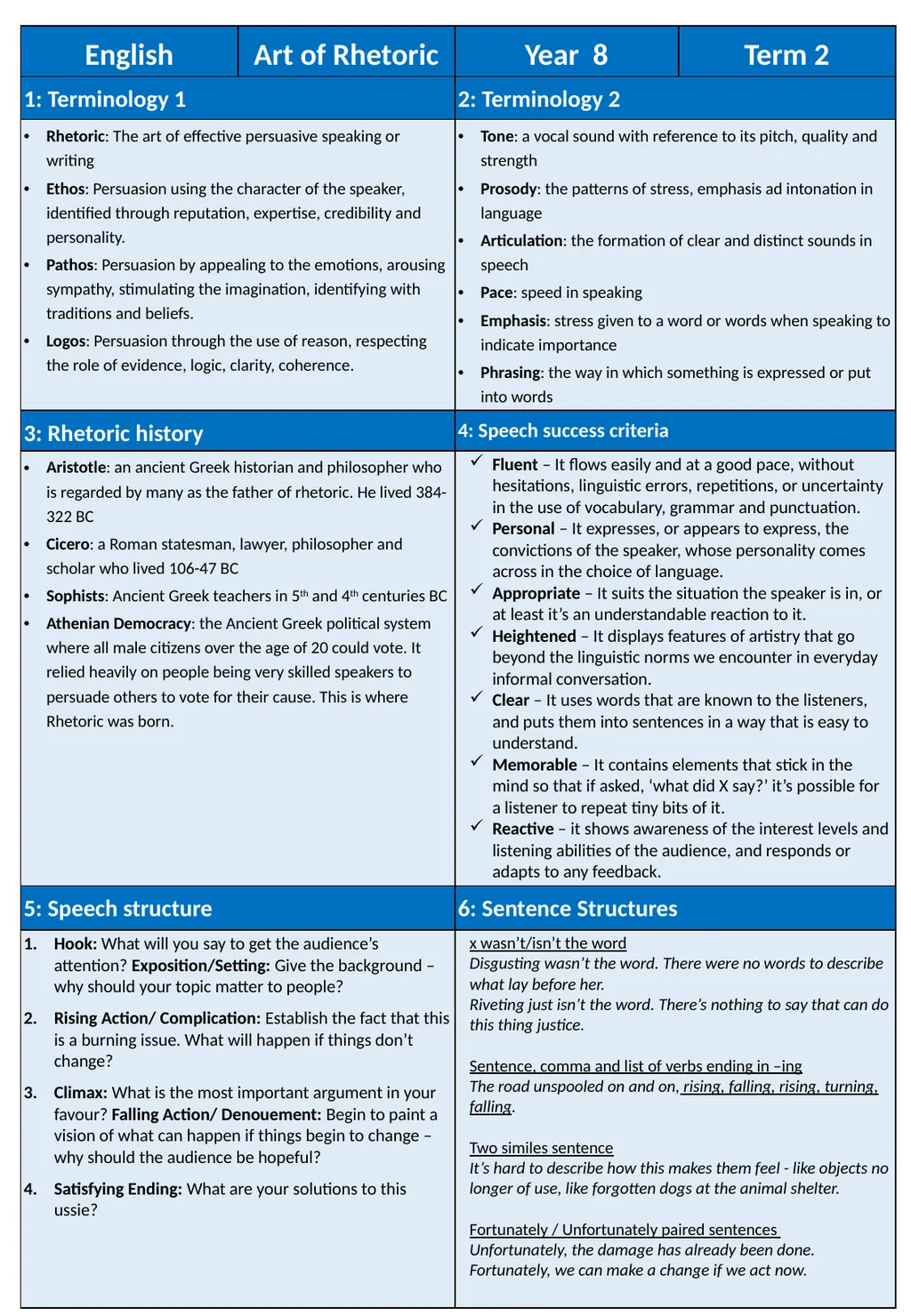
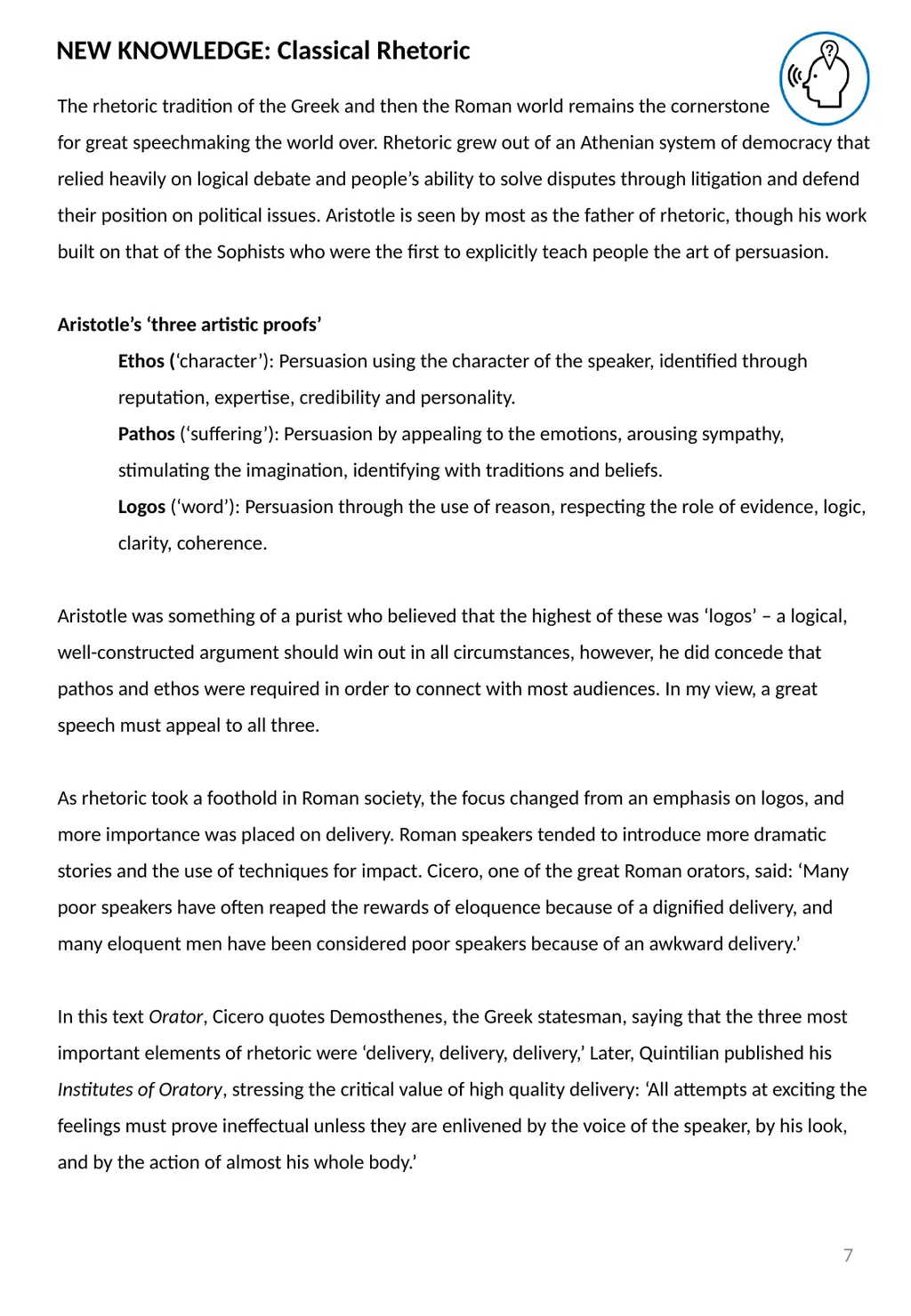
The rhetoric tradition of the Greek and then the Roman world remains the cornerstone
for great speechmaking the world over. Rhetoric grew out of an Athenian system of democracy that relied heavily on logical debate and people’s ability to solve disputes through litigation and defend their position on political issues. Aristotle is seen by most as the father of rhetoric, though his work built on that of the Sophists who were the first to explicitly teach people the art of persuasion.
Aristotle’s ‘three artistic proofs’
Ethos (‘character’): Persuasion using the character of the speaker, identified through reputation, expertise, credibility and personality.
Pathos (‘suffering’): Persuasion by appealing to the emotions, arousing sympathy, stimulating the imagination, identifying with traditions and beliefs.
Logos (‘word’): Persuasion through the use of reason, respecting the role of evidence, logic, clarity, coherence.
Aristotle was something of a purist who believed that the highest of these was ‘logos’ – a logical, well-constructed argument should win out in all circumstances, however, he did concede that pathos and ethos were required in order to connect with most audiences. In my view, a great speech must appeal to all three.
As rhetoric took a foothold in Roman society, the focus changed from an emphasis on logos, and more importance was placed on delivery. Roman speakers tended to introduce more dramatic stories and the use of techniques for impact. Cicero, one of the great Roman orators, said: ‘Many poor speakers have often reaped the rewards of eloquence because of a dignified delivery, and many eloquent men have been considered poor speakers because of an awkward delivery.’
In this text Orator, Cicero quotes Demosthenes, the Greek statesman, saying that the three most important elements of rhetoric were ‘delivery, delivery, delivery,’ Later, Quintilian published his Institutes of Oratory, stressing the critical value of high quality delivery: ‘All attempts at exciting the feelings must prove ineffectual unless they are enlivened by the voice of the speaker, by his look, and by the action of almost his whole body.’ NEW KNOWLEDGE: Classical Rhetoric 7<br>
for great speechmaking the world over. Rhetoric grew out of an Athenian system of democracy that relied heavily on logical debate and people’s ability to solve disputes through litigation and defend their position on political issues. Aristotle is seen by most as the father of rhetoric, though his work built on that of the Sophists who were the first to explicitly teach people the art of persuasion.
Aristotle’s ‘three artistic proofs’
Ethos (‘character’): Persuasion using the character of the speaker, identified through reputation, expertise, credibility and personality.
Pathos (‘suffering’): Persuasion by appealing to the emotions, arousing sympathy, stimulating the imagination, identifying with traditions and beliefs.
Logos (‘word’): Persuasion through the use of reason, respecting the role of evidence, logic, clarity, coherence.
Aristotle was something of a purist who believed that the highest of these was ‘logos’ – a logical, well-constructed argument should win out in all circumstances, however, he did concede that pathos and ethos were required in order to connect with most audiences. In my view, a great speech must appeal to all three.
As rhetoric took a foothold in Roman society, the focus changed from an emphasis on logos, and more importance was placed on delivery. Roman speakers tended to introduce more dramatic stories and the use of techniques for impact. Cicero, one of the great Roman orators, said: ‘Many poor speakers have often reaped the rewards of eloquence because of a dignified delivery, and many eloquent men have been considered poor speakers because of an awkward delivery.’
In this text Orator, Cicero quotes Demosthenes, the Greek statesman, saying that the three most important elements of rhetoric were ‘delivery, delivery, delivery,’ Later, Quintilian published his Institutes of Oratory, stressing the critical value of high quality delivery: ‘All attempts at exciting the feelings must prove ineffectual unless they are enlivened by the voice of the speaker, by his look, and by the action of almost his whole body.’ NEW KNOWLEDGE: Classical Rhetoric 7<br>
08
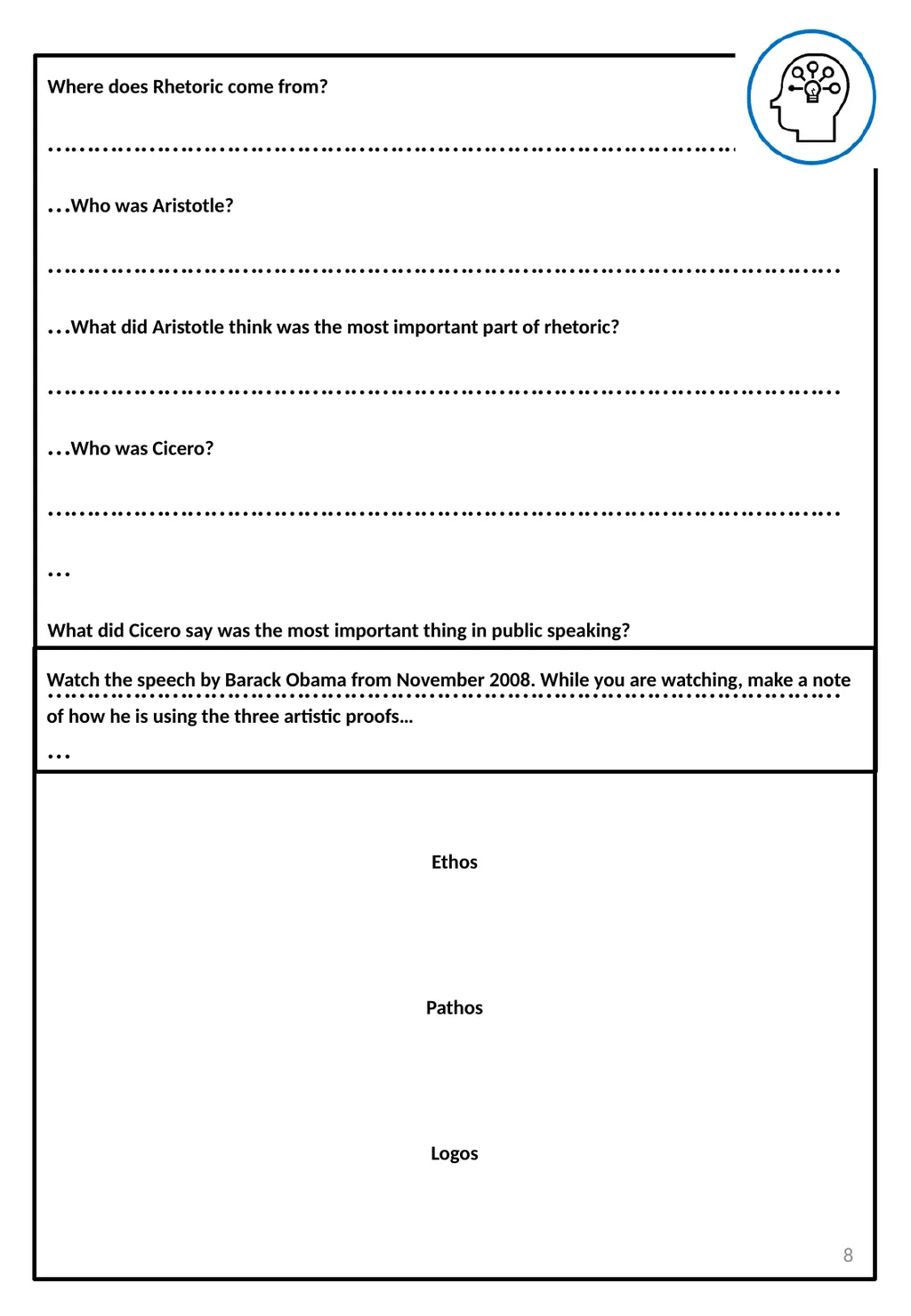
8 Where does Rhetoric come from?
……………………………………………………………………………………………Who was Aristotle? ……………………………………………………………………………………………What did Aristotle think was the most important part of rhetoric? ……………………………………………………………………………………………Who was Cicero? ……………………………………………………………………………………………
What did Cicero say was the most important thing in public speaking? …………………………………………………………………………………………… Watch the speech by Barack Obama from November 2008. While you are watching, make a note of how he is using the three artistic proofs…
Ethos
Pathos
Logos<br>
……………………………………………………………………………………………Who was Aristotle? ……………………………………………………………………………………………What did Aristotle think was the most important part of rhetoric? ……………………………………………………………………………………………Who was Cicero? ……………………………………………………………………………………………
What did Cicero say was the most important thing in public speaking? …………………………………………………………………………………………… Watch the speech by Barack Obama from November 2008. While you are watching, make a note of how he is using the three artistic proofs…
Ethos
Pathos
Logos<br>
09
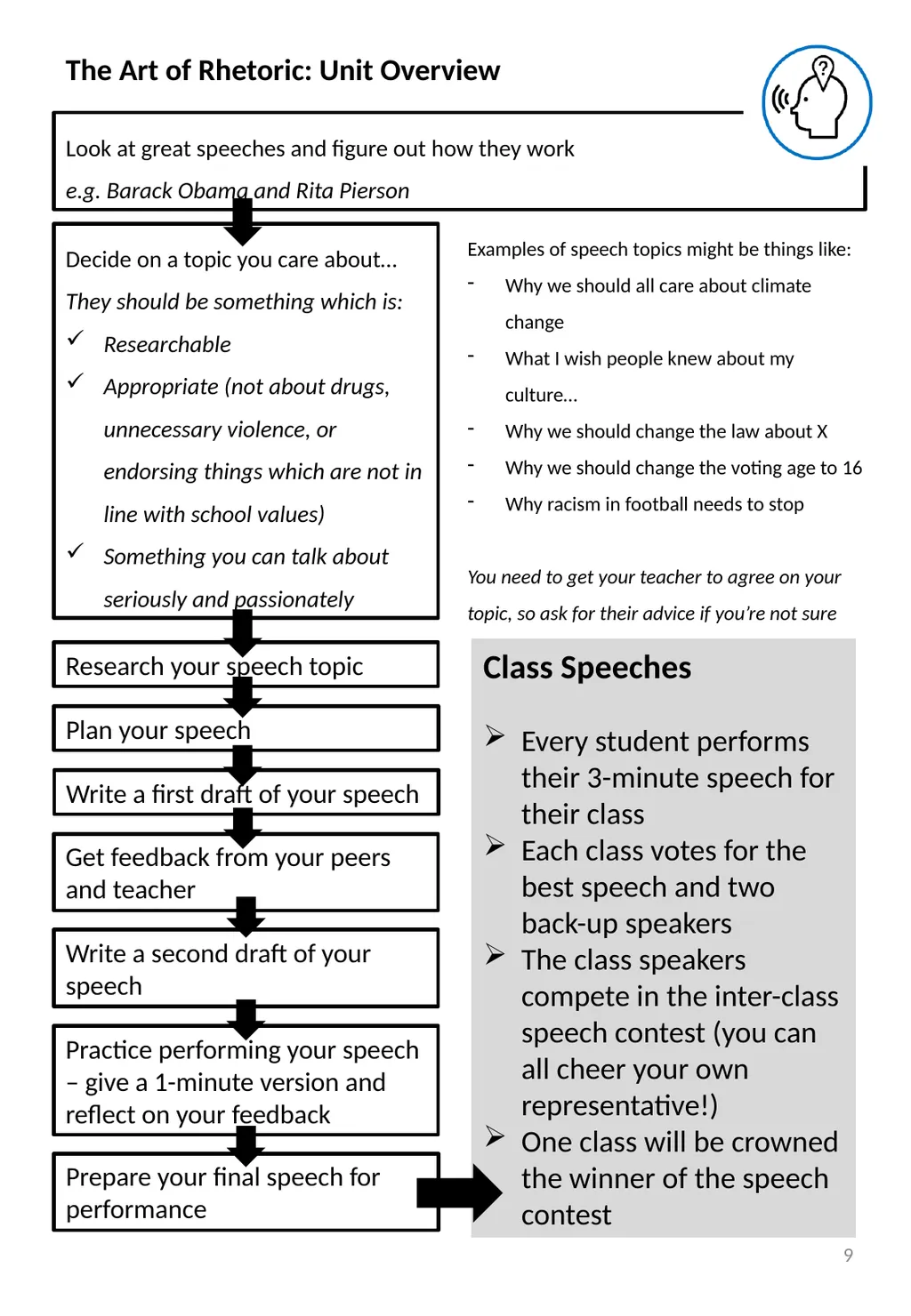
9 The Art of Rhetoric: Unit Overview Look at great speeches and figure out how they work
e.g. Barack Obama and Rita Pierson Decide on a topic you care about…
They should be something which is:
Researchable
Appropriate (not about drugs, unnecessary violence, or endorsing things which are not in line with school values)
Something you can talk about seriously and passionately Examples of speech topics might be things like:
Why we should all care about climate change
What I wish people knew about my culture…
Why we should change the law about X
Why we should change the voting age to 16
Why racism in football needs to stop
You need to get your teacher to agree on your topic, so ask for their advice if you’re not sure Research your speech topic Plan your speech Write a first draft of your speech Get feedback from your peers and teacher Write a second draft of your speech Practice performing your speech – give a 1-minute version and reflect on your feedback Prepare your final speech for performance Class Speeches
Every student performs their 3-minute speech for their class
Each class votes for the best speech and two back-up speakers
The class speakers compete in the inter-class speech contest (you can all cheer your own representative!)
One class will be crowned the winner of the speech contest<br>
e.g. Barack Obama and Rita Pierson Decide on a topic you care about…
They should be something which is:
Researchable
Appropriate (not about drugs, unnecessary violence, or endorsing things which are not in line with school values)
Something you can talk about seriously and passionately Examples of speech topics might be things like:
Why we should all care about climate change
What I wish people knew about my culture…
Why we should change the law about X
Why we should change the voting age to 16
Why racism in football needs to stop
You need to get your teacher to agree on your topic, so ask for their advice if you’re not sure Research your speech topic Plan your speech Write a first draft of your speech Get feedback from your peers and teacher Write a second draft of your speech Practice performing your speech – give a 1-minute version and reflect on your feedback Prepare your final speech for performance Class Speeches
Every student performs their 3-minute speech for their class
Each class votes for the best speech and two back-up speakers
The class speakers compete in the inter-class speech contest (you can all cheer your own representative!)
One class will be crowned the winner of the speech contest<br>
10
10 Barack Obama, November 2008
Hello, Chicago.
If there is anyone out there who still doubts that America is a place where all things are possible, who still wonders if the dream of our founders is alive in our time, who still questions the power of our democracy, tonight is your answer.
It's the answer told by lines that stretched around schools and churches in numbers this nation has never seen, by people who waited three hours and four hours, many for the first time in their lives, because they believed that this time must be different, that their voices could be that difference.
It's the answer spoken by young and old, rich and poor, Democrat and Republican, black, white, Hispanic, Asian, Native American, gay, straight, disabled and not disabled, Americans who sent a message to the world that we have never been just a collection of individuals or a collection of red states and blue states.
We are, and always will be, the United States of America.
It's the answer that led those who've been told for so long by so many to be cynical and fearful and doubtful about what we can achieve to put their hands on the arc of history and bend it once more toward the hope of a better day.
It's been a long time coming, but tonight, because of what we did on this date in this election at this defining moment, change has come to America.
And I would not be standing here tonight without the unyielding support of my best friend for the last 16 years, the rock of our family, the love of my life, the nation's next first lady Michelle Obama.
Sasha and Malia I love you both more than you can imagine. And you have earned the new puppy that's coming with us to the new White House.<br>
Hello, Chicago.
If there is anyone out there who still doubts that America is a place where all things are possible, who still wonders if the dream of our founders is alive in our time, who still questions the power of our democracy, tonight is your answer.
It's the answer told by lines that stretched around schools and churches in numbers this nation has never seen, by people who waited three hours and four hours, many for the first time in their lives, because they believed that this time must be different, that their voices could be that difference.
It's the answer spoken by young and old, rich and poor, Democrat and Republican, black, white, Hispanic, Asian, Native American, gay, straight, disabled and not disabled, Americans who sent a message to the world that we have never been just a collection of individuals or a collection of red states and blue states.
We are, and always will be, the United States of America.
It's the answer that led those who've been told for so long by so many to be cynical and fearful and doubtful about what we can achieve to put their hands on the arc of history and bend it once more toward the hope of a better day.
It's been a long time coming, but tonight, because of what we did on this date in this election at this defining moment, change has come to America.
And I would not be standing here tonight without the unyielding support of my best friend for the last 16 years, the rock of our family, the love of my life, the nation's next first lady Michelle Obama.
Sasha and Malia I love you both more than you can imagine. And you have earned the new puppy that's coming with us to the new White House.<br>
11
11 And while she's no longer with us, I know my grandmother's watching, along with the family that made me who I am. I miss them tonight. I know that my debt to them is beyond measure.
But above all, I will never forget who this victory truly belongs to. It belongs to you. It belongs to you.
I was never the likeliest candidate for this office.
We didn't start with much money or many endorsements.
Our campaign was not hatched in the halls of Washington. It began in the backyards of Des Moines and the living rooms of Concord and the front porches of Charleston.
It was built by working men and women who dug into what little savings they had to give 5 and 10 and 20 to the cause.
It grew strength from the young people who rejected the myth of their generation's apathy, who left their homes and their families for jobs that offered little pay and less sleep.
It drew strength from the not-so-young people who braved the bitter cold and scorching heat to knock on doors of perfect strangers, and from the millions of Americans who volunteered and organised and proved that more than two centuries later a government of the people, by the people, and for the people has not perished from the Earth.
This is your victory.
And I know you didn't do this just to win an election. And I know you didn't do it for me.
You did it because you understand the enormity of the task that lies ahead. For even as we celebrate tonight, we know the challenges that tomorrow will bring are the greatest of our lifetime - two wars, a planet in peril, the worst financial crisis in a century.<br>
But above all, I will never forget who this victory truly belongs to. It belongs to you. It belongs to you.
I was never the likeliest candidate for this office.
We didn't start with much money or many endorsements.
Our campaign was not hatched in the halls of Washington. It began in the backyards of Des Moines and the living rooms of Concord and the front porches of Charleston.
It was built by working men and women who dug into what little savings they had to give 5 and 10 and 20 to the cause.
It grew strength from the young people who rejected the myth of their generation's apathy, who left their homes and their families for jobs that offered little pay and less sleep.
It drew strength from the not-so-young people who braved the bitter cold and scorching heat to knock on doors of perfect strangers, and from the millions of Americans who volunteered and organised and proved that more than two centuries later a government of the people, by the people, and for the people has not perished from the Earth.
This is your victory.
And I know you didn't do this just to win an election. And I know you didn't do it for me.
You did it because you understand the enormity of the task that lies ahead. For even as we celebrate tonight, we know the challenges that tomorrow will bring are the greatest of our lifetime - two wars, a planet in peril, the worst financial crisis in a century.<br>
12
12 Even as we stand here tonight, we know there are brave Americans waking up in the deserts of Iraq and the mountains of Afghanistan to risk their lives for us.
There are mothers and fathers who will lie awake after the children fall asleep and wonder how they'll make the mortgage or pay their doctors' bills or save enough for their child's college education.
There's new energy to harness, new jobs to be created, new schools to build, and threats to meet, alliances to repair.
The road ahead will be long. Our climb will be steep. We may not get there in one year or even in one term. But, America, I have never been more hopeful than I am tonight that we will get there.
I promise you, we as a people will get there.
There will be setbacks and false starts. There are many who won't agree with every decision or policy I make as president. And we know the government can't solve every problem.
But I will always be honest with you about the challenges we face. I will listen to you, especially when we disagree. And, above all, I will ask you to join in the work of remaking this nation, the only way it's been done in America for 221 years - block by block, brick by brick, calloused hand by calloused hand.
What began 21 months ago in the depths of winter cannot end on this autumn night.
This victory alone is not the change we seek. It is only the chance for us to make that change. And that cannot happen if we go back to the way things were.
It can't happen without you, without a new spirit of service, a new spirit of sacrifice.<br>
There are mothers and fathers who will lie awake after the children fall asleep and wonder how they'll make the mortgage or pay their doctors' bills or save enough for their child's college education.
There's new energy to harness, new jobs to be created, new schools to build, and threats to meet, alliances to repair.
The road ahead will be long. Our climb will be steep. We may not get there in one year or even in one term. But, America, I have never been more hopeful than I am tonight that we will get there.
I promise you, we as a people will get there.
There will be setbacks and false starts. There are many who won't agree with every decision or policy I make as president. And we know the government can't solve every problem.
But I will always be honest with you about the challenges we face. I will listen to you, especially when we disagree. And, above all, I will ask you to join in the work of remaking this nation, the only way it's been done in America for 221 years - block by block, brick by brick, calloused hand by calloused hand.
What began 21 months ago in the depths of winter cannot end on this autumn night.
This victory alone is not the change we seek. It is only the chance for us to make that change. And that cannot happen if we go back to the way things were.
It can't happen without you, without a new spirit of service, a new spirit of sacrifice.<br>
13
13 So let us summon a new spirit of patriotism, of responsibility, where each of us resolves to pitch in and work harder and look after not only ourselves but each other.
Let us remember that, if this financial crisis taught us anything, it's that we cannot have a thriving Wall Street while Main Street suffers.
In this country, we rise or fall as one nation, as one people. Let's resist the temptation to fall back on the same partisanship and pettiness and immaturity that has poisoned our politics for so long.
Let's remember that it was a man from this state who first carried the banner of the Republican Party to the White House, a party founded on the values of self-reliance and individual liberty and national unity.
Those are values that we all share. And while the Democratic Party has won a great victory tonight, we do so with a measure of humility and determination to heal the divides that have held back our progress.
As Lincoln said to a nation far more divided than ours, we are not enemies but friends. Though passion may have strained, it must not break our bonds of affection.
And to those Americans whose support I have yet to earn, I may not have won your vote tonight, but I hear your voices. I need your help. And I will be your president, too.
And to all those watching tonight from beyond our shores, from parliaments and palaces, to those who are huddled around radios in the forgotten corners of the world, our stories are singular, but our destiny is shared, and a new dawn of American leadership is at hand.
To those - to those who would tear the world down: We will defeat you. To those who seek peace and security: We support you. And to all those who have wondered if America's beacon still burns as bright: Tonight we proved once more that the true strength of our nation comes not from the might of our arms or the scale of our wealth, but from the enduring power of our ideals: democracy, liberty, opportunity and unyielding hope.<br>
Let us remember that, if this financial crisis taught us anything, it's that we cannot have a thriving Wall Street while Main Street suffers.
In this country, we rise or fall as one nation, as one people. Let's resist the temptation to fall back on the same partisanship and pettiness and immaturity that has poisoned our politics for so long.
Let's remember that it was a man from this state who first carried the banner of the Republican Party to the White House, a party founded on the values of self-reliance and individual liberty and national unity.
Those are values that we all share. And while the Democratic Party has won a great victory tonight, we do so with a measure of humility and determination to heal the divides that have held back our progress.
As Lincoln said to a nation far more divided than ours, we are not enemies but friends. Though passion may have strained, it must not break our bonds of affection.
And to those Americans whose support I have yet to earn, I may not have won your vote tonight, but I hear your voices. I need your help. And I will be your president, too.
And to all those watching tonight from beyond our shores, from parliaments and palaces, to those who are huddled around radios in the forgotten corners of the world, our stories are singular, but our destiny is shared, and a new dawn of American leadership is at hand.
To those - to those who would tear the world down: We will defeat you. To those who seek peace and security: We support you. And to all those who have wondered if America's beacon still burns as bright: Tonight we proved once more that the true strength of our nation comes not from the might of our arms or the scale of our wealth, but from the enduring power of our ideals: democracy, liberty, opportunity and unyielding hope.<br>
14
14 That's the true genius of America: that America can change. Our union can be perfected. What we've already achieved gives us hope for what we can and must achieve tomorrow.
This election had many firsts and many stories that will be told for generations. But one that's on my mind tonight's about a woman who cast her ballot in Atlanta. She's a lot like the millions of others who stood in line to make their voice heard in this election except for one thing: Ann Nixon Cooper is 106 years old.
She was born just a generation past slavery; a time when there were no cars on the road or planes in the sky; when someone like her couldn't vote for two reasons - because she was a woman and because of the colour of her skin.
And tonight, I think about all that she's seen throughout her century in America - the heartache and the hope; the struggle and the progress; the times we were told that we can't, and the people who pressed on with that American creed: Yes we can.
When there was despair in the dust bowl and depression across the land, she saw a nation conquer fear itself with a New Deal, new jobs, a new sense of common purpose. Yes we can.
When the bombs fell on our harbour and tyranny threatened the world, she was there to witness a generation rise to greatness and a democracy was saved. Yes we can.
She was there for the buses in Montgomery, the hoses in Birmingham, a bridge in Selma, and a preacher from Atlanta who told a people that 'We Shall Overcome'. Yes we can.
A man touched down on the moon, a wall came down in Berlin, a world was connected by our own science and imagination.
And this year, in this election, she touched her finger to a screen, and cast her vote, because after 106 years in America, through the best of times and the darkest of hours, she knows how America can change.
Yes we can.<br>
This election had many firsts and many stories that will be told for generations. But one that's on my mind tonight's about a woman who cast her ballot in Atlanta. She's a lot like the millions of others who stood in line to make their voice heard in this election except for one thing: Ann Nixon Cooper is 106 years old.
She was born just a generation past slavery; a time when there were no cars on the road or planes in the sky; when someone like her couldn't vote for two reasons - because she was a woman and because of the colour of her skin.
And tonight, I think about all that she's seen throughout her century in America - the heartache and the hope; the struggle and the progress; the times we were told that we can't, and the people who pressed on with that American creed: Yes we can.
When there was despair in the dust bowl and depression across the land, she saw a nation conquer fear itself with a New Deal, new jobs, a new sense of common purpose. Yes we can.
When the bombs fell on our harbour and tyranny threatened the world, she was there to witness a generation rise to greatness and a democracy was saved. Yes we can.
She was there for the buses in Montgomery, the hoses in Birmingham, a bridge in Selma, and a preacher from Atlanta who told a people that 'We Shall Overcome'. Yes we can.
A man touched down on the moon, a wall came down in Berlin, a world was connected by our own science and imagination.
And this year, in this election, she touched her finger to a screen, and cast her vote, because after 106 years in America, through the best of times and the darkest of hours, she knows how America can change.
Yes we can.<br>
15
15 At a time when women's voices were silenced and their hopes dismissed, she lived to see them stand up and speak out and reach for the ballot. Yes we can.
America, we have come so far. We have seen so much. But there is so much more to do. So tonight, let us ask ourselves - if our children should live to see the next century; if my daughters should be so lucky to live as long as Ann Nixon Cooper, what change will they see? What progress will we have made?
This is our chance to answer that call. This is our moment.
This is our time, to put our people back to work and open doors of opportunity for our kids; to restore prosperity and promote the cause of peace; to reclaim the American dream and reaffirm that fundamental truth, that, out of many, we are one; that while we breathe, we hope. And where we are met with cynicism and doubts and those who tell us that we can't, we will respond with that timeless creed that sums up the spirit of a people: Yes, we can.
Thank you. God bless you. And may God bless the United States of America.<br>
America, we have come so far. We have seen so much. But there is so much more to do. So tonight, let us ask ourselves - if our children should live to see the next century; if my daughters should be so lucky to live as long as Ann Nixon Cooper, what change will they see? What progress will we have made?
This is our chance to answer that call. This is our moment.
This is our time, to put our people back to work and open doors of opportunity for our kids; to restore prosperity and promote the cause of peace; to reclaim the American dream and reaffirm that fundamental truth, that, out of many, we are one; that while we breathe, we hope. And where we are met with cynicism and doubts and those who tell us that we can't, we will respond with that timeless creed that sums up the spirit of a people: Yes, we can.
Thank you. God bless you. And may God bless the United States of America.<br>
16
16 Rita Pierson: Every Kid Needs a Champion
0:13 I have spent my entire life
0:16 either at the schoolhouse, on the way to the schoolhouse,
0:21 or talking about what happens in the schoolhouse.
0:23 (Laughter)
0:24 Both my parents were educators,
0:27 my maternal grandparents were educators,
0:30 and for the past 40 years, I've done the same thing.
0:34 And so, needless to say, over those years
0:36 I've had a chance to look at education reform
0:40 from a lot of perspectives.
0:42 Some of those reforms have been good.
0:44 Some of them have been not so good.
0:46 And we know why kids drop out.
0:48 We know why kids don't learn.
0:49 It's either poverty, low attendance,
0:52 negative peer influences...
0:55 We know why.
0:56 But one of the things that we never discuss
0:59 or we rarely discuss
1:01 is the value and importance of human connection.
1:05 Relationships.
1:08 James Comer says that no significant learning
1:11 can occur without a significant relationship.
1:14 George Washington Carver says all learning
1:17 is understanding relationships.
1:21 Everyone in this room has been affected by a teacher or an adult.
1:26 For years, I have watched people teach.
1:31 I have looked at the best and I've looked at some of the worst.
1:34 A colleague said to me one time,
1:36 "They don't pay me to like the kids.
1:39 They pay me to teach a lesson.<br>
0:13 I have spent my entire life
0:16 either at the schoolhouse, on the way to the schoolhouse,
0:21 or talking about what happens in the schoolhouse.
0:23 (Laughter)
0:24 Both my parents were educators,
0:27 my maternal grandparents were educators,
0:30 and for the past 40 years, I've done the same thing.
0:34 And so, needless to say, over those years
0:36 I've had a chance to look at education reform
0:40 from a lot of perspectives.
0:42 Some of those reforms have been good.
0:44 Some of them have been not so good.
0:46 And we know why kids drop out.
0:48 We know why kids don't learn.
0:49 It's either poverty, low attendance,
0:52 negative peer influences...
0:55 We know why.
0:56 But one of the things that we never discuss
0:59 or we rarely discuss
1:01 is the value and importance of human connection.
1:05 Relationships.
1:08 James Comer says that no significant learning
1:11 can occur without a significant relationship.
1:14 George Washington Carver says all learning
1:17 is understanding relationships.
1:21 Everyone in this room has been affected by a teacher or an adult.
1:26 For years, I have watched people teach.
1:31 I have looked at the best and I've looked at some of the worst.
1:34 A colleague said to me one time,
1:36 "They don't pay me to like the kids.
1:39 They pay me to teach a lesson.<br>
17
17 1:40 The kids should learn it.
1:42 I should teach it, they should learn it,
1:44 Case closed."
1:45 Well, I said to her,
1:48 "You know, kids don't learn from people they don't like."
1:51 (Laughter)
1:53 (Applause)
1:59 She said, "That's just a bunch of hooey."
2:02 And I said to her,
2:03 "Well, your year is going to be long and arduous, dear."
2:08 Needless to say, it was.
2:09 Some people think that you can either have it in you to build a relationship,
2:13 or you don't.
2:15 I think Stephen Covey had the right idea.
2:17 He said you ought to just throw in a few simple things,
2:20 like seeking first to understand,
2:23 as opposed to being understood.
2:25 Simple things, like apologizing.
2:28 You ever thought about that?
2:29 Tell a kid you're sorry, they're in shock.
2:31 (Laughter)
2:33 I taught a lesson once on ratios.
2:35 I'm not real good with math, but I was working on it.
2:38 (Laughter)
2:39 And I got back and looked at that teacher edition.
2:42 I'd taught the whole lesson wrong.
2:44 (Laughter)
2:45 So I came back to class the next day and I said,
2:47 "Look, guys, I need to apologize.
2:50 I taught the whole lesson wrong. I'm so sorry."
2:54 They said, "That's okay, Ms. Pierson.
2:55 You were so excited, we just let you go."<br>
1:42 I should teach it, they should learn it,
1:44 Case closed."
1:45 Well, I said to her,
1:48 "You know, kids don't learn from people they don't like."
1:51 (Laughter)
1:53 (Applause)
1:59 She said, "That's just a bunch of hooey."
2:02 And I said to her,
2:03 "Well, your year is going to be long and arduous, dear."
2:08 Needless to say, it was.
2:09 Some people think that you can either have it in you to build a relationship,
2:13 or you don't.
2:15 I think Stephen Covey had the right idea.
2:17 He said you ought to just throw in a few simple things,
2:20 like seeking first to understand,
2:23 as opposed to being understood.
2:25 Simple things, like apologizing.
2:28 You ever thought about that?
2:29 Tell a kid you're sorry, they're in shock.
2:31 (Laughter)
2:33 I taught a lesson once on ratios.
2:35 I'm not real good with math, but I was working on it.
2:38 (Laughter)
2:39 And I got back and looked at that teacher edition.
2:42 I'd taught the whole lesson wrong.
2:44 (Laughter)
2:45 So I came back to class the next day and I said,
2:47 "Look, guys, I need to apologize.
2:50 I taught the whole lesson wrong. I'm so sorry."
2:54 They said, "That's okay, Ms. Pierson.
2:55 You were so excited, we just let you go."<br>
18
18 3:02 I have had classes that were so low,
3:07 so academically deficient, that I cried.
3:10 I wondered, "How am I going to take this group,
3:13 in nine months,
3:15 from where they are to where they need to be?
3:18 And it was difficult, it was awfully hard.
3:22 How do I raise the self-esteem of a child
3:24 and his academic achievement at the same time?
3:27 One year I came up with a bright idea.
3:29 I told all my students,
3:31 "You were chosen to be in my class
3:35 because I am the best teacher
3:36 and you are the best students,
3:38 they put us all together
3:39 so we could show everybody else how to do it."
3:43 One of the students said, "Really?"
3:45 (Laughter)
3:47 I said, "Really. We have to show the other classes
3:50 how to do it, so when we walk down the hall,
3:53 people will notice us, so you can't make noise.
3:55 You just have to strut."
3:57 (Laughter)
3:58 And I gave them a saying to say:
4:00 "I am somebody.
4:01 I was somebody when I came.
4:02 I'll be a better somebody when I leave.
4:04 I am powerful, and I am strong.
4:06 I deserve the education that I get here.
4:09 I have things to do, people to impress,
4:11 and places to go."
4:13 And they said, "Yeah!"
4:14 (Laughter)
4:16 You say it long enough,<br>
3:07 so academically deficient, that I cried.
3:10 I wondered, "How am I going to take this group,
3:13 in nine months,
3:15 from where they are to where they need to be?
3:18 And it was difficult, it was awfully hard.
3:22 How do I raise the self-esteem of a child
3:24 and his academic achievement at the same time?
3:27 One year I came up with a bright idea.
3:29 I told all my students,
3:31 "You were chosen to be in my class
3:35 because I am the best teacher
3:36 and you are the best students,
3:38 they put us all together
3:39 so we could show everybody else how to do it."
3:43 One of the students said, "Really?"
3:45 (Laughter)
3:47 I said, "Really. We have to show the other classes
3:50 how to do it, so when we walk down the hall,
3:53 people will notice us, so you can't make noise.
3:55 You just have to strut."
3:57 (Laughter)
3:58 And I gave them a saying to say:
4:00 "I am somebody.
4:01 I was somebody when I came.
4:02 I'll be a better somebody when I leave.
4:04 I am powerful, and I am strong.
4:06 I deserve the education that I get here.
4:09 I have things to do, people to impress,
4:11 and places to go."
4:13 And they said, "Yeah!"
4:14 (Laughter)
4:16 You say it long enough,<br>
19
19 4:17 it starts to be a part of you.
4:21 (Applause)
4:28 I gave a quiz, 20 questions.
4:31 A student missed 18.
4:34 I put a "+2" on his paper and a big smiley face.
4:37 (Laughter)
4:39 He said, "Ms. Pierson, is this an F?"
4:43 I said, "Yes."
4:44 (Laughter)
4:45 He said, "Then why'd you put a smiley face?”
4:49 I said, "Because you're on a roll.
4:51 You got two right. You didn't miss them all."
4:54 (Laughter)
4:55 I said, "And when we review this, won't you do better?"
4:58 He said, "Yes, ma'am, I can do better."
5:01 You see, "-18" sucks all the life out of you.
5:04 "+2" said, "I ain't all bad."
5:12 For years, I watched my mother take the time at recess to review,
5:19 go on home visits in the afternoon,
5:21 buy combs and brushes and peanut butter and crackers
5:24 to put in her desk drawer for kids that needed to eat,
5:27 and a washcloth and some soap for the kids who didn't smell so good.
5:30 See, it's hard to teach kids who stink.
5:32 (Laughter)
5:34 And kids can be cruel.
5:36 And so she kept those things in her desk,
5:39 and years later, after she retired,
5:42 I watched some of those same kids come through
5:45 and say to her, "You know, Ms. Walker,
5:47 you made a difference in my life.
5:50 You made it work for me.
5:51 You made me feel like I was somebody,
5:53 when I knew, at the bottom, I wasn't.<br>
4:21 (Applause)
4:28 I gave a quiz, 20 questions.
4:31 A student missed 18.
4:34 I put a "+2" on his paper and a big smiley face.
4:37 (Laughter)
4:39 He said, "Ms. Pierson, is this an F?"
4:43 I said, "Yes."
4:44 (Laughter)
4:45 He said, "Then why'd you put a smiley face?”
4:49 I said, "Because you're on a roll.
4:51 You got two right. You didn't miss them all."
4:54 (Laughter)
4:55 I said, "And when we review this, won't you do better?"
4:58 He said, "Yes, ma'am, I can do better."
5:01 You see, "-18" sucks all the life out of you.
5:04 "+2" said, "I ain't all bad."
5:12 For years, I watched my mother take the time at recess to review,
5:19 go on home visits in the afternoon,
5:21 buy combs and brushes and peanut butter and crackers
5:24 to put in her desk drawer for kids that needed to eat,
5:27 and a washcloth and some soap for the kids who didn't smell so good.
5:30 See, it's hard to teach kids who stink.
5:32 (Laughter)
5:34 And kids can be cruel.
5:36 And so she kept those things in her desk,
5:39 and years later, after she retired,
5:42 I watched some of those same kids come through
5:45 and say to her, "You know, Ms. Walker,
5:47 you made a difference in my life.
5:50 You made it work for me.
5:51 You made me feel like I was somebody,
5:53 when I knew, at the bottom, I wasn't.<br>
20
20 5:56 And I want you to just see what I've become."
5:58 And when my mama died two years ago at 92,
6:01 there were so many former students at her funeral,
6:05 it brought tears to my eyes, not because she was gone,
6:07 but because she left a legacy of relationships
6:11 that could never disappear.
6:13 Can we stand to have more relationships?
6:17 Absolutely.
6:18 Will you like all your children? Of course not.
6:21 (Laughter)
6:23 And you know your toughest kids are never absent.
6:27 (Laughter)
6:29 Never.
6:30 You won't like them all,
6:32 and the tough ones show up for a reason.
6:35 It's the connection. It's the relationships.
6:44 So teachers become great actors and great actresses,
6:48 and we come to work when we don't feel like it,
6:50 and we're listening to policy that doesn't make sense,
6:53 and we teach anyway.
6:56 We teach anyway, because that's what we do.
7:00 Teaching and learning should bring joy.
7:03 How powerful would our world be
7:06 if we had kids who were not afraid to take risks,
7:10 who were not afraid to think,
7:11 and who had a champion?
7:12 Every child deserves a champion,
7:15 an adult who will never give up on them,
7:17 who understands the power of connection,
7:20 and insists that they become the best that they can possibly be.
7:24 Is this job tough? You betcha.
7:26 Oh God, you betcha.<br>
5:58 And when my mama died two years ago at 92,
6:01 there were so many former students at her funeral,
6:05 it brought tears to my eyes, not because she was gone,
6:07 but because she left a legacy of relationships
6:11 that could never disappear.
6:13 Can we stand to have more relationships?
6:17 Absolutely.
6:18 Will you like all your children? Of course not.
6:21 (Laughter)
6:23 And you know your toughest kids are never absent.
6:27 (Laughter)
6:29 Never.
6:30 You won't like them all,
6:32 and the tough ones show up for a reason.
6:35 It's the connection. It's the relationships.
6:44 So teachers become great actors and great actresses,
6:48 and we come to work when we don't feel like it,
6:50 and we're listening to policy that doesn't make sense,
6:53 and we teach anyway.
6:56 We teach anyway, because that's what we do.
7:00 Teaching and learning should bring joy.
7:03 How powerful would our world be
7:06 if we had kids who were not afraid to take risks,
7:10 who were not afraid to think,
7:11 and who had a champion?
7:12 Every child deserves a champion,
7:15 an adult who will never give up on them,
7:17 who understands the power of connection,
7:20 and insists that they become the best that they can possibly be.
7:24 Is this job tough? You betcha.
7:26 Oh God, you betcha.<br>
21
21 7:28 But it is not impossible.
7:32 We can do this. We're educators.
7:33 We're born to make a difference.
7:36 Thank you so much.
7:37 (Applause) How does this speech make you feel? Why?
…………………………………………………………………………………………… ……………………………………………………………………………………………
What is Rita Pierson trying to achieve in this speech? ……………………………………………………………………………………………
……………………………………………………………………………………………
How does Pierson establish ETHOS in this speech? …………………………………………………………………………………………… ……………………………………………………………………………………………How does Pierson use PATHOS in this speech? …………………………………………………………………………………………… ……………………………………………………………………………………………
How does Pierson use LOGOS in this speech? …………………………………………………………………………………………… ……………………………………………………………………………………………
What is the most powerful moment in this speech for you? Why? …………………………………………………………………………………………… ……………………………………………………………………………………………<br>
7:32 We can do this. We're educators.
7:33 We're born to make a difference.
7:36 Thank you so much.
7:37 (Applause) How does this speech make you feel? Why?
…………………………………………………………………………………………… ……………………………………………………………………………………………
What is Rita Pierson trying to achieve in this speech? ……………………………………………………………………………………………
……………………………………………………………………………………………
How does Pierson establish ETHOS in this speech? …………………………………………………………………………………………… ……………………………………………………………………………………………How does Pierson use PATHOS in this speech? …………………………………………………………………………………………… ……………………………………………………………………………………………
How does Pierson use LOGOS in this speech? …………………………………………………………………………………………… ……………………………………………………………………………………………
What is the most powerful moment in this speech for you? Why? …………………………………………………………………………………………… ……………………………………………………………………………………………<br>
22
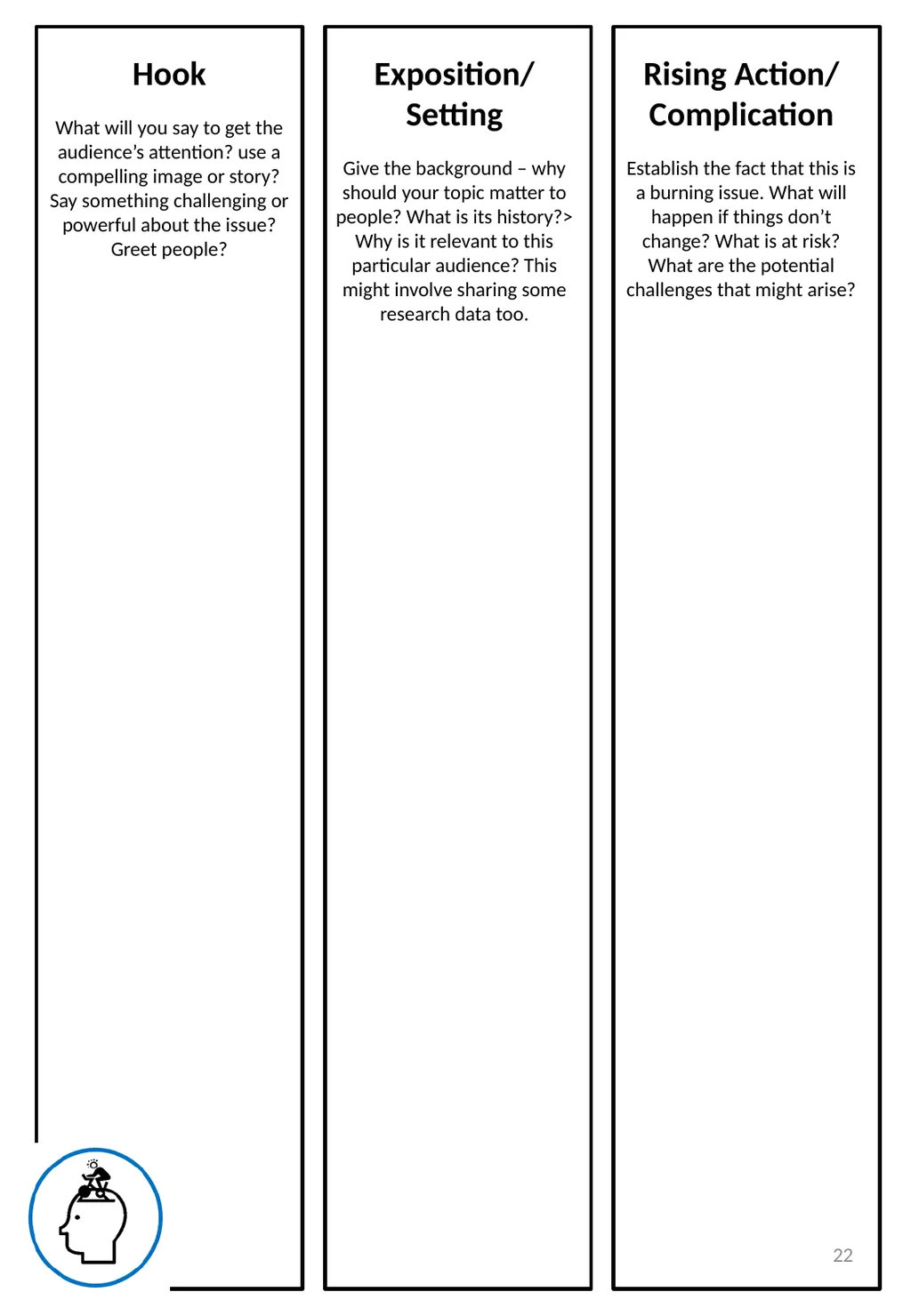
22 Hook
What will you say to get the audience’s attention? use a compelling image or story? Say something challenging or powerful about the issue? Greet people? Exposition/
Setting
Give the background – why should your topic matter to people? What is its history?> Why is it relevant to this particular audience? This might involve sharing some research data too. Rising Action/ Complication
Establish the fact that this is a burning issue. What will happen if things don’t change? What is at risk? What are the potential challenges that might arise?<br>
What will you say to get the audience’s attention? use a compelling image or story? Say something challenging or powerful about the issue? Greet people? Exposition/
Setting
Give the background – why should your topic matter to people? What is its history?> Why is it relevant to this particular audience? This might involve sharing some research data too. Rising Action/ Complication
Establish the fact that this is a burning issue. What will happen if things don’t change? What is at risk? What are the potential challenges that might arise?<br>
23
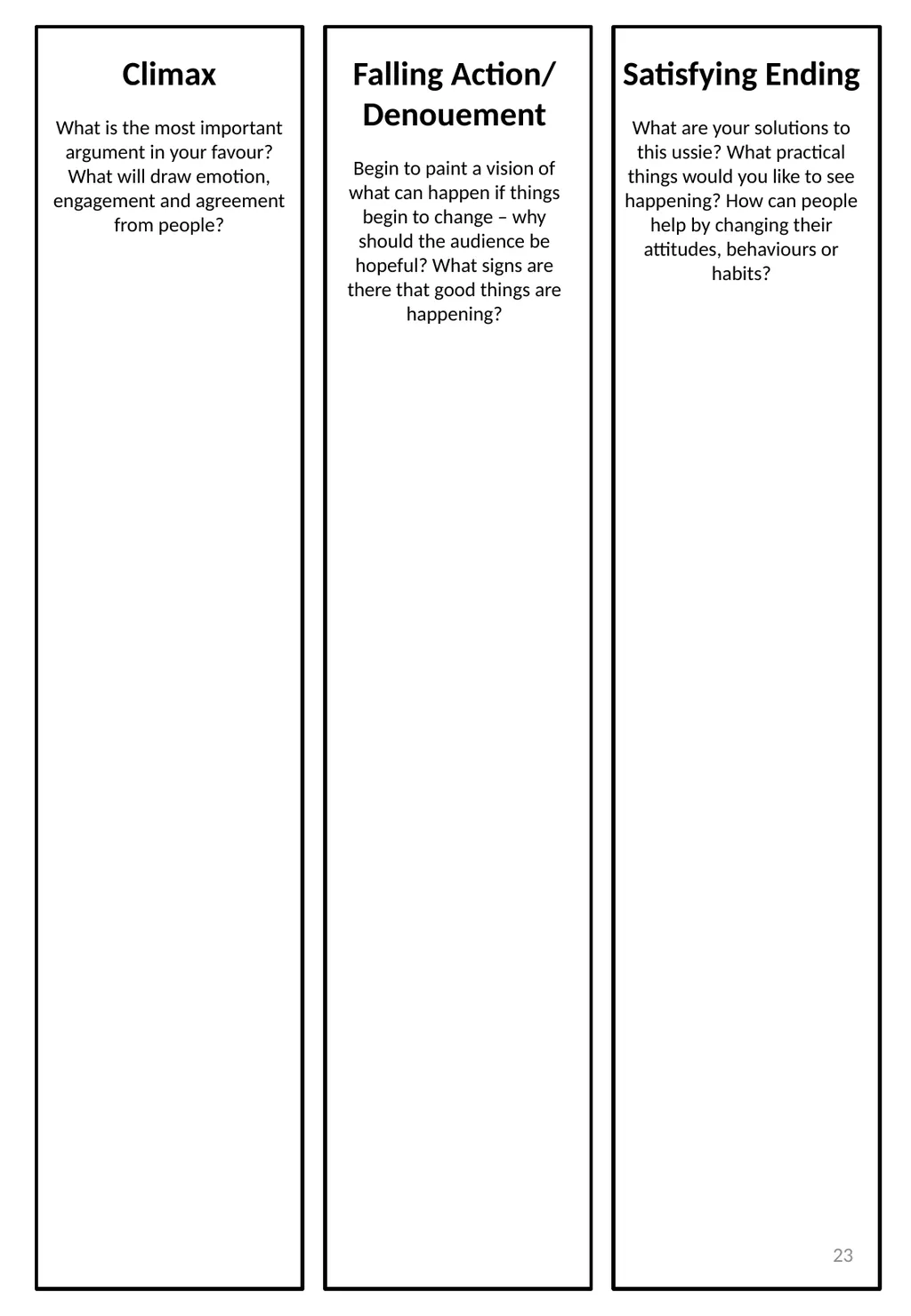
23 Climax
What is the most important argument in your favour? What will draw emotion, engagement and agreement from people? Falling Action/ Denouement
Begin to paint a vision of what can happen if things begin to change – why should the audience be hopeful? What signs are there that good things are happening? Satisfying Ending
What are your solutions to this ussie? What practical things would you like to see happening? How can people help by changing their attitudes, behaviours or habits?<br>
What is the most important argument in your favour? What will draw emotion, engagement and agreement from people? Falling Action/ Denouement
Begin to paint a vision of what can happen if things begin to change – why should the audience be hopeful? What signs are there that good things are happening? Satisfying Ending
What are your solutions to this ussie? What practical things would you like to see happening? How can people help by changing their attitudes, behaviours or habits?<br>
24
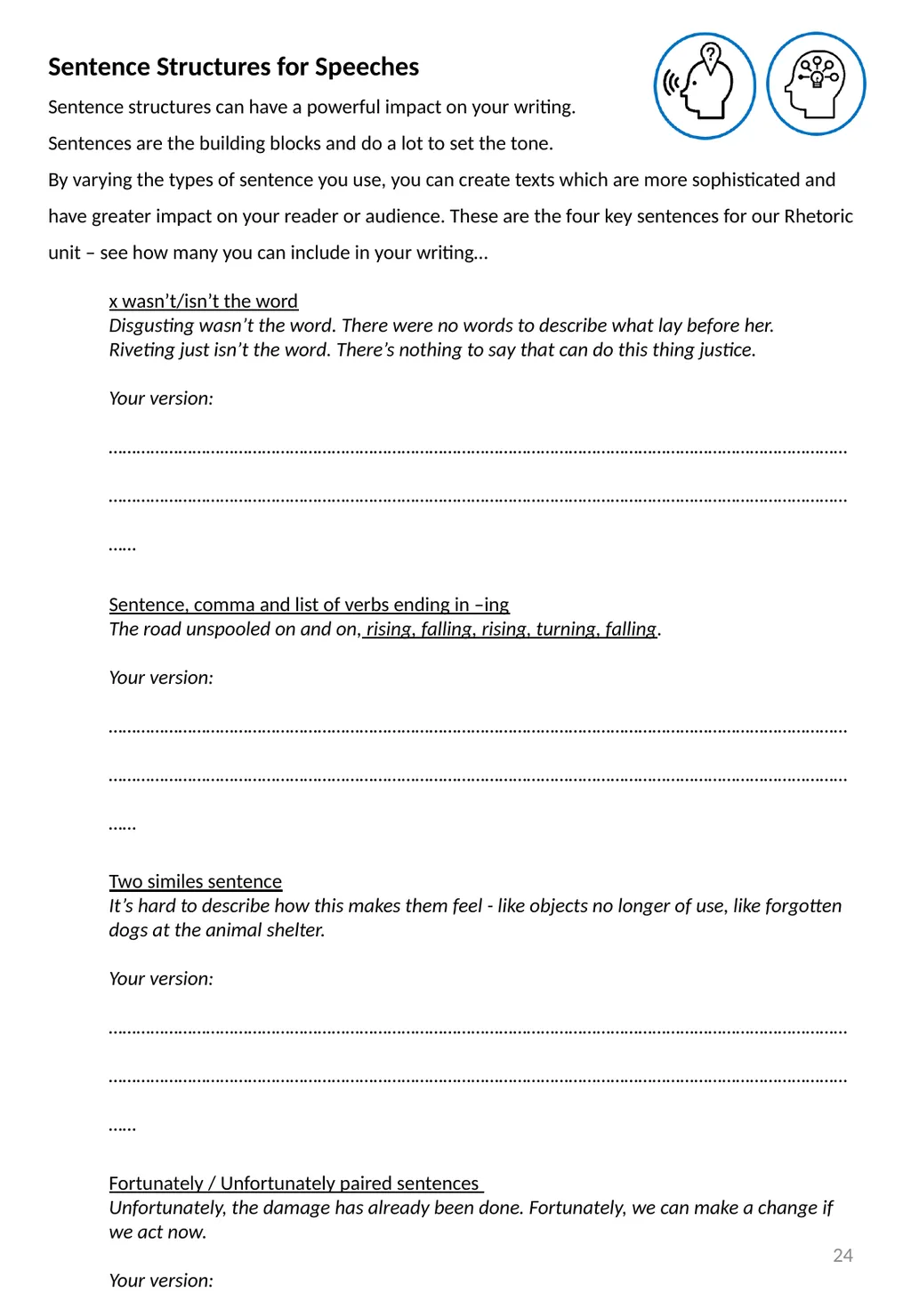
24 Sentence Structures for Speeches
Sentence structures can have a powerful impact on your writing.
Sentences are the building blocks and do a lot to set the tone.
By varying the types of sentence you use, you can create texts which are more sophisticated and have greater impact on your reader or audience. These are the four key sentences for our Rhetoric unit – see how many you can include in your writing…
x wasn’t/isn’t the word
Disgusting wasn’t the word. There were no words to describe what lay before her.
Riveting just isn’t the word. There’s nothing to say that can do this thing justice.
Your version:
………………………………………………………………………………………………………………………………………………………………………………………………………………………………………………………………………………………………
Sentence, comma and list of verbs ending in –ing
The road unspooled on and on, rising, falling, rising, turning, falling.
Your version:
………………………………………………………………………………………………………………………………………………………………………………………………………………………………………………………………………………………………
Two similes sentence
It’s hard to describe how this makes them feel - like objects no longer of use, like forgotten dogs at the animal shelter.
Your version:
………………………………………………………………………………………………………………………………………………………………………………………………………………………………………………………………………………………………
Fortunately / Unfortunately paired sentences
Unfortunately, the damage has already been done. Fortunately, we can make a change if we act now.
Your version:
………………………………………………………………………………………………………………………………………………………………………………………………………………………………………………………………………………………………<br>
Sentence structures can have a powerful impact on your writing.
Sentences are the building blocks and do a lot to set the tone.
By varying the types of sentence you use, you can create texts which are more sophisticated and have greater impact on your reader or audience. These are the four key sentences for our Rhetoric unit – see how many you can include in your writing…
x wasn’t/isn’t the word
Disgusting wasn’t the word. There were no words to describe what lay before her.
Riveting just isn’t the word. There’s nothing to say that can do this thing justice.
Your version:
………………………………………………………………………………………………………………………………………………………………………………………………………………………………………………………………………………………………
Sentence, comma and list of verbs ending in –ing
The road unspooled on and on, rising, falling, rising, turning, falling.
Your version:
………………………………………………………………………………………………………………………………………………………………………………………………………………………………………………………………………………………………
Two similes sentence
It’s hard to describe how this makes them feel - like objects no longer of use, like forgotten dogs at the animal shelter.
Your version:
………………………………………………………………………………………………………………………………………………………………………………………………………………………………………………………………………………………………
Fortunately / Unfortunately paired sentences
Unfortunately, the damage has already been done. Fortunately, we can make a change if we act now.
Your version:
………………………………………………………………………………………………………………………………………………………………………………………………………………………………………………………………………………………………<br>
25
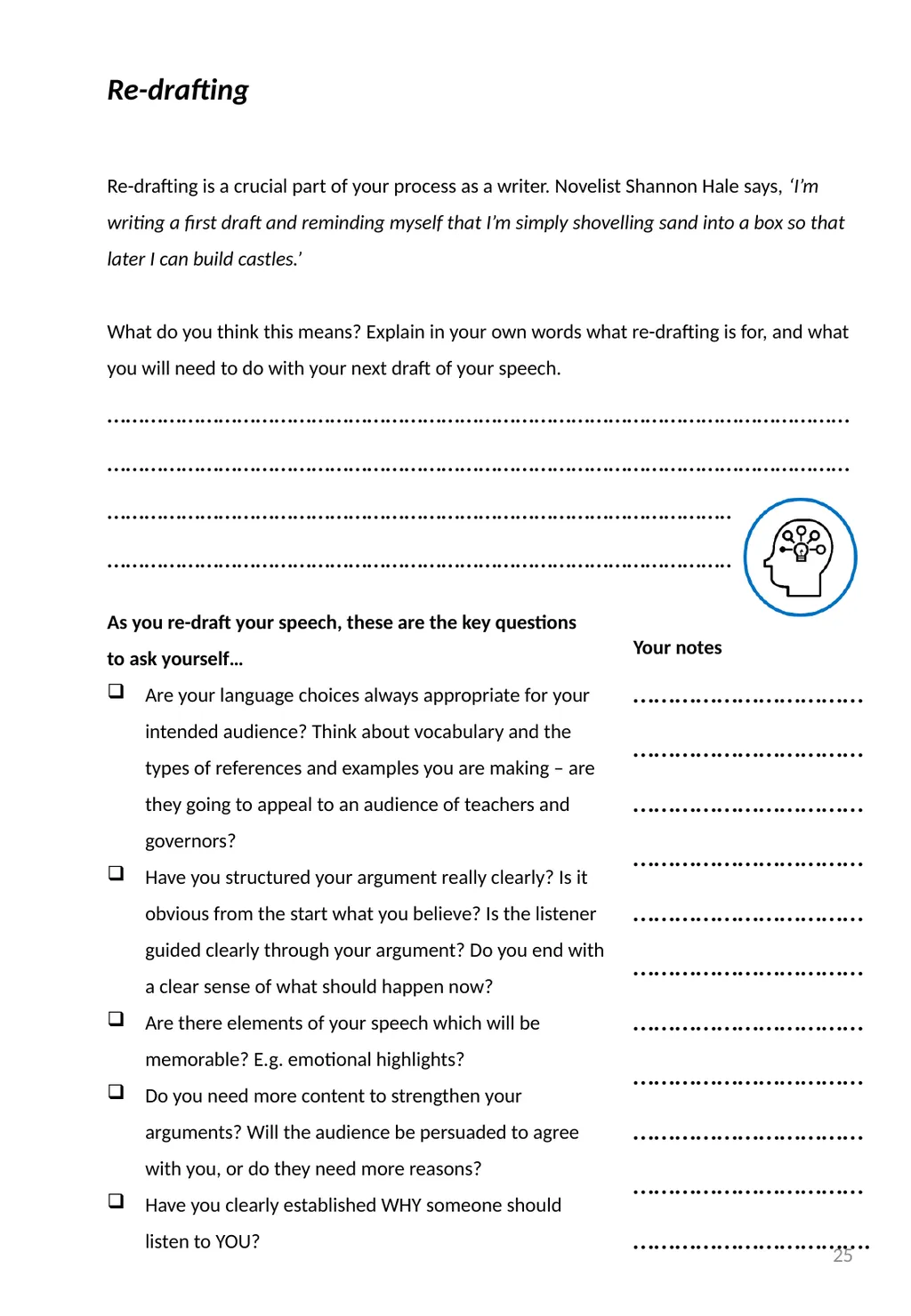
25 Re-drafting
Re-drafting is a crucial part of your process as a writer. Novelist Shannon Hale says, ‘I’m writing a first draft and reminding myself that I’m simply shovelling sand into a box so that later I can build castles.’
What do you think this means? Explain in your own words what re-drafting is for, and what you will need to do with your next draft of your speech.
……………………………………………………………………………………………………………………………………………………………………………………………………………………………………………………………………………………………………………………………………………………………………………………………………………………………………… As you re-draft your speech, these are the key questions
to ask yourself…
Are your language choices always appropriate for your intended audience? Think about vocabulary and the types of references and examples you are making – are they going to appeal to an audience of teachers and governors?
Have you structured your argument really clearly? Is it obvious from the start what you believe? Is the listener guided clearly through your argument? Do you end with a clear sense of what should happen now?
Are there elements of your speech which will be memorable? E.g. emotional highlights?
Do you need more content to strengthen your arguments? Will the audience be persuaded to agree with you, or do they need more reasons?
Have you clearly established WHY someone should listen to YOU? …………………………………………………………………………………………………………………………………………………………………………………………………………………………………………………………………………………………………………………………………. Your notes<br>
Re-drafting is a crucial part of your process as a writer. Novelist Shannon Hale says, ‘I’m writing a first draft and reminding myself that I’m simply shovelling sand into a box so that later I can build castles.’
What do you think this means? Explain in your own words what re-drafting is for, and what you will need to do with your next draft of your speech.
……………………………………………………………………………………………………………………………………………………………………………………………………………………………………………………………………………………………………………………………………………………………………………………………………………………………………… As you re-draft your speech, these are the key questions
to ask yourself…
Are your language choices always appropriate for your intended audience? Think about vocabulary and the types of references and examples you are making – are they going to appeal to an audience of teachers and governors?
Have you structured your argument really clearly? Is it obvious from the start what you believe? Is the listener guided clearly through your argument? Do you end with a clear sense of what should happen now?
Are there elements of your speech which will be memorable? E.g. emotional highlights?
Do you need more content to strengthen your arguments? Will the audience be persuaded to agree with you, or do they need more reasons?
Have you clearly established WHY someone should listen to YOU? …………………………………………………………………………………………………………………………………………………………………………………………………………………………………………………………………………………………………………………………………. Your notes<br>
26
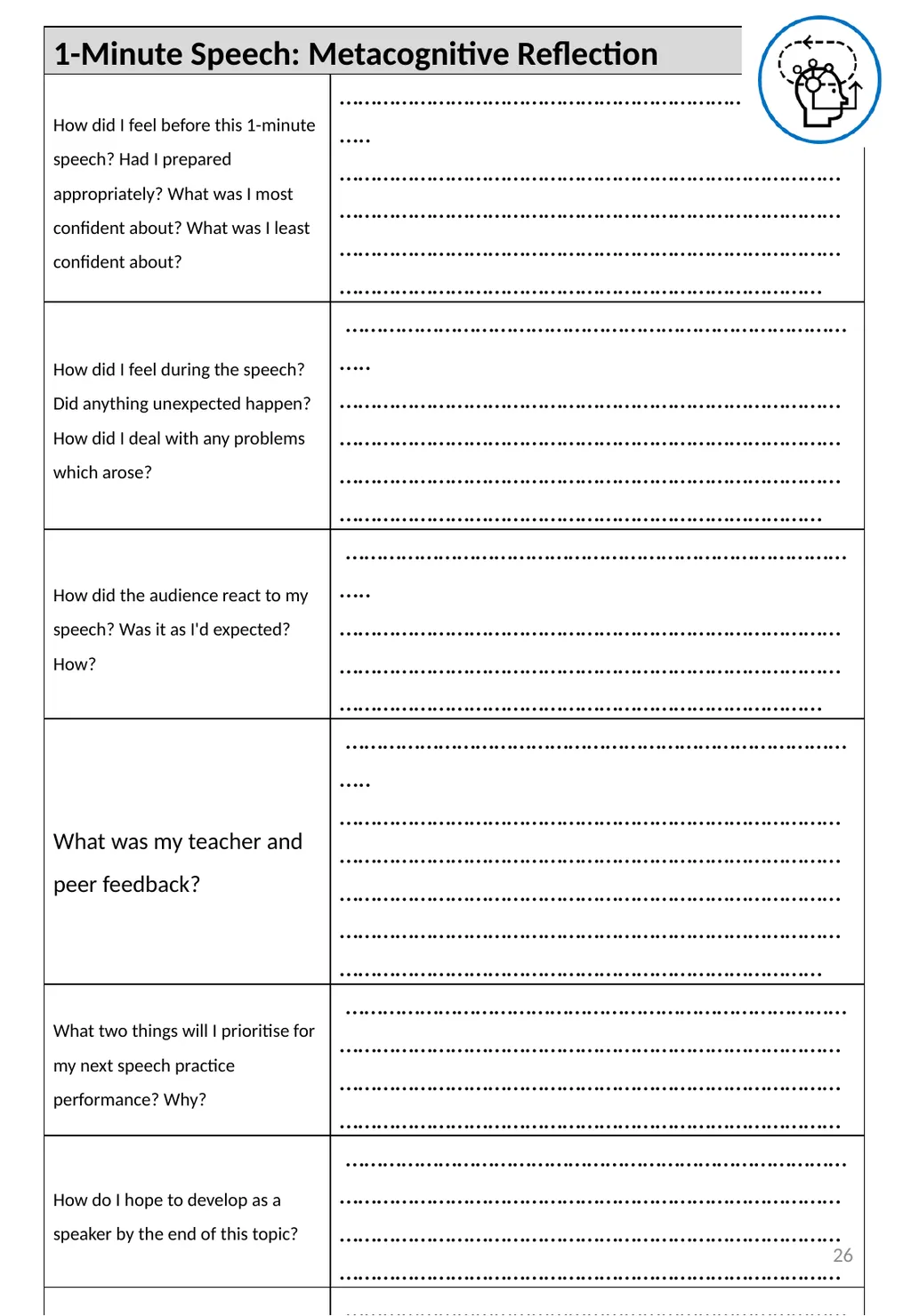
26<br>
27
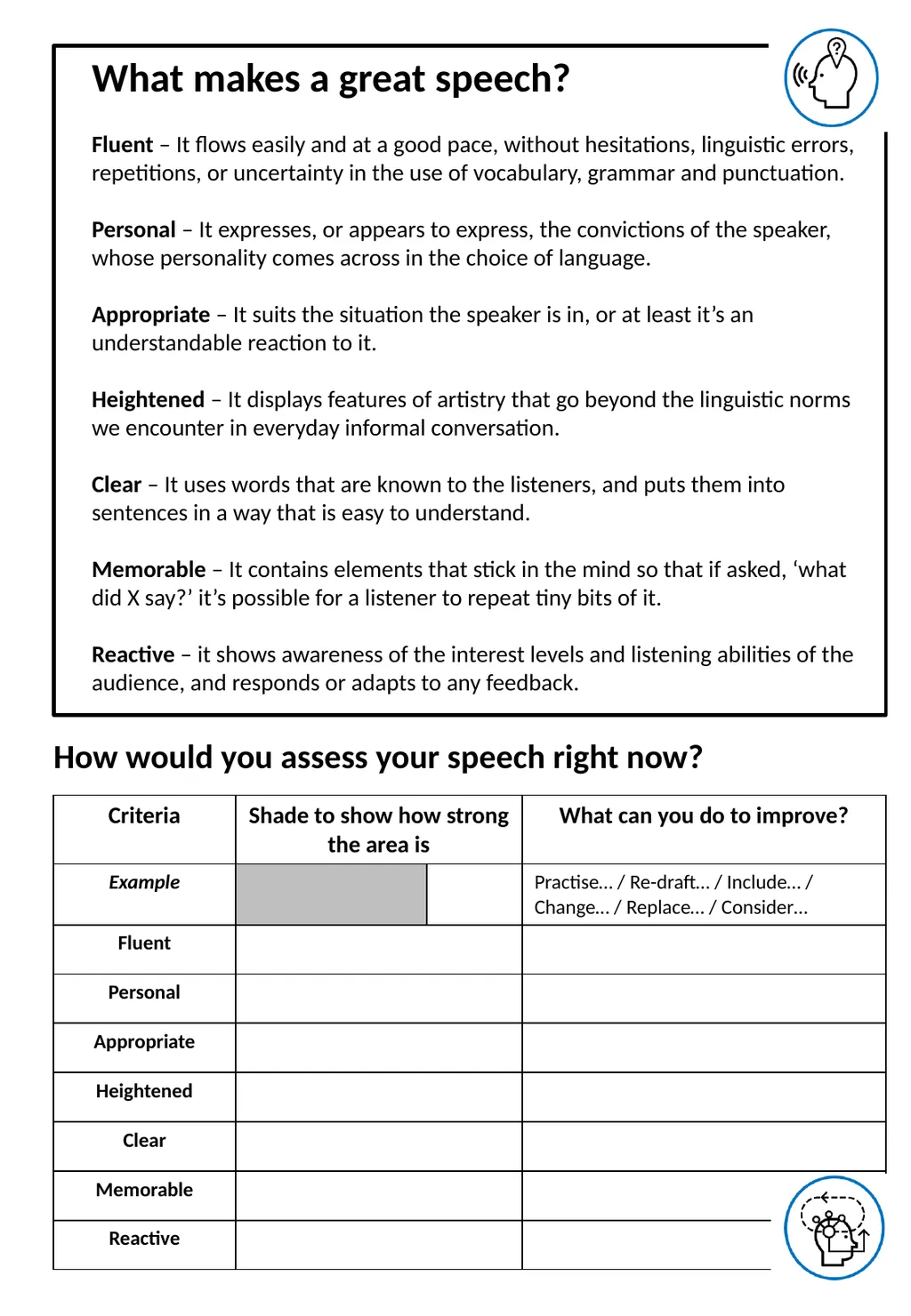
27 What makes a great speech?
Fluent – It flows easily and at a good pace, without hesitations, linguistic errors, repetitions, or uncertainty in the use of vocabulary, grammar and punctuation.
Personal – It expresses, or appears to express, the convictions of the speaker, whose personality comes across in the choice of language.
Appropriate – It suits the situation the speaker is in, or at least it’s an understandable reaction to it.
Heightened – It displays features of artistry that go beyond the linguistic norms we encounter in everyday informal conversation.
Clear – It uses words that are known to the listeners, and puts them into sentences in a way that is easy to understand.
Memorable – It contains elements that stick in the mind so that if asked, ‘what did X say?’ it’s possible for a listener to repeat tiny bits of it.
Reactive – it shows awareness of the interest levels and listening abilities of the audience, and responds or adapts to any feedback. How would you assess your speech right now?<br>
Fluent – It flows easily and at a good pace, without hesitations, linguistic errors, repetitions, or uncertainty in the use of vocabulary, grammar and punctuation.
Personal – It expresses, or appears to express, the convictions of the speaker, whose personality comes across in the choice of language.
Appropriate – It suits the situation the speaker is in, or at least it’s an understandable reaction to it.
Heightened – It displays features of artistry that go beyond the linguistic norms we encounter in everyday informal conversation.
Clear – It uses words that are known to the listeners, and puts them into sentences in a way that is easy to understand.
Memorable – It contains elements that stick in the mind so that if asked, ‘what did X say?’ it’s possible for a listener to repeat tiny bits of it.
Reactive – it shows awareness of the interest levels and listening abilities of the audience, and responds or adapts to any feedback. How would you assess your speech right now?<br>
28
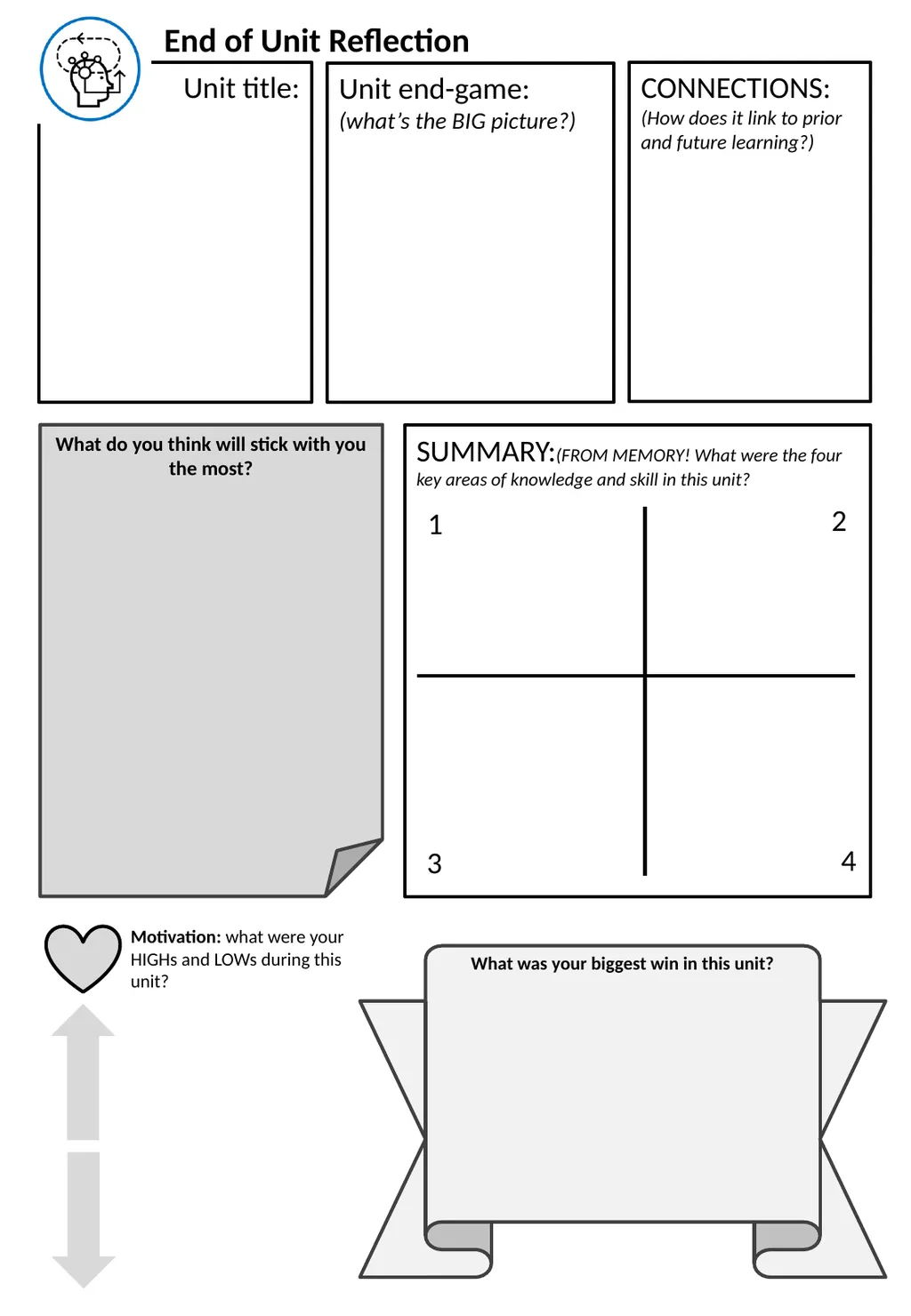
28 End of Unit Reflection Unit title: Unit end-game:
(what’s the BIG picture?) CONNECTIONS:
(How does it link to prior and future learning?) SUMMARY:(FROM MEMORY! What were the four key areas of knowledge and skill in this unit? 1 2 3 4 What do you think will stick with you the most? What was your biggest win in this unit? Motivation: what were your HIGHs and LOWs during this unit?<br>
(what’s the BIG picture?) CONNECTIONS:
(How does it link to prior and future learning?) SUMMARY:(FROM MEMORY! What were the four key areas of knowledge and skill in this unit? 1 2 3 4 What do you think will stick with you the most? What was your biggest win in this unit? Motivation: what were your HIGHs and LOWs during this unit?<br>
29
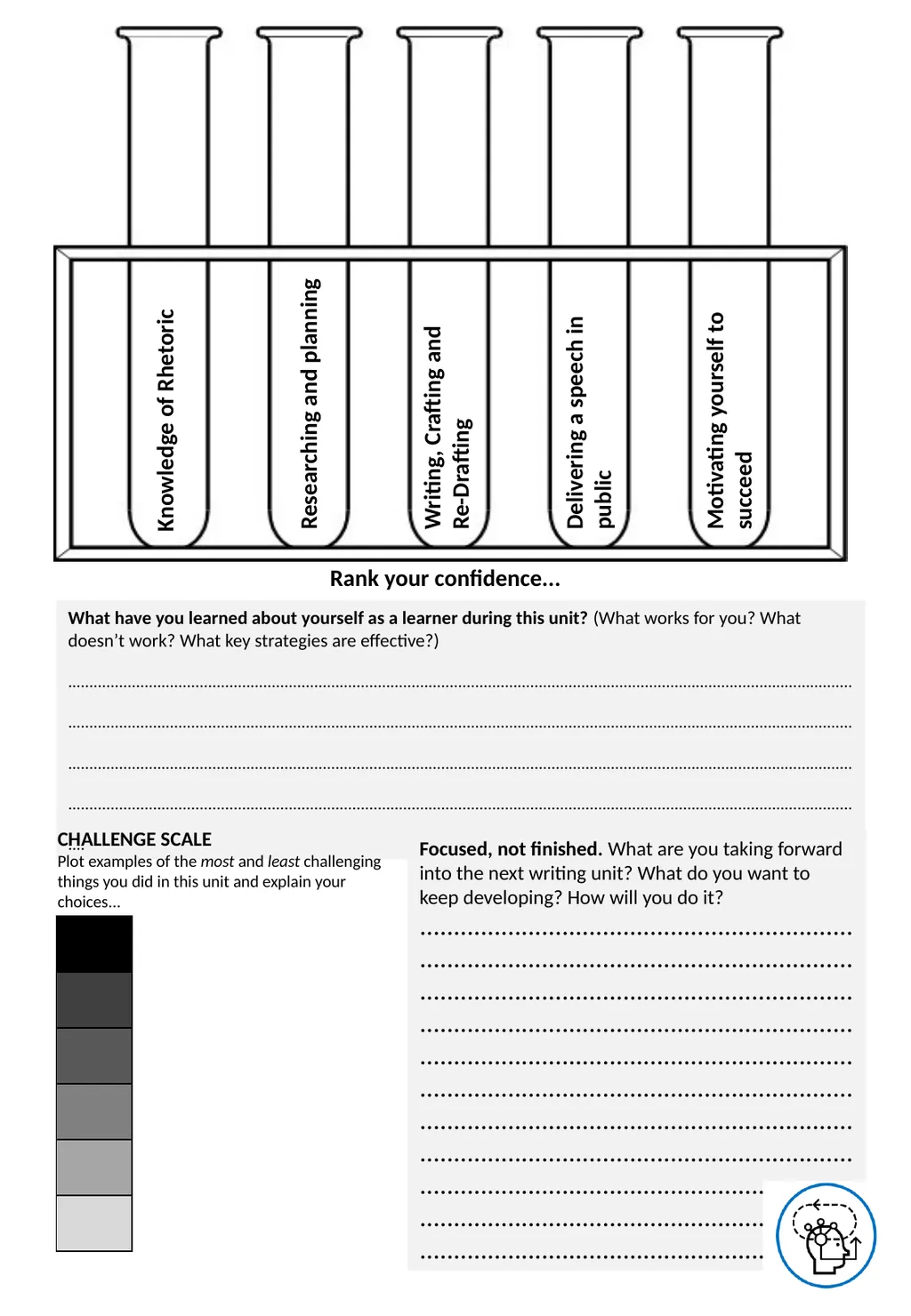
29 Rank your confidence... Knowledge of Rhetoric Researching and planning Writing, Crafting and Re-Drafting Delivering a speech in public Motivating yourself to succeed What have you learned about yourself as a learner during this unit? (What works for you? What doesn’t work? What key strategies are effective?)
........................................................................................................................................................................................................................................................................................................................................................................................................................................................................................................................................................................................................................................................................................................................................................................ CHALLENGE SCALE
Plot examples of the most and least challenging things you did in this unit and explain your choices... Focused, not finished. What are you taking forward into the next writing unit? What do you want to keep developing? How will you do it?
................................................................................................................................................................................................................................................................................................................................................................................................................................................................................................................................................................................................................................................................................................................................<br>
........................................................................................................................................................................................................................................................................................................................................................................................................................................................................................................................................................................................................................................................................................................................................................................ CHALLENGE SCALE
Plot examples of the most and least challenging things you did in this unit and explain your choices... Focused, not finished. What are you taking forward into the next writing unit? What do you want to keep developing? How will you do it?
................................................................................................................................................................................................................................................................................................................................................................................................................................................................................................................................................................................................................................................................................................................................<br>
30
30<br>
31
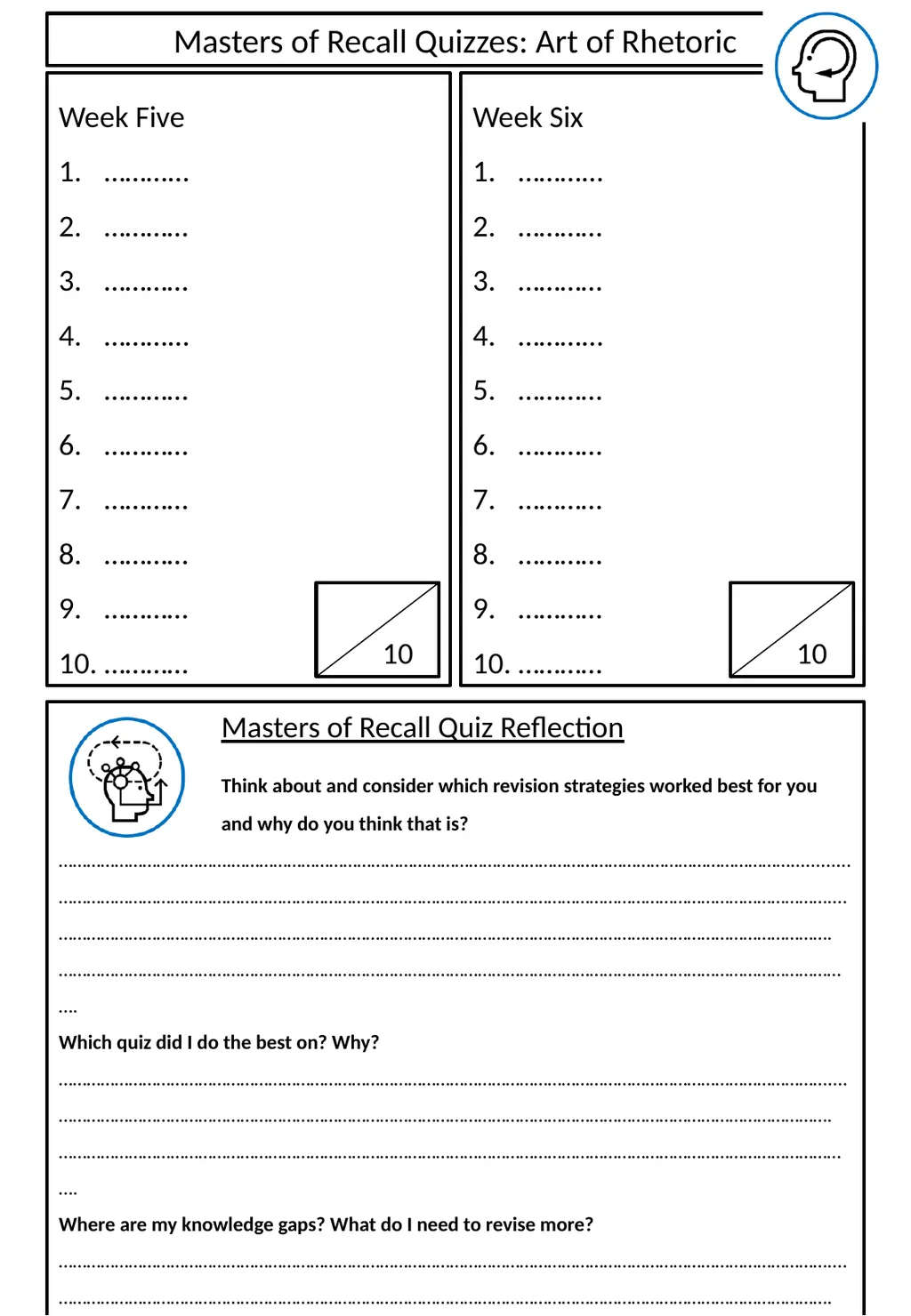
Masters of Recall Quiz Reflection
Think about and consider which revision strategies worked best for you and why do you think that is? ……………………………….…………………………………………………………………………………………………………............ …………………………………………………………………………………………………………………………………………………....………………………………………………………………………………………………………………………………………………….………………………………………………………………………………………………………………………………………………………. Which quiz did I do the best on? Why?
…………………………………………………………………………………………………………………………………………………....………………………………………………………………………………………………………………………………………………….……………………………………………………………………………………………………………………………………………………….
Where are my knowledge gaps? What do I need to revise more? …………………………………………………………………………………………………………………………………………………....………………………………………………………………………………………………………………………………………………….……………………………………………………………………………………………………………………………………………………….<br>
Think about and consider which revision strategies worked best for you and why do you think that is? ……………………………….…………………………………………………………………………………………………………............ …………………………………………………………………………………………………………………………………………………....………………………………………………………………………………………………………………………………………………….………………………………………………………………………………………………………………………………………………………. Which quiz did I do the best on? Why?
…………………………………………………………………………………………………………………………………………………....………………………………………………………………………………………………………………………………………………….……………………………………………………………………………………………………………………………………………………….
Where are my knowledge gaps? What do I need to revise more? …………………………………………………………………………………………………………………………………………………....………………………………………………………………………………………………………………………………………………….……………………………………………………………………………………………………………………………………………………….<br>