7 Attitudes, Beliefs, and Consistency Copyright ©
Description: 7 Attitudes, Beliefs, and Consistency Copyright 2017 Cengage Learning. All Rights Reserved. Define attitudes and why people have them Describe how attitudes are formed Summarize how major consistency theories and the duplex mind relate to
Related Topics
Download Presentation
"7 Attitudes, Beliefs, and Consistency Copyright ©" is the property of its rightful owner. Permission is granted to download and print the materials on this website for personal, non-commercial use only, and to display it on your personal computer provided you do not modify the materials and that you retain all copyright notices contained in the materials. By downloading content from our website, you accept the terms of this agreement.
Presentation Transcript
slide1. 7 Attitudes, Beliefs, and Consistency Copyright © 2017 Cengage Learning. All Rights Reserved.<br>
slide2. Define attitudes and why people have them
Describe how attitudes are formed
Summarize how major consistency theories and the duplex mind relate to attitudes
Explain the relationship between attitudes and behavior
Debate the role of attitudes in coping with trauma Learning Objectives Copyright © 2017 Cengage Learning. All Rights Reserved.<br>
slide3. Facebook allows people to express their attitudes and beliefs
Many digital tools are substitutes for normal social interaction
Facebook users tend to be more extraverted and narcissistic, but less conscientious and socially lonely, in comparison to nonusers Introduction Copyright © 2017 Cengage Learning. All Rights Reserved.<br>
slide4. Attitudes versus beliefs
Attitudes: global evaluations toward some object or issue
Beliefs: information about something; facts or opinions What Are Attitudes and Why Do People Have Them? Copyright © 2017 Cengage Learning. All Rights Reserved.<br>
slide5. Different evaluations of the same attitude object held by the same person
Perhaps one is deliberate, the other automatic
Automatic attitudes
Very fast evaluative, “gut-level” responses that people don’t think a great deal about
Deliberate attitudes
Reflective responses that people think more carefully about Dual Attitudes Copyright © 2017 Cengage Learning. All Rights Reserved.<br>
slide6. Mainly used to sort things into “good” and “bad” categories
Like or dislike
Helpful in decision making
Increases ease, speed, and quality Why People Have Attitudes Copyright © 2017 Cengage Learning. All Rights Reserved.<br>
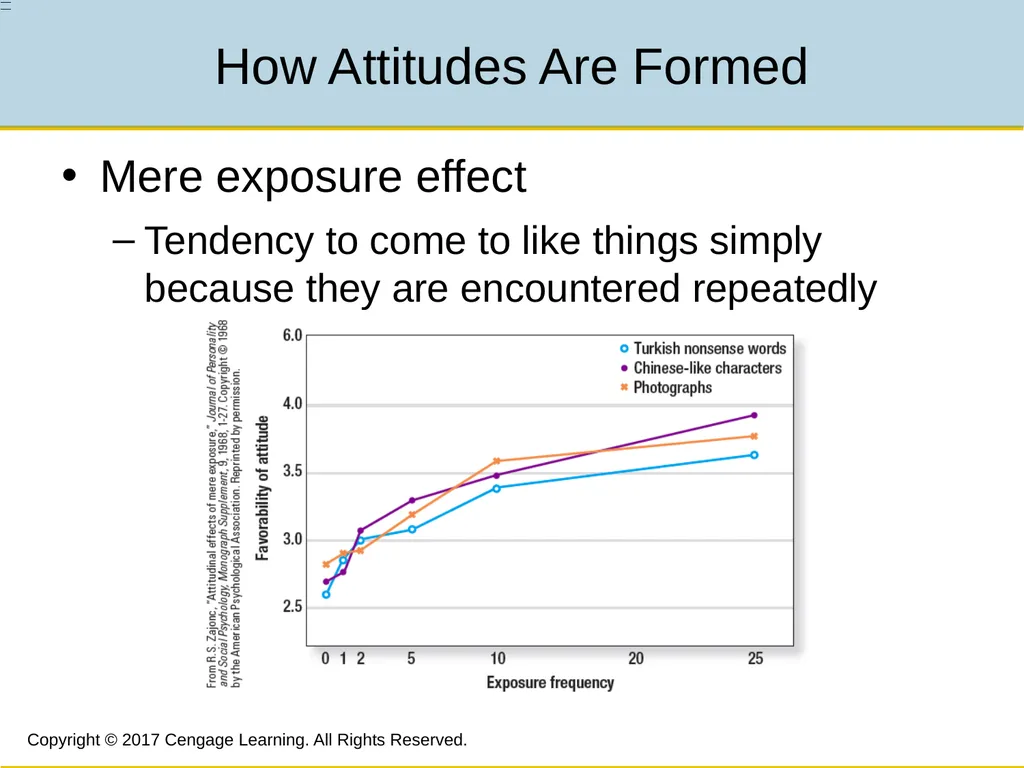
slide7. Mere exposure effect
Tendency to come to like things simply because they are encountered repeatedly How Attitudes Are Formed Copyright © 2017 Cengage Learning. All Rights Reserved.<br>
slide8. Embodied attitudes
Bodily movements shape people’s attitudes
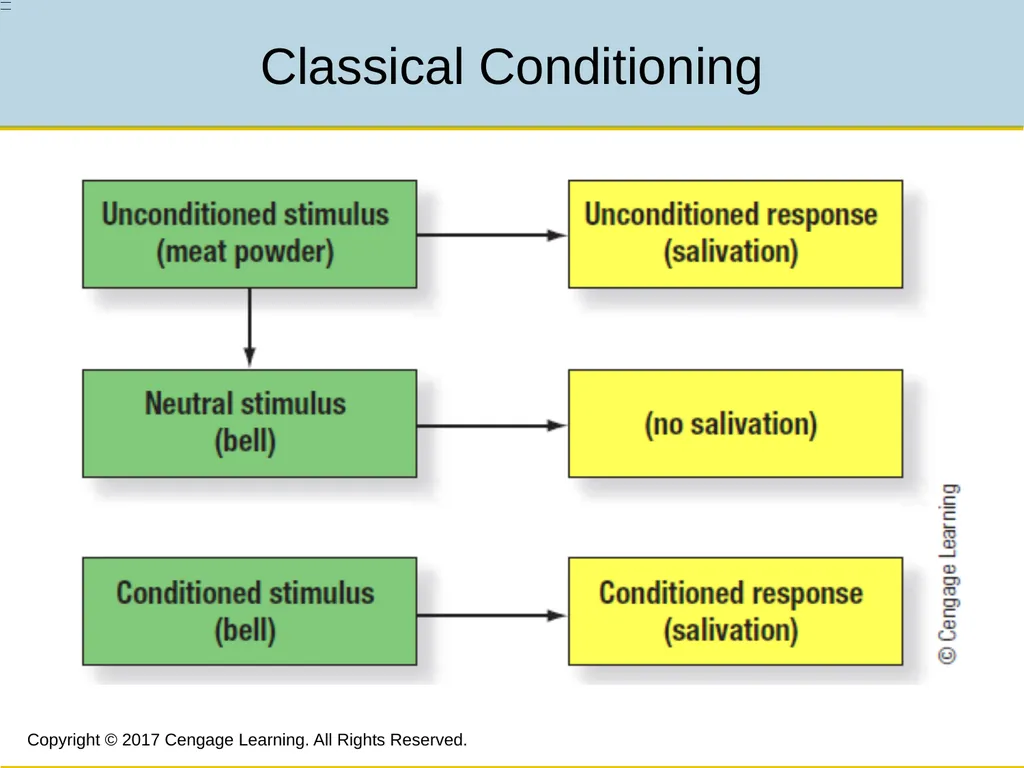
Classical conditioning
Learning in which, through repeated pairings, a neutral stimulus comes to evoke a conditioned response How Attitudes Are Formed (cont’d.) Copyright © 2017 Cengage Learning. All Rights Reserved.<br>
slide9. Classical Conditioning Copyright © 2017 Cengage Learning. All Rights Reserved.<br>
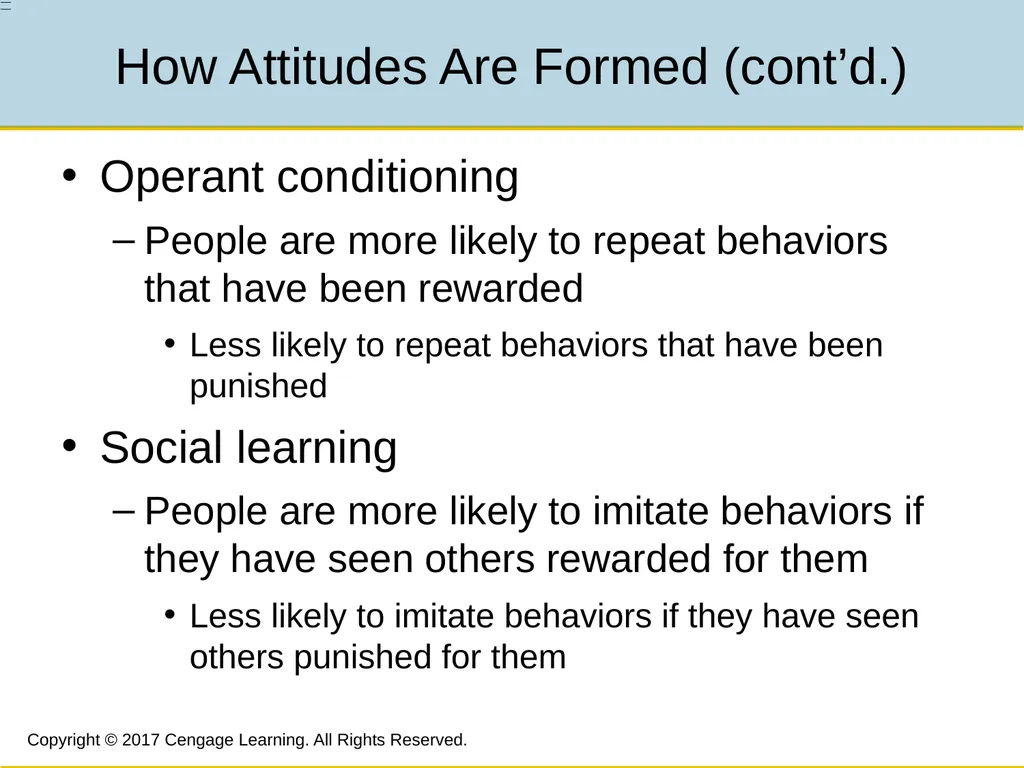
slide10. Operant conditioning
People are more likely to repeat behaviors that have been rewarded
Less likely to repeat behaviors that have been punished
Social learning
People are more likely to imitate behaviors if they have seen others rewarded for them
Less likely to imitate behaviors if they have seen others punished for them How Attitudes Are Formed (cont’d.) Copyright © 2017 Cengage Learning. All Rights Reserved.<br>
slide11. Attitude polarization
People’s attitudes become more extreme as they reflect on them
May generate new ideas or insights not considered when initial attitudes were formed
People with strong attitudes on certain issues may evaluate relevant evidence in a bias manner Polarization Copyright © 2017 Cengage Learning. All Rights Reserved.<br>
slide12. Commonalities in theories about consistency
Specify conditions required for consistency and inconsistency
Assume inconsistency is unpleasant
Specify conditions required to restore consistency Consistency Copyright © 2017 Cengage Learning. All Rights Reserved.<br>
slide13. Cognitive dissonance theory
Inconsistencies produce psychological discomfort
Leads people to rationalize their behavior or change their attitudes
People want to maintain consistency Cognitive Dissonance and Attitude Change Copyright © 2017 Cengage Learning. All Rights Reserved.<br>
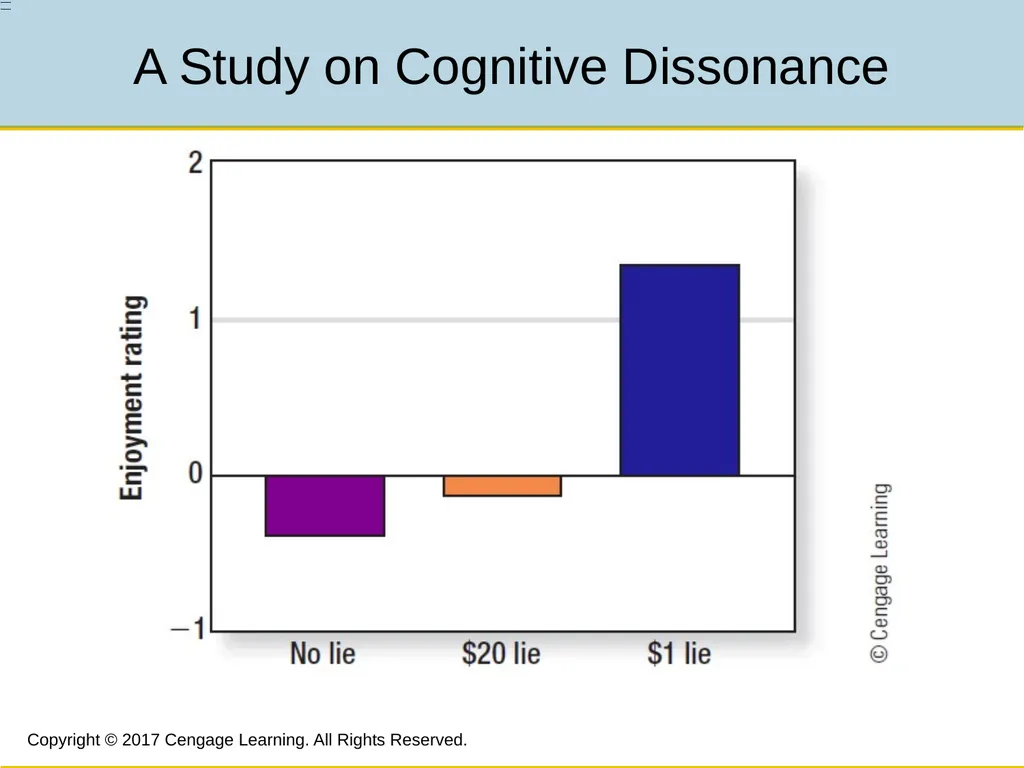
slide14. A Study on Cognitive Dissonance Copyright © 2017 Cengage Learning. All Rights Reserved.<br>
slide15. Effort justification
When people suffer, work hard, or make sacrifices, they will try to convince themselves that it is worthwhile
Justifying choices
Post-decision dissonance: cognitive dissonance experienced after making a difficult choice
Reduced by increasing attractiveness of chosen alternative and decreasing attractiveness of rejected Justifying Effort and Choices Copyright © 2017 Cengage Learning. All Rights Reserved.<br>
slide16. Would you eat a bug or a worm?
Subjects unwilling to eat a worm changed their opinion after being told they would have to eat the worm, and were given time to think about it
People are willing to suffer, if they are expecting to suffer—but only if they have changed their attitudes Food for Thought Copyright © 2017 Cengage Learning. All Rights Reserved.<br>
slide17. Dissonance is marked by both arousal and unpleasant arousal
It feels bad
People expect each other to be consistent
Reject inconsistency
Self-presentation plays an important role
Convincing others convinces yourself
Dissonance theory and the media
Filter bubbles: forced selective exposure Advances in Dissonance Theory Copyright © 2017 Cengage Learning. All Rights Reserved.<br>
slide18. The drive toward consistency most likely involves both parts of the duplex mind
Automatic system learns to detect inconsistencies and send out alarm signals (distress, arousal)
Deliberate system finds some resolution to the inconsistency by thinking about how to rationalize or rethink things Is the Drive for Consistency Rooted in Nature or Nurture? Copyright © 2017 Cengage Learning. All Rights Reserved.<br>
slide19. Gordon Allport
Attitude is the most important concept in psychology
Alan Wicker
Attitudes are a trivial, peripheral phenomenon
A–B problem: problem of inconsistency between attitudes (A) and behaviors (B) Attacking Attitudes Copyright © 2017 Cengage Learning. All Rights Reserved.<br>
slide20. General attitudes and specific behaviors
Attitudes predict specific behavior, but must measure very specific attitudes
Behavior aggregation
Combining attitudes across many different behaviors on different occasions
Broad attitudes in context
Broad attitudes can influence specific behaviors when interpreted here-and-now Defending Attitudes Copyright © 2017 Cengage Learning. All Rights Reserved.<br>
slide21. Attitude accessibility
How easily the attitude comes to mind
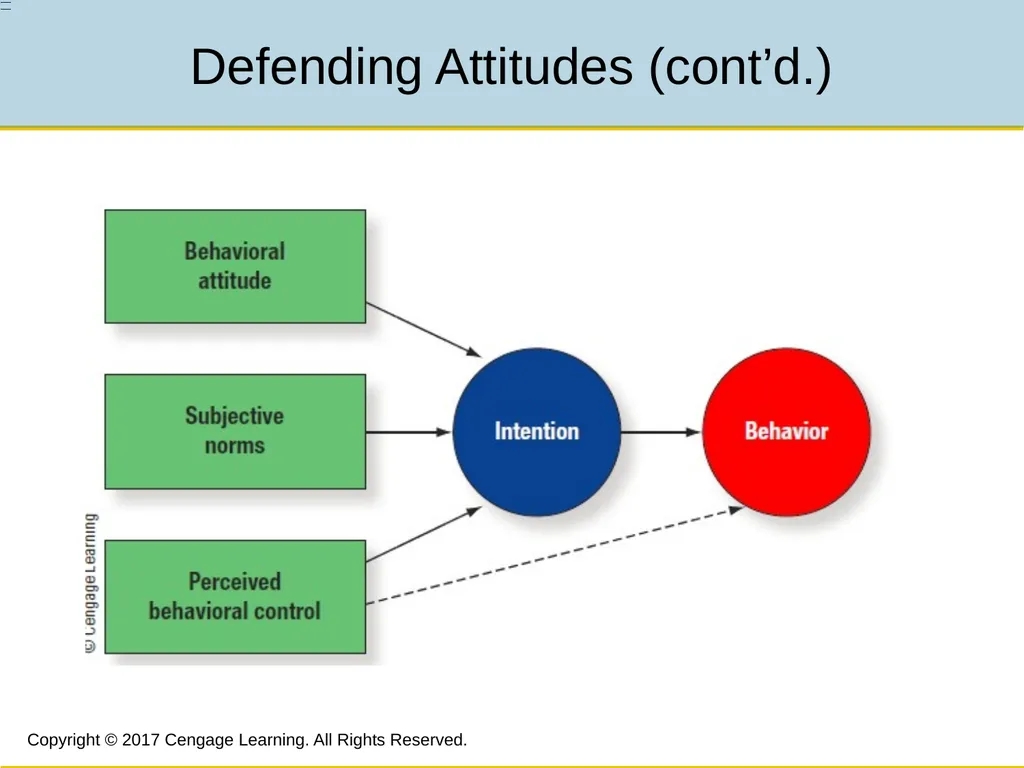
Behavioral intentions
Subjective norms: perceptions about whether significant others think they should perform the behavior
Perceived behavioral control: person’s beliefs about whether they can perform the behavior Defending Attitudes (cont’d.) Copyright © 2017 Cengage Learning. All Rights Reserved.<br>
slide22. Defending Attitudes (cont’d.) Copyright © 2017 Cengage Learning. All Rights Reserved.<br>
slide23. Belief versus doubting
Belief is automatic
Doubt is controlled
Belief perseverance
Once beliefs form, they are resistant to change, even if the information on which they are based is discredited Beliefs and Believing Copyright © 2017 Cengage Learning. All Rights Reserved.<br>
slide24. Beliefs help people understand the world around them
Coping: how people attempt to deal with traumas and go back to functioning effectively in life
Cognitive coping: idea that beliefs play a central role in helping people cope with and recover from misfortunes Belief and Coping Copyright © 2017 Cengage Learning. All Rights Reserved.<br>
slide25. Assumptive worlds: people live in social worlds with certain beliefs about reality
The world is benevolent
The world is fair and just
I am a good person Belief and Coping (cont’d.) Copyright © 2017 Cengage Learning. All Rights Reserved.<br>
slide26. Religious beliefs can help people cope with stress
People who rely on religion are less likely to fall back on ineffective coping strategies (e.g., drinking)
Appealing to a superordinate (high, all-encompassing) principle or power is an effective way to reduce dissonance Religious Belief Copyright © 2017 Cengage Learning. All Rights Reserved.<br>
slide27. People believe lots of seemingly crazy things
No rational basis
Paranormal beliefs
People who hold irrational beliefs
More anxious
Cope less well with terminal illnesses
More likely to become depressed over time
Have lower levels of self-esteem Irrational Belief Copyright © 2017 Cengage Learning. All Rights Reserved.<br>
slide28. Attitudes and beliefs reflect how we view the world
Attitudes are formed in two ways (automatically and deliberately) and are fairly stable once formed
Beliefs are the facts and information that we accept as true; they can help us cope or hurt us if they are irrational Summary Copyright © 2017 Cengage Learning. All Rights Reserved.<br>

slide2. Define attitudes and why people have them
Describe how attitudes are formed
Summarize how major consistency theories and the duplex mind relate to attitudes
Explain the relationship between attitudes and behavior
Debate the role of attitudes in coping with trauma Learning Objectives Copyright © 2017 Cengage Learning. All Rights Reserved.<br>
slide3. Facebook allows people to express their attitudes and beliefs
Many digital tools are substitutes for normal social interaction
Facebook users tend to be more extraverted and narcissistic, but less conscientious and socially lonely, in comparison to nonusers Introduction Copyright © 2017 Cengage Learning. All Rights Reserved.<br>
slide4. Attitudes versus beliefs
Attitudes: global evaluations toward some object or issue
Beliefs: information about something; facts or opinions What Are Attitudes and Why Do People Have Them? Copyright © 2017 Cengage Learning. All Rights Reserved.<br>
slide5. Different evaluations of the same attitude object held by the same person
Perhaps one is deliberate, the other automatic
Automatic attitudes
Very fast evaluative, “gut-level” responses that people don’t think a great deal about
Deliberate attitudes
Reflective responses that people think more carefully about Dual Attitudes Copyright © 2017 Cengage Learning. All Rights Reserved.<br>
slide6. Mainly used to sort things into “good” and “bad” categories
Like or dislike
Helpful in decision making
Increases ease, speed, and quality Why People Have Attitudes Copyright © 2017 Cengage Learning. All Rights Reserved.<br>
slide7. Mere exposure effect
Tendency to come to like things simply because they are encountered repeatedly How Attitudes Are Formed Copyright © 2017 Cengage Learning. All Rights Reserved.<br>
slide8. Embodied attitudes
Bodily movements shape people’s attitudes
Classical conditioning
Learning in which, through repeated pairings, a neutral stimulus comes to evoke a conditioned response How Attitudes Are Formed (cont’d.) Copyright © 2017 Cengage Learning. All Rights Reserved.<br>
slide9. Classical Conditioning Copyright © 2017 Cengage Learning. All Rights Reserved.<br>
slide10. Operant conditioning
People are more likely to repeat behaviors that have been rewarded
Less likely to repeat behaviors that have been punished
Social learning
People are more likely to imitate behaviors if they have seen others rewarded for them
Less likely to imitate behaviors if they have seen others punished for them How Attitudes Are Formed (cont’d.) Copyright © 2017 Cengage Learning. All Rights Reserved.<br>
slide11. Attitude polarization
People’s attitudes become more extreme as they reflect on them
May generate new ideas or insights not considered when initial attitudes were formed
People with strong attitudes on certain issues may evaluate relevant evidence in a bias manner Polarization Copyright © 2017 Cengage Learning. All Rights Reserved.<br>
slide12. Commonalities in theories about consistency
Specify conditions required for consistency and inconsistency
Assume inconsistency is unpleasant
Specify conditions required to restore consistency Consistency Copyright © 2017 Cengage Learning. All Rights Reserved.<br>
slide13. Cognitive dissonance theory
Inconsistencies produce psychological discomfort
Leads people to rationalize their behavior or change their attitudes
People want to maintain consistency Cognitive Dissonance and Attitude Change Copyright © 2017 Cengage Learning. All Rights Reserved.<br>
slide14. A Study on Cognitive Dissonance Copyright © 2017 Cengage Learning. All Rights Reserved.<br>
slide15. Effort justification
When people suffer, work hard, or make sacrifices, they will try to convince themselves that it is worthwhile
Justifying choices
Post-decision dissonance: cognitive dissonance experienced after making a difficult choice
Reduced by increasing attractiveness of chosen alternative and decreasing attractiveness of rejected Justifying Effort and Choices Copyright © 2017 Cengage Learning. All Rights Reserved.<br>
slide16. Would you eat a bug or a worm?
Subjects unwilling to eat a worm changed their opinion after being told they would have to eat the worm, and were given time to think about it
People are willing to suffer, if they are expecting to suffer—but only if they have changed their attitudes Food for Thought Copyright © 2017 Cengage Learning. All Rights Reserved.<br>
slide17. Dissonance is marked by both arousal and unpleasant arousal
It feels bad
People expect each other to be consistent
Reject inconsistency
Self-presentation plays an important role
Convincing others convinces yourself
Dissonance theory and the media
Filter bubbles: forced selective exposure Advances in Dissonance Theory Copyright © 2017 Cengage Learning. All Rights Reserved.<br>
slide18. The drive toward consistency most likely involves both parts of the duplex mind
Automatic system learns to detect inconsistencies and send out alarm signals (distress, arousal)
Deliberate system finds some resolution to the inconsistency by thinking about how to rationalize or rethink things Is the Drive for Consistency Rooted in Nature or Nurture? Copyright © 2017 Cengage Learning. All Rights Reserved.<br>
slide19. Gordon Allport
Attitude is the most important concept in psychology
Alan Wicker
Attitudes are a trivial, peripheral phenomenon
A–B problem: problem of inconsistency between attitudes (A) and behaviors (B) Attacking Attitudes Copyright © 2017 Cengage Learning. All Rights Reserved.<br>
slide20. General attitudes and specific behaviors
Attitudes predict specific behavior, but must measure very specific attitudes
Behavior aggregation
Combining attitudes across many different behaviors on different occasions
Broad attitudes in context
Broad attitudes can influence specific behaviors when interpreted here-and-now Defending Attitudes Copyright © 2017 Cengage Learning. All Rights Reserved.<br>
slide21. Attitude accessibility
How easily the attitude comes to mind
Behavioral intentions
Subjective norms: perceptions about whether significant others think they should perform the behavior
Perceived behavioral control: person’s beliefs about whether they can perform the behavior Defending Attitudes (cont’d.) Copyright © 2017 Cengage Learning. All Rights Reserved.<br>
slide22. Defending Attitudes (cont’d.) Copyright © 2017 Cengage Learning. All Rights Reserved.<br>
slide23. Belief versus doubting
Belief is automatic
Doubt is controlled
Belief perseverance
Once beliefs form, they are resistant to change, even if the information on which they are based is discredited Beliefs and Believing Copyright © 2017 Cengage Learning. All Rights Reserved.<br>
slide24. Beliefs help people understand the world around them
Coping: how people attempt to deal with traumas and go back to functioning effectively in life
Cognitive coping: idea that beliefs play a central role in helping people cope with and recover from misfortunes Belief and Coping Copyright © 2017 Cengage Learning. All Rights Reserved.<br>
slide25. Assumptive worlds: people live in social worlds with certain beliefs about reality
The world is benevolent
The world is fair and just
I am a good person Belief and Coping (cont’d.) Copyright © 2017 Cengage Learning. All Rights Reserved.<br>
slide26. Religious beliefs can help people cope with stress
People who rely on religion are less likely to fall back on ineffective coping strategies (e.g., drinking)
Appealing to a superordinate (high, all-encompassing) principle or power is an effective way to reduce dissonance Religious Belief Copyright © 2017 Cengage Learning. All Rights Reserved.<br>
slide27. People believe lots of seemingly crazy things
No rational basis
Paranormal beliefs
People who hold irrational beliefs
More anxious
Cope less well with terminal illnesses
More likely to become depressed over time
Have lower levels of self-esteem Irrational Belief Copyright © 2017 Cengage Learning. All Rights Reserved.<br>
slide28. Attitudes and beliefs reflect how we view the world
Attitudes are formed in two ways (automatically and deliberately) and are fairly stable once formed
Beliefs are the facts and information that we accept as true; they can help us cope or hurt us if they are irrational Summary Copyright © 2017 Cengage Learning. All Rights Reserved.<br>