A Multigenerational Workforce Boomers, X-ers Nets Erin VanderHorst, RN Ferris State University Nurs 450 Learning Objectives What is a Multigenerational workforce? Learn the differences between the different generations. Baby Boomers,
"A Multigenerational Workforce Boomers, X-er’s &" is the property of its rightful owner. Permission is granted to
download and print the materials on this website for personal, non-commercial use only, and to display it
on your personal computer provided you do not modify the materials and that you retain all copyright
notices contained in the materials. By downloading content from our website, you accept the terms of this
agreement.
Presentation Transcript
01
A Multigenerational Workforce Boomers, X-er’s & Nets Erin VanderHorst, RN
Ferris State University
Nurs 450<br>
02
Learning Objectives What is a Multigenerational workforce?
Learn the differences between the different generations.
Baby Boomers, X-er’s & Nets.
How does a generation’s values influence their work and work environment?
How does a multigenerational workforce influence nursing?
The Baby Boomer Generation is aging, how does that effect nursing?
What are some of the struggles we face with the Net generation and it’s impact on nursing?
Learn exactly what you bring to nursing dependent upon the generation you personally grew up in.<br>
03
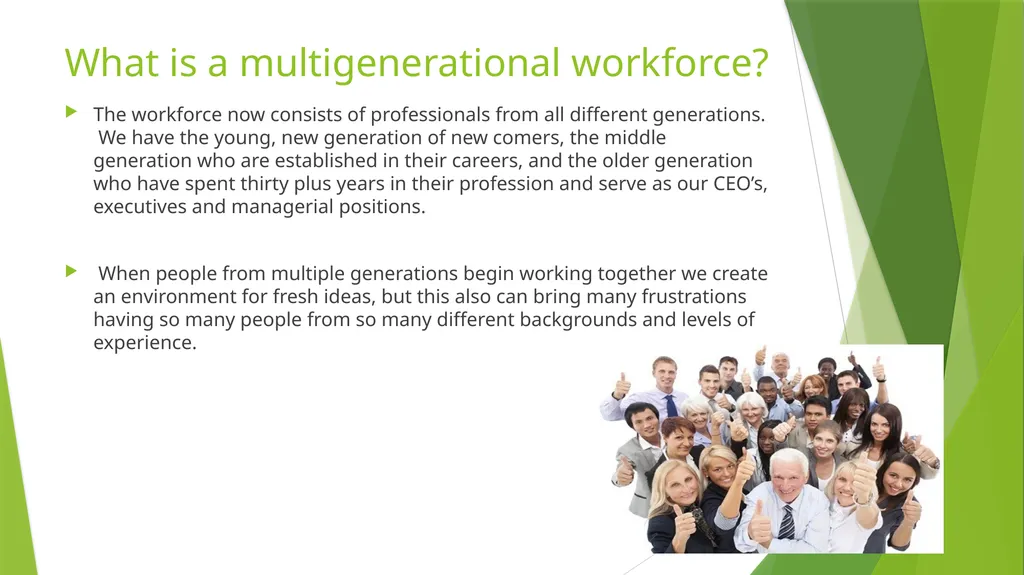
What is a multigenerational workforce? The workforce now consists of professionals from all different generations. We have the young, new generation of new comers, the middle generation who are established in their careers, and the older generation who have spent thirty plus years in their profession and serve as our CEO’s, executives and managerial positions.
When people from multiple generations begin working together we create an environment for fresh ideas, but this also can bring many frustrations having so many people from so many different backgrounds and levels of experience.<br>
04
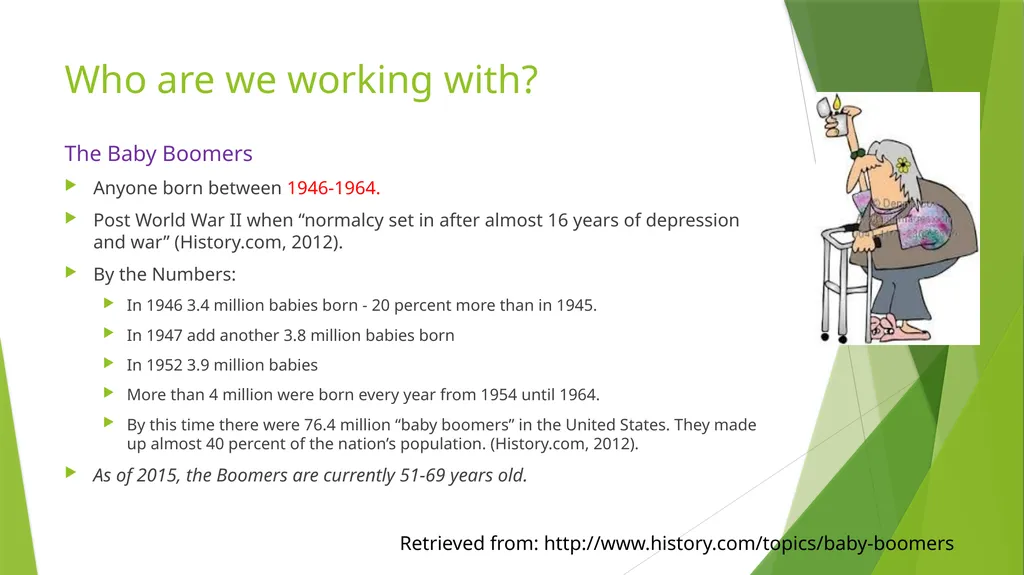
Who are we working with? The Baby Boomers
Anyone born between 1946-1964.
Post World War II when “normalcy set in after almost 16 years of depression and war” (History.com, 2012).
By the Numbers:
In 1946 3.4 million babies born - 20 percent more than in 1945.
In 1947 add another 3.8 million babies born
In 1952 3.9 million babies
More than 4 million were born every year from 1954 until 1964.
By this time there were 76.4 million “baby boomers” in the United States. They made up almost 40 percent of the nation’s population. (History.com, 2012).
As of 2015, the Boomers are currently 51-69 years old. Retrieved from: http://www.history.com/topics/baby-boomers<br>
05
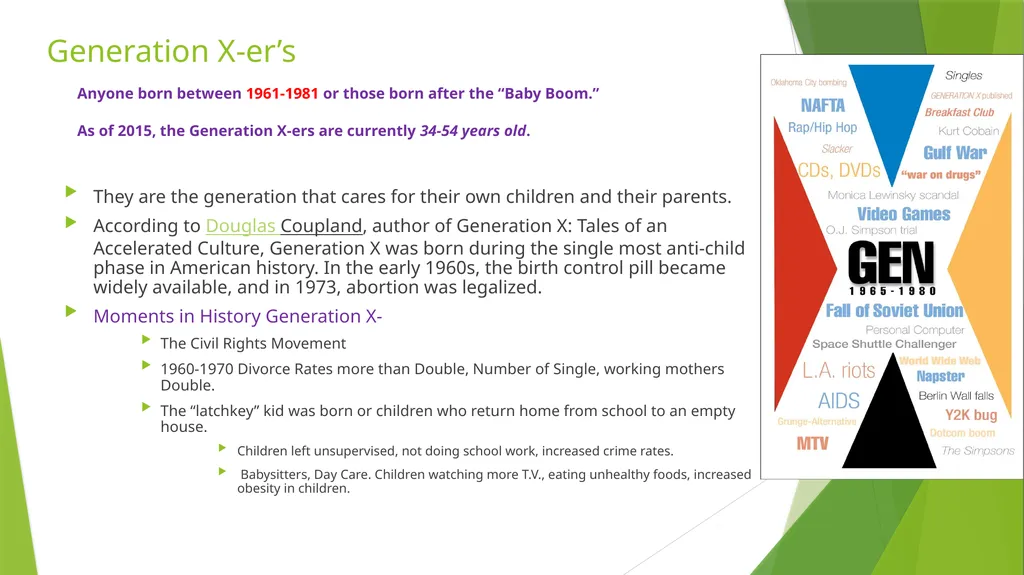
Generation X-er’s Anyone born between 1961-1981 or those born after the “Baby Boom.” As of 2015, the Generation X-ers are currently 34-54 years old. They are the generation that cares for their own children and their parents.
According to Douglas Coupland, author of Generation X: Tales of an Accelerated Culture, Generation X was born during the single most anti-child phase in American history. In the early 1960s, the birth control pill became widely available, and in 1973, abortion was legalized.
Moments in History Generation X-
The Civil Rights Movement
1960-1970 Divorce Rates more than Double, Number of Single, working mothers Double.
The “latchkey” kid was born or children who return home from school to an empty house.
Children left unsupervised, not doing school work, increased crime rates.
Babysitters, Day Care. Children watching more T.V., eating unhealthy foods, increased obesity in children.<br>
06
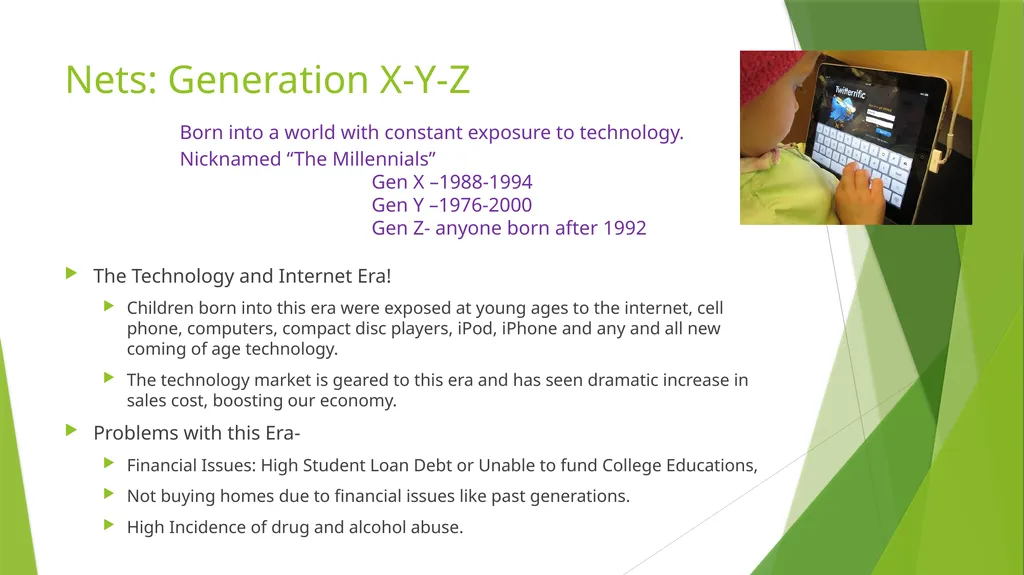
Nets: Generation X-Y-Z Born into a world with constant exposure to technology. Nicknamed “The Millennials” Gen X –1988-1994 Gen Y –1976-2000 Gen Z- anyone born after 1992 The Technology and Internet Era!
Children born into this era were exposed at young ages to the internet, cell phone, computers, compact disc players, iPod, iPhone and any and all new coming of age technology.
The technology market is geared to this era and has seen dramatic increase in sales cost, boosting our economy.
Problems with this Era-
Financial Issues: High Student Loan Debt or Unable to fund College Educations,
Not buying homes due to financial issues like past generations.
High Incidence of drug and alcohol abuse.<br>
07
The Generation Gap Gains of a Multi-gen Workforce Diversity can have a POSITIVE effect on a generation.
Values that each generation hold, are different because of they way and the environment in which they are brought up in.
Our older more experiences cohorts can teach the young.
The younger generation can bring their knowledge of technology to the workforce.
We ALL have something to give! Struggles of a Multi-Gen Workforce Many different generations working side by side.
This can lead to conflict, tension among co-workers, and decreased job satisfaction and productivity.
DIFFERENT VALUES = DIFFERENT WORK STYLES<br>
08
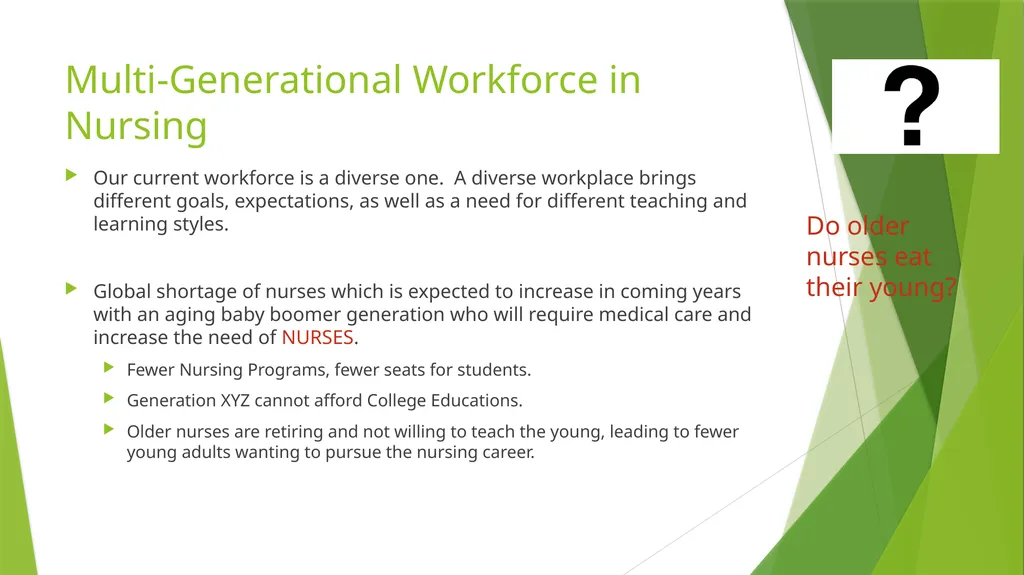
Multi-Generational Workforce in Nursing Our current workforce is a diverse one. A diverse workplace brings different goals, expectations, as well as a need for different teaching and learning styles.
Global shortage of nurses which is expected to increase in coming years with an aging baby boomer generation who will require medical care and increase the need of NURSES.
Fewer Nursing Programs, fewer seats for students.
Generation XYZ cannot afford College Educations.
Older nurses are retiring and not willing to teach the young, leading to fewer young adults wanting to pursue the nursing career. Do older nurses eat their young?<br>
09
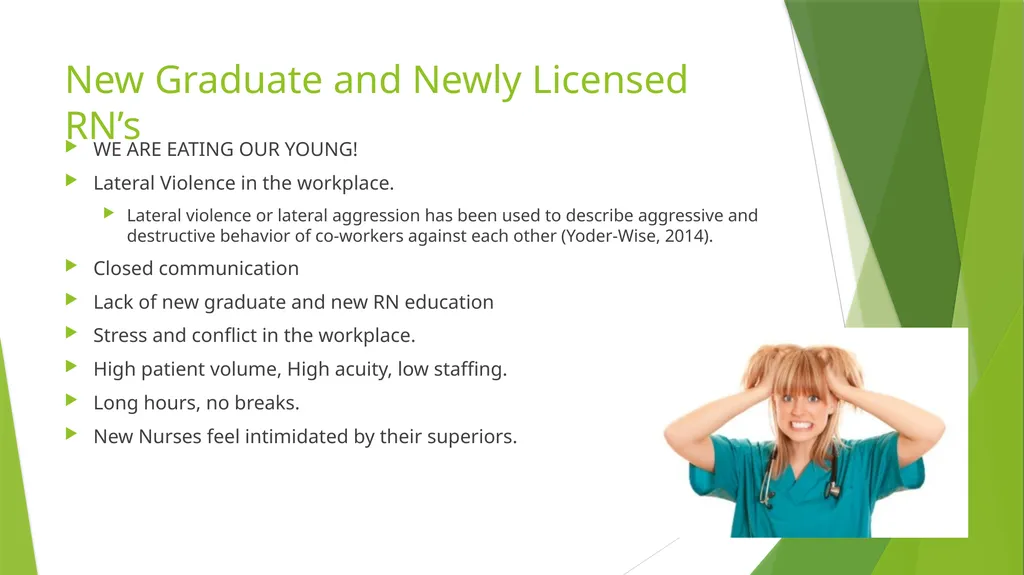
New Graduate and Newly Licensed RN’s WE ARE EATING OUR YOUNG!
Lateral Violence in the workplace.
Lateral violence or lateral aggression has been used to describe aggressive and destructive behavior of co-workers against each other (Yoder-Wise, 2014).
Closed communication
Lack of new graduate and new RN education
Stress and conflict in the workplace.
High patient volume, High acuity, low staffing.
Long hours, no breaks.
New Nurses feel intimidated by their superiors.<br>
10
Interventions for a Better Work Environment We need to create an environment in nursing that is welcoming and comfortable for nurses from any and all generations.
Open Communication. Hold meetings, conferences, conduct personal and peer evaluations on performance.
Modeling, coaching and confront our issues.
Be aware of personal bias
Develop a culture that promotes on-going learning.
“Nursing leaders must recognize and seize the opportunity that a multigenerational workforce provides to create an environment that is rich with the exchange of varying values, ethics, and perceptions” (Mercier, 2012).<br>
11
What do you bring to Nursing?<br>
12
References History.com Staff. (2010). Baby Boomers. Retrieved from: http://www.history.com/topics/baby-boomers
Mercier, N., (2012). Talent management strategies: Bridging the multigenerational gap in nursing. American Nurse Today. 7 (12). Retrieved from: http://www.americannursetoday.com/talent-management-strategies- bridging-the-multigenerational-gap-in-nursing/
Sherman, R.O. (2006). Leading a multigenerational nursing workforce: Issues, challenges and strategies. OJIN. Vol. 11. Doi: 10.3912/OJIN.Vol11No02Man02.
Yoder-Wise, P.S. (2014). Leading & Managing in Nursing (5th ed, Rev). St. Louis, MO; Saunders.<br>