ACADEMIC INTEGRITY MR SIRAYI Workshop goal: To explore academic dishonesty To explore academic integrity Declaration of academic integrity at NMU 3 Academic dishonesty Academic dishonesty 4 Academic dishonesty is defined as engaging in or
"ACADEMIC INTEGRITY MR SIRAYI Workshop goal: To" is the property of its rightful owner. Permission is granted to
download and print the materials on this website for personal, non-commercial use only, and to display it
on your personal computer provided you do not modify the materials and that you retain all copyright
notices contained in the materials. By downloading content from our website, you accept the terms of this
agreement.
Presentation Transcript
01
ACADEMIC INTEGRITY MR SIRAYI<br>
02
Workshop goal: To explore academic dishonesty
To explore academic integrity
Declaration of academic integrity at NMU<br>
03
3 Academic dishonesty<br>
04
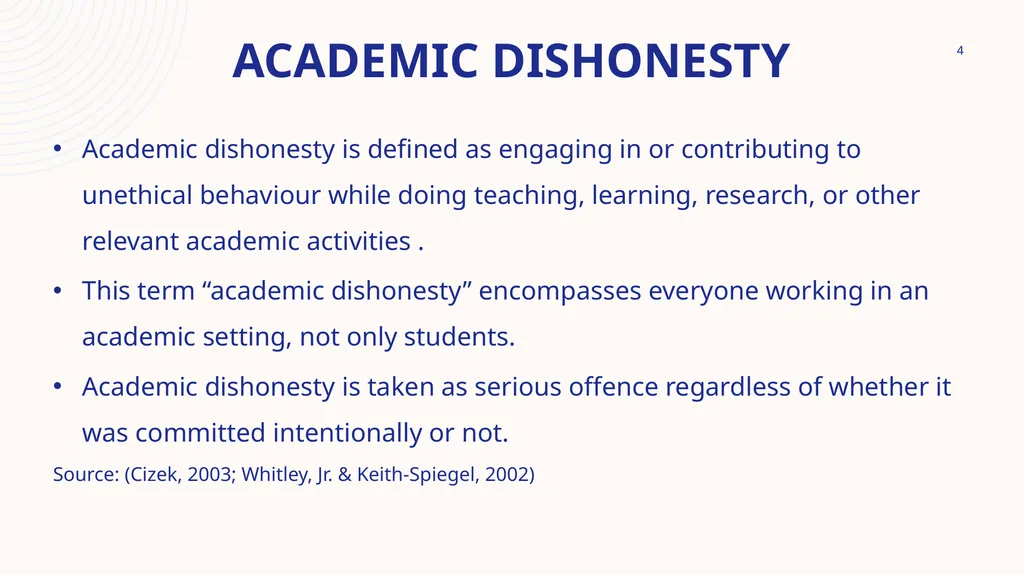
Academic dishonesty 4 Academic dishonesty is defined as engaging in or contributing to unethical behaviour while doing teaching, learning, research, or other relevant academic activities .
This term “academic dishonesty” encompasses everyone working in an academic setting, not only students.
Academic dishonesty is taken as serious offence regardless of whether it was committed intentionally or not.
Source: (Cizek, 2003; Whitley, Jr. & Keith-Spiegel, 2002)<br>
05
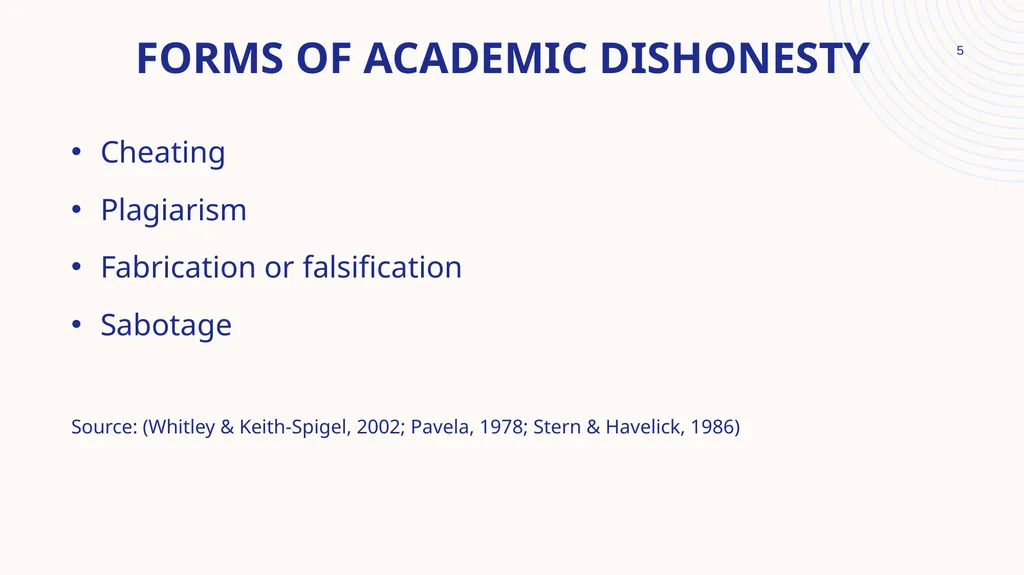
Forms of academic dishonesty 5 Cheating
Plagiarism
Fabrication or falsification
Sabotage
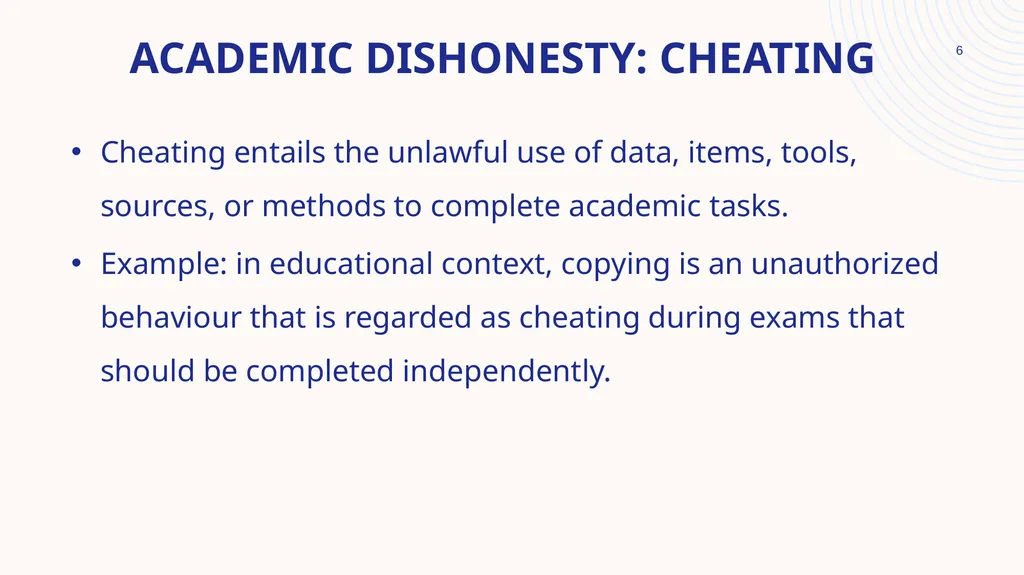
Academic dishonesty: cheating 6 Cheating entails the unlawful use of data, items, tools, sources, or methods to complete academic tasks.
Example: in educational context, copying is an unauthorized behaviour that is regarded as cheating during exams that should be completed independently.<br>
07
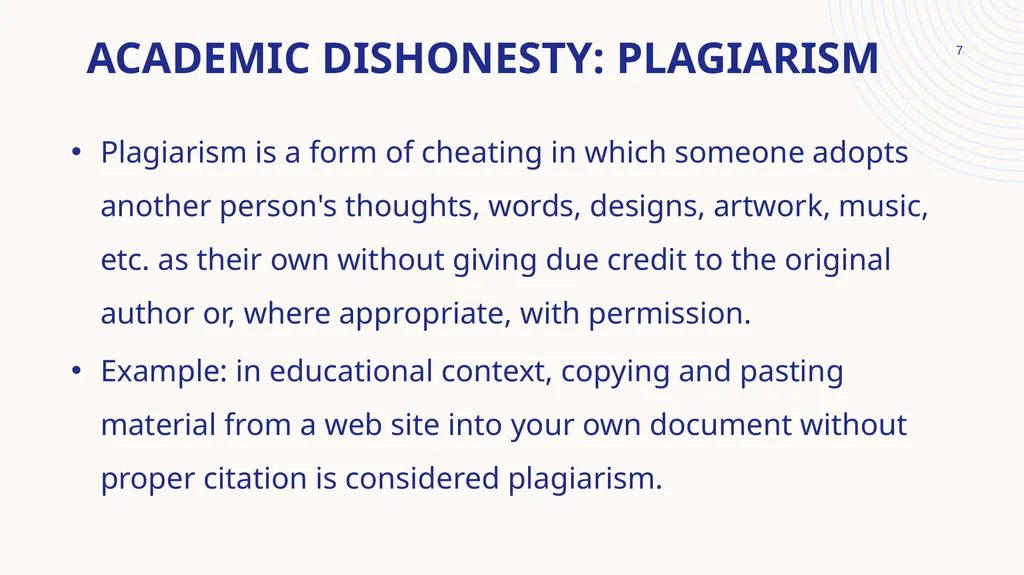
Academic dishonesty: plagiarism 7 Plagiarism is a form of cheating in which someone adopts another person's thoughts, words, designs, artwork, music, etc. as their own without giving due credit to the original author or, where appropriate, with permission.
Example: in educational context, copying and pasting material from a web site into your own document without proper citation is considered plagiarism.<br>
08
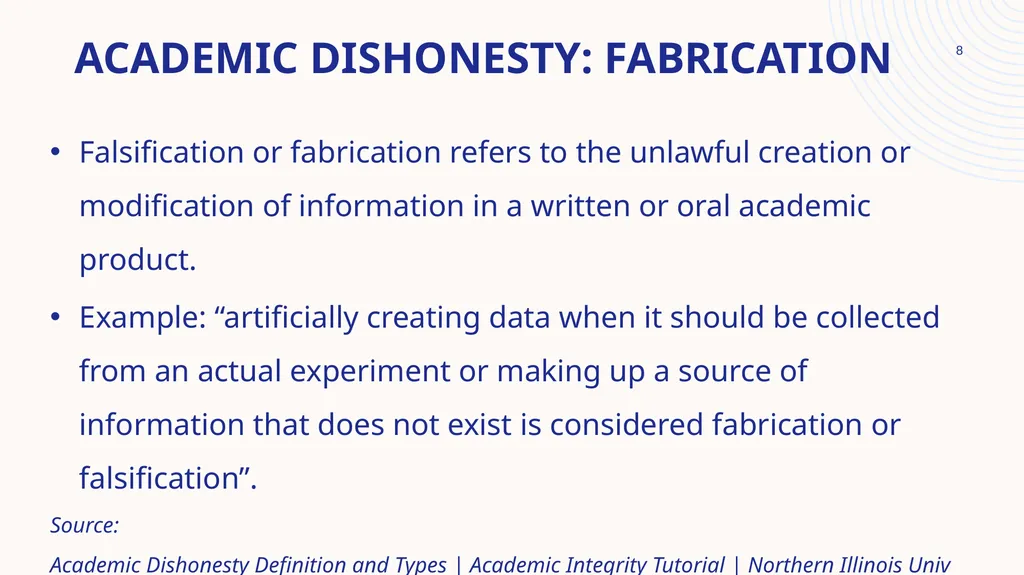
Academic dishonesty: Fabrication 8 Falsification or fabrication refers to the unlawful creation or modification of information in a written or oral academic product.
Example: “artificially creating data when it should be collected from an actual experiment or making up a source of information that does not exist is considered fabrication or falsification”.
Source: Academic Dishonesty Definition and Types | Academic Integrity Tutorial | Northern Illinois University (niu.edu).<br>
09
Academic dishonesty: sabotage 9 Sabotage is the act of interfering with or destroying someone else's work in order to prevent that person from successfully completing an academic task.
Example: in educational context, destroying another person's artwork, experiment, or design is considered sabotage. Failure to contribute as required to a team project can also be considered academic sabotage.<br>
10
Causes Academic dishonesty 10 Peer pressure
Performance anxiety
Excuse making
Inability to manage the demands of student life
Situations that encourage academic dishonesty
Self-justification habits
Unfamiliarity with what constitutes academic dishonesty
Lack of understanding about consequences
Source: (Whitley and Keith-Spiegel, 2002)<br>
11
Academic integrity 11<br>
12
Academic integrity? 12 The foundation of the university and the larger academic community is shared moral principles and expectations of conduct, such as decency, equity, and responsibility.
Academic integrity refers to putting these ideals into action through honesty in your academic work at school, fairness to others, taking ownership of your learning, and adhering to scholarly traditions.
How to show Academic integrity? 13 using information appropriately, according to copyright and privacy laws
acknowledging where the information you use comes from
not presenting other people's work as your own
conducting research ethically, in line with the University's regulations on human research ethics
reporting truthfully on your research
acting in an ethical manner in all your academic endeavours
Why Academic integrity is important? 14 You are at university to learn
The University must ensure the quality of its teaching and learning
You will need to demonstrate integrity in your future employment
There are rules, laws and regulations
There are penalties for academic misconduct
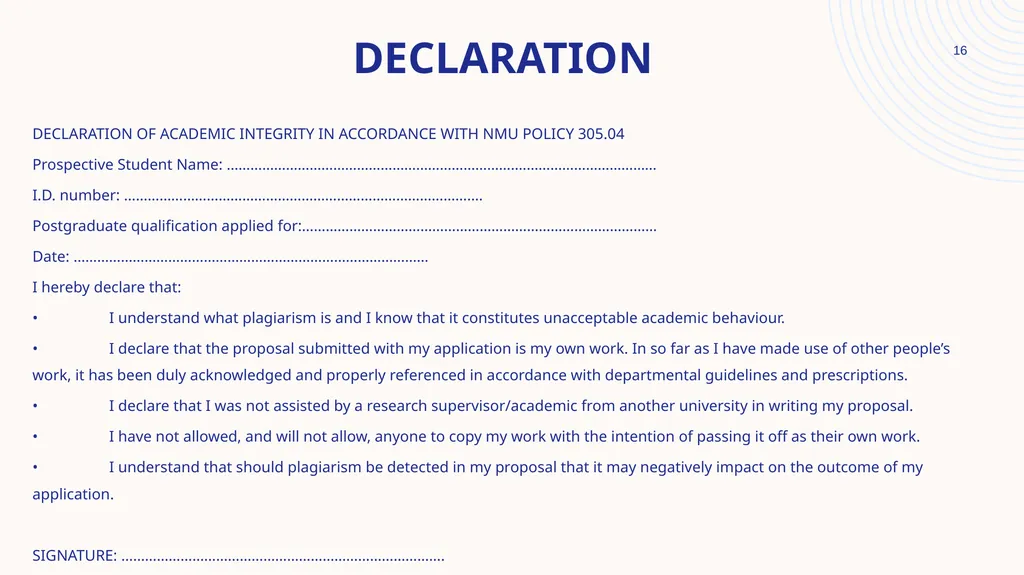
Declaration 16 DECLARATION OF ACADEMIC INTEGRITY IN ACCORDANCE WITH NMU POLICY 305.04
Prospective Student Name: ……………………………………………………………….………………………………
I.D. number: ……………………………………………………………………………….
Postgraduate qualification applied for:………………………………………………………………………………
Date: ………………………………………………………………………………
I hereby declare that:
• I understand what plagiarism is and I know that it constitutes unacceptable academic behaviour.
• I declare that the proposal submitted with my application is my own work. In so far as I have made use of other people’s work, it has been duly acknowledged and properly referenced in accordance with departmental guidelines and prescriptions.
• I declare that I was not assisted by a research supervisor/academic from another university in writing my proposal.
• I have not allowed, and will not allow, anyone to copy my work with the intention of passing it off as their own work.
• I understand that should plagiarism be detected in my proposal that it may negatively impact on the outcome of my application.