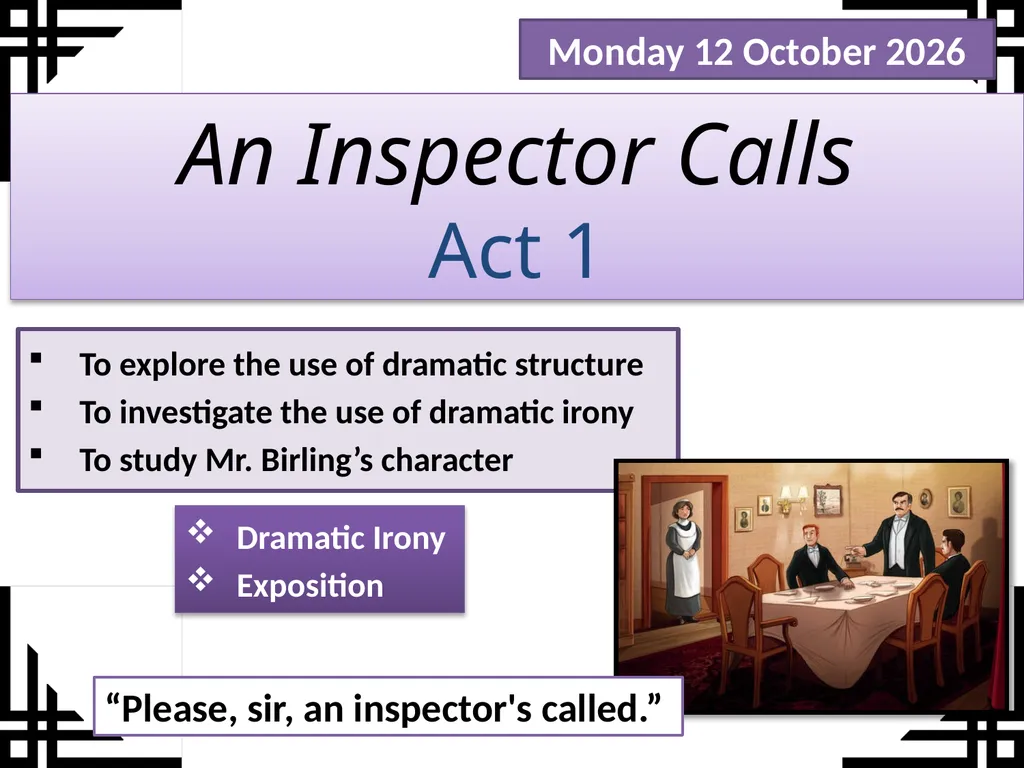
An Inspector Calls Act 1 To explore the use of dramatic structure To investigate the use of dramatic irony To study Mr. Birlings character Friday, 23 June 2017 Dramatic Irony Exposition Please, sir, an inspectors called. Dramatic Irony
"An Inspector Calls Act 1 To explore the use of" is the property of its rightful owner. Permission is granted to
download and print the materials on this website for personal, non-commercial use only, and to display it
on your personal computer provided you do not modify the materials and that you retain all copyright
notices contained in the materials. By downloading content from our website, you accept the terms of this
agreement.
Presentation Transcript
01
An Inspector Calls Act 1 To explore the use of dramatic structure
To investigate the use of dramatic irony
To study Mr. Birling’s character Friday, 23 June 2017 Dramatic Irony
Exposition “Please, sir, an inspector's called.”<br>
02
Dramatic Irony By setting the play in the past, Priestley can make use of dramatic irony – the audience knows what happens after the events in the play but obviously the characters don’t.
Why would a writer use this device?
What kind of effect does it have on an audience?<br>
03
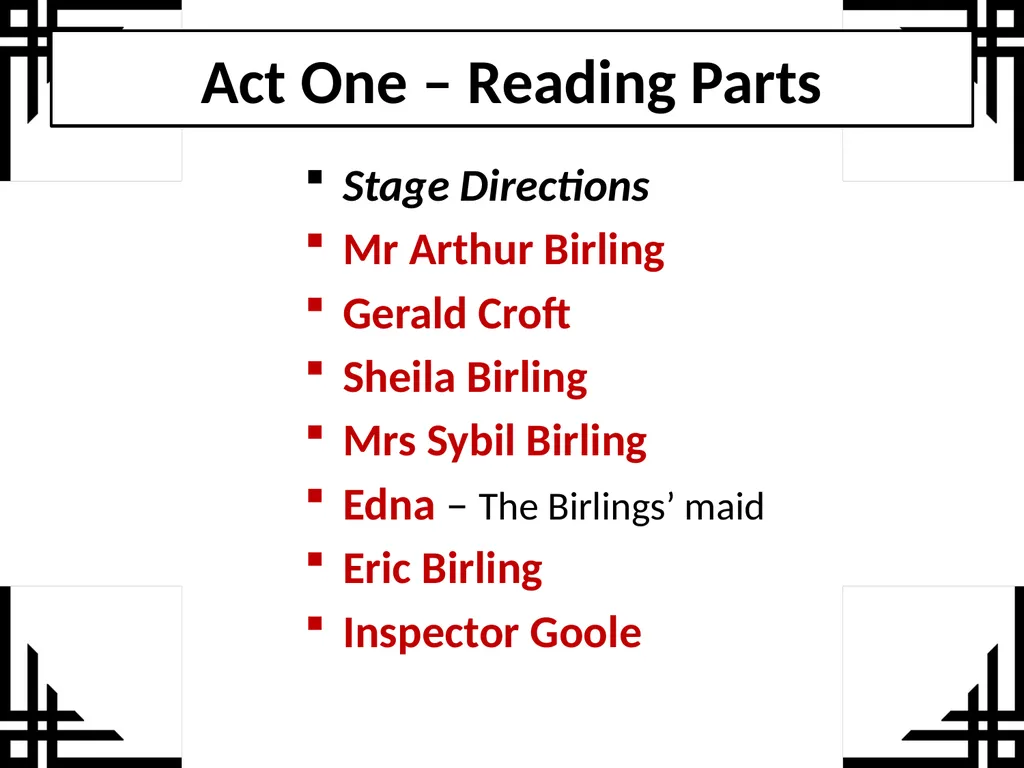
Act One – Reading Parts Stage Directions
Mr Arthur Birling
Gerald Croft
Sheila Birling
Mrs Sybil Birling
Edna – The Birlings’ maid
Eric Birling
Inspector Goole<br>
04
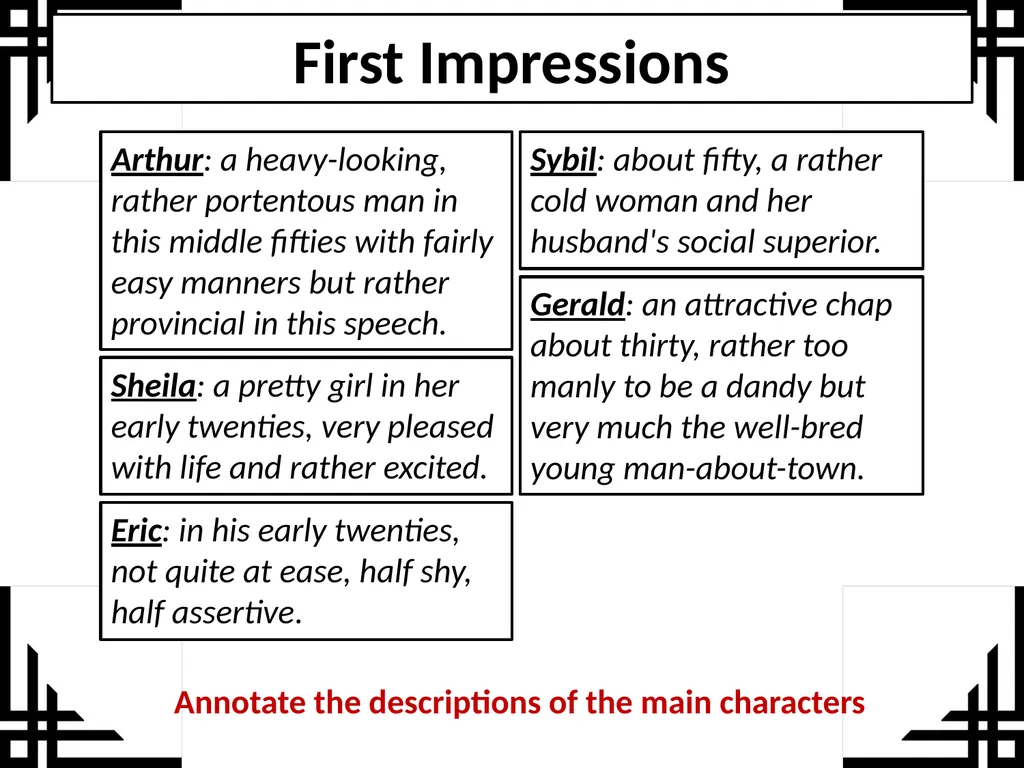
First Impressions Arthur: a heavy-looking, rather portentous man in this middle fifties with fairly easy manners but rather provincial in this speech. Sybil: about fifty, a rather cold woman and her husband's social superior. Sheila: a pretty girl in her early twenties, very pleased with life and rather excited. Gerald: an attractive chap about thirty, rather too manly to be a dandy but very much the well-bred young man-about-town. Eric: in his early twenties, not quite at ease, half shy, half assertive. Annotate the descriptions of the main characters<br>
05
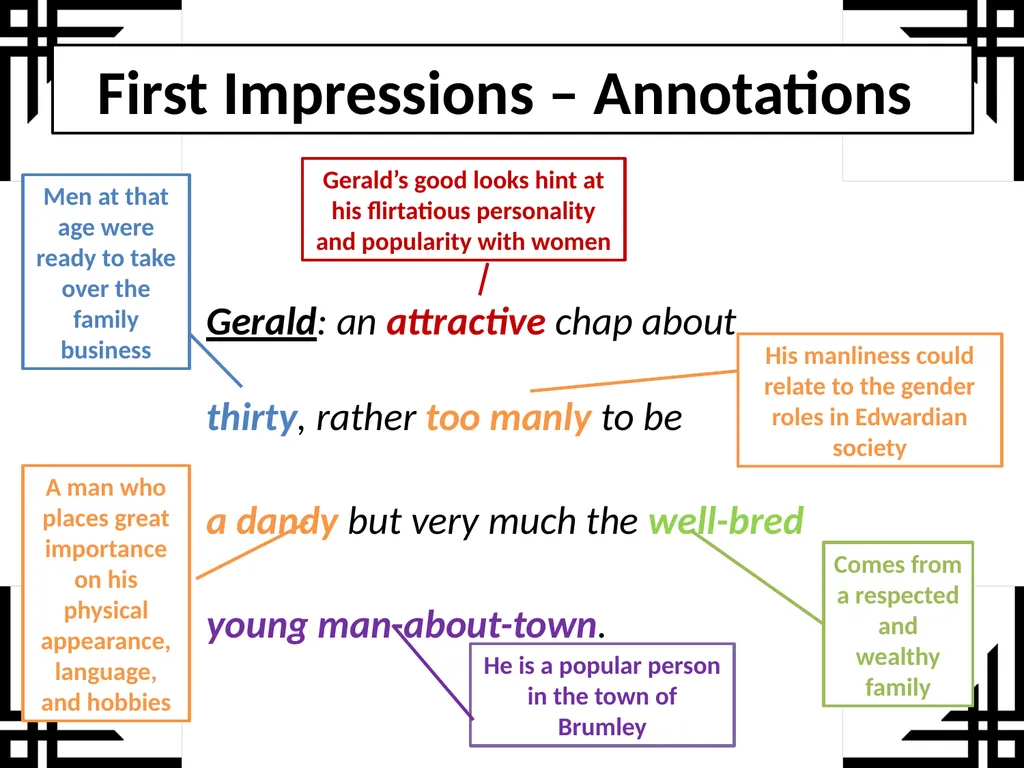
First Impressions – Annotations Gerald: an attractive chap about thirty, rather too manly to be
a dandy but very much the well-bred
young man-about-town. Gerald’s good looks hint at his flirtatious personality and popularity with women A man who places great importance on his physical appearance, language, and hobbies His manliness could relate to the gender roles in Edwardian society Comes from a respected and wealthy family He is a popular person in the town of Brumley Men at that age were ready to take over the family business<br>
06
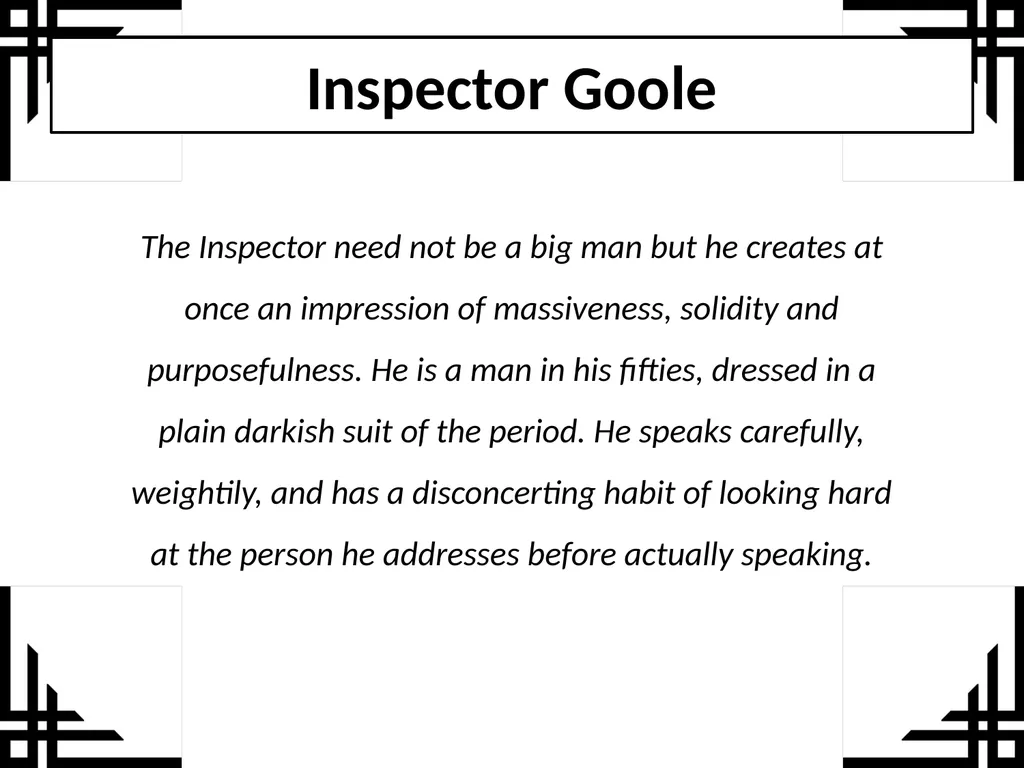
Inspector Goole The Inspector need not be a big man but he creates at once an impression of massiveness, solidity and purposefulness. He is a man in his fifties, dressed in a plain darkish suit of the period. He speaks carefully, weightily, and has a disconcerting habit of looking hard at the person he addresses before actually speaking.<br>
07
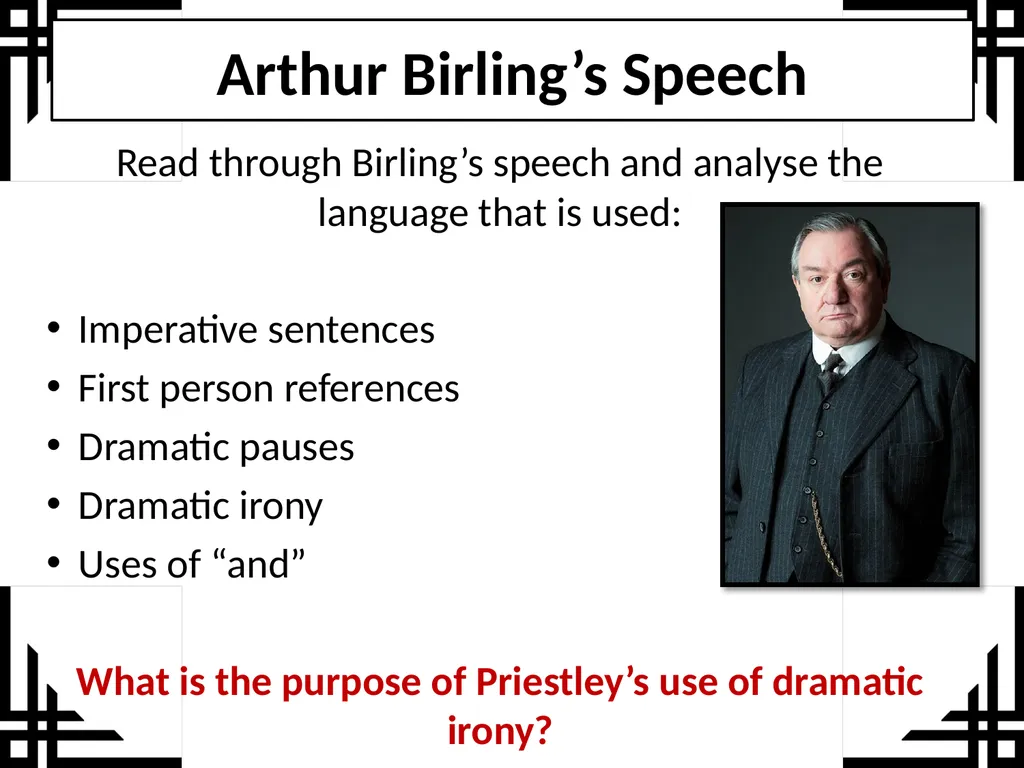
Arthur Birling’s Speech Read through Birling’s speech and analyse the language that is used:
Imperative sentences
First person references
Dramatic pauses
Dramatic irony
Uses of “and”
What is the purpose of Priestley’s use of dramatic irony?<br>
08
Just let me finish, Eric. You’ve a lot to learn yet. And I’m talking as a hard-headed, practical man of business. And I say there isn’t a chance of war. The world’s developing so fast that it’ll make war impossible. Look at the progress we’re making. In a year or two we’ll have aeroplanes that’ll be able to go anywhere. And look at the way the auto-mobiles making headway – bigger and faster all the time. And then the ships. Why, a friend of mine went over this new liner last week – the Titanic – she sails next week – forty-six thousand eight hundred tons – forty-six thousand eight hundred tons – New York in five days – and every luxury – and unsinkable. That’s what you’ve got to keep your eye on, facts like that, progress like that – and not a few German officers talking nonsense and a few scaremongers here making a fuss about nothing. Now you three young people just listen to this – and remember what I’m telling you now. In twenty or thirty years time – let’s say, in 1940 – you may be giving a little party like this – your son or daughter might be getting engaged – and I tell you, by that time you’ll be living in a world that’ll have forgotten all these capital versus labour agitations and all these silly little war scares. There’ll be peace and prosperity and rapid progress everywhere – except of course in Russia, which will always be behind hand naturally. Imperatives
First person references
Dramatic pauses
Dramatic irony
“And”<br>
09
Just let me finish, Eric. You’ve a lot to learn yet. And I’m talking as a hard-headed, practical man of business. And I say there isn’t a chance of war. The world’s developing so fast that it’ll make war impossible. Look at the progress we’re making. In a year or two we’ll have aeroplanes that’ll be able to go anywhere. And look at the way the auto-mobiles making headway – bigger and faster all the time. And then the ships. Why, a friend of mine went over this new liner last week – the Titanic – she sails next week – forty-six thousand eight hundred tons – forty-six thousand eight hundred tons – New York in five days – and every luxury – and unsinkable. That’s what you’ve got to keep your eye on, facts like that, progress like that – and not a few German officers talking nonsense and a few scaremongers here making a fuss about nothing. Now you three young people just listen to this – and remember what I’m telling you now. In twenty or thirty years time – let’s say, in 1940 – you may be giving a little party like this – your son or daughter might be getting engaged – and I tell you, by that time you’ll be living in a world that’ll have forgotten all these capital versus labour agitations and all these silly little war scares. There’ll be peace and prosperity and rapid progress everywhere – except of course in Russia, which will always be behind hand naturally. Imperatives
First person references
Dramatic pauses
Dramatic irony
“And”<br>
10
1926: General strike in England supporting miners’ pay and conditions. 1930: The Great Depression. A worldwide economic slump. 1914 – 1918 : World War I 1912: Titanic hits an iceberg and sinks in two hours 40 minutes. 1939: Start of World War II 1917: Russian Revolution, which put Russia (as the Soviet Union) on the map as a ‘superpower’ during the Cold War from 1945. Two influential writers of the 20th century, both socialist sympathisers and renowned for their earnest political messages.<br>
11
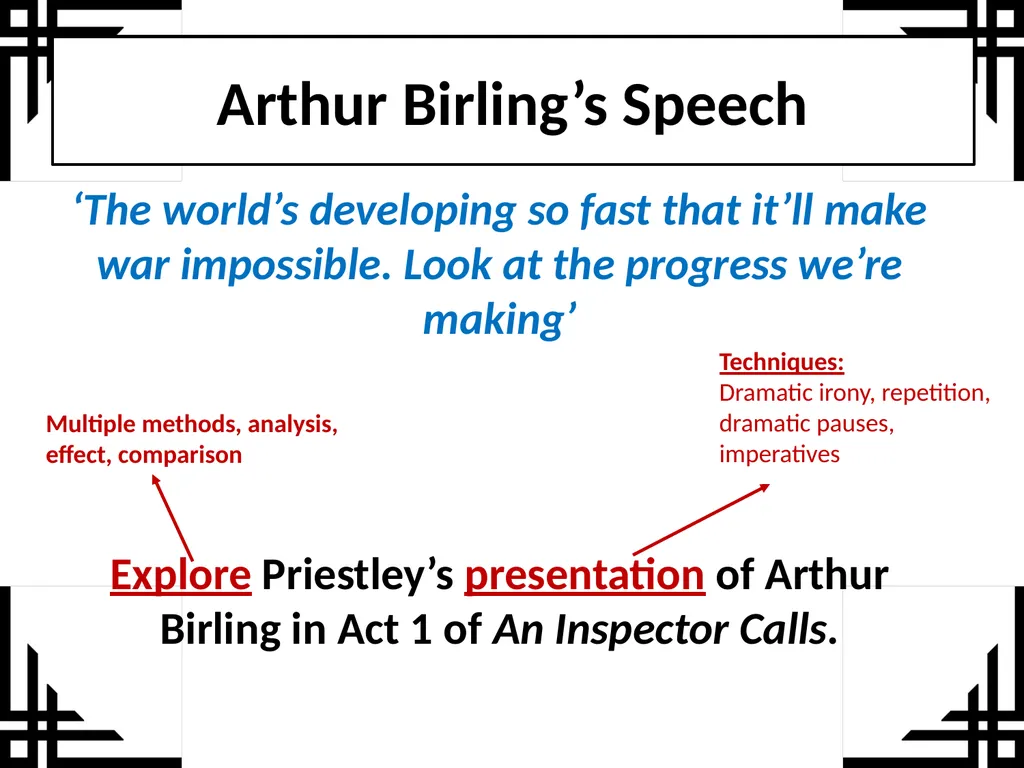
Arthur Birling’s Speech ‘The world’s developing so fast that it’ll make war impossible. Look at the progress we’re making’
Explore Priestley’s presentation of Arthur Birling in Act 1 of An Inspector Calls. Techniques:
Dramatic irony, repetition, dramatic pauses, imperatives Multiple methods, analysis, effect, comparison<br>
12
How does Birling sound selfish in this act?
How do the other characters react?
Are any of them sympathetic?
What do you think the Inspector’s role is?
What is different about the way Sheila responds to that of her father?
Are they right in the way they reject/accept responsibility? Why?
How can these ideas link to the context of the play? Act One Questions<br>