An Observation Article Guilloteaux, M. J. and Dörnyei, Z. (2008). Motivating Language Learners: A Classroom-Oriented Investigation of the Effects ofMotivational Strategies on Student Motivation. TESOL Quarterly, 42(1), 55-77. Abstract The
"An Observation Article Guilloteaux, M. J. and" is the property of its rightful owner. Permission is granted to
download and print the materials on this website for personal, non-commercial use only, and to display it
on your personal computer provided you do not modify the materials and that you retain all copyright
notices contained in the materials. By downloading content from our website, you accept the terms of this
agreement.
Presentation Transcript
01
An Observation Article Guilloteaux, M. J. and Dörnyei, Z. (2008). Motivating Language Learners: A Classroom-Oriented Investigation of the Effects ofMotivational Strategies on Student Motivation. TESOL Quarterly, 42(1), 55-77.<br>
02
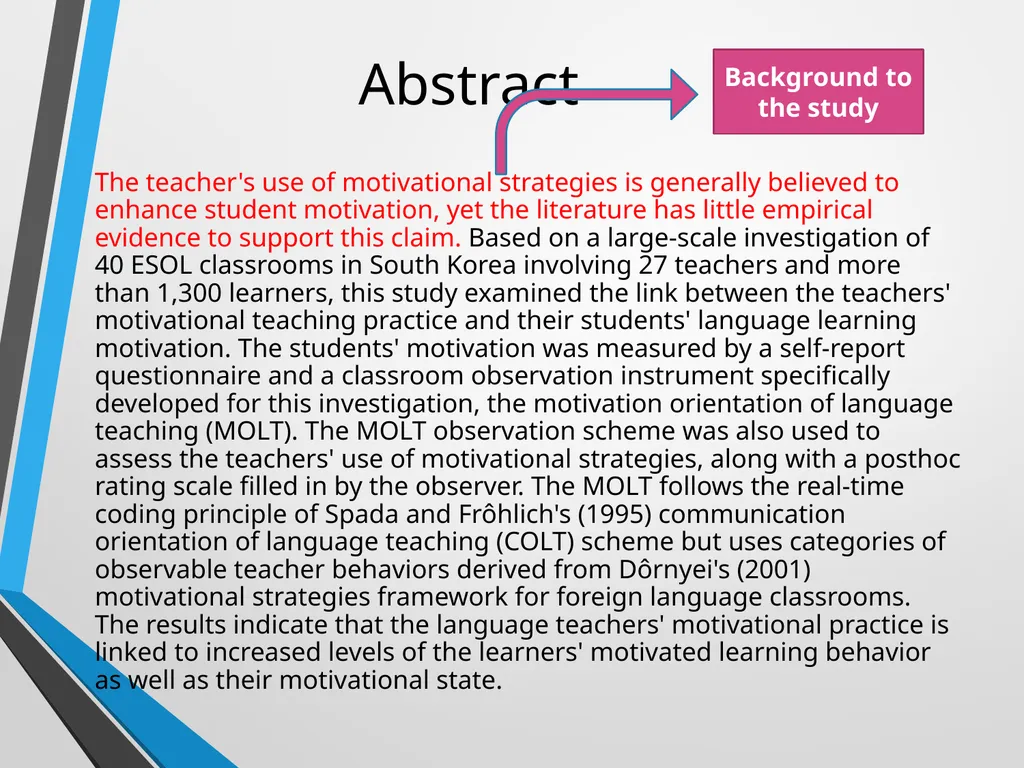
Abstract The teacher's use of motivational strategies is generally believed to enhance student motivation, yet the literature has little empirical evidence to support this claim. Based on a large-scale investigation of 40 ESOL classrooms in South Korea involving 27 teachers and more than 1,300 learners, this study examined the link between the teachers' motivational teaching practice and their students' language learning motivation. The students' motivation was measured by a self-report questionnaire and a classroom observation instrument specifically developed for this investigation, the motivation orientation of language teaching (MOLT). The MOLT observation scheme was also used to assess the teachers' use of motivational strategies, along with a posthoc rating scale filled in by the observer. The MOLT follows the real-time coding principle of Spada and Frôhlich's (1995) communication orientation of language teaching (COLT) scheme but uses categories of observable teacher behaviors derived from Dôrnyei's (2001) motivational strategies framework for foreign language classrooms. The results indicate that the language teachers' motivational practice is linked to increased levels of the learners' motivated learning behavior as well as their motivational state.<br>
03
Abstract The teacher's use of motivational strategies is generally believed to enhance student motivation, yet the literature has little empirical evidence to support this claim. Based on a large-scale investigation of 40 ESOL classrooms in South Korea involving 27 teachers and more than 1,300 learners, this study examined the link between the teachers' motivational teaching practice and their students' language learning motivation. The students' motivation was measured by a self-report questionnaire and a classroom observation instrument specifically developed for this investigation, the motivation orientation of language teaching (MOLT). The MOLT observation scheme was also used to assess the teachers' use of motivational strategies, along with a posthoc rating scale filled in by the observer. The MOLT follows the real-time coding principle of Spada and Frôhlich's (1995) communication orientation of language teaching (COLT) scheme but uses categories of observable teacher behaviors derived from Dôrnyei's (2001) motivational strategies framework for foreign language classrooms. The results indicate that the language teachers' motivational practice is linked to increased levels of the learners' motivated learning behavior as well as their motivational state. Background to the study<br>
04
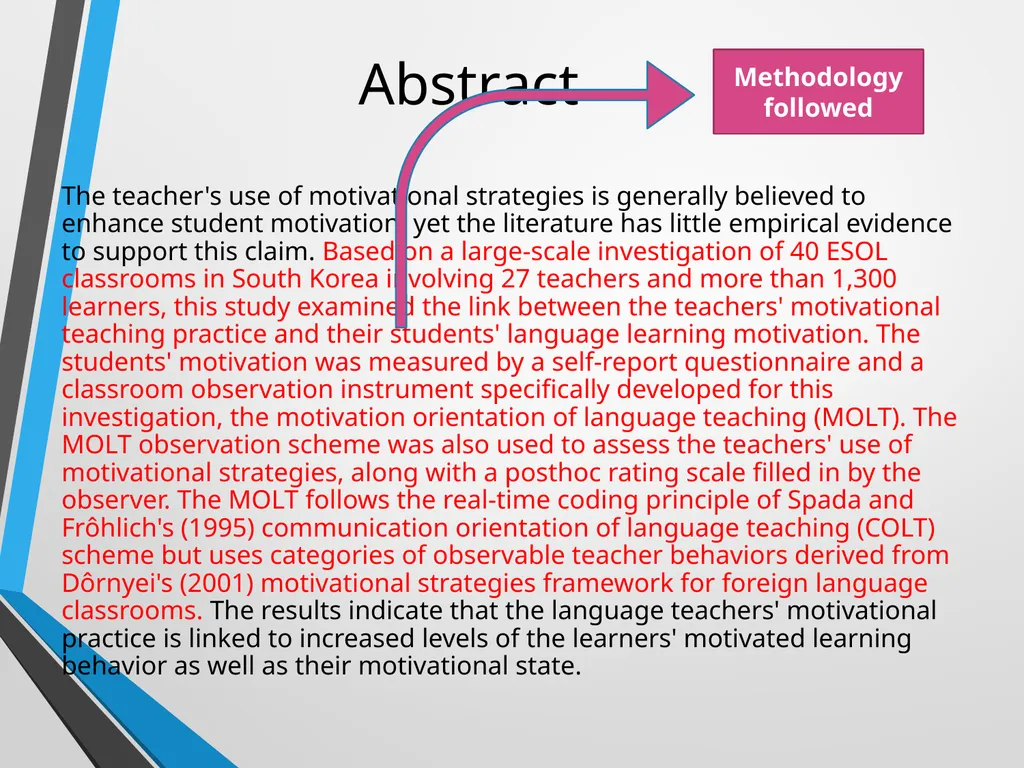
Abstract The teacher's use of motivational strategies is generally believed to enhance student motivation, yet the literature has little empirical evidence to support this claim. Based on a large-scale investigation of 40 ESOL classrooms in South Korea involving 27 teachers and more than 1,300 learners, this study examined the link between the teachers' motivational teaching practice and their students' language learning motivation. The students' motivation was measured by a self-report questionnaire and a classroom observation instrument specifically developed for this investigation, the motivation orientation of language teaching (MOLT). The MOLT observation scheme was also used to assess the teachers' use of motivational strategies, along with a posthoc rating scale filled in by the observer. The MOLT follows the real-time coding principle of Spada and Frôhlich's (1995) communication orientation of language teaching (COLT) scheme but uses categories of observable teacher behaviors derived from Dôrnyei's (2001) motivational strategies framework for foreign language classrooms. The results indicate that the language teachers' motivational practice is linked to increased levels of the learners' motivated learning behavior as well as their motivational state. Methodology followed<br>
05
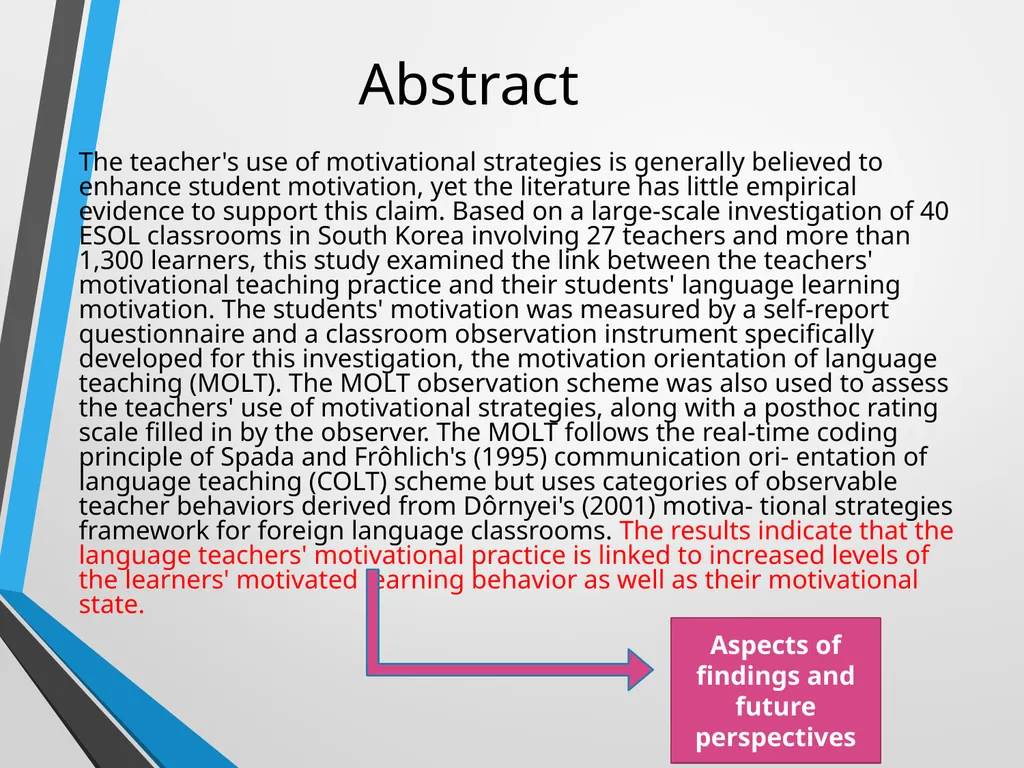
Abstract The teacher's use of motivational strategies is generally believed to enhance student motivation, yet the literature has little empirical evidence to support this claim. Based on a large-scale investigation of 40 ESOL classrooms in South Korea involving 27 teachers and more than 1,300 learners, this study examined the link between the teachers' motivational teaching practice and their students' language learning motivation. The students' motivation was measured by a self-report questionnaire and a classroom observation instrument specifically developed for this investigation, the motivation orientation of language teaching (MOLT). The MOLT observation scheme was also used to assess the teachers' use of motivational strategies, along with a posthoc rating scale filled in by the observer. The MOLT follows the real-time coding principle of Spada and Frôhlich's (1995) communication ori- entation of language teaching (COLT) scheme but uses categories of observable teacher behaviors derived from Dôrnyei's (2001) motiva- tional strategies framework for foreign language classrooms. The results indicate that the language teachers' motivational practice is linked to increased levels of the learners' motivated learning behavior as well as their motivational state. Aspects of findings and future perspectives<br>
06
Now scan the first part of the research paper up to the heading ‘A Framework for Motivational Strategies’.
What are the main points in the introduction?<br>
07
importance of motivation and motivational strategies in language learning
reports research which has been done before;
develops a rationale for the study;
criticises past practices
justifies the importance of this study;
engages the reader's interest;
gives the main purpose of the study
provides the context for the study;<br>
08
Now skim «A framework for Motivational Strategies» section
What are the main points in this part?<br>
09
Explanation of the motivational strategies<br>
10
Now skim and scan «Research Design and Research Questions» section
What research design did they use?
What instruments did they use?
What are the research questions<br>
11
They used a correlational design
Using a very structured observational for teachers’ motivational strategies and students’ motivational states<br>
12
Now skim and scan «Method» until Results and Discussion
How is this section written? What sub-sections does Method have?
How details is each sub-section?<br>
13
Participants and context of the study
The instruments used and the way they have been developed
The procedures followed
The way the data have been analyzed<br>
14
Now read the «Computing Composite Variables» under RESULTS and DISCUSSION (read the first and the second PARAGRAPHS)—no need to read the rest<br>