
BLOODBORNE PATHOGENS “The OSHA Bloodborne Pathogen
MY
Published · 90 slides · 0 views

1 / 1






Description
BLOODBORNE PATHOGENS The OSHA Bloodborne Pathogen Standard Part 4 of 4 Standard 29 CFR 1910.1030 Produced by Idaho State University Office of Workforce Training workforcetraining.isu.edu This material was produced under grant SH20849SHO
Related Topics
Share
Embed code
Download this presentation From Below
"BLOODBORNE PATHOGENS “The OSHA Bloodborne Pathogen" is the property of its rightful owner. Permission is granted to download and print the materials on this website for personal, non-commercial use only, and to display it on your personal computer provided you do not modify the materials and that you retain all copyright notices contained in the materials. By downloading content from our website, you accept the terms of this agreement.
Presentation Transcript
01
BLOODBORNE PATHOGENS
“The OSHA Bloodborne Pathogen Standard”
Part 4 of 4
Standard 29 CFR 1910.1030 Produced by
Idaho State University
Office of Workforce Training
workforcetraining.isu.edu<br>
Idaho State University
Office of Workforce Training
workforcetraining.isu.edu<br>
02
“This material was produced under grant SH20849SHO from the Occupational Safety and Health Administration, U.S. Department of Labor. It does not necessarily reflect the views or policies of the U.S. Department of Labor, nor does mention of trade names, commercial products, or organizations imply endorsement by the U.S. Government.”<br>
03
What is OSHA’s Purpose?<br>
04
OSHA website: http://www.osha.gov<br>
05
Link to OSHA Bloodborne Pathogen standards:
http://www.osha.gov/pls/oshaweb/owadisp.show_document?p_table=standards&p_id=10051<br>
http://www.osha.gov/pls/oshaweb/owadisp.show_document?p_table=standards&p_id=10051<br>
06
Federal regulation:
29 CFR1910.1030 Title: Toxic & Hazardous Substances
Subcategory: Bloodborne Pathogens<br>
29 CFR1910.1030 Title: Toxic & Hazardous Substances
Subcategory: Bloodborne Pathogens<br>
07
…(vii) The training program shall contain at a minimum the following elements... SOURCE: http://www.osha.gov/pls/oshaweb/owadisp.show_document?p_table=STANDARDS&p_id=10051<br>
08
…(vii) The training program shall contain at a minimum the following elements:
An accessible copy of the regulatory text of this standard and an explanation of its contents; SOURCE: http://www.osha.gov/pls/oshaweb/owadisp.show_document?p_table=STANDARDS&p_id=10051<br>
An accessible copy of the regulatory text of this standard and an explanation of its contents; SOURCE: http://www.osha.gov/pls/oshaweb/owadisp.show_document?p_table=STANDARDS&p_id=10051<br>
09
…(vii) The training program shall contain at a minimum the following elements:
An accessible copy of the regulatory text of this standard and an explanation of its contents;
A general explanation of the epidemiology and symptoms of bloodborne diseases; SOURCE: http://www.osha.gov/pls/oshaweb/owadisp.show_document?p_table=STANDARDS&p_id=10051<br>
An accessible copy of the regulatory text of this standard and an explanation of its contents;
A general explanation of the epidemiology and symptoms of bloodborne diseases; SOURCE: http://www.osha.gov/pls/oshaweb/owadisp.show_document?p_table=STANDARDS&p_id=10051<br>
10
…(vii) The training program shall contain at a minimum the following elements:
An accessible copy of the regulatory text of this standard and an explanation of its contents;
A general explanation of the epidemiology and symptoms of bloodborne diseases;
An explanation of the modes of transmission of bloodborne pathogens; SOURCE: http://www.osha.gov/pls/oshaweb/owadisp.show_document?p_table=STANDARDS&p_id=10051<br>
An accessible copy of the regulatory text of this standard and an explanation of its contents;
A general explanation of the epidemiology and symptoms of bloodborne diseases;
An explanation of the modes of transmission of bloodborne pathogens; SOURCE: http://www.osha.gov/pls/oshaweb/owadisp.show_document?p_table=STANDARDS&p_id=10051<br>
11
…(vii) The training program shall contain at a minimum the following elements:
An accessible copy of the regulatory text of this standard and an explanation of its contents;
A general explanation of the epidemiology and symptoms of bloodborne diseases;
An explanation of the modes of transmission of bloodborne pathogens;
An explanation of the employer's exposure control plan and the means by which the employee can obtain a copy of the written plan; SOURCE: http://www.osha.gov/pls/oshaweb/owadisp.show_document?p_table=STANDARDS&p_id=10051<br>
An accessible copy of the regulatory text of this standard and an explanation of its contents;
A general explanation of the epidemiology and symptoms of bloodborne diseases;
An explanation of the modes of transmission of bloodborne pathogens;
An explanation of the employer's exposure control plan and the means by which the employee can obtain a copy of the written plan; SOURCE: http://www.osha.gov/pls/oshaweb/owadisp.show_document?p_table=STANDARDS&p_id=10051<br>
12
An explanation of the appropriate methods for recognizing tasks and other activities that may involve exposure to blood and other potentially infectious materials; SOURCE: http://www.osha.gov/pls/oshaweb/owadisp.show_document?p_table=STANDARDS&p_id=10051<br>
13
An explanation of the appropriate methods for recognizing tasks and other activities that may involve exposure to blood and other potentially infectious materials;
An explanation of the use and limitations of methods that will prevent or reduce exposure including appropriate engineering controls, work practices, and personal protective equipment; SOURCE: http://www.osha.gov/pls/oshaweb/owadisp.show_document?p_table=STANDARDS&p_id=10051<br>
An explanation of the use and limitations of methods that will prevent or reduce exposure including appropriate engineering controls, work practices, and personal protective equipment; SOURCE: http://www.osha.gov/pls/oshaweb/owadisp.show_document?p_table=STANDARDS&p_id=10051<br>
14
An explanation of the appropriate methods for recognizing tasks and other activities that may involve exposure to blood and other potentially infectious materials;
An explanation of the use and limitations of methods that will prevent or reduce exposure including appropriate engineering controls, work practices, and personal protective equipment;
Information on the types, proper use, location, removal, handling, decontamination and disposal of personal protective equipment; SOURCE: http://www.osha.gov/pls/oshaweb/owadisp.show_document?p_table=STANDARDS&p_id=10051<br>
An explanation of the use and limitations of methods that will prevent or reduce exposure including appropriate engineering controls, work practices, and personal protective equipment;
Information on the types, proper use, location, removal, handling, decontamination and disposal of personal protective equipment; SOURCE: http://www.osha.gov/pls/oshaweb/owadisp.show_document?p_table=STANDARDS&p_id=10051<br>
15
An explanation of the basis for selection of personal protective equipment; SOURCE: http://www.osha.gov/pls/oshaweb/owadisp.show_document?p_table=STANDARDS&p_id=10051<br>
16
An explanation of the basis for selection of personal protective equipment;
Information on the hepatitis B vaccine, including information on its efficacy, safety, method of administration, the benefits of being vaccinated, and that the vaccine and vaccination will be offered free of charge; SOURCE: http://www.osha.gov/pls/oshaweb/owadisp.show_document?p_table=STANDARDS&p_id=10051<br>
Information on the hepatitis B vaccine, including information on its efficacy, safety, method of administration, the benefits of being vaccinated, and that the vaccine and vaccination will be offered free of charge; SOURCE: http://www.osha.gov/pls/oshaweb/owadisp.show_document?p_table=STANDARDS&p_id=10051<br>
17
An explanation of the basis for selection of personal protective equipment;
Information on the hepatitis B vaccine, including information on its efficacy, safety, method of administration, the benefits of being vaccinated, and that the vaccine and vaccination will be offered free of charge;
Information on the appropriate actions to take and persons to contact in an emergency involving blood or other potentially infectious materials; SOURCE: http://www.osha.gov/pls/oshaweb/owadisp.show_document?p_table=STANDARDS&p_id=10051<br>
Information on the hepatitis B vaccine, including information on its efficacy, safety, method of administration, the benefits of being vaccinated, and that the vaccine and vaccination will be offered free of charge;
Information on the appropriate actions to take and persons to contact in an emergency involving blood or other potentially infectious materials; SOURCE: http://www.osha.gov/pls/oshaweb/owadisp.show_document?p_table=STANDARDS&p_id=10051<br>
18
An explanation of the procedures to follow if an exposure incident occurs, including the method of reporting the incident and the medical follow-up that will be made available; SOURCE: http://www.osha.gov/pls/oshaweb/owadisp.show_document?p_table=STANDARDS&p_id=10051<br>
19
An explanation of the procedures to follow if an exposure incident occurs, including the method of reporting the incident and the medical follow-up that will be made available;
Information on the post exposure evaluation and follow-up that the employer is required to provide for the employee following an exposure incident; SOURCE: http://www.osha.gov/pls/oshaweb/owadisp.show_document?p_table=STANDARDS&p_id=10051<br>
Information on the post exposure evaluation and follow-up that the employer is required to provide for the employee following an exposure incident; SOURCE: http://www.osha.gov/pls/oshaweb/owadisp.show_document?p_table=STANDARDS&p_id=10051<br>
20
An explanation of the procedures to follow if an exposure incident occurs, including the method of reporting the incident and the medical follow-up that will be made available;
Information on the post exposure evaluation and follow-up that the employer is required to provide for the employee following an exposure incident;
An explanation of the signs and labels and/or color coding required by paragraph (g)(1); and SOURCE: http://www.osha.gov/pls/oshaweb/owadisp.show_document?p_table=STANDARDS&p_id=10051<br>
Information on the post exposure evaluation and follow-up that the employer is required to provide for the employee following an exposure incident;
An explanation of the signs and labels and/or color coding required by paragraph (g)(1); and SOURCE: http://www.osha.gov/pls/oshaweb/owadisp.show_document?p_table=STANDARDS&p_id=10051<br>
21
An explanation of the procedures to follow if an exposure incident occurs, including the method of reporting the incident and the medical follow-up that will be made available;
Information on the post exposure evaluation and follow-up that the employer is required to provide for the employee following an exposure incident;
An explanation of the signs and labels and/or color coding required by paragraph (g)(1); and
An opportunity for interactive questions and answers with the person conducting the training SOURCE: http://www.osha.gov/pls/oshaweb/owadisp.show_document?p_table=STANDARDS&p_id=10051<br>
Information on the post exposure evaluation and follow-up that the employer is required to provide for the employee following an exposure incident;
An explanation of the signs and labels and/or color coding required by paragraph (g)(1); and
An opportunity for interactive questions and answers with the person conducting the training SOURCE: http://www.osha.gov/pls/oshaweb/owadisp.show_document?p_table=STANDARDS&p_id=10051<br>
22
Element 1:
An accessible copy of the regulatory text of this standard and an explanation of its contents
Goal 1: The employee is able to access the text of the standard at any time
Goal 2:
The employee is able to navigate through the website or manual to locate information applicable to their work environment<br>
An accessible copy of the regulatory text of this standard and an explanation of its contents
Goal 1: The employee is able to access the text of the standard at any time
Goal 2:
The employee is able to navigate through the website or manual to locate information applicable to their work environment<br>
23
Heading: Definitions<br>
24
Heading: Definitions
Heading: Exposure Control Plan<br>
Heading: Exposure Control Plan<br>
25
Heading: Definitions
Heading: Exposure Control Plan
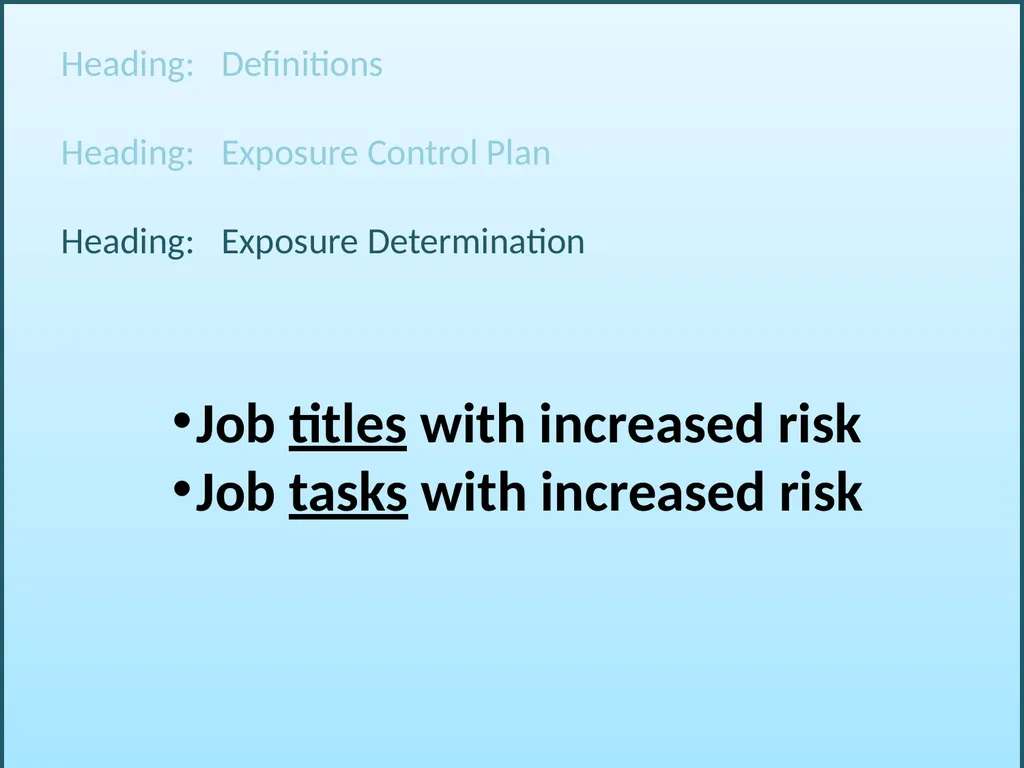
Heading: Exposure Determination Job titles with increased risk
Job tasks with increased risk<br>
Heading: Exposure Control Plan
Heading: Exposure Determination Job titles with increased risk
Job tasks with increased risk<br>
26
Heading: Definitions
Heading: Exposure Control Plan
Heading: Exposure Determination
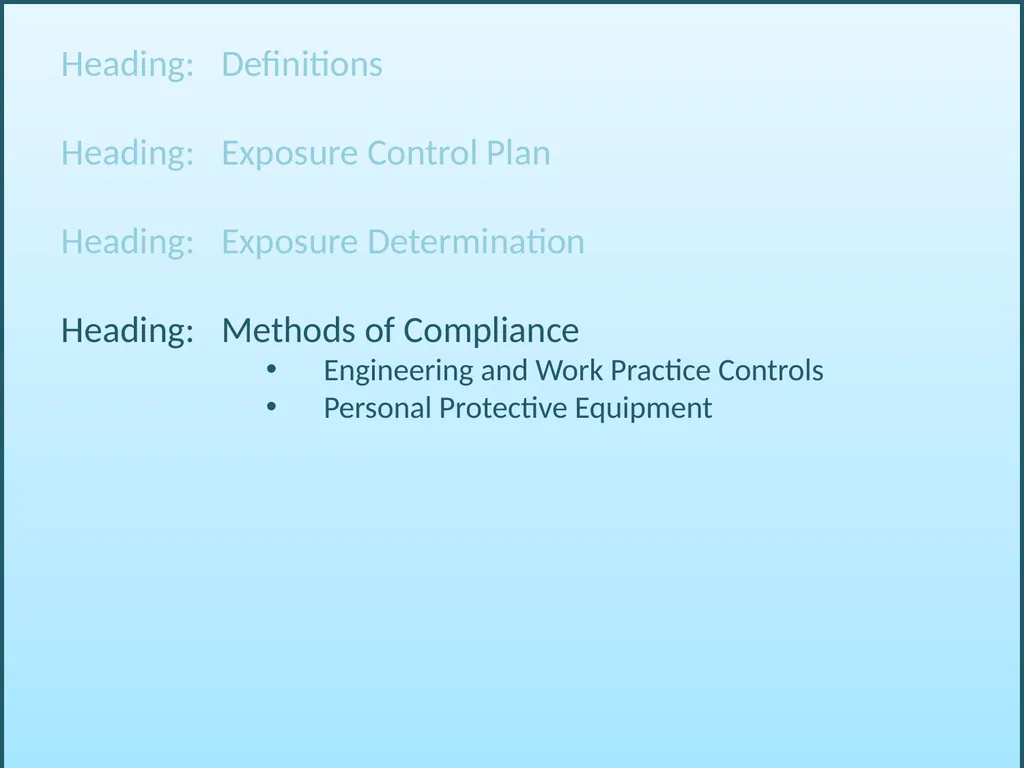
Heading: Methods of Compliance
Engineering and Work Practice Controls
Personal Protective Equipment<br>
Heading: Exposure Control Plan
Heading: Exposure Determination
Heading: Methods of Compliance
Engineering and Work Practice Controls
Personal Protective Equipment<br>
27
Heading: Definitions
Heading: Exposure Control Plan
Heading: Exposure Determination
Heading: Methods of Compliance
Engineering and Work Practice Controls
Personal Protective Equipment
Heading: Housekeeping<br>
Heading: Exposure Control Plan
Heading: Exposure Determination
Heading: Methods of Compliance
Engineering and Work Practice Controls
Personal Protective Equipment
Heading: Housekeeping<br>
28
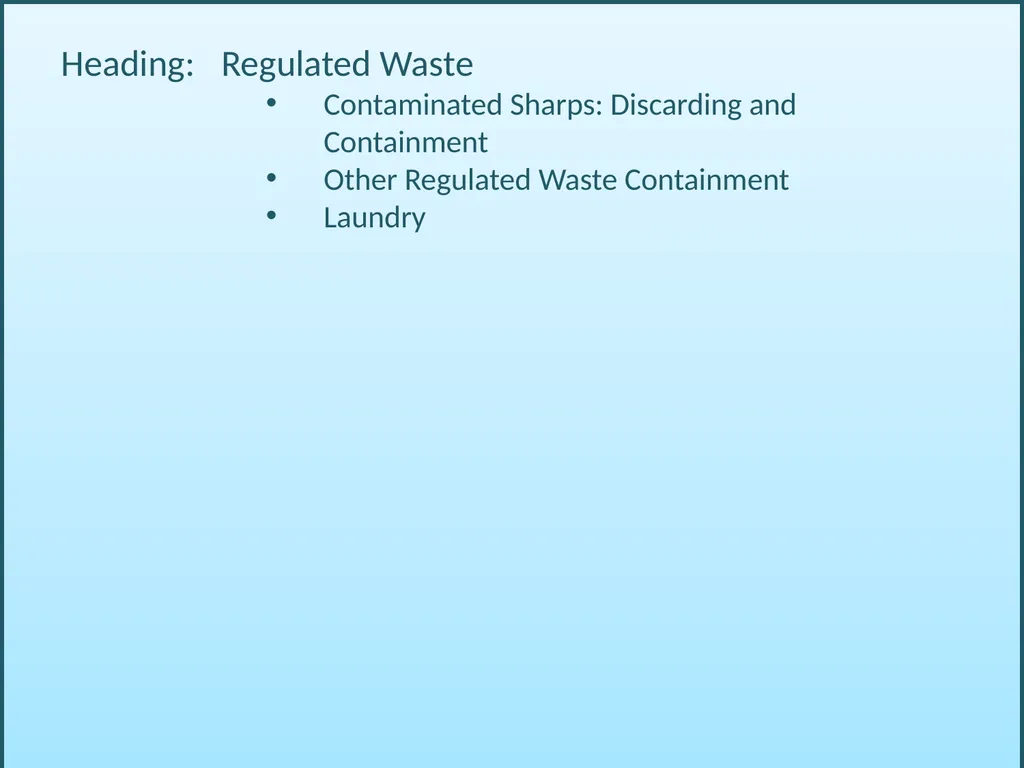
Heading: Regulated Waste
Contaminated Sharps: Discarding and Containment
Other Regulated Waste Containment
Laundry<br>
Contaminated Sharps: Discarding and Containment
Other Regulated Waste Containment
Laundry<br>
29
Heading: Regulated Waste
Contaminated Sharps: Discarding and Containment
Other Regulated Waste Containment
Laundry
Heading: HIV and HBV Research Laboratory and Production Facilities<br>
Contaminated Sharps: Discarding and Containment
Other Regulated Waste Containment
Laundry
Heading: HIV and HBV Research Laboratory and Production Facilities<br>
30
Heading: Regulated Waste
Contaminated Sharps: Discarding and Containment
Other Regulated Waste Containment
Laundry
Heading: HIV and HBV Research Laboratory and Production Facilities
Heading: Hepatitis B Vaccination and Post-exposure Evaluation and Follow-up<br>
Contaminated Sharps: Discarding and Containment
Other Regulated Waste Containment
Laundry
Heading: HIV and HBV Research Laboratory and Production Facilities
Heading: Hepatitis B Vaccination and Post-exposure Evaluation and Follow-up<br>
31
Heading: Regulated Waste
Contaminated Sharps: Discarding and Containment
Other Regulated Waste Containment
Laundry
Heading: HIV and HBV Research Laboratory and Production Facilities
Heading: Hepatitis B Vaccination and Post-exposure Evaluation and Follow-up
Heading: Communication of Hazards to Employees<br>
Contaminated Sharps: Discarding and Containment
Other Regulated Waste Containment
Laundry
Heading: HIV and HBV Research Laboratory and Production Facilities
Heading: Hepatitis B Vaccination and Post-exposure Evaluation and Follow-up
Heading: Communication of Hazards to Employees<br>
32
Heading: Regulated Waste
Contaminated Sharps: Discarding and Containment
Other Regulated Waste Containment
Laundry
Heading: HIV and HBV Research Laboratory and Production Facilities
Heading: Hepatitis B Vaccination and Post-exposure Evaluation and Follow-up
Heading: Communication of Hazards to Employees
Heading: Recordkeeping<br>
Contaminated Sharps: Discarding and Containment
Other Regulated Waste Containment
Laundry
Heading: HIV and HBV Research Laboratory and Production Facilities
Heading: Hepatitis B Vaccination and Post-exposure Evaluation and Follow-up
Heading: Communication of Hazards to Employees
Heading: Recordkeeping<br>
33
Element 2:
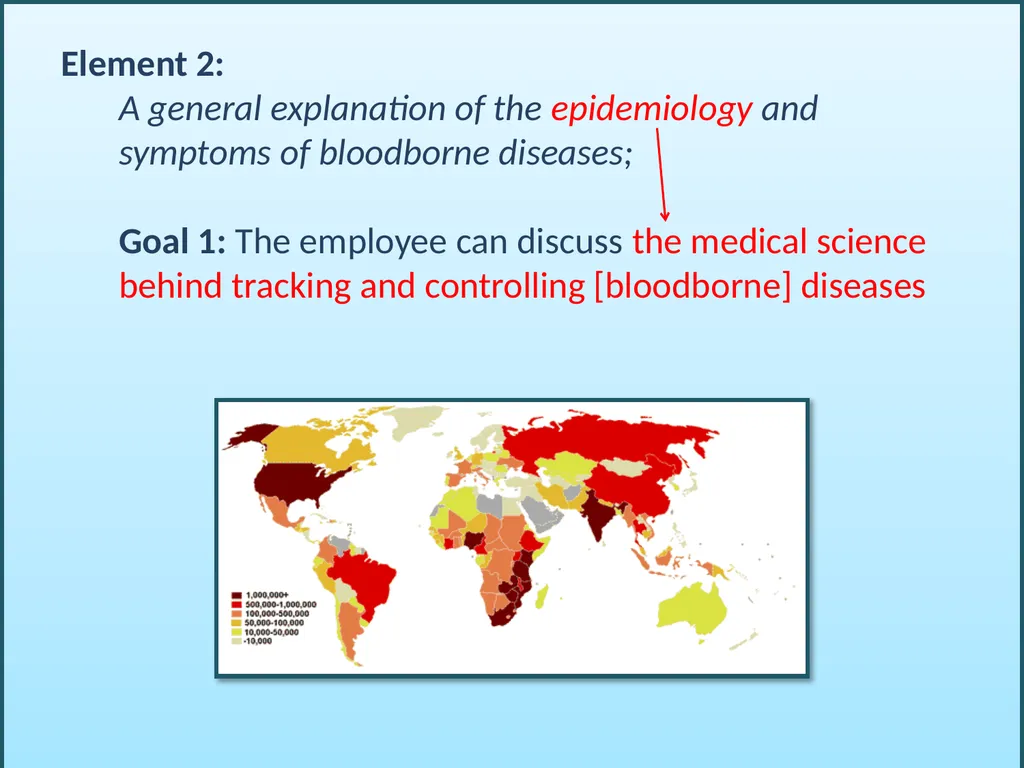
A general explanation of the epidemiology and symptoms of bloodborne diseases;
Goal 1: The employee can discuss the medical science behind tracking and controlling [bloodborne] diseases<br>
A general explanation of the epidemiology and symptoms of bloodborne diseases;
Goal 1: The employee can discuss the medical science behind tracking and controlling [bloodborne] diseases<br>
34
Element 2:
A general explanation of the epidemiology and symptoms of bloodborne diseases;
Goal 1: The employee can discuss the medical science behind tracking and controlling diseases
Goal 2: Employee can identify general characteristics of bloodborne pathogens and signs and symptoms people will show with the most common bloodborne pathogens<br>
A general explanation of the epidemiology and symptoms of bloodborne diseases;
Goal 1: The employee can discuss the medical science behind tracking and controlling diseases
Goal 2: Employee can identify general characteristics of bloodborne pathogens and signs and symptoms people will show with the most common bloodborne pathogens<br>
35
Element 3:
An explanation of the modes of transmission of bloodborne pathogens;
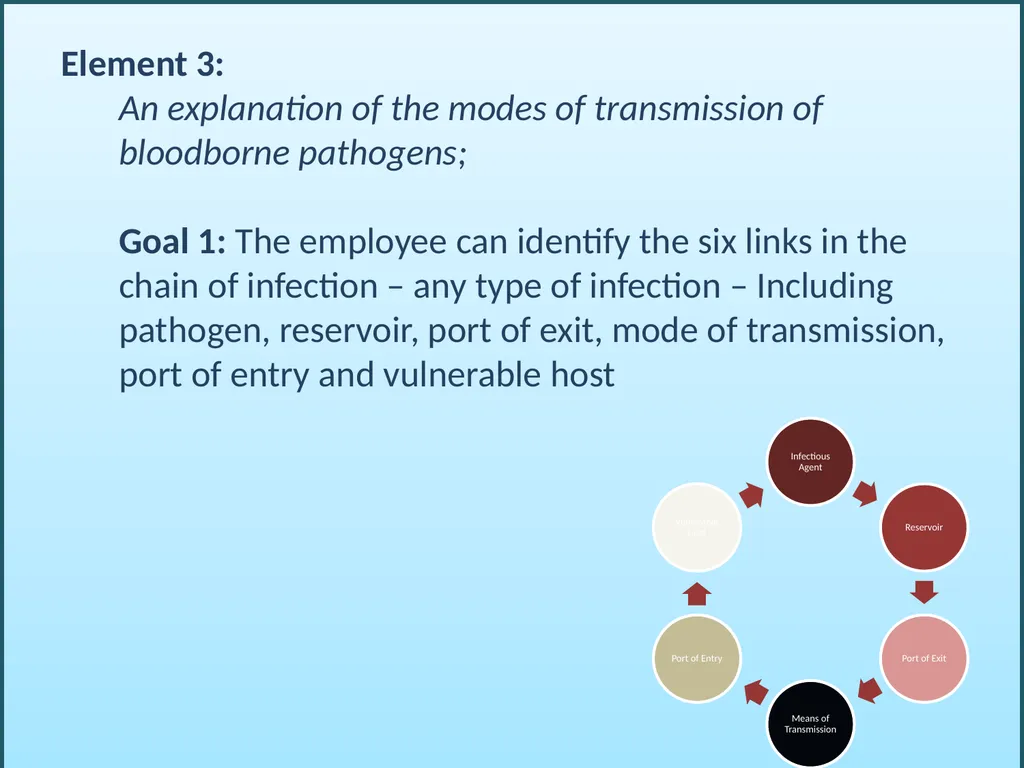
Goal 1: The employee can identify the six links in the chain of infection – any type of infection – Including pathogen, reservoir, port of exit, mode of transmission, port of entry and vulnerable host<br>
An explanation of the modes of transmission of bloodborne pathogens;
Goal 1: The employee can identify the six links in the chain of infection – any type of infection – Including pathogen, reservoir, port of exit, mode of transmission, port of entry and vulnerable host<br>
36
Element 3:
An explanation of the modes of transmission of bloodborne pathogens;
Goal 1: The employee can define the six links in the chain of infection – any type of infection – Including pathogen, reservoir, port of exit, mode of transmission, port of entry and vulnerable host
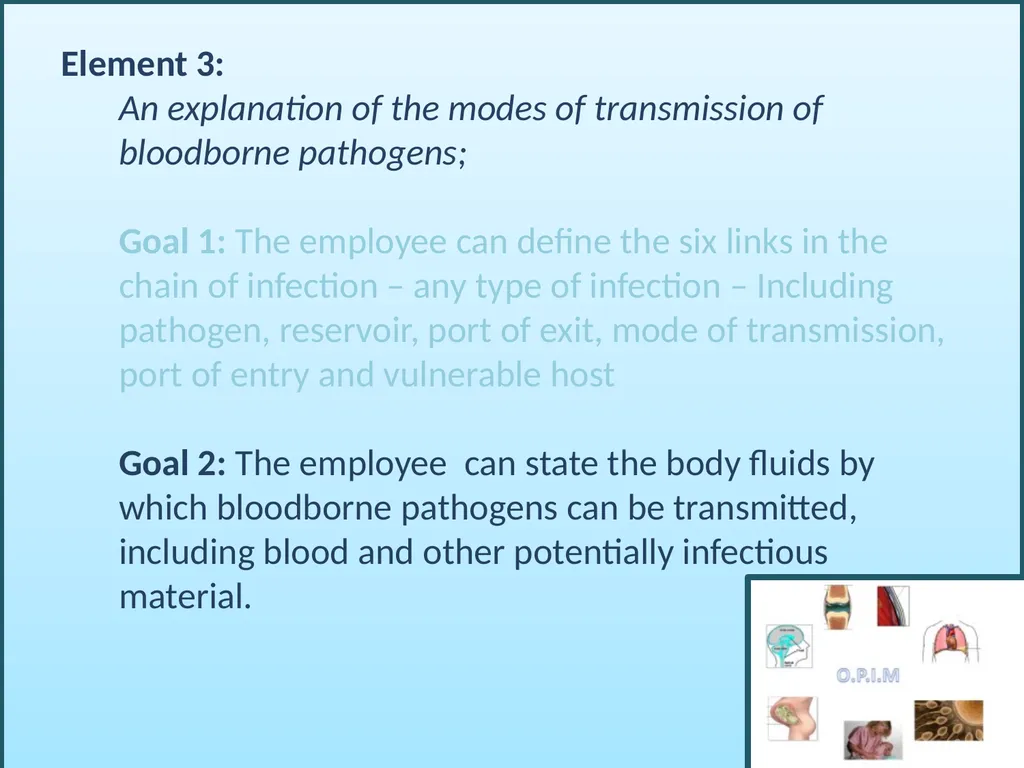
Goal 2: The employee can state the body fluids by which bloodborne pathogens can be transmitted, including blood and other potentially infectious material.<br>
An explanation of the modes of transmission of bloodborne pathogens;
Goal 1: The employee can define the six links in the chain of infection – any type of infection – Including pathogen, reservoir, port of exit, mode of transmission, port of entry and vulnerable host
Goal 2: The employee can state the body fluids by which bloodborne pathogens can be transmitted, including blood and other potentially infectious material.<br>
37
Element 4:
An explanation of the employer's exposure control plan and the means by which the employee can obtain a copy of the written plan;
Goal 1: The employee can locate the written exposure control plan at any time<br>
An explanation of the employer's exposure control plan and the means by which the employee can obtain a copy of the written plan;
Goal 1: The employee can locate the written exposure control plan at any time<br>
38
Michigan state university exposure control plan manual:
http://www.orcbs.msu.edu/biological/programs_guidelines/programs_guidelines.htm<br>
http://www.orcbs.msu.edu/biological/programs_guidelines/programs_guidelines.htm<br>
39
Element 4:
An explanation of the employer's exposure control plan and the means by which the employee can obtain a copy of the written plan;
Goal 1: The employee can locate the written exposure control plan at any time
Goal 2: The employee can state his/her rights to be oriented to the text of his/her employer’s exposure control plan<br>
An explanation of the employer's exposure control plan and the means by which the employee can obtain a copy of the written plan;
Goal 1: The employee can locate the written exposure control plan at any time
Goal 2: The employee can state his/her rights to be oriented to the text of his/her employer’s exposure control plan<br>
40
Heading: Exposure Control Plan
“Each employer having an employee(s) with occupation exposure as defined by paragraph (b) of this section shall establish a written Exposure Control Plan designed to eliminate or minimize employee exposure.”<br>
“Each employer having an employee(s) with occupation exposure as defined by paragraph (b) of this section shall establish a written Exposure Control Plan designed to eliminate or minimize employee exposure.”<br>
41
Heading: Exposure Control Plan
“Each employer having an employee(s) with occupation exposure as defined by paragraph (b) of this section shall establish a written Exposure Control Plan designed to eliminate or minimize employee exposure.”
Paragraph b (definitions)
Occupational exposure:
“...reasonably anticipated skin, eye, mucous membrane , or parenteral contact with blood or other potentially infectious material that may result from the performance of an employee’s duties.<br>
“Each employer having an employee(s) with occupation exposure as defined by paragraph (b) of this section shall establish a written Exposure Control Plan designed to eliminate or minimize employee exposure.”
Paragraph b (definitions)
Occupational exposure:
“...reasonably anticipated skin, eye, mucous membrane , or parenteral contact with blood or other potentially infectious material that may result from the performance of an employee’s duties.<br>
42
The exposure control plan should individualize five areas of the OSHA bloodborne pathogen standard:
Methods of compliance
Engineering and Work Practice Controls
Personal Protective Equipment<br>
Methods of compliance
Engineering and Work Practice Controls
Personal Protective Equipment<br>
43
The exposure control plan should individualize five areas of the OSHA bloodborne pathogen standard:
Methods of compliance
Engineering and Work Practice Controls
Personal Protective Equipment
HIV/HVB research and production facilities<br>
Methods of compliance
Engineering and Work Practice Controls
Personal Protective Equipment
HIV/HVB research and production facilities<br>
44
The exposure control plan should individualize five areas of the OSHA bloodborne pathogen standard:
Methods of compliance
Engineering and Work Practice Controls
Personal Protective Equipment
HIV/HVB research and production facilities
Hepatitis B vaccine and post-exposure evaluation and follow up<br>
Methods of compliance
Engineering and Work Practice Controls
Personal Protective Equipment
HIV/HVB research and production facilities
Hepatitis B vaccine and post-exposure evaluation and follow up<br>
45
The exposure control plan should individualize five areas of the OSHA bloodborne pathogen standard:
Methods of compliance
Engineering and Work Practice Controls
Personal Protective Equipment
HIV/HVB research and production facilities
Hepatitis B vaccine and post-exposure evaluation and follow up
Communication of hazards to employees<br>
Methods of compliance
Engineering and Work Practice Controls
Personal Protective Equipment
HIV/HVB research and production facilities
Hepatitis B vaccine and post-exposure evaluation and follow up
Communication of hazards to employees<br>
46
The exposure control plan should individualize five areas of the OSHA bloodborne pathogen standard:
Methods of compliance
Engineering and Work Practice Controls
Personal Protective Equipment
HIV/HVB research and production facilities
Hepatitis B vaccine and post-exposure evaluation and follow up
Communication of hazards to employees
Record keeping<br>
Methods of compliance
Engineering and Work Practice Controls
Personal Protective Equipment
HIV/HVB research and production facilities
Hepatitis B vaccine and post-exposure evaluation and follow up
Communication of hazards to employees
Record keeping<br>
47
Required to update exposure control plan at least annually
Sooner if:
Employees change
Jobs or tasks change
Better information/procedures/protective equipment become available<br>
Sooner if:
Employees change
Jobs or tasks change
Better information/procedures/protective equipment become available<br>
48
Element 5:
An explanation of the appropriate methods for recognizing tasks and other activities that may involve exposure to blood and other potentially infectious materials
Goal: The employee can state an exact sequence of steps to allow quick identification of tasks, procedures and situations increasing the risk for exposure STANDARD PRECAUTIONS!!<br>
An explanation of the appropriate methods for recognizing tasks and other activities that may involve exposure to blood and other potentially infectious materials
Goal: The employee can state an exact sequence of steps to allow quick identification of tasks, procedures and situations increasing the risk for exposure STANDARD PRECAUTIONS!!<br>
49
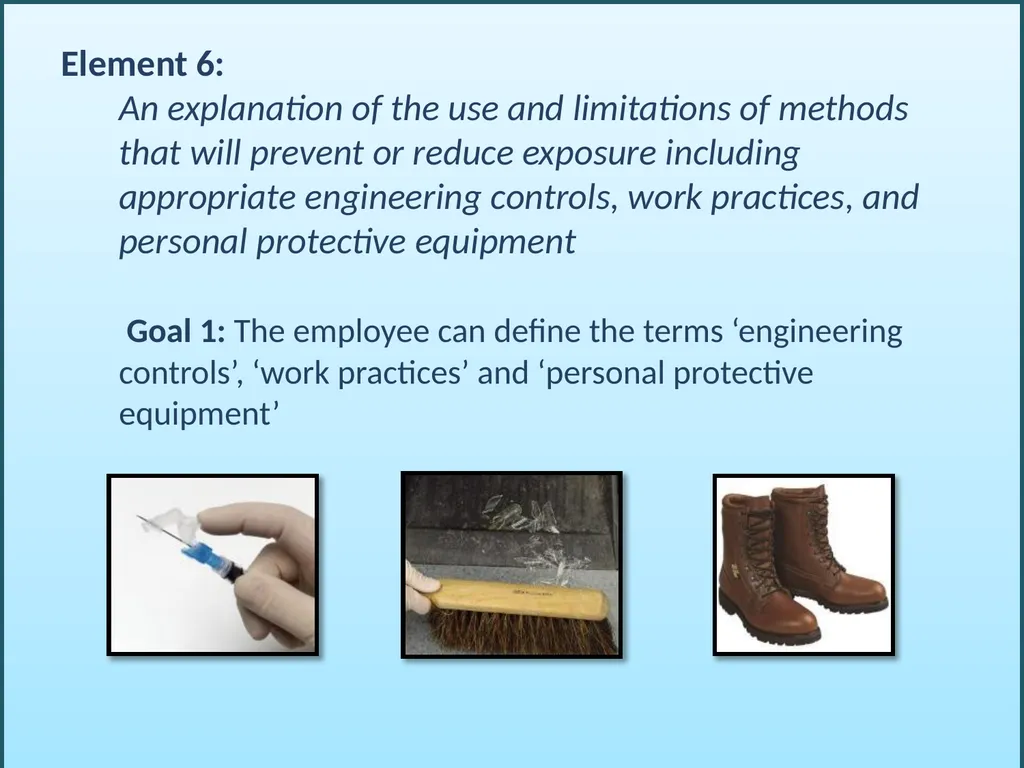
Element 6:
An explanation of the use and limitations of methods that will prevent or reduce exposure including appropriate engineering controls, work practices, and personal protective equipment
Goal 1: The employee can define the terms ‘engineering controls’, ‘work practices’ and ‘personal protective equipment’<br>
An explanation of the use and limitations of methods that will prevent or reduce exposure including appropriate engineering controls, work practices, and personal protective equipment
Goal 1: The employee can define the terms ‘engineering controls’, ‘work practices’ and ‘personal protective equipment’<br>
50
Element 6:
An explanation of the use and limitations of methods that will prevent or reduce exposure including appropriate engineering controls, work practices, and personal protective equipment
Goal 1: The employee can define the terms ‘engineering controls’, ‘work practices’ and ‘personal protective equipment’
Goal 2: The employee can state the USE of these methods intended to prevent or reduce exposure to bloodborne pathogens<br>
An explanation of the use and limitations of methods that will prevent or reduce exposure including appropriate engineering controls, work practices, and personal protective equipment
Goal 1: The employee can define the terms ‘engineering controls’, ‘work practices’ and ‘personal protective equipment’
Goal 2: The employee can state the USE of these methods intended to prevent or reduce exposure to bloodborne pathogens<br>
51
Element 6:
An explanation of the use and limitations of methods that will prevent or reduce exposure including appropriate engineering controls, work practices, and personal protective equipment
Goal 1: The employee can define the terms ‘engineering controls’, ‘work practices’ and ‘personal protective equipment’
Goal 2: The employee can state the USE of these methods intended to prevent or reduce exposure to bloodborne pathogens
Goal 3: The employee can state the LIMITATIONS of methods intended to prevent or reduce exposure to bloodborne pathogens<br>
An explanation of the use and limitations of methods that will prevent or reduce exposure including appropriate engineering controls, work practices, and personal protective equipment
Goal 1: The employee can define the terms ‘engineering controls’, ‘work practices’ and ‘personal protective equipment’
Goal 2: The employee can state the USE of these methods intended to prevent or reduce exposure to bloodborne pathogens
Goal 3: The employee can state the LIMITATIONS of methods intended to prevent or reduce exposure to bloodborne pathogens<br>
52
Element 7:
Information on the types, proper use, location, removal, handling, decontamination and disposal of personal protective equipment;
Goal: Regarding personal protective equipment (PPE), the employee can:
Identify types of PPE<br>
Information on the types, proper use, location, removal, handling, decontamination and disposal of personal protective equipment;
Goal: Regarding personal protective equipment (PPE), the employee can:
Identify types of PPE<br>
53
Element 7:
Information on the types, proper use, location, removal, handling, decontamination and disposal of personal protective equipment;
Goal: Regarding personal protective equipment (PPE), the employee can:
Identify types of PPE
Locate PPE at any time while working<br>
Information on the types, proper use, location, removal, handling, decontamination and disposal of personal protective equipment;
Goal: Regarding personal protective equipment (PPE), the employee can:
Identify types of PPE
Locate PPE at any time while working<br>
54
Element 7:
Information on the types, proper use, location, removal, handling, decontamination and disposal of personal protective equipment;
Goal: Regarding personal protective equipment (PPE), the employee can:
Identify types of PPE
Locate PPE at any time while working
Discuss proper use and application of clean disposable PPE and removal, handling and disposal of contaminated PPE<br>
Information on the types, proper use, location, removal, handling, decontamination and disposal of personal protective equipment;
Goal: Regarding personal protective equipment (PPE), the employee can:
Identify types of PPE
Locate PPE at any time while working
Discuss proper use and application of clean disposable PPE and removal, handling and disposal of contaminated PPE<br>
55
Element 7:
Information on the types, proper use, location, removal, handling, decontamination and disposal of personal protective equipment;
Goal: Regarding personal protective equipment (PPE), the employee can:
Identify types of PPE
Locate PPE at any time while working
Discuss proper use and application of clean disposable PPE and removal, handling and disposal of contaminated PPE
Discuss proper use and application of clean NON-disposable PPE and removal, handling and decontamination of the PPE<br>
Information on the types, proper use, location, removal, handling, decontamination and disposal of personal protective equipment;
Goal: Regarding personal protective equipment (PPE), the employee can:
Identify types of PPE
Locate PPE at any time while working
Discuss proper use and application of clean disposable PPE and removal, handling and disposal of contaminated PPE
Discuss proper use and application of clean NON-disposable PPE and removal, handling and decontamination of the PPE<br>
56
Element 8:
An explanation of the basis for selection of personal protective equipment;
Goal 1: The employee can state the purpose of the most common PPE used by those at risk of exposure to bloodborne pathogens<br>
An explanation of the basis for selection of personal protective equipment;
Goal 1: The employee can state the purpose of the most common PPE used by those at risk of exposure to bloodborne pathogens<br>
57
Element 8:
An explanation of the basis for selection of personal protective equipment;
Goal 1: The employee can state the purpose of the most common PPE used by those at risk of exposure to bloodborne pathogens
Goal 2: In specific exposure scenarios, the employee correctly chooses the appropriate PPE equipment to apply.<br>
An explanation of the basis for selection of personal protective equipment;
Goal 1: The employee can state the purpose of the most common PPE used by those at risk of exposure to bloodborne pathogens
Goal 2: In specific exposure scenarios, the employee correctly chooses the appropriate PPE equipment to apply.<br>
58
Scenario 1:
Joe Smith is a manager of a local production facility. A commotion in Bay 2 draws his attention and he hurries over. He pauses for a second to survey the scene...his newest employee has apparently attempted to operate a conveyor belt he has not yet been oriented to. His arm is caught in the device, traumatically amputated at the elbow and blood is shooting everywhere. The worker is still alive, but in obvious shock. Joe calls 911 and steps in to assist...<br>
Joe Smith is a manager of a local production facility. A commotion in Bay 2 draws his attention and he hurries over. He pauses for a second to survey the scene...his newest employee has apparently attempted to operate a conveyor belt he has not yet been oriented to. His arm is caught in the device, traumatically amputated at the elbow and blood is shooting everywhere. The worker is still alive, but in obvious shock. Joe calls 911 and steps in to assist...<br>
59
Scenario 1:
Joe Smith is a manager of a local production facility. A commotion in Bay 2 draws his attention and he hurries over. He pauses for a second to survey the scene...his newest employee has apparently attempted to operate a conveyor belt he has not yet been oriented to. His arm was caught in the device, traumatically amputated at the elbow and blood is shooting everywhere. The worker is still alive, but in obvious shock. He calls 911 and steps in to assist...<br>
Joe Smith is a manager of a local production facility. A commotion in Bay 2 draws his attention and he hurries over. He pauses for a second to survey the scene...his newest employee has apparently attempted to operate a conveyor belt he has not yet been oriented to. His arm was caught in the device, traumatically amputated at the elbow and blood is shooting everywhere. The worker is still alive, but in obvious shock. He calls 911 and steps in to assist...<br>
60
Scenario 2:
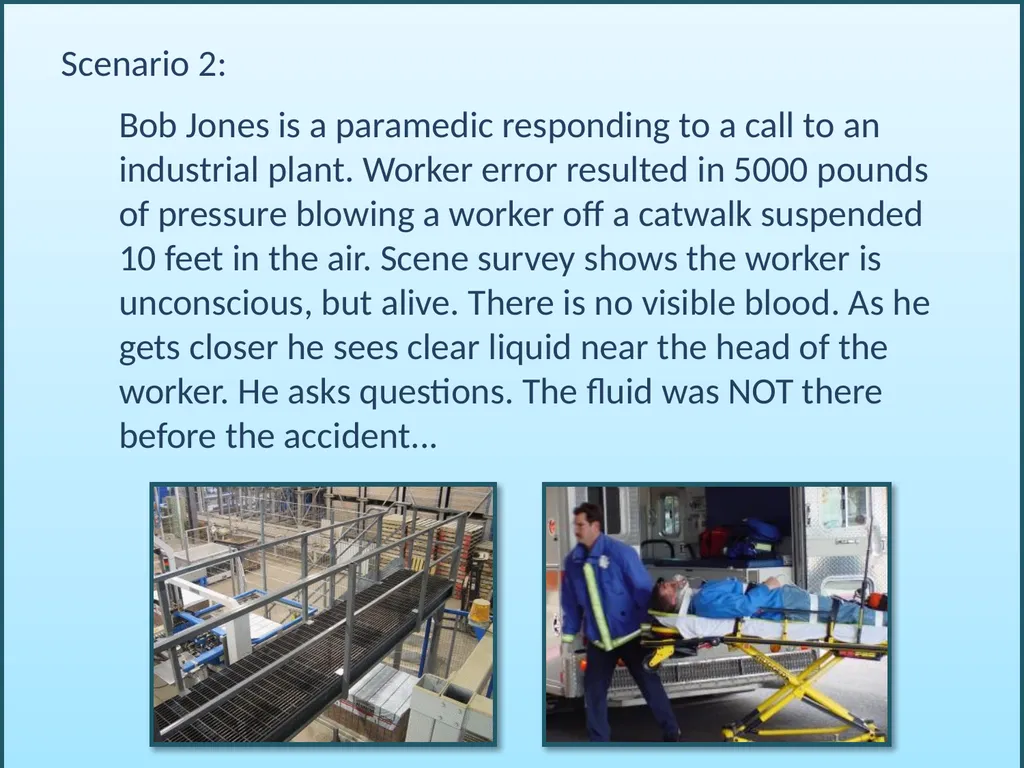
Bob Jones is a paramedic responding to a call to an industrial plant. Worker error resulted in 5000 pounds of pressure blowing a worker off a catwalk suspended 10 feet in the air. Scene survey shows the worker is unconscious, but alive. There is no visible blood. As he gets closer he sees clear liquid near the head of the worker. He asks questions. The fluid was NOT there before the accident...<br>
Bob Jones is a paramedic responding to a call to an industrial plant. Worker error resulted in 5000 pounds of pressure blowing a worker off a catwalk suspended 10 feet in the air. Scene survey shows the worker is unconscious, but alive. There is no visible blood. As he gets closer he sees clear liquid near the head of the worker. He asks questions. The fluid was NOT there before the accident...<br>
61
Scenario 2:
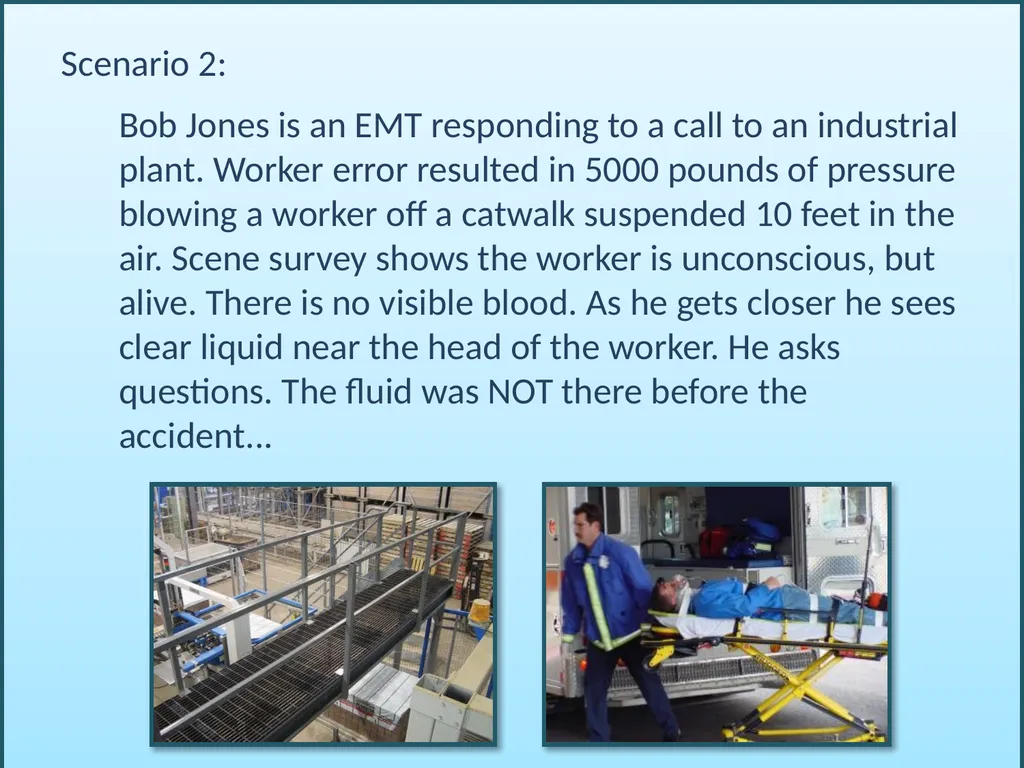
Bob Jones is an EMT responding to a call to an industrial plant. Worker error resulted in 5000 pounds of pressure blowing a worker off a catwalk suspended 10 feet in the air. Scene survey shows the worker is unconscious, but alive. There is no visible blood. As he gets closer he sees clear liquid near the head of the worker. He asks questions. The fluid was NOT there before the accident...<br>
Bob Jones is an EMT responding to a call to an industrial plant. Worker error resulted in 5000 pounds of pressure blowing a worker off a catwalk suspended 10 feet in the air. Scene survey shows the worker is unconscious, but alive. There is no visible blood. As he gets closer he sees clear liquid near the head of the worker. He asks questions. The fluid was NOT there before the accident...<br>
62
Element 9:
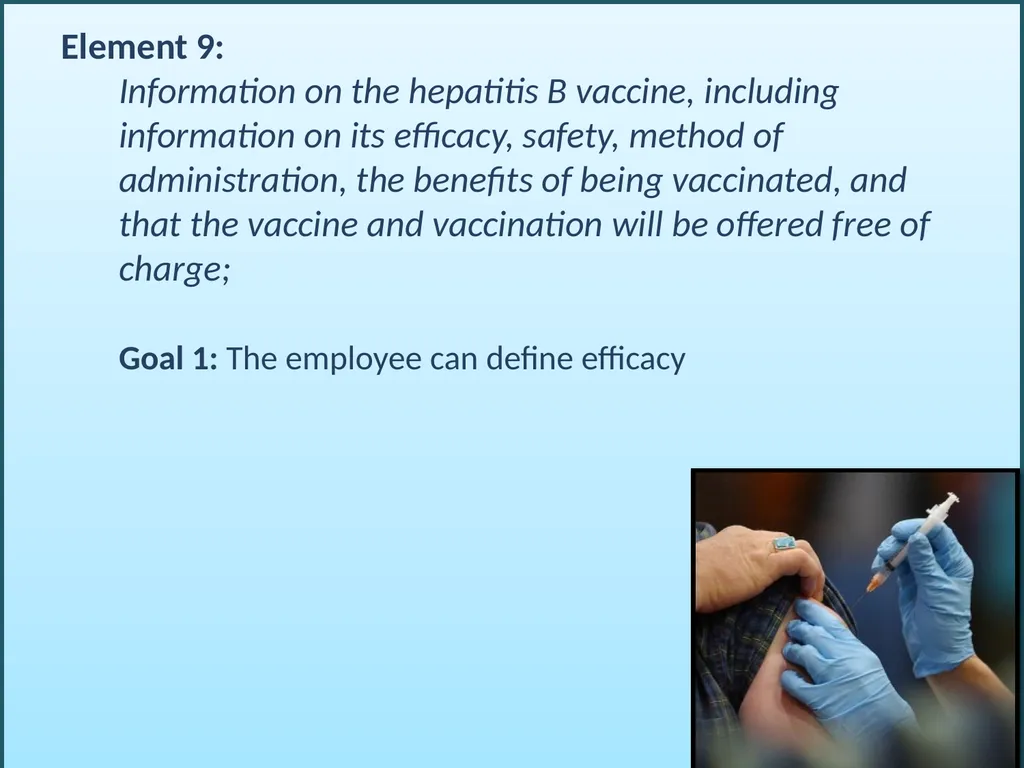
Information on the hepatitis B vaccine, including information on its efficacy, safety, method of administration, the benefits of being vaccinated, and that the vaccine and vaccination will be offered free of charge;
Goal 1: The employee can define efficacy<br>
Information on the hepatitis B vaccine, including information on its efficacy, safety, method of administration, the benefits of being vaccinated, and that the vaccine and vaccination will be offered free of charge;
Goal 1: The employee can define efficacy<br>
63
Element 9:
Information on the hepatitis B vaccine, including information on its efficacy, safety, method of administration, the benefits of being vaccinated, and that the vaccine and vaccination will be offered free of charge;
Goal 1: The employee can define efficacy
Goal 2: The employee can describe the efficacy, safety, method of administration and benefits of the hepatitis B vaccine<br>
Information on the hepatitis B vaccine, including information on its efficacy, safety, method of administration, the benefits of being vaccinated, and that the vaccine and vaccination will be offered free of charge;
Goal 1: The employee can define efficacy
Goal 2: The employee can describe the efficacy, safety, method of administration and benefits of the hepatitis B vaccine<br>
64
Element 9:
Information on the hepatitis B vaccine, including information on its efficacy, safety, method of administration, the benefits of being vaccinated, and that the vaccine and vaccination will be offered free of charge;
Goal 1: The employee can define efficacy
Goal 2: The employee can describe the efficacy, safety, method of administration and benefits of the hepatitis B vaccine<br>
Information on the hepatitis B vaccine, including information on its efficacy, safety, method of administration, the benefits of being vaccinated, and that the vaccine and vaccination will be offered free of charge;
Goal 1: The employee can define efficacy
Goal 2: The employee can describe the efficacy, safety, method of administration and benefits of the hepatitis B vaccine<br>
65
Element 9:
Information on the hepatitis B vaccine, including information on its efficacy, safety, method of administration, the benefits of being vaccinated, and that the vaccine and vaccination will be offered free of charge;
Goal 1: The employee can define efficacy
Goal 2: The employee can describe the efficacy, safety, method of administration and benefits of the hepatitis B vaccine
Goal 3: The employee demonstrates understanding he/she cannot be charged for the vaccine or administration of the vaccine if employed in a setting where risk of exposure exists<br>
Information on the hepatitis B vaccine, including information on its efficacy, safety, method of administration, the benefits of being vaccinated, and that the vaccine and vaccination will be offered free of charge;
Goal 1: The employee can define efficacy
Goal 2: The employee can describe the efficacy, safety, method of administration and benefits of the hepatitis B vaccine
Goal 3: The employee demonstrates understanding he/she cannot be charged for the vaccine or administration of the vaccine if employed in a setting where risk of exposure exists<br>
66
Element 10:
Information on the appropriate actions to take and persons to contact in an emergency involving blood or other potentially infectious materials;
Goal 1: The employee can state the location, in the exposure control plan, of the exact sequence of actions necessary in any emergency involving blood or other potentially infectious material (OPIM)<br>
Information on the appropriate actions to take and persons to contact in an emergency involving blood or other potentially infectious materials;
Goal 1: The employee can state the location, in the exposure control plan, of the exact sequence of actions necessary in any emergency involving blood or other potentially infectious material (OPIM)<br>
67
Element 10:
Information on the appropriate actions to take and persons to contact in an emergency involving blood or other potentially infectious materials;
Goal 1: The employee can state the location, in the exposure control plan, of the exact sequence of actions necessary in any emergency involving blood or other potentially infectious material (OPIM)
Goal 2: The employee can list all supervisory, human resource or other personnel at their employment setting to notify in the event of an emergency involving blood or OPIM<br>
Information on the appropriate actions to take and persons to contact in an emergency involving blood or other potentially infectious materials;
Goal 1: The employee can state the location, in the exposure control plan, of the exact sequence of actions necessary in any emergency involving blood or other potentially infectious material (OPIM)
Goal 2: The employee can list all supervisory, human resource or other personnel at their employment setting to notify in the event of an emergency involving blood or OPIM<br>
68
Element 10:
Information on the appropriate actions to take and persons to contact in an emergency involving blood or other potentially infectious materials;
Goal 1: The employee can state the location, in the exposure control plan, of the exact sequence of actions necessary in any emergency involving blood or other potentially infectious material (OPIM)
Goal 2: The employee can state all supervisory, human resource or other personnel at their employment setting to notify in the event of an emergency involving blood or OPIM
Goal 3: The employee can describe their obligations in following the exposure control plan of their employer.<br>
Information on the appropriate actions to take and persons to contact in an emergency involving blood or other potentially infectious materials;
Goal 1: The employee can state the location, in the exposure control plan, of the exact sequence of actions necessary in any emergency involving blood or other potentially infectious material (OPIM)
Goal 2: The employee can state all supervisory, human resource or other personnel at their employment setting to notify in the event of an emergency involving blood or OPIM
Goal 3: The employee can describe their obligations in following the exposure control plan of their employer.<br>
69
Element 11:
An explanation of the procedures to follow if an exposure incident occurs, including the method of reporting the incident and the medical follow-up that will be made available;
Goal 1: The employee will state common actions required in any exposure control incident in any employment setting, including reporting and medical follow-up<br>
An explanation of the procedures to follow if an exposure incident occurs, including the method of reporting the incident and the medical follow-up that will be made available;
Goal 1: The employee will state common actions required in any exposure control incident in any employment setting, including reporting and medical follow-up<br>
70
IMMEDIATELY wash the area very thoroughly with soap & water Standard recommendations in event of exposure<br>
71
IMMEDIATELY wash the area very thoroughly with soap & water
Within an hour, go to a defined medical facility for assessment, testing and treatment Standard recommendations in event of exposure<br>
Within an hour, go to a defined medical facility for assessment, testing and treatment Standard recommendations in event of exposure<br>
72
IMMEDIATELY wash the area very thoroughly with soap & water
Within an hour, go to a defined medical facility for assessment, testing and treatment
Notify supervisor (or required personnel) Standard recommendations in event of exposure<br>
Within an hour, go to a defined medical facility for assessment, testing and treatment
Notify supervisor (or required personnel) Standard recommendations in event of exposure<br>
73
IMMEDIATELY wash the area very thoroughly with soap & water
Within an hour, go to a defined medical facility for assessment, testing and treatment
Notify supervisor (or required personnel)
Complete an incident or accident report Standard recommendations in event of exposure<br>
Within an hour, go to a defined medical facility for assessment, testing and treatment
Notify supervisor (or required personnel)
Complete an incident or accident report Standard recommendations in event of exposure<br>
74
IMMEDIATELY wash the area very thoroughly with soap & water
Within an hour, go to a defined medical facility for assessment, testing and treatment
Notify supervisor (or required personnel)
Complete an incident or accident report Standard recommendations in event of exposure<br>
Within an hour, go to a defined medical facility for assessment, testing and treatment
Notify supervisor (or required personnel)
Complete an incident or accident report Standard recommendations in event of exposure<br>
75
IMMEDIATELY wash the area very thoroughly with soap & water
Within an hour, go to a defined medical facility for assessment, testing and treatment
Notify supervisor (or required personnel)
Complete an incident or accident report
Follow up with delayed medical testing and evaluation Standard recommendations in event of exposure<br>
Within an hour, go to a defined medical facility for assessment, testing and treatment
Notify supervisor (or required personnel)
Complete an incident or accident report
Follow up with delayed medical testing and evaluation Standard recommendations in event of exposure<br>
76
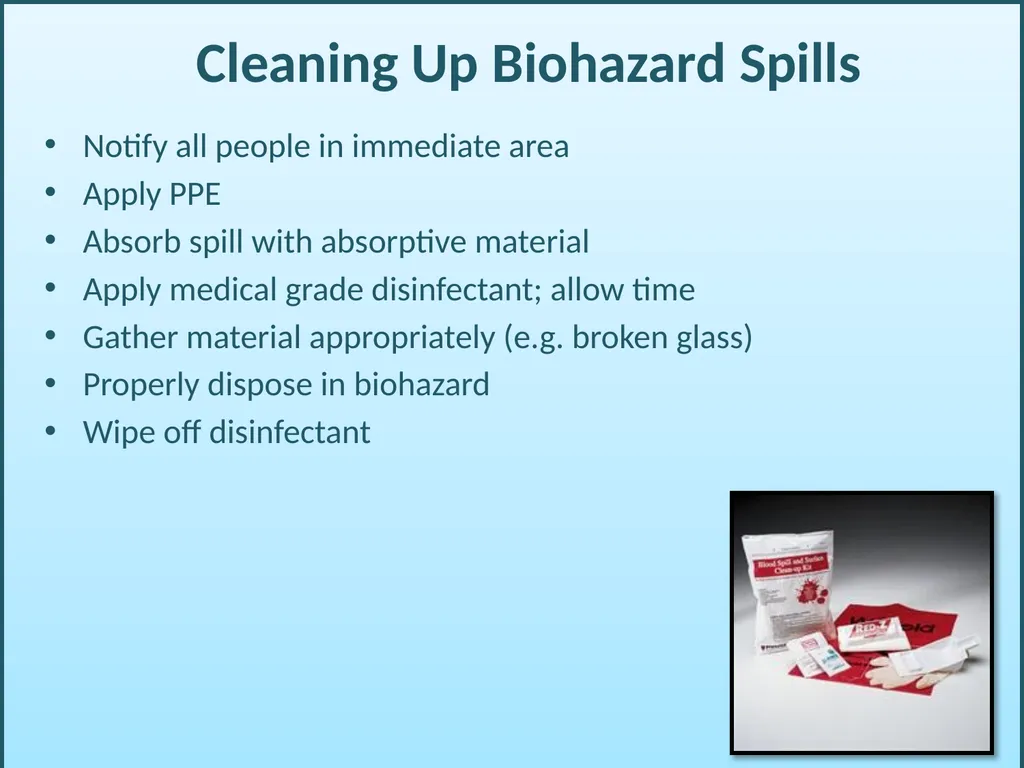
Cleaning Up Biohazard Spills Notify all people in immediate area
Apply PPE
Absorb spill with absorptive material
Apply medical grade disinfectant; allow time
Gather material appropriately (e.g. broken glass)
Properly dispose in biohazard
Wipe off disinfectant<br>
Apply PPE
Absorb spill with absorptive material
Apply medical grade disinfectant; allow time
Gather material appropriately (e.g. broken glass)
Properly dispose in biohazard
Wipe off disinfectant<br>
77
78 The most current exposure recommendations from the CDC:
HIV http://www.cdc.gov/mmwr/preview/mmwrhtml/rr5409a1.htm
Hepatitis & HIV http://www.cdc.gov/mmwr/preview/mmwrhtml/rr5011a1.htm
Health care professionals may or may not need prophylaxis – Dependent on:
Type of exposure
Type/amount of fluid/tissue
If person is known to be infected with HIV/hepatitis
Susceptibility of exposed person<br>
HIV http://www.cdc.gov/mmwr/preview/mmwrhtml/rr5409a1.htm
Hepatitis & HIV http://www.cdc.gov/mmwr/preview/mmwrhtml/rr5011a1.htm
Health care professionals may or may not need prophylaxis – Dependent on:
Type of exposure
Type/amount of fluid/tissue
If person is known to be infected with HIV/hepatitis
Susceptibility of exposed person<br>
78
Element 11:
An explanation of the procedures to follow if an exposure incident occurs, including the method of reporting the incident and the medical follow-up that will be made available;
Goal 1: The employee will state common actions required in any exposure control incident in any employment setting, including reporting and medical follow-up
Goal 2: The employee will be able to locate the exposure control plan specific to their employment setting<br>
An explanation of the procedures to follow if an exposure incident occurs, including the method of reporting the incident and the medical follow-up that will be made available;
Goal 1: The employee will state common actions required in any exposure control incident in any employment setting, including reporting and medical follow-up
Goal 2: The employee will be able to locate the exposure control plan specific to their employment setting<br>
79
Element 11:
An explanation of the procedures to follow if an exposure incident occurs, including the method of reporting the incident and the medical follow-up that will be made available;
Goal 1: The employee will state common actions required in any exposure control incident in any employment setting, including reporting and medical follow-up
Goal 2: The employee will be able to locate the exposure control plan specific to their employment setting
Goal 3: The employee will be able to locate the exact steps to take and available medical follow up in the employer’s exposure control plan before that employee is scheduled to work in a setting where there is a risk of an exposure incident<br>
An explanation of the procedures to follow if an exposure incident occurs, including the method of reporting the incident and the medical follow-up that will be made available;
Goal 1: The employee will state common actions required in any exposure control incident in any employment setting, including reporting and medical follow-up
Goal 2: The employee will be able to locate the exposure control plan specific to their employment setting
Goal 3: The employee will be able to locate the exact steps to take and available medical follow up in the employer’s exposure control plan before that employee is scheduled to work in a setting where there is a risk of an exposure incident<br>
80
Element 12:
Information on the post exposure evaluation and follow-up that the employer is required to provide for the employee following an exposure incident
Goal 1: The employee can list common requirement of the employer following an exposure incident
Goal 2: The employee can state obligations for learning their employers requirements for post exposure evaluation and follow up<br>
Information on the post exposure evaluation and follow-up that the employer is required to provide for the employee following an exposure incident
Goal 1: The employee can list common requirement of the employer following an exposure incident
Goal 2: The employee can state obligations for learning their employers requirements for post exposure evaluation and follow up<br>
81
Element 13:
An explanation of the signs and labels and/or color coding required by paragraph (g)(1);
Goal: The employ can locate, in his/her employer’s exposure control plan, signs and labels included on the OSHA Bloodborne Pathogen website (Found under 1910.1030(g)(1) Labels and Signs on the website)<br>
An explanation of the signs and labels and/or color coding required by paragraph (g)(1);
Goal: The employ can locate, in his/her employer’s exposure control plan, signs and labels included on the OSHA Bloodborne Pathogen website (Found under 1910.1030(g)(1) Labels and Signs on the website)<br>
82
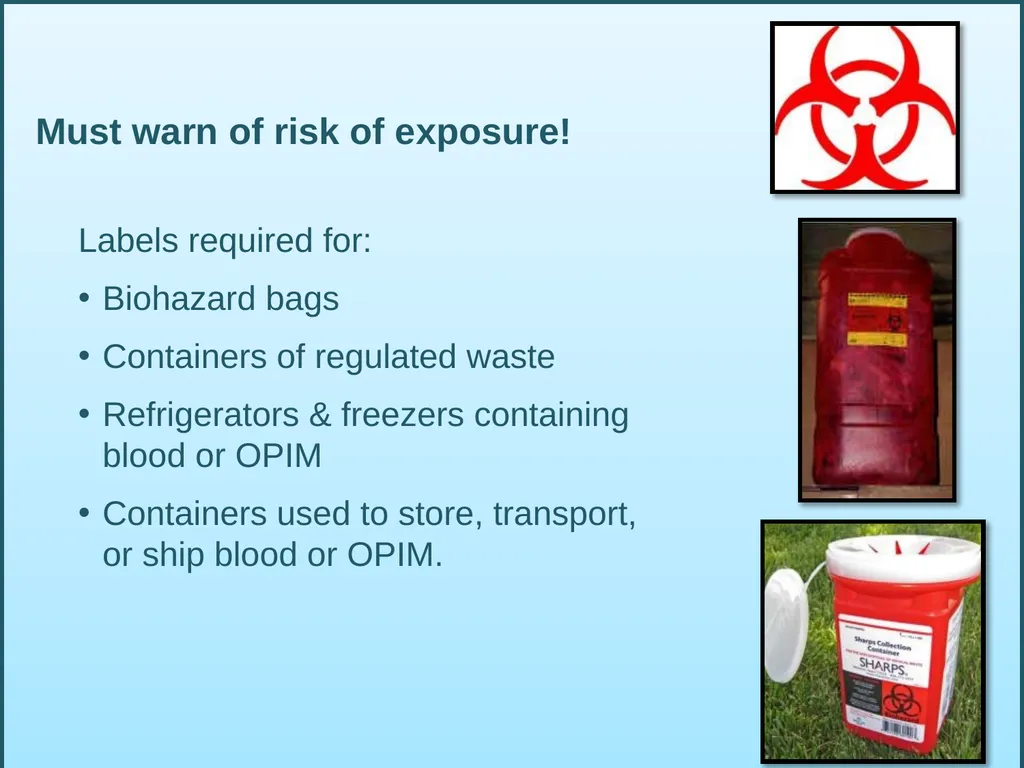
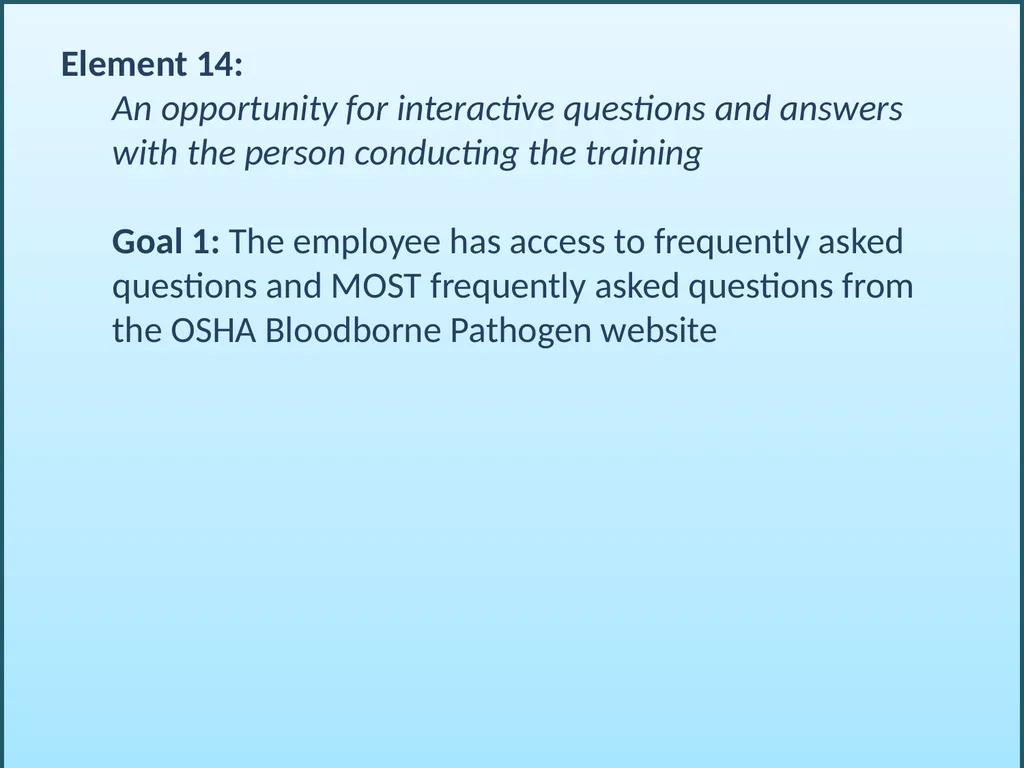
83 Labels required for:
Biohazard bags
Containers of regulated waste
Refrigerators & freezers containing blood or OPIM
Containers used to store, transport, or ship blood or OPIM. Must warn of risk of exposure!<br>
Biohazard bags
Containers of regulated waste
Refrigerators & freezers containing blood or OPIM
Containers used to store, transport, or ship blood or OPIM. Must warn of risk of exposure!<br>
83
Element 14:
An opportunity for interactive questions and answers with the person conducting the training
Goal 1: The employee has access to frequently asked questions and MOST frequently asked questions from the OSHA Bloodborne Pathogen website<br>
An opportunity for interactive questions and answers with the person conducting the training
Goal 1: The employee has access to frequently asked questions and MOST frequently asked questions from the OSHA Bloodborne Pathogen website<br>
84
Frequently asked questions
http://www.osha.gov/SLTC/bloodbornepathogens/bloodborne_faq.html
MOST frequently asked questions
http://www.osha.gov/pls/oshaweb/owadisp.show_document?p_table=INTERPRETATIONS&p_id=21010<br>
http://www.osha.gov/SLTC/bloodbornepathogens/bloodborne_faq.html
MOST frequently asked questions
http://www.osha.gov/pls/oshaweb/owadisp.show_document?p_table=INTERPRETATIONS&p_id=21010<br>
85
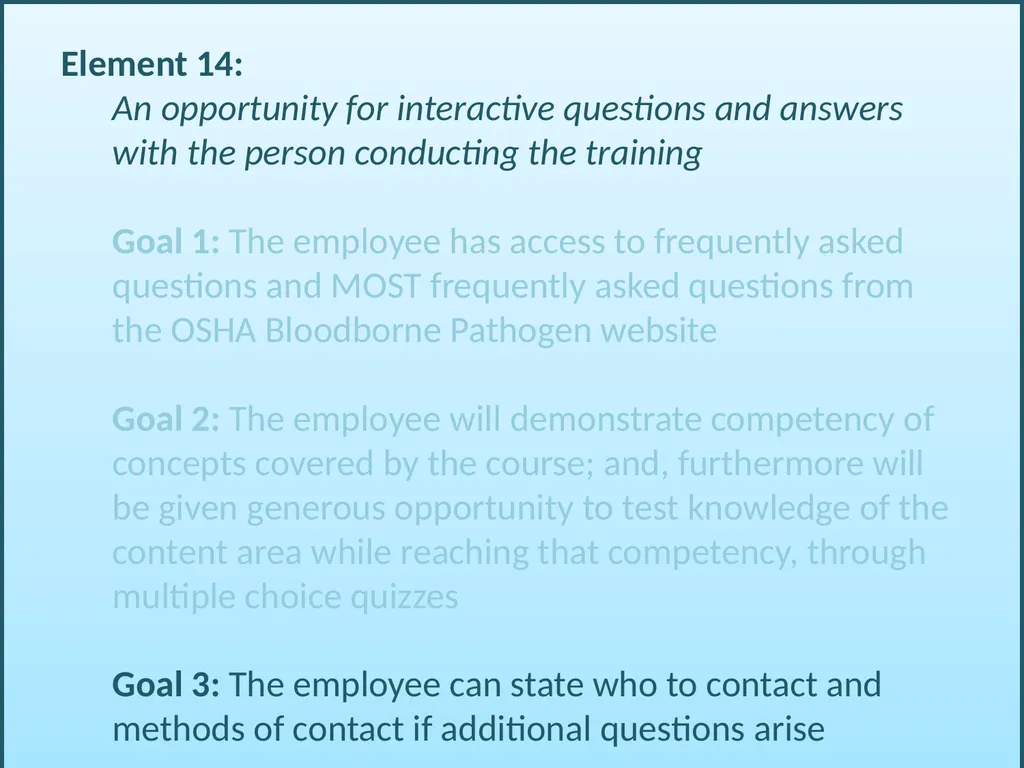
Element 14:
An opportunity for interactive questions and answers with the person conducting the training
Goal 1: The employee has access to frequently asked questions and MOST frequently asked questions from the OSHA Bloodborne Pathogen website
Goal 2: The employee will demonstrate competency of concepts covered by the course; and, furthermore will be given generous opportunity to test knowledge of the content area while reaching that competency, through multiple choice quizzes<br>
An opportunity for interactive questions and answers with the person conducting the training
Goal 1: The employee has access to frequently asked questions and MOST frequently asked questions from the OSHA Bloodborne Pathogen website
Goal 2: The employee will demonstrate competency of concepts covered by the course; and, furthermore will be given generous opportunity to test knowledge of the content area while reaching that competency, through multiple choice quizzes<br>
86
Element 14:
An opportunity for interactive questions and answers with the person conducting the training
Goal 1: The employee has access to frequently asked questions and MOST frequently asked questions from the OSHA Bloodborne Pathogen website
Goal 2: The employee will demonstrate competency of concepts covered by the course; and, furthermore will be given generous opportunity to test knowledge of the content area while reaching that competency, through multiple choice quizzes
Goal 3: The employee can state who to contact and methods of contact if additional questions arise<br>
An opportunity for interactive questions and answers with the person conducting the training
Goal 1: The employee has access to frequently asked questions and MOST frequently asked questions from the OSHA Bloodborne Pathogen website
Goal 2: The employee will demonstrate competency of concepts covered by the course; and, furthermore will be given generous opportunity to test knowledge of the content area while reaching that competency, through multiple choice quizzes
Goal 3: The employee can state who to contact and methods of contact if additional questions arise<br>
87
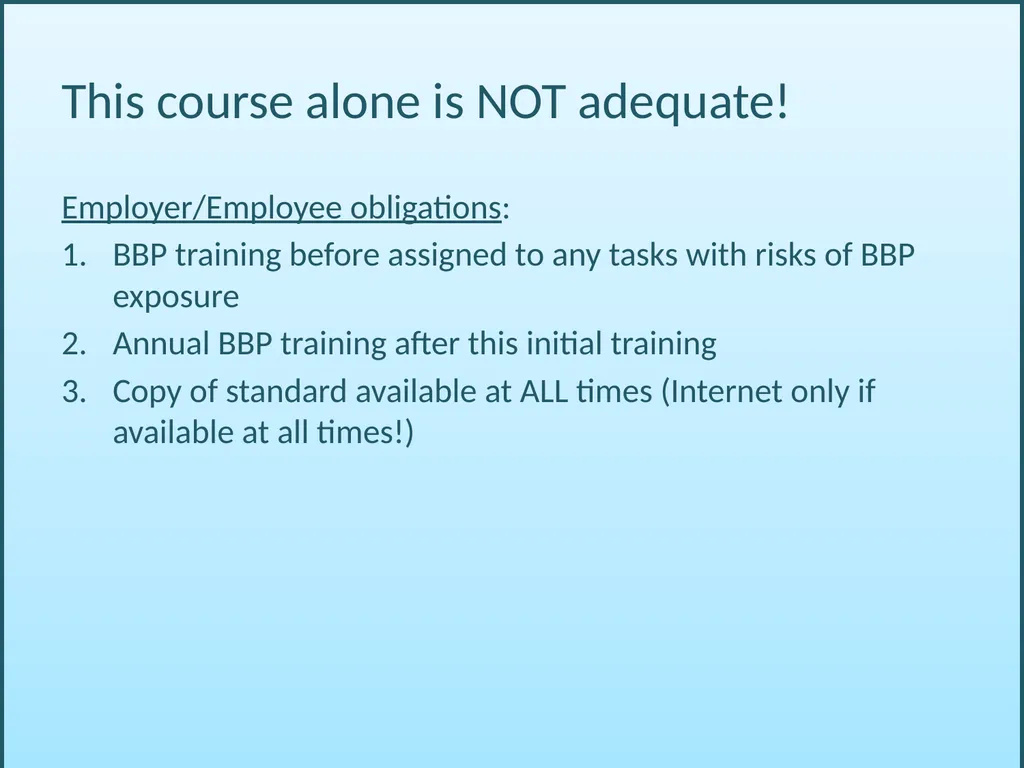
Employer/Employee obligations:
BBP training before assigned to any tasks with risks of BBP exposure
Annual BBP training after this initial training
Copy of standard available at ALL times (Internet only if available at all times!) This course alone is NOT adequate!<br>
BBP training before assigned to any tasks with risks of BBP exposure
Annual BBP training after this initial training
Copy of standard available at ALL times (Internet only if available at all times!) This course alone is NOT adequate!<br>
88
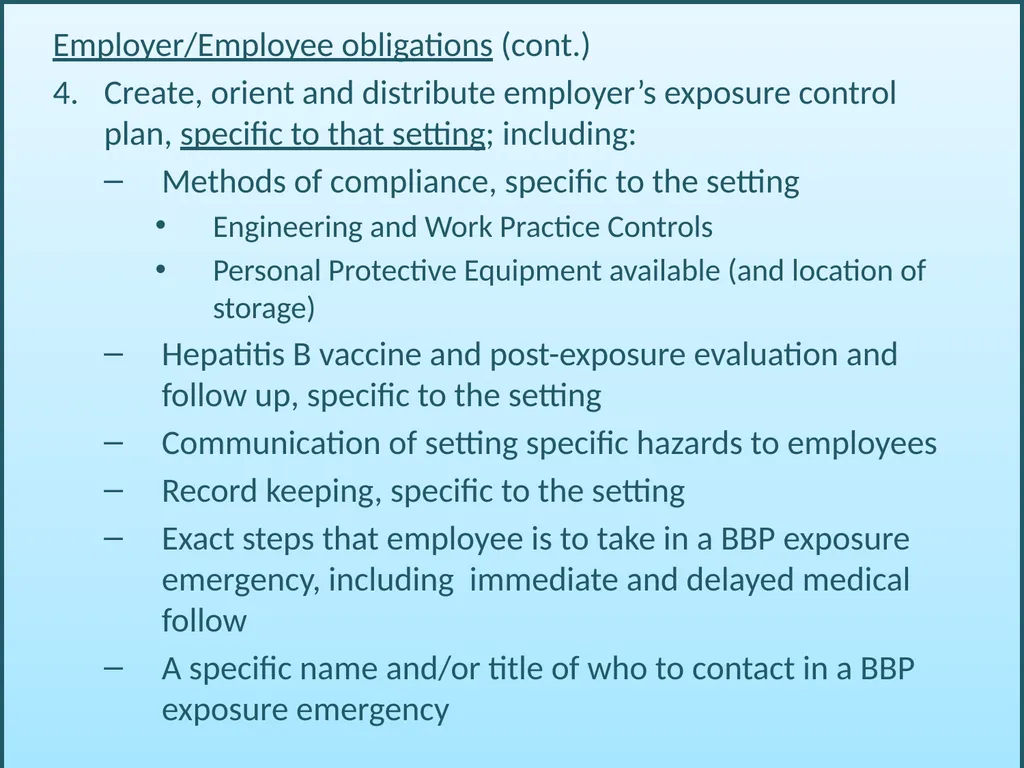
Employer/Employee obligations (cont.)
Create, orient and distribute employer’s exposure control plan, specific to that setting; including:
Methods of compliance, specific to the setting
Engineering and Work Practice Controls
Personal Protective Equipment available (and location of storage)
Hepatitis B vaccine and post-exposure evaluation and follow up, specific to the setting
Communication of setting specific hazards to employees
Record keeping, specific to the setting
Exact steps that employee is to take in a BBP exposure emergency, including immediate and delayed medical follow
A specific name and/or title of who to contact in a BBP exposure emergency<br>
Create, orient and distribute employer’s exposure control plan, specific to that setting; including:
Methods of compliance, specific to the setting
Engineering and Work Practice Controls
Personal Protective Equipment available (and location of storage)
Hepatitis B vaccine and post-exposure evaluation and follow up, specific to the setting
Communication of setting specific hazards to employees
Record keeping, specific to the setting
Exact steps that employee is to take in a BBP exposure emergency, including immediate and delayed medical follow
A specific name and/or title of who to contact in a BBP exposure emergency<br>
89
References OSHA Bloodborne Pathogen Standard: http://www.osha.gov/pls/oshaweb/owadisp.show_document?p_table=standards&p_id=10051
Summary and Explanation of the Standard:
http://www.osha.gov/pls/oshaweb/owadisp.show_document?p_id=811&p_table=PREAMBLES<br>
Summary and Explanation of the Standard:
http://www.osha.gov/pls/oshaweb/owadisp.show_document?p_id=811&p_table=PREAMBLES<br>