Breakout session 1 Somatic-to-germline testing
Description: Breakout session 1 Somatic-to-germline testing pathways Format Round table discussion 5 working groups Breast, Colorectal, Ovarian, Other, TP53 Three documents on table Individual variant testing scoring form (all to complete) Individual
Related Topics
Download Presentation
"Breakout session 1 Somatic-to-germline testing" is the property of its rightful owner. Permission is granted to download and print the materials on this website for personal, non-commercial use only, and to display it on your personal computer provided you do not modify the materials and that you retain all copyright notices contained in the materials. By downloading content from our website, you accept the terms of this agreement.
Presentation Transcript
slide1. Breakout session 1 Somatic-to-germline testing pathways<br>
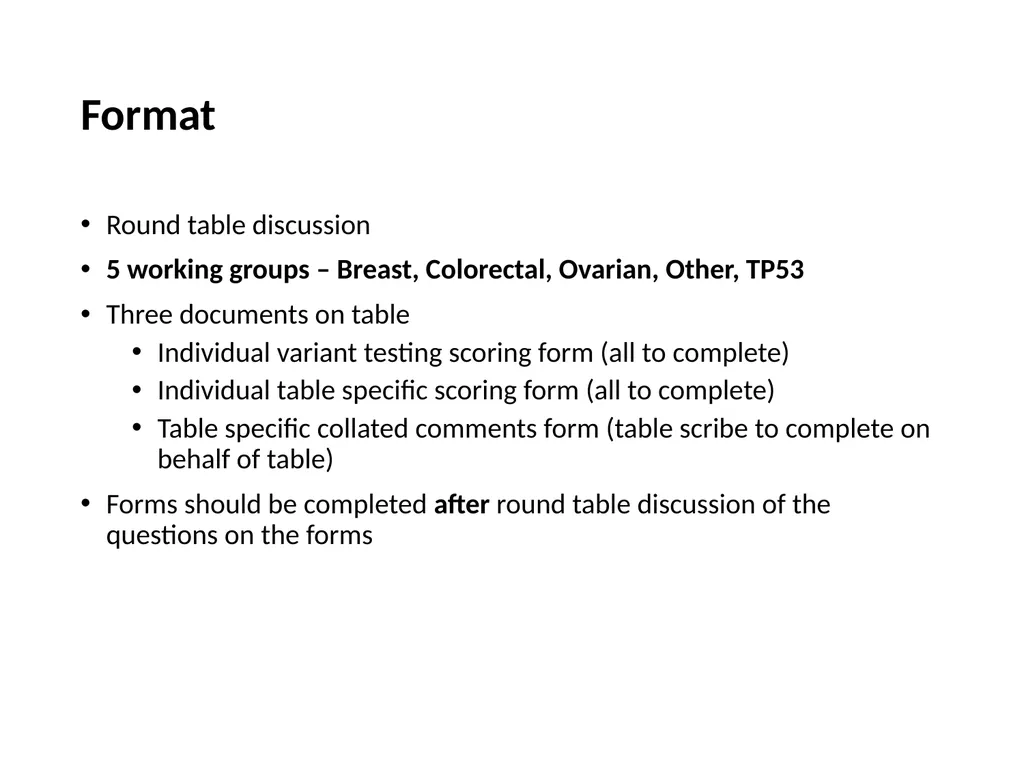
slide2. Format Round table discussion
5 working groups – Breast, Colorectal, Ovarian, Other, TP53
Three documents on table
Individual variant testing scoring form (all to complete)
Individual table specific scoring form (all to complete)
Table specific collated comments form (table scribe to complete on behalf of table)
Forms should be completed after round table discussion of the questions on the forms<br>
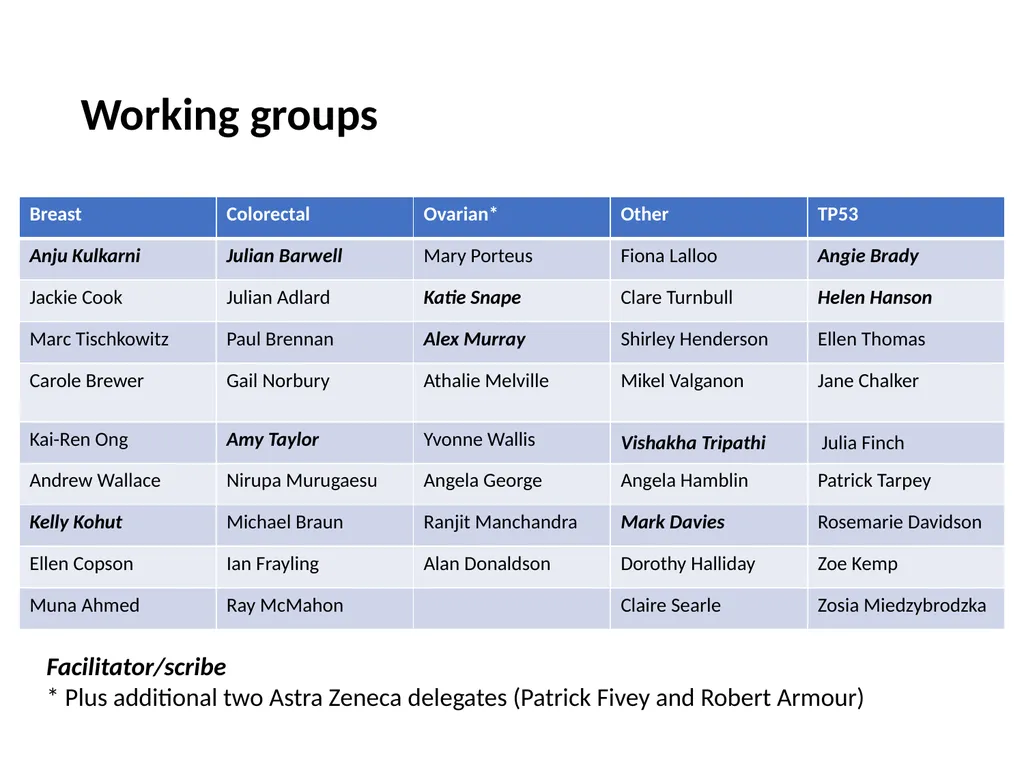
slide3. Working groups Facilitator/scribe
* Plus additional two Astra Zeneca delegates (Patrick Fivey and Robert Armour)<br>
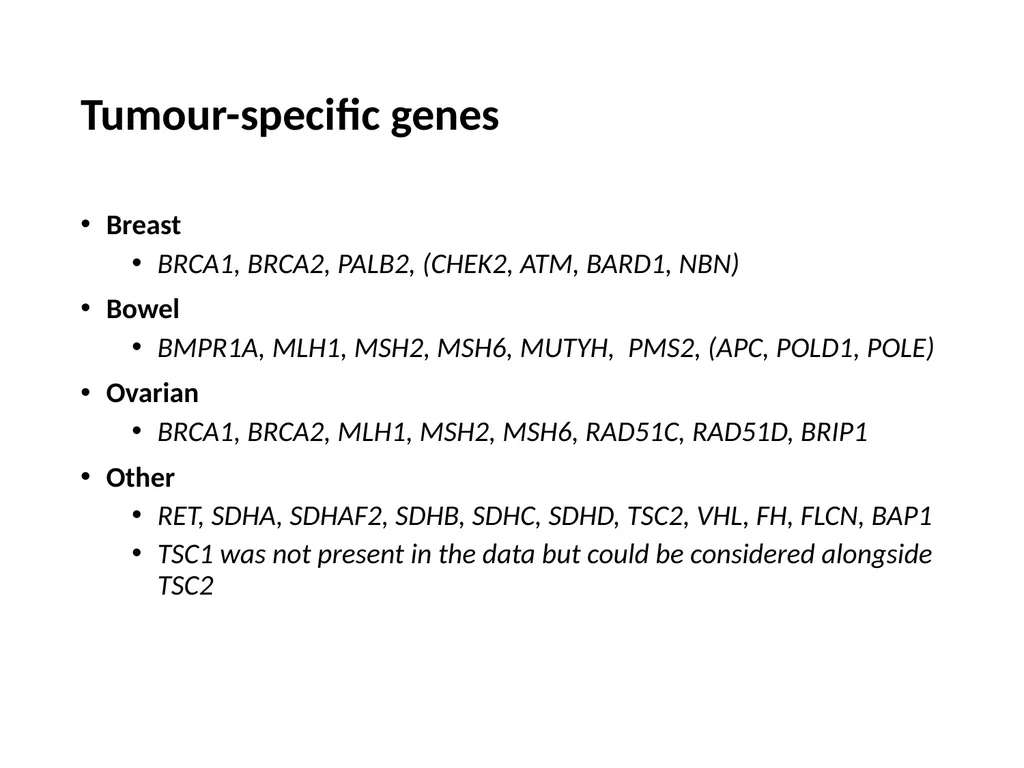
slide4. Tumour-specific genes Breast
BRCA1, BRCA2, PALB2, (CHEK2, ATM, BARD1, NBN)
Bowel
BMPR1A, MLH1, MSH2, MSH6, MUTYH, PMS2, (APC, POLD1, POLE)
Ovarian
BRCA1, BRCA2, MLH1, MSH2, MSH6, RAD51C, RAD51D, BRIP1
Other
RET, SDHA, SDHAF2, SDHB, SDHC, SDHD, TSC2, VHL, FH, FLCN, BAP1
TSC1 was not present in the data but could be considered alongside TSC2<br>
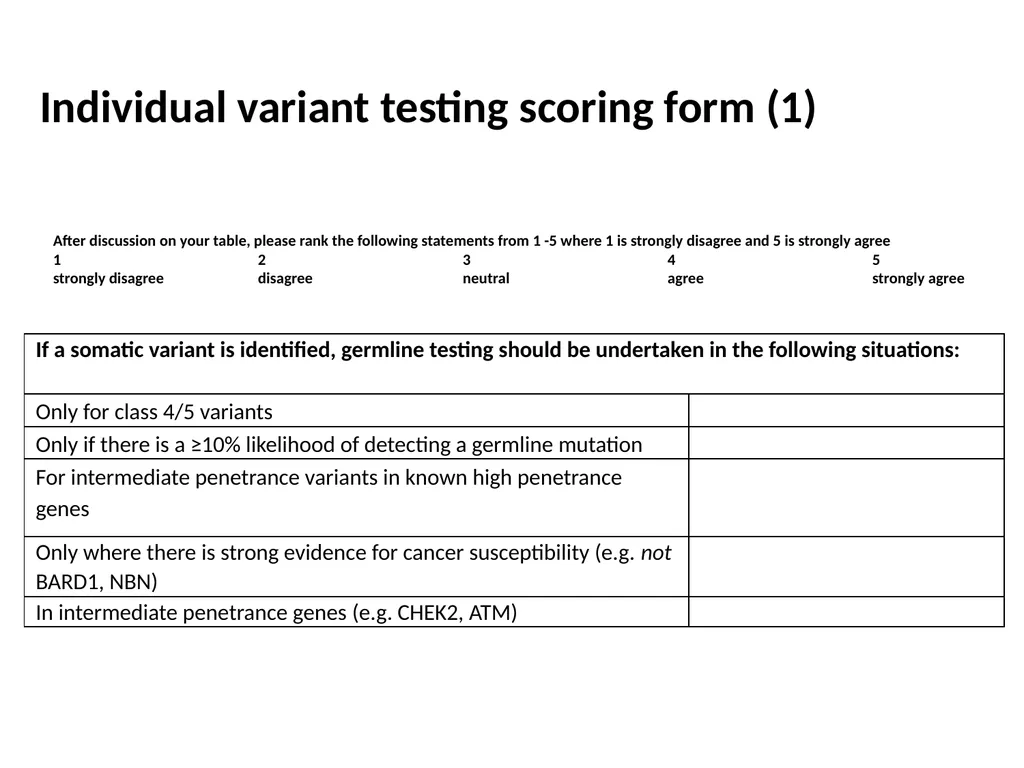
slide5. Individual variant testing scoring form (1) After discussion on your table, please rank the following statements from 1 -5 where 1 is strongly disagree and 5 is strongly agree
1 2 3 4 5
strongly disagree disagree neutral agree strongly agree<br>
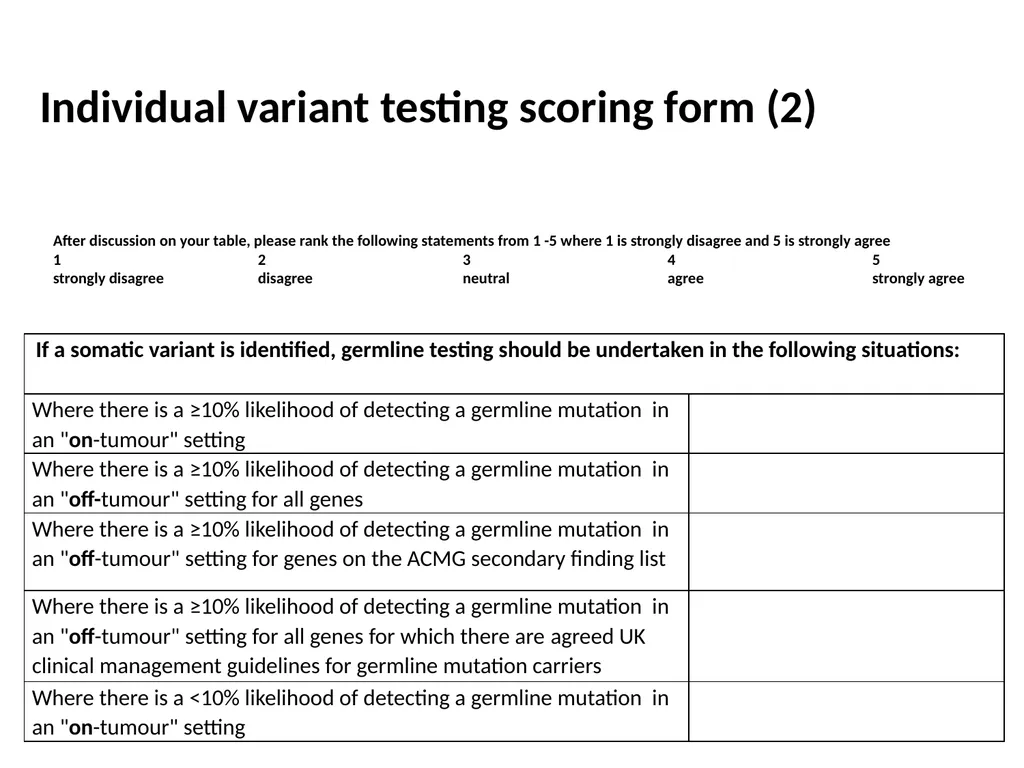
slide6. Individual variant testing scoring form (2) After discussion on your table, please rank the following statements from 1 -5 where 1 is strongly disagree and 5 is strongly agree
1 2 3 4 5
strongly disagree disagree neutral agree strongly agree<br>
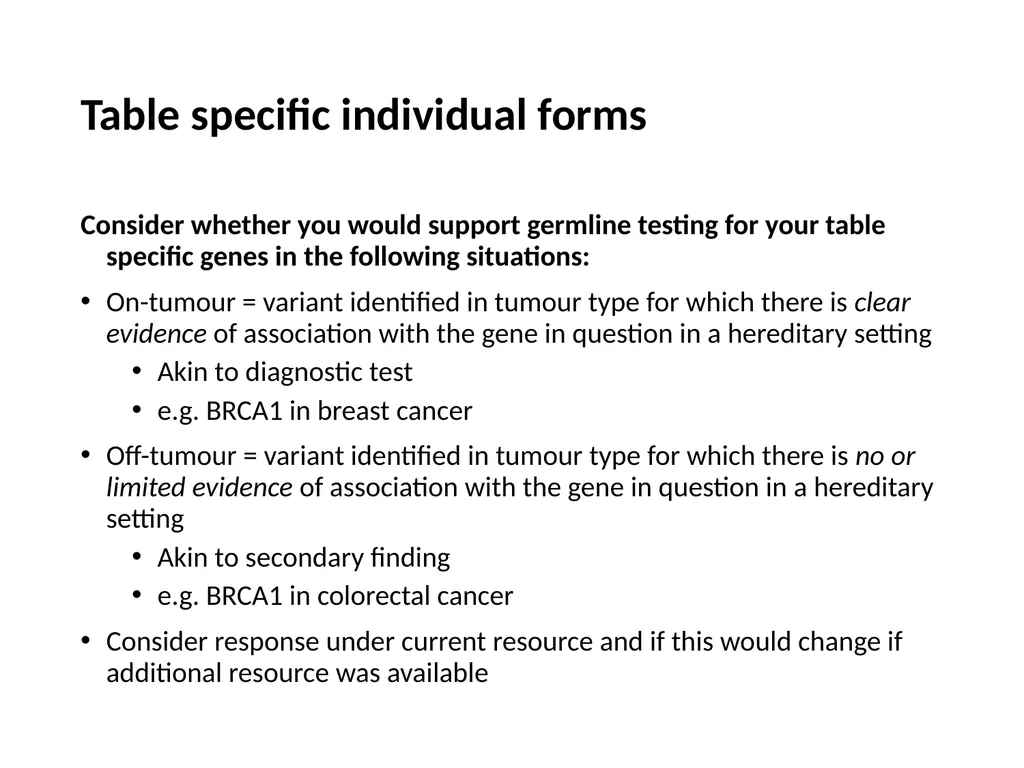
slide7. Table specific individual forms Consider whether you would support germline testing for your table specific genes in the following situations:
On-tumour = variant identified in tumour type for which there is clear evidence of association with the gene in question in a hereditary setting
Akin to diagnostic test
e.g. BRCA1 in breast cancer
Off-tumour = variant identified in tumour type for which there is no or limited evidence of association with the gene in question in a hereditary setting
Akin to secondary finding
e.g. BRCA1 in colorectal cancer
Consider response under current resource and if this would change if additional resource was available<br>
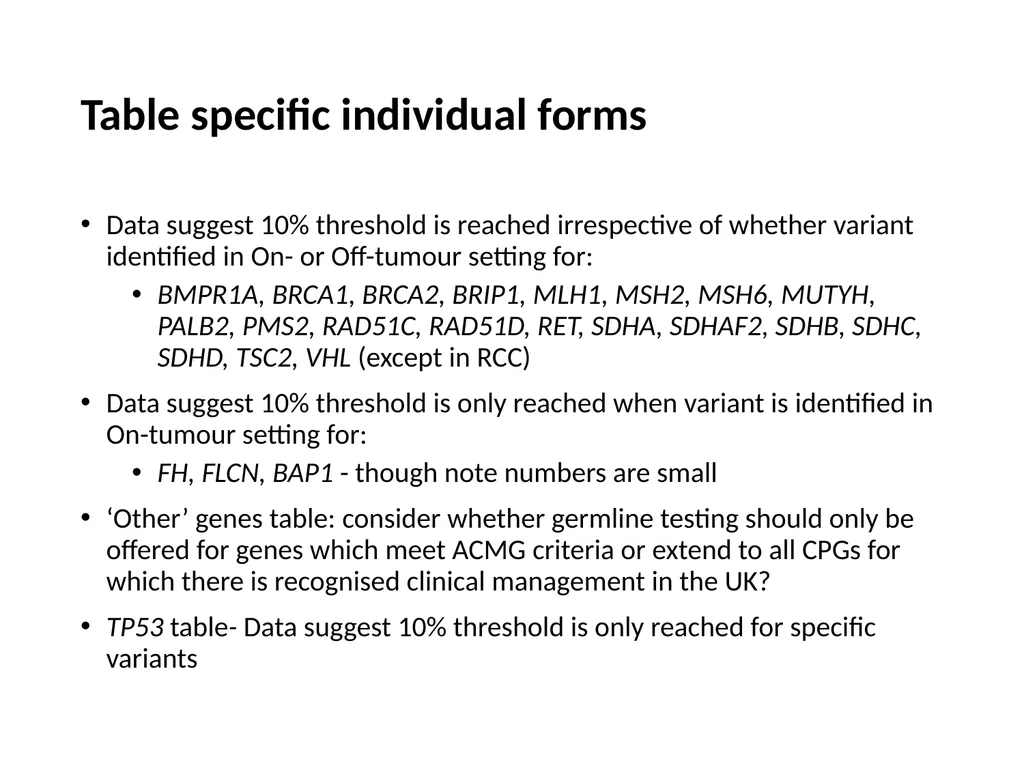
slide8. Table specific individual forms Data suggest 10% threshold is reached irrespective of whether variant identified in On- or Off-tumour setting for:
BMPR1A, BRCA1, BRCA2, BRIP1, MLH1, MSH2, MSH6, MUTYH, PALB2, PMS2, RAD51C, RAD51D, RET, SDHA, SDHAF2, SDHB, SDHC, SDHD, TSC2, VHL (except in RCC)
Data suggest 10% threshold is only reached when variant is identified in On-tumour setting for:
FH, FLCN, BAP1 - though note numbers are small
‘Other’ genes table: consider whether germline testing should only be offered for genes which meet ACMG criteria or extend to all CPGs for which there is recognised clinical management in the UK?
TP53 table- Data suggest 10% threshold is only reached for specific variants<br>
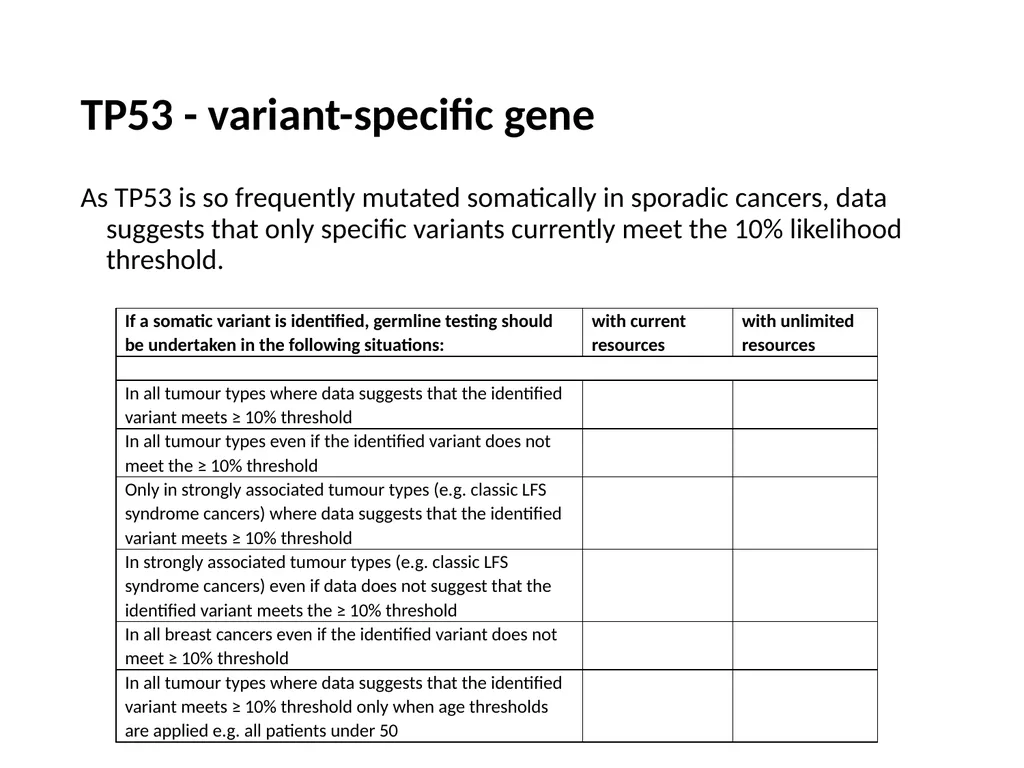
slide9. TP53 - variant-specific gene As TP53 is so frequently mutated somatically in sporadic cancers, data suggests that only specific variants currently meet the 10% likelihood threshold.<br>
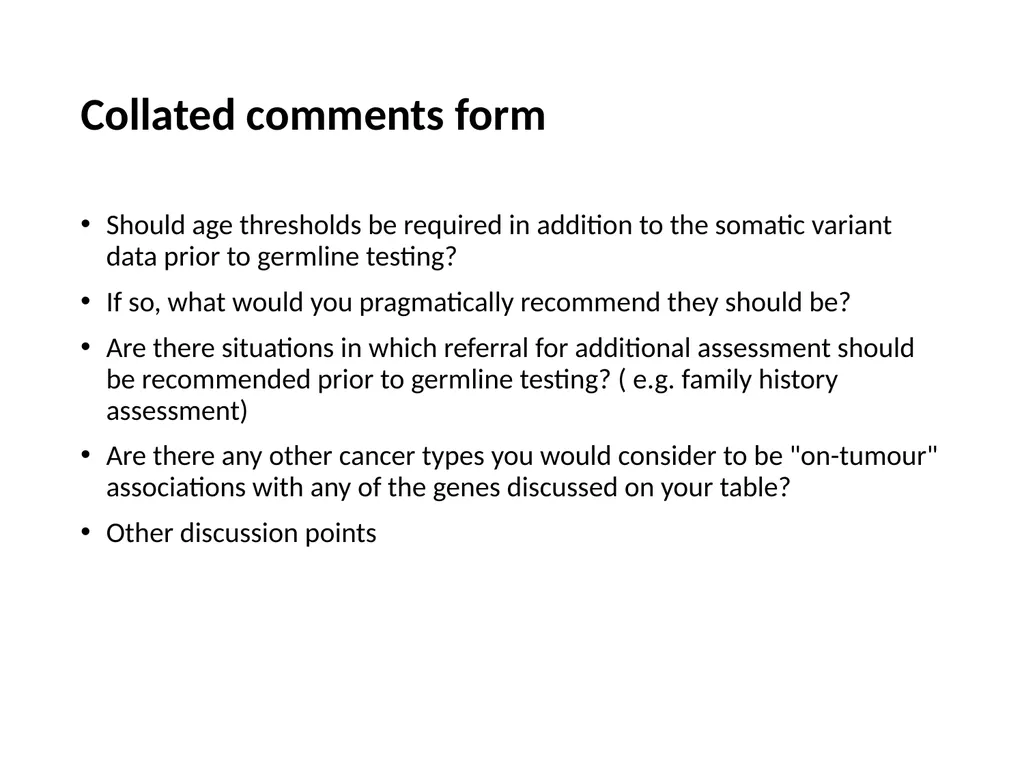
slide10. Collated comments form Should age thresholds be required in addition to the somatic variant data prior to germline testing?
If so, what would you pragmatically recommend they should be?
Are there situations in which referral for additional assessment should be recommended prior to germline testing? ( e.g. family history assessment)
Are there any other cancer types you would consider to be "on-tumour" associations with any of the genes discussed on your table?
Other discussion points<br>
slide11. Breakout session 2 Consent and clinical pathways<br>
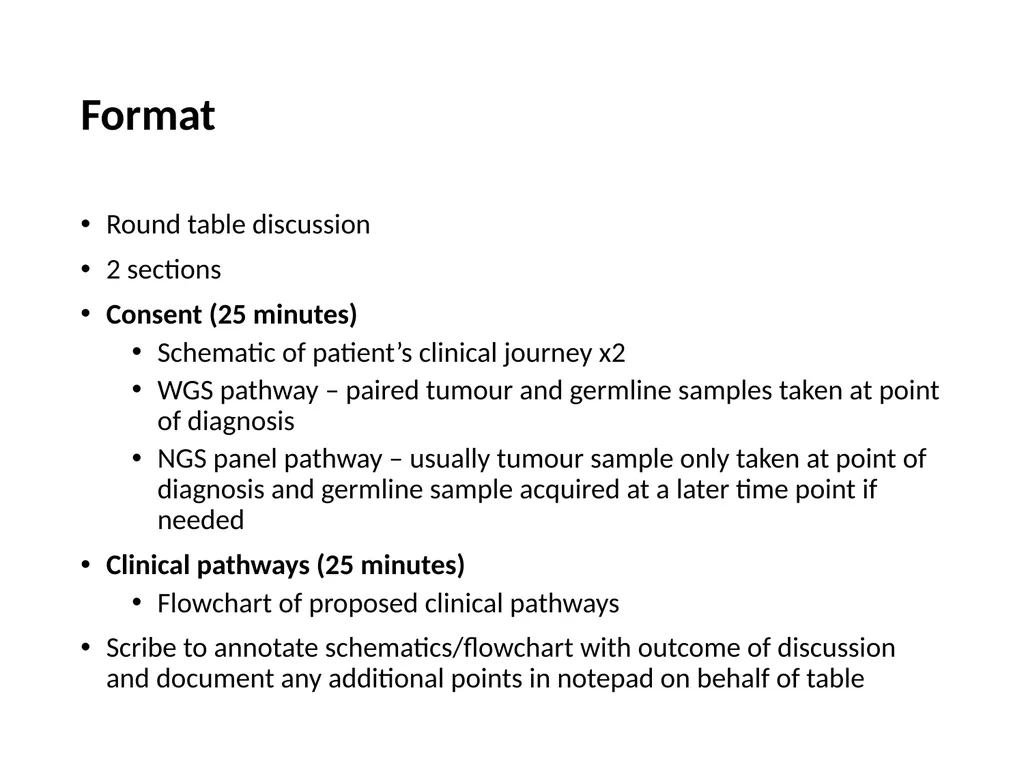
slide12. Format Round table discussion
2 sections
Consent (25 minutes)
Schematic of patient’s clinical journey x2
WGS pathway – paired tumour and germline samples taken at point of diagnosis
NGS panel pathway – usually tumour sample only taken at point of diagnosis and germline sample acquired at a later time point if needed
Clinical pathways (25 minutes)
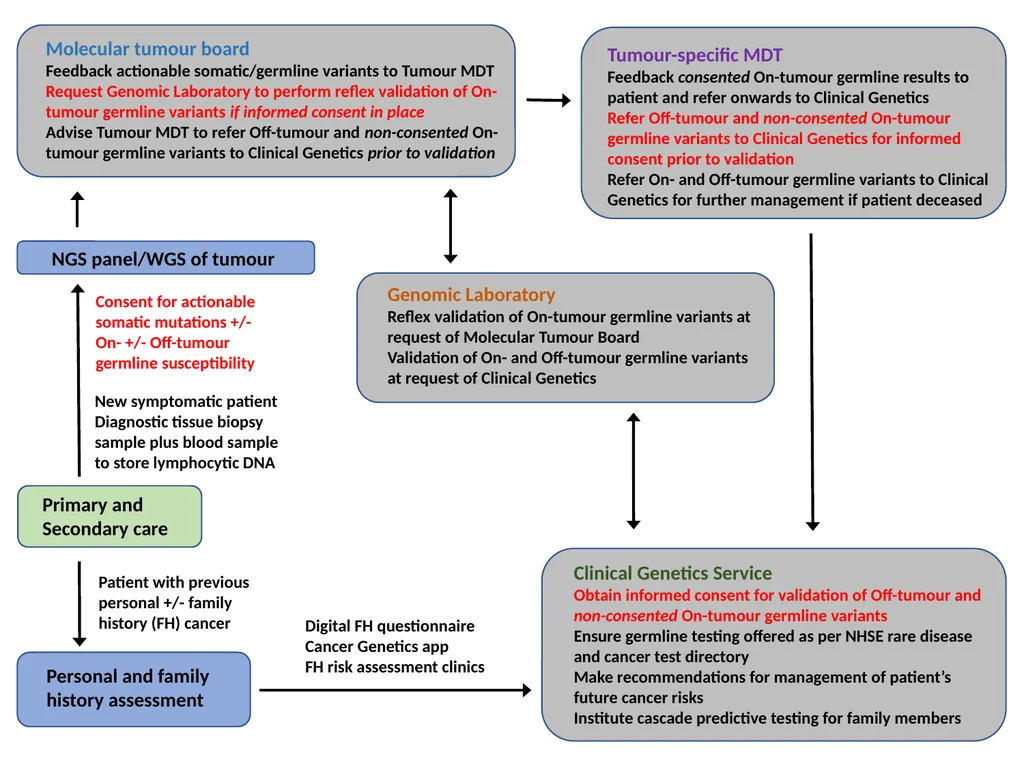
Flowchart of proposed clinical pathways
Scribe to annotate schematics/flowchart with outcome of discussion and document any additional points in notepad on behalf of table<br>
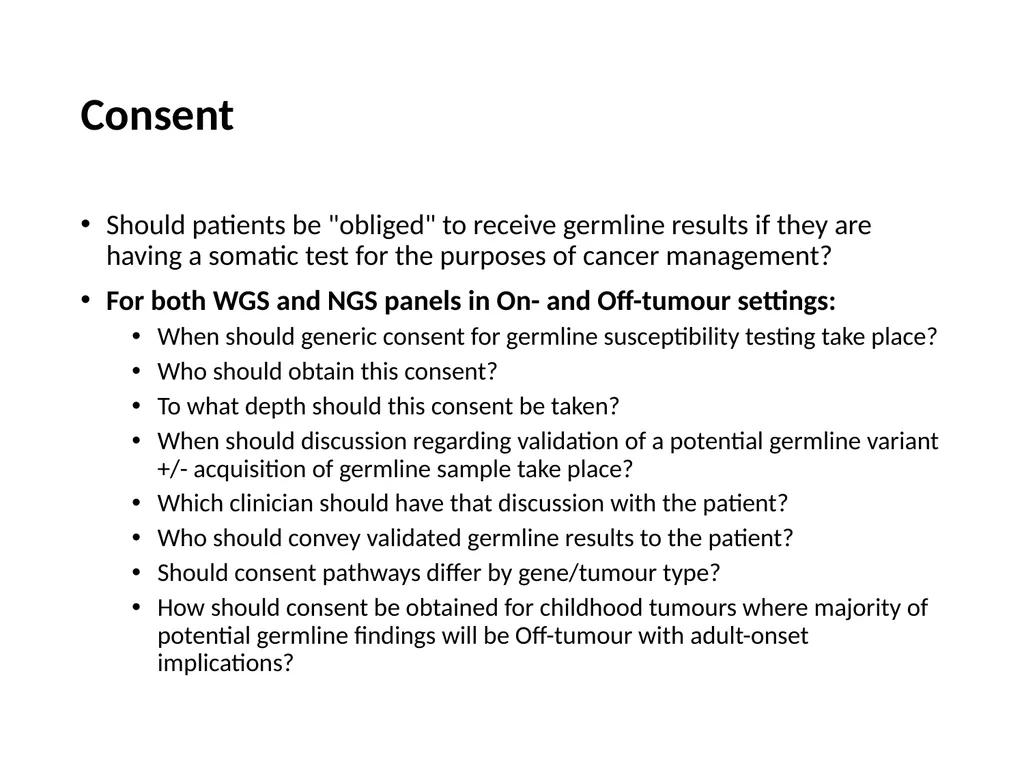
slide13. Consent Should patients be "obliged" to receive germline results if they are having a somatic test for the purposes of cancer management?
For both WGS and NGS panels in On- and Off-tumour settings:
When should generic consent for germline susceptibility testing take place?
Who should obtain this consent?
To what depth should this consent be taken?
When should discussion regarding validation of a potential germline variant +/- acquisition of germline sample take place?
Which clinician should have that discussion with the patient?
Who should convey validated germline results to the patient?
Should consent pathways differ by gene/tumour type?
How should consent be obtained for childhood tumours where majority of potential germline findings will be Off-tumour with adult-onset implications?<br>
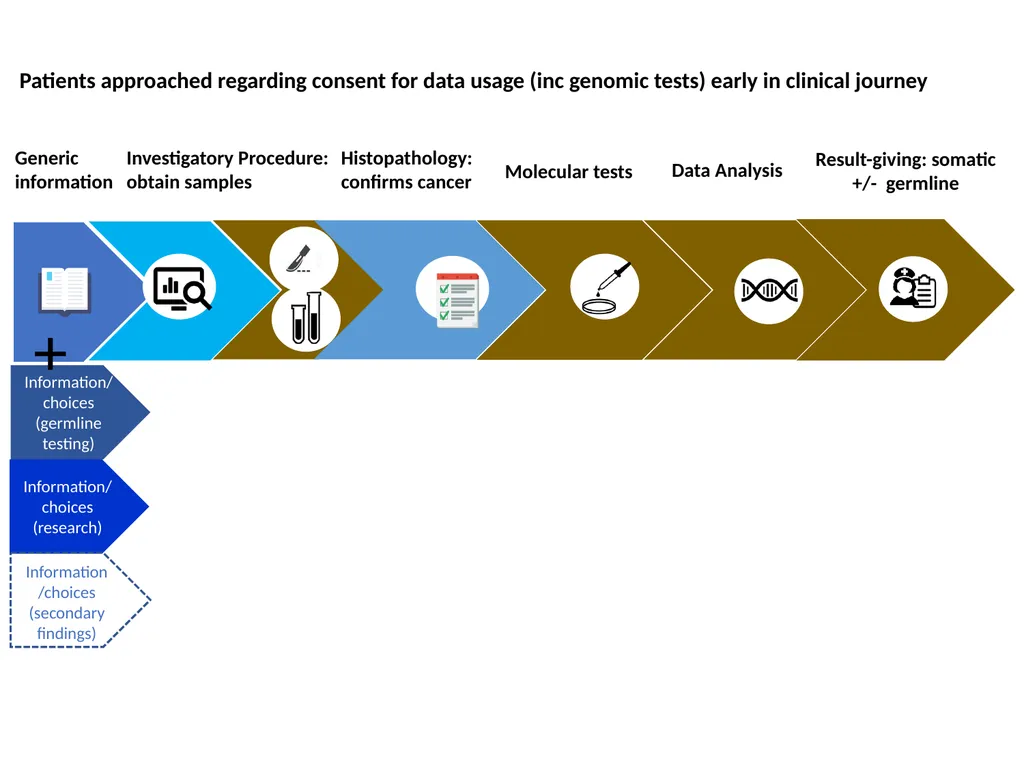
slide14. Investigatory Procedure: obtain samples Generic information Histopathology: confirms cancer Molecular tests Result-giving: somatic +/- germline Data Analysis + Patients approached regarding consent for data usage (inc genomic tests) early in clinical journey<br>
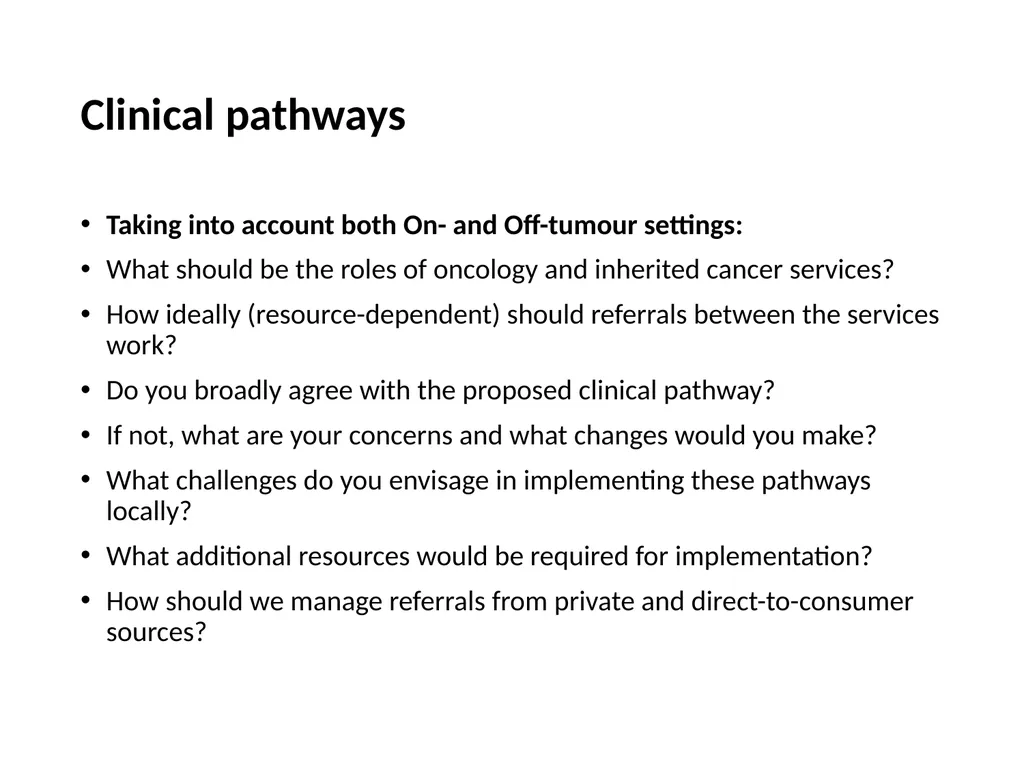
slide15. Clinical pathways Taking into account both On- and Off-tumour settings:
What should be the roles of oncology and inherited cancer services?
How ideally (resource-dependent) should referrals between the services work?
Do you broadly agree with the proposed clinical pathway?
If not, what are your concerns and what changes would you make?
What challenges do you envisage in implementing these pathways locally?
What additional resources would be required for implementation?
How should we manage referrals from private and direct-to-consumer sources?<br>
slide16. Consent for actionable somatic mutations +/- On- +/- Off-tumour germline susceptibility Digital FH questionnaire
Cancer Genetics app
FH risk assessment clinics New symptomatic patient
Diagnostic tissue biopsy sample plus blood sample to store lymphocytic DNA Patient with previous personal +/- family history (FH) cancer<br>

slide2. Format Round table discussion
5 working groups – Breast, Colorectal, Ovarian, Other, TP53
Three documents on table
Individual variant testing scoring form (all to complete)
Individual table specific scoring form (all to complete)
Table specific collated comments form (table scribe to complete on behalf of table)
Forms should be completed after round table discussion of the questions on the forms<br>
slide3. Working groups Facilitator/scribe
* Plus additional two Astra Zeneca delegates (Patrick Fivey and Robert Armour)<br>
slide4. Tumour-specific genes Breast
BRCA1, BRCA2, PALB2, (CHEK2, ATM, BARD1, NBN)
Bowel
BMPR1A, MLH1, MSH2, MSH6, MUTYH, PMS2, (APC, POLD1, POLE)
Ovarian
BRCA1, BRCA2, MLH1, MSH2, MSH6, RAD51C, RAD51D, BRIP1
Other
RET, SDHA, SDHAF2, SDHB, SDHC, SDHD, TSC2, VHL, FH, FLCN, BAP1
TSC1 was not present in the data but could be considered alongside TSC2<br>
slide5. Individual variant testing scoring form (1) After discussion on your table, please rank the following statements from 1 -5 where 1 is strongly disagree and 5 is strongly agree
1 2 3 4 5
strongly disagree disagree neutral agree strongly agree<br>
slide6. Individual variant testing scoring form (2) After discussion on your table, please rank the following statements from 1 -5 where 1 is strongly disagree and 5 is strongly agree
1 2 3 4 5
strongly disagree disagree neutral agree strongly agree<br>
slide7. Table specific individual forms Consider whether you would support germline testing for your table specific genes in the following situations:
On-tumour = variant identified in tumour type for which there is clear evidence of association with the gene in question in a hereditary setting
Akin to diagnostic test
e.g. BRCA1 in breast cancer
Off-tumour = variant identified in tumour type for which there is no or limited evidence of association with the gene in question in a hereditary setting
Akin to secondary finding
e.g. BRCA1 in colorectal cancer
Consider response under current resource and if this would change if additional resource was available<br>
slide8. Table specific individual forms Data suggest 10% threshold is reached irrespective of whether variant identified in On- or Off-tumour setting for:
BMPR1A, BRCA1, BRCA2, BRIP1, MLH1, MSH2, MSH6, MUTYH, PALB2, PMS2, RAD51C, RAD51D, RET, SDHA, SDHAF2, SDHB, SDHC, SDHD, TSC2, VHL (except in RCC)
Data suggest 10% threshold is only reached when variant is identified in On-tumour setting for:
FH, FLCN, BAP1 - though note numbers are small
‘Other’ genes table: consider whether germline testing should only be offered for genes which meet ACMG criteria or extend to all CPGs for which there is recognised clinical management in the UK?
TP53 table- Data suggest 10% threshold is only reached for specific variants<br>
slide9. TP53 - variant-specific gene As TP53 is so frequently mutated somatically in sporadic cancers, data suggests that only specific variants currently meet the 10% likelihood threshold.<br>
slide10. Collated comments form Should age thresholds be required in addition to the somatic variant data prior to germline testing?
If so, what would you pragmatically recommend they should be?
Are there situations in which referral for additional assessment should be recommended prior to germline testing? ( e.g. family history assessment)
Are there any other cancer types you would consider to be "on-tumour" associations with any of the genes discussed on your table?
Other discussion points<br>
slide11. Breakout session 2 Consent and clinical pathways<br>
slide12. Format Round table discussion
2 sections
Consent (25 minutes)
Schematic of patient’s clinical journey x2
WGS pathway – paired tumour and germline samples taken at point of diagnosis
NGS panel pathway – usually tumour sample only taken at point of diagnosis and germline sample acquired at a later time point if needed
Clinical pathways (25 minutes)
Flowchart of proposed clinical pathways
Scribe to annotate schematics/flowchart with outcome of discussion and document any additional points in notepad on behalf of table<br>
slide13. Consent Should patients be "obliged" to receive germline results if they are having a somatic test for the purposes of cancer management?
For both WGS and NGS panels in On- and Off-tumour settings:
When should generic consent for germline susceptibility testing take place?
Who should obtain this consent?
To what depth should this consent be taken?
When should discussion regarding validation of a potential germline variant +/- acquisition of germline sample take place?
Which clinician should have that discussion with the patient?
Who should convey validated germline results to the patient?
Should consent pathways differ by gene/tumour type?
How should consent be obtained for childhood tumours where majority of potential germline findings will be Off-tumour with adult-onset implications?<br>
slide14. Investigatory Procedure: obtain samples Generic information Histopathology: confirms cancer Molecular tests Result-giving: somatic +/- germline Data Analysis + Patients approached regarding consent for data usage (inc genomic tests) early in clinical journey<br>
slide15. Clinical pathways Taking into account both On- and Off-tumour settings:
What should be the roles of oncology and inherited cancer services?
How ideally (resource-dependent) should referrals between the services work?
Do you broadly agree with the proposed clinical pathway?
If not, what are your concerns and what changes would you make?
What challenges do you envisage in implementing these pathways locally?
What additional resources would be required for implementation?
How should we manage referrals from private and direct-to-consumer sources?<br>
slide16. Consent for actionable somatic mutations +/- On- +/- Off-tumour germline susceptibility Digital FH questionnaire
Cancer Genetics app
FH risk assessment clinics New symptomatic patient
Diagnostic tissue biopsy sample plus blood sample to store lymphocytic DNA Patient with previous personal +/- family history (FH) cancer<br>