Building Pathways from the Middle Grades to College: Learnings from the work of the Chicago Consortium of School Research (CCSR) and CRIS Presented by Jenny Nagaoka and Eliza Moeller October 21, 2014 Bush Institute Dallas, Texas Overview
"Building Pathways from the Middle Grades to" is the property of its rightful owner. Permission is granted to
download and print the materials on this website for personal, non-commercial use only, and to display it
on your personal computer provided you do not modify the materials and that you retain all copyright
notices contained in the materials. By downloading content from our website, you accept the terms of this
agreement.
Presentation Transcript
01
Building Pathways from the Middle Grades to College: Learnings from the work of the Chicago Consortium of School Research (CCSR) and CRIS Presented by Jenny Nagaoka and Eliza Moeller October 21, 2014 Bush Institute Dallas, Texas<br>
02
Overview Brief background on the Consortium on Chicago School Research and the College Readiness Indicator Systems Project.
What matters for college success
Predictors of high school graduation
What happens in the transition to high school
Middle grade indicators of high school and college readiness<br>
03
Mission of the University of Chicago Consortium on Chicago School Research CCSR’s mission is to support the search for solutions in ways that: build the capacity of schools to improve by identifying strategies and levers for improvement and working across all levels of the system. (Roderick, Easton, & Sebring, 2009)
We seek to build the capacity of schools and the district through:
Research identifying what matters: Organizing frameworks
Indicator development: The critical role of measurement
Identify leverage points: Support in identifying strategies for improvement
Outreach to a broad audience: Accessible and actionable publications and presentations and individual school data reports.<br>
04
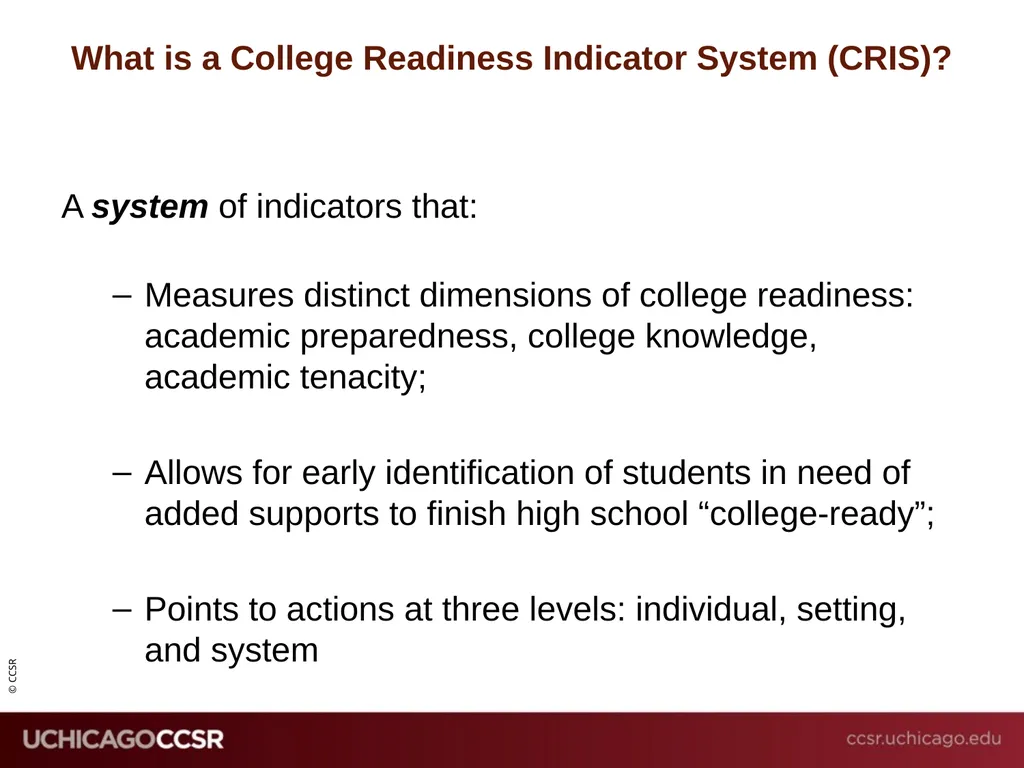
What is a College Readiness Indicator System (CRIS)? A system of indicators that:
Measures distinct dimensions of college readiness: academic preparedness, college knowledge, academic tenacity;
Allows for early identification of students in need of added supports to finish high school “college-ready”;
Points to actions at three levels: individual, setting, and system<br>
05
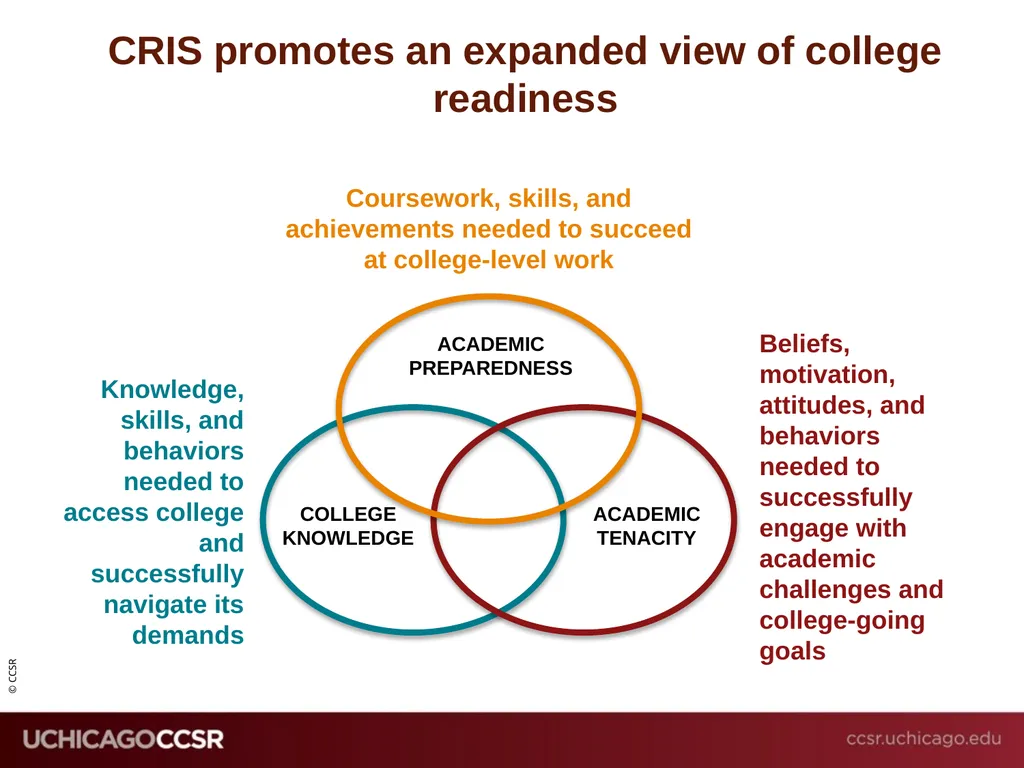
CRIS promotes an expanded view of college readiness Coursework, skills, and achievements needed to succeed at college-level work Beliefs, motivation, attitudes, and behaviors needed to successfully engage with academic challenges and college-going goals Knowledge, skills, and behaviors needed to access college and successfully navigate its demands<br>
06
What matters for college success?<br>
07
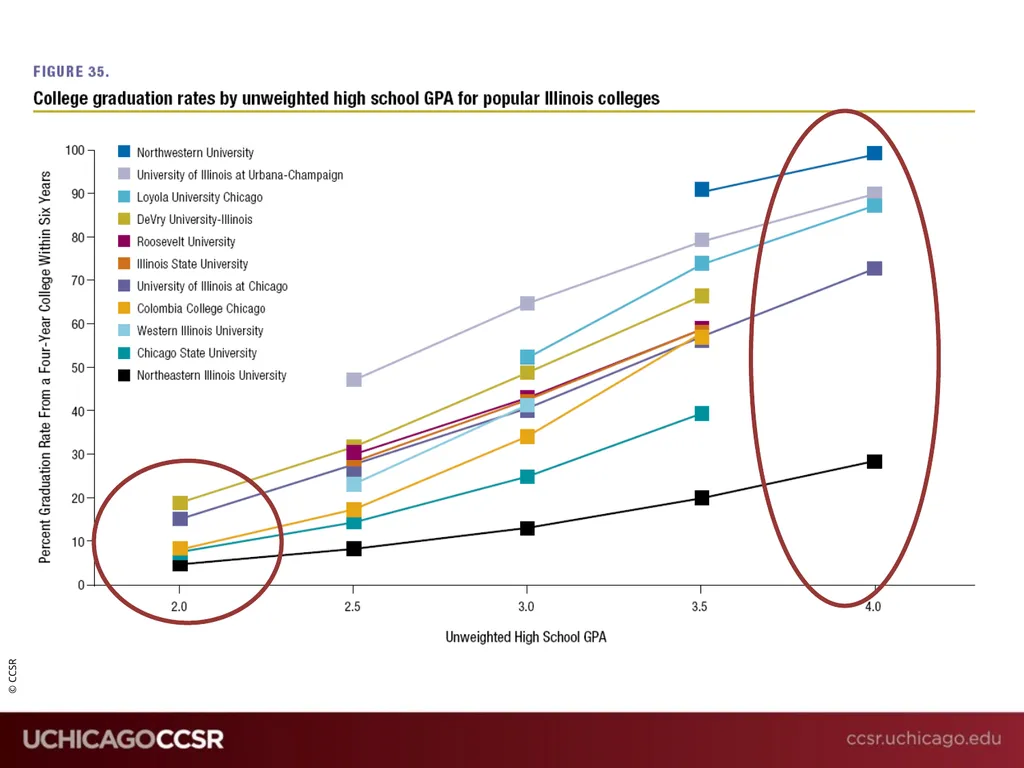
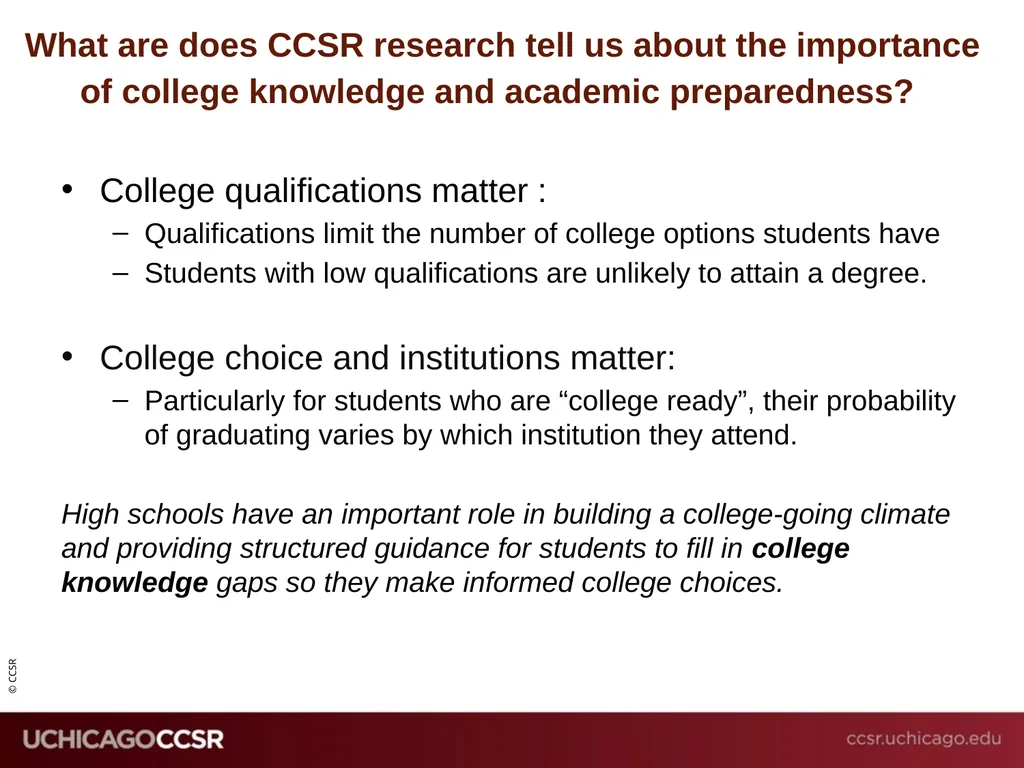
What are does CCSR research tell us about the importance of college knowledge and academic preparedness? College qualifications matter :
Qualifications limit the number of college options students have
Students with low qualifications are unlikely to attain a degree.
College choice and institutions matter:
Particularly for students who are “college ready”, their probability of graduating varies by which institution they attend.
High schools have an important role in building a college-going climate and providing structured guidance for students to fill in college knowledge gaps so they make informed college choices.<br>
08
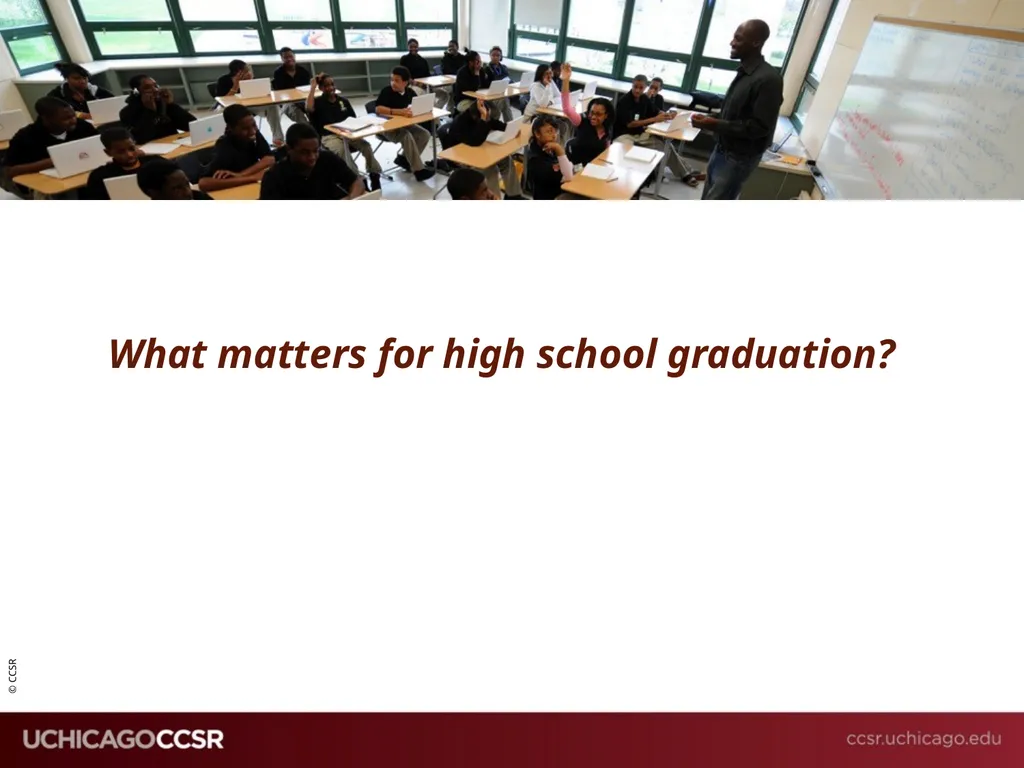
What matters for high school graduation?<br>
09
9th graders who are on track are four times more likely to graduate than students who are off track Allensworth and Easton (2005)<br>
10
Allensworth and Easton (2005)<br>
11
Allensworth and Easton (2007)<br>
12
What happens in the transition to high school?<br>
13
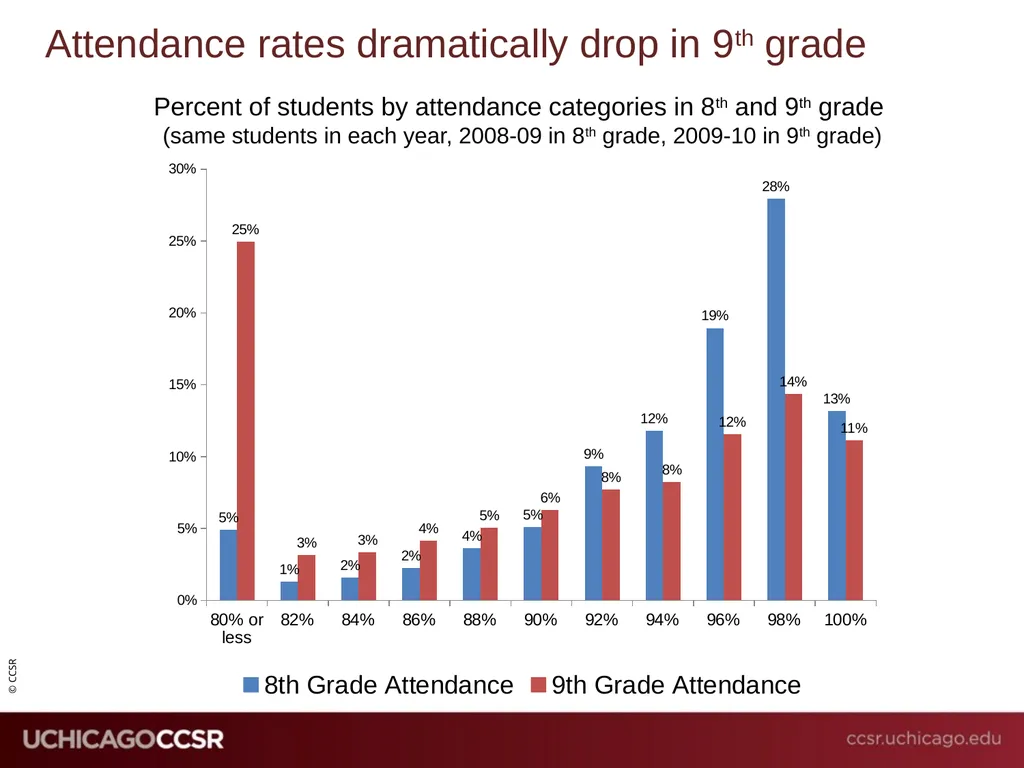
Attendance rates dramatically drop in 9th grade Percent of students by attendance categories in 8th and 9th grade
(same students in each year, 2008-09 in 8th grade, 2009-10 in 9th grade)<br>
14
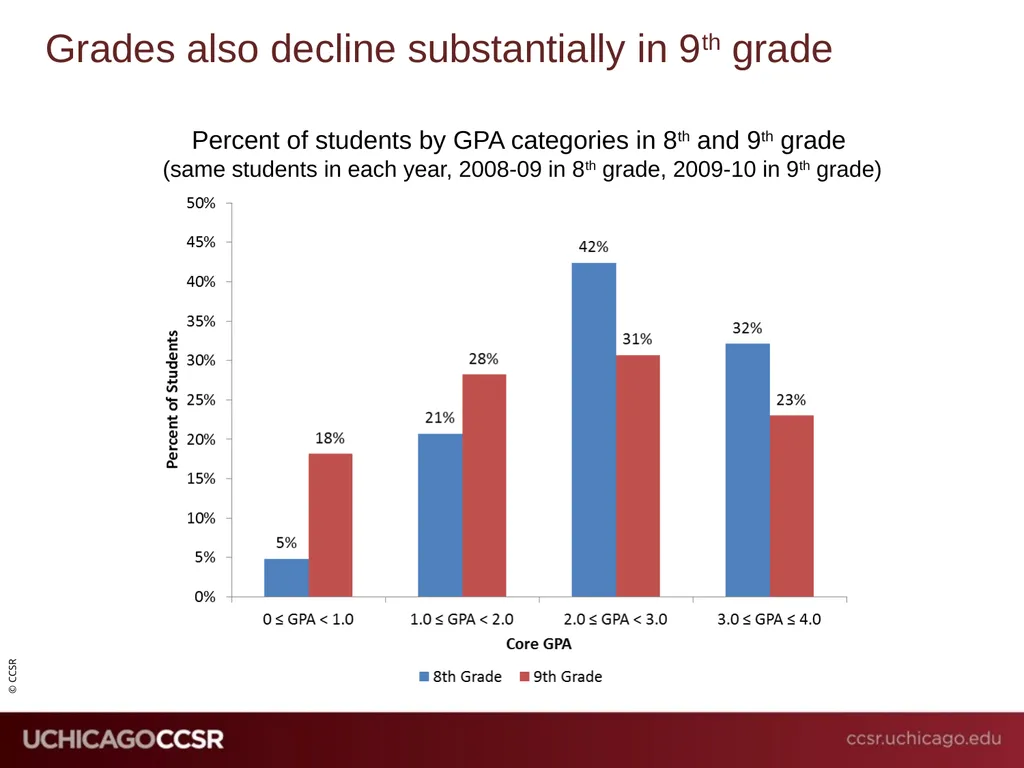
Grades also decline substantially in 9th grade Percent of students by GPA categories in 8th and 9th grade
(same students in each year, 2008-09 in 8th grade, 2009-10 in 9th grade)<br>
15
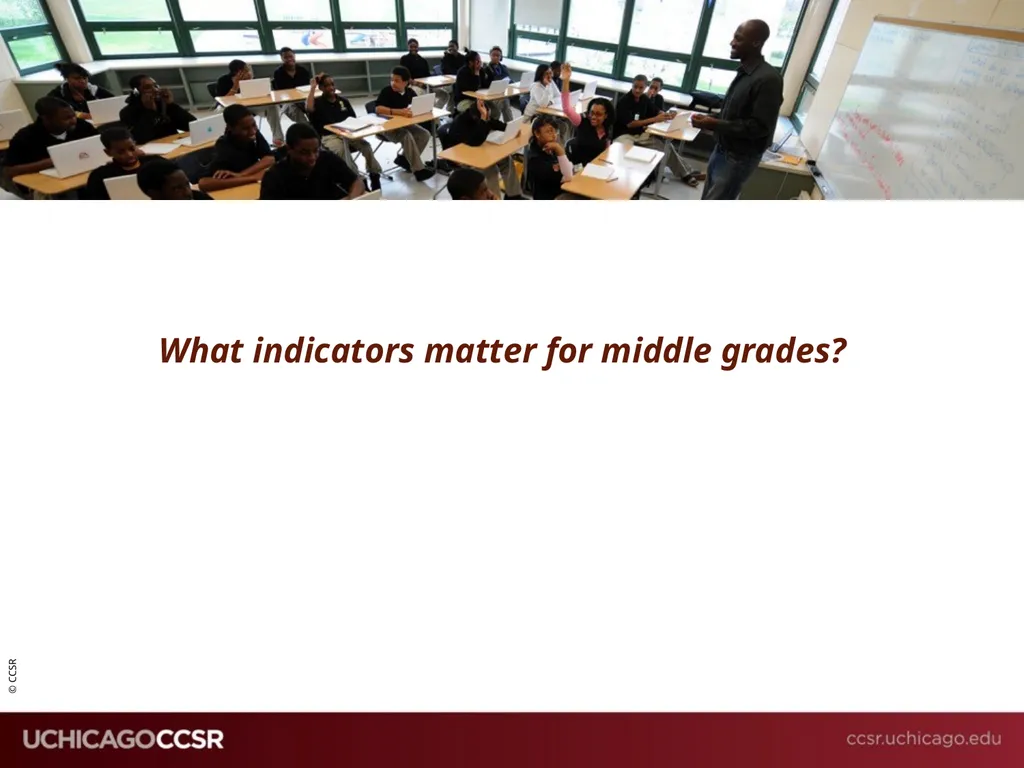
What indicators matter for middle grades?<br>
16
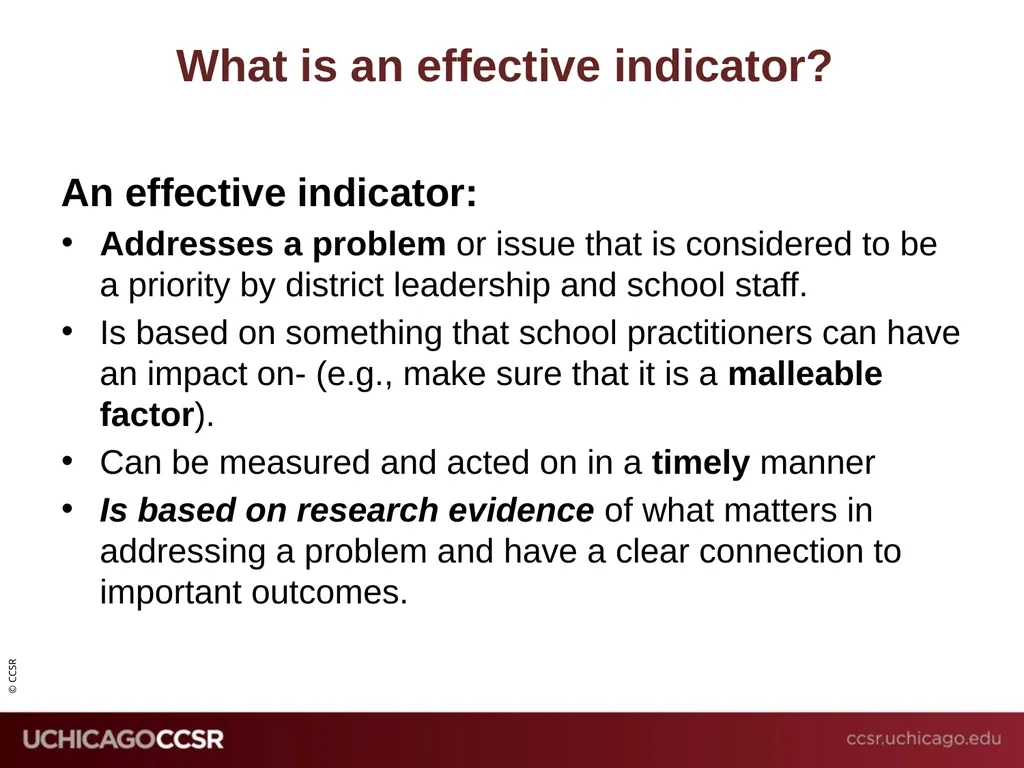
What is an effective indicator? An effective indicator:
Addresses a problem or issue that is considered to be a priority by district leadership and school staff.
Is based on something that school practitioners can have an impact on- (e.g., make sure that it is a malleable factor).
Can be measured and acted on in a timely manner
Is based on research evidence of what matters in addressing a problem and have a clear connection to important outcomes.<br>
17
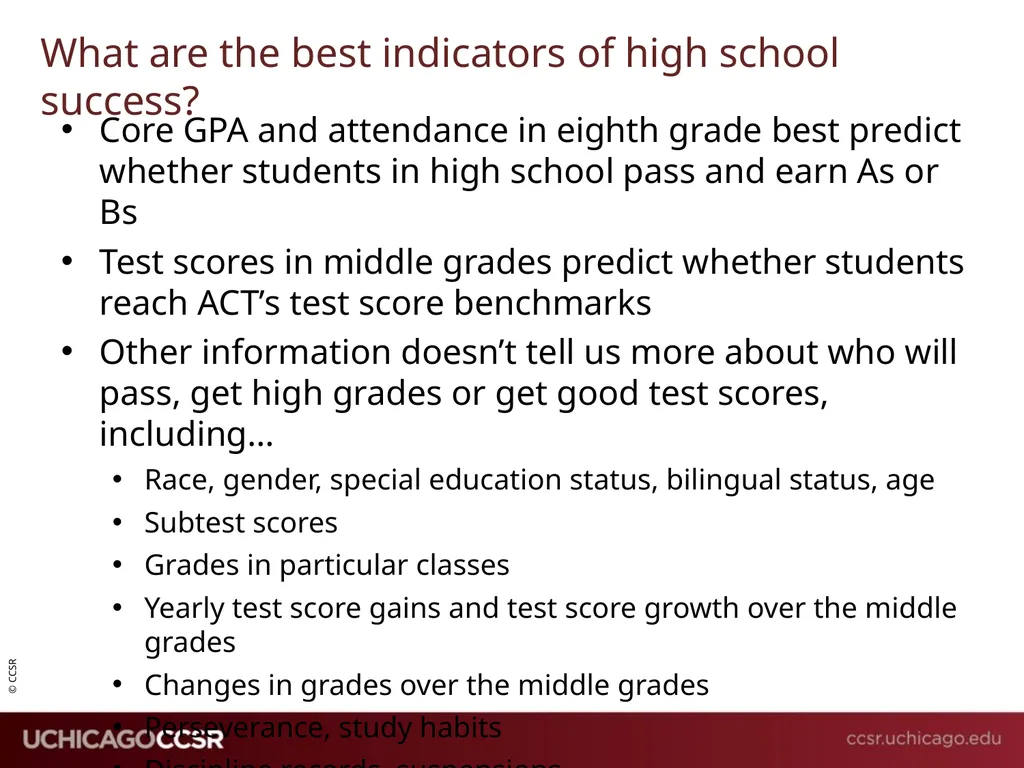
What are the best indicators of high school success? Core GPA and attendance in eighth grade best predict whether students in high school pass and earn As or Bs
Test scores in middle grades predict whether students reach ACT’s test score benchmarks
Other information doesn’t tell us more about who will pass, get high grades or get good test scores, including…
Race, gender, special education status, bilingual status, age
Subtest scores
Grades in particular classes
Yearly test score gains and test score growth over the middle grades
Changes in grades over the middle grades
Perseverance, study habits
Discipline records, suspensions<br>
18
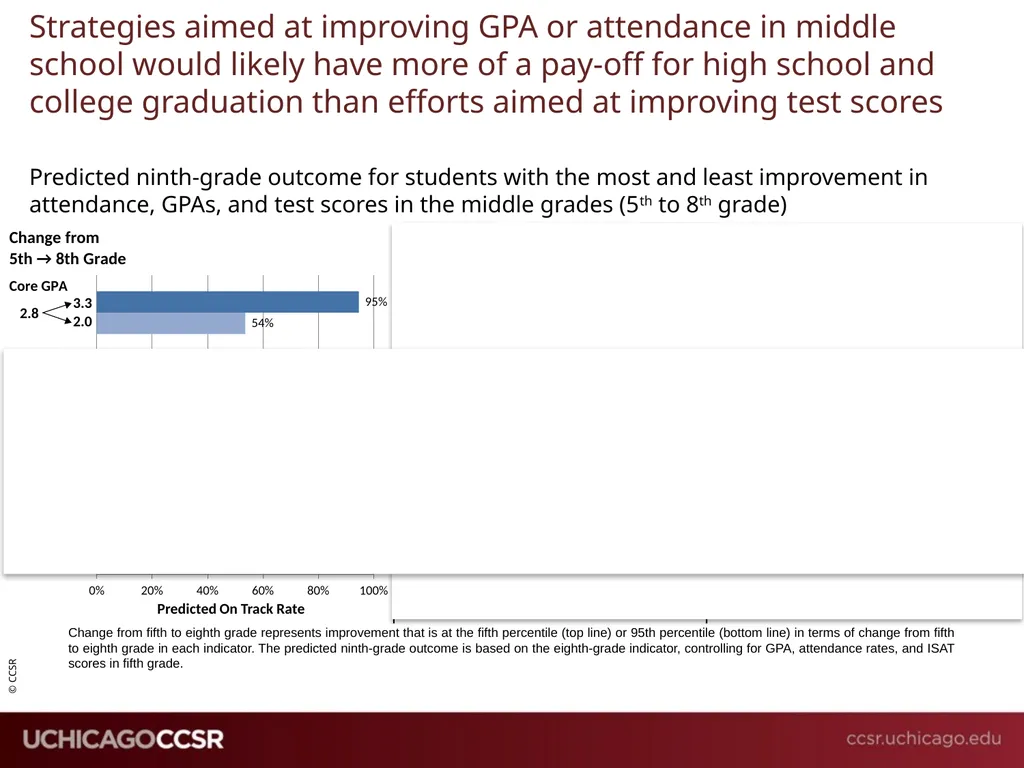
Change from fifth to eighth grade represents improvement that is at the fifth percentile (top line) or 95th percentile (bottom line) in terms of change from fifth to eighth grade in each indicator. The predicted ninth-grade outcome is based on the eighth-grade indicator, controlling for GPA, attendance rates, and ISAT scores in fifth grade. Strategies aimed at improving GPA or attendance in middle school would likely have more of a pay-off for high school and college graduation than efforts aimed at improving test scores Predicted ninth-grade outcome for students with the most and least improvement in attendance, GPAs, and test scores in the middle grades (5th to 8th grade)<br>
19
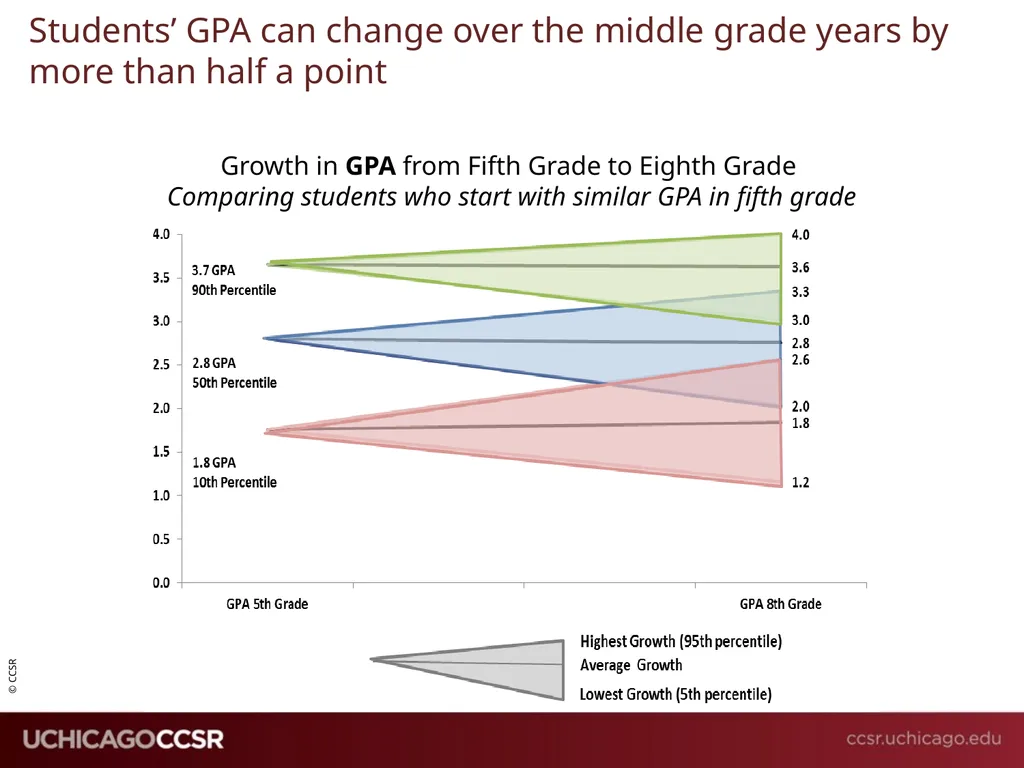
Students’ GPA can change over the middle grade years by more than half a point Growth in GPA from Fifth Grade to Eighth Grade
Comparing students who start with similar GPA in fifth grade<br>
20
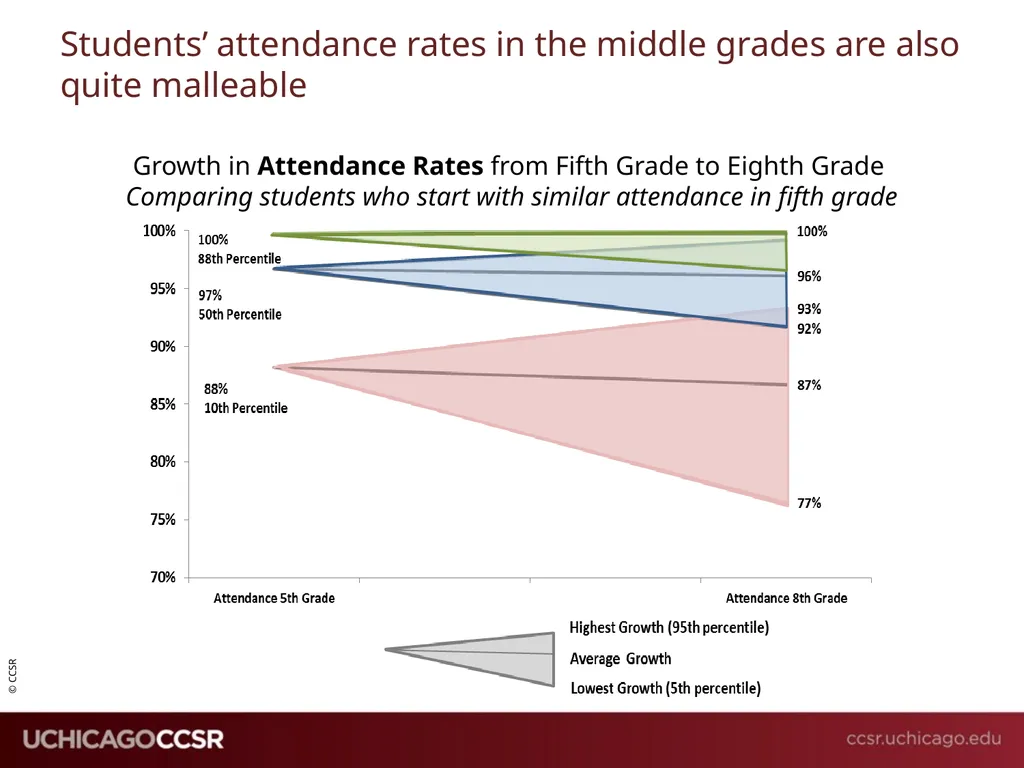
Students’ attendance rates in the middle grades are also quite malleable Growth in Attendance Rates from Fifth Grade to Eighth Grade
Comparing students who start with similar attendance in fifth grade<br>
21
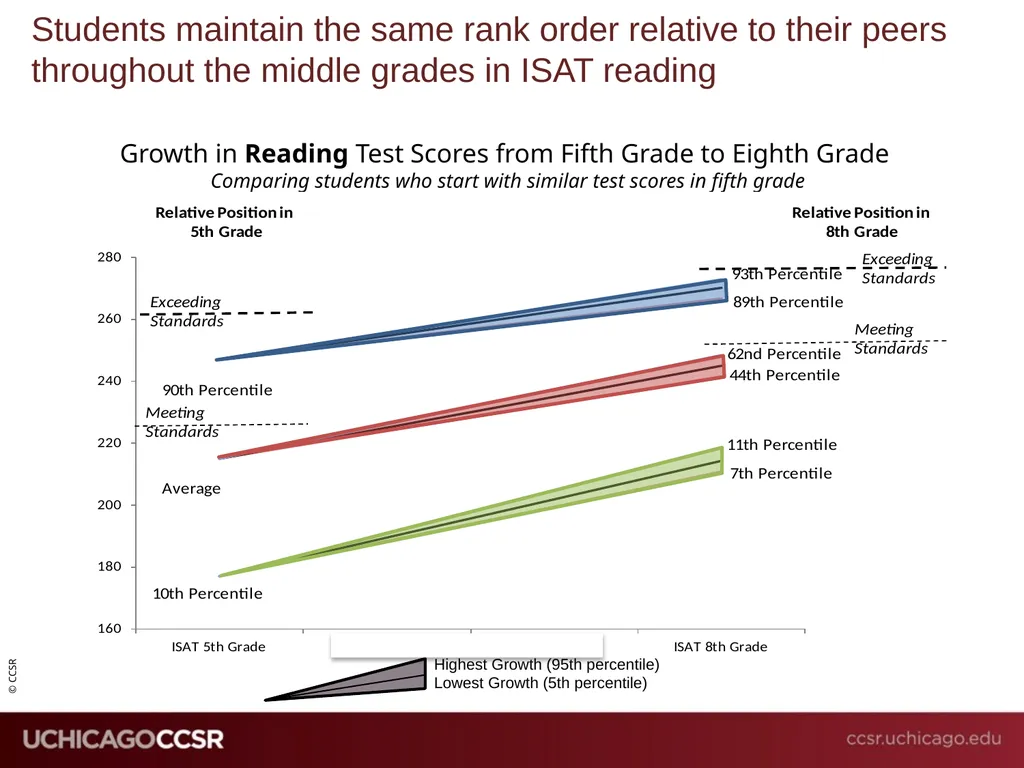
Growth in Reading Test Scores from Fifth Grade to Eighth Grade
Comparing students who start with similar test scores in fifth grade Students maintain the same rank order relative to their peers throughout the middle grades in ISAT reading Highest Growth (95th percentile)
Lowest Growth (5th percentile)<br>
22
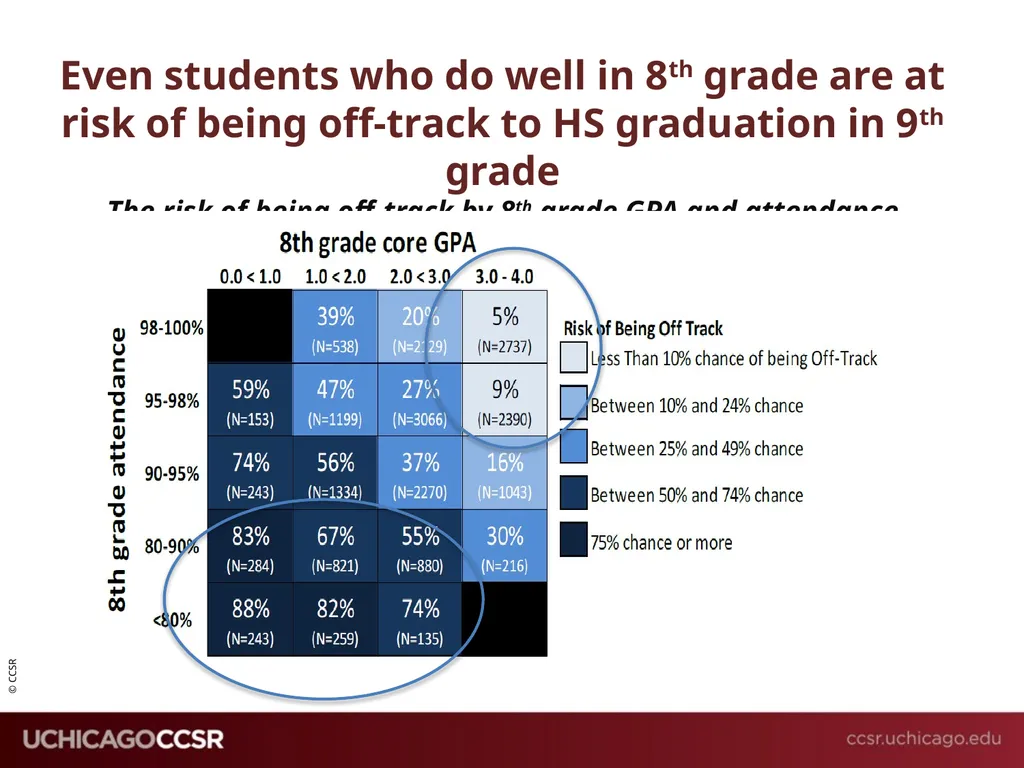
Even students who do well in 8th grade are at risk of being off-track to HS graduation in 9th grade The risk of being off-track by 8th grade GPA and attendance<br>
23
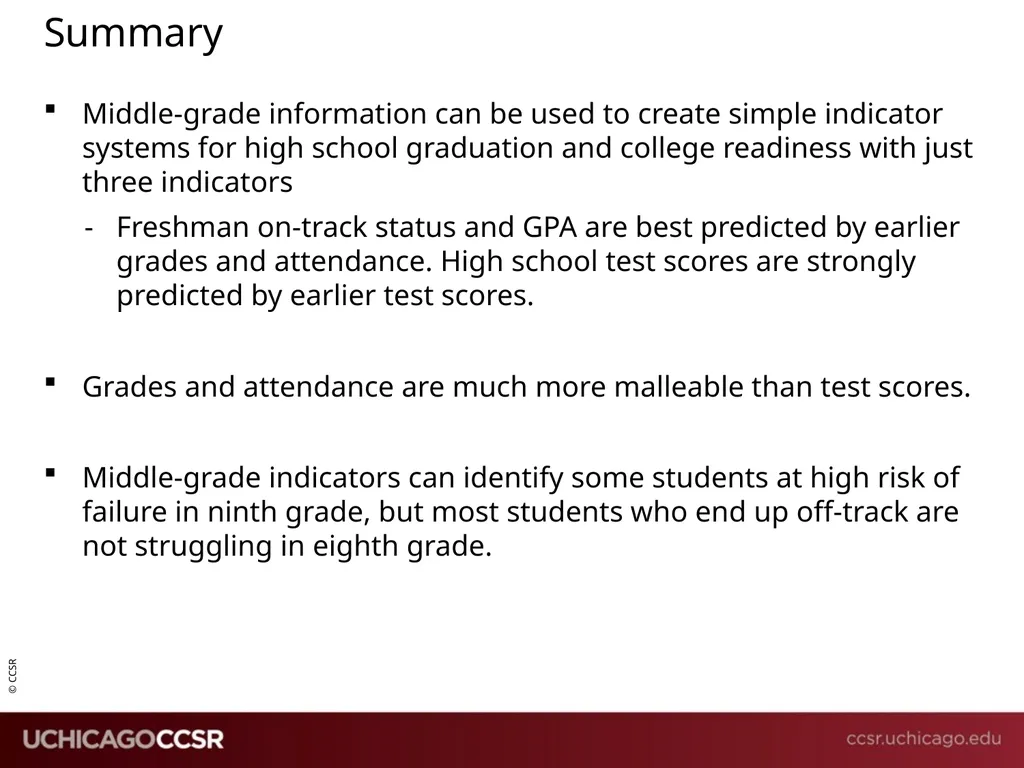
Middle-grade information can be used to create simple indicator systems for high school graduation and college readiness with just three indicators
Freshman on-track status and GPA are best predicted by earlier grades and attendance. High school test scores are strongly predicted by earlier test scores.
Grades and attendance are much more malleable than test scores.
Middle-grade indicators can identify some students at high risk of failure in ninth grade, but most students who end up off-track are not struggling in eighth grade. Summary<br>
24
For full pdf versions of reports, please visit ccsr.uchicago.edu or contact Jenny Nagaoka at jkn@uchicago.edu or Eliza Moeller at meliza@uchicago.edu<br>