Building Reading Comprehension Jeff Minneti Associate Professor of Legal Skills and Director of Academic Success Stetson University College of Law minnetilaw.stetson.edu Understand the process of reading comprehension Build reading
Related Topics
Share
Embed code
Download this presentation From Below
"Building Reading Comprehension Jeff Minneti" is the property of its rightful owner. Permission is granted to
download and print the materials on this website for personal, non-commercial use only, and to display it
on your personal computer provided you do not modify the materials and that you retain all copyright
notices contained in the materials. By downloading content from our website, you accept the terms of this
agreement.
Presentation Transcript
01
Building Reading Comprehension Jeff Minneti
Associate Professor of Legal Skills and
Director of Academic Success
Stetson University College of Law
minneti@law.stetson.edu<br>
02
Understand the process of reading comprehension
Build reading comprehension
Link reading comprehension to learning Objectives<br>
03
Reading comprehension = constructing meaning from text
Cascade of skills
Skills cascade draws upon verbal working memory Understanding Reading Comprehension--Process<br>
04
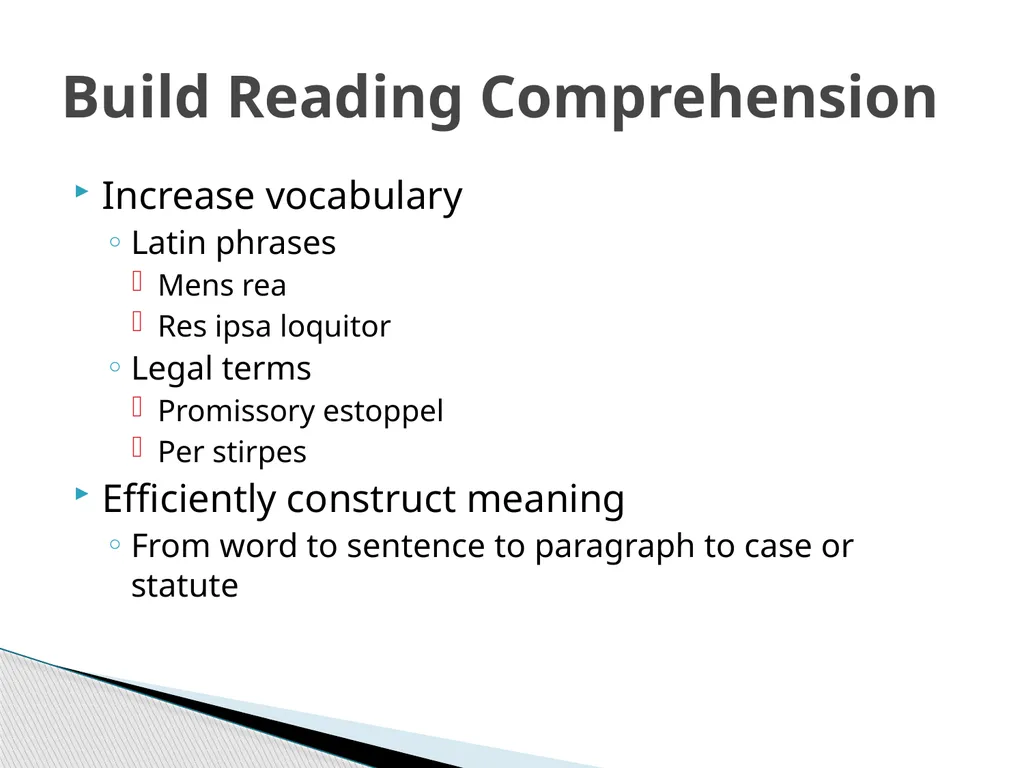
Increase vocabulary
Latin phrases
Mens rea
Res ipsa loquitor
Legal terms
Promissory estoppel
Per stirpes
Efficiently construct meaning
From word to sentence to paragraph to case or statute Build Reading Comprehension<br>
05
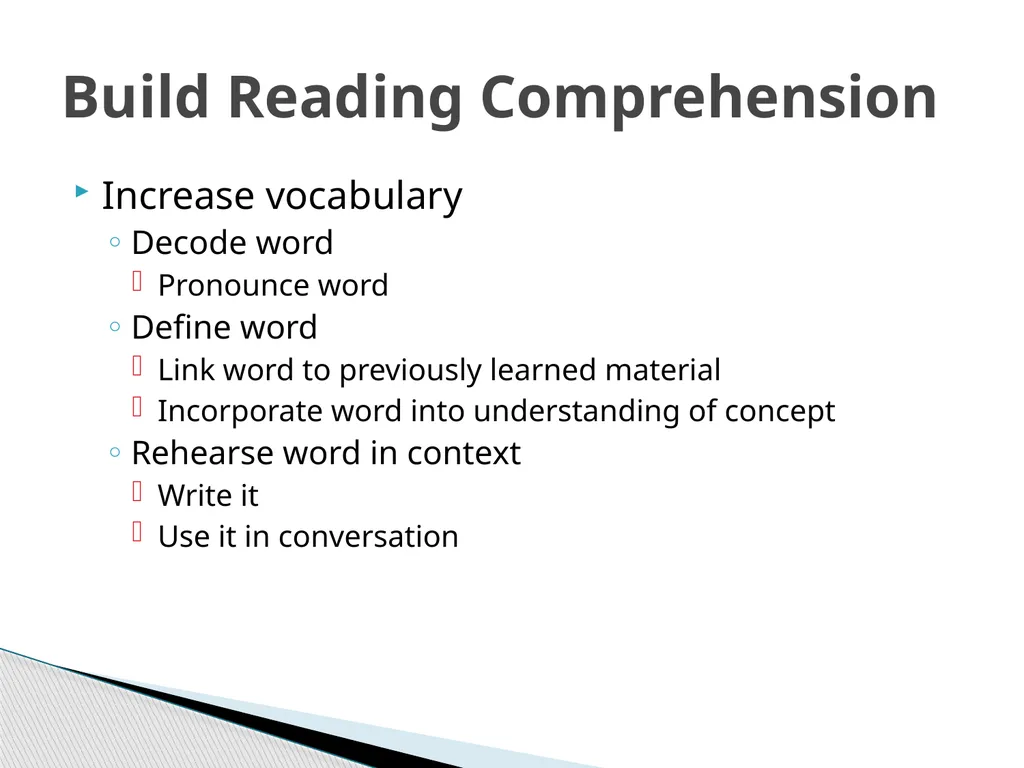
Increase vocabulary
Decode word
Pronounce word
Define word
Link word to previously learned material
Incorporate word into understanding of concept
Rehearse word in context
Write it
Use it in conversation Build Reading Comprehension<br>
06
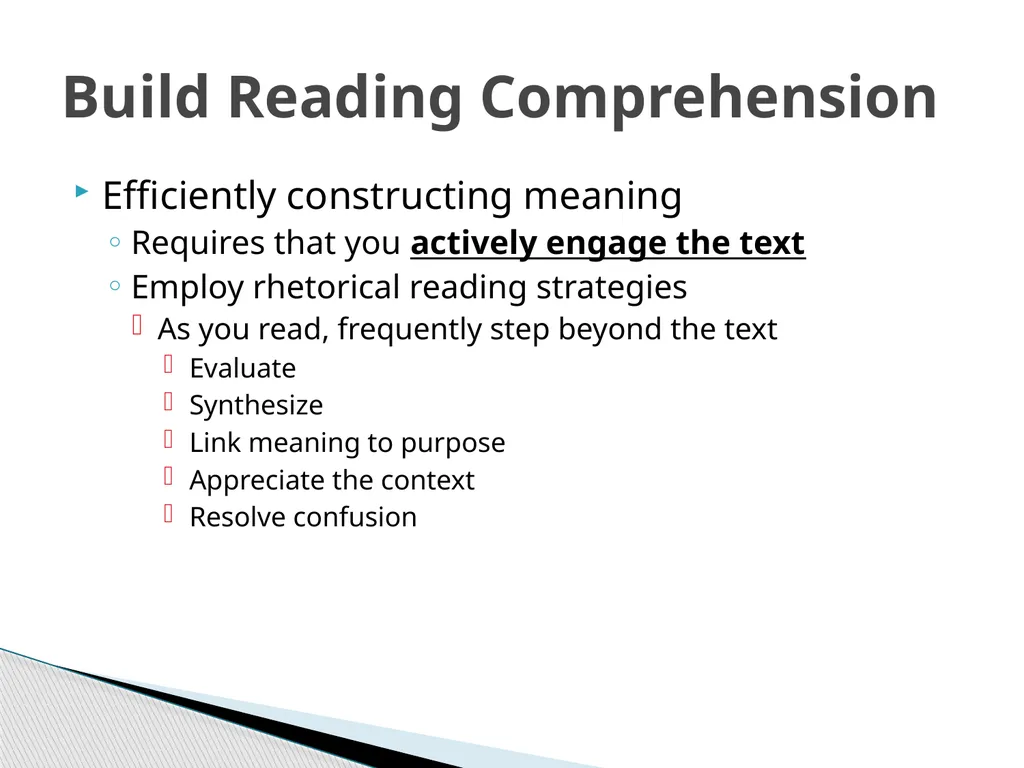
Efficiently constructing meaning
Requires that you actively engage the text
Employ rhetorical reading strategies
As you read, frequently step beyond the text
Evaluate
Synthesize
Link meaning to purpose
Appreciate the context
Resolve confusion Build Reading Comprehension<br>
07
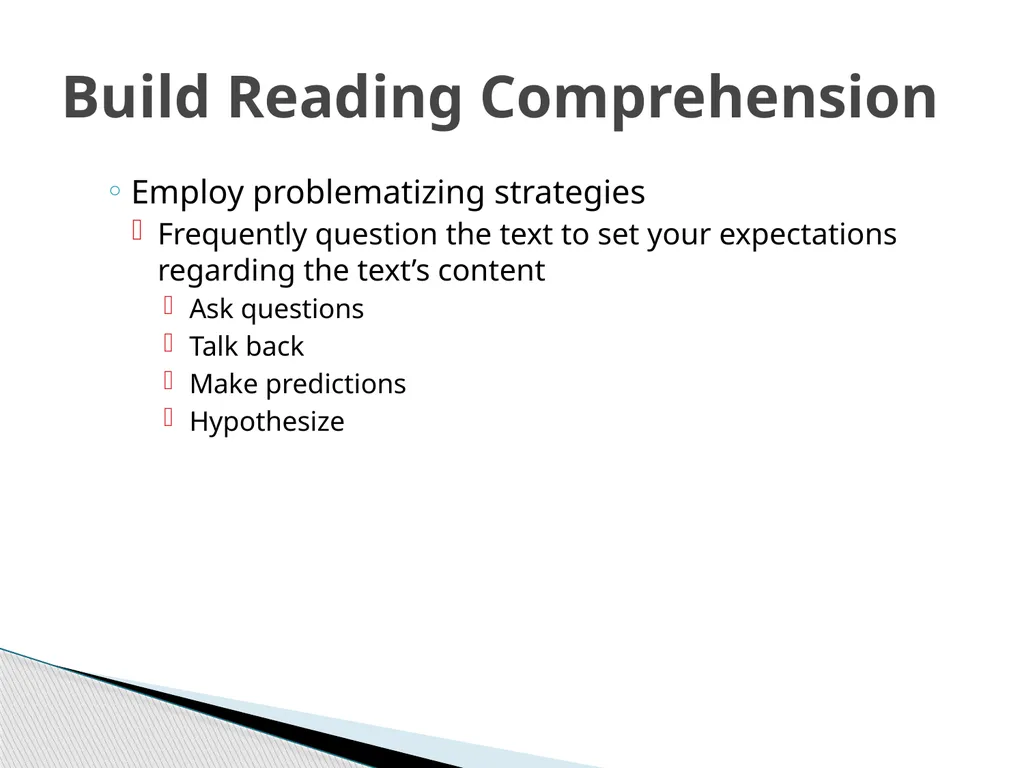
Employ problematizing strategies
Frequently question the text to set your expectations regarding the text’s content
Ask questions
Talk back
Make predictions
Hypothesize Build Reading Comprehension<br>
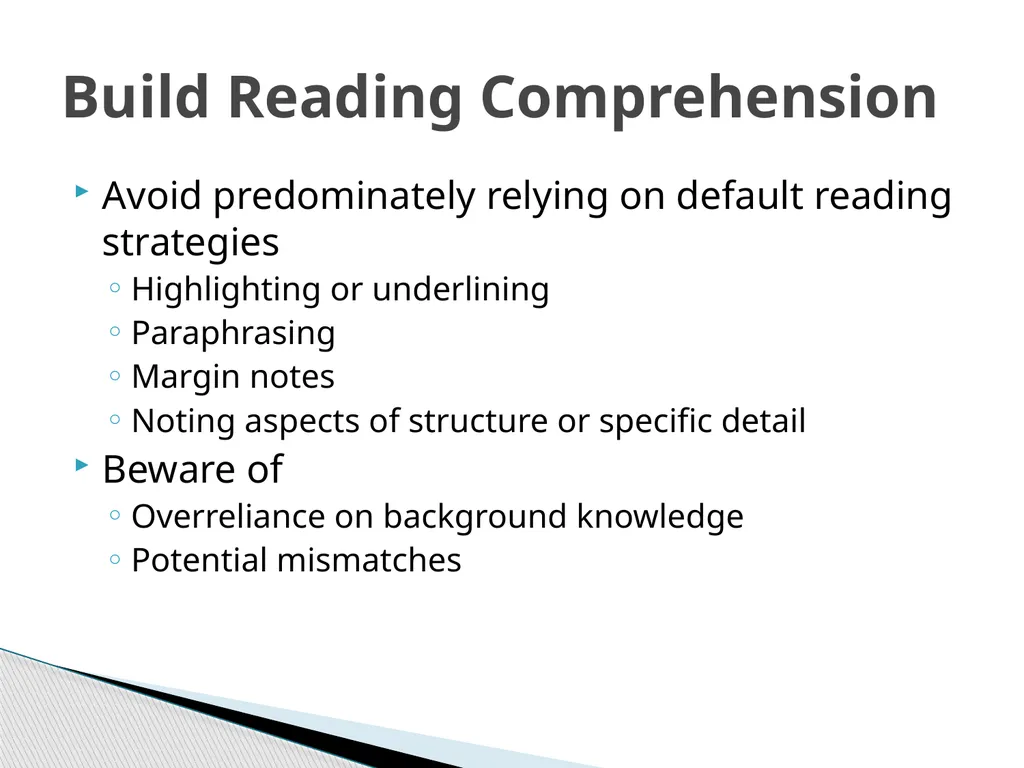
08
Avoid predominately relying on default reading strategies
Highlighting or underlining
Paraphrasing
Margin notes
Noting aspects of structure or specific detail
Beware of
Overreliance on background knowledge
Potential mismatches Build Reading Comprehension<br>
09
Blooms Taxonomy
Learning Theory Link Reading Comprehension to Learning<br>
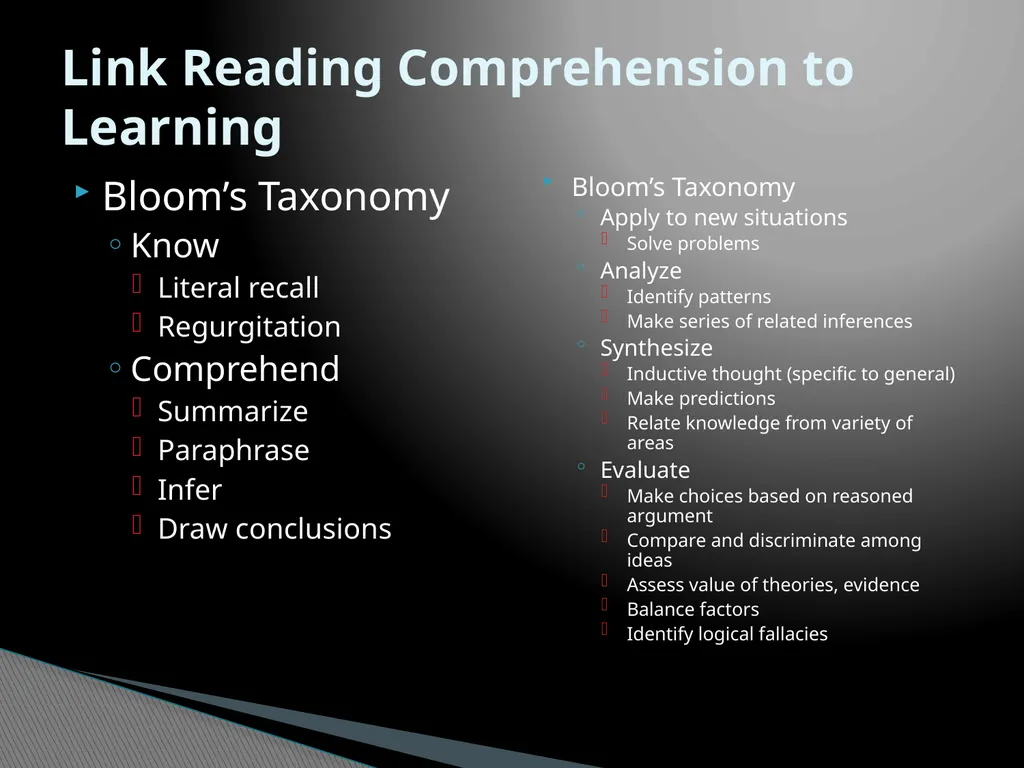
10
Bloom’s Taxonomy
Know
Literal recall
Regurgitation
Comprehend
Summarize
Paraphrase
Infer
Draw conclusions Bloom’s Taxonomy
Apply to new situations
Solve problems
Analyze
Identify patterns
Make series of related inferences
Synthesize
Inductive thought (specific to general)
Make predictions
Relate knowledge from variety of areas
Evaluate
Make choices based on reasoned argument
Compare and discriminate among ideas
Assess value of theories, evidence
Balance factors
Identify logical fallacies Link Reading Comprehension to Learning<br>
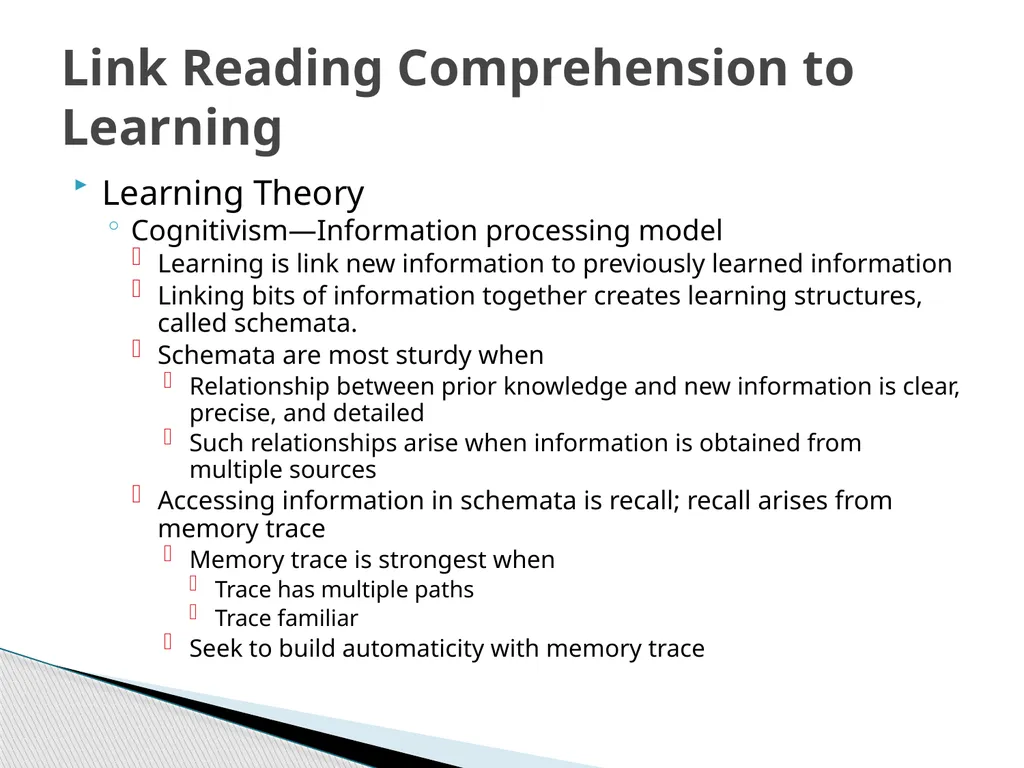
11
Learning Theory
Cognitivism—Information processing model
Learning is link new information to previously learned information
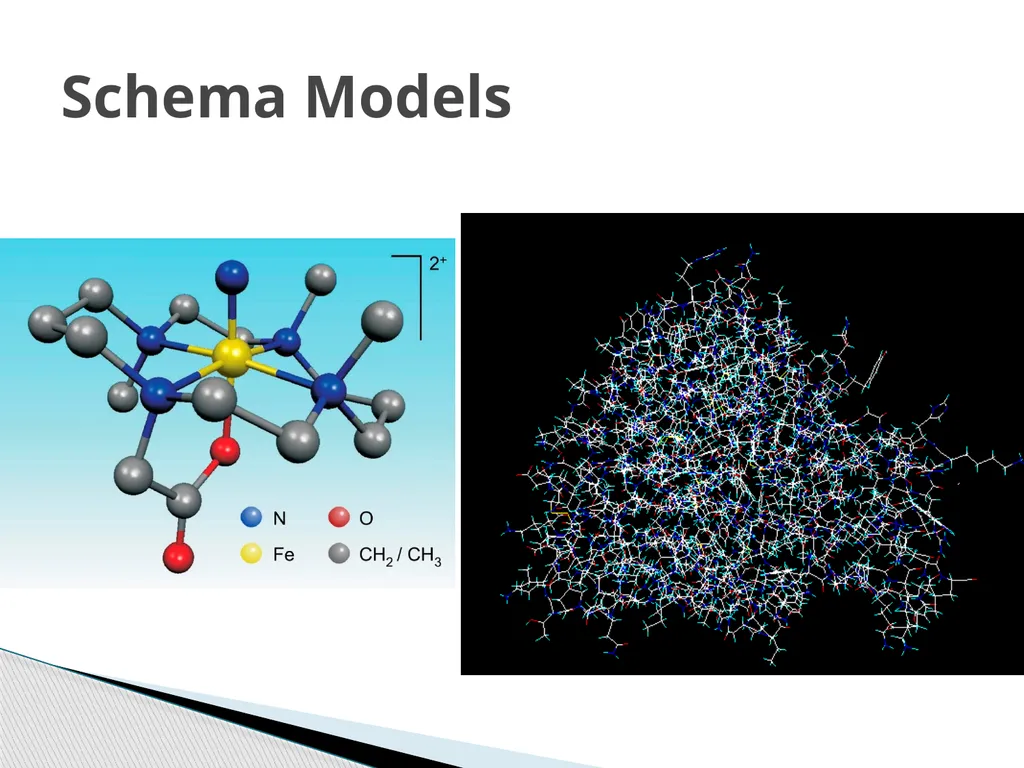
Linking bits of information together creates learning structures, called schemata.
Schemata are most sturdy when
Relationship between prior knowledge and new information is clear, precise, and detailed
Such relationships arise when information is obtained from multiple sources
Accessing information in schemata is recall; recall arises from memory trace
Memory trace is strongest when
Trace has multiple paths
Trace familiar
Seek to build automaticity with memory trace Link Reading Comprehension to Learning<br>
12
Schema Models<br>
13
Connecting Reading Comprehension and Cognitivism
Engage in “pre-reading”
Before you begin reading, access the schema you have on the topic by
As you read, enhance the memory trace
Employ rhetorical and problematizing strategies
Transfer information into a new modality
When you finish reading, reflect
If there is material you do not understand, list your questions and make a plan for answering them Link Reading Comprehension to Learning<br>
14
Learning Theory
Constructivism
Learning arises from the student’s experience with the information, not from the instructor’s dissemination of information
Learning environment is optimal when it provides
Authentic experiences
Collaborative experiences
Problem solving opportunities Link Reading Comprehension to Learning<br>
15
Connecting Reading Comprehension to Constructivism
Create authentic experiences
Utilize rhetorical reading strategies
Complete practice questions
Collaborate with classmates Link Reading Comprehension to Learning<br>
16
Understand the process of reading comprehension
Build reading comprehension
Link reading comprehension to learning Review<br>
17
View Critically Reading Cases presentation
Read and brief cases included on webpage
Develop reading comprehension with legal and non-legal texts Practice<br>