
Chapter 13 Project Stakeholder Management
Description: Chapter 13 Project Stakeholder Management Information Technology Project Management, Eighth Edition Note: See the text itself for full citations. Learning Objectives, Part 1 Understand the importance of project stakeholder management
Related Topics
Download Presentation
"Chapter 13 Project Stakeholder Management" is the property of its rightful owner. Permission is granted to download and print the materials on this website for personal, non-commercial use only, and to display it on your personal computer provided you do not modify the materials and that you retain all copyright notices contained in the materials. By downloading content from our website, you accept the terms of this agreement.
Presentation Transcript
slide1. Chapter 13
Project Stakeholder Management Information Technology Project Management, Eighth Edition Note: See the text itself for full citations.<br>
slide2. Learning Objectives, Part 1 Understand the importance of project stakeholder management throughout the life of a project
Discuss the process of identifying stakeholders, how to create a stakeholder register, and how to perform a stakeholder analysis
Describe the contents of a stakeholder management plan Information Technology Project Management, Eighth Edition 2<br>
slide3. Learning Objectives, Part 2 Understand the process of managing stakeholder engagement and how to use an issue log effectively
Explain methods for controlling stakeholder engagement
Discuss types of software available to assist in project stakeholder management Information Technology Project Management, Eighth Edition 3<br>
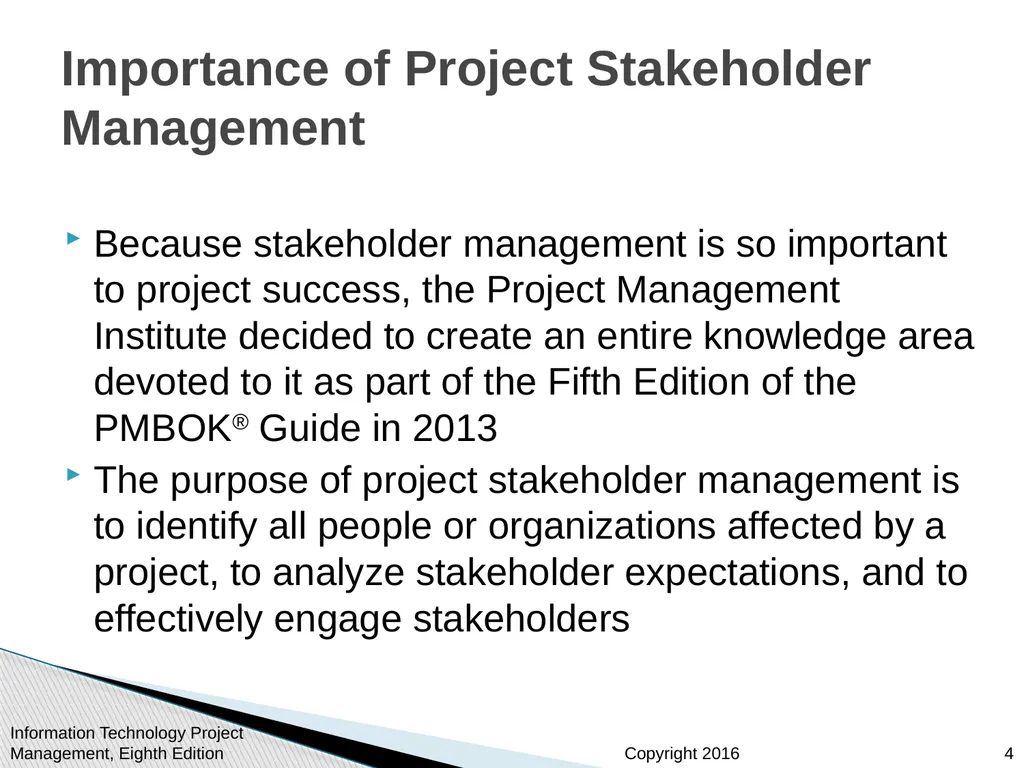
slide4. Importance of Project Stakeholder Management Because stakeholder management is so important to project success, the Project Management Institute decided to create an entire knowledge area devoted to it as part of the Fifth Edition of the PMBOK® Guide in 2013
The purpose of project stakeholder management is to identify all people or organizations affected by a project, to analyze stakeholder expectations, and to effectively engage stakeholders Information Technology Project Management, Eighth Edition 4<br>
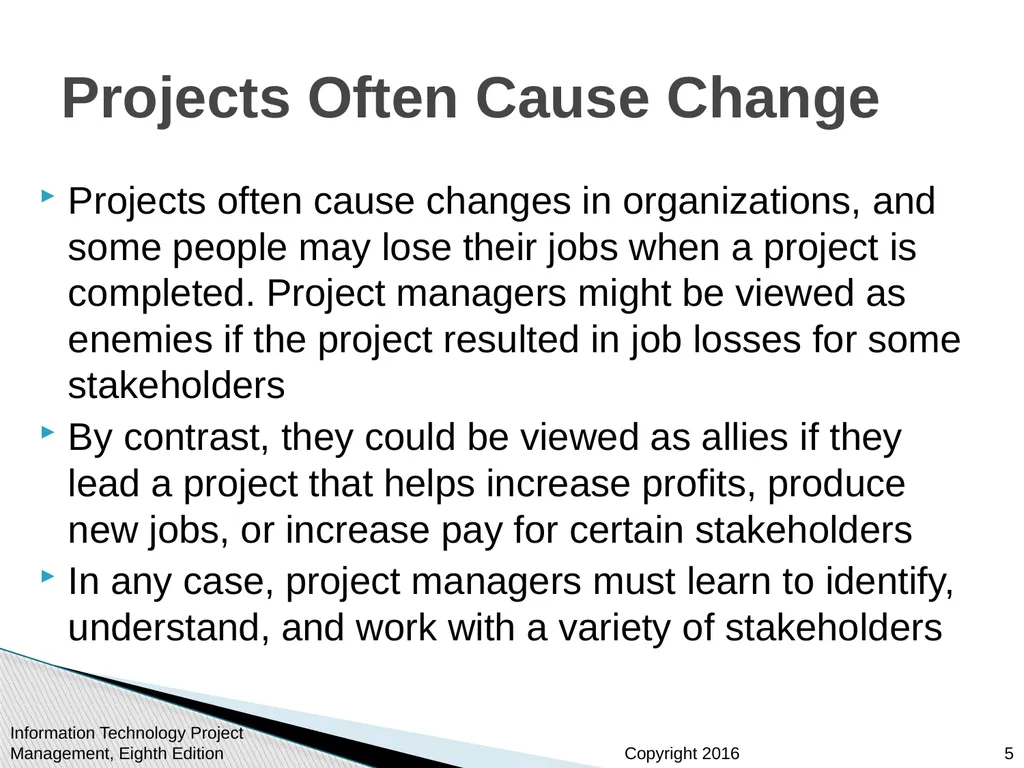
slide5. Projects Often Cause Change Projects often cause changes in organizations, and some people may lose their jobs when a project is completed. Project managers might be viewed as enemies if the project resulted in job losses for some stakeholders
By contrast, they could be viewed as allies if they lead a project that helps increase profits, produce new jobs, or increase pay for certain stakeholders
In any case, project managers must learn to identify, understand, and work with a variety of stakeholders Information Technology Project Management, Eighth Edition 5<br>
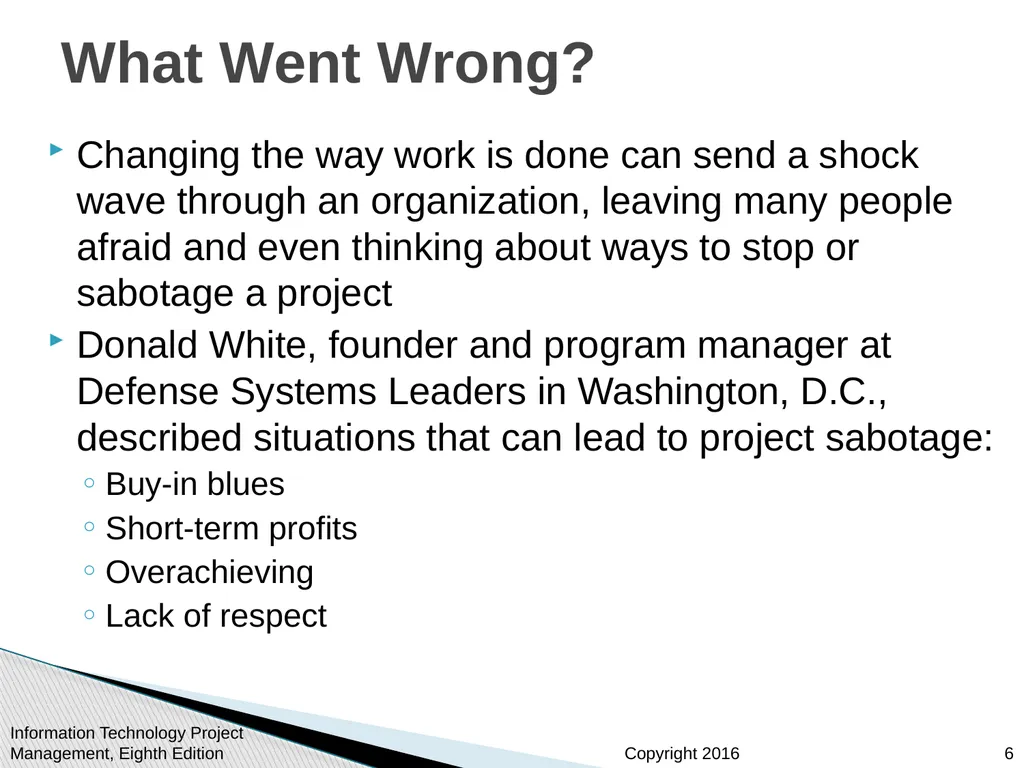
slide6. What Went Wrong? Changing the way work is done can send a shock wave through an organization, leaving many people afraid and even thinking about ways to stop or sabotage a project
Donald White, founder and program manager at Defense Systems Leaders in Washington, D.C., described situations that can lead to project sabotage:
Buy-in blues
Short-term profits
Overachieving
Lack of respect Information Technology Project Management, Eighth Edition 6<br>
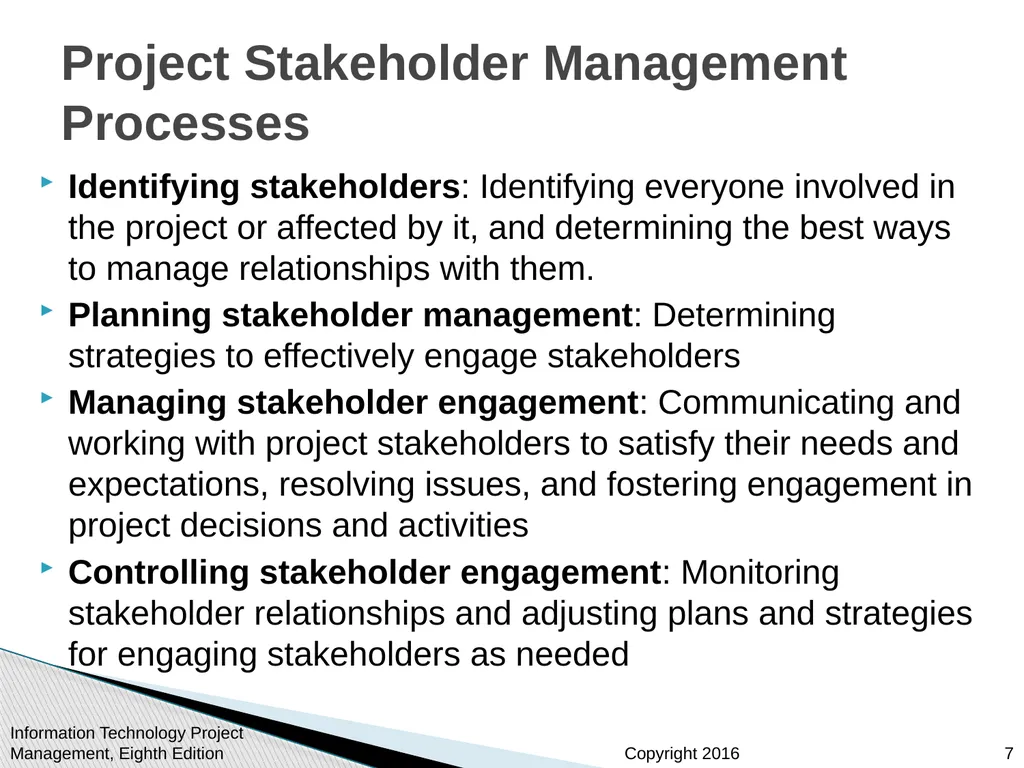
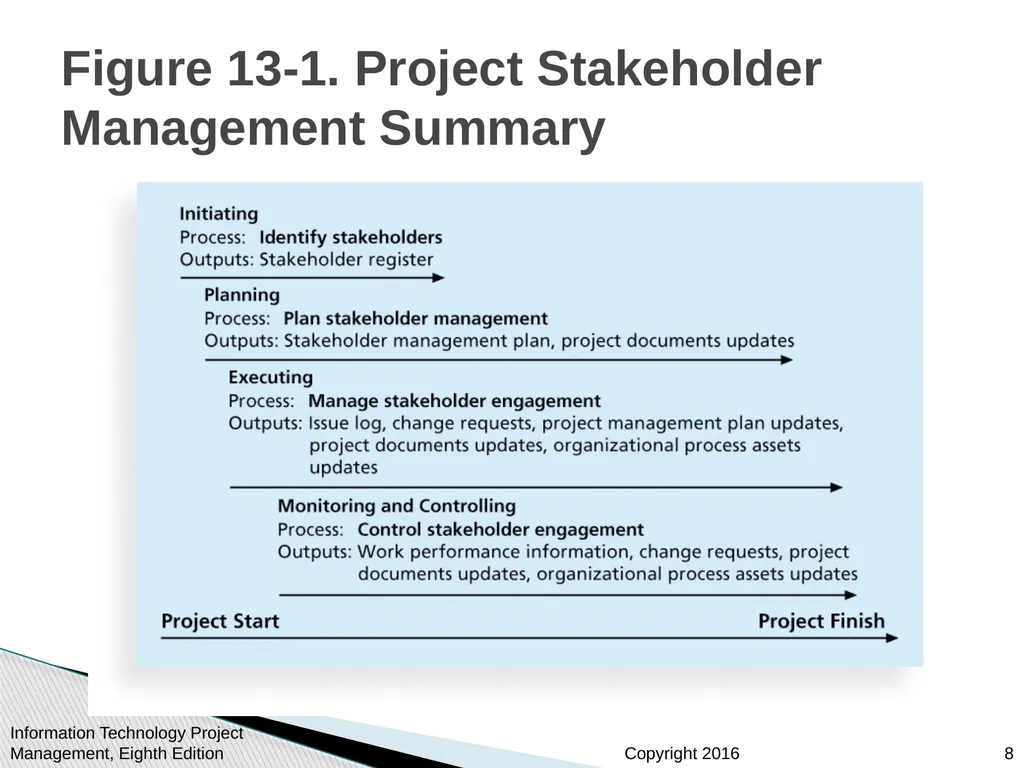
slide7. Project Stakeholder Management Processes Identifying stakeholders: Identifying everyone involved in the project or affected by it, and determining the best ways to manage relationships with them.
Planning stakeholder management: Determining strategies to effectively engage stakeholders
Managing stakeholder engagement: Communicating and working with project stakeholders to satisfy their needs and expectations, resolving issues, and fostering engagement in project decisions and activities
Controlling stakeholder engagement: Monitoring stakeholder relationships and adjusting plans and strategies for engaging stakeholders as needed Information Technology Project Management, Eighth Edition 7<br>
slide8. Figure 13-1. Project Stakeholder Management Summary Information Technology Project Management, Eighth Edition 8<br>
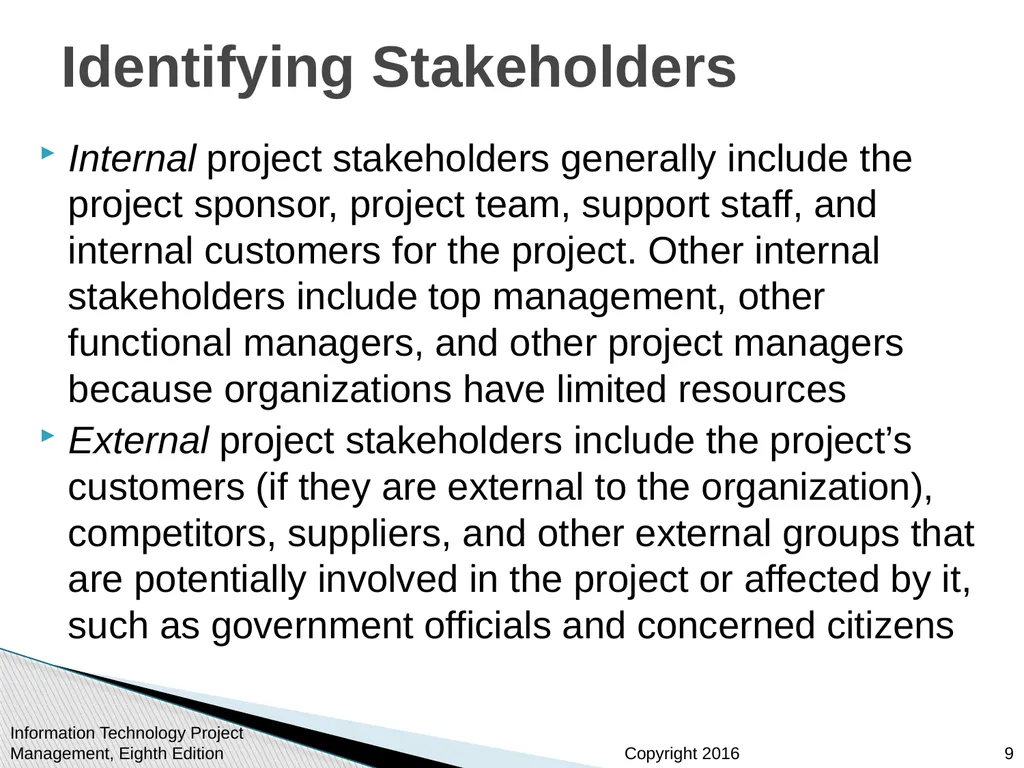
slide9. Identifying Stakeholders Internal project stakeholders generally include the project sponsor, project team, support staff, and internal customers for the project. Other internal stakeholders include top management, other functional managers, and other project managers because organizations have limited resources
External project stakeholders include the project’s customers (if they are external to the organization), competitors, suppliers, and other external groups that are potentially involved in the project or affected by it, such as government officials and concerned citizens Information Technology Project Management, Eighth Edition 9<br>
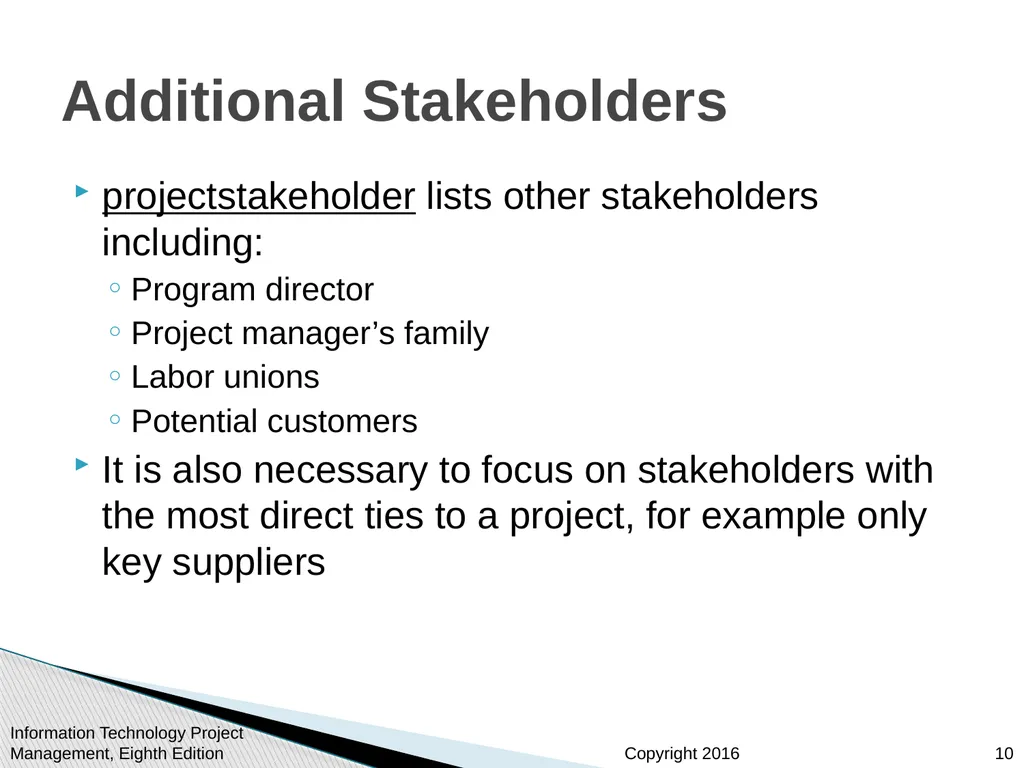
slide10. Additional Stakeholders projectstakeholder lists other stakeholders including:
Program director
Project manager’s family
Labor unions
Potential customers
It is also necessary to focus on stakeholders with the most direct ties to a project, for example only key suppliers Information Technology Project Management, Eighth Edition 10<br>
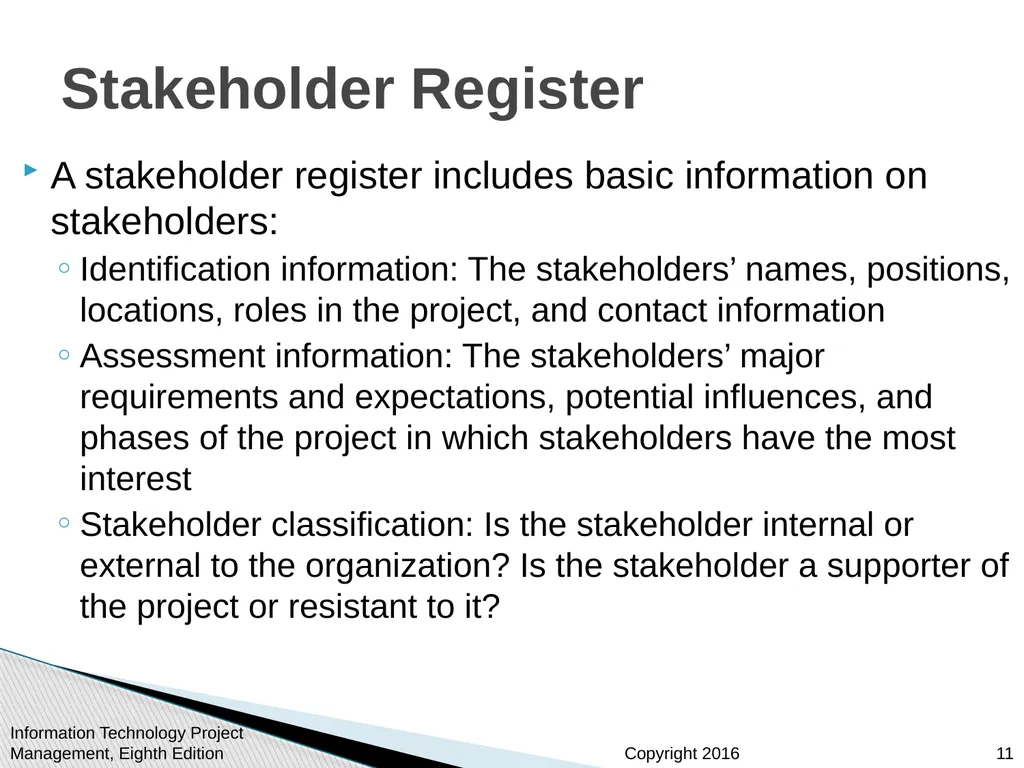
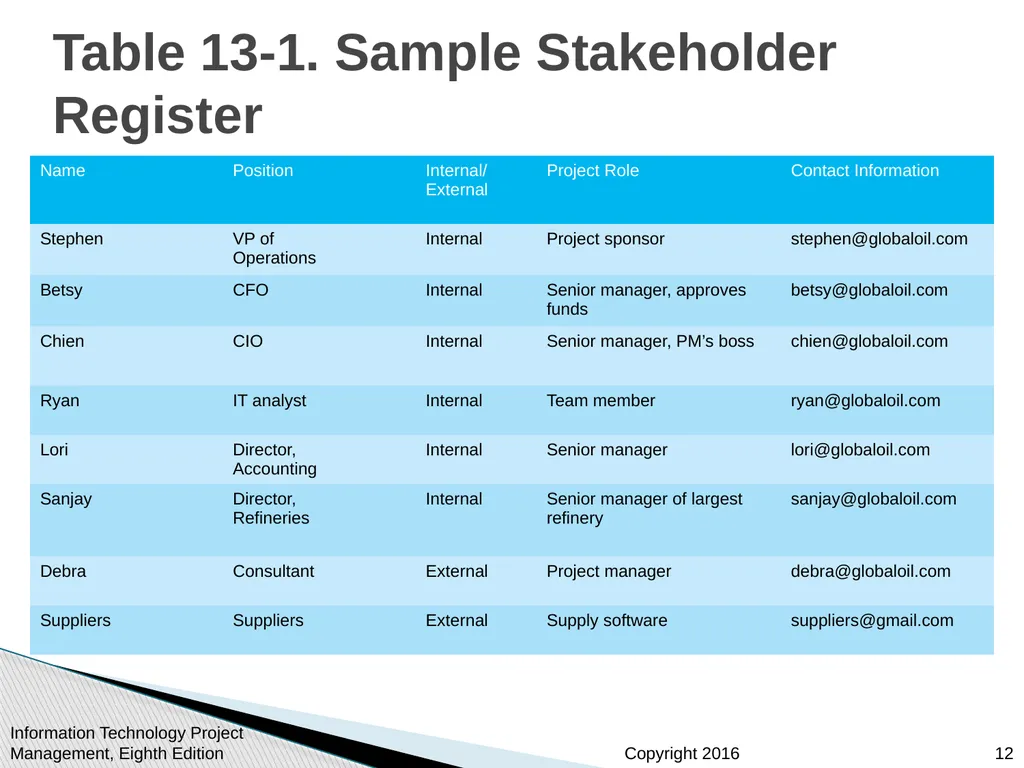
slide11. Stakeholder Register A stakeholder register includes basic information on stakeholders:
Identification information: The stakeholders’ names, positions, locations, roles in the project, and contact information
Assessment information: The stakeholders’ major requirements and expectations, potential influences, and phases of the project in which stakeholders have the most interest
Stakeholder classification: Is the stakeholder internal or external to the organization? Is the stakeholder a supporter of the project or resistant to it? Information Technology Project Management, Eighth Edition 11<br>
slide12. Table 13-1. Sample Stakeholder Register Information Technology Project Management, Eighth Edition 12<br>
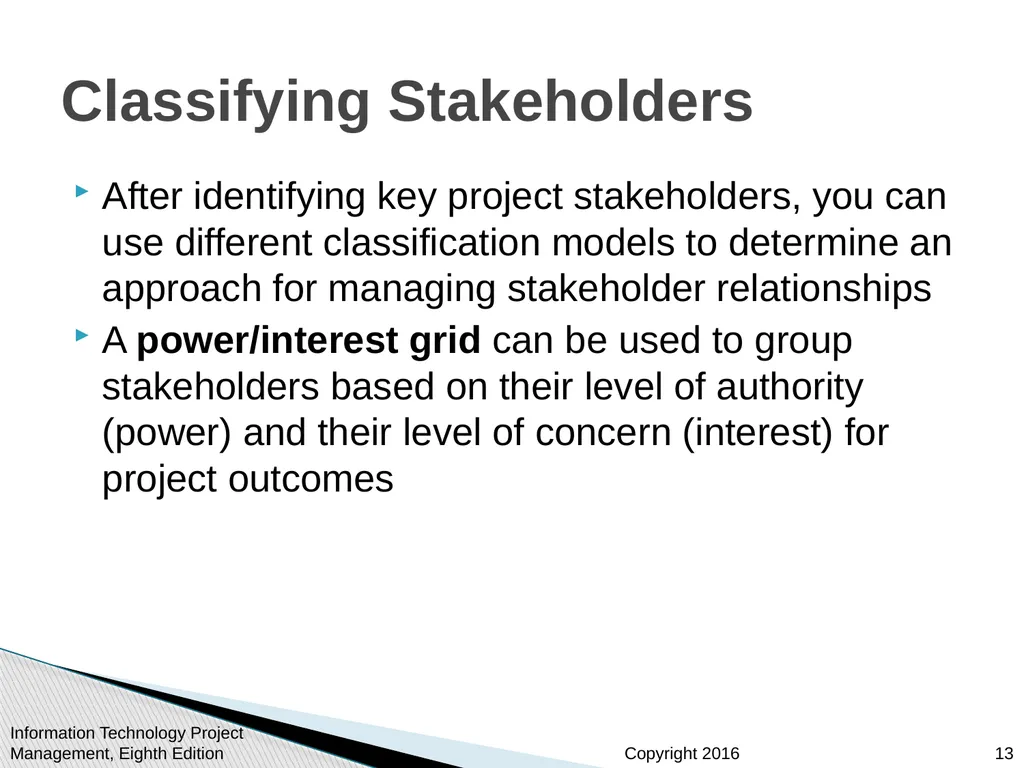
slide13. Classifying Stakeholders After identifying key project stakeholders, you can use different classification models to determine an approach for managing stakeholder relationships
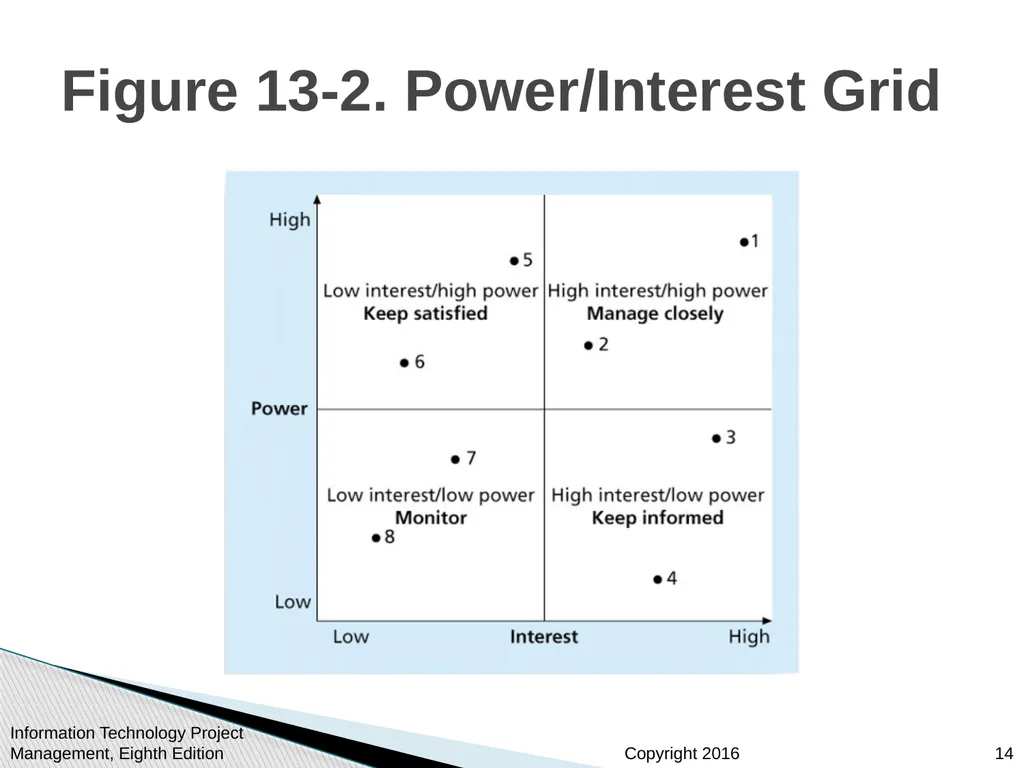
A power/interest grid can be used to group stakeholders based on their level of authority (power) and their level of concern (interest) for project outcomes Information Technology Project Management, Eighth Edition 13<br>
slide14. Figure 13-2. Power/Interest Grid Information Technology Project Management, Eighth Edition 14<br>
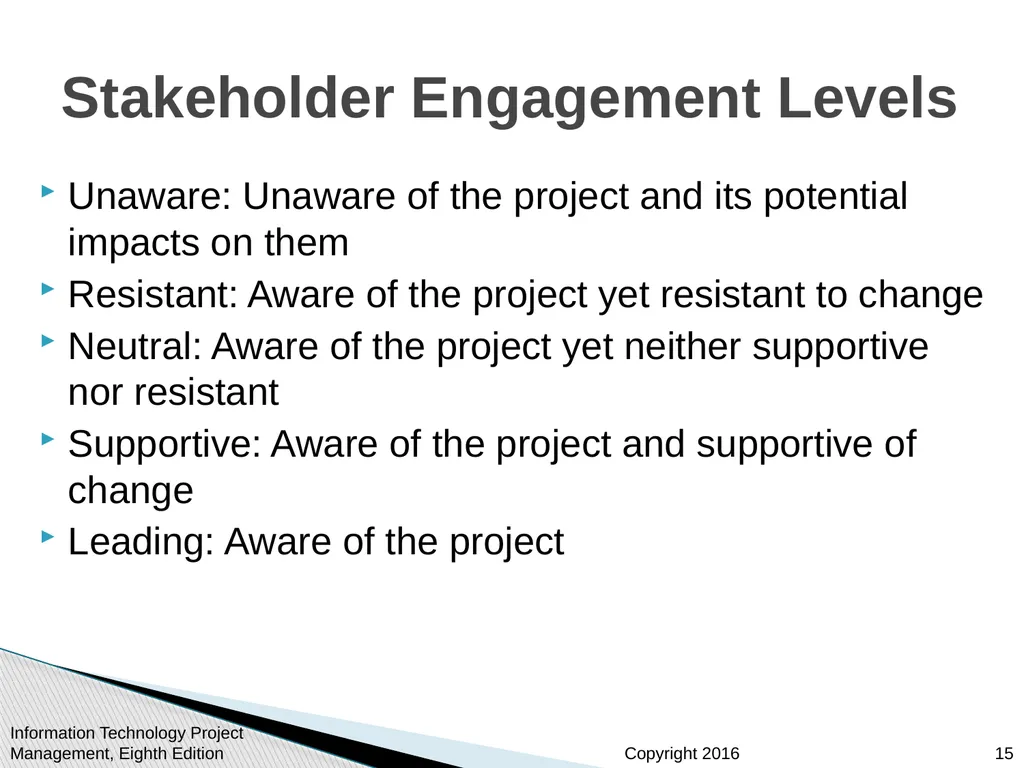
slide15. Stakeholder Engagement Levels Unaware: Unaware of the project and its potential impacts on them
Resistant: Aware of the project yet resistant to change
Neutral: Aware of the project yet neither supportive nor resistant
Supportive: Aware of the project and supportive of change
Leading: Aware of the project Information Technology Project Management, Eighth Edition 15<br>
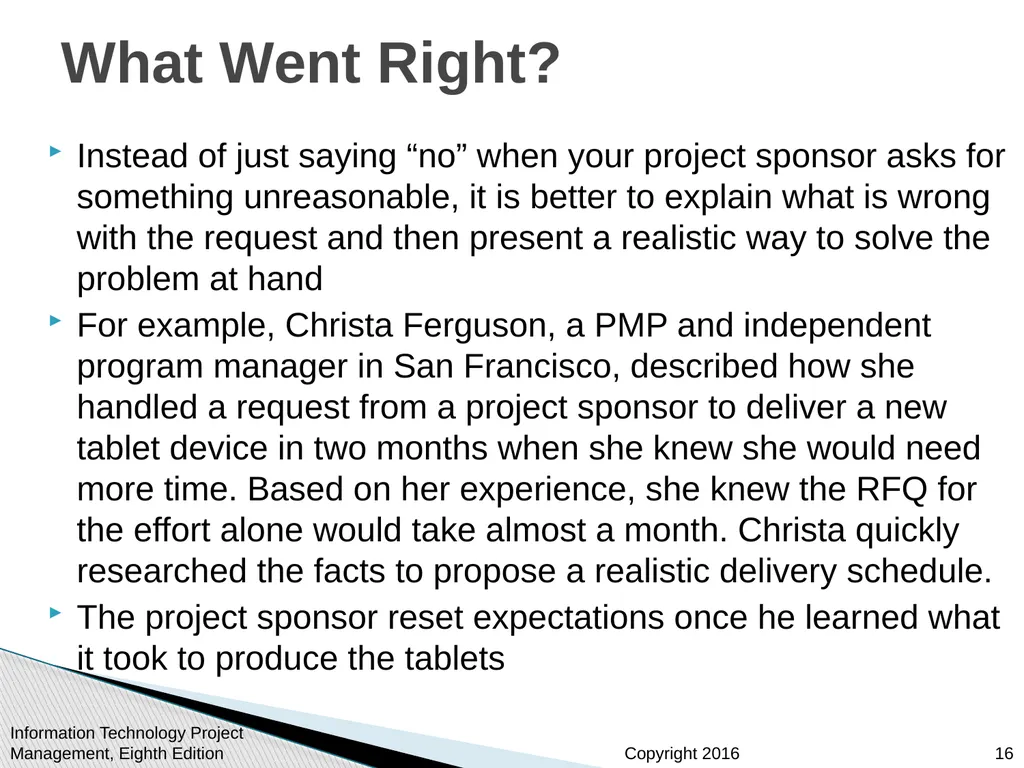
slide16. What Went Right? Instead of just saying “no” when your project sponsor asks for something unreasonable, it is better to explain what is wrong with the request and then present a realistic way to solve the problem at hand
For example, Christa Ferguson, a PMP and independent program manager in San Francisco, described how she handled a request from a project sponsor to deliver a new tablet device in two months when she knew she would need more time. Based on her experience, she knew the RFQ for the effort alone would take almost a month. Christa quickly researched the facts to propose a realistic delivery schedule.
The project sponsor reset expectations once he learned what it took to produce the tablets Information Technology Project Management, Eighth Edition 16<br>
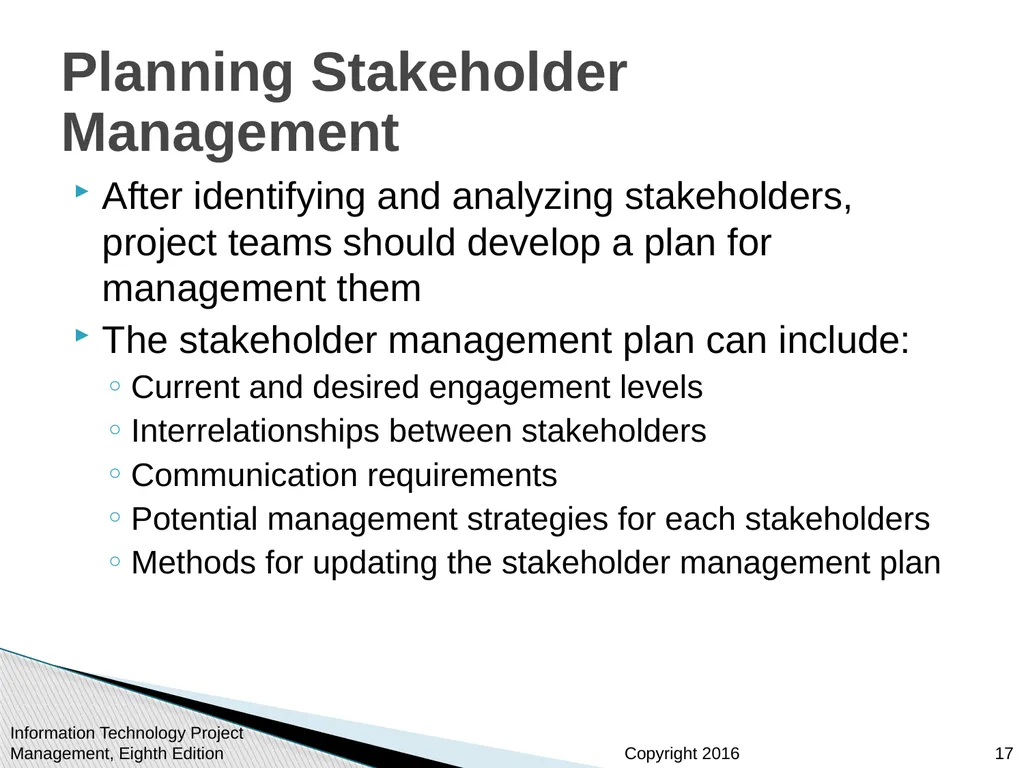
slide17. Planning Stakeholder Management After identifying and analyzing stakeholders, project teams should develop a plan for management them
The stakeholder management plan can include:
Current and desired engagement levels
Interrelationships between stakeholders
Communication requirements
Potential management strategies for each stakeholders
Methods for updating the stakeholder management plan Information Technology Project Management, Eighth Edition 17<br>
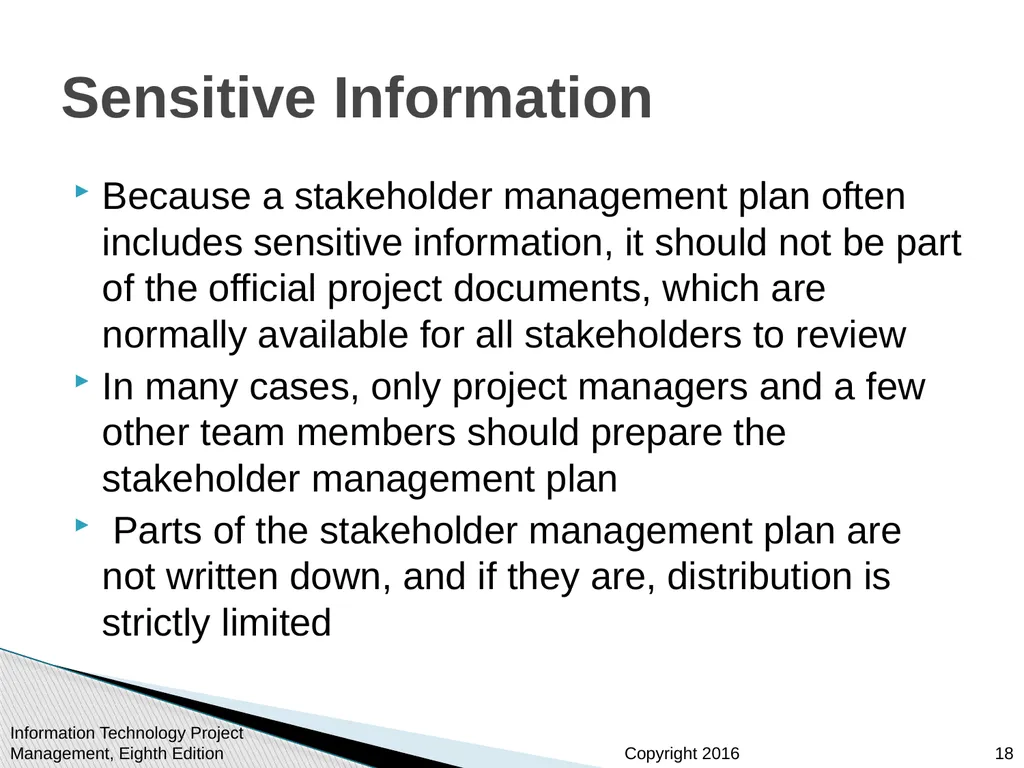
slide18. Sensitive Information Because a stakeholder management plan often includes sensitive information, it should not be part of the official project documents, which are normally available for all stakeholders to review
In many cases, only project managers and a few other team members should prepare the stakeholder management plan
Parts of the stakeholder management plan are not written down, and if they are, distribution is strictly limited Information Technology Project Management, Eighth Edition 18<br>
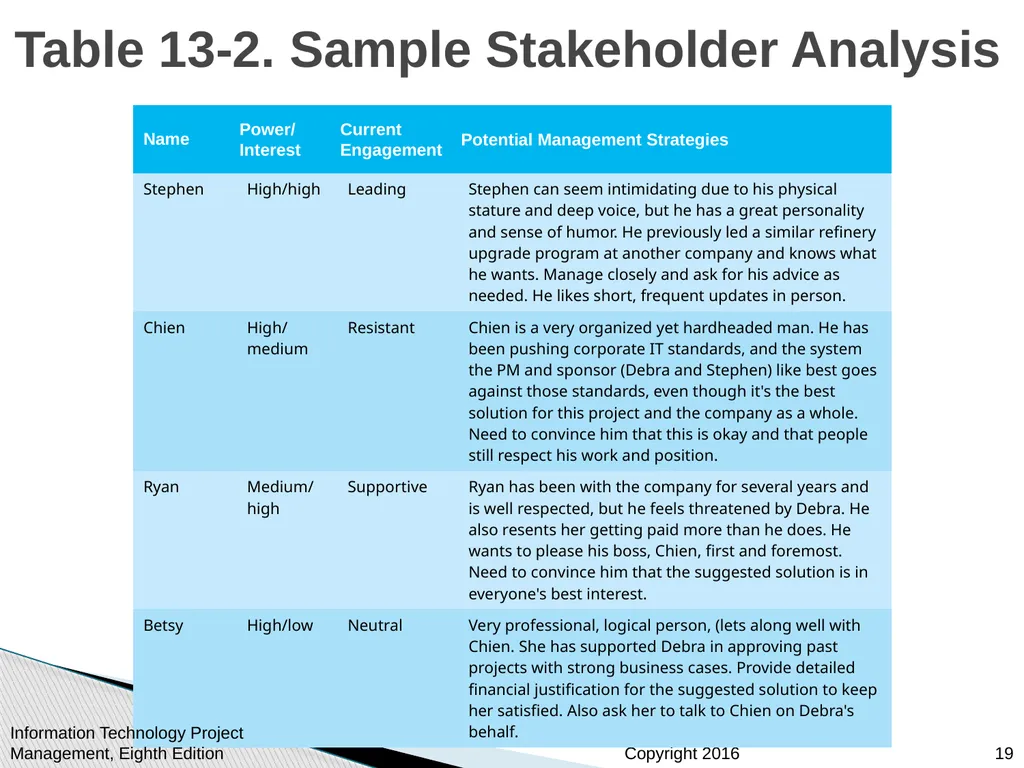
slide19. Table 13-2. Sample Stakeholder Analysis Information Technology Project Management, Eighth Edition 19<br>
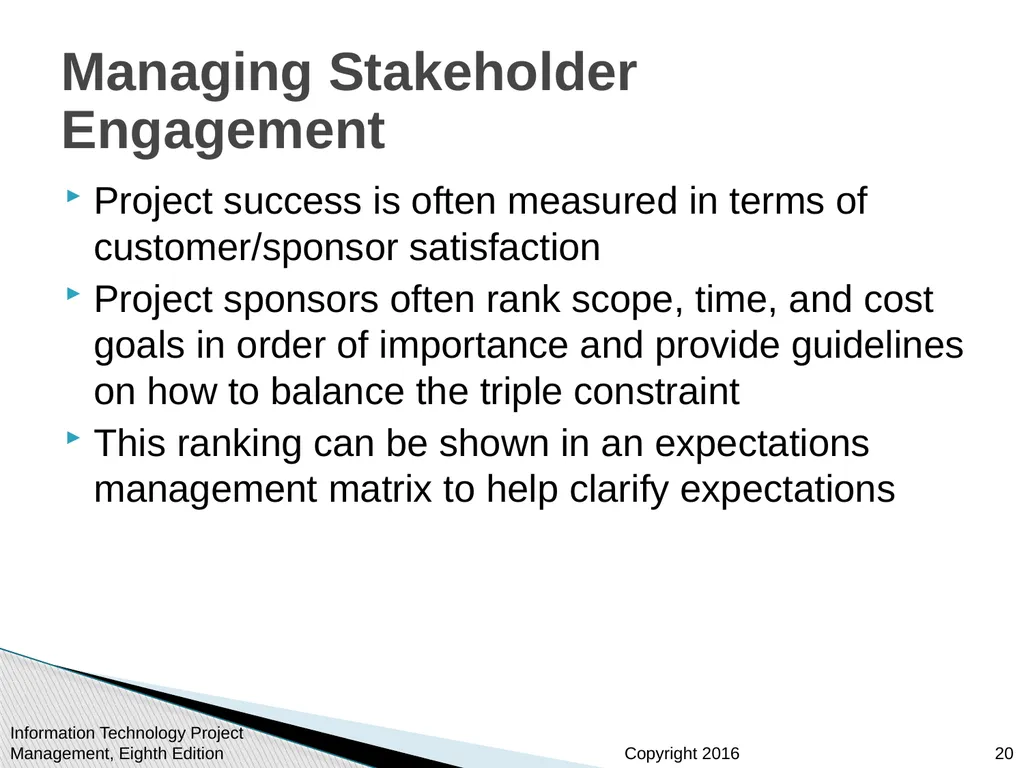
slide20. Managing Stakeholder Engagement Project success is often measured in terms of customer/sponsor satisfaction
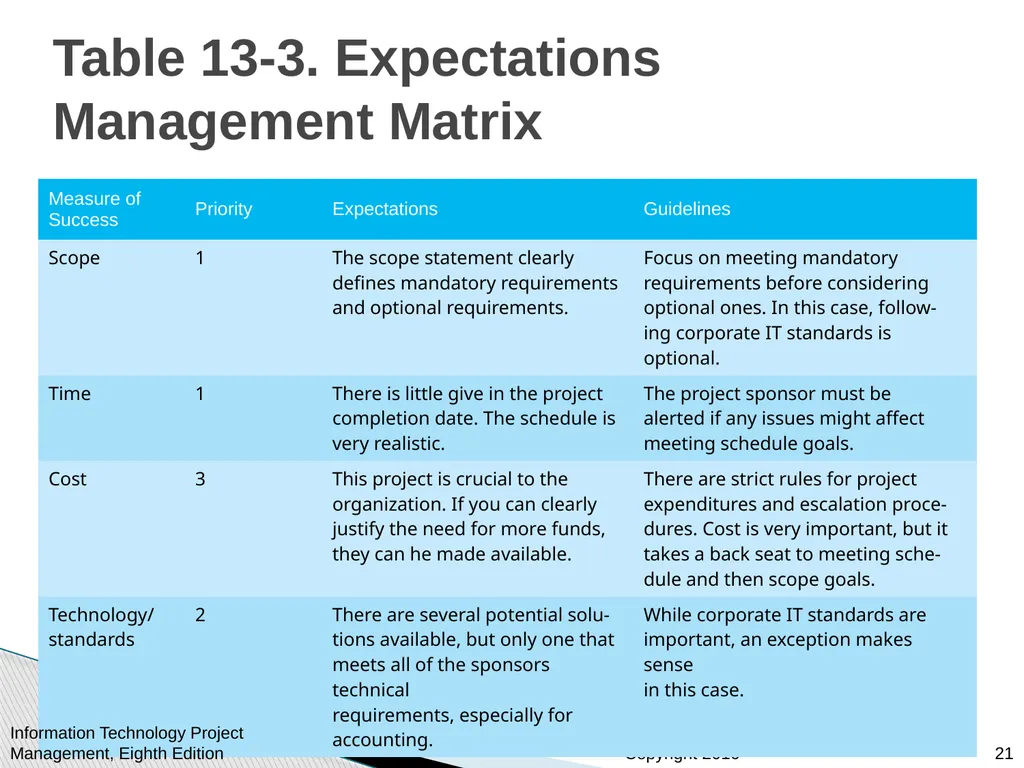
Project sponsors often rank scope, time, and cost goals in order of importance and provide guidelines on how to balance the triple constraint
This ranking can be shown in an expectations management matrix to help clarify expectations Information Technology Project Management, Eighth Edition 20<br>
slide21. Table 13-3. Expectations Management Matrix Information Technology Project Management, Eighth Edition 21<br>
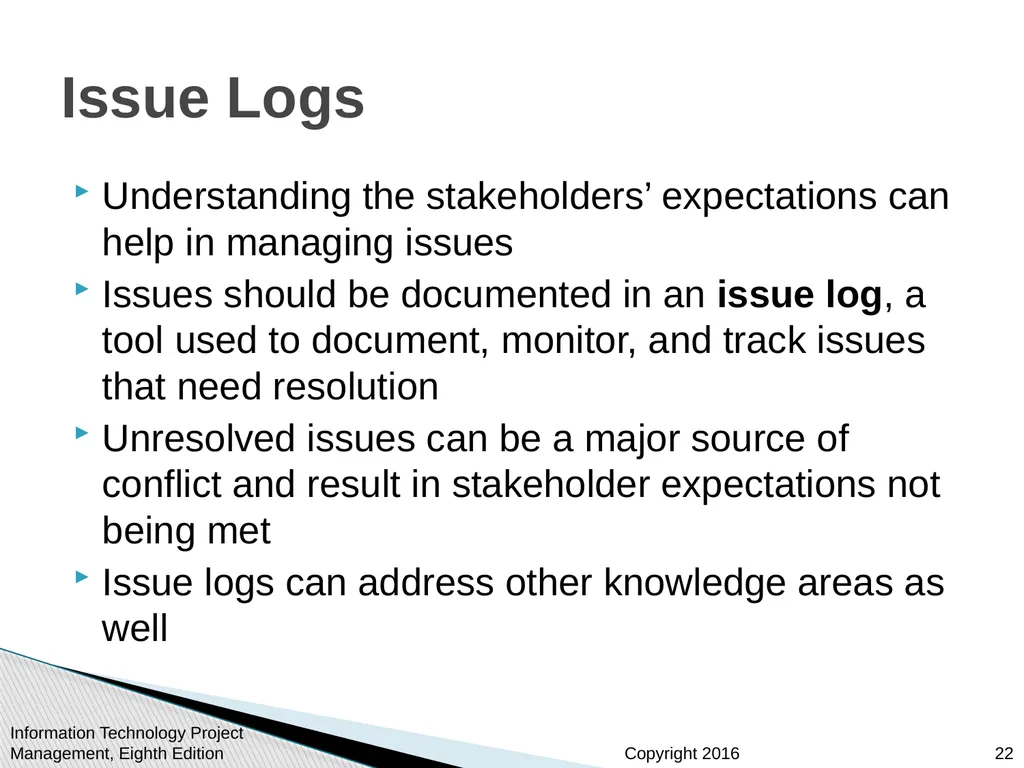
slide22. Issue Logs Understanding the stakeholders’ expectations can help in managing issues
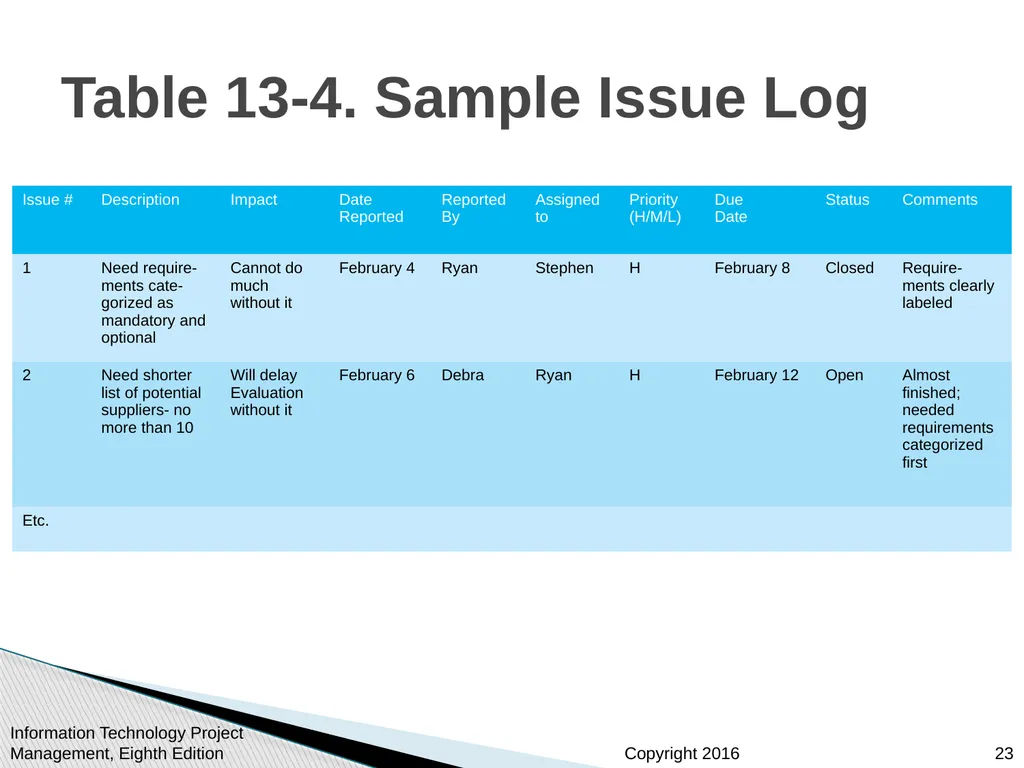
Issues should be documented in an issue log, a tool used to document, monitor, and track issues that need resolution
Unresolved issues can be a major source of conflict and result in stakeholder expectations not being met
Issue logs can address other knowledge areas as well Information Technology Project Management, Eighth Edition 22<br>
slide23. Table 13-4. Sample Issue Log Information Technology Project Management, Eighth Edition 23<br>
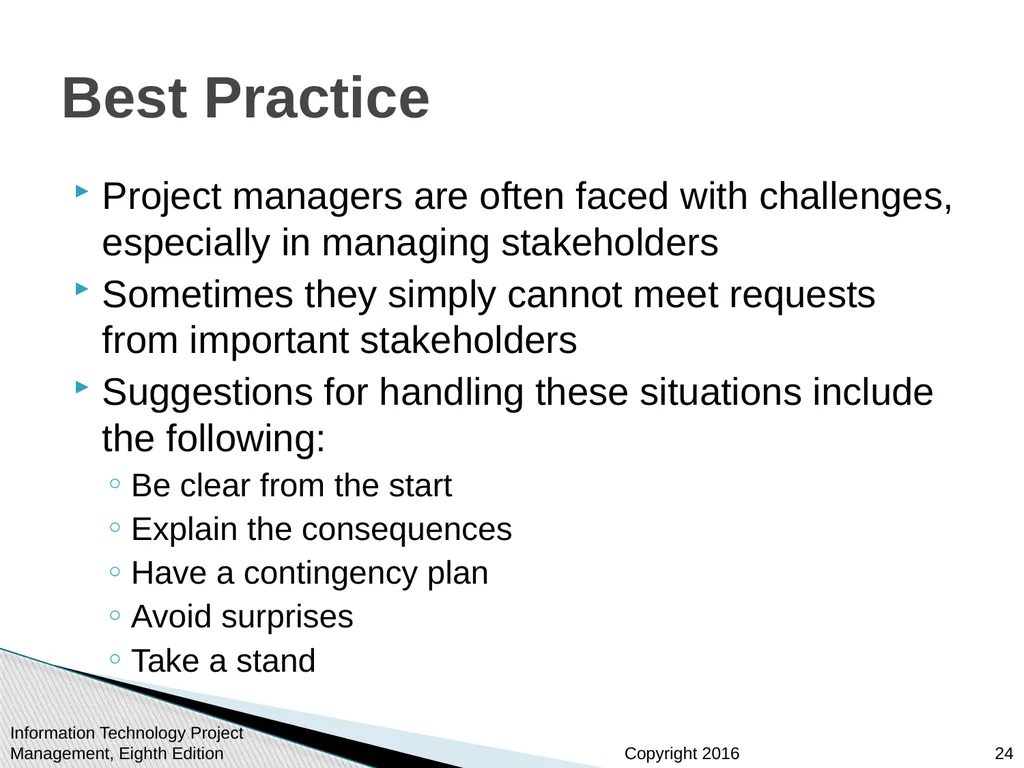
slide24. Best Practice Project managers are often faced with challenges, especially in managing stakeholders
Sometimes they simply cannot meet requests from important stakeholders
Suggestions for handling these situations include the following:
Be clear from the start
Explain the consequences
Have a contingency plan
Avoid surprises
Take a stand Information Technology Project Management, Eighth Edition 24<br>
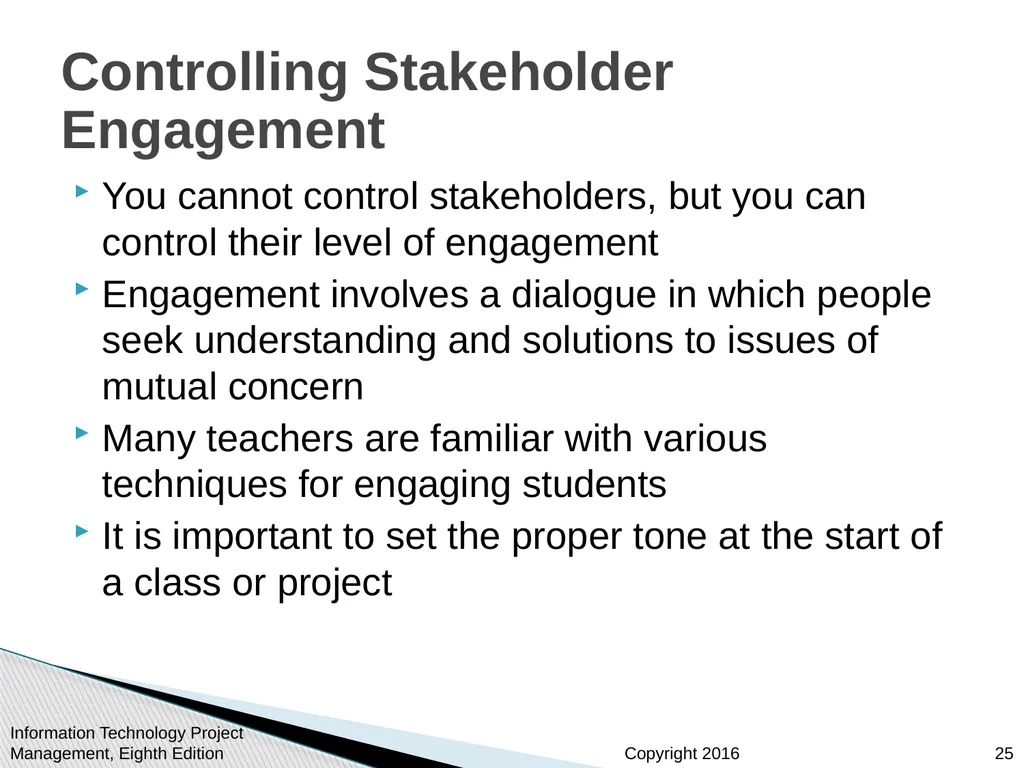
slide25. Controlling Stakeholder Engagement You cannot control stakeholders, but you can control their level of engagement
Engagement involves a dialogue in which people seek understanding and solutions to issues of mutual concern
Many teachers are familiar with various techniques for engaging students
It is important to set the proper tone at the start of a class or project Information Technology Project Management, Eighth Edition 25<br>
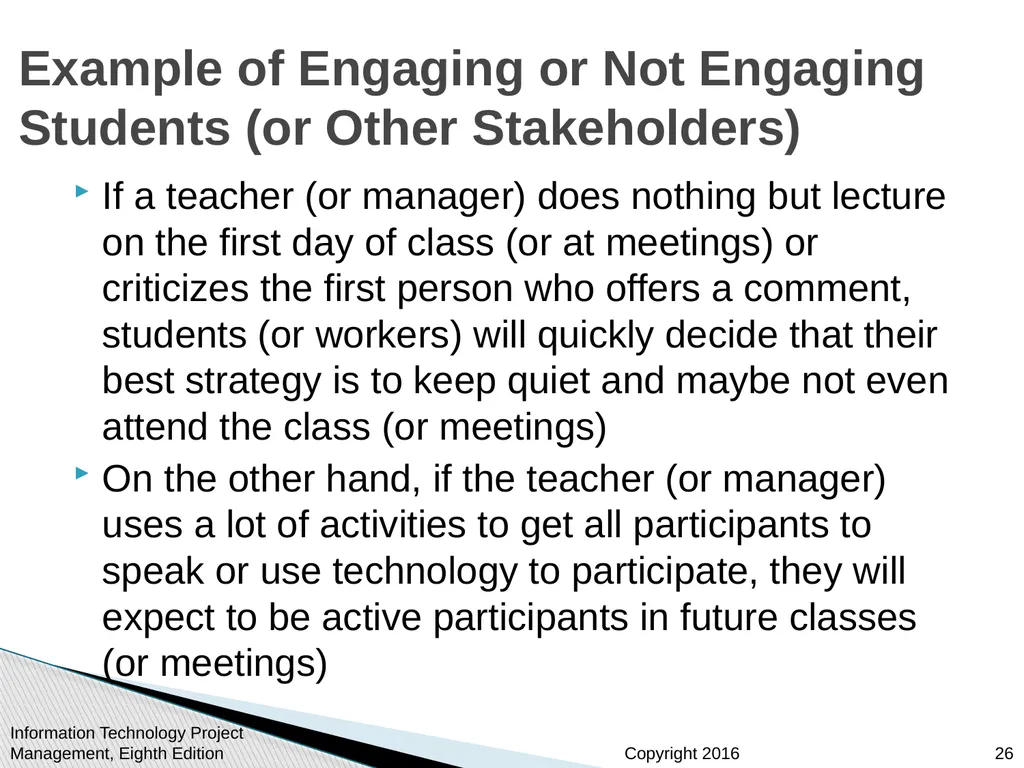
slide26. Example of Engaging or Not Engaging Students (or Other Stakeholders) If a teacher (or manager) does nothing but lecture on the first day of class (or at meetings) or criticizes the first person who offers a comment, students (or workers) will quickly decide that their best strategy is to keep quiet and maybe not even attend the class (or meetings)
On the other hand, if the teacher (or manager) uses a lot of activities to get all participants to speak or use technology to participate, they will expect to be active participants in future classes (or meetings) Information Technology Project Management, Eighth Edition 26<br>
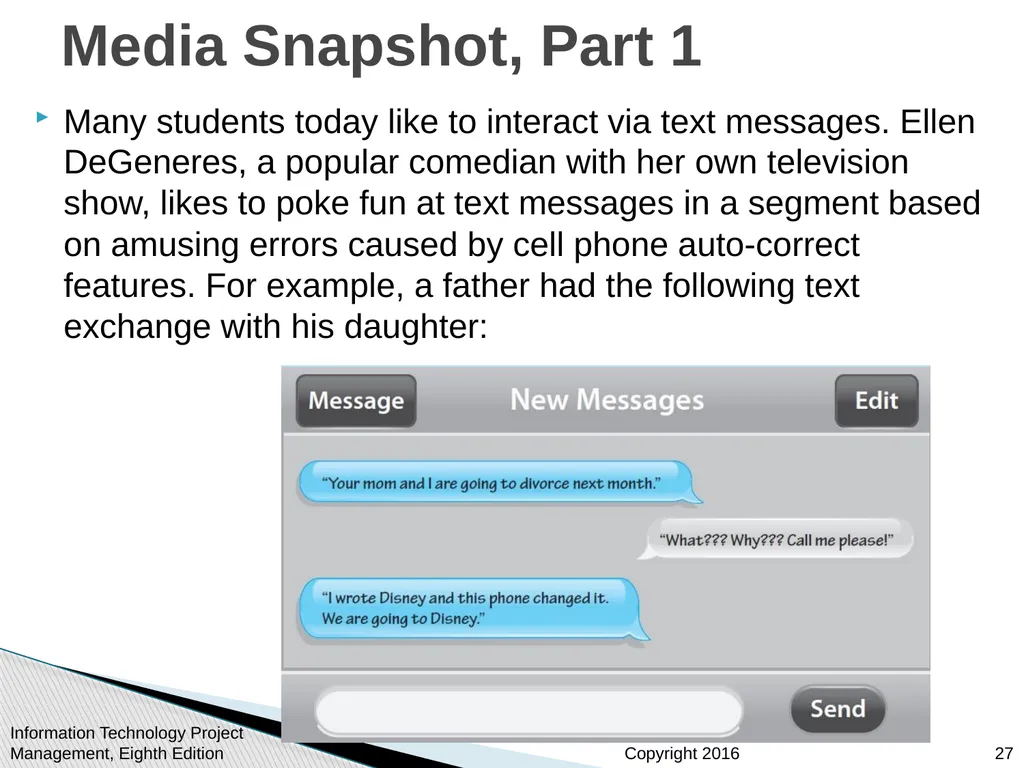
slide27. Media Snapshot, Part 1 Many students today like to interact via text messages. Ellen DeGeneres, a popular comedian with her own television show, likes to poke fun at text messages in a segment based on amusing errors caused by cell phone auto-correct features. For example, a father had the following text exchange with his daughter: Information Technology Project Management, Eighth Edition 27<br>
slide28. Media Snapshot, Part 2 In addition to watching out for auto-correct errors when messaging, users must also be careful who they reply to and what they say in reply
See the text for an example from an actual college student who forgot about an exam. The professor called the student’s cell phone shortly after the exam started. Her policy was to assign a grade of zero if students did not show up without a valid excuse
The student did not answer the phone call, but he sent several texts, which were obviously not true Information Technology Project Management, Eighth Edition 28<br>
slide29. Ways to Control Engagement Key stakeholders should be invited to actively participate in a kick-off meeting rather than merely attending it
The project manager should emphasize that a dialogue is expected at the meeting, including texts or whatever means of communication the stakeholders prefer. The project manager should also meet with important stakeholders before the kick-off meeting
The project schedule should include activities and deliverables related to stakeholder engagement, such as surveys, reviews, demonstrations, and sign-offs. Information Technology Project Management, Eighth Edition 29<br>
slide30. Stakeholders As Key Project Team Members On some IT projects, important stakeholders are invited to be members of the project teams
For example, when Northwest Airlines (now Delta) was developing a new reservation system called ResNet, it interviewed reservation agents for positions as programmers on the project team
Northwest made sure that user needs were understood by having them actually develop the system’s user interface Information Technology Project Management, Eighth Edition 30<br>
slide31. Using Software to Assist in Project Stakeholder Management Productivity software, communications software, and collaboration tools can promote stakeholder engagement
Social media can also help engage stakeholders. For example, LinkedIn has thousands of groups for project management professionals
Some project management software includes functionality like Facebook’s to encourage relationship building on projects, like giving high fives for a job well done Information Technology Project Management, Eighth Edition 31<br>
slide32. Social Media for Project Managers Elizabeth Harrin, author of Social Media for Project Managers, describes the pros and cons of several social media tools, including blogs, collaboration tools, instant messaging, microblogs like Twitter and Facebook, podcasts, RSS, social networks, vodcasts (video podcasts), webinars, and wikis
Harrin provides advice for when to use social media and when not to use it
As the saying goes, “A fool with a tool is still just a fool.” A lot of stakeholder engagement requires old-fashioned techniques like talking to someone! Information Technology Project Management, Eighth Edition 32<br>
slide33. Global Issues Not all software implementations go well, and managing stakeholders is a major challenge
The U.K. government scrapped its £11.4 billion national healthcare IT initiative in September 2011 after it failed to deliver the promised benefits. Unfortunately, this project was just one in a series of high-profile failures in the U.K.
In response, the government decided to send its project managers back to school! They partnered with the University of Oxford and the Deloitte consulting firm to establish the Major Projects Leadership Academy in Oxford, England
As of spring 2015, about 120 people have graduated and another 200 have enrolled Information Technology Project Management, Eighth Edition 33<br>
slide34. Chapter Summary Managing stakeholders is now the tenth knowledge area in the PMBOK® Guide.
Processes include:
Identify stakeholders
Plan stakeholder management
Manage stakeholder engagement
Control stakeholder engagement Information Technology Project Management, Eighth Edition 34<br>
slide2. Learning Objectives, Part 1 Understand the importance of project stakeholder management throughout the life of a project
Discuss the process of identifying stakeholders, how to create a stakeholder register, and how to perform a stakeholder analysis
Describe the contents of a stakeholder management plan Information Technology Project Management, Eighth Edition 2<br>
slide3. Learning Objectives, Part 2 Understand the process of managing stakeholder engagement and how to use an issue log effectively
Explain methods for controlling stakeholder engagement
Discuss types of software available to assist in project stakeholder management Information Technology Project Management, Eighth Edition 3<br>
slide4. Importance of Project Stakeholder Management Because stakeholder management is so important to project success, the Project Management Institute decided to create an entire knowledge area devoted to it as part of the Fifth Edition of the PMBOK® Guide in 2013
The purpose of project stakeholder management is to identify all people or organizations affected by a project, to analyze stakeholder expectations, and to effectively engage stakeholders Information Technology Project Management, Eighth Edition 4<br>
slide5. Projects Often Cause Change Projects often cause changes in organizations, and some people may lose their jobs when a project is completed. Project managers might be viewed as enemies if the project resulted in job losses for some stakeholders
By contrast, they could be viewed as allies if they lead a project that helps increase profits, produce new jobs, or increase pay for certain stakeholders
In any case, project managers must learn to identify, understand, and work with a variety of stakeholders Information Technology Project Management, Eighth Edition 5<br>
slide6. What Went Wrong? Changing the way work is done can send a shock wave through an organization, leaving many people afraid and even thinking about ways to stop or sabotage a project
Donald White, founder and program manager at Defense Systems Leaders in Washington, D.C., described situations that can lead to project sabotage:
Buy-in blues
Short-term profits
Overachieving
Lack of respect Information Technology Project Management, Eighth Edition 6<br>
slide7. Project Stakeholder Management Processes Identifying stakeholders: Identifying everyone involved in the project or affected by it, and determining the best ways to manage relationships with them.
Planning stakeholder management: Determining strategies to effectively engage stakeholders
Managing stakeholder engagement: Communicating and working with project stakeholders to satisfy their needs and expectations, resolving issues, and fostering engagement in project decisions and activities
Controlling stakeholder engagement: Monitoring stakeholder relationships and adjusting plans and strategies for engaging stakeholders as needed Information Technology Project Management, Eighth Edition 7<br>
slide8. Figure 13-1. Project Stakeholder Management Summary Information Technology Project Management, Eighth Edition 8<br>
slide9. Identifying Stakeholders Internal project stakeholders generally include the project sponsor, project team, support staff, and internal customers for the project. Other internal stakeholders include top management, other functional managers, and other project managers because organizations have limited resources
External project stakeholders include the project’s customers (if they are external to the organization), competitors, suppliers, and other external groups that are potentially involved in the project or affected by it, such as government officials and concerned citizens Information Technology Project Management, Eighth Edition 9<br>
slide10. Additional Stakeholders projectstakeholder lists other stakeholders including:
Program director
Project manager’s family
Labor unions
Potential customers
It is also necessary to focus on stakeholders with the most direct ties to a project, for example only key suppliers Information Technology Project Management, Eighth Edition 10<br>
slide11. Stakeholder Register A stakeholder register includes basic information on stakeholders:
Identification information: The stakeholders’ names, positions, locations, roles in the project, and contact information
Assessment information: The stakeholders’ major requirements and expectations, potential influences, and phases of the project in which stakeholders have the most interest
Stakeholder classification: Is the stakeholder internal or external to the organization? Is the stakeholder a supporter of the project or resistant to it? Information Technology Project Management, Eighth Edition 11<br>
slide12. Table 13-1. Sample Stakeholder Register Information Technology Project Management, Eighth Edition 12<br>
slide13. Classifying Stakeholders After identifying key project stakeholders, you can use different classification models to determine an approach for managing stakeholder relationships
A power/interest grid can be used to group stakeholders based on their level of authority (power) and their level of concern (interest) for project outcomes Information Technology Project Management, Eighth Edition 13<br>
slide14. Figure 13-2. Power/Interest Grid Information Technology Project Management, Eighth Edition 14<br>
slide15. Stakeholder Engagement Levels Unaware: Unaware of the project and its potential impacts on them
Resistant: Aware of the project yet resistant to change
Neutral: Aware of the project yet neither supportive nor resistant
Supportive: Aware of the project and supportive of change
Leading: Aware of the project Information Technology Project Management, Eighth Edition 15<br>
slide16. What Went Right? Instead of just saying “no” when your project sponsor asks for something unreasonable, it is better to explain what is wrong with the request and then present a realistic way to solve the problem at hand
For example, Christa Ferguson, a PMP and independent program manager in San Francisco, described how she handled a request from a project sponsor to deliver a new tablet device in two months when she knew she would need more time. Based on her experience, she knew the RFQ for the effort alone would take almost a month. Christa quickly researched the facts to propose a realistic delivery schedule.
The project sponsor reset expectations once he learned what it took to produce the tablets Information Technology Project Management, Eighth Edition 16<br>
slide17. Planning Stakeholder Management After identifying and analyzing stakeholders, project teams should develop a plan for management them
The stakeholder management plan can include:
Current and desired engagement levels
Interrelationships between stakeholders
Communication requirements
Potential management strategies for each stakeholders
Methods for updating the stakeholder management plan Information Technology Project Management, Eighth Edition 17<br>
slide18. Sensitive Information Because a stakeholder management plan often includes sensitive information, it should not be part of the official project documents, which are normally available for all stakeholders to review
In many cases, only project managers and a few other team members should prepare the stakeholder management plan
Parts of the stakeholder management plan are not written down, and if they are, distribution is strictly limited Information Technology Project Management, Eighth Edition 18<br>
slide19. Table 13-2. Sample Stakeholder Analysis Information Technology Project Management, Eighth Edition 19<br>
slide20. Managing Stakeholder Engagement Project success is often measured in terms of customer/sponsor satisfaction
Project sponsors often rank scope, time, and cost goals in order of importance and provide guidelines on how to balance the triple constraint
This ranking can be shown in an expectations management matrix to help clarify expectations Information Technology Project Management, Eighth Edition 20<br>
slide21. Table 13-3. Expectations Management Matrix Information Technology Project Management, Eighth Edition 21<br>
slide22. Issue Logs Understanding the stakeholders’ expectations can help in managing issues
Issues should be documented in an issue log, a tool used to document, monitor, and track issues that need resolution
Unresolved issues can be a major source of conflict and result in stakeholder expectations not being met
Issue logs can address other knowledge areas as well Information Technology Project Management, Eighth Edition 22<br>
slide23. Table 13-4. Sample Issue Log Information Technology Project Management, Eighth Edition 23<br>
slide24. Best Practice Project managers are often faced with challenges, especially in managing stakeholders
Sometimes they simply cannot meet requests from important stakeholders
Suggestions for handling these situations include the following:
Be clear from the start
Explain the consequences
Have a contingency plan
Avoid surprises
Take a stand Information Technology Project Management, Eighth Edition 24<br>
slide25. Controlling Stakeholder Engagement You cannot control stakeholders, but you can control their level of engagement
Engagement involves a dialogue in which people seek understanding and solutions to issues of mutual concern
Many teachers are familiar with various techniques for engaging students
It is important to set the proper tone at the start of a class or project Information Technology Project Management, Eighth Edition 25<br>
slide26. Example of Engaging or Not Engaging Students (or Other Stakeholders) If a teacher (or manager) does nothing but lecture on the first day of class (or at meetings) or criticizes the first person who offers a comment, students (or workers) will quickly decide that their best strategy is to keep quiet and maybe not even attend the class (or meetings)
On the other hand, if the teacher (or manager) uses a lot of activities to get all participants to speak or use technology to participate, they will expect to be active participants in future classes (or meetings) Information Technology Project Management, Eighth Edition 26<br>
slide27. Media Snapshot, Part 1 Many students today like to interact via text messages. Ellen DeGeneres, a popular comedian with her own television show, likes to poke fun at text messages in a segment based on amusing errors caused by cell phone auto-correct features. For example, a father had the following text exchange with his daughter: Information Technology Project Management, Eighth Edition 27<br>
slide28. Media Snapshot, Part 2 In addition to watching out for auto-correct errors when messaging, users must also be careful who they reply to and what they say in reply
See the text for an example from an actual college student who forgot about an exam. The professor called the student’s cell phone shortly after the exam started. Her policy was to assign a grade of zero if students did not show up without a valid excuse
The student did not answer the phone call, but he sent several texts, which were obviously not true Information Technology Project Management, Eighth Edition 28<br>
slide29. Ways to Control Engagement Key stakeholders should be invited to actively participate in a kick-off meeting rather than merely attending it
The project manager should emphasize that a dialogue is expected at the meeting, including texts or whatever means of communication the stakeholders prefer. The project manager should also meet with important stakeholders before the kick-off meeting
The project schedule should include activities and deliverables related to stakeholder engagement, such as surveys, reviews, demonstrations, and sign-offs. Information Technology Project Management, Eighth Edition 29<br>
slide30. Stakeholders As Key Project Team Members On some IT projects, important stakeholders are invited to be members of the project teams
For example, when Northwest Airlines (now Delta) was developing a new reservation system called ResNet, it interviewed reservation agents for positions as programmers on the project team
Northwest made sure that user needs were understood by having them actually develop the system’s user interface Information Technology Project Management, Eighth Edition 30<br>
slide31. Using Software to Assist in Project Stakeholder Management Productivity software, communications software, and collaboration tools can promote stakeholder engagement
Social media can also help engage stakeholders. For example, LinkedIn has thousands of groups for project management professionals
Some project management software includes functionality like Facebook’s to encourage relationship building on projects, like giving high fives for a job well done Information Technology Project Management, Eighth Edition 31<br>
slide32. Social Media for Project Managers Elizabeth Harrin, author of Social Media for Project Managers, describes the pros and cons of several social media tools, including blogs, collaboration tools, instant messaging, microblogs like Twitter and Facebook, podcasts, RSS, social networks, vodcasts (video podcasts), webinars, and wikis
Harrin provides advice for when to use social media and when not to use it
As the saying goes, “A fool with a tool is still just a fool.” A lot of stakeholder engagement requires old-fashioned techniques like talking to someone! Information Technology Project Management, Eighth Edition 32<br>
slide33. Global Issues Not all software implementations go well, and managing stakeholders is a major challenge
The U.K. government scrapped its £11.4 billion national healthcare IT initiative in September 2011 after it failed to deliver the promised benefits. Unfortunately, this project was just one in a series of high-profile failures in the U.K.
In response, the government decided to send its project managers back to school! They partnered with the University of Oxford and the Deloitte consulting firm to establish the Major Projects Leadership Academy in Oxford, England
As of spring 2015, about 120 people have graduated and another 200 have enrolled Information Technology Project Management, Eighth Edition 33<br>
slide34. Chapter Summary Managing stakeholders is now the tenth knowledge area in the PMBOK® Guide.
Processes include:
Identify stakeholders
Plan stakeholder management
Manage stakeholder engagement
Control stakeholder engagement Information Technology Project Management, Eighth Edition 34<br>