
Chapter 15Challenges in the Workplace OBJECTIVES
Description: Chapter 15Challenges in the Workplace OBJECTIVES Describe and give examples of several work-related challenges. Describe and give examples of several occupational challenges. Describe and give examples of several public health challenges.
Related Topics
Download Presentation
"Chapter 15Challenges in the Workplace OBJECTIVES" is the property of its rightful owner. Permission is granted to download and print the materials on this website for personal, non-commercial use only, and to display it on your personal computer provided you do not modify the materials and that you retain all copyright notices contained in the materials. By downloading content from our website, you accept the terms of this agreement.
Presentation Transcript
slide1. Chapter 15Challenges in the Workplace<br>
slide2. OBJECTIVES Describe and give examples of several work-related challenges.
Describe and give examples of several occupational challenges.
Describe and give examples of several public health challenges.
Describe and give examples of several environmental challenges.
Given a challenging situation, outline a course of action along with the reasons for that action.<br>
slide3. Work-Related Challenges Healthy workplace
Cultural and social environment is fair and supportive
Workers feel safe from injury and harm
Physical environment is efficient and comfortable
Coworkers practice healthy behaviors<br>
slide4. Work-Related Challenges Abusive Work Environment
Person feels threatened or intimated by boss or coworkers
Obvious behaviors (yelling, screaming, threats, throwing things)
Less obvious behaviors (shrugs, sighs, looks)
Decreases productivity
Worker goes home tired, drained, and frustrated
Provide written complaints to human resources manager<br>
slide5. Work-Related Challenges Whistleblowing
Reporting unethical or illegal workplace practices to an employer, a government agency, or the public
Must have substantiating documentation
Go to employer prior to going public
“Whistleblower” legislation protects nurses and others from retaliation (31 states have “whistleblower” legislation)<br>
slide6. Work-Related Challenges Bullying
Aggressive behavior intended to gain power over or hurt another person
Victim can suffer from stress-related health conditions (HTN, depression, anxiety)
State and federal laws address bullying in the workplace (Healthy Workplace Bill)-
only 9 states do not have laws
You can and should do something when you are either the target or know a target
Be supportive and corroborate your observations<br>
slide7. Work-Related Challenges Violence
Violent acts directed toward persons at work or on duty
Stalking and domestic violence
Most victims are women
Violence occasionally follows the woman to work
Measures to prevent domestic violence
National Domestic Violence Hotline<br>
slide8. Work-Related Challenges Diversity
Similarities and differences among workers in terms of age, cultural background, disabilities, spirituality and religion, race, gender, sexual orientation, and genetics
Age
Differences in work ethics and loyalty
Older worker technology and communication styles differ from younger worker
Bosses may be younger than themselves<br>
slide9. Work-Related Challenges Culture
People with different cultural backgrounds practice everyday activities in different ways
Adds different perspectives to the work environment
Learn to live with, work with, and provide services to those who are different from you<br>
slide10. Work-Related Challenges Disabilities
Physical, intellectual, or emotional disabilities
Provide a point of view to the work that others don’t have
The American with Disabilities Act prohibits discrimination<br>
slide11. Work-Related Challenges Spirituality and Religion
Being religious—following a set of organized beliefs and practices
Employers required to make reasonable accommodations
Spirituality—self-understanding of your own reality through your submission to your higher power
Individual quest
Practicing spirituality in the workplace<br>
slide12. Work-Related Challenges Race
Valuing racial diversity can lead to a collaborative work environment
Gender
Men receive preferential treatment and compensation in the workplace
Coworkers are challenged by another person’s sexual orientation<br>
slide13. Work-Related Challenges Discrimination
Treating people based on a class or category rather than on their individual qualities and abilities
Laws against discrimination are helpful, but subtle forms of discrimination still exist
Collaborative work environment
Improves relationships
Expands one’s understanding of the world
Improves customer service<br>
slide14. Work-Related Challenges Sexual Harassment
Unwelcome verbal or physical sexual advances or requests for sexual favors
Submission or rejection affects employment, interferes with work performance, or creates an intimidating, hostile, or offensive work environment
Affects victims detrimentally<br>
slide15. Work-Related Challenges Job Stress
Harmful physical and emotional responses occurring when job requirements do not match capabilities, resources, or needs of the worker
Can lead to poor health or injury
Personalized experience that can vary widely
Perception is key to how you will respond
Causes and effects<br>
slide16. Work-Related Challenges Information Technology
Technology that helps to produce, manipulate, store, communicate, and/or disseminate information
Concerns
Job elimination
Unauthorized access
Breach of confidentiality
General failure of systems<br>
slide17. Occupational Challenges Diversity
Nursing team reflects diversity of the nation
Offers many opportunities to explore our own values and beliefs and to learn to accept and appreciate values and beliefs of others
Develop an awareness of cultural effects in response to patients and coworkers<br>
slide18. Occupational Challenges Work Fatigue
Physically and mentally challenging work
Nurse risks personal injury
Patients at risk for errors in care
Causes and effects (what are some examples?)
National Institute of Medicine recommendations (pg. 333)<br>
slide19. Occupational Challenges Stress
Emergency response to a threat—“Fight or Flight”
Feeling frustrated and angry
Feel having little control
High potential for stress in nursing occupation
Learn symptoms of stress and how to manage stress rather than letting it manage you
Become skilled in applying effective coping strategies<br>
slide20. Occupational Challenges Burnout
Sense of hopelessness about job brought on by chronic stress
Decreases job performance
Carries into personal life
Result of highly stressful working conditions or relationships
Inability to match what they expect of themselves to what time and conditions let them deliver<br>
slide21. Occupational Challenges Compassion Fatigue
Caring too much resulting in physical, emotional, and spiritual exhaustion
Make mistakes, decreased job performance
Morale drops
Personal relationships are affected
Personality deteriorates<br>
slide22. Occupational Challenges Violence
Occurs most often in waiting rooms, geriatric units, emergency rooms, and psychiatric units
Volatile coworkers
Use behavior that helps diffuse anger
Present calm attitude, acknowledge person’s feelings
Avoid aggressive behavior
Use ingenuity to get help<br>
slide23. Occupational Challenges Health Risks
Nurses rank 10th for musculoskeletal injuries
Accidental needle sticks
Infectious disease
Chemical, radiation, drugs
Environmental toxins
Follow all recommendations, protocols, and precautions<br>
slide24. Public Health Challenges Terrorism
Use of force or violence against a group, society, or government with potential for large numbers of injured and dead
Huge influx of people into the health care facilities
Emergency preparedness training programs offered by employers and community groups<br>
slide25. Public Health Challenges Bioterrorism
Intentional use of microorganisms to bring about ill effects or death to humans, livestock, or crops
Varied methods of transmission
Standard precautions and additional appropriate precautions to avoid exposure or contamination<br>
slide26. Public Health Challenges Emergency Preparedness
Processes involved in planning for public health emergency
Federal, state and local agencies, and health care facilities
Mock disaster drills
Best response is to use common sense, remain calm, think critically, and follow instructions of those in charge<br>
slide27. Public Health Challenges Nurses’ Role
Critical to recovery from any public health emergency
Continue to learn about public health emergencies
How they could affect you, your family
How they could affect work
Consider being a volunteer<br>
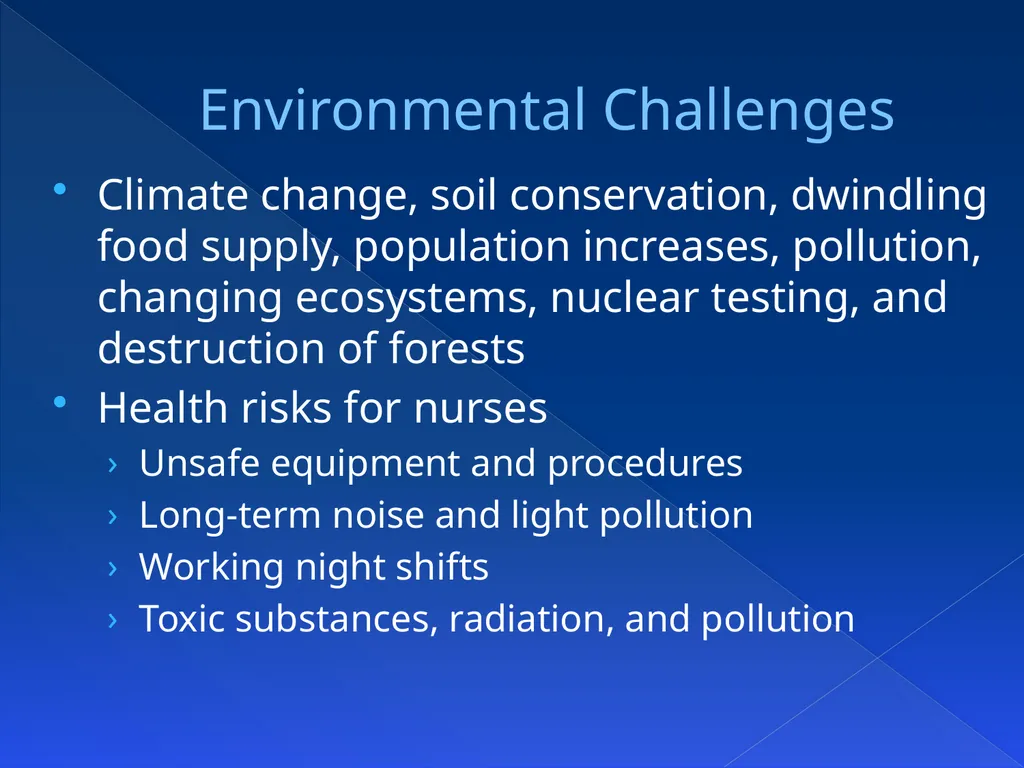
slide28. Environmental Challenges Climate change, soil conservation, dwindling food supply, population increases, pollution, changing ecosystems, nuclear testing, and destruction of forests
Health risks for nurses
Unsafe equipment and procedures
Long-term noise and light pollution
Working night shifts
Toxic substances, radiation, and pollution<br>
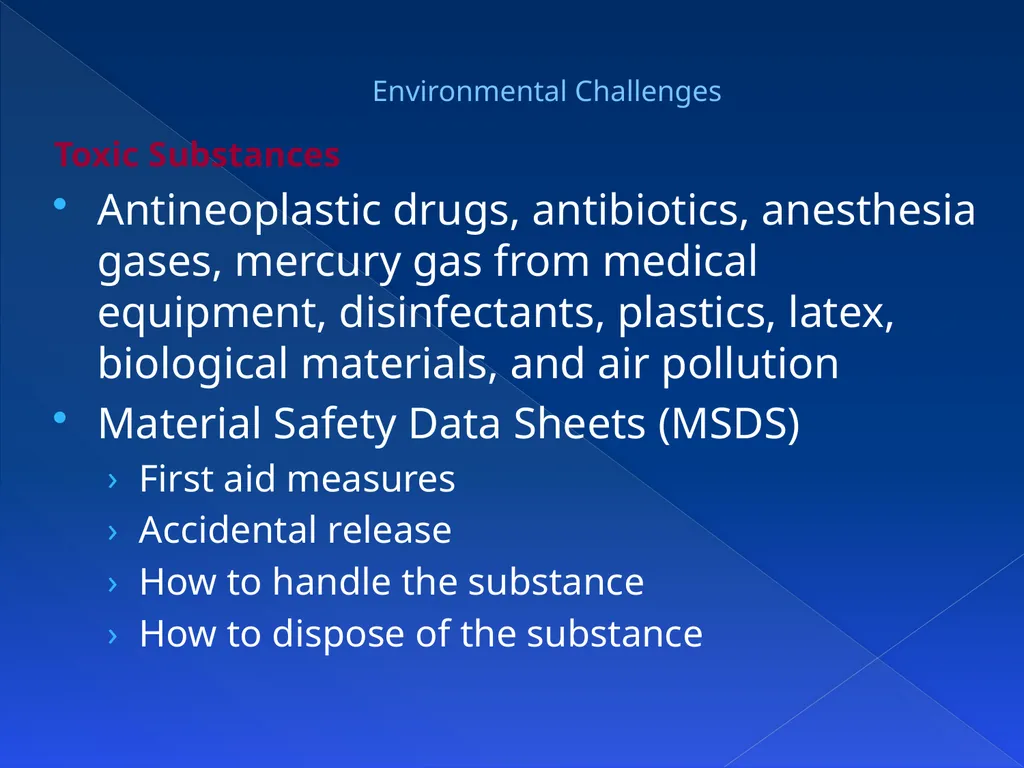
slide29. Environmental Challenges Toxic Substances
Antineoplastic drugs, antibiotics, anesthesia gases, mercury gas from medical equipment, disinfectants, plastics, latex, biological materials, and air pollution
Material Safety Data Sheets (MSDS)
First aid measures
Accidental release
How to handle the substance
How to dispose of the substance<br>
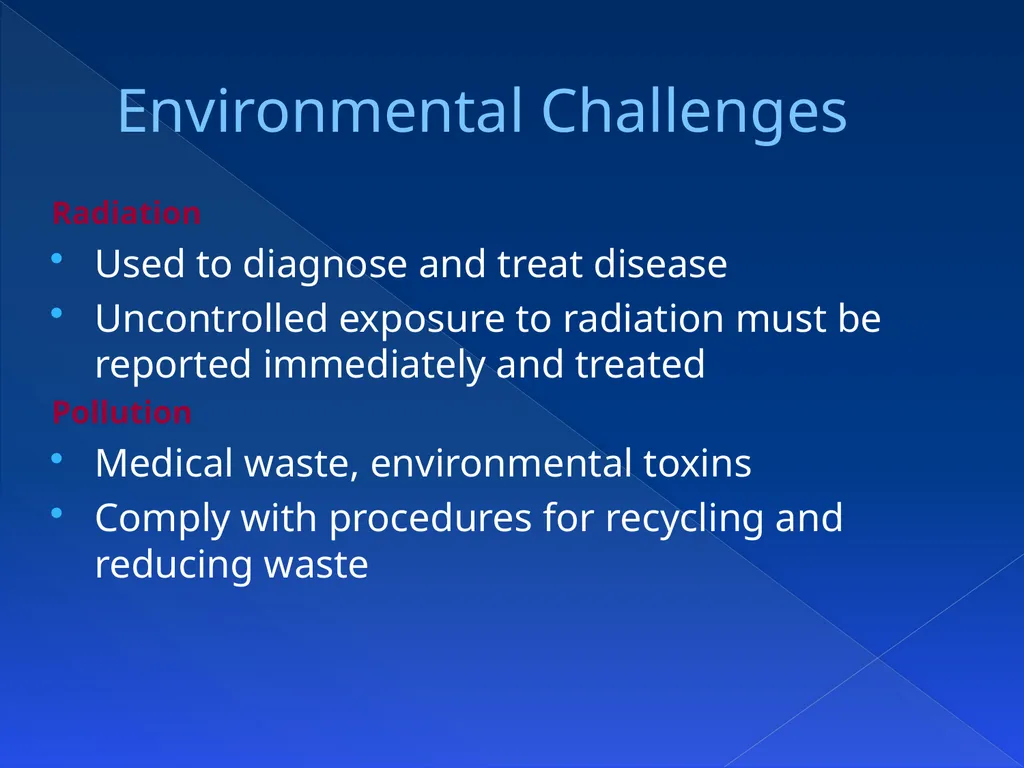
slide30. Environmental Challenges Radiation
Used to diagnose and treat disease
Uncontrolled exposure to radiation must be reported immediately and treated
Pollution
Medical waste, environmental toxins
Comply with procedures for recycling and reducing waste<br>
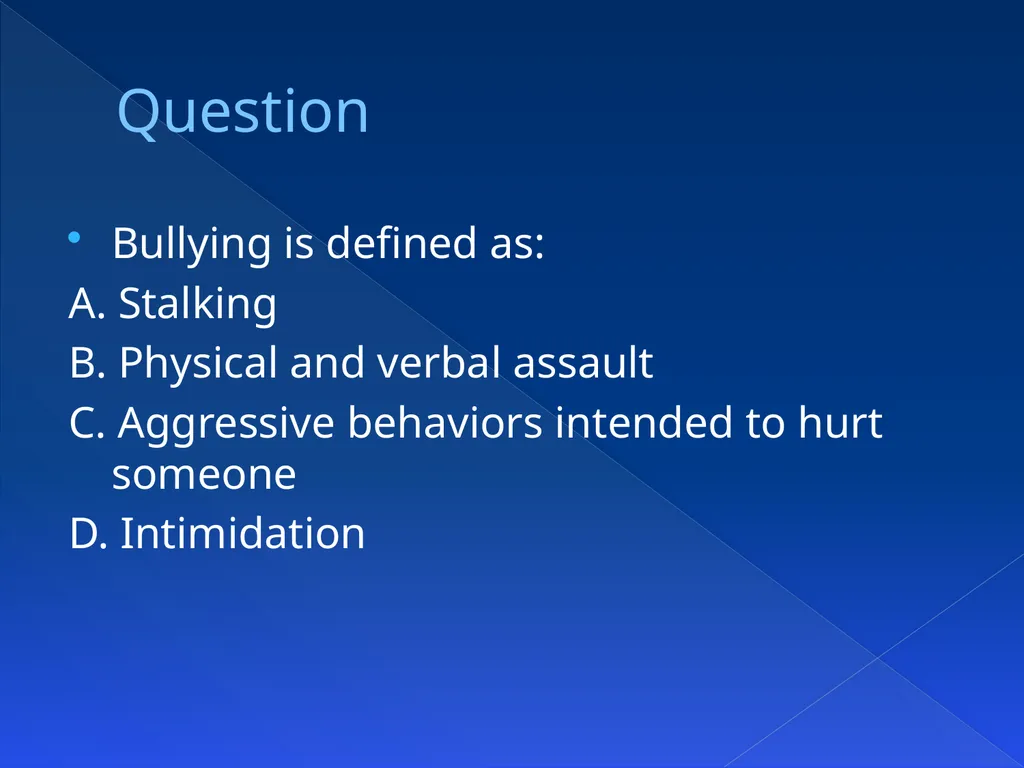
slide31. Question Bullying is defined as:
A. Stalking
B. Physical and verbal assault
C. Aggressive behaviors intended to hurt someone
D. Intimidation<br>
slide32. Answer C. Aggressive behaviors intended to hurt someone
Rationale: Bullying is aggressive behavior intended to gain power over or hurt another person.<br>
slide33. Question Is the following statement true or false?
There is a difference in the work ethics of older and younger workers’.<br>
slide34. Answer True
Rationale: Older workers’ work ethics may be quite different from younger workers’.<br>
slide35. Question Compassion fatigue is caused by:
A. Unwelcome sexual advances
B. Caring too much
C. Discrimination
D. Job stress<br>
slide36. Answer B. Caring too much
Rationale: Compassion fatigue is caused by caring too much and feeling the patients’ pain, which leads to physical, emotional, and spiritual exhaustion.<br>
slide37. Question Is the following statement true or false?
Material safety data sheets are not available for staff persons to read.<br>
slide38. Answer False
Rationale: All employees in all workplaces must have access to material safety data sheets to learn about substances they work with.<br>
slide39. DISCUSSION #1 Jack has been working on his newly assigned unit for the past week. Other nurses have laughingly warned him to stay away from Jean, but they do not say why. One day Jean comes up to him, bumps him with her hip and says, “How’ya doin’, Big Boy?” Jack is a bit surprised, but laughs it off and goes about his work. Several days later she walks by and pinches his buttocks. Jack jumps and she laughs. He starts to feel uneasy, and tries to avoid her. Each time he is near her, she flirts and makes suggestive comments. One day Jack is alone in the staff lounge, and she comes into the room. Jean comes up to Jack and whispers to him, “You want to go to bed with me?” Jack feels very upset and angry and gets up to leave. Jean turns on him and asked, “What? Are you queer or something?
What is Jean doing, and how is it affecting Jack?
How can Jack deal with this situation?<br>
slide40. DISCUSSION #2 You are the nursing team leader at the Aspirus Medical Clinic in the Internal Medicine Department, and you have observed a recently hired practical nurse named Elizabeth come to work with stitches in her lip, and a bruised cheek. She tells you she fell and had to go to the emergency room for stitches. Over the next 2 months you find she has been late to work 5 times, and has two absences for various ailments. You observe that she lacks self esteem and avoids socializing with other staff members. When other staff persons ask her if she wants to stop off for coffee or a drink after work, she seems uneasy, and says that her husband expects her home, and she cannot be late. Other team members have started to complain that she is getting a lot of telephone calls from her husband during the work day.
What can you conclude from your observations?
How can you approach Elizabeth to discuss your observations and suspicions?<br>
slide41. DISCUSSION TOPIC #3 You are a staff nurse working in a local nursing home. There have been several instances of patients falling out of bed, and mats have been placed on the floor next to the beds. It was determined after another incident, that it would be safer for these patients if their beds were down on the floor. At the time, there were not sufficient funds to purchase electric beds that could be lowered to the floor, so it was decided to cut the legs off these patients’ beds. The staff nursing assistants lifted the patients from the floor in pairs, as the mechanical lifts in the facility cannot be used to pick someone up from the floor. Today there is a new group of nursing students coming to clinical, and the instructor refuses to allow her students to care for those patients whose beds are on the floor. She says it is not safe and she will not allow her students to practice such poor body mechanics and risk injury. (This is a true scenario.)
What is the most effective response you can give to this nursing instructor?
What can you do as a staff nurse to correct this situation that puts other staff members at risk for personal injury?<br>
slide42. CASE STUDY Your instructor has been asked by the county emergency services to find volunteers for their next county-wide disaster drill. You are intrigued and your entire class has chosen to participate. On the day of the county-wide drill, your class is divided into groups and taken to different locations. All of your classmates are “victims” of a 9.0 earthquake close to your home. You are either dead or have simple to complex injuries. The organizers have provided food for a midmorning snack and a box lunch. At the end of the drill, you are bussed back to your departure point. All of your classmates are returning at different times. The drill was on a Friday, so you have not seen any of your classmates for feedback before the weekend.
On Monday, as the class is about to begin, students are exchanging stories and everyone seems to be saying the same thing. Although everyone enjoyed the drill, they felt that the hospital participants were very disorganized. Personnel did not know procedures or where to access equipment. In some places, even though the learners had minor wounds, major wounds, or were tagged as dead, they were asked to help out the staff.<br>
slide43. CASE STUDY CONT’D What could be two plausible reasons why this disaster drill was so disorganized?
If you are working in a health care facility when there is a disaster, what will you do—stay or leave to get to your family?
How often should personnel practice disaster drills? What are some other recommendations?<br>
slide2. OBJECTIVES Describe and give examples of several work-related challenges.
Describe and give examples of several occupational challenges.
Describe and give examples of several public health challenges.
Describe and give examples of several environmental challenges.
Given a challenging situation, outline a course of action along with the reasons for that action.<br>
slide3. Work-Related Challenges Healthy workplace
Cultural and social environment is fair and supportive
Workers feel safe from injury and harm
Physical environment is efficient and comfortable
Coworkers practice healthy behaviors<br>
slide4. Work-Related Challenges Abusive Work Environment
Person feels threatened or intimated by boss or coworkers
Obvious behaviors (yelling, screaming, threats, throwing things)
Less obvious behaviors (shrugs, sighs, looks)
Decreases productivity
Worker goes home tired, drained, and frustrated
Provide written complaints to human resources manager<br>
slide5. Work-Related Challenges Whistleblowing
Reporting unethical or illegal workplace practices to an employer, a government agency, or the public
Must have substantiating documentation
Go to employer prior to going public
“Whistleblower” legislation protects nurses and others from retaliation (31 states have “whistleblower” legislation)<br>
slide6. Work-Related Challenges Bullying
Aggressive behavior intended to gain power over or hurt another person
Victim can suffer from stress-related health conditions (HTN, depression, anxiety)
State and federal laws address bullying in the workplace (Healthy Workplace Bill)-
only 9 states do not have laws
You can and should do something when you are either the target or know a target
Be supportive and corroborate your observations<br>
slide7. Work-Related Challenges Violence
Violent acts directed toward persons at work or on duty
Stalking and domestic violence
Most victims are women
Violence occasionally follows the woman to work
Measures to prevent domestic violence
National Domestic Violence Hotline<br>
slide8. Work-Related Challenges Diversity
Similarities and differences among workers in terms of age, cultural background, disabilities, spirituality and religion, race, gender, sexual orientation, and genetics
Age
Differences in work ethics and loyalty
Older worker technology and communication styles differ from younger worker
Bosses may be younger than themselves<br>
slide9. Work-Related Challenges Culture
People with different cultural backgrounds practice everyday activities in different ways
Adds different perspectives to the work environment
Learn to live with, work with, and provide services to those who are different from you<br>
slide10. Work-Related Challenges Disabilities
Physical, intellectual, or emotional disabilities
Provide a point of view to the work that others don’t have
The American with Disabilities Act prohibits discrimination<br>
slide11. Work-Related Challenges Spirituality and Religion
Being religious—following a set of organized beliefs and practices
Employers required to make reasonable accommodations
Spirituality—self-understanding of your own reality through your submission to your higher power
Individual quest
Practicing spirituality in the workplace<br>
slide12. Work-Related Challenges Race
Valuing racial diversity can lead to a collaborative work environment
Gender
Men receive preferential treatment and compensation in the workplace
Coworkers are challenged by another person’s sexual orientation<br>
slide13. Work-Related Challenges Discrimination
Treating people based on a class or category rather than on their individual qualities and abilities
Laws against discrimination are helpful, but subtle forms of discrimination still exist
Collaborative work environment
Improves relationships
Expands one’s understanding of the world
Improves customer service<br>
slide14. Work-Related Challenges Sexual Harassment
Unwelcome verbal or physical sexual advances or requests for sexual favors
Submission or rejection affects employment, interferes with work performance, or creates an intimidating, hostile, or offensive work environment
Affects victims detrimentally<br>
slide15. Work-Related Challenges Job Stress
Harmful physical and emotional responses occurring when job requirements do not match capabilities, resources, or needs of the worker
Can lead to poor health or injury
Personalized experience that can vary widely
Perception is key to how you will respond
Causes and effects<br>
slide16. Work-Related Challenges Information Technology
Technology that helps to produce, manipulate, store, communicate, and/or disseminate information
Concerns
Job elimination
Unauthorized access
Breach of confidentiality
General failure of systems<br>
slide17. Occupational Challenges Diversity
Nursing team reflects diversity of the nation
Offers many opportunities to explore our own values and beliefs and to learn to accept and appreciate values and beliefs of others
Develop an awareness of cultural effects in response to patients and coworkers<br>
slide18. Occupational Challenges Work Fatigue
Physically and mentally challenging work
Nurse risks personal injury
Patients at risk for errors in care
Causes and effects (what are some examples?)
National Institute of Medicine recommendations (pg. 333)<br>
slide19. Occupational Challenges Stress
Emergency response to a threat—“Fight or Flight”
Feeling frustrated and angry
Feel having little control
High potential for stress in nursing occupation
Learn symptoms of stress and how to manage stress rather than letting it manage you
Become skilled in applying effective coping strategies<br>
slide20. Occupational Challenges Burnout
Sense of hopelessness about job brought on by chronic stress
Decreases job performance
Carries into personal life
Result of highly stressful working conditions or relationships
Inability to match what they expect of themselves to what time and conditions let them deliver<br>
slide21. Occupational Challenges Compassion Fatigue
Caring too much resulting in physical, emotional, and spiritual exhaustion
Make mistakes, decreased job performance
Morale drops
Personal relationships are affected
Personality deteriorates<br>
slide22. Occupational Challenges Violence
Occurs most often in waiting rooms, geriatric units, emergency rooms, and psychiatric units
Volatile coworkers
Use behavior that helps diffuse anger
Present calm attitude, acknowledge person’s feelings
Avoid aggressive behavior
Use ingenuity to get help<br>
slide23. Occupational Challenges Health Risks
Nurses rank 10th for musculoskeletal injuries
Accidental needle sticks
Infectious disease
Chemical, radiation, drugs
Environmental toxins
Follow all recommendations, protocols, and precautions<br>
slide24. Public Health Challenges Terrorism
Use of force or violence against a group, society, or government with potential for large numbers of injured and dead
Huge influx of people into the health care facilities
Emergency preparedness training programs offered by employers and community groups<br>
slide25. Public Health Challenges Bioterrorism
Intentional use of microorganisms to bring about ill effects or death to humans, livestock, or crops
Varied methods of transmission
Standard precautions and additional appropriate precautions to avoid exposure or contamination<br>
slide26. Public Health Challenges Emergency Preparedness
Processes involved in planning for public health emergency
Federal, state and local agencies, and health care facilities
Mock disaster drills
Best response is to use common sense, remain calm, think critically, and follow instructions of those in charge<br>
slide27. Public Health Challenges Nurses’ Role
Critical to recovery from any public health emergency
Continue to learn about public health emergencies
How they could affect you, your family
How they could affect work
Consider being a volunteer<br>
slide28. Environmental Challenges Climate change, soil conservation, dwindling food supply, population increases, pollution, changing ecosystems, nuclear testing, and destruction of forests
Health risks for nurses
Unsafe equipment and procedures
Long-term noise and light pollution
Working night shifts
Toxic substances, radiation, and pollution<br>
slide29. Environmental Challenges Toxic Substances
Antineoplastic drugs, antibiotics, anesthesia gases, mercury gas from medical equipment, disinfectants, plastics, latex, biological materials, and air pollution
Material Safety Data Sheets (MSDS)
First aid measures
Accidental release
How to handle the substance
How to dispose of the substance<br>
slide30. Environmental Challenges Radiation
Used to diagnose and treat disease
Uncontrolled exposure to radiation must be reported immediately and treated
Pollution
Medical waste, environmental toxins
Comply with procedures for recycling and reducing waste<br>
slide31. Question Bullying is defined as:
A. Stalking
B. Physical and verbal assault
C. Aggressive behaviors intended to hurt someone
D. Intimidation<br>
slide32. Answer C. Aggressive behaviors intended to hurt someone
Rationale: Bullying is aggressive behavior intended to gain power over or hurt another person.<br>
slide33. Question Is the following statement true or false?
There is a difference in the work ethics of older and younger workers’.<br>
slide34. Answer True
Rationale: Older workers’ work ethics may be quite different from younger workers’.<br>
slide35. Question Compassion fatigue is caused by:
A. Unwelcome sexual advances
B. Caring too much
C. Discrimination
D. Job stress<br>
slide36. Answer B. Caring too much
Rationale: Compassion fatigue is caused by caring too much and feeling the patients’ pain, which leads to physical, emotional, and spiritual exhaustion.<br>
slide37. Question Is the following statement true or false?
Material safety data sheets are not available for staff persons to read.<br>
slide38. Answer False
Rationale: All employees in all workplaces must have access to material safety data sheets to learn about substances they work with.<br>
slide39. DISCUSSION #1 Jack has been working on his newly assigned unit for the past week. Other nurses have laughingly warned him to stay away from Jean, but they do not say why. One day Jean comes up to him, bumps him with her hip and says, “How’ya doin’, Big Boy?” Jack is a bit surprised, but laughs it off and goes about his work. Several days later she walks by and pinches his buttocks. Jack jumps and she laughs. He starts to feel uneasy, and tries to avoid her. Each time he is near her, she flirts and makes suggestive comments. One day Jack is alone in the staff lounge, and she comes into the room. Jean comes up to Jack and whispers to him, “You want to go to bed with me?” Jack feels very upset and angry and gets up to leave. Jean turns on him and asked, “What? Are you queer or something?
What is Jean doing, and how is it affecting Jack?
How can Jack deal with this situation?<br>
slide40. DISCUSSION #2 You are the nursing team leader at the Aspirus Medical Clinic in the Internal Medicine Department, and you have observed a recently hired practical nurse named Elizabeth come to work with stitches in her lip, and a bruised cheek. She tells you she fell and had to go to the emergency room for stitches. Over the next 2 months you find she has been late to work 5 times, and has two absences for various ailments. You observe that she lacks self esteem and avoids socializing with other staff members. When other staff persons ask her if she wants to stop off for coffee or a drink after work, she seems uneasy, and says that her husband expects her home, and she cannot be late. Other team members have started to complain that she is getting a lot of telephone calls from her husband during the work day.
What can you conclude from your observations?
How can you approach Elizabeth to discuss your observations and suspicions?<br>
slide41. DISCUSSION TOPIC #3 You are a staff nurse working in a local nursing home. There have been several instances of patients falling out of bed, and mats have been placed on the floor next to the beds. It was determined after another incident, that it would be safer for these patients if their beds were down on the floor. At the time, there were not sufficient funds to purchase electric beds that could be lowered to the floor, so it was decided to cut the legs off these patients’ beds. The staff nursing assistants lifted the patients from the floor in pairs, as the mechanical lifts in the facility cannot be used to pick someone up from the floor. Today there is a new group of nursing students coming to clinical, and the instructor refuses to allow her students to care for those patients whose beds are on the floor. She says it is not safe and she will not allow her students to practice such poor body mechanics and risk injury. (This is a true scenario.)
What is the most effective response you can give to this nursing instructor?
What can you do as a staff nurse to correct this situation that puts other staff members at risk for personal injury?<br>
slide42. CASE STUDY Your instructor has been asked by the county emergency services to find volunteers for their next county-wide disaster drill. You are intrigued and your entire class has chosen to participate. On the day of the county-wide drill, your class is divided into groups and taken to different locations. All of your classmates are “victims” of a 9.0 earthquake close to your home. You are either dead or have simple to complex injuries. The organizers have provided food for a midmorning snack and a box lunch. At the end of the drill, you are bussed back to your departure point. All of your classmates are returning at different times. The drill was on a Friday, so you have not seen any of your classmates for feedback before the weekend.
On Monday, as the class is about to begin, students are exchanging stories and everyone seems to be saying the same thing. Although everyone enjoyed the drill, they felt that the hospital participants were very disorganized. Personnel did not know procedures or where to access equipment. In some places, even though the learners had minor wounds, major wounds, or were tagged as dead, they were asked to help out the staff.<br>
slide43. CASE STUDY CONT’D What could be two plausible reasons why this disaster drill was so disorganized?
If you are working in a health care facility when there is a disaster, what will you do—stay or leave to get to your family?
How often should personnel practice disaster drills? What are some other recommendations?<br>