
Chapter 2: How to Study Comparative Politics:
T
Published · 28 slides · 0 views
1 / 1
Description
Chapter 2: How to Study Comparative Politics: Using Comparative Methods OER materials provided with support from the Academic Senate for California Community Colleges (ASCCC) Open Educational Resources Initiative (OERI) Chapter Outline
Related Topics
Share
Embed code
Download this presentation From Below
"Chapter 2: How to Study Comparative Politics:" is the property of its rightful owner. Permission is granted to download and print the materials on this website for personal, non-commercial use only, and to display it on your personal computer provided you do not modify the materials and that you retain all copyright notices contained in the materials. By downloading content from our website, you accept the terms of this agreement.
Presentation Transcript
01
Chapter 2:
How to Study Comparative Politics: Using Comparative Methods OER materials provided with support from the Academic Senate for California Community Colleges (ASCCC) Open Educational Resources Initiative (OERI)<br>
02
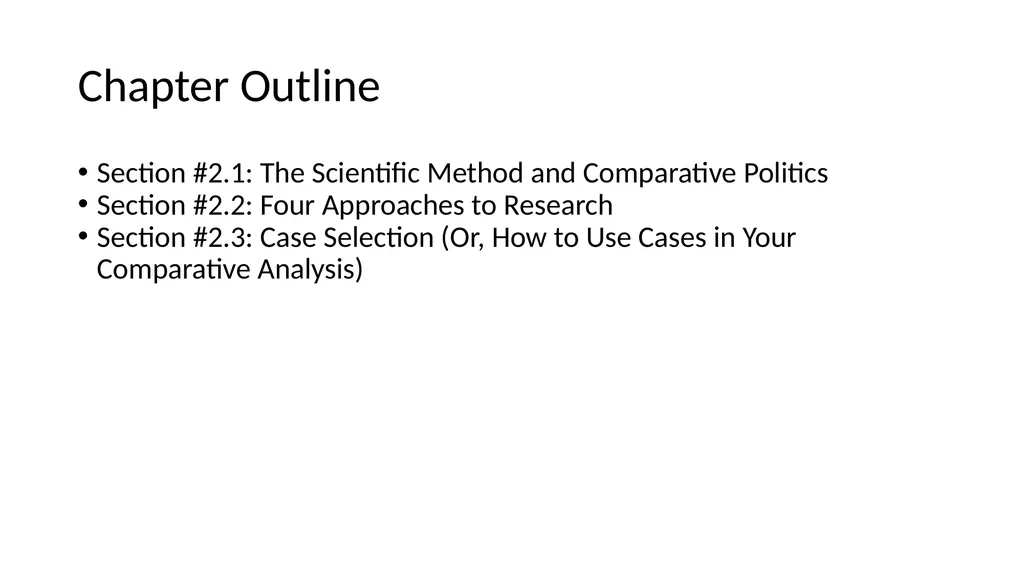
Chapter Outline Section #2.1: The Scientific Method and Comparative Politics
Section #2.2: Four Approaches to Research
Section #2.3: Case Selection (Or, How to Use Cases in Your Comparative Analysis)<br>
Section #2.2: Four Approaches to Research
Section #2.3: Case Selection (Or, How to Use Cases in Your Comparative Analysis)<br>
03
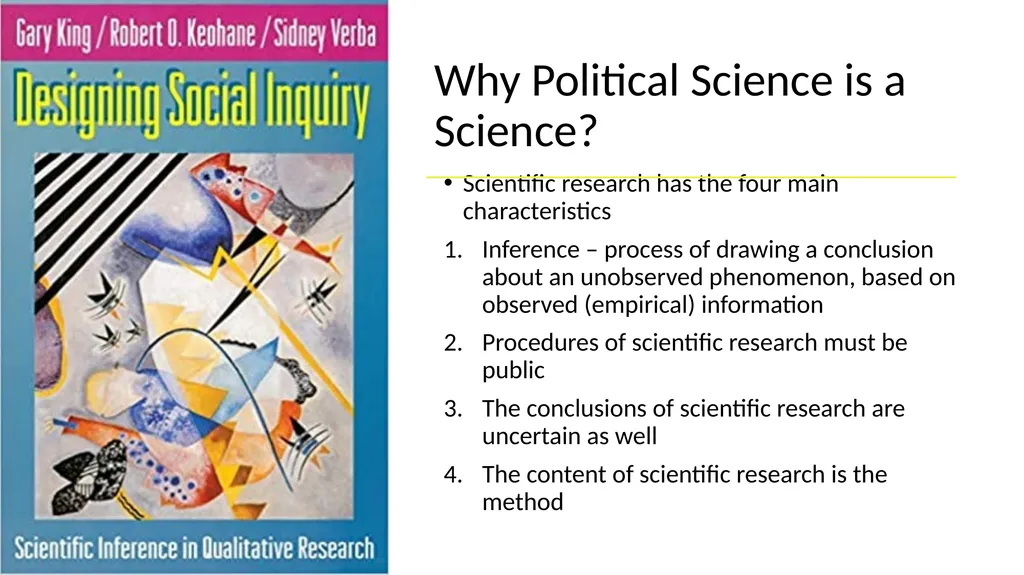
Why Political Science is a Science? Scientific research has the four main characteristics
Inference – process of drawing a conclusion about an unobserved phenomenon, based on observed (empirical) information
Procedures of scientific research must be public
The conclusions of scientific research are uncertain as well
The content of scientific research is the method<br>
Inference – process of drawing a conclusion about an unobserved phenomenon, based on observed (empirical) information
Procedures of scientific research must be public
The conclusions of scientific research are uncertain as well
The content of scientific research is the method<br>
04
2.1 The Scientific Method and Comparative Politics Science is defined as the systematic and organized approach to any area of inquiry and utilizes scientific methods to acquire and build a body of knowledge
Political science, as well as comparative politics as a subfield of political science, embody the essence of the scientific method and possess deep foundations for the scientific tools and theory formation which align with their areas of inquiry
Scientific research must adhere to a set of rules of inference because its validity is dependent on how closely one follows such rules and procedures
Simply put, one can virtually study anything in a scientific manner as long as the researcher follows the rules of inference and scientific methods<br>
Political science, as well as comparative politics as a subfield of political science, embody the essence of the scientific method and possess deep foundations for the scientific tools and theory formation which align with their areas of inquiry
Scientific research must adhere to a set of rules of inference because its validity is dependent on how closely one follows such rules and procedures
Simply put, one can virtually study anything in a scientific manner as long as the researcher follows the rules of inference and scientific methods<br>
05
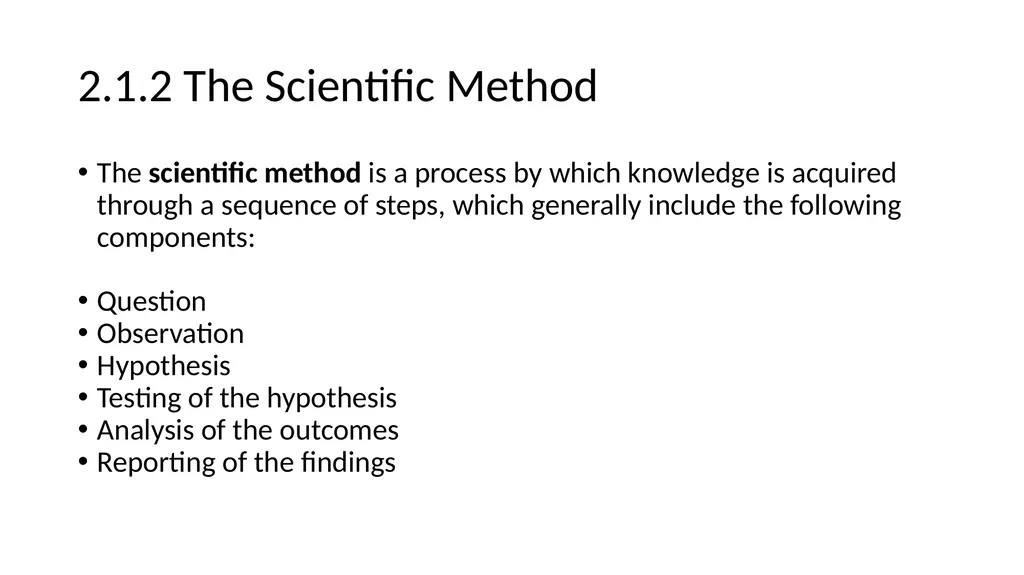
2.1.2 The Scientific Method The scientific method is a process by which knowledge is acquired through a sequence of steps, which generally include the following components:
Question
Observation
Hypothesis
Testing of the hypothesis
Analysis of the outcomes
Reporting of the findings<br>
Question
Observation
Hypothesis
Testing of the hypothesis
Analysis of the outcomes
Reporting of the findings<br>
06
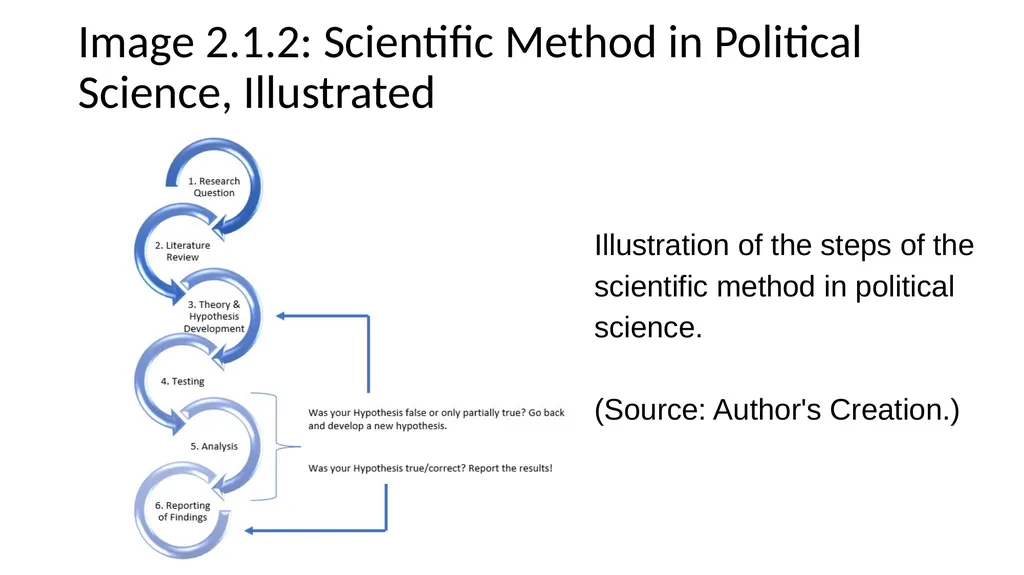
Image 2.1.2: Scientific Method in Political Science, Illustrated Illustration of the steps of the scientific method in political science.
(Source: Author's Creation.)<br>
(Source: Author's Creation.)<br>
07
2.1.2 The Scientific Method: The Research Question Develop a clear, focused and relevant research question
Although this sounds like a simple step, there is complexity of forming a sound research question
A research question must be falsifiable:
Able to be logically contradicted through empirical testing
Non-falsifiable
The question cannot be proven true or false under present circumstances, particularly questions which are subjective
Empirical analysis:
Defined as being based on experiment, experience or observation<br>
Although this sounds like a simple step, there is complexity of forming a sound research question
A research question must be falsifiable:
Able to be logically contradicted through empirical testing
Non-falsifiable
The question cannot be proven true or false under present circumstances, particularly questions which are subjective
Empirical analysis:
Defined as being based on experiment, experience or observation<br>
08
2.1.2 The Scientific Method: Literature Review Research the context and background information and previous research regarding this research question
A literature review becomes a section of your research paper or research process which collects key sources and previous research on your research question and discusses the findings in synthesis with each other
From this work, you are able to have a full scope of understanding of all previous work performed on your topic, which will enhance knowledge in the field.<br>
A literature review becomes a section of your research paper or research process which collects key sources and previous research on your research question and discusses the findings in synthesis with each other
From this work, you are able to have a full scope of understanding of all previous work performed on your topic, which will enhance knowledge in the field.<br>
09
2.1.2 The Scientific Method: Theory and Hypothesis Development Develop a theory that explains a potential answer to your research question
A theory is a statement that explains how the world works based on the experiences and observation
Consists of a set of assumptions, hypotheses, and independent (explanatory) and dependent (outcome) variables
Assumptions are statements that are taken for granted<br>
A theory is a statement that explains how the world works based on the experiences and observation
Consists of a set of assumptions, hypotheses, and independent (explanatory) and dependent (outcome) variables
Assumptions are statements that are taken for granted<br>
10
2.1.2 The Scientific Method: Theory and Hypothesis Development A hypothesis is a specific and testable prediction of what you think will happen
A hypothesis, or set of hypotheses, will describe, in very clear terms, what you expect will happen given the circumstances
Inductive reasoning
Scientists look at specific situations and attempt to form a hypothesis
Deductive reasoning
Make an inference and then test its truth using evidence and observations<br>
A hypothesis, or set of hypotheses, will describe, in very clear terms, what you expect will happen given the circumstances
Inductive reasoning
Scientists look at specific situations and attempt to form a hypothesis
Deductive reasoning
Make an inference and then test its truth using evidence and observations<br>
11
2.1.2 The Scientific Method: Theory and Hypothesis Development A variable is a factor or object that can vary or change.
As political scientists are concerned with cause-and-effect relationships, they will divide the variables into two categories:
Independent variables (a.k.a. Explanatory variables) are the cause, and these variables are independent of other variables under consideration in a study
Dependent variables (a.k.a. Outcome variables) are the assumed effect, their values will (presumably) depend on the changes in the independent variables<br>
As political scientists are concerned with cause-and-effect relationships, they will divide the variables into two categories:
Independent variables (a.k.a. Explanatory variables) are the cause, and these variables are independent of other variables under consideration in a study
Dependent variables (a.k.a. Outcome variables) are the assumed effect, their values will (presumably) depend on the changes in the independent variables<br>
12
2.1.2 The Scientific Method: Testing & Analysis A political scientist, at this stage, will test the hypothesis, or hypotheses, through observation of the relationship between the designated variables
When the testing is complete, political scientists will need to review their results and draw conclusions about the findings
Was the hypothesis correct? If so, they will be able to report out the success of their findings
Was the hypothesis incorrect? That’s okay! A famous quip in this field is, “No finding is still a finding”
If the hypothesis was not proven true, or fully true, then it’s back to the drawing board to rethink a new hypothesis and do the testing again<br>
When the testing is complete, political scientists will need to review their results and draw conclusions about the findings
Was the hypothesis correct? If so, they will be able to report out the success of their findings
Was the hypothesis incorrect? That’s okay! A famous quip in this field is, “No finding is still a finding”
If the hypothesis was not proven true, or fully true, then it’s back to the drawing board to rethink a new hypothesis and do the testing again<br>
13
2.1.2 The Scientific Method:
Reporting of Findings Reporting results, whether the hypothesis is true, partially true, or outright false, is critical to the advancement of the overall field
Not all research will result in publication, though publication is often the goal of research
Typically, researchers will attempt to publish their findings in a public and transparent manner
Others may continue research in that area<br>
Not all research will result in publication, though publication is often the goal of research
Typically, researchers will attempt to publish their findings in a public and transparent manner
Others may continue research in that area<br>
14
2.2 Four Approaches to Research 1. Experimental Method
2. Statistical Methods
3. The Comparative Method
4. Case Studies<br>
2. Statistical Methods
3. The Comparative Method
4. Case Studies<br>
15
2.2.1: The Experimental Method An experiment is defined as “laboratory studies in which investigators retain control over the recruitment, assignment to random conditions, treatment, and measurement of subjects”
An experiment is used whenever the researcher seeks to answer causal questions or is looking for causal inference. A causal question involves discerning cause and effect, also referred to as a causal relationship
Experimental methods in political science almost always involve statistical tools to discern causality, which will be discussed next<br>
An experiment is used whenever the researcher seeks to answer causal questions or is looking for causal inference. A causal question involves discerning cause and effect, also referred to as a causal relationship
Experimental methods in political science almost always involve statistical tools to discern causality, which will be discussed next<br>
16
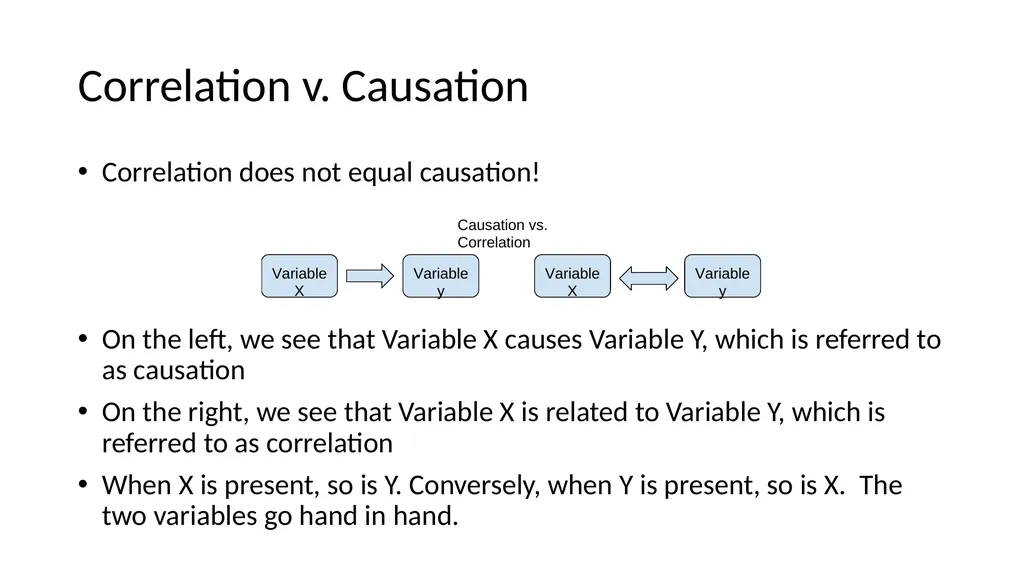
Correlation v. Causation Correlation does not equal causation!
On the left, we see that Variable X causes Variable Y, which is referred to as causation
On the right, we see that Variable X is related to Variable Y, which is referred to as correlation
When X is present, so is Y. Conversely, when Y is present, so is X. The two variables go hand in hand.<br>
On the left, we see that Variable X causes Variable Y, which is referred to as causation
On the right, we see that Variable X is related to Variable Y, which is referred to as correlation
When X is present, so is Y. Conversely, when Y is present, so is X. The two variables go hand in hand.<br>
17
2.2.2: Statistical Methods Statistical methods are the use of mathematical techniques to analyze collected data, usually in numerical form, such as interval or ratio-scale
Statistical methods are also the preferred approach when it comes to the analysis of survey data. Survey research involves the examination of a sample derived from a larger population
Applied research is defined as “research that attempts to explain social phenomena with immediate public policy implications"<br>
Statistical methods are also the preferred approach when it comes to the analysis of survey data. Survey research involves the examination of a sample derived from a larger population
Applied research is defined as “research that attempts to explain social phenomena with immediate public policy implications"<br>
18
2.2.3: The Comparative Method Comparative methods involve the analysis of a small number of cases, entailing at least two observations
Comparison is more than just description, it involves conceptualizing
A concept is defined as “an abstract or generic idea generalized from particular instances”
Concepts are “generally seen as nonmathematical and deal with substantive issues”
The comparative method involves more than a case study, or single-N research but less than a statistical analysis, or large-N study<br>
Comparison is more than just description, it involves conceptualizing
A concept is defined as “an abstract or generic idea generalized from particular instances”
Concepts are “generally seen as nonmathematical and deal with substantive issues”
The comparative method involves more than a case study, or single-N research but less than a statistical analysis, or large-N study<br>
19
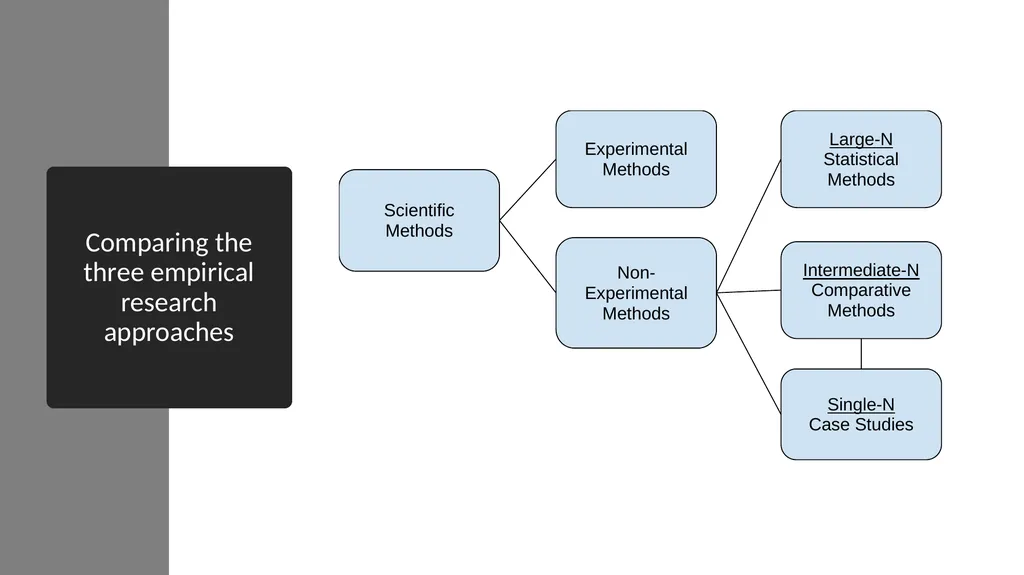
Comparing the three empirical research approaches<br>
20
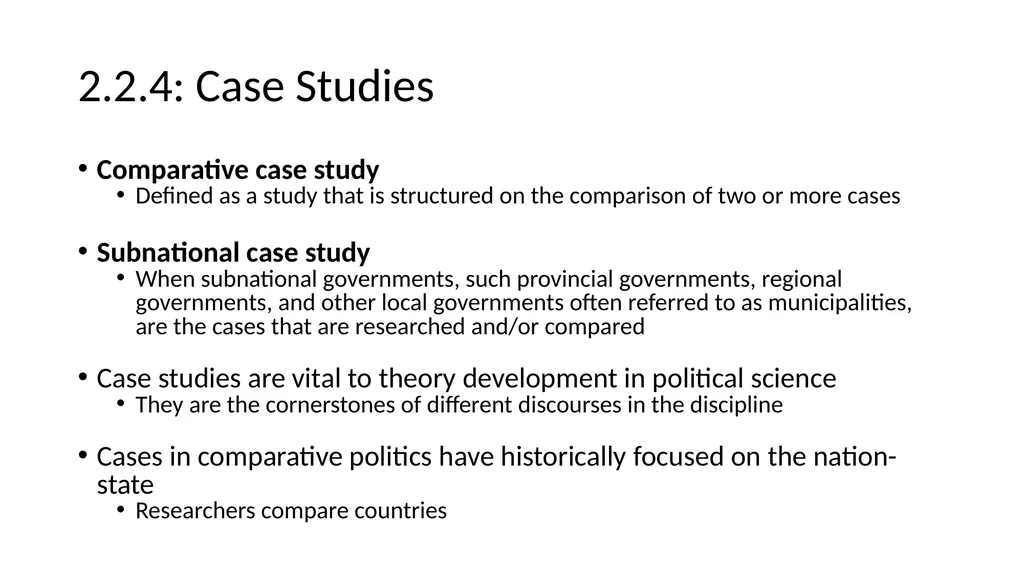
2.2.4: Case Studies Comparative case study
Defined as a study that is structured on the comparison of two or more cases
Subnational case study
When subnational governments, such provincial governments, regional governments, and other local governments often referred to as municipalities, are the cases that are researched and/or compared
Case studies are vital to theory development in political science
They are the cornerstones of different discourses in the discipline
Cases in comparative politics have historically focused on the nation-state
Researchers compare countries<br>
Defined as a study that is structured on the comparison of two or more cases
Subnational case study
When subnational governments, such provincial governments, regional governments, and other local governments often referred to as municipalities, are the cases that are researched and/or compared
Case studies are vital to theory development in political science
They are the cornerstones of different discourses in the discipline
Cases in comparative politics have historically focused on the nation-state
Researchers compare countries<br>
21
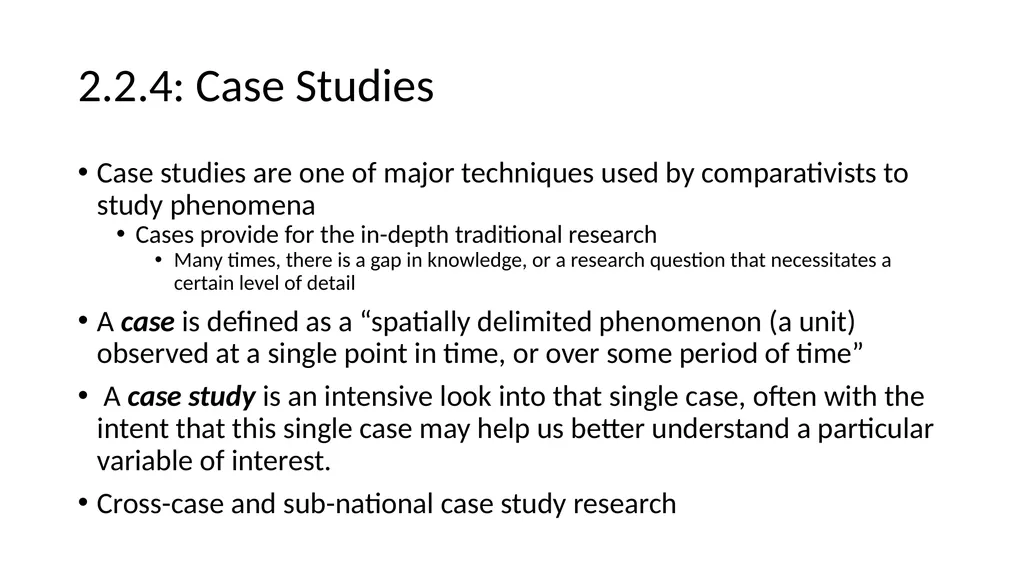
2.2.4: Case Studies Case studies are one of major techniques used by comparativists to study phenomena
Cases provide for the in-depth traditional research
Many times, there is a gap in knowledge, or a research question that necessitates a certain level of detail
A case is defined as a “spatially delimited phenomenon (a unit) observed at a single point in time, or over some period of time”
A case study is an intensive look into that single case, often with the intent that this single case may help us better understand a particular variable of interest.
Cross-case and sub-national case study research<br>
Cases provide for the in-depth traditional research
Many times, there is a gap in knowledge, or a research question that necessitates a certain level of detail
A case is defined as a “spatially delimited phenomenon (a unit) observed at a single point in time, or over some period of time”
A case study is an intensive look into that single case, often with the intent that this single case may help us better understand a particular variable of interest.
Cross-case and sub-national case study research<br>
22
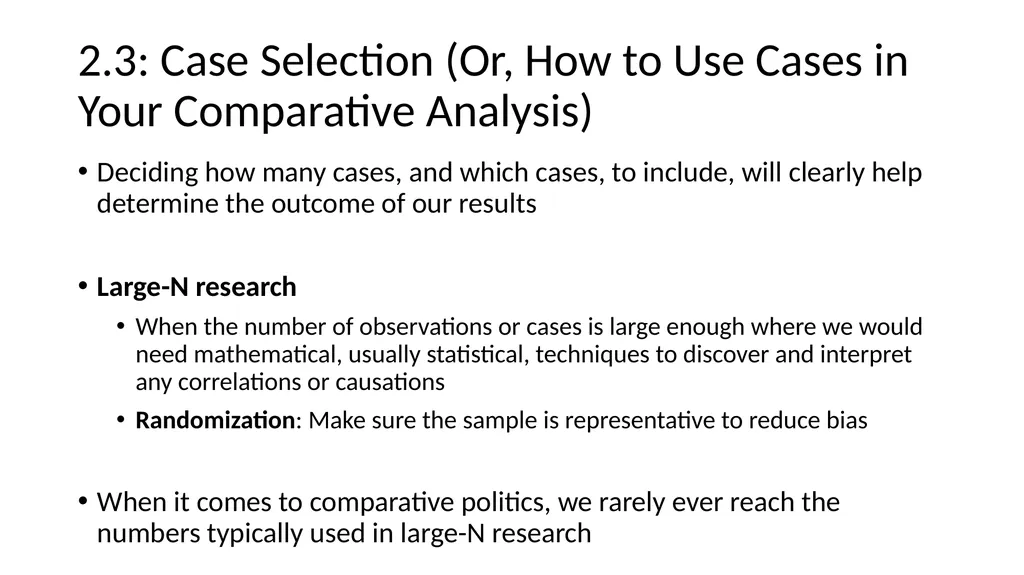
2.3: Case Selection (Or, How to Use Cases in Your Comparative Analysis) Deciding how many cases, and which cases, to include, will clearly help determine the outcome of our results
Large-N research
When the number of observations or cases is large enough where we would need mathematical, usually statistical, techniques to discover and interpret any correlations or causations
Randomization: Make sure the sample is representative to reduce bias
When it comes to comparative politics, we rarely ever reach the numbers typically used in large-N research<br>
Large-N research
When the number of observations or cases is large enough where we would need mathematical, usually statistical, techniques to discover and interpret any correlations or causations
Randomization: Make sure the sample is representative to reduce bias
When it comes to comparative politics, we rarely ever reach the numbers typically used in large-N research<br>
23
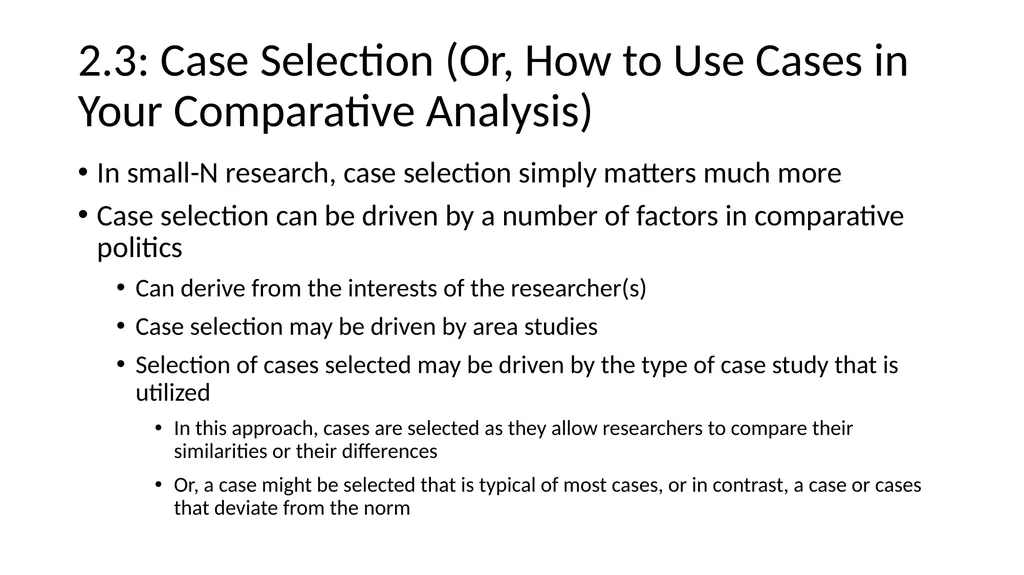
2.3: Case Selection (Or, How to Use Cases in Your Comparative Analysis) In small-N research, case selection simply matters much more
Case selection can be driven by a number of factors in comparative politics
Can derive from the interests of the researcher(s)
Case selection may be driven by area studies
Selection of cases selected may be driven by the type of case study that is utilized
In this approach, cases are selected as they allow researchers to compare their similarities or their differences
Or, a case might be selected that is typical of most cases, or in contrast, a case or cases that deviate from the norm<br>
Case selection can be driven by a number of factors in comparative politics
Can derive from the interests of the researcher(s)
Case selection may be driven by area studies
Selection of cases selected may be driven by the type of case study that is utilized
In this approach, cases are selected as they allow researchers to compare their similarities or their differences
Or, a case might be selected that is typical of most cases, or in contrast, a case or cases that deviate from the norm<br>
24
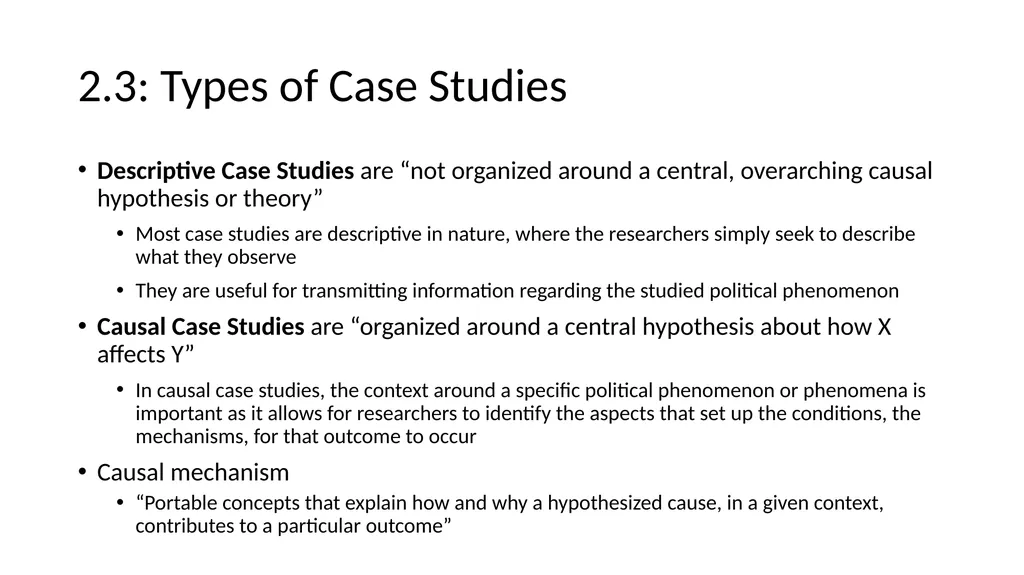
2.3: Types of Case Studies Descriptive Case Studies are “not organized around a central, overarching causal hypothesis or theory”
Most case studies are descriptive in nature, where the researchers simply seek to describe what they observe
They are useful for transmitting information regarding the studied political phenomenon
Causal Case Studies are “organized around a central hypothesis about how X affects Y”
In causal case studies, the context around a specific political phenomenon or phenomena is important as it allows for researchers to identify the aspects that set up the conditions, the mechanisms, for that outcome to occur
Causal mechanism
“Portable concepts that explain how and why a hypothesized cause, in a given context, contributes to a particular outcome”<br>
Most case studies are descriptive in nature, where the researchers simply seek to describe what they observe
They are useful for transmitting information regarding the studied political phenomenon
Causal Case Studies are “organized around a central hypothesis about how X affects Y”
In causal case studies, the context around a specific political phenomenon or phenomena is important as it allows for researchers to identify the aspects that set up the conditions, the mechanisms, for that outcome to occur
Causal mechanism
“Portable concepts that explain how and why a hypothesized cause, in a given context, contributes to a particular outcome”<br>
25
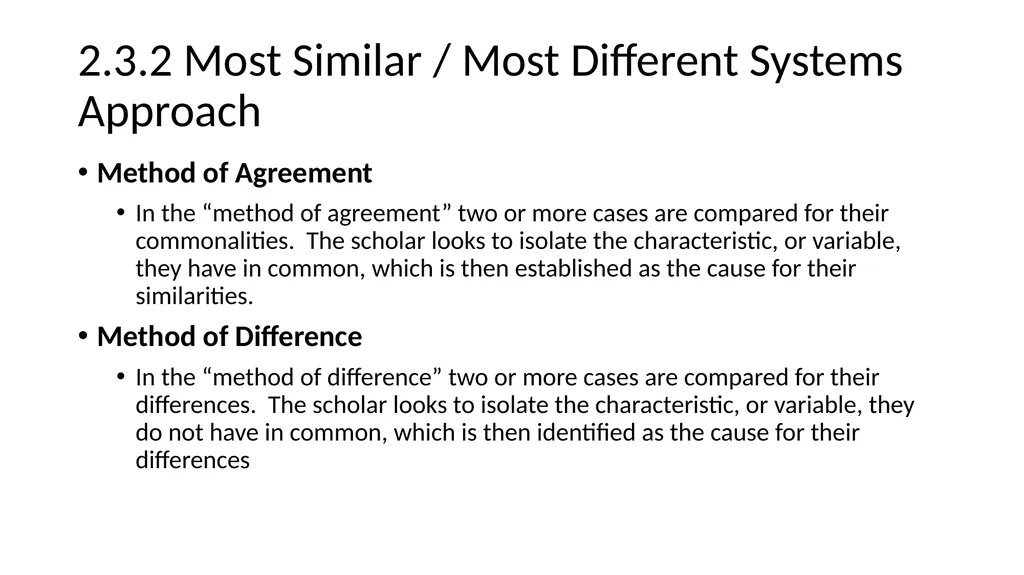
2.3.2 Most Similar / Most Different Systems Approach Method of Agreement
In the “method of agreement” two or more cases are compared for their commonalities. The scholar looks to isolate the characteristic, or variable, they have in common, which is then established as the cause for their similarities.
Method of Difference
In the “method of difference” two or more cases are compared for their differences. The scholar looks to isolate the characteristic, or variable, they do not have in common, which is then identified as the cause for their differences<br>
In the “method of agreement” two or more cases are compared for their commonalities. The scholar looks to isolate the characteristic, or variable, they have in common, which is then established as the cause for their similarities.
Method of Difference
In the “method of difference” two or more cases are compared for their differences. The scholar looks to isolate the characteristic, or variable, they do not have in common, which is then identified as the cause for their differences<br>
26
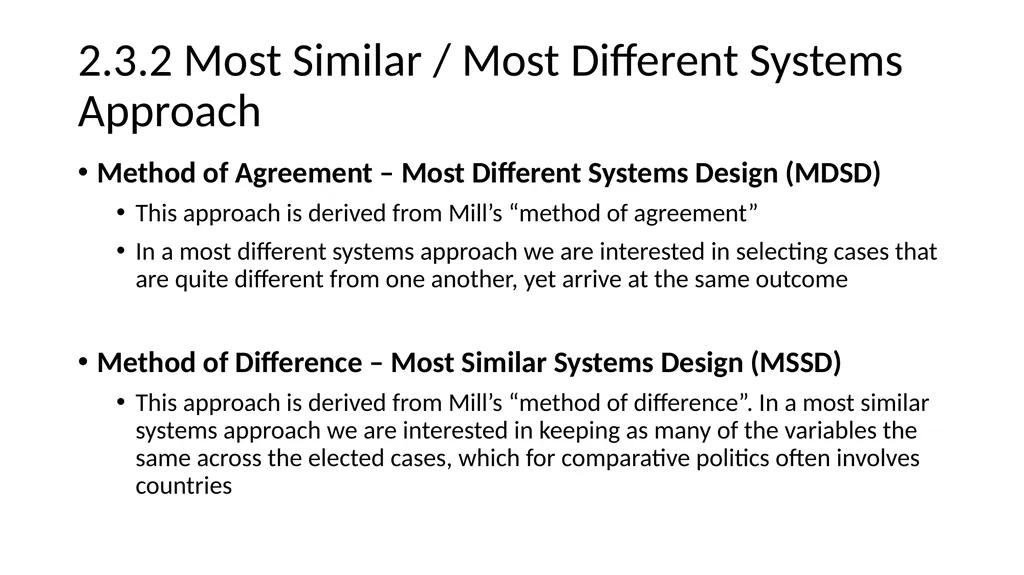
2.3.2 Most Similar / Most Different Systems Approach Method of Agreement – Most Different Systems Design (MDSD)
This approach is derived from Mill’s “method of agreement”
In a most different systems approach we are interested in selecting cases that are quite different from one another, yet arrive at the same outcome
Method of Difference – Most Similar Systems Design (MSSD)
This approach is derived from Mill’s “method of difference”. In a most similar systems approach we are interested in keeping as many of the variables the same across the elected cases, which for comparative politics often involves countries<br>
This approach is derived from Mill’s “method of agreement”
In a most different systems approach we are interested in selecting cases that are quite different from one another, yet arrive at the same outcome
Method of Difference – Most Similar Systems Design (MSSD)
This approach is derived from Mill’s “method of difference”. In a most similar systems approach we are interested in keeping as many of the variables the same across the elected cases, which for comparative politics often involves countries<br>
27
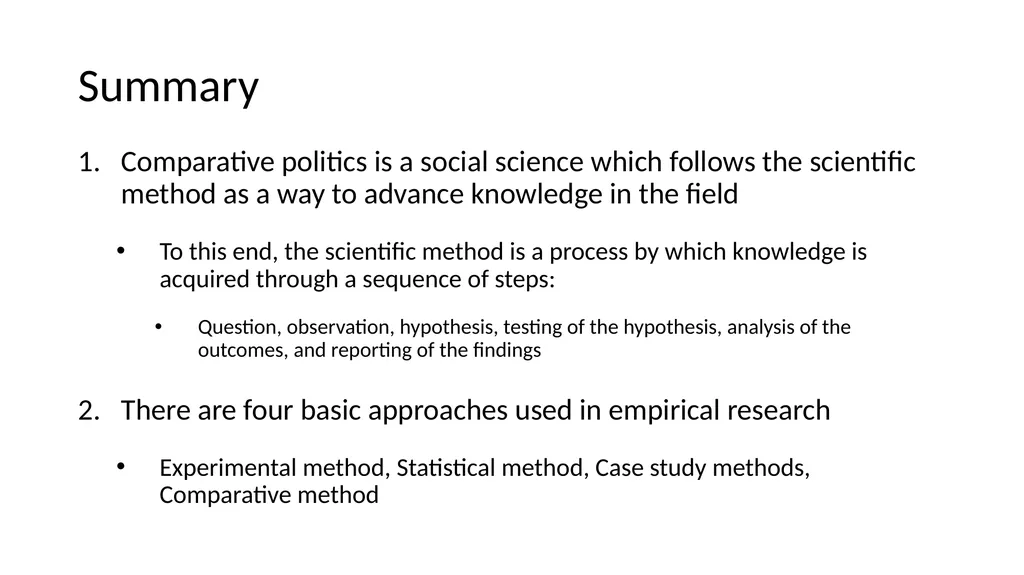
Summary Comparative politics is a social science which follows the scientific method as a way to advance knowledge in the field
To this end, the scientific method is a process by which knowledge is acquired through a sequence of steps:
Question, observation, hypothesis, testing of the hypothesis, analysis of the outcomes, and reporting of the findings
There are four basic approaches used in empirical research
Experimental method, Statistical method, Case study methods, Comparative method<br>
To this end, the scientific method is a process by which knowledge is acquired through a sequence of steps:
Question, observation, hypothesis, testing of the hypothesis, analysis of the outcomes, and reporting of the findings
There are four basic approaches used in empirical research
Experimental method, Statistical method, Case study methods, Comparative method<br>
28
Summary Case studies are one of major techniques used by comparativists to study various phenomena
A case study is an intensive look into a single case, often with the intent that this single case may help us better understand a particular variable of interest
For Case Selection, comparativists have utilized John Stuart Mill’s approaches of Most Similar System Design (MSSD) and Most Different System Design (MDSD)
In a Most Similar Systems Design approach, the cases selected are similar to each other, but result in different outcomes
Conversely, in a Most Different System Design, the cases selected are different from each other, but result in the same outcome<br>
A case study is an intensive look into a single case, often with the intent that this single case may help us better understand a particular variable of interest
For Case Selection, comparativists have utilized John Stuart Mill’s approaches of Most Similar System Design (MSSD) and Most Different System Design (MDSD)
In a Most Similar Systems Design approach, the cases selected are similar to each other, but result in different outcomes
Conversely, in a Most Different System Design, the cases selected are different from each other, but result in the same outcome<br>