
Child Development Revision Guide CNAT OCR TA4
PM
Published · 55 slides · 0 views
1 / 1



Description
Child Development Revision Guide CNAT OCR TA4 Topic Area 4: Childhood illnesses and a child safe environment Name: Introduction Welcome to your TA4 Child Development Revision Booklet! This booklet is designed to be your comprehensive guide
Related Topics
Share
Embed code
Download this presentation From Below
"Child Development Revision Guide CNAT OCR TA4" is the property of its rightful owner. Permission is granted to download and print the materials on this website for personal, non-commercial use only, and to display it on your personal computer provided you do not modify the materials and that you retain all copyright notices contained in the materials. By downloading content from our website, you accept the terms of this agreement.
Presentation Transcript
01
Child Development Revision Guide
CNAT OCR
TA4
Topic Area 4: Childhood illnesses and a child safe environment Name:<br>
02
Introduction Welcome to your TA4 Child Development Revision Booklet! This booklet is designed to be your comprehensive guide to preparing for the OCR Child Development TA1 exam. Inside, you'll find everything you need to confidently tackle the assessment.
To help you organise your revision, we've included helpful checklists to break down the information into manageable chunks. Each section of the TA4 specification is covered, providing a clear and concise overview of the key concepts. We've also included QR codes throughout the booklet that link to helpful websites, offering supplementary information and different perspectives on the topics.
To really get you thinking and applying your knowledge, each section concludes with activities designed to address common misconceptions and challenge your understanding. You'll also find practice exam questions, complete with model answers, to give you a feel for the exam format and the level of detail required.
Finally, a comprehensive glossary of key terms is provided at the back of the booklet.
Don't forget to check the very back for a complete answer section for all the activities.
Good luck with your revision!<br>
03
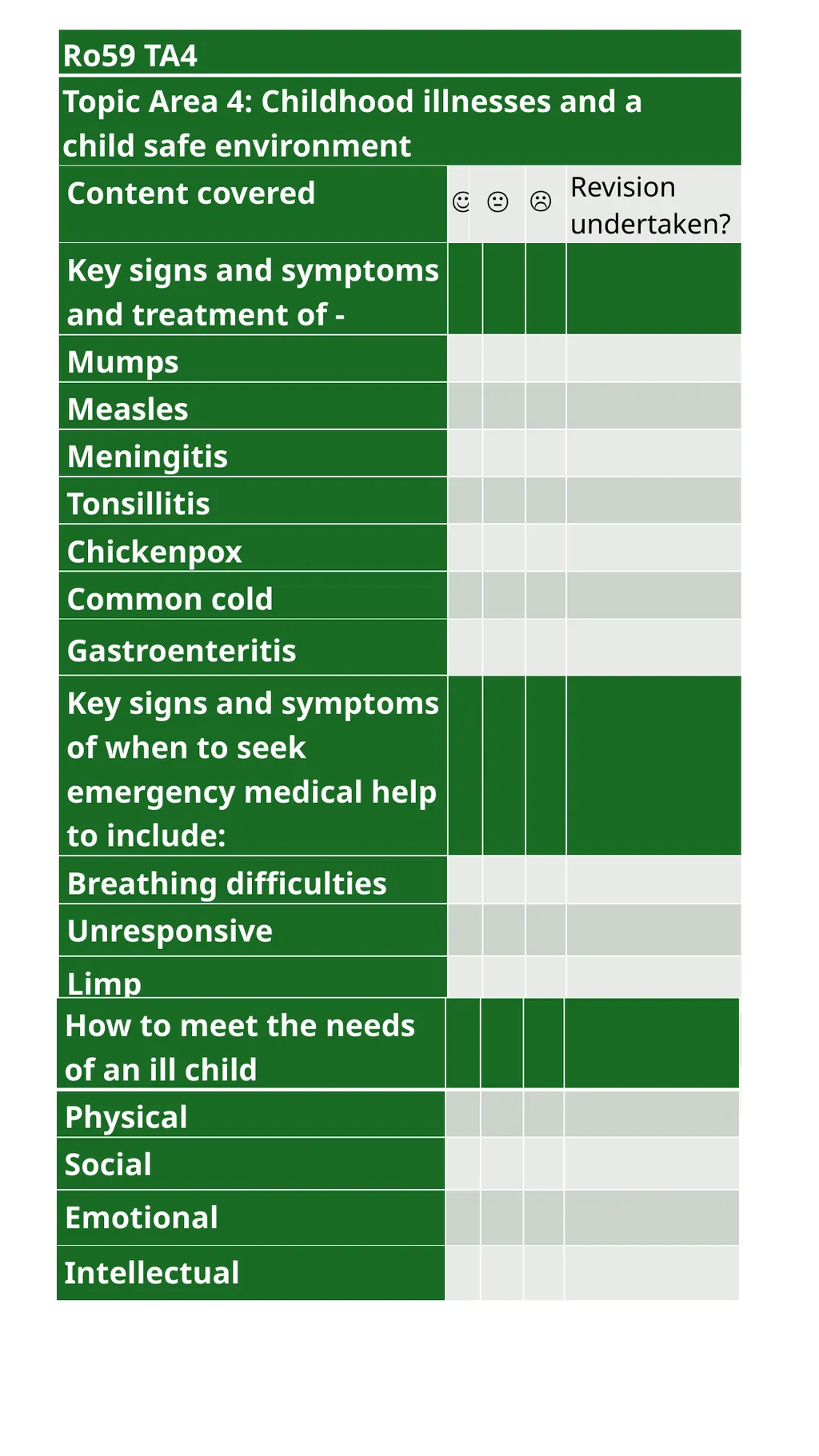
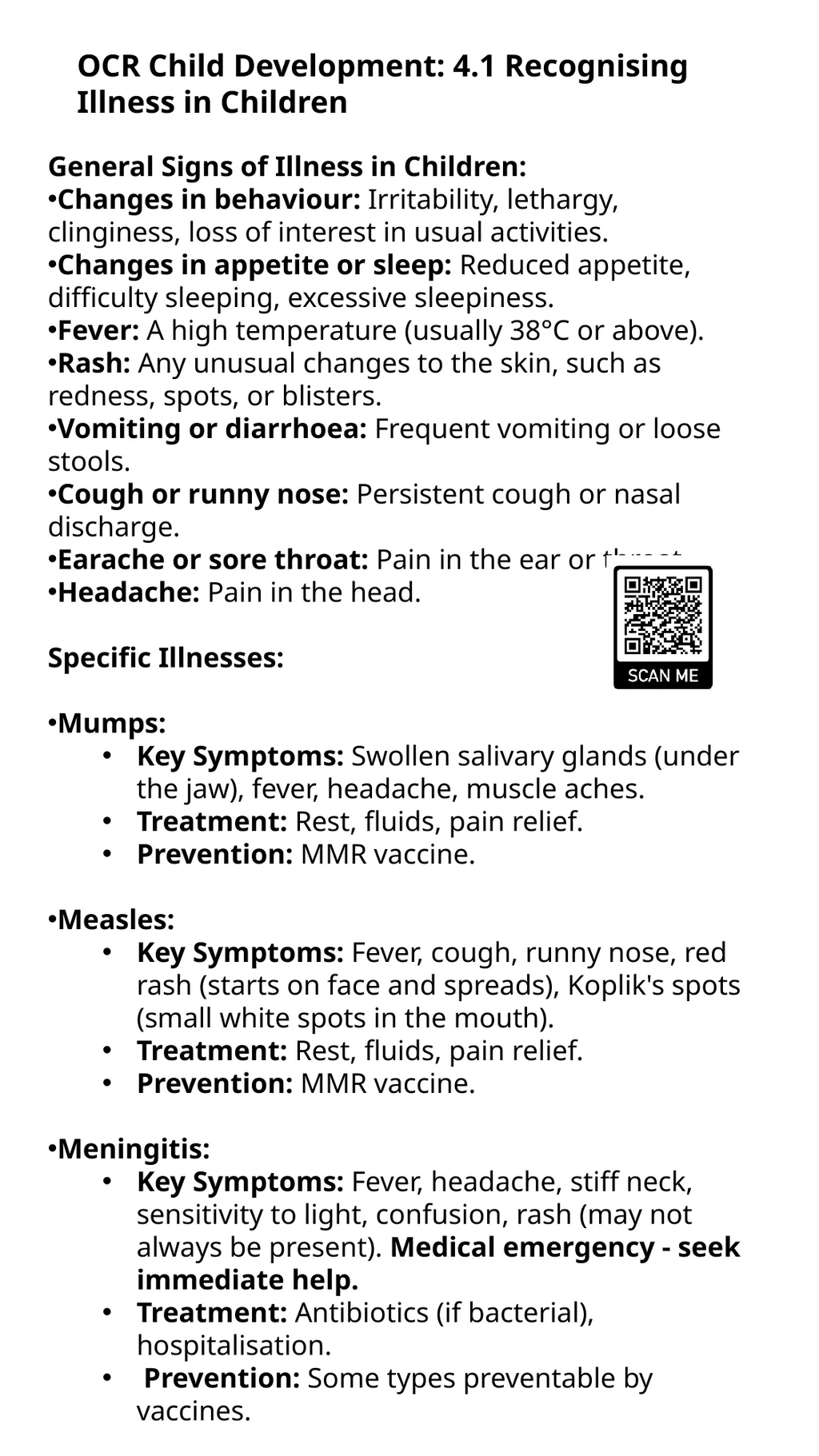
OCR Child Development: 4.1 Recognising Illness in Children General Signs of Illness in Children:
Changes in behaviour: Irritability, lethargy, clinginess, loss of interest in usual activities.
Changes in appetite or sleep: Reduced appetite, difficulty sleeping, excessive sleepiness.
Fever: A high temperature (usually 38°C or above).
Rash: Any unusual changes to the skin, such as redness, spots, or blisters.
Vomiting or diarrhoea: Frequent vomiting or loose stools.
Cough or runny nose: Persistent cough or nasal discharge.
Earache or sore throat: Pain in the ear or throat.
Headache: Pain in the head.
Specific Illnesses:
Mumps:
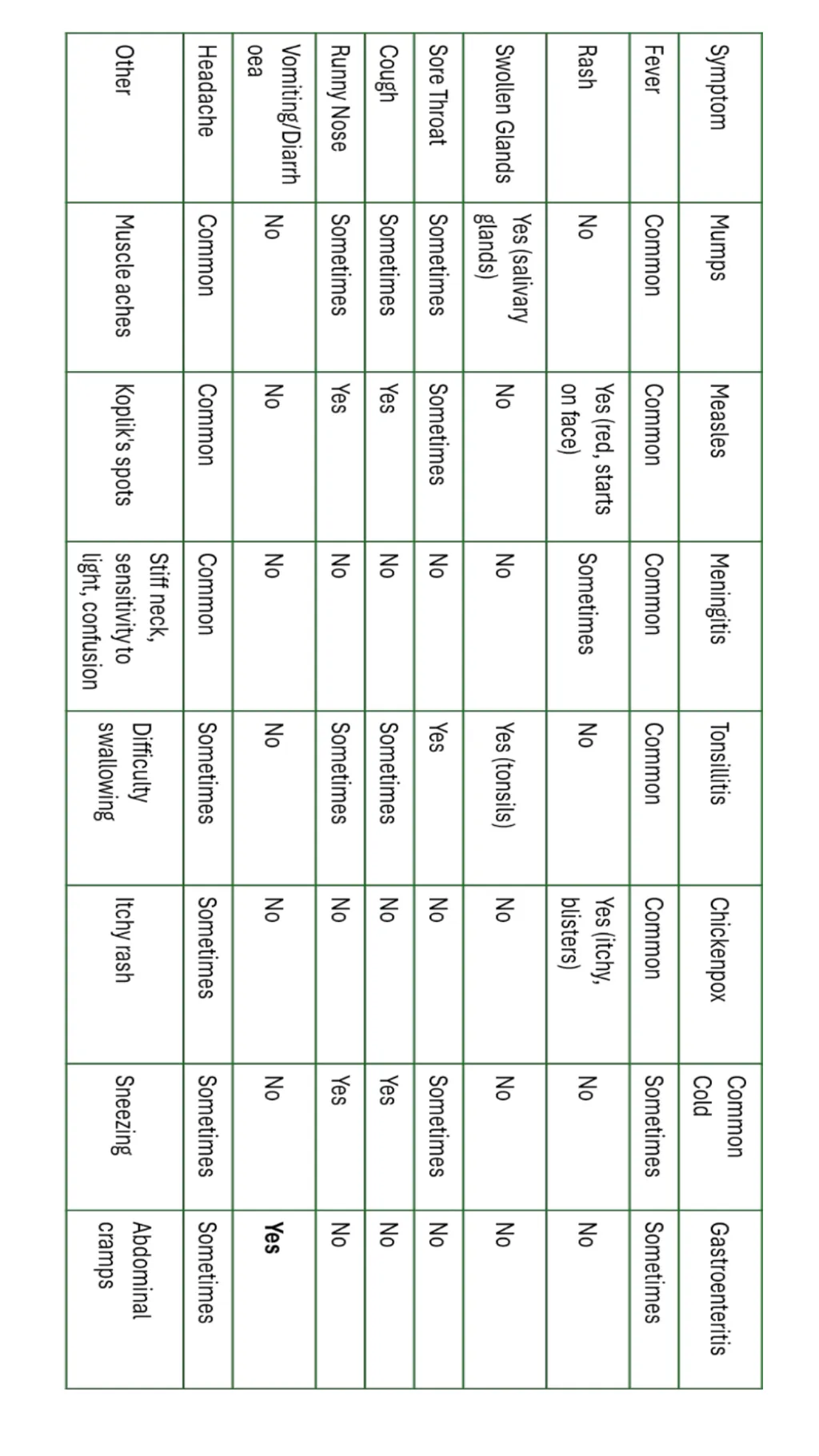
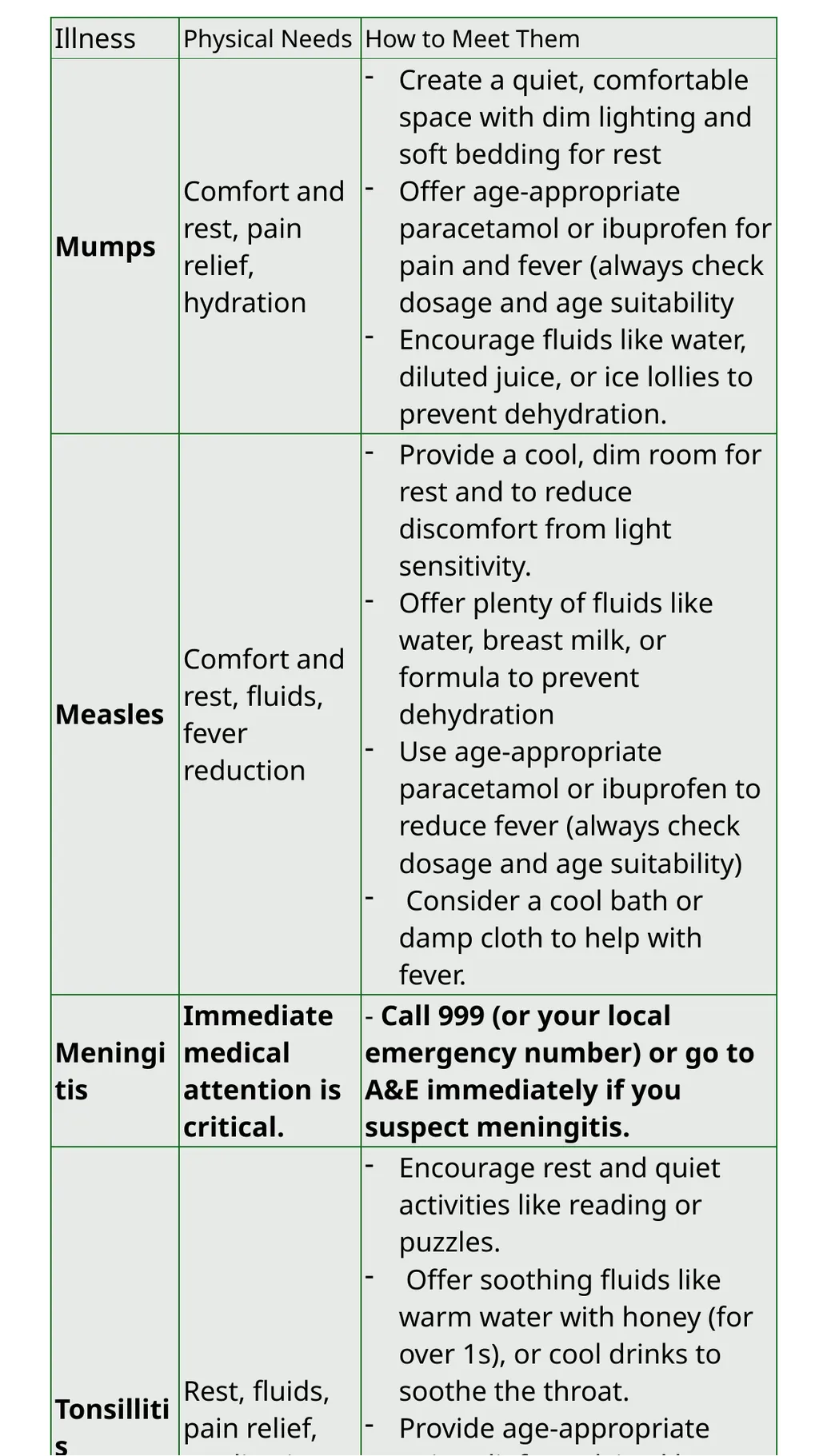
Key Symptoms: Swollen salivary glands (under the jaw), fever, headache, muscle aches.
Treatment: Rest, fluids, pain relief.
Prevention: MMR vaccine.
Measles:
Key Symptoms: Fever, cough, runny nose, red rash (starts on face and spreads), Koplik's spots (small white spots in the mouth).
Treatment: Rest, fluids, pain relief.
Prevention: MMR vaccine.
Meningitis:
Key Symptoms: Fever, headache, stiff neck, sensitivity to light, confusion, rash (may not always be present). Medical emergency - seek immediate help.
Treatment: Antibiotics (if bacterial), hospitalisation.
Prevention: Some types preventable by vaccines.<br>
04
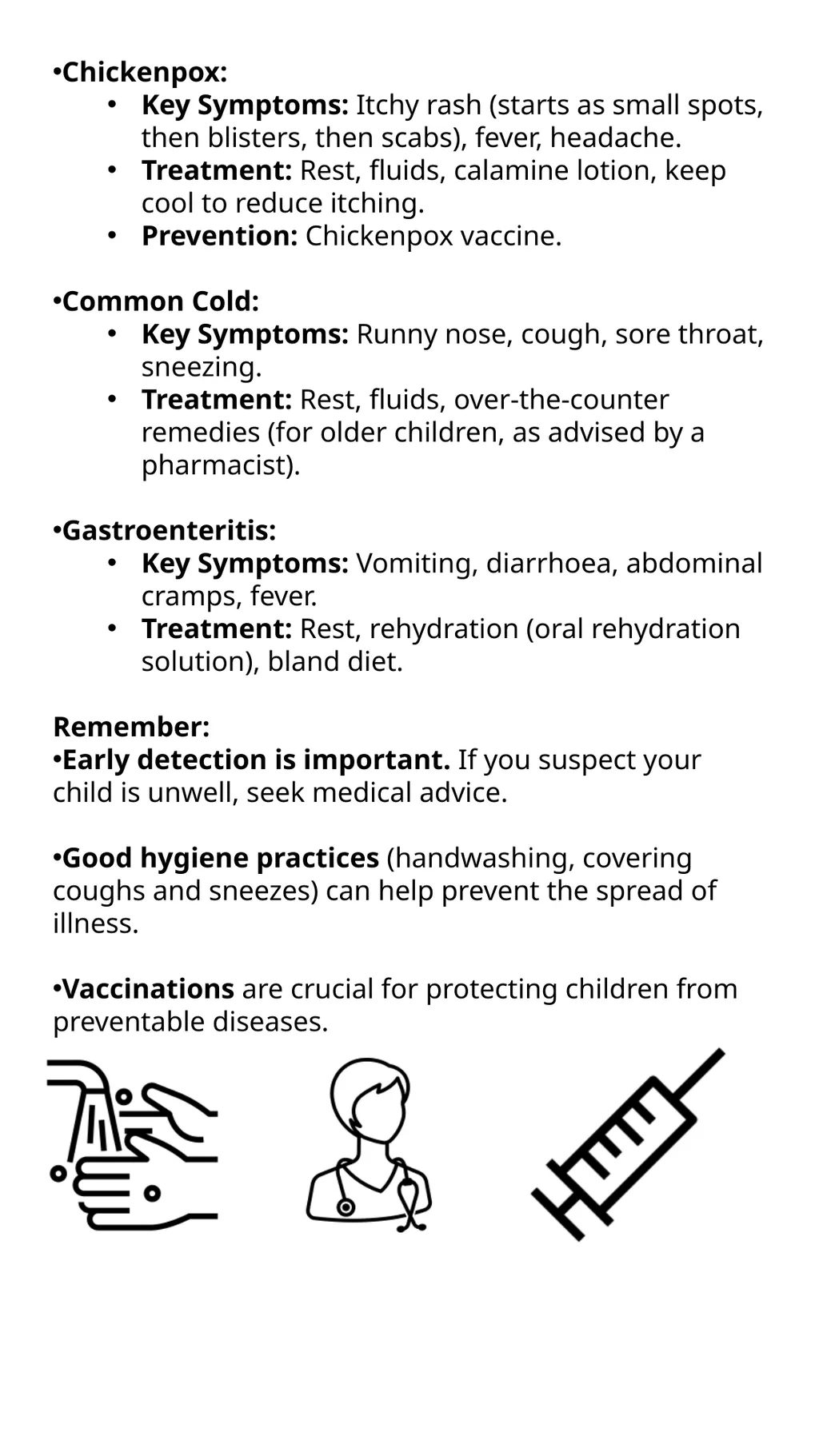
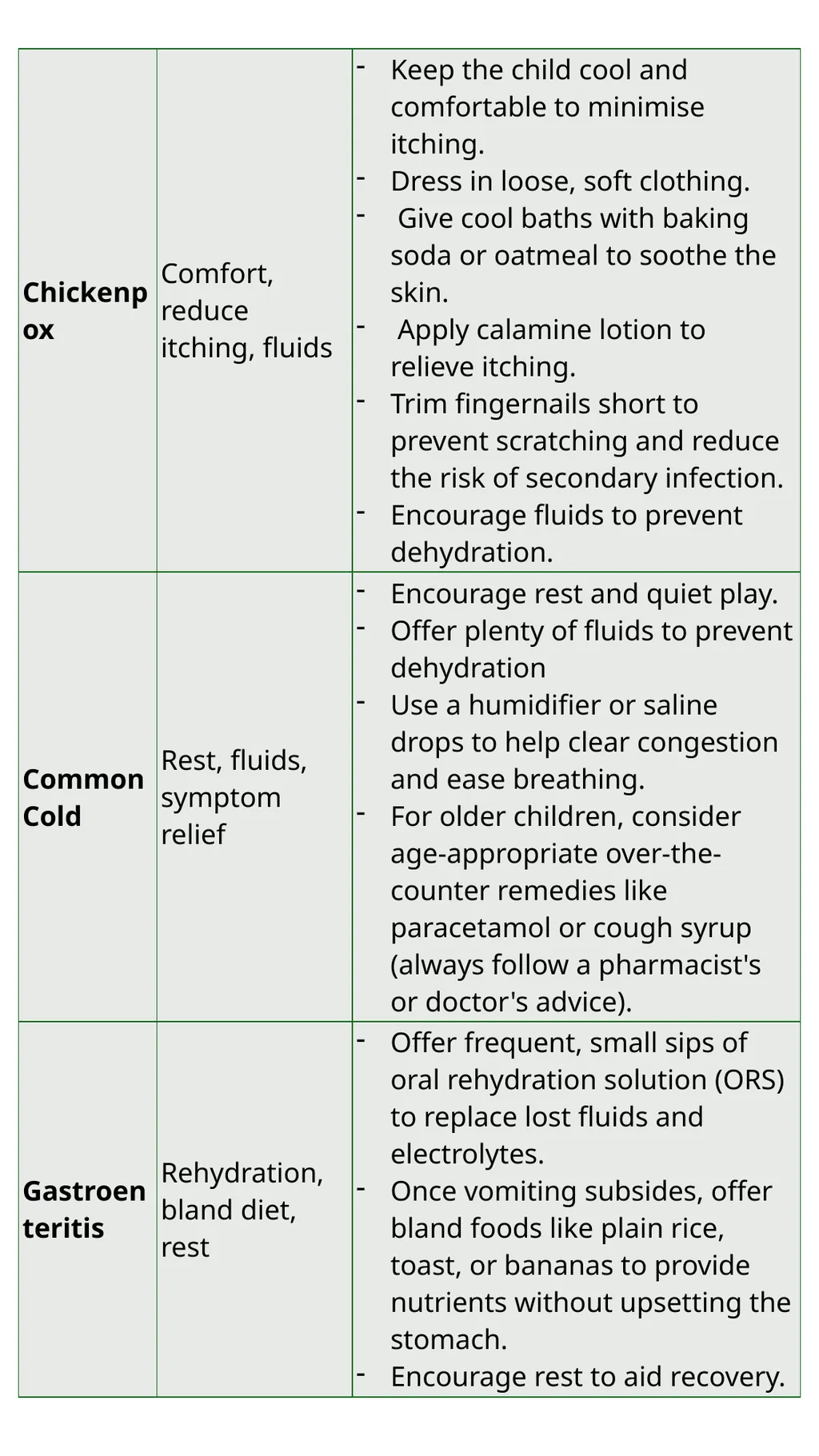
Chickenpox:
Key Symptoms: Itchy rash (starts as small spots, then blisters, then scabs), fever, headache.
Treatment: Rest, fluids, calamine lotion, keep cool to reduce itching.
Prevention: Chickenpox vaccine.
Common Cold:
Key Symptoms: Runny nose, cough, sore throat, sneezing.
Treatment: Rest, fluids, over-the-counter remedies (for older children, as advised by a pharmacist).
Gastroenteritis:
Key Symptoms: Vomiting, diarrhoea, abdominal cramps, fever.
Treatment: Rest, rehydration (oral rehydration solution), bland diet.
Remember:
Early detection is important. If you suspect your child is unwell, seek medical advice.
Good hygiene practices (handwashing, covering coughs and sneezes) can help prevent the spread of illness.
Vaccinations are crucial for protecting children from preventable diseases.<br>
05
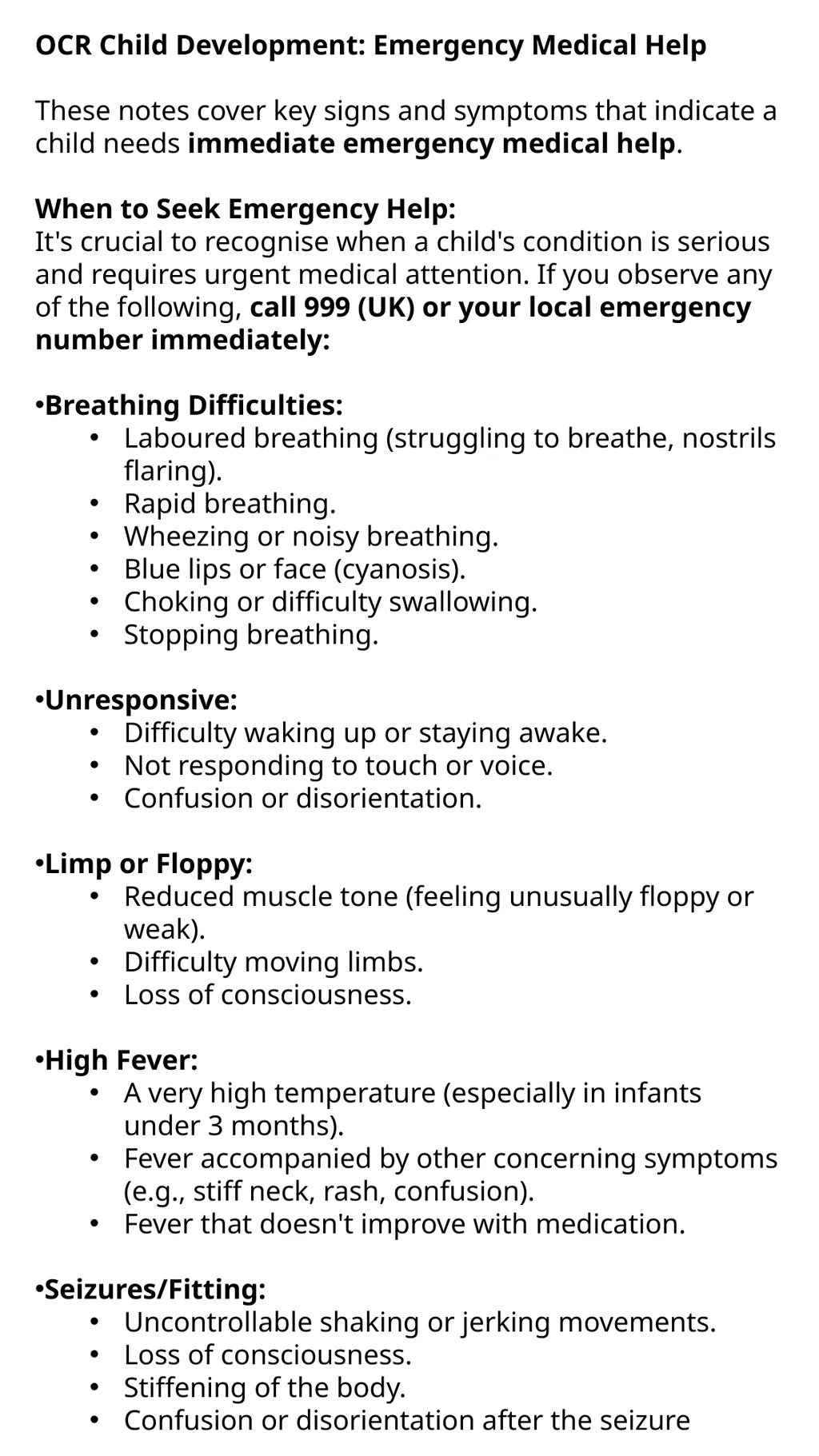
OCR Child Development: Emergency Medical Help
These notes cover key signs and symptoms that indicate a child needs immediate emergency medical help.
When to Seek Emergency Help:
It's crucial to recognise when a child's condition is serious and requires urgent medical attention. If you observe any of the following, call 999 (UK) or your local emergency number immediately:
Breathing Difficulties:
Laboured breathing (struggling to breathe, nostrils flaring).
Rapid breathing.
Wheezing or noisy breathing.
Blue lips or face (cyanosis).
Choking or difficulty swallowing.
Stopping breathing.
Unresponsive:
Difficulty waking up or staying awake.
Not responding to touch or voice.
Confusion or disorientation.
Limp or Floppy:
Reduced muscle tone (feeling unusually floppy or weak).
Difficulty moving limbs.
Loss of consciousness.
High Fever:
A very high temperature (especially in infants under 3 months).
Fever accompanied by other concerning symptoms (e.g., stiff neck, rash, confusion).
Fever that doesn't improve with medication.
Seizures/Fitting:
Uncontrollable shaking or jerking movements.
Loss of consciousness.
Stiffening of the body.
Confusion or disorientation after the seizure<br>
06
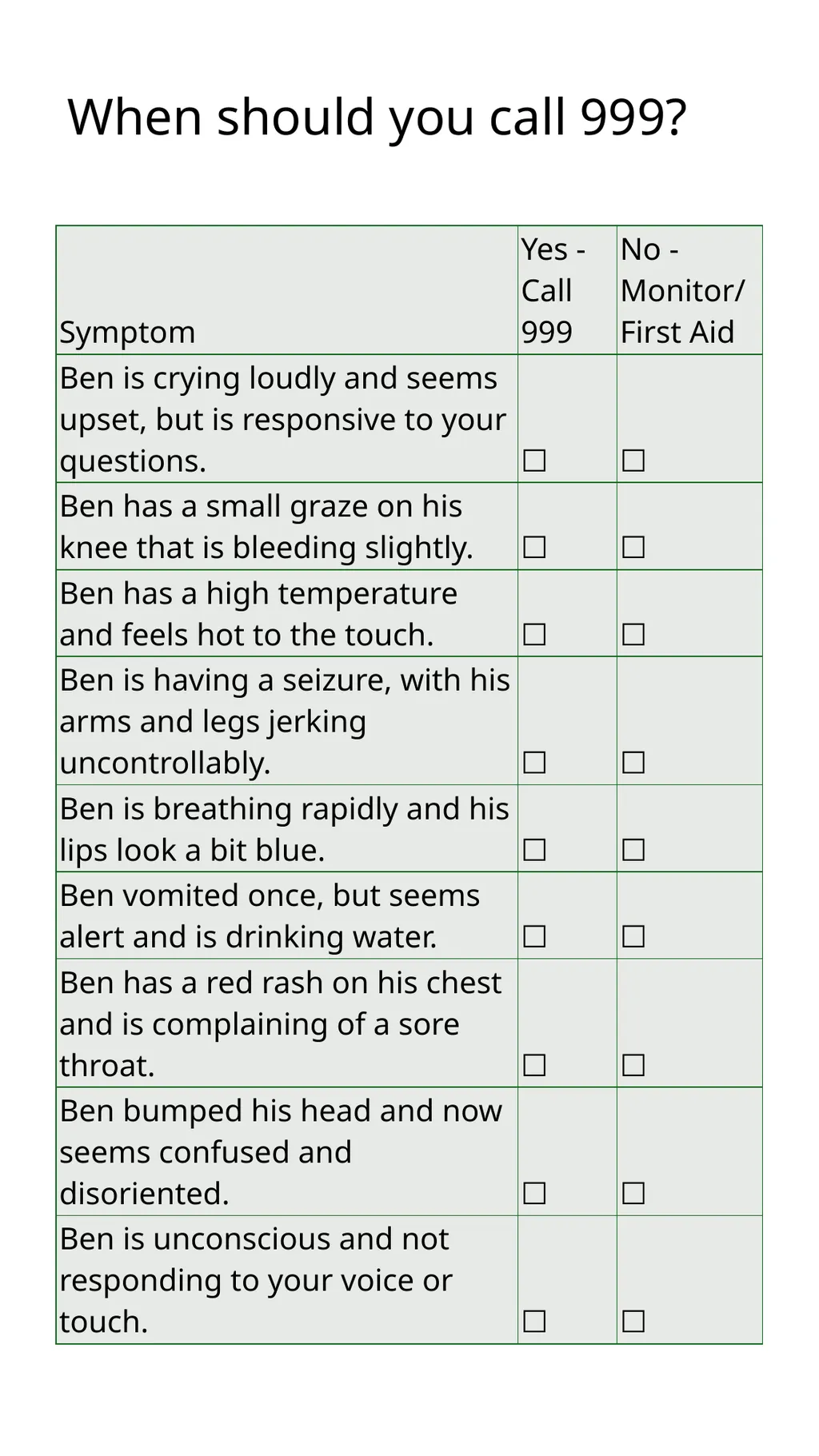
When should you call 999?<br>
07
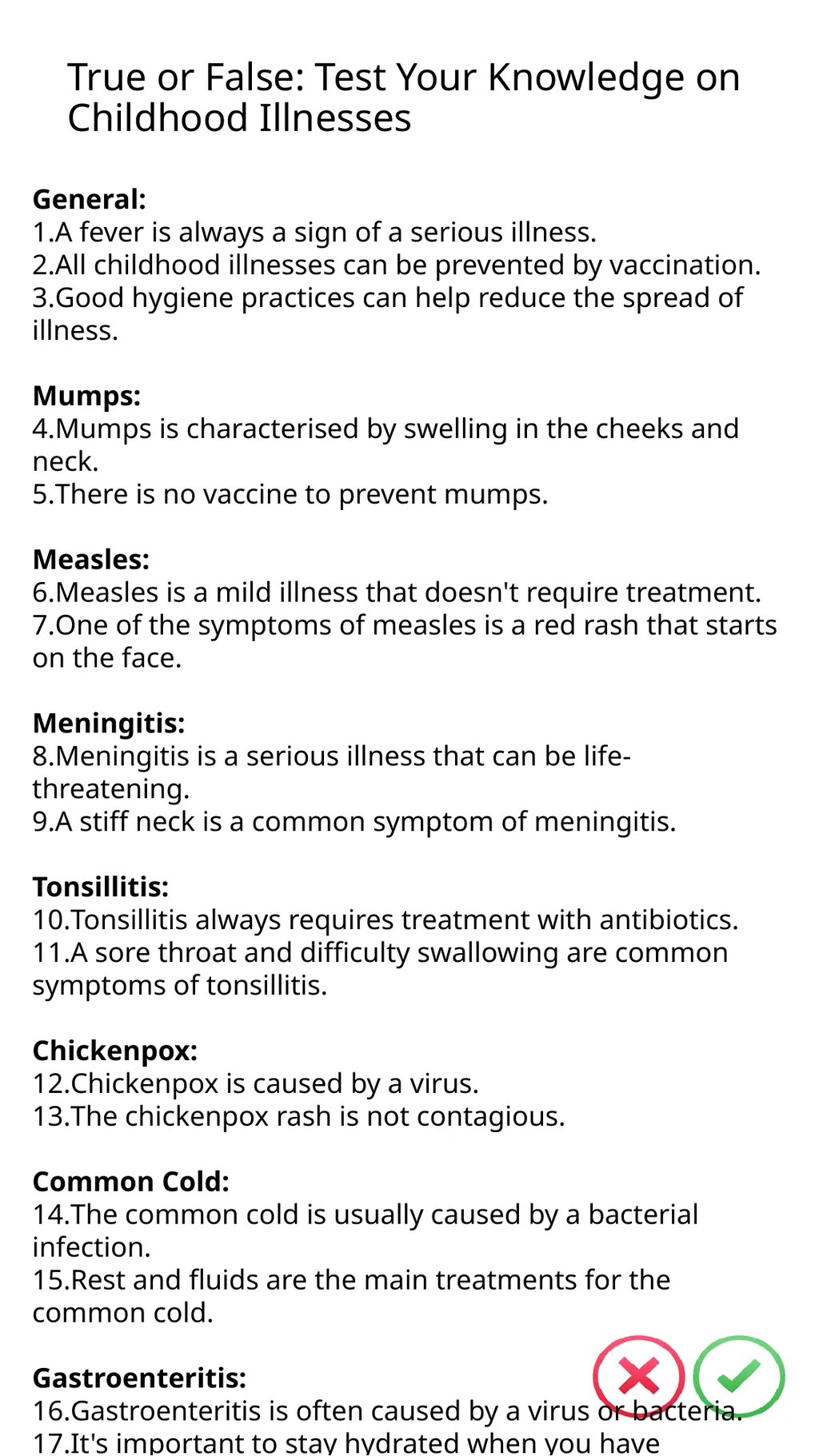
True or False: Test Your Knowledge on Childhood Illnesses General:
A fever is always a sign of a serious illness.
All childhood illnesses can be prevented by vaccination.
Good hygiene practices can help reduce the spread of illness.
Mumps:
Mumps is characterised by swelling in the cheeks and neck.
There is no vaccine to prevent mumps.
Measles:
Measles is a mild illness that doesn't require treatment.
One of the symptoms of measles is a red rash that starts on the face.
Meningitis:
Meningitis is a serious illness that can be life-threatening.
A stiff neck is a common symptom of meningitis.
Tonsillitis:
Tonsillitis always requires treatment with antibiotics.
A sore throat and difficulty swallowing are common symptoms of tonsillitis.
Chickenpox:
Chickenpox is caused by a virus.
The chickenpox rash is not contagious.
Common Cold:
The common cold is usually caused by a bacterial infection.
Rest and fluids are the main treatments for the common cold.
Gastroenteritis:
Gastroenteritis is often caused by a virus or bacteria.
It's important to stay hydrated when you have gastroenteritis<br>
08
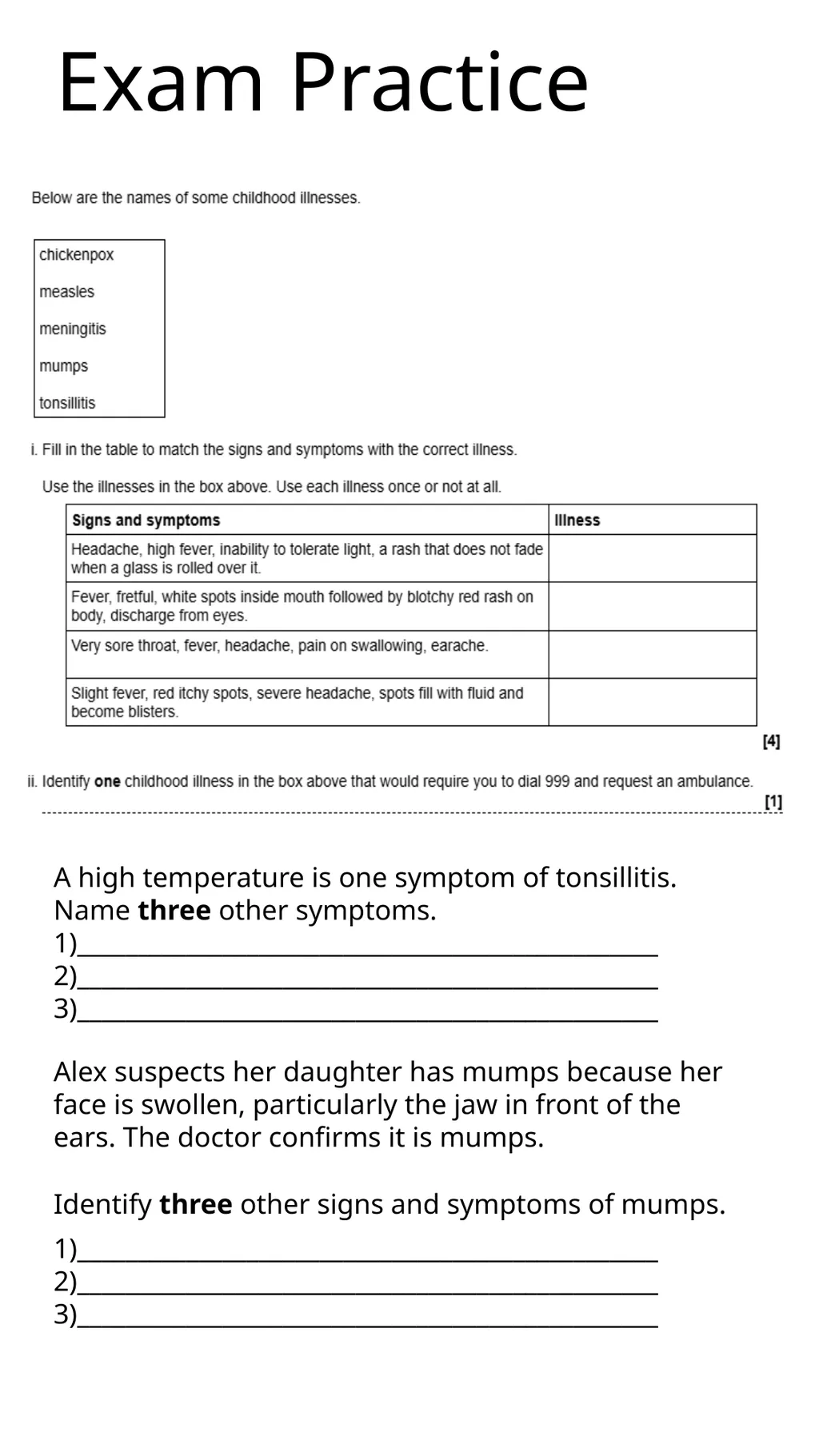
Exam Practice A high temperature is one symptom of tonsillitis. Name three other symptoms.
1)________________________________________________
2)________________________________________________
3)________________________________________________ Alex suspects her daughter has mumps because her face is swollen, particularly the jaw in front of the ears. The doctor confirms it is mumps.
Identify three other signs and symptoms of mumps.
1)________________________________________________
2)________________________________________________
3)________________________________________________<br>
1)________________________________________________
2)________________________________________________
3)________________________________________________ Alex suspects her daughter has mumps because her face is swollen, particularly the jaw in front of the ears. The doctor confirms it is mumps.
Identify three other signs and symptoms of mumps.
1)________________________________________________
2)________________________________________________
3)________________________________________________<br>
09
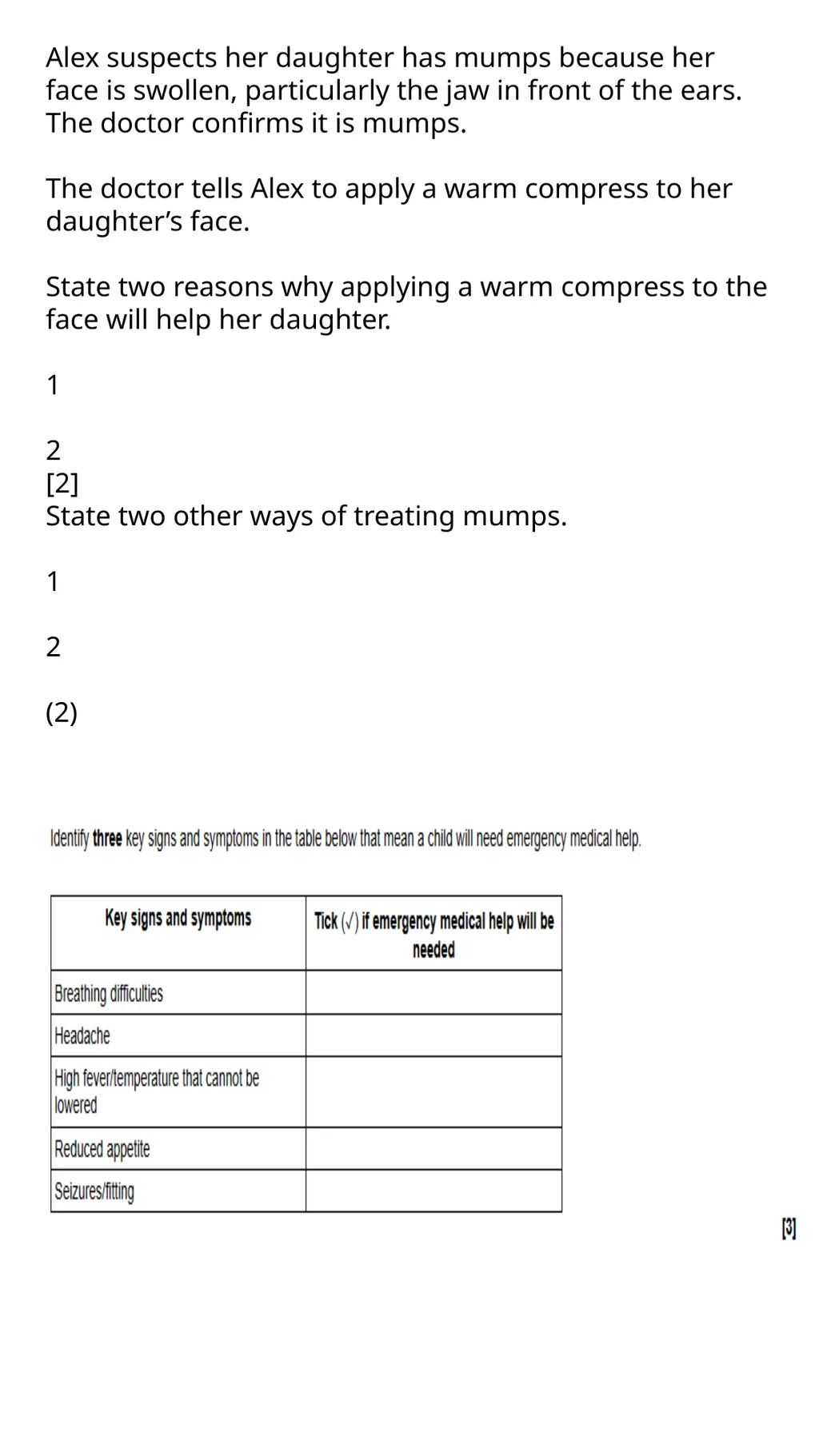
Alex suspects her daughter has mumps because her face is swollen, particularly the jaw in front of the ears. The doctor confirms it is mumps.
The doctor tells Alex to apply a warm compress to her daughter’s face.
State two reasons why applying a warm compress to the face will help her daughter.
1
2
[2]
State two other ways of treating mumps.
1
2
(2)<br>
The doctor tells Alex to apply a warm compress to her daughter’s face.
State two reasons why applying a warm compress to the face will help her daughter.
1
2
[2]
State two other ways of treating mumps.
1
2
(2)<br>
10
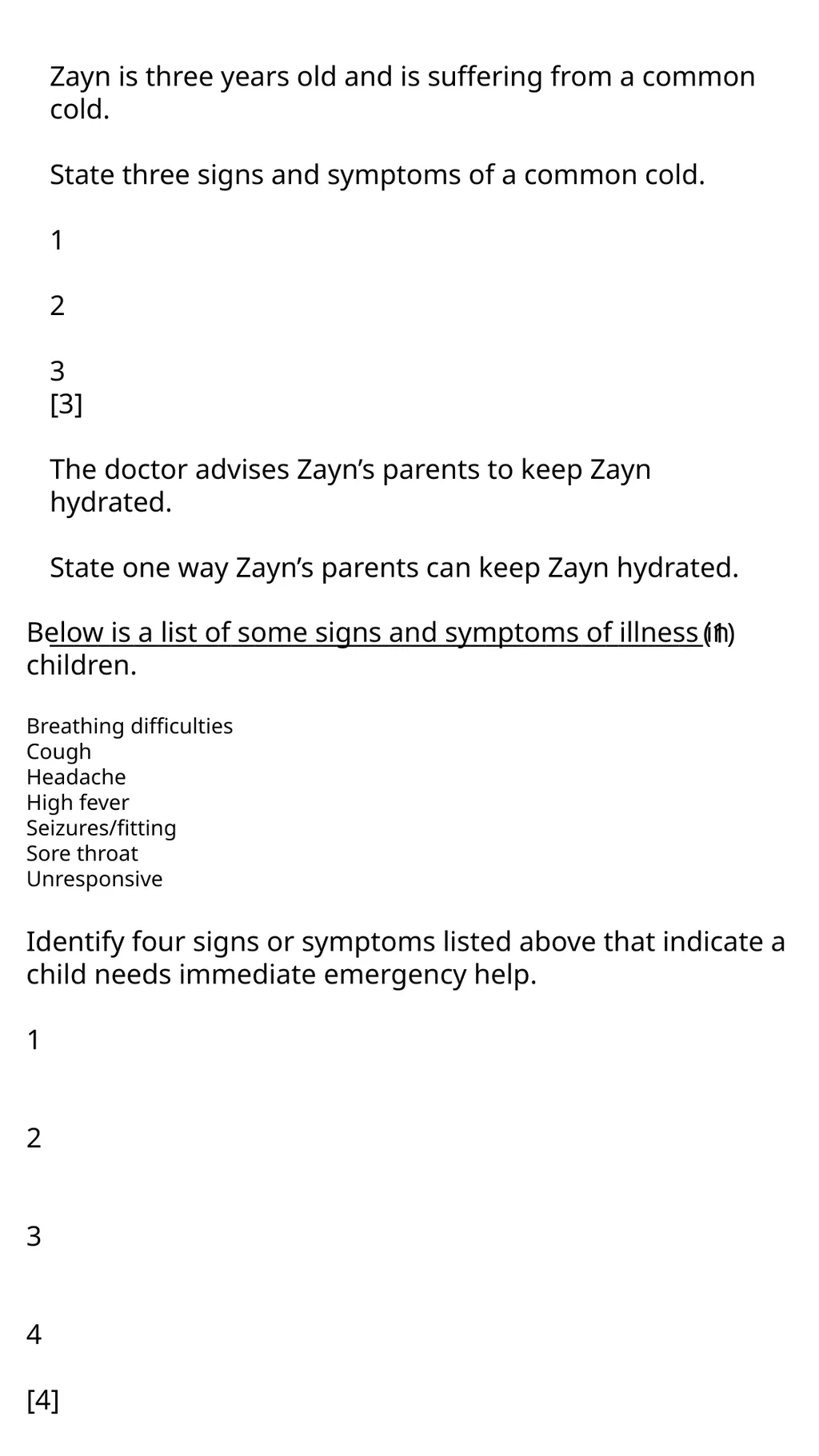
Zayn is three years old and is suffering from a common cold.
State three signs and symptoms of a common cold.
1
2
3
[3]
The doctor advises Zayn’s parents to keep Zayn hydrated.
State one way Zayn’s parents can keep Zayn hydrated.
______________________________________________________(1) Below is a list of some signs and symptoms of illness in children.
Breathing difficulties
Cough
Headache
High fever
Seizures/fitting
Sore throat
Unresponsive
Identify four signs or symptoms listed above that indicate a child needs immediate emergency help.
1
2
3
4
[4]<br>
11
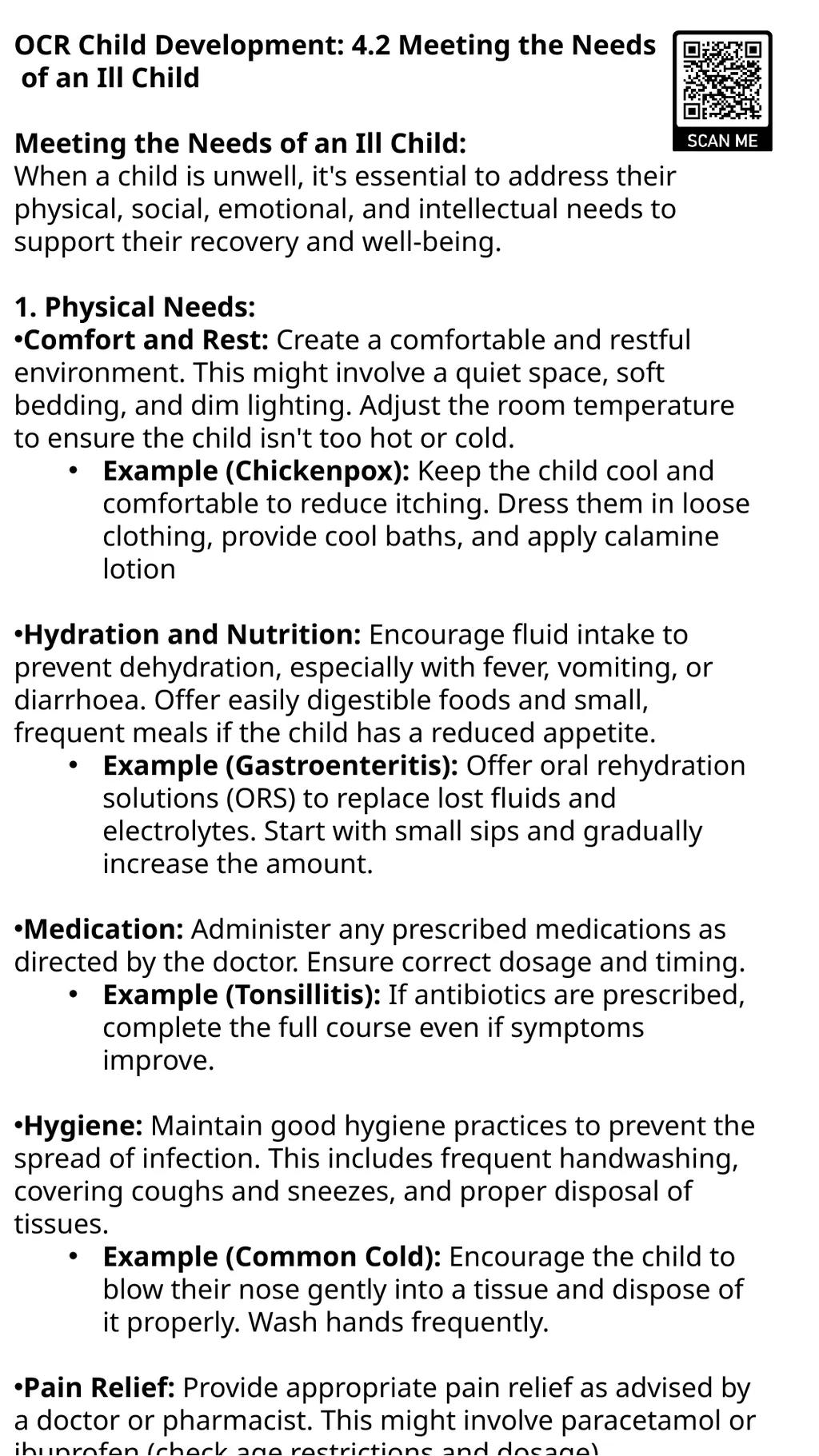
OCR Child Development: 4.2 Meeting the Needs
of an Ill Child
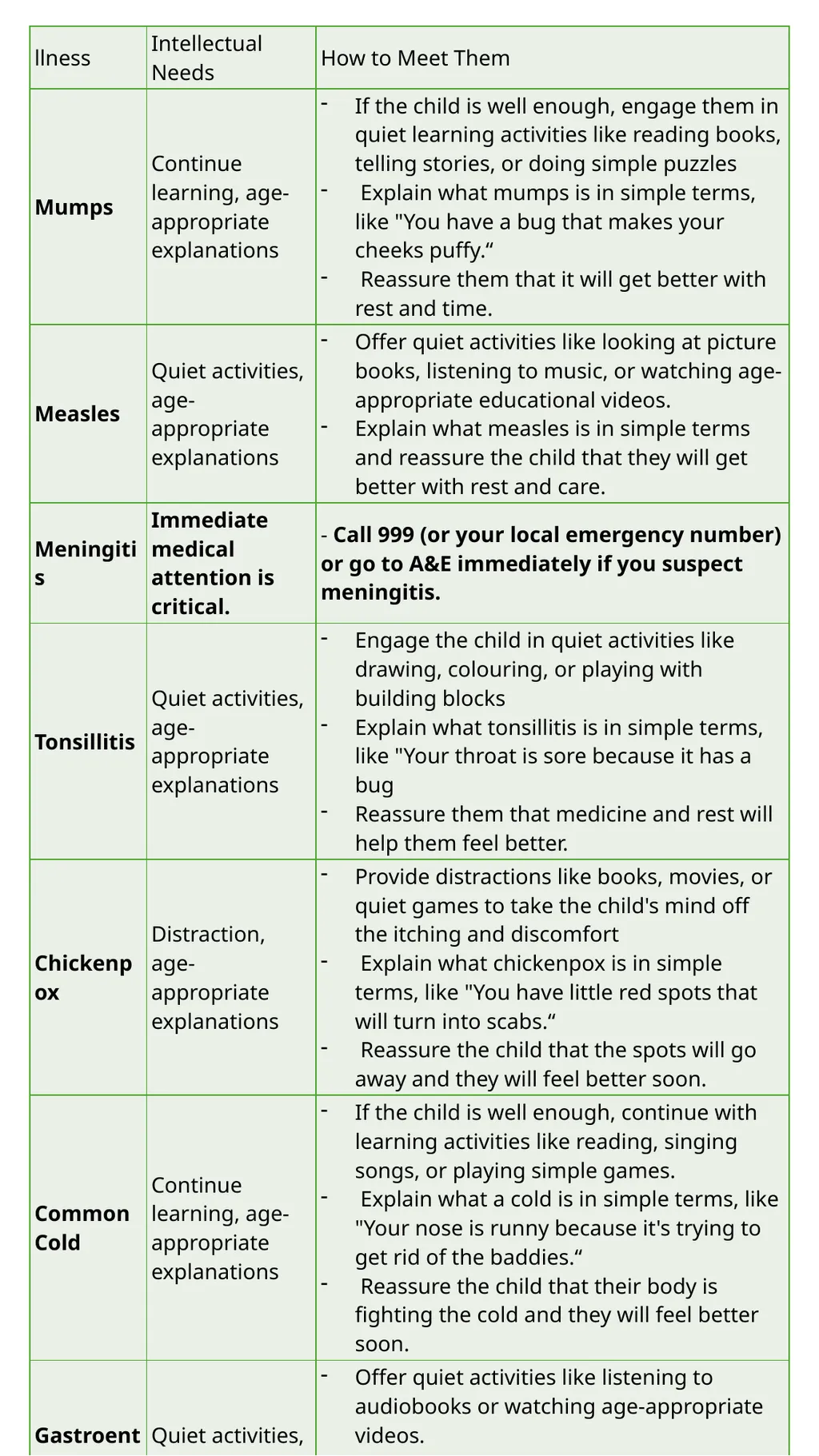
Meeting the Needs of an Ill Child:
When a child is unwell, it's essential to address their physical, social, emotional, and intellectual needs to support their recovery and well-being.
1. Physical Needs:
Comfort and Rest: Create a comfortable and restful environment. This might involve a quiet space, soft bedding, and dim lighting. Adjust the room temperature to ensure the child isn't too hot or cold.
Example (Chickenpox): Keep the child cool and comfortable to reduce itching. Dress them in loose clothing, provide cool baths, and apply calamine lotion
Hydration and Nutrition: Encourage fluid intake to prevent dehydration, especially with fever, vomiting, or diarrhoea. Offer easily digestible foods and small, frequent meals if the child has a reduced appetite.
Example (Gastroenteritis): Offer oral rehydration solutions (ORS) to replace lost fluids and electrolytes. Start with small sips and gradually increase the amount.
Medication: Administer any prescribed medications as directed by the doctor. Ensure correct dosage and timing.
Example (Tonsillitis): If antibiotics are prescribed, complete the full course even if symptoms improve.
Hygiene: Maintain good hygiene practices to prevent the spread of infection. This includes frequent handwashing, covering coughs and sneezes, and proper disposal of tissues.
Example (Common Cold): Encourage the child to blow their nose gently into a tissue and dispose of it properly. Wash hands frequently.
Pain Relief: Provide appropriate pain relief as advised by a doctor or pharmacist. This might involve paracetamol or ibuprofen (check age restrictions and dosage).
Example (Mumps): Offer pain relief for swollen glands and headaches<br>
12
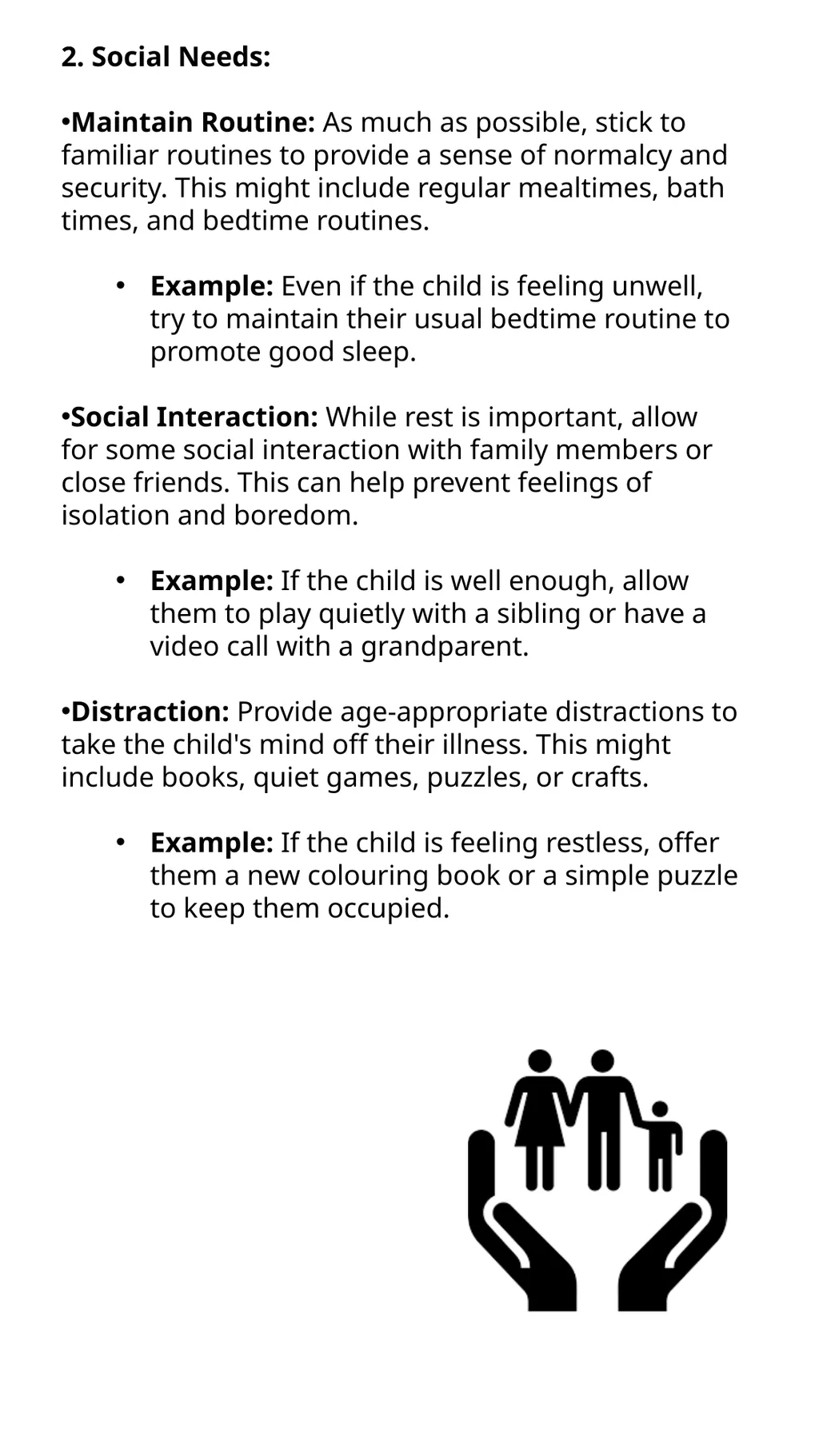
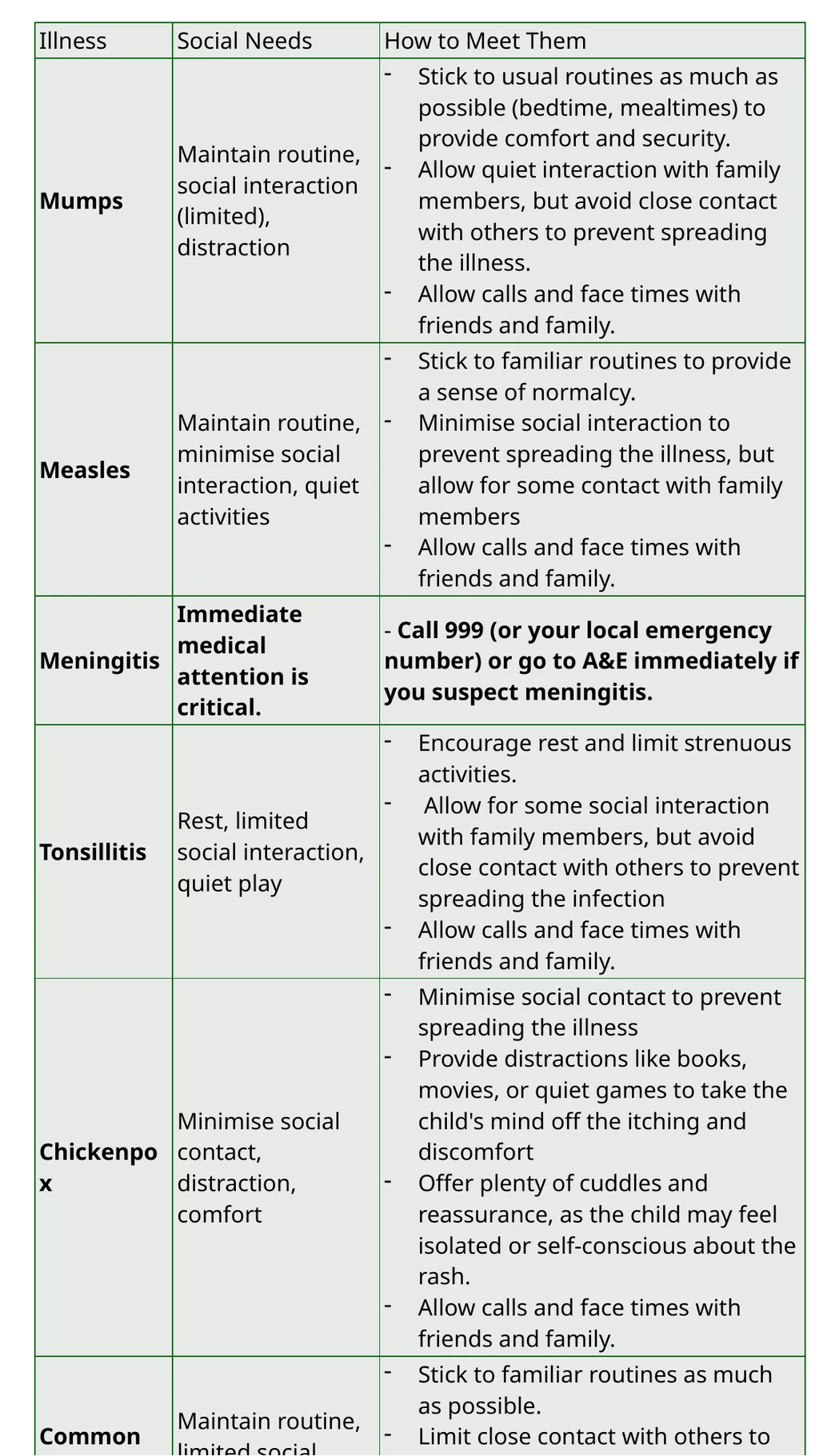
2. Social Needs:
Maintain Routine: As much as possible, stick to familiar routines to provide a sense of normalcy and security. This might include regular mealtimes, bath times, and bedtime routines.
Example: Even if the child is feeling unwell, try to maintain their usual bedtime routine to promote good sleep.
Social Interaction: While rest is important, allow for some social interaction with family members or close friends. This can help prevent feelings of isolation and boredom.
Example: If the child is well enough, allow them to play quietly with a sibling or have a video call with a grandparent.
Distraction: Provide age-appropriate distractions to take the child's mind off their illness. This might include books, quiet games, puzzles, or crafts.
Example: If the child is feeling restless, offer them a new colouring book or a simple puzzle to keep them occupied.<br>
13
Intellectual Needs:
Continue Learning: If the child is well enough, provide opportunities for learning and stimulation. This might involve reading books, playing educational games, or engaging in quiet activities like drawing or colouring.
Example: If the child is recovering from a cold, read them their favourite stories or play a simple board game together.
Age-Appropriate Explanations: Explain the illness and treatment in an age-appropriate way. This can help the child understand what's happening and reduce anxiety.
Example: Use simple terms and pictures to explain why the child needs to take medicine or stay home from nursery.
Encourage Questions: Encourage the child to ask questions and express their concerns. This helps them feel involved in their care and reduces fear.
Example: Create a safe space for the child to ask questions about their illness and treatment without feeling judged.<br>
14
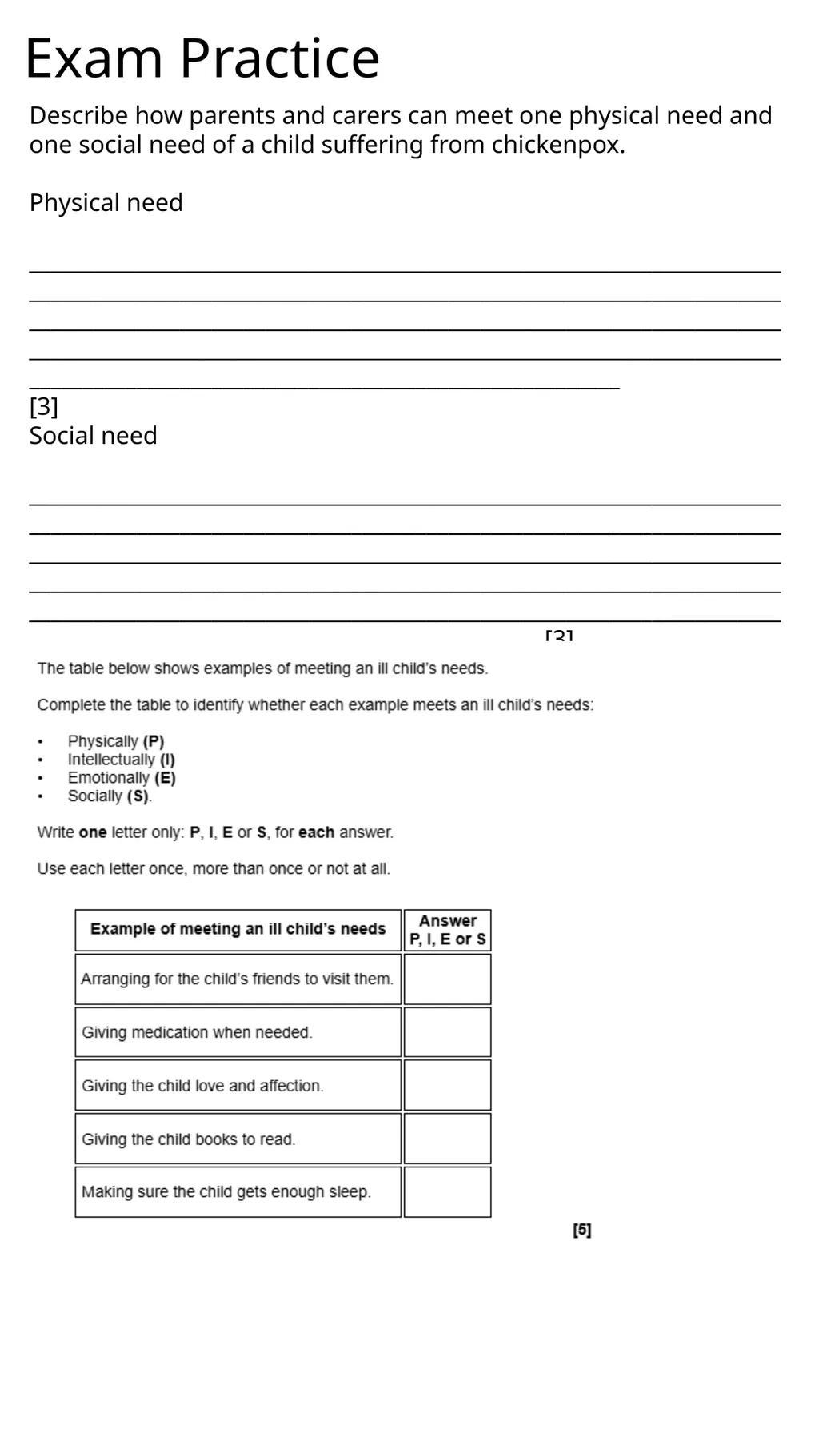
Exam Practice Describe how parents and carers can meet one physical need and one social need of a child suffering from chickenpox.
Physical need
_______________________________________________________________________________________________________________________________________________________________________________________________________________________________________________________________________________________________________________________________________________
[3]
Social need
______________________________________________________________________________________________________________________________________________________________________________________________________________________________________________________________________________________________________________________________________________________________________________________________________________[3]<br>
15
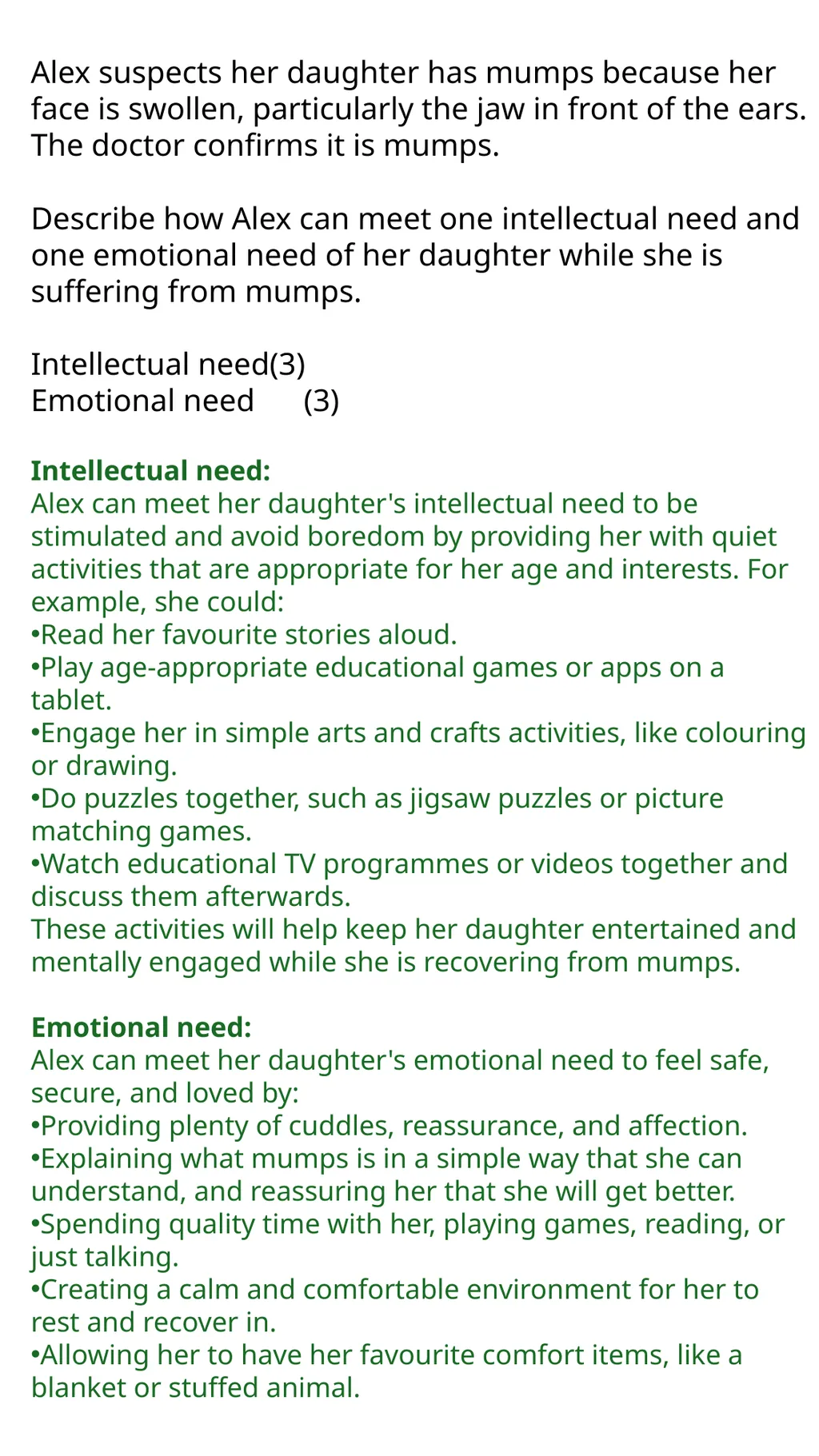
Alex suspects her daughter has mumps because her face is swollen, particularly the jaw in front of the ears. The doctor confirms it is mumps.
Describe how Alex can meet one intellectual need and one emotional need of her daughter while she is suffering from mumps.
Intellectual need(3)
Emotional need (3)
Intellectual need:
Alex can meet her daughter's intellectual need to be stimulated and avoid boredom by providing her with quiet activities that are appropriate for her age and interests. For example, she could:
Read her favourite stories aloud.
Play age-appropriate educational games or apps on a tablet.
Engage her in simple arts and crafts activities, like colouring or drawing.
Do puzzles together, such as jigsaw puzzles or picture matching games.
Watch educational TV programmes or videos together and discuss them afterwards.
These activities will help keep her daughter entertained and mentally engaged while she is recovering from mumps.
Emotional need:
Alex can meet her daughter's emotional need to feel safe, secure, and loved by:
Providing plenty of cuddles, reassurance, and affection.
Explaining what mumps is in a simple way that she can understand, and reassuring her that she will get better.
Spending quality time with her, playing games, reading, or just talking.
Creating a calm and comfortable environment for her to rest and recover in.
Allowing her to have her favourite comfort items, like a blanket or stuffed animal.<br>
16
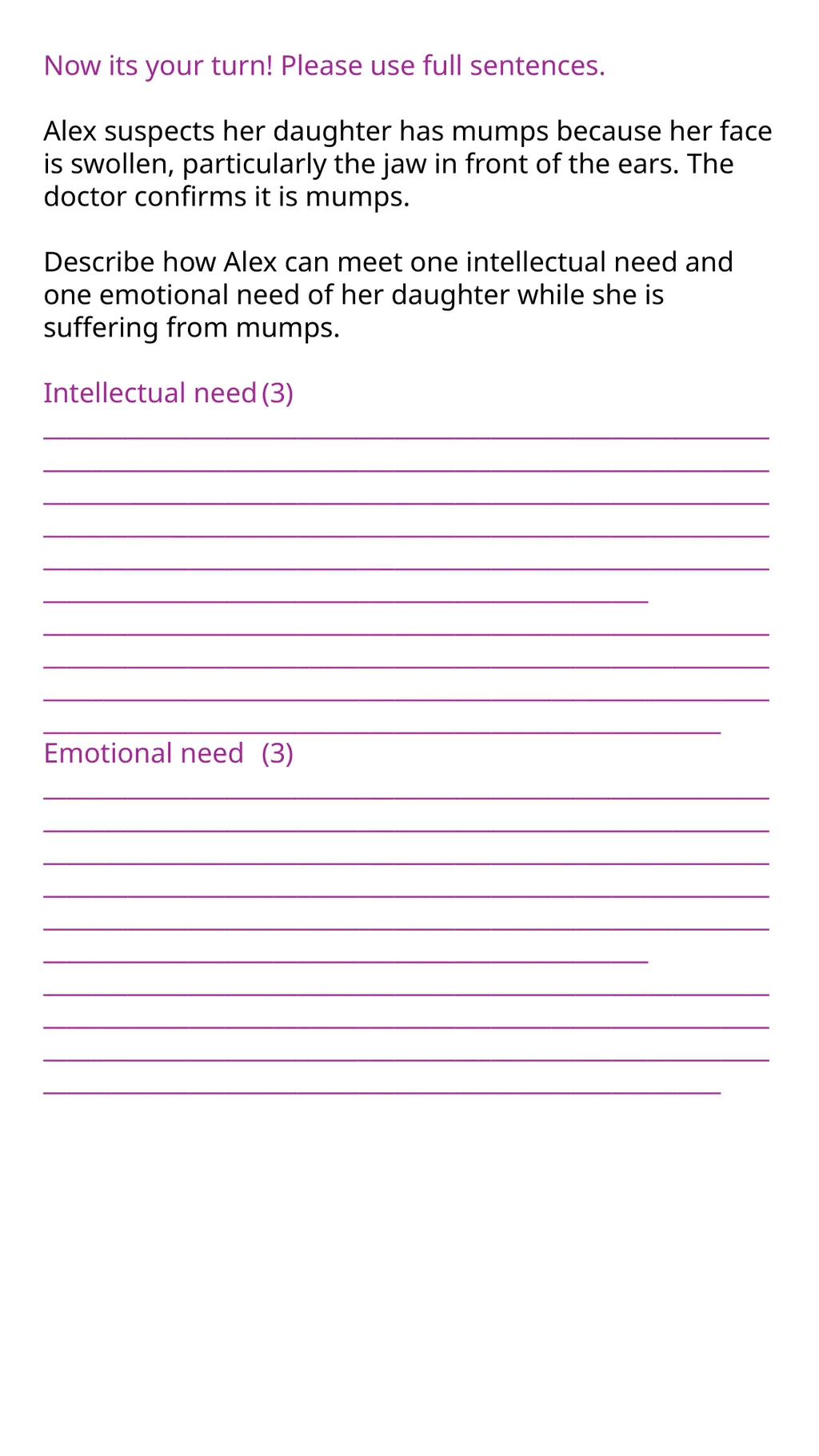
Now its your turn! Please use full sentences.
Alex suspects her daughter has mumps because her face is swollen, particularly the jaw in front of the ears. The doctor confirms it is mumps.
Describe how Alex can meet one intellectual need and one emotional need of her daughter while she is suffering from mumps.
Intellectual need (3)
______________________________________________________________________________________________________________________________________________________________________________________________________________________________________________________________________________________________________________________________________________________________
____________________________________________________________________________________________________________________________________________________________________________________________________________________________________________
Emotional need (3)
______________________________________________________________________________________________________________________________________________________________________________________________________________________________________________________________________________________________________________________________________________________________
____________________________________________________________________________________________________________________________________________________________________________________________________________________________________________<br>
17
Explain how parents can care for an ill child at home (6) . When caring for an ill child at home, it's important to make sure they drink plenty of fluids, like water or diluted juice. This helps their body fight off illness and prevents dehydration, which can make them feel worse.
This would be 2 marks our of 6.
What could you add to this answer to make it a full 6 marks? ________________________________________________________________________________________________________________________________________________________________________________________________________________________________________________________________________________________________________________________________________________
_______________________________________________________________________________________________________________________________________________________________________________________________________________________________
________________________________________________________________________________________________________________________________________________________________________________________________________________________________________________________________________________________________________________________________________________
________________________________________________________________________________________________________________________________________________________________________________________________________________________________<br>
18
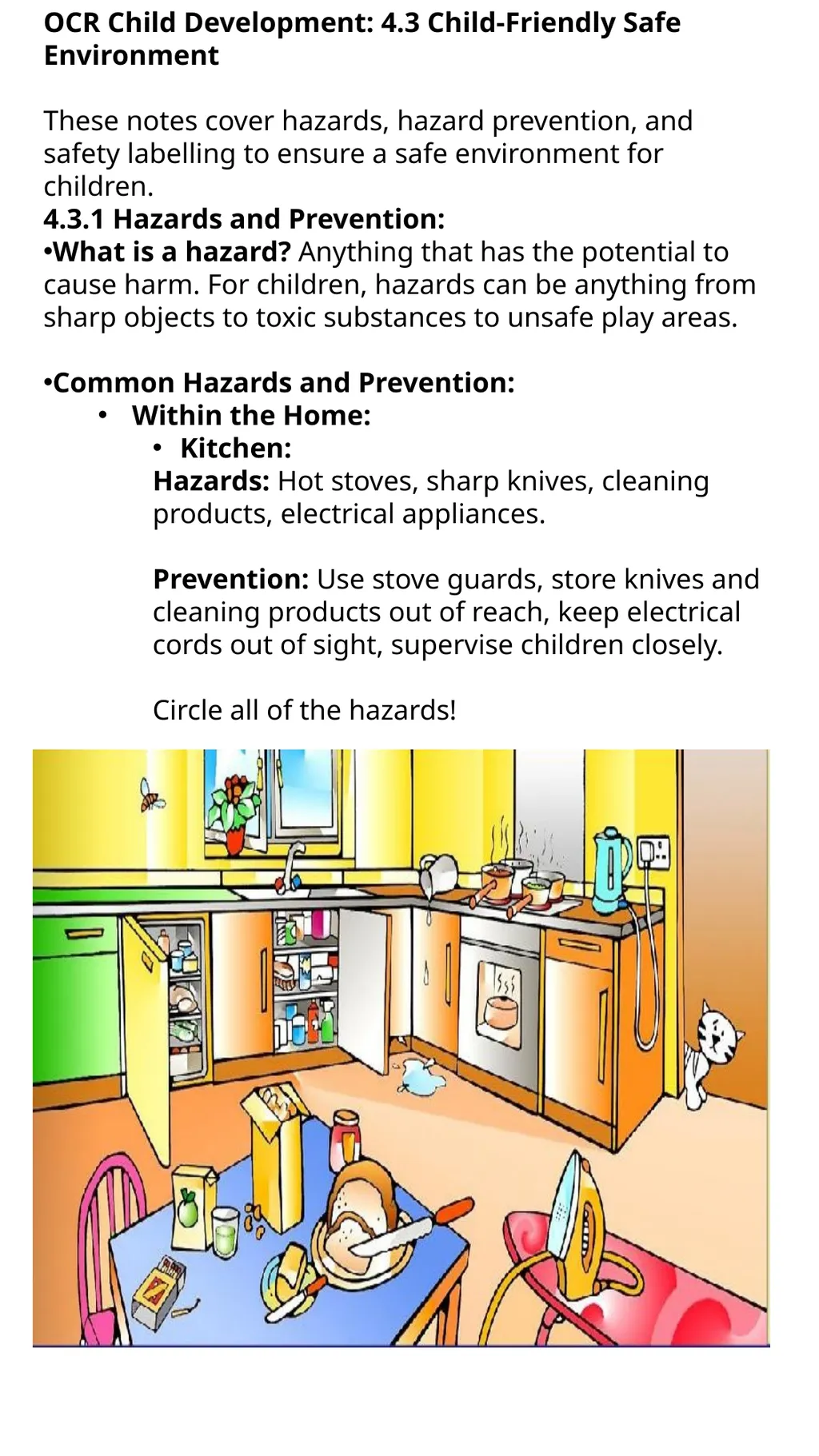
OCR Child Development: 4.3 Child-Friendly Safe Environment
These notes cover hazards, hazard prevention, and safety labelling to ensure a safe environment for children.
4.3.1 Hazards and Prevention:
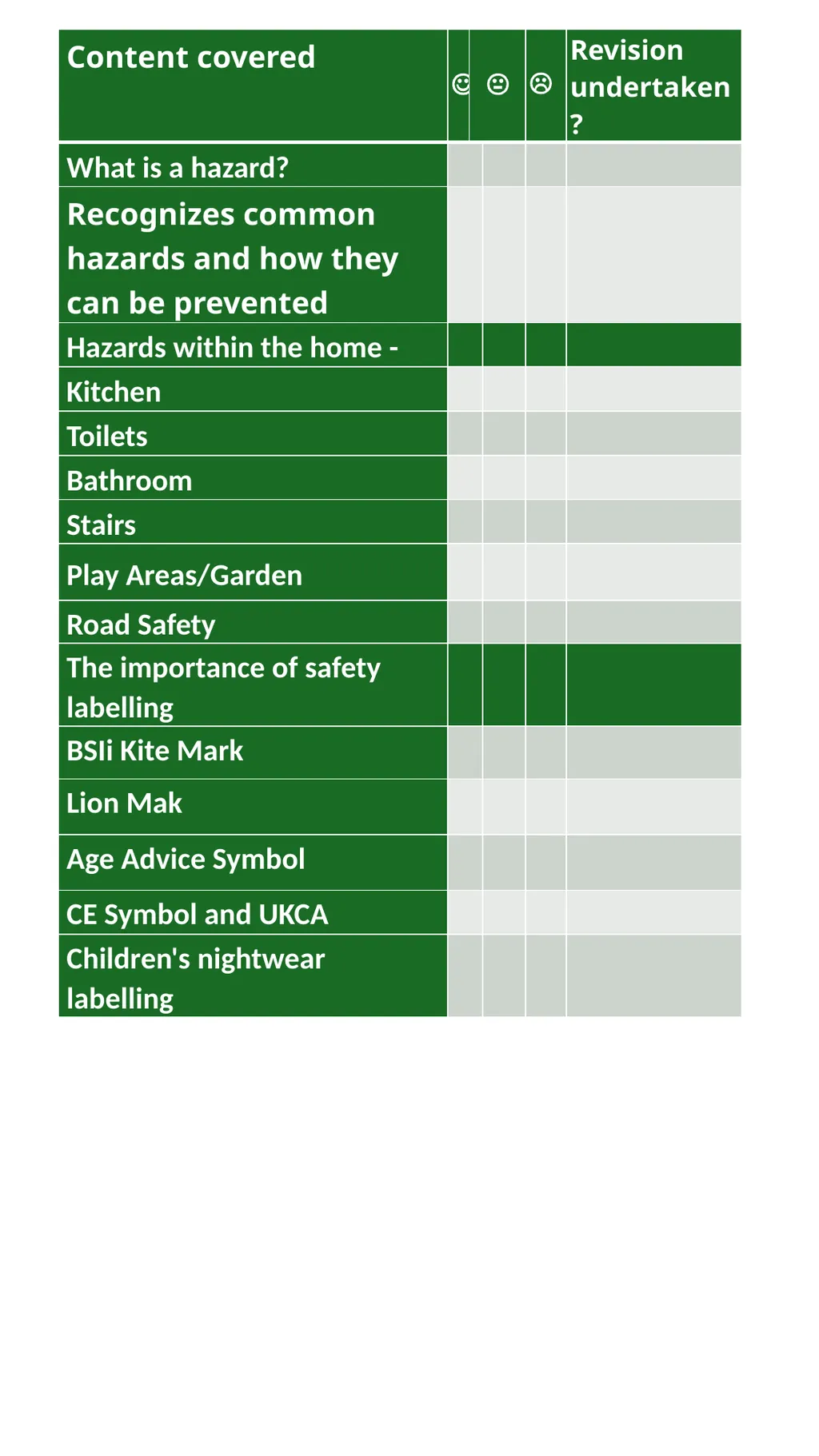
What is a hazard? Anything that has the potential to cause harm. For children, hazards can be anything from sharp objects to toxic substances to unsafe play areas.
Common Hazards and Prevention:
Within the Home:
Kitchen:
Hazards: Hot stoves, sharp knives, cleaning products, electrical appliances.
Prevention: Use stove guards, store knives and cleaning products out of reach, keep electrical cords out of sight, supervise children closely.
Circle all of the hazards!<br>
19
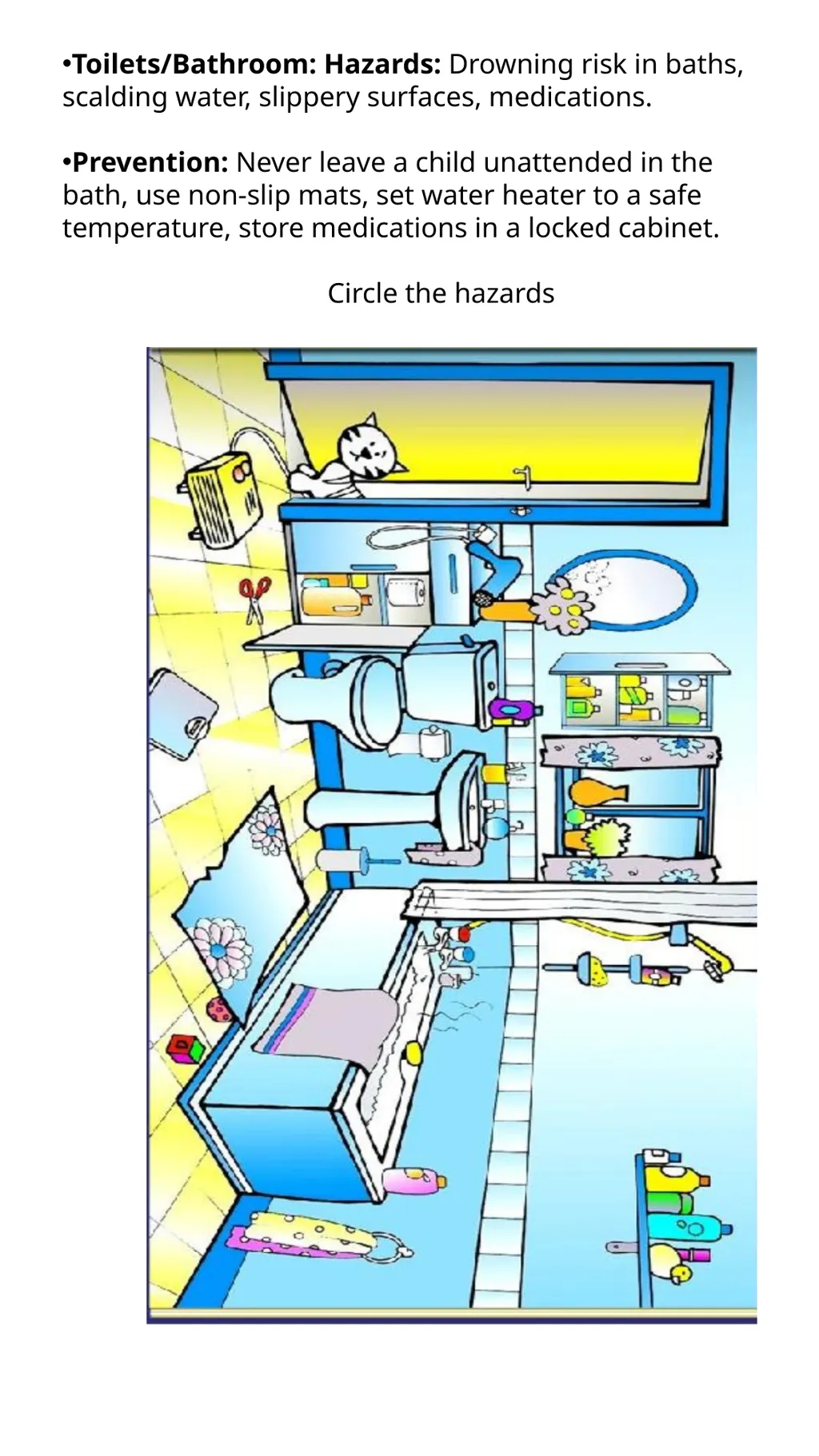
Toilets/Bathroom: Hazards: Drowning risk in baths, scalding water, slippery surfaces, medications.
Prevention: Never leave a child unattended in the bath, use non-slip mats, set water heater to a safe temperature, store medications in a locked cabinet.
Circle the hazards<br>
Prevention: Never leave a child unattended in the bath, use non-slip mats, set water heater to a safe temperature, store medications in a locked cabinet.
Circle the hazards<br>
20
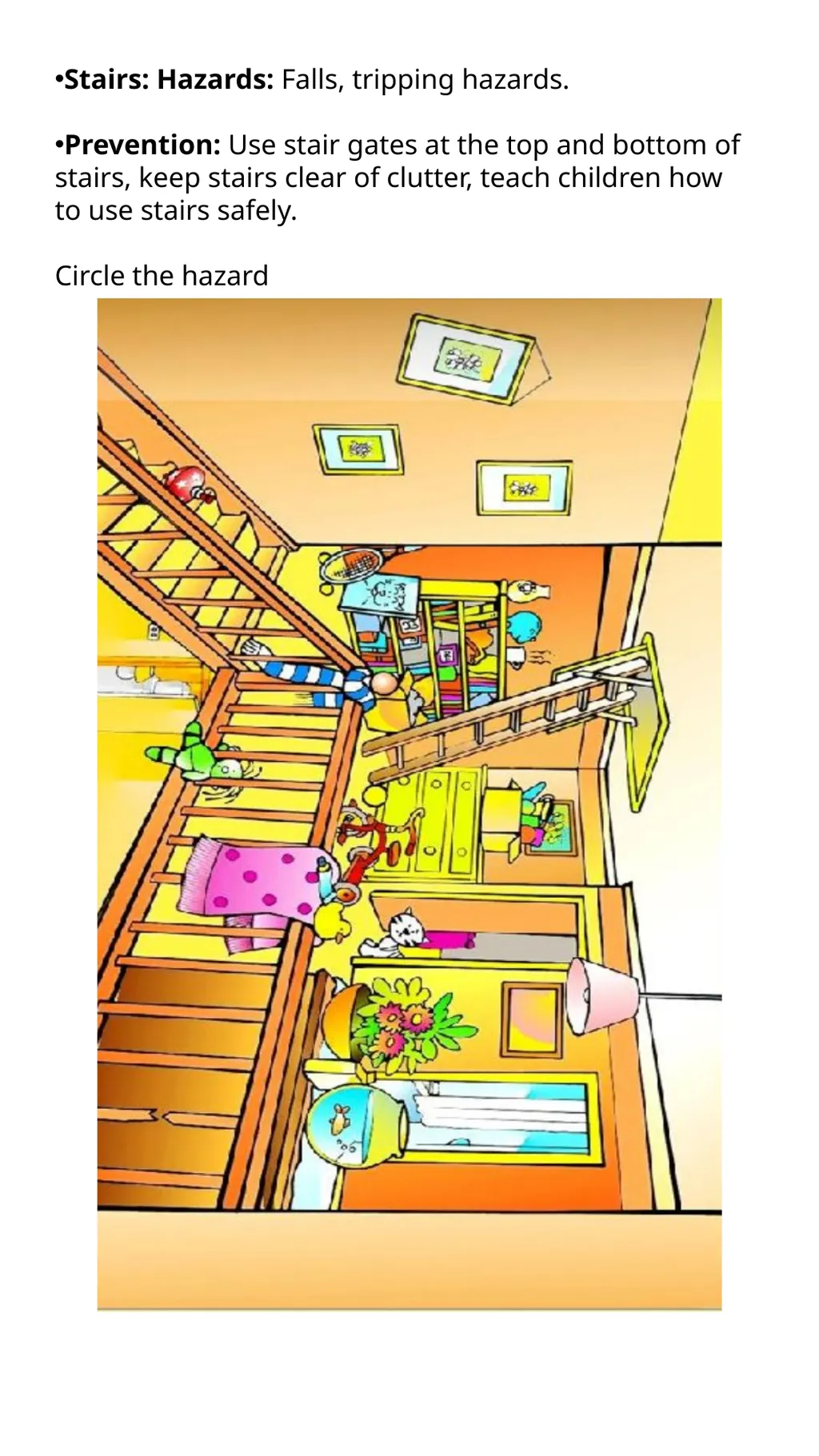
Stairs: Hazards: Falls, tripping hazards.
Prevention: Use stair gates at the top and bottom of stairs, keep stairs clear of clutter, teach children how to use stairs safely.
Circle the hazard<br>
Prevention: Use stair gates at the top and bottom of stairs, keep stairs clear of clutter, teach children how to use stairs safely.
Circle the hazard<br>
21
Play Areas/Garden: Hazards: Sharp objects, poisonous plants, garden tools, unsecured play equipment.
Prevention: Regularly check for and remove hazards, supervise children closely, ensure play equipment is age-appropriate and securely installed.
Circle the hazards<br>
Prevention: Regularly check for and remove hazards, supervise children closely, ensure play equipment is age-appropriate and securely installed.
Circle the hazards<br>
22
Roads: (Focus on Under 5s)
Hazards: Traffic, crossing roads unsafely.
Prevention:
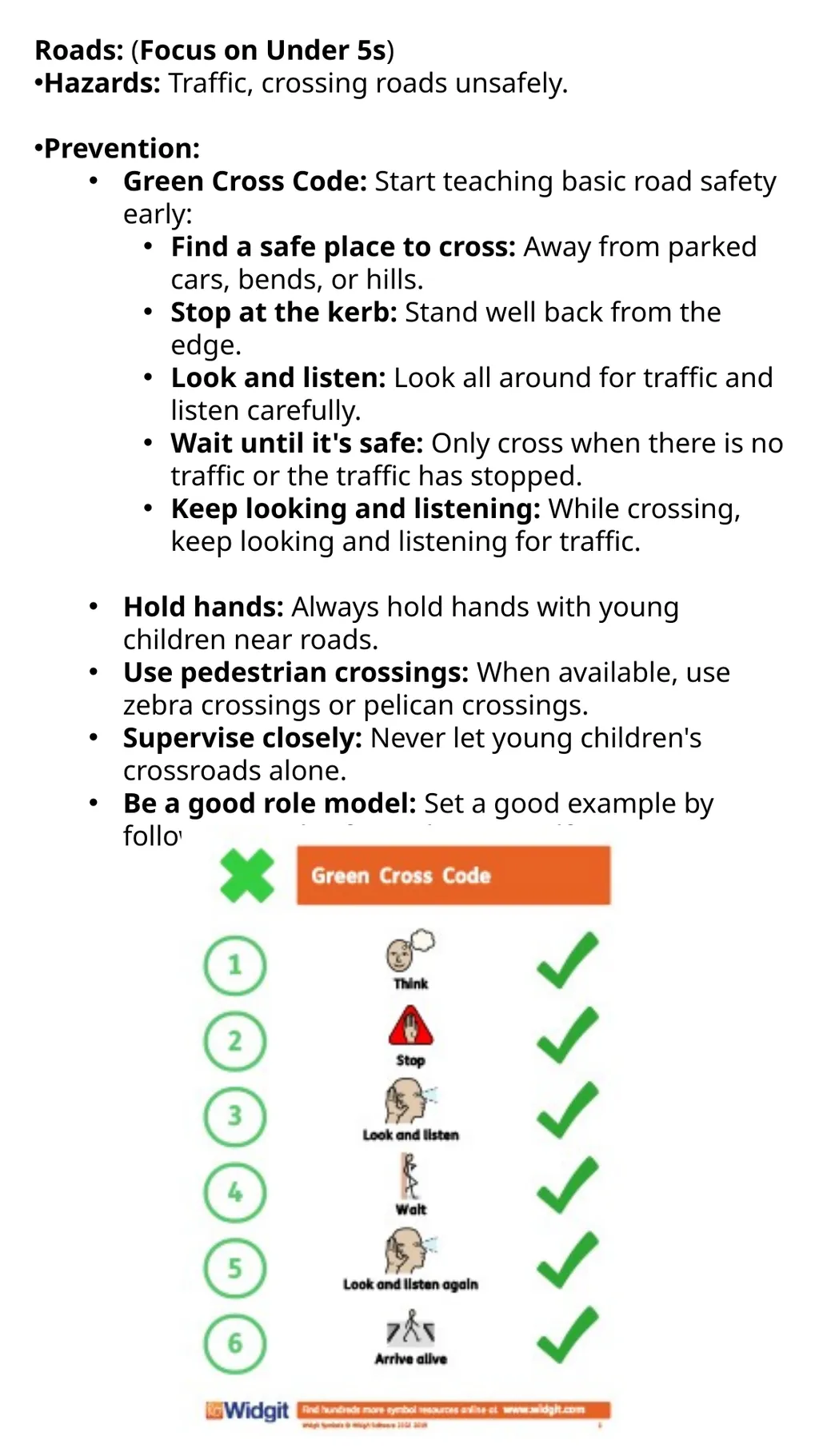
Green Cross Code: Start teaching basic road safety early:
Find a safe place to cross: Away from parked cars, bends, or hills.
Stop at the kerb: Stand well back from the edge.
Look and listen: Look all around for traffic and listen carefully.
Wait until it's safe: Only cross when there is no traffic or the traffic has stopped.
Keep looking and listening: While crossing, keep looking and listening for traffic.
Hold hands: Always hold hands with young children near roads.
Use pedestrian crossings: When available, use zebra crossings or pelican crossings.
Supervise closely: Never let young children's crossroads alone.
Be a good role model: Set a good example by following road safety rules yourself.<br>
23
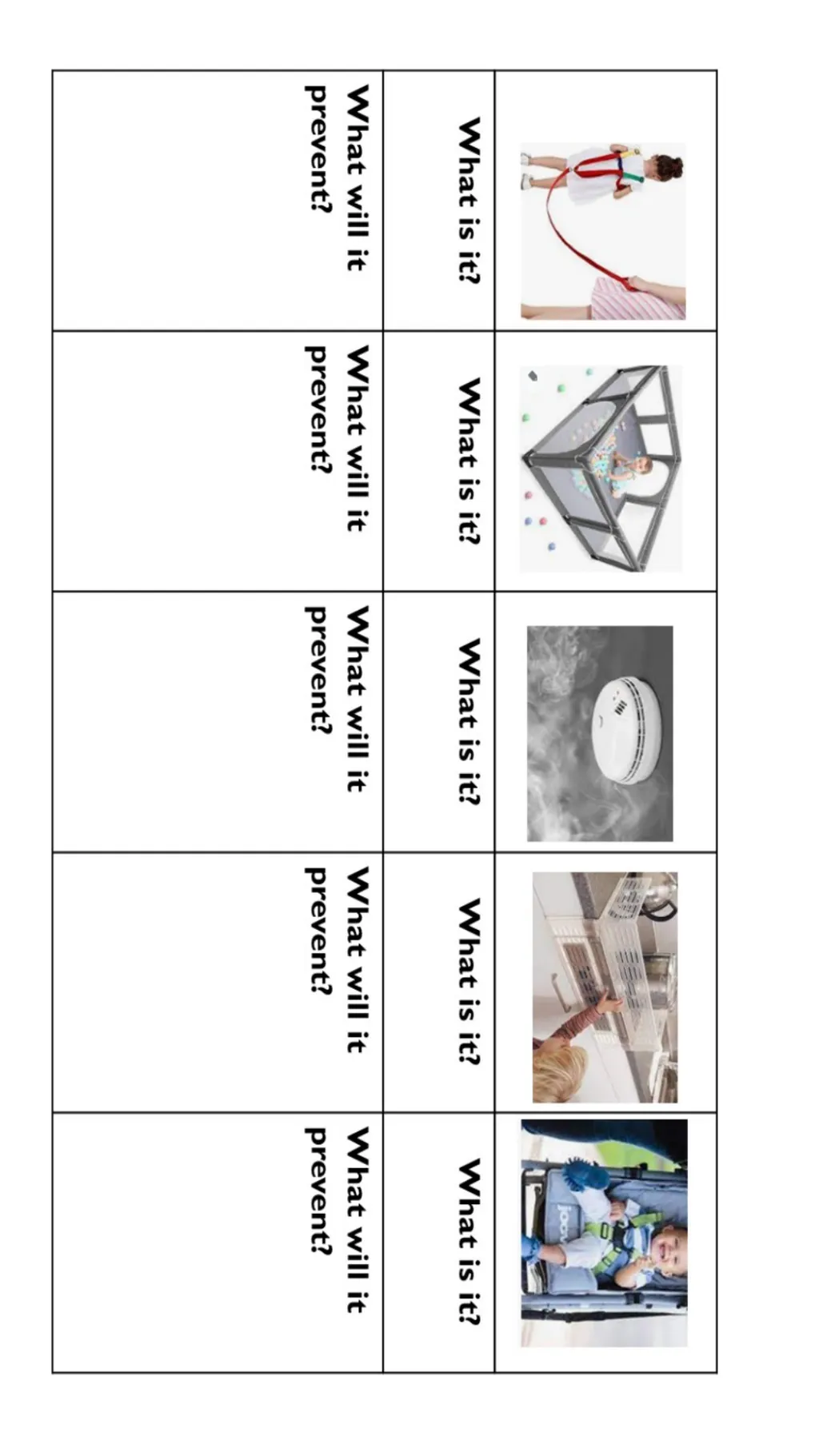
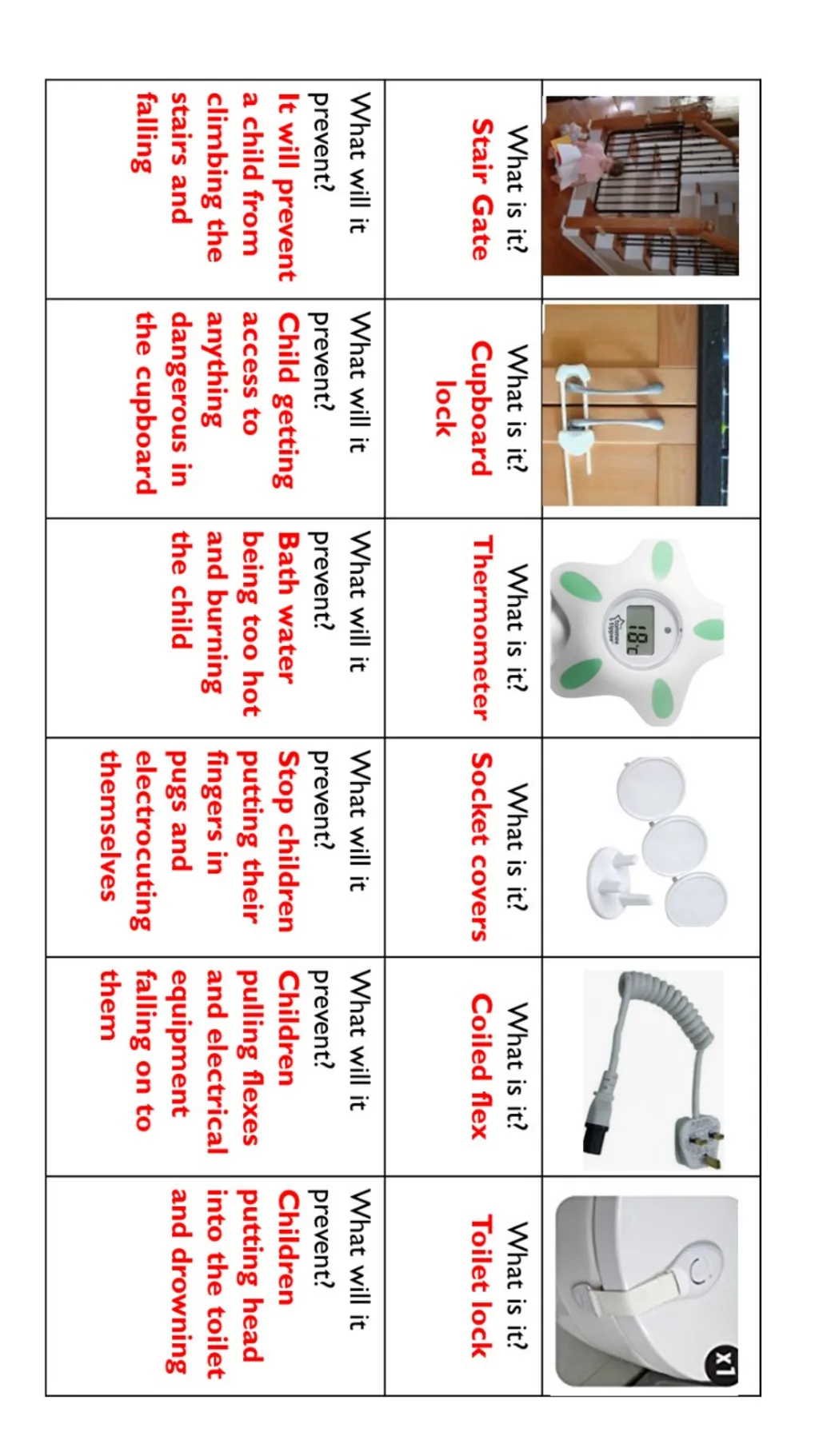
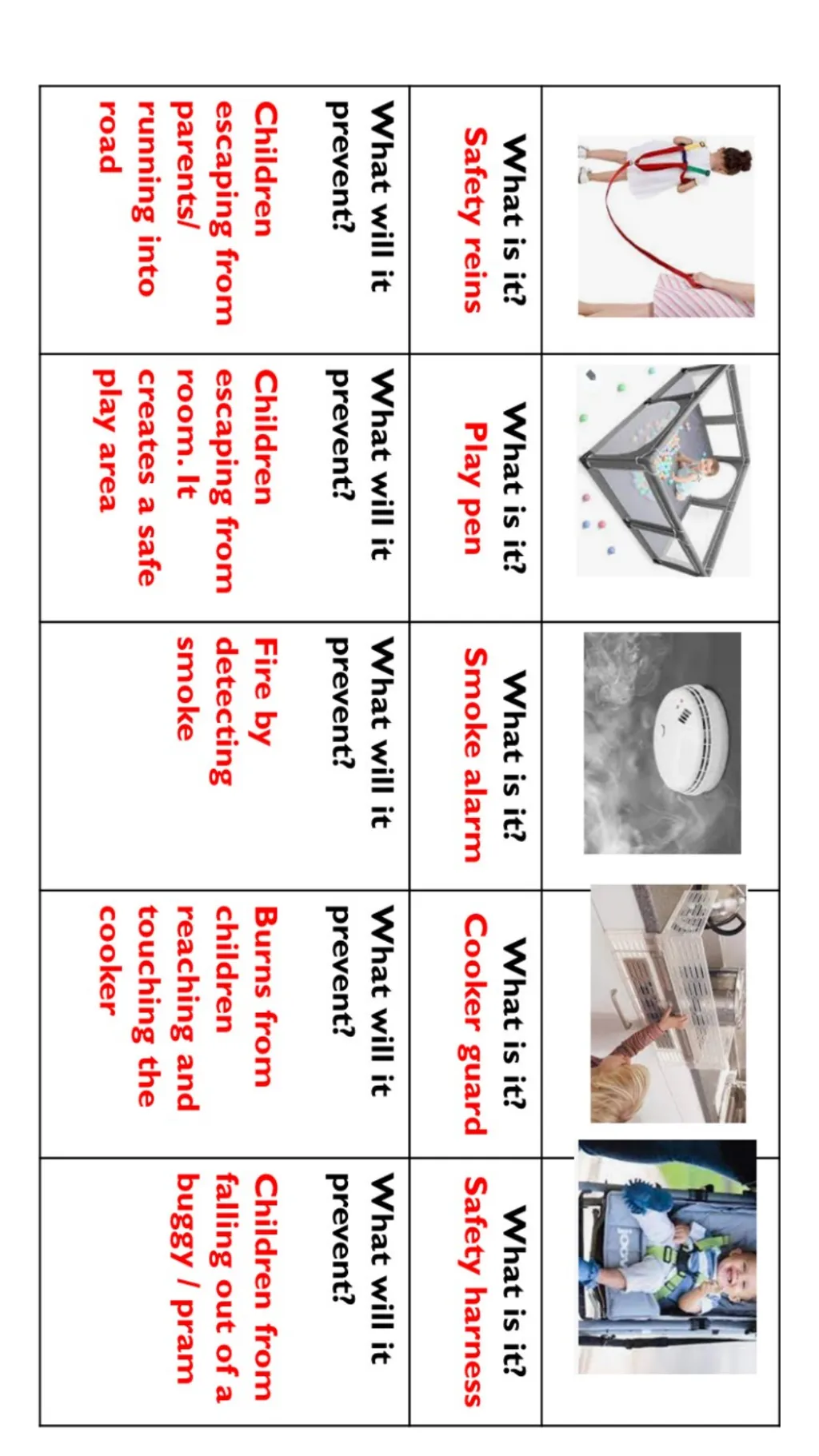
Safety equipment in the home Appropriate safety equipment helps to prevent accidents and injuries by creating a safer environment for young children, both inside and outside the home.<br>
24
Exam Practice<br>
25
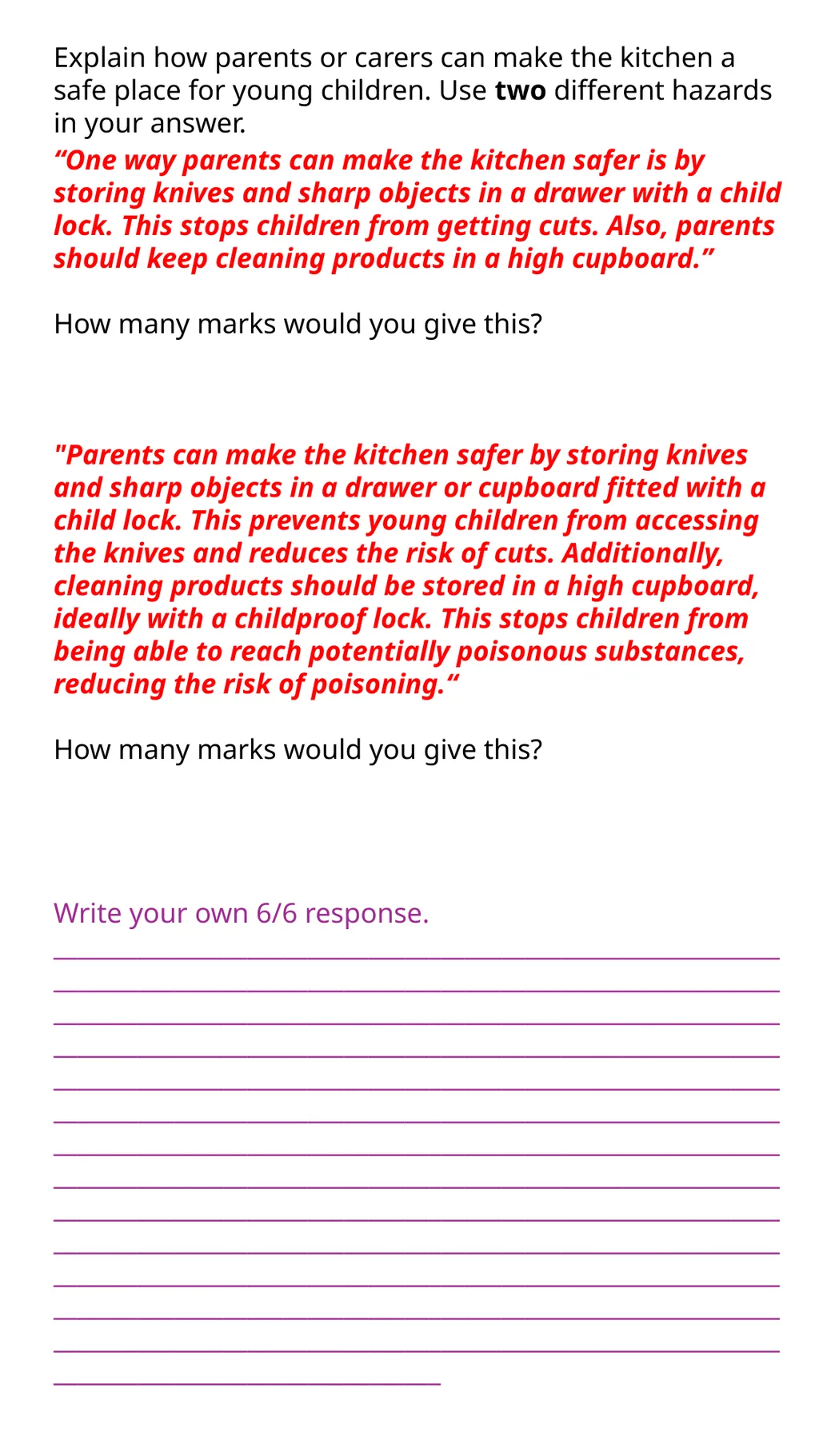
Explain how parents or carers can make the kitchen a safe place for young children. Use two different hazards in your answer. “One way parents can make the kitchen safer is by storing knives and sharp objects in a drawer with a child lock. This stops children from getting cuts. Also, parents should keep cleaning products in a high cupboard.”
How many marks would you give this?
"Parents can make the kitchen safer by storing knives and sharp objects in a drawer or cupboard fitted with a child lock. This prevents young children from accessing the knives and reduces the risk of cuts. Additionally, cleaning products should be stored in a high cupboard, ideally with a childproof lock. This stops children from being able to reach potentially poisonous substances, reducing the risk of poisoning.“
How many marks would you give this?
Write your own 6/6 response.
____________________________________________________________________________________________________________________________________________________________________________________________________________________________________________________________________________________________________________________________________________________________________________________________________________________________________________________________________________________________________________________________________________________________________________________________________________________________________________________________________________________________________________________________________________________________________________________________________________________________________________<br>
How many marks would you give this?
"Parents can make the kitchen safer by storing knives and sharp objects in a drawer or cupboard fitted with a child lock. This prevents young children from accessing the knives and reduces the risk of cuts. Additionally, cleaning products should be stored in a high cupboard, ideally with a childproof lock. This stops children from being able to reach potentially poisonous substances, reducing the risk of poisoning.“
How many marks would you give this?
Write your own 6/6 response.
____________________________________________________________________________________________________________________________________________________________________________________________________________________________________________________________________________________________________________________________________________________________________________________________________________________________________________________________________________________________________________________________________________________________________________________________________________________________________________________________________________________________________________________________________________________________________________________________________________________________________________<br>
26
The Importance of Safety Labelling
Safety labels are crucial for informing consumers
about product safety and ensuring products meet
legal and quality standards. They provide reassurance
and help prevent accidents.
Key Safety Labels:
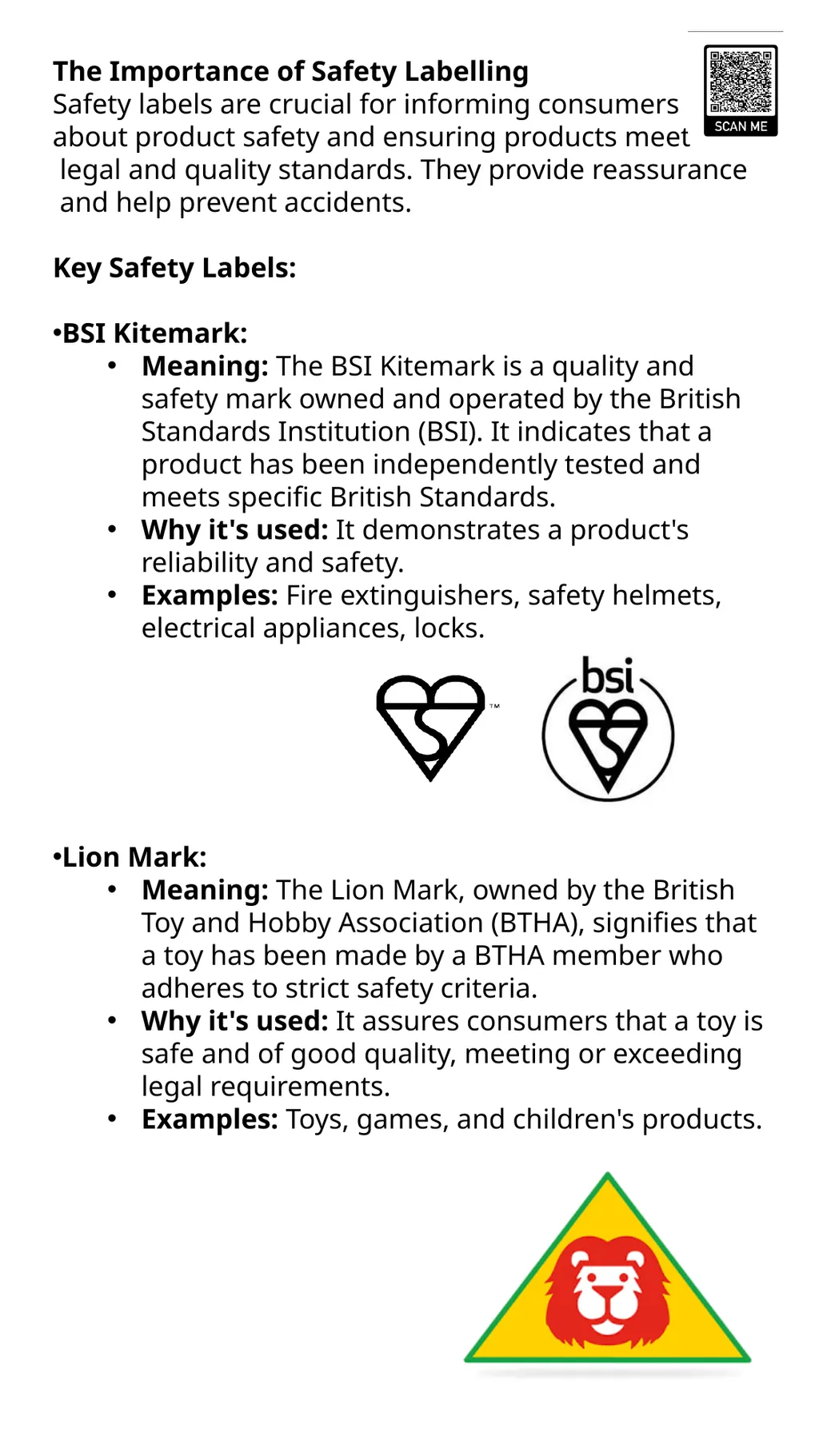
BSI Kitemark:
Meaning: The BSI Kitemark is a quality and safety mark owned and operated by the British Standards Institution (BSI). It indicates that a product has been independently tested and meets specific British Standards.
Why it's used: It demonstrates a product's reliability and safety.
Examples: Fire extinguishers, safety helmets, electrical appliances, locks.
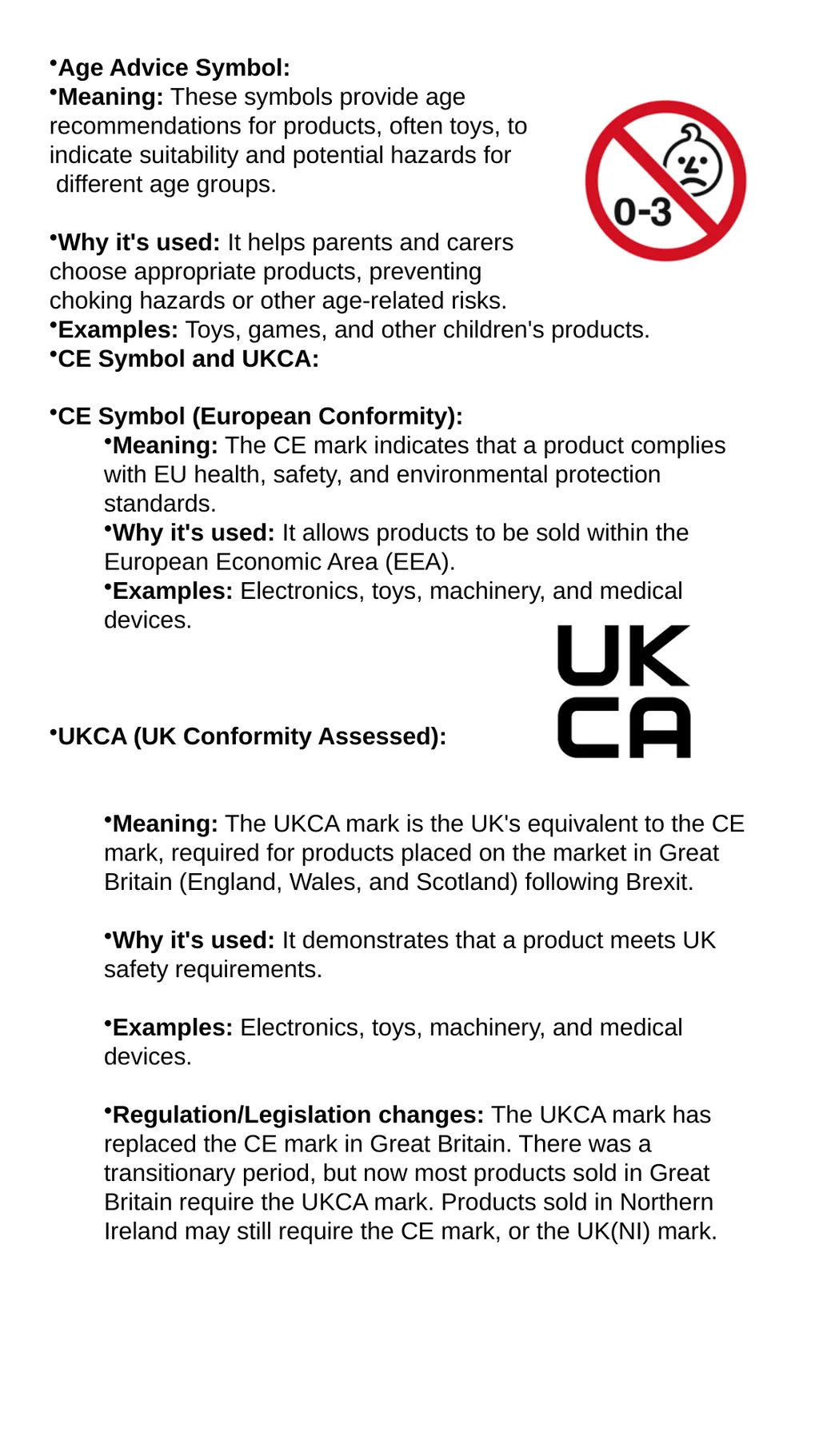
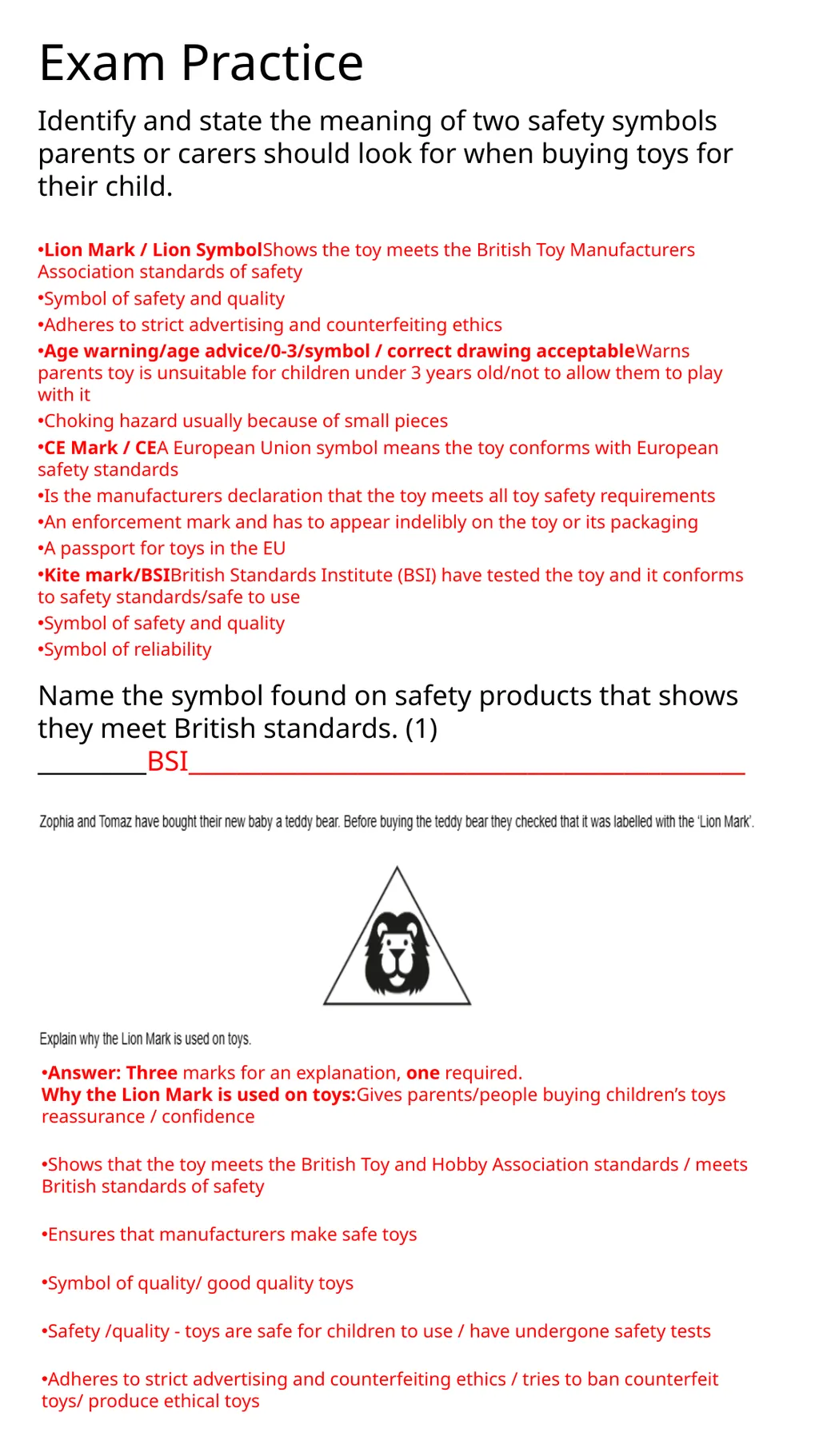
Lion Mark:
Meaning: The Lion Mark, owned by the British Toy and Hobby Association (BTHA), signifies that a toy has been made by a BTHA member who adheres to strict safety criteria.
Why it's used: It assures consumers that a toy is safe and of good quality, meeting or exceeding legal requirements.
Examples: Toys, games, and children's products.<br>
27
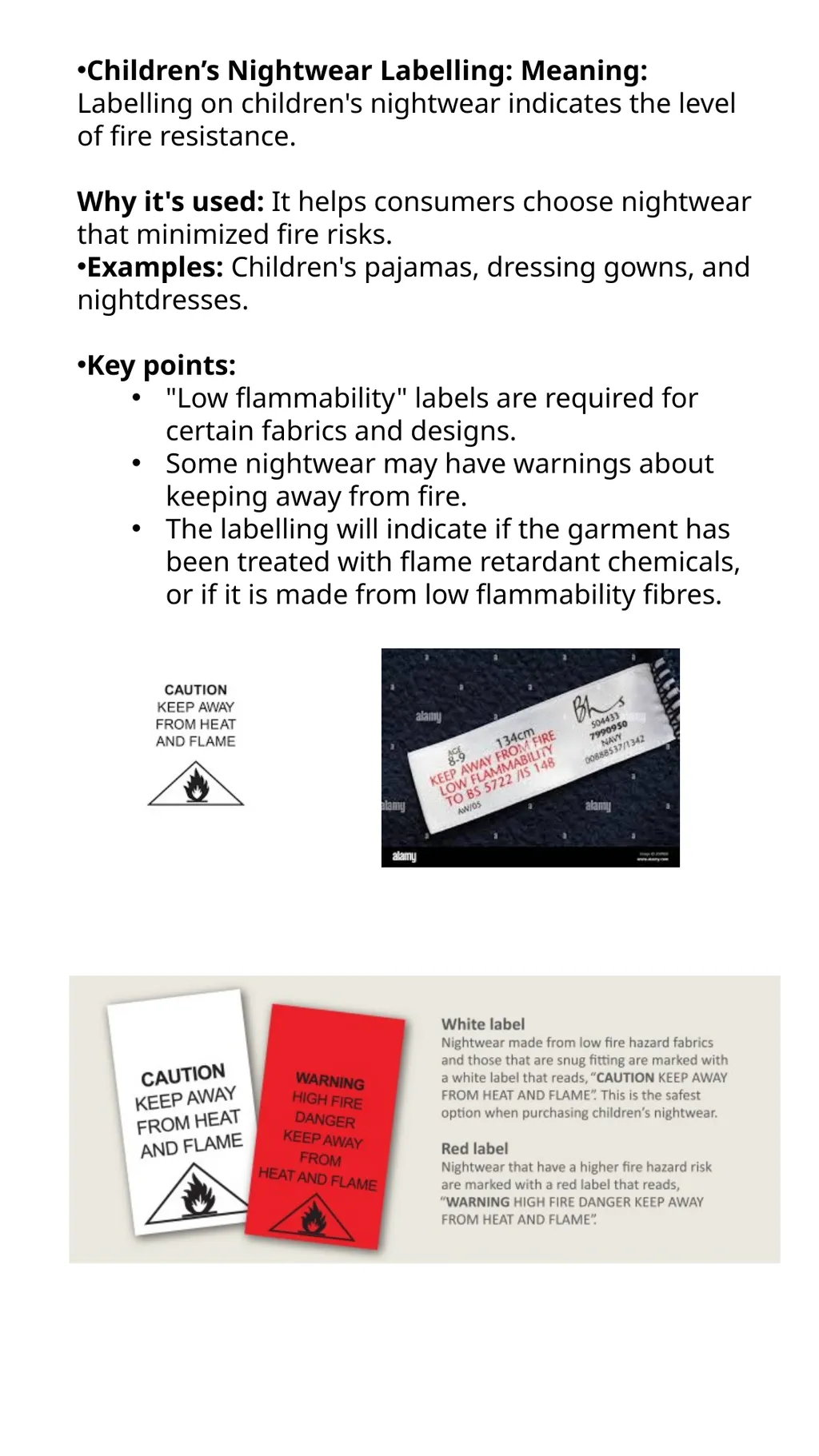
Age Advice Symbol:
Meaning: These symbols provide age
recommendations for products, often toys, to
indicate suitability and potential hazards for
different age groups.
Why it's used: It helps parents and carers
choose appropriate products, preventing
choking hazards or other age-related risks.
Examples: Toys, games, and other children's products.
CE Symbol and UKCA:
CE Symbol (European Conformity):
Meaning: The CE mark indicates that a product complies with EU health, safety, and environmental protection standards.
Why it's used: It allows products to be sold within the European Economic Area (EEA).
Examples: Electronics, toys, machinery, and medical devices.
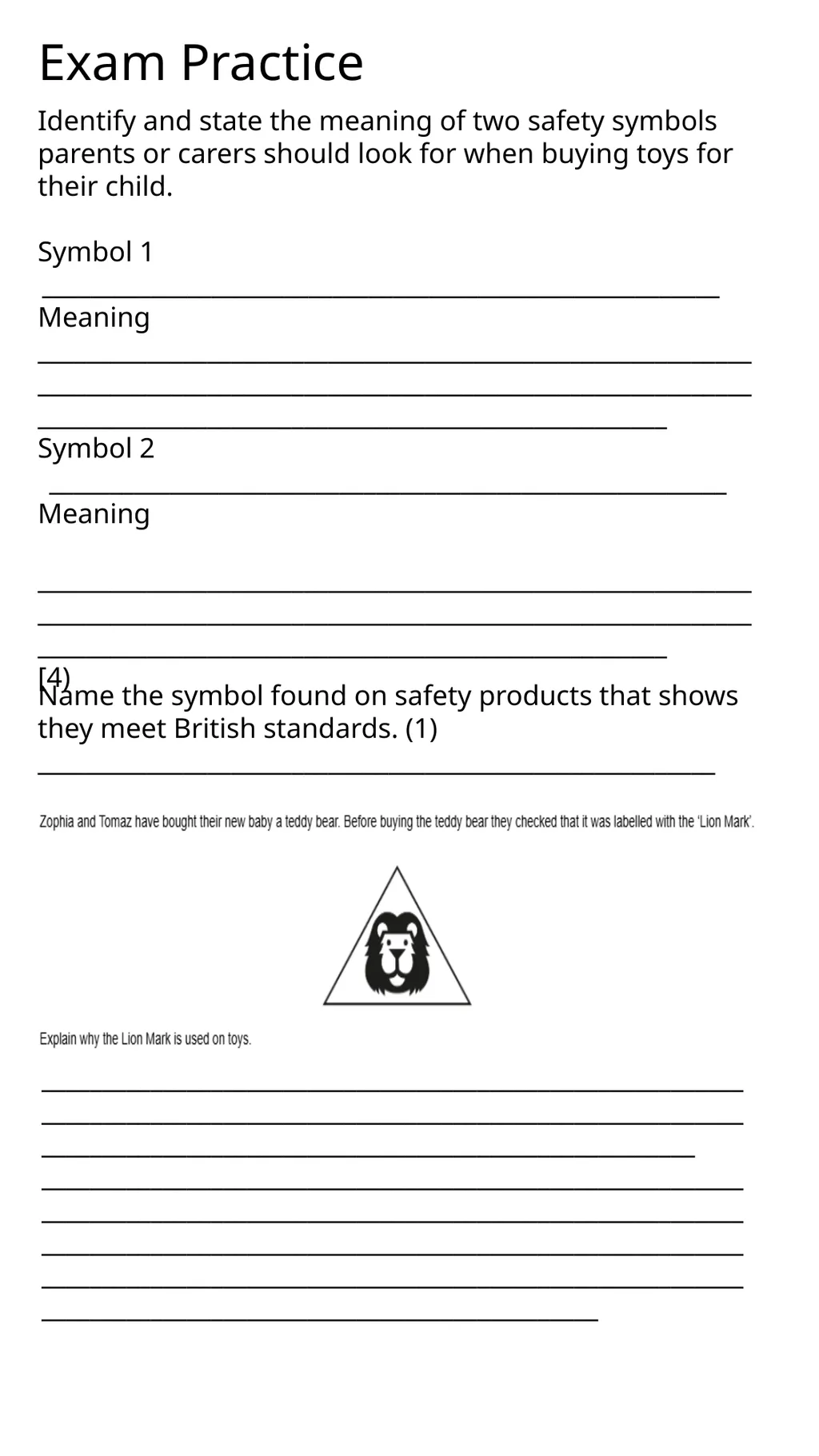
UKCA (UK Conformity Assessed):
Meaning: The UKCA mark is the UK's equivalent to the CE mark, required for products placed on the market in Great Britain (England, Wales, and Scotland) following Brexit.
Why it's used: It demonstrates that a product meets UK safety requirements.
Examples: Electronics, toys, machinery, and medical devices.
Regulation/Legislation changes: The UKCA mark has replaced the CE mark in Great Britain. There was a transitionary period, but now most products sold in Great Britain require the UKCA mark. Products sold in Northern Ireland may still require the CE mark, or the UK(NI) mark.<br>
28
Children’s Nightwear Labelling: Meaning: Labelling on children's nightwear indicates the level of fire resistance.
Why it's used: It helps consumers choose nightwear that minimized fire risks.
Examples: Children's pajamas, dressing gowns, and nightdresses.
Key points:
"Low flammability" labels are required for certain fabrics and designs.
Some nightwear may have warnings about keeping away from fire.
The labelling will indicate if the garment has been treated with flame retardant chemicals, or if it is made from low flammability fibres.<br>
29
Exam Practice Identify and state the meaning of two safety symbols parents or carers should look for when buying toys for their child.
Symbol 1
________________________________________________________
Meaning
__________________________________________________________________________________________________________________________________________________________________________
Symbol 2
________________________________________________________
Meaning
__________________________________________________________________________________________________________________________________________________________________________
[4) Name the symbol found on safety products that shows they meet British standards. (1)
________________________________________________________ __________________________________________________________________________________________________________________________________________________________________________ ______________________________________________________________________________________________________________________________________________________________________________________________________________________________________________________________________________________<br>
30
Answers – do not peak until the end!<br>
31
Here are the answers to the True/False questions about Childhood Illnesses:
False: A fever can be a sign of infection, but it can also occur due to other reasons like teething, heat exhaustion, or even vigorous exercise.
False: While vaccines protect against many childhood illnesses (like measles, mumps, chickenpox), some illnesses don't have vaccines (like the common cold).
True: Good hygiene practices like frequent handwashing, covering coughs and sneezes, and proper food handling can significantly reduce the spread of many childhood illnesses.
True: Mumps is characterized by the swelling of the salivary glands, often making the cheeks appear puffy.
False: There is an MMR vaccine that protects against measles, mumps, and rubella.
False: Measles is a serious viral infection.
True: A characteristic measles rash starts on the face and spreads to the rest of the body.
True: Meningitis can cause serious complications, including brain damage and even death.
True: A stiff neck is a classic symptom of meningitis, although it doesn't always occur.
False: Tonsillitis can often be treated with rest, fluids, and pain relief medication. Antibiotics are only necessary if a bacterial infection is present.
True: Sore throat and difficulty swallowing are common symptoms of tonsillitis.
True: Chickenpox is caused by the varicella-zoster virus.
False: The chickenpox rash is highly contagious and can spread easily to others.
False: The common cold is most often caused by viruses, not bacteria.
True: Rest and fluids are the mainstays of treatment for the common cold. It helps the body fight off the infection and relieves symptoms like congestion and sore throat.
True: Gastroenteritis can be caused by various viruses, bacteria, or even parasites.
True: Staying hydrated is crucial when dealing with gastroenteritis to prevent dehydration, which can be a serious complication, especially in young children.<br>
32
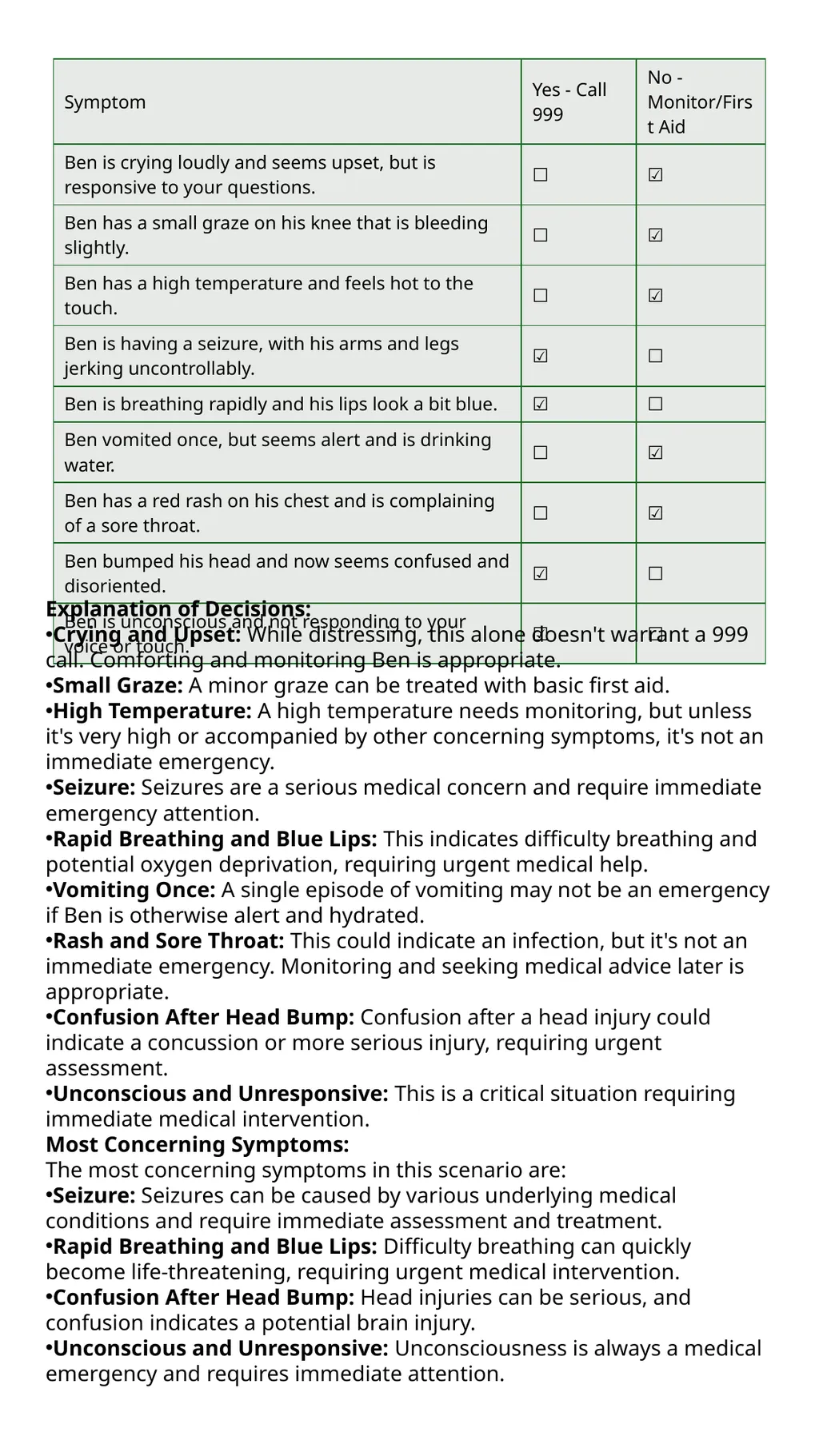
Explanation of Decisions:
Crying and Upset: While distressing, this alone doesn't warrant a 999 call. Comforting and monitoring Ben is appropriate.
Small Graze: A minor graze can be treated with basic first aid.
High Temperature: A high temperature needs monitoring, but unless it's very high or accompanied by other concerning symptoms, it's not an immediate emergency.
Seizure: Seizures are a serious medical concern and require immediate emergency attention.
Rapid Breathing and Blue Lips: This indicates difficulty breathing and potential oxygen deprivation, requiring urgent medical help.
Vomiting Once: A single episode of vomiting may not be an emergency if Ben is otherwise alert and hydrated.
Rash and Sore Throat: This could indicate an infection, but it's not an immediate emergency. Monitoring and seeking medical advice later is appropriate.
Confusion After Head Bump: Confusion after a head injury could indicate a concussion or more serious injury, requiring urgent assessment.
Unconscious and Unresponsive: This is a critical situation requiring immediate medical intervention.
Most Concerning Symptoms:
The most concerning symptoms in this scenario are:
Seizure: Seizures can be caused by various underlying medical conditions and require immediate assessment and treatment.
Rapid Breathing and Blue Lips: Difficulty breathing can quickly become life-threatening, requiring urgent medical intervention.
Confusion After Head Bump: Head injuries can be serious, and confusion indicates a potential brain injury.
Unconscious and Unresponsive: Unconsciousness is always a medical emergency and requires immediate attention.<br>
33
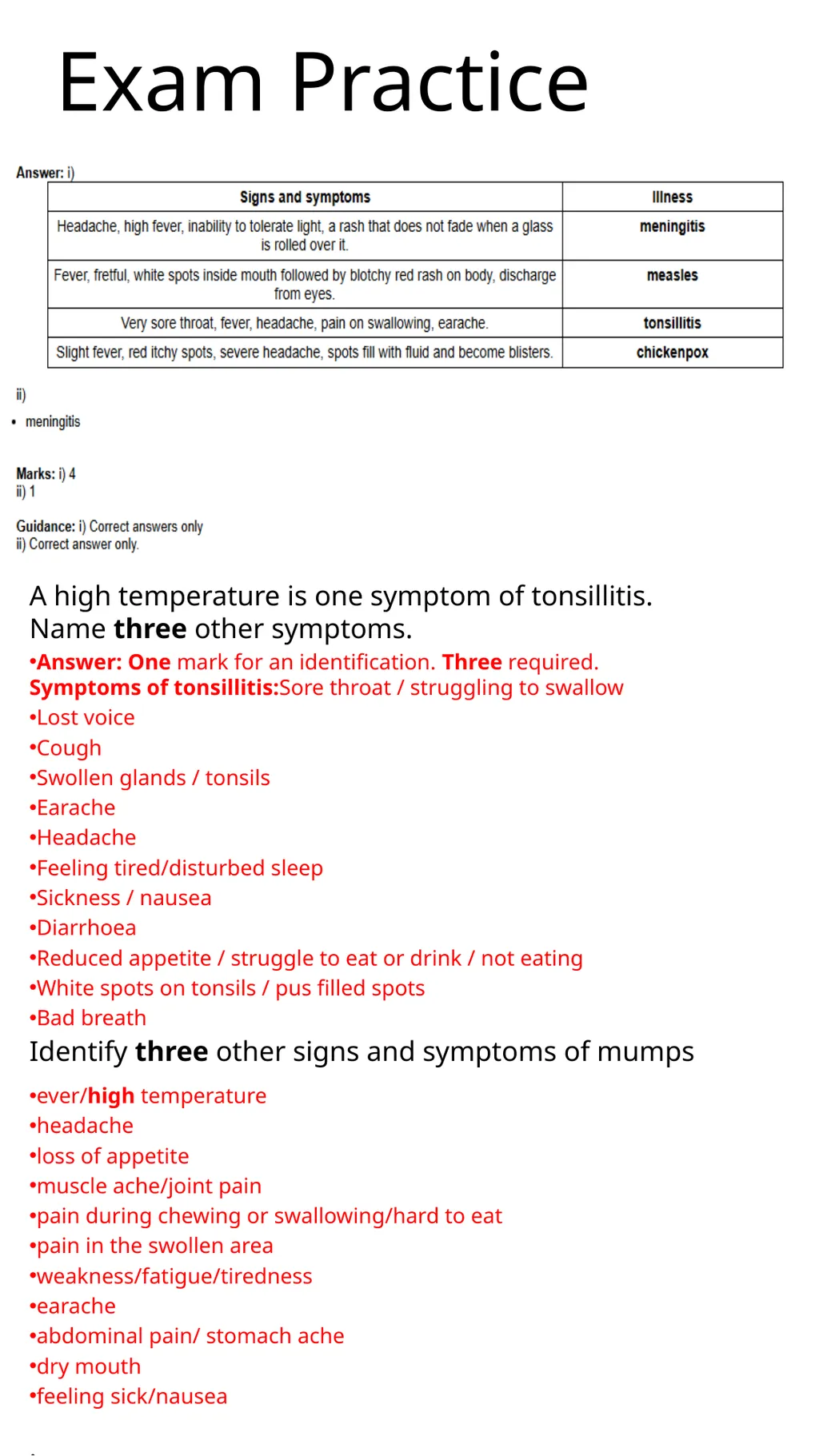
Exam Practice A high temperature is one symptom of tonsillitis. Name three other symptoms.
Answer: One mark for an identification. Three required. Symptoms of tonsillitis:Sore throat / struggling to swallow
Lost voice
Cough
Swollen glands / tonsils
Earache
Headache
Feeling tired/disturbed sleep
Sickness / nausea
Diarrhoea
Reduced appetite / struggle to eat or drink / not eating
White spots on tonsils / pus filled spots
Bad breath Identify three other signs and symptoms of mumps
ever/high temperature
headache
loss of appetite
muscle ache/joint pain
pain during chewing or swallowing/hard to eat
pain in the swollen area
weakness/fatigue/tiredness
earache
abdominal pain/ stomach ache
dry mouth
feeling sick/nausea
.<br>
34
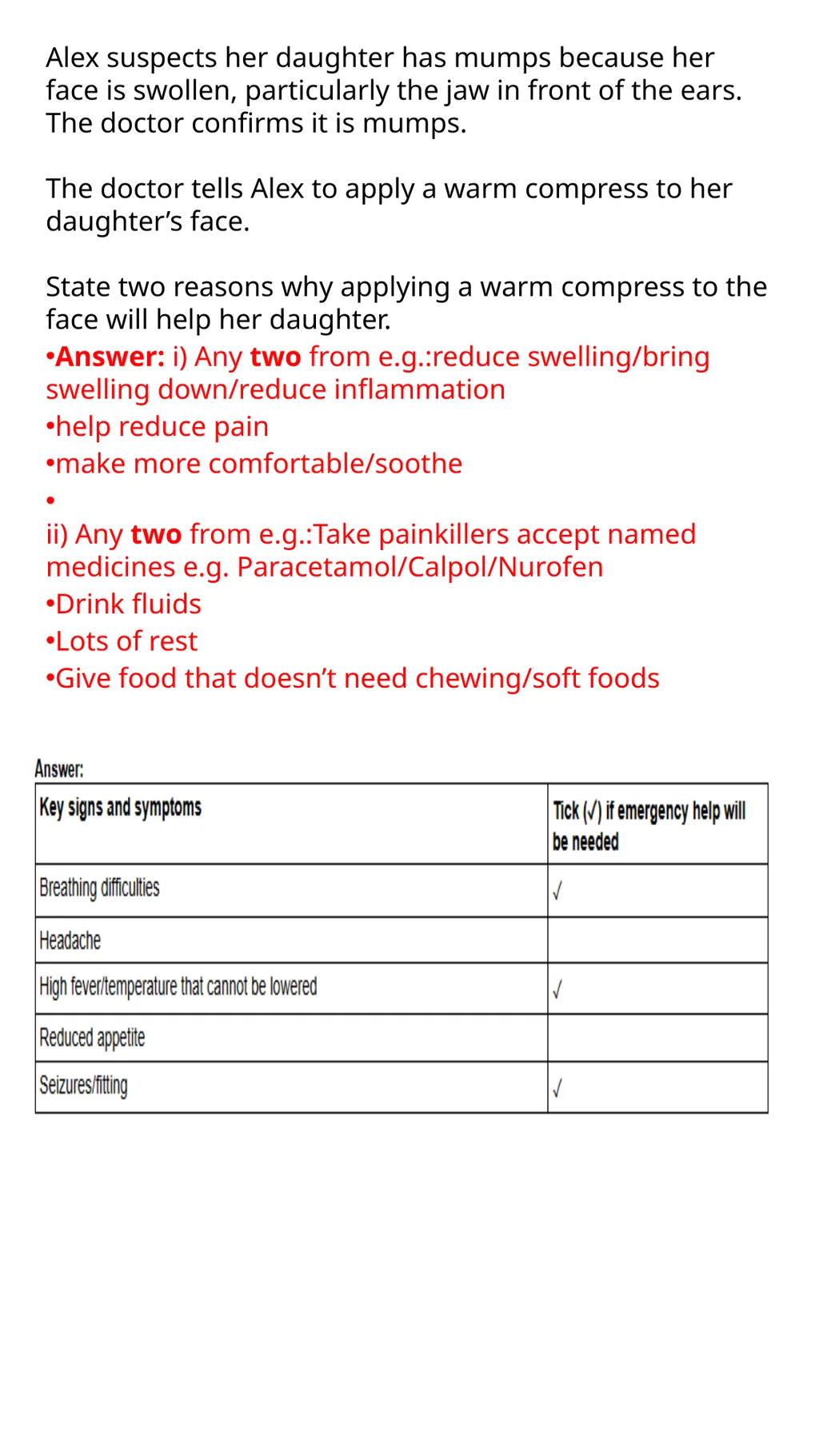
Alex suspects her daughter has mumps because her face is swollen, particularly the jaw in front of the ears. The doctor confirms it is mumps.
The doctor tells Alex to apply a warm compress to her daughter’s face.
State two reasons why applying a warm compress to the face will help her daughter.
Answer: i) Any two from e.g.:reduce swelling/bring swelling down/reduce inflammation
help reduce pain
make more comfortable/soothe
ii) Any two from e.g.:Take painkillers accept named medicines e.g. Paracetamol/Calpol/Nurofen
Drink fluids
Lots of rest
Give food that doesn’t need chewing/soft foods<br>
35
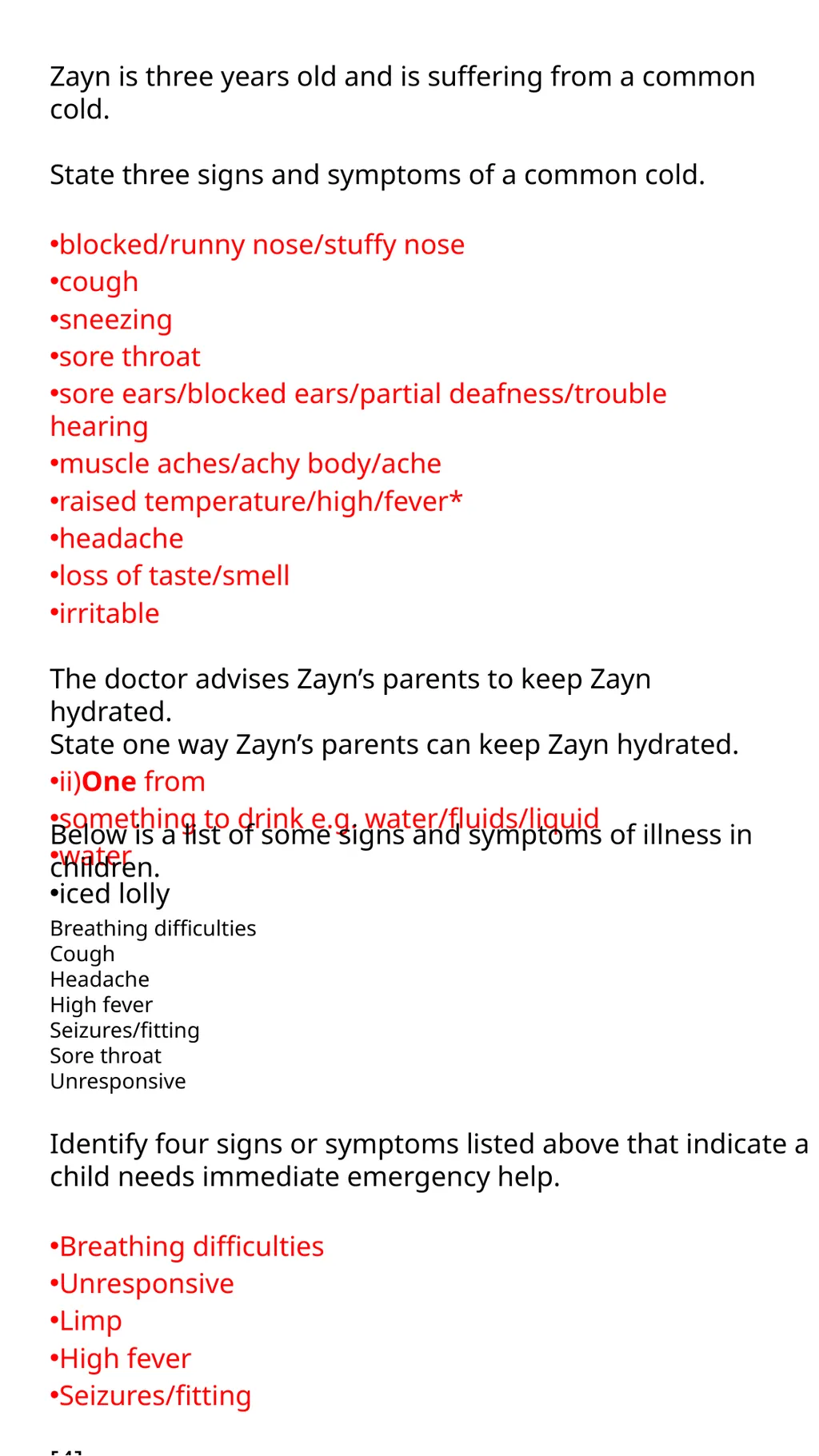
Zayn is three years old and is suffering from a common cold.
State three signs and symptoms of a common cold.
blocked/runny nose/stuffy nose
cough
sneezing
sore throat
sore ears/blocked ears/partial deafness/trouble hearing
muscle aches/achy body/ache
raised temperature/high/fever*
headache
loss of taste/smell
irritable
The doctor advises Zayn’s parents to keep Zayn hydrated.
State one way Zayn’s parents can keep Zayn hydrated.
ii)One from
something to drink e.g. water/fluids/liquid
water
iced lolly Below is a list of some signs and symptoms of illness in children.
Breathing difficulties
Cough
Headache
High fever
Seizures/fitting
Sore throat
Unresponsive
Identify four signs or symptoms listed above that indicate a child needs immediate emergency help.
Breathing difficulties
Unresponsive
Limp
High fever
Seizures/fitting
[4]<br>
36
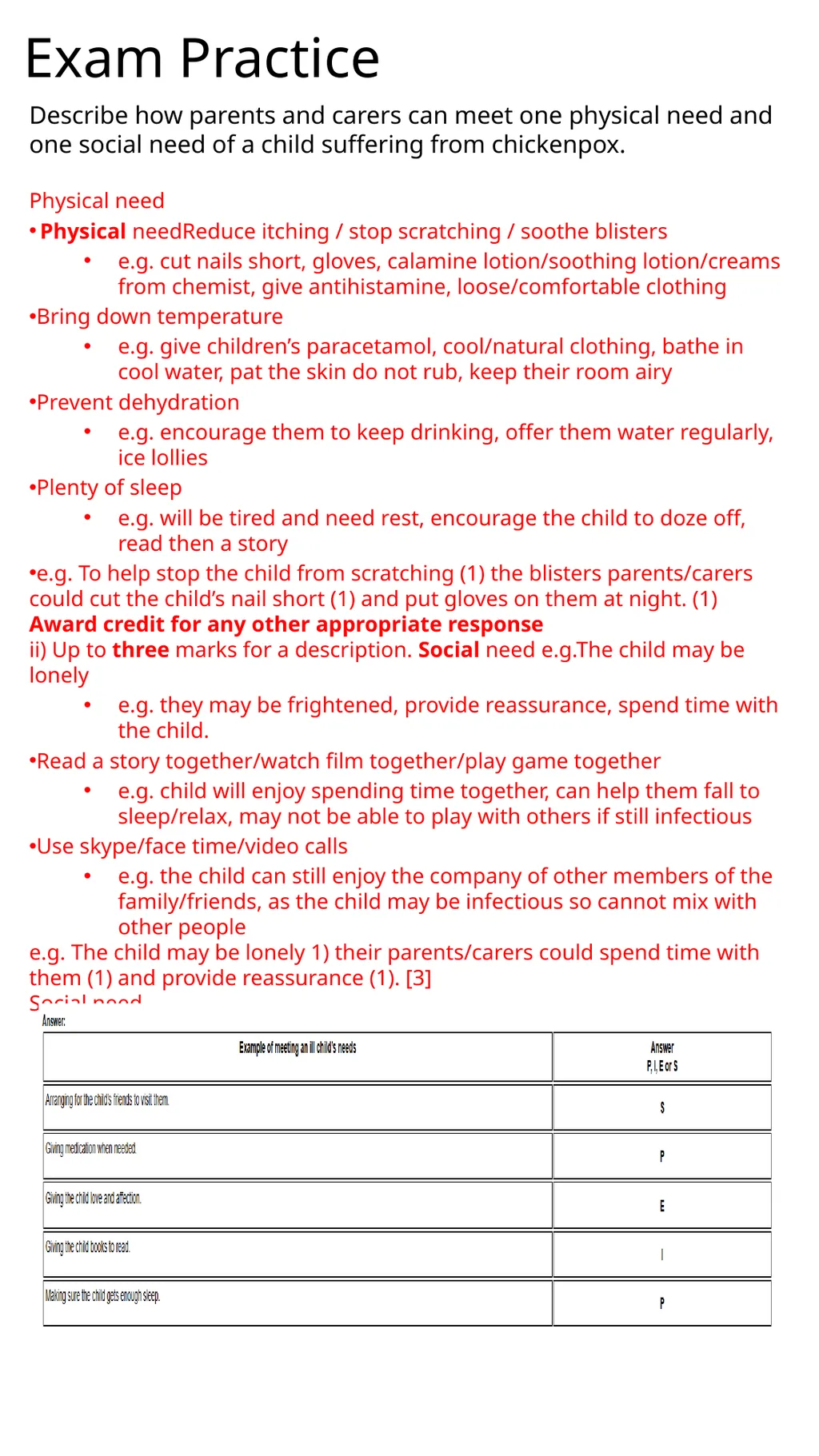
Exam Practice Describe how parents and carers can meet one physical need and one social need of a child suffering from chickenpox.
Physical need
Physical needReduce itching / stop scratching / soothe blisters
e.g. cut nails short, gloves, calamine lotion/soothing lotion/creams from chemist, give antihistamine, loose/comfortable clothing
Bring down temperature
e.g. give children’s paracetamol, cool/natural clothing, bathe in cool water, pat the skin do not rub, keep their room airy
Prevent dehydration
e.g. encourage them to keep drinking, offer them water regularly, ice lollies
Plenty of sleep
e.g. will be tired and need rest, encourage the child to doze off, read then a story
e.g. To help stop the child from scratching (1) the blisters parents/carers could cut the child’s nail short (1) and put gloves on them at night. (1) Award credit for any other appropriate response ii) Up to three marks for a description. Social need e.g.The child may be lonely
e.g. they may be frightened, provide reassurance, spend time with the child.
Read a story together/watch film together/play game together
e.g. child will enjoy spending time together, can help them fall to sleep/relax, may not be able to play with others if still infectious
Use skype/face time/video calls
e.g. the child can still enjoy the company of other members of the family/friends, as the child may be infectious so cannot mix with other people
e.g. The child may be lonely 1) their parents/carers could spend time with them (1) and provide reassurance (1). [3]
Social need<br>
37
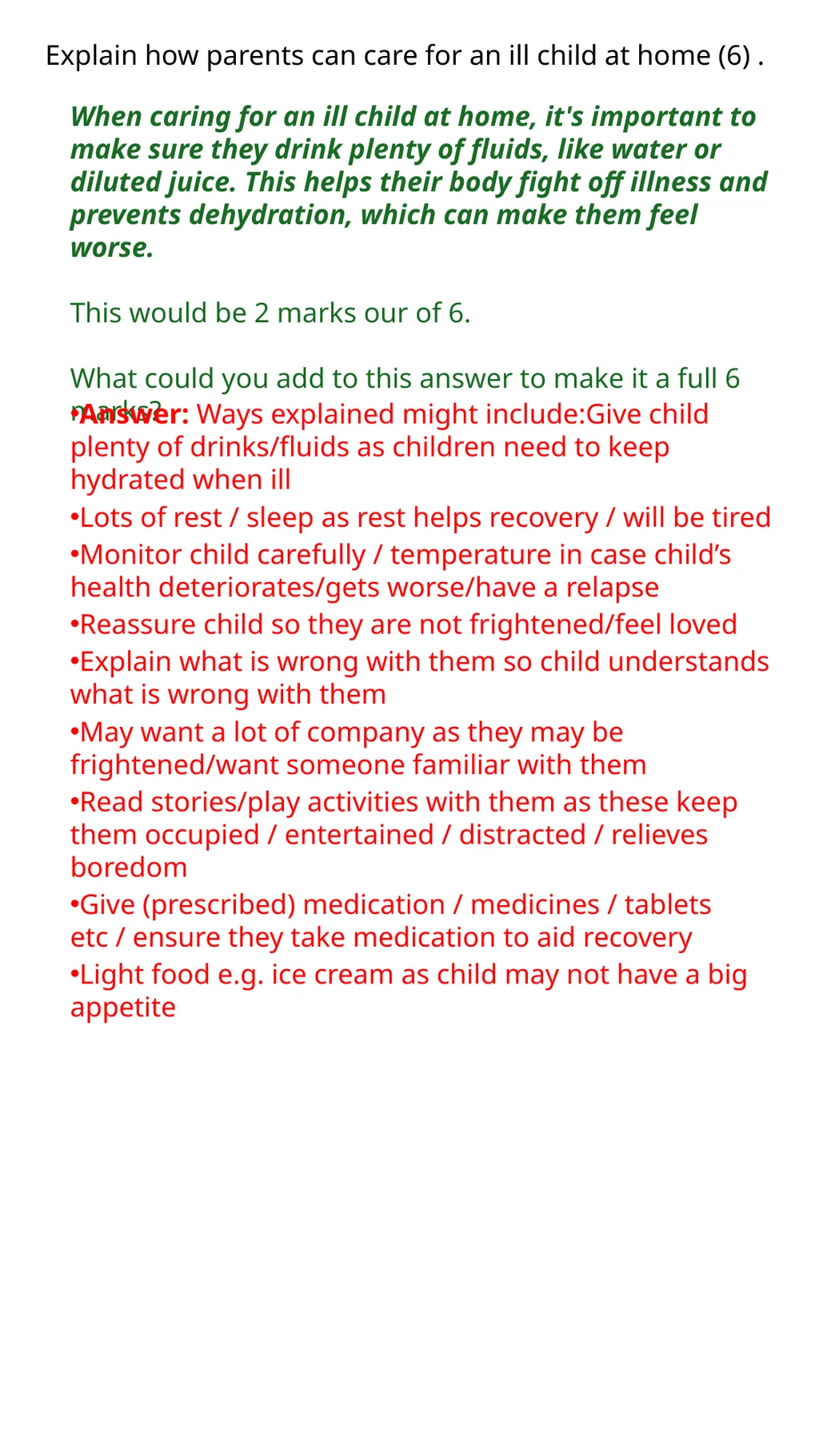
Explain how parents can care for an ill child at home (6) . When caring for an ill child at home, it's important to make sure they drink plenty of fluids, like water or diluted juice. This helps their body fight off illness and prevents dehydration, which can make them feel worse.
This would be 2 marks our of 6.
What could you add to this answer to make it a full 6 marks? Answer: Ways explained might include:Give child plenty of drinks/fluids as children need to keep hydrated when ill
Lots of rest / sleep as rest helps recovery / will be tired
Monitor child carefully / temperature in case child’s health deteriorates/gets worse/have a relapse
Reassure child so they are not frightened/feel loved
Explain what is wrong with them so child understands what is wrong with them
May want a lot of company as they may be frightened/want someone familiar with them
Read stories/play activities with them as these keep them occupied / entertained / distracted / relieves boredom
Give (prescribed) medication / medicines / tablets etc / ensure they take medication to aid recovery
Light food e.g. ice cream as child may not have a big appetite<br>
38
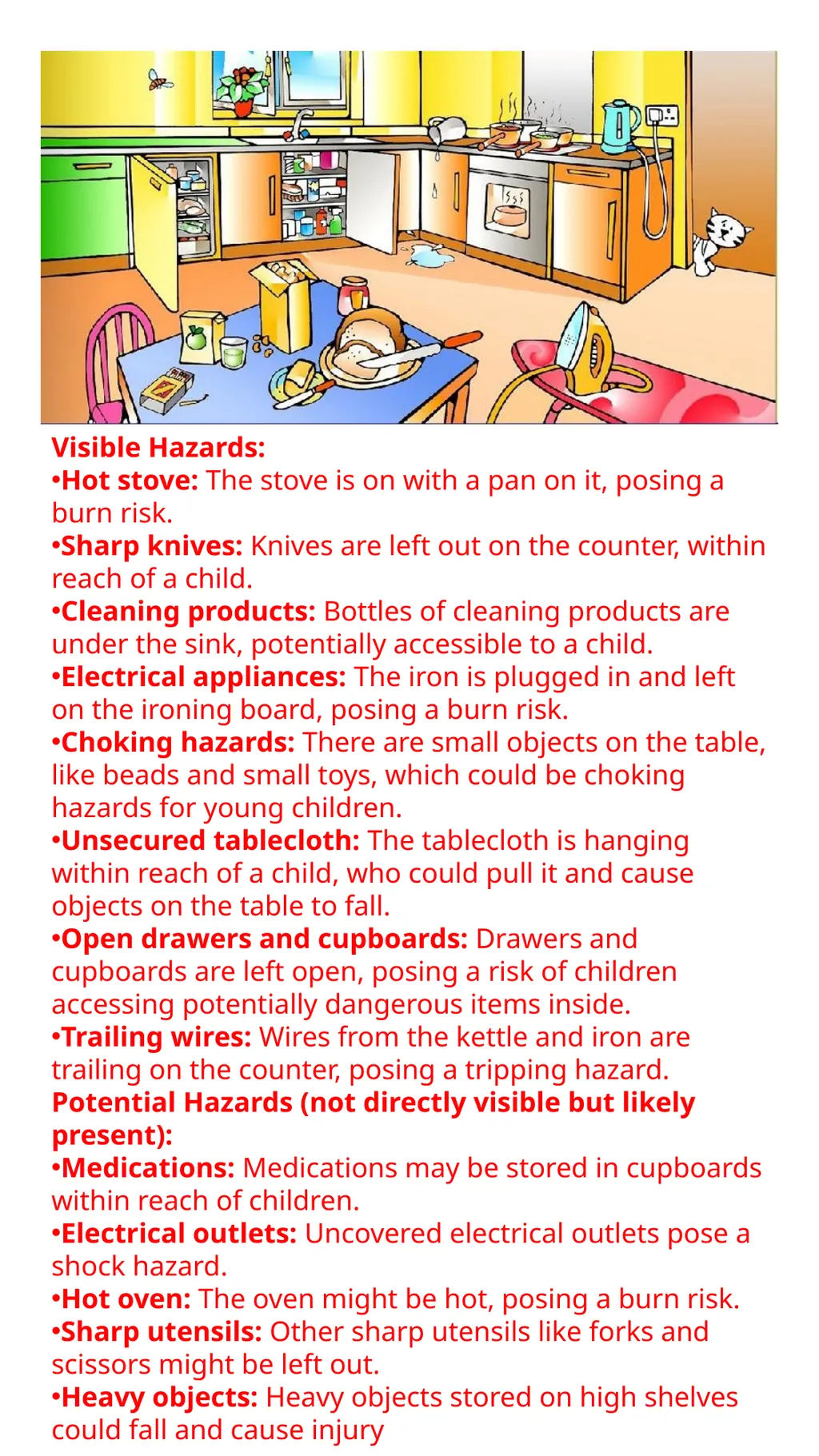
Visible Hazards:
Hot stove: The stove is on with a pan on it, posing a burn risk.
Sharp knives: Knives are left out on the counter, within reach of a child.
Cleaning products: Bottles of cleaning products are under the sink, potentially accessible to a child.
Electrical appliances: The iron is plugged in and left on the ironing board, posing a burn risk.
Choking hazards: There are small objects on the table, like beads and small toys, which could be choking hazards for young children.
Unsecured tablecloth: The tablecloth is hanging within reach of a child, who could pull it and cause objects on the table to fall.
Open drawers and cupboards: Drawers and cupboards are left open, posing a risk of children accessing potentially dangerous items inside.
Trailing wires: Wires from the kettle and iron are trailing on the counter, posing a tripping hazard.
Potential Hazards (not directly visible but likely present):
Medications: Medications may be stored in cupboards within reach of children.
Electrical outlets: Uncovered electrical outlets pose a shock hazard.
Hot oven: The oven might be hot, posing a burn risk.
Sharp utensils: Other sharp utensils like forks and scissors might be left out.
Heavy objects: Heavy objects stored on high shelves could fall and cause injury<br>
39
Visible Hazards:
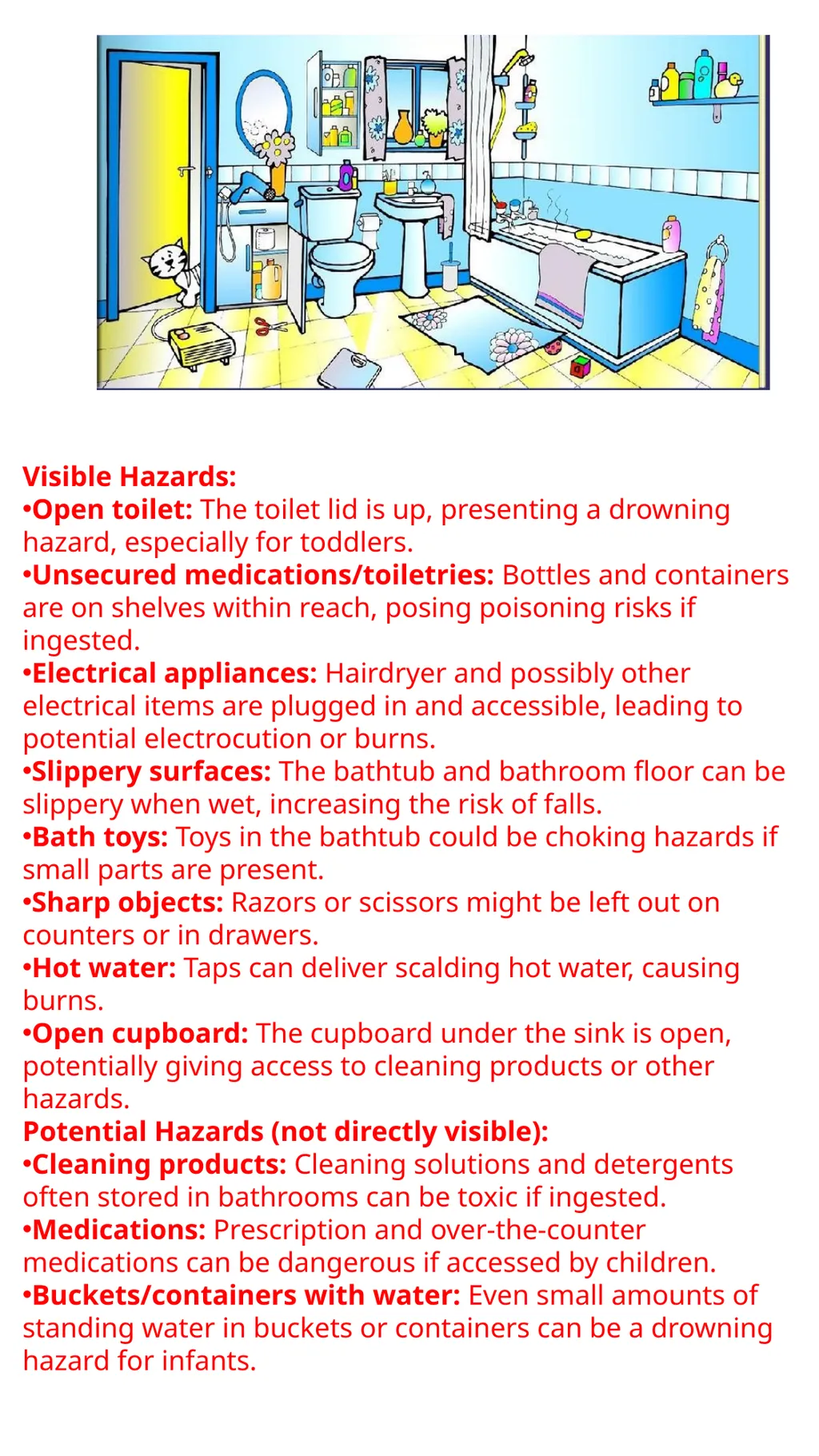
Open toilet: The toilet lid is up, presenting a drowning hazard, especially for toddlers.
Unsecured medications/toiletries: Bottles and containers are on shelves within reach, posing poisoning risks if ingested.
Electrical appliances: Hairdryer and possibly other electrical items are plugged in and accessible, leading to potential electrocution or burns.
Slippery surfaces: The bathtub and bathroom floor can be slippery when wet, increasing the risk of falls.
Bath toys: Toys in the bathtub could be choking hazards if small parts are present.
Sharp objects: Razors or scissors might be left out on counters or in drawers.
Hot water: Taps can deliver scalding hot water, causing burns.
Open cupboard: The cupboard under the sink is open, potentially giving access to cleaning products or other hazards.
Potential Hazards (not directly visible):
Cleaning products: Cleaning solutions and detergents often stored in bathrooms can be toxic if ingested.
Medications: Prescription and over-the-counter medications can be dangerous if accessed by children.
Buckets/containers with water: Even small amounts of standing water in buckets or containers can be a drowning hazard for infants.<br>
40
visible Hazards:
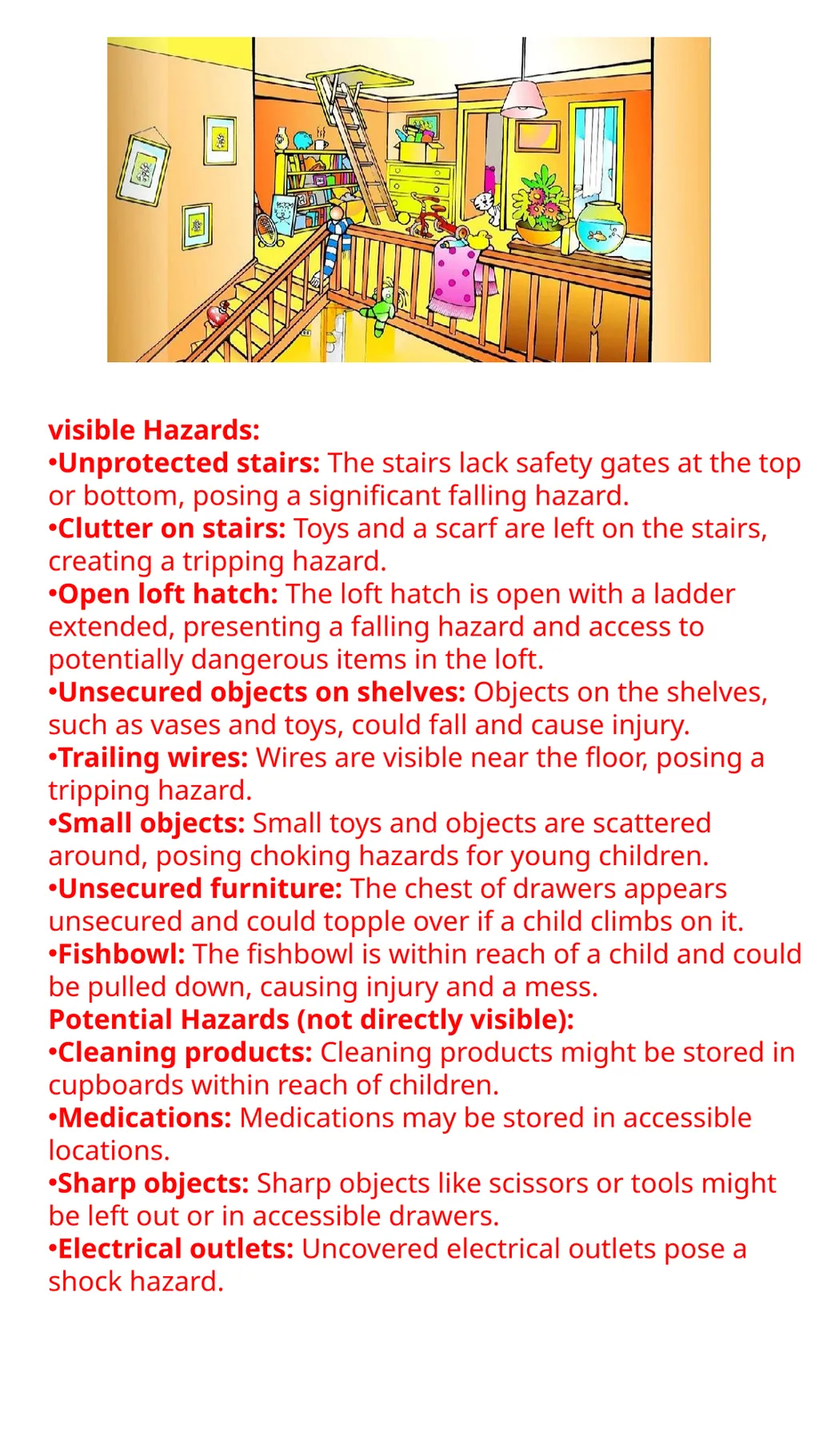
Unprotected stairs: The stairs lack safety gates at the top or bottom, posing a significant falling hazard.
Clutter on stairs: Toys and a scarf are left on the stairs, creating a tripping hazard.
Open loft hatch: The loft hatch is open with a ladder extended, presenting a falling hazard and access to potentially dangerous items in the loft.
Unsecured objects on shelves: Objects on the shelves, such as vases and toys, could fall and cause injury.
Trailing wires: Wires are visible near the floor, posing a tripping hazard.
Small objects: Small toys and objects are scattered around, posing choking hazards for young children.
Unsecured furniture: The chest of drawers appears unsecured and could topple over if a child climbs on it.
Fishbowl: The fishbowl is within reach of a child and could be pulled down, causing injury and a mess.
Potential Hazards (not directly visible):
Cleaning products: Cleaning products might be stored in cupboards within reach of children.
Medications: Medications may be stored in accessible locations.
Sharp objects: Sharp objects like scissors or tools might be left out or in accessible drawers.
Electrical outlets: Uncovered electrical outlets pose a shock hazard.<br>
41
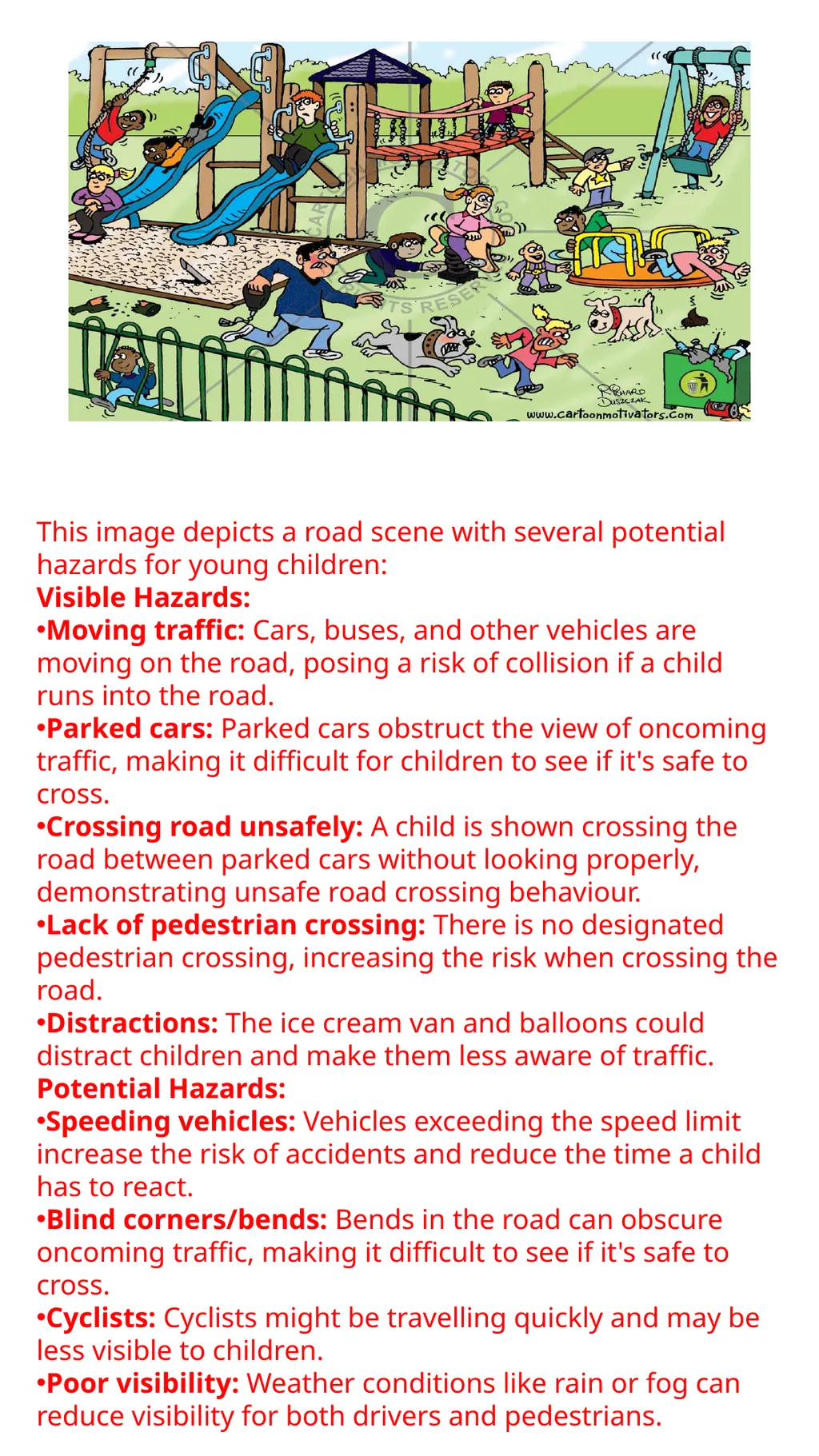
This image depicts a road scene with several potential hazards for young children:
Visible Hazards:
Moving traffic: Cars, buses, and other vehicles are moving on the road, posing a risk of collision if a child runs into the road.
Parked cars: Parked cars obstruct the view of oncoming traffic, making it difficult for children to see if it's safe to cross.
Crossing road unsafely: A child is shown crossing the road between parked cars without looking properly, demonstrating unsafe road crossing behaviour.
Lack of pedestrian crossing: There is no designated pedestrian crossing, increasing the risk when crossing the road.
Distractions: The ice cream van and balloons could distract children and make them less aware of traffic.
Potential Hazards:
Speeding vehicles: Vehicles exceeding the speed limit increase the risk of accidents and reduce the time a child has to react.
Blind corners/bends: Bends in the road can obscure oncoming traffic, making it difficult to see if it's safe to cross.
Cyclists: Cyclists might be travelling quickly and may be less visible to children.
Poor visibility: Weather conditions like rain or fog can reduce visibility for both drivers and pedestrians.<br>
42
Visible Hazards:
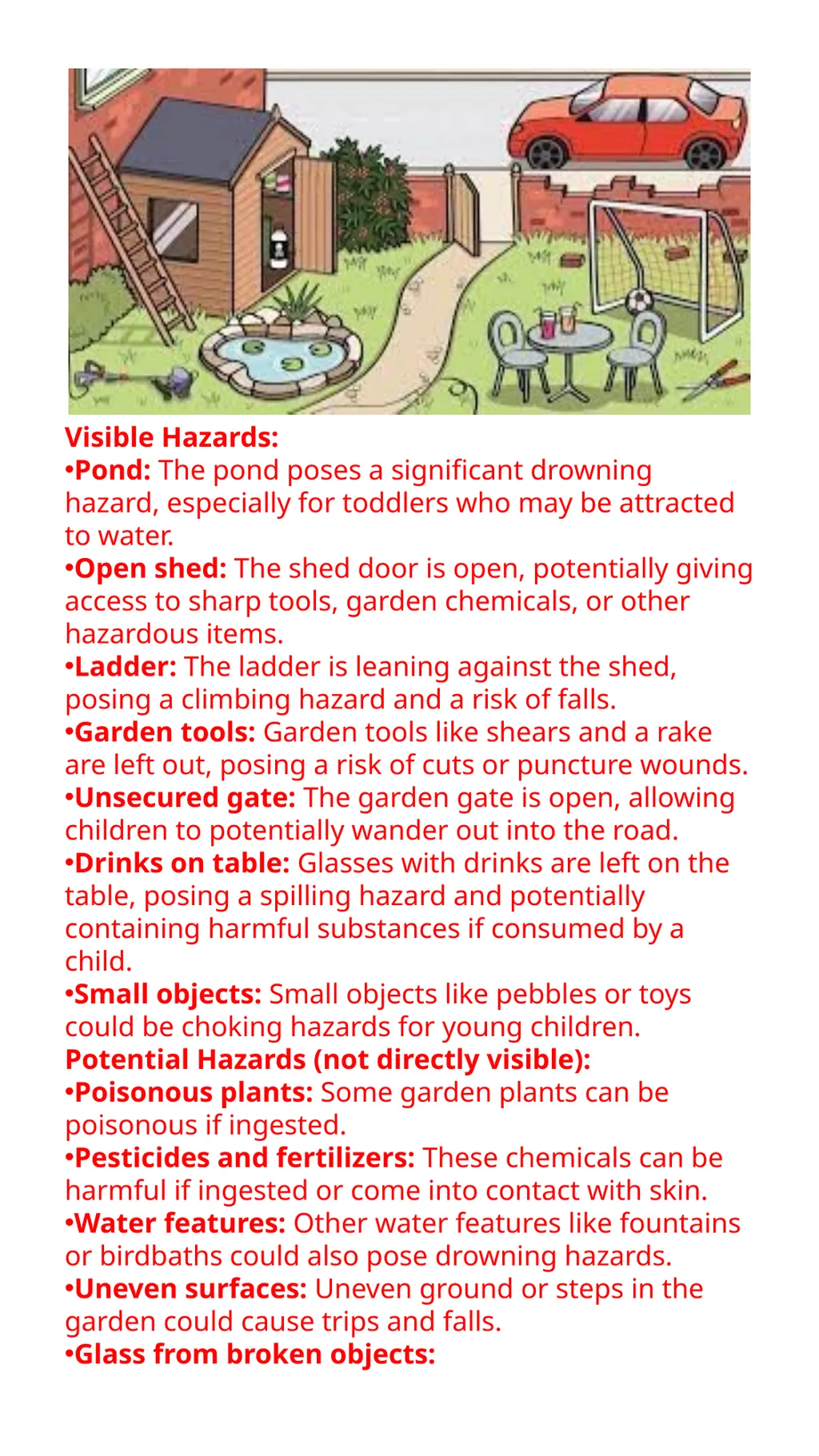
Pond: The pond poses a significant drowning hazard, especially for toddlers who may be attracted to water.
Open shed: The shed door is open, potentially giving access to sharp tools, garden chemicals, or other hazardous items.
Ladder: The ladder is leaning against the shed, posing a climbing hazard and a risk of falls.
Garden tools: Garden tools like shears and a rake are left out, posing a risk of cuts or puncture wounds.
Unsecured gate: The garden gate is open, allowing children to potentially wander out into the road.
Drinks on table: Glasses with drinks are left on the table, posing a spilling hazard and potentially containing harmful substances if consumed by a child.
Small objects: Small objects like pebbles or toys could be choking hazards for young children.
Potential Hazards (not directly visible):
Poisonous plants: Some garden plants can be poisonous if ingested.
Pesticides and fertilizers: These chemicals can be harmful if ingested or come into contact with skin.
Water features: Other water features like fountains or birdbaths could also pose drowning hazards.
Uneven surfaces: Uneven ground or steps in the garden could cause trips and falls.
Glass from broken objects:<br>
43
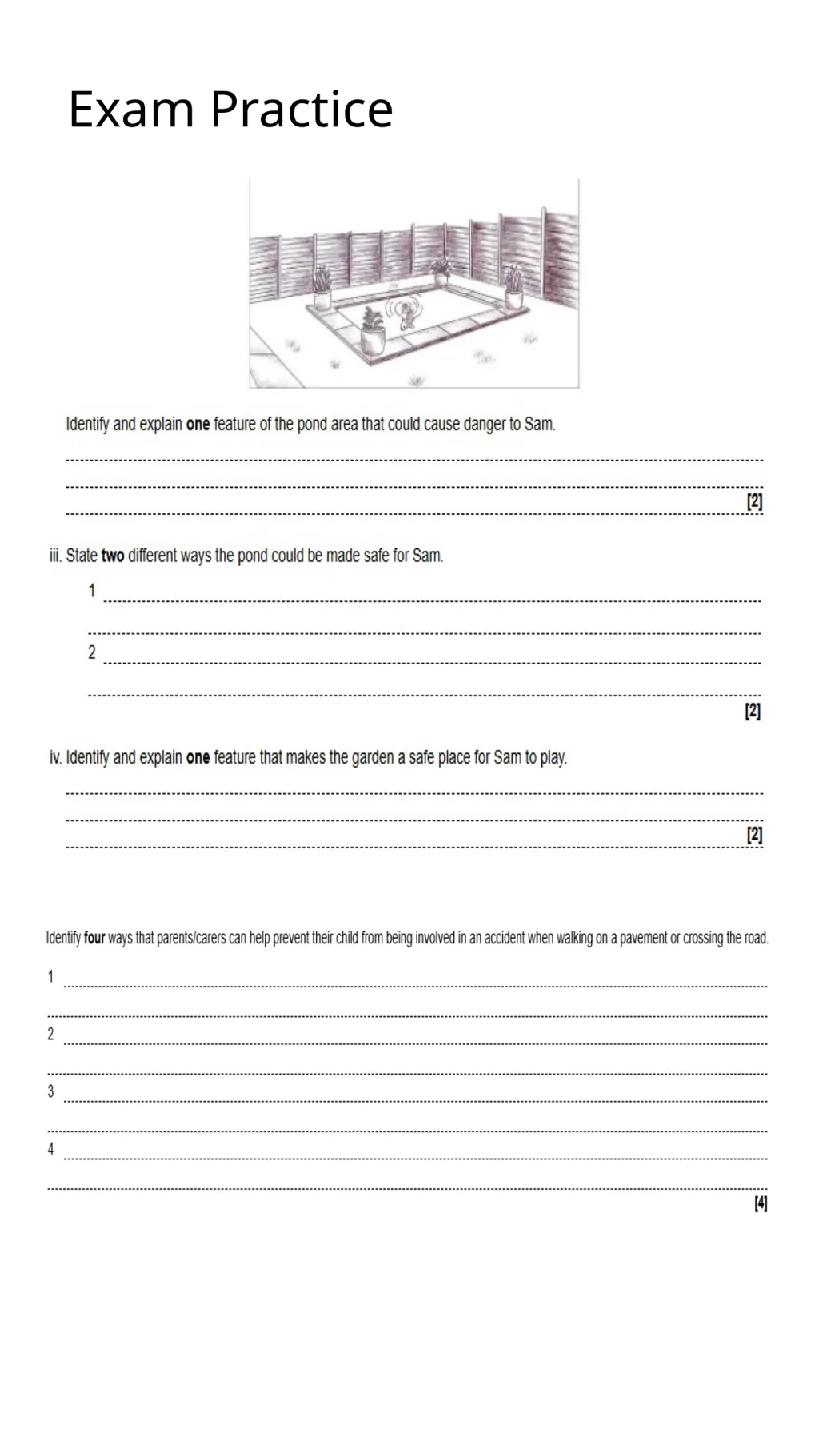
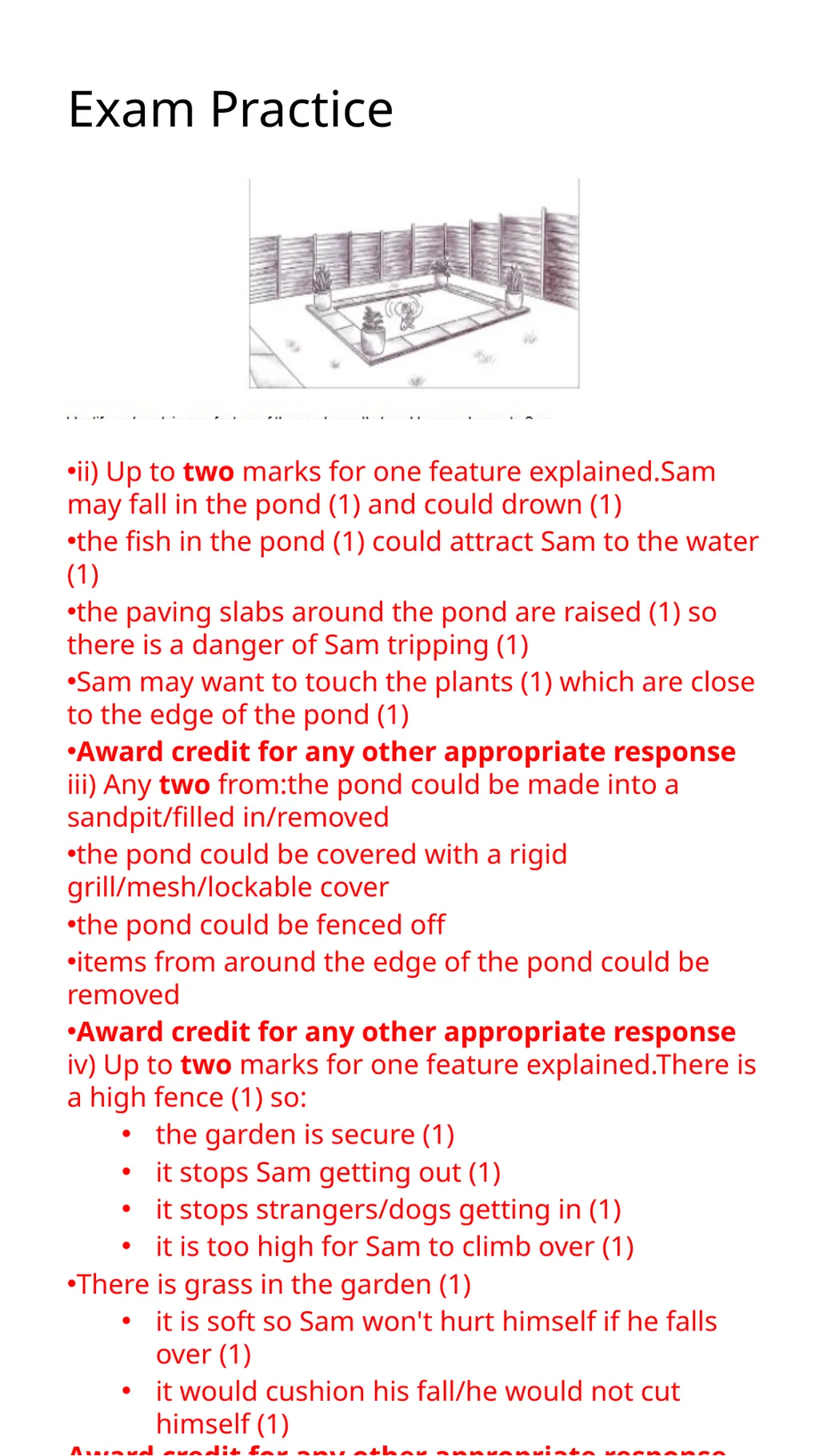
Exam Practice ii) Up to two marks for one feature explained.Sam may fall in the pond (1) and could drown (1)
the fish in the pond (1) could attract Sam to the water (1)
the paving slabs around the pond are raised (1) so there is a danger of Sam tripping (1)
Sam may want to touch the plants (1) which are close to the edge of the pond (1)
Award credit for any other appropriate response iii) Any two from:the pond could be made into a sandpit/filled in/removed
the pond could be covered with a rigid grill/mesh/lockable cover
the pond could be fenced off
items from around the edge of the pond could be removed
Award credit for any other appropriate response iv) Up to two marks for one feature explained.There is a high fence (1) so:
the garden is secure (1)
it stops Sam getting out (1)
it stops strangers/dogs getting in (1)
it is too high for Sam to climb over (1)
There is grass in the garden (1)
it is soft so Sam won't hurt himself if he falls over (1)
it would cushion his fall/he would not cut himself (1)
Award credit for any other appropriate response<br>
44
Explain how parents or carers can make the kitchen a safe place for young children. Use two different hazards in your answer. “One way parents can make the kitchen safer is by storing knives and sharp objects in a drawer with a child lock. This stops children from getting cuts. Also, parents should keep cleaning products in a high cupboard.”
How many marks would you give this?
"Parents can make the kitchen safer by storing knives and sharp objects in a drawer or cupboard fitted with a child lock. This prevents young children from accessing the knives and reduces the risk of cuts. Additionally, cleaning products should be stored in a high cupboard, ideally with a childproof lock. This stops children from being able to reach potentially poisonous substances, reducing the risk of poisoning.“
How many marks would you give this?
Write your own 6/6 response.
____________________________________________________________________________________________________________________________________________________________________________________________________________________________________________________________________________________________________________________________________________________________________________________________________________________________________________________________________________________________________________________________________________________________________________________________________________________________________________________________________________________________________________________________________________________________________________________________________________________________________________<br>
How many marks would you give this?
"Parents can make the kitchen safer by storing knives and sharp objects in a drawer or cupboard fitted with a child lock. This prevents young children from accessing the knives and reduces the risk of cuts. Additionally, cleaning products should be stored in a high cupboard, ideally with a childproof lock. This stops children from being able to reach potentially poisonous substances, reducing the risk of poisoning.“
How many marks would you give this?
Write your own 6/6 response.
____________________________________________________________________________________________________________________________________________________________________________________________________________________________________________________________________________________________________________________________________________________________________________________________________________________________________________________________________________________________________________________________________________________________________________________________________________________________________________________________________________________________________________________________________________________________________________________________________________________________________________<br>
45
Exam Practice Identify and state the meaning of two safety symbols parents or carers should look for when buying toys for their child.
Lion Mark / Lion SymbolShows the toy meets the British Toy Manufacturers Association standards of safety
Symbol of safety and quality
Adheres to strict advertising and counterfeiting ethics
Age warning/age advice/0-3/symbol / correct drawing acceptableWarns parents toy is unsuitable for children under 3 years old/not to allow them to play with it
Choking hazard usually because of small pieces
CE Mark / CEA European Union symbol means the toy conforms with European safety standards
Is the manufacturers declaration that the toy meets all toy safety requirements
An enforcement mark and has to appear indelibly on the toy or its packaging
A passport for toys in the EU
Kite mark/BSIBritish Standards Institute (BSI) have tested the toy and it conforms to safety standards/safe to use
Symbol of safety and quality
Symbol of reliability Name the symbol found on safety products that shows they meet British standards. (1)
_________BSI_______________________________________________ Answer: Three marks for an explanation, one required. Why the Lion Mark is used on toys:Gives parents/people buying children’s toys reassurance / confidence
Shows that the toy meets the British Toy and Hobby Association standards / meets British standards of safety
Ensures that manufacturers make safe toys
Symbol of quality/ good quality toys
Safety /quality - toys are safe for children to use / have undergone safety tests
Adheres to strict advertising and counterfeiting ethics / tries to ban counterfeit toys/ produce ethical toys<br>