
CHM 221- BASIC ORGANIC CHEMISTRY 1 ALLICYCLIC

































Description: CHM 221- BASIC ORGANIC CHEMISTRY 1 ALLICYCLIC HYDROCARBONS Allicyclic (aliphatic cyclic) hydrocarbon and their derivatives are cyclic hydrocarbons of alkane, alkene andor alkyne. Generally, allicyclic compounds are compounds which contain
Related Topics
Download Presentation
"CHM 221- BASIC ORGANIC CHEMISTRY 1 ALLICYCLIC" is the property of its rightful owner. Permission is granted to download and print the materials on this website for personal, non-commercial use only, and to display it on your personal computer provided you do not modify the materials and that you retain all copyright notices contained in the materials. By downloading content from our website, you accept the terms of this agreement.
Presentation Transcript
slide1. CHM 221- BASIC ORGANIC CHEMISTRY 1<br>
slide4. ALLICYCLIC HYDROCARBONS<br>
slide6. Allicyclic (aliphatic cyclic) hydrocarbon and their derivatives are cyclic hydrocarbons of alkane, alkene and/or alkyne. Generally, allicyclic compounds are compounds which contain at least one ring but are aliphatic hence are called allicyclic (aliphatic cyclic compounds). They are non aromatic. The saturated allicyclic compounds have the general formula CnH2n (corresponding to 1 ring), CnH2n-2 (corresponding to 2 rings-bicyclo compounds) and CnH2n-4 (corresponding to 3 rings), etc. The smallest numbers of carbon atoms that can be arranged in a ring is three represented by the hydrocarbon; cyclopropane. Each additional rings lowers the number of Hydrogen atoms in the general formula by 2. Aliphatic cyclic hydrocarbons having one ring are called Allicyclic hydrocarbons.<br>
slide7. NOMECLATURE AND STRUCTURE OF CYCLIC HYDROCARBONS<br>
slide8. Allicyclic compounds are often shown by the topological formulations such as;<br>
slide10. NUMECLATURE RULES<br>
slide11. The number of carbon atoms in the ring of the cyclic compound is counted and word ‘cyclo’ is prefixed to the name of the alkane having the same number of carbon atoms on a straight line.<br>
slide12. The general name of saturated cyclic hydrocarbons is cycloalkane. e.g.<br>
slide15. (2). Substituents/functional groups are indicated by numbering and either appropriate prefixes before the word cyclo or by appropriate ending indicating the functional group. e.g<br>
slide16. When there are more one substituents, the numbering of the carbon atom that gives the lowest sum is chosen, e.g.<br>
slide19. Cycloalkene and cycloalkynes are cyclic compounds containing double bonds and triple bonds respectively. The positions of the double-bonded and triple-bonded carbons in the carbon chain are given the numbers 1 and 2 and are not prefixed to the name of cycloalkene and cycloalkyne, e.g<br>
slide22. POLICYCLIC COMPOUNDS<br>
slide23. Compounds with more than one ring of carbon atoms and whose rings share two or more same carbon atoms are known as Policyclic compounds . Those with two rings are called bicyclic Compounds. The rings may be fused as in Decalin or bridged as in norborane.<br>
slide25. NUMECLATURE OF BICYCLIC COMPOUNDS<br>
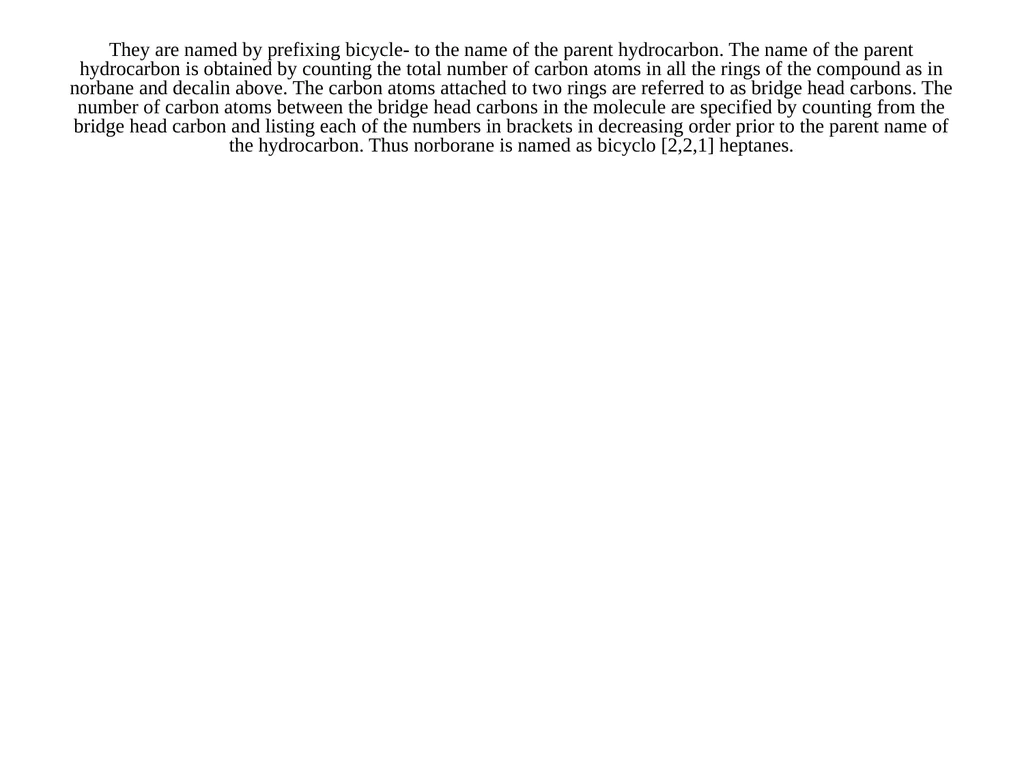
slide26. They are named by prefixing bicycle- to the name of the parent hydrocarbon. The name of the parent hydrocarbon is obtained by counting the total number of carbon atoms in all the rings of the compound as in norbane and decalin above. The carbon atoms attached to two rings are referred to as bridge head carbons. The number of carbon atoms between the bridge head carbons in the molecule are specified by counting from the bridge head carbon and listing each of the numbers in brackets in decreasing order prior to the parent name of the hydrocarbon. Thus norborane is named as bicyclo [2,2,1] heptanes.<br>
slide28. Other examples are:<br>
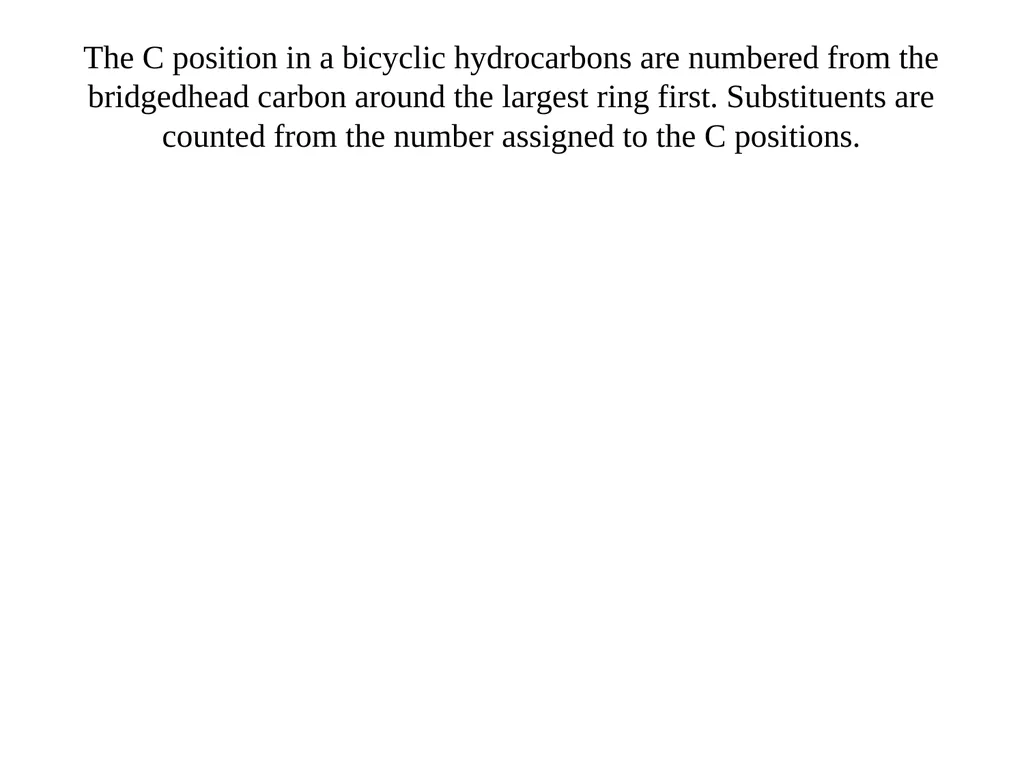
slide32. The C position in a bicyclic hydrocarbons are numbered from the bridgedhead carbon around the largest ring first. Substituents are counted from the number assigned to the C positions.<br>
slide33. Exercise;<br>
slide34. Draw the structure of the following alicyclic compounds:<br>
slide35. 1 bicyclo [4,3,0] nonane<br>
slide36. 2 2-chloro-4-carboxy bicycle[1,1,0]butane<br>
slide37. 3 2-methyl cyclopentan-1-one-oxime<br>
slide40. STRAIN ENERGY OF ALICYCLIC HYDROCARBONS<br>
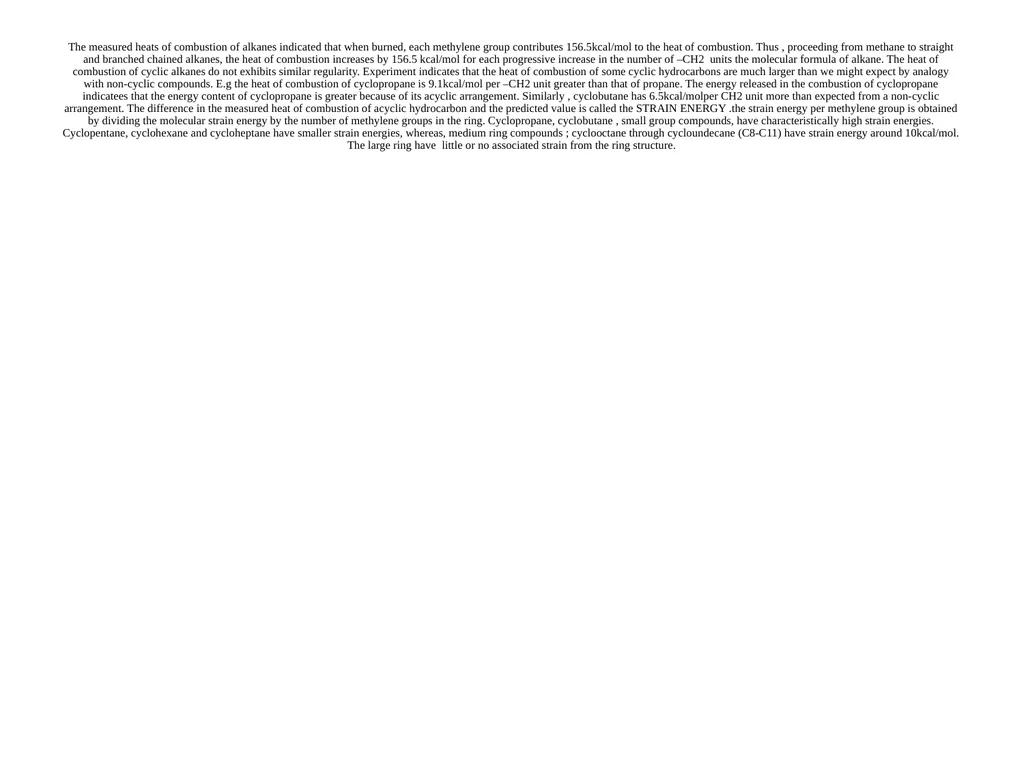
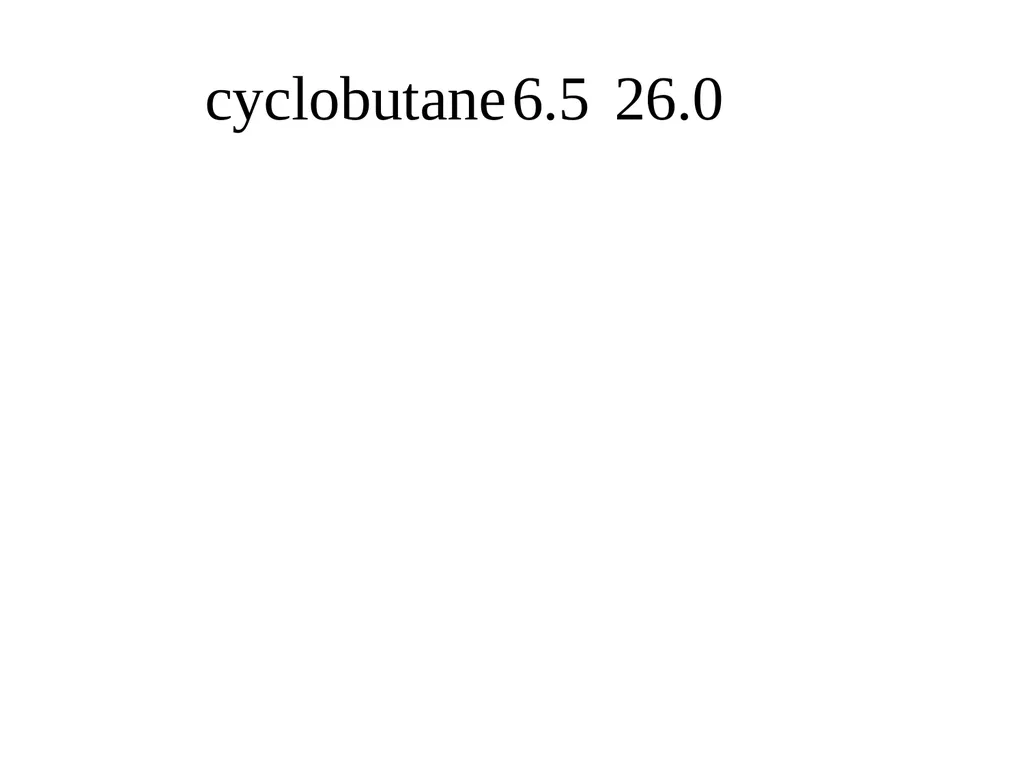
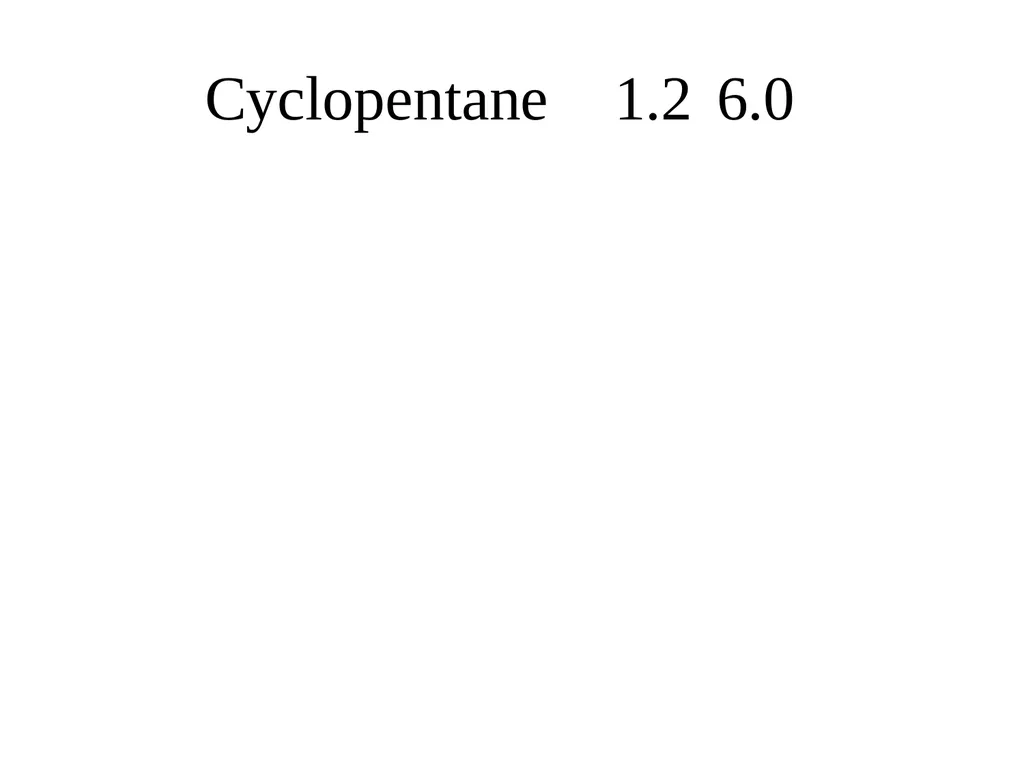
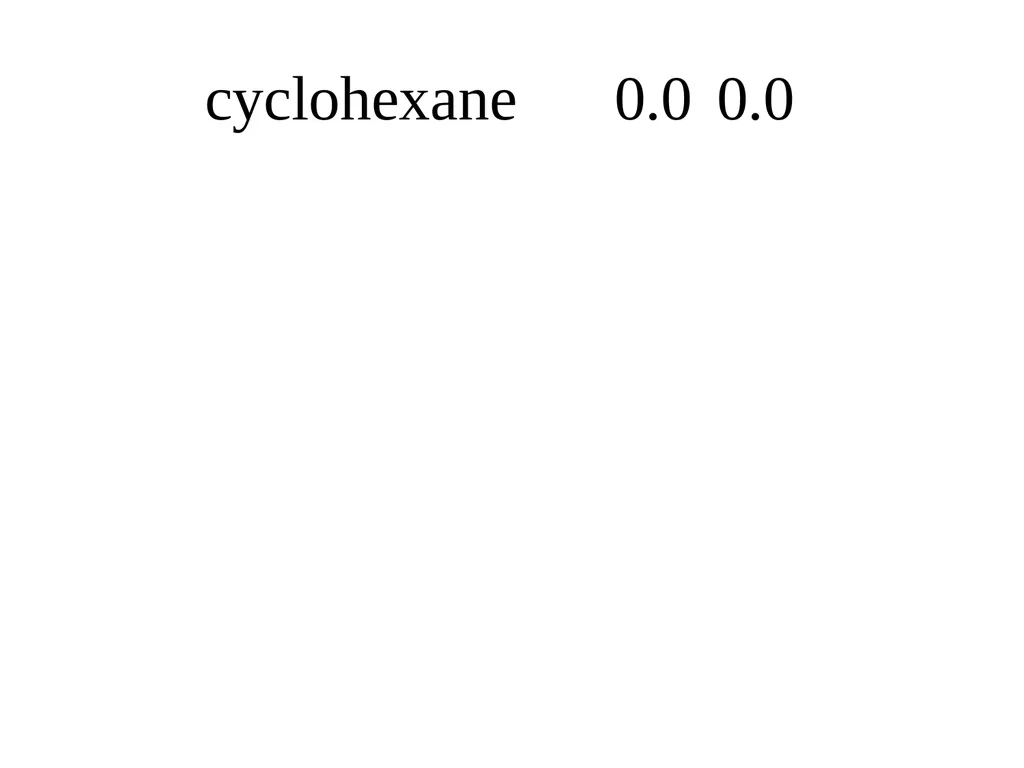
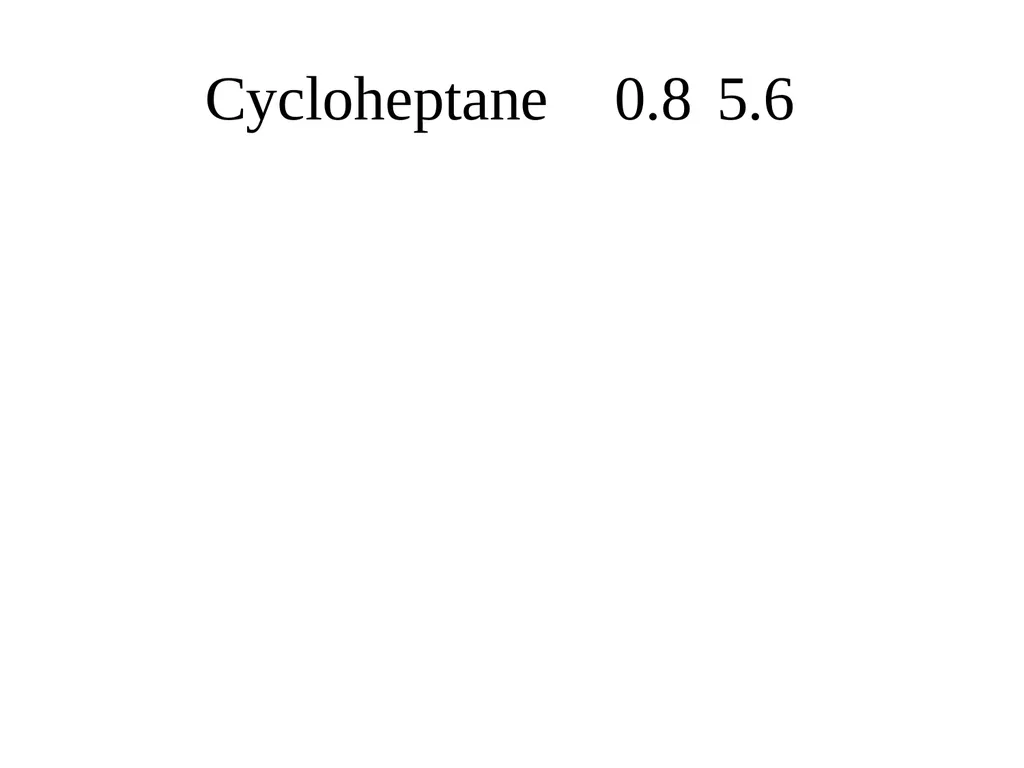
slide41. The measured heats of combustion of alkanes indicated that when burned, each methylene group contributes 156.5kcal/mol to the heat of combustion. Thus , proceeding from methane to straight and branched chained alkanes, the heat of combustion increases by 156.5 kcal/mol for each progressive increase in the number of –CH2 units the molecular formula of alkane. The heat of combustion of cyclic alkanes do not exhibits similar regularity. Experiment indicates that the heat of combustion of some cyclic hydrocarbons are much larger than we might expect by analogy with non-cyclic compounds. E.g the heat of combustion of cyclopropane is 9.1kcal/mol per –CH2 unit greater than that of propane. The energy released in the combustion of cyclopropane indicatees that the energy content of cyclopropane is greater because of its acyclic arrangement. Similarly , cyclobutane has 6.5kcal/molper CH2 unit more than expected from a non-cyclic arrangement. The difference in the measured heat of combustion of acyclic hydrocarbon and the predicted value is called the STRAIN ENERGY .the strain energy per methylene group is obtained by dividing the molecular strain energy by the number of methylene groups in the ring. Cyclopropane, cyclobutane , small group compounds, have characteristically high strain energies. Cyclopentane, cyclohexane and cycloheptane have smaller strain energies, whereas, medium ring compounds ; cyclooctane through cycloundecane (C8-C11) have strain energy around 10kcal/mol. The large ring have little or no associated strain from the ring structure.<br>
slide43. Strain energies of cycloalkanes.<br>
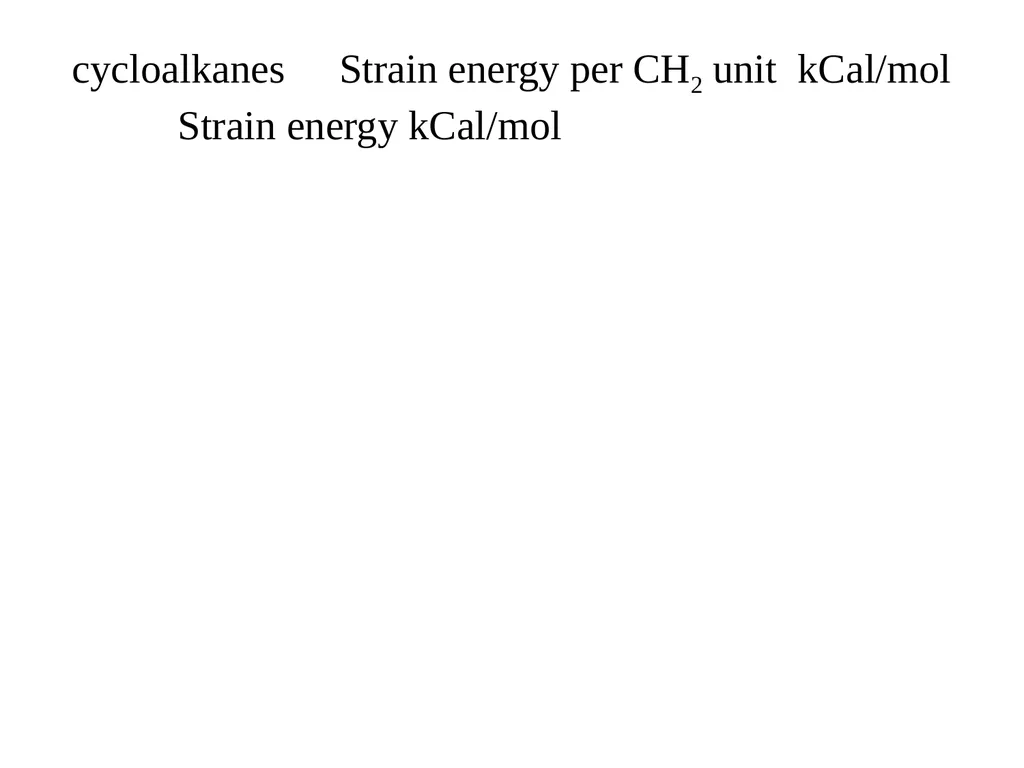
slide44. cycloalkanes Strain energy per CH2 unit kCal/mol Strain energy kCal/mol<br>
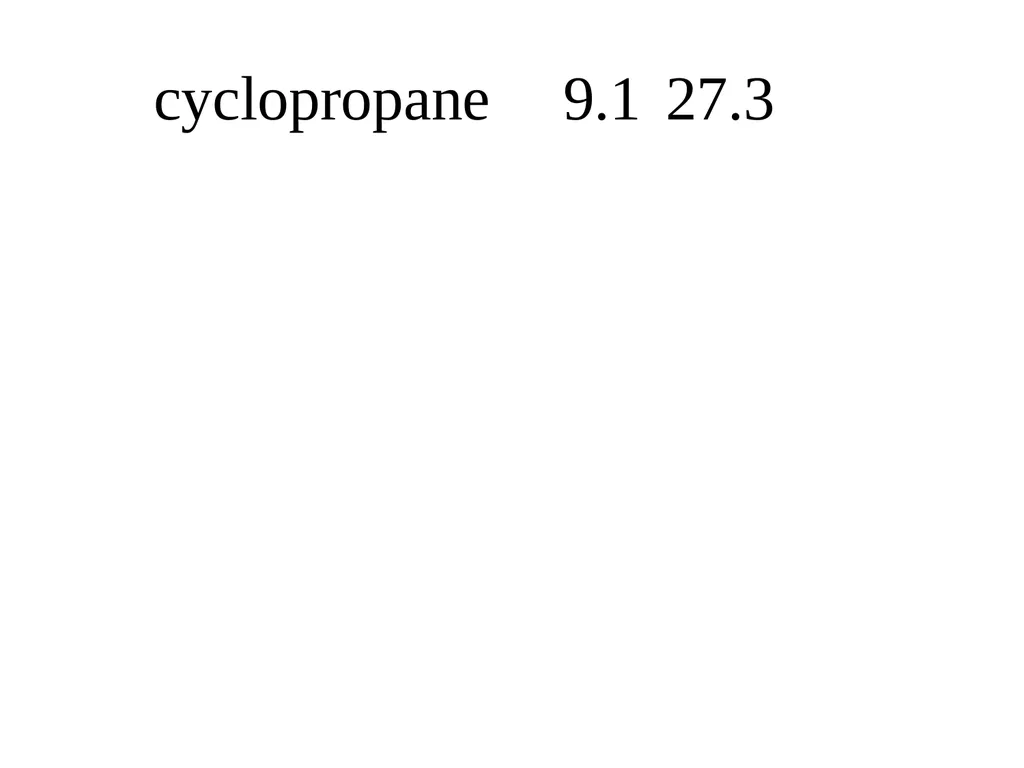
slide45. cyclopropane 9.1 27.3<br>
slide46. cyclobutane 6.5 26.0<br>
slide47. Cyclopentane 1.2 6.0<br>
slide48. cyclohexane 0.0 0.0<br>
slide49. Cycloheptane 0.8 5.6<br>
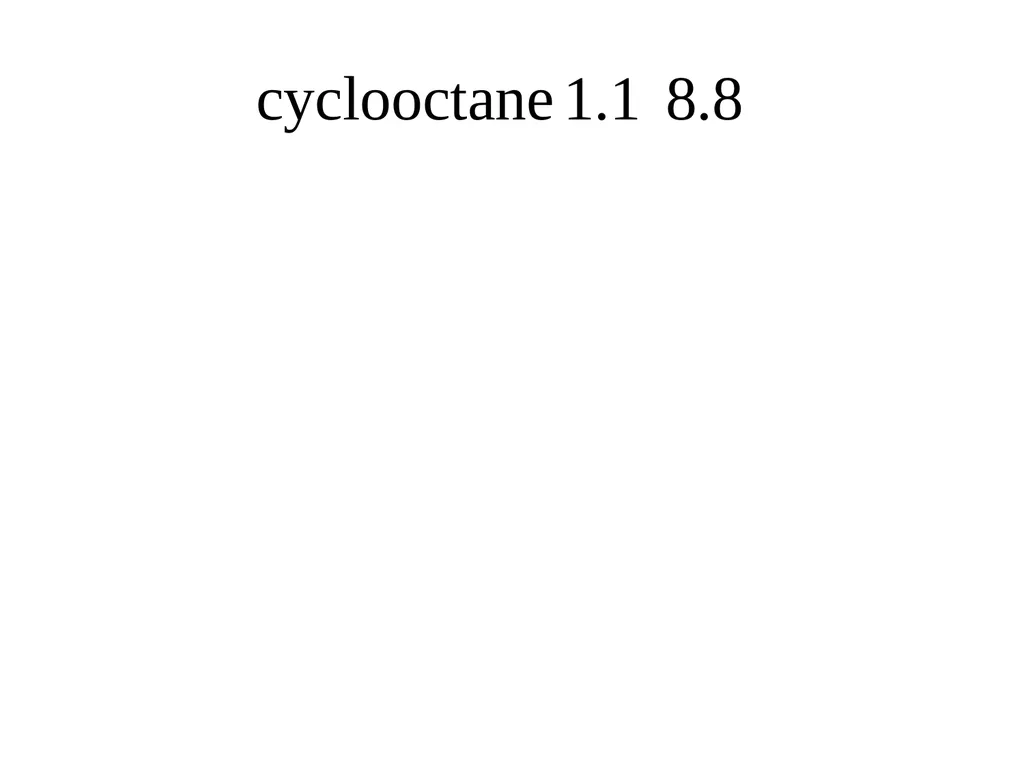
slide50. cyclooctane 1.1 8.8<br>
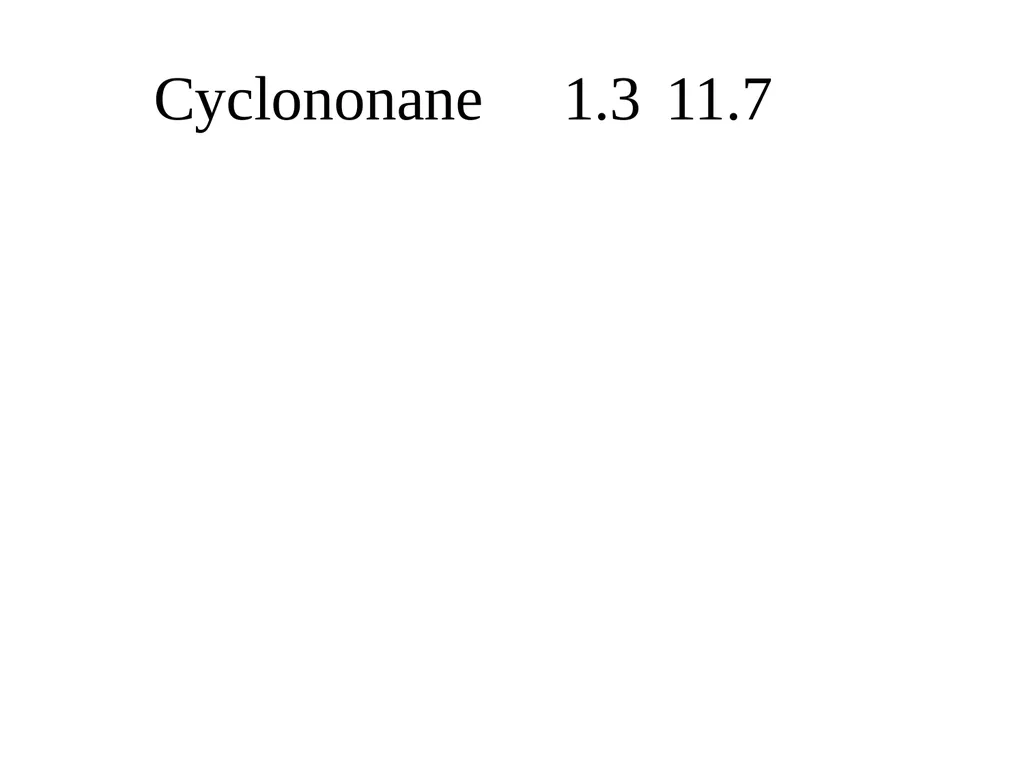
slide51. Cyclononane 1.3 11.7<br>
slide53. BONDING IN CYCLOALKANES- ANGLE STRAIN AND TORSIONAL STRAIN<br>
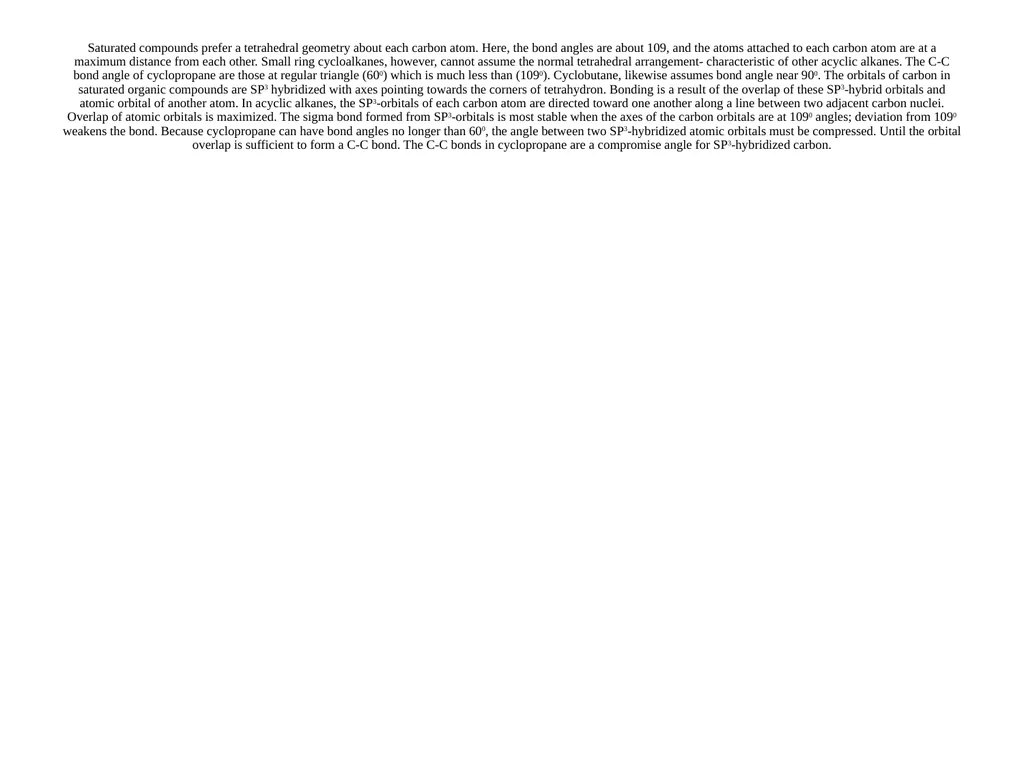
slide54. Saturated compounds prefer a tetrahedral geometry about each carbon atom. Here, the bond angles are about 109, and the atoms attached to each carbon atom are at a maximum distance from each other. Small ring cycloalkanes, however, cannot assume the normal tetrahedral arrangement- characteristic of other acyclic alkanes. The C-C bond angle of cyclopropane are those at regular triangle (600) which is much less than (1090). Cyclobutane, likewise assumes bond angle near 900. The orbitals of carbon in saturated organic compounds are SP3 hybridized with axes pointing towards the corners of tetrahydron. Bonding is a result of the overlap of these SP3-hybrid orbitals and atomic orbital of another atom. In acyclic alkanes, the SP3-orbitals of each carbon atom are directed toward one another along a line between two adjacent carbon nuclei. Overlap of atomic orbitals is maximized. The sigma bond formed from SP3-orbitals is most stable when the axes of the carbon orbitals are at 1090 angles; deviation from 1090 weakens the bond. Because cyclopropane can have bond angles no longer than 600, the angle between two SP3-hybridized atomic orbitals must be compressed. Until the orbital overlap is sufficient to form a C-C bond. The C-C bonds in cyclopropane are a compromise angle for SP3-hybridized carbon.<br>
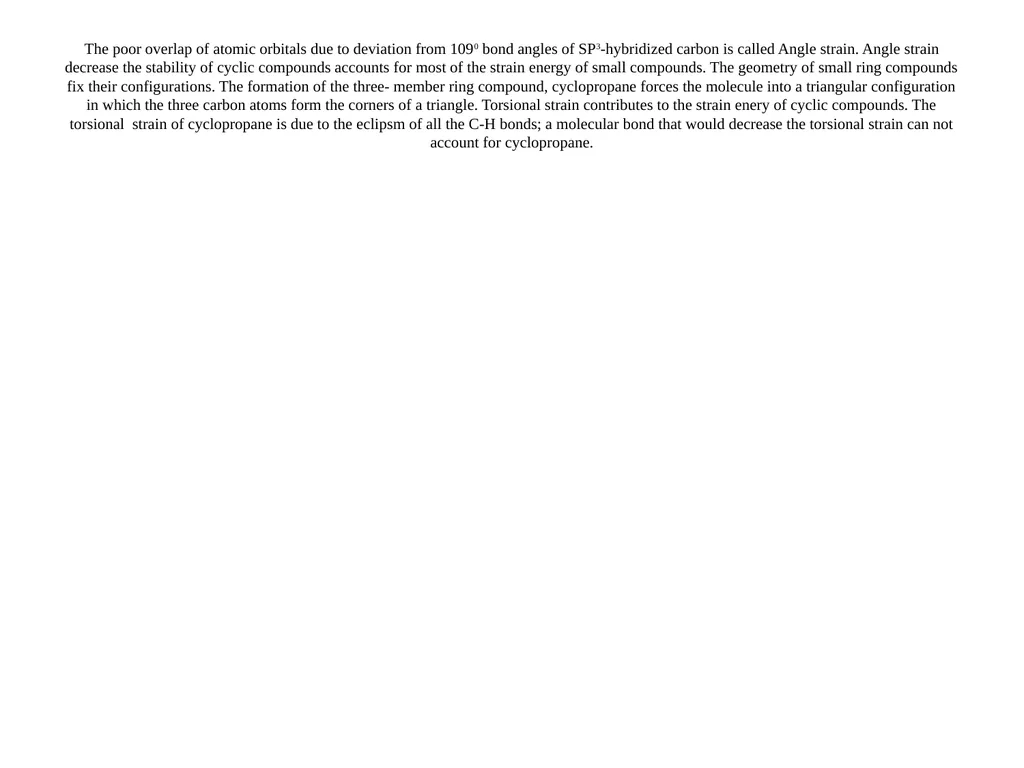
slide55. The poor overlap of atomic orbitals due to deviation from 1090 bond angles of SP3-hybridized carbon is called Angle strain. Angle strain decrease the stability of cyclic compounds accounts for most of the strain energy of small compounds. The geometry of small ring compounds fix their configurations. The formation of the three- member ring compound, cyclopropane forces the molecule into a triangular configuration in which the three carbon atoms form the corners of a triangle. Torsional strain contributes to the strain enery of cyclic compounds. The torsional strain of cyclopropane is due to the eclipsm of all the C-H bonds; a molecular bond that would decrease the torsional strain can not account for cyclopropane.<br>
slide56. CONSEQUENCES OF ANGLE STRAIN FOR CYCLIC COMPOUNDS<br>
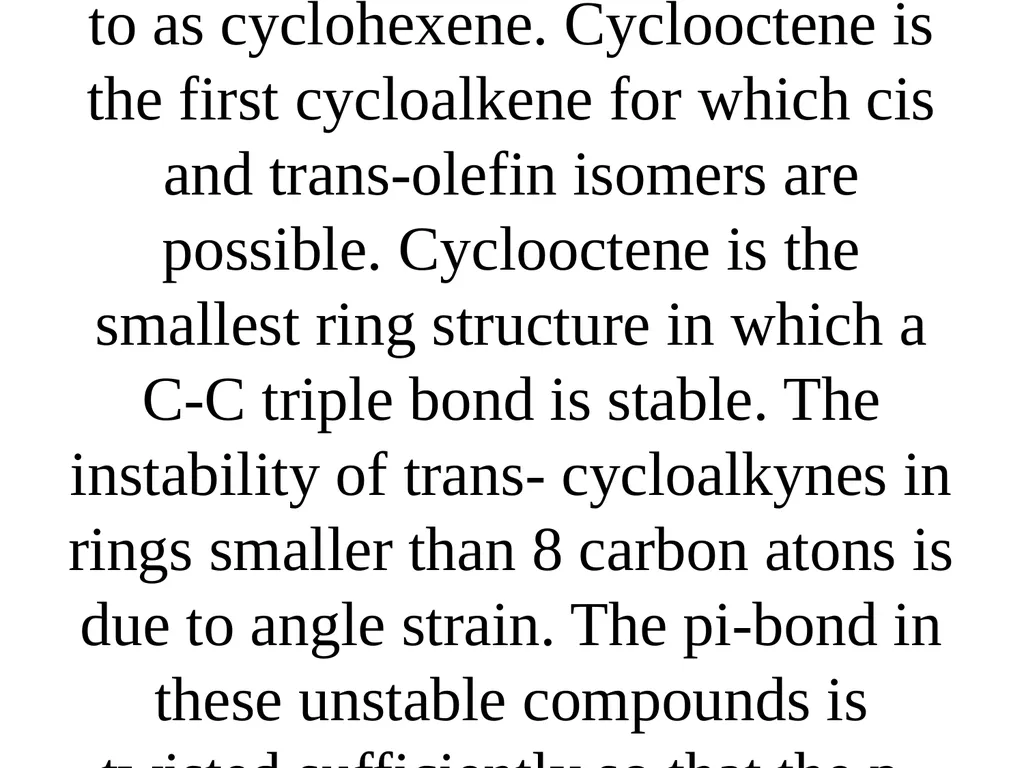
slide57. Compounds with strain energies of more than 65kcal/mol have been prepared. A high strain energy does not prelude their existence. However, highly strained compounds are often highly reactive and undergo ring opening reactions that relieve strain. Cycloalkenes with fewer than 8 carbons only exist in cis-form. Cyclohexen for example exist as cis-cyclohexene and because the trans-form is unknown, it is refered to as cyclohexene. Cyclooctene is the first cycloalkene for which cis and trans-olefin isomers are possible. Cyclooctene is the smallest ring structure in which a C-C triple bond is stable. The instability of trans- cycloalkynes in rings smaller than 8 carbon atons is due to angle strain. The pi-bond in these unstable compounds is twisted sufficiently so that the p-atomic orbital that would make up the pi-bond tend to become perpendicular. The perpendicular p-orbital have zero overlap and do not form a molecular orbital.<br>
slide58. STEREOCHEMISTRY AND CYCLIC HYDROCARBONS<br>
slide59. Formation of cyclic hydrocarbon has the effect of constraining the carbon atoms ino a fixed configuration relative to the straight chain. In cyclopropane, the H atoms lie either beloe or above the plane. Unlike the linear hydrocarbons, cyclic hydrocarbons have all groups attached to the cyclic structure arranged in a fix position relative to each other. As a result, geometric isomerismare possible with the cyclic hydrocarbons in exactly the same way that they were possible with alkenes. e.g, 1,2-dimethylcyclopropane. The ring carbon atoms of cyclopropane must lie in a single plane.The two configurations above are stereoisomers. They have different melting point and boiling points, different NMR and Infrared spectra and different chemical properties. There is no way in which two geometric isomers can be converted except by the breaking of a C-C bond.<br>
slide60. Stereoisomerism also occurs when substituents are attached at a more remote positions. E.g the geometric isomers of 1,3-dimethylcyclobutane and 1,4-dimetylcyclohexane.<br>
slide62. A convenient way to describe geometric isomerism in cycloalkene is to write ring in a planer form that represents the general geometry of the molecule.<br>
slide63. BAEYER’S STRAIN THEORY (1885);<br>
slide64. In order to account for the graded stability of cycloalkanes and their derivatives, Baeyer in 1885 proposed a strain theory which was based on the arrangement in space of the four valencies of the carbon atoms. His assumptions are:<br>
slide65. i ) the molecule of cycloalkene is planar<br>
slide66. ii) the normal angle between any two such valencies is 109028’ and that any deviation from this value causes a strain in the molecule of cycloalkane. The greater the deviation the greater the strain and the less stable and the lesser the reactivity. Cyclopentane from Baeyer’s theory is the most stable.<br>
slide67. DEVIATIONS FROM BAEYER’S STRAIN THEORY<br>
slide68. The theory is based on mechanical concept of valency and on the assumptions that all the rings are planar. Physical methods have shown that except for cyclohexane the rings are not planar. Plankton mechanical calculations do not permit very large distortion of bond angles. e.g heat of combustion of open chain alkane/CH2 is around 663KJ corresponding to C6 and C8 and we can assume there is no strain. The value obtained for C6 is similar to straight chain C6 alkane hence strainless ring occur in C6, C7, C8. cyclic molecules containing C6, C7, C8, C9 and more carbon atoms might be as stable as cyclopentane and this led to the assumption that the strainless ring occurs in two or more stereoisomeric form and therefore cyclohexane is not a regular hexagon. Cyclohexane exists in two conformations; chair and boat.<br>
slide69. According to SACHSE’ in cyclohexane, the ring is packet and the normal valency is retained and this produces strainless rings. Cyclohexane exist in two forms both of which are strainless. The two forms are called the chair and boat conformation. However , the two forms differ in energy content and therefore in stability. Stability depends on steric repulsion or non-bonded interaction of the hydrogen atoms.<br>
slide70. Non-bonded interaction is lesser in the chair form than the boat form, hence the chair form is more stable than the boat. The two forms are however interconvertible and the energy required is 37.7-46.0kj/mol. The energy barrier is not large enough for this interconversion but large enough to permit each conformation to retain its identity.<br>
slide73. OCCURRENCE<br>
slide74. Cyclopentane and cyclohexane compounds are usually obtained from petroleum or occur naturally. Because of their strain energies, cyclopropane and cyclobutane s are not abundant in nature and are generally prepared by synthesis.<br>
slide75. 3,4,5-member alicyclic alkane occurs in terpenes (natural product) as cyclic terpenes.<br>
slide78. PREPARATION/SYNTHESIS<br>
slide79. Lower cycloalkanes are prepared by @,w-dihalogen derivatives of the alkanes with sodium or zinc. Elimination of Halogen from the 1,3 position form the propane ring in a method called Baeyer ring closure.<br>
slide80. The methylene insertion reaction involving the addition of a CH2 unit across the C-C double bond of an alkene. ( Simmon Smith reaction; diiodomethane is used as the source of CH2)<br>
slide81. PREPARATION OF CYCLOPROPANE<br>
slide82. methylene insertion ( Simmon-Smithr reaction)<br>
slide83. 2)Baeyer ring closure<br>
slide84. by distillation of Ca or Ba salt of dicarboxylic acid. E.g barium adipate ester (Barium (ii) 1,6-hexane durate acid)<br>
slide85. from Benzene derivatives (for cyclohexane)<br>
slide87. PREPARATION OF CYCLOBUTANE<br>
slide88. Cyclobutane compounds are normally more difficult to prepare than cyclopropane. The Baeyer ring closure reaction do not form good yield of cyclobutane.<br>
slide4. ALLICYCLIC HYDROCARBONS<br>
slide6. Allicyclic (aliphatic cyclic) hydrocarbon and their derivatives are cyclic hydrocarbons of alkane, alkene and/or alkyne. Generally, allicyclic compounds are compounds which contain at least one ring but are aliphatic hence are called allicyclic (aliphatic cyclic compounds). They are non aromatic. The saturated allicyclic compounds have the general formula CnH2n (corresponding to 1 ring), CnH2n-2 (corresponding to 2 rings-bicyclo compounds) and CnH2n-4 (corresponding to 3 rings), etc. The smallest numbers of carbon atoms that can be arranged in a ring is three represented by the hydrocarbon; cyclopropane. Each additional rings lowers the number of Hydrogen atoms in the general formula by 2. Aliphatic cyclic hydrocarbons having one ring are called Allicyclic hydrocarbons.<br>
slide7. NOMECLATURE AND STRUCTURE OF CYCLIC HYDROCARBONS<br>
slide8. Allicyclic compounds are often shown by the topological formulations such as;<br>
slide10. NUMECLATURE RULES<br>
slide11. The number of carbon atoms in the ring of the cyclic compound is counted and word ‘cyclo’ is prefixed to the name of the alkane having the same number of carbon atoms on a straight line.<br>
slide12. The general name of saturated cyclic hydrocarbons is cycloalkane. e.g.<br>
slide15. (2). Substituents/functional groups are indicated by numbering and either appropriate prefixes before the word cyclo or by appropriate ending indicating the functional group. e.g<br>
slide16. When there are more one substituents, the numbering of the carbon atom that gives the lowest sum is chosen, e.g.<br>
slide19. Cycloalkene and cycloalkynes are cyclic compounds containing double bonds and triple bonds respectively. The positions of the double-bonded and triple-bonded carbons in the carbon chain are given the numbers 1 and 2 and are not prefixed to the name of cycloalkene and cycloalkyne, e.g<br>
slide22. POLICYCLIC COMPOUNDS<br>
slide23. Compounds with more than one ring of carbon atoms and whose rings share two or more same carbon atoms are known as Policyclic compounds . Those with two rings are called bicyclic Compounds. The rings may be fused as in Decalin or bridged as in norborane.<br>
slide25. NUMECLATURE OF BICYCLIC COMPOUNDS<br>
slide26. They are named by prefixing bicycle- to the name of the parent hydrocarbon. The name of the parent hydrocarbon is obtained by counting the total number of carbon atoms in all the rings of the compound as in norbane and decalin above. The carbon atoms attached to two rings are referred to as bridge head carbons. The number of carbon atoms between the bridge head carbons in the molecule are specified by counting from the bridge head carbon and listing each of the numbers in brackets in decreasing order prior to the parent name of the hydrocarbon. Thus norborane is named as bicyclo [2,2,1] heptanes.<br>
slide28. Other examples are:<br>
slide32. The C position in a bicyclic hydrocarbons are numbered from the bridgedhead carbon around the largest ring first. Substituents are counted from the number assigned to the C positions.<br>
slide33. Exercise;<br>
slide34. Draw the structure of the following alicyclic compounds:<br>
slide35. 1 bicyclo [4,3,0] nonane<br>
slide36. 2 2-chloro-4-carboxy bicycle[1,1,0]butane<br>
slide37. 3 2-methyl cyclopentan-1-one-oxime<br>
slide40. STRAIN ENERGY OF ALICYCLIC HYDROCARBONS<br>
slide41. The measured heats of combustion of alkanes indicated that when burned, each methylene group contributes 156.5kcal/mol to the heat of combustion. Thus , proceeding from methane to straight and branched chained alkanes, the heat of combustion increases by 156.5 kcal/mol for each progressive increase in the number of –CH2 units the molecular formula of alkane. The heat of combustion of cyclic alkanes do not exhibits similar regularity. Experiment indicates that the heat of combustion of some cyclic hydrocarbons are much larger than we might expect by analogy with non-cyclic compounds. E.g the heat of combustion of cyclopropane is 9.1kcal/mol per –CH2 unit greater than that of propane. The energy released in the combustion of cyclopropane indicatees that the energy content of cyclopropane is greater because of its acyclic arrangement. Similarly , cyclobutane has 6.5kcal/molper CH2 unit more than expected from a non-cyclic arrangement. The difference in the measured heat of combustion of acyclic hydrocarbon and the predicted value is called the STRAIN ENERGY .the strain energy per methylene group is obtained by dividing the molecular strain energy by the number of methylene groups in the ring. Cyclopropane, cyclobutane , small group compounds, have characteristically high strain energies. Cyclopentane, cyclohexane and cycloheptane have smaller strain energies, whereas, medium ring compounds ; cyclooctane through cycloundecane (C8-C11) have strain energy around 10kcal/mol. The large ring have little or no associated strain from the ring structure.<br>
slide43. Strain energies of cycloalkanes.<br>
slide44. cycloalkanes Strain energy per CH2 unit kCal/mol Strain energy kCal/mol<br>
slide45. cyclopropane 9.1 27.3<br>
slide46. cyclobutane 6.5 26.0<br>
slide47. Cyclopentane 1.2 6.0<br>
slide48. cyclohexane 0.0 0.0<br>
slide49. Cycloheptane 0.8 5.6<br>
slide50. cyclooctane 1.1 8.8<br>
slide51. Cyclononane 1.3 11.7<br>
slide53. BONDING IN CYCLOALKANES- ANGLE STRAIN AND TORSIONAL STRAIN<br>
slide54. Saturated compounds prefer a tetrahedral geometry about each carbon atom. Here, the bond angles are about 109, and the atoms attached to each carbon atom are at a maximum distance from each other. Small ring cycloalkanes, however, cannot assume the normal tetrahedral arrangement- characteristic of other acyclic alkanes. The C-C bond angle of cyclopropane are those at regular triangle (600) which is much less than (1090). Cyclobutane, likewise assumes bond angle near 900. The orbitals of carbon in saturated organic compounds are SP3 hybridized with axes pointing towards the corners of tetrahydron. Bonding is a result of the overlap of these SP3-hybrid orbitals and atomic orbital of another atom. In acyclic alkanes, the SP3-orbitals of each carbon atom are directed toward one another along a line between two adjacent carbon nuclei. Overlap of atomic orbitals is maximized. The sigma bond formed from SP3-orbitals is most stable when the axes of the carbon orbitals are at 1090 angles; deviation from 1090 weakens the bond. Because cyclopropane can have bond angles no longer than 600, the angle between two SP3-hybridized atomic orbitals must be compressed. Until the orbital overlap is sufficient to form a C-C bond. The C-C bonds in cyclopropane are a compromise angle for SP3-hybridized carbon.<br>
slide55. The poor overlap of atomic orbitals due to deviation from 1090 bond angles of SP3-hybridized carbon is called Angle strain. Angle strain decrease the stability of cyclic compounds accounts for most of the strain energy of small compounds. The geometry of small ring compounds fix their configurations. The formation of the three- member ring compound, cyclopropane forces the molecule into a triangular configuration in which the three carbon atoms form the corners of a triangle. Torsional strain contributes to the strain enery of cyclic compounds. The torsional strain of cyclopropane is due to the eclipsm of all the C-H bonds; a molecular bond that would decrease the torsional strain can not account for cyclopropane.<br>
slide56. CONSEQUENCES OF ANGLE STRAIN FOR CYCLIC COMPOUNDS<br>
slide57. Compounds with strain energies of more than 65kcal/mol have been prepared. A high strain energy does not prelude their existence. However, highly strained compounds are often highly reactive and undergo ring opening reactions that relieve strain. Cycloalkenes with fewer than 8 carbons only exist in cis-form. Cyclohexen for example exist as cis-cyclohexene and because the trans-form is unknown, it is refered to as cyclohexene. Cyclooctene is the first cycloalkene for which cis and trans-olefin isomers are possible. Cyclooctene is the smallest ring structure in which a C-C triple bond is stable. The instability of trans- cycloalkynes in rings smaller than 8 carbon atons is due to angle strain. The pi-bond in these unstable compounds is twisted sufficiently so that the p-atomic orbital that would make up the pi-bond tend to become perpendicular. The perpendicular p-orbital have zero overlap and do not form a molecular orbital.<br>
slide58. STEREOCHEMISTRY AND CYCLIC HYDROCARBONS<br>
slide59. Formation of cyclic hydrocarbon has the effect of constraining the carbon atoms ino a fixed configuration relative to the straight chain. In cyclopropane, the H atoms lie either beloe or above the plane. Unlike the linear hydrocarbons, cyclic hydrocarbons have all groups attached to the cyclic structure arranged in a fix position relative to each other. As a result, geometric isomerismare possible with the cyclic hydrocarbons in exactly the same way that they were possible with alkenes. e.g, 1,2-dimethylcyclopropane. The ring carbon atoms of cyclopropane must lie in a single plane.The two configurations above are stereoisomers. They have different melting point and boiling points, different NMR and Infrared spectra and different chemical properties. There is no way in which two geometric isomers can be converted except by the breaking of a C-C bond.<br>
slide60. Stereoisomerism also occurs when substituents are attached at a more remote positions. E.g the geometric isomers of 1,3-dimethylcyclobutane and 1,4-dimetylcyclohexane.<br>
slide62. A convenient way to describe geometric isomerism in cycloalkene is to write ring in a planer form that represents the general geometry of the molecule.<br>
slide63. BAEYER’S STRAIN THEORY (1885);<br>
slide64. In order to account for the graded stability of cycloalkanes and their derivatives, Baeyer in 1885 proposed a strain theory which was based on the arrangement in space of the four valencies of the carbon atoms. His assumptions are:<br>
slide65. i ) the molecule of cycloalkene is planar<br>
slide66. ii) the normal angle between any two such valencies is 109028’ and that any deviation from this value causes a strain in the molecule of cycloalkane. The greater the deviation the greater the strain and the less stable and the lesser the reactivity. Cyclopentane from Baeyer’s theory is the most stable.<br>
slide67. DEVIATIONS FROM BAEYER’S STRAIN THEORY<br>
slide68. The theory is based on mechanical concept of valency and on the assumptions that all the rings are planar. Physical methods have shown that except for cyclohexane the rings are not planar. Plankton mechanical calculations do not permit very large distortion of bond angles. e.g heat of combustion of open chain alkane/CH2 is around 663KJ corresponding to C6 and C8 and we can assume there is no strain. The value obtained for C6 is similar to straight chain C6 alkane hence strainless ring occur in C6, C7, C8. cyclic molecules containing C6, C7, C8, C9 and more carbon atoms might be as stable as cyclopentane and this led to the assumption that the strainless ring occurs in two or more stereoisomeric form and therefore cyclohexane is not a regular hexagon. Cyclohexane exists in two conformations; chair and boat.<br>
slide69. According to SACHSE’ in cyclohexane, the ring is packet and the normal valency is retained and this produces strainless rings. Cyclohexane exist in two forms both of which are strainless. The two forms are called the chair and boat conformation. However , the two forms differ in energy content and therefore in stability. Stability depends on steric repulsion or non-bonded interaction of the hydrogen atoms.<br>
slide70. Non-bonded interaction is lesser in the chair form than the boat form, hence the chair form is more stable than the boat. The two forms are however interconvertible and the energy required is 37.7-46.0kj/mol. The energy barrier is not large enough for this interconversion but large enough to permit each conformation to retain its identity.<br>
slide73. OCCURRENCE<br>
slide74. Cyclopentane and cyclohexane compounds are usually obtained from petroleum or occur naturally. Because of their strain energies, cyclopropane and cyclobutane s are not abundant in nature and are generally prepared by synthesis.<br>
slide75. 3,4,5-member alicyclic alkane occurs in terpenes (natural product) as cyclic terpenes.<br>
slide78. PREPARATION/SYNTHESIS<br>
slide79. Lower cycloalkanes are prepared by @,w-dihalogen derivatives of the alkanes with sodium or zinc. Elimination of Halogen from the 1,3 position form the propane ring in a method called Baeyer ring closure.<br>
slide80. The methylene insertion reaction involving the addition of a CH2 unit across the C-C double bond of an alkene. ( Simmon Smith reaction; diiodomethane is used as the source of CH2)<br>
slide81. PREPARATION OF CYCLOPROPANE<br>
slide82. methylene insertion ( Simmon-Smithr reaction)<br>
slide83. 2)Baeyer ring closure<br>
slide84. by distillation of Ca or Ba salt of dicarboxylic acid. E.g barium adipate ester (Barium (ii) 1,6-hexane durate acid)<br>
slide85. from Benzene derivatives (for cyclohexane)<br>
slide87. PREPARATION OF CYCLOBUTANE<br>
slide88. Cyclobutane compounds are normally more difficult to prepare than cyclopropane. The Baeyer ring closure reaction do not form good yield of cyclobutane.<br>