
Classification, Nomenclature of Organic Compounds
TG
Published · 31 slides · 0 views

1 / 1




Description
Classification, Nomenclature of Organic Compounds BY Dr. MAYANK YADAV Professor Pharmaceutical Chemistry Adarsh Vijendra Institute of Pharmaceutical Sciences (A constituent institute of Shobhit University) Gangoh, Saharanpur ORGANIC
Related Topics
Share
Embed code
Download this presentation From Below
"Classification, Nomenclature of Organic Compounds" is the property of its rightful owner. Permission is granted to download and print the materials on this website for personal, non-commercial use only, and to display it on your personal computer provided you do not modify the materials and that you retain all copyright notices contained in the materials. By downloading content from our website, you accept the terms of this agreement.
Presentation Transcript
01
Classification, Nomenclature of Organic Compounds BY
Dr. MAYANK YADAV
Professor
Pharmaceutical Chemistry
Adarsh Vijendra Institute of Pharmaceutical Sciences
(A constituent institute of Shobhit University)
Gangoh, Saharanpur<br>
Dr. MAYANK YADAV
Professor
Pharmaceutical Chemistry
Adarsh Vijendra Institute of Pharmaceutical Sciences
(A constituent institute of Shobhit University)
Gangoh, Saharanpur<br>
02
ORGANIC CHEMISTRY
Organic chemistry is the study of the structures, reactions and properties of carbon-based compounds.
Note:
Carbon monoxide, carbon dioxide, metal carbonates and metal cyanides are not classified as organic compounds.<br>
Organic chemistry is the study of the structures, reactions and properties of carbon-based compounds.
Note:
Carbon monoxide, carbon dioxide, metal carbonates and metal cyanides are not classified as organic compounds.<br>
03
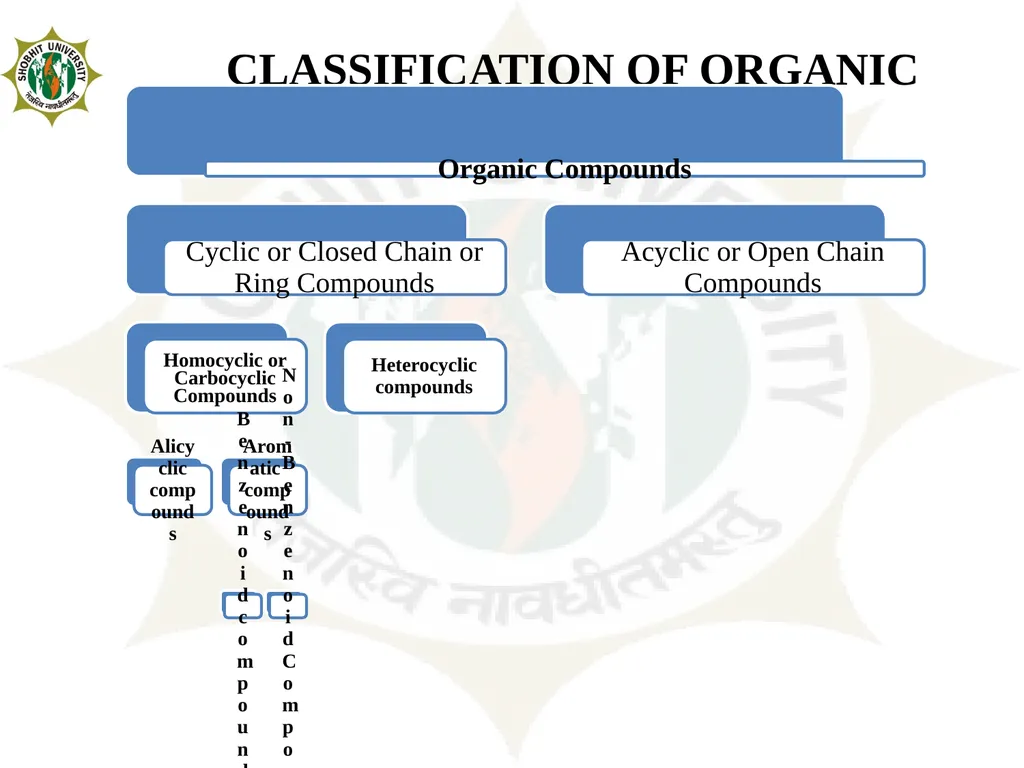
CLASSIFICATION OF ORGANIC
COMPOUNDS<br>
COMPOUNDS<br>
04
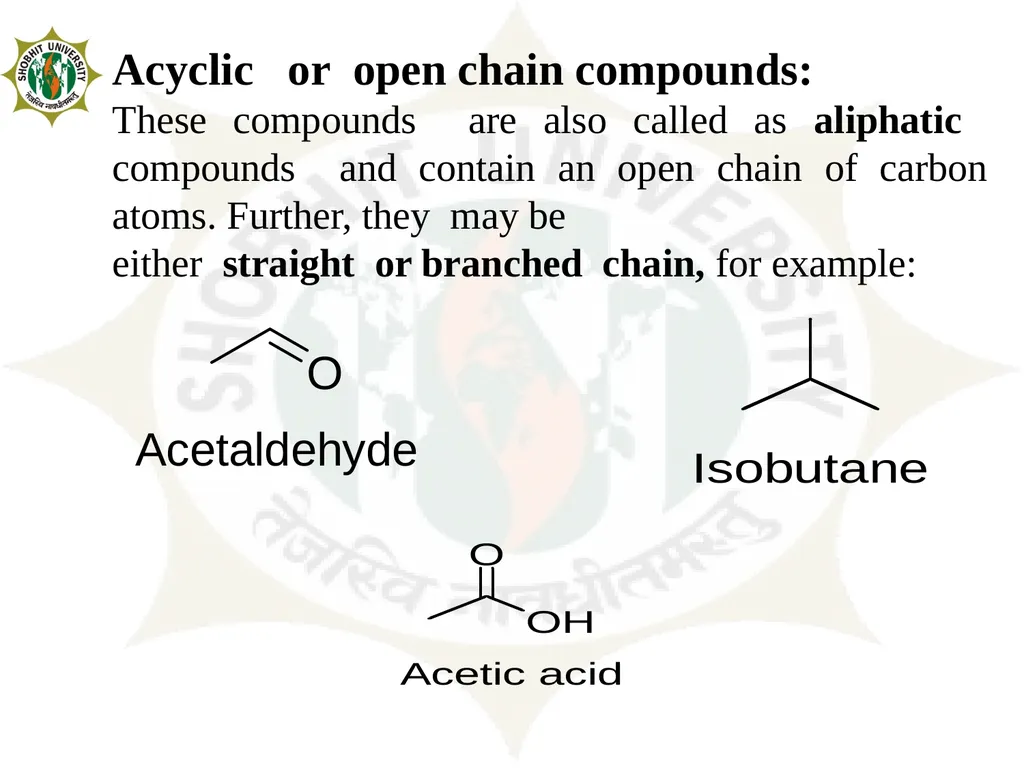
Acyclic or open chain compounds:
These compounds are also called as aliphatic compounds and contain an open chain of carbon atoms. Further, they may be
either straight or branched chain, for example:<br>
These compounds are also called as aliphatic compounds and contain an open chain of carbon atoms. Further, they may be
either straight or branched chain, for example:<br>
05
Cyclic or closed chain compounds
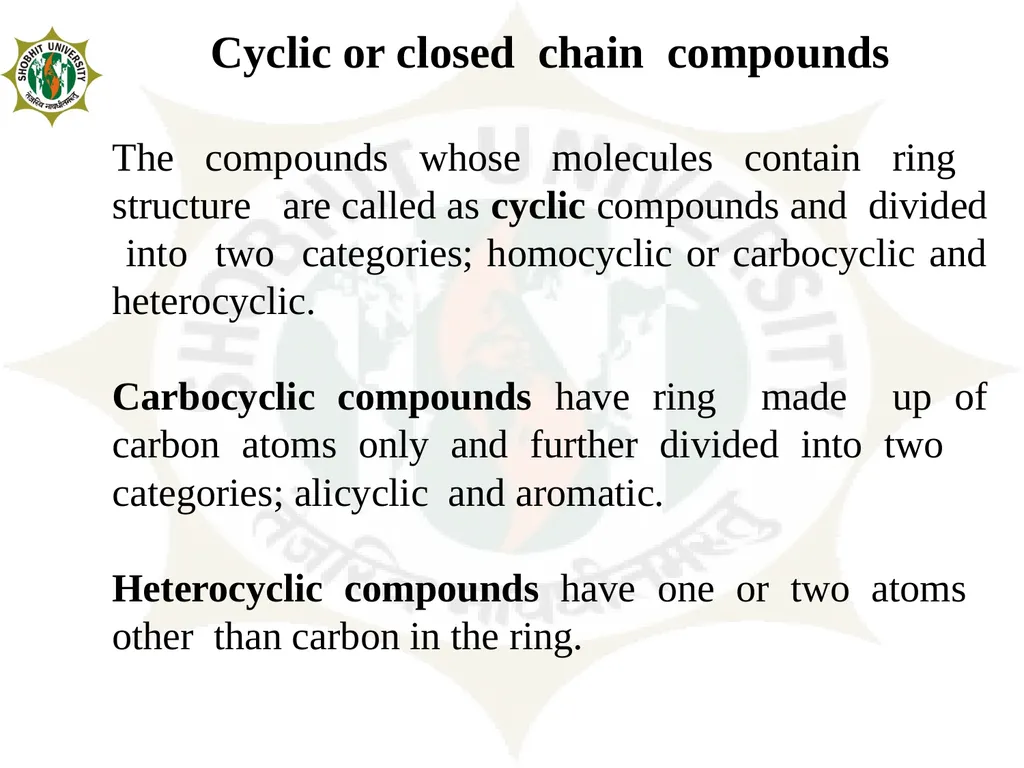
The compounds whose molecules contain ring structure are called as cyclic compounds and divided into two categories; homocyclic or carbocyclic and heterocyclic.
Carbocyclic compounds have ring made up of carbon atoms only and further divided into two categories; alicyclic and aromatic.
Heterocyclic compounds have one or two atoms other than carbon in the ring.<br>
06
Alicyclic carbocyclic compounds:
Alicyclic (aliphatic cyclic) compounds contain carbon atoms joined by single covalent bonds in the form of a ring. They exhibit properties similar to aliphatic compounds.
Some examples are:<br>
Alicyclic (aliphatic cyclic) compounds contain carbon atoms joined by single covalent bonds in the form of a ring. They exhibit properties similar to aliphatic compounds.
Some examples are:<br>
07
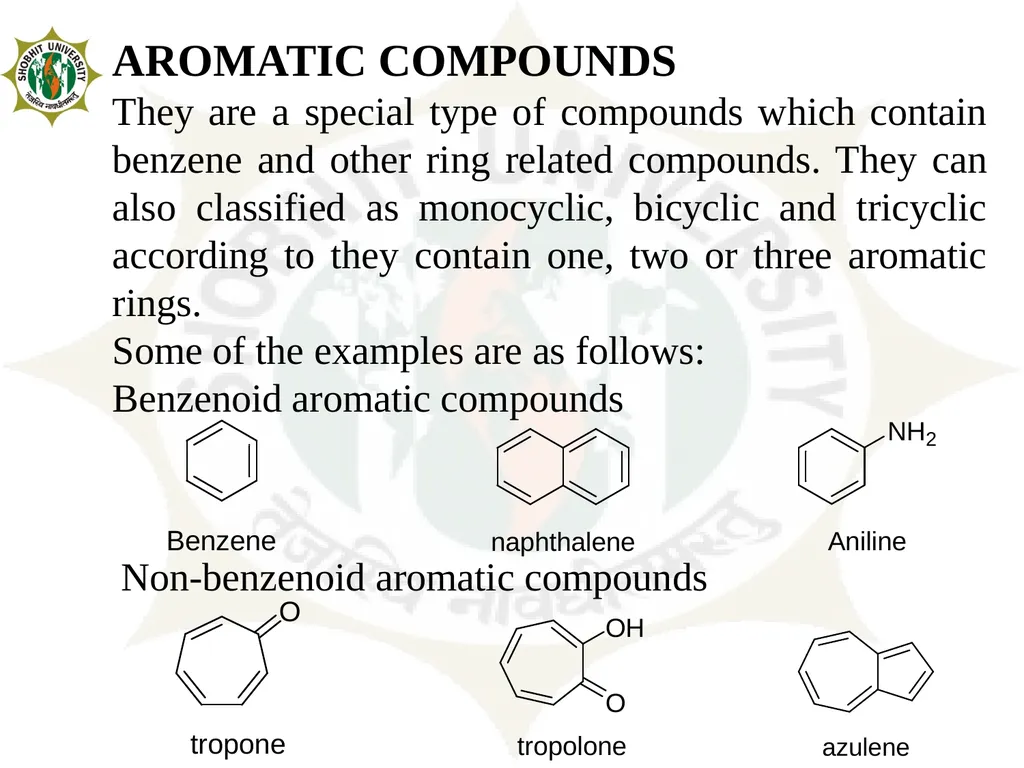
AROMATIC COMPOUNDS
They are a special type of compounds which contain benzene and other ring related compounds. They can also classified as monocyclic, bicyclic and tricyclic according to they contain one, two or three aromatic rings.
Some of the examples are as follows:
Benzenoid aromatic compounds Non-benzenoid aromatic compounds<br>
08
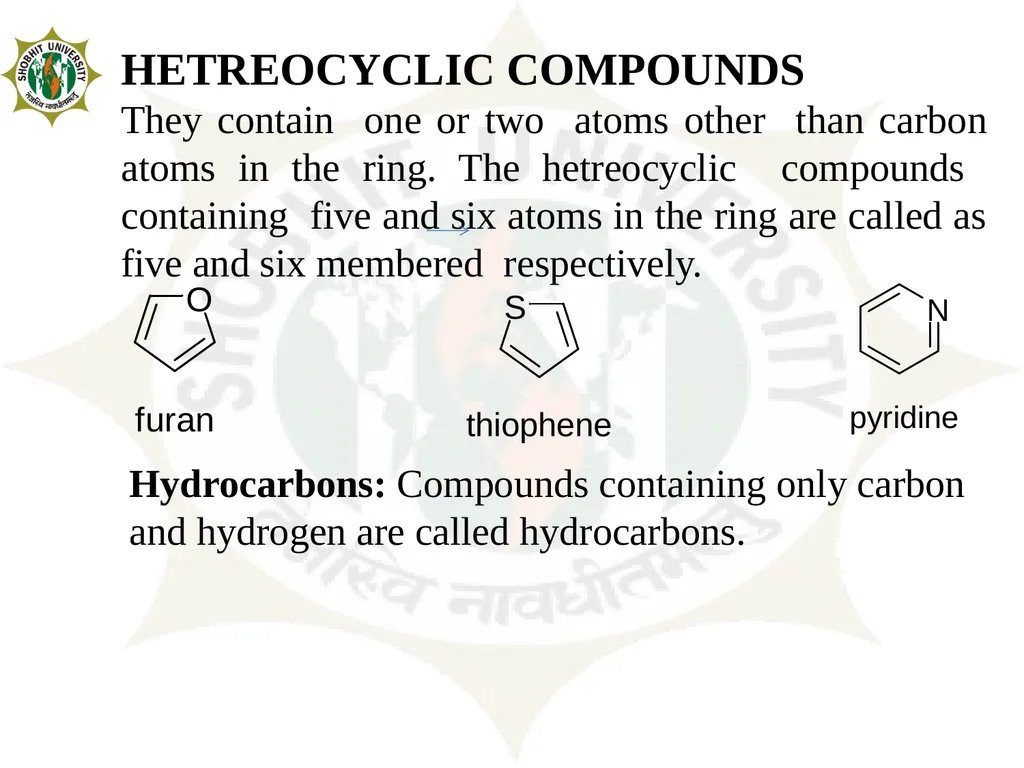
HETREOCYCLIC COMPOUNDS
They contain one or two atoms other than carbon atoms in the ring. The hetreocyclic compounds containing five and six atoms in the ring are called as five and six membered respectively. Hydrocarbons: Compounds containing only carbon and hydrogen are called hydrocarbons.<br>
They contain one or two atoms other than carbon atoms in the ring. The hetreocyclic compounds containing five and six atoms in the ring are called as five and six membered respectively. Hydrocarbons: Compounds containing only carbon and hydrogen are called hydrocarbons.<br>
09
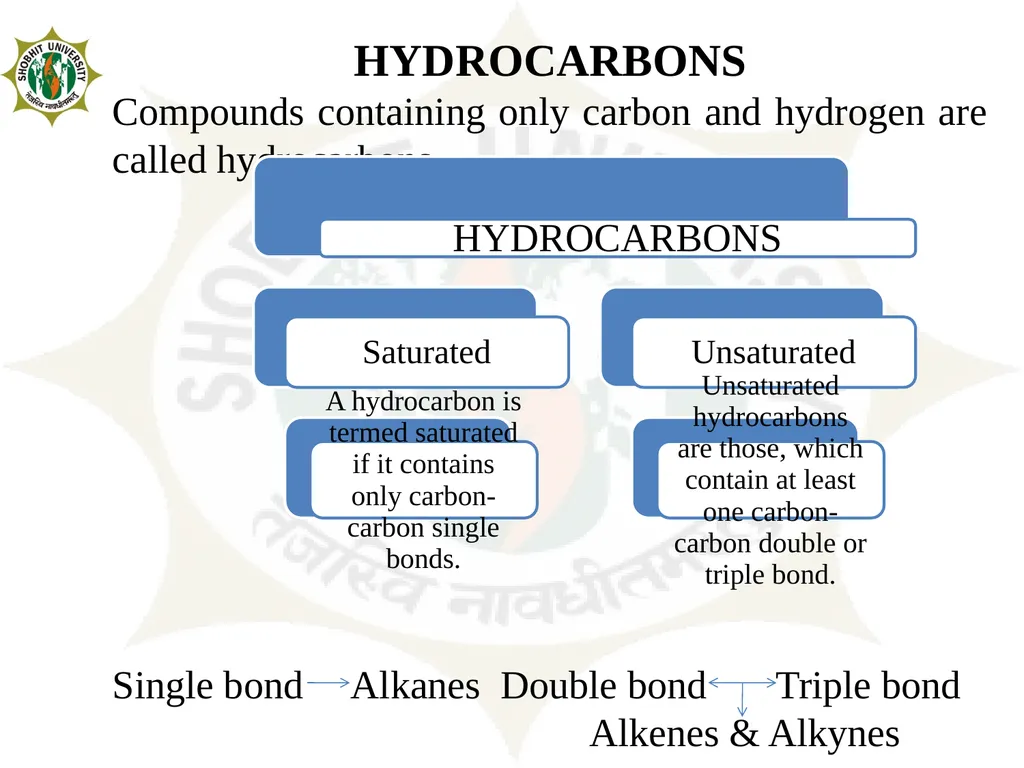
HYDROCARBONS
Compounds containing only carbon and hydrogen are called hydrocarbons.
Single bond Alkanes Double bond Triple bond
Alkenes & Alkynes<br>
Compounds containing only carbon and hydrogen are called hydrocarbons.
Single bond Alkanes Double bond Triple bond
Alkenes & Alkynes<br>
10
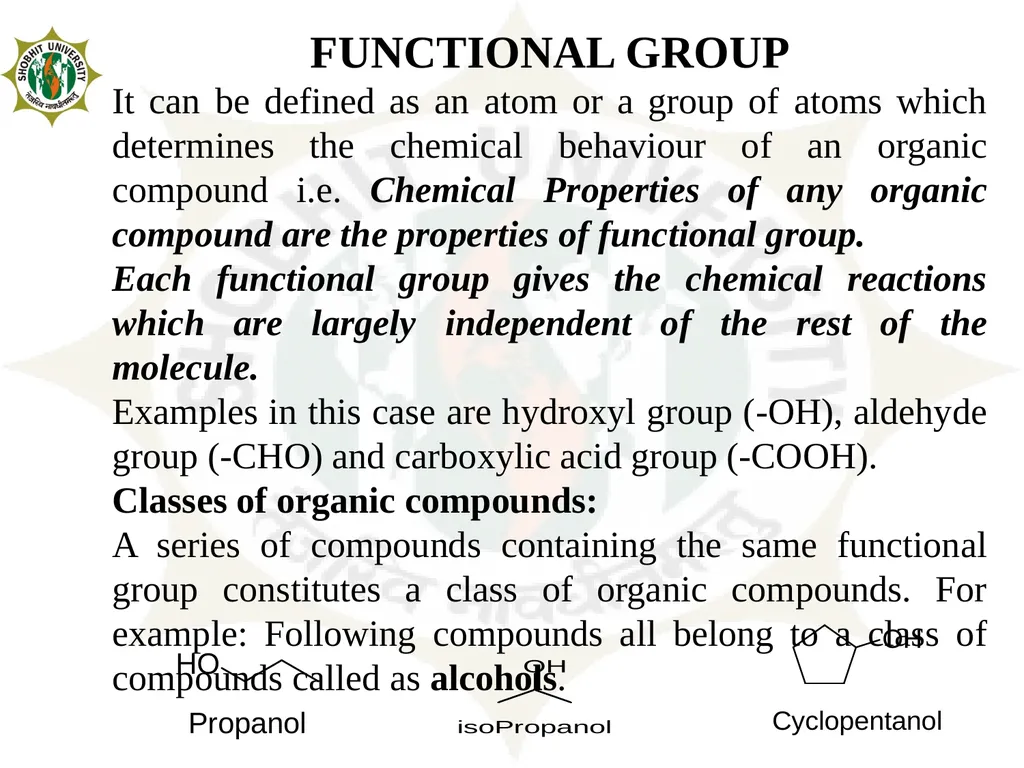
FUNCTIONAL GROUP
It can be defined as an atom or a group of atoms which determines the chemical behaviour of an organic compound i.e. Chemical Properties of any organic compound are the properties of functional group.
Each functional group gives the chemical reactions which are largely independent of the rest of the molecule.
Examples in this case are hydroxyl group (-OH), aldehyde group (-CHO) and carboxylic acid group (-COOH).
Classes of organic compounds:
A series of compounds containing the same functional group constitutes a class of organic compounds. For example: Following compounds all belong to a class of compounds called as alcohols.<br>
11
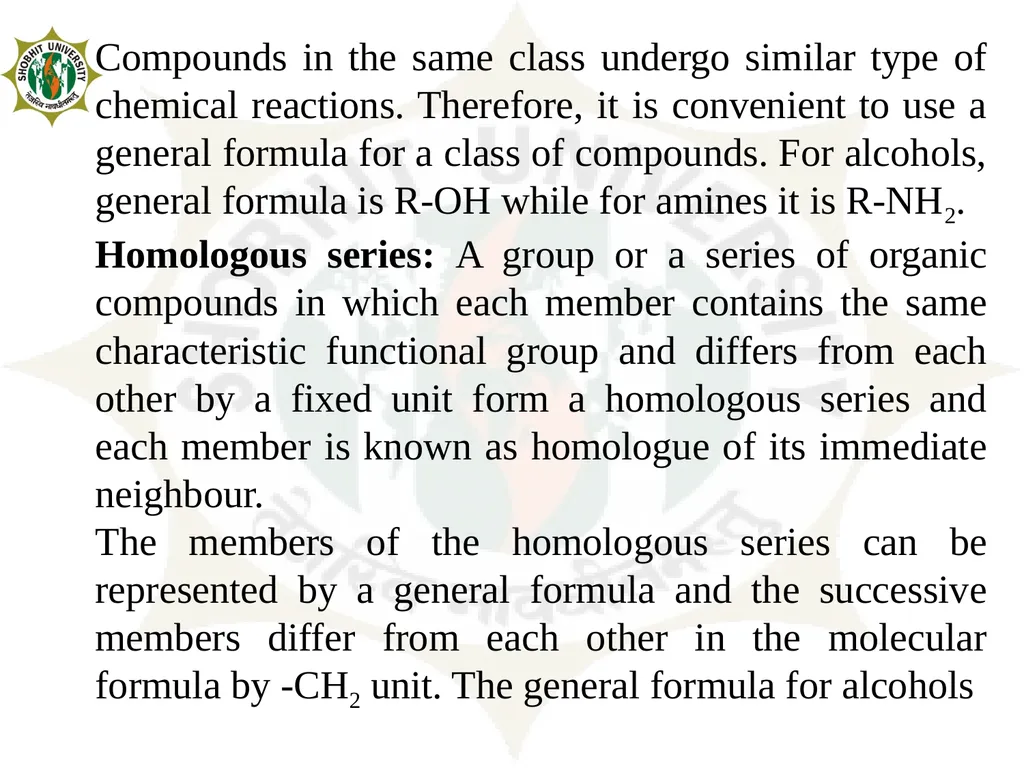
Compounds in the same class undergo similar type of chemical reactions. Therefore, it is convenient to use a general formula for a class of compounds. For alcohols, general formula is R-OH while for amines it is R-NH2.
Homologous series: A group or a series of organic compounds in which each member contains the same characteristic functional group and differs from each other by a fixed unit form a homologous series and each member is known as homologue of its immediate neighbour.
The members of the homologous series can be represented by a general formula and the successive members differ from each other in the molecular formula by -CH2 unit. The general formula for alcohols<br>
12
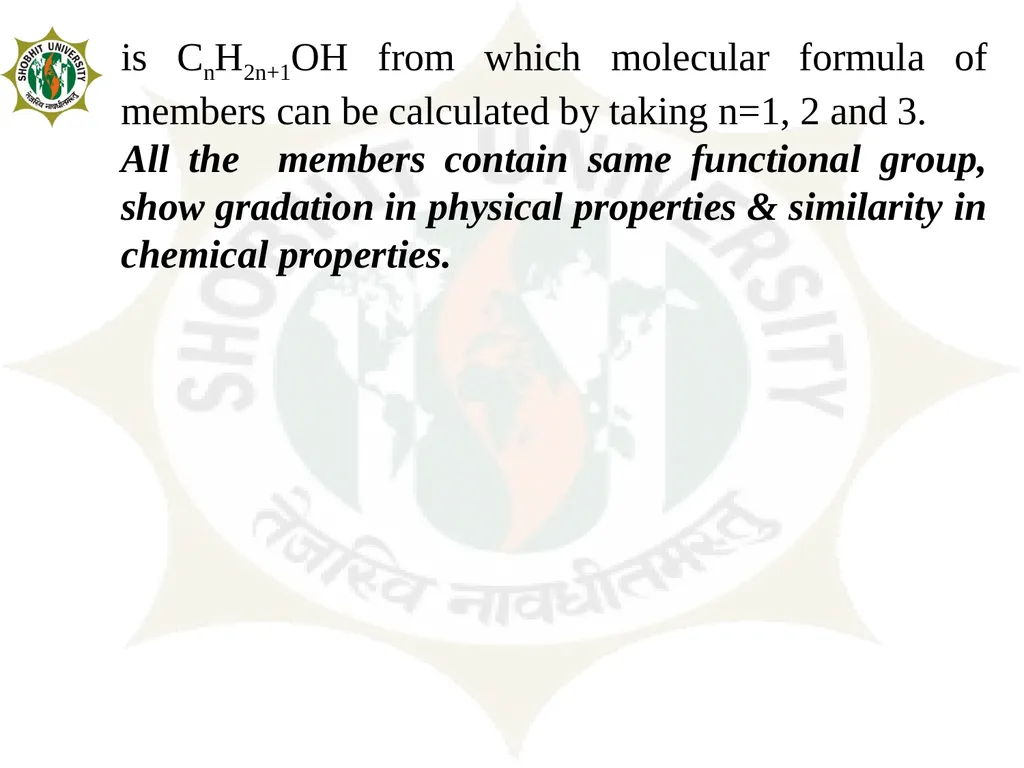
is CnH2n+1OH from which molecular formula of members can be calculated by taking n=1, 2 and 3.
All the members contain same functional group, show gradation in physical properties & similarity in chemical properties.<br>
All the members contain same functional group, show gradation in physical properties & similarity in chemical properties.<br>
13
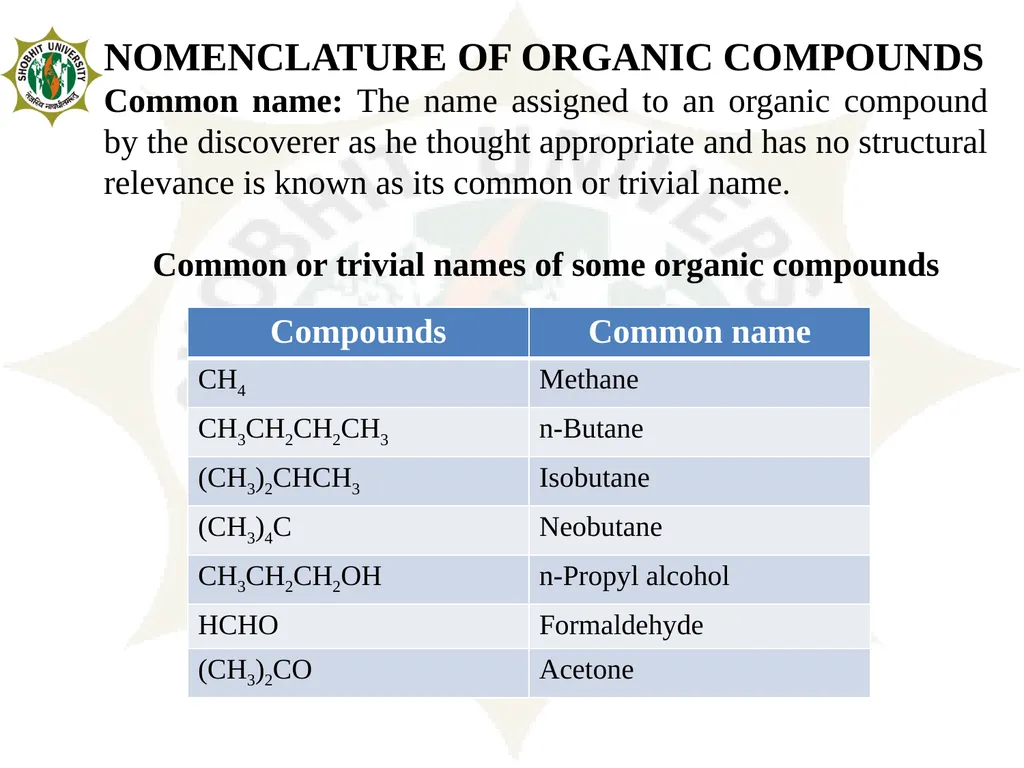
NOMENCLATURE OF ORGANIC COMPOUNDS
Common name: The name assigned to an organic compound by the discoverer as he thought appropriate and has no structural relevance is known as its common or trivial name.
Common or trivial names of some organic compounds<br>
Common name: The name assigned to an organic compound by the discoverer as he thought appropriate and has no structural relevance is known as its common or trivial name.
Common or trivial names of some organic compounds<br>
14
Systematic name: The rationale name of an organic compound derived from its structure is called as systematic name. Each name stands for one compound and one structure. The systematic nomenclature has been developed and used in modern practice is the IUPAC nomenclature. The names assigned to the organic compounds according to this system are known as IUPAC (International Union of Pure and Applied Chemistry) names.
IUPAC system provides the set rules for assigning the names to all the known organic compounds and to many more yet to be synthesized.
IUPAC Nomenclature of Alkanes
Open chain saturated hydrocarbons as a class are named alkanes and with a cyclic carbon structure are named as cycloalkanes.
Straight chain hydrocarbons: the alkanes whose molecules are made up of continuous or straight carbon chains are referred to<br>
15
as Straight chain alkanes.
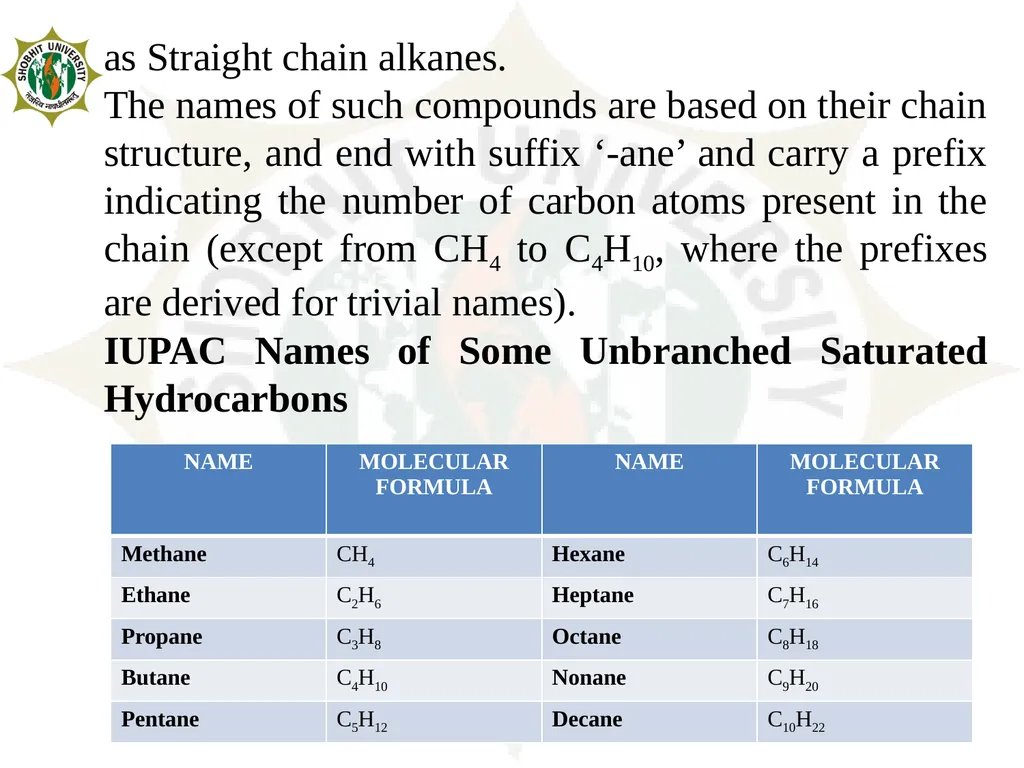
The names of such compounds are based on their chain structure, and end with suffix ‘-ane’ and carry a prefix indicating the number of carbon atoms present in the chain (except from CH4 to C4H10, where the prefixes are derived for trivial names).
IUPAC Names of Some Unbranched Saturated Hydrocarbons<br>
16
IUPAC Nomenclature of Alkyl Groups
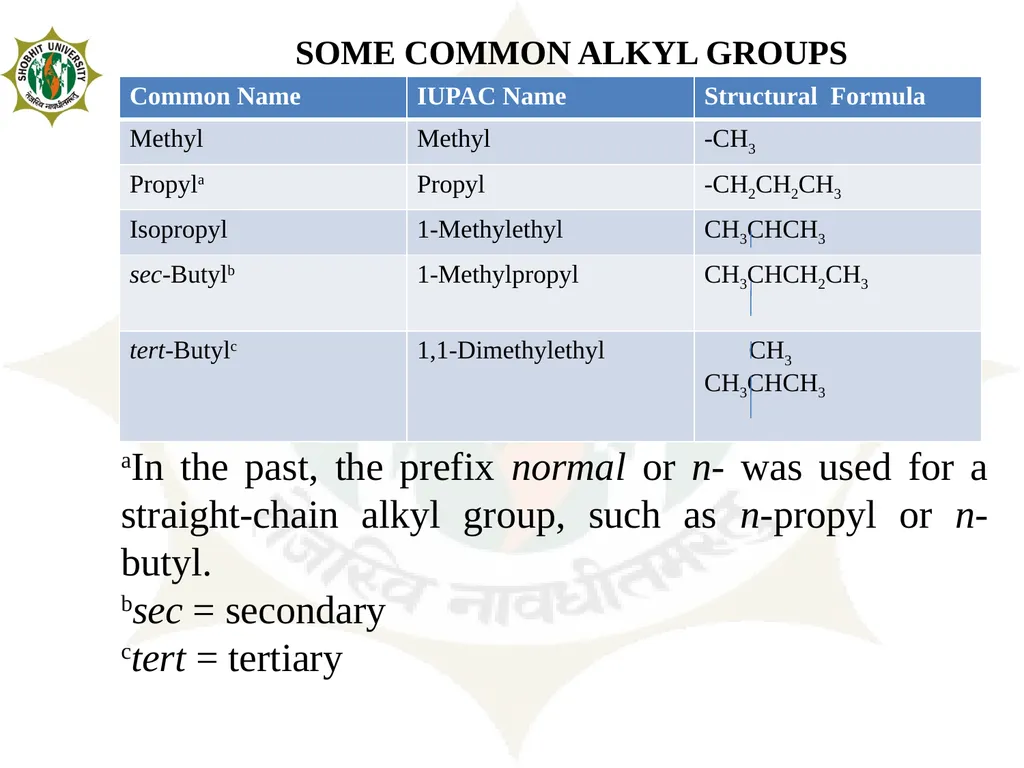
The hydrocarbon unit derived by removal of one hydrogen of an alkane, are called alkyl groups. The IUPAC name of an alkyl group is obtained by replacing the ending –ane of the parent alkane with –yl (alkanes with a continuous carbon-chain or normal carbon-chain are referred to as normal alkanes.<br>
The hydrocarbon unit derived by removal of one hydrogen of an alkane, are called alkyl groups. The IUPAC name of an alkyl group is obtained by replacing the ending –ane of the parent alkane with –yl (alkanes with a continuous carbon-chain or normal carbon-chain are referred to as normal alkanes.<br>
17
Branched alkanes: When an alkane has a shorter side-chain attached to the continuous-chain, it is designated as a Branched alkane. The continuous chain is called the root or parent, while the side-chain is called the alkyl group. The carbon of the alkyl group bonded directly to the parent chain is referred to as the head carbon.<br>
18
SOME COMMON ALKYL GROUPS aIn the past, the prefix normal or n- was used for a straight-chain alkyl group, such as n-propyl or n-butyl.
bsec = secondary
ctert = tertiary<br>
bsec = secondary
ctert = tertiary<br>
19
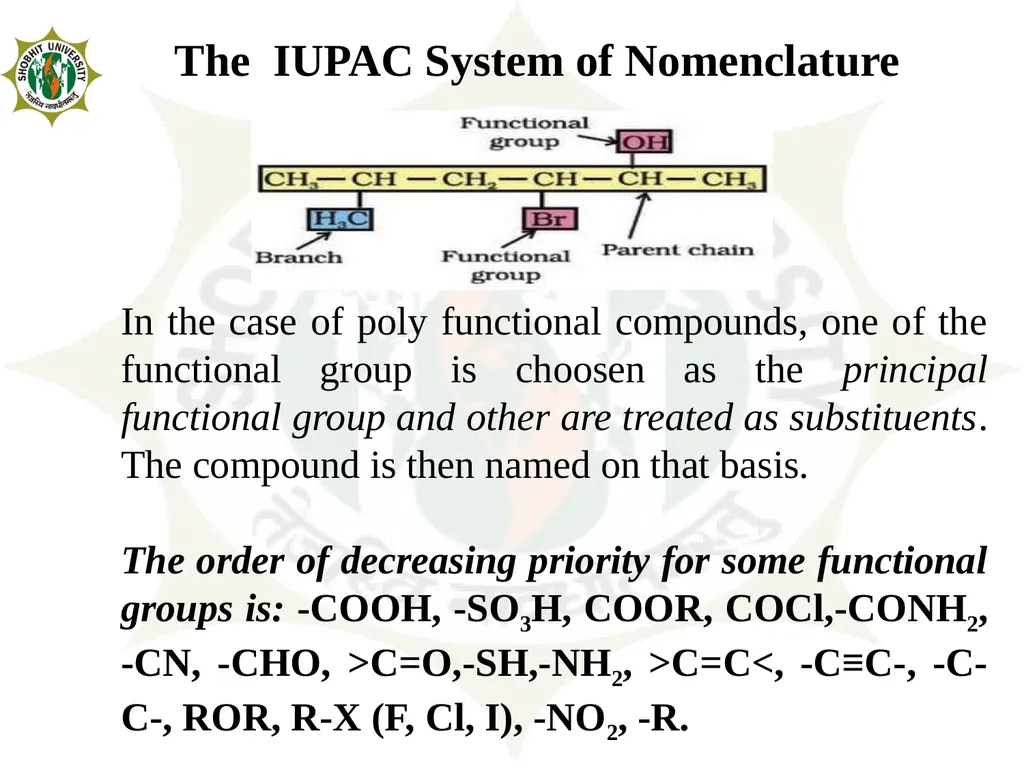
The IUPAC System of Nomenclature In the case of poly functional compounds, one of the functional group is choosen as the principal functional group and other are treated as substituents. The compound is then named on that basis.
The order of decreasing priority for some functional groups is: -COOH, -SO3H, COOR, COCl,-CONH2, -CN, -CHO, >C=O,-SH,-NH2, >C=C<, -C≡C-, -C-C-, ROR, R-X (F, Cl, I), -NO2, -R.<br>
The order of decreasing priority for some functional groups is: -COOH, -SO3H, COOR, COCl,-CONH2, -CN, -CHO, >C=O,-SH,-NH2, >C=C<, -C≡C-, -C-C-, ROR, R-X (F, Cl, I), -NO2, -R.<br>
20
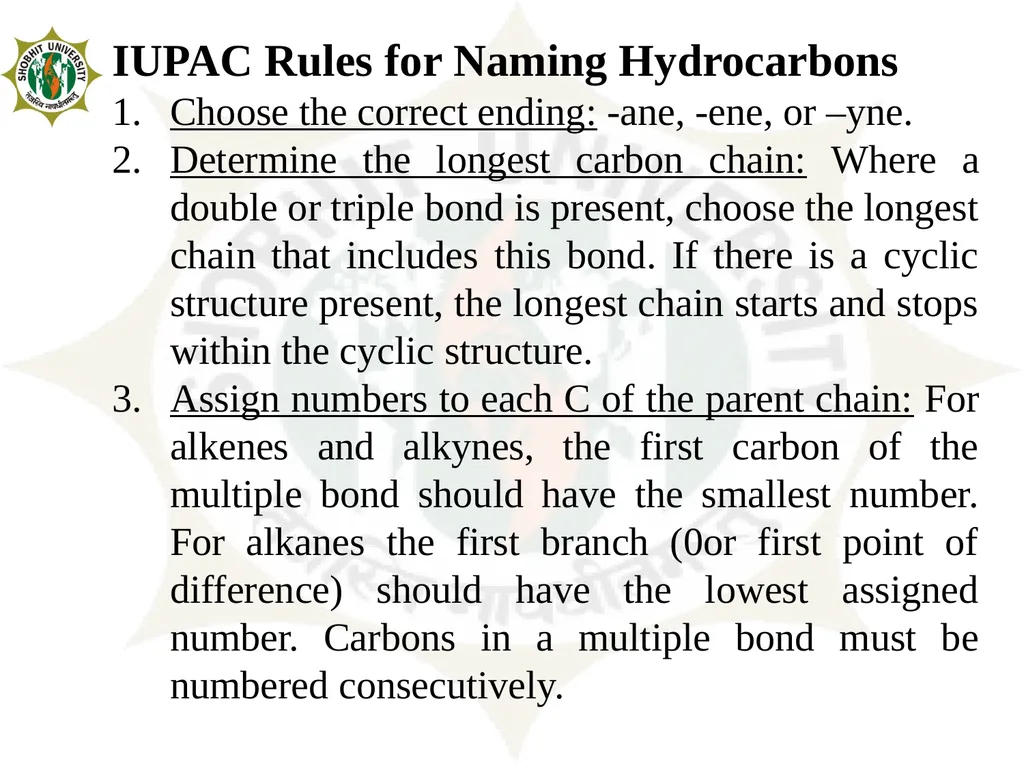
IUPAC Rules for Naming Hydrocarbons
Choose the correct ending: -ane, -ene, or –yne.
Determine the longest carbon chain: Where a double or triple bond is present, choose the longest chain that includes this bond. If there is a cyclic structure present, the longest chain starts and stops within the cyclic structure.
Assign numbers to each C of the parent chain: For alkenes and alkynes, the first carbon of the multiple bond should have the smallest number. For alkanes the first branch (0or first point of difference) should have the lowest assigned number. Carbons in a multiple bond must be numbered consecutively.<br>
21
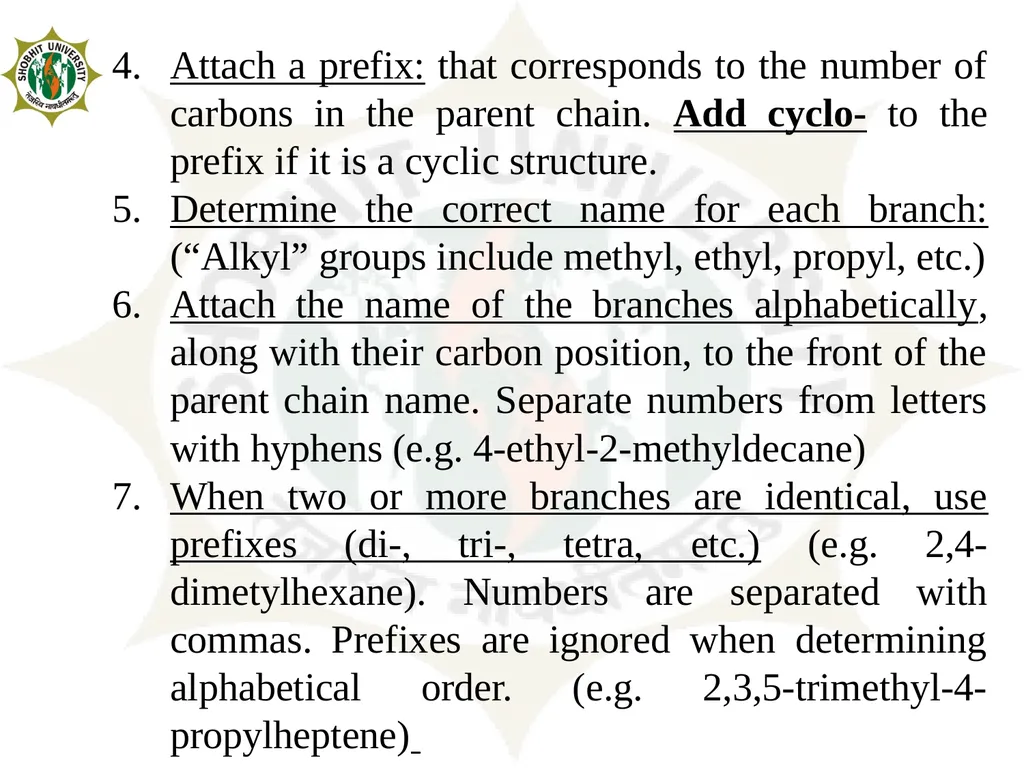
Attach a prefix: that corresponds to the number of carbons in the parent chain. Add cyclo- to the prefix if it is a cyclic structure.
Determine the correct name for each branch: (“Alkyl” groups include methyl, ethyl, propyl, etc.)
Attach the name of the branches alphabetically, along with their carbon position, to the front of the parent chain name. Separate numbers from letters with hyphens (e.g. 4-ethyl-2-methyldecane)
When two or more branches are identical, use prefixes (di-, tri-, tetra, etc.) (e.g. 2,4-dimetylhexane). Numbers are separated with commas. Prefixes are ignored when determining alphabetical order. (e.g. 2,3,5-trimethyl-4-propylheptene)<br>
22
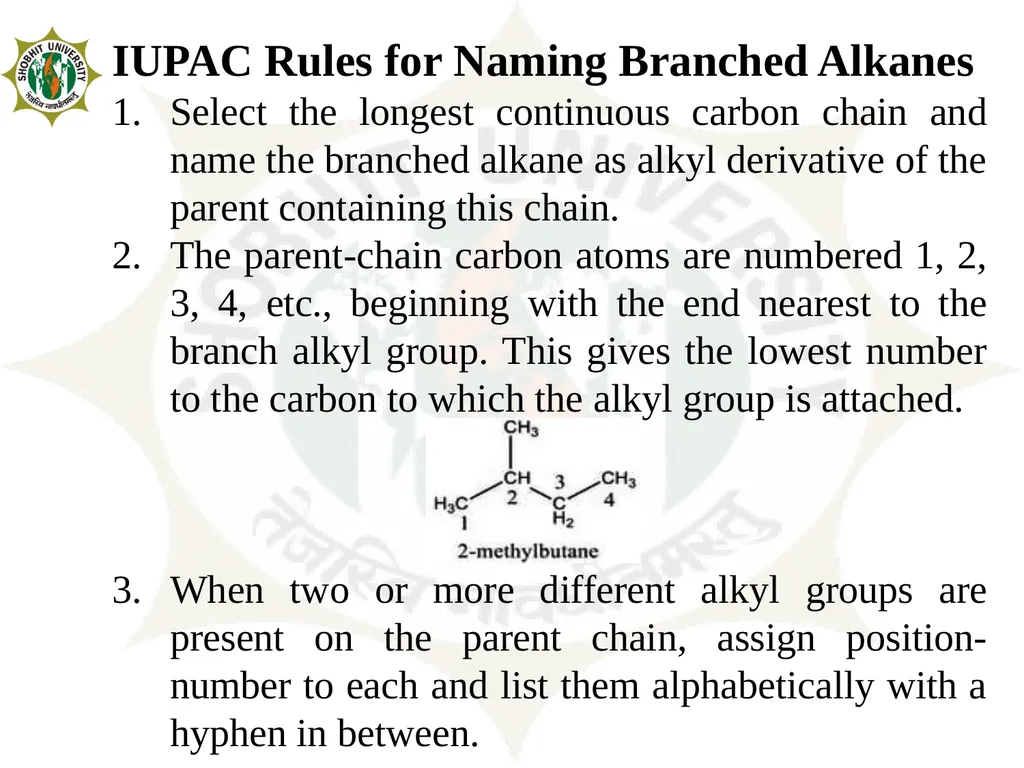
IUPAC Rules for Naming Branched Alkanes
Select the longest continuous carbon chain and name the branched alkane as alkyl derivative of the parent containing this chain.
The parent-chain carbon atoms are numbered 1, 2, 3, 4, etc., beginning with the end nearest to the branch alkyl group. This gives the lowest number to the carbon to which the alkyl group is attached.
When two or more different alkyl groups are present on the parent chain, assign position-number to each and list them alphabetically with a hyphen in between.<br>
23
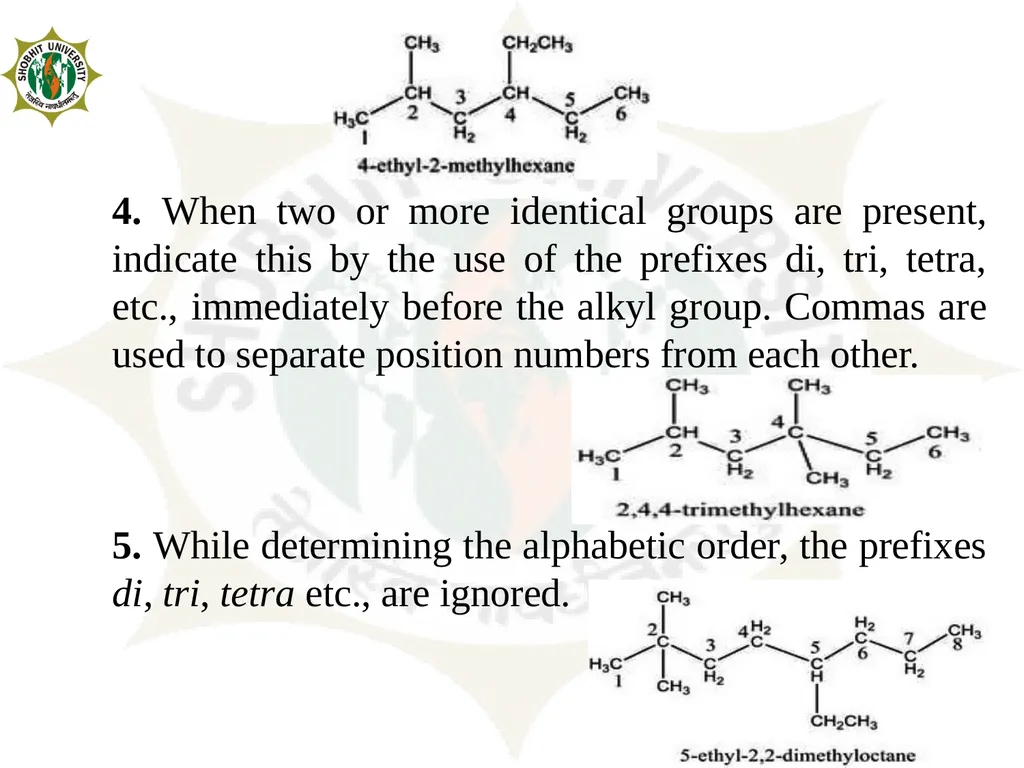
4. When two or more identical groups are present, indicate this by the use of the prefixes di, tri, tetra, etc., immediately before the alkyl group. Commas are used to separate position numbers from each other.
5. While determining the alphabetic order, the prefixes di, tri, tetra etc., are ignored.<br>
5. While determining the alphabetic order, the prefixes di, tri, tetra etc., are ignored.<br>
24
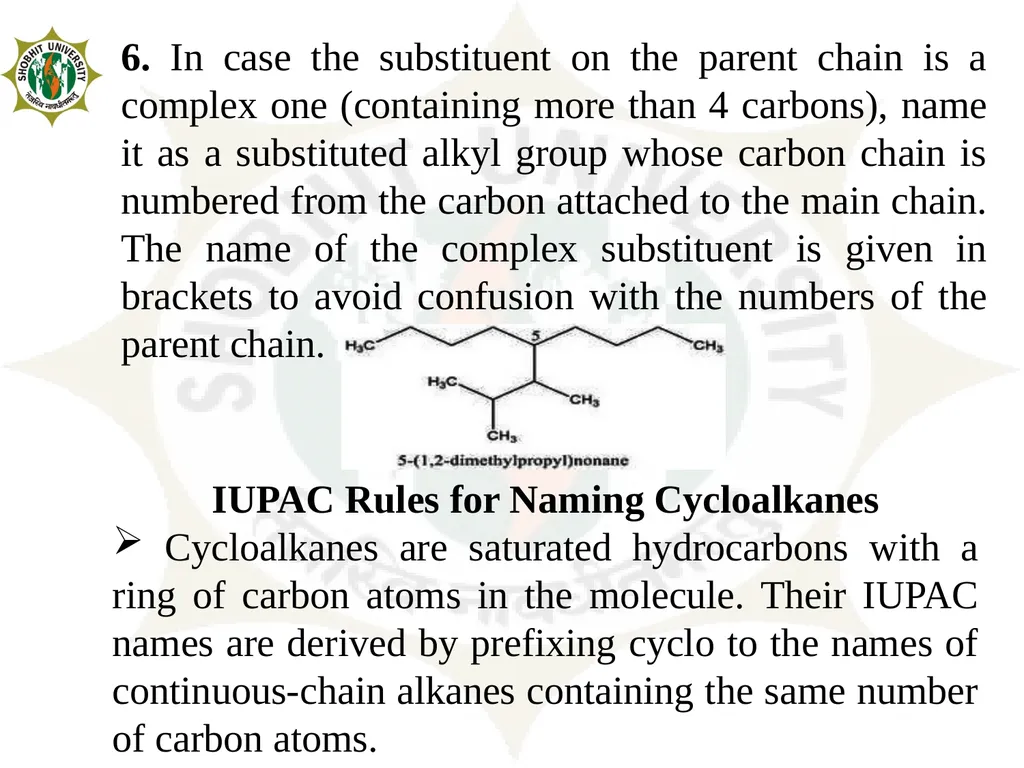
6. In case the substituent on the parent chain is a complex one (containing more than 4 carbons), name it as a substituted alkyl group whose carbon chain is numbered from the carbon attached to the main chain. The name of the complex substituent is given in brackets to avoid confusion with the numbers of the parent chain. IUPAC Rules for Naming Cycloalkanes
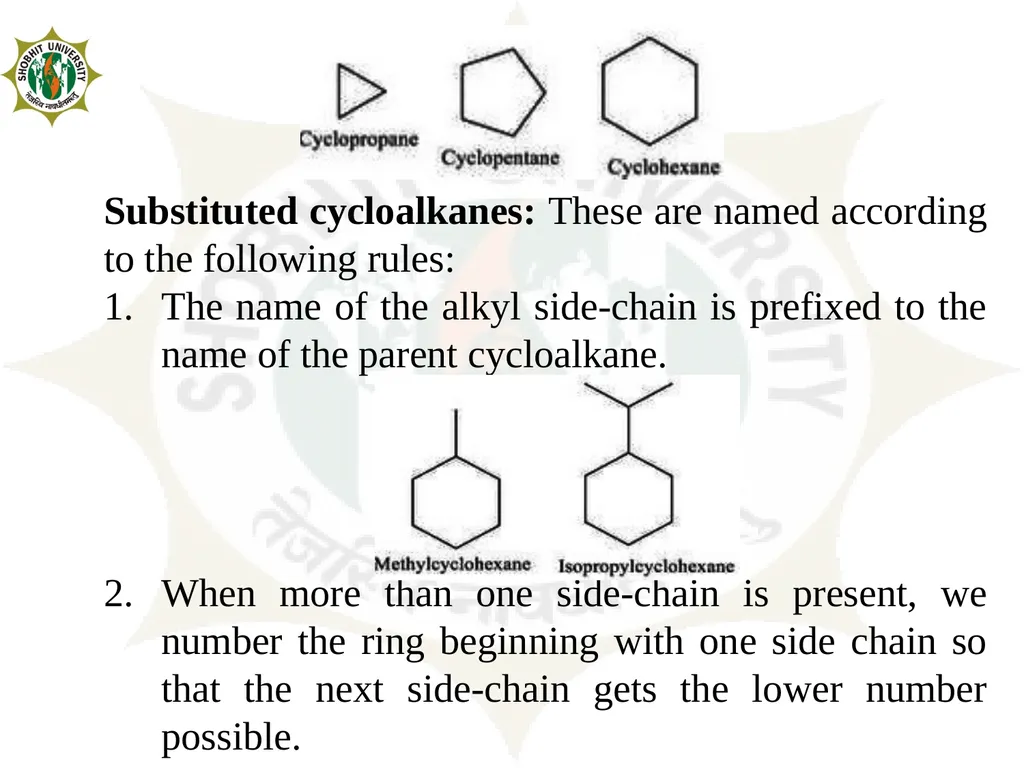
Cycloalkanes are saturated hydrocarbons with a ring of carbon atoms in the molecule. Their IUPAC names are derived by prefixing cyclo to the names of continuous-chain alkanes containing the same number of carbon atoms.<br>
Cycloalkanes are saturated hydrocarbons with a ring of carbon atoms in the molecule. Their IUPAC names are derived by prefixing cyclo to the names of continuous-chain alkanes containing the same number of carbon atoms.<br>
25
Substituted cycloalkanes: These are named according to the following rules:
The name of the alkyl side-chain is prefixed to the name of the parent cycloalkane.
When more than one side-chain is present, we number the ring beginning with one side chain so that the next side-chain gets the lower number possible.<br>
The name of the alkyl side-chain is prefixed to the name of the parent cycloalkane.
When more than one side-chain is present, we number the ring beginning with one side chain so that the next side-chain gets the lower number possible.<br>
26
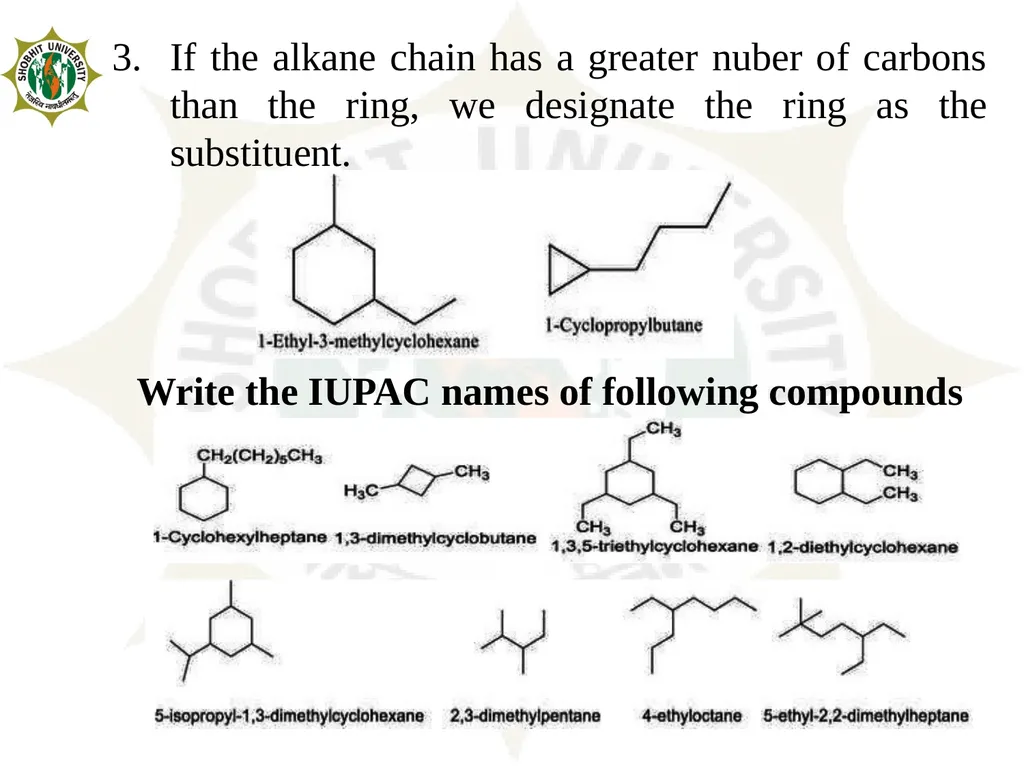
If the alkane chain has a greater nuber of carbons than the ring, we designate the ring as the substituent.
Write the IUPAC names of following compounds<br>
Write the IUPAC names of following compounds<br>
27
IUPAC Rules for Naming Alkenes
A hydrocarbon with one double bond C=C is called an alkene. The functional group of alkenes is C=C, which is designated by the suffix ‘ene’.
Select the longest continuous chain that contains both carbons of the double bond and change the name of the corresponding alkane from ‘ane’ to ‘ene’.
Number the parent chain beginning at the end nearer the double bond and indicate the position of the double bond by using the number of the first carbon of the double bond as prefix.
Name and indicate the position of any substituent group as for the alkanes.
When there are two or more double bonds in a<br>
28
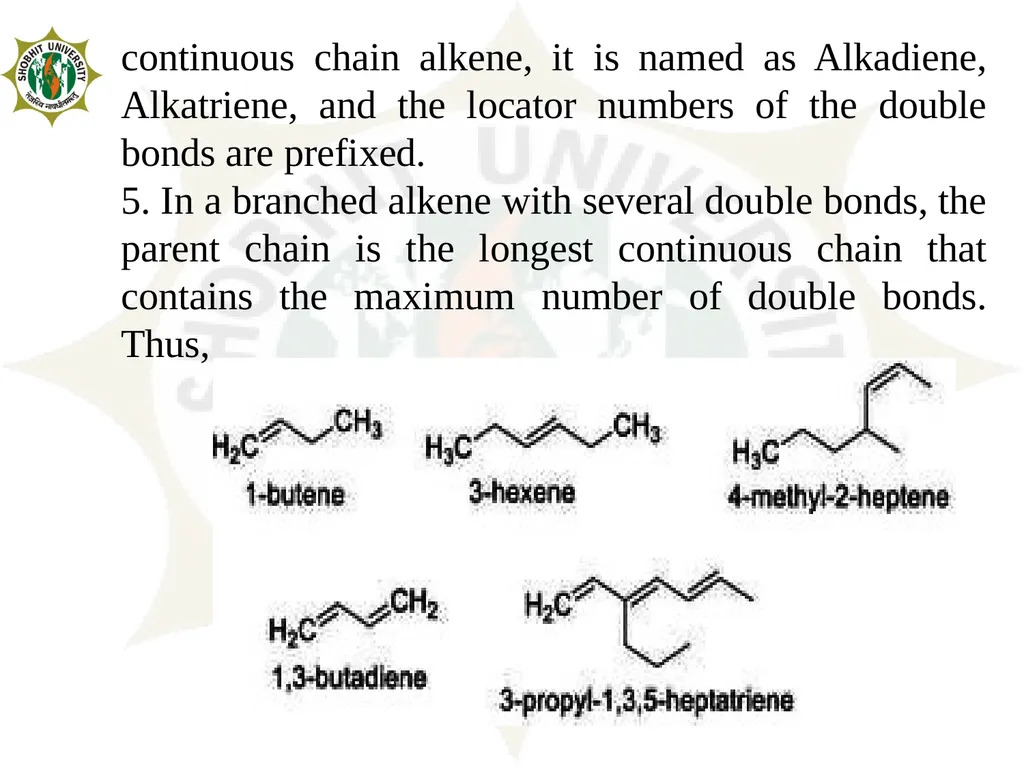
continuous chain alkene, it is named as Alkadiene, Alkatriene, and the locator numbers of the double bonds are prefixed.
5. In a branched alkene with several double bonds, the parent chain is the longest continuous chain that contains the maximum number of double bonds. Thus,<br>
5. In a branched alkene with several double bonds, the parent chain is the longest continuous chain that contains the maximum number of double bonds. Thus,<br>
29
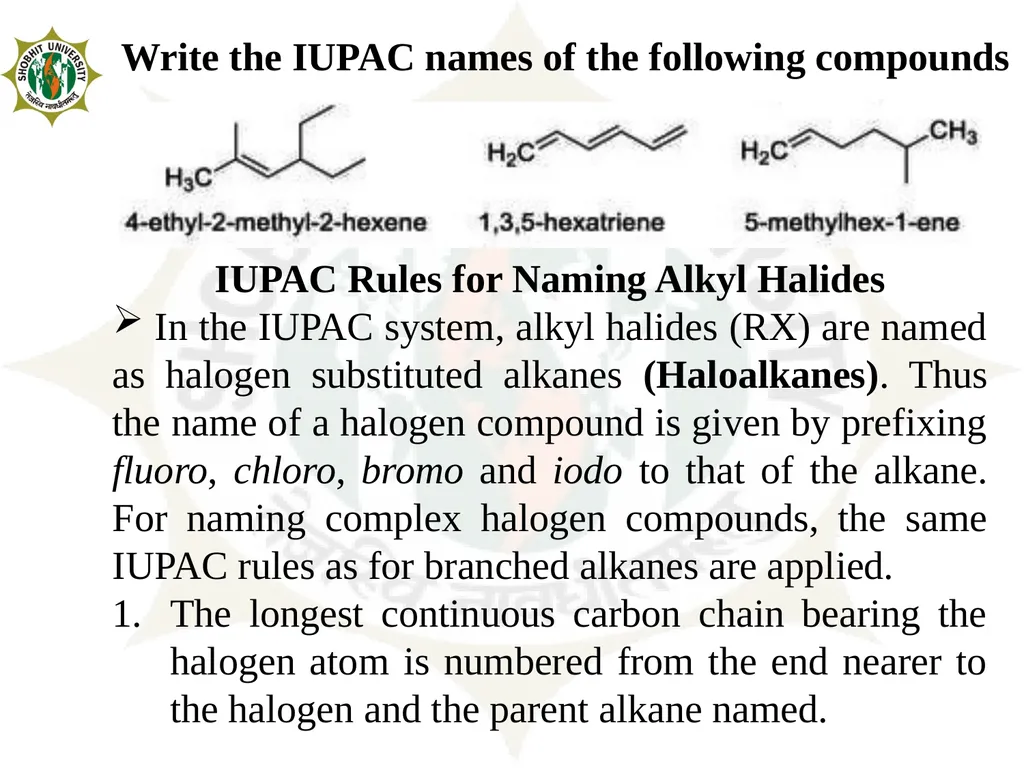
Write the IUPAC names of the following compounds IUPAC Rules for Naming Alkyl Halides
In the IUPAC system, alkyl halides (RX) are named as halogen substituted alkanes (Haloalkanes). Thus the name of a halogen compound is given by prefixing fluoro, chloro, bromo and iodo to that of the alkane. For naming complex halogen compounds, the same IUPAC rules as for branched alkanes are applied.
The longest continuous carbon chain bearing the halogen atom is numbered from the end nearer to the halogen and the parent alkane named.<br>
30
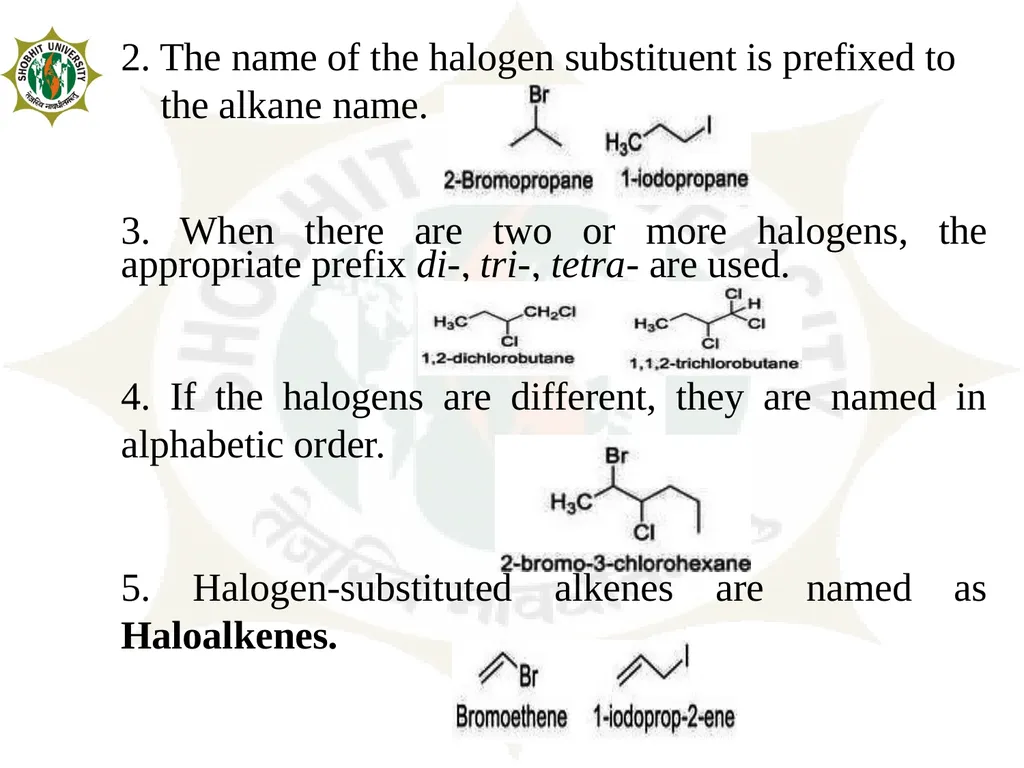
2. The name of the halogen substituent is prefixed to
the alkane name.
3. When there are two or more halogens, the appropriate prefix di-, tri-, tetra- are used.
4. If the halogens are different, they are named in alphabetic order.
5. Halogen-substituted alkenes are named as Haloalkenes.<br>
the alkane name.
3. When there are two or more halogens, the appropriate prefix di-, tri-, tetra- are used.
4. If the halogens are different, they are named in alphabetic order.
5. Halogen-substituted alkenes are named as Haloalkenes.<br>
31
Thank You<br>