
Conflict Management and de-escalation strategies
CM
Published · 57 slides · 0 views

1 / 1






Description
Conflict Management and de-escalation strategies for Transit Staff Transit Association of Maryland (TAM) Ream Lazaro Safety Consulting, LLC 1 Overview 2 Agenda Defining the Risk De-escalation Skills Leadership Strategies 3 The Reality
Related Topics
Share
Embed code
Download this presentation From Below
"Conflict Management and de-escalation strategies" is the property of its rightful owner. Permission is granted to download and print the materials on this website for personal, non-commercial use only, and to display it on your personal computer provided you do not modify the materials and that you retain all copyright notices contained in the materials. By downloading content from our website, you accept the terms of this agreement.
Presentation Transcript
01
Conflict Management and
de-escalation strategies
for Transit Staff Transit Association of Maryland (TAM)
Ream Lazaro Safety Consulting, LLC 1<br>
Ream Lazaro Safety Consulting, LLC 1<br>
02
Overview 2<br>
03
Agenda Defining the Risk
De-escalation Skills
Leadership Strategies 3<br>
De-escalation Skills
Leadership Strategies 3<br>
04
The Reality Checks 4<br>
05
Defining the Risk 5<br>
06
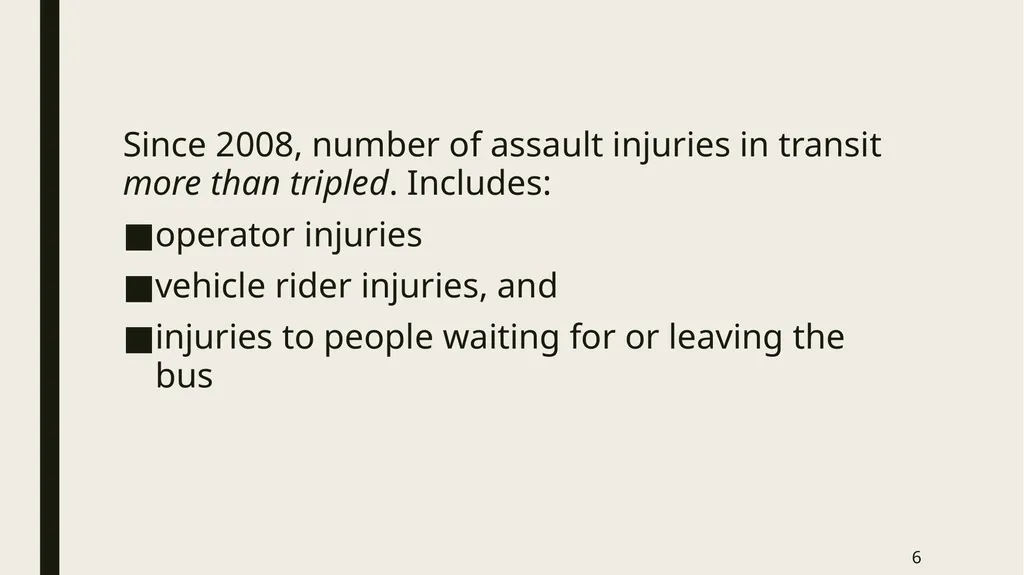
Since 2008, number of assault injuries in transit more than tripled. Includes:
operator injuries
vehicle rider injuries, and
injuries to people waiting for or leaving the bus 6<br>
operator injuries
vehicle rider injuries, and
injuries to people waiting for or leaving the bus 6<br>
07
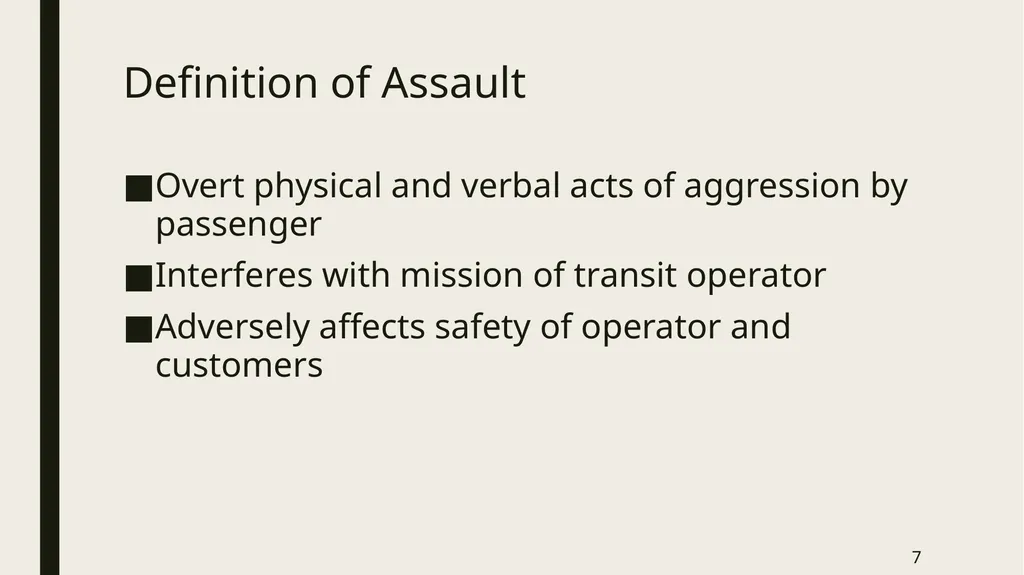
Definition of Assault Overt physical and verbal acts of aggression by passenger
Interferes with mission of transit operator
Adversely affects safety of operator and customers 7<br>
Interferes with mission of transit operator
Adversely affects safety of operator and customers 7<br>
08
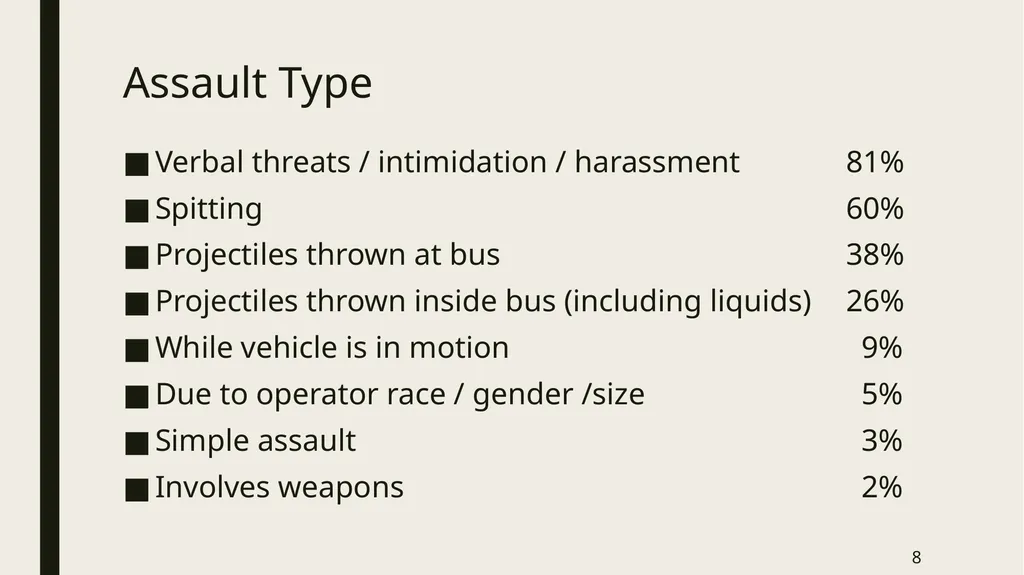
Assault Type Verbal threats / intimidation / harassment 81%
Spitting 60%
Projectiles thrown at bus 38%
Projectiles thrown inside bus (including liquids) 26%
While vehicle is in motion 9%
Due to operator race / gender /size 5%
Simple assault 3%
Involves weapons 2% 8<br>
Spitting 60%
Projectiles thrown at bus 38%
Projectiles thrown inside bus (including liquids) 26%
While vehicle is in motion 9%
Due to operator race / gender /size 5%
Simple assault 3%
Involves weapons 2% 8<br>
09
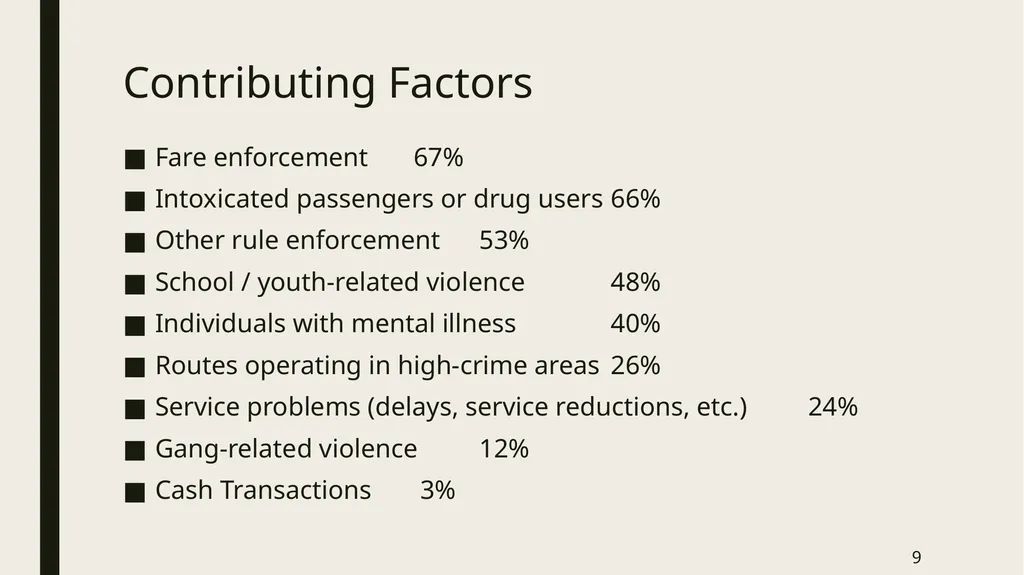
Contributing Factors Fare enforcement 67%
Intoxicated passengers or drug users 66%
Other rule enforcement 53%
School / youth-related violence 48%
Individuals with mental illness 40%
Routes operating in high-crime areas 26%
Service problems (delays, service reductions, etc.) 24%
Gang-related violence 12%
Cash Transactions 3% 9<br>
Intoxicated passengers or drug users 66%
Other rule enforcement 53%
School / youth-related violence 48%
Individuals with mental illness 40%
Routes operating in high-crime areas 26%
Service problems (delays, service reductions, etc.) 24%
Gang-related violence 12%
Cash Transactions 3% 9<br>
10
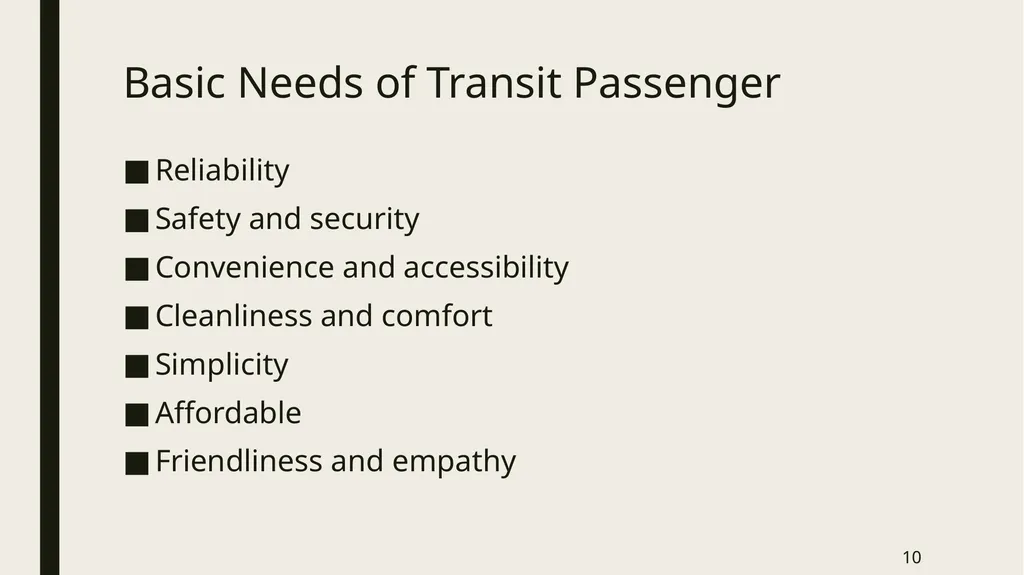
Basic Needs of Transit Passenger Reliability
Safety and security
Convenience and accessibility
Cleanliness and comfort
Simplicity
Affordable
Friendliness and empathy 10<br>
Safety and security
Convenience and accessibility
Cleanliness and comfort
Simplicity
Affordable
Friendliness and empathy 10<br>
11
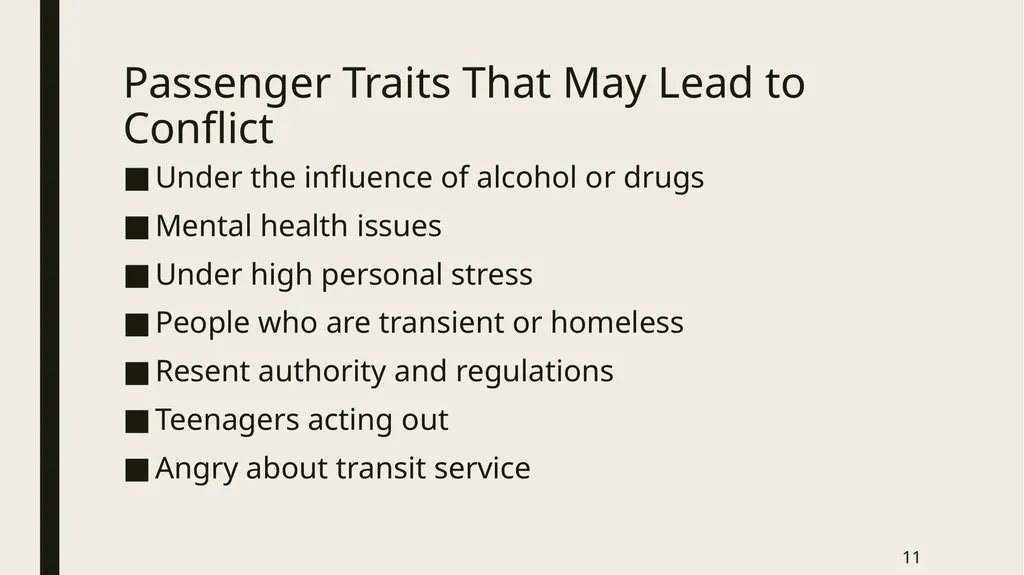
Passenger Traits That May Lead to Conflict Under the influence of alcohol or drugs
Mental health issues
Under high personal stress
People who are transient or homeless
Resent authority and regulations
Teenagers acting out
Angry about transit service 11<br>
Mental health issues
Under high personal stress
People who are transient or homeless
Resent authority and regulations
Teenagers acting out
Angry about transit service 11<br>
12
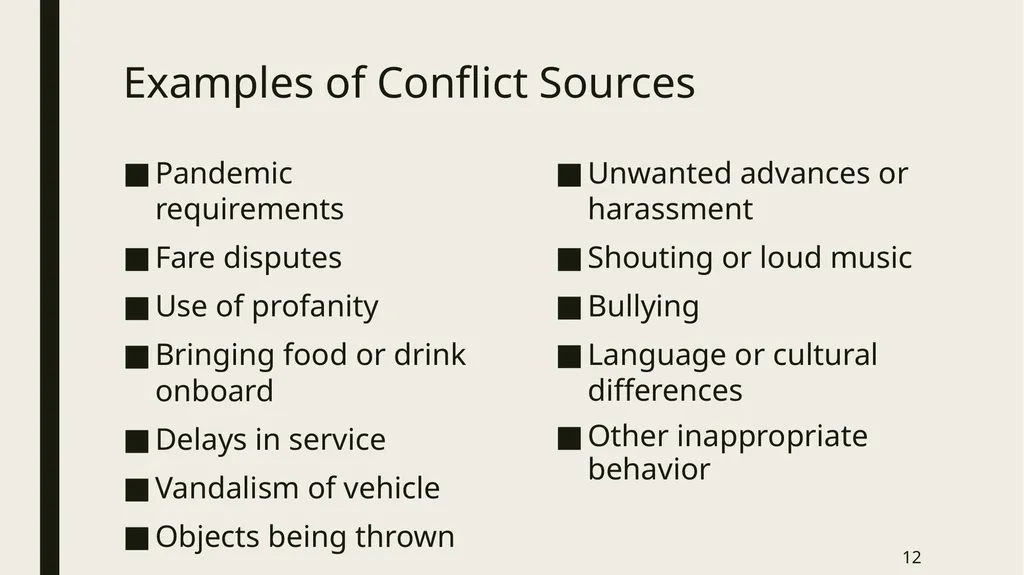
Examples of Conflict Sources Pandemic requirements
Fare disputes
Use of profanity
Bringing food or drink onboard
Delays in service
Vandalism of vehicle
Objects being thrown Unwanted advances or harassment
Shouting or loud music
Bullying
Language or cultural differences
Other inappropriate behavior 12<br>
Fare disputes
Use of profanity
Bringing food or drink onboard
Delays in service
Vandalism of vehicle
Objects being thrown Unwanted advances or harassment
Shouting or loud music
Bullying
Language or cultural differences
Other inappropriate behavior 12<br>
13
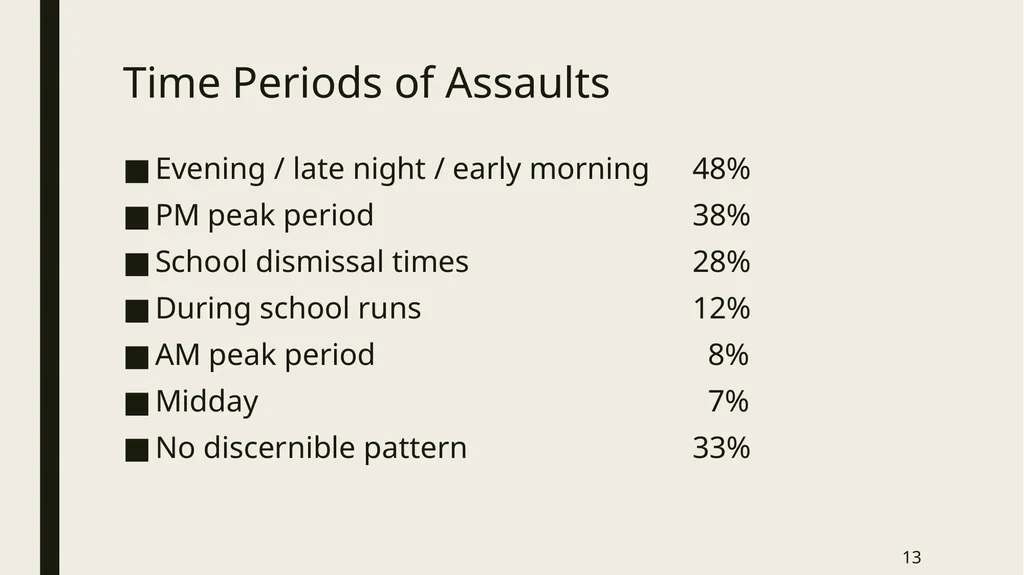
Time Periods of Assaults Evening / late night / early morning 48%
PM peak period 38%
School dismissal times 28%
During school runs 12%
AM peak period 8%
Midday 7%
No discernible pattern 33% 13<br>
PM peak period 38%
School dismissal times 28%
During school runs 12%
AM peak period 8%
Midday 7%
No discernible pattern 33% 13<br>
14
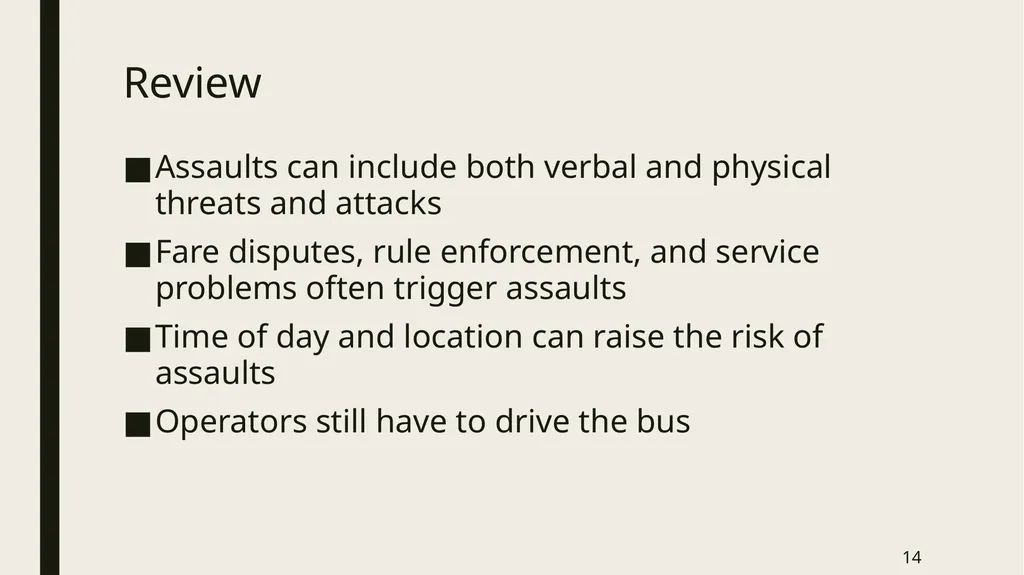
Review Assaults can include both verbal and physical threats and attacks
Fare disputes, rule enforcement, and service problems often trigger assaults
Time of day and location can raise the risk of assaults
Operators still have to drive the bus 14<br>
Fare disputes, rule enforcement, and service problems often trigger assaults
Time of day and location can raise the risk of assaults
Operators still have to drive the bus 14<br>
15
Reality Check “The Risk” 15<br>
16
De-Escalation Skills 16<br>
17
What is Conflict? Conflict is a disagreement in which the people involved see a threat to their needs, interests, or concerns.
Conflict key element – the idea that each person may have a different perception of any given situation 17<br>
Conflict key element – the idea that each person may have a different perception of any given situation 17<br>
18
What is de-escalation? De-escalation - when we use communication skills to calm a person who is angry, out of control, or disturbed.
Escalation phase – when interaction turns into conflict
Critical to deploy de-escalation techniques during this phase 18<br>
Escalation phase – when interaction turns into conflict
Critical to deploy de-escalation techniques during this phase 18<br>
19
Types of Conflict Passenger against driver
Passenger against supervisor
Passenger against passenger 19<br>
Passenger against supervisor
Passenger against passenger 19<br>
20
Three Aspects of Communication Words (what we actually say)
Tone (how we say the words)
Body language
Combine to express an overall message
A powerful form of communication 20<br>
Tone (how we say the words)
Body language
Combine to express an overall message
A powerful form of communication 20<br>
21
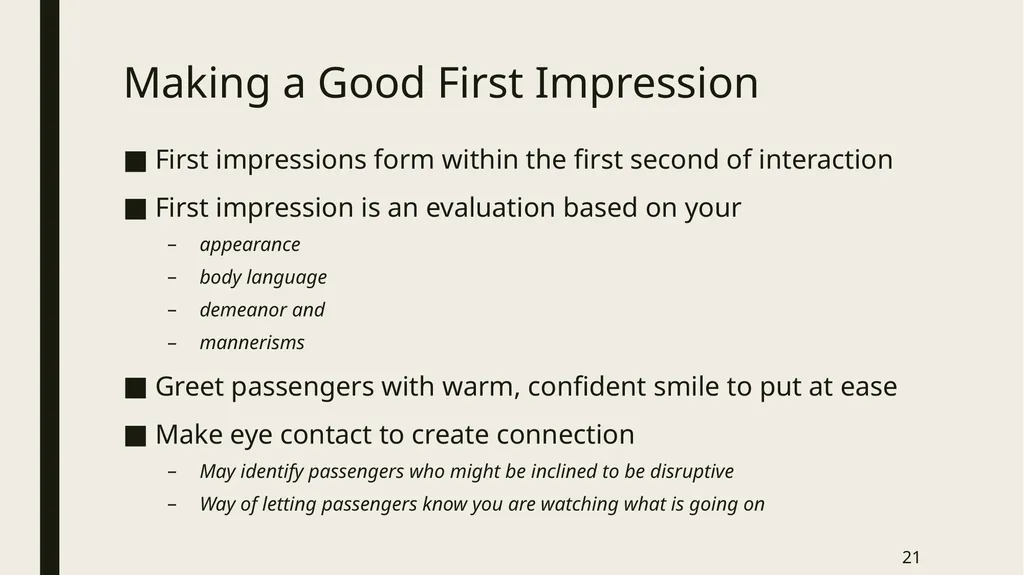
Making a Good First Impression First impressions form within the first second of interaction
First impression is an evaluation based on your
appearance
body language
demeanor and
mannerisms
Greet passengers with warm, confident smile to put at ease
Make eye contact to create connection
May identify passengers who might be inclined to be disruptive
Way of letting passengers know you are watching what is going on 21<br>
22
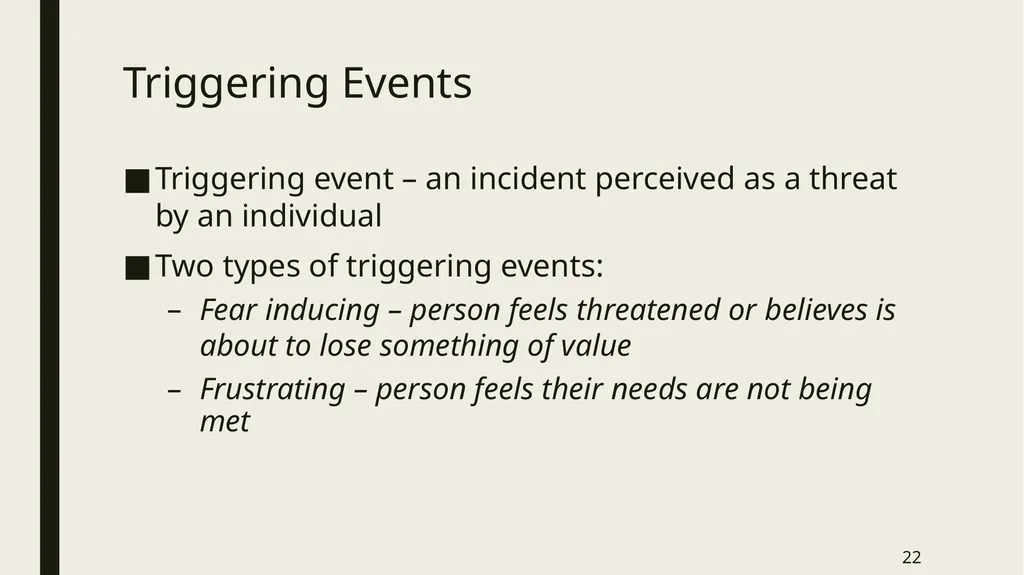
Triggering Events Triggering event – an incident perceived as a threat by an individual
Two types of triggering events:
Fear inducing – person feels threatened or believes is about to lose something of value
Frustrating – person feels their needs are not being met 22<br>
Two types of triggering events:
Fear inducing – person feels threatened or believes is about to lose something of value
Frustrating – person feels their needs are not being met 22<br>
23
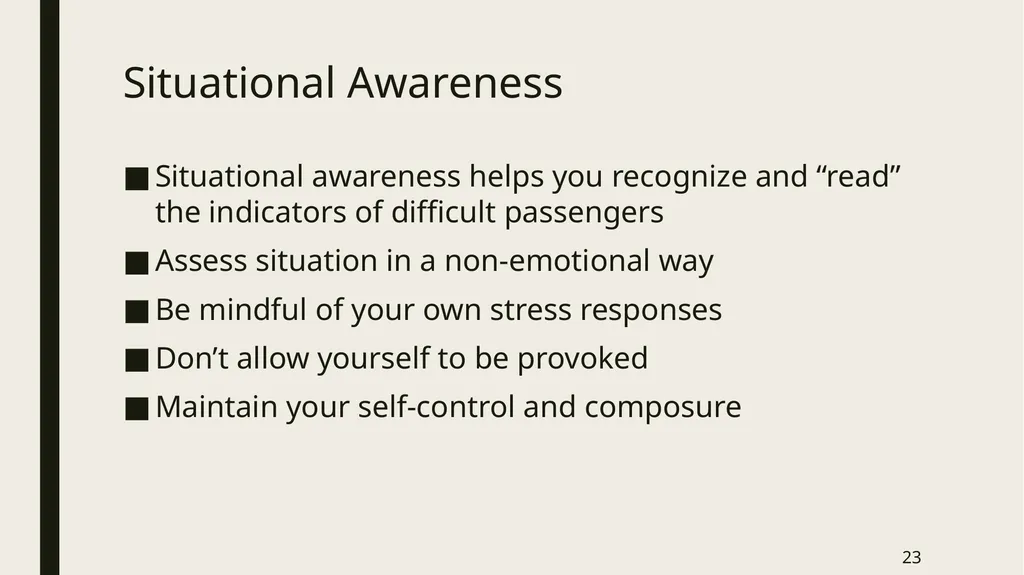
Situational Awareness Situational awareness helps you recognize and “read” the indicators of difficult passengers
Assess situation in a non-emotional way
Be mindful of your own stress responses
Don’t allow yourself to be provoked
Maintain your self-control and composure 23<br>
Assess situation in a non-emotional way
Be mindful of your own stress responses
Don’t allow yourself to be provoked
Maintain your self-control and composure 23<br>
24
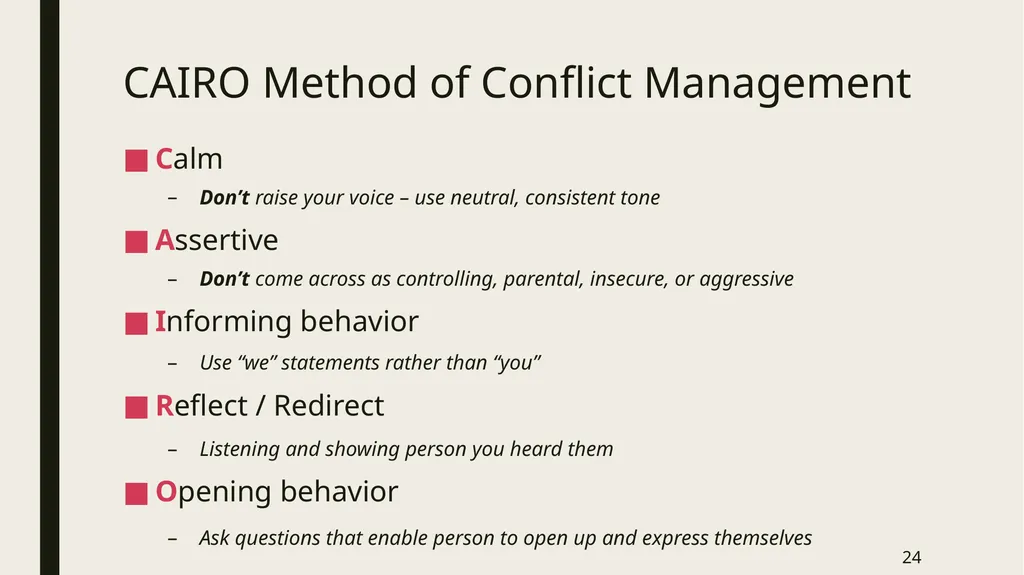
CAIRO Method of Conflict Management Calm
Don’t raise your voice – use neutral, consistent tone
Assertive
Don’t come across as controlling, parental, insecure, or aggressive
Informing behavior
Use “we” statements rather than “you”
Reflect / Redirect
Listening and showing person you heard them
Opening behavior
Ask questions that enable person to open up and express themselves 24<br>
25
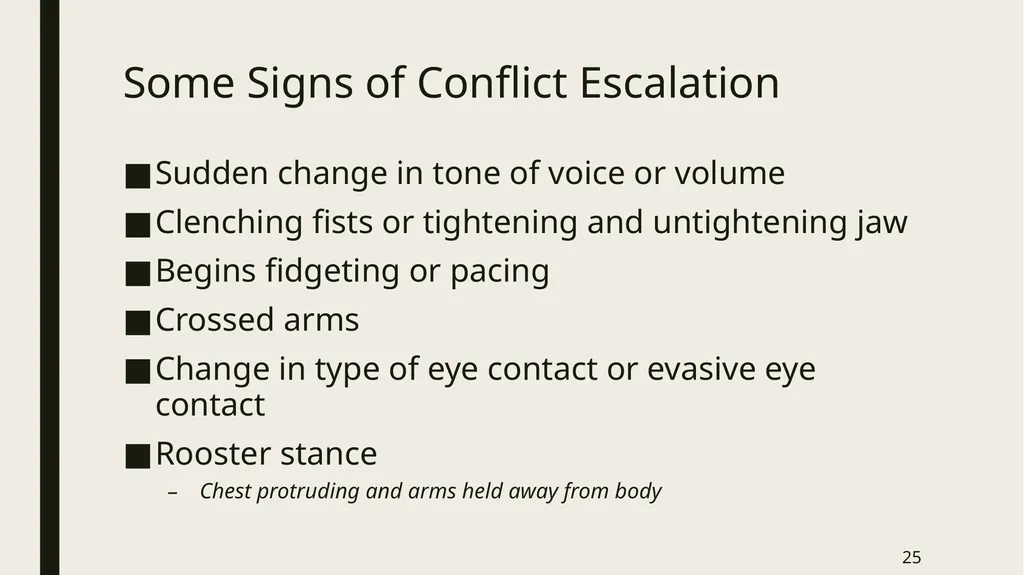
Some Signs of Conflict Escalation Sudden change in tone of voice or volume
Clenching fists or tightening and untightening jaw
Begins fidgeting or pacing
Crossed arms
Change in type of eye contact or evasive eye contact
Rooster stance
Chest protruding and arms held away from body 25<br>
Clenching fists or tightening and untightening jaw
Begins fidgeting or pacing
Crossed arms
Change in type of eye contact or evasive eye contact
Rooster stance
Chest protruding and arms held away from body 25<br>
26
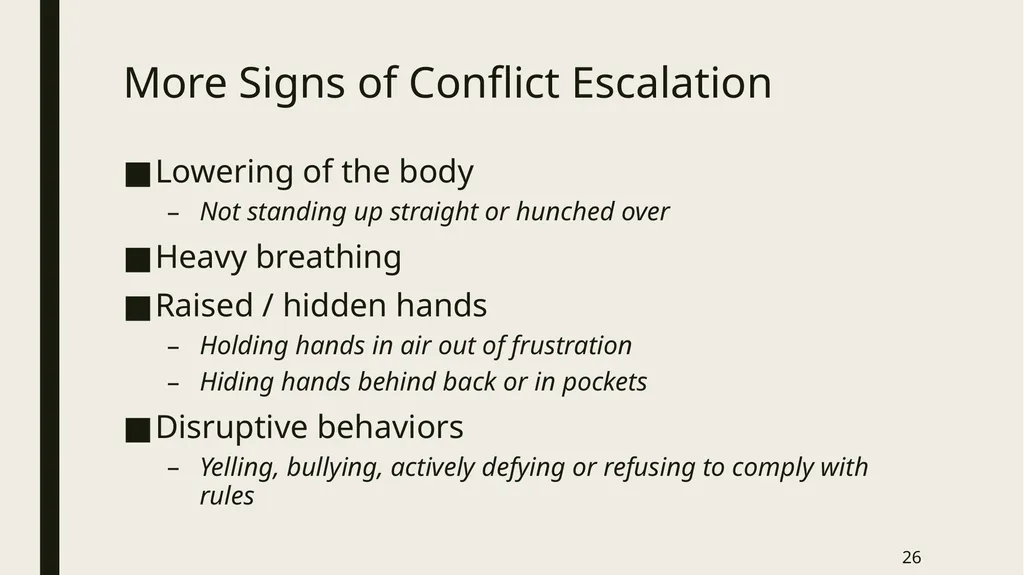
More Signs of Conflict Escalation Lowering of the body
Not standing up straight or hunched over
Heavy breathing
Raised / hidden hands
Holding hands in air out of frustration
Hiding hands behind back or in pockets
Disruptive behaviors
Yelling, bullying, actively defying or refusing to comply with rules 26<br>
Not standing up straight or hunched over
Heavy breathing
Raised / hidden hands
Holding hands in air out of frustration
Hiding hands behind back or in pockets
Disruptive behaviors
Yelling, bullying, actively defying or refusing to comply with rules 26<br>
27
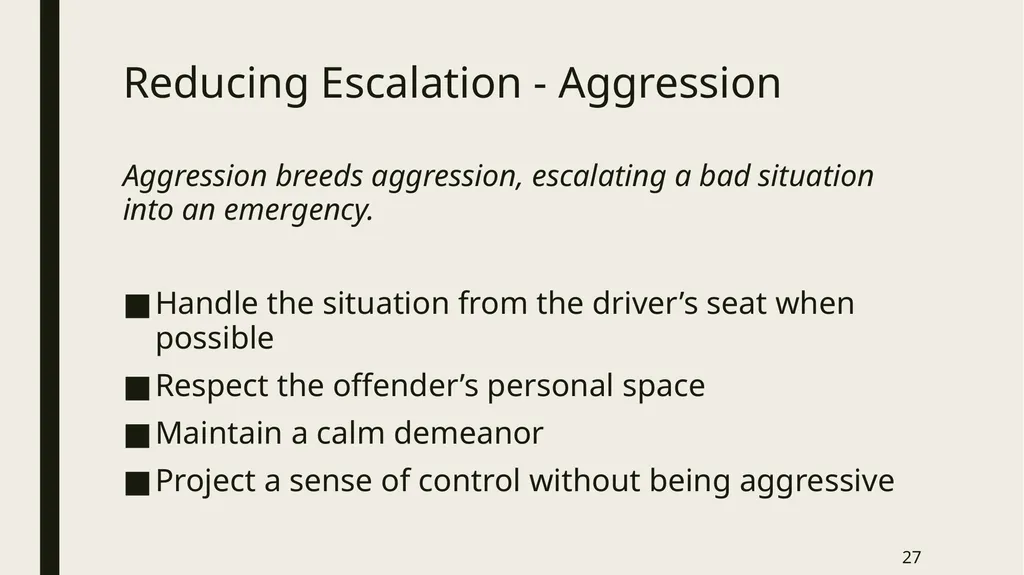
Reducing Escalation - Aggression Aggression breeds aggression, escalating a bad situation into an emergency.
Handle the situation from the driver’s seat when possible
Respect the offender’s personal space
Maintain a calm demeanor
Project a sense of control without being aggressive 27<br>
Handle the situation from the driver’s seat when possible
Respect the offender’s personal space
Maintain a calm demeanor
Project a sense of control without being aggressive 27<br>
28
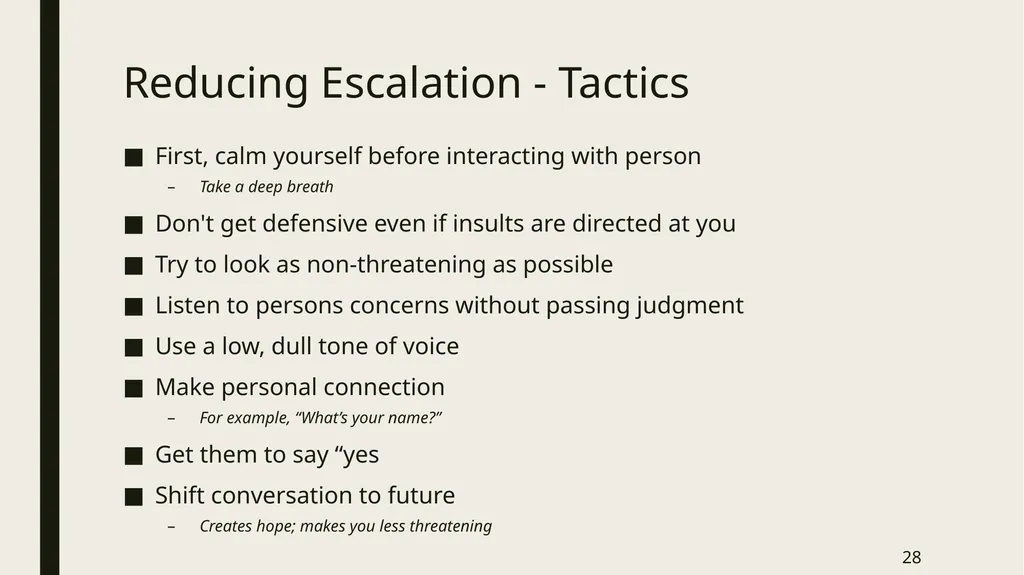
Reducing Escalation - Tactics First, calm yourself before interacting with person
Take a deep breath
Don't get defensive even if insults are directed at you
Try to look as non-threatening as possible
Listen to persons concerns without passing judgment
Use a low, dull tone of voice
Make personal connection
For example, “What’s your name?”
Get them to say “yes
Shift conversation to future
Creates hope; makes you less threatening 28<br>
29
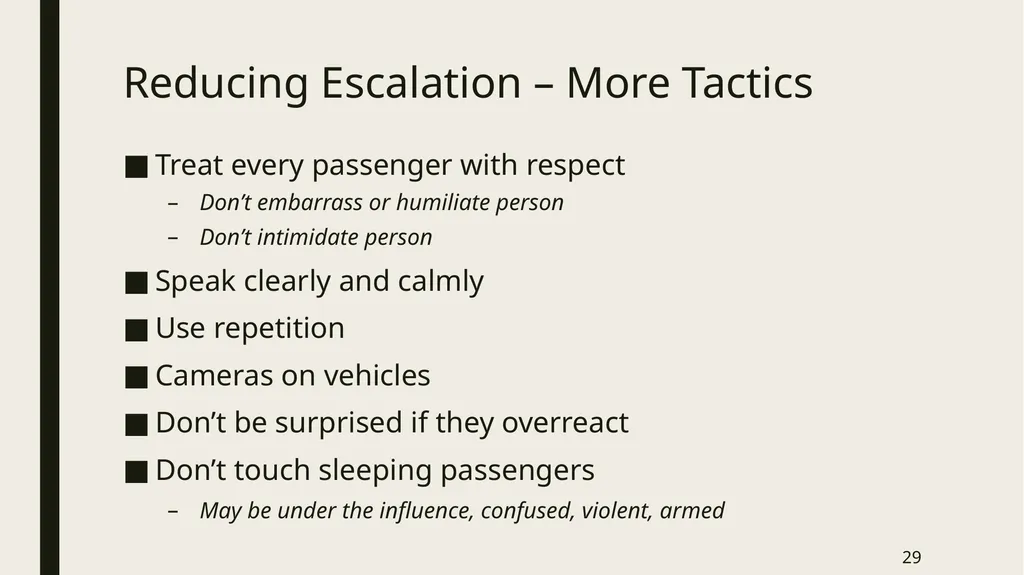
Reducing Escalation – More Tactics Treat every passenger with respect
Don’t embarrass or humiliate person
Don’t intimidate person
Speak clearly and calmly
Use repetition
Cameras on vehicles
Don’t be surprised if they overreact
Don’t touch sleeping passengers
May be under the influence, confused, violent, armed 29<br>
Don’t embarrass or humiliate person
Don’t intimidate person
Speak clearly and calmly
Use repetition
Cameras on vehicles
Don’t be surprised if they overreact
Don’t touch sleeping passengers
May be under the influence, confused, violent, armed 29<br>
30
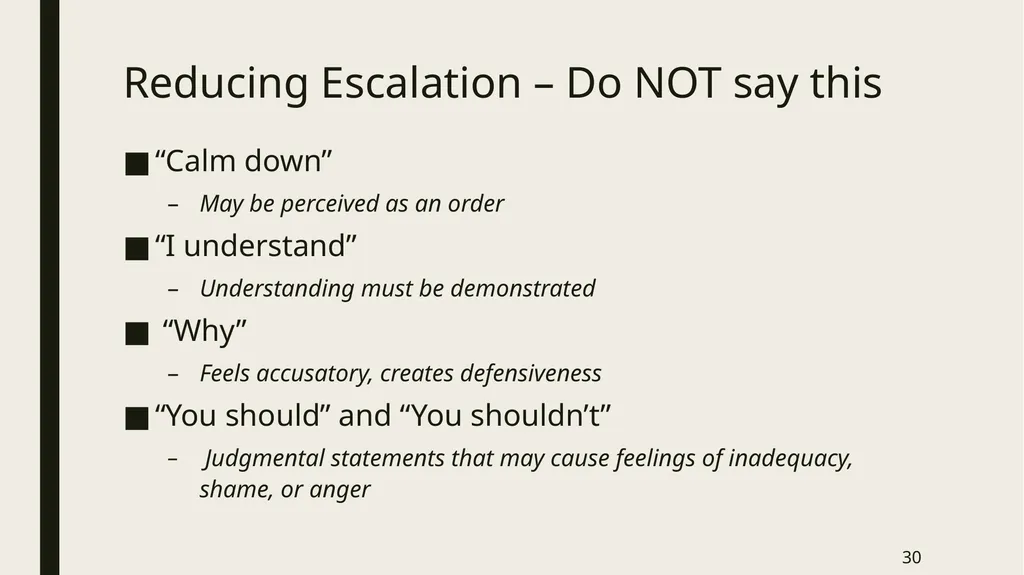
Reducing Escalation – Do NOT say this “Calm down”
May be perceived as an order
“I understand”
Understanding must be demonstrated
“Why”
Feels accusatory, creates defensiveness
“You should” and “You shouldn’t”
Judgmental statements that may cause feelings of inadequacy, shame, or anger 30<br>
May be perceived as an order
“I understand”
Understanding must be demonstrated
“Why”
Feels accusatory, creates defensiveness
“You should” and “You shouldn’t”
Judgmental statements that may cause feelings of inadequacy, shame, or anger 30<br>
31
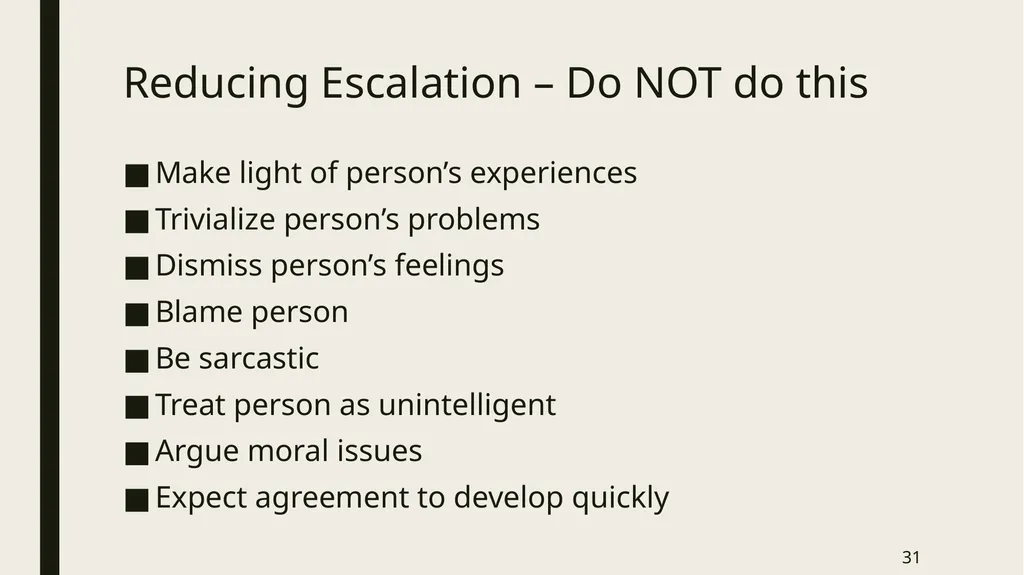
Reducing Escalation – Do NOT do this Make light of person’s experiences
Trivialize person’s problems
Dismiss person’s feelings
Blame person
Be sarcastic
Treat person as unintelligent
Argue moral issues
Expect agreement to develop quickly 31<br>
Trivialize person’s problems
Dismiss person’s feelings
Blame person
Be sarcastic
Treat person as unintelligent
Argue moral issues
Expect agreement to develop quickly 31<br>
32
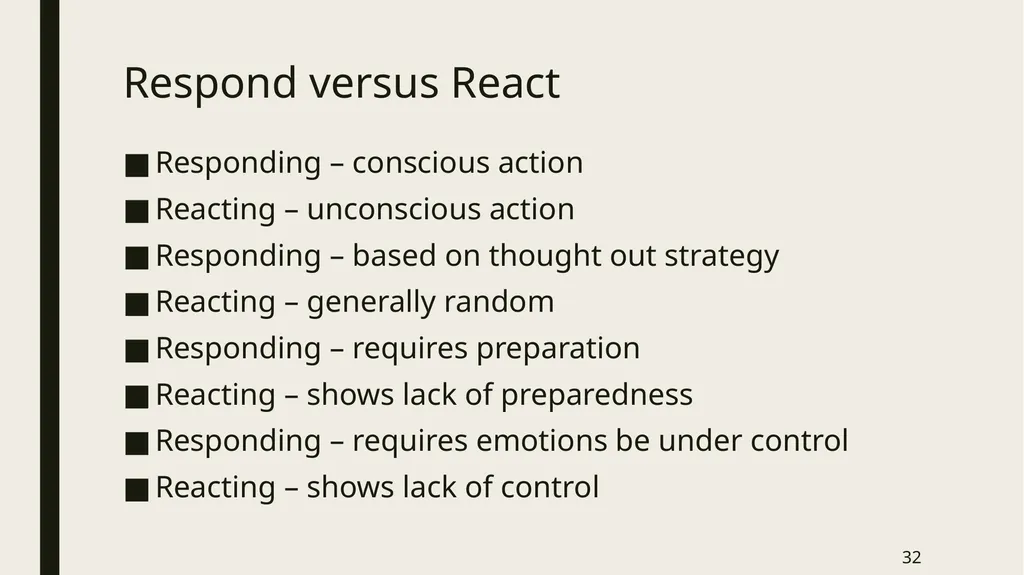
Respond versus React Responding – conscious action
Reacting – unconscious action
Responding – based on thought out strategy
Reacting – generally random
Responding – requires preparation
Reacting – shows lack of preparedness
Responding – requires emotions be under control
Reacting – shows lack of control 32<br>
Reacting – unconscious action
Responding – based on thought out strategy
Reacting – generally random
Responding – requires preparation
Reacting – shows lack of preparedness
Responding – requires emotions be under control
Reacting – shows lack of control 32<br>
33
Identify Your Hot Buttons Know your hot buttons
Develop strategies to overcome reactions to your hot button being pushed
Practice positive self-talk to calm yourself down and maintain self-control
Don’t take the bait 33<br>
Develop strategies to overcome reactions to your hot button being pushed
Practice positive self-talk to calm yourself down and maintain self-control
Don’t take the bait 33<br>
34
Consider Avoidance Consider conflict avoidance
If issue is minor
Further confrontation would result in escalation
Do not use avoidance if issue needs to be addressed
Do not compromise safety rules 34<br>
If issue is minor
Further confrontation would result in escalation
Do not use avoidance if issue needs to be addressed
Do not compromise safety rules 34<br>
35
Take a Time Out Give yourself time to calm down
Think through how to handle the situation 35<br>
Think through how to handle the situation 35<br>
36
Listen and Repeat Key Points Listening – most critical element of communication
Listen to:
Identify the problem
Filter out unnecessary information
Put into words what you think problem is
Repeat back the key points for clarification 36<br>
Listen to:
Identify the problem
Filter out unnecessary information
Put into words what you think problem is
Repeat back the key points for clarification 36<br>
37
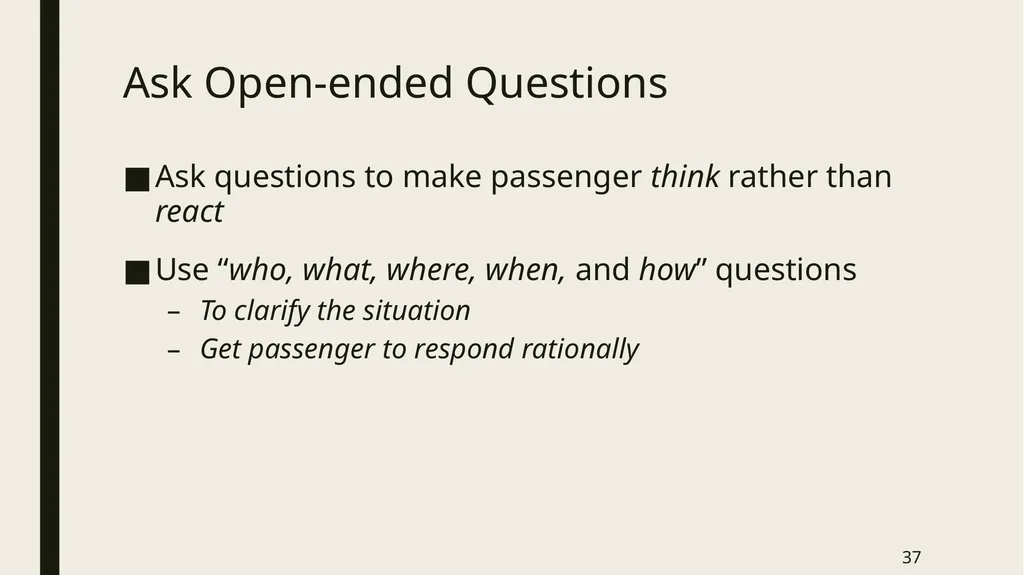
Ask Open-ended Questions Ask questions to make passenger think rather than react
Use “who, what, where, when, and how” questions
To clarify the situation
Get passenger to respond rationally 37<br>
Use “who, what, where, when, and how” questions
To clarify the situation
Get passenger to respond rationally 37<br>
38
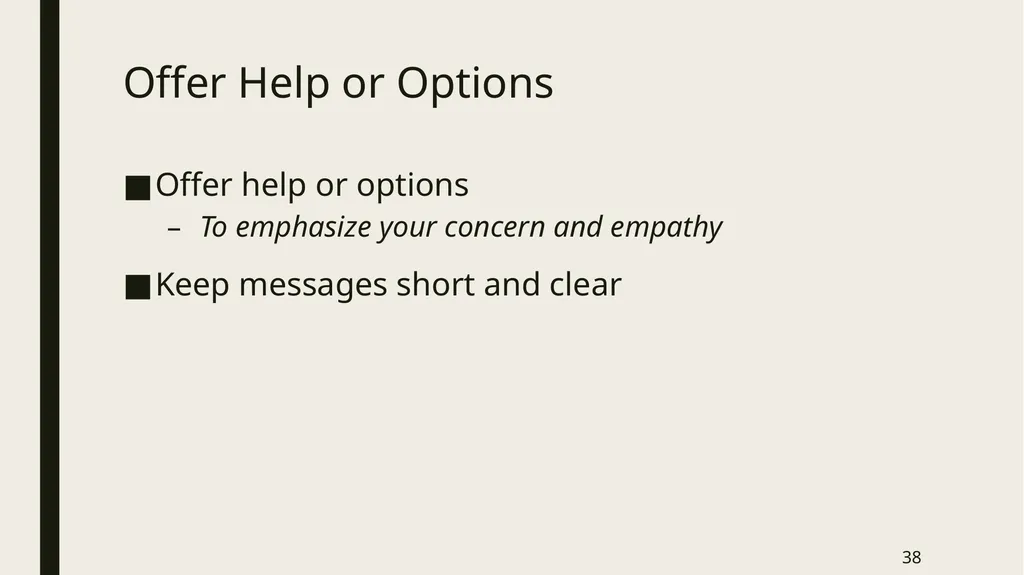
Offer Help or Options Offer help or options
To emphasize your concern and empathy
Keep messages short and clear 38<br>
To emphasize your concern and empathy
Keep messages short and clear 38<br>
39
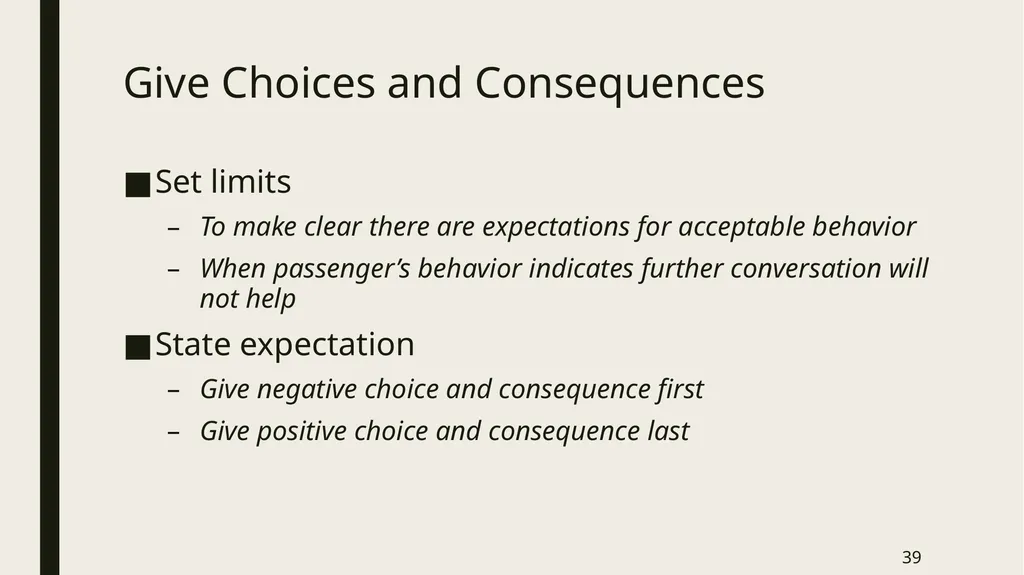
Give Choices and Consequences Set limits
To make clear there are expectations for acceptable behavior
When passenger’s behavior indicates further conversation will not help
State expectation
Give negative choice and consequence first
Give positive choice and consequence last 39<br>
To make clear there are expectations for acceptable behavior
When passenger’s behavior indicates further conversation will not help
State expectation
Give negative choice and consequence first
Give positive choice and consequence last 39<br>
40
Take Action Ask
Explain
Present options
Confirm
Act 40<br>
Explain
Present options
Confirm
Act 40<br>
41
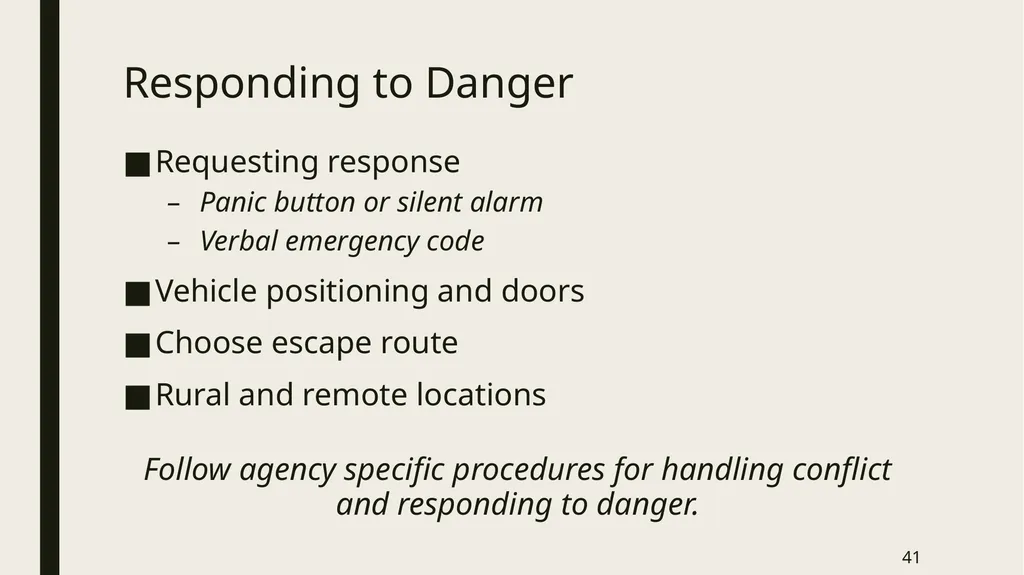
Responding to Danger Requesting response
Panic button or silent alarm
Verbal emergency code
Vehicle positioning and doors
Choose escape route
Rural and remote locations
Follow agency specific procedures for handling conflict and responding to danger. 41<br>
Panic button or silent alarm
Verbal emergency code
Vehicle positioning and doors
Choose escape route
Rural and remote locations
Follow agency specific procedures for handling conflict and responding to danger. 41<br>
42
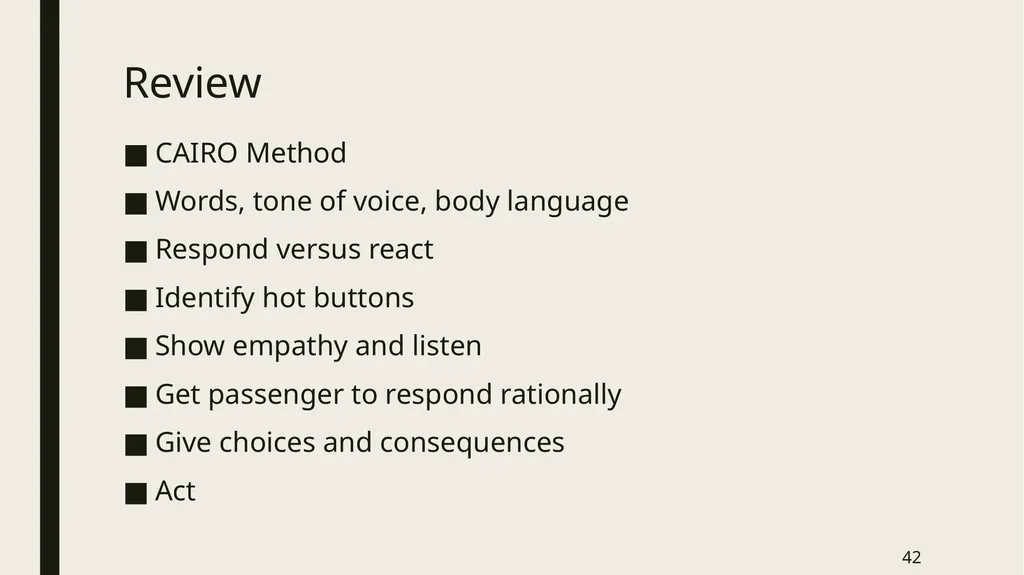
Review CAIRO Method
Words, tone of voice, body language
Respond versus react
Identify hot buttons
Show empathy and listen
Get passenger to respond rationally
Give choices and consequences
Act 42<br>
Words, tone of voice, body language
Respond versus react
Identify hot buttons
Show empathy and listen
Get passenger to respond rationally
Give choices and consequences
Act 42<br>
43
Reality Check “De-escalation” 43<br>
44
Leadership Strategies 44<br>
45
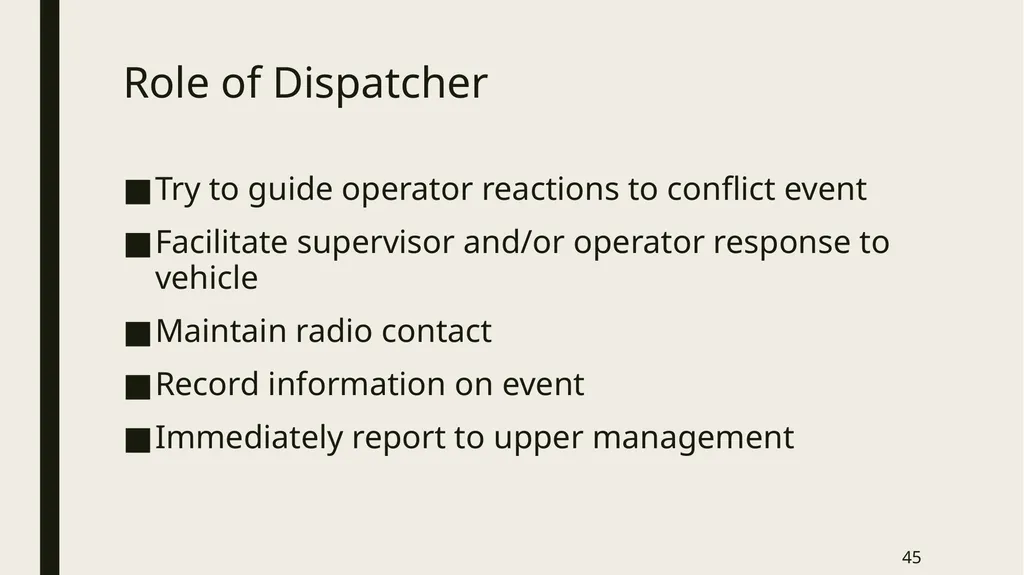
Role of Dispatcher Try to guide operator reactions to conflict event
Facilitate supervisor and/or operator response to vehicle
Maintain radio contact
Record information on event
Immediately report to upper management 45<br>
Facilitate supervisor and/or operator response to vehicle
Maintain radio contact
Record information on event
Immediately report to upper management 45<br>
46
Role of Supervisor Coach operator’s on conflict management and de-escalation skills
When opportunity arises and no passengers are around
Respond to vehicle when requested
Use de-escalation skills
Request law enforcement response, if necessary
Complete follow-up report 46<br>
When opportunity arises and no passengers are around
Respond to vehicle when requested
Use de-escalation skills
Request law enforcement response, if necessary
Complete follow-up report 46<br>
47
Role of Trainer Provide operators new-hire and refresher training and re-training on conflict management and de-escalation skills
During training, rely heavily on role play and case studies 47<br>
During training, rely heavily on role play and case studies 47<br>
48
Relationship with Law Enforcement Work to build on-going relationships
Increase law enforcement visibility at “hot spots”
Provide copies of transit policies, rules, and regulations that could be catalyst for passenger conflict
Conduct “hot wash” – create After-Action Report
Share with law enforcement 48<br>
Increase law enforcement visibility at “hot spots”
Provide copies of transit policies, rules, and regulations that could be catalyst for passenger conflict
Conduct “hot wash” – create After-Action Report
Share with law enforcement 48<br>
49
Policies and Procedures Orient operators, supervisors, dispatchers on policies / procedures that could generate passenger conflict
Periodically review those policies /procedures
Revise as necessary
Update operators, supervisors, dispatchers on revised policies /procedures 49<br>
Periodically review those policies /procedures
Revise as necessary
Update operators, supervisors, dispatchers on revised policies /procedures 49<br>
50
Routes and Schedules When addressing service design challenges
Consider information on:
high risk crime areas
gang activity areas
high risk times of day
day of week
time of year
Attempt to address assault risk through service design
Periodically conduct live evaluations of all routes at all times and days of week 50<br>
Consider information on:
high risk crime areas
gang activity areas
high risk times of day
day of week
time of year
Attempt to address assault risk through service design
Periodically conduct live evaluations of all routes at all times and days of week 50<br>
51
Equipment and Technology Consider driver compartment barriers
Consider vehicles with driver left-side door
Install panic/emergency alert buttons on vehicles
Establish verbal code for operators to use with dispatch to request assistance
Have ability to initiate “open mic” on vehicle video/audio equipment 51<br>
Consider vehicles with driver left-side door
Install panic/emergency alert buttons on vehicles
Establish verbal code for operators to use with dispatch to request assistance
Have ability to initiate “open mic” on vehicle video/audio equipment 51<br>
52
Employee and Customer Reporting Make sure operators report all conflict events
No matter how minor
Publicize request for passengers to report conflict-related activities
For example, “See something, Say Something”
Provide easy channel for passengers to report 52<br>
No matter how minor
Publicize request for passengers to report conflict-related activities
For example, “See something, Say Something”
Provide easy channel for passengers to report 52<br>
53
Guidance and Counseling Ensure availability of counseling services to transit staff who are involved in significant conflict events
Encourage employees to reach out for counseling services 53<br>
Encourage employees to reach out for counseling services 53<br>
54
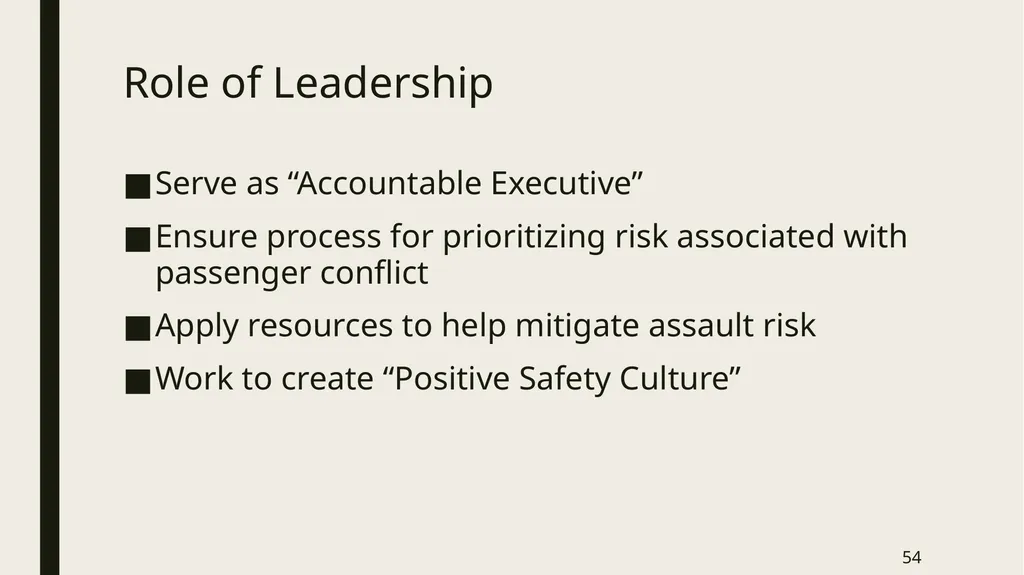
Role of Leadership Serve as “Accountable Executive”
Ensure process for prioritizing risk associated with passenger conflict
Apply resources to help mitigate assault risk
Work to create “Positive Safety Culture” 54<br>
Ensure process for prioritizing risk associated with passenger conflict
Apply resources to help mitigate assault risk
Work to create “Positive Safety Culture” 54<br>
55
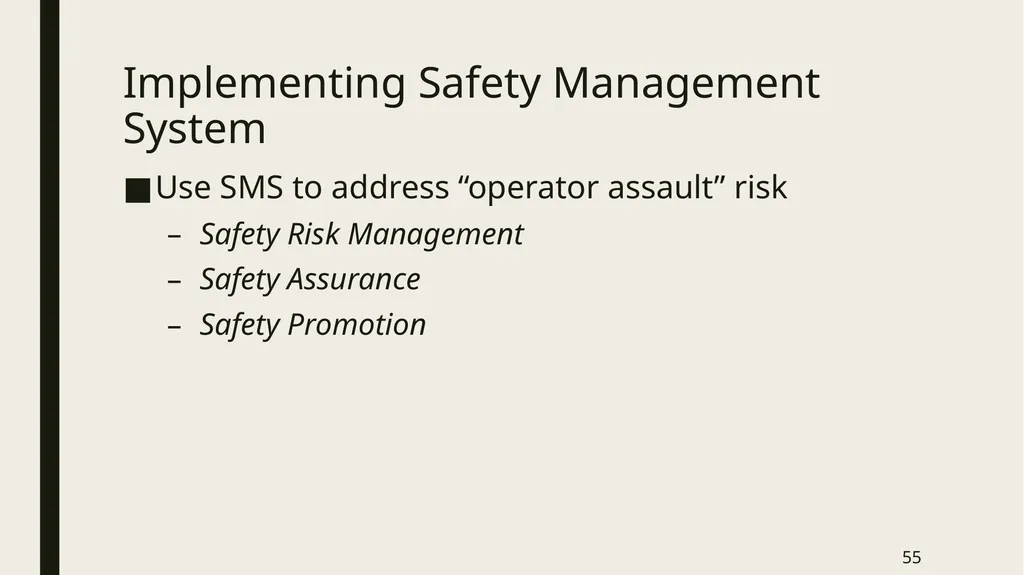
Implementing Safety Management System Use SMS to address “operator assault” risk
Safety Risk Management
Safety Assurance
Safety Promotion 55<br>
Safety Risk Management
Safety Assurance
Safety Promotion 55<br>
56
Reality Check “Leadership” 56<br>
57
Review and Wrap Up 57<br>