
Conflict Resolution Objectives Learn the basics

Description: Conflict Resolution Objectives Learn the basics about conflict Know the skills needed to resolve conflict Understand your natural conflict resolutionmanagement style and when to use other techniques How to work better in teams Goal setting
Related Topics
Download Presentation
"Conflict Resolution Objectives Learn the basics" is the property of its rightful owner. Permission is granted to download and print the materials on this website for personal, non-commercial use only, and to display it on your personal computer provided you do not modify the materials and that you retain all copyright notices contained in the materials. By downloading content from our website, you accept the terms of this agreement.
Presentation Transcript
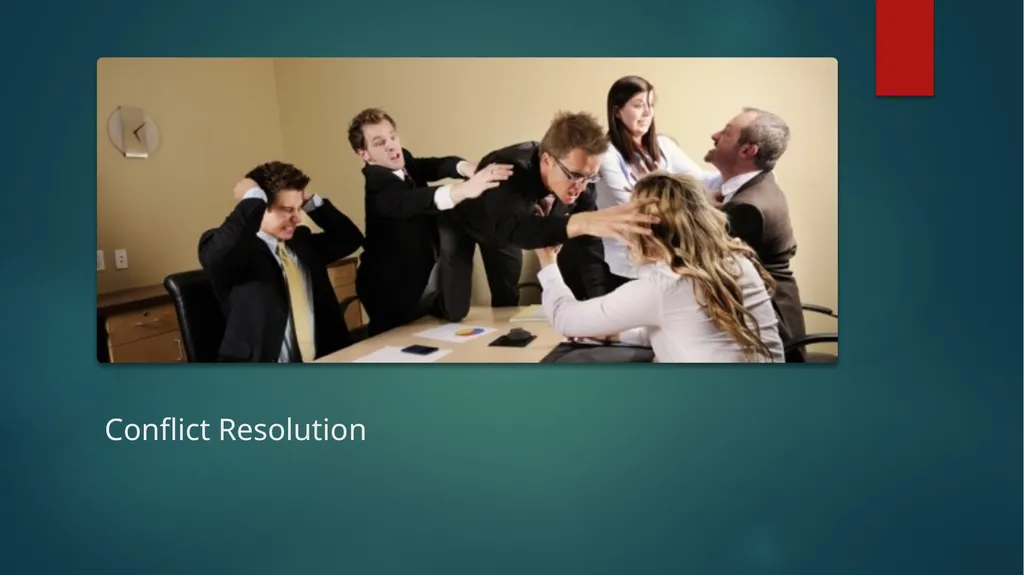
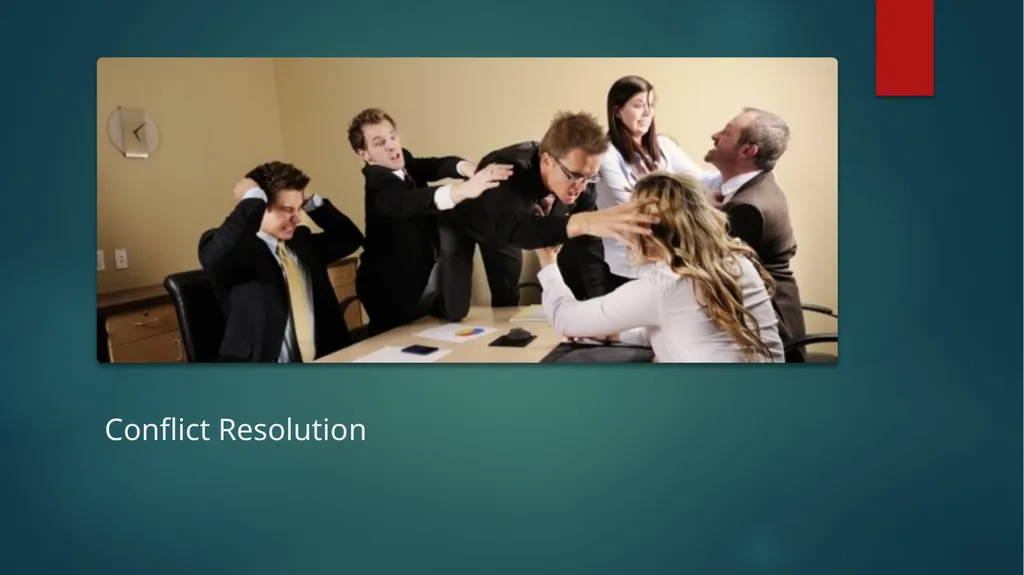
slide1. Conflict Resolution<br>
slide2. Objectives Learn the basics about conflict
Know the skills needed to resolve conflict
Understand your natural conflict resolution/management style and when to use other techniques
How to work better in teams
Goal setting and how this can help conflict from starting
Practice, practice, practice<br>
slide3. What is conflict? Conflict occurs whenever people disagree over their values, motivation, perceptions, idea or desires.
It is a situation in which one or both parties perceive a threat with a disagreement– whether the threat is real or not.
When it is mismanaged, it can cause great harm to a relationship or a team and the team process.<br>
slide4. Facts about Conflict We respond to conflicts based on our perceptions.
1. Our perceptions are influenced by our life experiences, culture, values and beliefs.
Conflicts tend to fester when ignored.
Conflicts trigger strong emotions when we are threatened.
Conflicts are an opportunity for growth and great outcomes.
How we think of conflict itself can influence how we respond.<br>
slide5. Conflict in the human service field Most people are in human services for a reason:
To help other people
To make other’s lives better
To help people feel better about themselves
To help a loved one
To be valued and respected for the work we do
For the relationships we build; friendships
The benefits
Others?<br>
slide6. Conflict in the Human Service Field So what can happen when people don’t agree with each other? What are some unhealthy responses to conflict?
Communication breakdown
Blame other people for problems
Take things personally
Feelings: disrespected, not taken seriously, unsafe, fearful, hurt, angry, avoidance
Fight or flight<br>
slide7. Resolving Conflict A Healthy approach to positive outcomes<br>
slide8. What is conflict Resolution? Effectively handling conflict to promote positive goals, better relationships, and positive work environments
Key steps to handling conflict:
Perception: Most people are good and want to do good
The capacity to recognize and respond to the things that matter to the other person.
Ability to regulate your own emotions
Calm, non-defensive and respectful reactions
The ability to seek compromise and avoid punishment.
A belief that facing the conflict is, most often, the best thing.
Active listening and communication.
The ability to forgive and forget and to move past the conflict without holding resentments and anger. Continuing to work on teams.<br>
slide9. Skills needed to resolve conflict: Quick stress relief!
Being able to manage and relieve stress in the moment is the key to staying balanced, focused and in control of yourself.
If you don’t know how to stay centered and in control of yourself, you will become overwhelmed in conflict situations and unable to respond effectively.
Be professional
Use critical thinking skills
Be a problem solver
Use good communication skills<br>
slide10. Stress reductions allows for: The ability to accurately read another person’s non verbal communication
Hear what someone is really saying
Be aware of your own feelings
Be in touch with your own needs – Emotional awareness
Communicate your points clearly<br>
slide11. Emotional Awareness When you manage your own stress level, you can control your emotions and your behavior.
You can communicate your needs without threatening or frightening others.
Pay attention to the feelings being expressed as well as the words of others. Non verbal communication.
Be aware of and respectful of differences.<br>
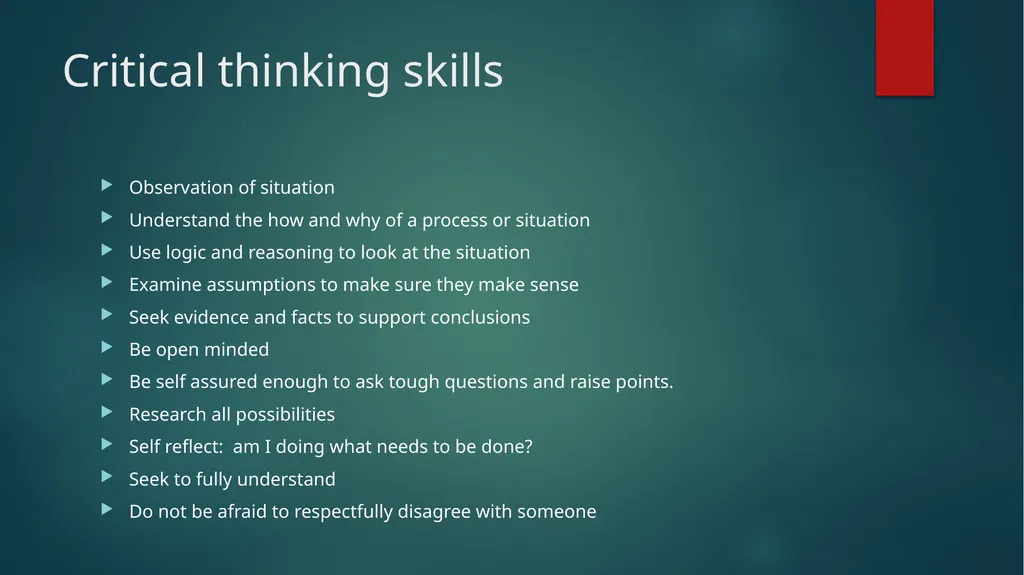
slide12. Critical thinking skills Observation of situation
Understand the how and why of a process or situation
Use logic and reasoning to look at the situation
Examine assumptions to make sure they make sense
Seek evidence and facts to support conclusions
Be open minded
Be self assured enough to ask tough questions and raise points.
Research all possibilities
Self reflect: am I doing what needs to be done?
Seek to fully understand
Do not be afraid to respectfully disagree with someone<br>
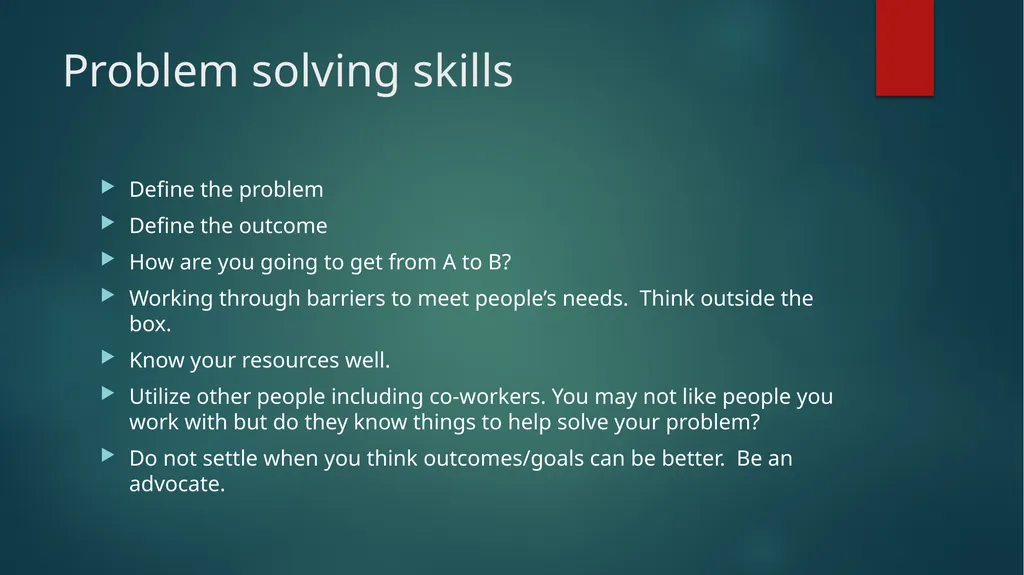
slide13. Problem solving skills Define the problem
Define the outcome
How are you going to get from A to B?
Working through barriers to meet people’s needs. Think outside the box.
Know your resources well.
Utilize other people including co-workers. You may not like people you work with but do they know things to help solve your problem?
Do not settle when you think outcomes/goals can be better. Be an advocate.<br>
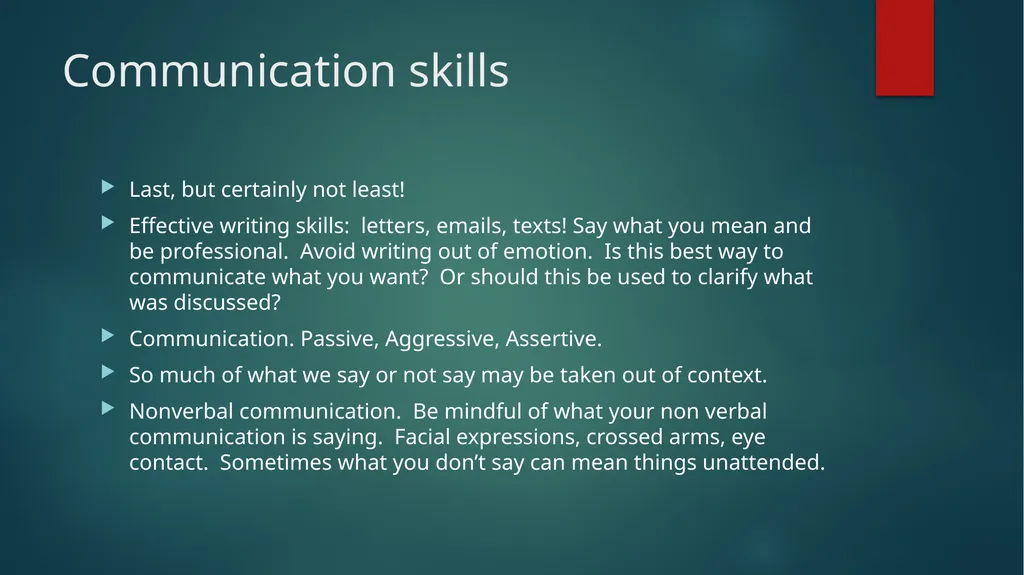
slide14. Communication skills Last, but certainly not least!
Effective writing skills: letters, emails, texts! Say what you mean and be professional. Avoid writing out of emotion. Is this best way to communicate what you want? Or should this be used to clarify what was discussed?
Communication. Passive, Aggressive, Assertive.
So much of what we say or not say may be taken out of context.
Nonverbal communication. Be mindful of what your non verbal communication is saying. Facial expressions, crossed arms, eye contact. Sometimes what you don’t say can mean things unattended.<br>
slide15. Handling conflict What type are you?
Worksheet<br>
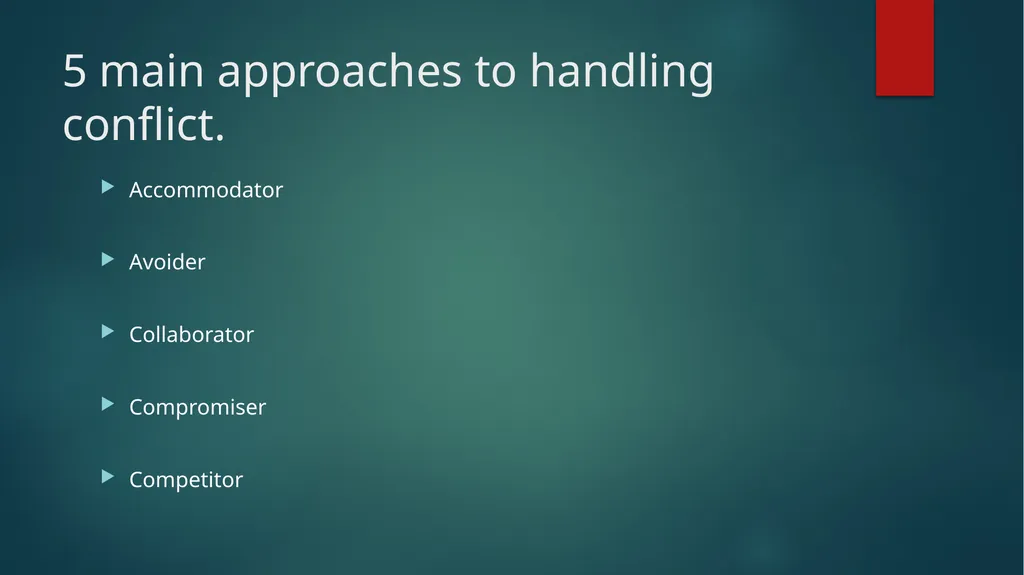
slide16. 5 main approaches to handling conflict. Accommodator
Avoider
Collaborator
Compromiser
Competitor<br>
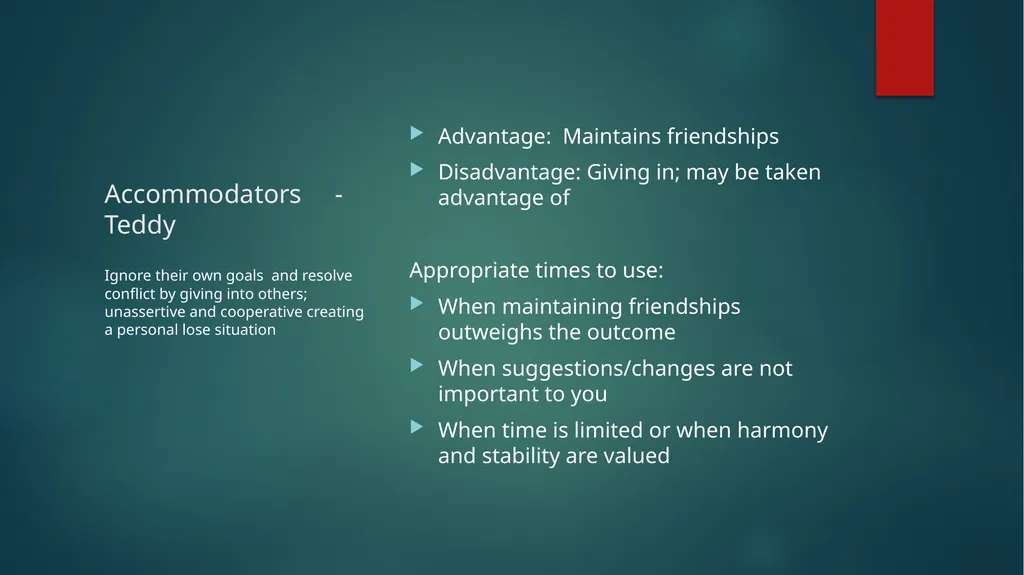
slide17. Accommodators - Teddy Advantage: Maintains friendships
Disadvantage: Giving in; may be taken advantage of
Appropriate times to use:
When maintaining friendships outweighs the outcome
When suggestions/changes are not important to you
When time is limited or when harmony and stability are valued Ignore their own goals and resolve conflict by giving into others; unassertive and cooperative creating a personal lose situation<br>
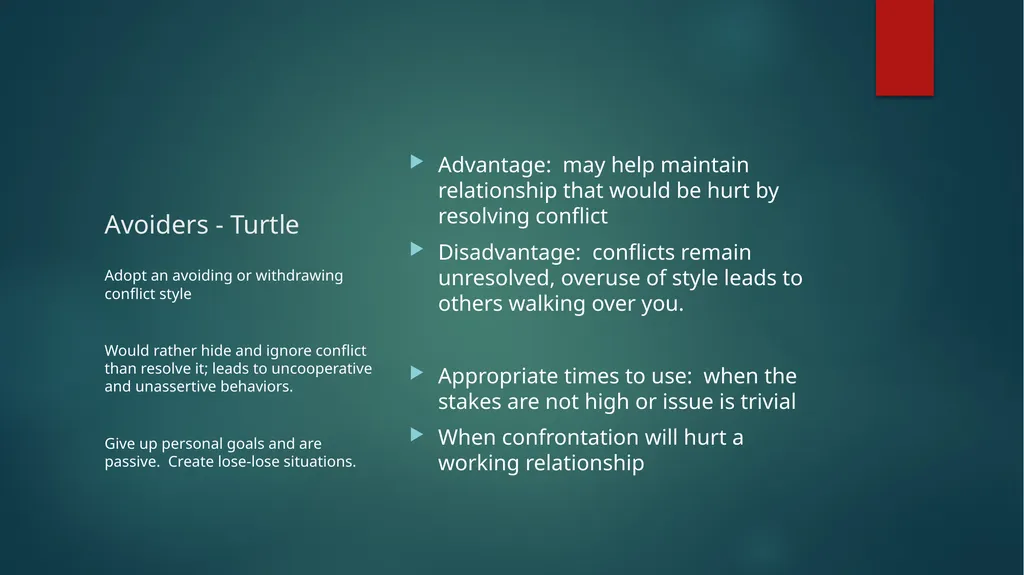
slide18. Avoiders - Turtle Advantage: may help maintain relationship that would be hurt by resolving conflict
Disadvantage: conflicts remain unresolved, overuse of style leads to others walking over you.
Appropriate times to use: when the stakes are not high or issue is trivial
When confrontation will hurt a working relationship Adopt an avoiding or withdrawing conflict style
Would rather hide and ignore conflict than resolve it; leads to uncooperative and unassertive behaviors.
Give up personal goals and are passive. Create lose-lose situations.<br>
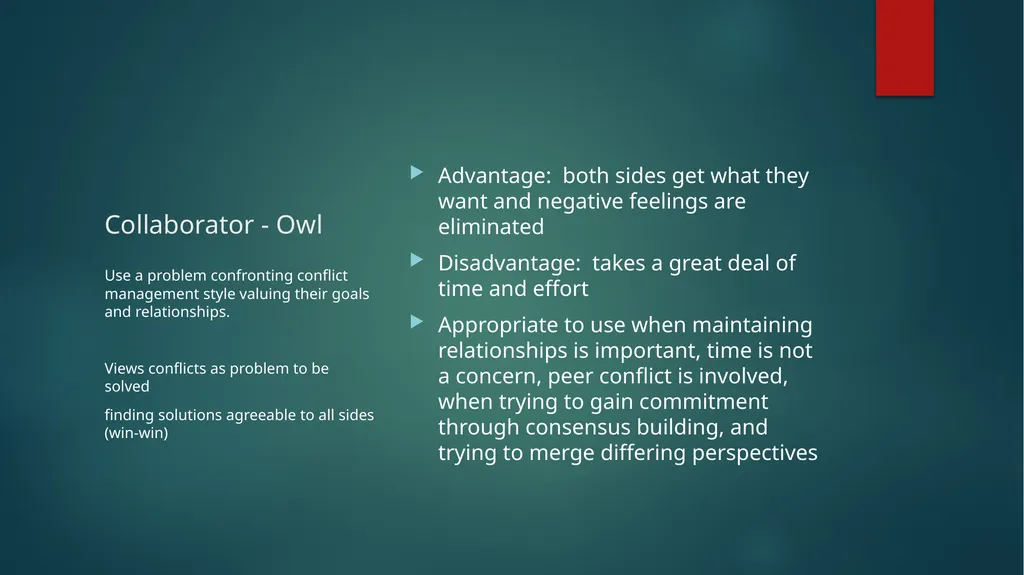
slide19. Collaborator - Owl Advantage: both sides get what they want and negative feelings are eliminated
Disadvantage: takes a great deal of time and effort
Appropriate to use when maintaining relationships is important, time is not a concern, peer conflict is involved, when trying to gain commitment through consensus building, and trying to merge differing perspectives Use a problem confronting conflict management style valuing their goals and relationships.
Views conflicts as problem to be solved
finding solutions agreeable to all sides (win-win)<br>
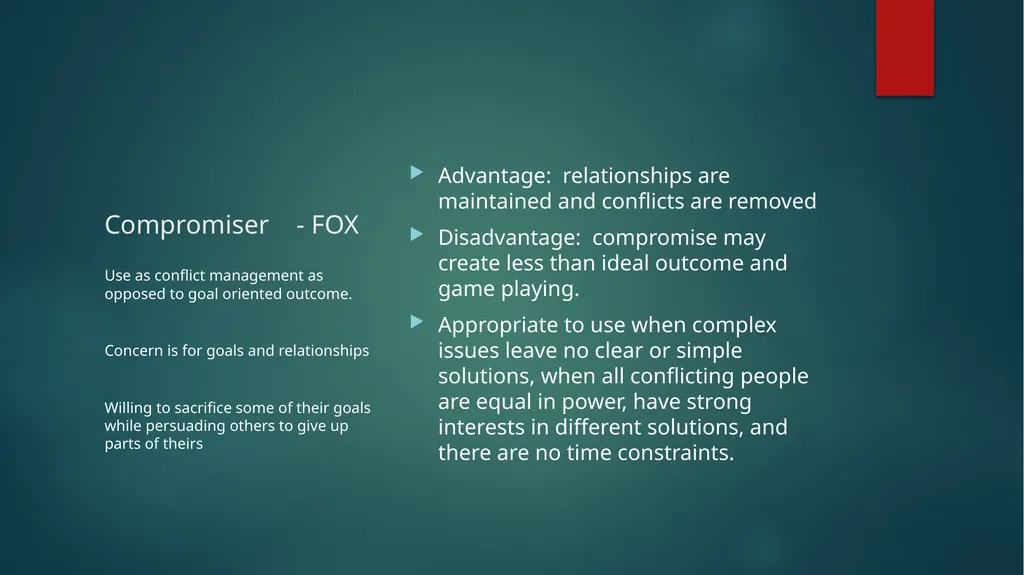
slide20. Compromiser - FOX Advantage: relationships are maintained and conflicts are removed
Disadvantage: compromise may create less than ideal outcome and game playing.
Appropriate to use when complex issues leave no clear or simple solutions, when all conflicting people are equal in power, have strong interests in different solutions, and there are no time constraints. Use as conflict management as opposed to goal oriented outcome.
Concern is for goals and relationships
Willing to sacrifice some of their goals while persuading others to give up parts of theirs<br>
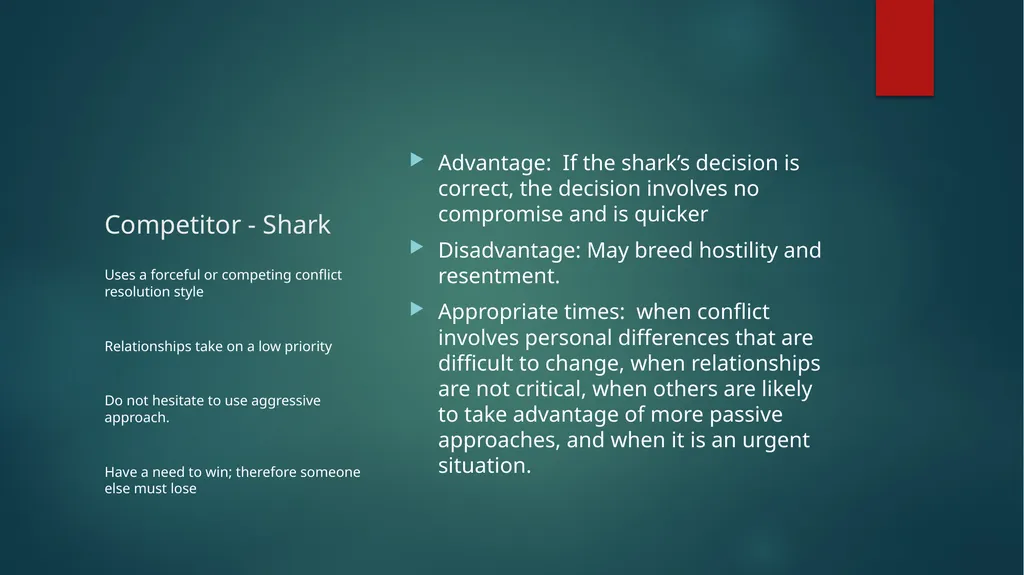
slide21. Competitor - Shark Advantage: If the shark’s decision is correct, the decision involves no compromise and is quicker
Disadvantage: May breed hostility and resentment.
Appropriate times: when conflict involves personal differences that are difficult to change, when relationships are not critical, when others are likely to take advantage of more passive approaches, and when it is an urgent situation. Uses a forceful or competing conflict resolution style
Relationships take on a low priority
Do not hesitate to use aggressive approach.
Have a need to win; therefore someone else must lose<br>
slide22. Facilitation Working better in teams<br>
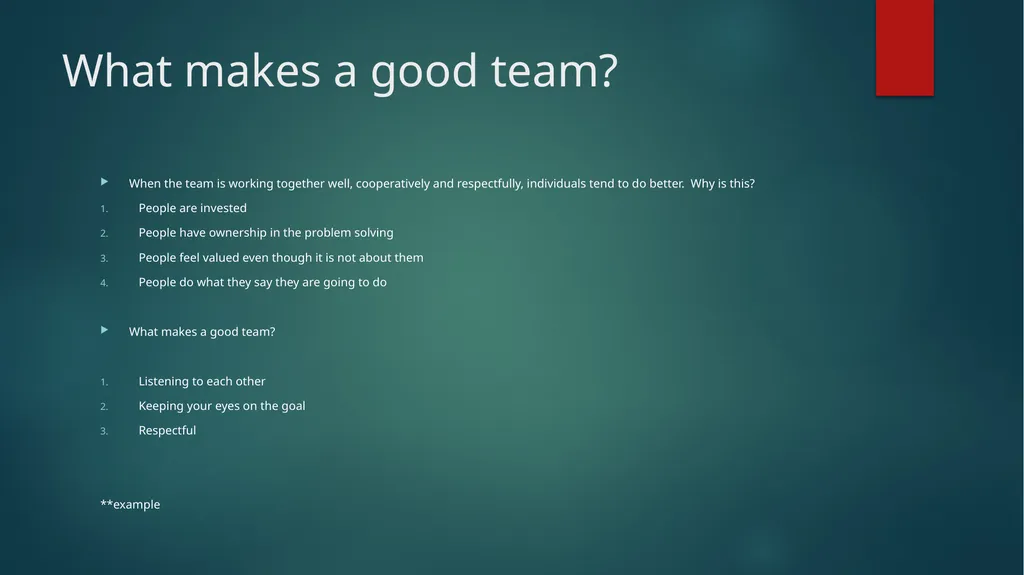
slide23. What makes a good team? When the team is working together well, cooperatively and respectfully, individuals tend to do better. Why is this?
People are invested
People have ownership in the problem solving
People feel valued even though it is not about them
People do what they say they are going to do
What makes a good team?
Listening to each other
Keeping your eyes on the goal
Respectful
**example<br>
slide24. Freedoms Freedom to be known in the relationship
Freedom to be heard
Freedom to dream and to voice those ideas
Freedom to choose to contribute
Freedom to act with support
Freedom to be positive<br>
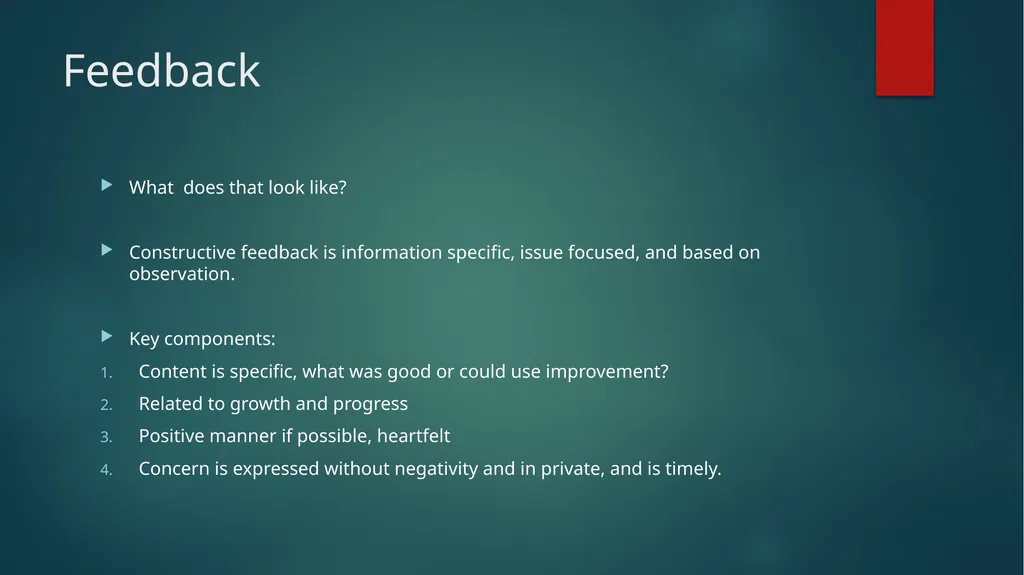
slide25. Feedback What does that look like?
Constructive feedback is information specific, issue focused, and based on observation.
Key components:
Content is specific, what was good or could use improvement?
Related to growth and progress
Positive manner if possible, heartfelt
Concern is expressed without negativity and in private, and is timely.<br>
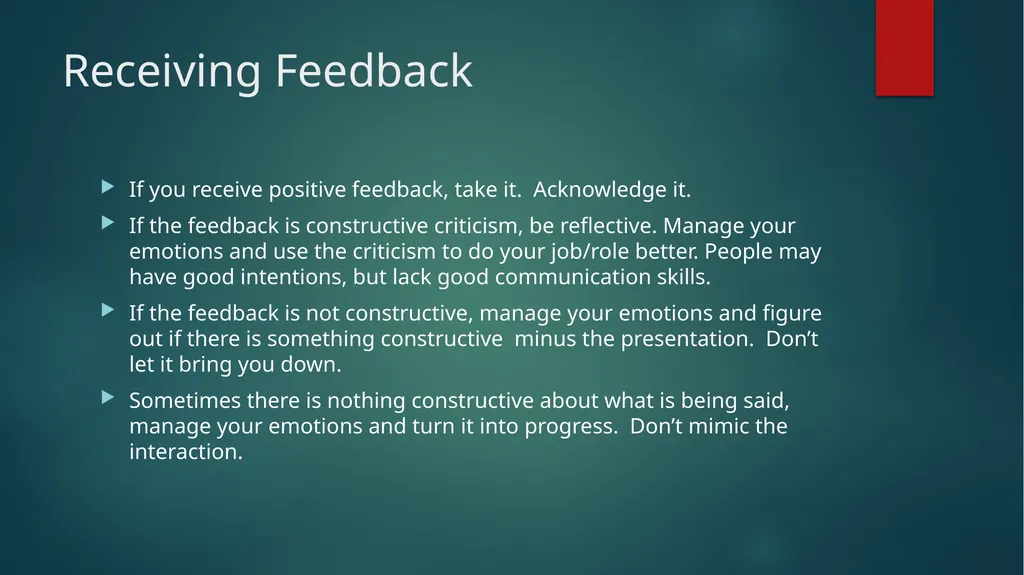
slide26. Receiving Feedback If you receive positive feedback, take it. Acknowledge it.
If the feedback is constructive criticism, be reflective. Manage your emotions and use the criticism to do your job/role better. People may have good intentions, but lack good communication skills.
If the feedback is not constructive, manage your emotions and figure out if there is something constructive minus the presentation. Don’t let it bring you down.
Sometimes there is nothing constructive about what is being said, manage your emotions and turn it into progress. Don’t mimic the interaction.<br>
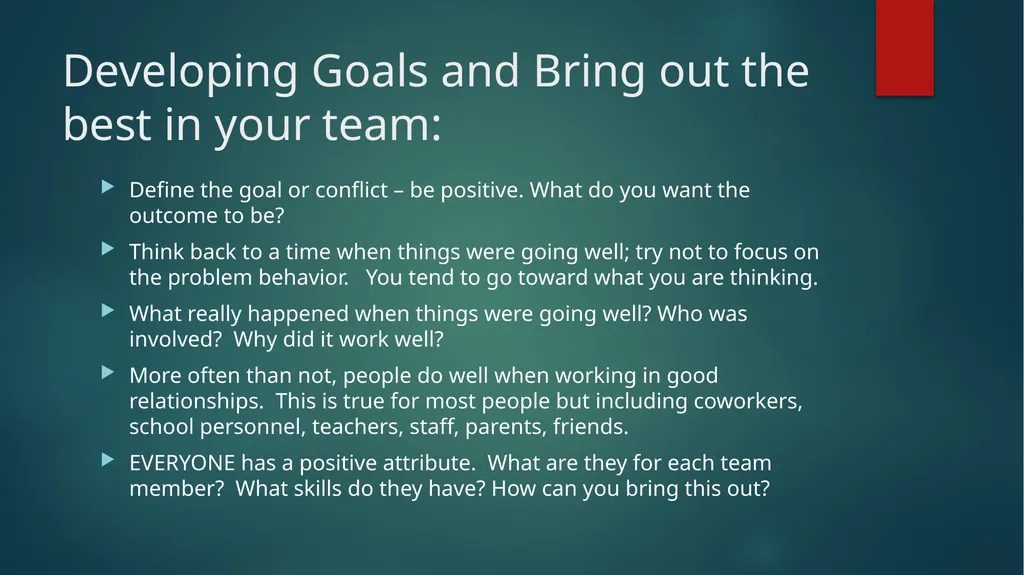
slide27. Developing Goals and Bring out the best in your team: Define the goal or conflict – be positive. What do you want the outcome to be?
Think back to a time when things were going well; try not to focus on the problem behavior. You tend to go toward what you are thinking.
What really happened when things were going well? Who was involved? Why did it work well?
More often than not, people do well when working in good relationships. This is true for most people but including coworkers, school personnel, teachers, staff, parents, friends.
EVERYONE has a positive attribute. What are they for each team member? What skills do they have? How can you bring this out?<br>
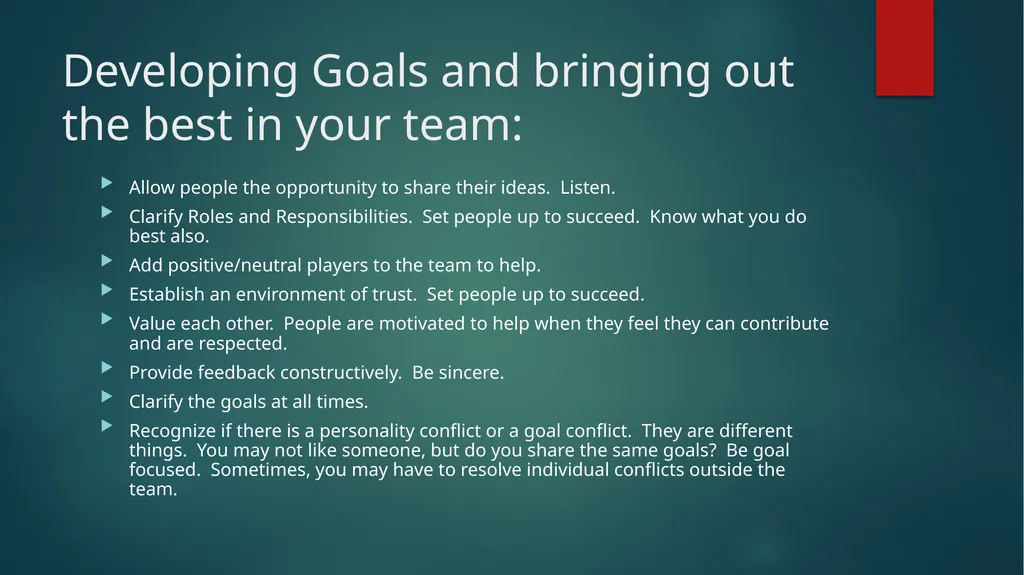
slide28. Developing Goals and bringing out the best in your team: Allow people the opportunity to share their ideas. Listen.
Clarify Roles and Responsibilities. Set people up to succeed. Know what you do best also.
Add positive/neutral players to the team to help.
Establish an environment of trust. Set people up to succeed.
Value each other. People are motivated to help when they feel they can contribute and are respected.
Provide feedback constructively. Be sincere.
Clarify the goals at all times.
Recognize if there is a personality conflict or a goal conflict. They are different things. You may not like someone, but do you share the same goals? Be goal focused. Sometimes, you may have to resolve individual conflicts outside the team.<br>
slide29. Help! I need help! Brainstorming<br>
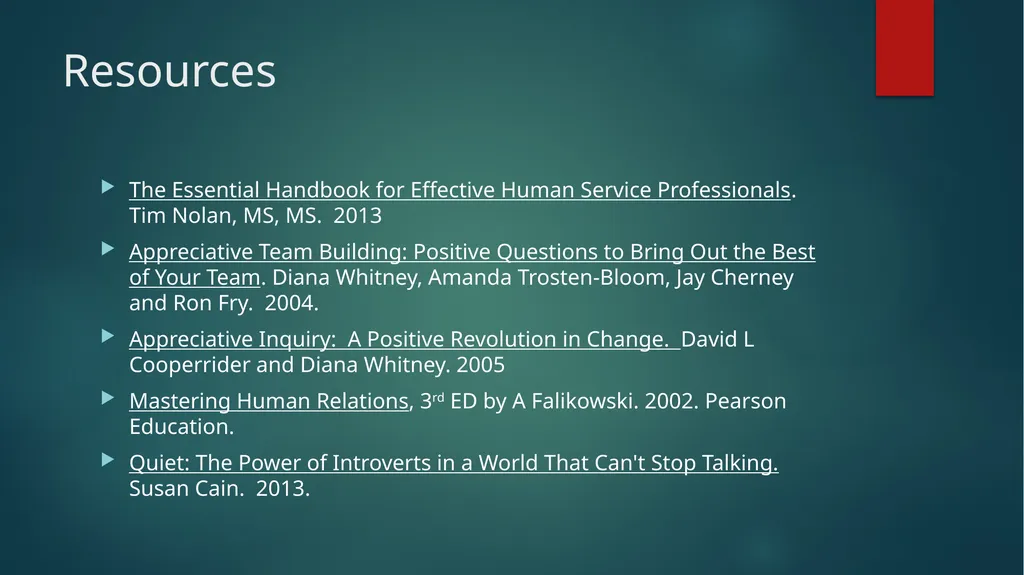
slide30. Resources The Essential Handbook for Effective Human Service Professionals. Tim Nolan, MS, MS. 2013
Appreciative Team Building: Positive Questions to Bring Out the Best of Your Team. Diana Whitney, Amanda Trosten-Bloom, Jay Cherney and Ron Fry. 2004.
Appreciative Inquiry: A Positive Revolution in Change. David L Cooperrider and Diana Whitney. 2005
Mastering Human Relations, 3rd ED by A Falikowski. 2002. Pearson Education.
Quiet: The Power of Introverts in a World That Can't Stop Talking. Susan Cain. 2013.<br>
slide2. Objectives Learn the basics about conflict
Know the skills needed to resolve conflict
Understand your natural conflict resolution/management style and when to use other techniques
How to work better in teams
Goal setting and how this can help conflict from starting
Practice, practice, practice<br>
slide3. What is conflict? Conflict occurs whenever people disagree over their values, motivation, perceptions, idea or desires.
It is a situation in which one or both parties perceive a threat with a disagreement– whether the threat is real or not.
When it is mismanaged, it can cause great harm to a relationship or a team and the team process.<br>
slide4. Facts about Conflict We respond to conflicts based on our perceptions.
1. Our perceptions are influenced by our life experiences, culture, values and beliefs.
Conflicts tend to fester when ignored.
Conflicts trigger strong emotions when we are threatened.
Conflicts are an opportunity for growth and great outcomes.
How we think of conflict itself can influence how we respond.<br>
slide5. Conflict in the human service field Most people are in human services for a reason:
To help other people
To make other’s lives better
To help people feel better about themselves
To help a loved one
To be valued and respected for the work we do
For the relationships we build; friendships
The benefits
Others?<br>
slide6. Conflict in the Human Service Field So what can happen when people don’t agree with each other? What are some unhealthy responses to conflict?
Communication breakdown
Blame other people for problems
Take things personally
Feelings: disrespected, not taken seriously, unsafe, fearful, hurt, angry, avoidance
Fight or flight<br>
slide7. Resolving Conflict A Healthy approach to positive outcomes<br>
slide8. What is conflict Resolution? Effectively handling conflict to promote positive goals, better relationships, and positive work environments
Key steps to handling conflict:
Perception: Most people are good and want to do good
The capacity to recognize and respond to the things that matter to the other person.
Ability to regulate your own emotions
Calm, non-defensive and respectful reactions
The ability to seek compromise and avoid punishment.
A belief that facing the conflict is, most often, the best thing.
Active listening and communication.
The ability to forgive and forget and to move past the conflict without holding resentments and anger. Continuing to work on teams.<br>
slide9. Skills needed to resolve conflict: Quick stress relief!
Being able to manage and relieve stress in the moment is the key to staying balanced, focused and in control of yourself.
If you don’t know how to stay centered and in control of yourself, you will become overwhelmed in conflict situations and unable to respond effectively.
Be professional
Use critical thinking skills
Be a problem solver
Use good communication skills<br>
slide10. Stress reductions allows for: The ability to accurately read another person’s non verbal communication
Hear what someone is really saying
Be aware of your own feelings
Be in touch with your own needs – Emotional awareness
Communicate your points clearly<br>
slide11. Emotional Awareness When you manage your own stress level, you can control your emotions and your behavior.
You can communicate your needs without threatening or frightening others.
Pay attention to the feelings being expressed as well as the words of others. Non verbal communication.
Be aware of and respectful of differences.<br>
slide12. Critical thinking skills Observation of situation
Understand the how and why of a process or situation
Use logic and reasoning to look at the situation
Examine assumptions to make sure they make sense
Seek evidence and facts to support conclusions
Be open minded
Be self assured enough to ask tough questions and raise points.
Research all possibilities
Self reflect: am I doing what needs to be done?
Seek to fully understand
Do not be afraid to respectfully disagree with someone<br>
slide13. Problem solving skills Define the problem
Define the outcome
How are you going to get from A to B?
Working through barriers to meet people’s needs. Think outside the box.
Know your resources well.
Utilize other people including co-workers. You may not like people you work with but do they know things to help solve your problem?
Do not settle when you think outcomes/goals can be better. Be an advocate.<br>
slide14. Communication skills Last, but certainly not least!
Effective writing skills: letters, emails, texts! Say what you mean and be professional. Avoid writing out of emotion. Is this best way to communicate what you want? Or should this be used to clarify what was discussed?
Communication. Passive, Aggressive, Assertive.
So much of what we say or not say may be taken out of context.
Nonverbal communication. Be mindful of what your non verbal communication is saying. Facial expressions, crossed arms, eye contact. Sometimes what you don’t say can mean things unattended.<br>
slide15. Handling conflict What type are you?
Worksheet<br>
slide16. 5 main approaches to handling conflict. Accommodator
Avoider
Collaborator
Compromiser
Competitor<br>
slide17. Accommodators - Teddy Advantage: Maintains friendships
Disadvantage: Giving in; may be taken advantage of
Appropriate times to use:
When maintaining friendships outweighs the outcome
When suggestions/changes are not important to you
When time is limited or when harmony and stability are valued Ignore their own goals and resolve conflict by giving into others; unassertive and cooperative creating a personal lose situation<br>
slide18. Avoiders - Turtle Advantage: may help maintain relationship that would be hurt by resolving conflict
Disadvantage: conflicts remain unresolved, overuse of style leads to others walking over you.
Appropriate times to use: when the stakes are not high or issue is trivial
When confrontation will hurt a working relationship Adopt an avoiding or withdrawing conflict style
Would rather hide and ignore conflict than resolve it; leads to uncooperative and unassertive behaviors.
Give up personal goals and are passive. Create lose-lose situations.<br>
slide19. Collaborator - Owl Advantage: both sides get what they want and negative feelings are eliminated
Disadvantage: takes a great deal of time and effort
Appropriate to use when maintaining relationships is important, time is not a concern, peer conflict is involved, when trying to gain commitment through consensus building, and trying to merge differing perspectives Use a problem confronting conflict management style valuing their goals and relationships.
Views conflicts as problem to be solved
finding solutions agreeable to all sides (win-win)<br>
slide20. Compromiser - FOX Advantage: relationships are maintained and conflicts are removed
Disadvantage: compromise may create less than ideal outcome and game playing.
Appropriate to use when complex issues leave no clear or simple solutions, when all conflicting people are equal in power, have strong interests in different solutions, and there are no time constraints. Use as conflict management as opposed to goal oriented outcome.
Concern is for goals and relationships
Willing to sacrifice some of their goals while persuading others to give up parts of theirs<br>
slide21. Competitor - Shark Advantage: If the shark’s decision is correct, the decision involves no compromise and is quicker
Disadvantage: May breed hostility and resentment.
Appropriate times: when conflict involves personal differences that are difficult to change, when relationships are not critical, when others are likely to take advantage of more passive approaches, and when it is an urgent situation. Uses a forceful or competing conflict resolution style
Relationships take on a low priority
Do not hesitate to use aggressive approach.
Have a need to win; therefore someone else must lose<br>
slide22. Facilitation Working better in teams<br>
slide23. What makes a good team? When the team is working together well, cooperatively and respectfully, individuals tend to do better. Why is this?
People are invested
People have ownership in the problem solving
People feel valued even though it is not about them
People do what they say they are going to do
What makes a good team?
Listening to each other
Keeping your eyes on the goal
Respectful
**example<br>
slide24. Freedoms Freedom to be known in the relationship
Freedom to be heard
Freedom to dream and to voice those ideas
Freedom to choose to contribute
Freedom to act with support
Freedom to be positive<br>
slide25. Feedback What does that look like?
Constructive feedback is information specific, issue focused, and based on observation.
Key components:
Content is specific, what was good or could use improvement?
Related to growth and progress
Positive manner if possible, heartfelt
Concern is expressed without negativity and in private, and is timely.<br>
slide26. Receiving Feedback If you receive positive feedback, take it. Acknowledge it.
If the feedback is constructive criticism, be reflective. Manage your emotions and use the criticism to do your job/role better. People may have good intentions, but lack good communication skills.
If the feedback is not constructive, manage your emotions and figure out if there is something constructive minus the presentation. Don’t let it bring you down.
Sometimes there is nothing constructive about what is being said, manage your emotions and turn it into progress. Don’t mimic the interaction.<br>
slide27. Developing Goals and Bring out the best in your team: Define the goal or conflict – be positive. What do you want the outcome to be?
Think back to a time when things were going well; try not to focus on the problem behavior. You tend to go toward what you are thinking.
What really happened when things were going well? Who was involved? Why did it work well?
More often than not, people do well when working in good relationships. This is true for most people but including coworkers, school personnel, teachers, staff, parents, friends.
EVERYONE has a positive attribute. What are they for each team member? What skills do they have? How can you bring this out?<br>
slide28. Developing Goals and bringing out the best in your team: Allow people the opportunity to share their ideas. Listen.
Clarify Roles and Responsibilities. Set people up to succeed. Know what you do best also.
Add positive/neutral players to the team to help.
Establish an environment of trust. Set people up to succeed.
Value each other. People are motivated to help when they feel they can contribute and are respected.
Provide feedback constructively. Be sincere.
Clarify the goals at all times.
Recognize if there is a personality conflict or a goal conflict. They are different things. You may not like someone, but do you share the same goals? Be goal focused. Sometimes, you may have to resolve individual conflicts outside the team.<br>
slide29. Help! I need help! Brainstorming<br>
slide30. Resources The Essential Handbook for Effective Human Service Professionals. Tim Nolan, MS, MS. 2013
Appreciative Team Building: Positive Questions to Bring Out the Best of Your Team. Diana Whitney, Amanda Trosten-Bloom, Jay Cherney and Ron Fry. 2004.
Appreciative Inquiry: A Positive Revolution in Change. David L Cooperrider and Diana Whitney. 2005
Mastering Human Relations, 3rd ED by A Falikowski. 2002. Pearson Education.
Quiet: The Power of Introverts in a World That Can't Stop Talking. Susan Cain. 2013.<br>