Costumer loyalty The loyalty business model The loyalty business model is a business model used in strategic management in which company resources are employed so as to increase the loyalty of customers and other stakeholders in the
"Costumer loyalty The loyalty business model The" is the property of its rightful owner. Permission is granted to
download and print the materials on this website for personal, non-commercial use only, and to display it
on your personal computer provided you do not modify the materials and that you retain all copyright
notices contained in the materials. By downloading content from our website, you accept the terms of this
agreement.
Presentation Transcript
01
Costumer loyalty<br>
02
The loyalty business model The loyalty business model is a business model used in strategic management in which company resources are employed so as to increase the loyalty of customers and other stakeholders in the expectation that corporate objectives will be met or surpassed. A typical example of this type of model is: quality of product or service leads to customer satisfaction, which leads to customer loyalty, which leads to profitability.<br>
03
A model by Kaj Storbacka, Tore Strandvik, and Christian Grönroos (1994), the service quality model, is more detailed than the basic loyalty business model but arrives at the same conclusion.
In it, customer satisfaction is first based on a recent experience of the product or service.
If the recent experience exceeds prior expectations, customer satisfaction is likely to be high.
Likewise, a customer can be dissatisfied with the service encounter and still perceive the overall quality to be good.<br>
04
This model then looks at the strength of the business relationship;.
Customers are said to have a "zone of tolerance" corresponding to a range of service quality between "barely adequate" and "exceptional
The existence of these bonds acts as an exit barrier. There are several types of bonds, including: legal bonds (contracts), technological bonds (shared technology), economic bonds (dependence), knowledge bonds, social bonds, cultural or ethnic bonds, ideological bonds, psychological bonds, geographical bonds, time bonds, and planning bonds.<br>
05
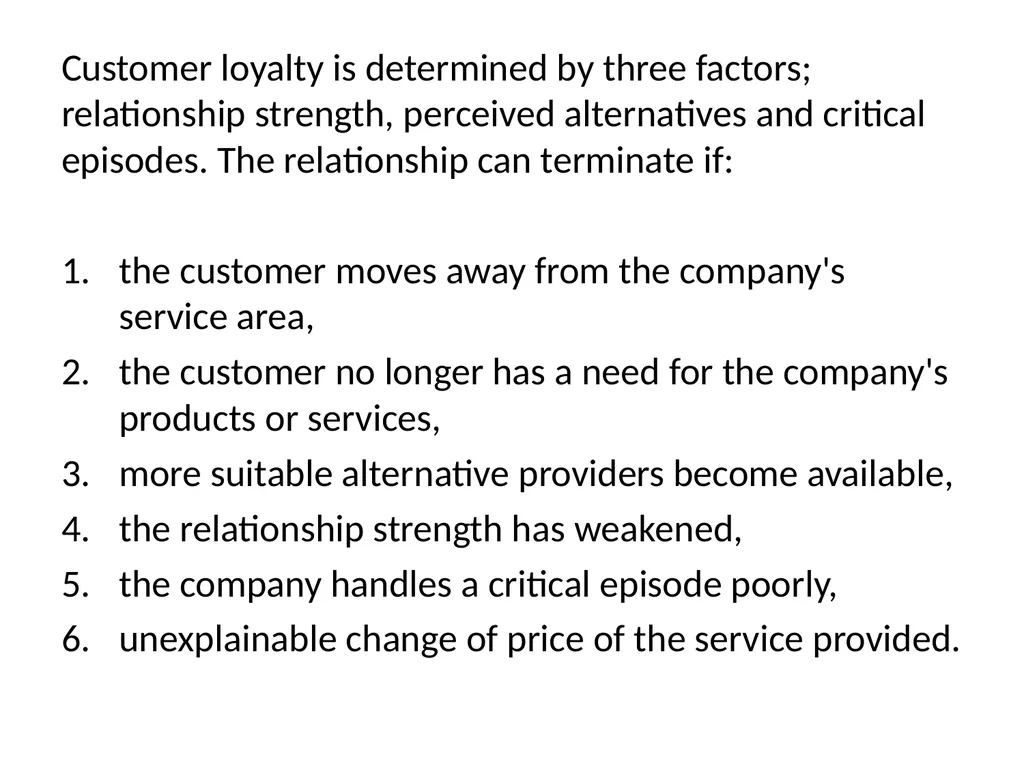
Customer loyalty is determined by three factors; relationship strength, perceived alternatives and critical episodes. The relationship can terminate if:
the customer moves away from the company's service area,
the customer no longer has a need for the company's products or services,
more suitable alternative providers become available,
the relationship strength has weakened,
the company handles a critical episode poorly,
unexplainable change of price of the service provided.<br>
06
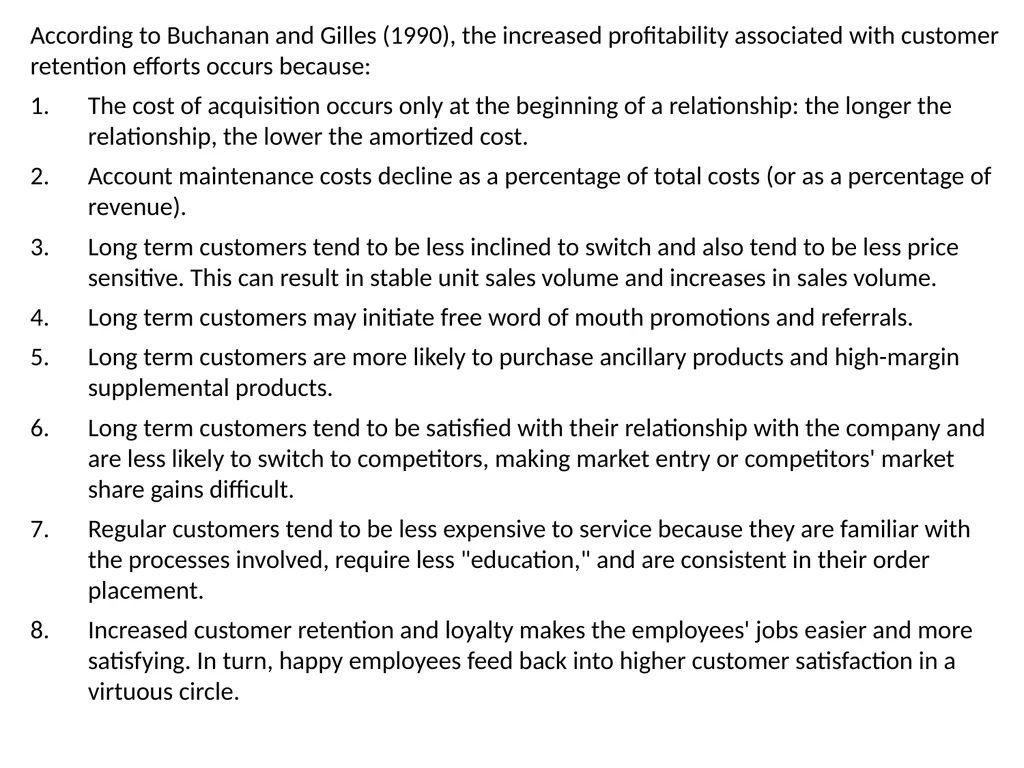
According to Buchanan and Gilles (1990), the increased profitability associated with customer retention efforts occurs because:
The cost of acquisition occurs only at the beginning of a relationship: the longer the relationship, the lower the amortized cost.
Account maintenance costs decline as a percentage of total costs (or as a percentage of revenue).
Long term customers tend to be less inclined to switch and also tend to be less price sensitive. This can result in stable unit sales volume and increases in sales volume.
Long term customers may initiate free word of mouth promotions and referrals.
Long term customers are more likely to purchase ancillary products and high-margin supplemental products.
Long term customers tend to be satisfied with their relationship with the company and are less likely to switch to competitors, making market entry or competitors' market share gains difficult.
Regular customers tend to be less expensive to service because they are familiar with the processes involved, require less "education," and are consistent in their order placement.
Increased customer retention and loyalty makes the employees' jobs easier and more satisfying. In turn, happy employees feed back into higher customer satisfaction in a virtuous circle.<br>
07
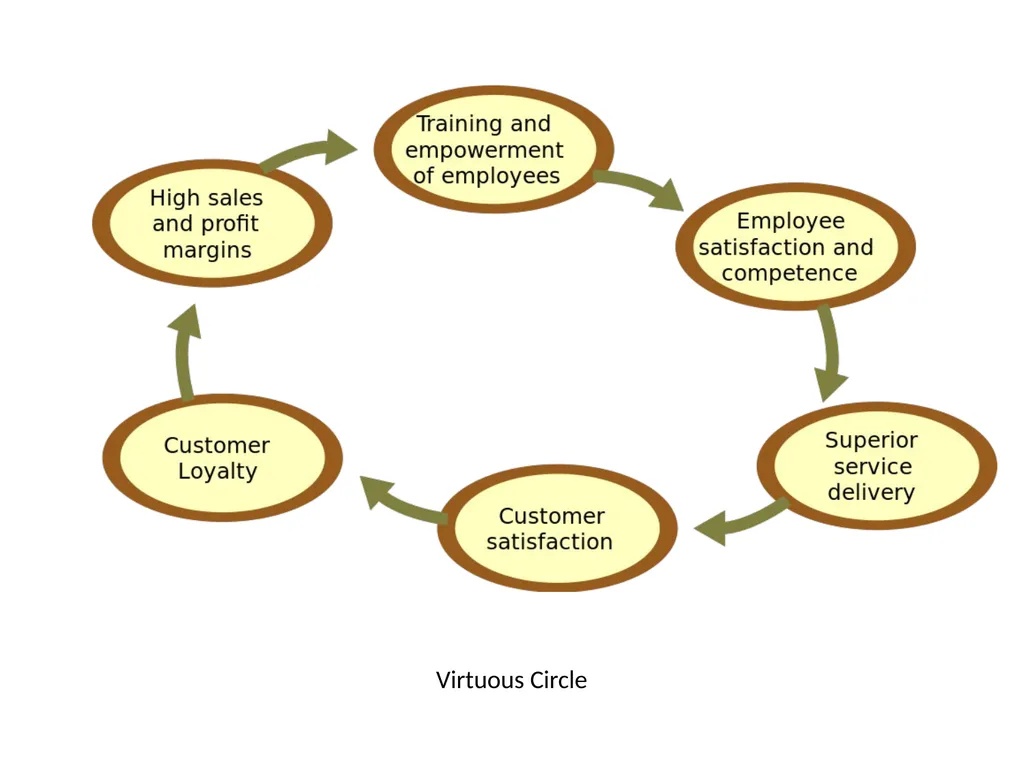
Schlesinger and Heskett (1991) added employee loyalty to the basic customer loyalty model. They developed the concepts of "cycle of success" and "cycle of failure". In the cycle of success, an investment in your employees’ ability to provide superior service to customers can be seen as a "virtuous circle".
Effort spent in selecting and training employees and creating a corporate culture in which they are empowered can lead to increased employee satisfaction and employee competence. This will likely result in superior service delivery and customer satisfaction.
This in turn can create customer loyalty, improved sales levels, and higher profit margins. Some of these profits can be reinvested in employee development thereby initiating another iteration of a virtuous cycle. Virtuous Circle<br>
08
Virtuous Circle<br>
09
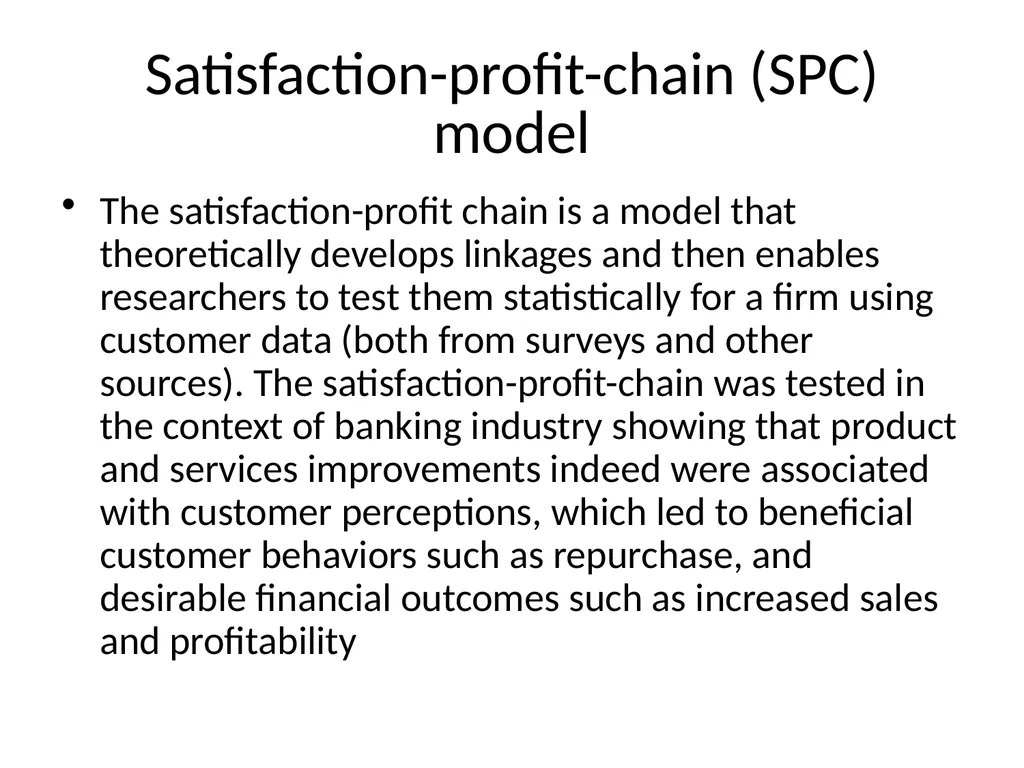
Satisfaction-profit-chain (SPC) model The satisfaction-profit chain is a model that theoretically develops linkages and then enables researchers to test them statistically for a firm using customer data (both from surveys and other sources). The satisfaction-profit-chain was tested in the context of banking industry showing that product and services improvements indeed were associated with customer perceptions, which led to beneficial customer behaviors such as repurchase, and desirable financial outcomes such as increased sales and profitability<br>
10
Though the relationship is positive, research shows there are many differences:
The effect of customer satisfaction on customer loyalty can vary based on customer demographics and segments, such that it is stronger for some demographic groups and segments than others.
The effect of customer satisfaction and customer loyalty, and subsequent financial outcomes for firms, can vary based on industry.<br>
11
3. The measurement of loyalty—especially for customers is multi-faceted. Customer loyalty includes a variety of outcomes—intentions and behaviors associated with repurchase including word-of-mouth, complaint behaviors, share-of-wallet or the relative proportion of purchasing from a single firm relative to customer's total purchasing, and likelihood to recommend.
4. Customer loyalty is influenced, not only by customer satisfaction but also employee satisfaction. Customer loyalty is a function of customer satisfaction. In many firms, especially service-oriented industries such as retailing, health-care, financial services, education, and hospitality the level of satisfaction experienced by front-line employees is a critical component.<br>
12
Commitment-loyalty model The customer commitment approach to loyalty is based on the idea that customers with higher commitment toward the brand are also more likely to be loyal toward the brand. Earlier models of customer commitment conceptualized it as a unidimensional construct (e.g., Garbarino and Johnson 1999; Moorman et al. 1992. The five commitment dimensions include:
Affective commitment
Normative commitment
Economic commitment
Forced commitment
Habitual commitment<br>
13
Loyalty marketing Loyalty marketing is an approach to marketing, based on strategic management, in which a company focuses on growing and retaining existing customers through incentives. Branding, product marketing, and loyalty marketing all form part of the customer proposition – the subjective assessment by the customer of whether to purchase a brand or not based on the integrated combination of the value they receive from each of these marketing discipline<br>
14
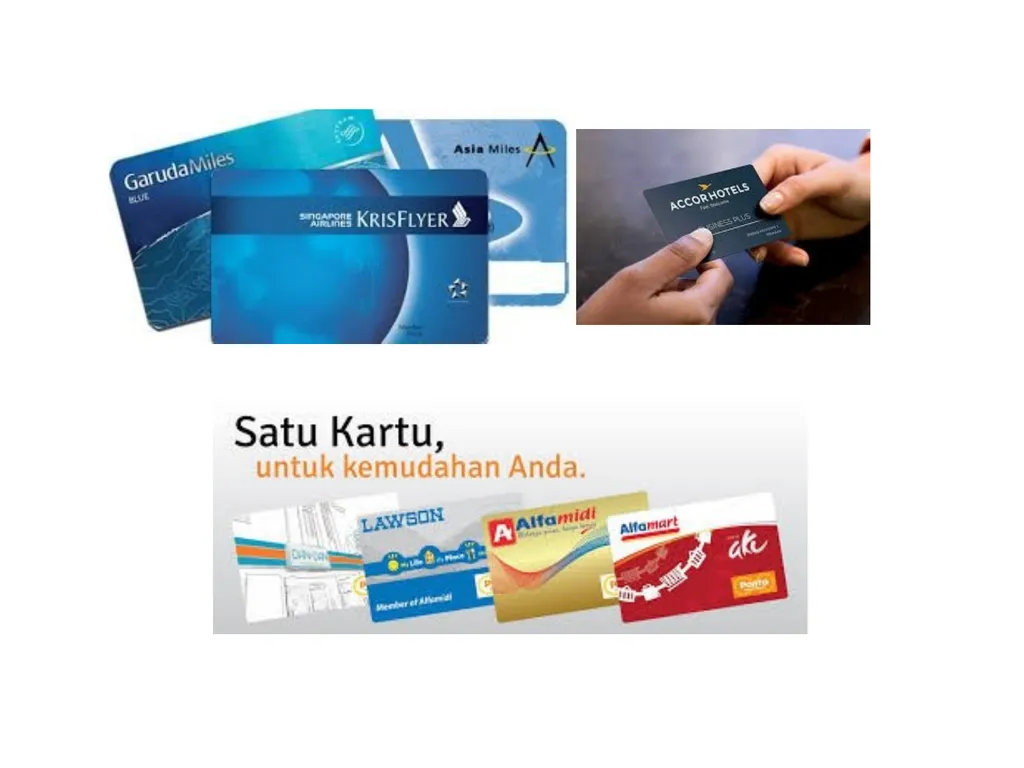
The discipline of customer loyalty marketing has been around for many years, but expansions from it merely being a model for conducting business to becoming a vehicle for marketing and advertising have made it omnipresent in consumer marketing organizations since the mid- to late-1990s. Some of the newer loyalty marketing industry insiders, such as Fred Reichheld, have claimed a strong link between customer loyalty marketing and customer referral. In recent years, a new marketing discipline called "customer advocacy marketing" has been combined with or replaced by "customer loyalty marketing." To the general public, many airline miles programs, hotel frequent guest programs, and credit card incentive programs are the most visible customer loyalty marketing programs.[<br>
15
Loyalty program A loyalty program is a marketing strategy designed to encourage customers to continue to shop at or use the services of a business associated with the program.Today, such programs cover most types of commerce, each having varying features and rewards schemes, including in banking, entertainment, hospitality, retailing and travel.<br>