
Course Title: Democracy and Multiculturalism

Description: Course Title: Democracy and Multiculturalism Course Code: POL3086 Todays Topic: Understanding Multiculturalism Date: 13th August 2025 Class Taken by: Humen Boruah Digital Class MA 3rd Semester Department of Political Science Paschim
Related Topics
Download Presentation
"Course Title: Democracy and Multiculturalism" is the property of its rightful owner. Permission is granted to download and print the materials on this website for personal, non-commercial use only, and to display it on your personal computer provided you do not modify the materials and that you retain all copyright notices contained in the materials. By downloading content from our website, you accept the terms of this agreement.
Presentation Transcript
slide1. Course Title: Democracy and Multiculturalism
Course Code: POL3086
Today's Topic: Understanding Multiculturalism
Date: 13th August 2025 Class Taken by: Humen Boruah Digital Class MA 3rd Semester Department of Political Science Paschim Guwahati Mahavidyalaya, Dharapur<br>
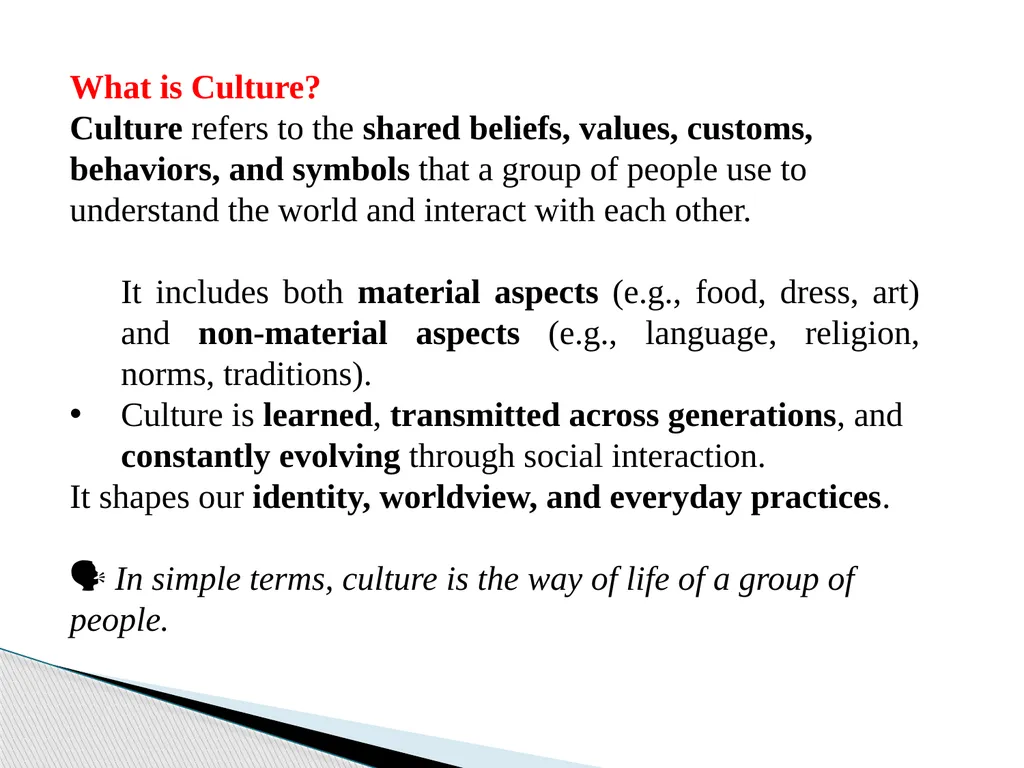
slide2. What is Culture?
Culture refers to the shared beliefs, values, customs, behaviors, and symbols that a group of people use to understand the world and interact with each other.
It includes both material aspects (e.g., food, dress, art) and non-material aspects (e.g., language, religion, norms, traditions).
Culture is learned, transmitted across generations, and constantly evolving through social interaction.
It shapes our identity, worldview, and everyday practices.
🗣️ In simple terms, culture is the way of life of a group of people.<br>
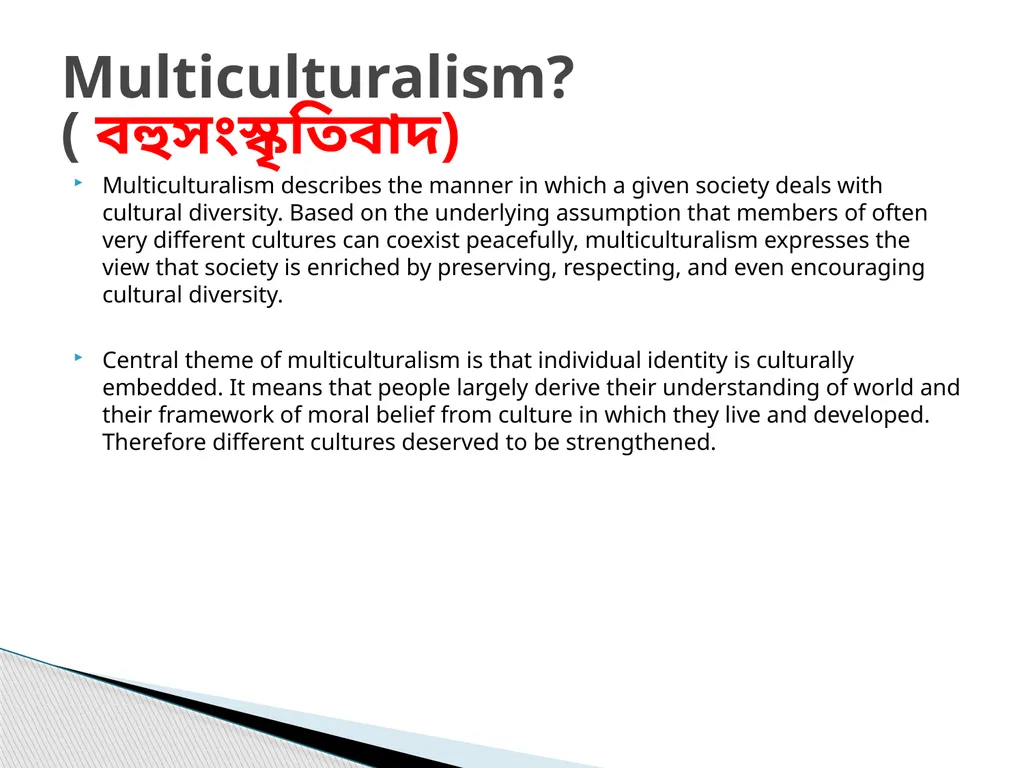
slide3. Multiculturalism describes the manner in which a given society deals with cultural diversity. Based on the underlying assumption that members of often very different cultures can coexist peacefully, multiculturalism expresses the view that society is enriched by preserving, respecting, and even encouraging cultural diversity.
Central theme of multiculturalism is that individual identity is culturally embedded. It means that people largely derive their understanding of world and their framework of moral belief from culture in which they live and developed. Therefore different cultures deserved to be strengthened. Multiculturalism?( বহুসংস্কৃতিবাদ)<br>
slide4. Key Insights on Multiculturalism
➤Multiculturalism is the way in which a society deals with cultural diversity, both at the national and at the community level.
Multiculturalism assumes that society as a whole benefits from increased diversity through the harmonious coexistence of different cultures.
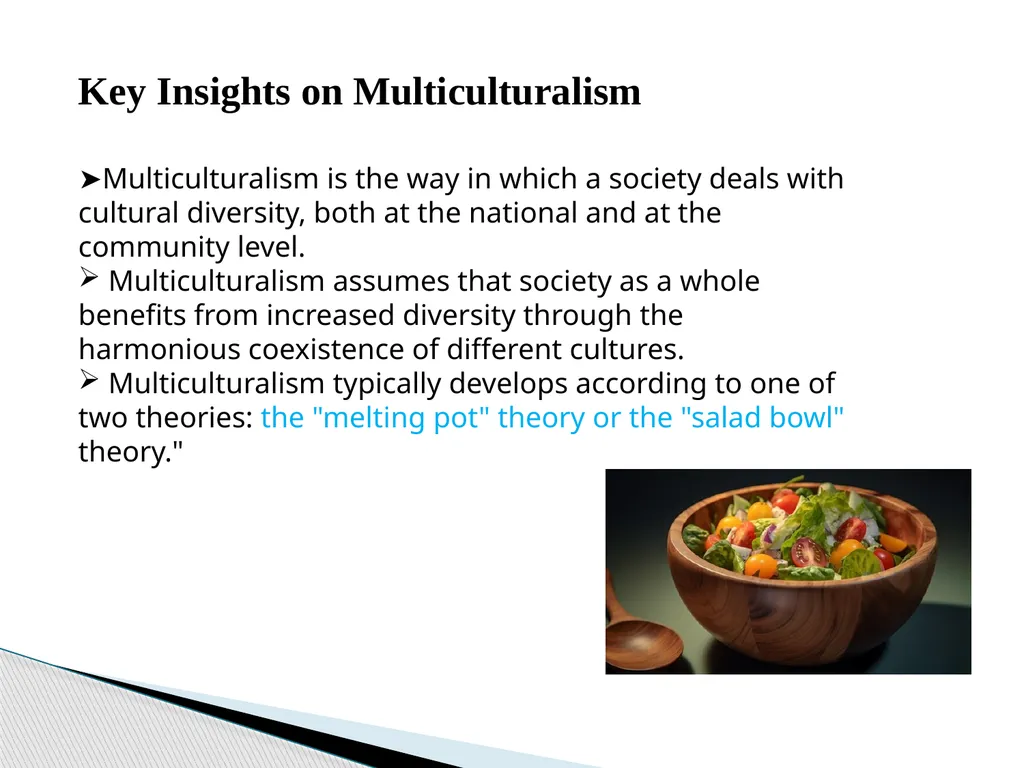
Multiculturalism typically develops according to one of two theories: the "melting pot" theory or the "salad bowl" theory."<br>
slide5. Historical Background
The idea of multiculturalism gained prominence in the 1960s.
Canada (1971) and Australia (1993) officially adopted multiculturalism as national policy.
Today, many countries recognize multiculturalism as a response to cultural diversity and identity politics.
🟨 Key Factors Behind the Emergence:
1.Decolonization
Post-colonial states in Asia and Africa were inherently pluralistic.
Postcolonial theory challenged Eurocentric norms and emphasized indigenous, diverse value systems. Emergence of Multiculturalism<br>
slide6. . 2.Post-WWII Migration Waves Refugee crises in fascist regimes (Germany, Italy) led to mass migrations. Homogeneous European societies were confronted with cultural diversity. United Nations addressed it globally; states responded with multicultural policies.
3) Globalisation: The process of globalization which encourage free flow of labour from one country to other also resulted in problem of immigrant in these countries.
4) Disintegration of U.S.S.R.: Due to collapse of USSR ethnic nationalism emerge victorious. Later on ethnic groups made demand for separate statehood as in Yugoslavia. This fear also forced various countries to accept multiculturalism.
5) Accommodation to Minority Groups: Liberal democracy in 20th century could not address problems of minority group properly. This dissatisfaction for democracy also strengthen demand for multiculturalism<br>
slide7. Who is Will Kymlicka?
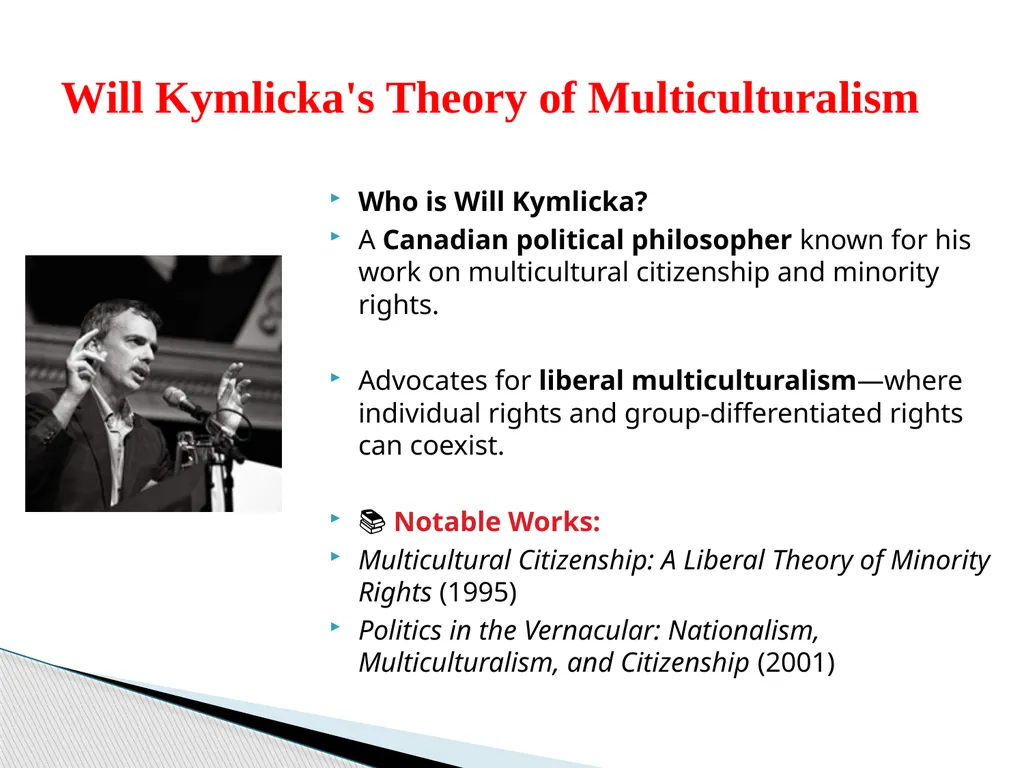
A Canadian political philosopher known for his work on multicultural citizenship and minority rights.
Advocates for liberal multiculturalism—where individual rights and group-differentiated rights can coexist.
📚 Notable Works:
Multicultural Citizenship: A Liberal Theory of Minority Rights (1995)
Politics in the Vernacular: Nationalism, Multiculturalism, and Citizenship (2001) Will Kymlicka's Theory of Multiculturalism<br>
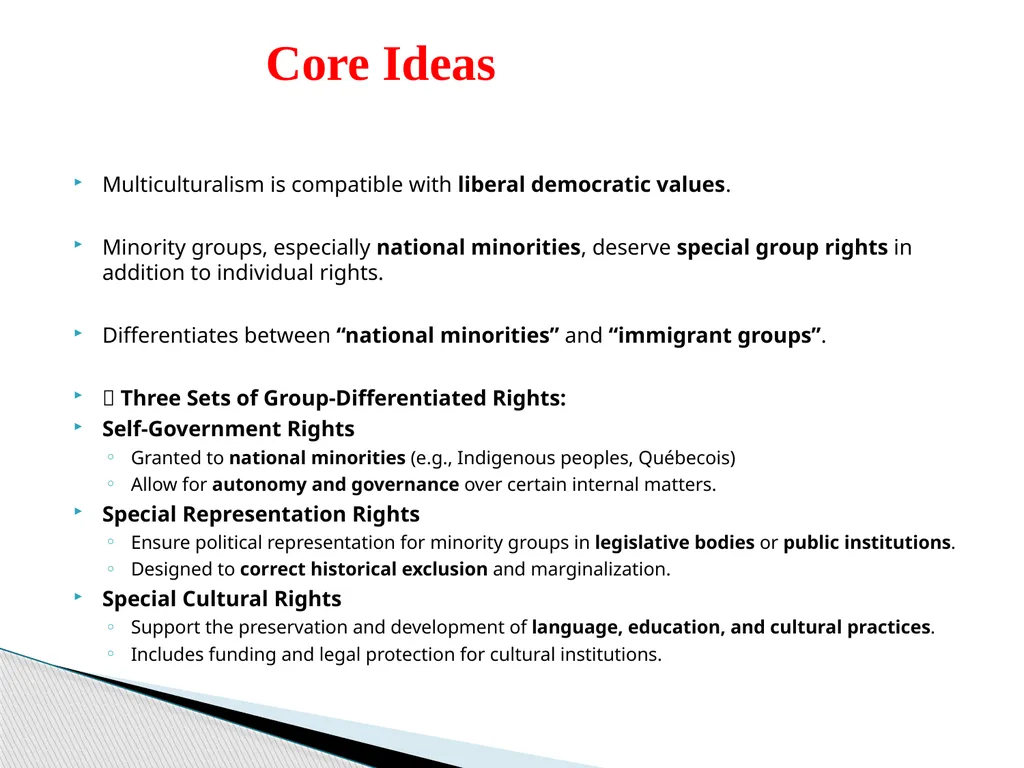
slide8. Multiculturalism is compatible with liberal democratic values.
Minority groups, especially national minorities, deserve special group rights in addition to individual rights.
Differentiates between “national minorities” and “immigrant groups”.
🧩 Three Sets of Group-Differentiated Rights:
Self-Government Rights
Granted to national minorities (e.g., Indigenous peoples, Québecois)
Allow for autonomy and governance over certain internal matters.
Special Representation Rights
Ensure political representation for minority groups in legislative bodies or public institutions.
Designed to correct historical exclusion and marginalization.
Special Cultural Rights
Support the preservation and development of language, education, and cultural practices.
Includes funding and legal protection for cultural institutions. Core Ideas<br>
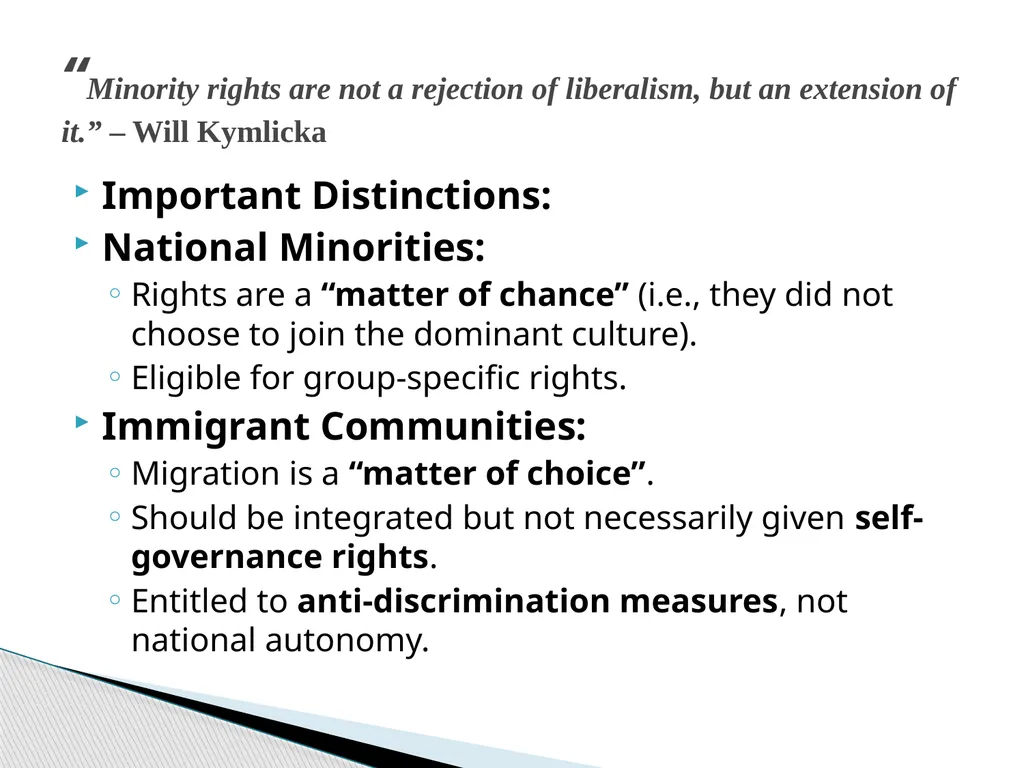
slide9. Important Distinctions:
National Minorities:
Rights are a “matter of chance” (i.e., they did not choose to join the dominant culture).
Eligible for group-specific rights.
Immigrant Communities:
Migration is a “matter of choice”.
Should be integrated but not necessarily given self-governance rights.
Entitled to anti-discrimination measures, not national autonomy. “Minority rights are not a rejection of liberalism, but an extension of it.” – Will Kymlicka<br>
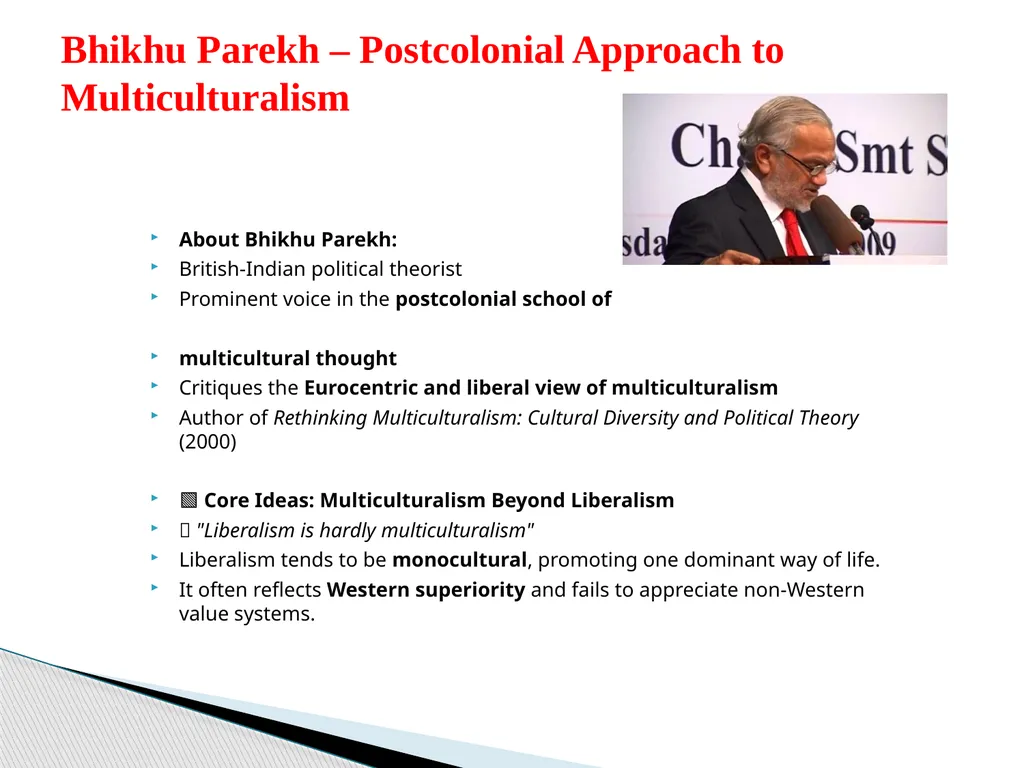
slide10. About Bhikhu Parekh:
British-Indian political theorist
Prominent voice in the postcolonial school of
multicultural thought
Critiques the Eurocentric and liberal view of multiculturalism
Author of Rethinking Multiculturalism: Cultural Diversity and Political Theory (2000)
🟩 Core Ideas: Multiculturalism Beyond Liberalism
🔹 "Liberalism is hardly multiculturalism"
Liberalism tends to be monocultural, promoting one dominant way of life.
It often reflects Western superiority and fails to appreciate non-Western value systems. Bhikhu Parekh – Postcolonial Approach to Multiculturalism<br>
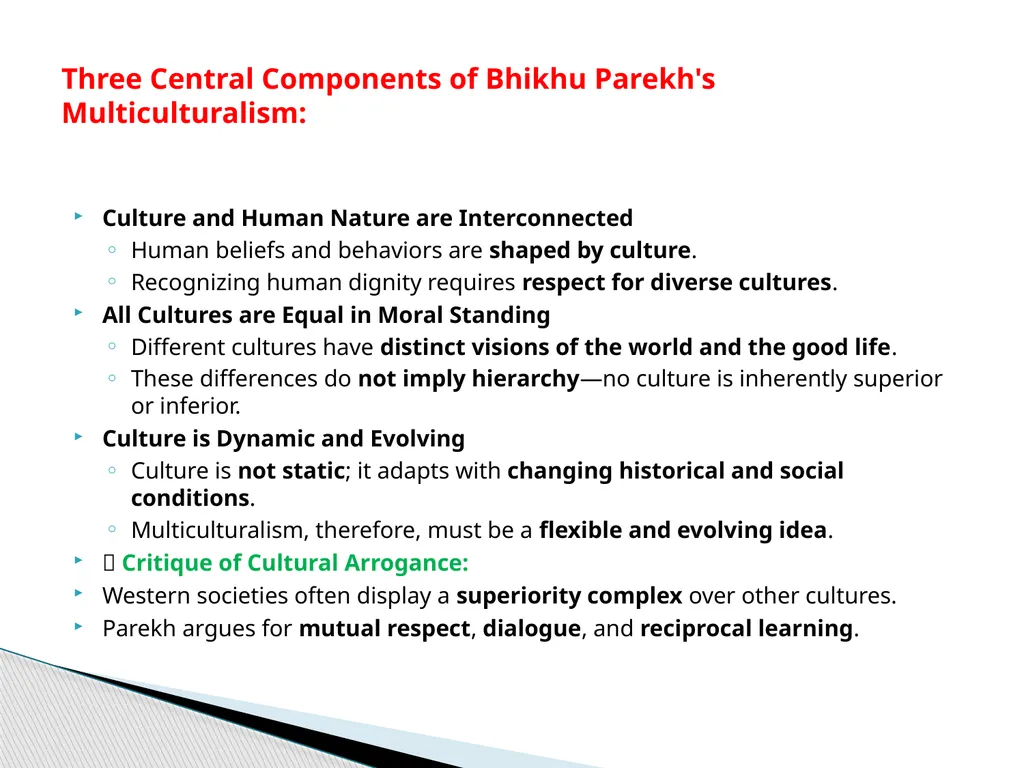
slide11. Culture and Human Nature are Interconnected
Human beliefs and behaviors are shaped by culture.
Recognizing human dignity requires respect for diverse cultures.
All Cultures are Equal in Moral Standing
Different cultures have distinct visions of the world and the good life.
These differences do not imply hierarchy—no culture is inherently superior or inferior.
Culture is Dynamic and Evolving
Culture is not static; it adapts with changing historical and social conditions.
Multiculturalism, therefore, must be a flexible and evolving idea.
🔴 Critique of Cultural Arrogance:
Western societies often display a superiority complex over other cultures.
Parekh argues for mutual respect, dialogue, and reciprocal learning. Three Central Components of Bhikhu Parekh's Multiculturalism:<br>
slide12. Thank you<br>
Today's Topic: Understanding Multiculturalism
Date: 13th August 2025 Class Taken by: Humen Boruah Digital Class MA 3rd Semester Department of Political Science Paschim Guwahati Mahavidyalaya, Dharapur<br>
slide2. What is Culture?
Culture refers to the shared beliefs, values, customs, behaviors, and symbols that a group of people use to understand the world and interact with each other.
It includes both material aspects (e.g., food, dress, art) and non-material aspects (e.g., language, religion, norms, traditions).
Culture is learned, transmitted across generations, and constantly evolving through social interaction.
It shapes our identity, worldview, and everyday practices.
🗣️ In simple terms, culture is the way of life of a group of people.<br>
slide3. Multiculturalism describes the manner in which a given society deals with cultural diversity. Based on the underlying assumption that members of often very different cultures can coexist peacefully, multiculturalism expresses the view that society is enriched by preserving, respecting, and even encouraging cultural diversity.
Central theme of multiculturalism is that individual identity is culturally embedded. It means that people largely derive their understanding of world and their framework of moral belief from culture in which they live and developed. Therefore different cultures deserved to be strengthened. Multiculturalism?( বহুসংস্কৃতিবাদ)<br>
slide4. Key Insights on Multiculturalism
➤Multiculturalism is the way in which a society deals with cultural diversity, both at the national and at the community level.
Multiculturalism assumes that society as a whole benefits from increased diversity through the harmonious coexistence of different cultures.
Multiculturalism typically develops according to one of two theories: the "melting pot" theory or the "salad bowl" theory."<br>
slide5. Historical Background
The idea of multiculturalism gained prominence in the 1960s.
Canada (1971) and Australia (1993) officially adopted multiculturalism as national policy.
Today, many countries recognize multiculturalism as a response to cultural diversity and identity politics.
🟨 Key Factors Behind the Emergence:
1.Decolonization
Post-colonial states in Asia and Africa were inherently pluralistic.
Postcolonial theory challenged Eurocentric norms and emphasized indigenous, diverse value systems. Emergence of Multiculturalism<br>
slide6. . 2.Post-WWII Migration Waves Refugee crises in fascist regimes (Germany, Italy) led to mass migrations. Homogeneous European societies were confronted with cultural diversity. United Nations addressed it globally; states responded with multicultural policies.
3) Globalisation: The process of globalization which encourage free flow of labour from one country to other also resulted in problem of immigrant in these countries.
4) Disintegration of U.S.S.R.: Due to collapse of USSR ethnic nationalism emerge victorious. Later on ethnic groups made demand for separate statehood as in Yugoslavia. This fear also forced various countries to accept multiculturalism.
5) Accommodation to Minority Groups: Liberal democracy in 20th century could not address problems of minority group properly. This dissatisfaction for democracy also strengthen demand for multiculturalism<br>
slide7. Who is Will Kymlicka?
A Canadian political philosopher known for his work on multicultural citizenship and minority rights.
Advocates for liberal multiculturalism—where individual rights and group-differentiated rights can coexist.
📚 Notable Works:
Multicultural Citizenship: A Liberal Theory of Minority Rights (1995)
Politics in the Vernacular: Nationalism, Multiculturalism, and Citizenship (2001) Will Kymlicka's Theory of Multiculturalism<br>
slide8. Multiculturalism is compatible with liberal democratic values.
Minority groups, especially national minorities, deserve special group rights in addition to individual rights.
Differentiates between “national minorities” and “immigrant groups”.
🧩 Three Sets of Group-Differentiated Rights:
Self-Government Rights
Granted to national minorities (e.g., Indigenous peoples, Québecois)
Allow for autonomy and governance over certain internal matters.
Special Representation Rights
Ensure political representation for minority groups in legislative bodies or public institutions.
Designed to correct historical exclusion and marginalization.
Special Cultural Rights
Support the preservation and development of language, education, and cultural practices.
Includes funding and legal protection for cultural institutions. Core Ideas<br>
slide9. Important Distinctions:
National Minorities:
Rights are a “matter of chance” (i.e., they did not choose to join the dominant culture).
Eligible for group-specific rights.
Immigrant Communities:
Migration is a “matter of choice”.
Should be integrated but not necessarily given self-governance rights.
Entitled to anti-discrimination measures, not national autonomy. “Minority rights are not a rejection of liberalism, but an extension of it.” – Will Kymlicka<br>
slide10. About Bhikhu Parekh:
British-Indian political theorist
Prominent voice in the postcolonial school of
multicultural thought
Critiques the Eurocentric and liberal view of multiculturalism
Author of Rethinking Multiculturalism: Cultural Diversity and Political Theory (2000)
🟩 Core Ideas: Multiculturalism Beyond Liberalism
🔹 "Liberalism is hardly multiculturalism"
Liberalism tends to be monocultural, promoting one dominant way of life.
It often reflects Western superiority and fails to appreciate non-Western value systems. Bhikhu Parekh – Postcolonial Approach to Multiculturalism<br>
slide11. Culture and Human Nature are Interconnected
Human beliefs and behaviors are shaped by culture.
Recognizing human dignity requires respect for diverse cultures.
All Cultures are Equal in Moral Standing
Different cultures have distinct visions of the world and the good life.
These differences do not imply hierarchy—no culture is inherently superior or inferior.
Culture is Dynamic and Evolving
Culture is not static; it adapts with changing historical and social conditions.
Multiculturalism, therefore, must be a flexible and evolving idea.
🔴 Critique of Cultural Arrogance:
Western societies often display a superiority complex over other cultures.
Parekh argues for mutual respect, dialogue, and reciprocal learning. Three Central Components of Bhikhu Parekh's Multiculturalism:<br>
slide12. Thank you<br>