
Creating characters in narrative: Using verbs to
Description: Creating characters in narrative: Using verbs to show not tell LEAD Principles Creating Characters in Narrative Show not tell: reveal your character through showing what they are like, not just telling the reader; Use specific, concrete
Related Topics
Download Presentation
"Creating characters in narrative: Using verbs to" is the property of its rightful owner. Permission is granted to download and print the materials on this website for personal, non-commercial use only, and to display it on your personal computer provided you do not modify the materials and that you retain all copyright notices contained in the materials. By downloading content from our website, you accept the terms of this agreement.
Presentation Transcript
slide1. Creating characters in narrative: Using verbs to show not tell<br>
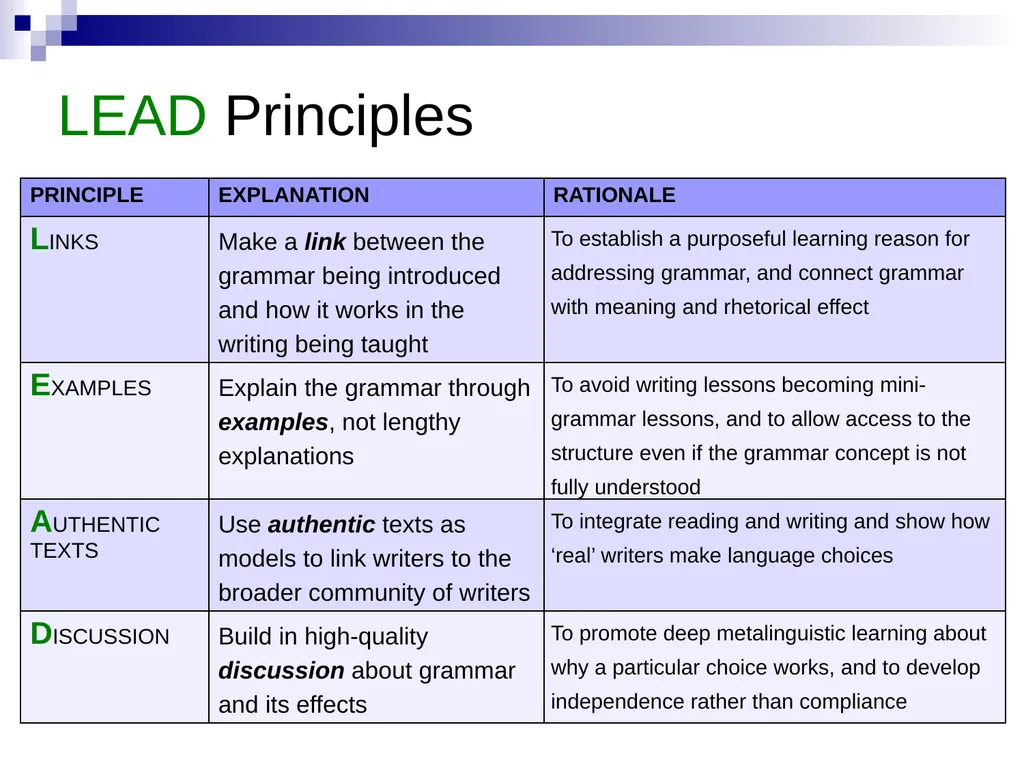
slide2. LEAD Principles<br>
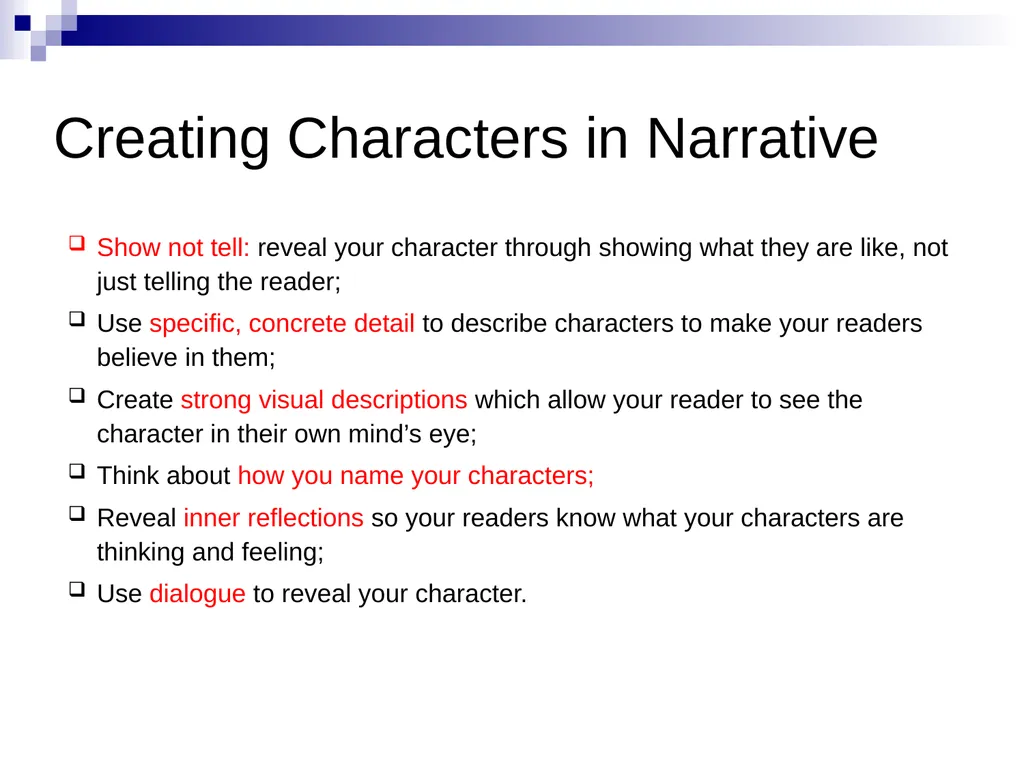
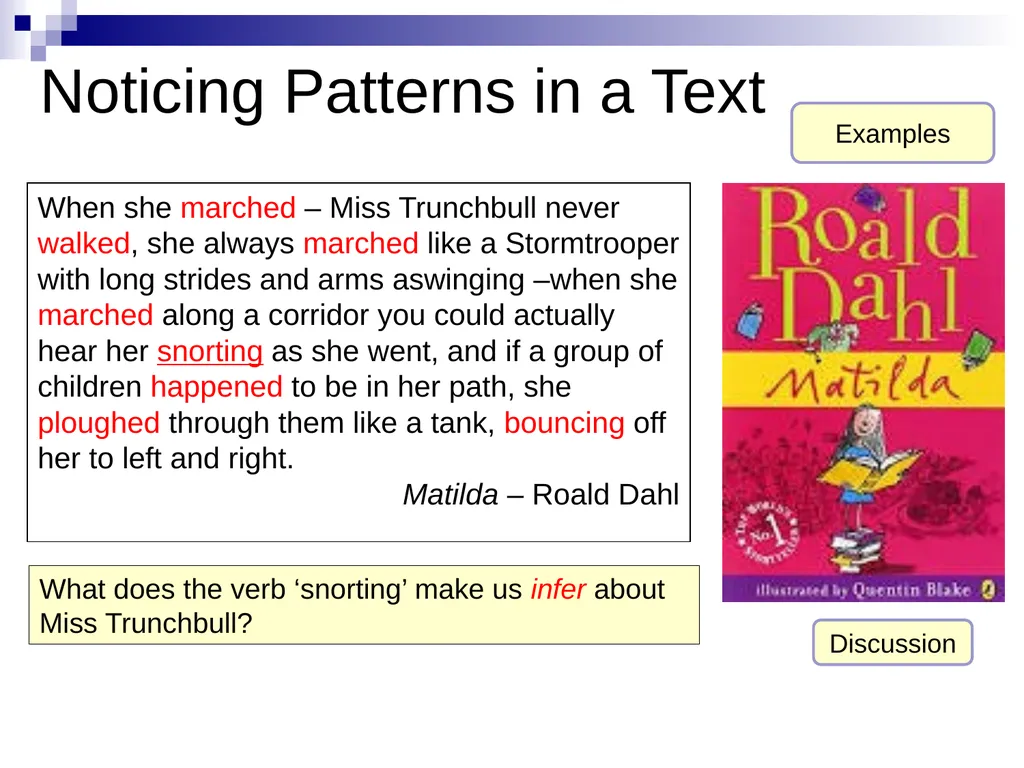
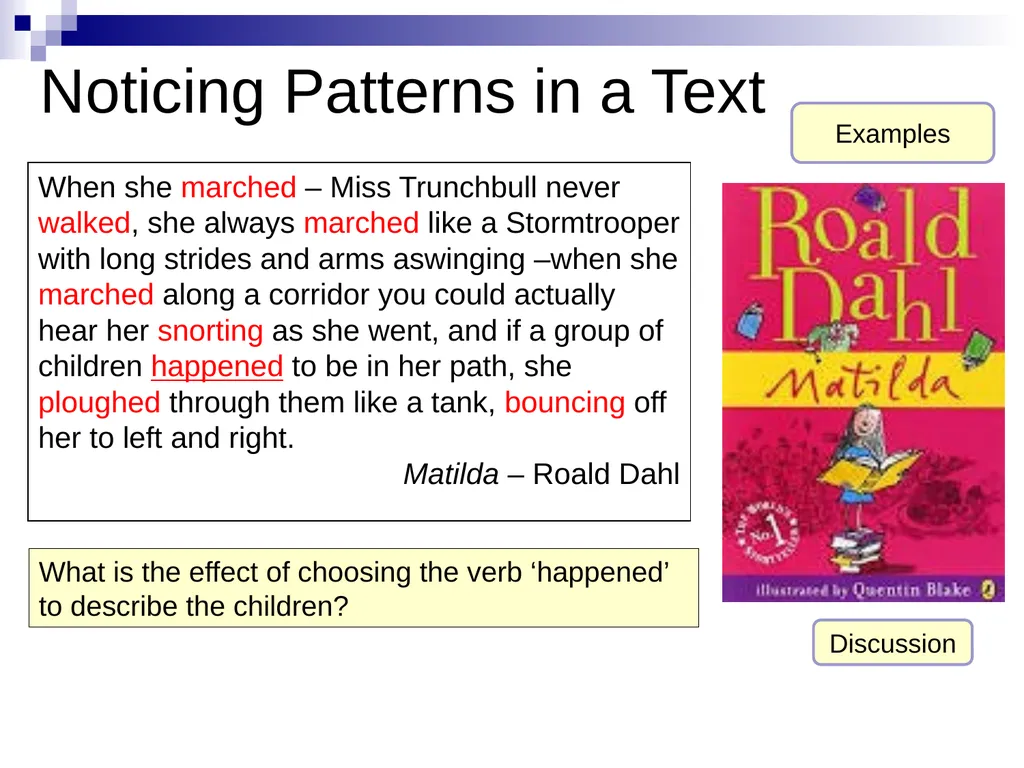
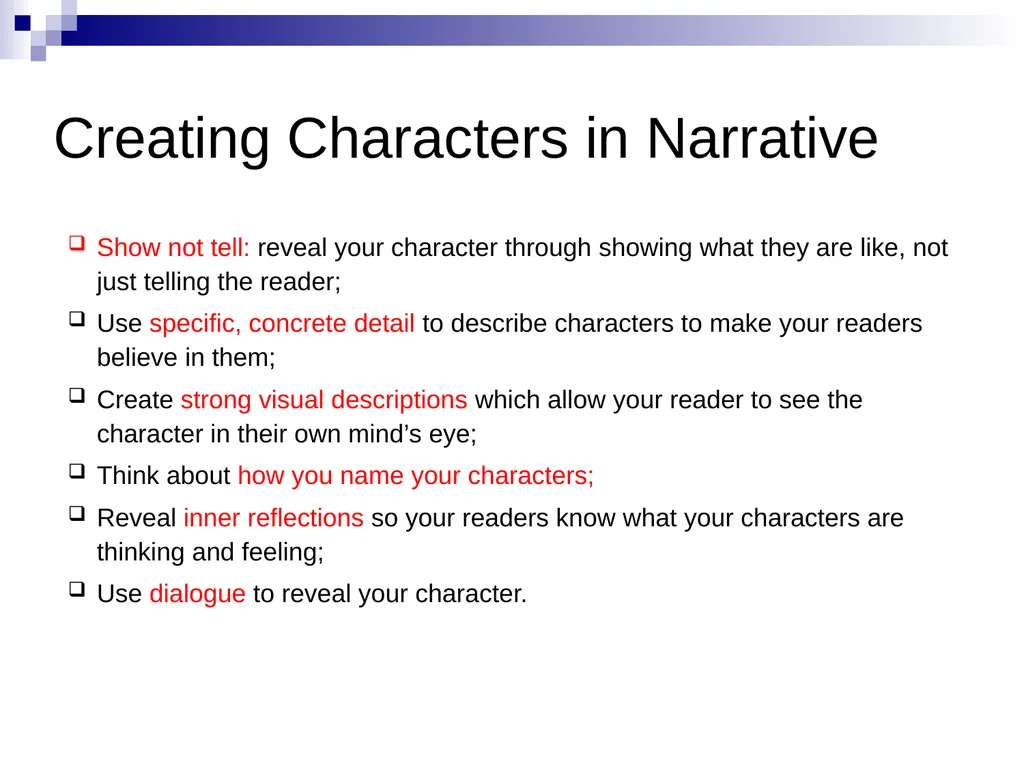
slide3. Creating Characters in Narrative Show not tell: reveal your character through showing what they are like, not just telling the reader;
Use specific, concrete detail to describe characters to make your readers believe in them;
Create strong visual descriptions which allow your reader to see the character in their own mind’s eye;
Think about how you name your characters;
Reveal inner reflections so your readers know what your characters are thinking and feeling;
Use dialogue to reveal your character.<br>
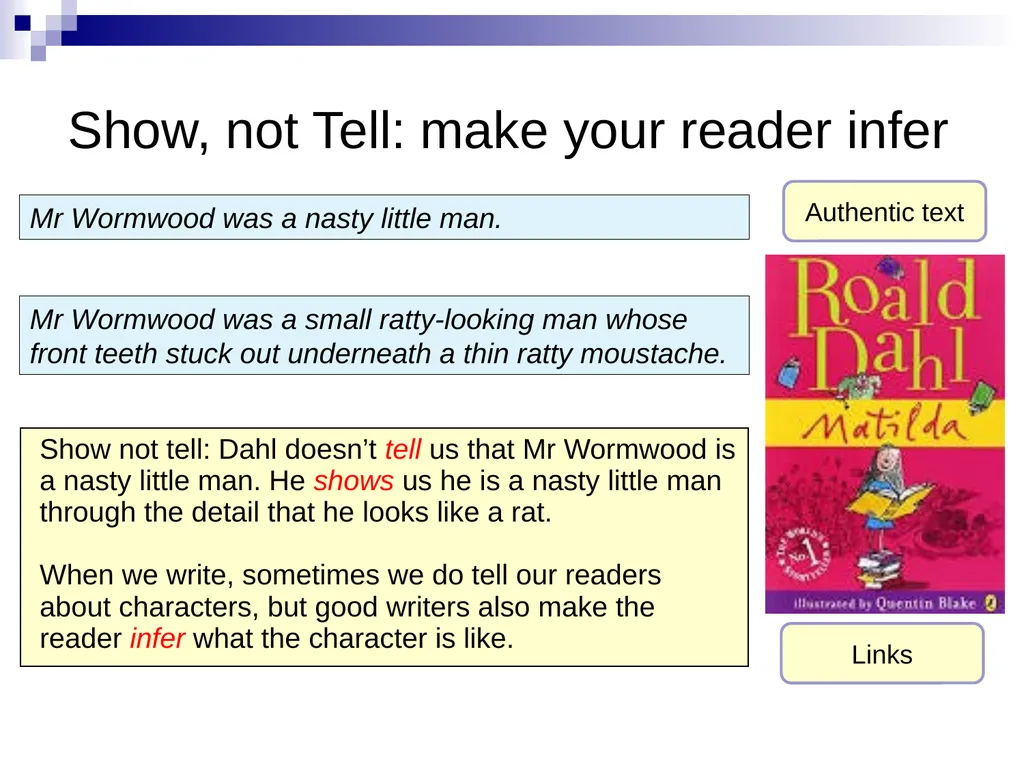
slide4. Show, not Tell: make your reader infer Show not tell: Dahl doesn’t tell us that Mr Wormwood is a nasty little man. He shows us he is a nasty little man through the detail that he looks like a rat.
When we write, sometimes we do tell our readers about characters, but good writers also make the reader infer what the character is like. Mr Wormwood was a small ratty-looking man whose front teeth stuck out underneath a thin ratty moustache. Mr Wormwood was a nasty little man. Authentic text Links<br>
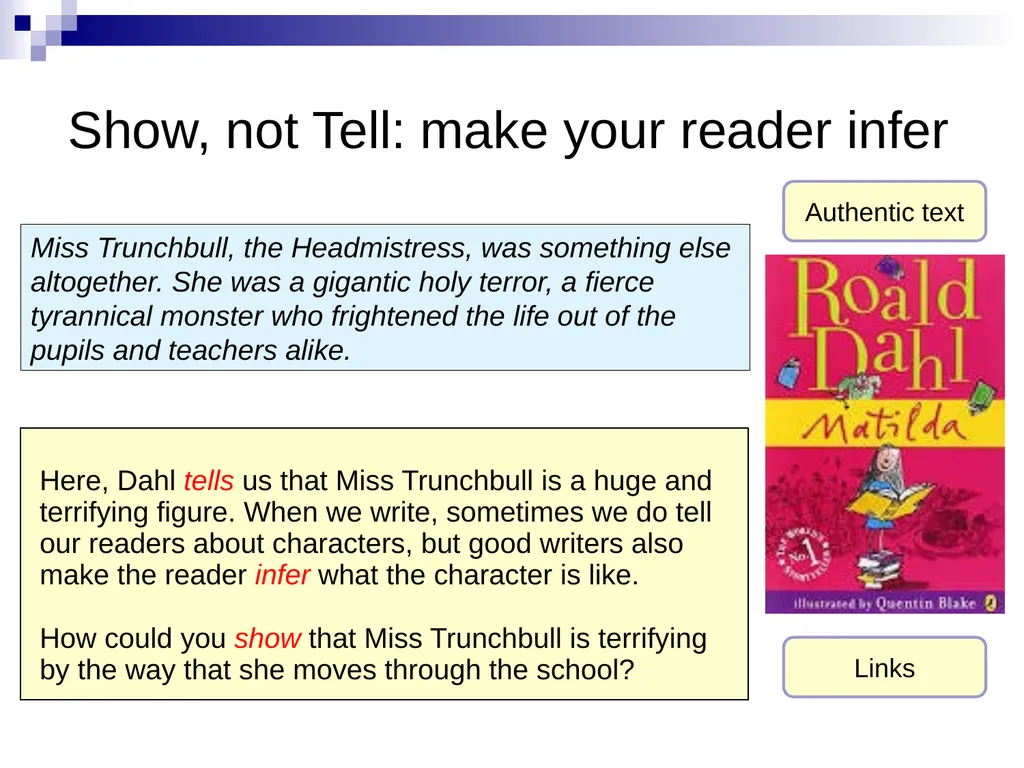
slide5. Show, not Tell: make your reader infer Here, Dahl tells us that Miss Trunchbull is a huge and terrifying figure. When we write, sometimes we do tell our readers about characters, but good writers also make the reader infer what the character is like.
How could you show that Miss Trunchbull is terrifying by the way that she moves through the school? Miss Trunchbull, the Headmistress, was something else altogether. She was a gigantic holy terror, a fierce tyrannical monster who frightened the life out of the pupils and teachers alike. Authentic text Links<br>
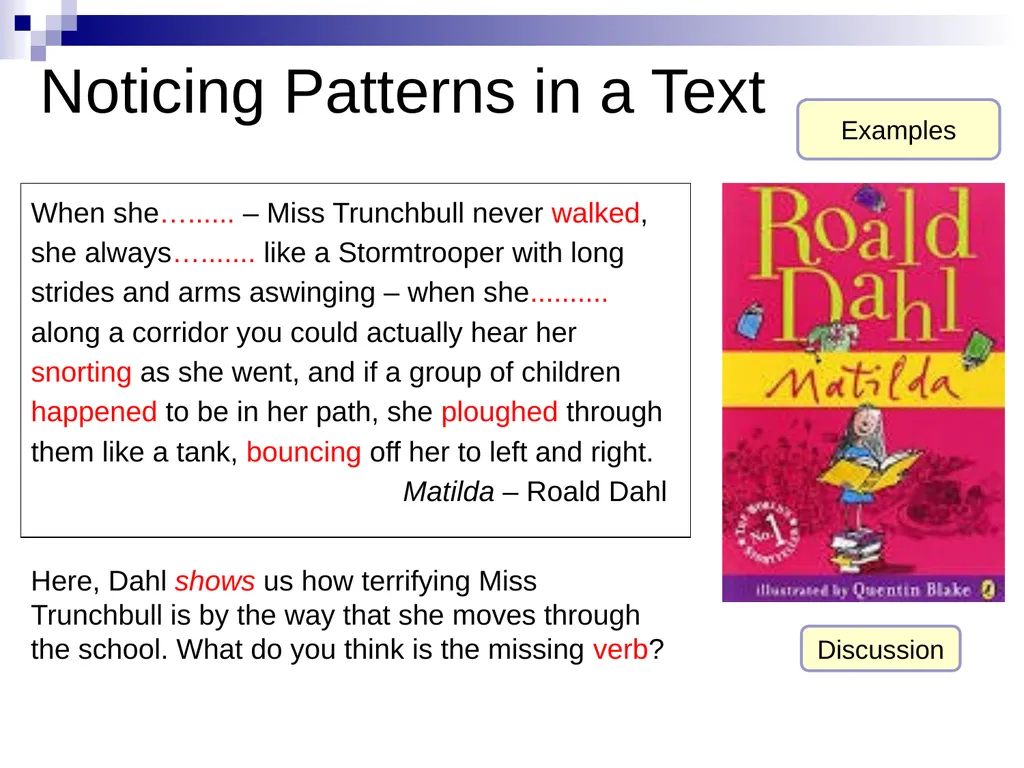
slide6. Noticing Patterns in a Text When she…...... – Miss Trunchbull never walked, she always…....... like a Stormtrooper with long strides and arms aswinging – when she.......... along a corridor you could actually hear her snorting as she went, and if a group of children happened to be in her path, she ploughed through them like a tank, bouncing off her to left and right.
Matilda – Roald Dahl Examples Discussion Here, Dahl shows us how terrifying Miss Trunchbull is by the way that she moves through the school. What do you think is the missing verb?<br>
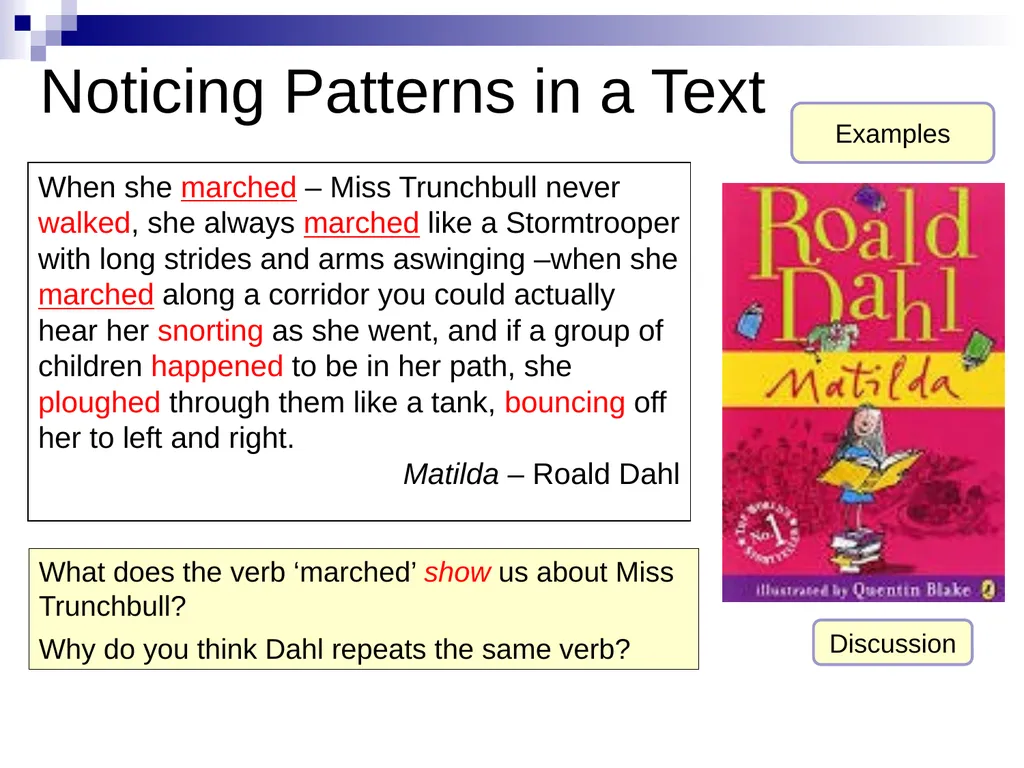
slide7. Noticing Patterns in a Text When she marched – Miss Trunchbull never walked, she always marched like a Stormtrooper with long strides and arms aswinging –when she marched along a corridor you could actually hear her snorting as she went, and if a group of children happened to be in her path, she ploughed through them like a tank, bouncing off her to left and right.
Matilda – Roald Dahl
the fold Examples Discussion What does the verb ‘marched’ show us about Miss Trunchbull?
Why do you think Dahl repeats the same verb?<br>
slide8. Noticing Patterns in a Text When she marched – Miss Trunchbull never walked, she always marched like a Stormtrooper with long strides and arms aswinging –when she marched along a corridor you could actually hear her snorting as she went, and if a group of children happened to be in her path, she ploughed through them like a tank, bouncing off her to left and right.
Matilda – Roald Dahl
the fold Examples Discussion What does the verb ‘snorting’ make us infer about Miss Trunchbull?<br>
slide9. Noticing Patterns in a Text When she marched – Miss Trunchbull never walked, she always marched like a Stormtrooper with long strides and arms aswinging –when she marched along a corridor you could actually hear her snorting as she went, and if a group of children happened to be in her path, she ploughed through them like a tank, bouncing off her to left and right.
Matilda – Roald Dahl
the fold Examples Discussion What is the effect of choosing the verb ‘happened’ to describe the children?<br>
slide10. Creating Characters in Narrative Show not tell: reveal your character through showing what they are like, not just telling the reader;
Use specific, concrete detail to describe characters to make your readers believe in them;
Create strong visual descriptions which allow your reader to see the character in their own mind’s eye;
Think about how you name your characters;
Reveal inner reflections so your readers know what your characters are thinking and feeling;
Use dialogue to reveal your character.<br>
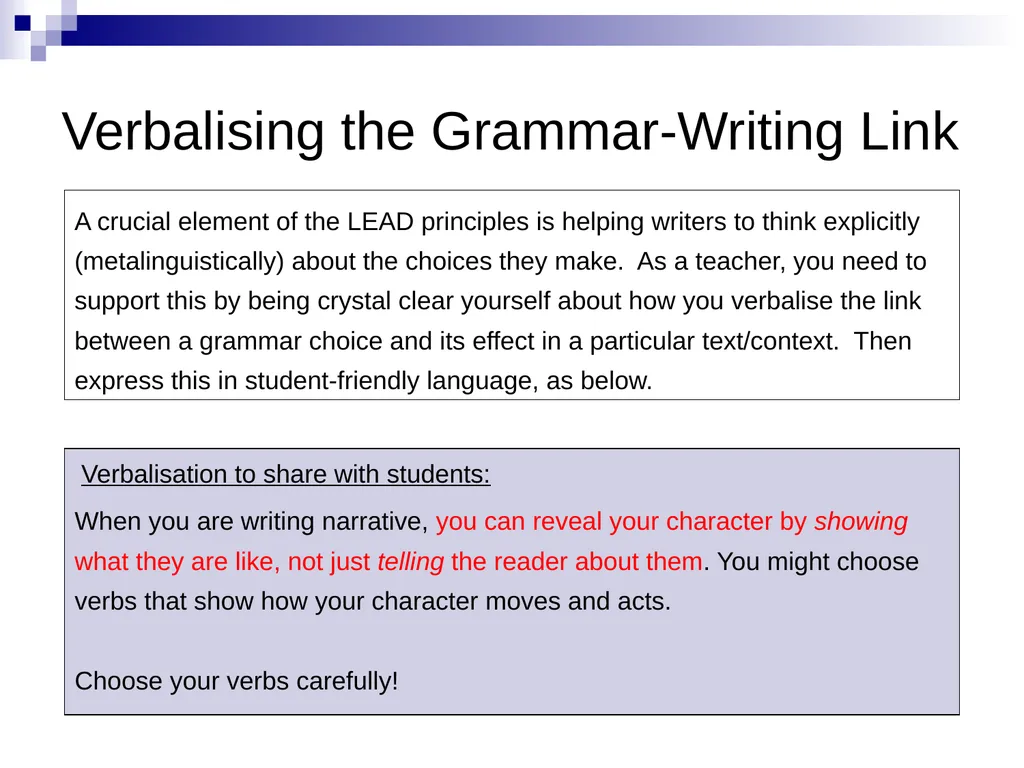
slide11. Verbalising the Grammar-Writing Link Verbalisation to share with students:
When you are writing narrative, you can reveal your character by showing what they are like, not just telling the reader about them. You might choose verbs that show how your character moves and acts.
Choose your verbs carefully! A crucial element of the LEAD principles is helping writers to think explicitly (metalinguistically) about the choices they make. As a teacher, you need to support this by being crystal clear yourself about how you verbalise the link between a grammar choice and its effect in a particular text/context. Then express this in student-friendly language, as below.<br>
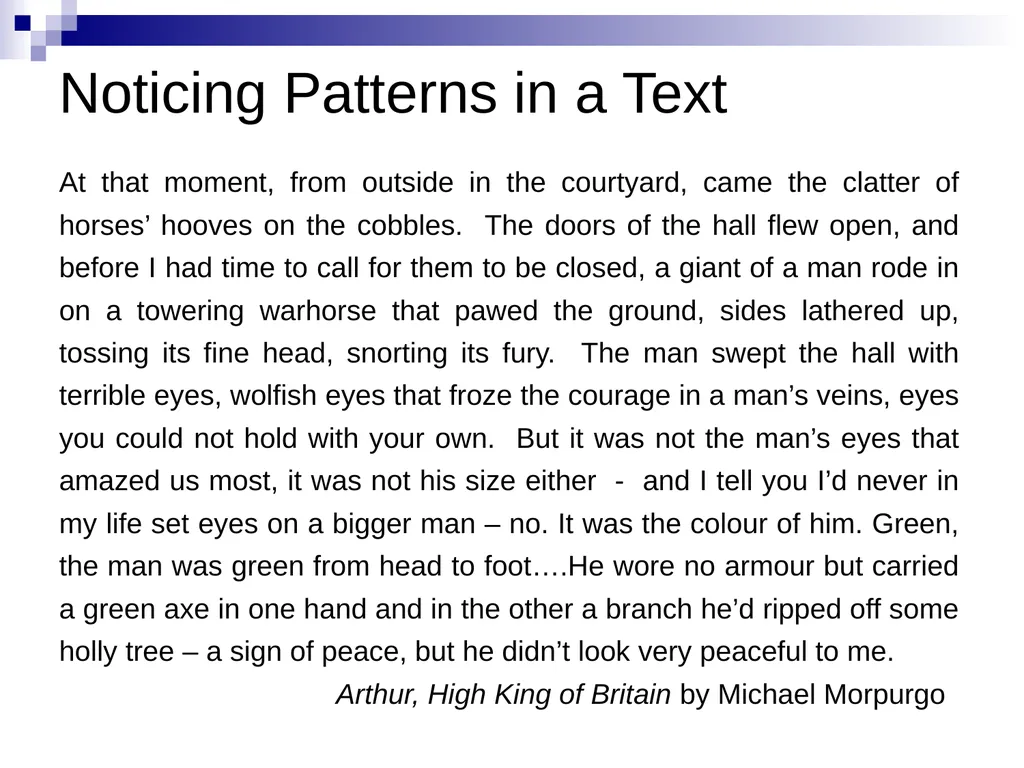
slide12. Noticing Patterns in a Text At that moment, from outside in the courtyard, came the clatter of horses’ hooves on the cobbles. The doors of the hall flew open, and before I had time to call for them to be closed, a giant of a man rode in on a towering warhorse that pawed the ground, sides lathered up, tossing its fine head, snorting its fury. The man swept the hall with terrible eyes, wolfish eyes that froze the courage in a man’s veins, eyes you could not hold with your own. But it was not the man’s eyes that amazed us most, it was not his size either - and I tell you I’d never in my life set eyes on a bigger man – no. It was the colour of him. Green, the man was green from head to foot….He wore no armour but carried a green axe in one hand and in the other a branch he’d ripped off some holly tree – a sign of peace, but he didn’t look very peaceful to me.
Arthur, High King of Britain by Michael Morpurgo<br>
slide2. LEAD Principles<br>
slide3. Creating Characters in Narrative Show not tell: reveal your character through showing what they are like, not just telling the reader;
Use specific, concrete detail to describe characters to make your readers believe in them;
Create strong visual descriptions which allow your reader to see the character in their own mind’s eye;
Think about how you name your characters;
Reveal inner reflections so your readers know what your characters are thinking and feeling;
Use dialogue to reveal your character.<br>
slide4. Show, not Tell: make your reader infer Show not tell: Dahl doesn’t tell us that Mr Wormwood is a nasty little man. He shows us he is a nasty little man through the detail that he looks like a rat.
When we write, sometimes we do tell our readers about characters, but good writers also make the reader infer what the character is like. Mr Wormwood was a small ratty-looking man whose front teeth stuck out underneath a thin ratty moustache. Mr Wormwood was a nasty little man. Authentic text Links<br>
slide5. Show, not Tell: make your reader infer Here, Dahl tells us that Miss Trunchbull is a huge and terrifying figure. When we write, sometimes we do tell our readers about characters, but good writers also make the reader infer what the character is like.
How could you show that Miss Trunchbull is terrifying by the way that she moves through the school? Miss Trunchbull, the Headmistress, was something else altogether. She was a gigantic holy terror, a fierce tyrannical monster who frightened the life out of the pupils and teachers alike. Authentic text Links<br>
slide6. Noticing Patterns in a Text When she…...... – Miss Trunchbull never walked, she always…....... like a Stormtrooper with long strides and arms aswinging – when she.......... along a corridor you could actually hear her snorting as she went, and if a group of children happened to be in her path, she ploughed through them like a tank, bouncing off her to left and right.
Matilda – Roald Dahl Examples Discussion Here, Dahl shows us how terrifying Miss Trunchbull is by the way that she moves through the school. What do you think is the missing verb?<br>
slide7. Noticing Patterns in a Text When she marched – Miss Trunchbull never walked, she always marched like a Stormtrooper with long strides and arms aswinging –when she marched along a corridor you could actually hear her snorting as she went, and if a group of children happened to be in her path, she ploughed through them like a tank, bouncing off her to left and right.
Matilda – Roald Dahl
the fold Examples Discussion What does the verb ‘marched’ show us about Miss Trunchbull?
Why do you think Dahl repeats the same verb?<br>
slide8. Noticing Patterns in a Text When she marched – Miss Trunchbull never walked, she always marched like a Stormtrooper with long strides and arms aswinging –when she marched along a corridor you could actually hear her snorting as she went, and if a group of children happened to be in her path, she ploughed through them like a tank, bouncing off her to left and right.
Matilda – Roald Dahl
the fold Examples Discussion What does the verb ‘snorting’ make us infer about Miss Trunchbull?<br>
slide9. Noticing Patterns in a Text When she marched – Miss Trunchbull never walked, she always marched like a Stormtrooper with long strides and arms aswinging –when she marched along a corridor you could actually hear her snorting as she went, and if a group of children happened to be in her path, she ploughed through them like a tank, bouncing off her to left and right.
Matilda – Roald Dahl
the fold Examples Discussion What is the effect of choosing the verb ‘happened’ to describe the children?<br>
slide10. Creating Characters in Narrative Show not tell: reveal your character through showing what they are like, not just telling the reader;
Use specific, concrete detail to describe characters to make your readers believe in them;
Create strong visual descriptions which allow your reader to see the character in their own mind’s eye;
Think about how you name your characters;
Reveal inner reflections so your readers know what your characters are thinking and feeling;
Use dialogue to reveal your character.<br>
slide11. Verbalising the Grammar-Writing Link Verbalisation to share with students:
When you are writing narrative, you can reveal your character by showing what they are like, not just telling the reader about them. You might choose verbs that show how your character moves and acts.
Choose your verbs carefully! A crucial element of the LEAD principles is helping writers to think explicitly (metalinguistically) about the choices they make. As a teacher, you need to support this by being crystal clear yourself about how you verbalise the link between a grammar choice and its effect in a particular text/context. Then express this in student-friendly language, as below.<br>
slide12. Noticing Patterns in a Text At that moment, from outside in the courtyard, came the clatter of horses’ hooves on the cobbles. The doors of the hall flew open, and before I had time to call for them to be closed, a giant of a man rode in on a towering warhorse that pawed the ground, sides lathered up, tossing its fine head, snorting its fury. The man swept the hall with terrible eyes, wolfish eyes that froze the courage in a man’s veins, eyes you could not hold with your own. But it was not the man’s eyes that amazed us most, it was not his size either - and I tell you I’d never in my life set eyes on a bigger man – no. It was the colour of him. Green, the man was green from head to foot….He wore no armour but carried a green axe in one hand and in the other a branch he’d ripped off some holly tree – a sign of peace, but he didn’t look very peaceful to me.
Arthur, High King of Britain by Michael Morpurgo<br>