CS 57320 Artificial Intelligence Constraint Satisfaction Problems AIMA Chapter 6 Slides by Michael Hahsler based on Slides by Svetlana Lazepnik with figures from the AIMA textbook Constraint Satisfaction Problems (CSPs) Add constraints
"CS 5/7320 Artificial Intelligence Constraint" is the property of its rightful owner. Permission is granted to
download and print the materials on this website for personal, non-commercial use only, and to display it
on your personal computer provided you do not modify the materials and that you retain all copyright
notices contained in the materials. By downloading content from our website, you accept the terms of this
agreement.
Presentation Transcript
01
CS 5/7320 Artificial Intelligence Constraint Satisfaction Problems AIMA Chapter 6 Slides by Michael Hahsler based on Slides by Svetlana Lazepnik with figures from the AIMA textbook<br>
02
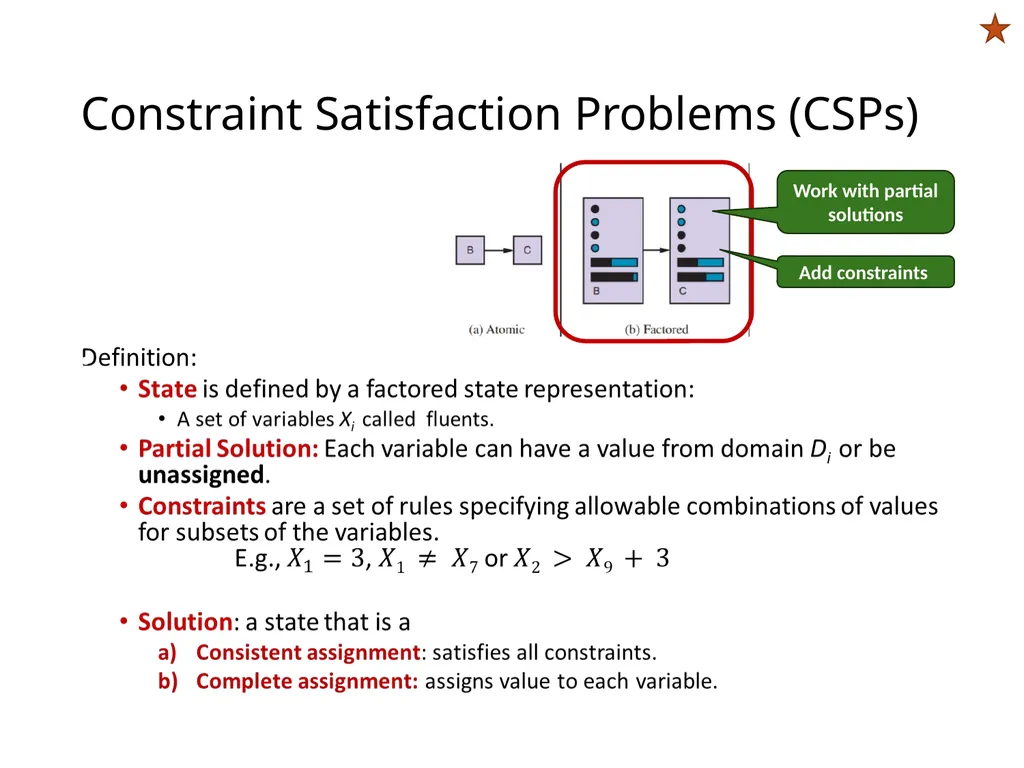
Constraint Satisfaction Problems (CSPs) Add constraints Work with partial solutions<br>
03
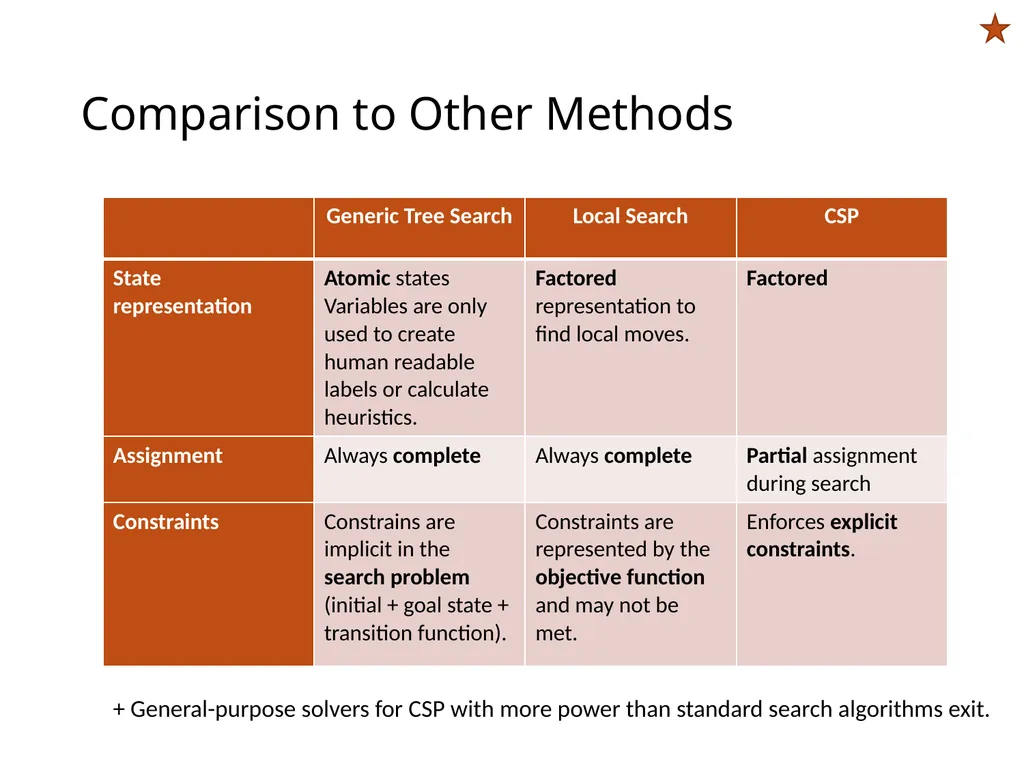
Comparison to Other Methods + General-purpose solvers for CSP with more power than standard search algorithms exit.<br>
04
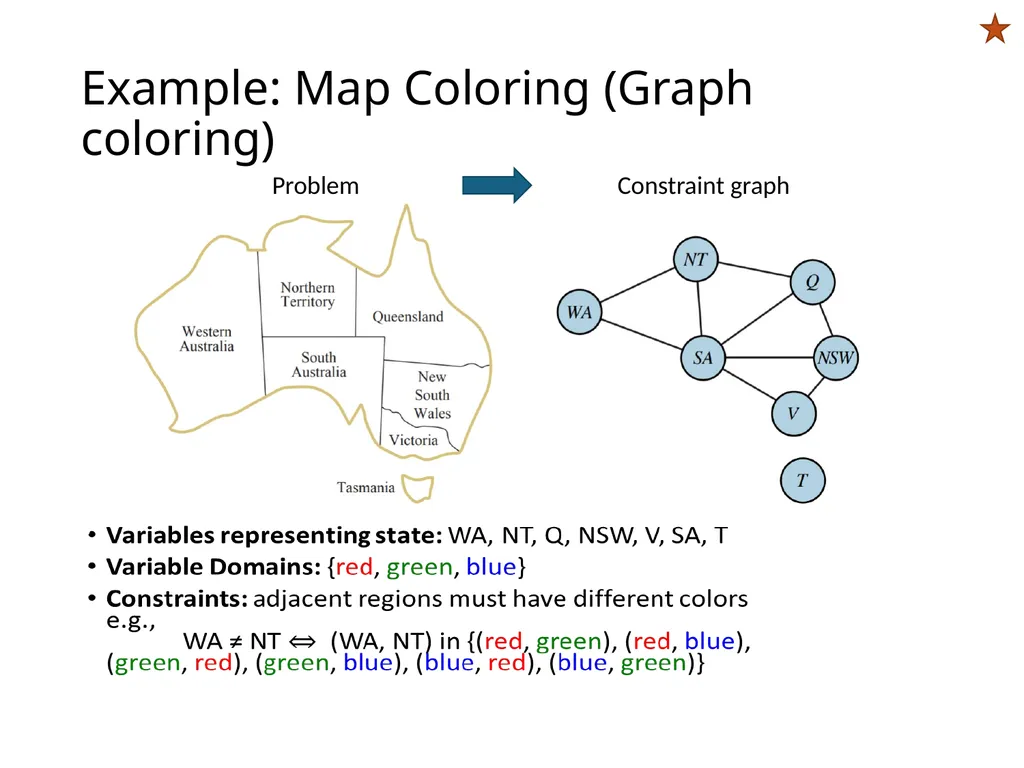
Example: Map Coloring (Graph coloring)<br>
05
Example: Map Coloring Solutions are complete and consistent assignments, e.g.,
WA = red, NT = green, Q = red, NSW = green, V = red, SA = blue, T = green<br>
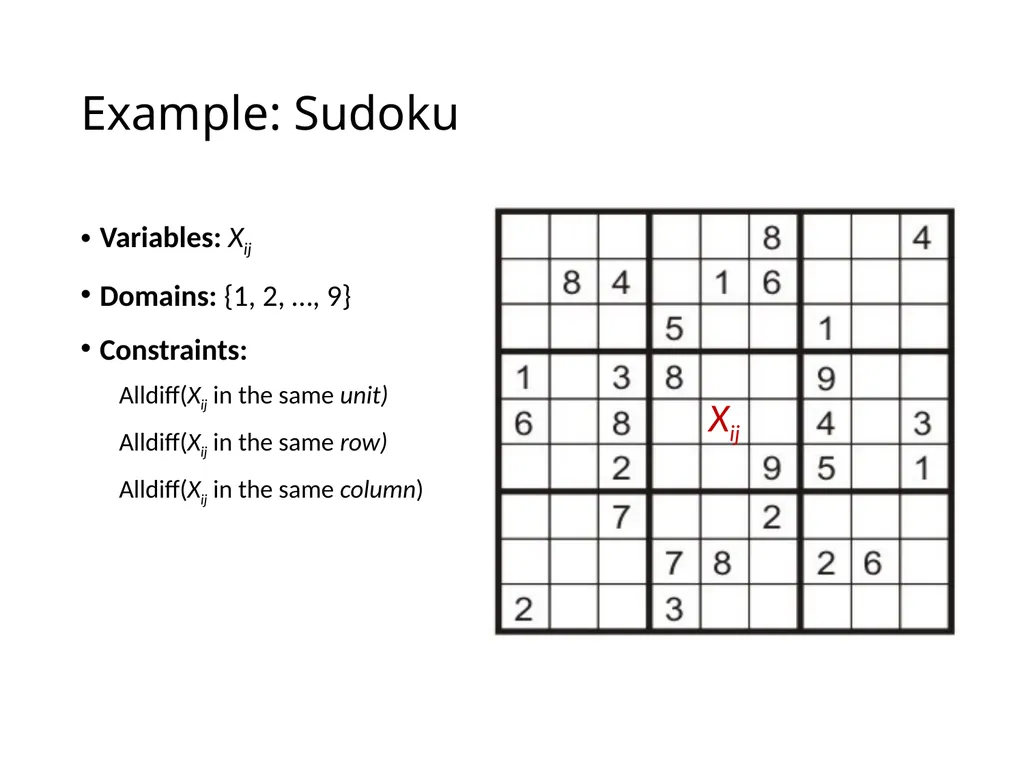
Example: Sudoku Variables: Xij
Domains: {1, 2, …, 9}
Constraints:
Alldiff(Xij in the same unit)
Alldiff(Xij in the same row)
Alldiff(Xij in the same column)<br>
09
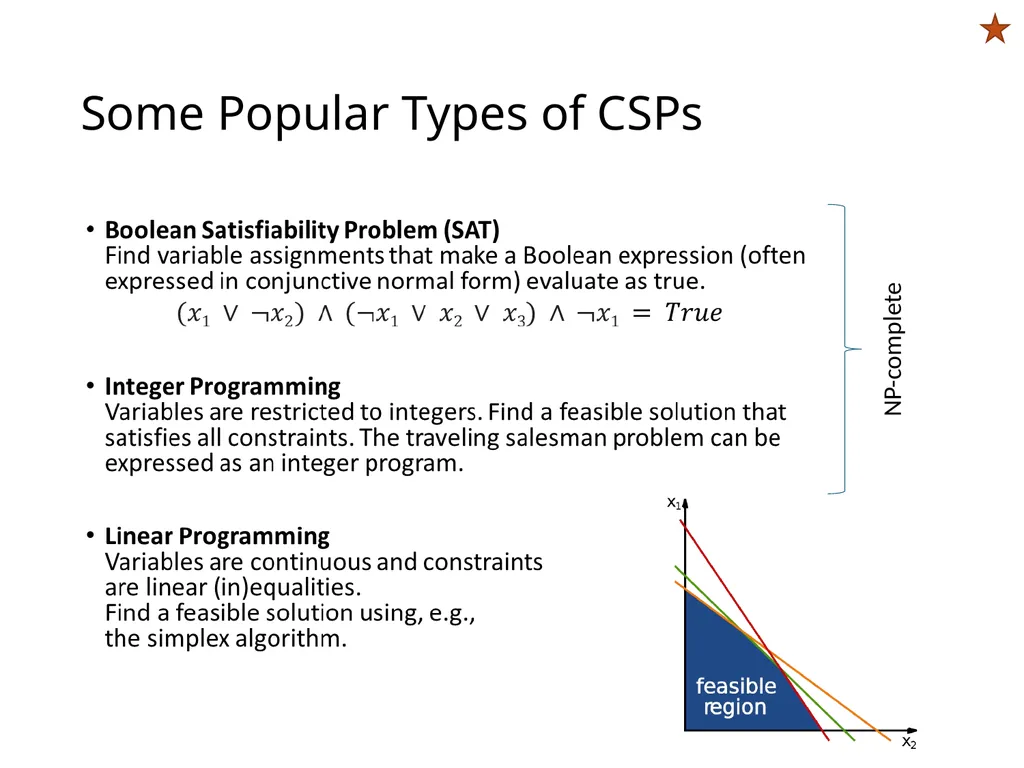
Some Popular Types of CSPs NP-complete<br>
10
Real-world CSPs Assignment problems
e.g., who teaches what class for a fixed schedule. A teacher cannot be in two classes at the same time!
Timetable problems
e.g., which class is offered when and where? No two classes in the same room at the same time.
Scheduling in transportation and production (e.g., order of production steps).
Many problems can naturally also be formulated as CSPs.
More examples of CSPs: http://www.csplib.org/<br>
11
Constraint Satisfaction Problems and Tree Search<br>
12
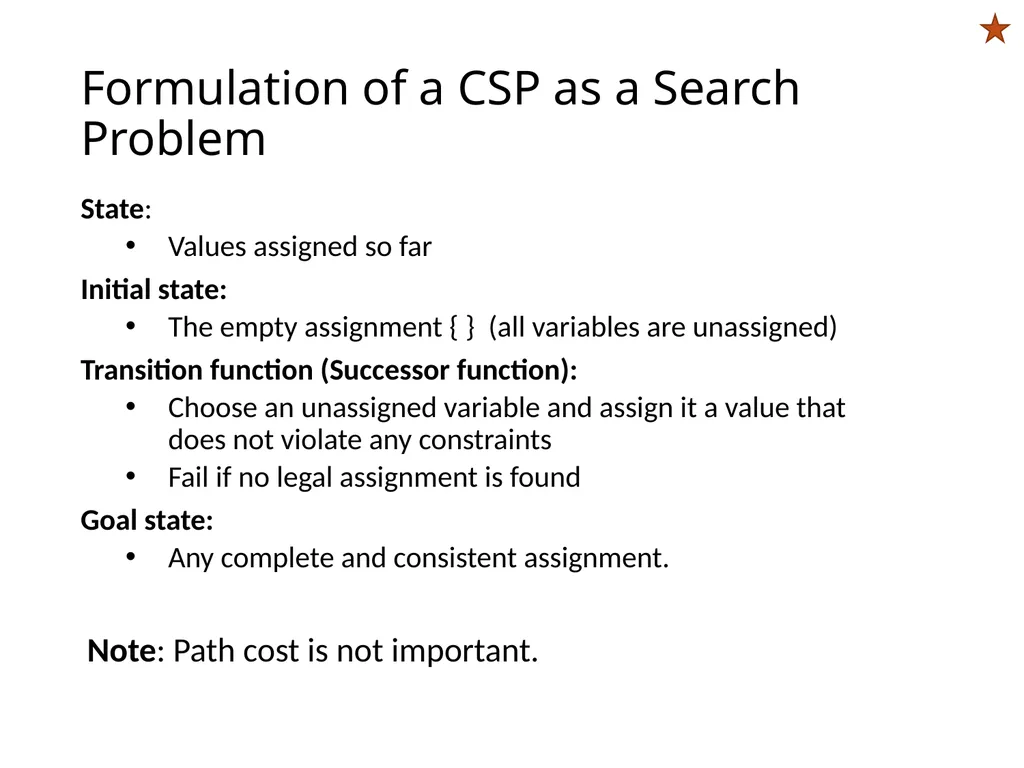
Formulation of a CSP as a Search Problem State:
Values assigned so far
Initial state:
The empty assignment { } (all variables are unassigned)
Transition function (Successor function):
Choose an unassigned variable and assign it a value that does not violate any constraints
Fail if no legal assignment is found
Goal state:
Any complete and consistent assignment.
Note: Path cost is not important.<br>
13
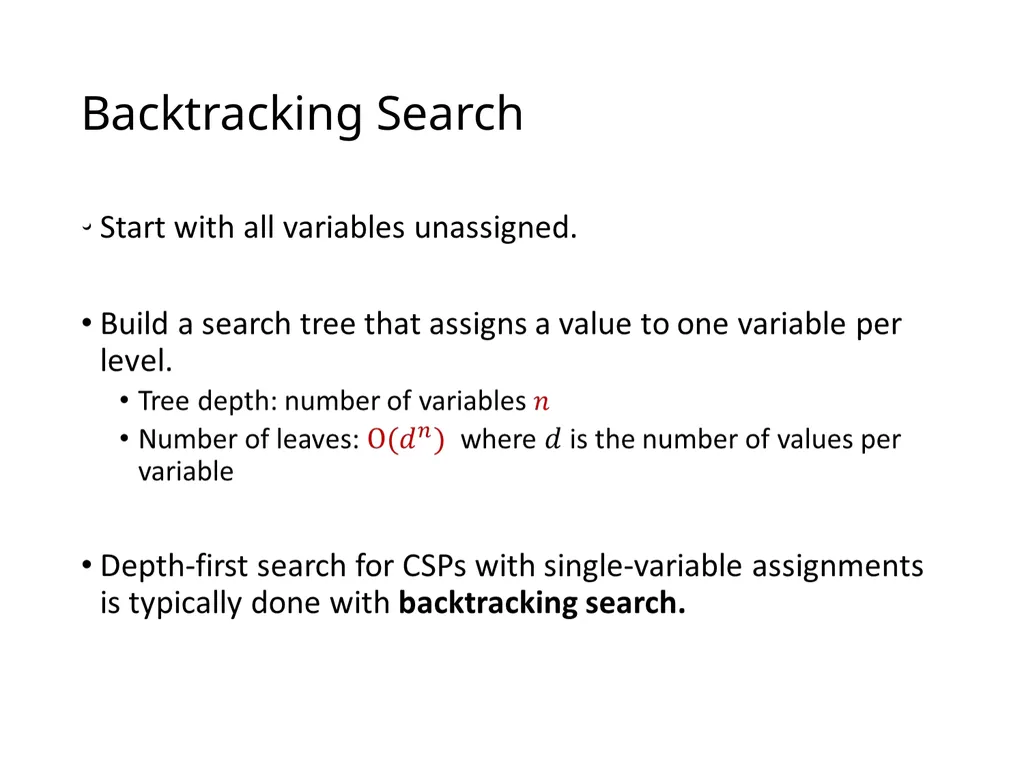
Backtracking Search<br>
14
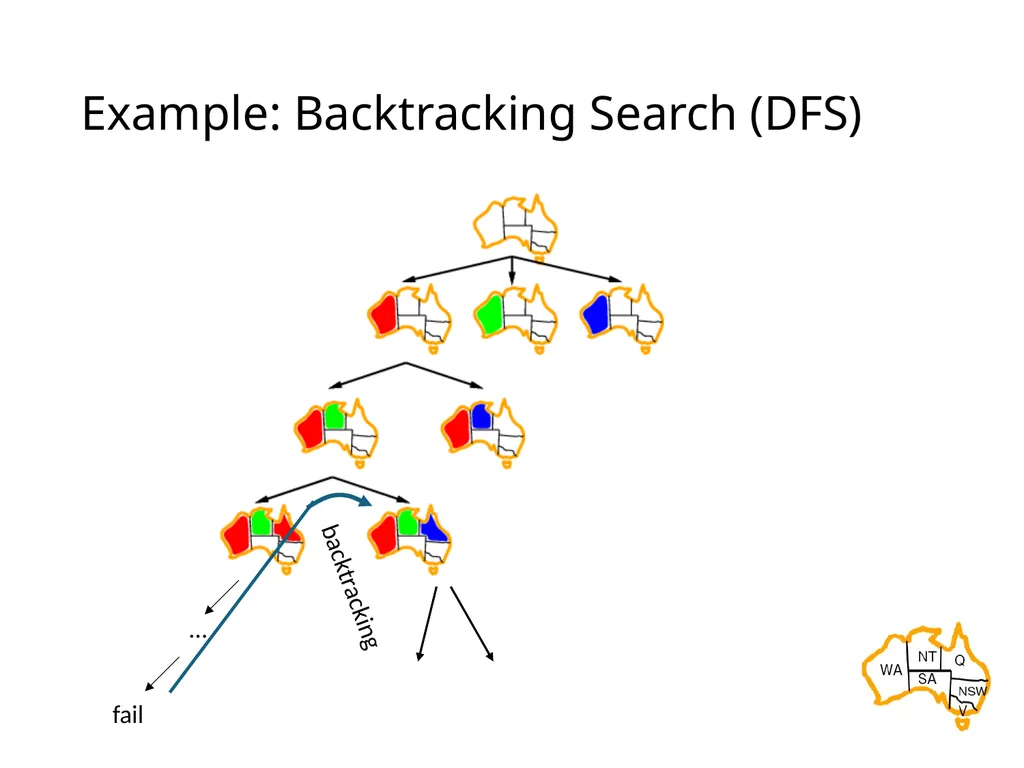
Example: Backtracking Search (DFS)<br>
15
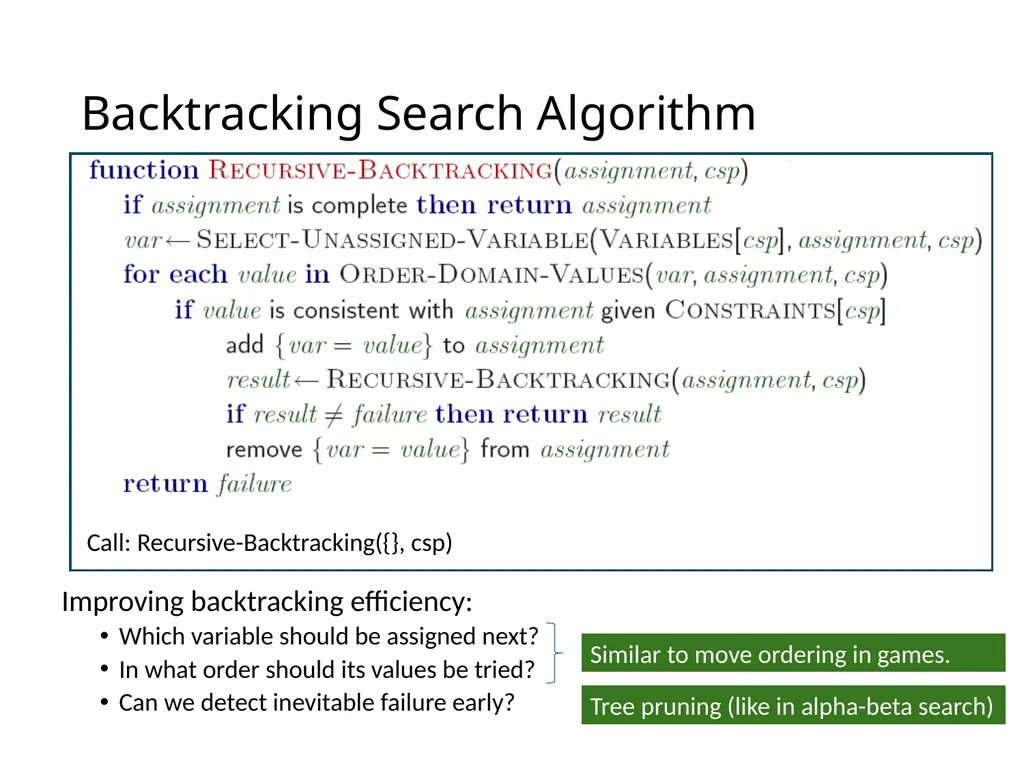
Backtracking Search Algorithm Improving backtracking efficiency:
Which variable should be assigned next?
In what order should its values be tried?
Can we detect inevitable failure early? Similar to move ordering in games. Tree pruning (like in alpha-beta search)<br>
16
Variable/Value Ordering Which variable should be assigned next?
Most constrained variable:
Keep track of remaining legal values for unassigned variables (using constraints).
Choose the variable with the fewest legal values left.
A.k.a. minimum remaining values (MRV) heuristic.
In which order should its values be tried?
Choose the least constraining value:
The value that rules out the fewest values in the remaining variables.<br>
17
Early Detection of Failure: Forward Checking Node Consistency Keep track of remaining legal values for unassigned variables
Terminate search when any variable has no legal values (i.e., minimum remaining values = 0)
NT and SA cannot both be blue! This violates the constraint.<br>
18
Early Detection of Failure: Forward Checking Arc Consistency X is arc consistent wrt Y iff for every value of X there is some allowed value of Y.
Make X arc consistent wrt Y by throwing out any values of X for which there is no allowed value of Y.
Arc consistency detects failure earlier than node consistency
There are more consistency checks (path consistency, K-consistency) NWS cannot be blue because SA has to be blue.
V cannot be red because NSW has to be red.
SA cannot be blue because NT is blue.
Fail and backtrack<br>
19
Backtracking Search With Ordering and Early Failure Detection<br>
20
Local Search for Constraint Satisfaction Problems Minimize violated constraints MotorCycleUSA.com<br>
21
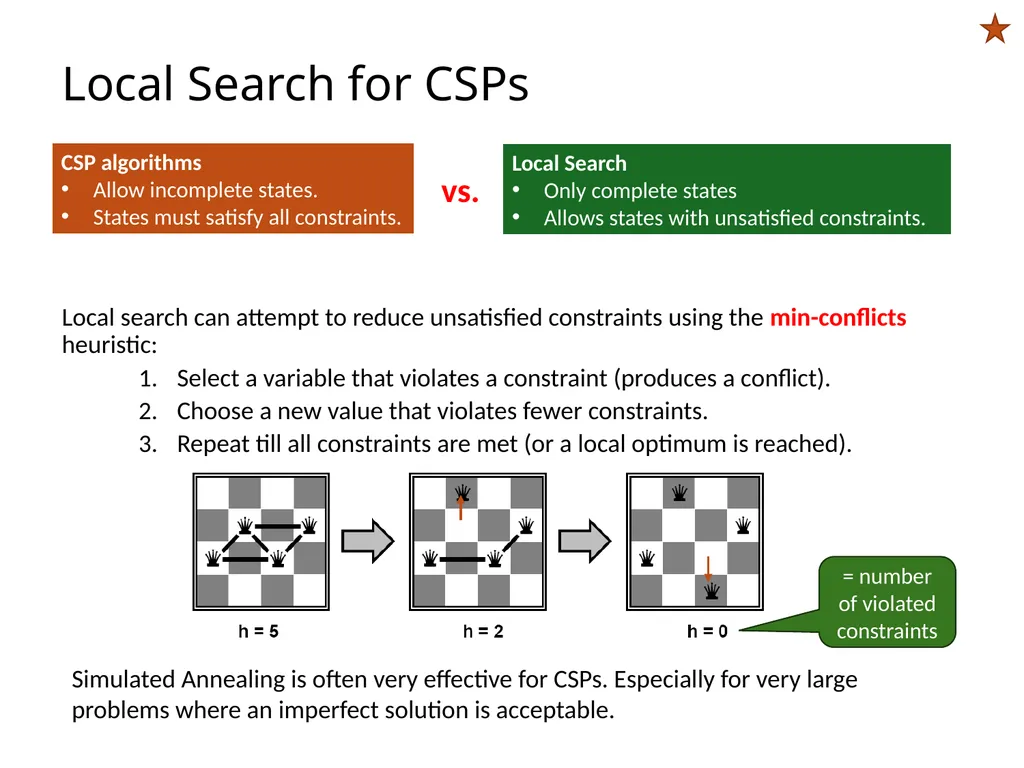
Local Search for CSPs CSP algorithms
Allow incomplete states.
States must satisfy all constraints. vs. Local Search
Only complete states
Allows states with unsatisfied constraints. Local search can attempt to reduce unsatisfied constraints using the min-conflicts heuristic:
Select a variable that violates a constraint (produces a conflict).
Choose a new value that violates fewer constraints.
Repeat till all constraints are met (or a local optimum is reached). Simulated Annealing is often very effective for CSPs. Especially for very large problems where an imperfect solution is acceptable.<br>
22
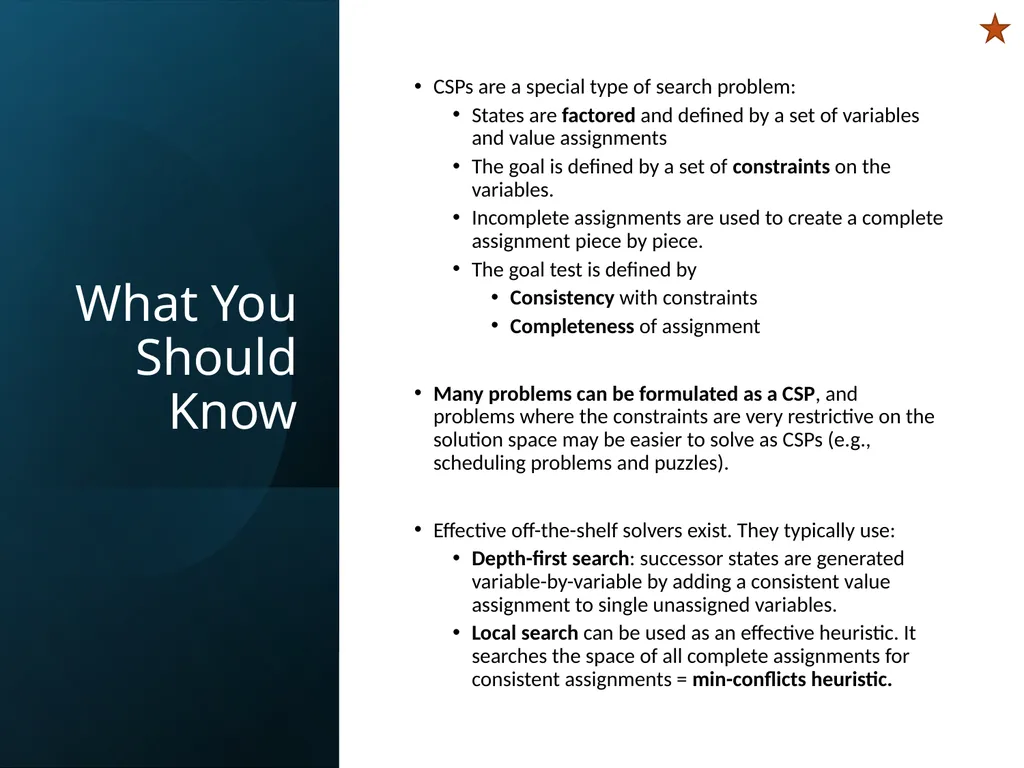
What You Should Know CSPs are a special type of search problem:
States are factored and defined by a set of variables and value assignments
The goal is defined by a set of constraints on the variables.
Incomplete assignments are used to create a complete assignment piece by piece.
The goal test is defined by
Consistency with constraints
Completeness of assignment
Many problems can be formulated as a CSP, and problems where the constraints are very restrictive on the solution space may be easier to solve as CSPs (e.g., scheduling problems and puzzles).
Effective off-the-shelf solvers exist. They typically use:
Depth-first search: successor states are generated variable-by-variable by adding a consistent value assignment to single unassigned variables.
Local search can be used as an effective heuristic. It searches the space of all complete assignments for consistent assignments = min-conflicts heuristic.<br>