
CS 5/7320 Artificial Intelligence Intelligent
LV
Published · 48 slides · 0 views
1 / 1
Description
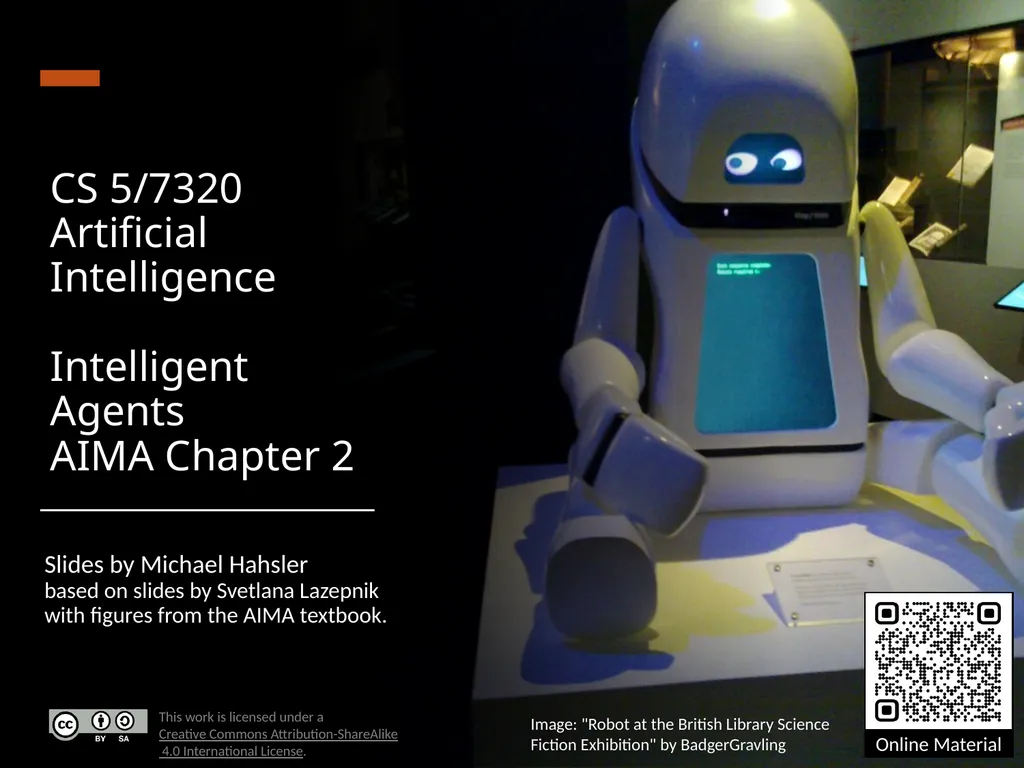
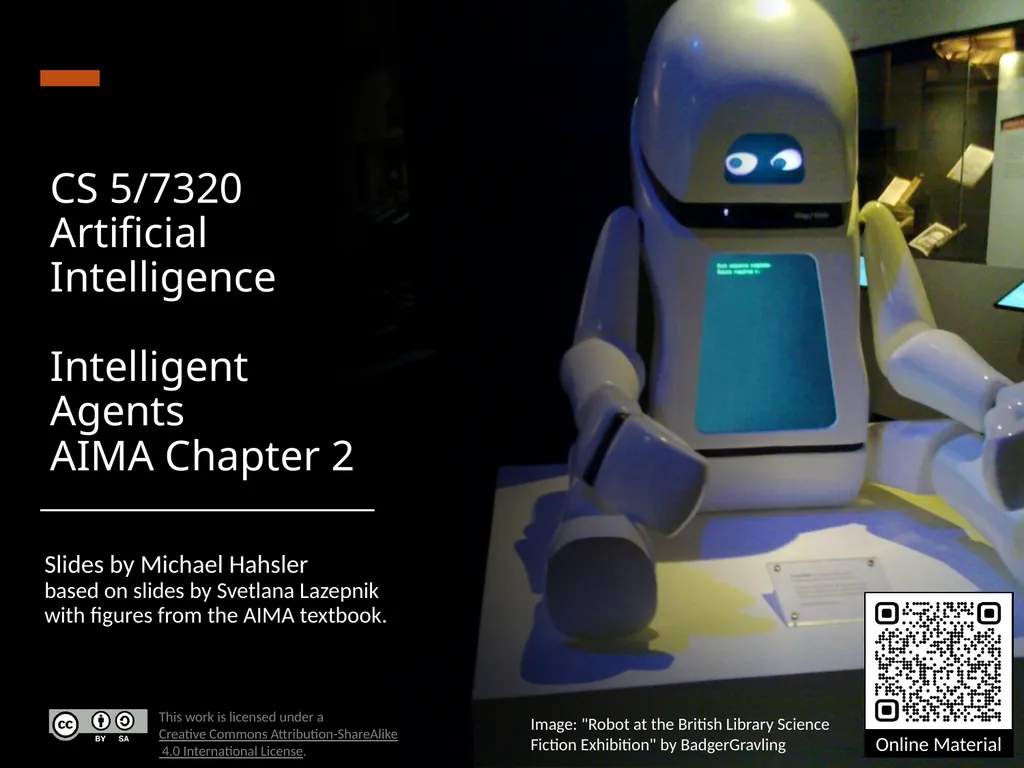
CS 57320 Artificial Intelligence Intelligent Agents AIMA Chapter 2 Slides by Michael Hahsler based on slides by Svetlana Lazepnik with figures from the AIMA textbook. Image: Robot at the British Library Science Fiction Exhibition by
Related Topics
Share
Embed code
Download this presentation From Below
"CS 5/7320 Artificial Intelligence Intelligent" is the property of its rightful owner. Permission is granted to download and print the materials on this website for personal, non-commercial use only, and to display it on your personal computer provided you do not modify the materials and that you retain all copyright notices contained in the materials. By downloading content from our website, you accept the terms of this agreement.
Presentation Transcript
01
CS 5/7320
Artificial Intelligence
Intelligent Agents
AIMA Chapter 2 Slides by Michael Hahsler
based on slides by Svetlana Lazepnik with figures from the AIMA textbook. Image: "Robot at the British Library Science Fiction Exhibition" by BadgerGravling<br>
02
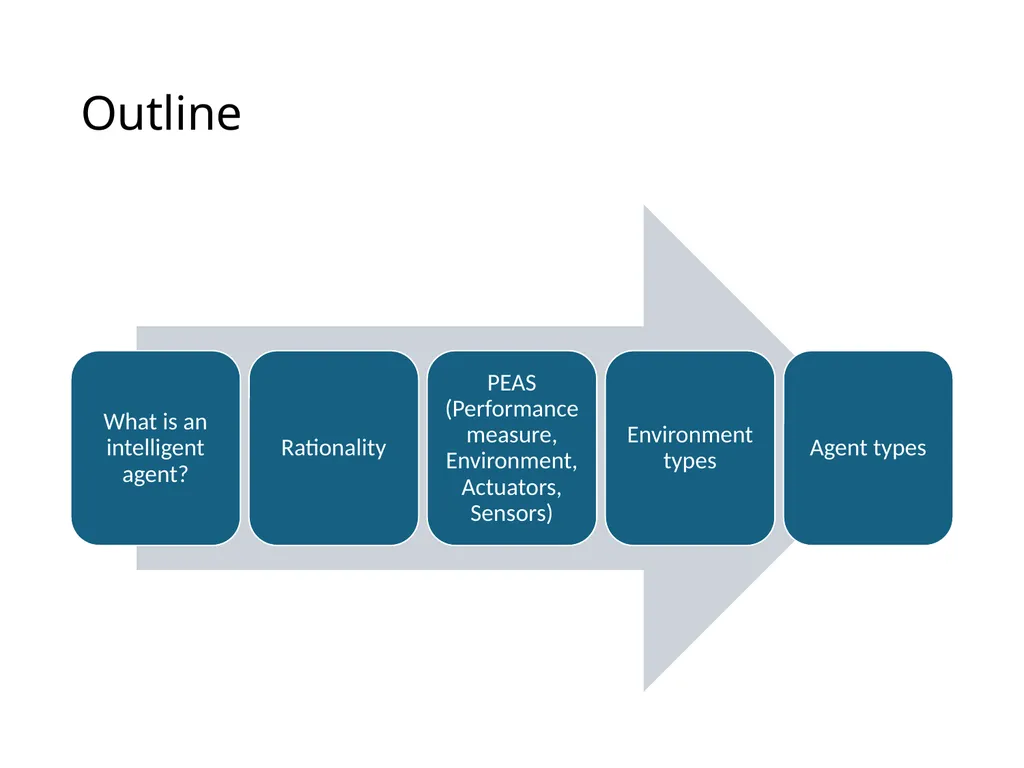
Outline<br>
03
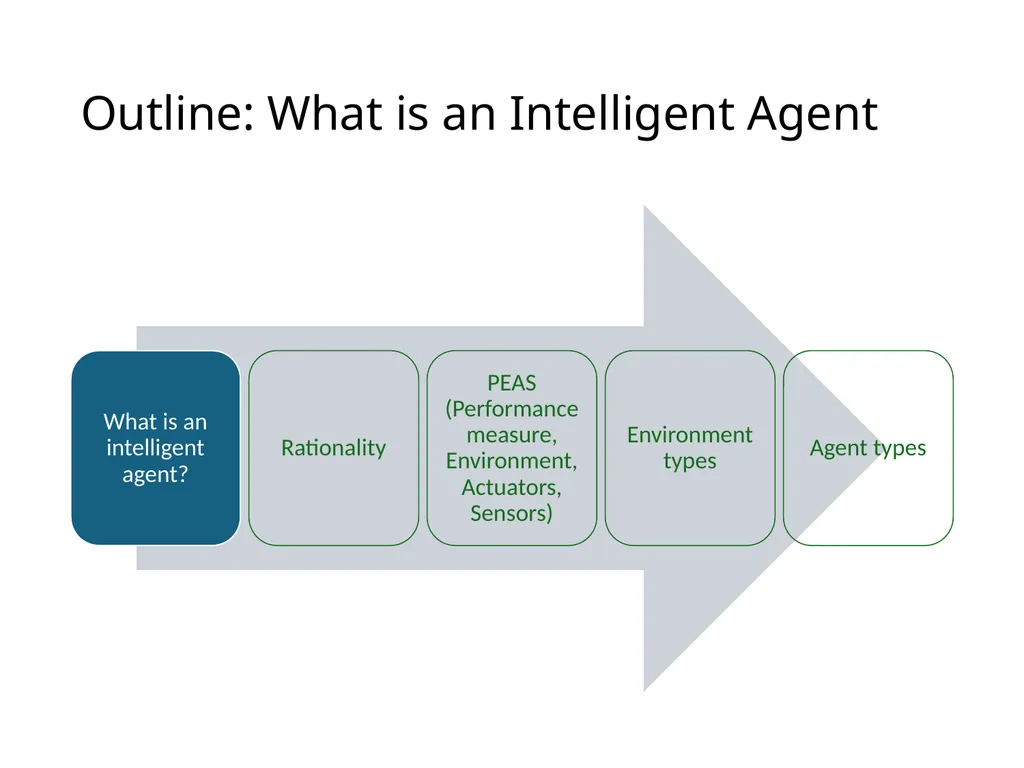
Outline: What is an Intelligent Agent<br>
04
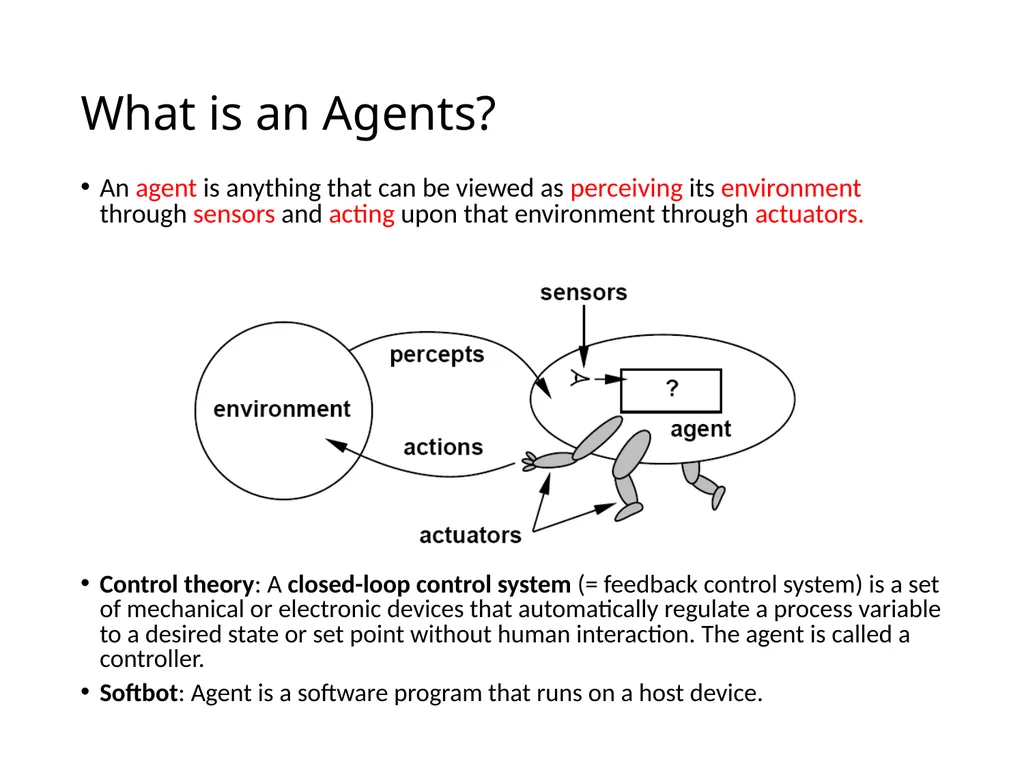
What is an Agents? An agent is anything that can be viewed as perceiving its environment through sensors and acting upon that environment through actuators.
Control theory: A closed-loop control system (= feedback control system) is a set of mechanical or electronic devices that automatically regulate a process variable to a desired state or set point without human interaction. The agent is called a controller.
Softbot: Agent is a software program that runs on a host device.<br>
Control theory: A closed-loop control system (= feedback control system) is a set of mechanical or electronic devices that automatically regulate a process variable to a desired state or set point without human interaction. The agent is called a controller.
Softbot: Agent is a software program that runs on a host device.<br>
05
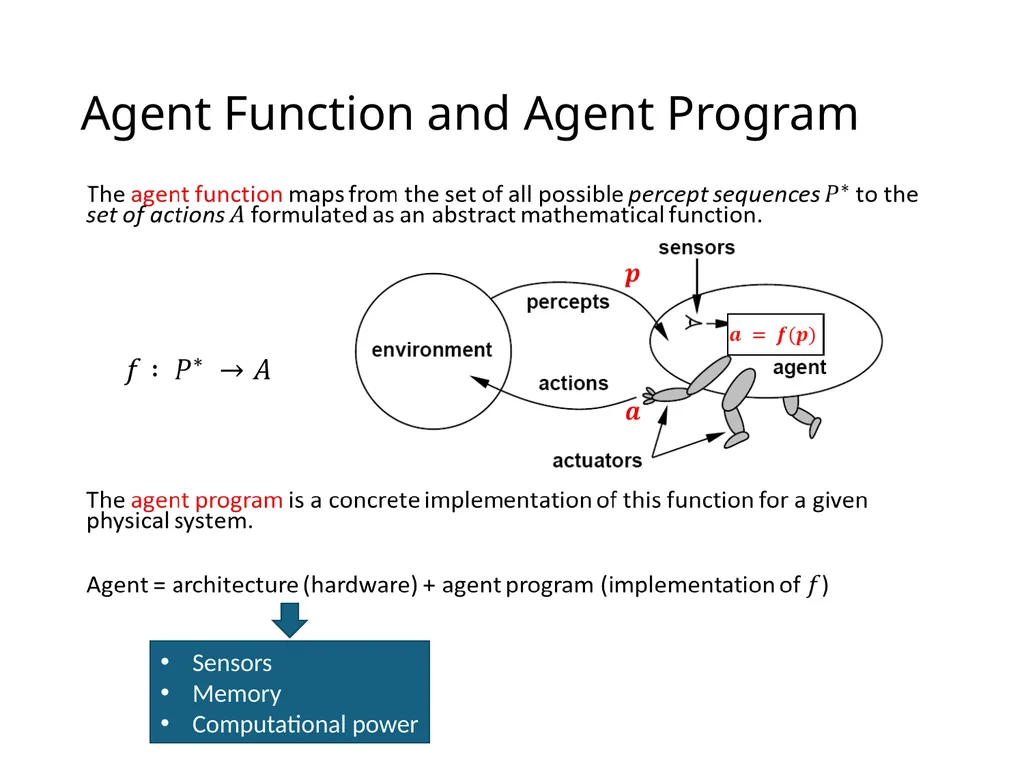
Agent Function and Agent Program Sensors
Memory
Computational power<br>
Memory
Computational power<br>
06
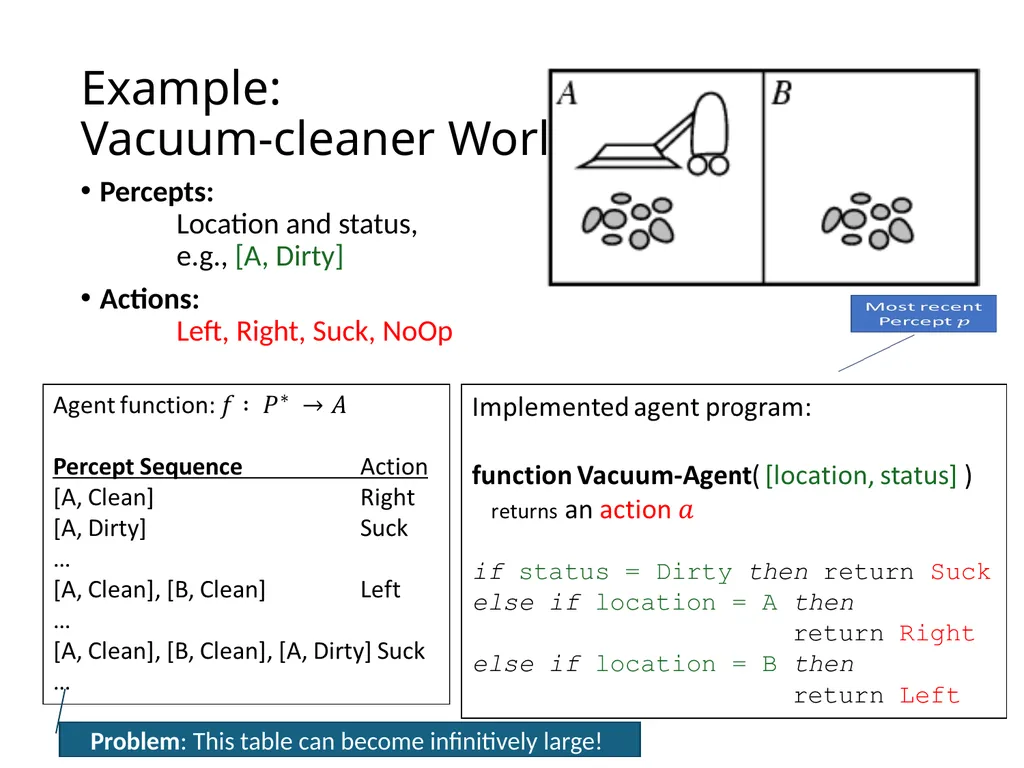
Example:
Vacuum-cleaner World Percepts:
Location and status,
e.g., [A, Dirty]
Actions: Left, Right, Suck, NoOp Problem: This table can become infinitively large!<br>
Actions: Left, Right, Suck, NoOp Problem: This table can become infinitively large!<br>
07
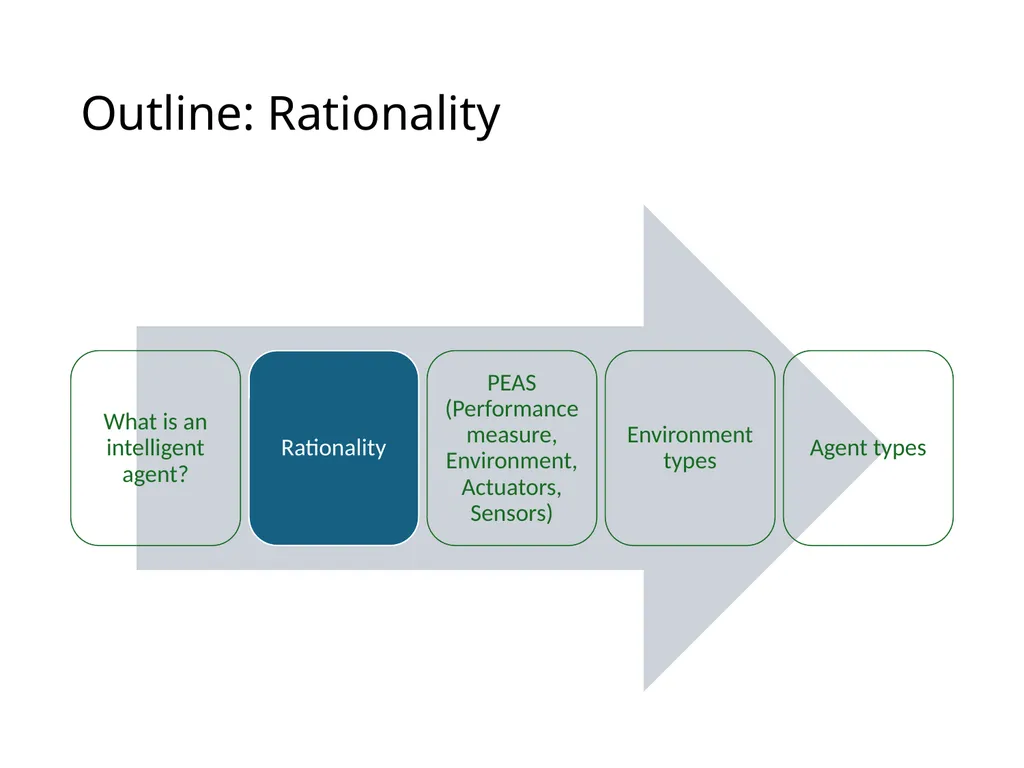
Outline: Rationality<br>
08
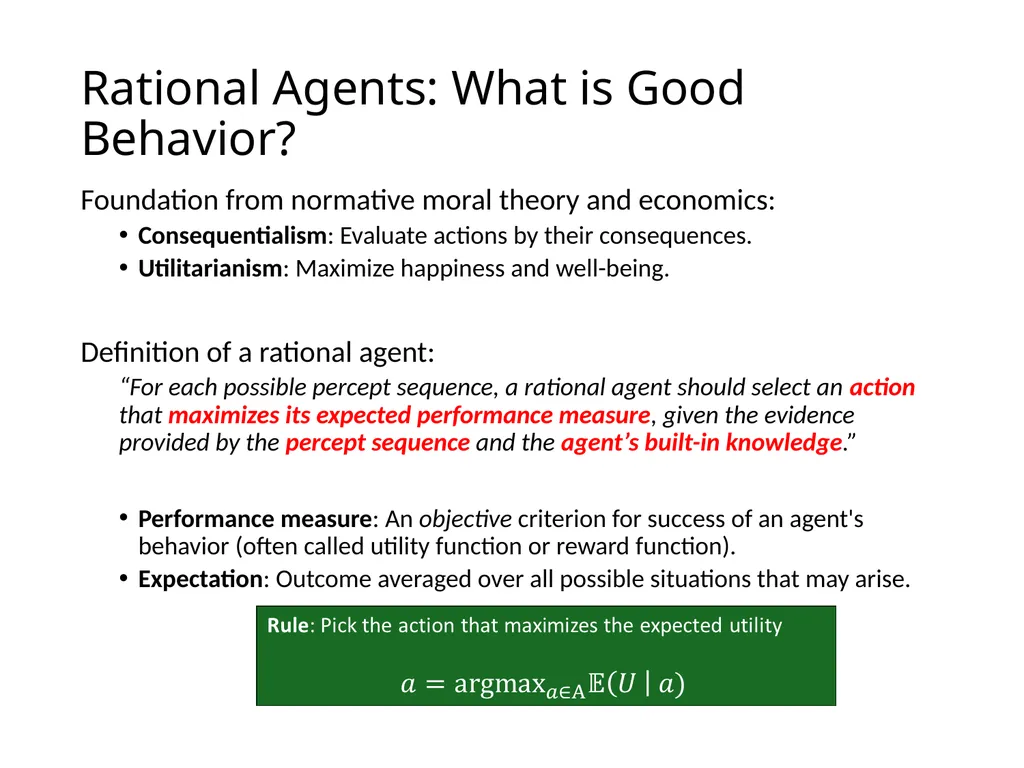
Rational Agents: What is Good Behavior? Foundation from normative moral theory and economics:
Consequentialism: Evaluate actions by their consequences.
Utilitarianism: Maximize happiness and well-being.
Definition of a rational agent:
“For each possible percept sequence, a rational agent should select an action that maximizes its expected performance measure, given the evidence provided by the percept sequence and the agent’s built-in knowledge.”
Performance measure: An objective criterion for success of an agent's behavior (often called utility function or reward function).
Expectation: Outcome averaged over all possible situations that may arise.<br>
Consequentialism: Evaluate actions by their consequences.
Utilitarianism: Maximize happiness and well-being.
Definition of a rational agent:
“For each possible percept sequence, a rational agent should select an action that maximizes its expected performance measure, given the evidence provided by the percept sequence and the agent’s built-in knowledge.”
Performance measure: An objective criterion for success of an agent's behavior (often called utility function or reward function).
Expectation: Outcome averaged over all possible situations that may arise.<br>
09
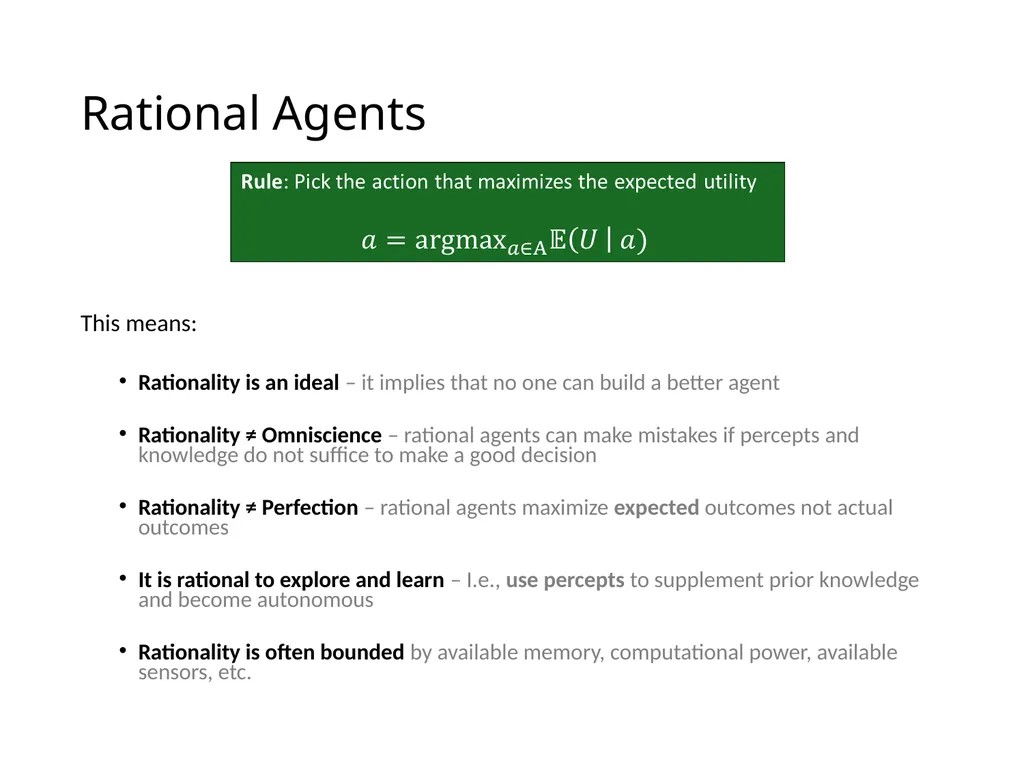
Rational Agents This means:
Rationality is an ideal – it implies that no one can build a better agent
Rationality ≠ Omniscience – rational agents can make mistakes if percepts and knowledge do not suffice to make a good decision
Rationality ≠ Perfection – rational agents maximize expected outcomes not actual outcomes
It is rational to explore and learn – I.e., use percepts to supplement prior knowledge and become autonomous
Rationality is often bounded by available memory, computational power, available sensors, etc.<br>
Rationality is an ideal – it implies that no one can build a better agent
Rationality ≠ Omniscience – rational agents can make mistakes if percepts and knowledge do not suffice to make a good decision
Rationality ≠ Perfection – rational agents maximize expected outcomes not actual outcomes
It is rational to explore and learn – I.e., use percepts to supplement prior knowledge and become autonomous
Rationality is often bounded by available memory, computational power, available sensors, etc.<br>
10
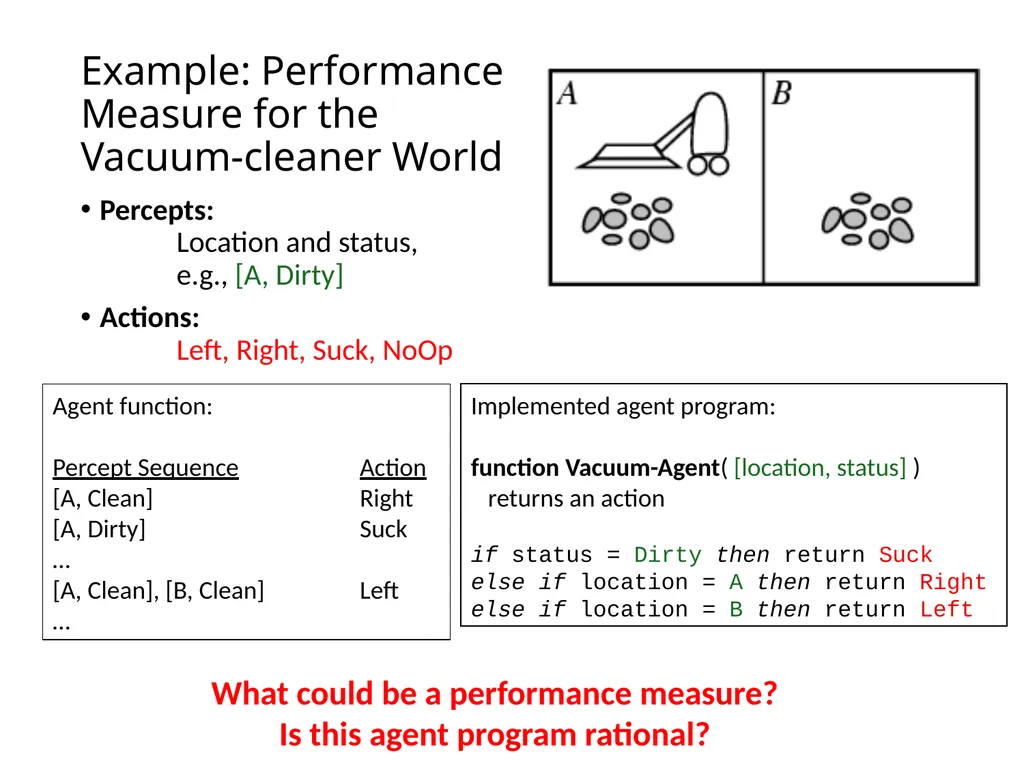
Example: Performance Measure for the
Vacuum-cleaner World Percepts:
Location and status,
e.g., [A, Dirty]
Actions: Left, Right, Suck, NoOp Agent function:
Percept Sequence Action
[A, Clean] Right
[A, Dirty] Suck
…
[A, Clean], [B, Clean] Left
… Implemented agent program:
function Vacuum-Agent( [location, status] ) returns an action
if status = Dirty then return Suck
else if location = A then return Right
else if location = B then return Left What could be a performance measure?
Is this agent program rational?<br>
Actions: Left, Right, Suck, NoOp Agent function:
Percept Sequence Action
[A, Clean] Right
[A, Dirty] Suck
…
[A, Clean], [B, Clean] Left
… Implemented agent program:
function Vacuum-Agent( [location, status] ) returns an action
if status = Dirty then return Suck
else if location = A then return Right
else if location = B then return Left What could be a performance measure?
Is this agent program rational?<br>
11
Outline: PEAS<br>
12
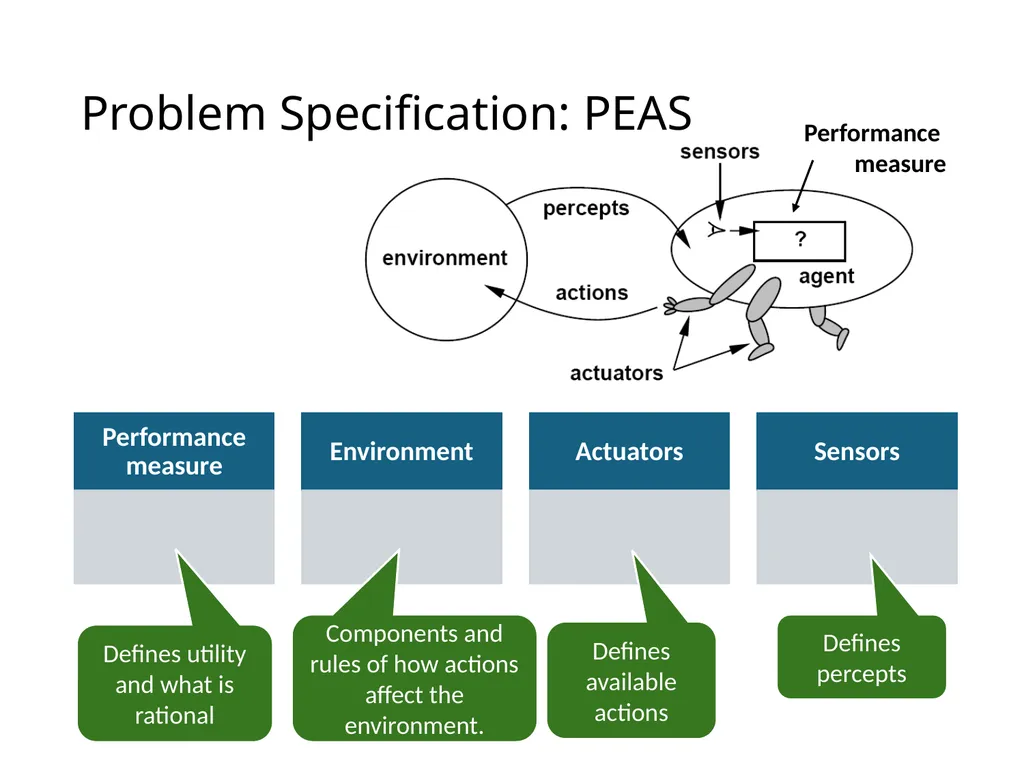
Problem Specification: PEAS Defines utility and what is rational Components and rules of how actions affect the environment. Defines available actions Defines percepts<br>
13
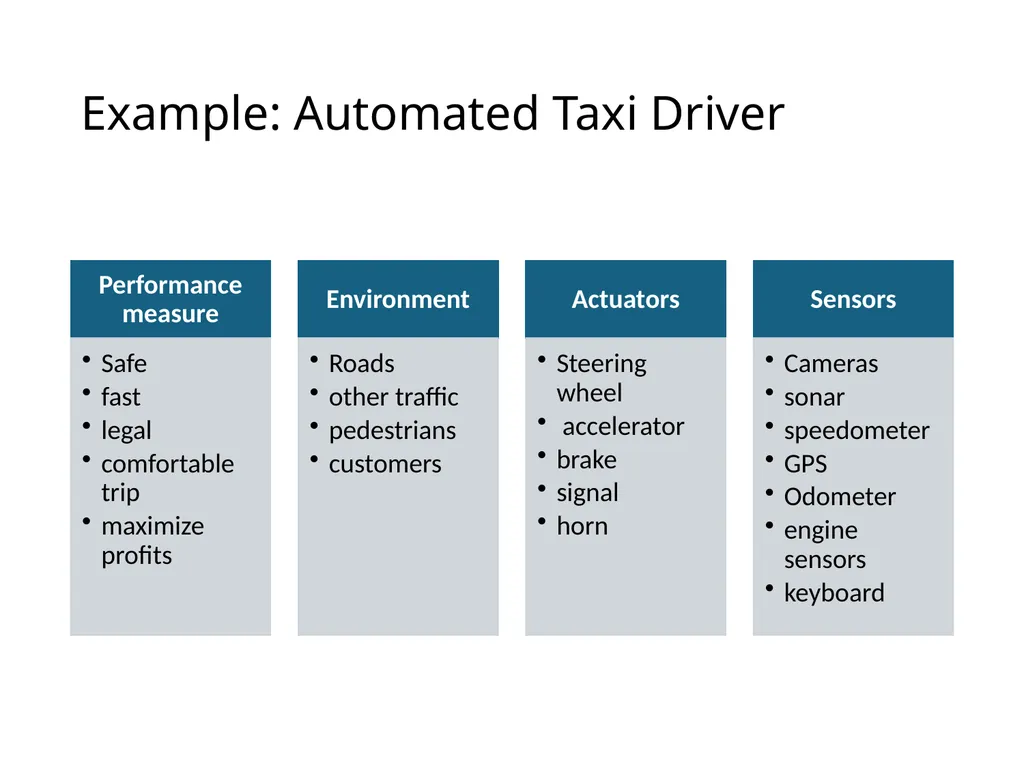
Example: Automated Taxi Driver<br>
14
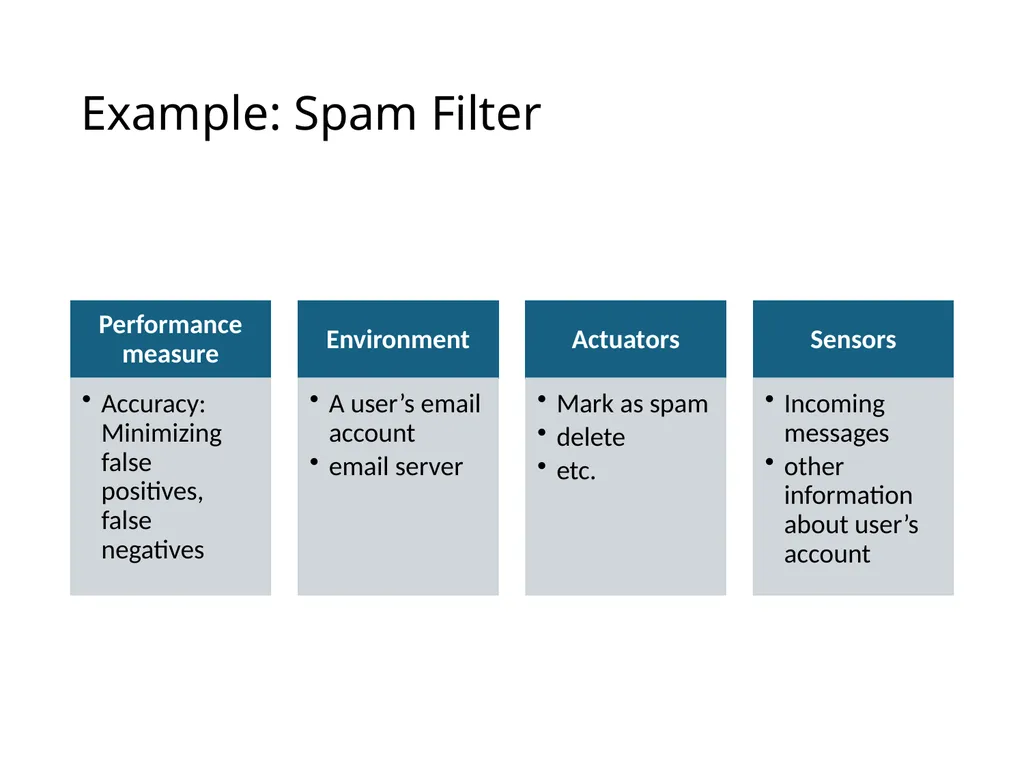
Example: Spam Filter<br>
15
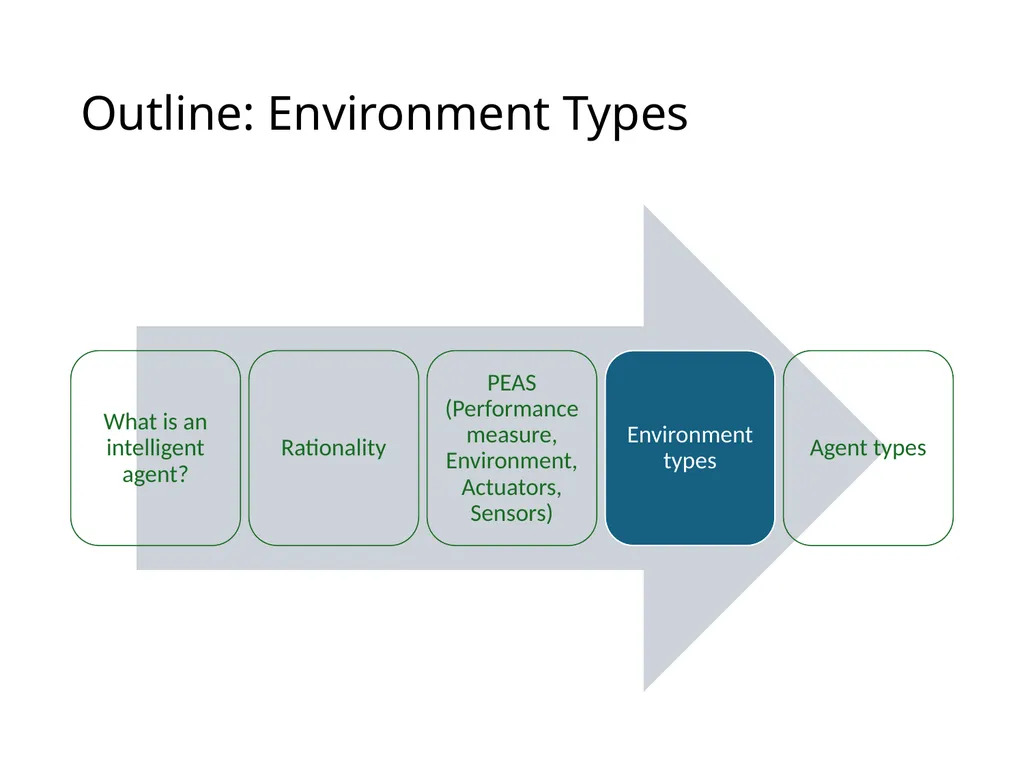
Outline: Environment Types<br>
16
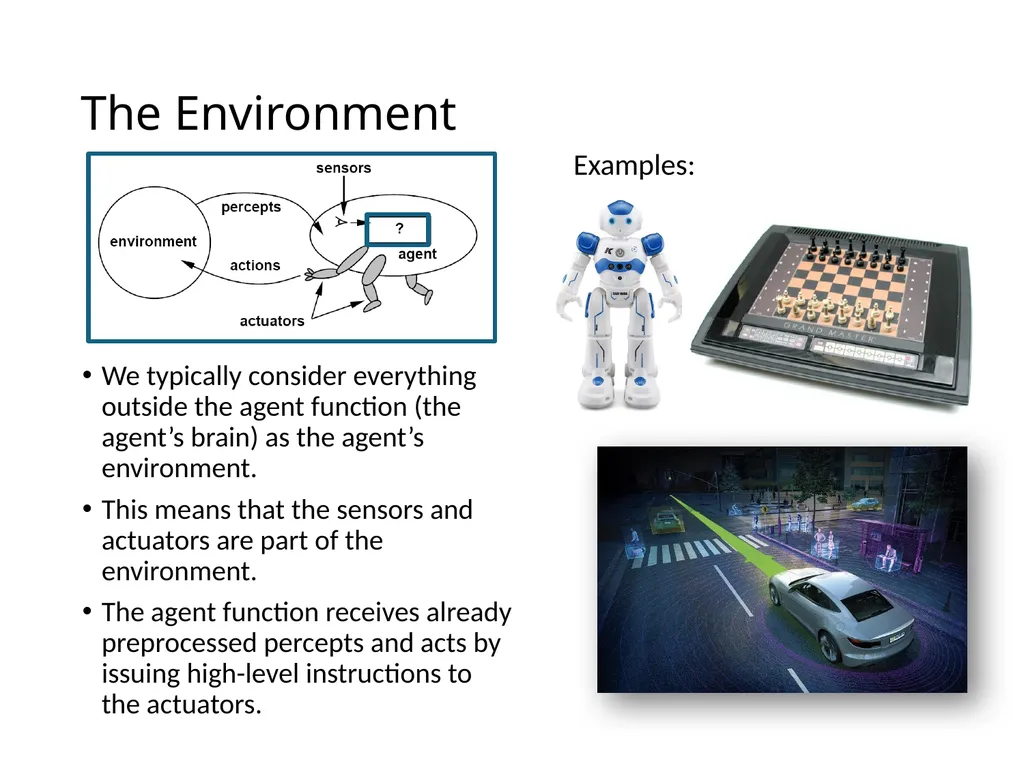
The Environment We typically consider everything outside the agent function (the agent’s brain) as the agent’s environment.
This means that the sensors and actuators are part of the environment.
The agent function receives already preprocessed percepts and acts by issuing high-level instructions to the actuators. Examples:<br>
This means that the sensors and actuators are part of the environment.
The agent function receives already preprocessed percepts and acts by issuing high-level instructions to the actuators. Examples:<br>
17
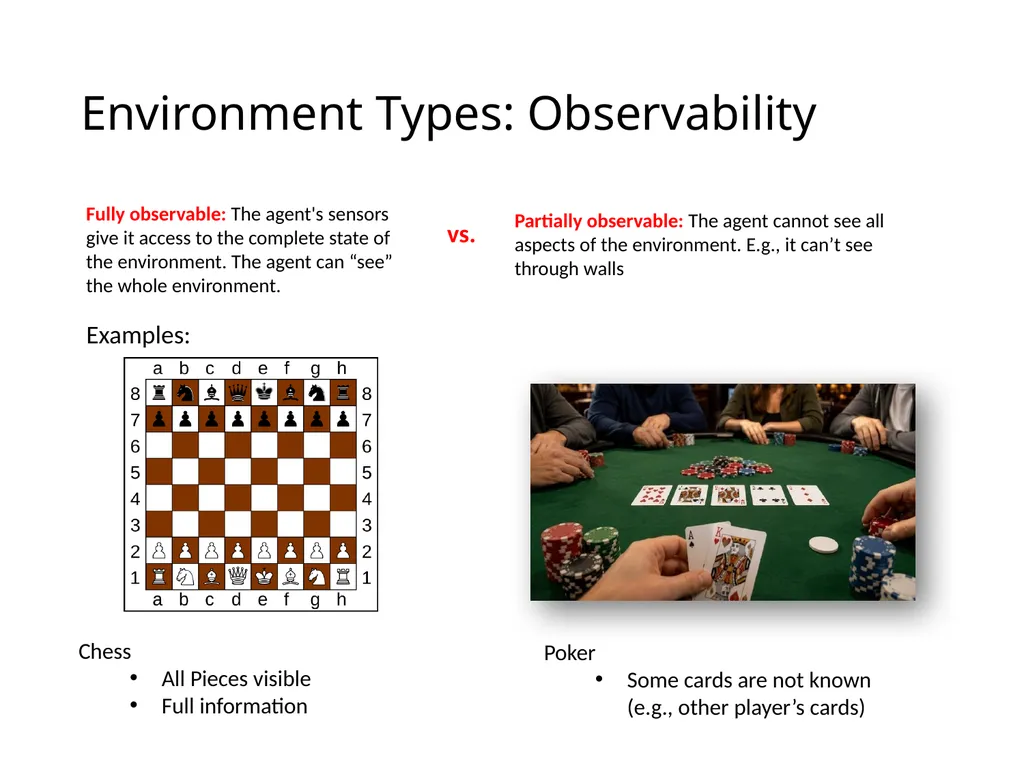
Environment Types: Observability Fully observable: The agent's sensors give it access to the complete state of the environment. The agent can “see” the whole environment. vs. Partially observable: The agent cannot see all aspects of the environment. E.g., it can’t see through walls Examples:<br>
18
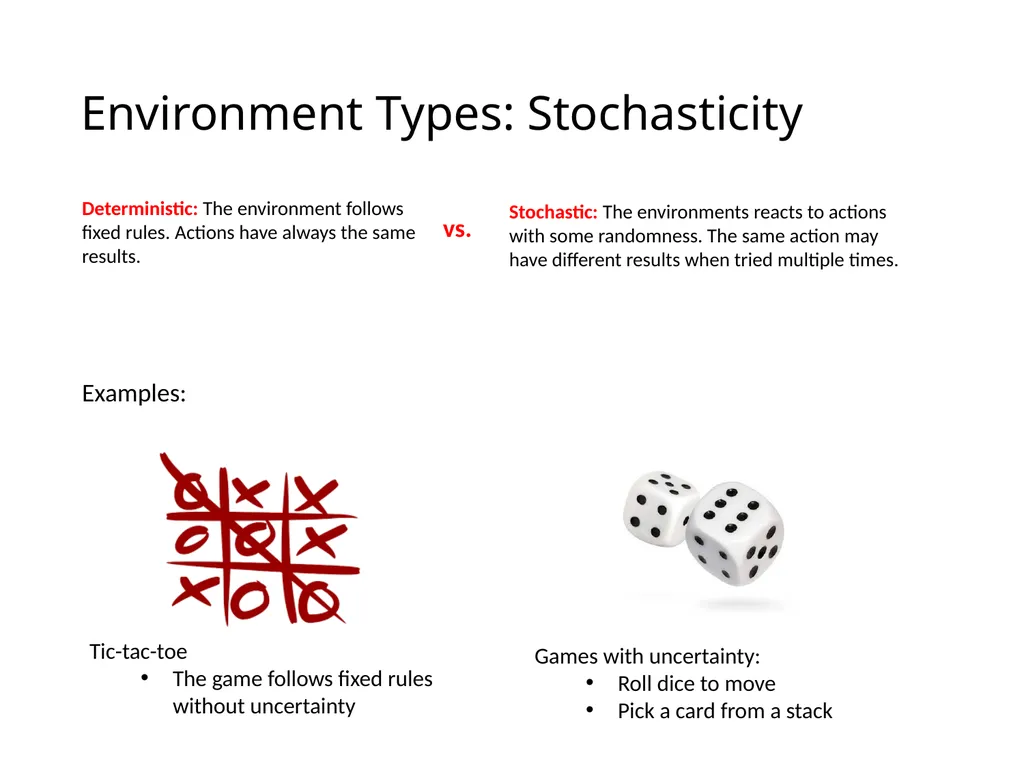
Environment Types: Stochasticity Deterministic: The environment follows fixed rules. Actions have always the same results. vs. Stochastic: The environments reacts to actions with some randomness. The same action may have different results when tried multiple times. Examples:<br>
19
Special Case of Stochastic Environments:
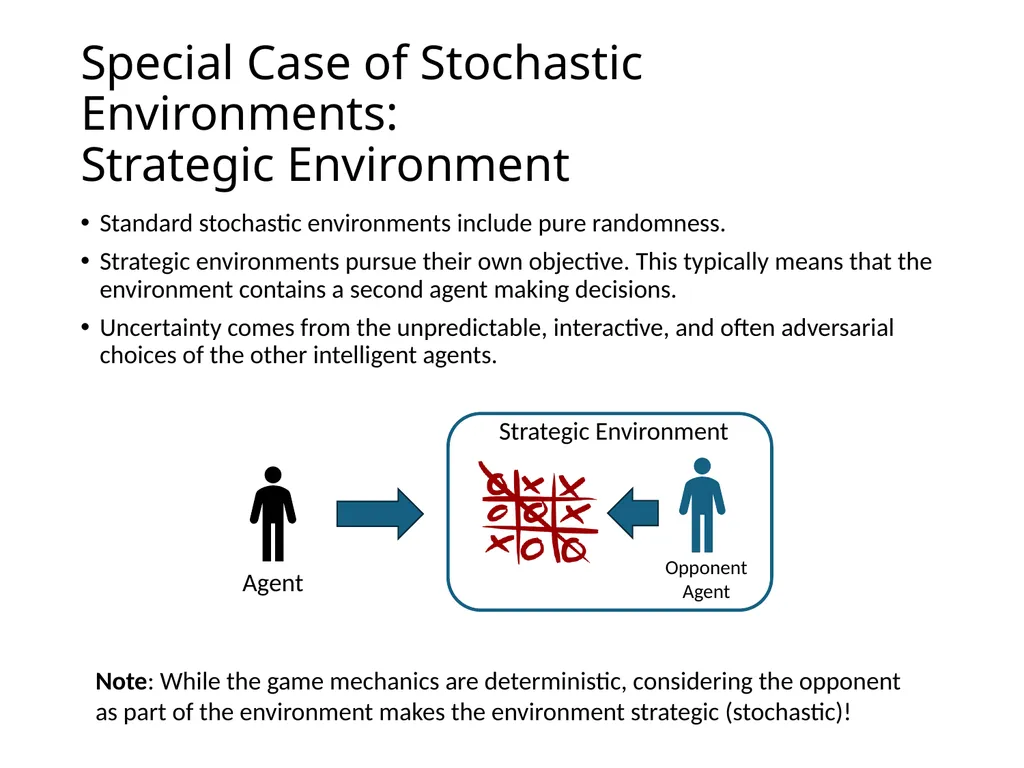
Strategic Environment Standard stochastic environments include pure randomness.
Strategic environments pursue their own objective. This typically means that the environment contains a second agent making decisions.
Uncertainty comes from the unpredictable, interactive, and often adversarial choices of the other intelligent agents. Note: While the game mechanics are deterministic, considering the opponent as part of the environment makes the environment strategic (stochastic)!<br>
Strategic environments pursue their own objective. This typically means that the environment contains a second agent making decisions.
Uncertainty comes from the unpredictable, interactive, and often adversarial choices of the other intelligent agents. Note: While the game mechanics are deterministic, considering the opponent as part of the environment makes the environment strategic (stochastic)!<br>
20
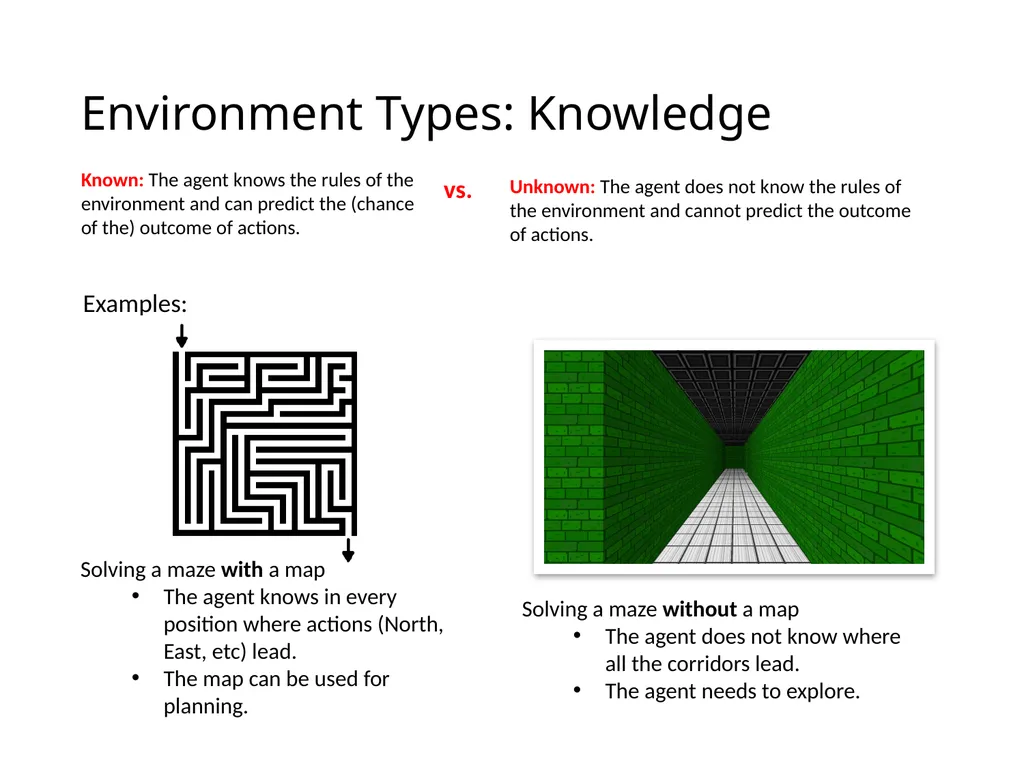
Environment Types: Knowledge Known: The agent knows the rules of the environment and can predict the (chance of the) outcome of actions. vs. Unknown: The agent does not know the rules of the environment and cannot predict the outcome of actions. Examples:<br>
21
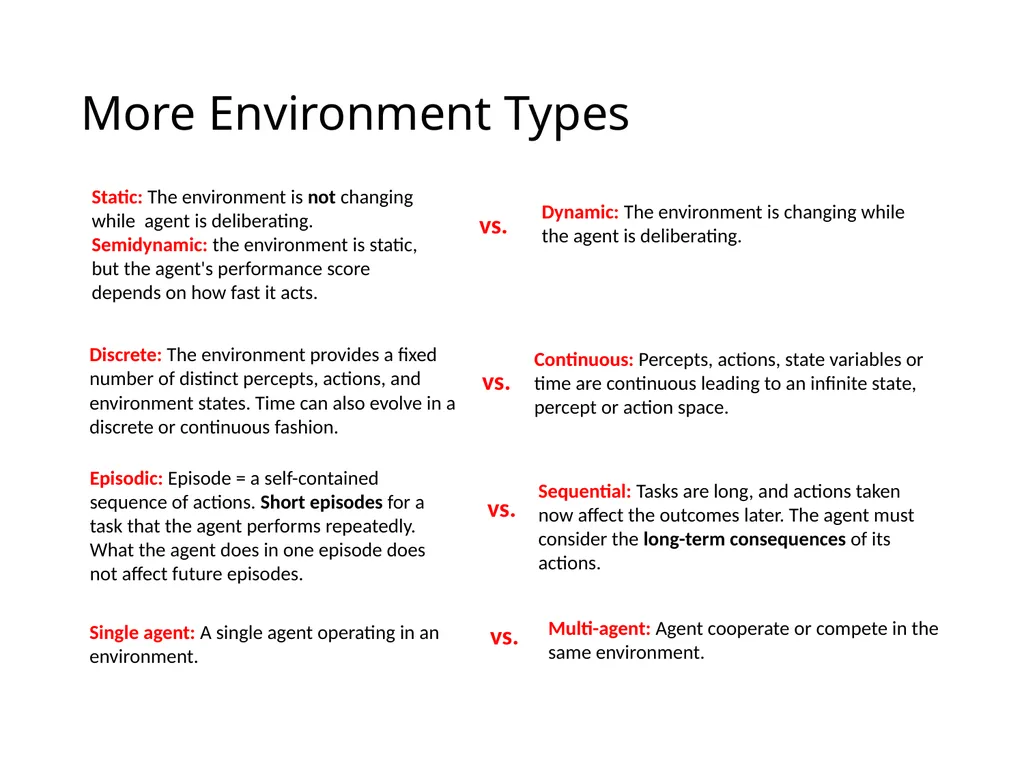
More Environment Types Static: The environment is not changing while agent is deliberating. Semidynamic: the environment is static, but the agent's performance score depends on how fast it acts. vs. Dynamic: The environment is changing while the agent is deliberating. Discrete: The environment provides a fixed number of distinct percepts, actions, and environment states. Time can also evolve in a discrete or continuous fashion. vs. Continuous: Percepts, actions, state variables or time are continuous leading to an infinite state, percept or action space. Episodic: Episode = a self-contained sequence of actions. Short episodes for a task that the agent performs repeatedly. What the agent does in one episode does not affect future episodes. vs. Sequential: Tasks are long, and actions taken now affect the outcomes later. The agent must consider the long-term consequences of its actions. Single agent: A single agent operating in an environment. vs. Multi-agent: Agent cooperate or compete in the same environment.<br>
22
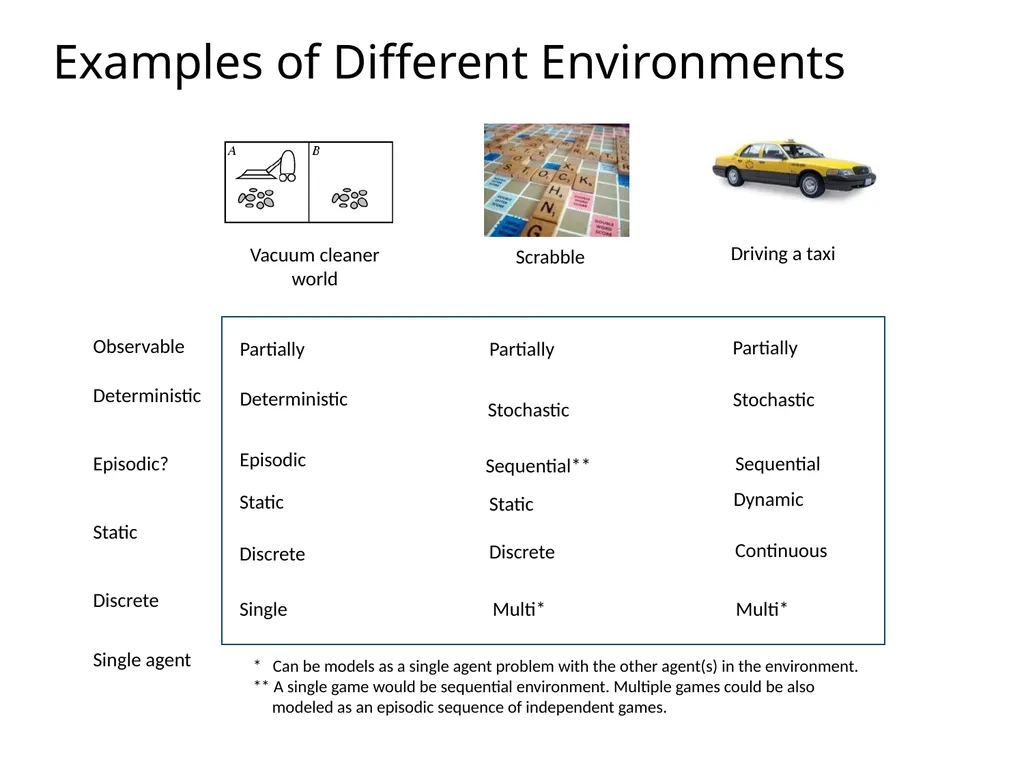
Examples of Different Environments Observable
Deterministic
Episodic?
Static
Discrete
Single agent * Can be models as a single agent problem with the other agent(s) in the environment.
** A single game would be sequential environment. Multiple games could be also modeled as an episodic sequence of independent games.<br>
Deterministic
Episodic?
Static
Discrete
Single agent * Can be models as a single agent problem with the other agent(s) in the environment.
** A single game would be sequential environment. Multiple games could be also modeled as an episodic sequence of independent games.<br>
23
Outline: Agent Types<br>
24
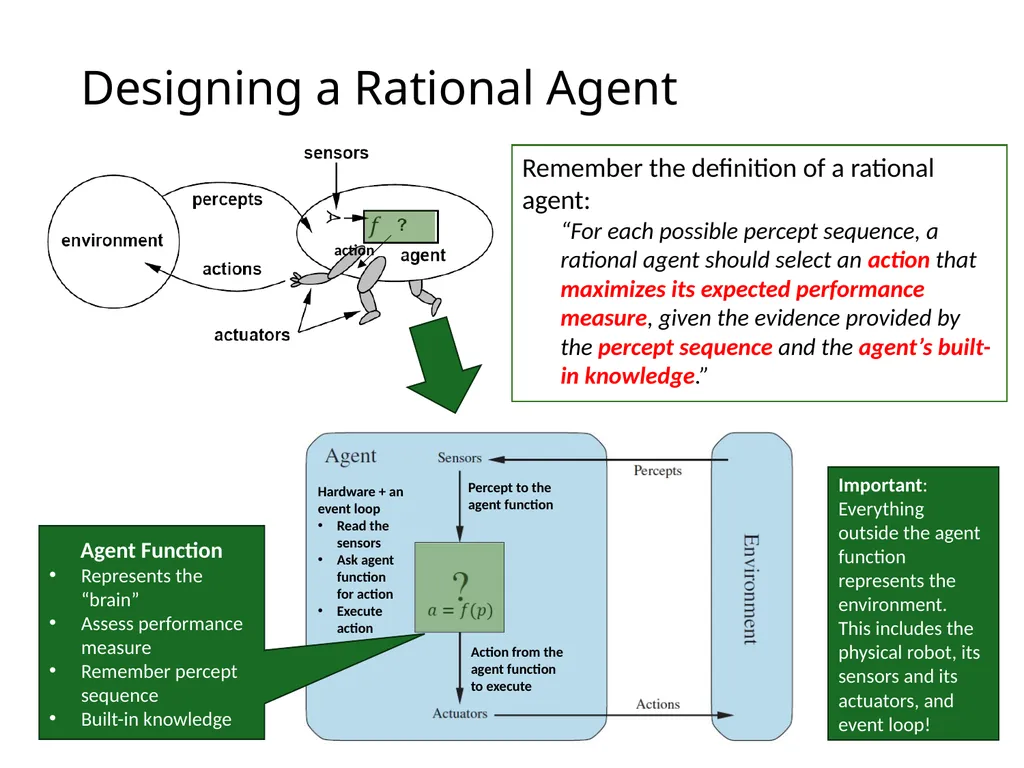
Designing a Rational Agent Remember the definition of a rational agent:
“For each possible percept sequence, a rational agent should select an action that maximizes its expected performance measure, given the evidence provided by the percept sequence and the agent’s built-in knowledge.” action Hardware + an event loop
Read the sensors
Ask agent function for action
Execute action Agent Function
Represents the “brain”
Assess performance measure
Remember percept sequence
Built-in knowledge Important: Everything outside the agent function represents the environment.
This includes the physical robot, its sensors and its actuators, and event loop!<br>
“For each possible percept sequence, a rational agent should select an action that maximizes its expected performance measure, given the evidence provided by the percept sequence and the agent’s built-in knowledge.” action Hardware + an event loop
Read the sensors
Ask agent function for action
Execute action Agent Function
Represents the “brain”
Assess performance measure
Remember percept sequence
Built-in knowledge Important: Everything outside the agent function represents the environment.
This includes the physical robot, its sensors and its actuators, and event loop!<br>
25
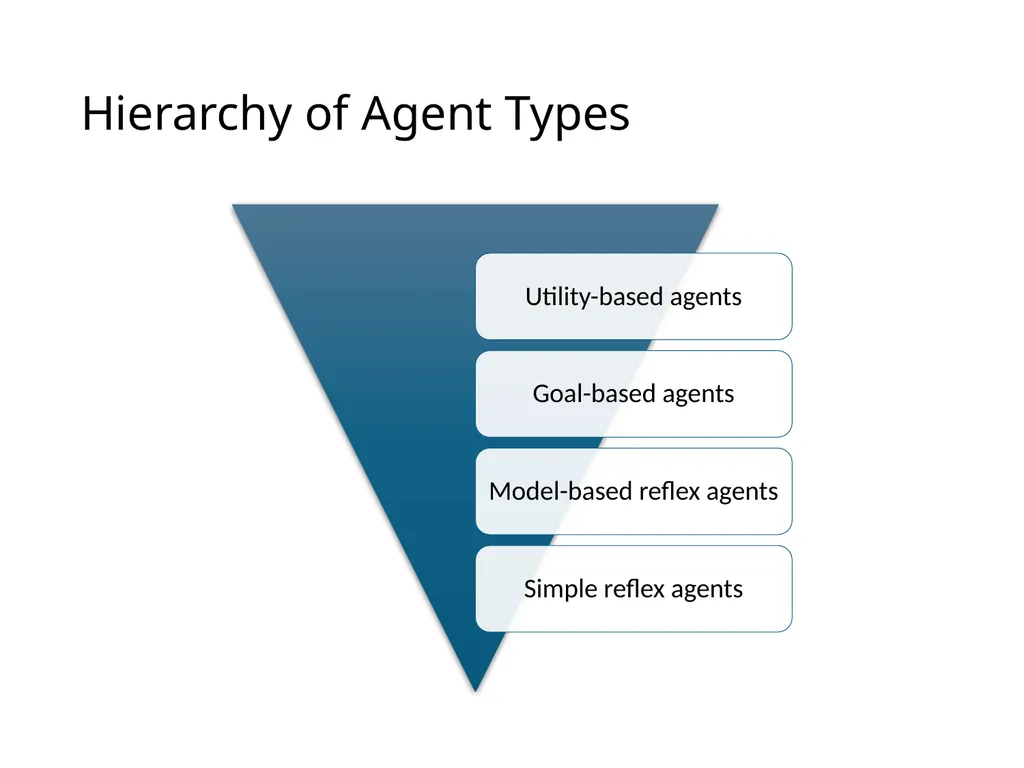
Hierarchy of Agent Types<br>
26
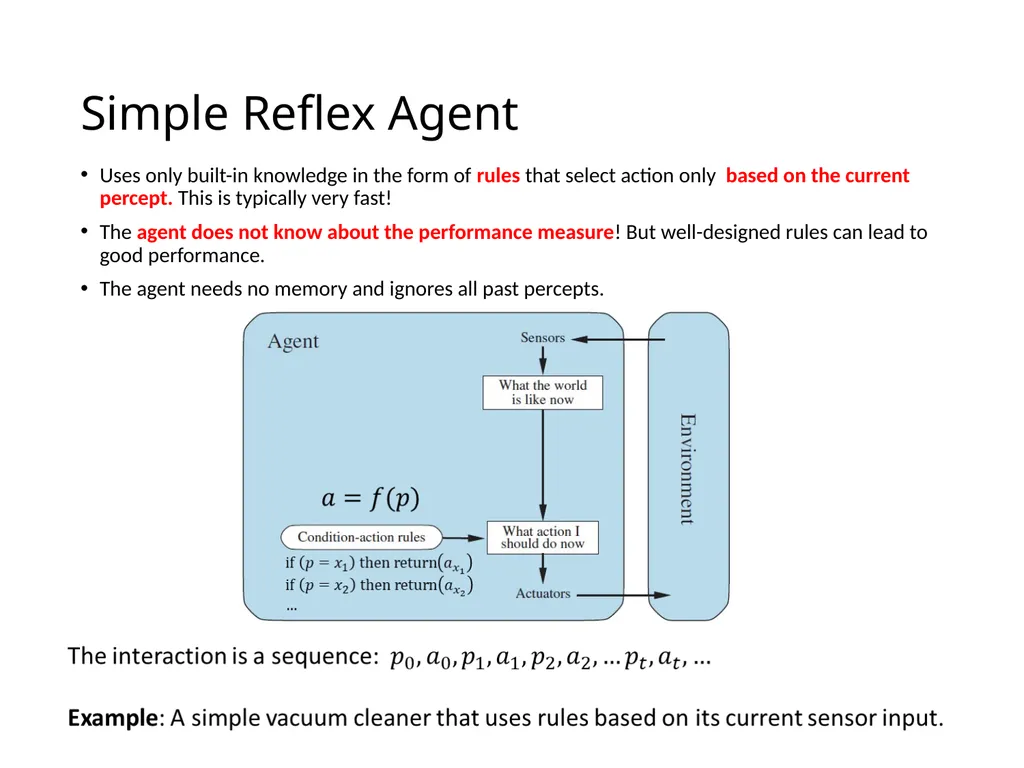
Simple Reflex Agent Uses only built-in knowledge in the form of rules that select action only based on the current percept. This is typically very fast!
The agent does not know about the performance measure! But well-designed rules can lead to good performance.
The agent needs no memory and ignores all past percepts.<br>
The agent does not know about the performance measure! But well-designed rules can lead to good performance.
The agent needs no memory and ignores all past percepts.<br>
27
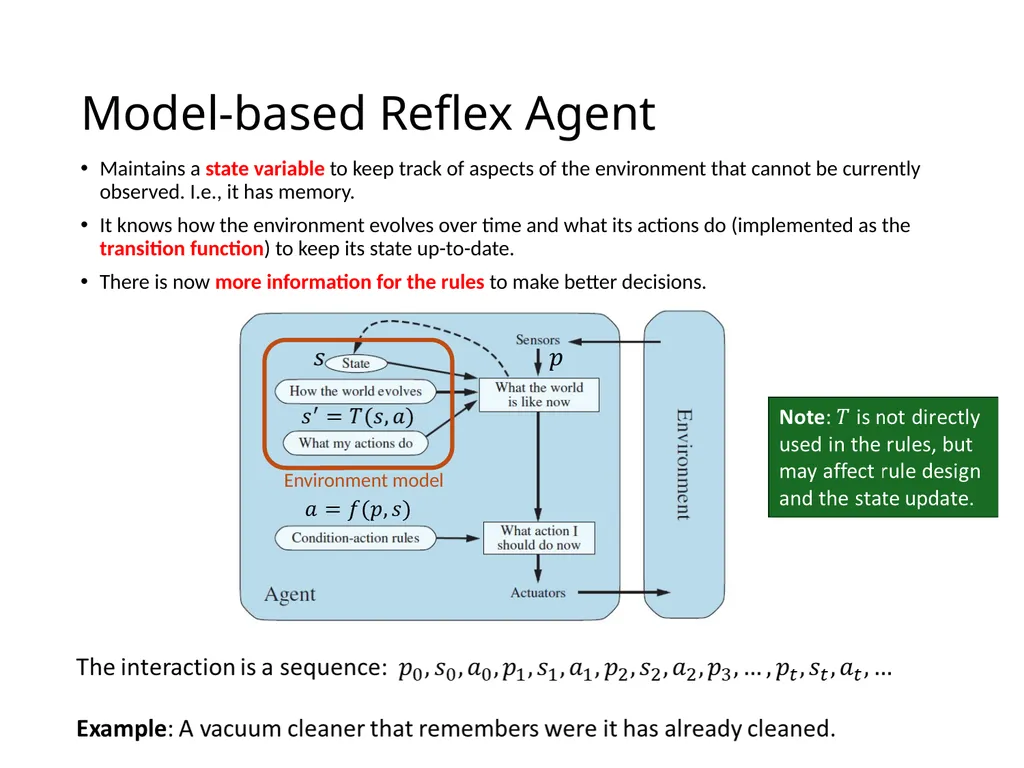
Model-based Reflex Agent Maintains a state variable to keep track of aspects of the environment that cannot be currently observed. I.e., it has memory.
It knows how the environment evolves over time and what its actions do (implemented as the transition function) to keep its state up-to-date.
There is now more information for the rules to make better decisions. Environment model<br>
It knows how the environment evolves over time and what its actions do (implemented as the transition function) to keep its state up-to-date.
There is now more information for the rules to make better decisions. Environment model<br>
28
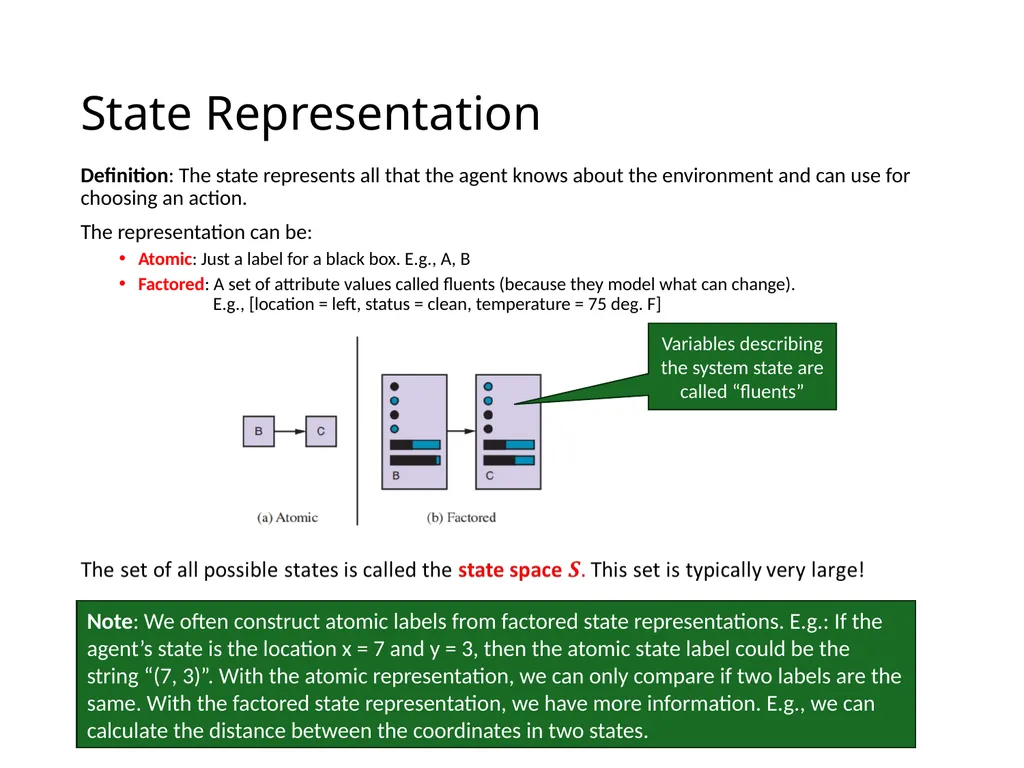
State Representation Definition: The state represents all that the agent knows about the environment and can use for choosing an action.
The representation can be:
Atomic: Just a label for a black box. E.g., A, B
Factored: A set of attribute values called fluents (because they model what can change). E.g., [location = left, status = clean, temperature = 75 deg. F] Note: We often construct atomic labels from factored state representations. E.g.: If the agent’s state is the location x = 7 and y = 3, then the atomic state label could be the string “(7, 3)”. With the atomic representation, we can only compare if two labels are the same. With the factored state representation, we have more information. E.g., we can calculate the distance between the coordinates in two states.<br>
The representation can be:
Atomic: Just a label for a black box. E.g., A, B
Factored: A set of attribute values called fluents (because they model what can change). E.g., [location = left, status = clean, temperature = 75 deg. F] Note: We often construct atomic labels from factored state representations. E.g.: If the agent’s state is the location x = 7 and y = 3, then the atomic state label could be the string “(7, 3)”. With the atomic representation, we can only compare if two labels are the same. With the factored state representation, we have more information. E.g., we can calculate the distance between the coordinates in two states.<br>
29
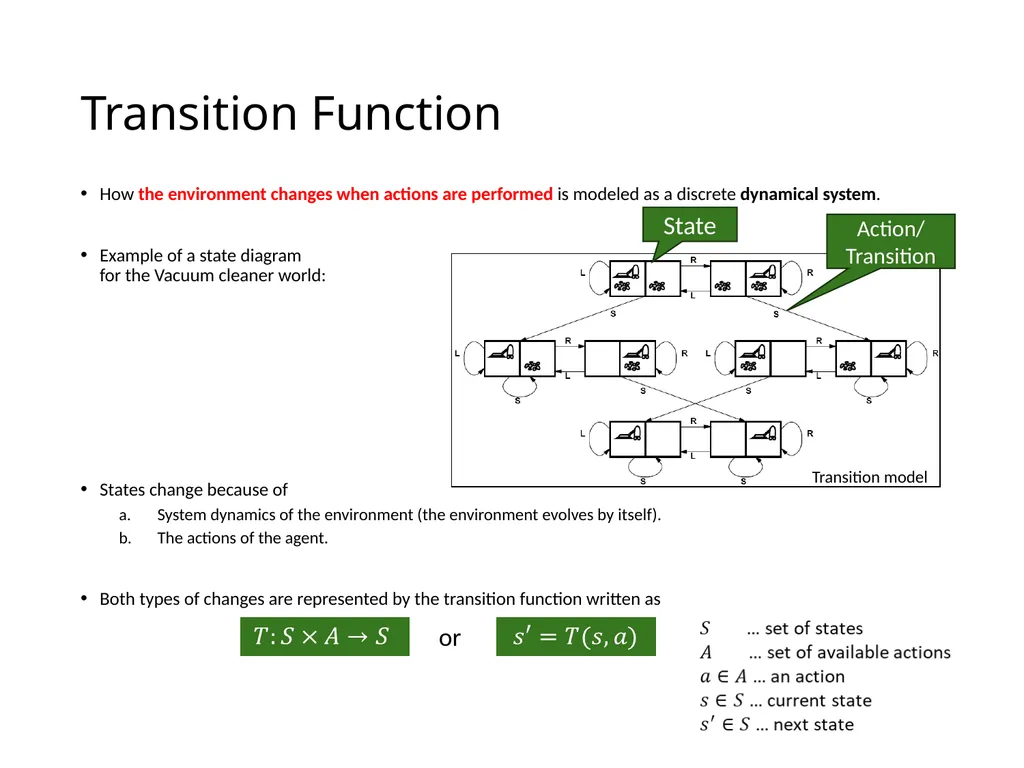
Transition Function How the environment changes when actions are performed is modeled as a discrete dynamical system.
Example of a state diagram for the Vacuum cleaner world:
States change because of
System dynamics of the environment (the environment evolves by itself).
The actions of the agent.
Both types of changes are represented by the transition function written as<br>
Example of a state diagram for the Vacuum cleaner world:
States change because of
System dynamics of the environment (the environment evolves by itself).
The actions of the agent.
Both types of changes are represented by the transition function written as<br>
30
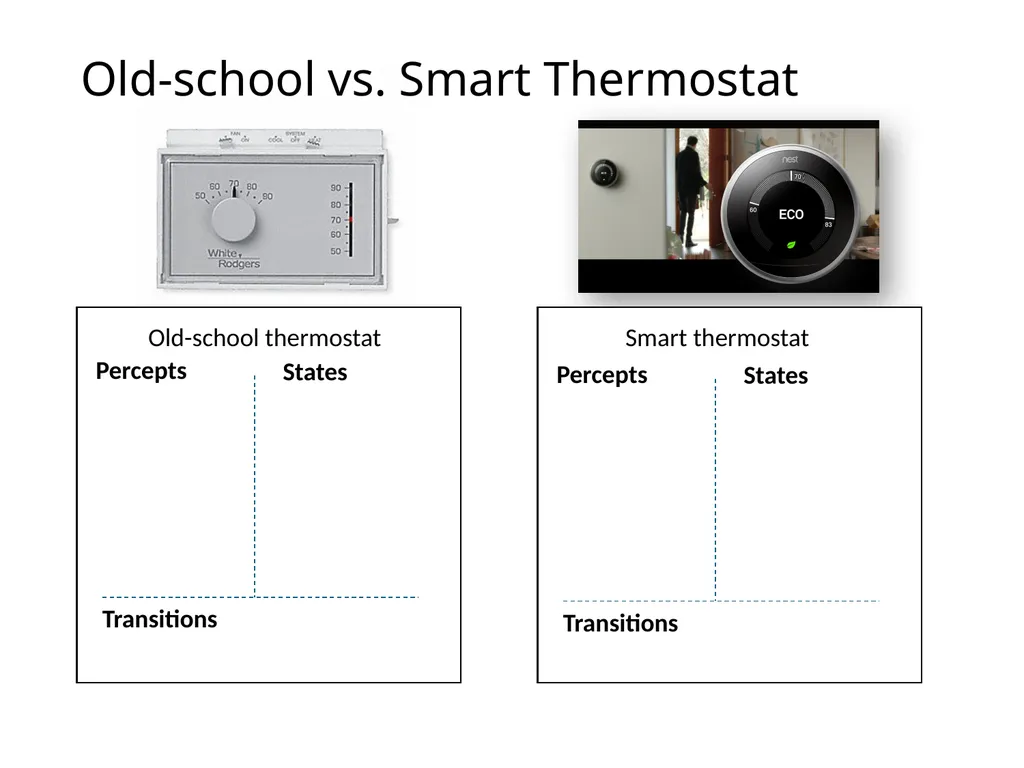
Old-school vs. Smart Thermostat<br>
31
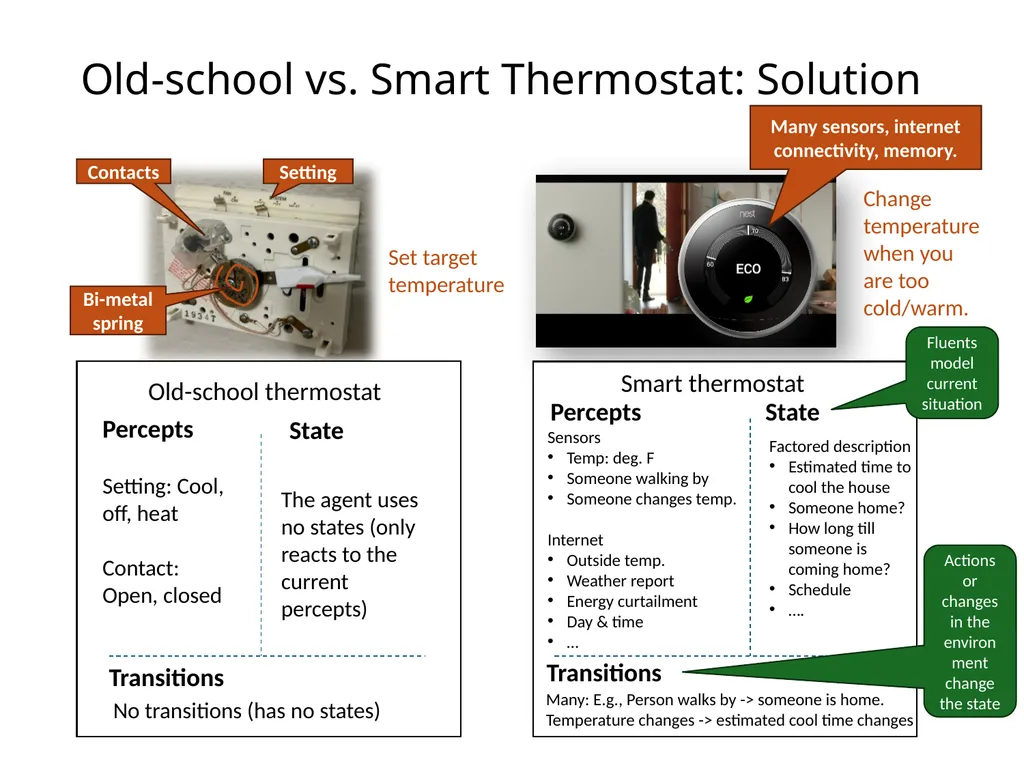
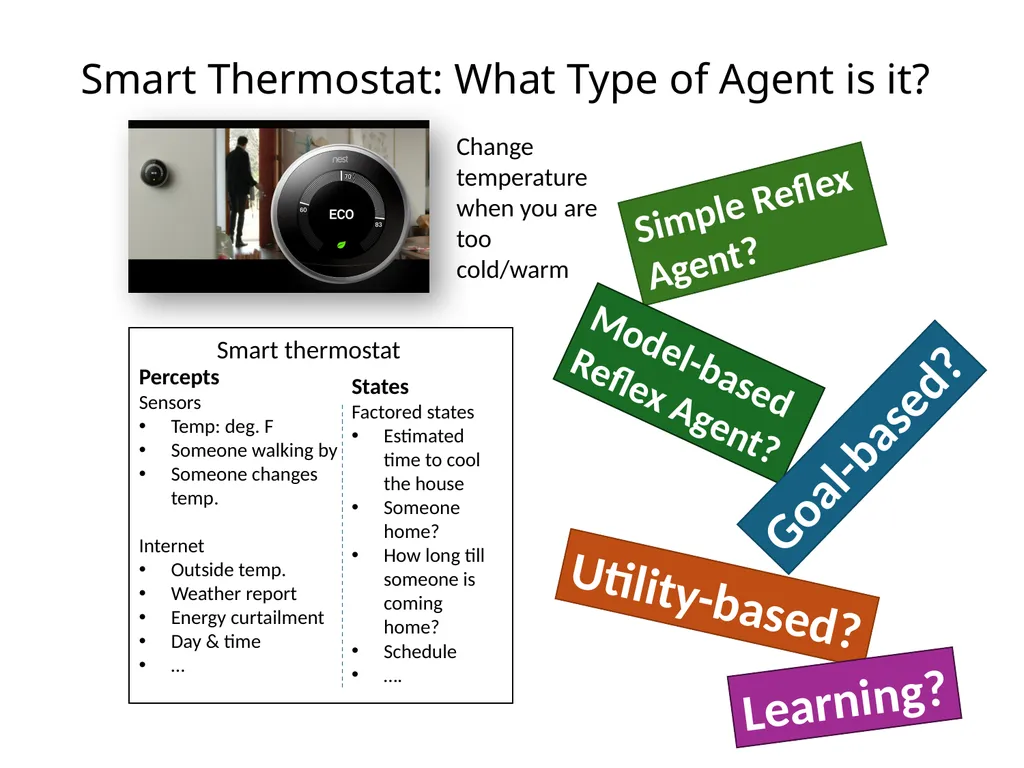
Old-school vs. Smart Thermostat: Solution Set target temperature Many sensors, internet connectivity, memory. Change temperature when you are too cold/warm. Setting Contacts Bi-metal spring Setting: Cool, off, heat
Contact:
Open, closed The agent uses no states (only reacts to the current percepts) No transitions (has no states) Sensors
Temp: deg. F
Someone walking by
Someone changes temp.
Internet
Outside temp.
Weather report
Energy curtailment
Day & time
… Factored description
Estimated time to cool the house
Someone home?
How long till someone is coming home?
Schedule
…. Many: E.g., Person walks by -> someone is home.
Temperature changes -> estimated cool time changes Fluents model current situation Actions or changes in the environment change the state<br>
Contact:
Open, closed The agent uses no states (only reacts to the current percepts) No transitions (has no states) Sensors
Temp: deg. F
Someone walking by
Someone changes temp.
Internet
Outside temp.
Weather report
Energy curtailment
Day & time
… Factored description
Estimated time to cool the house
Someone home?
How long till someone is coming home?
Schedule
…. Many: E.g., Person walks by -> someone is home.
Temperature changes -> estimated cool time changes Fluents model current situation Actions or changes in the environment change the state<br>
32
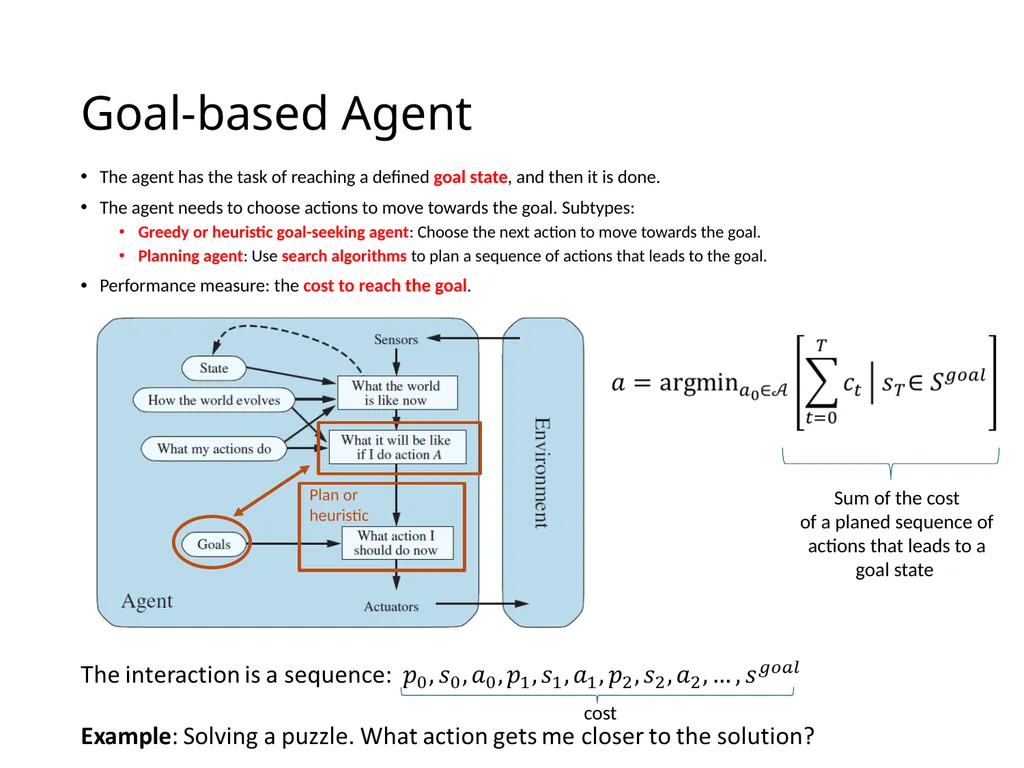
Goal-based Agent The agent has the task of reaching a defined goal state, and then it is done.
The agent needs to choose actions to move towards the goal. Subtypes:
Greedy or heuristic goal-seeking agent: Choose the next action to move towards the goal.
Planning agent: Use search algorithms to plan a sequence of actions that leads to the goal.
Performance measure: the cost to reach the goal.<br>
The agent needs to choose actions to move towards the goal. Subtypes:
Greedy or heuristic goal-seeking agent: Choose the next action to move towards the goal.
Planning agent: Use search algorithms to plan a sequence of actions that leads to the goal.
Performance measure: the cost to reach the goal.<br>
33
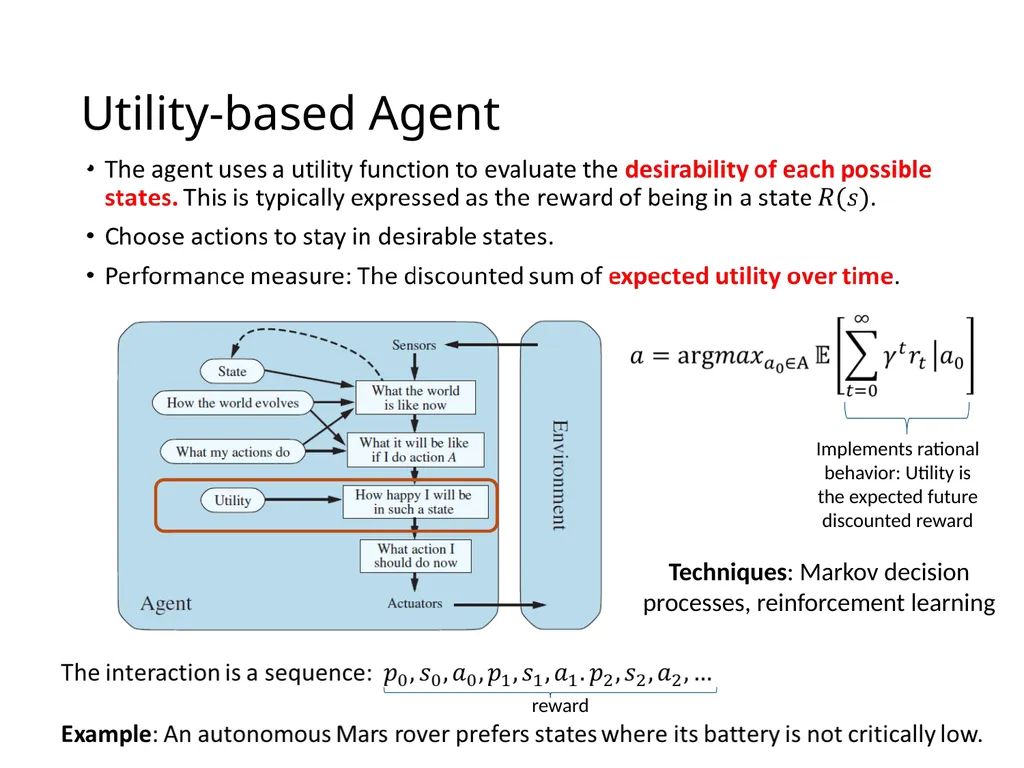
Utility-based Agent<br>
34
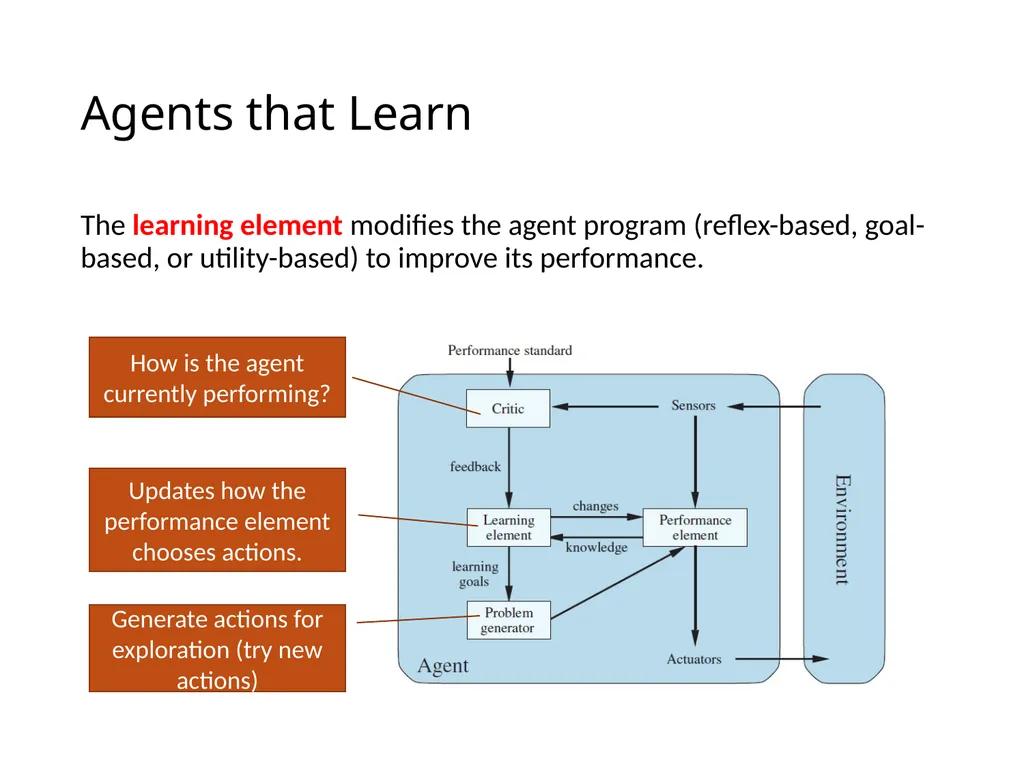
Agents that Learn The learning element modifies the agent program (reflex-based, goal-based, or utility-based) to improve its performance. How is the agent currently performing? Updates how the performance element chooses actions. Generate actions for exploration (try new actions)<br>
35
Examples<br>
36
Smart Thermostat: What Type of Agent is it? Change temperature when you are too cold/warm Simple Reflex Agent? Model-based Reflex Agent? Goal-based? Utility-based? Learning?<br>
37
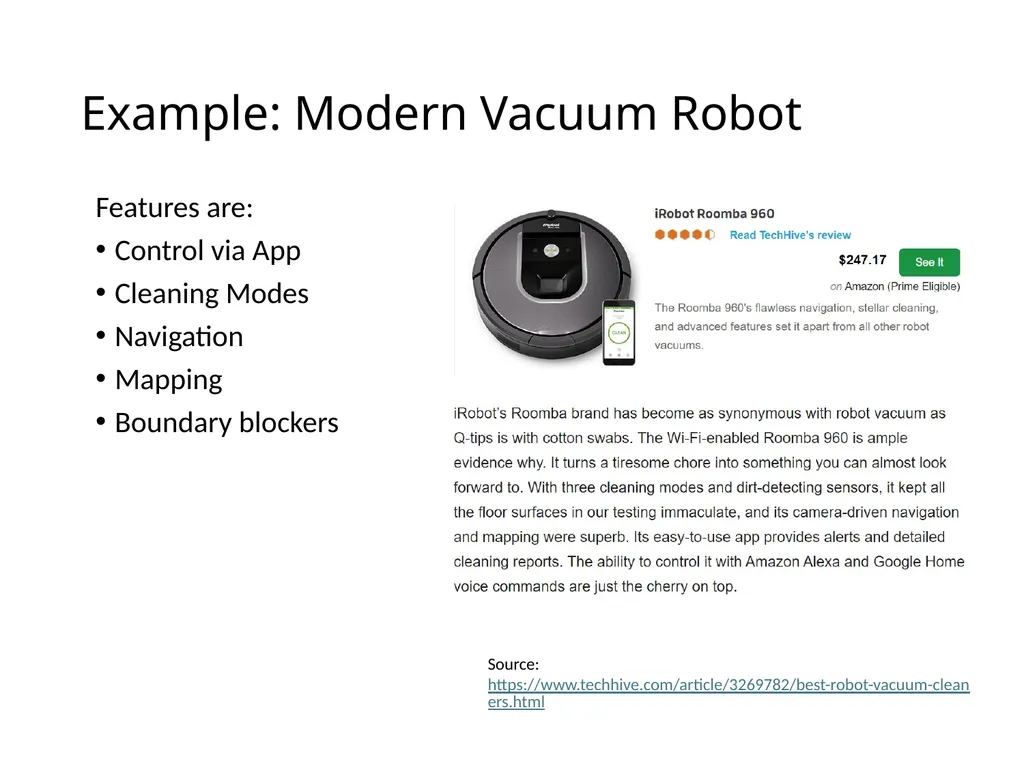
Example: Modern Vacuum Robot Features are:
Control via App
Cleaning Modes
Navigation
Mapping
Boundary blockers Source: https://www.techhive.com/article/3269782/best-robot-vacuum-cleaners.html<br>
Control via App
Cleaning Modes
Navigation
Mapping
Boundary blockers Source: https://www.techhive.com/article/3269782/best-robot-vacuum-cleaners.html<br>
38
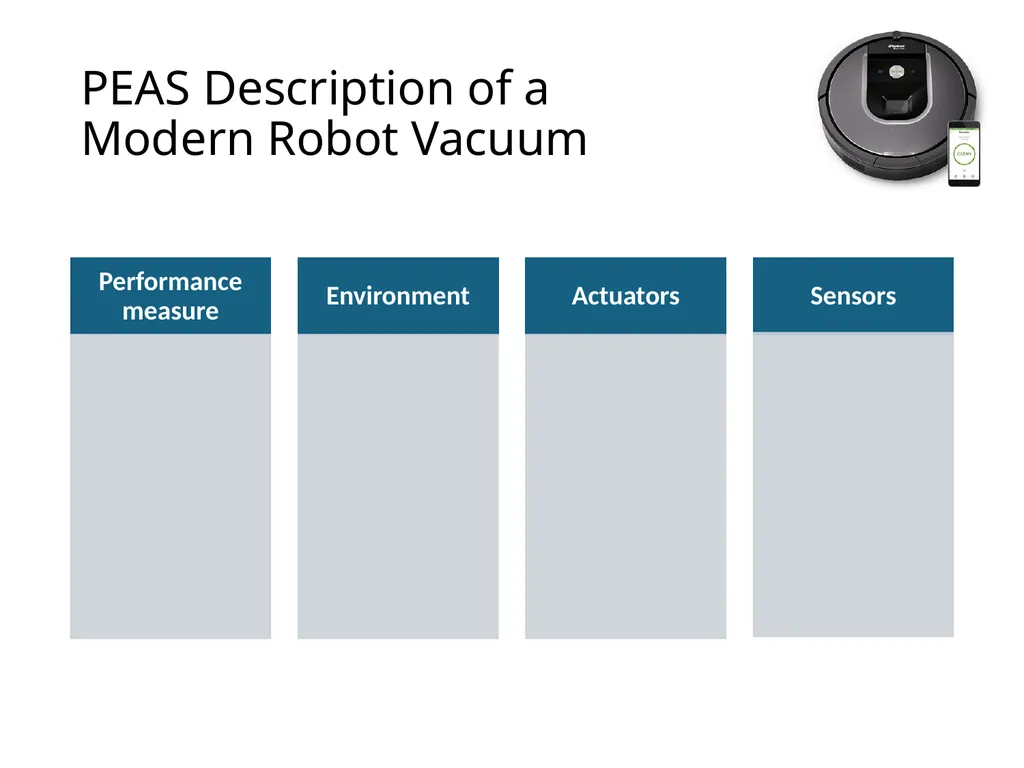
PEAS Description of a
Modern Robot Vacuum<br>
39
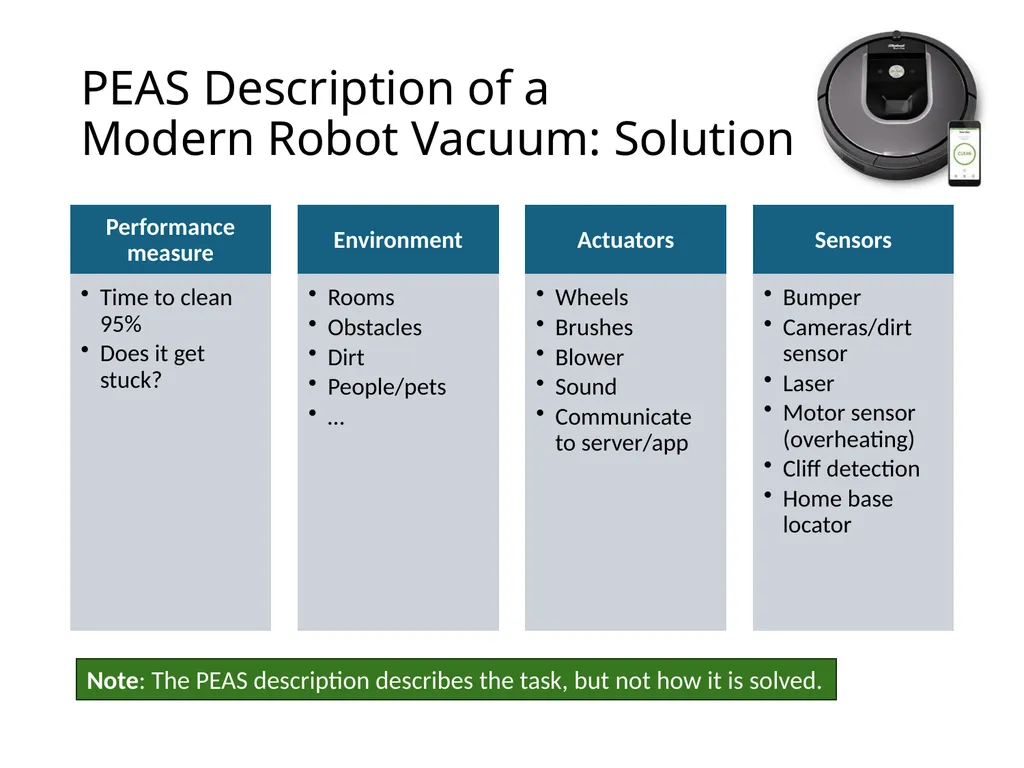
PEAS Description of a
Modern Robot Vacuum: Solution Performance measure Time to clean 95%
Does it get stuck? Environment Rooms
Obstacles
Dirt
People/pets
… Actuators Wheels
Brushes
Blower
Sound
Communicate to server/app Sensors Bumper
Cameras/dirt sensor
Laser
Motor sensor (overheating)
Cliff detection
Home base locator Note: The PEAS description describes the task, but not how it is solved.<br>
Does it get stuck? Environment Rooms
Obstacles
Dirt
People/pets
… Actuators Wheels
Brushes
Blower
Sound
Communicate to server/app Sensors Bumper
Cameras/dirt sensor
Laser
Motor sensor (overheating)
Cliff detection
Home base locator Note: The PEAS description describes the task, but not how it is solved.<br>
40
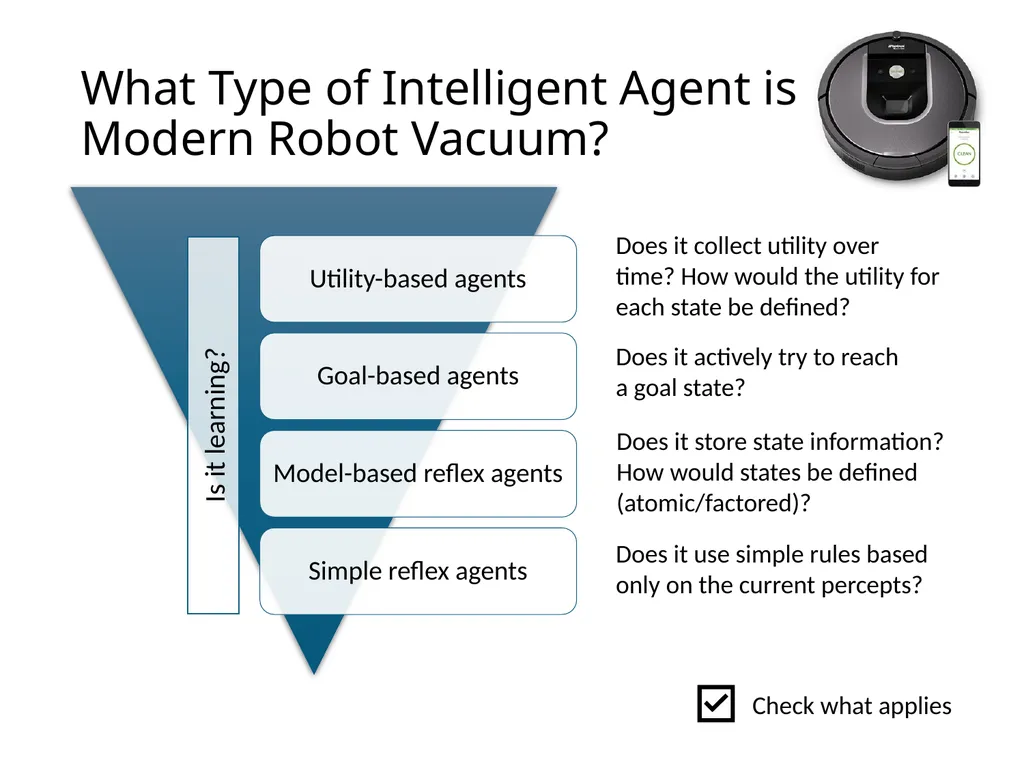
What Type of Intelligent Agent is a
Modern Robot Vacuum? Does it collect utility over time? How would the utility for each state be defined? Does it actively try to reach a goal state? Does it store state information? How would states be defined (atomic/factored)? Does it use simple rules based only on the current percepts? Is it learning?<br>
41
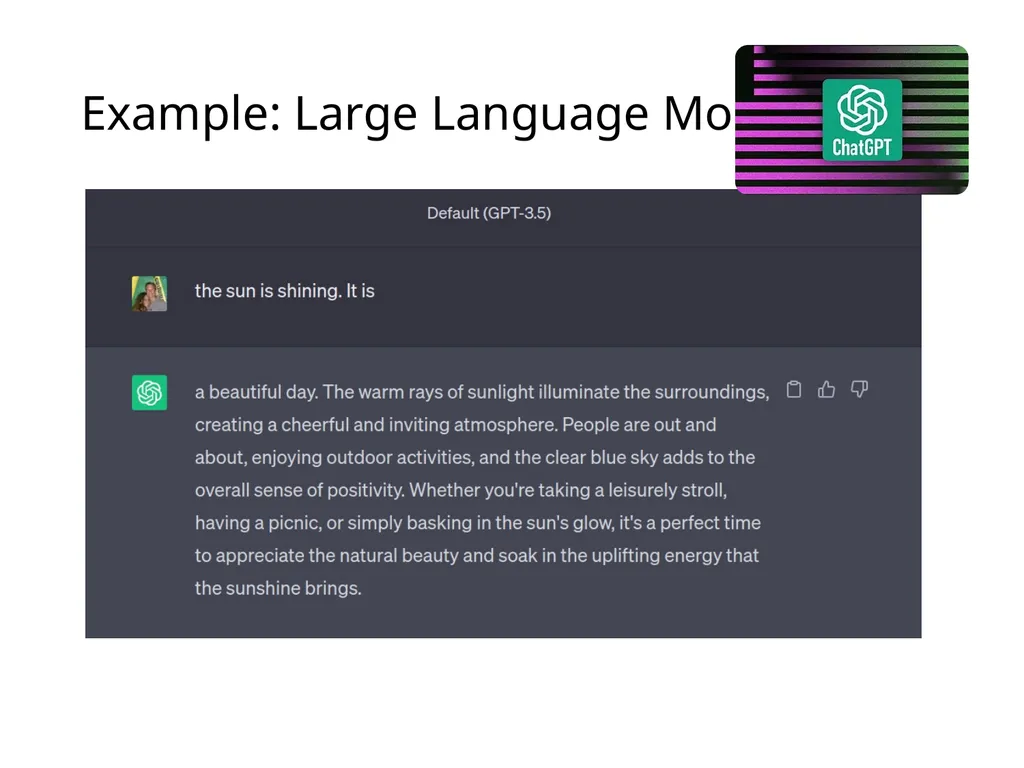
Example: Large Language Models<br>
42
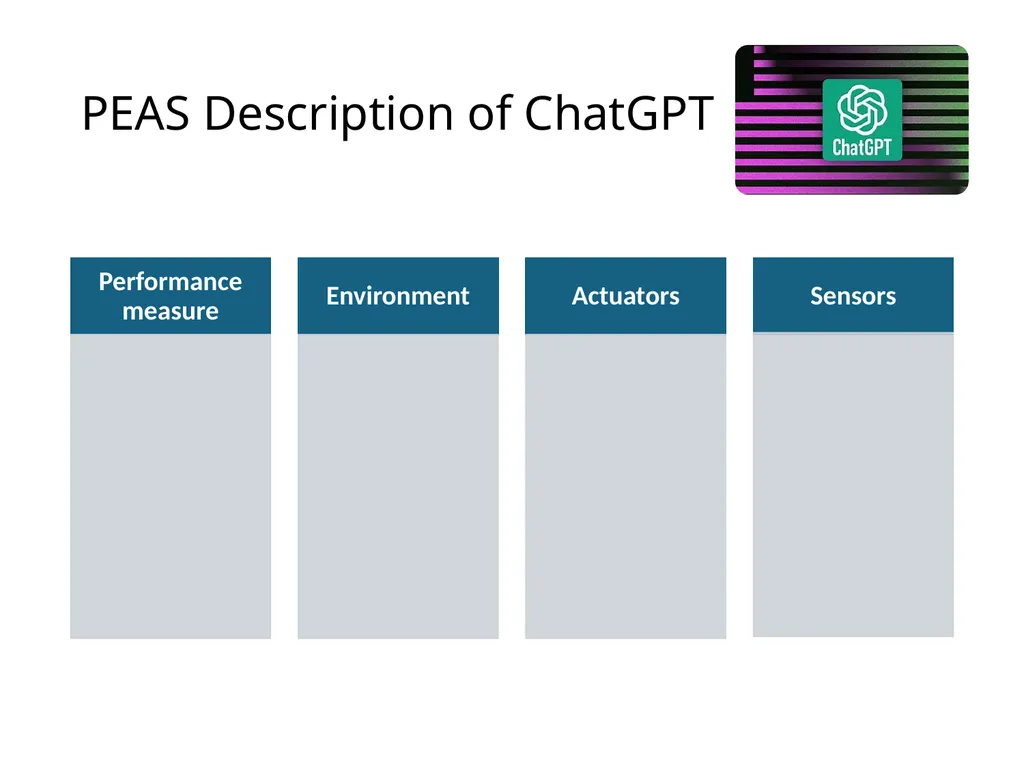
PEAS Description of ChatGPT<br>
43
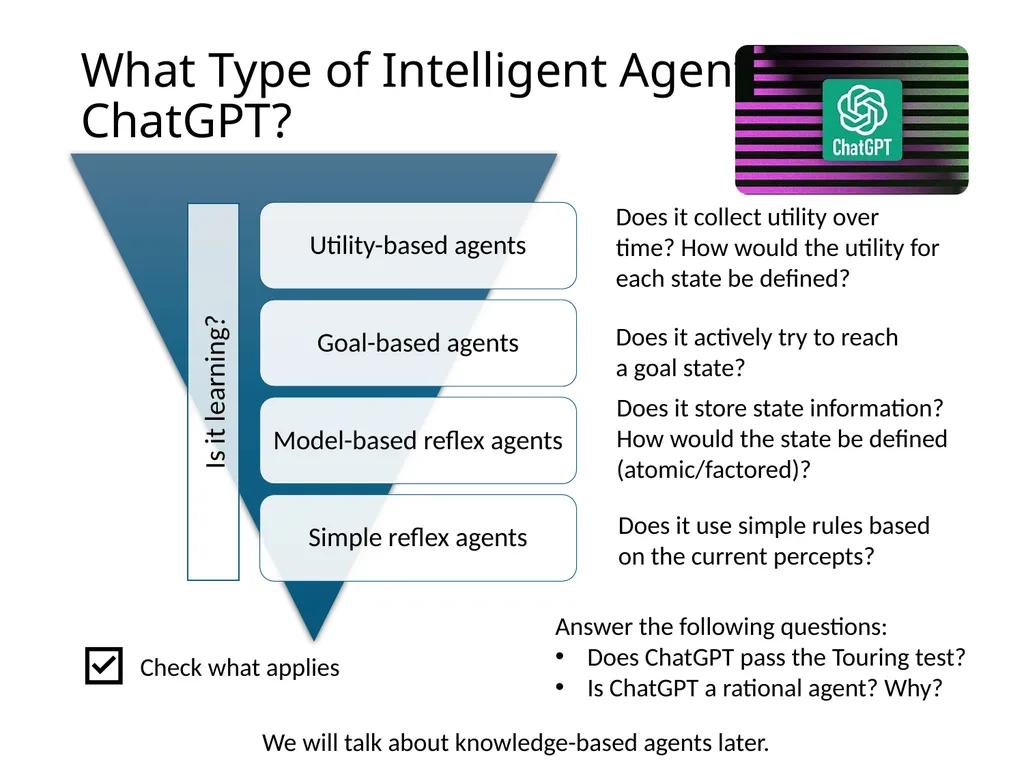
What Type of Intelligent Agent is
ChatGPT? Does it collect utility over time? How would the utility for each state be defined? Does it actively try to reach a goal state? Does it store state information? How would the state be defined (atomic/factored)? Does it use simple rules based on the current percepts? Is it learning? Answer the following questions:
Does ChatGPT pass the Touring test?
Is ChatGPT a rational agent? Why? We will talk about knowledge-based agents later.<br>
Does ChatGPT pass the Touring test?
Is ChatGPT a rational agent? Why? We will talk about knowledge-based agents later.<br>
44
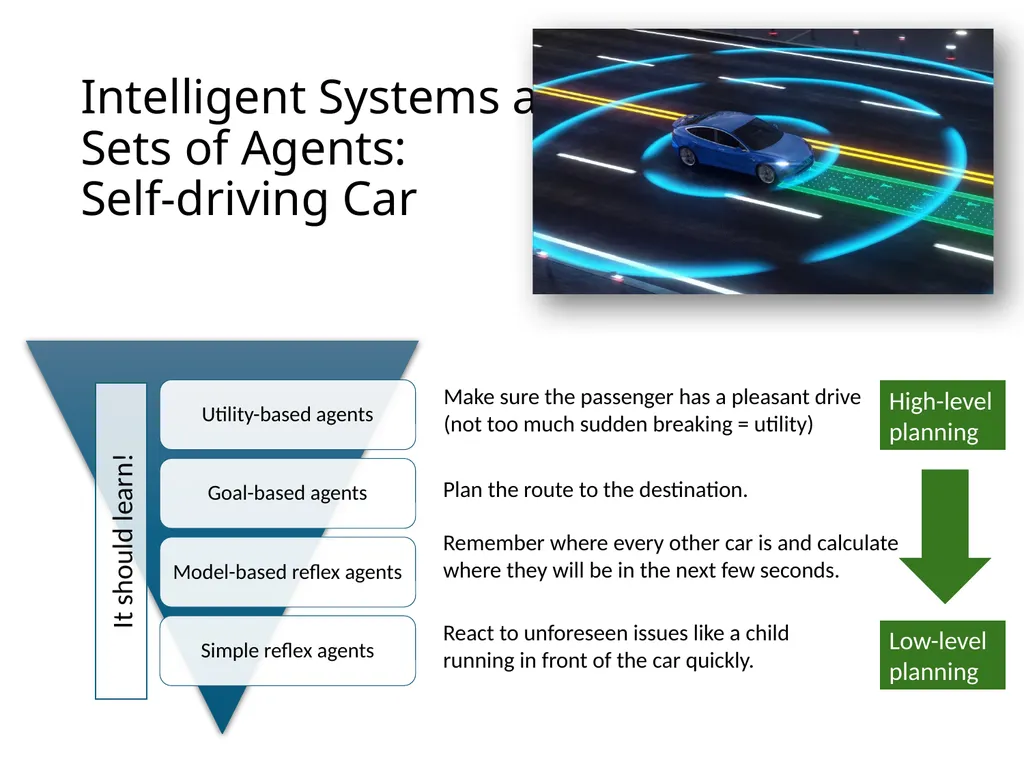
Intelligent Systems a
Sets of Agents:
Self-driving Car Make sure the passenger has a pleasant drive (not too much sudden breaking = utility) Plan the route to the destination. Remember where every other car is and calculate where they will be in the next few seconds. React to unforeseen issues like a child running in front of the car quickly. It should learn! High-level planning Low-level planning<br>
45
Wrapup<br>
46
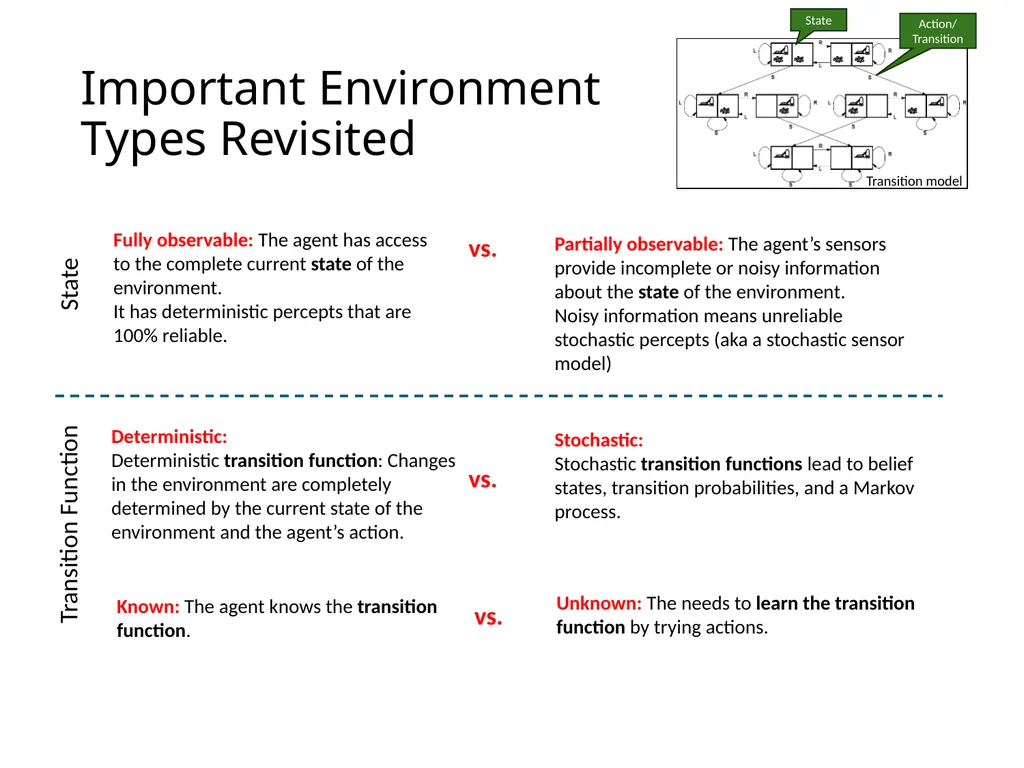
Important Environment Types Revisited<br>
47
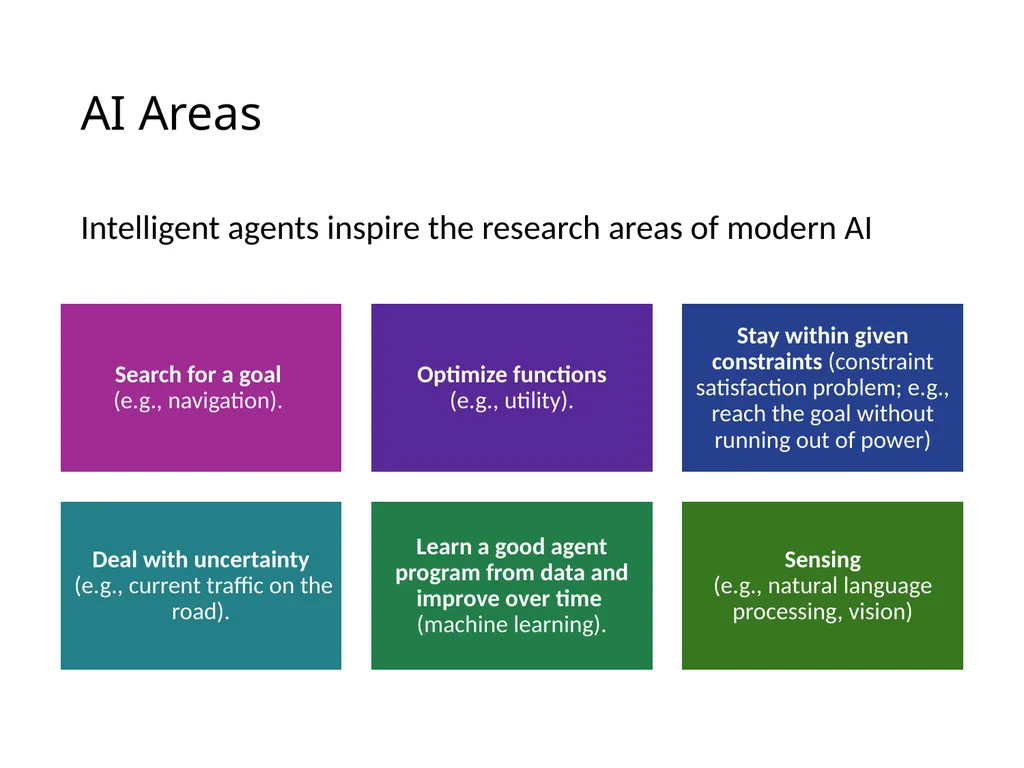
AI Areas Intelligent agents inspire the research areas of modern AI<br>
48
What You
Should Know<br>