"CS344: Introduction to Artificial Intelligence" is the property of its rightful owner. Permission is granted to
download and print the materials on this website for personal, non-commercial use only, and to display it
on your personal computer provided you do not modify the materials and that you retain all copyright
notices contained in the materials. By downloading content from our website, you accept the terms of this
agreement.
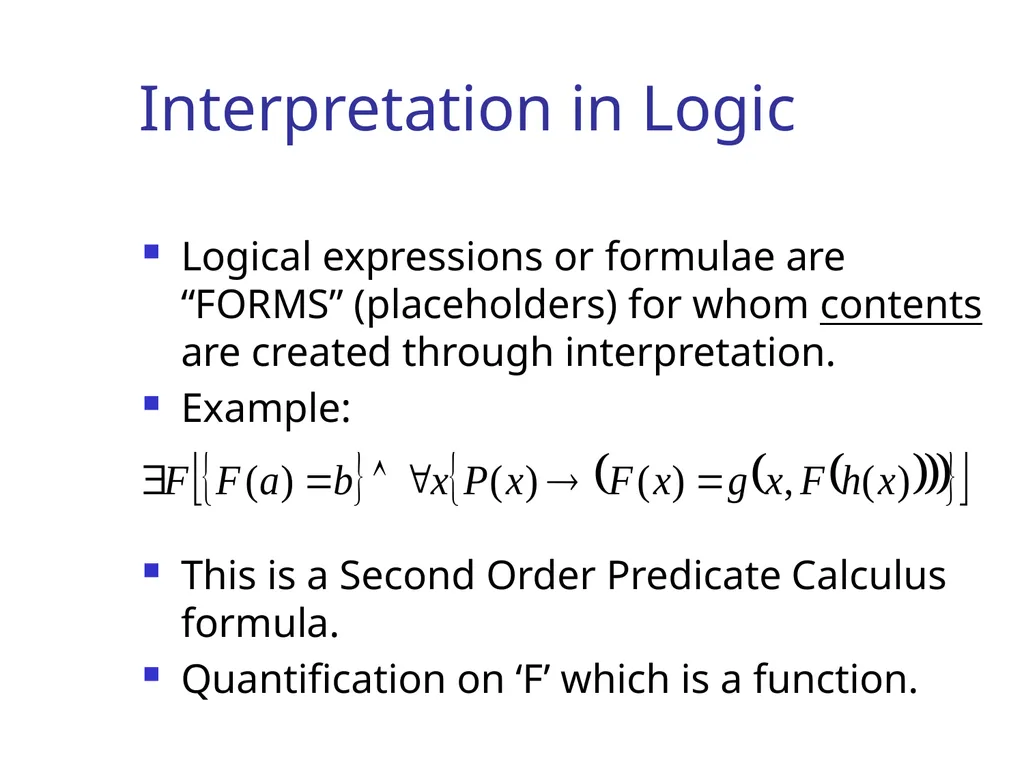
Interpretation in Logic Logical expressions or formulae are “FORMS” (placeholders) for whom contents are created through interpretation.
Example:
This is a Second Order Predicate Calculus formula.
Quantification on ‘F’ which is a function.<br>
03
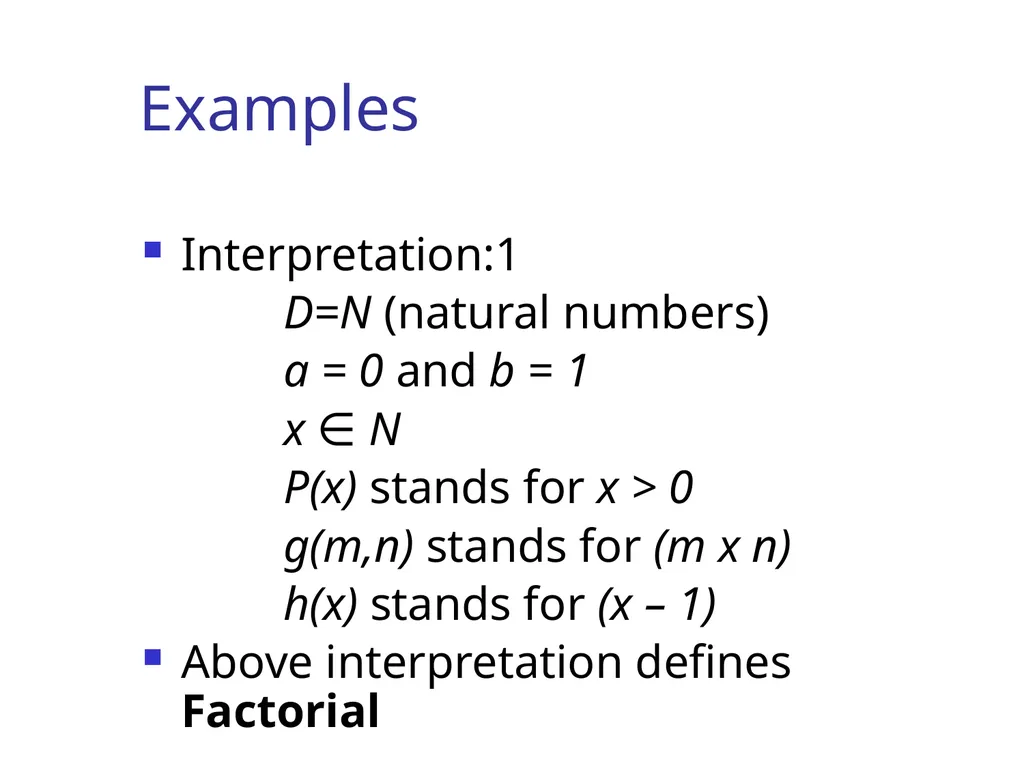
Interpretation:1
D=N (natural numbers)
a = 0 and b = 1
x ∈ N
P(x) stands for x > 0
g(m,n) stands for (m x n)
h(x) stands for (x – 1)
Above interpretation defines Factorial Examples<br>
04
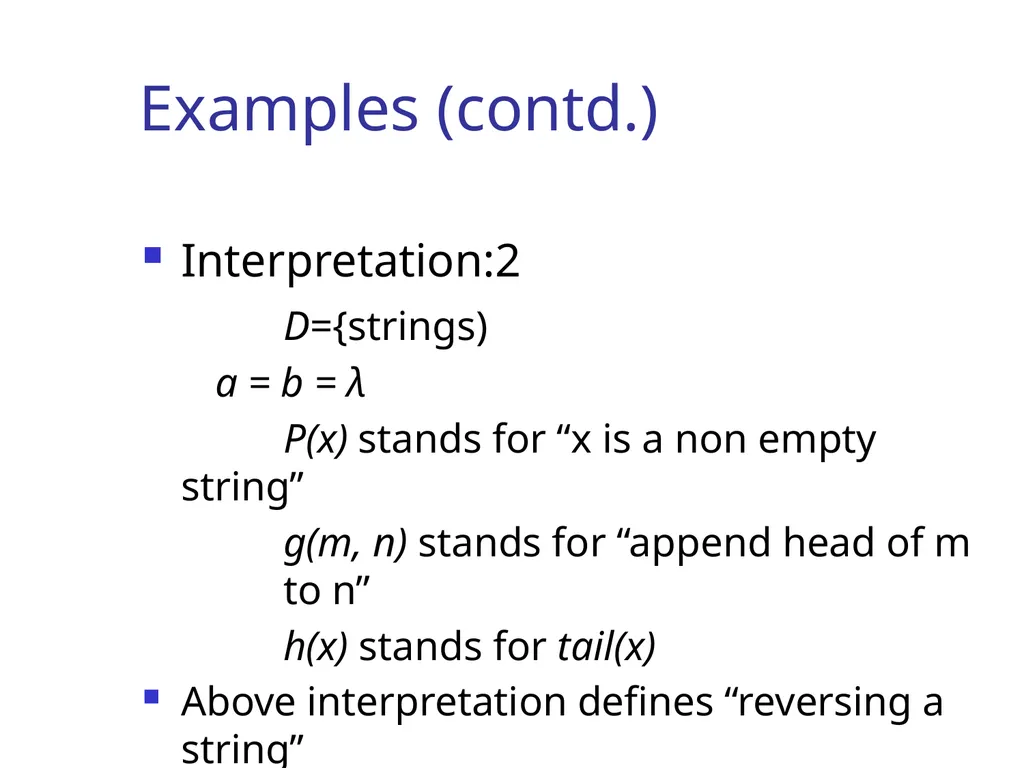
Interpretation:2
D={strings)
a = b = λ
P(x) stands for “x is a non empty string”
g(m, n) stands for “append head of m to n”
h(x) stands for tail(x)
Above interpretation defines “reversing a string” Examples (contd.)<br>
05
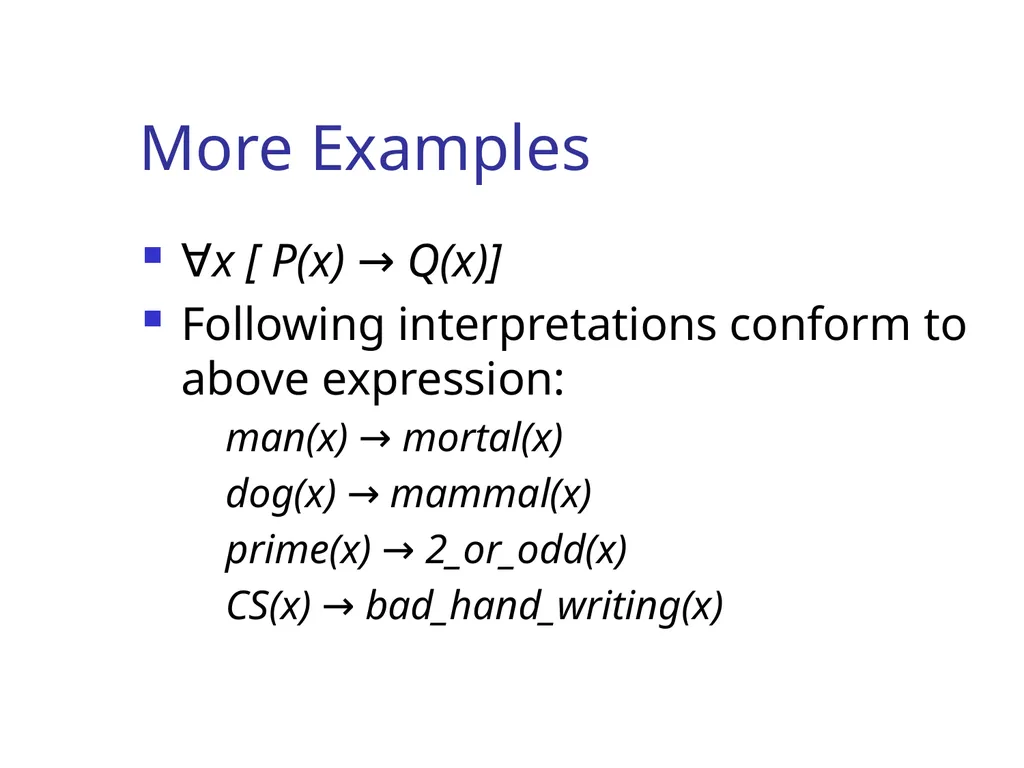
More Examples ∀x [ P(x) → Q(x)]
Following interpretations conform to above expression:
man(x) → mortal(x)
dog(x) → mammal(x)
prime(x) → 2_or_odd(x)
CS(x) → bad_hand_writing(x)<br>
06
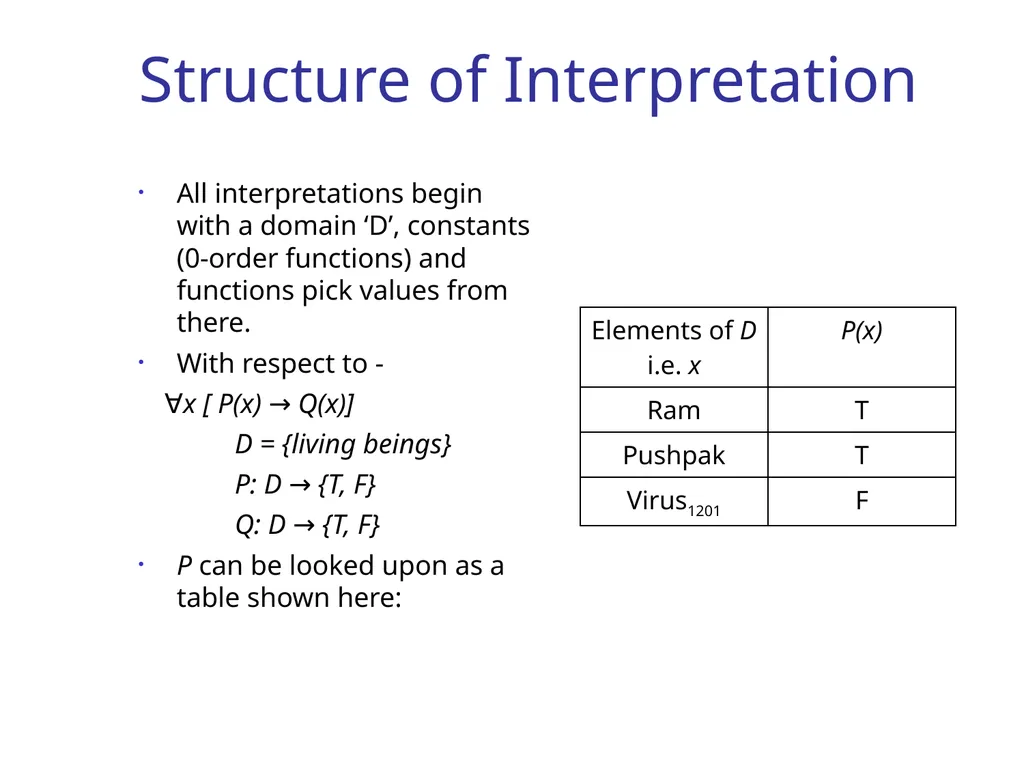
Structure of Interpretation All interpretations begin with a domain ‘D’, constants (0-order functions) and functions pick values from there.
With respect to -
∀x [ P(x) → Q(x)]
D = {living beings}
P: D → {T, F}
Q: D → {T, F}
P can be looked upon as a table shown here:<br>
07
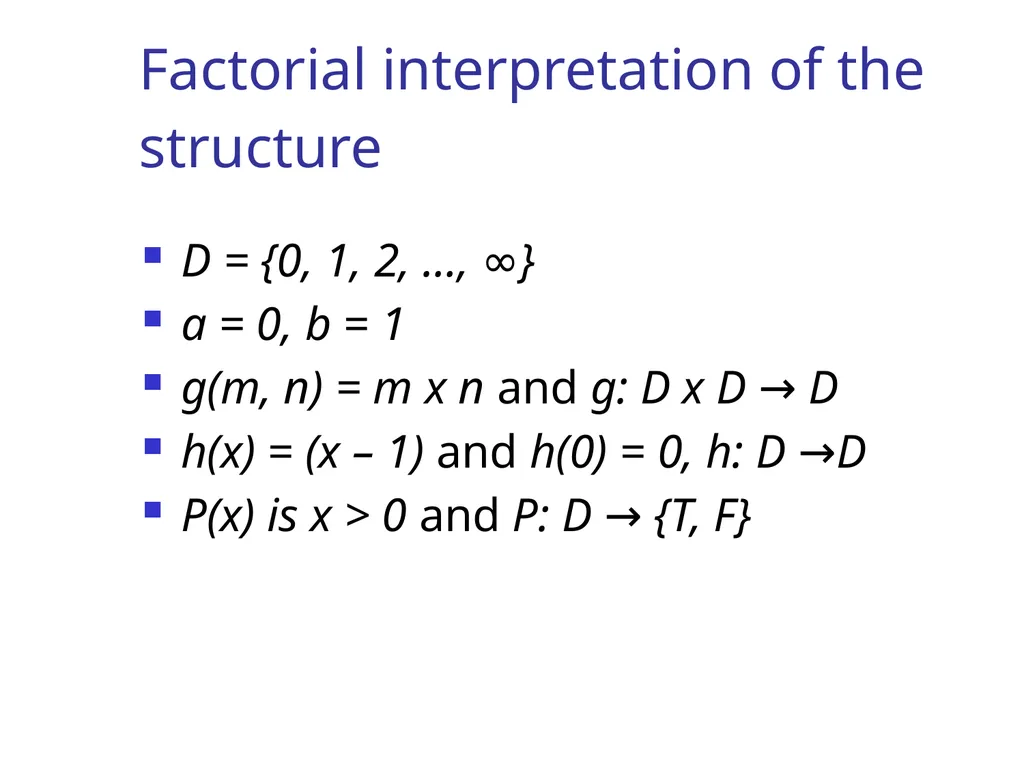
Factorial interpretation of the structure D = {0, 1, 2, …, ∞}
a = 0, b = 1
g(m, n) = m x n and g: D x D → D
h(x) = (x – 1) and h(0) = 0, h: D →D
P(x) is x > 0 and P: D → {T, F}<br>
08
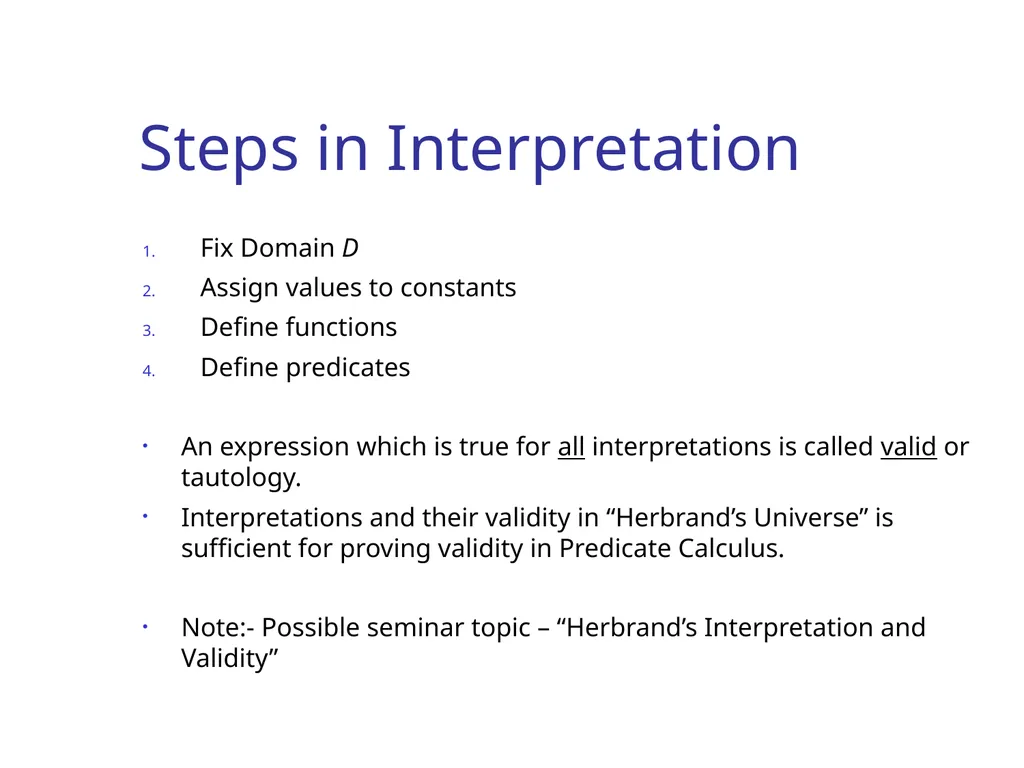
Steps in Interpretation Fix Domain D
Assign values to constants
Define functions
Define predicates
An expression which is true for all interpretations is called valid or tautology.
Interpretations and their validity in “Herbrand’s Universe” is sufficient for proving validity in Predicate Calculus.
Note:- Possible seminar topic – “Herbrand’s Interpretation and Validity”<br>
09
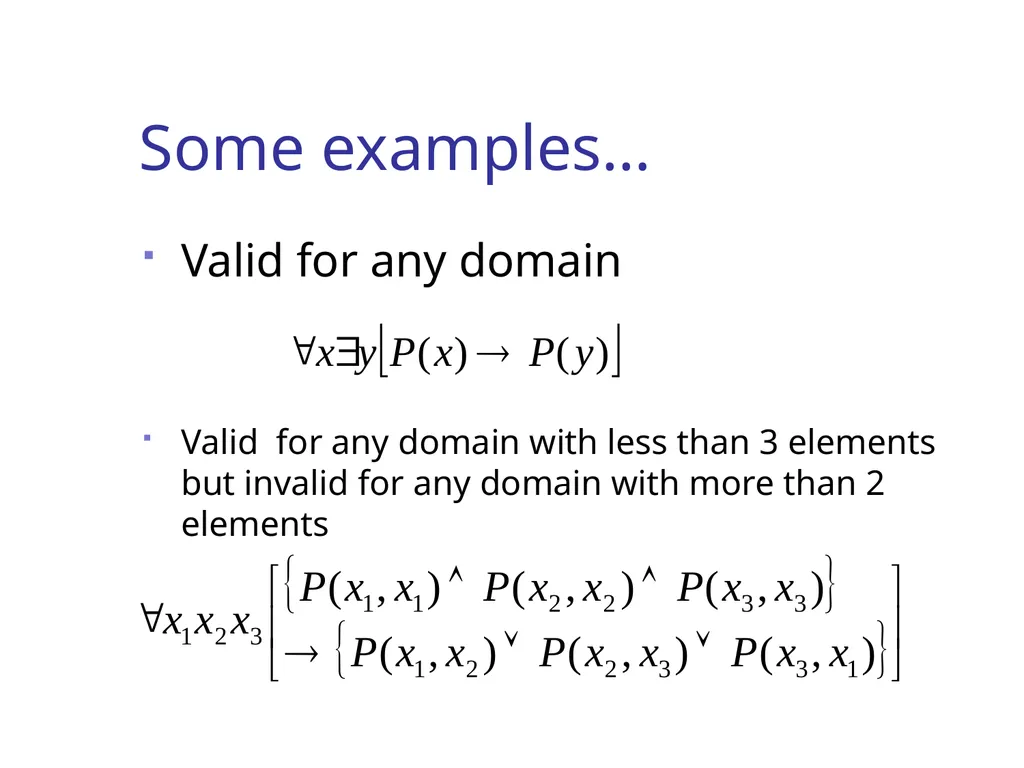
Some examples… Valid for any domain
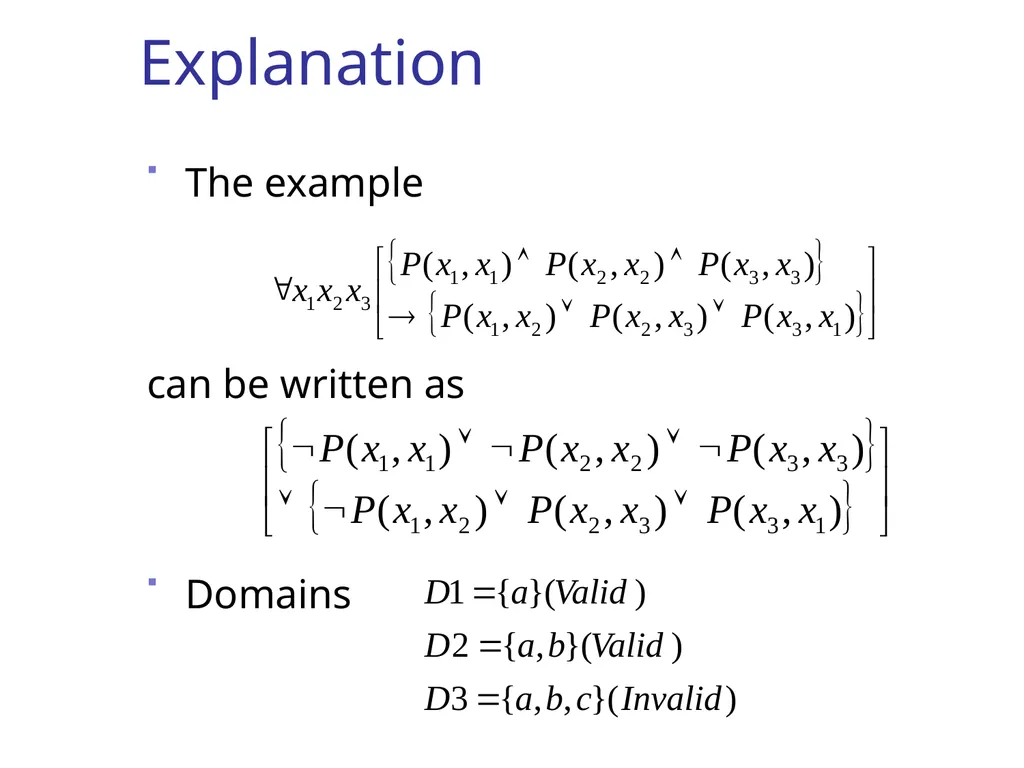
Valid for any domain with less than 3 elements but invalid for any domain with more than 2 elements<br>
10
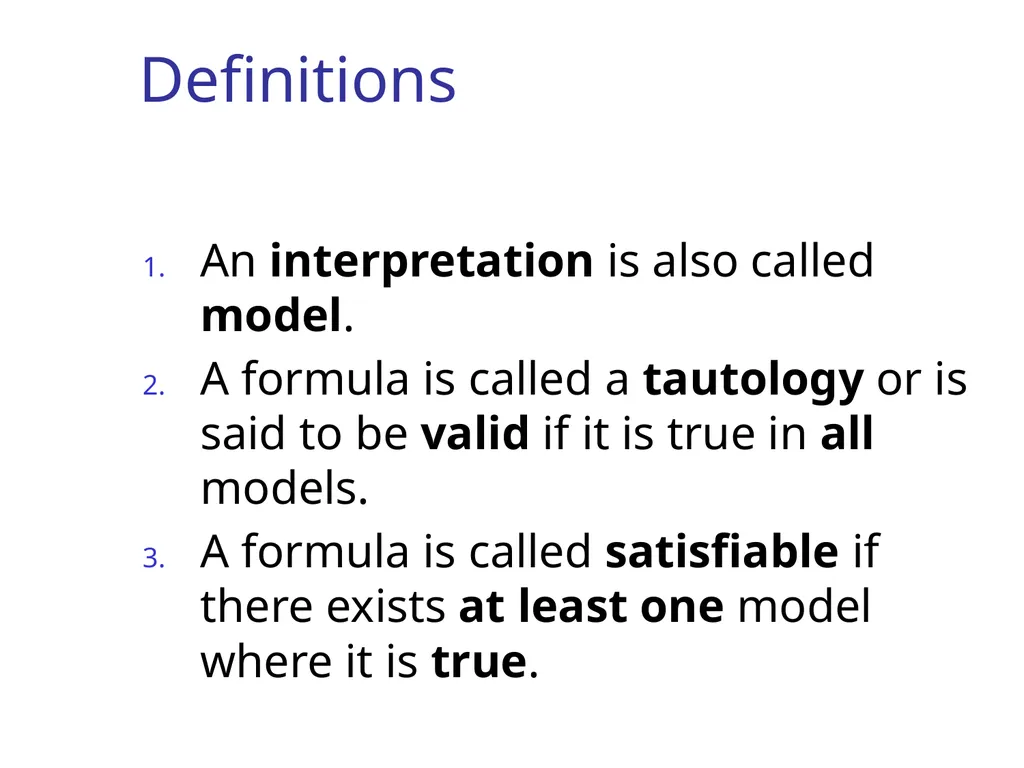
Definitions An interpretation is also called model.
A formula is called a tautology or is said to be valid if it is true in all models.
A formula is called satisfiable if there exists at least one model where it is true.<br>