
CS4710: Artificial Intelligence Knowledge
KB
Published · 45 slides · 0 views
1 / 1

Description
CS4710: Artificial Intelligence Knowledge Representation For most AI problems, we must represent complex information. What are some techniques for doing this? What are the pros and cons of each? Topics Overview of Knowledge Representation
Related Topics
Download this presentation From Below
"CS4710: Artificial Intelligence Knowledge" is the property of its rightful owner. Permission is granted to download and print the materials on this website for personal, non-commercial use only, and to display it on your personal computer provided you do not modify the materials and that you retain all copyright notices contained in the materials. By downloading content from our website, you accept the terms of this agreement.
Share
Embed code
Presentation Transcript
01
CS4710: Artificial Intelligence
Knowledge Representation For most AI problems, we must represent complex information. What are some techniques for doing this? What are the pros and cons of each?<br>
02
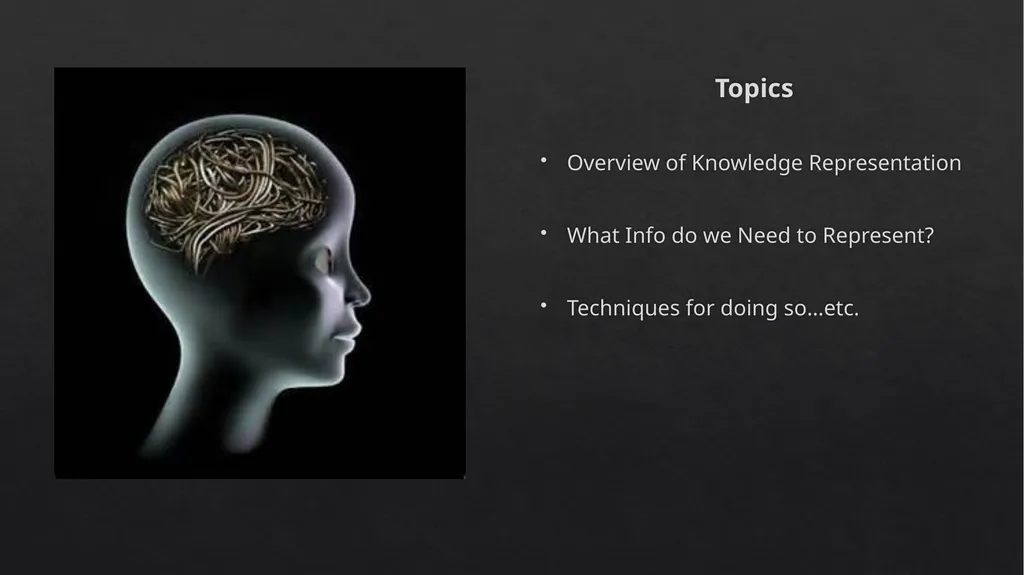
Topics
Overview of Knowledge Representation
What Info do we Need to Represent?
Techniques for doing so…etc.<br>
Overview of Knowledge Representation
What Info do we Need to Represent?
Techniques for doing so…etc.<br>
03
Physical Symbol Systems and the beginning of AI<br>
04
Physical Symbol Systems
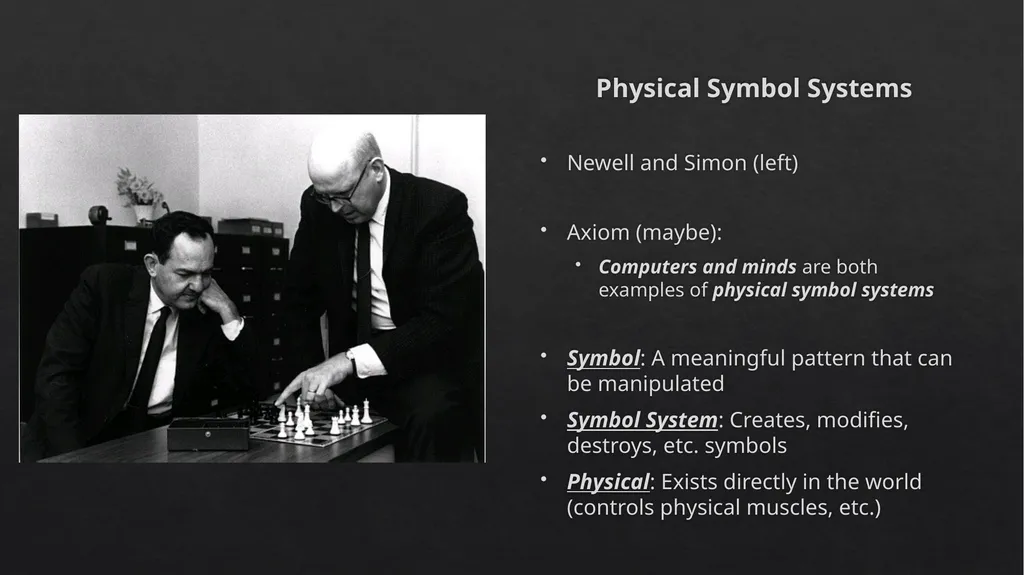
Newell and Simon (left)
Axiom (maybe):
Computers and minds are both examples of physical symbol systems
Symbol: A meaningful pattern that can be manipulated
Symbol System: Creates, modifies, destroys, etc. symbols
Physical: Exists directly in the world (controls physical muscles, etc.)<br>
Newell and Simon (left)
Axiom (maybe):
Computers and minds are both examples of physical symbol systems
Symbol: A meaningful pattern that can be manipulated
Symbol System: Creates, modifies, destroys, etc. symbols
Physical: Exists directly in the world (controls physical muscles, etc.)<br>
05
Physical Symbol System Hypothesis
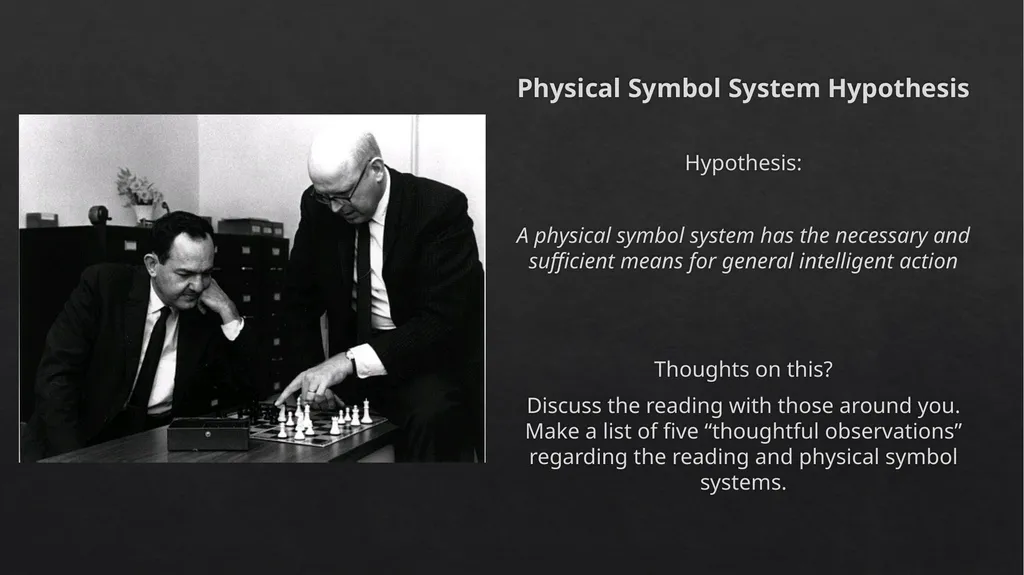
Hypothesis:
A physical symbol system has the necessary and sufficient means for general intelligent action
Thoughts on this?
Discuss the reading with those around you. Make a list of five “thoughtful observations” regarding the reading and physical symbol systems.<br>
Hypothesis:
A physical symbol system has the necessary and sufficient means for general intelligent action
Thoughts on this?
Discuss the reading with those around you. Make a list of five “thoughtful observations” regarding the reading and physical symbol systems.<br>
06
Representation AI agents deal with knowledge (data)
Facts (believe & observe knowledge)
Procedures (how to knowledge)
Meaning (relate & define knowledge)
Right representation is crucial
Early realisation in AI
Wrong choice can lead to project failure
Active research area<br>
Facts (believe & observe knowledge)
Procedures (how to knowledge)
Meaning (relate & define knowledge)
Right representation is crucial
Early realisation in AI
Wrong choice can lead to project failure
Active research area<br>
07
Choosing a Representation For certain problem solving techniques
‘Best’ representation already known
Often a requirement of the technique
Or a requirement of the programming language (e.g. Prolog)
Examples
First order theorem proving… first order logic
Inductive logic programming… logic programs
Neural networks learning… neural networks<br>
‘Best’ representation already known
Often a requirement of the technique
Or a requirement of the programming language (e.g. Prolog)
Examples
First order theorem proving… first order logic
Inductive logic programming… logic programs
Neural networks learning… neural networks<br>
08
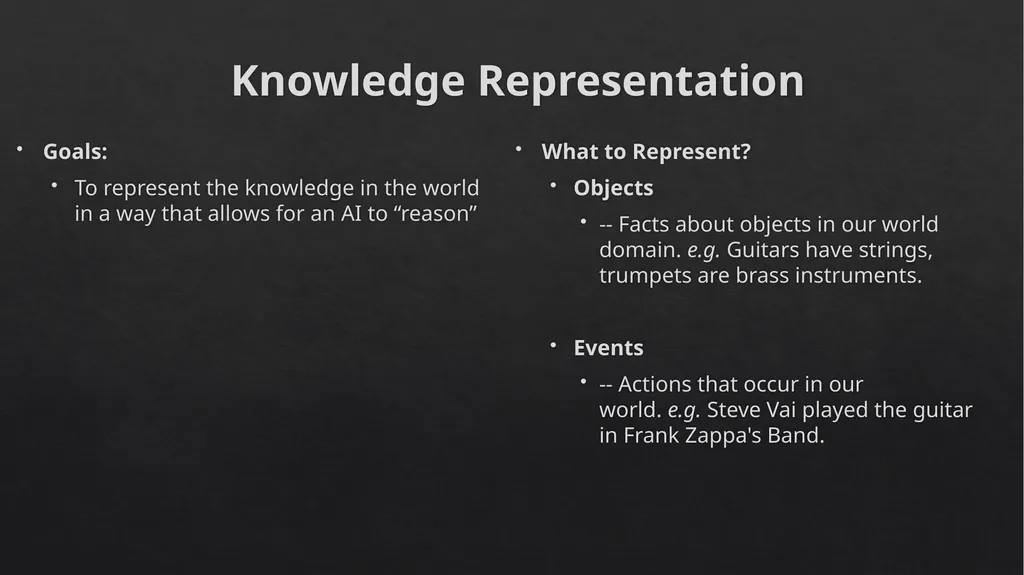
Knowledge Representation Goals:
To represent the knowledge in the world in a way that allows for an AI to “reason” What to Represent?
Objects
-- Facts about objects in our world domain. e.g. Guitars have strings, trumpets are brass instruments.
Events
-- Actions that occur in our world. e.g. Steve Vai played the guitar in Frank Zappa's Band.<br>
To represent the knowledge in the world in a way that allows for an AI to “reason” What to Represent?
Objects
-- Facts about objects in our world domain. e.g. Guitars have strings, trumpets are brass instruments.
Events
-- Actions that occur in our world. e.g. Steve Vai played the guitar in Frank Zappa's Band.<br>
09
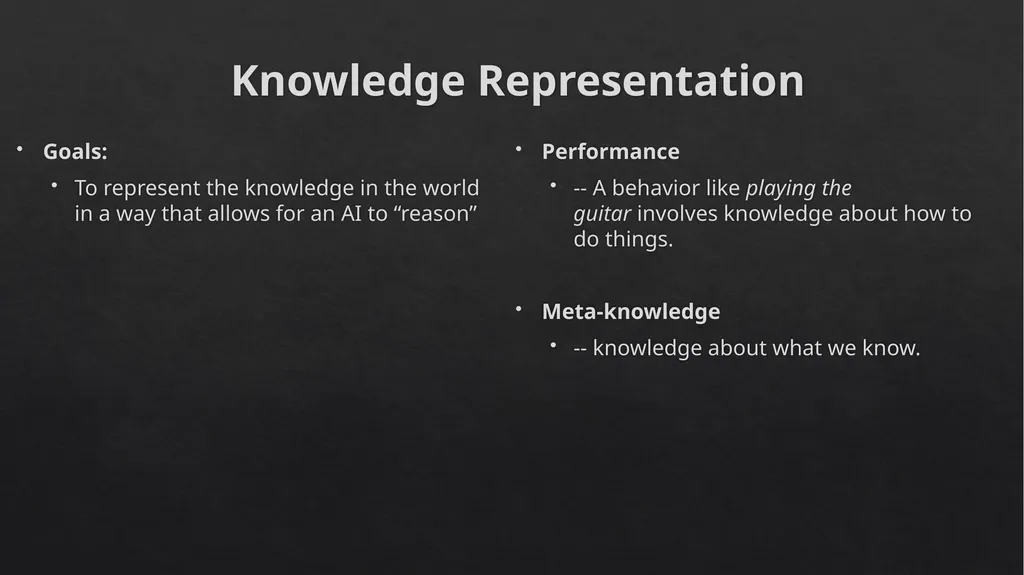
Knowledge Representation Goals:
To represent the knowledge in the world in a way that allows for an AI to “reason” Performance
-- A behavior like playing the guitar involves knowledge about how to do things.
Meta-knowledge
-- knowledge about what we know.<br>
To represent the knowledge in the world in a way that allows for an AI to “reason” Performance
-- A behavior like playing the guitar involves knowledge about how to do things.
Meta-knowledge
-- knowledge about what we know.<br>
10
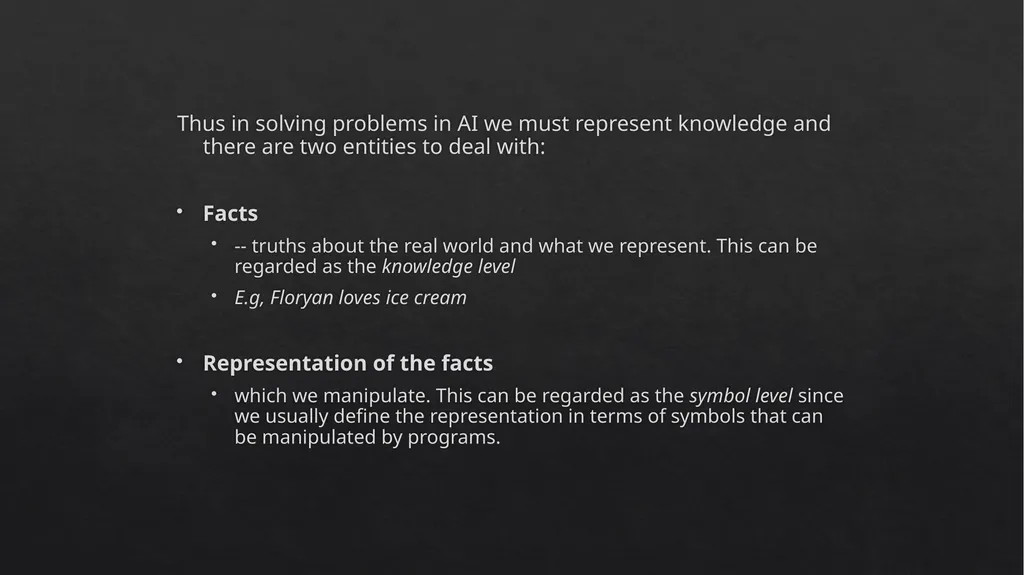
Thus in solving problems in AI we must represent knowledge and there are two entities to deal with:
Facts
-- truths about the real world and what we represent. This can be regarded as the knowledge level
E.g, Floryan loves ice cream
Representation of the facts
which we manipulate. This can be regarded as the symbol level since we usually define the representation in terms of symbols that can be manipulated by programs.<br>
Facts
-- truths about the real world and what we represent. This can be regarded as the knowledge level
E.g, Floryan loves ice cream
Representation of the facts
which we manipulate. This can be regarded as the symbol level since we usually define the representation in terms of symbols that can be manipulated by programs.<br>
11
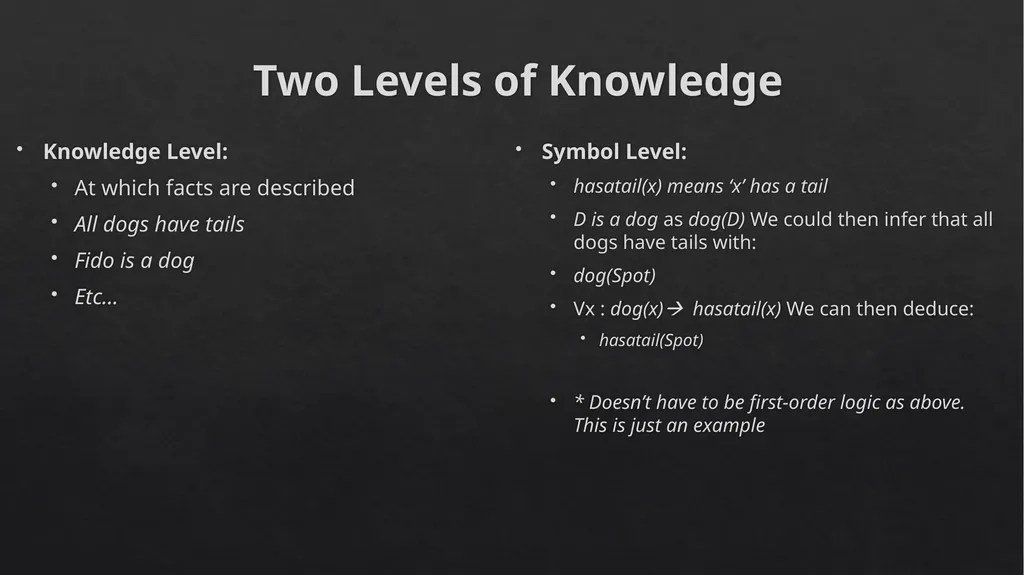
Two Levels of Knowledge Knowledge Level:
At which facts are described
All dogs have tails
Fido is a dog
Etc… Symbol Level:
hasatail(x) means ‘x’ has a tail
D is a dog as dog(D) We could then infer that all dogs have tails with:
dog(Spot)
Vx : dog(x) hasatail(x) We can then deduce:
hasatail(Spot)
* Doesn’t have to be first-order logic as above. This is just an example<br>
At which facts are described
All dogs have tails
Fido is a dog
Etc… Symbol Level:
hasatail(x) means ‘x’ has a tail
D is a dog as dog(D) We could then infer that all dogs have tails with:
dog(Spot)
Vx : dog(x) hasatail(x) We can then deduce:
hasatail(Spot)
* Doesn’t have to be first-order logic as above. This is just an example<br>
12
Properties for Knowledge Representation Systems Representational Adequacy
-- the ability to represent the required knowledge;
Inferential Adequacy
- the ability to manipulate the knowledge represented to produce new knowledge corresponding to that inferred from the original;
Inferential Efficiency
- the ability to direct the inferential mechanisms into the most productive directions by storing appropriate guides;
Acquisitional Efficiency
- the ability to acquire new knowledge using automatic methods wherever possible rather than reliance on human intervention.
To date no single system optimizes all of the above<br>
-- the ability to represent the required knowledge;
Inferential Adequacy
- the ability to manipulate the knowledge represented to produce new knowledge corresponding to that inferred from the original;
Inferential Efficiency
- the ability to direct the inferential mechanisms into the most productive directions by storing appropriate guides;
Acquisitional Efficiency
- the ability to acquire new knowledge using automatic methods wherever possible rather than reliance on human intervention.
To date no single system optimizes all of the above<br>
13
Representational Adequacy
-- the ability to represent the required knowledge;
What it means:
Need a way to represent ALL types of knowledge.
Easy:
Spot is a dog, all dogs have tails
Medium:
Spot does not have a tail (apparent contradiction)
A Little Harder:
I must go grocery shopping between 8 and 2 on Tuesdays.<br>
-- the ability to represent the required knowledge;
What it means:
Need a way to represent ALL types of knowledge.
Easy:
Spot is a dog, all dogs have tails
Medium:
Spot does not have a tail (apparent contradiction)
A Little Harder:
I must go grocery shopping between 8 and 2 on Tuesdays.<br>
14
Inferential Adequacy
- the ability to manipulate the knowledge represented to produce new knowledge corresponding to that inferred from the original;
What it means:
In formal logic, this means applying logical reasoning to infer new things.
Spot is a dog
All dogs have tails
Thus, Spot has a tail
If we can represent knowledge, but can’t use it to infer anything interesting, then our representation is quite poor.<br>
- the ability to manipulate the knowledge represented to produce new knowledge corresponding to that inferred from the original;
What it means:
In formal logic, this means applying logical reasoning to infer new things.
Spot is a dog
All dogs have tails
Thus, Spot has a tail
If we can represent knowledge, but can’t use it to infer anything interesting, then our representation is quite poor.<br>
15
Inferential Efficiency
- the ability to direct the inferential mechanisms into the most productive directions by storing appropriate guides;
What it means:
When making complex inferences, system should do so in the most efficient manner possible.
Basically an algorithms problem
System should be able to choose, if many inferential paths possible, the most important or productive path!<br>
- the ability to direct the inferential mechanisms into the most productive directions by storing appropriate guides;
What it means:
When making complex inferences, system should do so in the most efficient manner possible.
Basically an algorithms problem
System should be able to choose, if many inferential paths possible, the most important or productive path!<br>
16
Acquisitional Efficiency
- the ability to acquire new knowledge using automatic methods wherever possible rather than reliance on human intervention.
What it means:
Humans should not have to manually teach the system everything. It needs to learn on it’s own as much as possible.<br>
- the ability to acquire new knowledge using automatic methods wherever possible rather than reliance on human intervention.
What it means:
Humans should not have to manually teach the system everything. It needs to learn on it’s own as much as possible.<br>
17
Basic Approaches to Knowledge Representation<br>
18
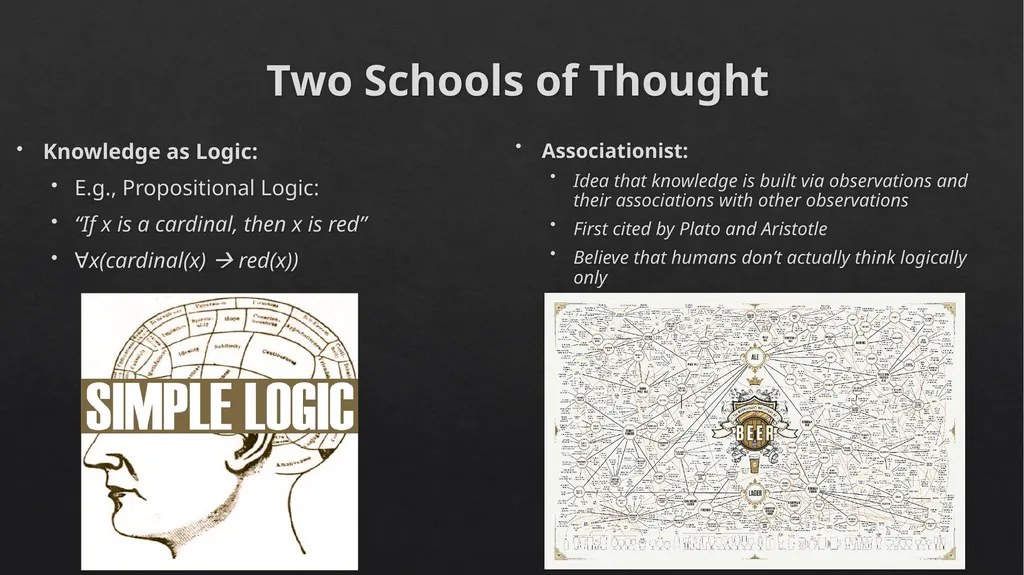
Two Schools of Thought Knowledge as Logic:
E.g., Propositional Logic:
“If x is a cardinal, then x is red”
∀x(cardinal(x) red(x)) Associationist:
Idea that knowledge is built via observations and their associations with other observations
First cited by Plato and Aristotle
Believe that humans don’t actually think logically only<br>
E.g., Propositional Logic:
“If x is a cardinal, then x is red”
∀x(cardinal(x) red(x)) Associationist:
Idea that knowledge is built via observations and their associations with other observations
First cited by Plato and Aristotle
Believe that humans don’t actually think logically only<br>
19
What is a Logic? A language with concrete rules
No ambiguity in representation (may be other errors!)
Allows unambiguous communication and processing
Very unlike natural languages e.g. English
Many ways to translate between languages
A statement can be represented in different logics
And perhaps differently in same logic
Expressiveness of a logic
How much can we say in this language?
Not to be confused with logical reasoning
Logics are languages, reasoning is a process (may use logic)<br>
No ambiguity in representation (may be other errors!)
Allows unambiguous communication and processing
Very unlike natural languages e.g. English
Many ways to translate between languages
A statement can be represented in different logics
And perhaps differently in same logic
Expressiveness of a logic
How much can we say in this language?
Not to be confused with logical reasoning
Logics are languages, reasoning is a process (may use logic)<br>
20
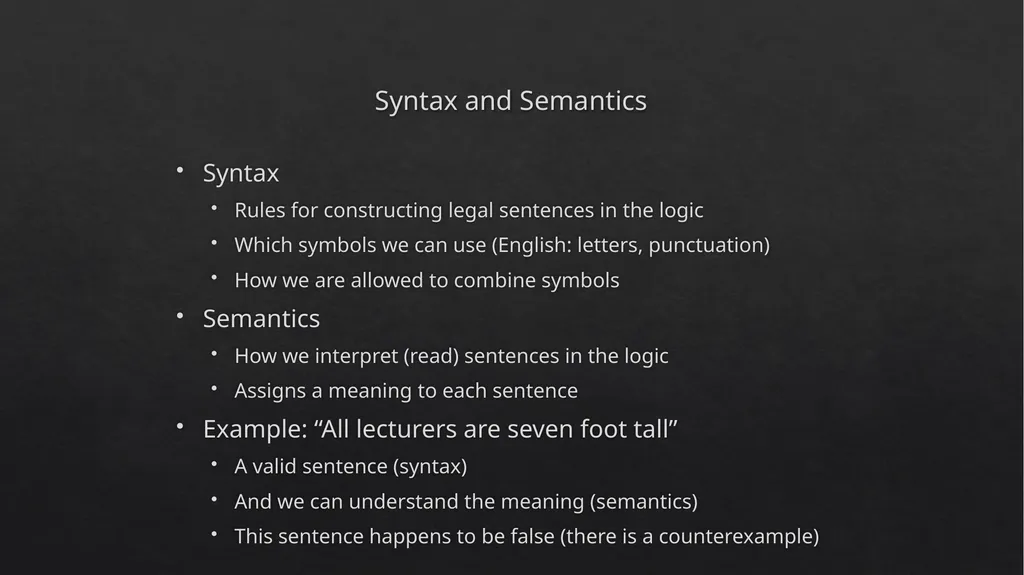
Syntax and Semantics Syntax
Rules for constructing legal sentences in the logic
Which symbols we can use (English: letters, punctuation)
How we are allowed to combine symbols
Semantics
How we interpret (read) sentences in the logic
Assigns a meaning to each sentence
Example: “All lecturers are seven foot tall”
A valid sentence (syntax)
And we can understand the meaning (semantics)
This sentence happens to be false (there is a counterexample)<br>
Rules for constructing legal sentences in the logic
Which symbols we can use (English: letters, punctuation)
How we are allowed to combine symbols
Semantics
How we interpret (read) sentences in the logic
Assigns a meaning to each sentence
Example: “All lecturers are seven foot tall”
A valid sentence (syntax)
And we can understand the meaning (semantics)
This sentence happens to be false (there is a counterexample)<br>
21
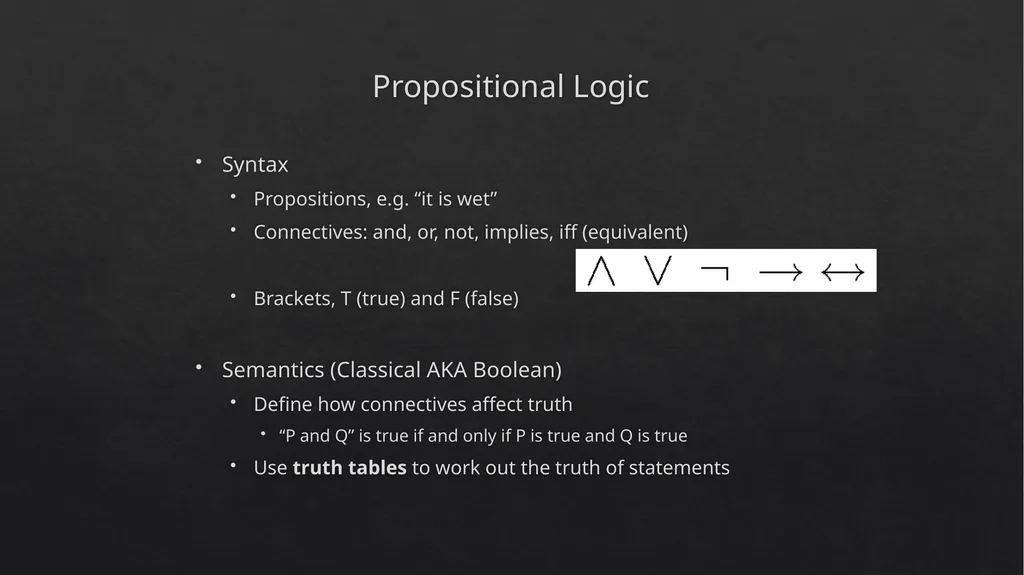
Propositional Logic Syntax
Propositions, e.g. “it is wet”
Connectives: and, or, not, implies, iff (equivalent)
Brackets, T (true) and F (false)
Semantics (Classical AKA Boolean)
Define how connectives affect truth
“P and Q” is true if and only if P is true and Q is true
Use truth tables to work out the truth of statements<br>
Propositions, e.g. “it is wet”
Connectives: and, or, not, implies, iff (equivalent)
Brackets, T (true) and F (false)
Semantics (Classical AKA Boolean)
Define how connectives affect truth
“P and Q” is true if and only if P is true and Q is true
Use truth tables to work out the truth of statements<br>
22
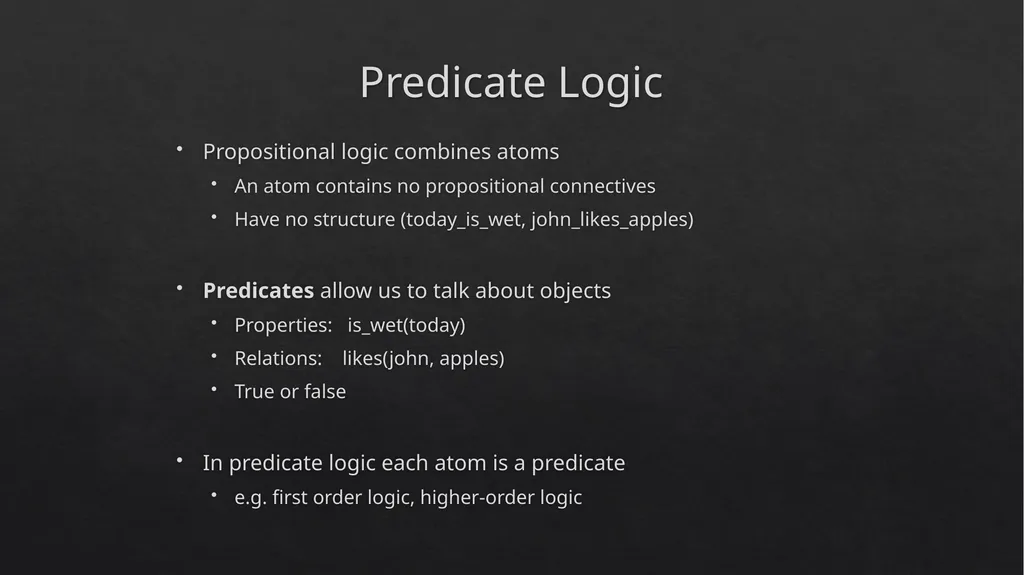
Predicate Logic Propositional logic combines atoms
An atom contains no propositional connectives
Have no structure (today_is_wet, john_likes_apples)
Predicates allow us to talk about objects
Properties: is_wet(today)
Relations: likes(john, apples)
True or false
In predicate logic each atom is a predicate
e.g. first order logic, higher-order logic<br>
An atom contains no propositional connectives
Have no structure (today_is_wet, john_likes_apples)
Predicates allow us to talk about objects
Properties: is_wet(today)
Relations: likes(john, apples)
True or false
In predicate logic each atom is a predicate
e.g. first order logic, higher-order logic<br>
23
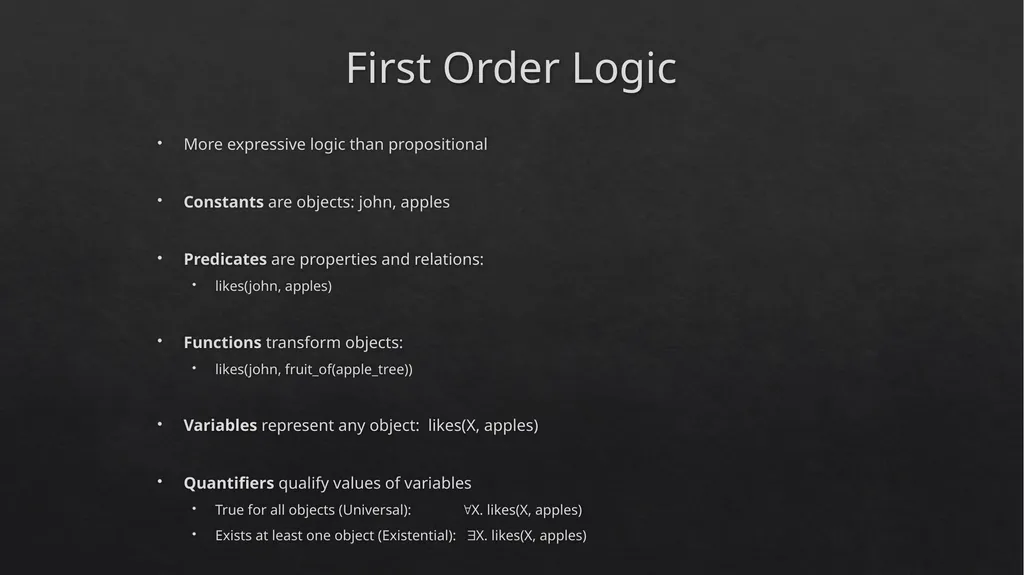
First Order Logic More expressive logic than propositional
Constants are objects: john, apples
Predicates are properties and relations:
likes(john, apples)
Functions transform objects:
likes(john, fruit_of(apple_tree))
Variables represent any object: likes(X, apples)
Quantifiers qualify values of variables
True for all objects (Universal): X. likes(X, apples)
Exists at least one object (Existential): X. likes(X, apples)<br>
Constants are objects: john, apples
Predicates are properties and relations:
likes(john, apples)
Functions transform objects:
likes(john, fruit_of(apple_tree))
Variables represent any object: likes(X, apples)
Quantifiers qualify values of variables
True for all objects (Universal): X. likes(X, apples)
Exists at least one object (Existential): X. likes(X, apples)<br>
24
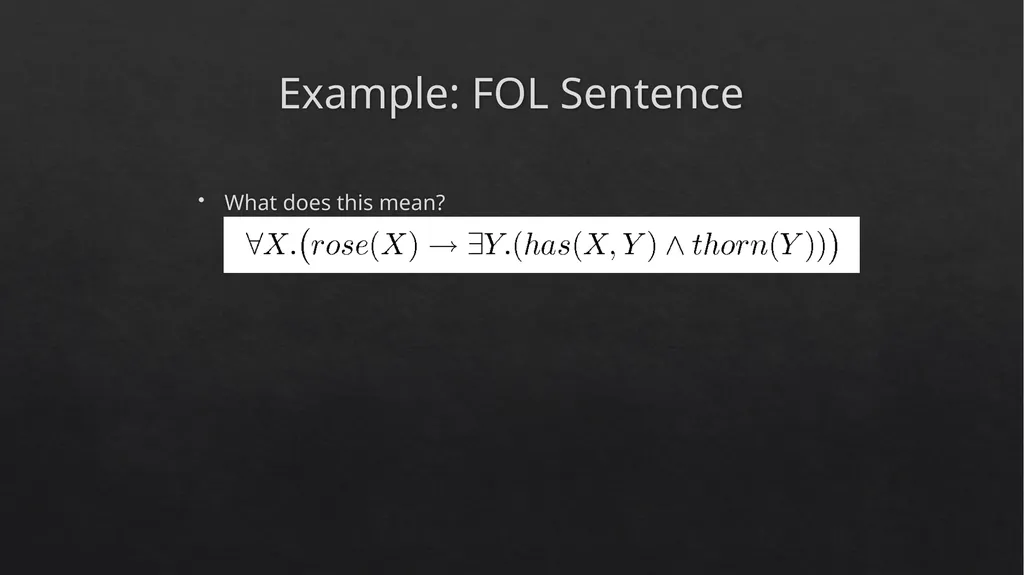
Example: FOL Sentence What does this mean?<br>
25
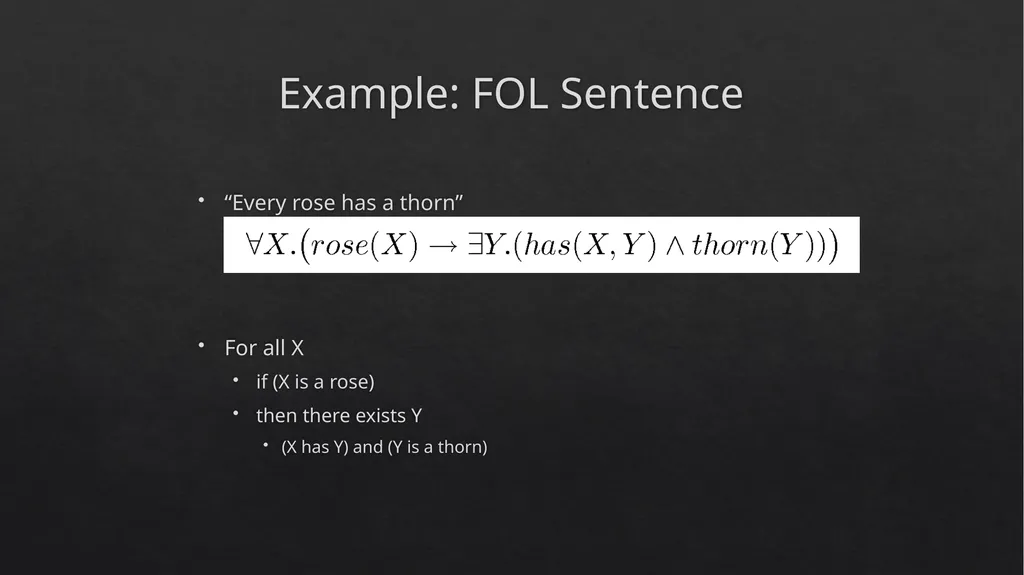
Example: FOL Sentence “Every rose has a thorn”
For all X
if (X is a rose)
then there exists Y
(X has Y) and (Y is a thorn)<br>
For all X
if (X is a rose)
then there exists Y
(X has Y) and (Y is a thorn)<br>
26
Example: FOL Sentence<br>
27
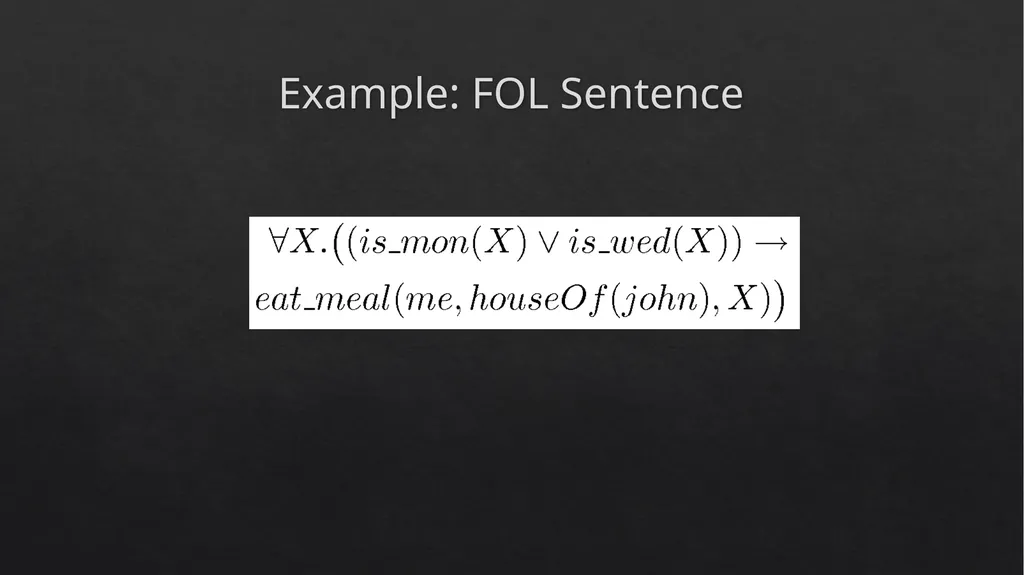
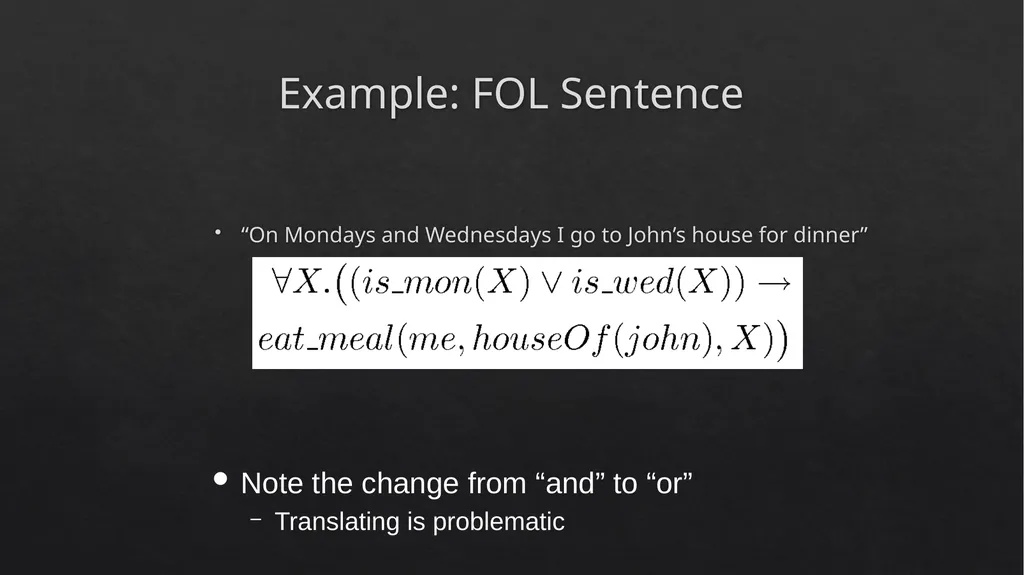
Example: FOL Sentence “On Mondays and Wednesdays I go to John’s house for dinner” Note the change from “and” to “or”
Translating is problematic<br>
Translating is problematic<br>
28
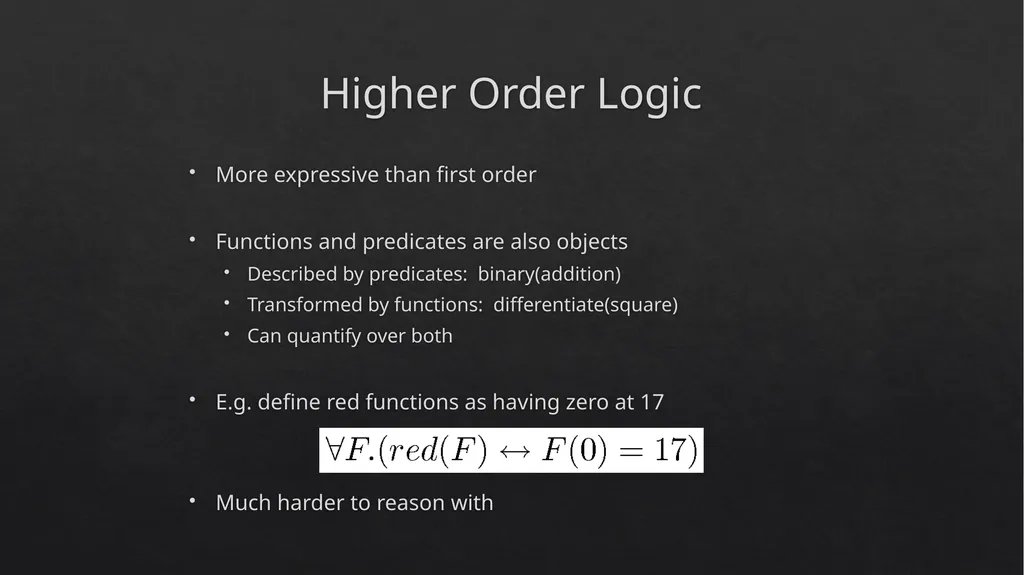
Higher Order Logic More expressive than first order
Functions and predicates are also objects
Described by predicates: binary(addition)
Transformed by functions: differentiate(square)
Can quantify over both
E.g. define red functions as having zero at 17
Much harder to reason with<br>
Functions and predicates are also objects
Described by predicates: binary(addition)
Transformed by functions: differentiate(square)
Can quantify over both
E.g. define red functions as having zero at 17
Much harder to reason with<br>
29
Production Rules Rule set of <condition,action> pairs
“if condition then action”
Match-resolve-act cycle
Match: Agent checks if each rule’s condition holds
Resolve:
Multiple production rules may fire at once (conflict set)
Agent must choose rule from set (conflict resolution)
Act: If so, rule “fires” and the action is carried out
Working memory:
rule can write knowledge to working memory
knowledge may match and fire other rules<br>
“if condition then action”
Match-resolve-act cycle
Match: Agent checks if each rule’s condition holds
Resolve:
Multiple production rules may fire at once (conflict set)
Agent must choose rule from set (conflict resolution)
Act: If so, rule “fires” and the action is carried out
Working memory:
rule can write knowledge to working memory
knowledge may match and fire other rules<br>
30
Production Rules Example IF (at bus stop AND bus arrives) THEN action(get on the bus)
IF (on bus AND not paid AND have oyster card) THEN action(pay with oyster) AND add(paid)
IF (on bus AND paid AND empty seat) THEN sit down
conditions and actions must be clearly defined
can easily be expressed in first order logic!<br>
IF (on bus AND not paid AND have oyster card) THEN action(pay with oyster) AND add(paid)
IF (on bus AND paid AND empty seat) THEN sit down
conditions and actions must be clearly defined
can easily be expressed in first order logic!<br>
31
Beyond True and False Multi-valued logics
More than two truth values
e.g., true, false & unknown
Fuzzy logic uses probabilities, truth value in [0,1]<br>
More than two truth values
e.g., true, false & unknown
Fuzzy logic uses probabilities, truth value in [0,1]<br>
32
Logic is a Good Representation Fairly easy to do the translation when possible
Branches of mathematics devoted to it
It enables us to do logical reasoning
Tools and techniques come for free
Basis for programming languages
Prolog uses logic programs (a subset of FOL)
Prolog based on HOL<br>
Branches of mathematics devoted to it
It enables us to do logical reasoning
Tools and techniques come for free
Basis for programming languages
Prolog uses logic programs (a subset of FOL)
Prolog based on HOL<br>
33
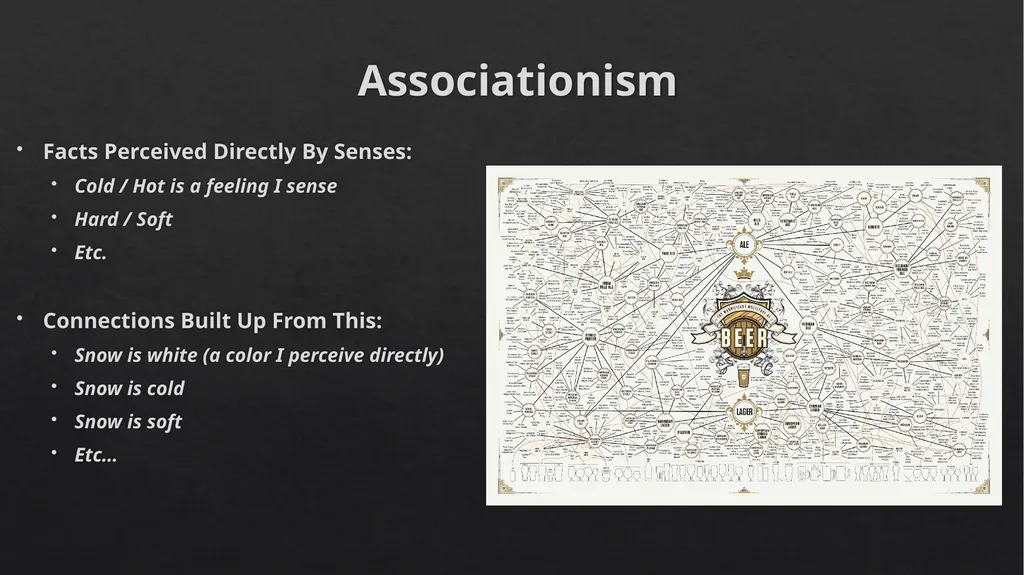
Associationism Facts Perceived Directly By Senses:
Cold / Hot is a feeling I sense
Hard / Soft
Etc.
Connections Built Up From This:
Snow is white (a color I perceive directly)
Snow is cold
Snow is soft
Etc…<br>
Cold / Hot is a feeling I sense
Hard / Soft
Etc.
Connections Built Up From This:
Snow is white (a color I perceive directly)
Snow is cold
Snow is soft
Etc…<br>
34
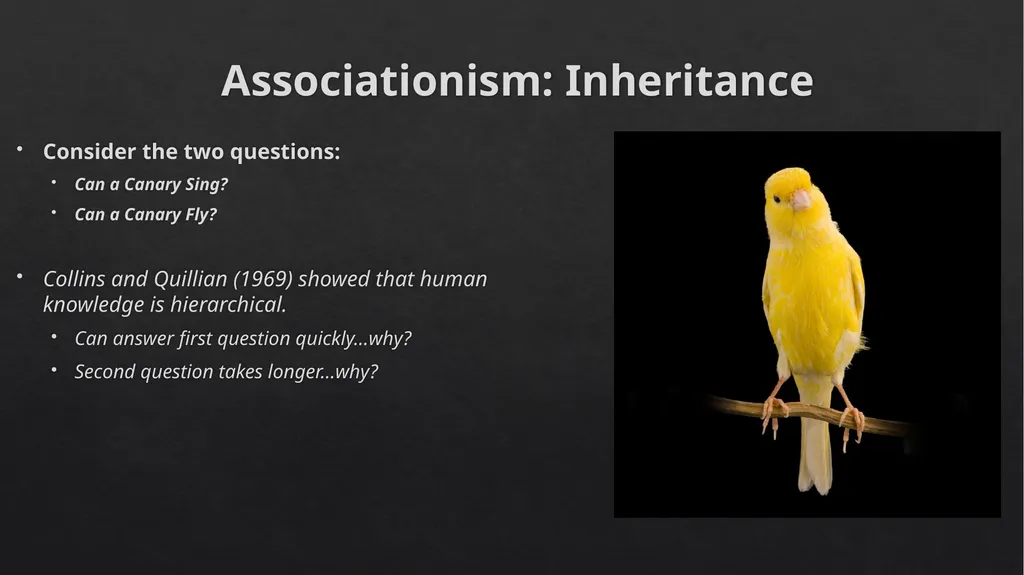
Associationism: Inheritance Consider the two questions:
Can a Canary Sing?
Can a Canary Fly?
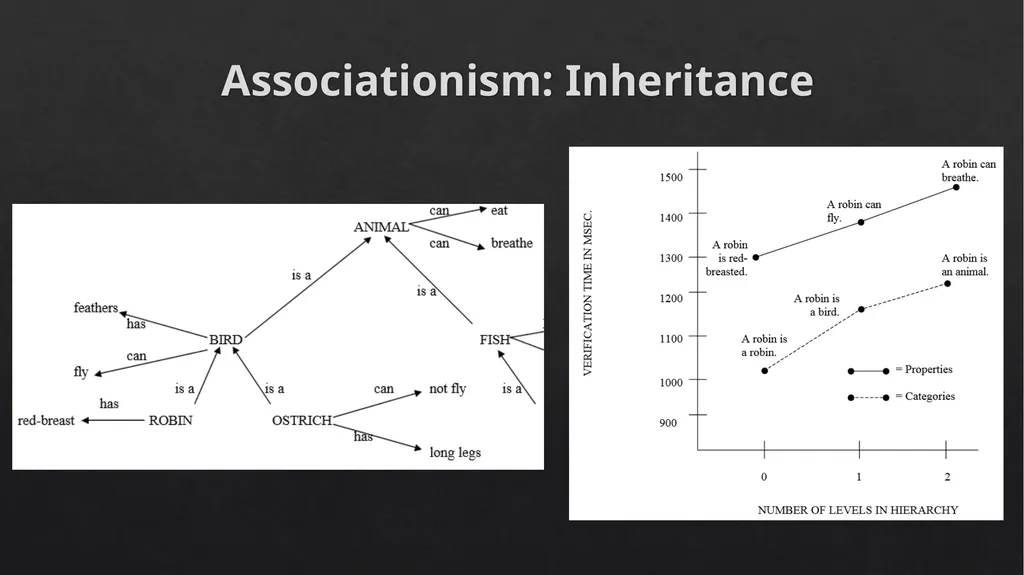
Collins and Quillian (1969) showed that human knowledge is hierarchical.
Can answer first question quickly…why?
Second question takes longer…why?<br>
Can a Canary Sing?
Can a Canary Fly?
Collins and Quillian (1969) showed that human knowledge is hierarchical.
Can answer first question quickly…why?
Second question takes longer…why?<br>
35
Associationism: Inheritance<br>
36
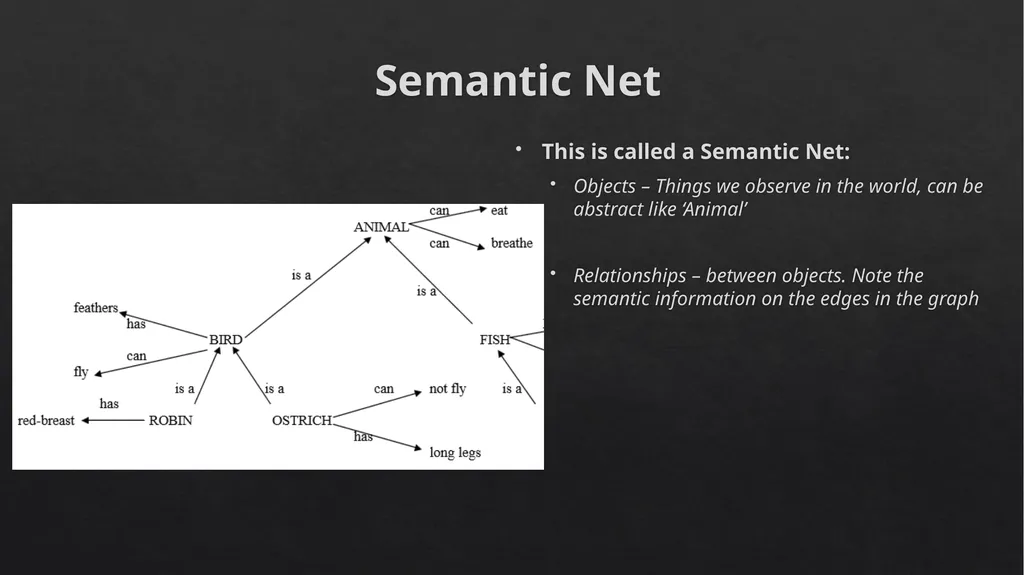
Semantic Net This is called a Semantic Net:
Objects – Things we observe in the world, can be abstract like ‘Animal’
Relationships – between objects. Note the semantic information on the edges in the graph<br>
Objects – Things we observe in the world, can be abstract like ‘Animal’
Relationships – between objects. Note the semantic information on the edges in the graph<br>
37
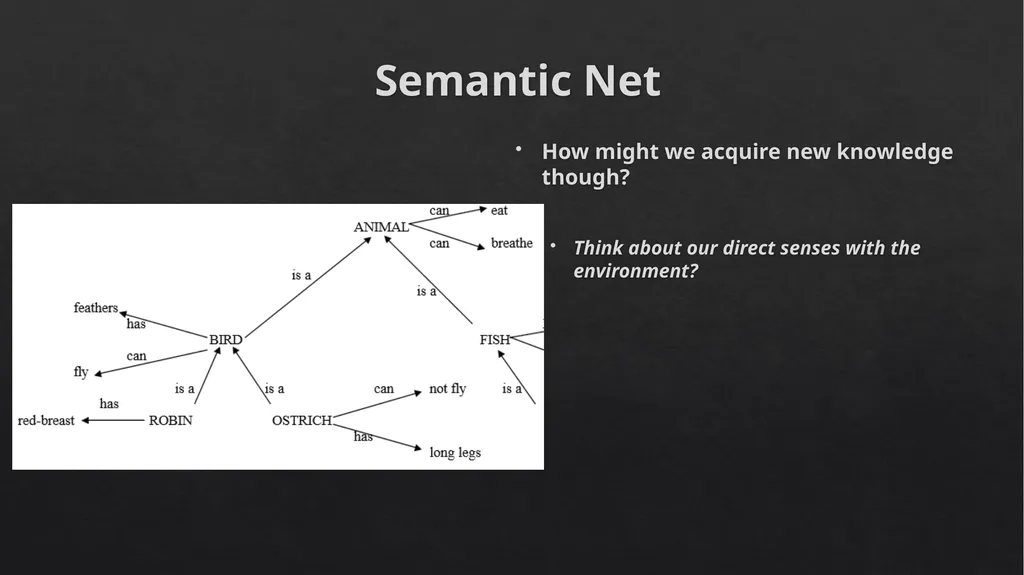
Semantic Net How might we acquire new knowledge though?
Think about our direct senses with the environment?<br>
Think about our direct senses with the environment?<br>
38
Semantic Networks Graphical representation (a graph)
Links indicate subset, member, relation, ...
Equivalent to logical statements (usually FOL)
Easier to understand than FOL?
Specialised SN reasoning algorithms can be faster
Example: natural language understanding
Sentences with same meaning have same graphs
e.g. Conceptual Dependency Theory (Schank)<br>
Links indicate subset, member, relation, ...
Equivalent to logical statements (usually FOL)
Easier to understand than FOL?
Specialised SN reasoning algorithms can be faster
Example: natural language understanding
Sentences with same meaning have same graphs
e.g. Conceptual Dependency Theory (Schank)<br>
39
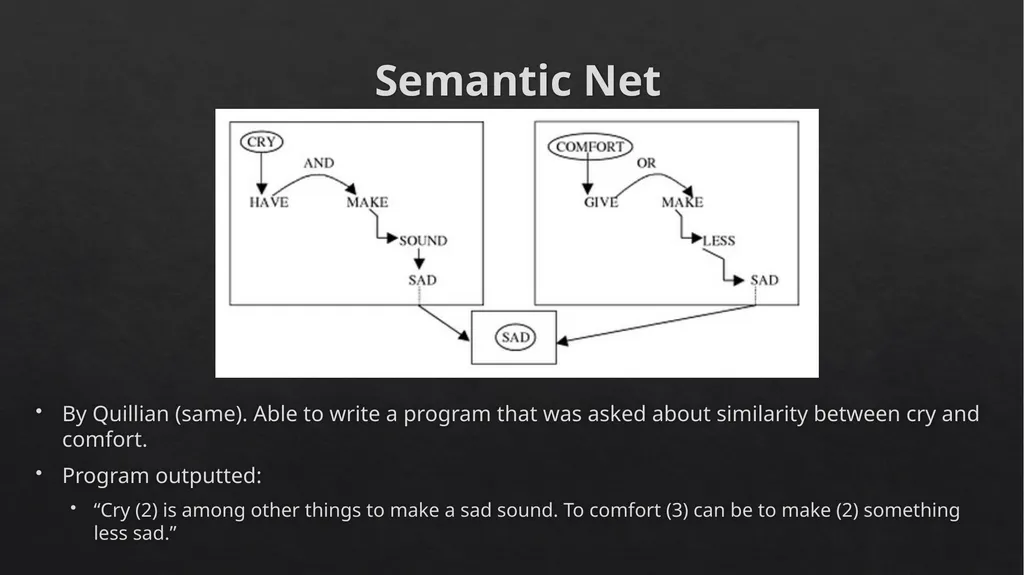
Semantic Net By Quillian (same). Able to write a program that was asked about similarity between cry and comfort.
Program outputted:
“Cry (2) is among other things to make a sad sound. To comfort (3) can be to make (2) something less sad.”<br>
Program outputted:
“Cry (2) is among other things to make a sad sound. To comfort (3) can be to make (2) something less sad.”<br>
40
Frames<br>
41
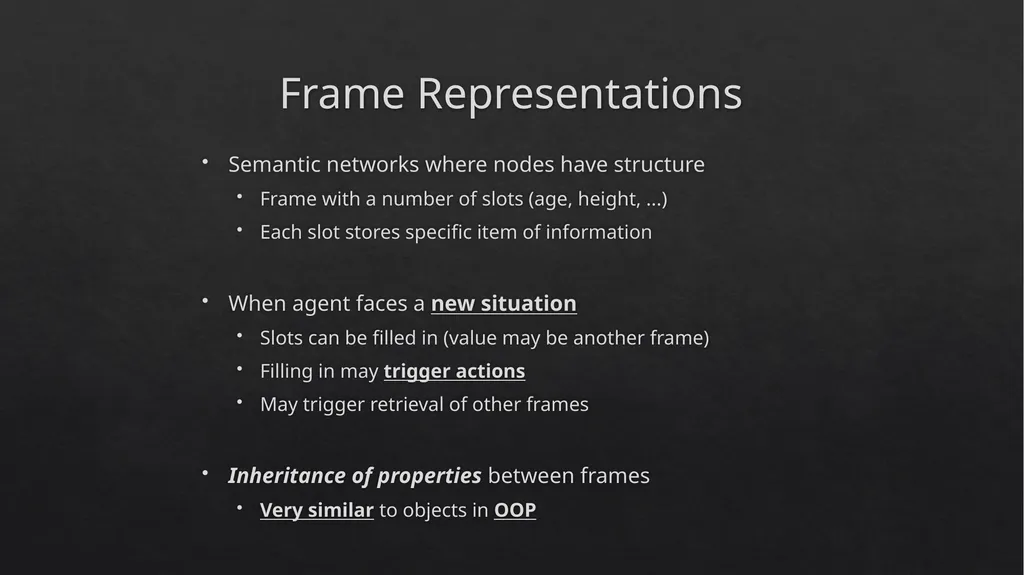
Frame Representations Semantic networks where nodes have structure
Frame with a number of slots (age, height, ...)
Each slot stores specific item of information
When agent faces a new situation
Slots can be filled in (value may be another frame)
Filling in may trigger actions
May trigger retrieval of other frames
Inheritance of properties between frames
Very similar to objects in OOP<br>
Frame with a number of slots (age, height, ...)
Each slot stores specific item of information
When agent faces a new situation
Slots can be filled in (value may be another frame)
Filling in may trigger actions
May trigger retrieval of other frames
Inheritance of properties between frames
Very similar to objects in OOP<br>
42
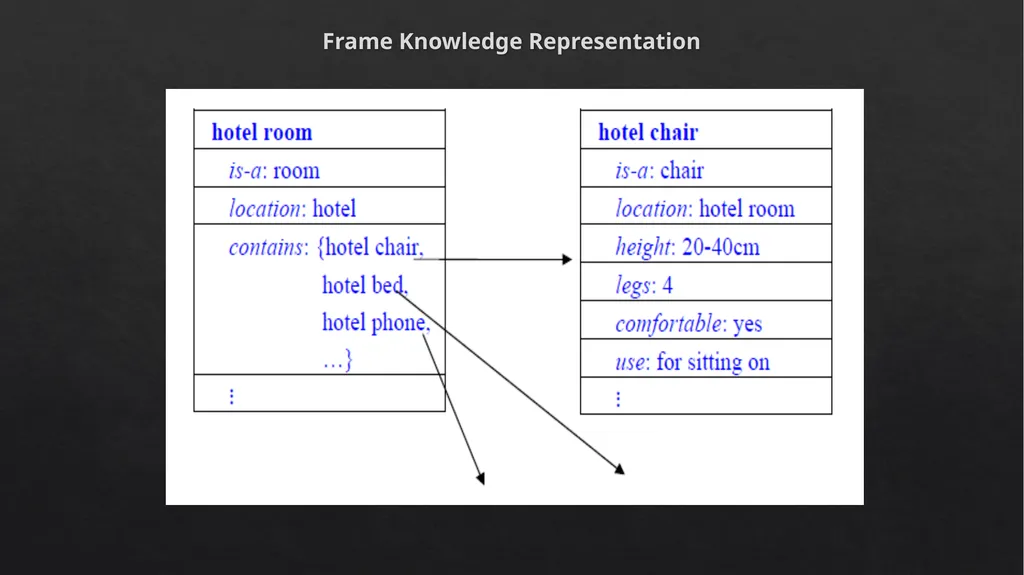
Frame Knowledge Representation<br>
43
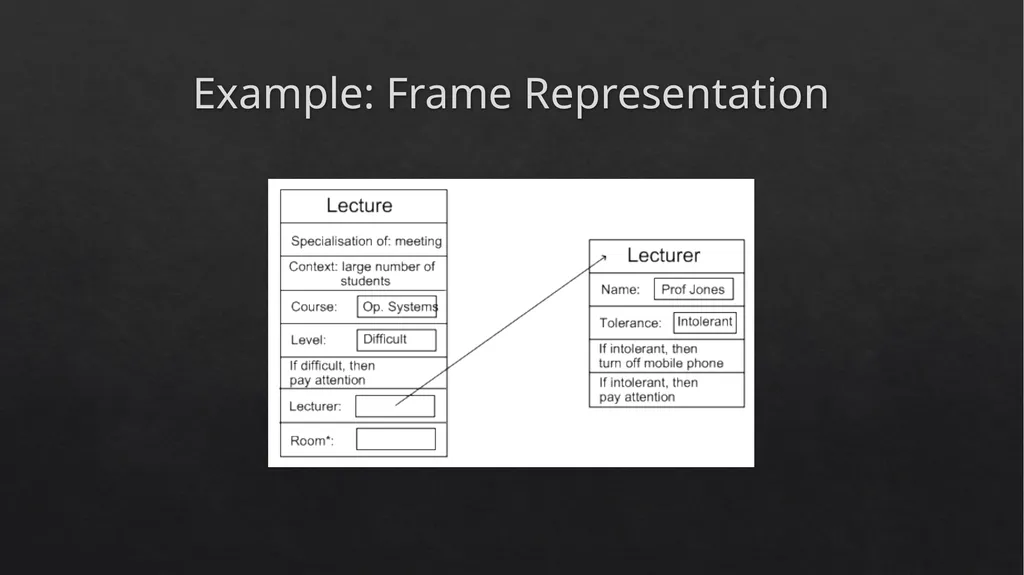
Example: Frame Representation<br>
44
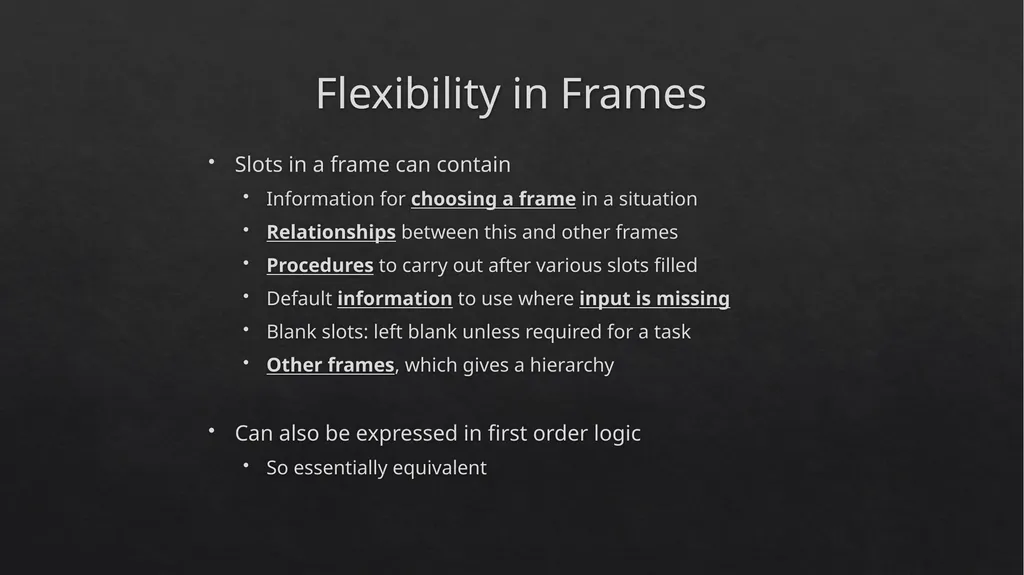
Flexibility in Frames Slots in a frame can contain
Information for choosing a frame in a situation
Relationships between this and other frames
Procedures to carry out after various slots filled
Default information to use where input is missing
Blank slots: left blank unless required for a task
Other frames, which gives a hierarchy
Can also be expressed in first order logic
So essentially equivalent<br>
Information for choosing a frame in a situation
Relationships between this and other frames
Procedures to carry out after various slots filled
Default information to use where input is missing
Blank slots: left blank unless required for a task
Other frames, which gives a hierarchy
Can also be expressed in first order logic
So essentially equivalent<br>
45
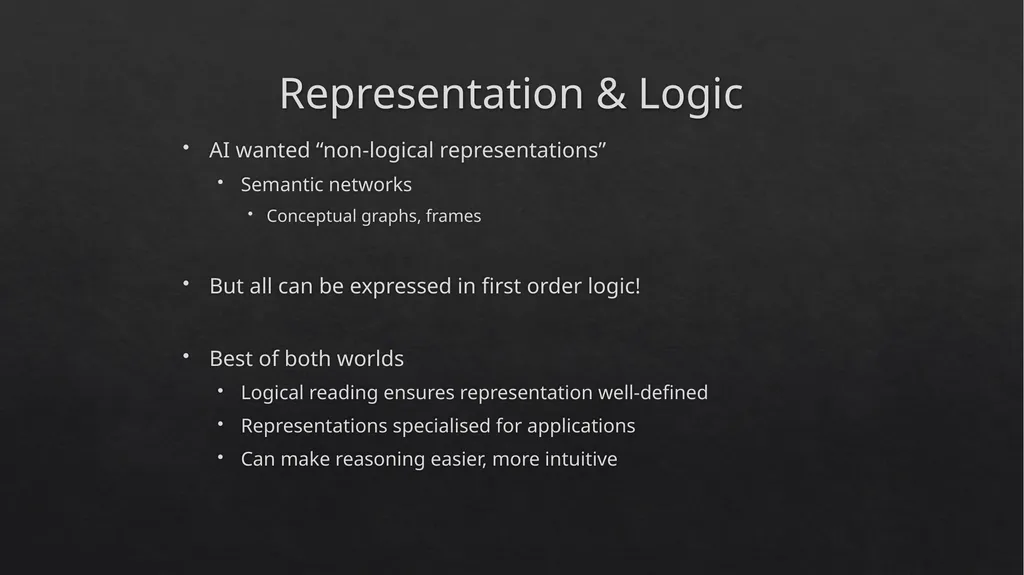
Representation & Logic AI wanted “non-logical representations”
Semantic networks
Conceptual graphs, frames
But all can be expressed in first order logic!
Best of both worlds
Logical reading ensures representation well-defined
Representations specialised for applications
Can make reasoning easier, more intuitive<br>
Semantic networks
Conceptual graphs, frames
But all can be expressed in first order logic!
Best of both worlds
Logical reading ensures representation well-defined
Representations specialised for applications
Can make reasoning easier, more intuitive<br>