04
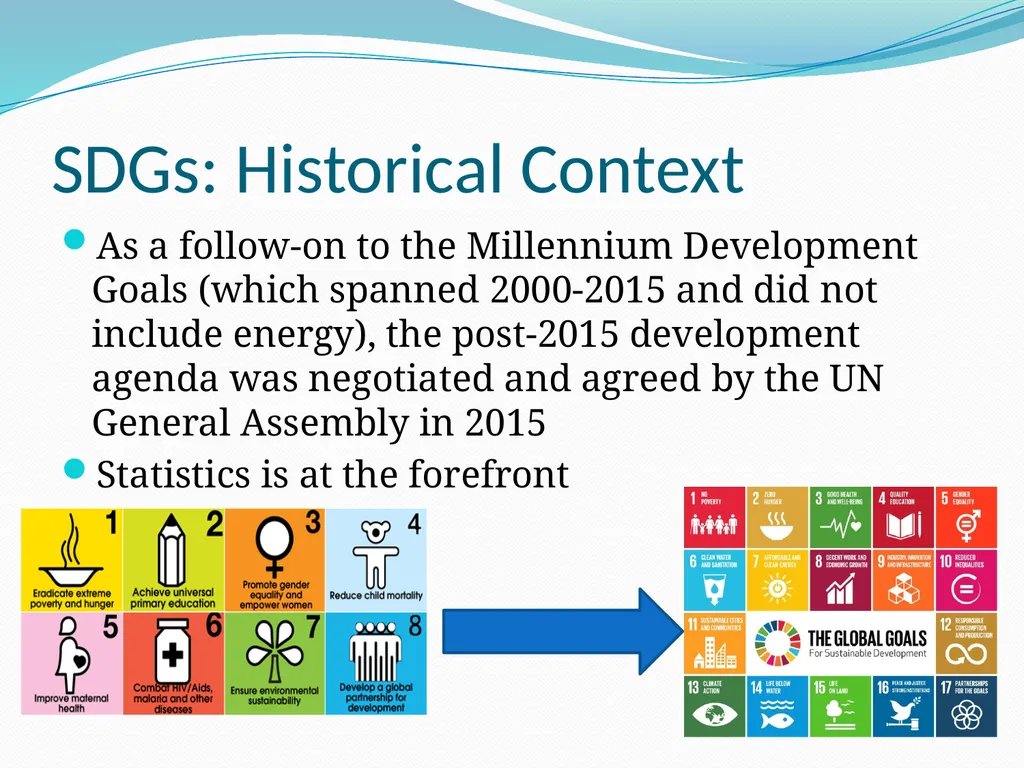
SDGs: Historical Context As a follow-on to the Millennium Development Goals (which spanned 2000-2015 and did not include energy), the post-2015 development agenda was negotiated and agreed by the UN General Assembly in 2015
Statistics is at the forefront<br>
05
Measuring the SDGs At the 46th session, the Statistical Commission established the Inter-Agency Expert Group on the Sustainable Development Goals (IAEG-SDGs)
The group comprises member states, with international and regional organisations as observers (national ownership is key)
Its mandate is to develop an indicator framework to measure the 17 goals and 169 targets
Indicators for each target have now been proposed and classified into three tiers, relating to status of methodology and data collection<br>
06
SDG7 and its Targets Sustainable Development Goal 7: Ensure access to affordable, reliable, sustainable and modern energy for all
Broken down into three main targets (plus two additional targets relating to means of implementation)
Target 7.1: By 2030, ensure universal access to affordable, reliable and modern energy services
Target 7.2: By 2030, increase substantially the share of renewable energy in the global energy mix
Target 7.3: By 2030, double the rate of improvement in energy efficiency
Unlike some other goals, the targets for Energy are (reasonably) clear to measure, established methodology exists and indicators are already available (thus all tier I)<br>
07
SDG7: Process for indicators For SDG 7, inputs have been coordinated by leading agencies and umbrella groups on energy statistics, such as:
UNSD, UN-Energy, SE4all, Worldbank
Some representatives also attended as observers at the IAEG meetings to present the inputs<br>
08
SDG7: Process for indicators Inputs provided so far:
Proposals for indicators that have agreed methodology and existing data collections
Arguments against other proposed indicators that did not
Metadata for energy indicators
Currently still being discussed by the IAEG – with inputs provided by the energy agencies:
Finalization of metadata
Organization of data collection process at world-wide level and identification of lead agencies
Indicators for means of implementation (7.a and 7.b) are still under review
(Current proposals are out of scope of actual energy statistics and are Tier III)<br>
09
SDG 7 indicators 7.1.1: % of population with electricity access
7.1.2 % of population with primary reliance on clean fuels and technology
7.2.1: renewable energy share in total final energy consumption (%)
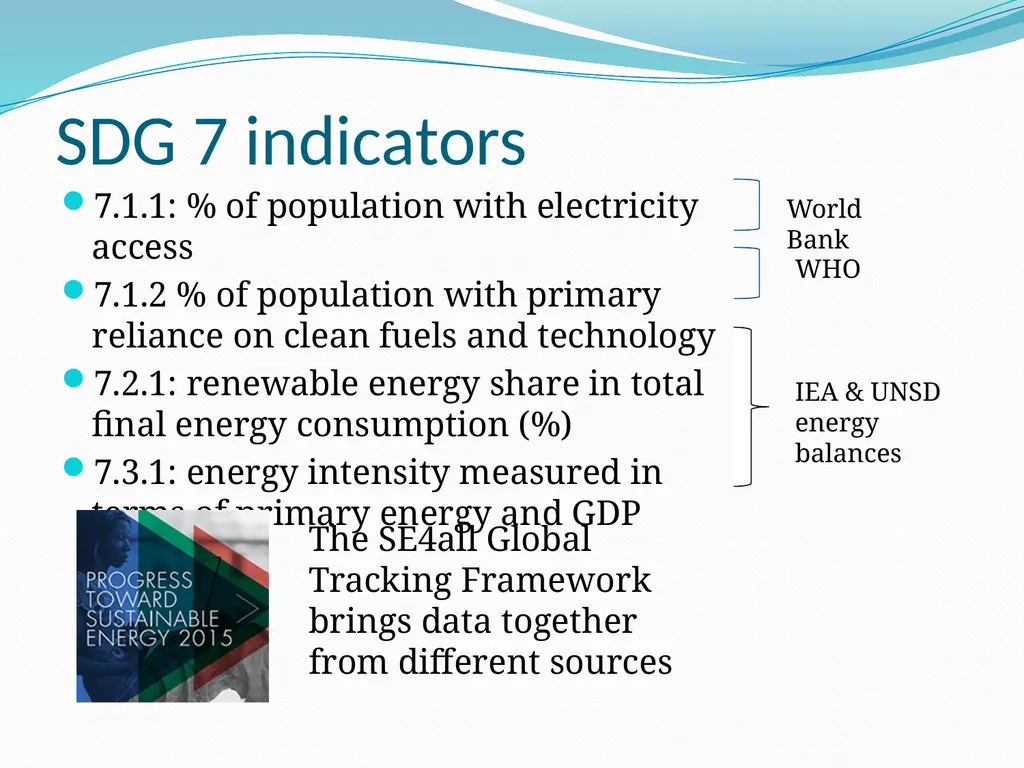
7.3.1: energy intensity measured in terms of primary energy and GDP World Bank WHO IEA & UNSD energy balances The SE4all Global Tracking Framework brings data together from different sources<br>
10
SDGs: IAEG work plan Sub-groups set up on SDMX, Geospatial information, interlinkages between goals
The IAEG-SDGs will develop a plan to review the indicator framework to present to the next UNSC.
The data flows from national to international level are still to be determined, as are baseline years
Tier III indicator proposals to be made by July and finalised by September
Data disaggregation (by income, sex, urban vs rural etc.) is seen as key to reflect the “no-one left behind” approach. Is this relevant/possible for energy?<br>
11
SDG7: UNSD technical cooperation Two regional workshops in 2015 organised by UN DESA’s Division for Sustainable Development, in Panama and Korea
Title: “Mainstreaming energy SDGs, targets and indicators into statistical programmes of countries”
A great way to promote IRES as a practical tool, highlights the benefits of harmonisation
Allowed countries to see how others are integrating the SDG targets into their statistics systems
A third workshop for African countries is planned for June; China workshop in 2 weeks will cover similar topics<br>
12
SDGs, Green Economy With so many SDG indicators and just a few related to energy, UNSD launched a project on the Green Economy that includes energy as one of its priorities: http://unstats.un.org/unsd/greeneconomy/
Goal of the project is to strengthen national statistical systems in developing countries
to enable them to effectively produce statistical indicators on green economy and green growth in the context of sustainable development. 12<br>
13
Green economy energy indicators The green economy project focuses on indicators more purely derived from energy statistics.
In this respect, they align with the SDG ones while being a bit more detailed. 13<br>
14
Green Economy Conclusion Countries must identify policy priorities and goals, then strengthen their national statistical systems in order to provide relevant indicators
Energy GEIs will not be enough for national purposes, even if they are more detailed than SDG7
Countries are thus encouraged to complement these indicators with those relevant to their circumstances 14<br>
15
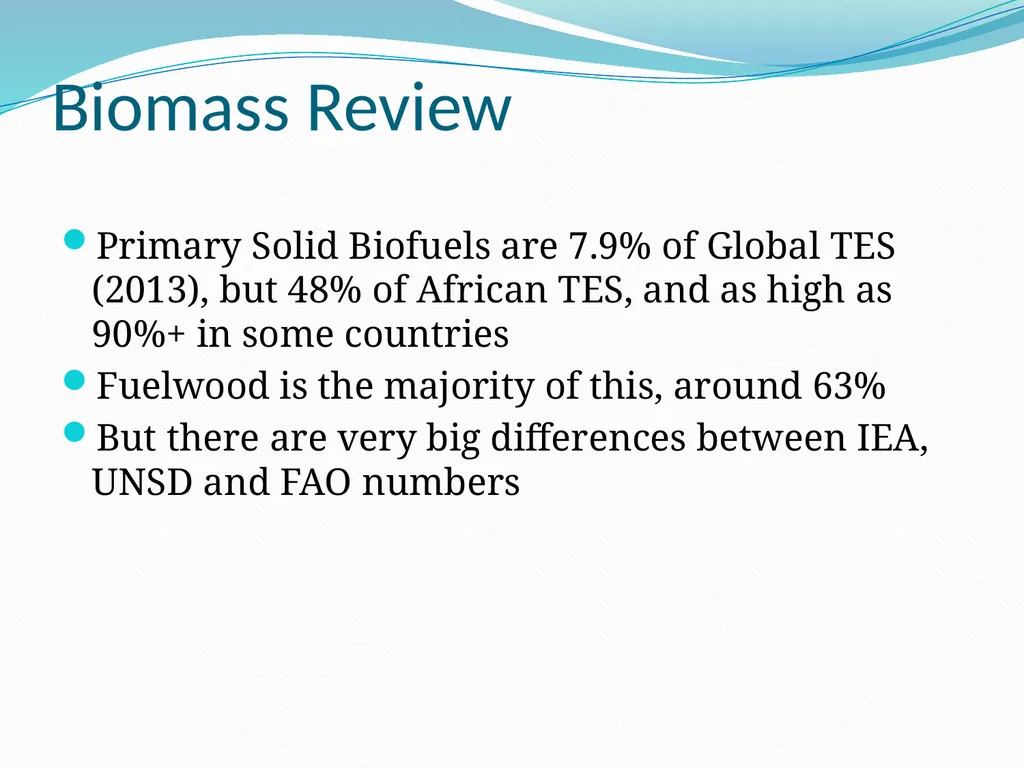
Biomass Review Primary Solid Biofuels are 7.9% of Global TES (2013), but 48% of African TES, and as high as 90%+ in some countries
Fuelwood is the majority of this, around 63%
But there are very big differences between IEA, UNSD and FAO numbers<br>
16
World fuelwood production�2000-2013<br>
18
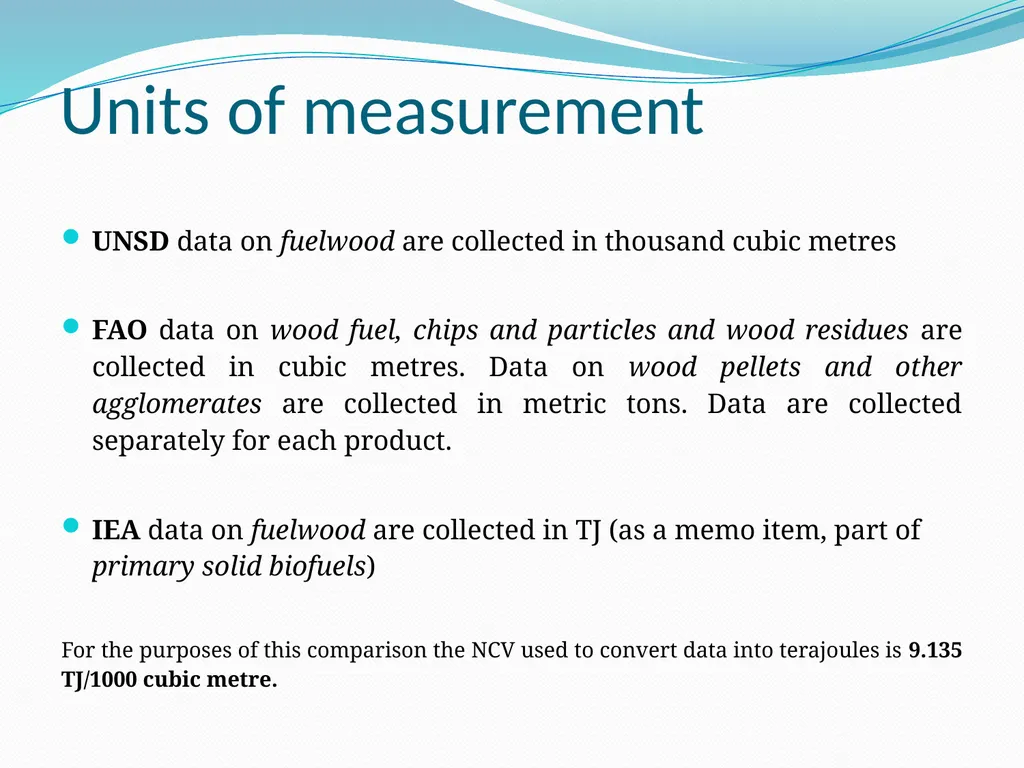
Units of measurement UNSD data on fuelwood are collected in thousand cubic metres
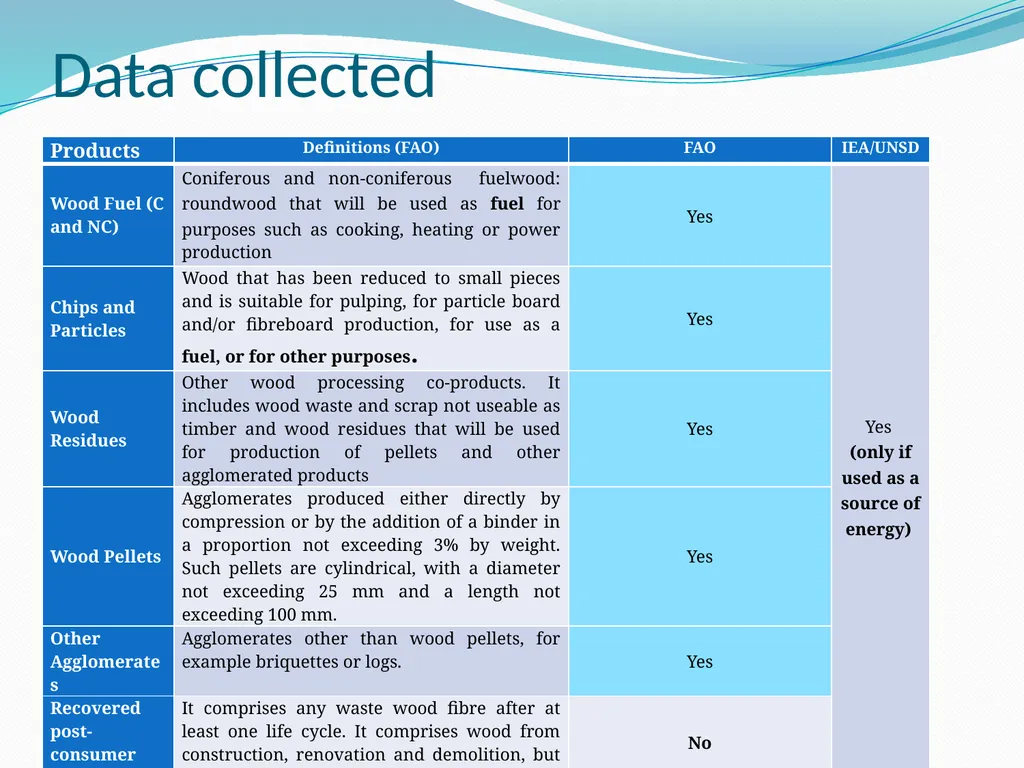
FAO data on wood fuel, chips and particles and wood residues are collected in cubic metres. Data on wood pellets and other agglomerates are collected in metric tons. Data are collected separately for each product.
IEA data on fuelwood are collected in TJ (as a memo item, part of primary solid biofuels)
For the purposes of this comparison the NCV used to convert data into terajoules is 9.135 TJ/1000 cubic metre.<br>
19
Fuelwood production, 2013�Major countries Petajoules<br>
20
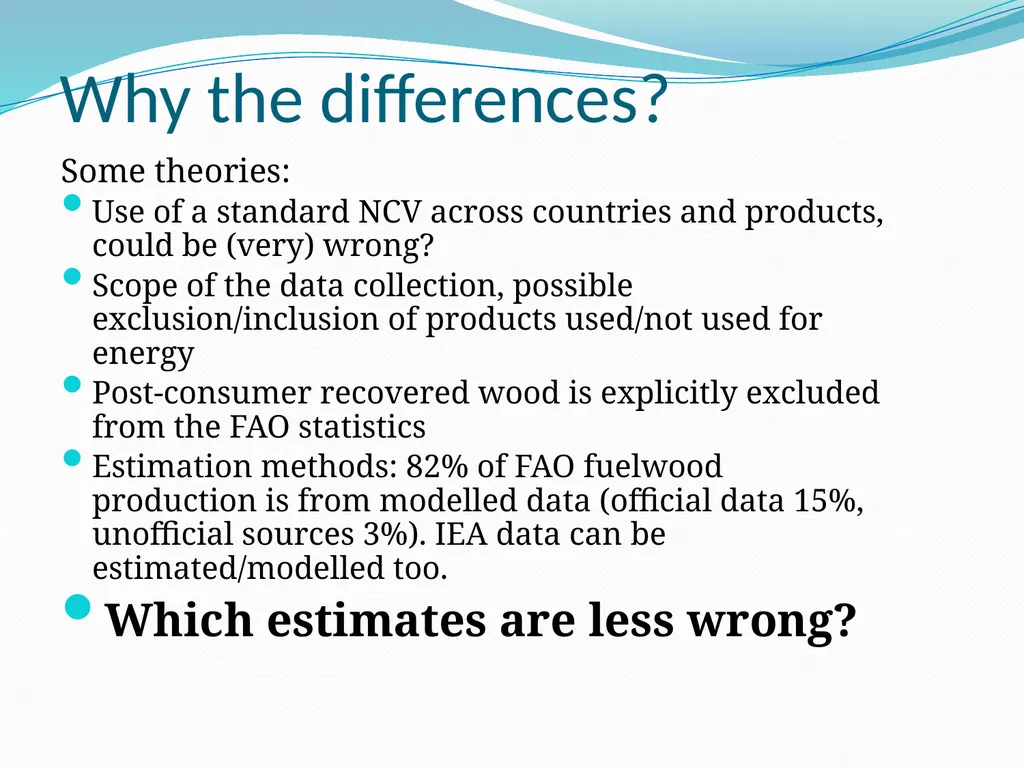
Why the differences? Some theories:
Use of a standard NCV across countries and products, could be (very) wrong?
Scope of the data collection, possible exclusion/inclusion of products used/not used for energy
Post-consumer recovered wood is explicitly excluded from the FAO statistics
Estimation methods: 82% of FAO fuelwood production is from modelled data (official data 15%, unofficial sources 3%). IEA data can be estimated/modelled too.
Which estimates are less wrong?<br>
21
THANKS http://unstats.un.org/unsd/energy/default.htm
http://unstats.un.org/sdgs/<br>