
DESCRIBING LANGUAGE YANUARTI APSARI, M.Pd MEANING


Description: DESCRIBING LANGUAGE YANUARTI APSARI, M.Pd MEANING IN CONTEXT The meaning of the same sentences will be changed depend on the context (who is speaking, to whom and why) E.q : Its Warm Here 1. someone who is lazy, ill or in some position of
Related Topics
Download Presentation
"DESCRIBING LANGUAGE YANUARTI APSARI, M.Pd MEANING" is the property of its rightful owner. Permission is granted to download and print the materials on this website for personal, non-commercial use only, and to display it on your personal computer provided you do not modify the materials and that you retain all copyright notices contained in the materials. By downloading content from our website, you accept the terms of this agreement.
Presentation Transcript
slide1. DESCRIBING LANGUAGE YANUARTI APSARI, M.Pd<br>
slide2. MEANING IN CONTEXT The meaning of the same sentences will be changed depend on the context (who is speaking, to whom and why)<br>
slide3. E.q : I’t’s Warm Here 1. someone who is lazy, ill or in some position of power
(A REQUEST for someone to open the window) 2.two people are trying to decide the room to use as their bedroom
(A SUGGESTION not to choose the room) 3. The sentence also can be used to express SATISFATION or PLEASURE Therefore, it can be concluded that the same sentence can perform different language FUNCTION<br>
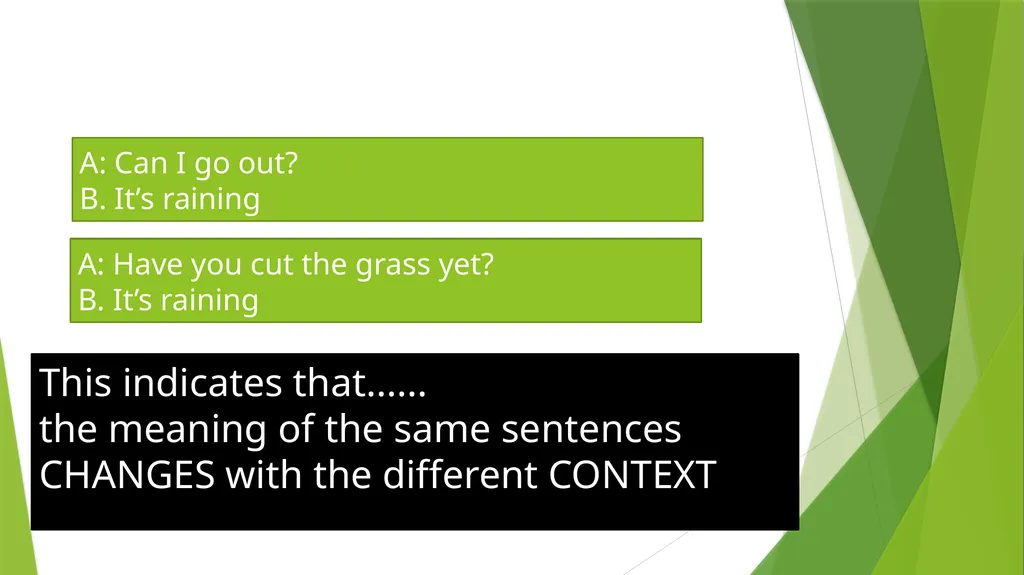
slide4. This indicates that...... the meaning of the same sentences CHANGES with the different CONTEXT A: Can I go out?
B. It’s raining A: Have you cut the grass yet?
B. It’s raining<br>
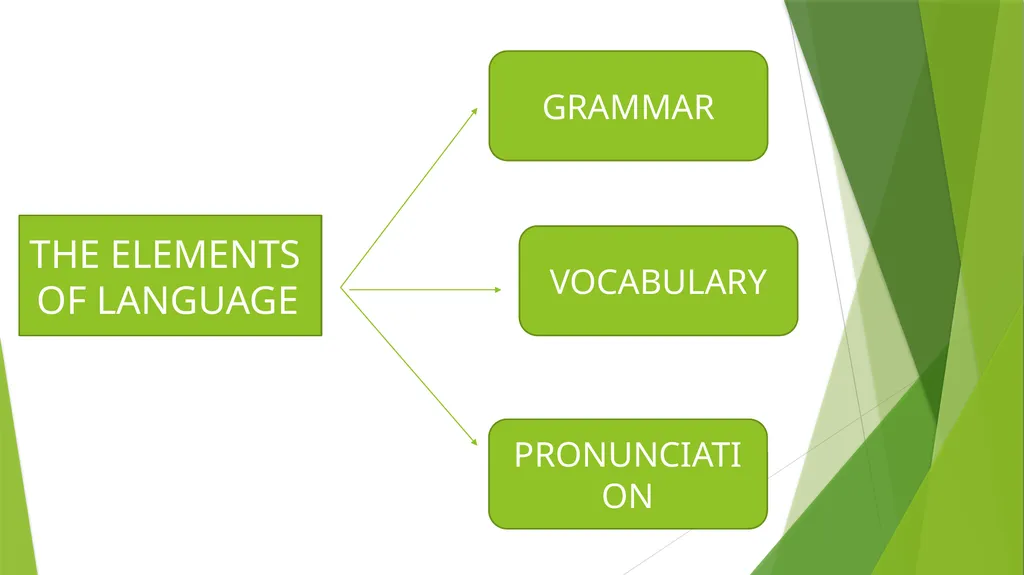
slide5. THE ELEMENTS OF LANGUAGE GRAMMAR VOCABULARY PRONUNCIATION<br>
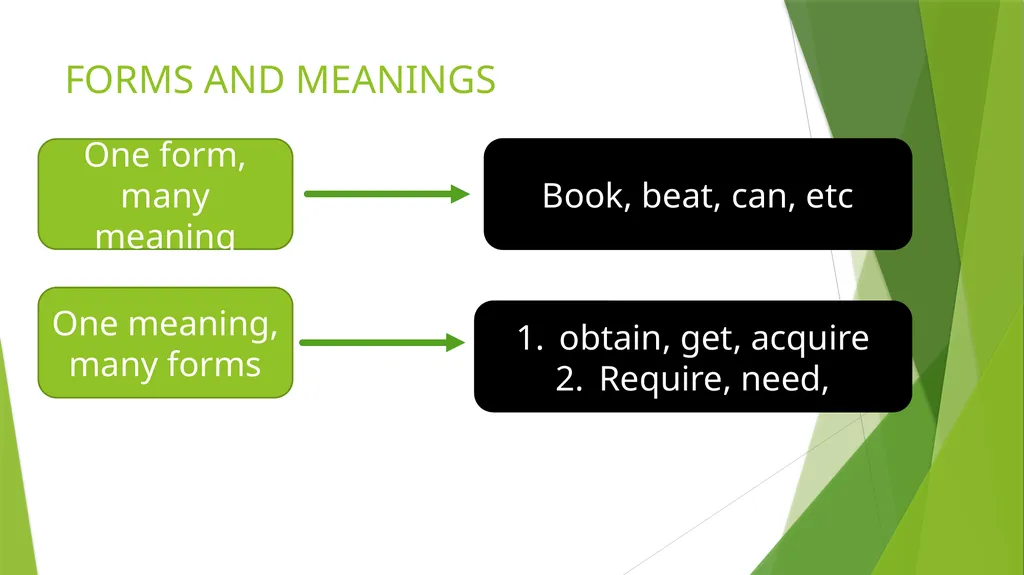
slide6. FORMS AND MEANINGS One form, many meaning One meaning, many forms Book, beat, can, etc obtain, get, acquire
Require, need,<br>
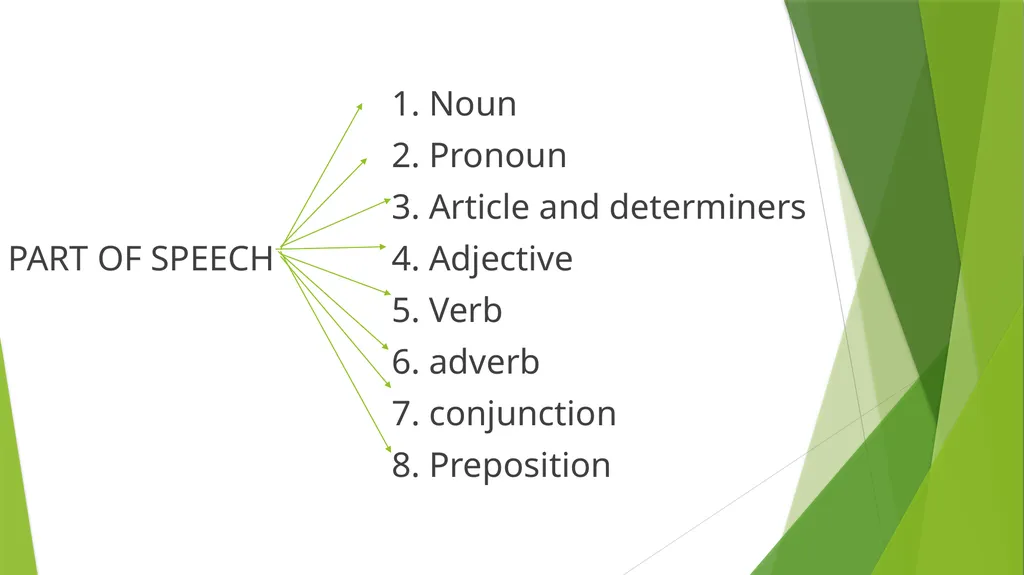
slide7. 1. Noun
2. Pronoun
3. Article and determiners
PART OF SPEECH 4. Adjective
5. Verb
6. adverb
7. conjunction
8. Preposition<br>
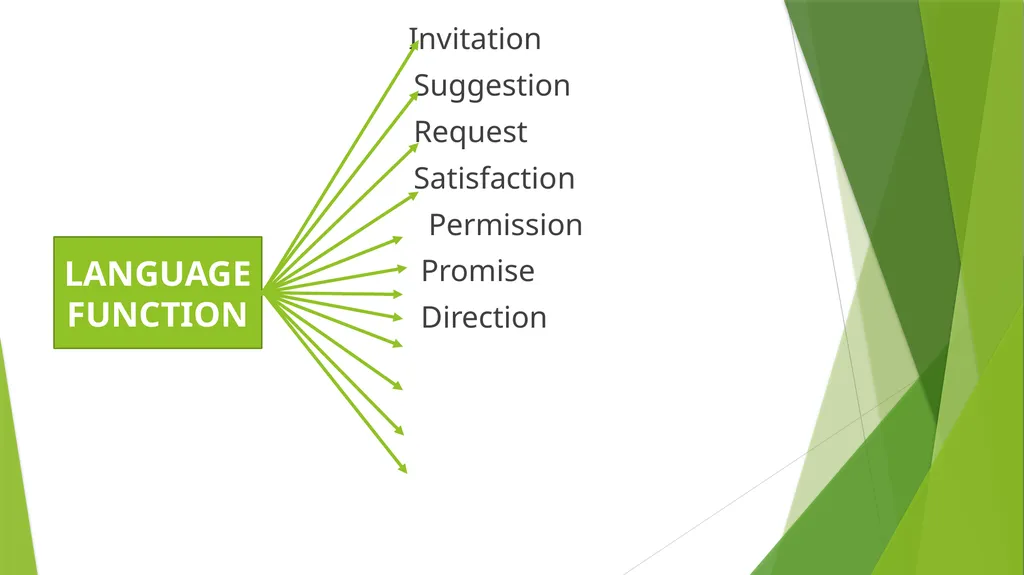
slide8. Invitation
Suggestion
Request
Satisfaction
Permission
Promise
Direction LANGUAGE FUNCTION<br>
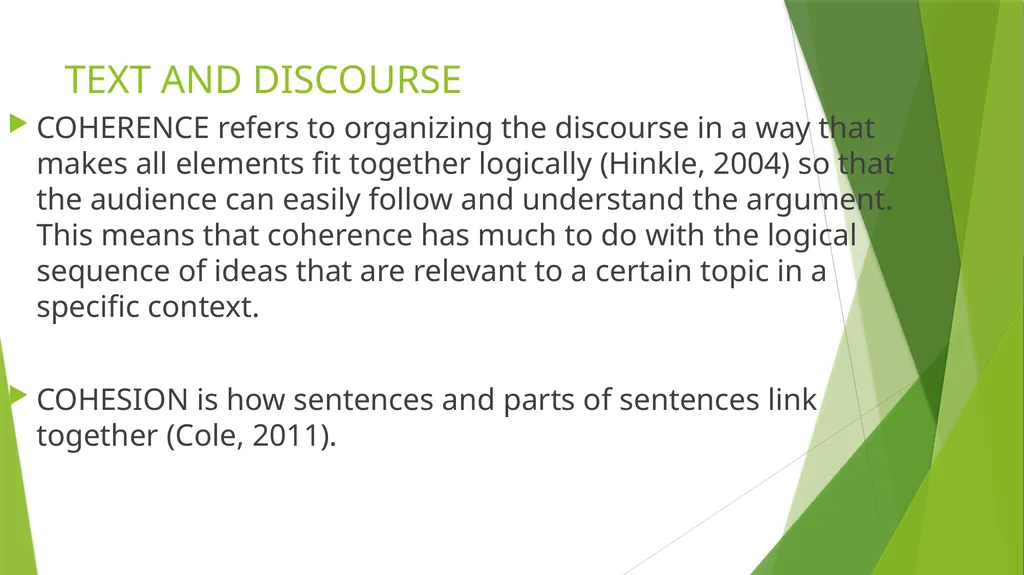
slide9. TEXT AND DISCOURSE COHERENCE refers to organizing the discourse in a way that makes all elements fit together logically (Hinkle, 2004) so that the audience can easily follow and understand the argument. This means that coherence has much to do with the logical sequence of ideas that are relevant to a certain topic in a specific context.
COHESION is how sentences and parts of sentences link together (Cole, 2011).<br>
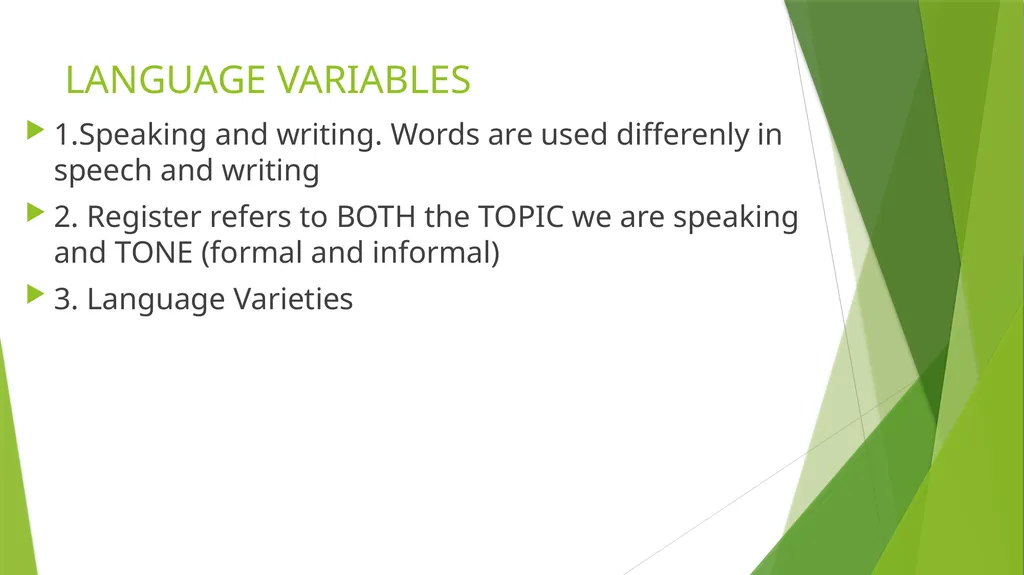
slide10. LANGUAGE VARIABLES 1.Speaking and writing. Words are used differenly in speech and writing
2. Register refers to BOTH the TOPIC we are speaking and TONE (formal and informal)
3. Language Varieties<br>
slide11. CHAPTER 6 TEACHING THE LANGUAGE SYSTEM<br>
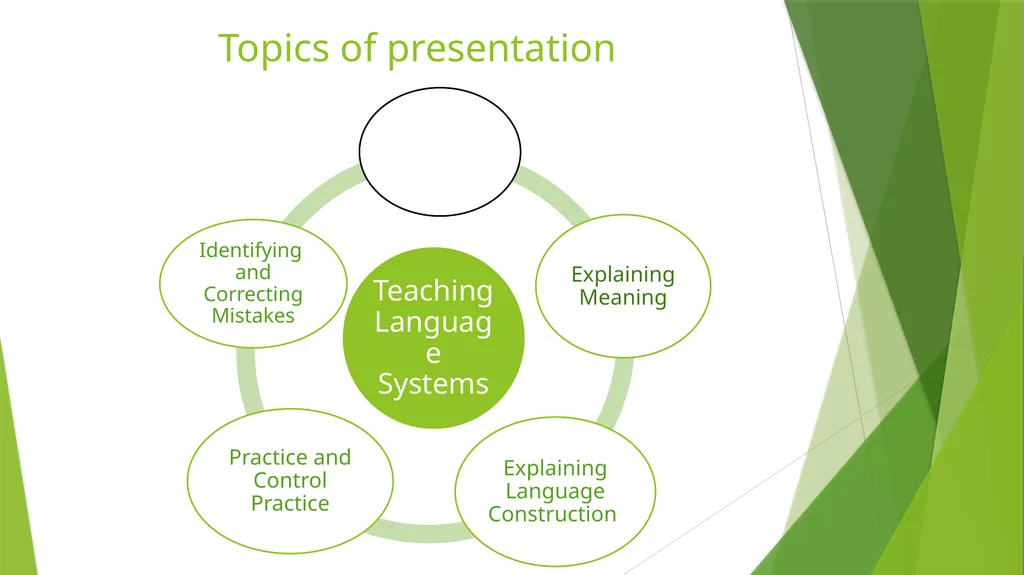
slide12. Topics of presentation<br>
slide13. Teaching Specific Aspects of Language 1. Deductive Approach
We give students explanations or grammar rules
Then based on this, the students make phrases and sentences using the new language.
(engage-study-activate)
e.g Show picture, say contructions, repeat, cue repetition (saying verbs)
Jhonson (2001) names this; three Ps (PPP) :
Presentation – Practise - Production<br>
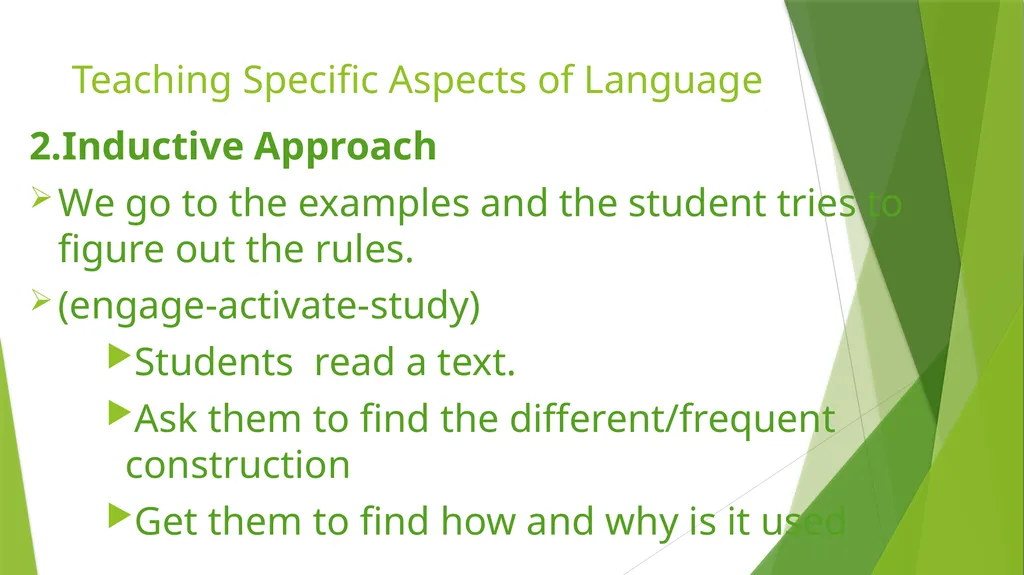
slide14. Teaching Specific Aspects of Language 2.Inductive Approach
We go to the examples and the student tries to figure out the rules.
(engage-activate-study)
Students read a text.
Ask them to find the different/frequent construction
Get them to find how and why is it used<br>
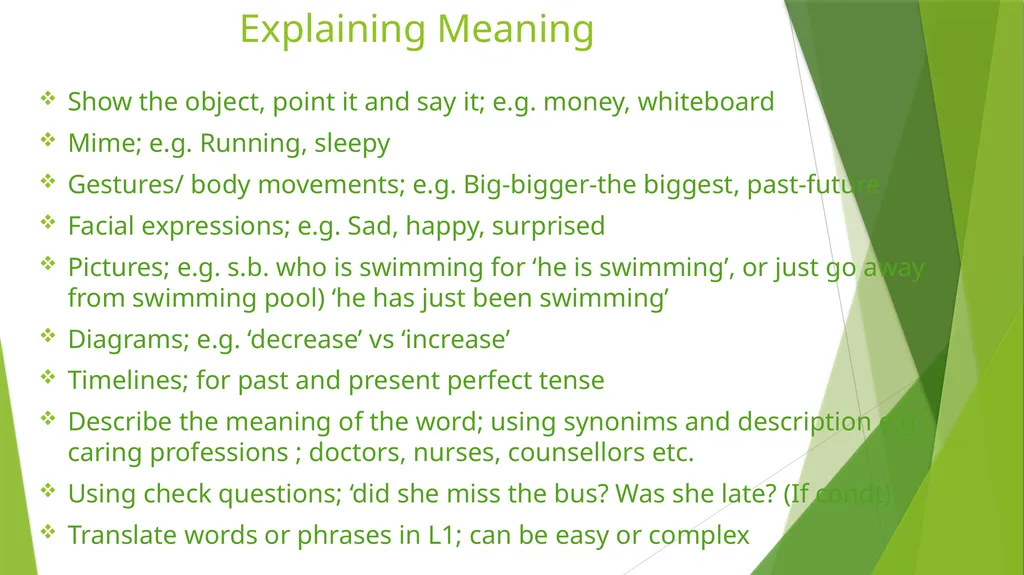
slide15. Explaining Meaning Show the object, point it and say it; e.g. money, whiteboard
Mime; e.g. Running, sleepy
Gestures/ body movements; e.g. Big-bigger-the biggest, past-future
Facial expressions; e.g. Sad, happy, surprised
Pictures; e.g. s.b. who is swimming for ‘he is swimming’, or just go away from swimming pool) ‘he has just been swimming’
Diagrams; e.g. ‘decrease’ vs ‘increase’
Timelines; for past and present perfect tense
Describe the meaning of the word; using synonims and description e.g caring professions ; doctors, nurses, counsellors etc.
Using check questions; ‘did she miss the bus? Was she late? (If condt)
Translate words or phrases in L1; can be easy or complex<br>
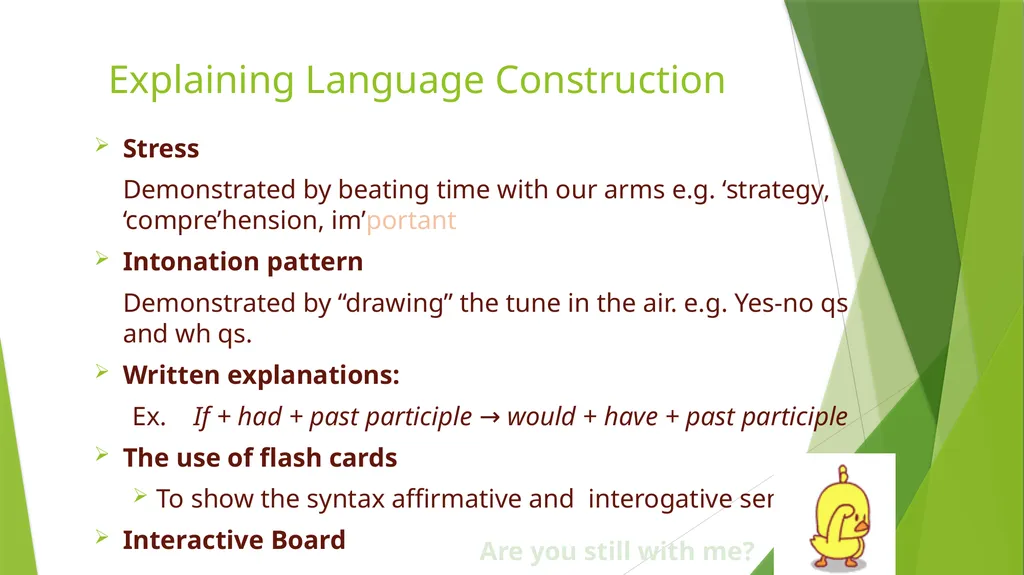
slide16. Explaining Language Construction Stress
Demonstrated by beating time with our arms e.g. ‘strategy, ‘compre’hension, im’portant
Intonation pattern
Demonstrated by “drawing” the tune in the air. e.g. Yes-no qs and wh qs.
Written explanations:
Ex. If + had + past participle → would + have + past participle
The use of flash cards
To show the syntax affirmative and interogative sentence
Interactive Board Are you still with me?<br>
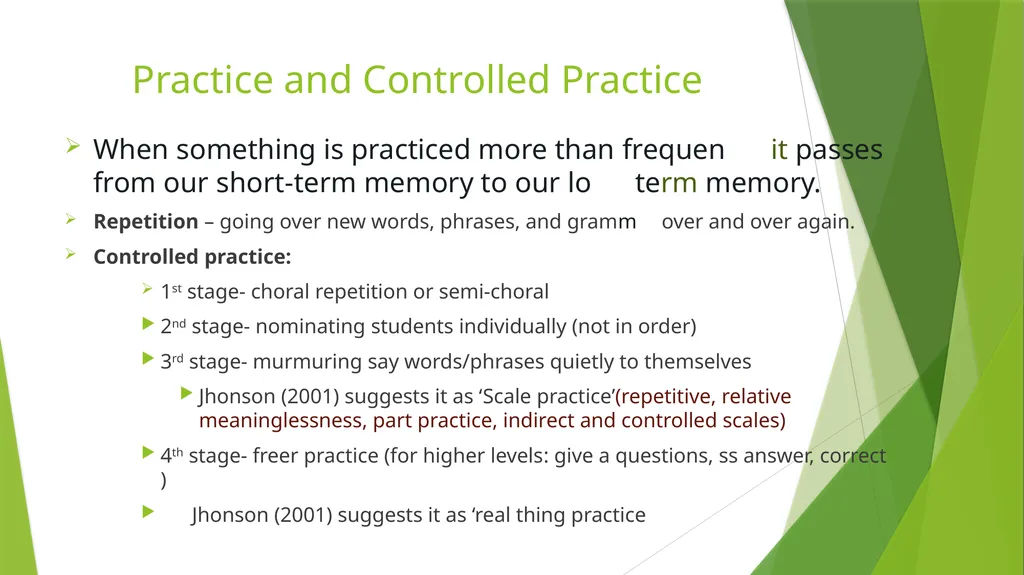
slide17. Practice and Controlled Practice When something is practiced more than frequently it passes from our short-term memory to our long-term memory.
Repetition – going over new words, phrases, and grammar over and over again.
Controlled practice:
1st stage- choral repetition or semi-choral
2nd stage- nominating students individually (not in order)
3rd stage- murmuring say words/phrases quietly to themselves
Jhonson (2001) suggests it as ‘Scale practice’(repetitive, relative meaninglessness, part practice, indirect and controlled scales)
4th stage- freer practice (for higher levels: give a questions, ss answer, correct )
Jhonson (2001) suggests it as ‘real thing practice<br>
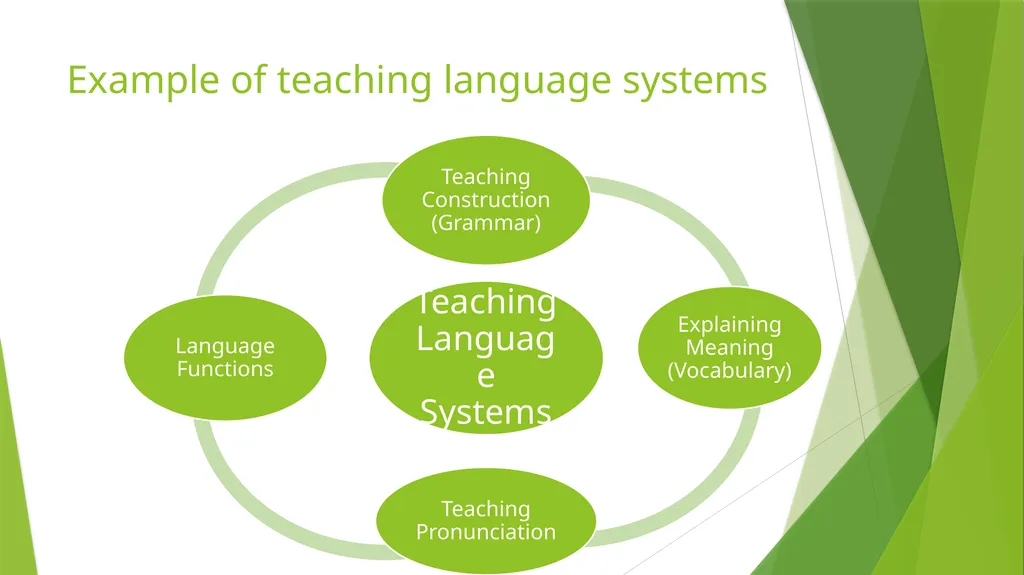
slide18. Example of teaching language systems<br>
slide19. Correcting Students Correction
In a speaking activity, Instant and intrusive correction is not recommended immediately as it can interfere the flow of the activity and inhibit Ss’ trying to activate language.
Correction must be treated carefully. Avoid to upset Ss and dent their confident
Ways
Peers: T explain problems, peers can help out
Echoing: T repeat sentence (in which mistakes) in question intonation.<br>
slide20. It is the end of presentation Thank you
for watching<br>
slide2. MEANING IN CONTEXT The meaning of the same sentences will be changed depend on the context (who is speaking, to whom and why)<br>
slide3. E.q : I’t’s Warm Here 1. someone who is lazy, ill or in some position of power
(A REQUEST for someone to open the window) 2.two people are trying to decide the room to use as their bedroom
(A SUGGESTION not to choose the room) 3. The sentence also can be used to express SATISFATION or PLEASURE Therefore, it can be concluded that the same sentence can perform different language FUNCTION<br>
slide4. This indicates that...... the meaning of the same sentences CHANGES with the different CONTEXT A: Can I go out?
B. It’s raining A: Have you cut the grass yet?
B. It’s raining<br>
slide5. THE ELEMENTS OF LANGUAGE GRAMMAR VOCABULARY PRONUNCIATION<br>
slide6. FORMS AND MEANINGS One form, many meaning One meaning, many forms Book, beat, can, etc obtain, get, acquire
Require, need,<br>
slide7. 1. Noun
2. Pronoun
3. Article and determiners
PART OF SPEECH 4. Adjective
5. Verb
6. adverb
7. conjunction
8. Preposition<br>
slide8. Invitation
Suggestion
Request
Satisfaction
Permission
Promise
Direction LANGUAGE FUNCTION<br>
slide9. TEXT AND DISCOURSE COHERENCE refers to organizing the discourse in a way that makes all elements fit together logically (Hinkle, 2004) so that the audience can easily follow and understand the argument. This means that coherence has much to do with the logical sequence of ideas that are relevant to a certain topic in a specific context.
COHESION is how sentences and parts of sentences link together (Cole, 2011).<br>
slide10. LANGUAGE VARIABLES 1.Speaking and writing. Words are used differenly in speech and writing
2. Register refers to BOTH the TOPIC we are speaking and TONE (formal and informal)
3. Language Varieties<br>
slide11. CHAPTER 6 TEACHING THE LANGUAGE SYSTEM<br>
slide12. Topics of presentation<br>
slide13. Teaching Specific Aspects of Language 1. Deductive Approach
We give students explanations or grammar rules
Then based on this, the students make phrases and sentences using the new language.
(engage-study-activate)
e.g Show picture, say contructions, repeat, cue repetition (saying verbs)
Jhonson (2001) names this; three Ps (PPP) :
Presentation – Practise - Production<br>
slide14. Teaching Specific Aspects of Language 2.Inductive Approach
We go to the examples and the student tries to figure out the rules.
(engage-activate-study)
Students read a text.
Ask them to find the different/frequent construction
Get them to find how and why is it used<br>
slide15. Explaining Meaning Show the object, point it and say it; e.g. money, whiteboard
Mime; e.g. Running, sleepy
Gestures/ body movements; e.g. Big-bigger-the biggest, past-future
Facial expressions; e.g. Sad, happy, surprised
Pictures; e.g. s.b. who is swimming for ‘he is swimming’, or just go away from swimming pool) ‘he has just been swimming’
Diagrams; e.g. ‘decrease’ vs ‘increase’
Timelines; for past and present perfect tense
Describe the meaning of the word; using synonims and description e.g caring professions ; doctors, nurses, counsellors etc.
Using check questions; ‘did she miss the bus? Was she late? (If condt)
Translate words or phrases in L1; can be easy or complex<br>
slide16. Explaining Language Construction Stress
Demonstrated by beating time with our arms e.g. ‘strategy, ‘compre’hension, im’portant
Intonation pattern
Demonstrated by “drawing” the tune in the air. e.g. Yes-no qs and wh qs.
Written explanations:
Ex. If + had + past participle → would + have + past participle
The use of flash cards
To show the syntax affirmative and interogative sentence
Interactive Board Are you still with me?<br>
slide17. Practice and Controlled Practice When something is practiced more than frequently it passes from our short-term memory to our long-term memory.
Repetition – going over new words, phrases, and grammar over and over again.
Controlled practice:
1st stage- choral repetition or semi-choral
2nd stage- nominating students individually (not in order)
3rd stage- murmuring say words/phrases quietly to themselves
Jhonson (2001) suggests it as ‘Scale practice’(repetitive, relative meaninglessness, part practice, indirect and controlled scales)
4th stage- freer practice (for higher levels: give a questions, ss answer, correct )
Jhonson (2001) suggests it as ‘real thing practice<br>
slide18. Example of teaching language systems<br>
slide19. Correcting Students Correction
In a speaking activity, Instant and intrusive correction is not recommended immediately as it can interfere the flow of the activity and inhibit Ss’ trying to activate language.
Correction must be treated carefully. Avoid to upset Ss and dent their confident
Ways
Peers: T explain problems, peers can help out
Echoing: T repeat sentence (in which mistakes) in question intonation.<br>
slide20. It is the end of presentation Thank you
for watching<br>