
Diversity: Legal, Ethical & Regulatory
TG
Published · 41 slides · 0 views

1 / 1
Description
Diversity: Legal, Ethical Regulatory Considerations for Nurses Presented by: Dr. Ruth L.M. Burkhart, DNP, MSN, MA, RN-BC, LPCC Director of Nursing Ottawa University Disclosure Statement Diversitysometimes we miss the whole picture
Related Topics
Share
Embed code
Download this presentation From Below
"Diversity: Legal, Ethical & Regulatory" is the property of its rightful owner. Permission is granted to download and print the materials on this website for personal, non-commercial use only, and to display it on your personal computer provided you do not modify the materials and that you retain all copyright notices contained in the materials. By downloading content from our website, you accept the terms of this agreement.
Presentation Transcript
01
Diversity: Legal, Ethical & Regulatory Considerations for Nurses Presented by: Dr. Ruth L.M. Burkhart, DNP, MSN, MA, RN-BC, LPCC
Director of Nursing
Ottawa University<br>
Director of Nursing
Ottawa University<br>
02
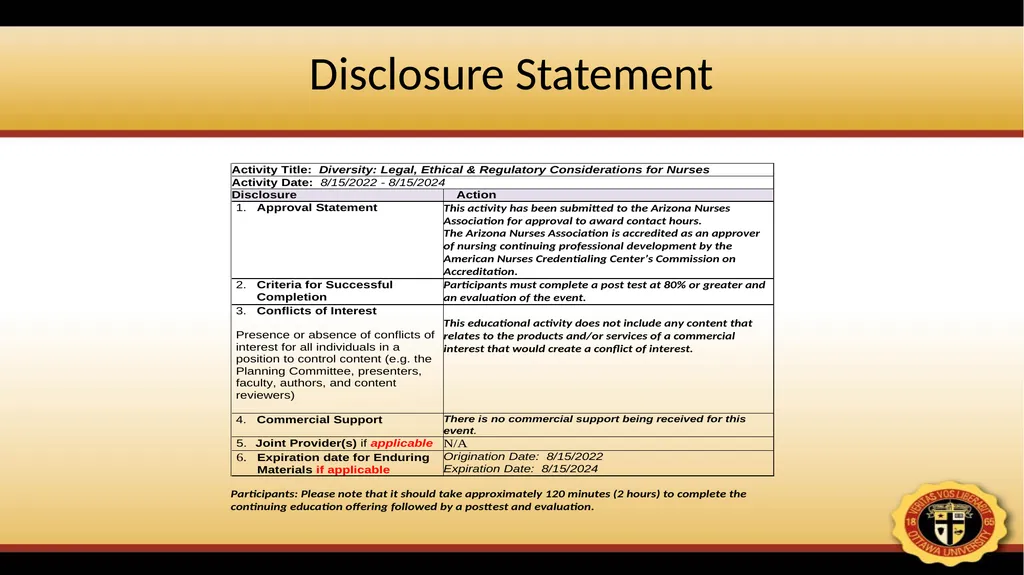
Disclosure Statement<br>
03
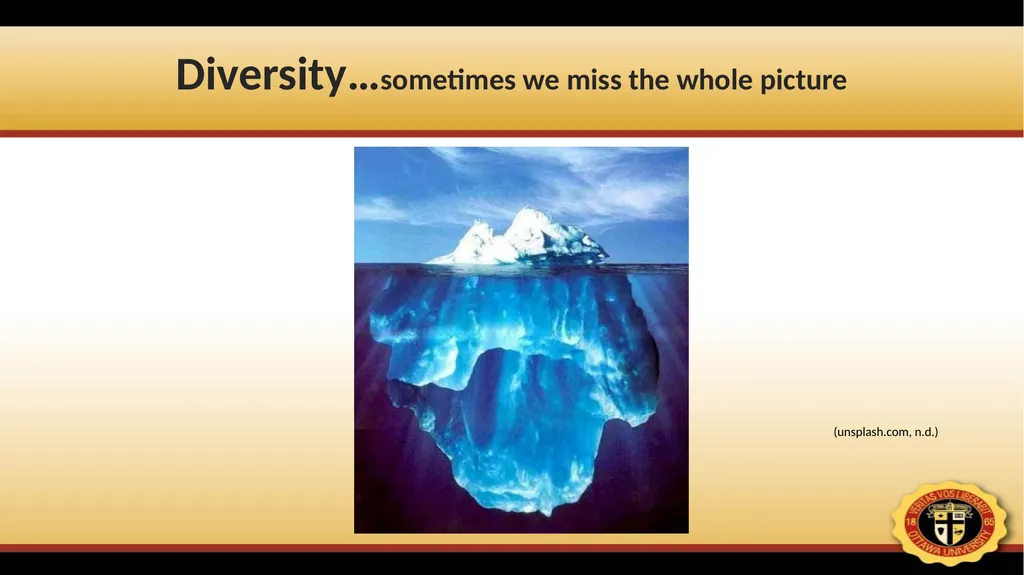
Diversity…sometimes we miss the whole picture (unsplash.com, n.d.)<br>
04
Diversity: What is it? Definition of Diversity
1: the condition of having or being composed of differing elements: variety especially : the inclusion of people of different races, cultures, etc. in a group or organization programs intended to promote diversity in schools
2: an instance of being composed of differing elements or qualities : an instance of being diverse, a diversity of opinion (Merriam-Webster Dictionary, 2022, para 1).<br>
05
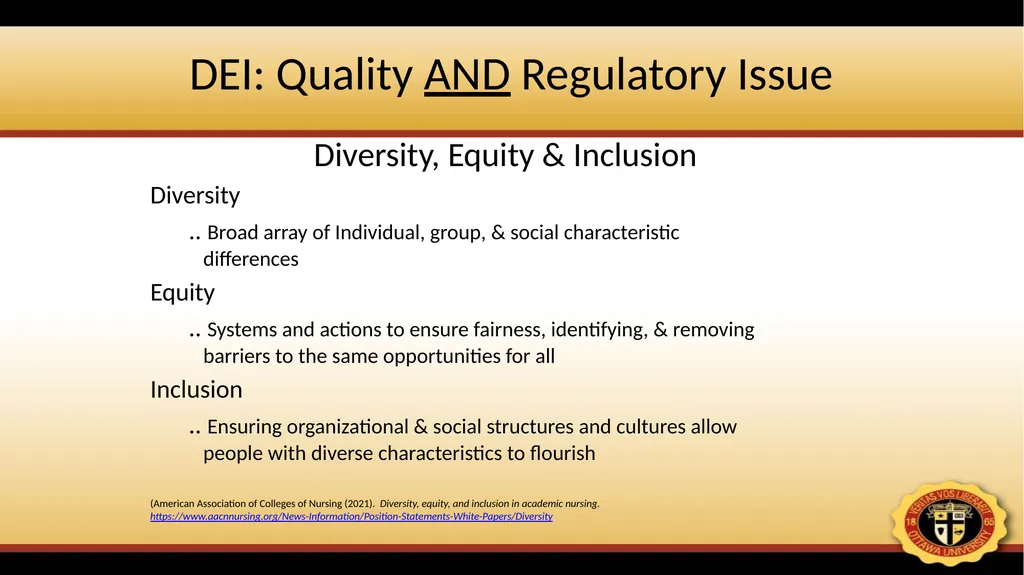
DEI: Quality AND Regulatory Issue Diversity, Equity & Inclusion
Diversity
.. Broad array of Individual, group, & social characteristic differences
Equity
.. Systems and actions to ensure fairness, identifying, & removing barriers to the same opportunities for all
Inclusion
.. Ensuring organizational & social structures and cultures allow people with diverse characteristics to flourish
(American Association of Colleges of Nursing (2021). Diversity, equity, and inclusion in academic nursing. https://www.aacnnursing.org/News-Information/Position-Statements-White-Papers/Diversity<br>
06
Diversity in Nursing: Why this Matters What’s it all about?
Why is this important in nursing?
Hint: it’s not just about culture & personal bias
Unique Role of the Nurse
Understanding of Communication is Essential
Engagement & Trust Building<br>
Why is this important in nursing?
Hint: it’s not just about culture & personal bias
Unique Role of the Nurse
Understanding of Communication is Essential
Engagement & Trust Building<br>
07
Nursing Actions = Life or Death Assessment, Judgment, & Actions by the Nurse involve Public Safety & Concern
Role of the Nurse is Unique – Holistic Approach, often Longer Care Episodes than other Team Disciplines
Misunderstandings in Communication or Bias Could Mean Injury or Death for the Patient
Diversity, Equity, & Inclusion Prevent Both (American Nurses Association, 2022).<br>
Role of the Nurse is Unique – Holistic Approach, often Longer Care Episodes than other Team Disciplines
Misunderstandings in Communication or Bias Could Mean Injury or Death for the Patient
Diversity, Equity, & Inclusion Prevent Both (American Nurses Association, 2022).<br>
08
Office of Minority Health Website – Think Cultural Health
https://www.minorityhealth.hhs.gov/omh/browse.aspx?lvl=2&lvlid=53
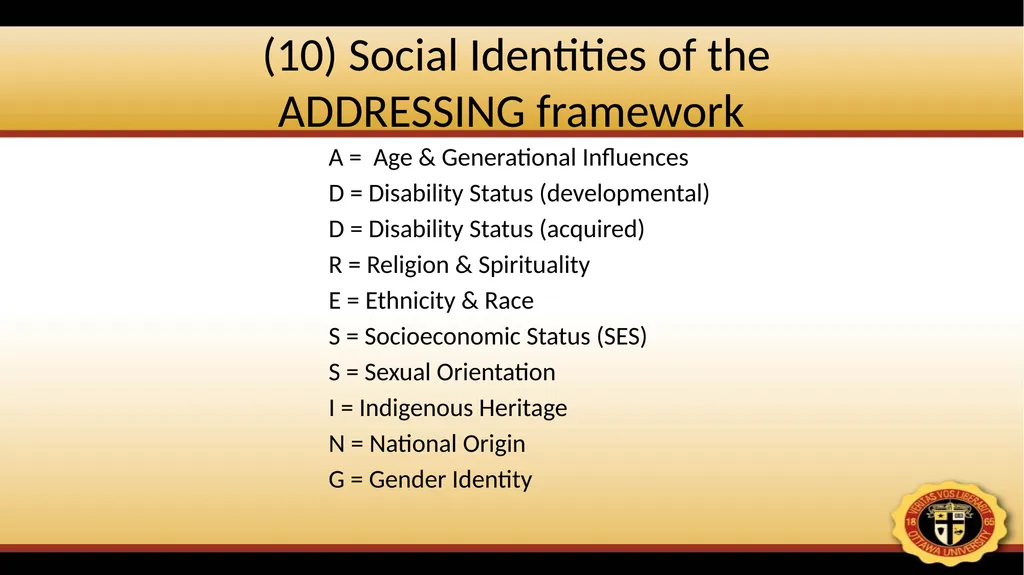
The “ADDRESSING framework” mnemonic helps remember the (10) key social identities to consider (Office of Minority Health, 2021)<br>
https://www.minorityhealth.hhs.gov/omh/browse.aspx?lvl=2&lvlid=53
The “ADDRESSING framework” mnemonic helps remember the (10) key social identities to consider (Office of Minority Health, 2021)<br>
09
(10) Social Identities of the ADDRESSING framework A = Age & Generational Influences
D = Disability Status (developmental)
D = Disability Status (acquired)
R = Religion & Spirituality
E = Ethnicity & Race
S = Socioeconomic Status (SES)
S = Sexual Orientation
I = Indigenous Heritage
N = National Origin
G = Gender Identity<br>
D = Disability Status (developmental)
D = Disability Status (acquired)
R = Religion & Spirituality
E = Ethnicity & Race
S = Socioeconomic Status (SES)
S = Sexual Orientation
I = Indigenous Heritage
N = National Origin
G = Gender Identity<br>
10
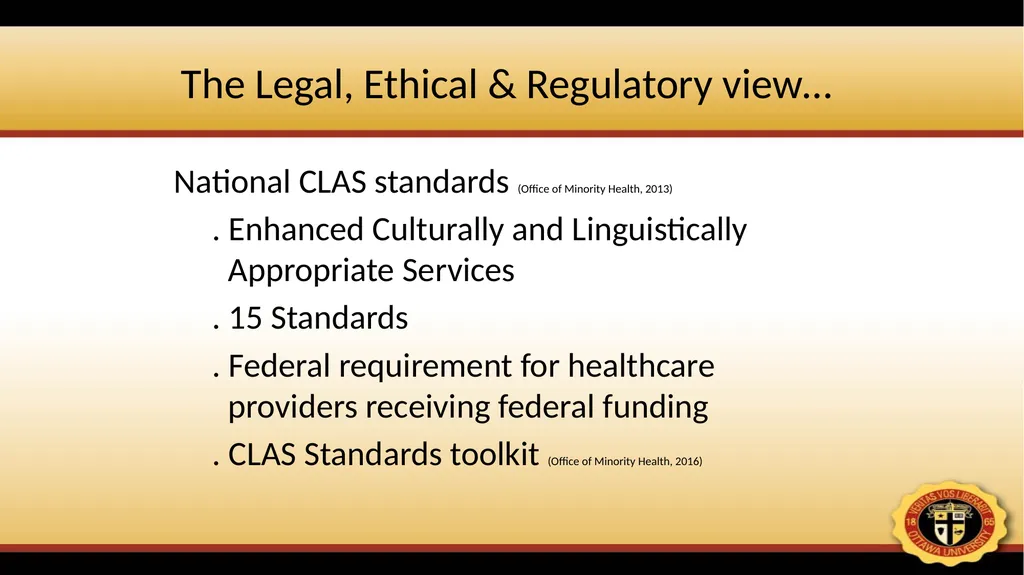
The Legal, Ethical & Regulatory view… National CLAS standards (Office of Minority Health, 2013)
. Enhanced Culturally and Linguistically Appropriate Services
. 15 Standards
. Federal requirement for healthcare providers receiving federal funding
. CLAS Standards toolkit (Office of Minority Health, 2016)<br>
. Enhanced Culturally and Linguistically Appropriate Services
. 15 Standards
. Federal requirement for healthcare providers receiving federal funding
. CLAS Standards toolkit (Office of Minority Health, 2016)<br>
11
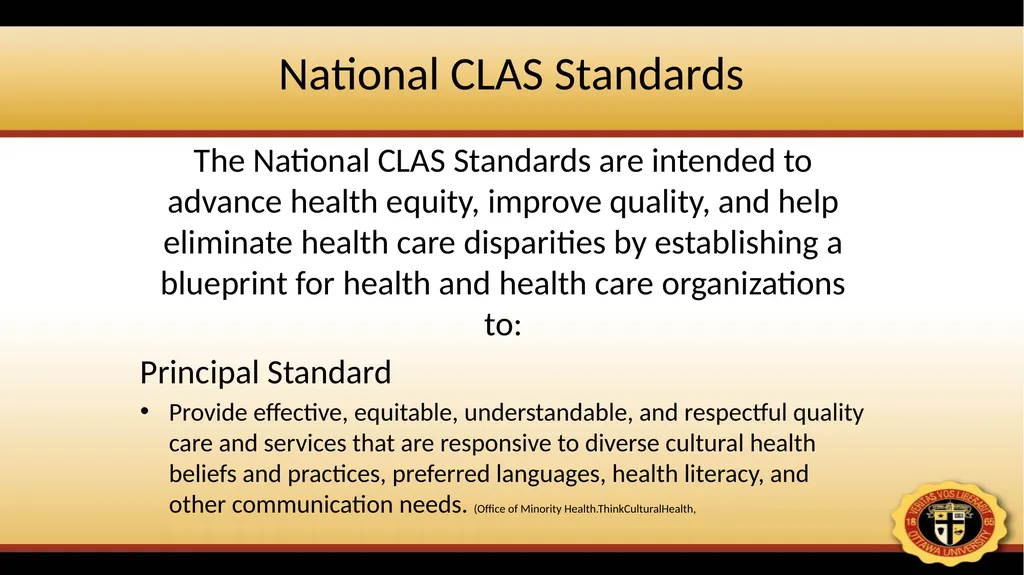
National CLAS Standards The National CLAS Standards are intended to advance health equity, improve quality, and help eliminate health care disparities by establishing a blueprint for health and health care organizations to:
Principal Standard
Provide effective, equitable, understandable, and respectful quality care and services that are responsive to diverse cultural health beliefs and practices, preferred languages, health literacy, and other communication needs. (Office of Minority Health.ThinkCulturalHealth,<br>
Principal Standard
Provide effective, equitable, understandable, and respectful quality care and services that are responsive to diverse cultural health beliefs and practices, preferred languages, health literacy, and other communication needs. (Office of Minority Health.ThinkCulturalHealth,<br>
12
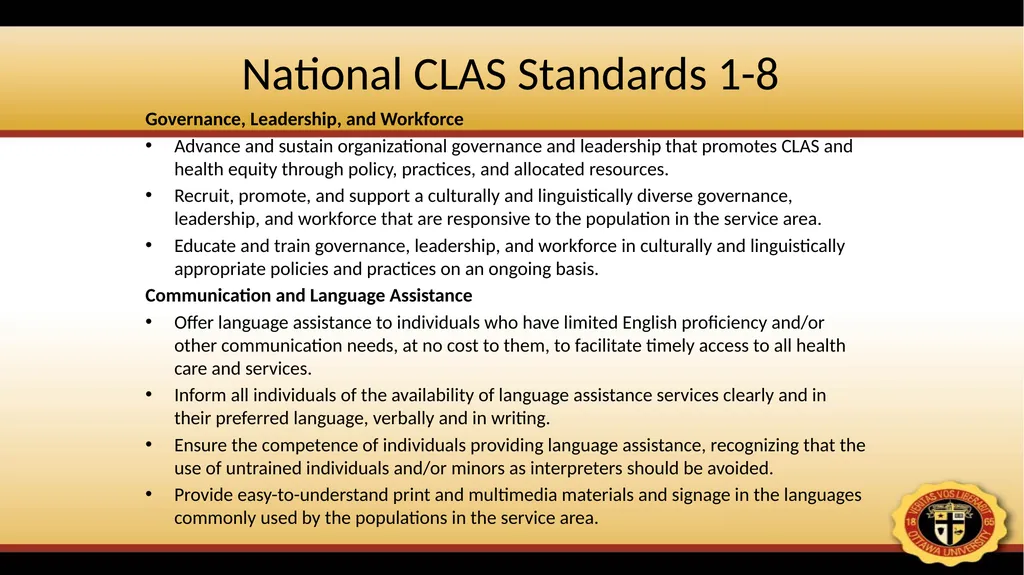
National CLAS Standards 1-8 Governance, Leadership, and Workforce
Advance and sustain organizational governance and leadership that promotes CLAS and health equity through policy, practices, and allocated resources.
Recruit, promote, and support a culturally and linguistically diverse governance, leadership, and workforce that are responsive to the population in the service area.
Educate and train governance, leadership, and workforce in culturally and linguistically appropriate policies and practices on an ongoing basis.
Communication and Language Assistance
Offer language assistance to individuals who have limited English proficiency and/or other communication needs, at no cost to them, to facilitate timely access to all health care and services.
Inform all individuals of the availability of language assistance services clearly and in their preferred language, verbally and in writing.
Ensure the competence of individuals providing language assistance, recognizing that the use of untrained individuals and/or minors as interpreters should be avoided.
Provide easy-to-understand print and multimedia materials and signage in the languages commonly used by the populations in the service area.<br>
13
National CLAS Standards 9-15 Engagement, Continuous Improvement, and Accountability
9. Establish culturally and linguistically appropriate goals, policies, and management accountability, and infuse them throughout the organization’s planning and operations.
10. Conduct ongoing assessments of the organization’s CLAS-related activities and integrate CLAS-related measures into measurement and continuous quality improvement activities.
11. Collect and maintain accurate and reliable demographic data to monitor and evaluate the impact of CLAS on health equity and outcomes and to inform service delivery.
12. Conduct regular assessments of community health assets and needs and use the results to plan and implement services that respond to the cultural and linguistic diversity of populations in the service area.
13. Partner with the community to design, implement, and evaluate policies, practices, and services to ensure cultural and linguistic appropriateness.
14. Create conflict and grievance resolution processes that are culturally and linguistically appropriate to identify, prevent, and resolve conflicts or complaints.
15. Communicate the organization’s progress in implementing and sustaining CLAS to all stakeholders, constituents, and the general public.
(Office of Minority Health. ThinkCulturalHealth, 2015)<br>
14
NCSBN: National Council State Boards of Nursing NCSBN holds Key Position in Nursing
“Statement on Diversity and Equality in America”
Strong Support for Future of Nursing 2020-2030
. “Charting a Path to Achieve Health Equity”
. Impacts Significance of Diversity, Equity, & Inclusion (DEI) Recommendation
. Moves DEI toward Priority for Nursing
. Increasing Diversity in Nursing → Health Equity
(National Council State Boards of Nursing, 2020)<br>
15
The Future of Nursing, 2020-2030: Charting a
Path to Achieve Health Equity . Published 2021 by National Academies of
Sciences, Engineering and Medicine
. Institute of Medicine’s Future of Nursing 2010 Report – set the standard in four key areas
.Nurse practice to full extent of training
.Streamlined education system to promote higher levels of nurse education
.Nurses as full partners in redesign of US healthcare
.Improved data collection & information systems
(National Academies Press, 2021)<br>
16
The American Nurses Association American Nurses Association (ANA) Position Statement
. ANA Standard 8: Culturally Congruent Practice (2015) (
. “No Discrimination” Position Statement (2018)
. Reinforces ANA’s stance on Discrimination and
nurse accountability to “inclusive strategies for nursing care of all individuals of all ages and from all populations” (American Nurses Association Ethics Advisory Board, 2018)<br>
17
The National League for Nursing: Hallmarks of Excellence The NLN (National League for Nursing)
Recognized Voice and Leader in Nursing since late 1800s
NLN first Organization for Nurses in U.S. (1893), first Standards of Nursing (1917), renamed National League for Nursing in 1942, Recognized by U.S. Department of Education for first Nursing Accreditation
NLN’s “Hallmarks of Excellence” (2020) includes Importance of Diversity (National League for Nursing, 2020)<br>
18
NLN: Hallmarks of Excellence Engaged Students
Diverse, Well-Prepared Faculty
A Culture of Continuous Quality Improvement
Innovative, Evidence-Based Curriculum
Innovative, Evidence-Based Approaches to Facilitate and Evaluate Learning
Resources to Support Program Goal Attainment
Commitment to Pedagogical Scholarship
Effective Institutional and Professional Leadership
(NLN, 2020)<br>
19
NLN: Diversity Excellence Includes Faculty Diversity in More than Race/Ethnicity Category
Policies, Hiring, Orientation, Mentoring Promote Faculty Diversity
System of Faculty Accountability Promotes Faculty Diversity
Organizational Culture Promotes Faculty Diversity (National League for Nursing, 2020)<br>
Policies, Hiring, Orientation, Mentoring Promote Faculty Diversity
System of Faculty Accountability Promotes Faculty Diversity
Organizational Culture Promotes Faculty Diversity (National League for Nursing, 2020)<br>
20
The Nursing Code of Ethics The Significance of The Code
Adherence to The Code is Not Optional
The Code outlines Guidance Pertaining to Diversity, Equity, & Inclusion
Provisions of the Code, Three Areas: 1-3, 4-6, 7-9 Outline Fundamental Nurse Values & Commitments, Boundaries of Duty & Loyalty, & Obligations<br>
Adherence to The Code is Not Optional
The Code outlines Guidance Pertaining to Diversity, Equity, & Inclusion
Provisions of the Code, Three Areas: 1-3, 4-6, 7-9 Outline Fundamental Nurse Values & Commitments, Boundaries of Duty & Loyalty, & Obligations<br>
21
Nurses Code of Ethics Summary American Nurses Association Code of Ethics for Nurses
Provision 1 The nurse practices with compassion and respect for the inherent dignity, worth, and unique attributes of every person. Provision 2 The nurse’s primary commitment is to the patient, whether an individual, family, group, community, or population.
Provision 3 The nurse promotes, advocates for, and protects the rights, health, and safety of the patient.
Provision 4 The nurse has authority, accountability and responsibility for nursing practice; makes decisions; and takes action consistent with the obligation to provide optimal patient care.
Provision 5 The nurse owes the same duties to self as to others, including the responsibility to promote health and safety, preserve wholeness of character and integrity, maintain competence, and continue personal and professional growth.
Provision 6 The nurse, through individual and collective effort, establishes, maintains, and improves the ethical environment of the work setting and conditions of employment that are conducive to safe, quality health care.
Provision 7 The nurse, in all roles and settings, advances the profession through research and scholarly inquiry, professional standards development, and the generation of both nursing and health policy.
Provision 8 The nurse collaborates with other health professionals and the public to protect human rights, promote health diplomacy, and reduce health disparities.
Provision 9 The profession of nursing, collectively through its professional organizations, must articulate nursing values, maintain the integrity of the profession and integrate principles of social justice into nursing and health policy.
American Nurses Association. (2015). Code of ethics with interpretative statements. Silver Spring, MD: Author. Retrieved from http://www.nursingworld.org/MainMenuCategories/EthicsStandards/CodeofEthicsforNurses/Code-of-Ethics-For-Nurses.html<br>
22
The Legal Angle: Nurses Want to Know…. Questions:
Does the U.S. law protect Diversity, Equity, & Inclusion in the Healthcare Workplace?
. Criminal versus Civil Charges?
Can a Nurse be Sued for Infractions related to
Diversity, Equity, & Inclusion?
3. What could Happen to a Nurse if Accused?
Manson, P. (30 July, 2021). Calif. court strikes law on transgender pronoun use in nursing homes. https://www.upi.com/Top_News/US/2021/07/30/transgender-pronouns-California-nursing-homes-lawsuit/4341627575533/
Nurses Service Organization (NSO) (2021). Creating inclusiveness for transgender patients. https://www.nso.com/Learning/Artifacts/Articles/Creating-Inclusiveness-for-Transgender-Patients<br>
23
The U.S. Constitution: the First Amendment First of all…the First Amendment
“Congress shall make no law respecting an establishment of religion, or prohibiting the free exercise thereof, or abridging the freedom of speech, or of the press; or the right of the people peacefully to assemble, and to petition the government for a redress of grievances” (U.S. Const. amend. I)<br>
“Congress shall make no law respecting an establishment of religion, or prohibiting the free exercise thereof, or abridging the freedom of speech, or of the press; or the right of the people peacefully to assemble, and to petition the government for a redress of grievances” (U.S. Const. amend. I)<br>
24
U.S. Acts in Support of Diversity Title VII of the Civil Rights Act of 1964
Discrimination Prohibited if Federal Funds Received (U.S. Department of Labor, n.d.)
Age Discrimination in Employment Act
Involuntary Retirement Prohibited, Employer Must Show Reasonable Cause for Termination Other than Age, if Over Age 40 years (Equal Opportunity Employment Commission (EEOC), n.d.)
Americans With Disabilities Act
Prohibits Discrimination based in a Disability in ALL Areas of Public Life (American Disabilities Act (ADA), 2009; The White House, 2021).
14th Amendment to the Constitution’s Equal Protection Clause
Prohibits ANY State Law from Denying ANY Individual Due Protection
Under the Law<br>
25
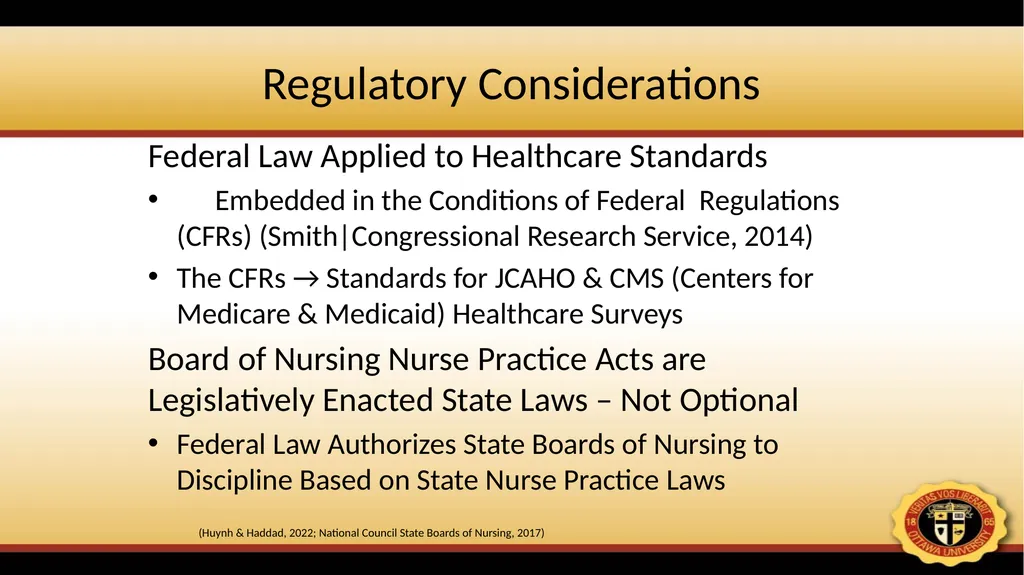
Regulatory Considerations Federal Law Applied to Healthcare Standards
Embedded in the Conditions of Federal Regulations (CFRs) (Smith|Congressional Research Service, 2014)
The CFRs → Standards for JCAHO & CMS (Centers for Medicare & Medicaid) Healthcare Surveys
Board of Nursing Nurse Practice Acts are Legislatively Enacted State Laws – Not Optional
Federal Law Authorizes State Boards of Nursing to Discipline Based on State Nurse Practice Laws
(Huynh & Haddad, 2022; National Council State Boards of Nursing, 2017)<br>
26
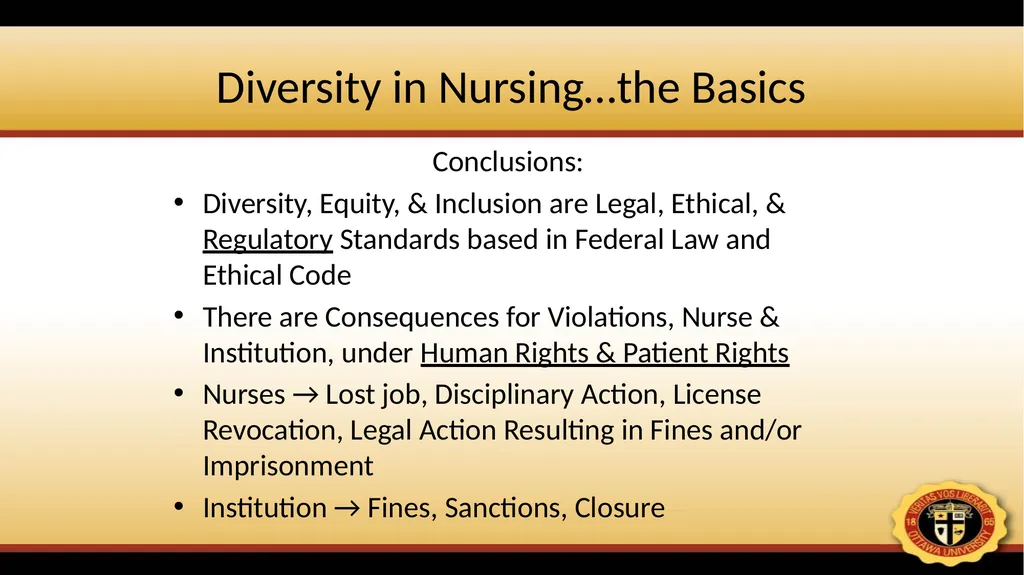
Diversity in Nursing…the Basics Conclusions:
Diversity, Equity, & Inclusion are Legal, Ethical, & Regulatory Standards based in Federal Law and Ethical Code
There are Consequences for Violations, Nurse & Institution, under Human Rights & Patient Rights
Nurses → Lost job, Disciplinary Action, License Revocation, Legal Action Resulting in Fines and/or Imprisonment
Institution → Fines, Sanctions, Closure<br>
27
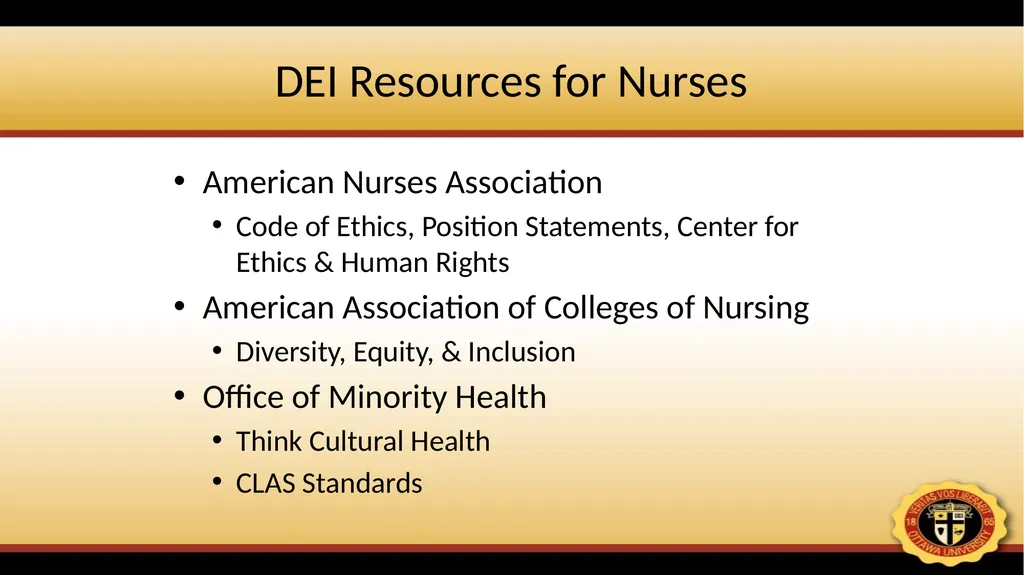
DEI Resources for Nurses American Nurses Association
Code of Ethics, Position Statements, Center for Ethics & Human Rights
American Association of Colleges of Nursing
Diversity, Equity, & Inclusion
Office of Minority Health
Think Cultural Health
CLAS Standards<br>
Code of Ethics, Position Statements, Center for Ethics & Human Rights
American Association of Colleges of Nursing
Diversity, Equity, & Inclusion
Office of Minority Health
Think Cultural Health
CLAS Standards<br>
28
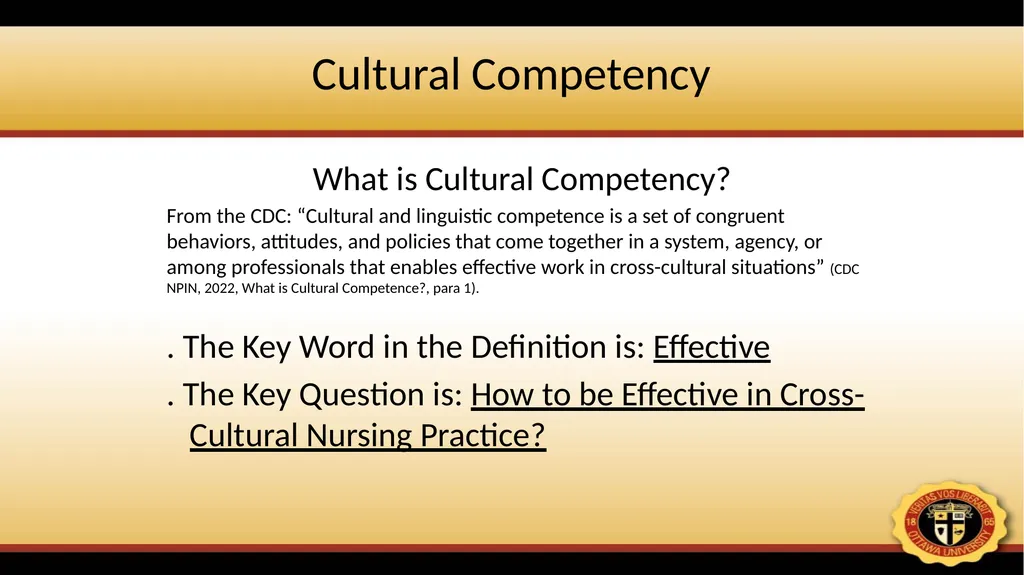
Cultural Competency What is Cultural Competency?
From the CDC: “Cultural and linguistic competence is a set of congruent behaviors, attitudes, and policies that come together in a system, agency, or among professionals that enables effective work in cross-cultural situations” (CDC NPIN, 2022, What is Cultural Competence?, para 1).
. The Key Word in the Definition is: Effective
. The Key Question is: How to be Effective in Cross- Cultural Nursing Practice?<br>
29
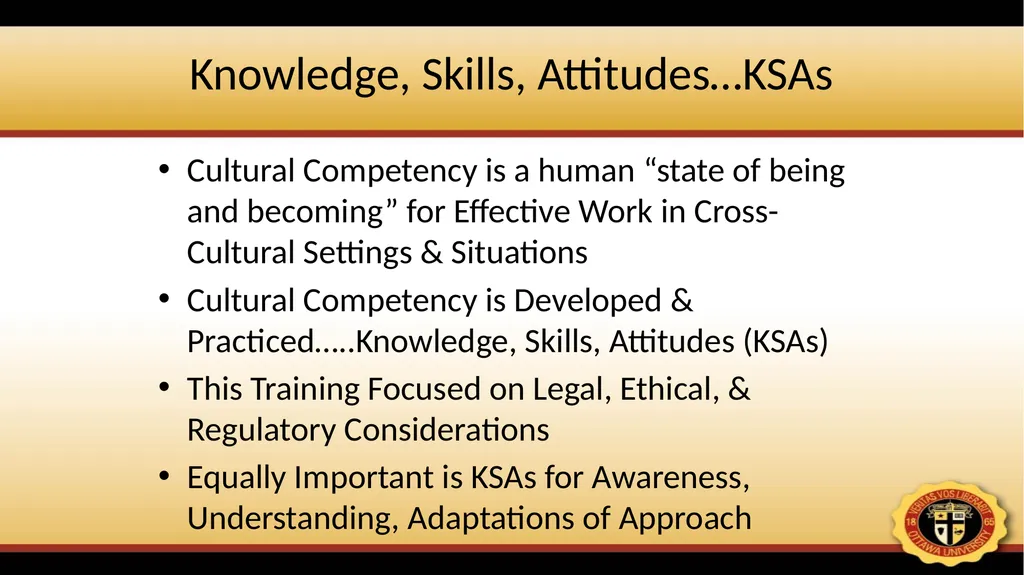
Knowledge, Skills, Attitudes…KSAs Cultural Competency is a human “state of being and becoming” for Effective Work in Cross-Cultural Settings & Situations
Cultural Competency is Developed & Practiced…..Knowledge, Skills, Attitudes (KSAs)
This Training Focused on Legal, Ethical, & Regulatory Considerations
Equally Important is KSAs for Awareness, Understanding, Adaptations of Approach<br>
Cultural Competency is Developed & Practiced…..Knowledge, Skills, Attitudes (KSAs)
This Training Focused on Legal, Ethical, & Regulatory Considerations
Equally Important is KSAs for Awareness, Understanding, Adaptations of Approach<br>
30
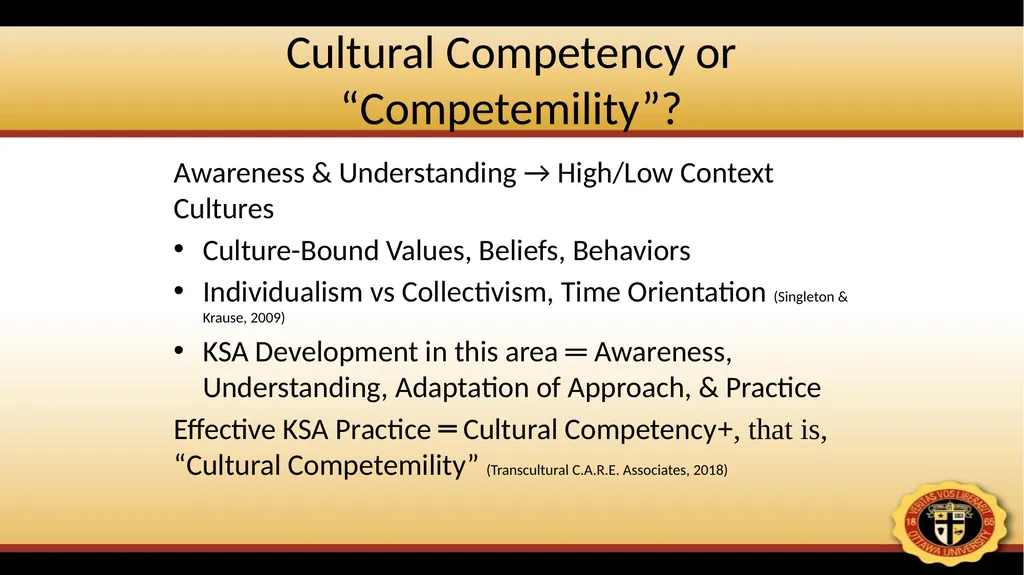
Cultural Competency or “Competemility”? Awareness & Understanding → High/Low Context Cultures
Culture-Bound Values, Beliefs, Behaviors
Individualism vs Collectivism, Time Orientation (Singleton & Krause, 2009)
KSA Development in this area ═ Awareness, Understanding, Adaptation of Approach, & Practice
Effective KSA Practice ═ Cultural Competency+, that is, “Cultural Competemility” (Transcultural C.A.R.E. Associates, 2018)<br>
31
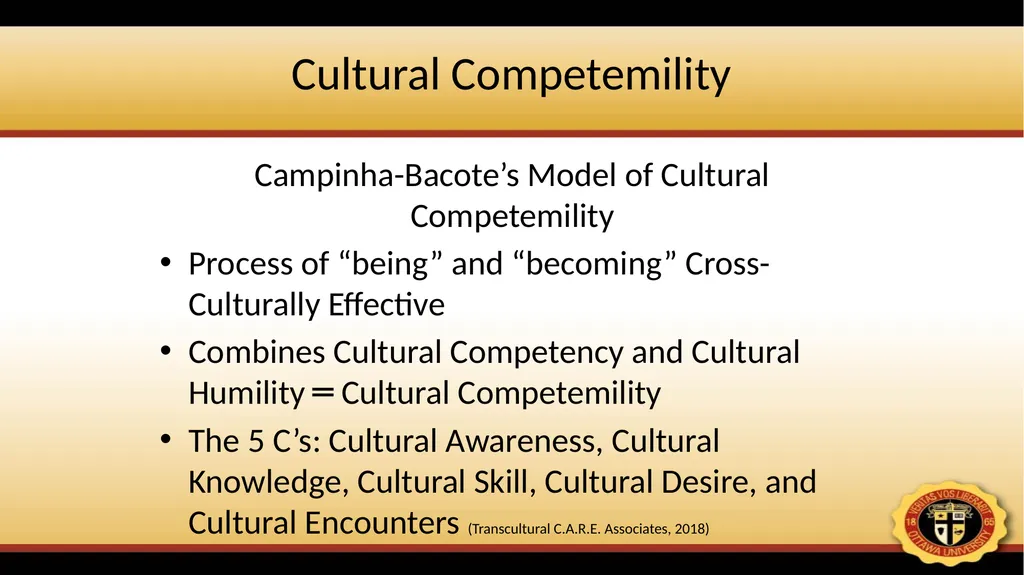
Cultural Competemility Campinha-Bacote’s Model of Cultural Competemility
Process of “being” and “becoming” Cross-Culturally Effective
Combines Cultural Competency and Cultural Humility ═ Cultural Competemility
The 5 C’s: Cultural Awareness, Cultural Knowledge, Cultural Skill, Cultural Desire, and Cultural Encounters (Transcultural C.A.R.E. Associates, 2018)<br>
Process of “being” and “becoming” Cross-Culturally Effective
Combines Cultural Competency and Cultural Humility ═ Cultural Competemility
The 5 C’s: Cultural Awareness, Cultural Knowledge, Cultural Skill, Cultural Desire, and Cultural Encounters (Transcultural C.A.R.E. Associates, 2018)<br>
32
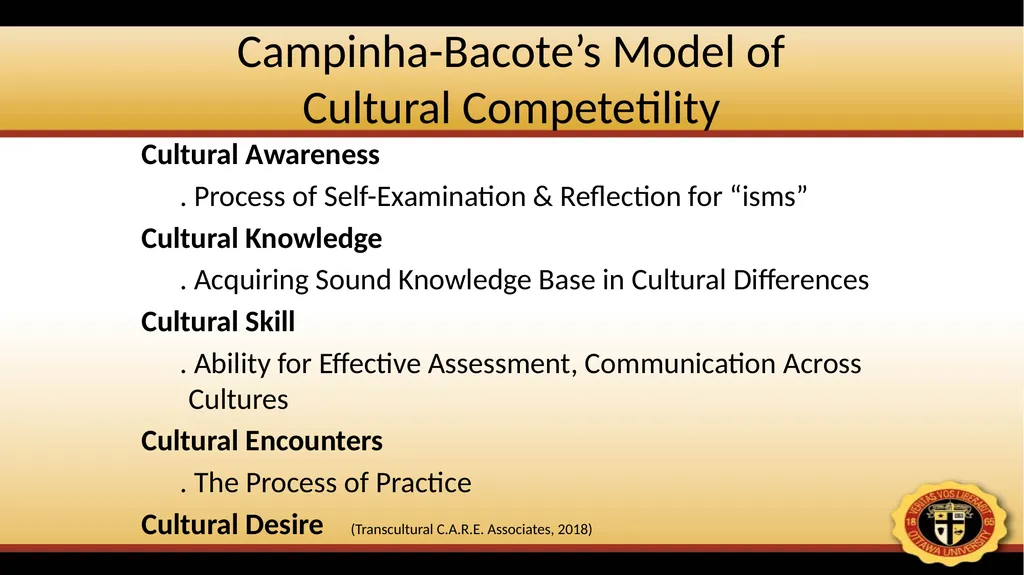
Campinha-Bacote’s Model of Cultural Competetility Cultural Awareness
. Process of Self-Examination & Reflection for “isms”
Cultural Knowledge
. Acquiring Sound Knowledge Base in Cultural Differences
Cultural Skill
. Ability for Effective Assessment, Communication Across Cultures
Cultural Encounters
. The Process of Practice
Cultural Desire (Transcultural C.A.R.E. Associates, 2018)<br>
33
The LEARN Model Cross Cultural Communication Model
L = Listen
E = Explain
A = Acknowledge
R = Recommend
N = Negotiate (Ladha, Zubairi, Hunter, Audcent, & Johnstone, 2018)<br>
L = Listen
E = Explain
A = Acknowledge
R = Recommend
N = Negotiate (Ladha, Zubairi, Hunter, Audcent, & Johnstone, 2018)<br>
34
DEI Compliance: Communication Tips Communication Tips for Effective Cross-Cultural Caring
Verbal versus Non-Verbal Communication
Dishonoring versus Honoring
Demanding versus Patient
Dominating versus Humble
Criticizing versus Accepting (McDonald, 2008)<br>
Verbal versus Non-Verbal Communication
Dishonoring versus Honoring
Demanding versus Patient
Dominating versus Humble
Criticizing versus Accepting (McDonald, 2008)<br>
35
DEI: Be a Lifelong Nurse Learner! Culturally Competent Nurses Must GROW
“G” - Genuine, Authentic
“R” - Respectful, Communicating the Value of the Human Being
“O” - Open, Willing and Eager to Learn About Others & Cultures
“W” - Warm, Approachable and Kind (McDonald, 2008)<br>
“G” - Genuine, Authentic
“R” - Respectful, Communicating the Value of the Human Being
“O” - Open, Willing and Eager to Learn About Others & Cultures
“W” - Warm, Approachable and Kind (McDonald, 2008)<br>
36
Post-test Survey Link Please complete the Post-test for the “Diversity: Legal, Ethical & Regulatory Considerations for Nurses” CNE at the Survey Planet link below, and upon completion, proceed to the next slide for Evaluation Survey instructions:
https://s.surveyplanet.com/meiitzd6<br>
https://s.surveyplanet.com/meiitzd6<br>
37
Evaluation Instructions Please complete the Evaluation Survey for “Diversity: Legal, Ethical & Regulatory Considerations for Nurses” CNE at the Survey Planet link below:
https://s.surveyplanet.com/3p6j2gx8<br>
https://s.surveyplanet.com/3p6j2gx8<br>
38
References . American Association of Colleges of Nursing (2021). Diversity, equity, and inclusion in academic nursing.
https://www.aacnnursing.org/Diversity-Equity-and-Inclusion/Publications-on-Diversity/Position-Statement
American Disabilities Act (ADA) (2009). Americans with Disabilities Act of 1990, as amended. https://www.ada.gov/pubs/adastatute08.htm
American Nurses Association (2022) Ethics and human rights. https://www.nursingworld.org/practice-policy/nursing-excellence/ethics/
American Nurses Association (2015). Code of ethics for nurses. American Nurses Publishing.
American Nurses Association Ethics Advisory Board. (June 7, 2019). ANA position statement: The nurse’s role in addressing discrimination: Protecting and promoting inclusive strategies in practice settings, policy, and advocacy. OJIN: The Online Journal of Issues in Nursing, 24(3). https://doi.org/10.3912/OJIN.Vol24No03PoSCol01
CDC (Centers for Disease Control) NPIN (2022). Cultural competence in health & human services. https://npin.cdc.gov/pages/cultural-competence#what
Cornel Law School Legal Information Institute (n.d.). Equal protection. https://www.law.cornell.edu/wex/equal_protection
Equal Opportunity Employment Commission (EEOC) (n.d.). Regulations related to age discrimination. https://www.eeoc.gov/regulations-related-age-discrimination
Ladha, T., Zubairi, M., Hunter, A., Audcent, T., & Johnstone, J. (2018). Cross-cultural communication: Tools for working with families and children. Paediatrics & Child Health, 66–69. doi: 10.1093/pch/pxx126<br>
39
References Marion, L., Douglas, M., Lavin, M., Barr, N., Gazaway, S., Thomas, L., Bickford, C., (November 18, 2016). Implementing the new ANA Standard 8: Culturally congruent practice. OJIN: The Online Journal of Issues in Nursing 22(1). https://doi.org/10.3912/OJIN.Vol22No01PPT20
McDonald, S. (Spring, 2008). Nursing across cultures. Minority Nurse, 34-38.
Merriam-Webster Dictionary (2022). Diversity. https://www.merriam-webster.com/dictionary/diversity
National Academies of Sciences, Engineering, and Medicine (2021). The future of nursing 2020-2030: Charting a path to achieve health equity. Washington, DC: The National Academies Press. https://doi.org/10.17226/25982.
NCSBN (2021). The Future of Nursing Report, 2020-2030: Charting a Path to Achieve Health Equity https://www.ncsbn.org/15924.htm#:~:text=On%20May%2011%2C%202021%2C%20the,the%20%E2%80%9CFON%20Report%E2%80%9D).&text=The%20Future%20of%20Nursing%3A%20Leading%20Change%2C%20Advancing%20Health.
National League for Nursing (2020). Hallmarks of excellence. https://www.nln.org/education/teaching-resources/professional-development-programsteaching-resources/hallmarks-of-excellence-%C2%A9-dffbb05c-7836-6c70-9642-ff00005f0421
Office of Minority Health (2015). An implementation checklist for the national CLAS Standards with a CLAS action worksheet and CLAS testimonials. https://thinkculturalhealth.hhs.gov/assets/pdfs/AnImplementationChecklistfortheNationalCLASStandards.pdf
Office of Minority Health (2013). National standards for culturally and linguistically appropriate services in health and health care: A blueprint for advancing and sustaining CLAS policy and practice. [Washington, D.C.]: Office of Minority Health, U.S. Department of Health and Human Services.<br>
40
References Office of Minority Health (2021). Think cultural health. https://www.minorityhealth.hhs.gov/omh/browse.aspx?lvl=2&lvlid=53
Singleton, K., & Krause, E. (2009). Understanding cultural and linguistic barriers to health literacy. OJIN: The Online Journal of Issues in Nursing, 14(3).
Smith, A.|Congressional Research Service (2014). Overview of selected federal criminal civil rights statutes. https://sgp.fas.org/crs/misc/R43830.pdf
The White House. “Fact Sheet: Advancing Disability Inclusive Democracy in the United States and Globally,” December 03, 2021. March 14, 2022. https://www.whitehouse.gov/briefing-room/statements-releases/2021/12/03/fact-sheet-advancing-disability-inclusive-democracy-in-the-united-states-and-globally/
The White House (2021). Fact sheet: Advancing disability inclusive democracy in the United States and globally. https://www.whitehouse.gov/briefing-room/statements-releases/2021/12/03/fact-sheet-advancing-disability-inclusive-democracy-in-the-united-states-and-globally/
Transcultural C.A.R.E. Associates (2018). The process of cultural competemility. http://transculturalcare.net/the-process-of-cultural-competence-in-the-delivery-of-healthcare-services/
unsplash.com (n.d.). Images. https://unsplash.com/s/photos/iceberg-underwater
U.S. Department of Labor (n.d.). Legal highlight: the Civil Rights Act of 1964. https://www.dol.gov/agencies/oasam/civil-rights-center/statutes/civil-rights-act-of-1964<br>
41
Instructions for CNE Your certificate will be emailed to you upon completion of the post test and evaluation
Thank you for participating!
We wish you the very best<br>
Thank you for participating!
We wish you the very best<br>