04
Importance in Veterinary Practice
Welfare Improvement: Promotes better mental and physical health in animals
Behavioral Support: Reduces abnormal or stereotypic behaviors (e.g., pacing, feather plucking).
Rehabilitation: Assists in recovery and healing during treatment.
Ethical Responsibility: Part of providing high standards of care in clinical and non-clinical settings.<br>
05
Feeding
Tactile
Structural
Auditory
Olfactory
Visual
Social
Cognitive
Occupational
Human-animal Types of Enrichment<br>
06
Manipulation of the food itself or the means through which it is delivered
Rather than providing all of an animal’s daily rations in an easily accessible, single delivery, zoos have shifted towards practices such as scatter feeding (spreading food around to require travel between locations to obtain all items) Feeding Enrichment<br>
07
Provisioning of objects such as bags or balls that are physically stimulating to an animal
Installing floor panels that provide extra heat or cooling when reclining
Bears and some great cats need water features so they can swim
A comfortable environment for many animals requires a full immersion pool, mud, and plenty of available dust TACTILE ENRICHMENT<br>
08
longer-term or semi-permanent changes to an animal’s environment such as the introduction of a new platform for sitting or ropes for swinging.
Artificial tree was built in the orangutan exhibit. The tree contained several enrichment devices such as a computer for cognitive testing with a pellet-delivery system, water sprayers, and a heated platform
Artificial climbing structures STRUCTURAL ENRICHMENT<br>
09
Providing species-appropriate sounds may have the effect of enriching an animal’s environment.
Curatorial knowledge about which sounds are appropriate for a given specie
Playing lion roars
Authentic forest sounds of birds and insects:- decrease stress related behavior and marginally affect abnormal behavior
Odors from other individuals, even other species, can be spread in an animal’s enclosure through urine, feces, or materials that promote interaction with the substance
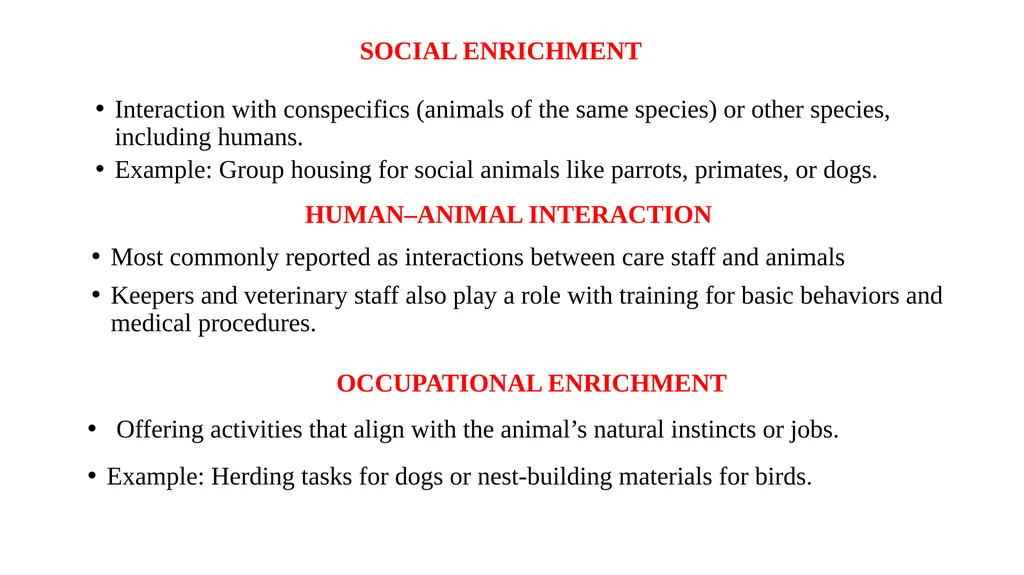
Visual forms of enrichment are commonly used with great apes in the form of television shows or movies
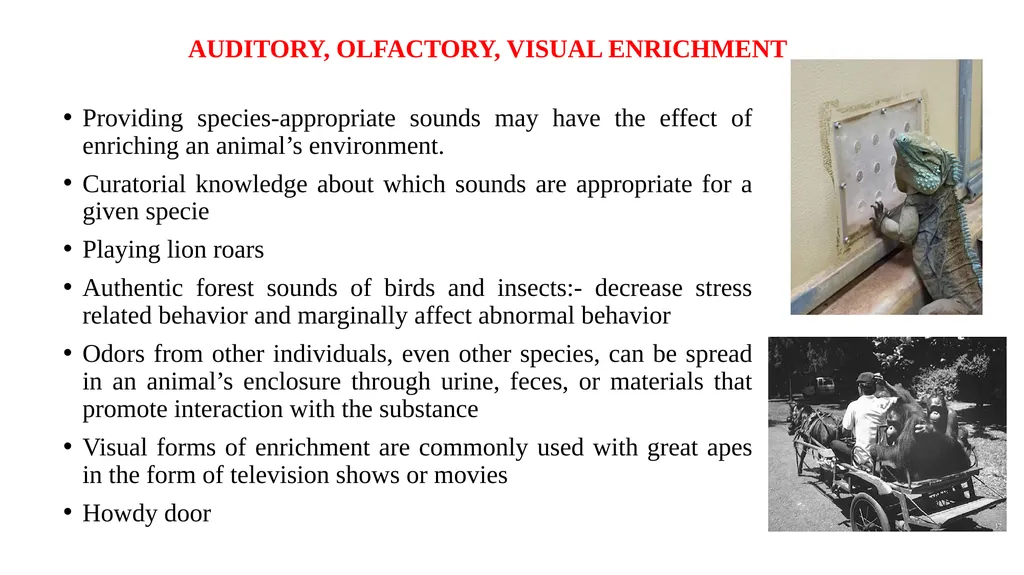
Howdy door AUDITORY, OLFACTORY, VISUAL ENRICHMENT<br>
10
Most commonly reported as interactions between care staff and animals
Keepers and veterinary staff also play a role with training for basic behaviors and medical procedures. HUMAN–ANIMAL INTERACTION OCCUPATIONAL ENRICHMENT
Offering activities that align with the animal’s natural instincts or jobs.
Example: Herding tasks for dogs or nest-building materials for birds. SOCIAL ENRICHMENT Interaction with conspecifics (animals of the same species) or other species, including humans.
Example: Group housing for social animals like parrots, primates, or dogs.<br>
11
Cognitive enrichment refers to the process of challenging and stimulating an organism’s memory, decision making, judgment, perception, attention, problem solving, executive functioning, learning and species-specific abilities.
The types of cognitive enrichment range from simple manipulations to more complex, computerized test systems and can be implemented with almost any species.
Problem-solving task such as a foraging opportunity that promoted species-typical behaviors (e.G., Extraction, manipulation, hunting)
Training sessions, interactive toys, or tasks that reward animals with food or play
Computerized or manual tasks can be introduced to explore issues such as self control, decision-making, social learning, memory, and perception. COGNITIVE ENRICHMENT<br>
12
Dogs
Physical: Regular exercise, interactive toys (e.g., tug ropes, frisbees).
Cognitive: Puzzle feeders, obedience training, scent work.
Social: Playdates with other dogs, interaction with humans.
Cats
Physical: Scratching posts, climbing trees, laser pointers.
Cognitive: Food-dispensing toys, interactive games.
Sensory: Catnip toys, perches for watching outside activity.
Rabbits
Physical: Tunnels, ramps, chewable toys (e.g., untreated wood).
Social: Bonded pairs or groups, human interaction.
Dietary: Hiding vegetables or hay for foraging.
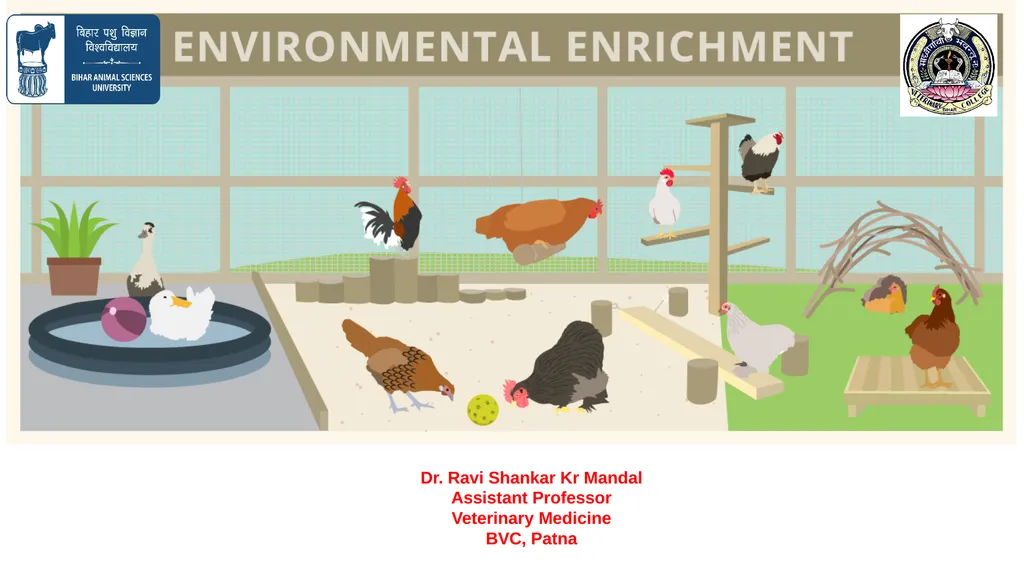
Birds
Physical: Perches of varying sizes, swings, ladders.
Cognitive: Puzzle feeders, mirrors, training for tricks.
Sensory: Music, natural sounds, bird-safe plants.
Livestock
Physical: Pasture grazing, obstacle courses, scratching posts.
Social: Herd living or interaction with conspecifics.
Nutritional: Scatter feeding or hay nets for foraging<br>
13
Primates
Swinging ropes, fruit hidden in puzzle feeders, mirrors for grooming.
Big Cats
Scented enrichment (spices, perfumes), cardboard boxes, climbing platforms.
Elephants
Large sandpits, tree logs for pushing or tearing, swimming pools.
Aquatic Mammals
Floating toys, interactive training, varying water depths.
Reptiles
Logs for basking, hiding spots, thermal gradients.<br>
14
Challenges in Implementing Enrichment
Species-Specific Needs
Enrichment must be tailored to each species’ biology and behavior.
Logistical Constraints
Space, budget, and staff availability can limit enrichment options.
Safety
Enrichment items must be safe and non-toxic.
Evaluation and Adjustment
Regular monitoring is required to ensure the enrichment remains effective and engaging.<br>